

1. Origination is a governed decision system
An acquisition pipeline should answer a decision question: which organisations deserve scarce executive attention now, why, and what evidence would change that priority? A database of company names cannot answer it. The origination system must connect strategy, market coverage, observed change, relationship knowledge and transaction feasibility to a clear next action.
The board begins by defining acquisition intent. That intent can include capability, geography, customer access, recurring revenue, supply security, talent, technology, licences, infrastructure or consolidation. Each objective needs an observable definition. A claim such as "acquire digital capability" is too broad for screening. A useful definition identifies the customer problem, required capability, business model, geography, minimum operating scale, ownership constraints and acceptable integration burden.
The radar then converts heterogeneous evidence into a controlled chain. A source event is recorded with date, provenance and entity identity. The event becomes a signal only when it relates to an acquisition thesis. An analyst validates the signal, assesses materiality and updates the target score. A coverage owner chooses an action: research, relationship development, management meeting, strategic partnership, adviser engagement, diligence preparation or removal from active coverage.
This sequence prevents activity from masquerading as progress. More records, alerts and outreach can increase noise. Decision quality improves when the system shows why a company is relevant, what is known, what remains uncertain, who owns the relationship and which next step can test the thesis.
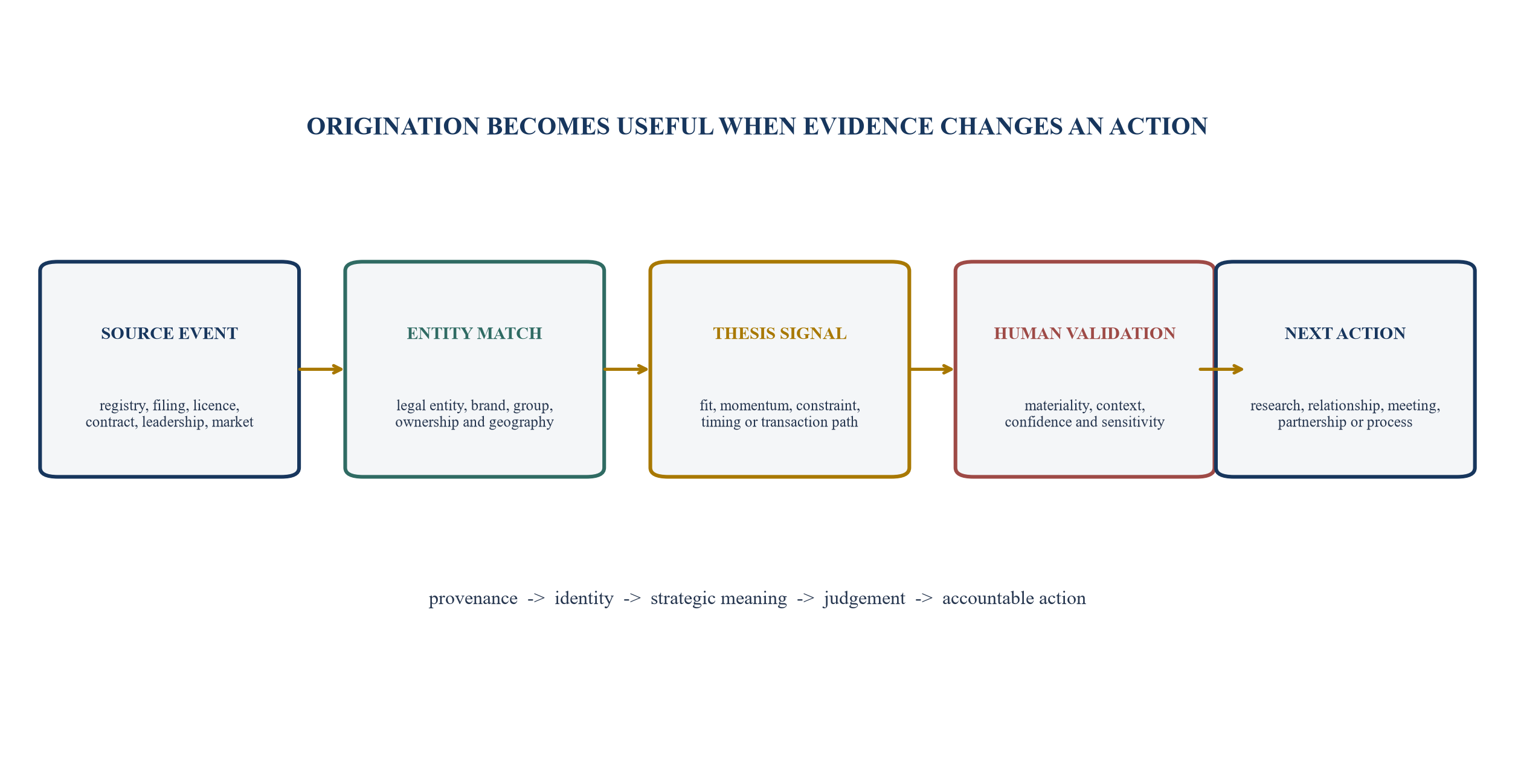
Each material signal should reach a documented thesis implication, owner and next action.
2. Translate the acquisition thesis into search rules
The target universe should be derived from strategic choices. Management should specify the value mechanism expected from an acquisition and the conditions required for that mechanism to work. If the thesis is route-to-market expansion, the search needs customer segment, channel access, licences, sales coverage and retention evidence. If the thesis is capability acquisition, the search needs technical assets, specialist talent, intellectual-property rights, delivery references and integration dependencies.
Each criterion should be classified as mandatory, preferred, disqualifying or unknown. Mandatory criteria define the minimum viable perimeter. Preferred criteria rank alternatives. Disqualifiers protect capital and management time. Unknown criteria become research questions rather than assumed negatives. This structure permits a company to remain visible while its evidence is incomplete.
The thesis also requires a value-creation bridge. The team should state how the buyer expects ownership to improve growth, margin, cash, resilience or strategic position. That bridge supports early screening. A target with attractive standalone growth may still be a poor acquisition if the buyer cannot preserve its people, customers or operating model. A modest business can be valuable when it controls a scarce licence, customer relationship, distribution route or technical capability that the buyer can scale.
Search rules should avoid false precision. Revenue bands, employee counts and sector labels may differ across sources and dates. The radar should store ranges and confidence, preserve the original observation and avoid converting an estimate into a verified fact. A target can be prioritised with incomplete information when the uncertainty is visible and the next action is designed to resolve it.
3. Define the operating and legal-entity perimeter
The operating company, legal entity, commercial licence, brand, family group and consolidated parent may be different objects. A reliable radar needs to represent each one and the relationships between them. Otherwise, the system can count branches as independent targets, miss a common owner, attach news to the wrong entity or approach one group through conflicting channels.
The perimeter begins with legal identity. Useful fields include registry number, issuing authority, entity type, status, incorporation date, registered activities, addresses, jurisdiction and filing history. The operating identity adds brands, websites, locations, products, customers and management. The ownership layer adds immediate and ultimate parents, known shareholders, family or state affiliations, joint ventures and controlled subsidiaries. Access to beneficial-ownership information varies, so the radar should state which ownership facts are public, licensed, privately confirmed or unknown.
Geographic coverage should reflect the thesis. A GCC-wide view includes the six member states and relevant free zones, while the transaction perimeter can extend to holding companies, overseas subsidiaries and assets outside the region. A group incorporated in one jurisdiction may earn most of its revenue elsewhere. The system should therefore separate place of registration, operating footprint, customer geography and owner domicile.
The universe should include exclusions with reasons. Inactive, dissolved, duplicate, regulated-incompatible, state-restricted, subscale or thesis-inconsistent entities may remain in the master data while leaving active coverage. Retaining the record prevents repeated rediscovery and allows the team to revisit a company when its status or strategy changes.
Table 1. Minimum target-master structure
| data object | minimum fields | source treatment | confidence question | decision use |
|---|---|---|---|---|
| legal entity | registry number, name, type, status, date and authority | retain official identifier and retrieval date | does the record identify the current legal person? | perimeter and legal diligence |
| operating business | brand, products, locations, website and activities | separate observed operations from registered activity | does the entity deliver the proposition being screened? | strategic fit |
| ownership group | parent, subsidiaries, known holders and control links | distinguish public, licensed and confirmed private evidence | who can make or block a transaction decision? | access and transaction path |
| management | roles, tenure, authorised contacts and succession signals | use professional, lawful and purpose-specific data | is the relationship owner engaging the right decision makers? | coverage strategy |
| financial profile | revenue range, margin, growth, capital and debt indicators | store period, currency, scope and evidence status | are numbers comparable and current? | scale and value hypothesis |
| signal history | event, date, source, entity match and analyst interpretation | preserve source text and subsequent corrections | did a real event change the thesis or timing? | prioritisation |
| relationship record | contact route, consent, interactions, commitments and next step | restrict access and record purpose | is the intelligence current and appropriately obtained? | origination execution |
Availability and permitted use of ownership and personal data depend on the source and jurisdiction.
4. Build a layered data architecture
No single source provides a complete target view. The architecture should combine authoritative records, market disclosures, company-published information, licensed datasets, transaction knowledge and relationship intelligence without blurring their evidential status.
The foundation is a source ledger. Every field should retain its provider, retrieval date, original identifier, permitted use and refresh rule. Official registries can establish legal existence and selected registered facts. Exchange disclosures can provide financial statements, ownership changes, board events and material announcements for listed companies. Government statistics can describe sector size and business demographics at an aggregate level. Company websites and procurement portals can reveal products, projects and capabilities. Relationship evidence can establish strategic intent and transaction timing.
The next layer standardises values. Names require Arabic and English variants, transliteration handling, punctuation normalisation and historical aliases. Dates, currencies, units, sectors and geographic labels require common formats while preserving originals. Activity codes should be mapped to the investment thesis rather than used as the sole definition of an industry.
The decision layer creates features and signals. It can calculate filing recency, expansion activity, management change, hiring momentum, licence additions, customer concentration indicators, capital events or relationship progress. Each calculated field should be reproducible from governed inputs. Analysts should be able to inspect the underlying records before relying on a score.
The presentation layer should serve different users. Analysts need evidence and exceptions. relationship owners need contacts, context and next actions. Executives need market coverage, qualified opportunities and decision bottlenecks. The board needs thesis coverage, capital relevance and whether the pipeline is producing credible transaction paths.
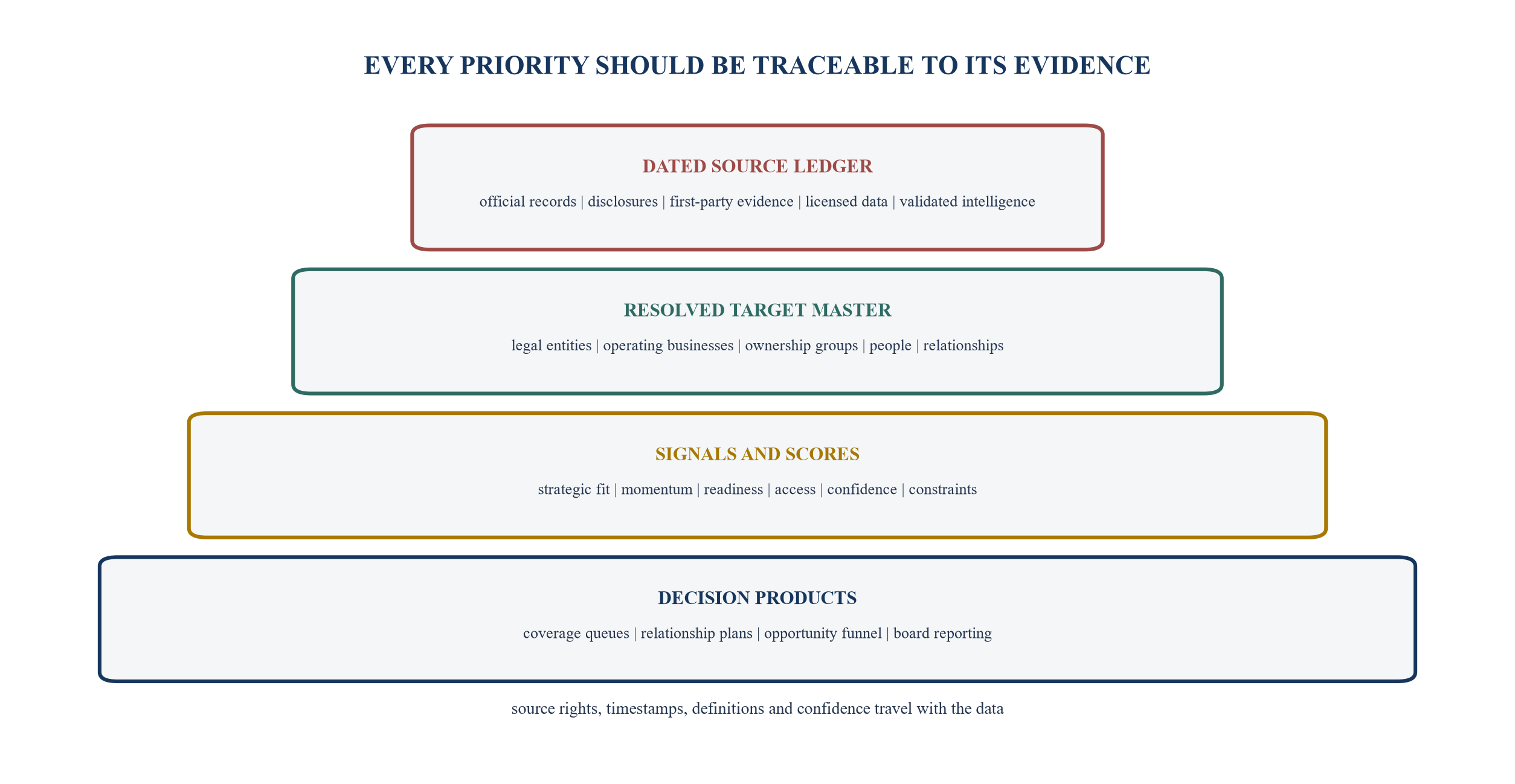
Derived scores remain traceable to dated source records and analyst validation.
5. Resolve identity before scoring targets
Entity resolution is the control that connects records referring to the same business and separates records referring to different businesses. Name similarity alone is insufficient. Common names, transliteration, branch structures and reused brands can create false matches. A robust process combines official identifiers, addresses, websites, telephone numbers, directors, ownership, licences and known group relationships.
The process should create a canonical target identifier independent of any source. Each source record maps to that identifier with a match status and confidence. Exact registry identifiers can support deterministic matches. Domain, address and ownership combinations can support strong probabilistic matches. Name-only matches should remain provisional until another attribute confirms identity.
Contradictions should be preserved as exceptions. Two current addresses, inconsistent incorporation dates or different ownership descriptions may reflect a change, a branch, a stale source or an incorrect match. Overwriting one value destroys information. The radar should retain both observations, assign a resolution owner and state which value is used for decisions.
Group resolution matters commercially. The attractive operating company may sit within a wider family group whose assets, debt, brands, real estate, licences or shared services affect separability. A direct approach to a subsidiary can be ineffective when control sits at the parent or family council. The relationship map should therefore connect targets to the people and governance forums able to evaluate strategic alternatives.
Table 2. Entity-resolution confidence rules
| match tier | supporting evidence | permitted system action | required review | failure risk |
|---|---|---|---|---|
| deterministic | same official registry or exchange identifier | merge source records into one legal entity | periodic identifier and status refresh | stale or reused external identifier |
| strong | exact domain plus address, ownership or authorised contact | link provisionally and permit scoring | analyst confirms legal perimeter | brand shared across entities |
| moderate | name similarity plus sector and location | hold in candidate cluster | seek a second independent attribute | false positive from common names |
| weak | name or brand similarity only | preserve as unresolved lead | no outreach or score aggregation | contact with wrong organisation |
| conflict | identifiers or control attributes disagree | quarantine affected fields | named owner resolves source conflict | incorrect ownership or duplicate target |
| historical | reliable evidence refers to a prior name, status or structure | retain lineage without treating it as current | confirm effective date and successor | obsolete relationship path |
Thresholds are illustrative management assumptions and should be calibrated to the actual source environment.
6. Map ownership, control and access
Origination depends on the ability to reach a credible decision maker. Legal ownership, economic interest, management authority and family influence may sit with different people. The radar should record what each relationship represents and avoid assuming that a visible executive can sponsor a sale.
Ownership evidence should be handled conservatively. Public registers and exchange disclosures may identify selected shareholders, directors or authorised representatives. Beneficial-ownership information can be restricted. FATF guidance emphasises adequate, accurate and up-to-date ownership information through multiple sources. For an acquirer, this supports a multi-pronged verification approach while respecting access rules and confidentiality.
The access map should identify existing relationships across the buyer, board, shareholders, advisers, lenders, customers and industry network. It should record the strength and recency of each connection, the basis on which information was obtained and any conflict or sensitivity. A shared contact is a route for thoughtful engagement, not evidence of seller intent.
Family and founder-controlled groups may require a longer sequence. Strategic dialogue, joint commercial work, minority investment, succession planning or portfolio review can precede an acquisition discussion. The radar should show these pathways without converting relationship warmth into an implied probability of sale.
7. Detect growth and capability signals
Growth signals help identify companies whose relevance is increasing. Useful events include new licences, geographic expansion, facility openings, major project awards, new product approvals, senior hires, capital investment, tender participation and customer partnerships. The evidence should show what changed and why the event matters to the acquisition thesis.
Official registers and licensing systems provide important coverage across the GCC. The UAE National Economic Registry brings together business-licence information across the emirates. Saudi Ministry of Commerce services provide commercial-registration information and open-data access. Bahrain's Sijilat supports public commercial-registration searches. Qatar's Business Map provides establishment and activity information. Oman and Kuwait provide additional registry, exchange and licensed-entity sources. These systems differ in fields, access and update mechanisms, so the radar should preserve source-specific definitions.
Market disclosures add operating context for listed companies. Announcements, financial reports, ownership changes, board appointments and capital events can reveal strategic direction. The system should distinguish the date of the underlying event from the publication date and retrieval date. A filing is an evidence item, while its implication for the thesis remains an analyst judgement.
Capability signals also arise outside formal filings. Patents, technical certifications, regulated permissions, project references, supplier accreditations and specialist hiring can indicate scarce assets. Each signal should be tested against actual delivery. A licence that is inactive, a capability held by one person or a project delivered through a parent may not transfer with the target.
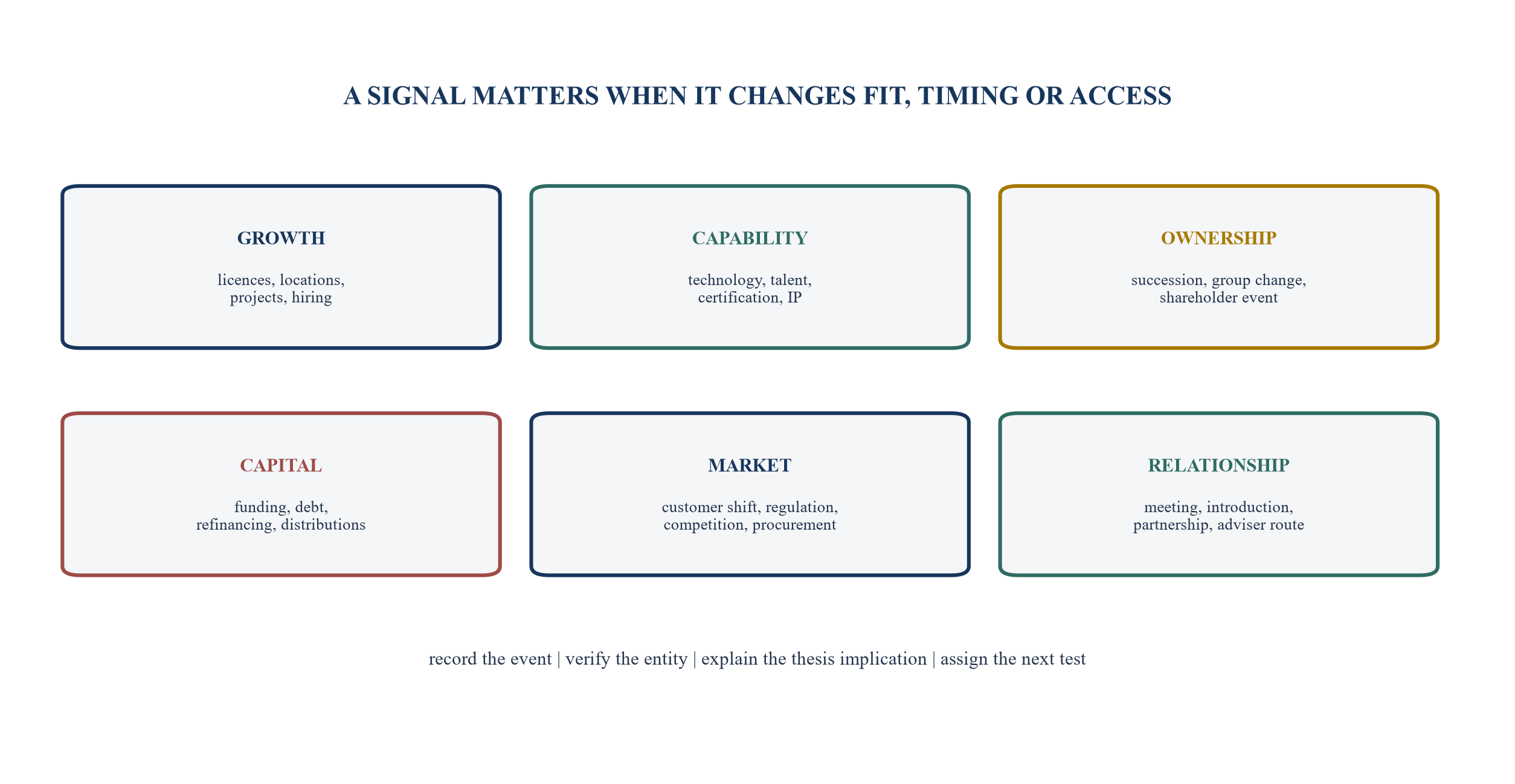
Signal strength depends on evidence quality, materiality and connection to the acquisition thesis.
8. Detect leadership, succession and ownership change
Leadership change can alter both strategic direction and transaction openness. Founder transition, succession planning, a new chief executive, board renewal or the appointment of professional management can create a period in which portfolio choices are reconsidered. The radar should treat these as prompts for research and relationship development.
The team should reconstruct context. A retirement announcement can be orderly succession. A cluster of executive departures can indicate strategic stress, governance change or a completed transformation. A new chief financial officer can precede capital raising, refinancing, improved reporting or transaction preparation. Interpretation should be grounded in multiple sources and, where appropriate, direct dialogue.
Ownership changes require careful handling. Listed-company disclosures can show major shareholding events and board appointments. Private-company information may be limited. The radar should avoid assigning an inferred owner or seller motivation where evidence is absent. An unverified relationship comment can be recorded with its source, date and restricted visibility while remaining outside any verified-fact field.
Succession can also create non-sale opportunities. A family group may need a governance redesign, minority capital, carve-out, management incentive plan or strategic review. Capturing the underlying decision problem allows origination to support advisory mandates even when a control transaction is premature.
9. Read capital and financial-pressure signals carefully
Capital events can affect transaction timing. New borrowing, refinancing, covenant pressure, shareholder distributions, delayed filings, auditor changes, capital increases and restructuring can indicate investment needs or strategic choices. They do not prove distress or willingness to sell.
The radar should distinguish verified financial facts, management estimates and model outputs. Financial periods, currencies, consolidation scope and accounting definitions must travel with each value. A revenue estimate derived from headcount or website activity belongs in an explicitly modelled field, with assumptions and range. It should never overwrite a filed or management-confirmed figure.
The team can use scenarios to identify research priorities. A company with fast expansion, high fixed investment and limited disclosed capital may warrant a financing-capacity review. A non-core subsidiary within a leveraged group may warrant a portfolio-strategy discussion. A business facing refinancing may still be a poor target if its customer economics or legal perimeter are weak.
Early value thinking should remain directional. The radar can store likely valuation methods, comparable sets and major sensitivities. A transaction view requires current financial evidence, normalisation, debt and working-capital analysis, ownership rights and a credible path to control. The score should reward the availability of evidence, not the optimism of the estimate.
Table 3. Signal-to-research translation
| observed signal | possible strategic meaning | minimum corroboration | next research action | prohibited conclusion |
|---|---|---|---|---|
| new licence or geography | expansion, capability or market entry | official record plus operating evidence | confirm scope, investment and customer use | revenue growth is assured |
| senior leadership change | succession, transformation or governance reset | board or company disclosure and role history | map decision rights and strategic agenda | company is for sale |
| capital increase or refinancing | growth funding, balance-sheet repair or ownership event | terms, purpose and current financial evidence | assess uses, constraints and shareholder impact | financial distress exists |
| project or tender award | customer access and delivery capability | award authority, contract scope and timing | test economics, backlog quality and execution capacity | full contract value becomes revenue |
| delayed filing or licence change | process issue, restructuring or status change | official status and direct explanation | resolve cause and current operating position | misconduct or insolvency occurred |
| adviser or shareholder engagement | potential strategic dialogue | dated relationship record and permission | define objective, participants and next step | a transaction mandate exists |
The listed interpretations are questions for validation, not conclusions about any company.
10. Use customer, procurement and ecosystem evidence
Customer evidence is valuable because it can demonstrate market access, reputation and delivery capability. Public contract awards, approved-supplier lists, project references and ecosystem partnerships can help identify targets that ordinary sector searches miss. The radar should capture the awarding entity, scope, geography, date, contract status and source.
Contract announcements can overstate commercial value when ceiling values, consortium shares, options, mobilisation periods or pass-through costs are unclear. The origination team should treat announced values as descriptors until financial evidence confirms revenue and margin. Repeated awards from the same customer can signal strength and concentration at the same time.
Supplier and partner networks can reveal clusters. A strategic target may sit behind a visible prime contractor, operate through a joint venture or hold a specialist subcontract. Mapping these relationships supports thematic searches and warm introductions. It also shows whether a capability can be acquired directly or depends on non-transferable alliances.
Government procurement data can support market mapping when terms permit. The system should avoid unauthorised scraping, personal-data overcollection and use beyond the source conditions. It should retain links and retrieval dates so an analyst can confirm material evidence at the decision point.
11. Treat regulation and licences as both signals and gates
Regulation can create scarcity, timing and transaction constraints. A licence may be central to target value, while change-of-control approval, ownership limits, fit-and-proper requirements or activity restrictions can affect feasibility. The radar should connect each regulated activity to the issuing authority, legal entity, status, scope and known transfer process.
The GCC contains federal, national, local and financial-free-zone regimes. A brand operating across the region can use different entities and permissions. The target master should avoid treating one licence as evidence of group-wide authority. The relationship between the licensed entity and the operating proposition needs verification.
Regulatory registers also support exclusion and safety. DFSA, ADGM, Kuwait CMA and other official sources identify authorised entities within their mandates. A valid entry proves a defined status at a date. It does not prove commercial quality, solvency, transaction readiness or regulatory approval for an acquisition.
Potential merger-control, foreign-ownership, sector-approval and national-security issues should enter the funnel early. The radar can flag that analysis is required. Qualified advisers must determine the applicable rules and filing obligations from the actual parties and transaction.
12. Design GCC source coverage by jurisdiction
The source plan should be explicit because availability differs across the GCC. The UAE Growth platform supports national business-licence discovery across the emirates and uses a unified economic number. Free-zone and financial-services registers provide additional entity and licence evidence. Saudi Ministry of Commerce data supports registry searches and commercial-register statistics, while Saudi Exchange announcements provide listed-company events.
Bahrain's Sijilat offers public commercial-registration search fields, and Bahrain Bourse provides listed-company and market information. Qatar's Ministry of Commerce and Industry provides company, business-map and regulatory information. Muscat Stock Exchange publishes company, financial-report and disclosure information for Oman. Kuwait Business Center and Kuwait Capital Markets Authority provide company-formation, licensed-entity and disclosure-related sources.
Coverage should be measured rather than assumed. For each jurisdiction, the team should record the sources used, fields available, retrieval method, access restrictions, update frequency, language, historical depth and permitted use. Missing fields become explicit research requirements.
Cross-border comparability needs a mapping layer. Legal forms, activity codes, statuses and licence terminology vary. The system should retain source-native values and map them to a common analytical taxonomy. The mapping should be versioned so a change in classification does not rewrite historical evidence.
Table 4. GCC source-coverage control matrix
| market | authoritative source families | useful observations | common limitation | control response |
|---|---|---|---|---|
| United Arab Emirates | national economic registry, local and free-zone registers, financial regulators and exchanges | licences, entities, activities, regulated status and disclosures | operating groups span multiple authorities | resolve to unified entity and group map |
| Saudi Arabia | Ministry of Commerce registry and open data, official statistics and Saudi Exchange | registration, activity, location, announcements and business demographics | aggregate data cannot identify private-company quality | separate market sizing from target evidence |
| Bahrain | Sijilat, Bahrain Bourse and regulator sources | registration search, listed entities, announcements and ownership services | public and licensed data have different access rights | store source rights and evidence tier |
| Qatar | Ministry of Commerce and Industry, Business Map and exchange sources | establishments, activities, licences and regulatory indicators | some services require authentication or company consent | record access basis and unresolved fields |
| Oman | business-registration services, Muscat Stock Exchange and regulator sources | entities, listed companies, financial reports and disclosures | listed-company depth exceeds private-company depth | add first-party and relationship validation |
| Kuwait | Kuwait Business Center, Capital Markets Authority and exchange-related disclosures | formation, licensed persons, regulated status and filings | Arabic-first sources and portal workflows require review | preserve original language and analyst translation |
Source availability and interfaces change; teams should confirm current access and terms before use.
13. Use global systems as design comparators
Global official data systems illustrate useful architectural patterns. The United States SEC provides company submission histories and XBRL facts through documented APIs and bulk files. Companies House provides public company data through a REST API with authentication and rate limits. The European Business Registers Interconnection System connects national registers and supplies company information in real time through the e-Justice portal.
Singapore publishes ACRA entity data through a downloadable dataset and API. India's Ministry of Corporate Affairs provides company and limited-liability-partnership master-data services. Australia's ASIC makes business-register datasets available through data.gov.au and documents interfaces for registry interaction. These systems differ in scope, access, rights and reporting populations.
The lesson is architectural. A target radar should use stable identifiers, keep source provenance, respect rate limits and licensing, distinguish real-time from periodic data and avoid assuming equivalence across jurisdictions. Bulk access can improve coverage while increasing the need for deduplication, version control and retention discipline.
Global comparators also help evaluate missingness. Absence of a field in one market does not establish absence of the underlying fact. It can reflect disclosure law, entity type, data access or source design. Scoring should avoid penalising a target simply because its jurisdiction publishes less data.
14. Score fit, timing, access and confidence separately
A single composite score can hide important differences. A strategically excellent target with no access requires a different plan from an accessible company with weak fit. The radar should preserve separate dimensions and allow the committee to see the profile.
Strategic fit measures the connection to the acquisition thesis. Business quality measures customer value, economics, capability and resilience at the level supportable by current evidence. Timing measures observable change that may create a decision window. Access measures relationship strength and proximity to a decision maker. Feasibility measures ownership, regulatory, financing and integration constraints. Confidence measures the quality, recency and completeness of evidence.
Weights should reflect strategy and be approved before reviewing named targets. Otherwise, teams can adjust the model to favour a familiar company. Scoring rubrics should define what each level means and which evidence is required. Analysts should provide a concise rationale and identify the observation most likely to change the score.
Scores should decay when evidence ages. A leadership change can remain relevant while a licence status or relationship commitment may need rapid refresh. Material events should trigger rescoring. Overrides should require a named approver, reason and expiry date.
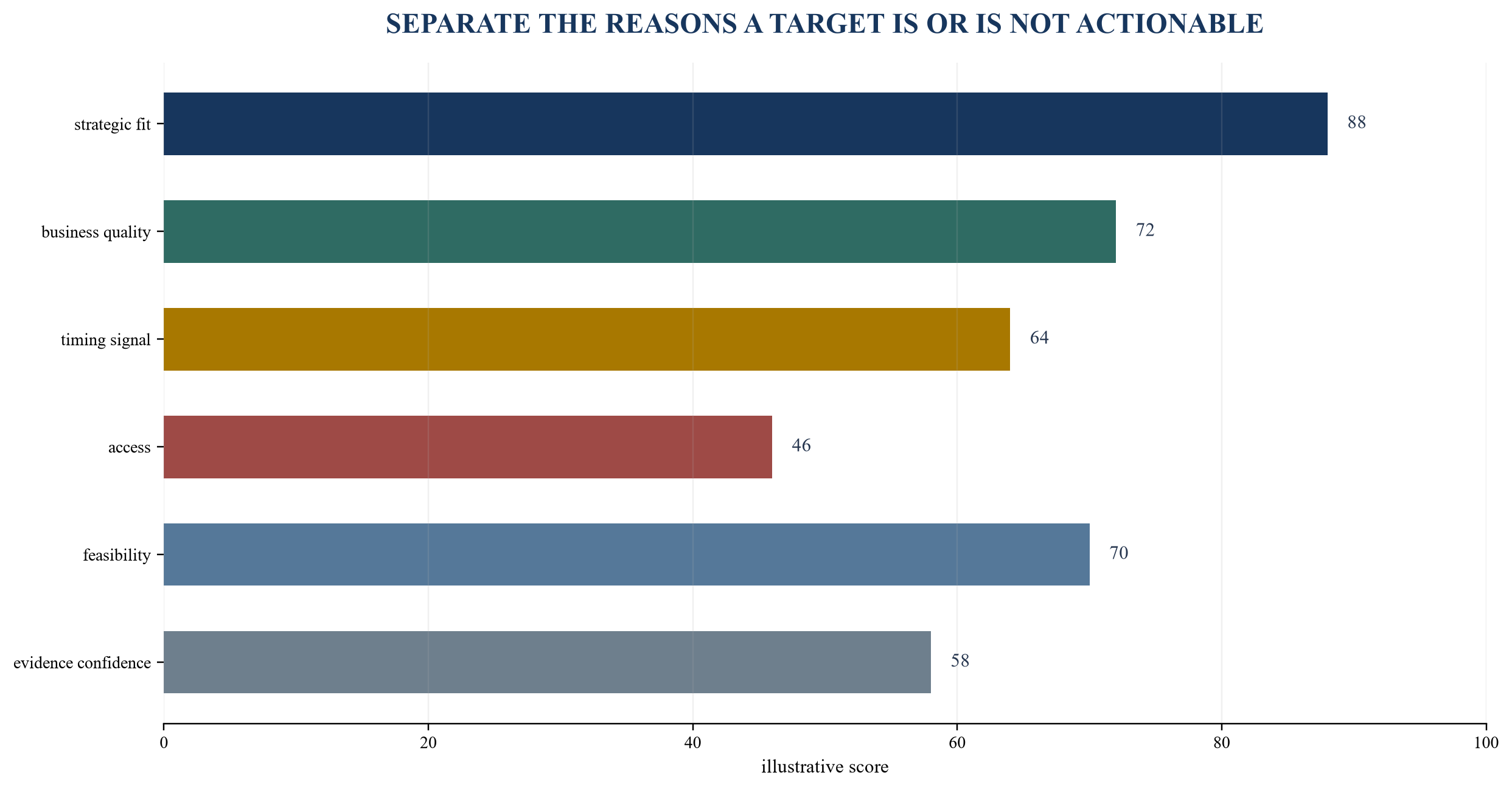
Values are hypothetical management assumptions and do not describe an actual company.
Table 5. Target-priority scoring rubric
| dimension | decision question | high-score evidence | low-confidence warning | committee use |
|---|---|---|---|---|
| strategic fit | does ownership advance a defined strategic objective? | direct capability, customer or geography connection | broad thematic resemblance only | retain or remove from thesis universe |
| business quality | is there evidence of durable customer and economic value? | reconciled financial, customer and operating evidence | estimates without period or scope | determine research depth |
| timing | has an event created a credible decision window? | confirmed succession, portfolio review, capital need or strategic dialogue | media speculation or undated comment | choose engagement sequence |
| access | can the buyer reach an authorised decision path? | trusted route to owner, board or mandated adviser | generic contact or social connection | assign coverage owner |
| feasibility | can a viable transaction and ownership plan be designed? | understood perimeter, approvals, funding and integration path | unresolved control, licence or separability issue | escalate gating analysis |
| confidence | how reliable, current and complete is the evidence? | multiple dated authoritative or directly confirmed sources | inferred or conflicting data | set score ceiling and next test |
Weights and thresholds are illustrative; management should calibrate them to the approved acquisition strategy.
15. Keep human validation at the centre
Automation can monitor sources, standardise records, detect changes and rank review queues. Human judgement remains necessary to establish strategic meaning, resolve identity, understand context and choose an appropriate relationship action.
Analysts should review the source record behind each material signal. They should confirm the entity, event date, source authority and relevance. A quality-control sample can compare automated matches and classifications with expert decisions. False positives, false negatives and unresolved cases should be measured by source and signal type.
Language and market context matter. Arabic and English names can vary. Legal announcements may use precise terms that lose meaning in automated translation. Family-group structures, local licensing and sector practices require experienced interpretation. The system should preserve original-language evidence and record who approved any translated or normalised value used in a decision.
Human validation should also prevent inappropriate outreach. Sensitive events, personal circumstances, disputes or regulatory matters require careful handling. The fact that information is public does not make every use appropriate. Relationship owners should consider purpose, source terms, privacy, reputation and the buyer's conduct standards.
16. Build relationships before a sale process exists
An always-on radar creates value when it supports better relationships, not just earlier alerts. The coverage plan should define the strategic reason for engagement and offer a useful conversation. Market insight, commercial collaboration, capability partnerships, capital planning and succession dialogue can establish relevance before a transaction is contemplated.
Each priority target should have one accountable coverage owner and a coordinated relationship map. Senior executives, board members, advisers and business units should avoid uncoordinated approaches. The record should show introductions, meetings, commitments, sensitivities and agreed follow-up, with access limited to those who need it.
Relationship stages should be evidence-based. "Known" can mean a verified contact exists. "Engaged" can require a substantive two-way discussion. "Strategic dialogue" can require an agreed topic and next step. "Qualified opportunity" should require a defined strategic objective, credible decision participants, an indicated transaction or advisory problem and permission to progress.
A relationship can create optionality without becoming a deal. The system should value learning, trust and strategic access while avoiding inflated pipeline claims. The board should see qualified opportunities separately from coverage activity.
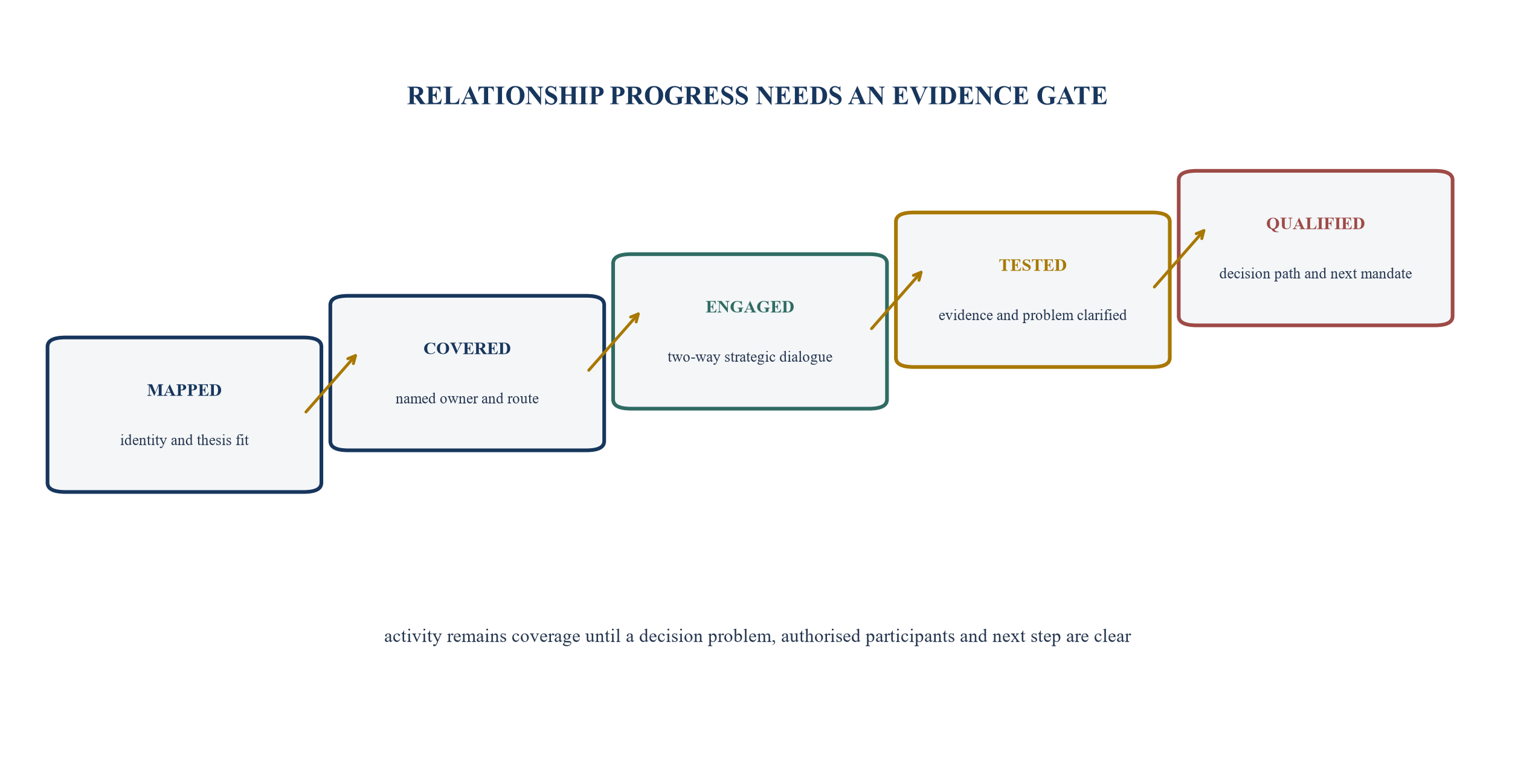
Progress requires observed evidence at each gate; elapsed time varies by company and context.
17. Govern confidentiality, competition and personal data
Origination data can include personal contacts, relationship notes, strategic plans and transaction-sensitive information. The programme needs a documented purpose, access model, retention schedule and escalation route. Fields should be limited to what is necessary for legitimate corporate-development work.
Public-source collection should follow source terms and applicable law. Official portals can restrict bulk extraction, redistribution or automated access. Licensed datasets carry contractual conditions. The source ledger should record rights, authentication basis, rate limits and any restriction on storage or sharing.
Competition concerns can arise when strategic dialogue involves competitors, suppliers or customers. Early conversations should avoid unnecessary exchange of competitively sensitive information. If a process advances, advisers may establish clean teams, protocols and staged access. The radar should flag relationships requiring legal guidance rather than storing sensitive commercial detail broadly.
Transaction confidentiality begins before formal diligence. A visible pattern of outreach, shared target list or poorly controlled calendar can reveal strategy. Access should be role-based, exports controlled and material actions logged. The programme should have a response plan for incorrect data, unauthorised access and a request to correct or remove information where applicable.
18. Establish decision rights and operating cadence
The corporate-development leader should own the target universe, scoring policy and opportunity funnel. Strategy leaders own the acquisition thesis. Business executives own the commercial rationale and relationship contribution. Data owners maintain sources, quality and access. Legal, compliance, privacy and information-security functions define controls within their mandates. The investment committee determines when a qualified opportunity receives capital and diligence resources.
The operating cadence should match signal speed. Automated source refreshes can run according to permitted access and source frequency. Analysts can review material alerts daily or weekly. Coverage teams can review priority targets monthly. Strategy owners can refresh thesis rules quarterly or when the business plan changes. The board can review coverage and qualified opportunities on a regular transaction calendar.
Decision logs should record additions, removals, score overrides, relationship ownership and opportunity promotion. This makes the radar auditable and reduces dependence on individual memory. When an employee leaves, the company should retain an appropriate institutional record without retaining unnecessary personal material.
Metrics should assess decision quality. Useful measures include thesis-universe coverage, proportion with resolved identity, stale evidence, signal validation time, access progression, qualified-opportunity conversion, duplicate outreach, research cycle time and reasons opportunities stop. Raw contact volume and alert counts are workload measures.
19. Measure the economics of origination
The radar consumes data, technology, analyst time and executive attention. Its business case should compare those costs with improved coverage, earlier access, faster qualification and better allocation of diligence resources. Claims about proprietary deal flow should be supported by actual conversion evidence.
The funnel should separate market universe, thesis-qualified targets, active coverage, engaged relationships, qualified opportunities, authorised processes, signed transactions and completed transactions. Movement requires defined evidence gates. A target should not become a qualified opportunity because it received a high model score.
The team should measure false work. Duplicate entities, irrelevant alerts, stale targets, uncoordinated outreach and premature diligence consume capacity. Reducing these costs can create value before any acquisition closes. The programme should also show which sources and signal types produce useful decisions.
Transaction outcomes have long cycles and small samples. Management can use leading indicators while retaining the distinction between activity and economics. A completed acquisition, signed mandate or documented strategic partnership provides stronger evidence than meetings or response rates.
Table 6. Board reporting for the target radar
| reporting block | metric | decision question | evidence gate | board action |
|---|---|---|---|---|
| universe coverage | targets by thesis, geography and evidence confidence | does the radar cover the market implied by strategy? | resolved identity and dated source | commission gap analysis |
| active coverage | priority targets with owner, route and next step | is executive attention concentrated on the right companies? | approved score and coverage plan | reallocate ownership |
| relationship progression | mapped, engaged, tested and qualified stages | are relationships producing strategic learning and access? | stage-specific interaction evidence | sponsor senior engagement |
| opportunity funnel | qualified, authorised, diligenced, signed and completed | is the programme creating actionable transaction paths? | explicit promotion criteria | allocate capital and advisers |
| quality and control | stale records, conflicts, false matches and policy exceptions | can the committee rely on the information? | quality review and exception owner | require remediation |
| economics | programme cost, time saved and outcome evidence | does the operating model improve capital allocation? | reconciled cost and documented outcomes | continue, redesign or stop components |
Counts and thresholds should use consistent definitions and disclose changes in methodology.
20. Apply the framework to a hypothetical acquisition programme
Consider a hypothetical industrial group seeking digital-service, engineering and recurring-maintenance capabilities across the GCC. Management begins with 1,200 source records from official registries, exchange disclosures, company publications and existing relationship files. All counts, scores and outcomes in this example are hypothetical management assumptions.
Entity resolution maps the records to 760 distinct legal entities and 510 operating groups. Thesis rules identify 140 groups with relevant capabilities and geography. Evidence review removes 35 that are inactive, misclassified or dependent on assets outside the transaction perimeter. The remaining 105 receive separate fit, quality, timing, access, feasibility and confidence scores.
The programme assigns active coverage to 30 targets. Twelve have an existing relationship route, eight require adviser or ecosystem introductions and ten begin with research-led strategic engagement. Over 90 days, six relationships reach substantive dialogue. Three reveal advisory or partnership needs, two remain long-term coverage targets and one becomes a qualified acquisition opportunity after the owners authorise a structured discussion.
The example shows why the system needs distinct stages. The initial 1,200 records are inputs. The 105 thesis-relevant groups are research candidates. The 30 actively covered companies consume executive capacity. The single qualified opportunity has a defined strategic rationale, identified decision participants, an indicated transaction path and permission to progress. None of the earlier stages should be described as a deal pipeline without its evidence gate.
The programme begins with four acquisition theses rather than one broad ambition. The first seeks a regulated distribution capability that can carry an existing product into two additional GCC markets. The second seeks a specialist engineering team with recurring maintenance revenue. The third seeks a software-enabled service business that can improve customer retention across the buyer's installed base. The fourth seeks a smaller platform whose licences, local leadership and customer references can support a new-country entry. Each thesis receives its own mandatory attributes, disqualifiers, evidence sources, relationship map and integration questions. A company can therefore rank highly for one thesis and remain irrelevant to the others.
The team then creates a canonical universe from permitted official records, exchange disclosures, company materials and trusted industry sources. Analysts resolve trading names to legal entities, connect subsidiaries to parent groups and record uncertainty where ownership is incomplete. The first review removes entities outside the approved geography, size, sector or licence perimeter. The second review checks whether the available evidence supports the claimed capability. The third review asks whether an acquisition is a credible route to the objective; a commercial partnership, minority investment or recruitment programme may be more appropriate. These gates preserve research time for situations where transaction logic is plausible.
Signals change the order of work rather than determine an outcome. A new licence may increase strategic relevance. A senior appointment may indicate investment capacity or a succession event. A refinancing, facility expansion or major customer award may alter timing. Every signal is stored with a date, source, linked entity, confidence assessment and analyst interpretation. The interpretation remains reviewable because the same event can support several explanations. A new plant could indicate growth, a customer commitment, capacity risk or the need for additional capital. The relationship owner decides whether the evidence warrants discreet validation.
Relationship development follows a defined sequence. The first objective is to test strategic relevance and learn the stakeholder map. A qualified conversation explores the owner's priorities, decision horizon, constraints and preferred forms of collaboration. Permission to continue leads to a tailored value hypothesis and a proposed next step. The team records what the counterparty actually said, separates it from internal interpretation and limits circulation according to sensitivity. This discipline protects trust and gives the investment committee a more accurate view of access.
The monthly portfolio review compares the four theses. Management can see which theses have adequate universe coverage, which depend on weak data, where relationship access is concentrated and where qualified opportunities are emerging. Resources move toward evidence-rich themes and away from searches that repeatedly fail the strategic or access gate. The review also examines false positives, duplicate entities and stale scores. These diagnostics reveal flaws in the system before they shape capital-allocation decisions.
At the board gate, the team presents a concise evidence pack for each qualified opportunity: strategic objective, canonical entity and group perimeter, ownership and control, cited signals, relationship status, indicative transaction form, principal diligence questions, integration dependencies and the requested decision. The board can authorise deeper work, request a narrower test, defer the opportunity or close it. The radar remains useful when no transaction proceeds because it records why the thesis, timing, access or risk did not meet the gate and feeds that learning into subsequent searches.
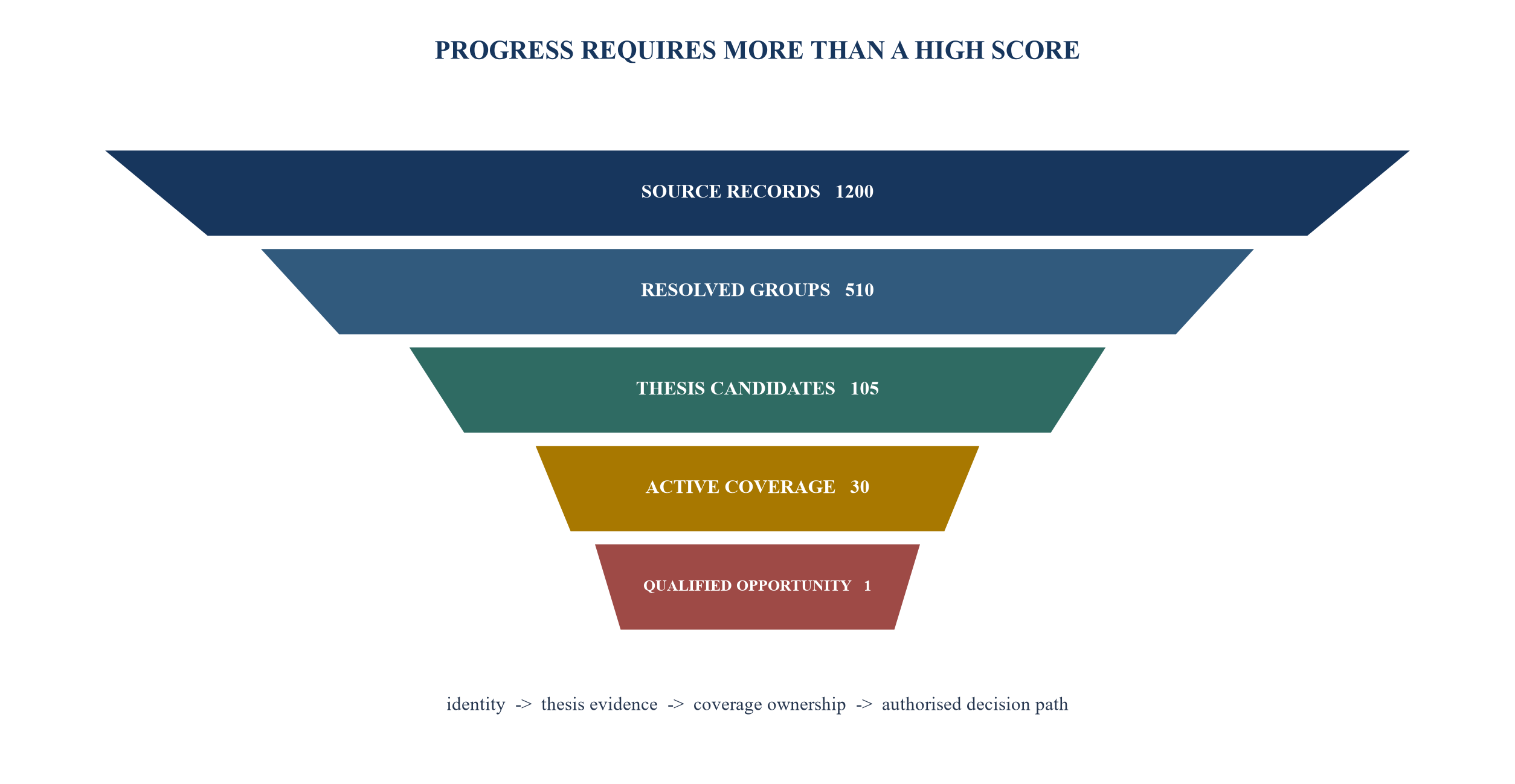
Counts are hypothetical management assumptions and do not represent Matchpoint Partners, a client or current market activity.
21. Build the radar in 90 days and apply a board gate
The first 30 days should establish governance and identity. Management approves the acquisition thesis, source rights, target-master schema, scoring dimensions, access roles and stage definitions. The team loads a bounded priority universe, resolves duplicates and tests entity matches. It selects a small number of signal types with clear strategic meaning.
Days 31 to 60 should establish operating evidence. The team connects permitted source refreshes, validates changes, calibrates score rubrics and creates analyst queues. Relationship owners review priority targets, correct group maps and define next actions. Quality testing measures false matches, stale values, translation issues and unexplained score changes.
Days 61 to 90 should prove decision use. The programme runs a complete coverage cycle, promotes only opportunities meeting the agreed gate and produces the first board report. Management measures analyst effort, executive time, signal usefulness, relationship progression and control exceptions. Weak sources or signals are removed.
The board gate should require five conclusions. First, the market universe is traceable to the approved thesis. Second, priority targets have resolved identity and visible evidence confidence. Third, every active target has one coverage owner and a proportionate next action. Fourth, a qualified opportunity requires authorised counterparties, a defined decision problem and a credible transaction or advisory path. Fifth, information collection, access and outreach comply with the approved governance model.
An always-on radar should improve institutional memory and strategic preparedness. Its value depends on disciplined definitions, reliable identity, current evidence, respectful relationships and the willingness to remove weak opportunities. The system becomes proprietary through accumulated validated knowledge and trusted access, rather than through the volume of records it stores.
Sources and further reading
- United Arab Emirates Ministry of Economy and Tourism, National Economic Registry Growth Launch Official source
- United Arab Emirates Ministry of Economy and Tourism, Commercial Register Legislation Official source
- United Arab Emirates Ministry of Economy and Tourism, Growth Platform Digital Integration Official source
- Abu Dhabi Global Market, Registration Authority and Public Register Official source
- Dubai Financial Services Authority, Public Register of Firms Official source
- Saudi Arabia Ministry of Commerce, Commercial Register GIS Information Official source
- Saudi Arabia Ministry of Commerce, Open Data Official source
- Saudi Arabia Ministry of Commerce, Commercial Register REST API Guide Official source
- Saudi Exchange, Issuers and Financial Adviser Announcements Official source
- Saudi General Authority for Statistics, Structural Business Statistics Survey Official source
- Kingdom of Bahrain, Sijilat Commercial Registration Search Official source
- Bahrain Bourse, Listed Companies Official source
- Bahrain Bourse, Market Data Services Official source
- Qatar Ministry of Commerce and Industry, Business Map Portal Services Official source
- Qatar Ministry of Commerce and Industry, Commercial and Economic Register Laws Official source
- Qatar Ministry of Commerce and Industry, Company Regulatory Record Report Service Official source
- Muscat Stock Exchange, Companies Official source
- Muscat Stock Exchange, Financial Reports Official source
- Kuwait Business Center, Single Window Operating Procedures Official source
- Kuwait Capital Markets Authority, Licensed Companies Official source
- Kuwait Capital Markets Authority, Listed Company Disclosure Portal Official source
- United States Securities and Exchange Commission, EDGAR Application Programming Interfaces Official source
- UK Companies House, Get Started with the Companies House API Official source
- UK Companies House, Developer Guidelines Official source
- European e-Justice Portal, Business Registers Interconnection System Official source
- Singapore Government and Accounting and Corporate Regulatory Authority, Registered Entities with Unique Entity Number Official source
- Government of India Ministry of Corporate Affairs, MCA Website Services and Company Master Data Official source
- Australian Securities and Investments Commission, Business Register Data on Data.gov.au Official source
- Australian Securities and Investments Commission, Application Programming Interfaces Official source
- Financial Action Task Force, Guidance on Beneficial Ownership of Legal Persons Official source
