

1. Define the business that must continue
A distressed acquisition requires a precise answer to what the buyer will own, what it may operate and what cash it must provide. The proposed acquisition structure should connect those questions before the buyer settles its price. A list of attractive assets is insufficient if the operating plan depends on a contract, permission or capability outside that list. Equally, retaining an existing corporate entity requires an assessment of the obligations and control conditions attached to it.
This paper proposes a structure-selection method based on an evidence register and a comparable cash model. First establish the operating activities that the buyer intends to continue. Identify the rights and resources needed for each activity, the proposed owner after completion and the conditions for use. Then translate the verified structure into dated payments and operating cash flows. Unresolved legal or operational conditions remain explicit decision conditions; a favourable numerical result cannot resolve them.
The analysis uses selected UK guidance and US statutory provisions to illustrate why transaction labels require qualification. It does not provide an exhaustive statement of either jurisdiction's law, and it does not transplant their rules to another country. The numerical comparison is an original hypothetical teaching model. Its prices, settlements, costs, cash flows and timing are author assumptions without empirical calibration. They describe no actual seller, target, lender or proposed mandate.
The intended output is a comparison that a transaction team can challenge. A reviewer should be able to move from a claimed continuity benefit to the underlying right, from a liability allocation to its legal assessment, and from a funding requirement to the model's cash schedule. That traceability gives each specialist a defined question and allows the investment committee to see which unresolved matters could change its decision.
2. Map ownership and the operating perimeter
Begin with an ownership map showing the entities, shares and assets involved. For an asset proposal, list the property and rights intended to transfer, their present owners and any items expressly excluded. For a share proposal, identify the particular company and any subsidiaries within scope. The buyer should reconcile the commercial description of the business with this map. A group brand, reporting division or management presentation need not correspond to a single legal owner.
Next map each source of forecast cash to the resources that support it. These may include premises, equipment, staff, customer arrangements, software, data access and permissions. Record whether each resource is owned, leased, licensed, shared or supplied by another entity. The proposed diligence method treats an undocumented dependency as unresolved. It gives no presumption that an asset listed in the accounts can be used independently after completion.
Separate ownership from access. The business might operate equipment that belongs to a financing provider, use systems supplied by a parent, or rely on a licence held elsewhere. Conversely, an owned asset may be outside the intended business and have no role in the forecast. The acquisition schedule should explain both situations so that cash-flow assumptions correspond to the actual perimeter.
The map should also record the date on which a right becomes usable. Legal completion, physical handover, technical access and permission to trade may be different events. A proposed transition arrangement must specify its duration and dependency on the counterparty. The financial model can then distinguish costs required to acquire ownership from costs required to establish usable operations. This separation is especially important when the seller's continuing support is uncertain.
3. Establish executable continuity conditions
Before ranking structures financially, identify conditions without which the intended business cannot operate lawfully or practically. The proposed framework uses three evidence states: established, subject to a specified condition, and unresolved. Each entry identifies the document or confirmation supporting that state. These are review categories rather than legal conclusions. The appropriate adviser remains responsible for determining whether the evidence satisfies the applicable requirement.
A condition should name the action, responsible party and required date. An expected consent is different from a consent received. An application submitted is different from approval granted. Where a right is central to the operating plan, the acquisition team should identify what happens if it is unavailable by completion. The response might involve a different timetable, an agreed conditional structure or reconsideration of the transaction. Each alternative requires its own authority and economics.
Avoid converting a binary permission into an arbitrary probability simply to retain a positive valuation result. A probability-weighted analysis may be useful for a properly defined decision under uncertainty, but it does not confer a right to operate. The executable case should show which permissions and access arrangements actually support its cash flows. A separate conditional case can show the consequences of specified alternatives.
The evidence register should distinguish a temporary workaround from a permanent solution. A short transition service can bridge a systems dependency only for its agreed scope and duration. The model should include the cost and timing of the replacement capability. If no replacement route has been established, the forecast should identify that limitation rather than silently extending the temporary arrangement through the investment horizon.
Table 1. Proposed rights and continuity register
| Item | Evidence | Decision condition |
|---|---|---|
| Asset or share | Ownership and perimeter | Confirm scope |
| Contract | Operative terms and advice | Establish continuity |
| Permission | Holder and required approval | Confirm usable date |
| Employee obligation | Applicable assessment | Reconcile allocation |
| Data and systems | Rights and access evidence | Establish lawful use |
Proposed review structure; each transaction requires its own facts and professional assessment.
4. Reconcile legacy exposure once
Prepare a liability register that connects each material claim to its asserted basis, obligor, amount and payment timing. Record the transaction team's legal assessment separately from the claimant's assertion and from the proposed commercial settlement. A disputed claim should retain its disputed status until supported resolution exists. The purpose is to prevent an accounting label or acquisition label from becoming an unsupported statement about who ultimately pays.
The register should then connect to the price bridge and funding model. If an obligation has already reduced the proposed consideration, show whether the buyer or target must still fund its settlement. Those two entries can describe different economic effects, but their relationship must be explicit. Deducting the same obligation repeatedly from the same measure would distort the comparison. Conversely, reducing price does not itself provide cash at the operating entity when payment is due.
Keep legacy settlements separate from normal post-completion operating expenses. A payment to resolve an old supplier balance may accompany new supply terms. The model needs both the settlement and the terms of future trading, with a clear cut-off. The same discipline applies to employee amounts, lease arrears and other obligations. It should be possible to reconcile the opening schedule to the first operating forecast without duplication or omission.
An indemnity or warranty also needs a recovery assessment before it is treated as cash protection. Identify the obligor, scope, limitations, claim process and evidence of available recourse. The paper assumes no universal recoverability in distress. A proposed contractual protection should remain distinct from a collected amount. Where recovery is uncertain, the committee should see the gross exposure and any separately justified recovery scenario, including its timing and enforcement costs.
5. Examine the sale process within its jurisdiction
US Bankruptcy Code section 363 provides a bounded example of a court-supervised sale mechanism. Its provisions address sales outside the ordinary course after notice and a hearing, adequate protection of interests, and specified conditions for selling free and clear of interests. Subsection (f) requires a listed condition; subsection (o) preserves specified consumer-credit claims and defences. The text therefore cannot support a blanket statement that every liability disappears in an asset sale. The particular interest, proceeding and proposed order require legal assessment. [1]
For diligence purposes, identify exactly what the sale process is expected to achieve. Record the property covered, the relevant interest, the authority sought and the scope of the proposed documentation. Then connect unresolved matters to the operating perimeter. The buyer's model should not assume that a general reference to a court process resolves every ownership or continuity issue affecting the forecast.
The commercial review should also distinguish the agreement from the conditions necessary to complete it. Record required approvals, deadlines and any dependencies on another party's performance. A structure may be attractive in principle while remaining unavailable on the timetable assumed in the model. The analysis should preserve that distinction and show the cost or consequence of an alternative timetable where it can be supported.
This paper does not compare the full procedural law of insolvency regimes. Its proposed method is to identify the actual procedure first and obtain the advice needed for that procedure. For a cross-border business, repeat the analysis for material assets and rights in their relevant locations. A transaction document drafted for one part of the business is insufficient evidence of the legal outcome for every other part.
6. Connect contracts to continuing cash flow
For each material customer and supplier arrangement, identify the contracting entity, term, performance obligations and relevant transfer or control provisions. The reviewer should read the operative document, amendments and applicable context together. A summary stating that a contract is transferable should retain its supporting basis and any conditions. The financial consequence depends on what the business must do to preserve performance and collection under the proposed structure.
US section 365 illustrates a distinct contract analysis. Subject to its provisions, assumption requires court approval; where relevant defaults exist, subsection (b) addresses cure, compensation and assurance of future performance, with exceptions. Subsection (c) limits assumption or assignment in specified circumstances. Subsection (f) links assignment to assumption and adequate assurance by the assignee. These provisions require contract-specific legal analysis; a sale assumption alone does not establish that every desired agreement will continue. [2]
The commercial register should translate that analysis into cash and timing. Identify any agreed cure payment, deposit, revised supply term or implementation cost. If the model already includes an amount in legacy settlements, do not add it again under contract continuity. Where the amount remains subject to agreement, show the condition and a supported sensitivity rather than presenting the estimate as an agreed price.
Customer continuity also depends on the ability to perform. A retained agreement has limited value if the acquired operation cannot meet its service obligations. Map the staff, systems, supplier inputs and permissions required for performance. The proposed method joins these dependencies to the forecast at the contract level, allowing the reviewer to challenge whether the assumed receipts and associated costs remain coherent after the transaction.
7. Review licences and changes in control
Create a permissions schedule that identifies the holder, authorised activity, territory, conditions and relevant ownership or control requirements. Ask the appropriate reviewer to determine how the contemplated transaction affects each permission. The schedule should separately record the status of any application or confirmation. It should also show which operating cash flows depend on that permission and the first date on which the forecast requires it.
The FCA's change-in-control guidance states that relevant acquisitions or increases of control in firms it regulates require notification and approval beforehand, subject to the regime's scope and exceptions. It describes an assessment period of up to sixty working days from a complete notification, excluding interruption periods. That is regulatory process context, not a promised transaction timetable. Retaining the corporate entity does not itself resolve a relevant control approval. [3]
The model should avoid assuming that all approvals run in parallel or that preparation begins only after signing. Instead, identify the evidence required for each submission, any dependencies and the date by which a decision is needed. When the process depends on information from the seller or another investor, record that dependency. Counsel and the relevant regulatory specialists should establish which steps are permitted before approval.
A licence-related delay may affect more than the start date of revenue. The buyer might need to maintain systems, retain staff or provide other resources while awaiting readiness. Those costs belong in a transaction-specific forecast if supported. The later numerical example deliberately omits such carrying costs to isolate timing arithmetic; it should not be adopted as a complete model of a regulated acquisition.
8. Screen sensitive activities and assets
National-security review requires its own analysis of activities, assets and control. The UK's published NSI guidance describes mandatory notification for qualifying entity acquisitions meeting the relevant tests in sensitive areas. It also explains that qualifying assets include land, tangible property and economically valuable intellectual property, and that rights to use or control qualifying assets can fall within the wider regime. Mandatory notification and wider scrutiny are distinct questions. An asset structure should not be treated as a universal route around review. [4]
The proposed diligence schedule should identify the actual activities and rights involved. A broad sector name is insufficient to determine whether a transaction meets a legal test. Record the specific technology, service, asset use and geographic connection, together with the professional assessment. Where sensitive activities sit in only part of a group, reconcile them to the exact acquisition perimeter before relying on a structural exclusion.
This question is relevant to the design of the operating plan as well as completion timing. A proposed restriction or required arrangement could affect how assets are used, which systems are shared or how governance operates. Those effects should enter the commercial analysis only when their basis is established. The paper does not predict a regulatory outcome or assign an unsupported probability of clearance.
For cross-border structures, avoid treating the buyer's incorporation or the seller's headquarters as the only geography that matters. The location and use of relevant rights require examination. The analytical method is to obtain a jurisdiction-specific screening conclusion, identify outstanding conditions and maintain a dated completion plan. Each financial case should then state the set of conditions on which its operations depend.
9. Connect employment continuity to the perimeter
The workforce assessment should identify the employing entities, required roles and obligations relevant to the contemplated transfer. It should distinguish employees supporting the acquired activities from those outside scope, subject to the applicable legal analysis. The operating forecast needs a supported plan for the capabilities it assumes, including access to essential systems and any required authorisations. A headcount total alone cannot establish readiness.
UK government guidance states that a business transfer protected by TUPE involves a change in the employer's identity. Its insolvency guidance distinguishes rescue from closure and explains that, in a TUPE-protected transfer, the new employer must pay residual employee amounts after relevant National Insurance Fund payments. These are reasons to examine the actual structure and procedure with employment advisers. They do not support a general assumption that an asset purchase removes employment exposure or that every insolvency transfer has the same result. [5,6]
Translate the resulting assessment into disjoint cash categories. Record any historical amount included in the transaction's settlement schedule, normal payroll after completion and separately approved transition spending. If the forecast assumes particular employees remain available, establish the basis for that assumption through an appropriate process. The model should identify unresolved capability dependencies without inferring an individual's intentions or treating personal characteristics as evidence.
The implementation plan should also cover the first payment cycle, access arrangements and responsibility for employee communications. These operational details should follow the agreed and legally reviewed structure. If employment continuity depends on actions outside the buyer's control, show the dependency in the readiness schedule. A financial comparison can quantify a stated interruption case, but it cannot establish that the proposed employment outcome is lawful or achievable.
10. Treat tax as an evidenced transaction input
Tax analysis should follow the exact transaction, asset mix, parties and intended use. Identify which questions require professional determination, which amounts are agreed and which remain estimates. The financial comparison should show the timing of cash payments and any evidenced recovery separately. An assumed future recovery should not be netted against an immediate payment without considering whether the buyer can fund the intervening period.
HMRC VAT Notice 700/9 explains that a qualifying transfer of a business as a going concern can be treated as involving no supply for VAT purposes, subject to its conditions. The rules are compulsory when applicable. Relevant conditions include the nature of the transferred business, intended continuation and registration requirements; property can raise further conditions. The notice distinguishes a share transfer where assets remain owned by the company. This is conditional UK guidance, not a general tax exemption for distressed acquisitions. [7]
For the proposed comparison, maintain a tax schedule outside the initial operating model until its treatment is established. This allows the team to see whether a claimed structure advantage depends on an unresolved assumption. Record the source of each conclusion, its date and the facts on which it depends. If the structure changes, the tax reviewer should assess whether those facts and conclusions still hold.
The numerical example below excludes all taxes and VAT. It therefore makes no claim about after-tax investor returns or the tax superiority of either route. A real transaction model would need to add the relevant transfer, operating and other tax consequences, including timing. The omission is deliberate to make the comparison transparent; it is a material limitation when moving from the teaching model to an executable bid.
11. Trace technology and data rights
For a technology-enabled business, distinguish ownership of equipment or source code from the rights needed to operate the complete service. The proposed schedule should identify software licences, hosting arrangements, data permissions, support commitments and access credentials. Each item should have a holder, documented basis, permitted use and transfer or control assessment. The presence of a system in the business does not by itself establish that the buyer may continue every use.
For an AI-enabled product, the review should separately identify the model, associated code, training or reference data, external services and deployment environment. The purpose is to locate dependencies and unresolved rights. This paper does not determine the legal status of a particular dataset or model. Those questions require the applicable agreements, provenance evidence and specialist review before the forecast relies on continued use.
The commercial model should distinguish the cost of establishing access from the cost of replacing an unavailable component. A proposed replacement may require technical validation, customer approval or further development. Its timetable should come from the relevant delivery assessment. The acquisition model should not assume immediate substitution merely because another product exists. Where a workaround has limited functionality, reflect the corresponding limitation in the operating case.
Data-room access also needs a clear purpose and authority. The proposed method uses controlled access to necessary evidence and records the review decision without expanding disclosure beyond the transaction's permissions. Sensitive data should remain subject to the appropriate safeguards. A structure comparison gains credibility when the source of each material assumption can be inspected by an authorised reviewer and traced to the exact version used.
Table 2. Boundaries of the cited legal examples
| Context | Issue illustrated | Required transaction work |
|---|---|---|
| US sections 363 and 365 | Sale interests and contracts | Review process and terms |
| UK FCA control | Relevant prior approval | Establish scope and timetable |
| UK NSI | Entity and asset scrutiny | Screen actual activities |
| UK TUPE | Employment continuity | Assess transfer and claims |
| UK VAT TOGC | Conditional treatment | Establish facts and tax advice |
Summarises the bounded discussions in sections 5 to 10 and references 1 to 7; no transaction opinion is provided.
12. Establish the hypothetical comparison
The numerical example compares two author-designed structures over twenty-four monthly periods, using GBP millions. It is a finite-horizon cash exercise with no empirical calibration. No actual price, legal allocation or company forecast is represented. The asset route assumes consideration of 4.00, legacy settlements of 0.40, contract cure costs of 0.60 and transition outlay of 0.80. The share route assumes corresponding amounts of 3.00, 1.60, 0.20 and 0.30.
All four cost categories are assumed disjoint and paid at time zero. The different allocations are inputs chosen for comparison; they are not legal consequences assigned to the structures. Both cases assume that all necessary permissions and rights are available under their stated implementation conditions. If that premise fails in a real transaction, the relevant operating case would need revision or exclusion before its financial result could support a decision.
After its assumed delay, the asset route produces net operating cash of 0.35 at each month-end. Its first two months have zero net operating cash. The share route produces 0.32 from month one. These amounts are defined as net cash after normal operating spending and maintenance requirements. They are neither revenue nor EBITDA. Zero cash during delayed months is a simplifying assumption that omits separate carrying costs.
The discount rate is an assumed one percent per month, applied consistently to both routes. The example excludes terminal value, tax, debt financing, additional contingent payments and distributions from the cash reserve. No claim is made that the discount rate represents market risk or the buyer's cost of capital. The purpose is to show how a transparent set of structure-specific costs and timing assumptions changes a common calculation.
Table 3. Hypothetical comparison assumptions
| Input | Asset route | Share route |
|---|---|---|
| Consideration | 4.00 | 3.00 |
| Legacy settlements | 0.40 | 1.60 |
| Contract cure | 0.60 | 0.20 |
| Transition outlay | 0.80 | 0.30 |
| Monthly net cash | 0.35 | 0.32 |
| Lost initial months | 2 | 0 |
| Retained reserve | 0.50 | 0.50 |
GBP million except months. Author assumptions; all one-time outlays occur at time zero. Monthly rate 1 percent; horizon 24 months; taxes, debt and terminal value excluded.
13. Separate upfront outlays from retained cash
The asset case's four upfront categories total 5.80. The share case totals 5.10. The model also assumes that the buyer provides a common cash reserve of 0.50 at completion. This produces opening cash requirements of 6.30 and 5.60 respectively. The reserve remains cash in the acquired operation. It is excluded from the finite-horizon surplus calculation because it is not modelled as an expense or consumed amount.
This distinction matters when discussing funding. The buyer needs access to the reserve even though its provision is not treated as a cost in this particular surplus measure. Conversely, a cost recognised in the calculation must be funded at its assumed date. The example shows a time-zero funding requirement, not a complete liquidity forecast. A real transaction should model reserve use, restrictions and subsequent operating balances explicitly.
The comparison should retain all four upfront categories even where the agreement presents a single combined payment. Their analytical separation helps the team identify what changes when the structure changes. If a cure amount is included in the proposed consideration in a real agreement, the model must reconcile the combined amount rather than counting both. The example assumes no such overlap and uses the category totals solely for reproducible arithmetic.
An investment committee should therefore read opening funding and calculated surplus together. They answer different questions. The first shows assumed resources required at completion; the second compares discounted operating cash with the defined one-time outlays. Neither measure establishes that financing is available, that cash may be transferred between entities, or that the full investment meets a required return after all omitted items are included.
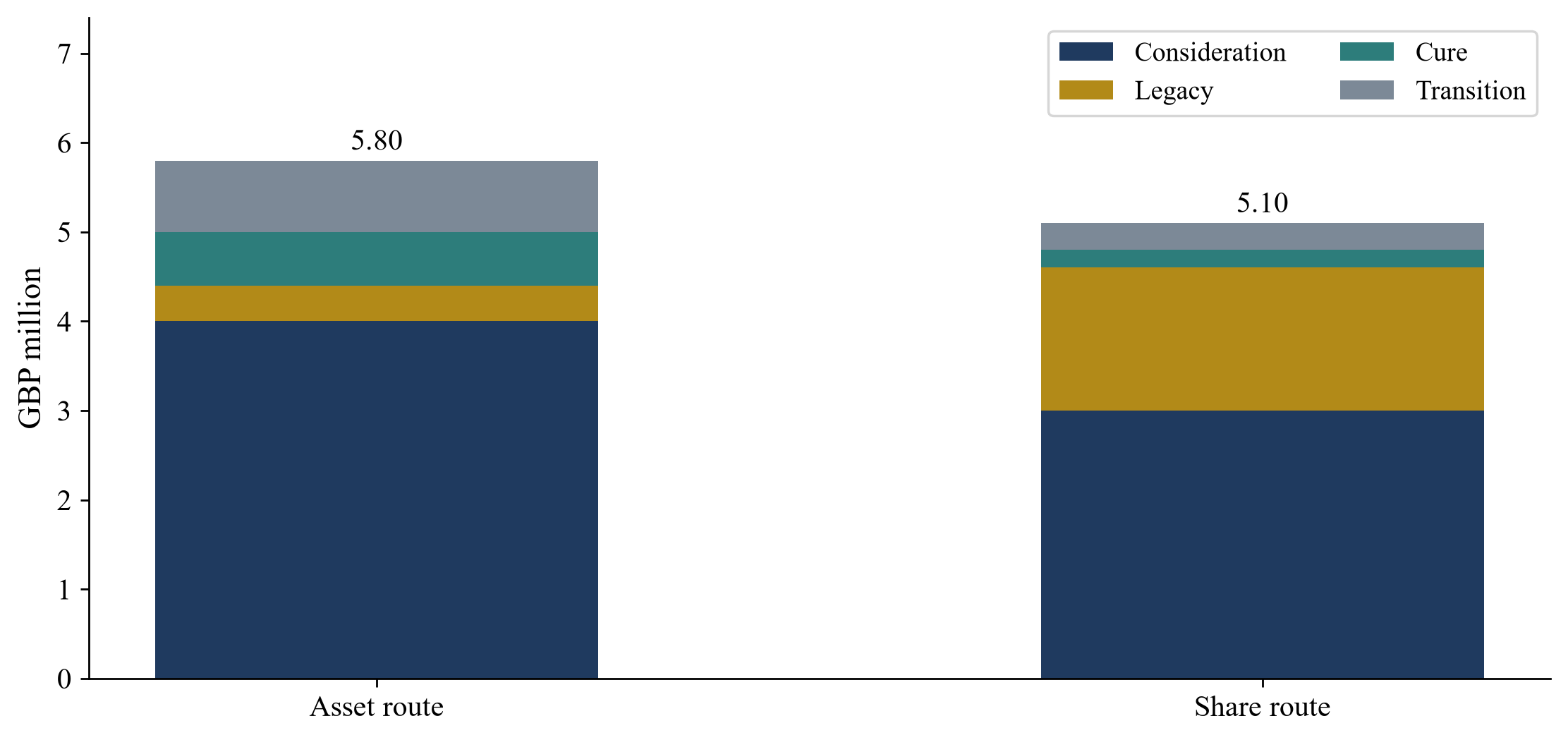
Author assumptions. Retained cash reserve of 0.50 is additional opening funding and is excluded from these outlays.
14. Calculate the finite-horizon surplus
For each route, discount every month-end operating cash flow to time zero and sum the results. Subtract the four upfront outlays to obtain the defined finite-horizon surplus. With monthly cash C, delay d, monthly rate r and horizon H, the operating present value is C multiplied by the difference between (1+r) raised to minus d and (1+r) raised to minus H, divided by r. Here H is twenty-four and r is 0.01.
The implementation calculates the result in two independent forms: a direct sum of the individual monthly cash flows and the finite-annuity expression. The outputs agree within numerical tolerance. It also checks the boundary where the delay equals the full horizon, which leaves no operating cash in the calculation. These checks support the arithmetic under the stated assumptions. They provide no evidence that the assumed business cash flows will occur.
The delay convention is important. A two-month delay means months one and two contribute zero and month three is the first positive cash flow. The model does not extend the horizon to compensate for those lost months. Nor does it add a catch-up receipt. A transaction in which cash is merely postponed beyond the horizon would need an extended schedule to measure that effect correctly.
The chosen measure should retain its explicit name. It is a surplus over a defined period after specified outlays. It is not a complete enterprise valuation or a measure of equity value, because terminal economics, financing and other material items are excluded. Keeping that boundary visible allows the calculation to serve as a focused sensitivity tool without overstating what its result proves.
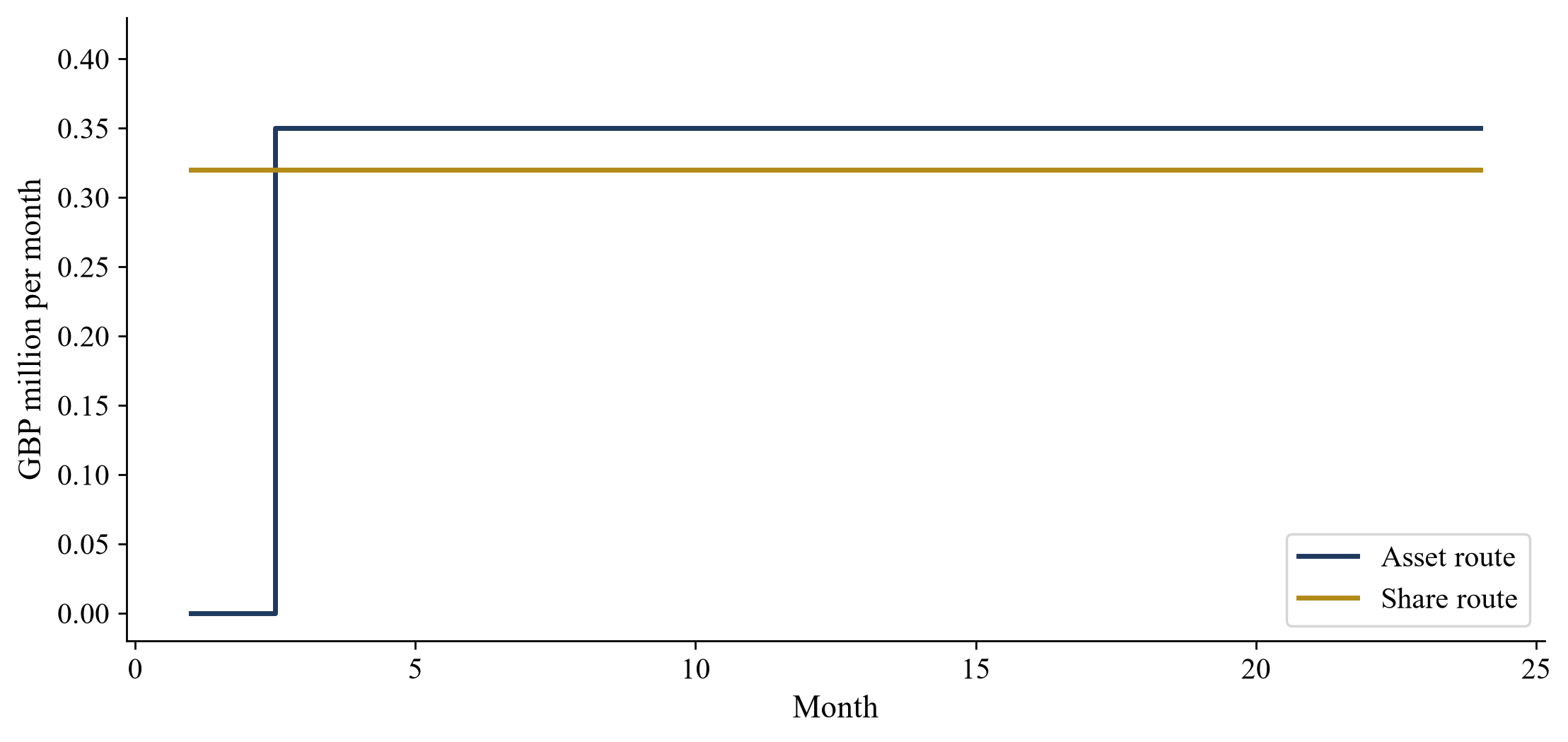
Hypothetical net cash; delayed months have zero cash by assumption. Separate carrying costs and catch-up receipts are excluded.
15. Interpret the base cases
Under the base assumptions, the present value of operating cash is approximately 6.7455 for the asset route and 6.7979 for the share route. Subtracting the respective upfront outlays gives finite-horizon surpluses of 0.9455 and 1.6979. The share case therefore exceeds the asset case by approximately 0.7523 within this example. The comparison follows from the selected inputs and should not be generalised into a preference for share purchases.
The higher monthly cash assumed for the asset route does not produce the higher present value over this horizon because that route loses its first two monthly receipts. It also begins with greater upfront outlays in the example. These are separate mechanisms. The analysis can identify how much of a change comes from timing and how much comes from an additional payment, instead of attributing the entire difference to a transaction label.
Before using a similar comparison in diligence, establish whether the two forecasts describe the same intended business. Differences in scope, maintenance spending, customer retention or operating capability should be visible. If one case omits a cost needed to produce its assumed cash, the apparent advantage may come from inconsistent modelling. The paper's cases define their inputs explicitly so that the reader can alter them without changing the calculation method.
The base ranking remains conditional on both structures being executable. The numbers cannot cure an unavailable permission, an excluded critical asset or an unresolved right. The committee should therefore receive the evidence conditions alongside the financial table. If a condition changes, the reviewer should identify which cash inputs depend on it and re-run the relevant case with a documented explanation.
16. Test a longer asset transition
The first sensitivity extends the asset route's delay from two months to four. All other inputs remain fixed, including the upfront transition outlay and later monthly net cash. The present value of operating cash falls to approximately 6.0695, giving a surplus of 0.2695. The reduction from the asset base case is approximately 0.6760. It equals the discounted loss of the third and fourth monthly cash flows under the stated convention.
Opening funding remains 6.30 in this simplified sensitivity because the model adds no carrying cost during the extra delay. That result is a limitation of the input design, not a claim that real delays require no additional funding. A practical forecast should include supported payroll, maintenance, premises or other cash requirements during the delay. It should also test whether later operating performance changes as a result.
The sensitivity is useful as a question for diligence: what evidence supports the assumed date on which operating cash begins? The answer might involve a documented transfer, tested systems access or a verified capability milestone. The model should connect each material date to that evidence. If the date remains uncertain, show a transparent range of timing cases without assigning unsupported likelihoods.
An extension can separate delay in legal completion from delay after completion. Those events may leave costs with different parties and affect when consideration is paid. The current example assumes all outlays occur at time zero and isolates post-completion operating timing. It should therefore be rebuilt before use in a transaction where signing, payment, control and readiness occur on different dates.
17. Test additional legacy cash in the share route
The second sensitivity adds 1.50 to the share route's assumed time-zero legacy settlement. All operating cash assumptions remain unchanged. Upfront outlays rise from 5.10 to 6.60 and the finite-horizon surplus falls to approximately 0.1979. Including the retained reserve, opening cash required becomes 7.10. The extra payment reduces surplus one-for-one because it is assumed to occur at time zero.
This case is deliberately a cash sensitivity. It does not assert that an additional claim exists, that the buyer is legally liable for it, or that a settlement at that amount is appropriate. A real entry would require evidence about the obligation, legal assessment and payment terms. The point is to show the consequence if the stated payment is included in an otherwise unchanged transaction model.
Timing and recoverability can alter the calculation. A payment due later would have a different present value, while a supported recovery would require a separate cash flow and date. The investment team should avoid presenting a gross claim amount as equivalent to a certain immediate settlement without explanation. Equally, it should avoid discounting an obligation solely because its resolution is inconvenient for the proposed price.
The sensitivity should be linked back to the liability register. Each change should identify the evidence or assumption that changed, the affected model line and the resulting funding consequence. This allows the committee to distinguish a newly discovered issue from a revised estimate or a negotiated allocation. It also creates a record of what must be resolved before an approved case becomes an executable transaction.
Table 4. Hypothetical case results
| Case | Surplus | Opening funding |
|---|---|---|
| Asset base | 0.9455 | 6.30 |
| Share base | 1.6979 | 5.60 |
| Asset delay 4 | 0.2695 | 6.30 |
| Share legacy +1.5 | 0.1979 | 7.10 |
GBP million. Surplus is discounted 24-month operating cash less defined outlays. Opening funding includes retained reserve. Neither measure is a complete valuation.
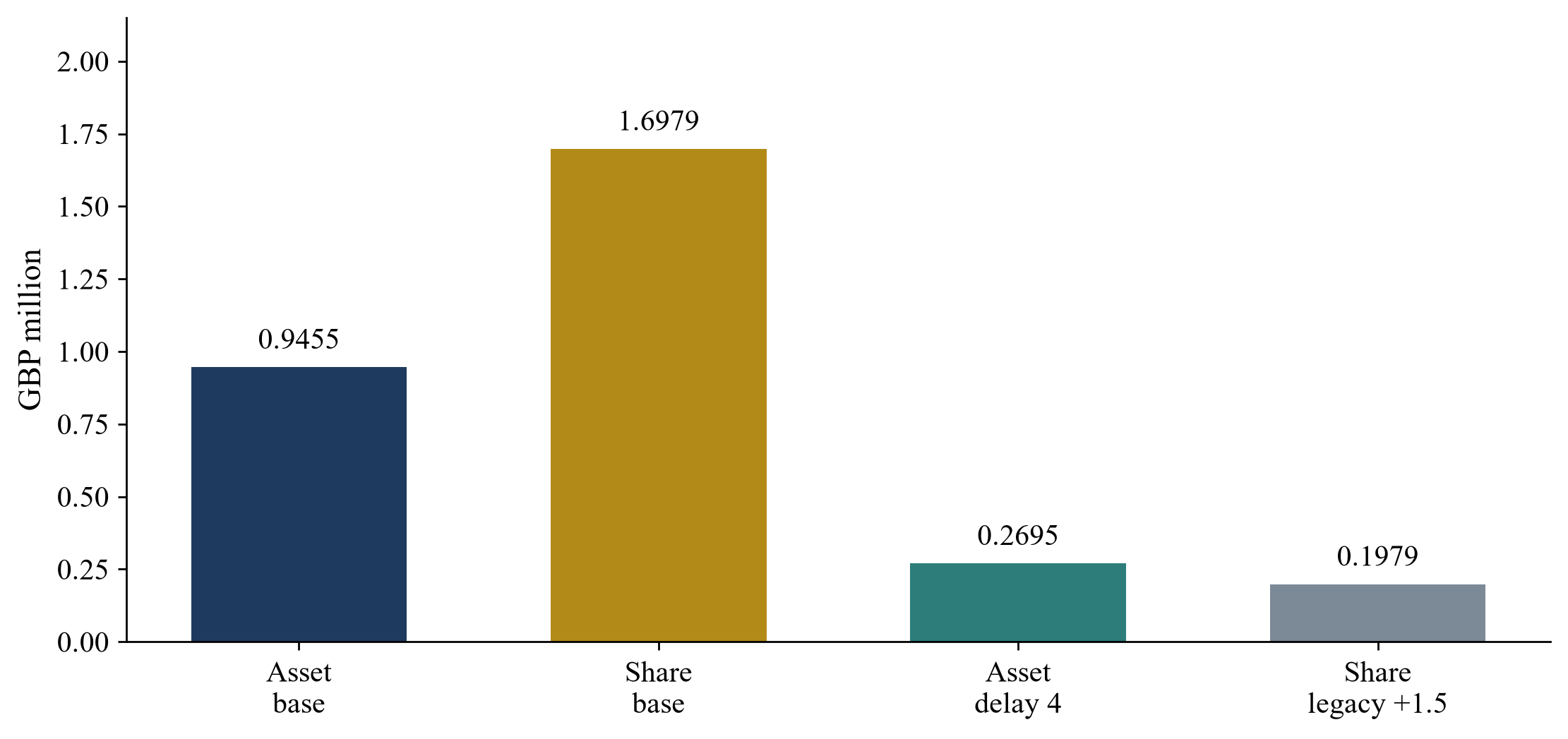
Original calculations under fixed assumptions; no probabilities, terminal value, tax or debt included.
18. Locate the parity boundary
Holding the asset base case and the share operating forecast fixed, an additional share-route time-zero payment of approximately 0.7523 equalises the two surpluses. This is the difference between their base results. The model verifies the boundary by inserting the exact unrounded amount and checking equality. It then adds and subtracts 0.01 to confirm that the ranking changes in the expected direction.
The boundary is a conditional arithmetic result. It is not a recommended settlement limit or a valuation of legal risk. The amount would change if the operating forecasts, transition timing, discount rate, horizon or other costs changed. Its practical use is to identify whether a disputed modelling input could be material enough to alter the comparison under a stated set of assumptions.
A two-dimensional sensitivity varies asset delay from zero to six months and additional share legacy cash from zero to 2.00 in increments of 0.25. Each cell shows asset surplus less share surplus. Positive values favour the asset case on this defined measure; negative values favour the share case. The grid contains no probabilities and gives no estimate of how likely any combination is.
The committee should use such a grid to focus the evidence review. If a small supported change in timing could reverse the ranking, the readiness timetable deserves close attention. If the comparison is sensitive to a particular settlement, its legal and commercial basis needs resolution. The grid helps frame questions; it does not replace the source documents, specialist judgments or decision authority needed to answer them.
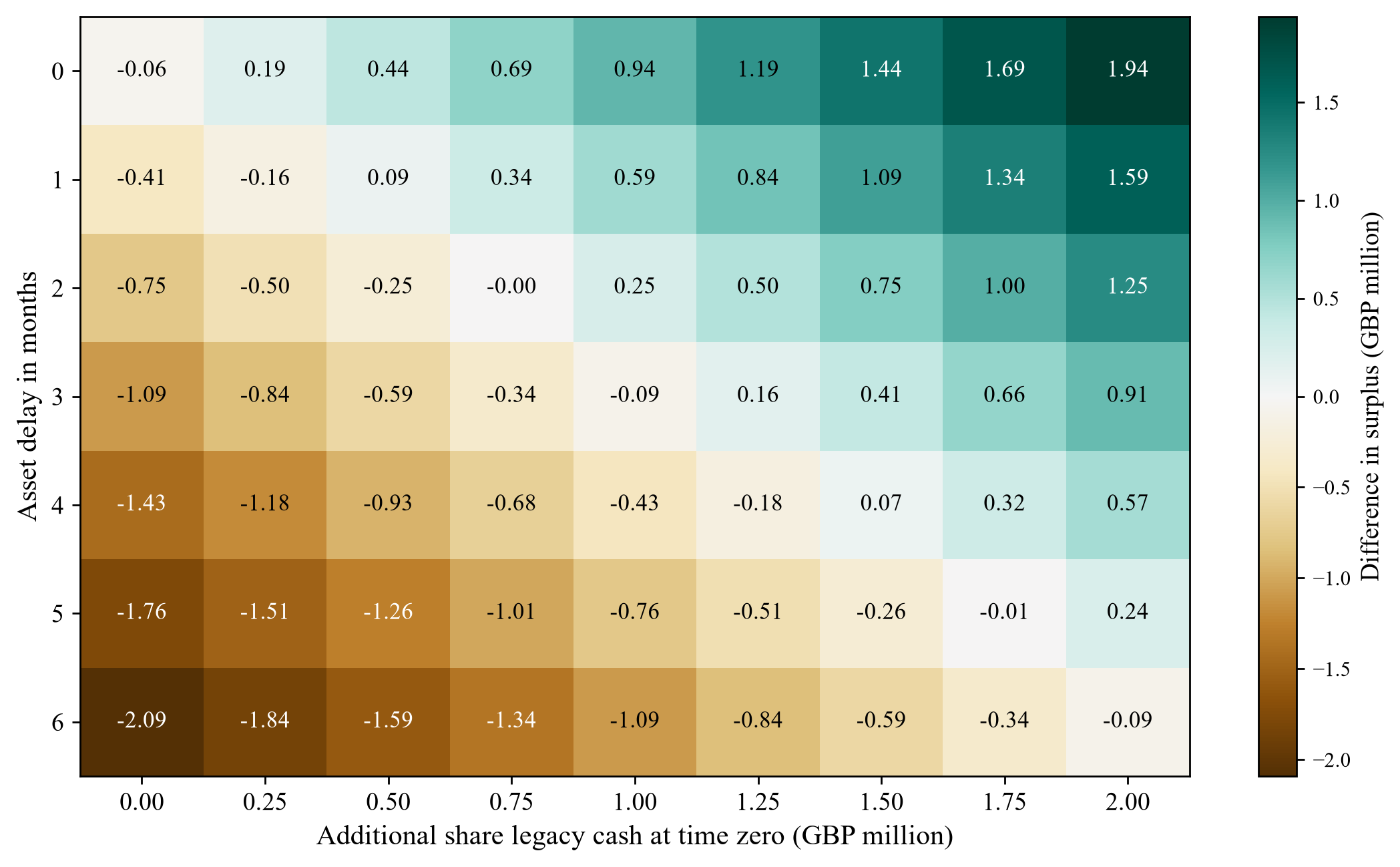
Positive cells favour the asset case on this limited measure; negative cells favour the share case. All inputs are hypothetical and no likelihood is assigned.
19. Rebuild the financing assessment separately
A structure that requires less opening cash in the example may still be harder to finance in a particular transaction. The proposed method therefore uses a separate sources-and-uses schedule. Identify the borrower, funding source, permitted use, availability date and conditions for each amount. A sponsor commitment, an indicative lender proposal and unrestricted cash should retain their distinct evidence status until the relevant conditions are established.
Reconcile security and borrowing rights to the ownership map. The finance team should establish what the contemplated borrower can provide under the proposed structure, supported by the applicable agreements and advice. The paper assumes no automatic continuation of existing facilities and no new lender appetite. Financing costs and repayment obligations must be added to a transaction-specific case before it can support a funding decision.
The reserve also needs an operational definition. State where it is held, what payments it can meet and whether any restriction limits access. The illustrative 0.50 reserve is simply a common assumed amount. It is not a recommended buffer for a business of any size. Its adequacy would need to be tested against a cash schedule that includes adverse timing and the actual payment obligations of the acquired operation.
Finally, connect the financing timetable to the completion conditions. A facility available after a critical payment cannot fund that payment unless another source bridges the interval. The transaction team should identify the responsible party and evidence for each funding date. The structure comparison becomes actionable only when the approved case can be reconciled to resources that are available in the correct entity at the required time.
20. Translate the comparison into bid conditions
The proposed bid process begins with the acquisition perimeter and the assumptions on which the buyer can proceed. The transaction team should identify material unresolved rights, approvals and settlement questions before an irreversible commitment. Where a condition is proposed, counsel should determine its wording and legal effect. The financial analysis can then show the consequences of satisfying, changing or failing that condition within the authorised process.
The investment record should include the cash bridge for each executable alternative. Show consideration, defined additional outlays, retained cash and the assumptions behind the operating forecast. Link each material difference to the evidence register. A reviewer should be able to see whether a proposed price change responds to a different asset scope, a new payment, a changed timeline or a revised operating expectation.
Implementation should follow the actual dependencies. Establish ownership and authority, arrange required permissions, prepare access and payment systems, and verify readiness for the first operating obligations. The sequence must be tailored to the transaction; the paper does not prescribe that every step can occur in that order. Some activities require preparation before completion, while others may be restricted until approval or control is obtained.
At handover, reconcile the completed transaction to the approved case. Record what changed and whether the change affects funding, rights or the operating forecast. Unresolved items should have an accountable owner and a defined escalation path. This closes the analytical loop between the structure selected by the committee and the business that the buyer actually receives and must operate.
Table 5. Proposed implementation decisions
| Decision | Evidence needed | Model connection |
|---|---|---|
| Perimeter accepted | Ownership and exclusions | Forecast scope |
| Continuity established | Rights and conditions | Start date |
| Claims reconciled | Assessment and terms | One-time outlays |
| Funding ready | Source and availability | Payment dates |
| Handover reviewed | Completed arrangements | Revised operating case |
Proposed transaction workflow; responsibilities and legal authority must be established for the actual acquisition.
21. Use AI for reviewable diligence support
The proposed role of AI and data tools is to organise evidence for authorised human review. A tool may assist with locating contract provisions, grouping obligations or identifying inconsistent names across documents. Each output should retain its source, version and review status. The paper makes no accuracy claim for a particular tool and does not treat generated text as a legal conclusion.
Clause extraction is especially dependent on context. A transfer provision can be qualified elsewhere in an agreement or affected by an amendment. A date in correspondence may be provisional. The workflow should therefore require the reviewer to inspect the relevant context before changing a material assumption. The resulting model entry should record the accepted interpretation and the person or process responsible for it.
Data reconciliation can also help identify duplication. A payment might appear in a liability schedule, a contract cure list and a proposed price adjustment. A candidate match can prompt review, but the reviewer must establish whether those entries describe the same obligation and how they affect different measures. Automated deletion would be inappropriate where apparently similar entries have different legal or economic roles.
The analytical benefit should be tested against the work it supports. Measure whether the process produces traceable, complete and reviewable evidence for the actual transaction questions. Do not claim that faster document processing establishes a better acquisition outcome. The committee still needs supported facts, explicit assumptions and accountable decisions before a structure or funding commitment can be approved.
22. Limitations and further analysis
The proposed framework combines an evidence register with a deliberately narrow financial comparison. The cited sources establish selected legal and regulatory context, not a complete transaction opinion. They do not determine the rights, liabilities or tax treatment of a particular acquisition. The framework requires transaction-specific documents and professional advice before any legal premise enters an executable case.
The numerical model has no empirical calibration, terminal value, taxes or debt. It assumes fixed monthly net cash, immediate payment of all one-time outlays and zero net operating cash during delayed months. It excludes the cost of holding the reserve and any eventual release. These choices make the arithmetic transparent but limit the interpretation of its surplus measure. A full investment appraisal would need a broader forecast and appropriately supported risk assumptions.
Further work should connect individual readiness conditions to operating cash and costs. A delayed permission, lost contract or unavailable system may have different consequences and may interact with other events. Those relationships should be modelled only where there is evidence for them. A richer model should also distinguish deferred receipts from permanently lost cash and identify obligations that continue during an interruption.
The central proposed discipline is to connect the structure choice to the business that can actually continue and the cash that must support it. Establish rights and conditions, reconcile obligations, compare consistent operating cases and preserve the evidence behind each material assumption. This gives the buyer a reviewable basis for deciding which structure to pursue and what must be resolved before committing capital.
References
- United States Code. Title 11, section 363, Use, sale, or lease of property. Subsections (b), (e), (f) and (o). Reviewed 5 September 2026. https://www.law.cornell.edu/uscode/text/11/363
- United States Code. Title 11, section 365, Executory contracts and unexpired leases. Subsections (a), (b), (c) and (f). Reviewed 5 September 2026. https://www.law.cornell.edu/uscode/text/11/365
- Financial Conduct Authority. Change in control. Updated 30 June 2026; accessed 5 September 2026. https://www.fca.org.uk/firms/change-control
- Cabinet Office. Check if you need to tell the government about an acquisition that could harm the UK's national security. Updated 15 July 2026; accessed 5 September 2026. https://www.gov.uk/guidance/national-security-and-investment-act-guidance-on-acquisitions
- UK Government. Business transfers, takeovers and TUPE, Overview. Accessed 5 September 2026. https://www.gov.uk/transfers-takeovers
- UK Government. Business transfers, takeovers and TUPE, Insolvent businesses. Accessed 5 September 2026. https://www.gov.uk/transfers-takeovers/insolvent-businesses
- HM Revenue and Customs. Transfer a business as a going concern, VAT Notice 700/9. Paragraphs 1.4, 1.5 and 2.2. Accessed 5 September 2026. https://www.gov.uk/guidance/transfer-a-business-as-a-going-concern-and-vat-notice-7009
