

1 Decide what the auction must deliver
An owner appointing a sell-side adviser needs an answer that survives the first round of bids. The adviser may create a buyer list, circulate a teaser, arrange management calls and announce that several parties are interested. Those activities are useful only when they produce a record from which the owner can decide whether to continue, negotiate, pause or withdraw. A credible bid identifies the transaction perimeter, price and payment form, remaining diligence, funding path, required approvals, material contract terms and a timetable that the bidder can explain. It is still an offer subject to its stated conditions. The owner should ask what evidence supports each part of it.
The paper treats bid quality as a decision construct, not as a hidden numerical score. One offer can state the highest enterprise value while requiring the largest earn-out and an extended financing process. Another can offer less on the headline line and more cash at completion. A third can leave the working-capital target or liabilities undefined. These offers cannot be ranked by price alone. The owner's objective and constraints should be written before outreach, including the intended business perimeter, acceptable deferred consideration, required treatment of employees and management, desired timetable and minimum evidence of financing. Counsel, accountants and relevant shareholders should review the aspects within their remit.
The mandate should state which deliverables the adviser will provide and what the owner must approve. The adviser can coordinate preparation, challenge buyer assumptions and maintain the bid record. Management must warrant the accuracy of its own information and make informed disclosure decisions. Counsel must control legal terms and disclosure obligations. The owner retains the decision to launch, change course, grant exclusivity and accept an offer. The process is stronger when those rights are recorded before an attractive headline bid creates pressure to improvise.
The question addressed here is whether preparation and outreach deliverables precede more credible bids and fewer late-stage price revisions. No consented cohort of private UAE mandates was available to answer it empirically. The framework below defines what could be observed in such a study and what an individual seller can insist on now. It does not claim that a checklist causes a higher price or a successful closing.
2 Locate the evidence and its limits
Boone and Mulherin analysed the pre-public phase of US takeover processes in a historical public-company sample. Their work shows that many targets encountered bidder competition before public announcement and that auctions and single-bidder negotiations had comparable target-shareholder wealth effects in their event-study analysis [1]. Gentry and Stroup subsequently modelled and estimated bidder entry and uncertainty; their aggregate comparison also found similar prices across auctions and negotiations, while the relative advantage varied with the target's characteristics and uncertainty [2]. These studies caution against treating a larger invited-buyer count as a universal result.
A 2024 ECGI working paper examines bidding strategies in the private phase of takeover processes. It reports associations between stronger or more precise initial offers and later bid revisions or other outcomes, with results that differ by process type and payment method [3]. Hoffmann and Vladimirov's 2025 theory shows why payment structure can change the relative economics of an auction and a negotiation when contingent consideration is available [4]. Neither source supplies a causal conversion factor that can be applied to a founder-owned UAE company. Their questions remain useful: who enters, what information does a bid contain, and how do price and payment terms change as diligence proceeds?
Public US filings provide concrete process records. In one 2025 proxy, selected bidders received a virtual data room, a draft merger agreement and disclosure schedules; management presentations and second-round process letters followed. Four of five selected parties later withdrew before the requested letter of intent [5]. Another filing records final-round letters, management diligence, written responses and competing proposals with different agreement markups and exclusivity requests [6]. A 2026 proxy records revised cash proposals accompanied either by merger-agreement markups or by legal issues lists [7]. A separate 2026 disclosure describes one participant cutting its proposed price after enhanced diligence [8]. These are named transactions, not representative observations of UAE private M&A.
The DFSA's 2026 thematic review concerns conflict management by authorised firms in the DIFC [9]. Its jurisdiction and population should not be projected onto every UAE adviser or seller. A mandate involving related buyers, financing roles or multiple adviser services warrants a transaction-specific conflict review and advice on the applicable regulatory perimeter. The paper uses the published evidence to frame controls, identifies where the setting differs, and keeps its own numerical scenarios explicitly illustrative.
3 Define a bid before counting one
The word “bid” can cover a marketing response, a verbal range, a non-binding indication of interest, an exclusivity request or a signed purchase agreement. A management dashboard that adds all of them together can make a thin process look competitive. The seller should define stages before the first approach. An enquiry is a request for information. An indication of interest states a transaction concept and preliminary valuation. A qualified preliminary offer identifies at least the perimeter, price basis, payment mix, funding route, diligence still needed, material approvals and proposed timetable. A final-round proposal adds comments to key legal terms and a documented route to signing. These are author-developed classifications; the legal status of any actual document follows its wording and governing law.
The adviser should record each response against the definition that existed when it was received. A party that signs an NDA and views a data room has entered a controlled information process; it has not thereby offered to buy. A strategic buyer may ask for a management meeting to learn about an adjacent market. A private-capital bidder may circulate a valuation range before securing investment-committee approval. Both contacts matter, but neither should be presented as a comparable offer until its terms and authority are visible. A report should distinguish the number contacted, the number that accepted information, the number that provided a qualified written proposal and the number still engaged after diligence.
The definition should also specify the minimum evidence required to count a revision. A buyer who repeats the same range after a meeting has not improved it. A higher headline paired with more contingent consideration may be a different bargain rather than a better one. A bidder who narrows a price range, identifies a funding source and sends a marked agreement may have advanced materially even without changing the top number. The owner needs a dated version history so these changes remain observable.
The denominator matters when reporting conversion. The adviser should not present a percentage based only on buyers who answered if the owner asked what happened to the full target universe. Some parties were never approved for outreach, some were screened for conflicts, some signed an NDA and then withdrew, and some never received the information needed to bid. These categories should be retained. A later study could compare stages only when the sampling frame and exposure to information are known.
4 Reserve the owner's decisions before the launch
The owner should issue a concise transaction brief before the adviser approaches a buyer. It should define what is for sale, which shareholders can commit, whether a minority or staged transaction remains possible, and how management participation will be handled. The brief should record the owner's priorities and non-negotiable constraints without putting a public price on a private company. The adviser can use it to prepare a buyer universe and process calendar. The owner should approve that universe, any excluded parties and the information that may be released at each stage.
Decision rights should appear in the mandate and the working protocol. A change to the perimeter, an invitation to a competitor, a release of sensitive customer data, a management presentation, an exclusivity period and a material bid extension should each have a named approval route. A board or shareholder approval may be required by the company's own documents and applicable law. The paper does not determine those requirements for a particular company. Counsel should inspect the constitution, shareholder agreements, financing covenants and relevant transaction rules before a process timetable is promised.
The adviser should keep a decision log that is separate from the contact log. It records the issue presented, evidence provided, options considered, approving person or body and date. A later buyer may ask for an accelerated meeting; the owner can approve that request while recording what competing bidders were offered and why. A bidder may seek exclusivity in return for a price increase; the owner can compare the incremental economics with the value of keeping other parties engaged. The log enables informed decisions without converting an adviser recommendation into unreviewed authority.
The process should include a pause right. If a material forecast error, missing licence or unverified customer concentration emerges, management should correct the record before further representations are made. A written pause does not imply that a sale will fail. It gives the seller a way to protect the integrity of information, rescope a data request and revise the timetable while the relevant professionals assess the issue.
5 Build gates that produce evidence
The proposed process uses five seller-controlled gates: preparation, permitted outreach, preliminary offers, confirmatory diligence and final terms. Each gate has an output and a decision. Preparation yields a reconciled information baseline. Outreach yields a recorded universe and confidentiality record. Preliminary offers yield comparable written terms. Diligence yields a closed issue log or a transparent set of residual conditions. Final terms yield a documented offer, marked agreement and completion workplan. A company may combine or skip stages when its size, urgency or buyer access justifies doing so; the owner should record the trade-off.
Figure 1 shows the sequence. It avoids a decorative funnel because attrition is not evidence of failure on its own. A seller might decline outreach to a competitor with sensitive market access, and a buyer might decline after deciding the target is outside its investment mandate. The useful measure is whether the remaining proposals became more comparable and whether new information moved into explicit terms. The adviser should record what was promised at each stage and what was delivered.
An early gate should require a seller-side financial bridge that ties the management forecast to historical results. A later gate should require bidders to explain the major conditions between a non-binding price and an executable contract. The adviser can run a disciplined timetable only when management allocates people to answer diligence requests and counsel can issue or review the relevant documents. Where those resources are unavailable, the timetable should be adjusted rather than published as a certainty.
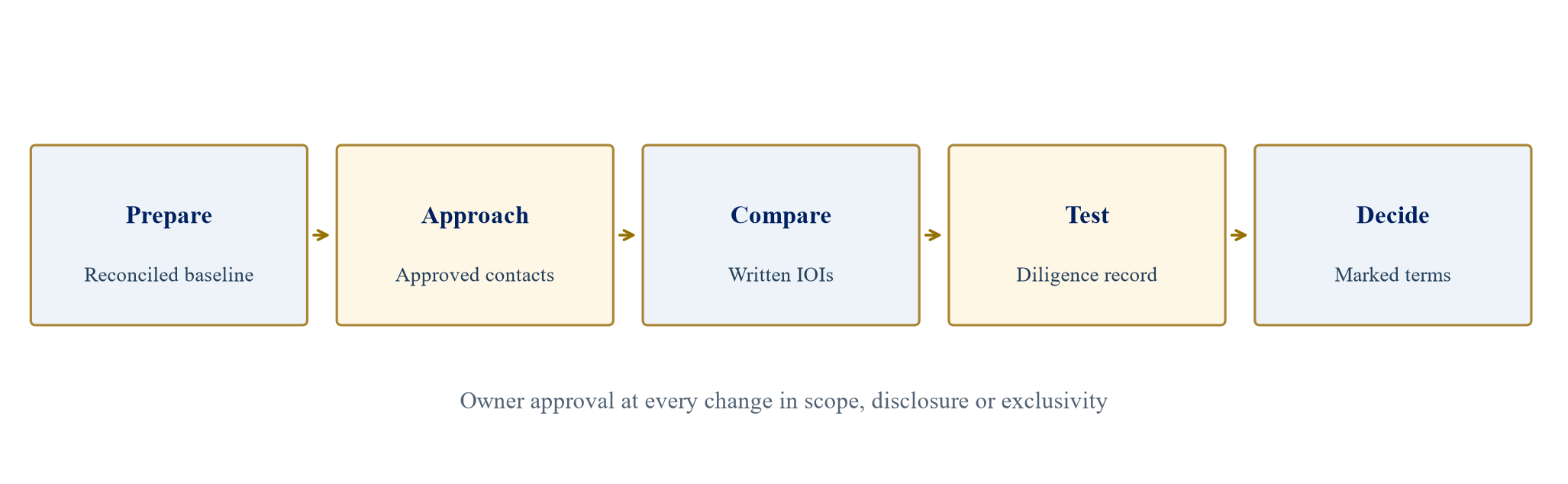
Author-developed process map. The gates do not imply a probability of sale or a standard timetable.
6 Reconcile the seller's baseline before presenting it
The business should prepare a source-linked baseline before any buyer is asked to value it. The baseline is not a promotional forecast. It records the corporate perimeter, accounting period, revenue recognition, EBITDA adjustments, debt and cash, working-capital seasonality, key contracts, ownership of intellectual property and material litigation or regulatory issues as applicable. Management should identify open items and the person responsible for resolving each. The adviser can then prepare a confidential information presentation that describes the business without hiding the items a serious bidder will test.
For each metric, the baseline should identify a source document and the date on which it was approved. A revenue chart taken from management accounts may differ from audited accounts because of cut-off, consolidation or classification. An adjusted earnings calculation may include costs that a buyer does not accept as non-recurring. The seller should keep an unadjusted line alongside adjustments and be prepared to explain each one. The owner need not release every source at the first contact; the internal reconciliation should already exist so later disclosures can be checked against it.
Table 1 translates preparation into acceptance criteria. It is a process design, not a statement of universal legal requirements. Its purpose is to prevent a polished presentation from advancing ahead of the records that support it. A small company may have limited formal reporting; that limitation belongs in the issue log and may affect how much a buyer can underwrite before deeper diligence. A business with several subsidiaries should also reconcile intercompany balances and the actual entity that owns each asset or contract.
Table 1. Seller preparation register before controlled outreach
| Deliverable | Minimum evidence to inspect | Owner decision | If incomplete |
|---|---|---|---|
| Transaction perimeter | Entity chart, owners, assets and excluded operations | Approve what is offered | Qualify teaser or postpone valuation request |
| Historical financial bridge | Accounts, management reports and reconciliation of adjustments | Approve financial baseline | Flag unexplained variances and assign reviewer |
| Forecast and assumptions | Dated model, drivers, downside cases and management sign-off | Approve release version | Mark forecast as draft and restrict reliance |
| Debt, cash and working capital | Facility letters, balances and seasonal history | Approve pricing definitions | Request transaction-specific bridge |
| Customer and contract exposure | Executed contracts, concentration and consent map | Approve staged disclosure | Limit access and seek counsel's advice |
| Legal and regulatory issues | Licences, disputes and material obligations | Approve issue description | Resolve or disclose uncertainty in controlled form |
Author-developed acceptance criteria. Apply them to the actual transaction perimeter and applicable law.
7 Design a buyer universe that can be tested
A buyer universe should be a set of reasoned hypotheses, not a large mailing list. For each proposed counterparty, the adviser should identify the strategic or financial rationale, likely decision maker, prior acquisition experience where verified, geographic reach, possible funding route and any conflict or confidentiality concern. The record should distinguish direct evidence from an adviser assumption. A company's public strategy statement may support interest in a sector; it does not prove current acquisition authority. A prior deal may demonstrate that a buyer can close something, but it does not establish available capital or appetite for this target.
The owner should approve tiers for outreach. A first tier may contain parties with a clear transaction thesis and manageable disclosure risk. A second tier may be contingent on early market feedback. A small group can preserve discretion for a family company with customer or employee sensitivity, while a wider process may be justified when the business has multiple plausible buyer categories. Research into auctions and negotiated sales shows that the relative outcomes depend on entry and information conditions; it does not support a fixed rule that broader outreach always wins [1,2].
The universe should include a written exclusion rationale where appropriate. A direct competitor may require additional information controls. An investor with a portfolio overlap may need conflict review. A buyer whose capital must be syndicated could still be credible, provided the financing route and approval steps are visible. The owner can allow a party to receive a teaser and withhold customer-level data until a later stage. The adviser must not imply that a buyer has approved a transaction merely because an introductory call occurred.
After outreach, the adviser should report outcomes by stage and reason rather than by an aggregate “buyers contacted” figure. Silence, lack of sector fit, price, process timing and legal restrictions are different results. A declined approach can improve the buyer map if its reason is reliable and recorded. Claims about the quality of the pool should be made with reference to these observations, not to the original size of the list.
8 Stage disclosure through the teaser and confidentiality process
The initial teaser should allow a relevant buyer to assess strategic fit without giving away commercially sensitive information that is unnecessary at that stage. It should accurately describe the business perimeter, broad economics, operating model and transaction concept. The owner should approve its claims against the baseline. A teaser that promises a growth rate or customer mix inconsistent with the data room creates a revision problem before a bid has been made.
When a party wants more information, counsel should prepare the confidentiality framework for the actual parties and jurisdiction. The agreement may address permitted use, disclosure to advisers or financing sources, restrictions on solicitation and the handling of information if the process ends. The adviser should record execution and permitted recipients before releasing the confidential information presentation. This paper does not prescribe a form of NDA or decide what restrictions are enforceable; counsel must review the transaction-specific language.
Information should be released in a planned sequence. A buyer can receive aggregated customer concentration and a description of major contracts before names or terms are disclosed. A direct competitor may require clean-team arrangements or delayed access to granular information. A financial sponsor may need enough detail to test an investment case and funding path, but the same control log should record every version it received. In public US sale processes, filings show the use of NDAs, staged data packages, data rooms and management sessions [5,6,10]. Those examples illustrate mechanics rather than a required private-company script.
The adviser should maintain a release log containing the recipient, information version, time, permission and follow-up question. A later disagreement about what a buyer knew can then be investigated. Where a material error is found, the seller can issue a controlled correction to relevant recipients and record its effect on the bid timetable. Consistency matters because a bidder may change price when an assumption changes; the seller needs to know whether that change reflects new facts or a revised negotiating position.
9 Make the information presentation auditable
The confidential information presentation should connect historical performance, current trading and forecast assumptions in a way that a buyer can test. Management should identify the source of each material statement and the person accountable for it. A claim about recurring revenue should explain the contract, renewal and churn definitions. A margin forecast should state the cost actions required to reach it. A description of a project pipeline should distinguish awarded work from bids and from management expectations. These distinctions are necessary for a buyer to value the business on the same perimeter as the seller.
The presentation should give a balanced account of concentration, customer dependence, owner involvement, capex needs and regulatory dependencies where material. An owner may fear that disclosing risks weakens the price. A buyer who discovers a material issue late may change both price and trust in the process. This paper cannot quantify the effect of early disclosure. It proposes that the seller document each known issue and decide when and how to present it with advisers and counsel, keeping the underlying evidence ready for questions.
Forecasts deserve their own version control. The company should store the model used for outreach, the model used for indications of interest and any later revision. If management changes a sales assumption, the adviser should show the resulting change in revenue, cash and debt, not silently replace a PDF. The buyer should be told which version it is asked to bid against. A process with several bidders becomes difficult to compare when each has used a different management case.
A presentation can include an upside case, but it should label its assumptions and distinguish them from historical results. The owner should avoid presenting a scenario as a committed plan when it depends on unapproved investment, customer contracts or market prices. A credible buyer may value a contingent opportunity while reserving diligence rights over it. The adviser should keep those rights visible in the bid comparison rather than interpreting a valuation range as acceptance of every forecast line.
10 Operate the data room as an evidence system
A virtual data room is a controlled record of what was disclosed, to whom and when. Its index should follow the transaction perimeter and the questions a bidder must answer. A folder full of unsorted files does not make an issue diligence-ready. Core documents should be named, dated and linked to the relevant claim in the information presentation. Access rights can be set by bidder and stage. Management and counsel should decide whether sensitive records require redaction, delayed release or supervised review.
The question-and-answer process should use one log. Each question needs a receiving date, category, owner, source document, response status and approval before the answer is released. A question about contract termination may require legal review. A question about customer revenue may require a reconciliation from the finance team. The adviser can coordinate the queue, track outstanding items and ensure that material answers are reflected in the next bid request. The seller should preserve versions; later price revisions can be assessed against what the buyer had actually seen.
Access records are useful, with limits. A bidder opening many files may be diligent, exploratory or trying to learn about the sector. Download counts do not demonstrate intent or financing. The adviser should infer engagement from the substance of questions, management attendance, revised terms and work on a draft agreement. The owner should not treat data-room activity as a hidden probability of completion.
Public deal histories show why the room and bid draft belong together. The Streamline filing reports selected bidders receiving a virtual data room and draft merger agreement before management presentations and a request for LOIs [5]. The 2024-25 VOXX process released a draft agreement and disclosure schedules before final proposals, with subsequent diligence sessions and legal markups [6]. Those records show possible sequencing. The seller should adapt the sequence to its own scale, confidentiality obligations and available management capacity.
11 Use management meetings to resolve underwriting questions
Management presentations are a chance to test the assumptions beneath a bid. The adviser should ask each participating buyer to identify the questions that would materially change its valuation or ability to sign. Management can then prepare factual answers, identify the documents needed and decide who should speak for each topic. A rehearsed promotional narrative cannot substitute for a reconciliation of revenue, customers, margins, capital expenditure and management dependence. A buyer that asks precise questions may be demonstrating work; the seller should also test whether the bidder has the authority and resources to act on the answers.
The meeting agenda should separate business explanation from negotiation. The owner may ask the adviser to lead the process and record open diligence, while management explains operations. Counsel should attend or be briefed where legal assertions or sensitive disclosure are likely. If a buyer seeks an immediate promise about pricing, employment, indemnity or exclusivity, the team should refer that issue to the approved decision route. Meeting notes should record material questions, responses and any correction promised after the meeting. They should not claim agreement where the parties have only exchanged views.
There is a cost to management time. A founder who runs sales, operations and finance can spend weeks serving buyers who have no live bid authority. The adviser should schedule deeper meetings after an initial fit and information test. Conversely, a buyer may require direct management access before committing capital. The owner should choose that sequence consciously and apply it consistently enough that bid comparisons remain interpretable.
The Streamline disclosure shows that several selected parties attended management presentations and then withdrew before submitting requested LOIs or agreement markups [5]. The record does not establish that the presentations caused withdrawal. It demonstrates that a meeting can produce a different outcome from the one inferred from the number of parties still invited. The adviser should report the change in status and the reason where the buyer provides one.
12 Require comparable indications of interest
A first-round request should ask each bidder for the same core terms while allowing space to explain an unusual structure. The request can specify the perimeter, reference accounts date, price basis, assumed debt and cash, expected working-capital adjustment, cash and non-cash consideration, proposed rollover or earn-out, financing sources, approvals, remaining diligence, exclusivity request and target dates for signing and completion. The bidder should identify which parts are preliminary and what evidence would change them. Counsel should review the request and any discussion of legal effect.
The adviser should not create a false sense of comparability by forcing different proposals into one headline number. A bidder may buy only a division; another may acquire the entire group. A financial sponsor may require the founder to roll over equity. A strategic buyer may pay in its own listed shares. The seller should first identify differences in perimeter and payment, then decide whether each offer can be recast to an agreed common case. If it cannot, the adviser should present separate decision paths rather than invent a conversion rate.
The same rule applies to timing. “Ready to sign” means little if financing committee approval, customer consents, diligence and regulatory review remain open. Ask the bidder to state the decisions already made, the people with authority to make the rest and the documents required. Evidence might include a board or investment-committee approval, a lender commitment or a precise financing plan. Its sufficiency depends on the transaction and legal context. A letter from an adviser describing possible debt funding should be recorded differently from an executed commitment.
The bidder should submit a dated written proposal. The adviser can then maintain a version history and compare like with like. In a 2026 US sale process, final proposals carried different legal materials, including full agreement markups and issues lists [7]. That filing shows why a price column alone misses information already available before exclusivity.
13 Normalize the price and the payment promise
The bid comparison begins with a common accounting and transaction perimeter. For an illustrative share sale, enterprise value can be bridged to equity consideration by subtracting agreed debt and adding agreed cash. Completion cash then depends on deferrals, escrow and non-cash consideration. Other adjustments, tax, advisory fees and transaction costs must be reviewed separately. The precise agreement definitions govern the real transaction. A seller should not add a buyer's stated enterprise value to contingent consideration if that consideration is already included in the headline.
Table 2 uses three author-created proposals. Each assumes USD 15 million of debt and USD 3 million of cash on an agreed basis, with no further bridge adjustments. Bid A states USD 80 million of enterprise value, all in cash consideration apart from USD 6.8 million held in escrow. Bid B states USD 85 million but includes USD 15 million of contingent consideration and a USD 5 million escrow. Bid C states USD 78 million with a USD 3 million escrow. Under those assumptions, completion cash before tax and transaction costs is USD 61.2 million, USD 53 million and USD 63 million respectively. The escrow and contingent amounts may later be paid, partly paid or never paid. No probability is assigned.
The exercise shows what a bid sheet must reveal. Bid B has the highest headline value and the lowest completion cash of the three modeled cases. Bid C has the lowest enterprise value and the highest modeled completion cash. This arithmetic does not select Bid C. A real decision also depends on the buyer's ability to fund, contract terms, timing, post-closing obligations and the seller's own preference for contingent upside. The adviser should show the components separately and ask the owner which risks it is willing to retain.
Table 2. Three illustrative offers normalized to a common perimeter
| Offer | Enterprise value | Equity consideration | Earn-out included | Escrow | Cash at completion | Open execution question |
|---|---|---|---|---|---|---|
| A | 80.0 | 68.0 | 0.0 | 6.8 | 61.2 | Confirm financing and release conditions |
| B | 85.0 | 73.0 | 15.0 | 5.0 | 53.0 | Define earn-out and funding path |
| C | 78.0 | 66.0 | 0.0 | 3.0 | 63.0 | Test approvals and closing timetable |
USD millions. Author-created arithmetic; debt 15 and cash 3 in each case. Completion cash excludes tax, advisory fees, other costs and any additional purchase-price adjustment.
Figure 2 displays the same cash and conditional components. The figure contains no risk-adjusted valuation. It deliberately avoids a weighted expected value because there is no credible probability estimate for escrow release, earn-out achievement or completion. A seller with a different utility for liquidity or future upside may rationally prefer a different offer. The model should be rerun when the bidder changes the transaction perimeter or price-adjustment mechanism.
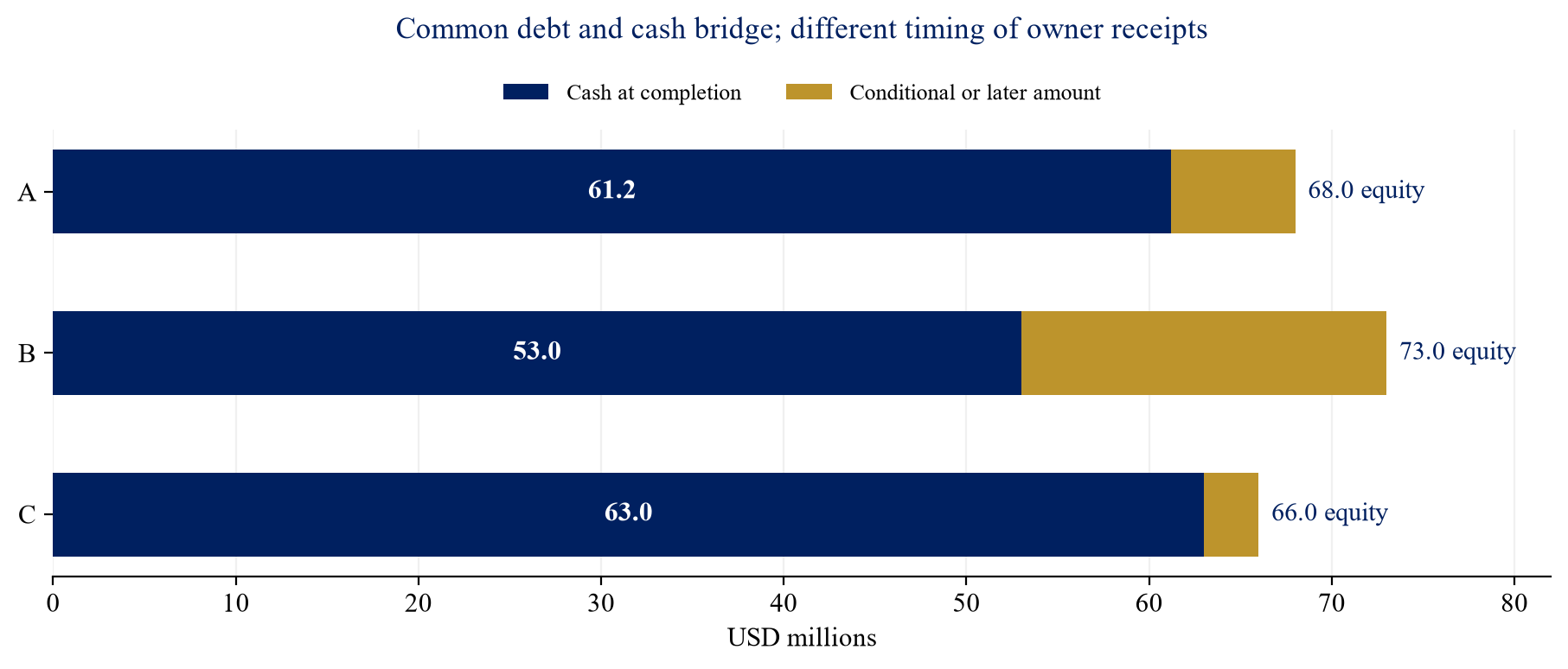
Author-created offers in USD millions. Conditional components include escrow and the stated earn-out; their future receipt is not predicted.
14 Test financing evidence and execution conditions
Funding language belongs beside price. A buyer may plan to use cash on its balance sheet, committed equity, bank debt, a fund's available capital or a new syndicate. Each route has different approvals and documentary proof. The adviser should request a financing map that names the payer, sources, decision makers, conditions and dates. Counsel should assess the actual proposal and agreement language. An assertion that a fund has assets under management is not evidence that this transaction has the required equity reserved for it.
The seller should also separate financing conditions from broader execution conditions. A bid can be free of an express financing contingency and still depend on material regulatory approvals, third-party consents or due diligence. A buyer can have financing arranged but ask for a long exclusivity period. A short timetable can be attractive when the buyer has already completed substantive work; it can also be unrealistic if customer contracts and tax matters remain unresolved. The adviser should identify which dependencies are within the buyer's control and which are not.
Public filings show how this information can alter comparison. A 2026 proxy describes a bidder stating that a whole-company acquisition would be funded from a committed fund without a financing contingency, alongside diligence and agreement markups [7]. Another 2026 disclosure records requests for more detail on a bidder's equity funding sources during enhanced diligence [8]. These are transaction-specific statements. The seller should ask for current evidence rather than assuming that a similar phrase in a private LOI offers equivalent protection.
The mandate should require the adviser to keep a financing-status column with date, source and unresolved conditions. An issue that remains open should appear in the owner briefing even if the buyer has the highest price. The owner can then decide whether to pursue two buyers in parallel, ask for stronger funding evidence or give one party a short conditional exclusivity period. Each choice has a cost in management time and negotiating leverage that should be recorded.
15 Trace price revisions to new facts and changed positions
A revised bid can reflect a legitimate discovery, a change in the buyer's financing, a different view of value or an attempt to renegotiate after rivals have left. The seller should not assign motive from the reduction alone. It can ask the bidder to identify the line item, source document, calculation and proposed contract change behind a revision. Management and advisers can then verify the issue and decide whether the same information was available before the earlier bid. The answer belongs in a dated revision log.
The log should keep the earlier proposal intact. For each revision, it should show the prior and new price, changed payment structure, assumptions, diligence items, financing conditions, legal markups and owner response. If the buyer claims a working-capital shortfall, the accountant can calculate it under the agreed definition. If the buyer cites a customer contract, counsel and management can test the clause and the commercial exposure. If a forecast is changed by the seller, every relevant bidder should be told through an approved disclosure route. The adviser should not conceal a material correction to preserve a headline number.
A 2026 US proxy records Party L reducing a proposed per-share price from USD 39.00 to USD 36.65, citing the results of due diligence and considerations about replicating equity compensation in a private company [8]. That record does not identify a general re-trade rate or establish that a different seller preparation process would have prevented the reduction. It illustrates the level of specificity needed to understand a revision. A seller may negotiate the identified item, seek alternative risk allocation or compare the revised proposal with another bidder's terms.
Figure 3 sets out the issue-to-decision path. It is a control against two opposite errors: accepting every lower price as inevitable and rejecting every lower price as bad faith. Evidence, contract language and the owner's alternatives should determine the response. A revised bid can improve certainty despite a lower number if it resolves a condition; a higher bid can become less attractive if it introduces a new contingency.
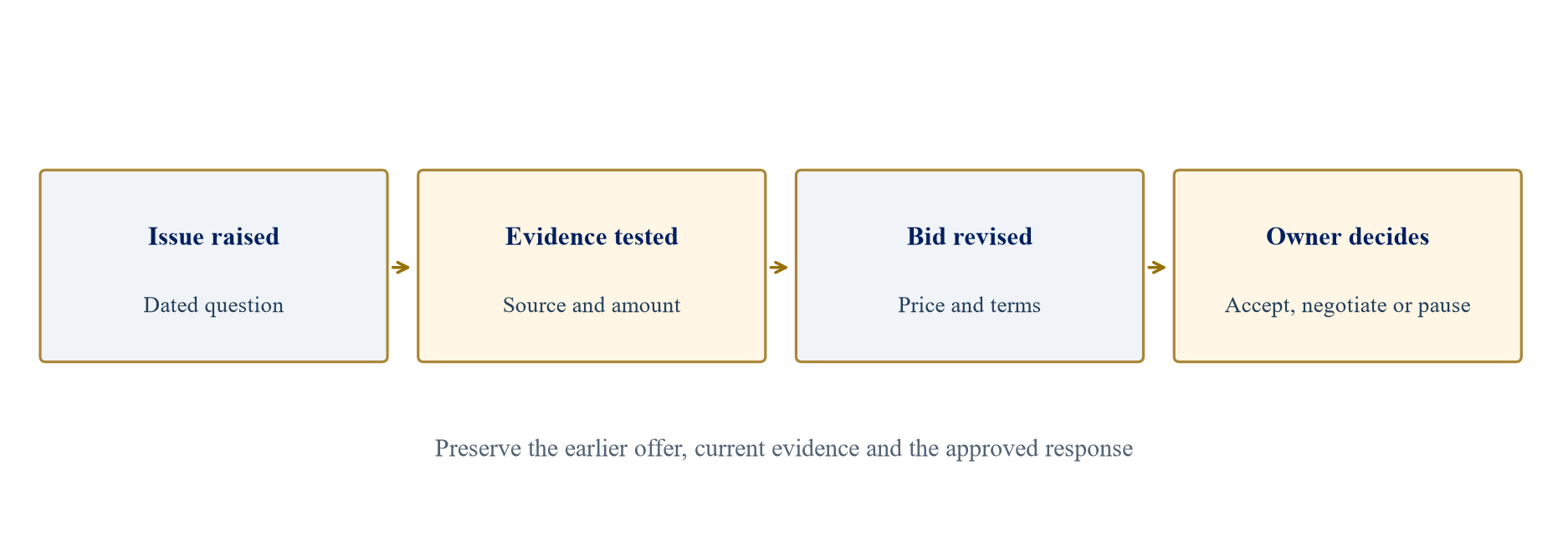
Author-developed decision sequence. It does not attribute motive or predict closing success.
16 Choose the sale format for the actual market
An auction is an organized comparison among several invited bidders. It may be appropriate when more than one buyer can underwrite the business and the seller can support a controlled process. A bilateral negotiation may be appropriate when one buyer has unusual synergies, confidentiality is highly sensitive or the transaction requires a bespoke payment structure. A sequential process can begin with a limited group and widen if terms remain weak. The owner should ask the adviser to explain the available formats against the specific buyer map and information risks, rather than describing an auction as intrinsically superior.
The empirical literature provides a useful discipline here. Boone and Mulherin's historical sample found comparable target-shareholder wealth effects for auctions and negotiations [1]. Gentry and Stroup estimated that the relative price performance varies with bidder uncertainty [2]. Hoffmann and Vladimirov show in theory that the payment structure can favour negotiation in particular settings [4]. Those results are from different data and models. They do not supply a decision rule for a private UAE owner with a specific business and a small number of credible counterparties.
A seller can preserve optionality by avoiding premature exclusivity. If one bidder offers to undertake expensive confirmatory diligence only with exclusivity, the owner should ask what diligence remains, how long the restriction lasts, whether milestones are measurable and how the process can restart if the bidder misses them. Counsel should draft the terms. The adviser should value the owner's foregone alternatives in qualitative terms where probabilities are unavailable and document which other buyers have actually remained engaged.
The format can change as evidence changes. A buyer might submit a compelling early offer with clear funding and accept an accelerated bilateral path. A broad initial process might reveal that only two buyers can handle the transaction perimeter. The owner can narrow the field with a recorded rationale. A negotiated sale can be tested against a pre-agreed market-check plan where lawful and commercially sensible. The mandate should allow the owner to make those choices without treating a change in process as an adviser failure by default.
17 Make the adviser mandate accountable to outputs
The engagement letter should state work products and decision points, not only a launch date and a closing objective. The owner can require a preparation gap register, buyer universe with rationale, approved teaser and information presentation, NDA and release log, data-room index, question log, preliminary-offer matrix, legal-issues tracker, financing-status record and final buyer recommendation with alternatives. Each deliverable should have an owner, a review date and an acceptance condition. The format can be scaled; the need for a reliable decision record remains.
Table 3 is an author-developed checklist for negotiating that scope. It does not create legal duties or claim a market-standard engagement term. A real mandate should specify the role of counsel and management, the confidentiality and conflict framework, payment terms, termination rights and any obligations that survive the mandate. The seller should also ask how records and data-room access will be handed over if the adviser changes. A sole adviser holding the only copy of the process log creates avoidable operational dependence.
The owner should require reporting that distinguishes work completed from market response. A weekly note could show which documents were approved, which counterparties were contacted, which signed NDAs, what questions remain, and how each live proposal changed. It should identify facts and unresolved judgements in separate columns. A board should be able to see why a buyer advanced or exited without relying on a verbal reconstruction months later.
Table 3. Mandate deliverables and acceptance questions
| Deliverable | Acceptance question | Evidence retained | Owner decision |
|---|---|---|---|
| Preparation register | Are the financial, legal and operating gaps assigned? | Versioned issue list and source links | Approve readiness or pause |
| Buyer universe | Does each proposed buyer have a stated fit and disclosure risk? | Approved target list and exclusions | Approve outreach tiers |
| Information package | Do material claims match approved source records? | Teaser, presentation and release versions | Approve information release |
| Diligence control | Can each material answer be traced to a source and reviewer? | Room index, Q&A log and access record | Authorize response or correction |
| Offer comparison | Are perimeter, cash, contingencies and conditions visible? | Dated IOIs, bridge and terms matrix | Select next-round bidders |
| Final recommendation | Can the owner see alternatives, open issues and legal markups? | Decision memo and document redlines | Negotiate, grant exclusivity or stop |
Author-developed scope checklist. The engagement letter and transaction documents govern actual rights and duties.
18 Work an illustrative decision through the protocol
Suppose a founder-owned group receives the three offers in Table 2. The common debt and cash bridge makes their equity values USD 68 million, USD 73 million and USD 66 million. The completion cash figures differ because of the modeled earn-out and escrows. Those numbers are useful but incomplete. The seller should ask each bidder for a written financing map, the remaining diligence list, treatment of employees and founder rollover, a proposed working-capital mechanism and comments on the draft agreement. The adviser should record the version of management information on which each offer was based.
Assume Bid A's price is supported by a written financing plan, but a key customer consent has not been tested. Bid B seeks a broad earn-out with accounting definitions still open. Bid C has a narrower escrow and proposes a shorter diligence list, but one material regulatory approval is unresolved. These are assumptions in a worked example, not observations about named buyers. The owner could ask A to allocate customer-consent risk more precisely, ask B for objective earn-out measures and stronger funding evidence, and ask C for a realistic approval timetable. Counsel and the relevant specialists would review each response.
The next board paper should show what changed after those requests. If B converts part of the earn-out to closing cash, the normalized comparison changes. If C cannot obtain approval within the owner's timetable, its larger completion-cash line loses some practical appeal. If A offers a price adjustment tied to the customer issue, the owner can compare that mechanism with the alternative of delaying exclusivity. The adviser should present the options and the evidence, including the opportunity cost of management time. It should not turn an internally chosen point score into an alleged probability of sale.
The example also shows the limits of a single acceptance rule. An owner with an urgent liquidity need may value cash at completion highly. Another may prefer contingent upside tied to a business it will continue to influence. A regulated buyer may face a predictable approval process that still takes longer. A family shareholder group may place weight on employee continuity. These preferences must be stated by the actual decision makers and tested against the terms; the paper does not assume them for a client.
19 Design a study that could test the deliverable question
A credible empirical study would need consented records from completed and abandoned private-company sell-side mandates. The unit of observation should be a buyer-mandate pair, with the seller and process identified by stable confidential keys. For each pair, the dataset would capture when a buyer was approached, which information version it received, whether it signed confidentiality terms, the stage it reached, every written proposal and revision, diligence questions, financing evidence, legal conditions and final outcome. The adviser deliverables should be recorded from dated files, not recalled after the result is known.
Two outcomes are especially relevant: the change from first qualified written proposal to final proposal, and the change from final proposal to signed agreement. A later price reduction should be separated from a change in transaction perimeter or payment form. Bid credibility could be described through disclosed financing, diligence and contract terms, but any composite score would require pre-registered definitions and sensitivity tests. The number of bids is a process measure, not itself a shareholder outcome. Owner cash and completion are separate outcomes that need their own accounting.
Selection is a serious obstacle. Advisers with stronger preparation practices may be hired by better-prepared companies. Buyers may engage more deeply when a target is unusually attractive. Distressed sellers may have limited time and fewer credible alternatives. Sector, size, trading trajectory, ownership, transaction form, buyer type and market conditions should be recorded. A before-and-after comparison within one mandate can describe revisions, but it cannot isolate the effect of the deliverable that preceded them. A study could use matched samples or a carefully specified event design if the data permit it; causal claims would still depend on identification and robustness.
Confidentiality and consent determine feasibility. The study would require permission from owners and advisers, a lawful data-handling plan, separation of identifying information, and a rule against publishing deal-level terms that reveal counterparties. No such cohort has been assembled for this paper. The study design makes the missing evidence explicit and gives a future researcher a field list that can be audited. Until it is executed, the paper's framework remains a decision aid, not an empirical result.
20 Leave the owner with a defensible decision record
At the end of a sale process, the owner should be able to answer six questions from contemporaneous records: what was offered for sale; what information each bidder received; which written proposals were comparable; what cash and conditional consideration each proposed; which approvals, funding and diligence items remained; and who authorised each material process decision. If one of those answers depends on a memory of a call, the adviser and management should repair the record before asking for a final commitment.
The auction behind the mandate is the work of turning buyer interest into reviewable alternatives. The adviser should show evidence of preparation, permitted outreach, controlled disclosure, diligence resolution and bidder engagement. The owner should compare offers under the same accounting bridge and then evaluate the differences that cannot be reduced to cash. A high headline can remain attractive when its conditions are acceptable; a lower bid can be preferable when its payment and execution terms fit the owner's objectives. The decision belongs to the owner after advice from the appropriate professionals.
The paper's figures and worksheets give a way to run that review. They do not imply a universal optimal number of buyers, a standard bid-conversion rate or a probability that a particular offer closes. The cited studies and named public transactions show why those questions matter; the private-company mandate data needed to test the proposed relationship are absent. That boundary should remain visible when the framework is used in a live sale.
An owner can demand a high-quality process even when a sale does not complete. The deliverable is an accurate record of options, risks and decisions that remains useful for a later financing, restructuring or renewed sale process. The adviser should make that record portable and ensure that sensitive information is returned or controlled under the agreed terms. The board can then assess whether the mandate delivered its contracted work, independently of a result that no adviser can promise.
References
- Boone, A. L. and Mulherin, J. H. “How Are Firms Sold?” Journal of Finance 62(2), 2007, 847-875. Accessed 6 October 2026. https://onlinelibrary.wiley.com/doi/10.1111/j.1540-6261.2007.01225.x
- Gentry, M. and Stroup, C. “Entry and Competition in Takeover Auctions.” Journal of Financial Economics 132(2), 2019, 298-324. Accessed 6 October 2026. https://www.sciencedirect.com/science/article/pii/S0304405X18302964
- Boone, A., De Maeseneire, W., Dereeper, S., Luypaert, M. and Nguyen Thuy, M. “Unravelling Bidding Strategies in M&A Transactions: Evidence from the Private Phase of the Deal Process.” ECGI Finance Working Paper 1015/2024, revised 11 November 2024. Accessed 6 October 2026. https://www.ecgi.global/publications/working-papers/unravelling-bidding-strategies-in-ma-transactions-evidence-from-the
- Hoffmann, F. and Vladimirov, V. “Auctions versus Negotiations: The Role of the Payment Structure.” Journal of Finance 80(3), 2025, 1769-1813. Accessed 6 October 2026. https://onlinelibrary.wiley.com/doi/10.1111/jofi.13446
- US Securities and Exchange Commission. Streamline Health Solutions preliminary merger proxy, 2025, background of the merger and sale process. Accessed 6 October 2026. https://www.sec.gov/Archives/edgar/data/1008586/000143774925021552/strm20250616_prem14a.htm
- US Securities and Exchange Commission. VOXX International preliminary merger proxy, 2025, final-round process letters, diligence and proposals. Accessed 6 October 2026. https://www.sec.gov/Archives/edgar/data/807707/000110465925015692/tm252893-4_prer14a.htm
- US Securities and Exchange Commission. AstroNova definitive merger proxy, 2026, buyer diligence, revised proposals and legal-term comparison. Accessed 6 October 2026. https://www.sec.gov/Archives/edgar/data/8146/000119312526326441/d140981ddefm14a.htm
- US Securities and Exchange Commission. MarineMax merger proxy, 2026, enhanced diligence and revised proposals. Accessed 6 October 2026. https://www.sec.gov/Archives/edgar/data/1057060/000119312526412241/d130789ddefm14a.htm
- Dubai Financial Services Authority. “New DFSA Thematic Review: Conflicts of Interest across DIFC Firms.” 9 January 2026. Accessed 6 October 2026. https://www.dfsa.ae/news/new-dfsa-thematic-review-conflict-interest-across-difc-firms
- US Securities and Exchange Commission. INNOVATE Corp. preliminary information statement concerning the DBMG sale, 2026, confidentiality agreements, information packages and indications of interest. Accessed 6 October 2026. https://www.sec.gov/Archives/edgar/data/1006837/000100683726000103/a20260821prem14cinformatio.htm
About the Author
Chennakeshav (CK) is a corporate finance and investment banking executive with 25+ years of global experience in deal origination, structuring and execution across M&A, growth capital and corporate strategy. He has led value-creation mandates for founders, corporates and funds — bridging the boardroom view to hands-on execution and close.
His career spans Morgan Stanley, HSBC, Lloyds Banking Group, EWEC, ADQ portfolio companies and Emirates Growth Fund, across TMT, real estate, fintech, deeptech, cleantech, infrastructure and energy. He has partnered with C-suite leaders, private equity and venture funds, sovereign wealth funds and family offices to finance complex fund raises and scale-up ventures, and has led M&A due diligence, post-merger integration and business-transformation initiatives to create value.
At Matchpoint Partners he is Managing Partner, leading the firm's corporate finance, M&A and capital-raising practice. He holds an MBA from London Business School, an engineering degree from VTU and a Master of Laws (LLM, in progress) from UCL London.
An active start-up mentor, CK mentors at Techstars, DIFC FinTech Hive, Startup Grind, Founder Institute and IN5, serves as Entrepreneur Mentor in Residence (EMiR) at London Business School, and judges the Entrepreneurship World Cup.
