

1. Define the public service outcome
The project team should state the essential service, users, capacity, access, quality, resilience and policy result being purchased. The required output is a service-outcome charter. Record the accountable party, source evidence, legal and budget authority, assumption, contractual treatment, cash-flow consequence and review date [1][2].
Test the treatment against service need, value for money, performance evidence, whole-life cost, public revenue and expenditure, debt and liquidity constraints, accounting and statistical rules, lender requirements and applicable law.
The principal risk is that payment can preserve an asset while failing the underlying public need. Quantify the effect on service continuity, payment entitlement, deductions, lifecycle condition, financing resilience, fiscal headroom, public debt, intergenerational cost and residual value. Compare the proposed structure with credible public delivery, user-pay, regulated, hybrid and reprocurement alternatives.
Translate the conclusion into the output specification, payment mechanism, deduction rules, indexation, budget controls, security, disclosure, monitoring, disputes, change, relief, termination and handback provisions. Refresh the evidence after material service, fiscal, macroeconomic, legal, accounting, financing or performance change.
2. Separate availability from demand
The project team should distinguish capacity, operability and quality from actual usage, tariff collection and policy-driven demand. The required output is an availability-demand boundary map. Record the accountable party, source evidence, legal and budget authority, assumption, contractual treatment, cash-flow consequence and review date [1][3].
Test the treatment against service need, value for money, performance evidence, whole-life cost, public revenue and expenditure, debt and liquidity constraints, accounting and statistical rules, lender requirements and applicable law.
The principal risk is that government can absorb demand exposure without recognising its budget consequence. Quantify the effect on service continuity, payment entitlement, deductions, lifecycle condition, financing resilience, fiscal headroom, public debt, intergenerational cost and residual value. Compare the proposed structure with credible public delivery, user-pay, regulated, hybrid and reprocurement alternatives.
Translate the conclusion into the output specification, payment mechanism, deduction rules, indexation, budget controls, security, disclosure, monitoring, disputes, change, relief, termination and handback provisions. Refresh the evidence after material service, fiscal, macroeconomic, legal, accounting, financing or performance change.
3. Establish the payment baseline
The project team should identify fixed, indexed, volume-related, pass-through, lifecycle and exceptional payment components. The required output is a baseline unitary-payment schedule. Record the accountable party, source evidence, legal and budget authority, assumption, contractual treatment, cash-flow consequence and review date [4][5].
Test the treatment against service need, value for money, performance evidence, whole-life cost, public revenue and expenditure, debt and liquidity constraints, accounting and statistical rules, lender requirements and applicable law.
The principal risk is that headline annual payments can omit material escalation and contingent layers. Quantify the effect on service continuity, payment entitlement, deductions, lifecycle condition, financing resilience, fiscal headroom, public debt, intergenerational cost and residual value. Compare the proposed structure with credible public delivery, user-pay, regulated, hybrid and reprocurement alternatives.
Translate the conclusion into the output specification, payment mechanism, deduction rules, indexation, budget controls, security, disclosure, monitoring, disputes, change, relief, termination and handback provisions. Refresh the evidence after material service, fiscal, macroeconomic, legal, accounting, financing or performance change.
4. Map the complete fiscal exposure
The project team should combine contractual payments, guarantees, compensation, termination, retained risks and likely renegotiation costs. The required output is a fiscal-exposure register. Record the accountable party, source evidence, legal and budget authority, assumption, contractual treatment, cash-flow consequence and review date [6][7].
Test the treatment against service need, value for money, performance evidence, whole-life cost, public revenue and expenditure, debt and liquidity constraints, accounting and statistical rules, lender requirements and applicable law.
The principal risk is that formal accounting can understate the economic claim on future budgets. Quantify the effect on service continuity, payment entitlement, deductions, lifecycle condition, financing resilience, fiscal headroom, public debt, intergenerational cost and residual value. Compare the proposed structure with credible public delivery, user-pay, regulated, hybrid and reprocurement alternatives.
Translate the conclusion into the output specification, payment mechanism, deduction rules, indexation, budget controls, security, disclosure, monitoring, disputes, change, relief, termination and handback provisions. Refresh the evidence after material service, fiscal, macroeconomic, legal, accounting, financing or performance change.
5. Test delivery-model value for money
The project team should compare the partnership with credible public procurement and regulated alternatives on a risk-adjusted whole-life basis. The required output is a delivery-model appraisal. Record the accountable party, source evidence, legal and budget authority, assumption, contractual treatment, cash-flow consequence and review date [8][9].
Test the treatment against service need, value for money, performance evidence, whole-life cost, public revenue and expenditure, debt and liquidity constraints, accounting and statistical rules, lender requirements and applicable law.
The principal risk is that financing structure can drive procurement choice before service economics are tested. Quantify the effect on service continuity, payment entitlement, deductions, lifecycle condition, financing resilience, fiscal headroom, public debt, intergenerational cost and residual value. Compare the proposed structure with credible public delivery, user-pay, regulated, hybrid and reprocurement alternatives.
Translate the conclusion into the output specification, payment mechanism, deduction rules, indexation, budget controls, security, disclosure, monitoring, disputes, change, relief, termination and handback provisions. Refresh the evidence after material service, fiscal, macroeconomic, legal, accounting, financing or performance change.
6. Set the affordability envelope
The project team should cap annual and cumulative commitments against realistic revenue, expenditure, debt and policy headroom. The required output is a multi-year affordability limit. Record the accountable party, source evidence, legal and budget authority, assumption, contractual treatment, cash-flow consequence and review date [6][10].
Test the treatment against service need, value for money, performance evidence, whole-life cost, public revenue and expenditure, debt and liquidity constraints, accounting and statistical rules, lender requirements and applicable law.
The principal risk is that a project can be financeable for lenders while unaffordable for the public authority. Quantify the effect on service continuity, payment entitlement, deductions, lifecycle condition, financing resilience, fiscal headroom, public debt, intergenerational cost and residual value. Compare the proposed structure with credible public delivery, user-pay, regulated, hybrid and reprocurement alternatives.
Translate the conclusion into the output specification, payment mechanism, deduction rules, indexation, budget controls, security, disclosure, monitoring, disputes, change, relief, termination and handback provisions. Refresh the evidence after material service, fiscal, macroeconomic, legal, accounting, financing or performance change.
7. Define measurable availability
The project team should specify locations, service periods, capacity states, access conditions, safety and permitted exclusions. The required output is an availability specification. Record the accountable party, source evidence, legal and budget authority, assumption, contractual treatment, cash-flow consequence and review date [1][11].
Test the treatment against service need, value for money, performance evidence, whole-life cost, public revenue and expenditure, debt and liquidity constraints, accounting and statistical rules, lender requirements and applicable law.
The principal risk is that ambiguous availability can produce payment despite material loss of service. Quantify the effect on service continuity, payment entitlement, deductions, lifecycle condition, financing resilience, fiscal headroom, public debt, intergenerational cost and residual value. Compare the proposed structure with credible public delivery, user-pay, regulated, hybrid and reprocurement alternatives.
Translate the conclusion into the output specification, payment mechanism, deduction rules, indexation, budget controls, security, disclosure, monitoring, disputes, change, relief, termination and handback provisions. Refresh the evidence after material service, fiscal, macroeconomic, legal, accounting, financing or performance change.
8. Design service and performance standards
The project team should translate user outcomes into measurable response, quality, maintenance, safety and resilience requirements. The required output is a performance-standard schedule. Record the accountable party, source evidence, legal and budget authority, assumption, contractual treatment, cash-flow consequence and review date [11][12].
Test the treatment against service need, value for money, performance evidence, whole-life cost, public revenue and expenditure, debt and liquidity constraints, accounting and statistical rules, lender requirements and applicable law.
The principal risk is that large payment streams can depend on narrow indicators unrelated to user harm. Quantify the effect on service continuity, payment entitlement, deductions, lifecycle condition, financing resilience, fiscal headroom, public debt, intergenerational cost and residual value. Compare the proposed structure with credible public delivery, user-pay, regulated, hybrid and reprocurement alternatives.
Translate the conclusion into the output specification, payment mechanism, deduction rules, indexation, budget controls, security, disclosure, monitoring, disputes, change, relief, termination and handback provisions. Refresh the evidence after material service, fiscal, macroeconomic, legal, accounting, financing or performance change.
Table 1. Availability-payment architecture
| Layer | Payment basis | Primary control |
|---|---|---|
| capacity | available service | unavailability deduction |
| quality | performance standard | failure points and deduction |
| lifecycle | supported condition | reserve and inspection |
| exception | defined event | evidence and approval |
Illustrative analytical structure; verified project and jurisdiction evidence governs.
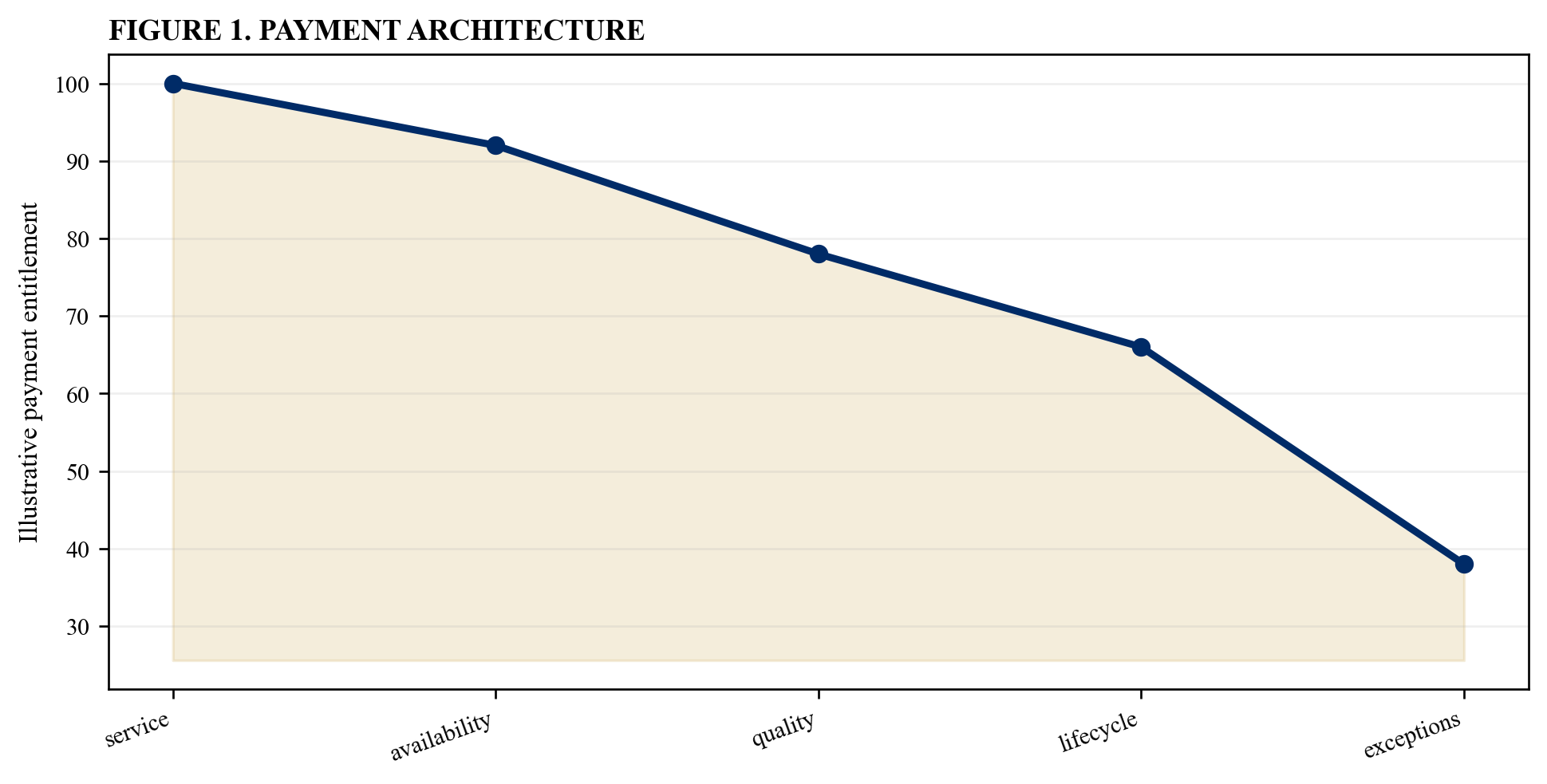
Illustrative analytical scenario; verified project evidence should replace values.
9. Create the deduction architecture
The project team should link failure severity, duration, affected capacity, recurrence and service criticality to monetary deductions. The required output is a calibrated deduction matrix. Record the accountable party, source evidence, legal and budget authority, assumption, contractual treatment, cash-flow consequence and review date [1][13].
Test the treatment against service need, value for money, performance evidence, whole-life cost, public revenue and expenditure, debt and liquidity constraints, accounting and statistical rules, lender requirements and applicable law.
The principal risk is that weak deductions can become an accepted operating cost rather than an incentive. Quantify the effect on service continuity, payment entitlement, deductions, lifecycle condition, financing resilience, fiscal headroom, public debt, intergenerational cost and residual value. Compare the proposed structure with credible public delivery, user-pay, regulated, hybrid and reprocurement alternatives.
Translate the conclusion into the output specification, payment mechanism, deduction rules, indexation, budget controls, security, disclosure, monitoring, disputes, change, relief, termination and handback provisions. Refresh the evidence after material service, fiscal, macroeconomic, legal, accounting, financing or performance change.
10. Calibrate proportionality and materiality
The project team should test deductions across isolated, repeated, correlated and whole-facility failure scenarios. The required output is a deduction calibration model. Record the accountable party, source evidence, legal and budget authority, assumption, contractual treatment, cash-flow consequence and review date [13][14].
Test the treatment against service need, value for money, performance evidence, whole-life cost, public revenue and expenditure, debt and liquidity constraints, accounting and statistical rules, lender requirements and applicable law.
The principal risk is that excessive deductions can destabilise the project while trivial deductions fail to protect value. Quantify the effect on service continuity, payment entitlement, deductions, lifecycle condition, financing resilience, fiscal headroom, public debt, intergenerational cost and residual value. Compare the proposed structure with credible public delivery, user-pay, regulated, hybrid and reprocurement alternatives.
Translate the conclusion into the output specification, payment mechanism, deduction rules, indexation, budget controls, security, disclosure, monitoring, disputes, change, relief, termination and handback provisions. Refresh the evidence after material service, fiscal, macroeconomic, legal, accounting, financing or performance change.
11. Control cure and rectification
The project team should define response clocks, temporary mitigation, permanent repair, retesting and recurrence treatment. The required output is a rectification protocol. Record the accountable party, source evidence, legal and budget authority, assumption, contractual treatment, cash-flow consequence and review date [11][15].
Test the treatment against service need, value for money, performance evidence, whole-life cost, public revenue and expenditure, debt and liquidity constraints, accounting and statistical rules, lender requirements and applicable law.
The principal risk is that repeated cure periods can allow persistent underperformance without economic consequence. Quantify the effect on service continuity, payment entitlement, deductions, lifecycle condition, financing resilience, fiscal headroom, public debt, intergenerational cost and residual value. Compare the proposed structure with credible public delivery, user-pay, regulated, hybrid and reprocurement alternatives.
Translate the conclusion into the output specification, payment mechanism, deduction rules, indexation, budget controls, security, disclosure, monitoring, disputes, change, relief, termination and handback provisions. Refresh the evidence after material service, fiscal, macroeconomic, legal, accounting, financing or performance change.
12. Govern self-reporting and verification
The project team should combine operator reporting, authority validation, automated evidence, user feedback and independent audit. The required output is a performance-evidence protocol. Record the accountable party, source evidence, legal and budget authority, assumption, contractual treatment, cash-flow consequence and review date [12][16].
Test the treatment against service need, value for money, performance evidence, whole-life cost, public revenue and expenditure, debt and liquidity constraints, accounting and statistical rules, lender requirements and applicable law.
The principal risk is that information asymmetry can suppress recorded failures and deductions. Quantify the effect on service continuity, payment entitlement, deductions, lifecycle condition, financing resilience, fiscal headroom, public debt, intergenerational cost and residual value. Compare the proposed structure with credible public delivery, user-pay, regulated, hybrid and reprocurement alternatives.
Translate the conclusion into the output specification, payment mechanism, deduction rules, indexation, budget controls, security, disclosure, monitoring, disputes, change, relief, termination and handback provisions. Refresh the evidence after material service, fiscal, macroeconomic, legal, accounting, financing or performance change.
13. Prevent waiver and enforcement drift
The project team should require documented decisions, delegated authority, cumulative registers and periodic assurance. The required output is an enforcement-control register. Record the accountable party, source evidence, legal and budget authority, assumption, contractual treatment, cash-flow consequence and review date [15][17].
Test the treatment against service need, value for money, performance evidence, whole-life cost, public revenue and expenditure, debt and liquidity constraints, accounting and statistical rules, lender requirements and applicable law.
The principal risk is that informal tolerance can rewrite the payment bargain without transparent approval. Quantify the effect on service continuity, payment entitlement, deductions, lifecycle condition, financing resilience, fiscal headroom, public debt, intergenerational cost and residual value. Compare the proposed structure with credible public delivery, user-pay, regulated, hybrid and reprocurement alternatives.
Translate the conclusion into the output specification, payment mechanism, deduction rules, indexation, budget controls, security, disclosure, monitoring, disputes, change, relief, termination and handback provisions. Refresh the evidence after material service, fiscal, macroeconomic, legal, accounting, financing or performance change.
14. Design indexation deliberately
The project team should separate labour, energy, materials and fixed-cost exposures and apply suitable indices, lags, caps and floors. The required output is an indexation schedule. Record the accountable party, source evidence, legal and budget authority, assumption, contractual treatment, cash-flow consequence and review date [4][18].
Test the treatment against service need, value for money, performance evidence, whole-life cost, public revenue and expenditure, debt and liquidity constraints, accounting and statistical rules, lender requirements and applicable law.
The principal risk is that broad inflation pass-through can transfer efficiency and basis risk back to government. Quantify the effect on service continuity, payment entitlement, deductions, lifecycle condition, financing resilience, fiscal headroom, public debt, intergenerational cost and residual value. Compare the proposed structure with credible public delivery, user-pay, regulated, hybrid and reprocurement alternatives.
Translate the conclusion into the output specification, payment mechanism, deduction rules, indexation, budget controls, security, disclosure, monitoring, disputes, change, relief, termination and handback provisions. Refresh the evidence after material service, fiscal, macroeconomic, legal, accounting, financing or performance change.
15. Allocate utility and commodity costs
The project team should assign power, water, fuel, connectivity and waste exposures to the party with control and hedging capacity. The required output is a pass-through and efficiency matrix. Record the accountable party, source evidence, legal and budget authority, assumption, contractual treatment, cash-flow consequence and review date [18][19].
Test the treatment against service need, value for money, performance evidence, whole-life cost, public revenue and expenditure, debt and liquidity constraints, accounting and statistical rules, lender requirements and applicable law.
The principal risk is that uncontrolled input costs can turn fixed availability payments into open-ended claims. Quantify the effect on service continuity, payment entitlement, deductions, lifecycle condition, financing resilience, fiscal headroom, public debt, intergenerational cost and residual value. Compare the proposed structure with credible public delivery, user-pay, regulated, hybrid and reprocurement alternatives.
Translate the conclusion into the output specification, payment mechanism, deduction rules, indexation, budget controls, security, disclosure, monitoring, disputes, change, relief, termination and handback provisions. Refresh the evidence after material service, fiscal, macroeconomic, legal, accounting, financing or performance change.
16. Fund lifecycle performance
The project team should align maintenance, renewal, reserve, inspection and handback obligations with the payment and financing model. The required output is a lifecycle-funding plan. Record the accountable party, source evidence, legal and budget authority, assumption, contractual treatment, cash-flow consequence and review date [20][21].
Test the treatment against service need, value for money, performance evidence, whole-life cost, public revenue and expenditure, debt and liquidity constraints, accounting and statistical rules, lender requirements and applicable law.
The principal risk is that short-term payment pressure can defer renewal and create a larger public liability later. Quantify the effect on service continuity, payment entitlement, deductions, lifecycle condition, financing resilience, fiscal headroom, public debt, intergenerational cost and residual value. Compare the proposed structure with credible public delivery, user-pay, regulated, hybrid and reprocurement alternatives.
Translate the conclusion into the output specification, payment mechanism, deduction rules, indexation, budget controls, security, disclosure, monitoring, disputes, change, relief, termination and handback provisions. Refresh the evidence after material service, fiscal, macroeconomic, legal, accounting, financing or performance change.
Table 2. Illustrative deduction bands
| Failure | Illustrative severity | Commercial response |
|---|---|---|
| minor local | 10 | rectify and record |
| material repeated | 35 | deduction and escalation |
| critical capacity | 70 | weighted deduction |
| whole service | 100 | no affected payment |
Illustrative analytical structure; verified project and jurisdiction evidence governs.
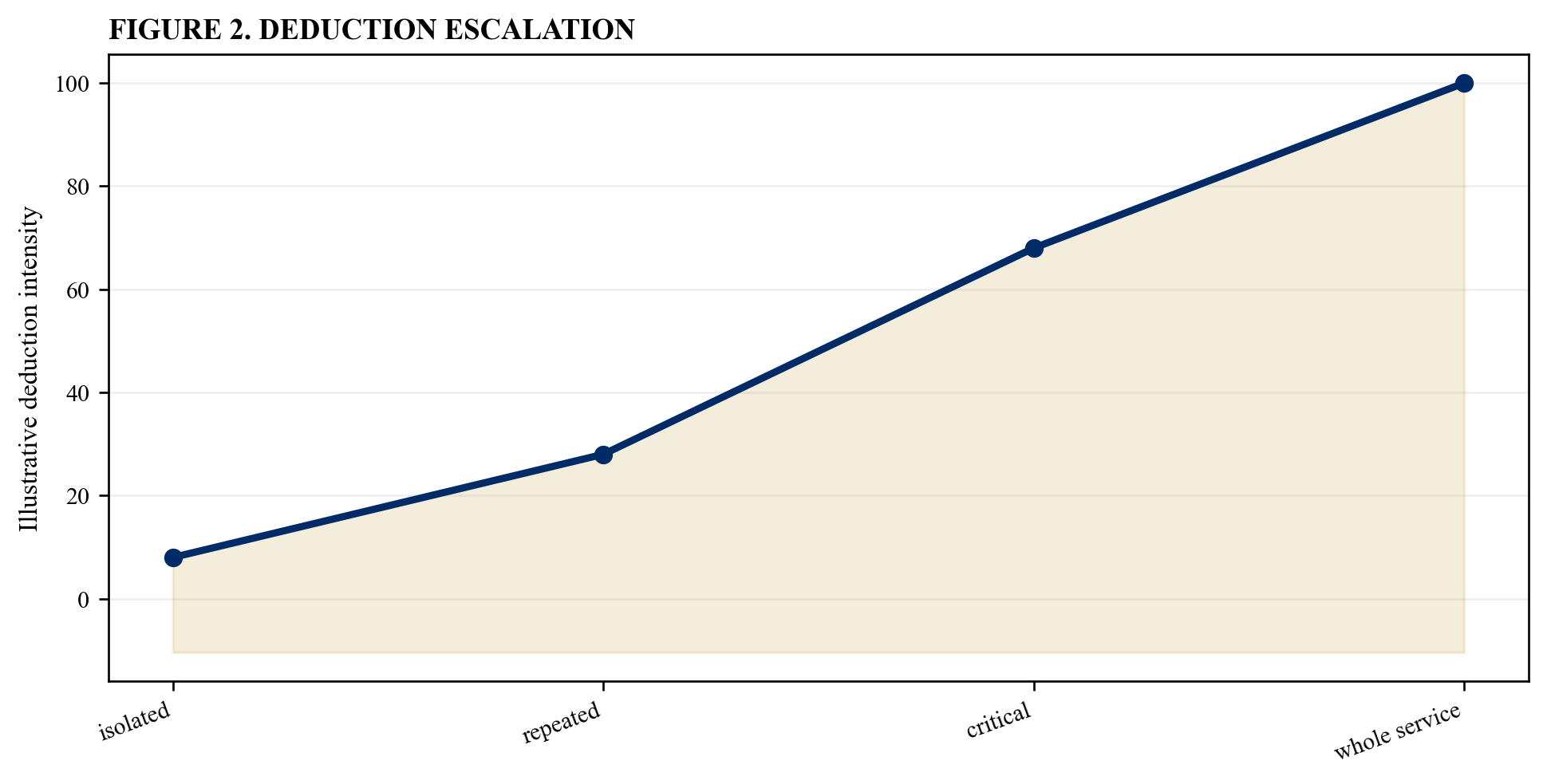
Illustrative analytical scenario; verified project evidence should replace values.
17. Model nominal whole-life payments
The project team should forecast base payments, indexation, taxes, lifecycle, change and expected deductions across the contract term. The required output is a nominal fiscal-payment profile. Record the accountable party, source evidence, legal and budget authority, assumption, contractual treatment, cash-flow consequence and review date [6][22].
Test the treatment against service need, value for money, performance evidence, whole-life cost, public revenue and expenditure, debt and liquidity constraints, accounting and statistical rules, lender requirements and applicable law.
The principal risk is that discounted project value can conceal annual cash peaks and cumulative nominal burden. Quantify the effect on service continuity, payment entitlement, deductions, lifecycle condition, financing resilience, fiscal headroom, public debt, intergenerational cost and residual value. Compare the proposed structure with credible public delivery, user-pay, regulated, hybrid and reprocurement alternatives.
Translate the conclusion into the output specification, payment mechanism, deduction rules, indexation, budget controls, security, disclosure, monitoring, disputes, change, relief, termination and handback provisions. Refresh the evidence after material service, fiscal, macroeconomic, legal, accounting, financing or performance change.
18. Stress public revenue and expenditure
The project team should combine recession, inflation, interest, exchange, commodity, emergency spending and revenue weakness. The required output is a macro-fiscal affordability stress. Record the accountable party, source evidence, legal and budget authority, assumption, contractual treatment, cash-flow consequence and review date [7][23].
Test the treatment against service need, value for money, performance evidence, whole-life cost, public revenue and expenditure, debt and liquidity constraints, accounting and statistical rules, lender requirements and applicable law.
The principal risk is that payments can crowd out priority services precisely when public finances deteriorate. Quantify the effect on service continuity, payment entitlement, deductions, lifecycle condition, financing resilience, fiscal headroom, public debt, intergenerational cost and residual value. Compare the proposed structure with credible public delivery, user-pay, regulated, hybrid and reprocurement alternatives.
Translate the conclusion into the output specification, payment mechanism, deduction rules, indexation, budget controls, security, disclosure, monitoring, disputes, change, relief, termination and handback provisions. Refresh the evidence after material service, fiscal, macroeconomic, legal, accounting, financing or performance change.
19. Recognise contingent liabilities
The project team should identify guarantees, minimum payments, debt support, compensation, force majeure, termination and step-in costs. The required output is a contingent-liability inventory. Record the accountable party, source evidence, legal and budget authority, assumption, contractual treatment, cash-flow consequence and review date [6][24].
Test the treatment against service need, value for money, performance evidence, whole-life cost, public revenue and expenditure, debt and liquidity constraints, accounting and statistical rules, lender requirements and applicable law.
The principal risk is that low-probability claims exposures can become large cash calls during correlated stress. Quantify the effect on service continuity, payment entitlement, deductions, lifecycle condition, financing resilience, fiscal headroom, public debt, intergenerational cost and residual value. Compare the proposed structure with credible public delivery, user-pay, regulated, hybrid and reprocurement alternatives.
Translate the conclusion into the output specification, payment mechanism, deduction rules, indexation, budget controls, security, disclosure, monitoring, disputes, change, relief, termination and handback provisions. Refresh the evidence after material service, fiscal, macroeconomic, legal, accounting, financing or performance change.
20. Price retained public risks
The project team should estimate expected loss, tail loss, timing and liquidity need for risks left with the authority. The required output is a retained-risk valuation. Record the accountable party, source evidence, legal and budget authority, assumption, contractual treatment, cash-flow consequence and review date [24][25].
Test the treatment against service need, value for money, performance evidence, whole-life cost, public revenue and expenditure, debt and liquidity constraints, accounting and statistical rules, lender requirements and applicable law.
The principal risk is that risk allocation language can lack a funded estimate of the public downside. Quantify the effect on service continuity, payment entitlement, deductions, lifecycle condition, financing resilience, fiscal headroom, public debt, intergenerational cost and residual value. Compare the proposed structure with credible public delivery, user-pay, regulated, hybrid and reprocurement alternatives.
Translate the conclusion into the output specification, payment mechanism, deduction rules, indexation, budget controls, security, disclosure, monitoring, disputes, change, relief, termination and handback provisions. Refresh the evidence after material service, fiscal, macroeconomic, legal, accounting, financing or performance change.
21. Use fiscal commitment limits
The project team should apply portfolio ceilings, project thresholds, gate approvals and medium-term expenditure controls. The required output is a commitment-control framework. Record the accountable party, source evidence, legal and budget authority, assumption, contractual treatment, cash-flow consequence and review date [10][26].
Test the treatment against service need, value for money, performance evidence, whole-life cost, public revenue and expenditure, debt and liquidity constraints, accounting and statistical rules, lender requirements and applicable law.
The principal risk is that projects can be approved individually while the portfolio becomes collectively unaffordable. Quantify the effect on service continuity, payment entitlement, deductions, lifecycle condition, financing resilience, fiscal headroom, public debt, intergenerational cost and residual value. Compare the proposed structure with credible public delivery, user-pay, regulated, hybrid and reprocurement alternatives.
Translate the conclusion into the output specification, payment mechanism, deduction rules, indexation, budget controls, security, disclosure, monitoring, disputes, change, relief, termination and handback provisions. Refresh the evidence after material service, fiscal, macroeconomic, legal, accounting, financing or performance change.
22. Integrate budget and treasury systems
The project team should connect contract forecasts with appropriations, cash management, debt strategy and fiscal reporting. The required output is an integrated budget calendar. Record the accountable party, source evidence, legal and budget authority, assumption, contractual treatment, cash-flow consequence and review date [6][27].
Test the treatment against service need, value for money, performance evidence, whole-life cost, public revenue and expenditure, debt and liquidity constraints, accounting and statistical rules, lender requirements and applicable law.
The principal risk is that contract invoices can arrive outside the processes that manage public liquidity. Quantify the effect on service continuity, payment entitlement, deductions, lifecycle condition, financing resilience, fiscal headroom, public debt, intergenerational cost and residual value. Compare the proposed structure with credible public delivery, user-pay, regulated, hybrid and reprocurement alternatives.
Translate the conclusion into the output specification, payment mechanism, deduction rules, indexation, budget controls, security, disclosure, monitoring, disputes, change, relief, termination and handback provisions. Refresh the evidence after material service, fiscal, macroeconomic, legal, accounting, financing or performance change.
23. Secure lawful payment authority
The project team should verify appropriation, multi-year authority, sovereign or subnational powers and payment priority. The required output is a payment-authority opinion and schedule. Record the accountable party, source evidence, legal and budget authority, assumption, contractual treatment, cash-flow consequence and review date [2][28].
Test the treatment against service need, value for money, performance evidence, whole-life cost, public revenue and expenditure, debt and liquidity constraints, accounting and statistical rules, lender requirements and applicable law.
The principal risk is that uncertain legal authority can weaken bankability and raise public financing cost. Quantify the effect on service continuity, payment entitlement, deductions, lifecycle condition, financing resilience, fiscal headroom, public debt, intergenerational cost and residual value. Compare the proposed structure with credible public delivery, user-pay, regulated, hybrid and reprocurement alternatives.
Translate the conclusion into the output specification, payment mechanism, deduction rules, indexation, budget controls, security, disclosure, monitoring, disputes, change, relief, termination and handback provisions. Refresh the evidence after material service, fiscal, macroeconomic, legal, accounting, financing or performance change.
24. Design proportionate payment security
The project team should compare appropriations, reserves, escrow, liquidity facilities, guarantees and intercepts. The required output is a payment-security waterfall. Record the accountable party, source evidence, legal and budget authority, assumption, contractual treatment, cash-flow consequence and review date [28][29].
Test the treatment against service need, value for money, performance evidence, whole-life cost, public revenue and expenditure, debt and liquidity constraints, accounting and statistical rules, lender requirements and applicable law.
The principal risk is that over-enhancement can socialise private risk while under-enhancement can prevent financing. Quantify the effect on service continuity, payment entitlement, deductions, lifecycle condition, financing resilience, fiscal headroom, public debt, intergenerational cost and residual value. Compare the proposed structure with credible public delivery, user-pay, regulated, hybrid and reprocurement alternatives.
Translate the conclusion into the output specification, payment mechanism, deduction rules, indexation, budget controls, security, disclosure, monitoring, disputes, change, relief, termination and handback provisions. Refresh the evidence after material service, fiscal, macroeconomic, legal, accounting, financing or performance change.
Table 3. Fiscal exposure map
| Exposure | Recognition | Control |
|---|---|---|
| base payments | expected cash flow | budget ceiling |
| indexation | scenario range | cap and basis test |
| contingent events | probability and tail | reserve or limit |
| termination | scenario value | approval and disclosure |
Illustrative analytical structure; verified project and jurisdiction evidence governs.
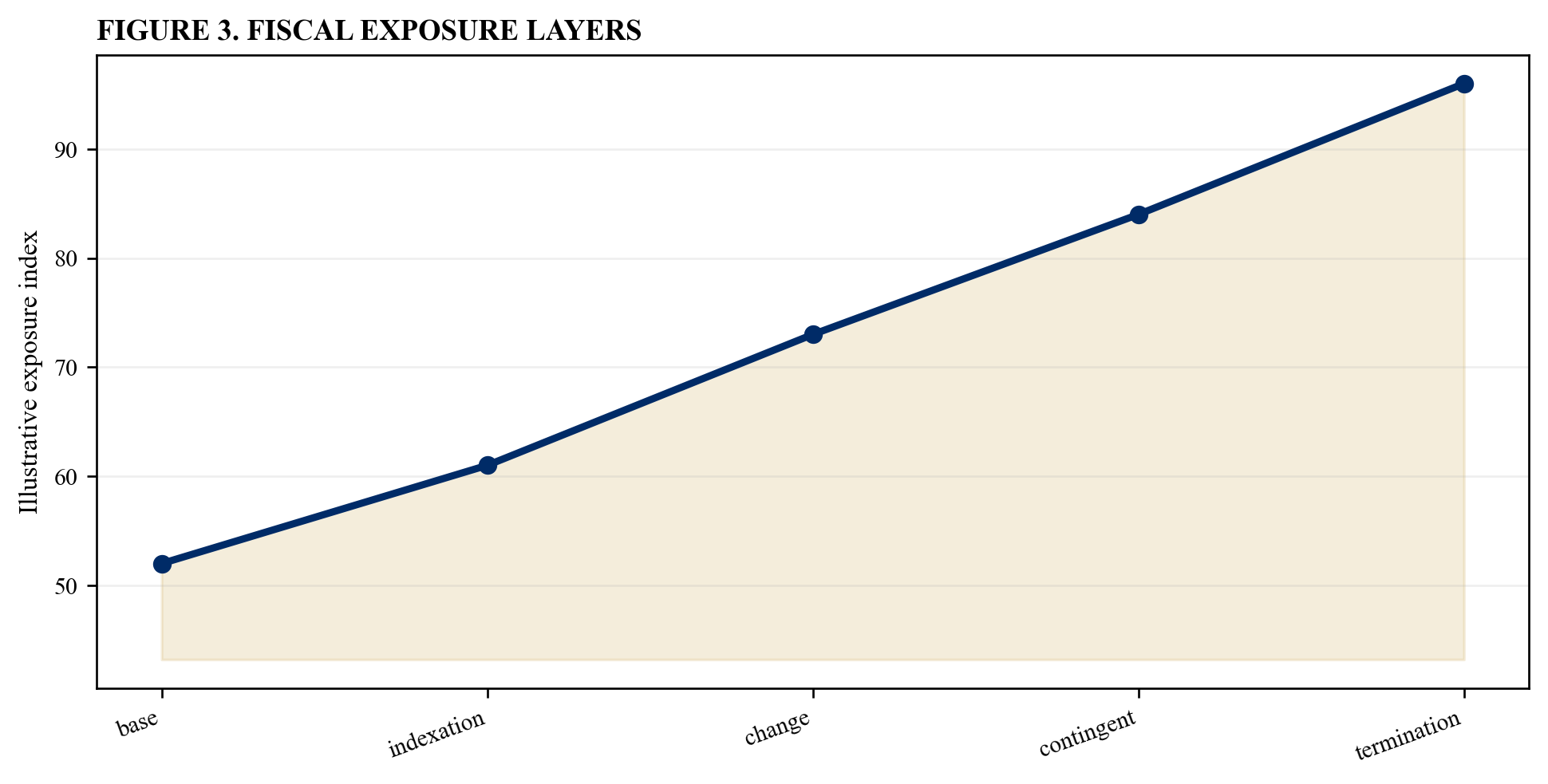
Illustrative analytical scenario; verified project evidence should replace values.
25. Preserve payment dispute liquidity
The project team should separate undisputed payment, expert determination, set-off limits and temporary liquidity arrangements. The required output is a payment-dispute protocol. Record the accountable party, source evidence, legal and budget authority, assumption, contractual treatment, cash-flow consequence and review date [15][30].
Test the treatment against service need, value for money, performance evidence, whole-life cost, public revenue and expenditure, debt and liquidity constraints, accounting and statistical rules, lender requirements and applicable law.
The principal risk is that a technical disagreement can trigger avoidable debt-service stress and service interruption. Quantify the effect on service continuity, payment entitlement, deductions, lifecycle condition, financing resilience, fiscal headroom, public debt, intergenerational cost and residual value. Compare the proposed structure with credible public delivery, user-pay, regulated, hybrid and reprocurement alternatives.
Translate the conclusion into the output specification, payment mechanism, deduction rules, indexation, budget controls, security, disclosure, monitoring, disputes, change, relief, termination and handback provisions. Refresh the evidence after material service, fiscal, macroeconomic, legal, accounting, financing or performance change.
26. Align lender rights with public value
The project team should test cure, step-in, direct agreement, reserve and termination protection against performance accountability. The required output is a lender-rights matrix. Record the accountable party, source evidence, legal and budget authority, assumption, contractual treatment, cash-flow consequence and review date [29][31].
Test the treatment against service need, value for money, performance evidence, whole-life cost, public revenue and expenditure, debt and liquidity constraints, accounting and statistical rules, lender requirements and applicable law.
The principal risk is that finance protections can weaken effective deductions or prolong poor service. Quantify the effect on service continuity, payment entitlement, deductions, lifecycle condition, financing resilience, fiscal headroom, public debt, intergenerational cost and residual value. Compare the proposed structure with credible public delivery, user-pay, regulated, hybrid and reprocurement alternatives.
Translate the conclusion into the output specification, payment mechanism, deduction rules, indexation, budget controls, security, disclosure, monitoring, disputes, change, relief, termination and handback provisions. Refresh the evidence after material service, fiscal, macroeconomic, legal, accounting, financing or performance change.
27. Control change and scope growth
The project team should require needs evidence, options appraisal, affordability, price testing, approval and updated disclosure. The required output is a change-control gateway. Record the accountable party, source evidence, legal and budget authority, assumption, contractual treatment, cash-flow consequence and review date [15][32].
Test the treatment against service need, value for money, performance evidence, whole-life cost, public revenue and expenditure, debt and liquidity constraints, accounting and statistical rules, lender requirements and applicable law.
The principal risk is that incremental variations can create a hidden second procurement and cumulative liability. Quantify the effect on service continuity, payment entitlement, deductions, lifecycle condition, financing resilience, fiscal headroom, public debt, intergenerational cost and residual value. Compare the proposed structure with credible public delivery, user-pay, regulated, hybrid and reprocurement alternatives.
Translate the conclusion into the output specification, payment mechanism, deduction rules, indexation, budget controls, security, disclosure, monitoring, disputes, change, relief, termination and handback provisions. Refresh the evidence after material service, fiscal, macroeconomic, legal, accounting, financing or performance change.
28. Govern relief and compensation events
The project team should define causation, mitigation, evidence, time relief, cost relief, insurance and sharing rules. The required output is an event-compensation matrix. Record the accountable party, source evidence, legal and budget authority, assumption, contractual treatment, cash-flow consequence and review date [3][33].
Test the treatment against service need, value for money, performance evidence, whole-life cost, public revenue and expenditure, debt and liquidity constraints, accounting and statistical rules, lender requirements and applicable law.
The principal risk is that broad relief can convert operational risk transfer into public payment exposure. Quantify the effect on service continuity, payment entitlement, deductions, lifecycle condition, financing resilience, fiscal headroom, public debt, intergenerational cost and residual value. Compare the proposed structure with credible public delivery, user-pay, regulated, hybrid and reprocurement alternatives.
Translate the conclusion into the output specification, payment mechanism, deduction rules, indexation, budget controls, security, disclosure, monitoring, disputes, change, relief, termination and handback provisions. Refresh the evidence after material service, fiscal, macroeconomic, legal, accounting, financing or performance change.
29. Design termination compensation
The project team should model authority default, project default, force majeure, voluntary termination and corrupt acts. The required output is a termination-liability schedule. Record the accountable party, source evidence, legal and budget authority, assumption, contractual treatment, cash-flow consequence and review date [24][34].
Test the treatment against service need, value for money, performance evidence, whole-life cost, public revenue and expenditure, debt and liquidity constraints, accounting and statistical rules, lender requirements and applicable law.
The principal risk is that termination formulas can create large and poorly disclosed public claims. Quantify the effect on service continuity, payment entitlement, deductions, lifecycle condition, financing resilience, fiscal headroom, public debt, intergenerational cost and residual value. Compare the proposed structure with credible public delivery, user-pay, regulated, hybrid and reprocurement alternatives.
Translate the conclusion into the output specification, payment mechanism, deduction rules, indexation, budget controls, security, disclosure, monitoring, disputes, change, relief, termination and handback provisions. Refresh the evidence after material service, fiscal, macroeconomic, legal, accounting, financing or performance change.
30. Test refinancing and capital changes
The project team should govern gains, consent, distributions, reserve release, hedging and debt repricing. The required output is a refinancing-control protocol. Record the accountable party, source evidence, legal and budget authority, assumption, contractual treatment, cash-flow consequence and review date [31][35].
Test the treatment against service need, value for money, performance evidence, whole-life cost, public revenue and expenditure, debt and liquidity constraints, accounting and statistical rules, lender requirements and applicable law.
The principal risk is that public payments can remain unchanged while financing upside accrues privately. Quantify the effect on service continuity, payment entitlement, deductions, lifecycle condition, financing resilience, fiscal headroom, public debt, intergenerational cost and residual value. Compare the proposed structure with credible public delivery, user-pay, regulated, hybrid and reprocurement alternatives.
Translate the conclusion into the output specification, payment mechanism, deduction rules, indexation, budget controls, security, disclosure, monitoring, disputes, change, relief, termination and handback provisions. Refresh the evidence after material service, fiscal, macroeconomic, legal, accounting, financing or performance change.
31. Make fiscal reporting transparent
The project team should publish expected payments, present value, contingent exposure, guarantees, risk assumptions and realised deductions. The required output is a fiscal-disclosure statement. Record the accountable party, source evidence, legal and budget authority, assumption, contractual treatment, cash-flow consequence and review date [7][36].
Test the treatment against service need, value for money, performance evidence, whole-life cost, public revenue and expenditure, debt and liquidity constraints, accounting and statistical rules, lender requirements and applicable law.
The principal risk is that fragmented reports can hide the project’s full intergenerational cost. Quantify the effect on service continuity, payment entitlement, deductions, lifecycle condition, financing resilience, fiscal headroom, public debt, intergenerational cost and residual value. Compare the proposed structure with credible public delivery, user-pay, regulated, hybrid and reprocurement alternatives.
Translate the conclusion into the output specification, payment mechanism, deduction rules, indexation, budget controls, security, disclosure, monitoring, disputes, change, relief, termination and handback provisions. Refresh the evidence after material service, fiscal, macroeconomic, legal, accounting, financing or performance change.
32. Reconcile accounting and economics
The project team should compare statistical, budgetary, financial-reporting and contract views without allowing classification to drive allocation. The required output is an exposure-reconciliation table. Record the accountable party, source evidence, legal and budget authority, assumption, contractual treatment, cash-flow consequence and review date [8][37].
Test the treatment against service need, value for money, performance evidence, whole-life cost, public revenue and expenditure, debt and liquidity constraints, accounting and statistical rules, lender requirements and applicable law.
The principal risk is that off-balance-sheet treatment can create an affordability illusion. Quantify the effect on service continuity, payment entitlement, deductions, lifecycle condition, financing resilience, fiscal headroom, public debt, intergenerational cost and residual value. Compare the proposed structure with credible public delivery, user-pay, regulated, hybrid and reprocurement alternatives.
Translate the conclusion into the output specification, payment mechanism, deduction rules, indexation, budget controls, security, disclosure, monitoring, disputes, change, relief, termination and handback provisions. Refresh the evidence after material service, fiscal, macroeconomic, legal, accounting, financing or performance change.
Table 4. Illustrative affordability stress
| Scenario | Payment burden index | Fiscal response |
|---|---|---|
| base | 54 | normal appropriation |
| inflation shock | 67 | index review |
| revenue shock | 78 | portfolio control |
| compound stress | 91 | continuity protocol |
Illustrative analytical structure; verified project and jurisdiction evidence governs.
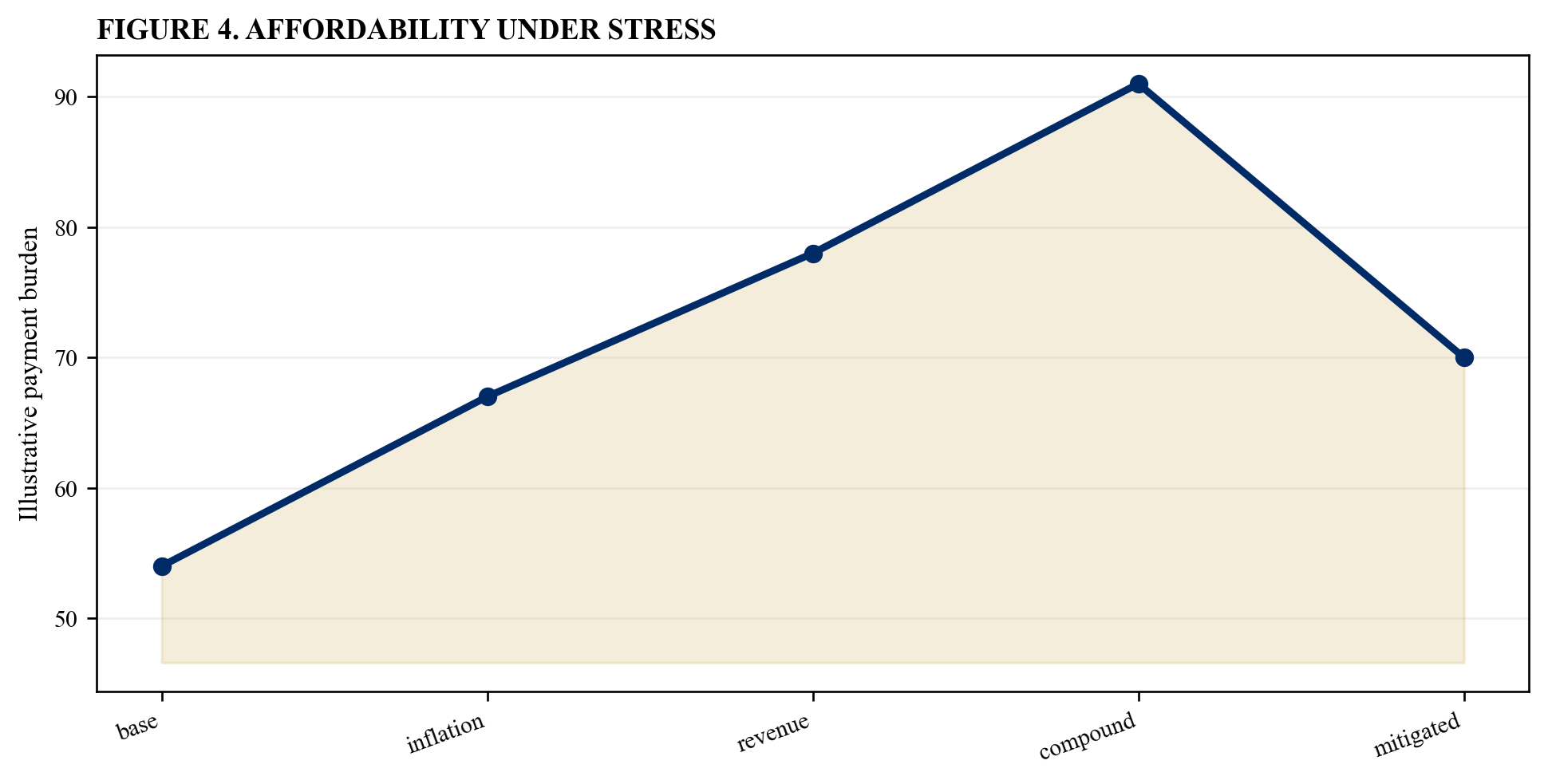
Illustrative analytical scenario; verified project evidence should replace values.
33. Monitor the portfolio concentration
The project team should aggregate payments by ministry, sector, currency, index, counterparty, maturity and fiscal stress. The required output is a PPP portfolio dashboard. Record the accountable party, source evidence, legal and budget authority, assumption, contractual treatment, cash-flow consequence and review date [6][26].
Test the treatment against service need, value for money, performance evidence, whole-life cost, public revenue and expenditure, debt and liquidity constraints, accounting and statistical rules, lender requirements and applicable law.
The principal risk is that shared macro shocks can affect many projects and public revenue simultaneously. Quantify the effect on service continuity, payment entitlement, deductions, lifecycle condition, financing resilience, fiscal headroom, public debt, intergenerational cost and residual value. Compare the proposed structure with credible public delivery, user-pay, regulated, hybrid and reprocurement alternatives.
Translate the conclusion into the output specification, payment mechanism, deduction rules, indexation, budget controls, security, disclosure, monitoring, disputes, change, relief, termination and handback provisions. Refresh the evidence after material service, fiscal, macroeconomic, legal, accounting, financing or performance change.
34. Create early-warning thresholds
The project team should track payment share, indexation, deduction leakage, disputes, lifecycle backlog, covenant headroom and fiscal variance. The required output is an affordability early-warning system. Record the accountable party, source evidence, legal and budget authority, assumption, contractual treatment, cash-flow consequence and review date [12][23].
Test the treatment against service need, value for money, performance evidence, whole-life cost, public revenue and expenditure, debt and liquidity constraints, accounting and statistical rules, lender requirements and applicable law.
The principal risk is that intervention can begin only after arrears or restructuring become unavoidable. Quantify the effect on service continuity, payment entitlement, deductions, lifecycle condition, financing resilience, fiscal headroom, public debt, intergenerational cost and residual value. Compare the proposed structure with credible public delivery, user-pay, regulated, hybrid and reprocurement alternatives.
Translate the conclusion into the output specification, payment mechanism, deduction rules, indexation, budget controls, security, disclosure, monitoring, disputes, change, relief, termination and handback provisions. Refresh the evidence after material service, fiscal, macroeconomic, legal, accounting, financing or performance change.
35. Protect service during fiscal stress
The project team should predefine prioritisation, temporary liquidity, controlled rescheduling and minimum-service safeguards. The required output is a fiscal-stress continuity plan. Record the accountable party, source evidence, legal and budget authority, assumption, contractual treatment, cash-flow consequence and review date [23][30].
Test the treatment against service need, value for money, performance evidence, whole-life cost, public revenue and expenditure, debt and liquidity constraints, accounting and statistical rules, lender requirements and applicable law.
The principal risk is that ad hoc payment cuts can destroy service and value while shifting costs forward. Quantify the effect on service continuity, payment entitlement, deductions, lifecycle condition, financing resilience, fiscal headroom, public debt, intergenerational cost and residual value. Compare the proposed structure with credible public delivery, user-pay, regulated, hybrid and reprocurement alternatives.
Translate the conclusion into the output specification, payment mechanism, deduction rules, indexation, budget controls, security, disclosure, monitoring, disputes, change, relief, termination and handback provisions. Refresh the evidence after material service, fiscal, macroeconomic, legal, accounting, financing or performance change.
36. Constrain renegotiation
The project team should require objective triggers, independent valuation, competition tests, transparency and restoration of value for money. The required output is a renegotiation governance protocol. Record the accountable party, source evidence, legal and budget authority, assumption, contractual treatment, cash-flow consequence and review date [32][38].
Test the treatment against service need, value for money, performance evidence, whole-life cost, public revenue and expenditure, debt and liquidity constraints, accounting and statistical rules, lender requirements and applicable law.
The principal risk is that fiscal pressure can become a pretext for opaque risk reallocation. Quantify the effect on service continuity, payment entitlement, deductions, lifecycle condition, financing resilience, fiscal headroom, public debt, intergenerational cost and residual value. Compare the proposed structure with credible public delivery, user-pay, regulated, hybrid and reprocurement alternatives.
Translate the conclusion into the output specification, payment mechanism, deduction rules, indexation, budget controls, security, disclosure, monitoring, disputes, change, relief, termination and handback provisions. Refresh the evidence after material service, fiscal, macroeconomic, legal, accounting, financing or performance change.
37. Audit performance and payment
The project team should test source data, failure classification, deduction calculations, waivers, invoices and control effectiveness. The required output is an independent payment audit. Record the accountable party, source evidence, legal and budget authority, assumption, contractual treatment, cash-flow consequence and review date [16][17].
Test the treatment against service need, value for money, performance evidence, whole-life cost, public revenue and expenditure, debt and liquidity constraints, accounting and statistical rules, lender requirements and applicable law.
The principal risk is that contract governance can report compliance while value leakage accumulates. Quantify the effect on service continuity, payment entitlement, deductions, lifecycle condition, financing resilience, fiscal headroom, public debt, intergenerational cost and residual value. Compare the proposed structure with credible public delivery, user-pay, regulated, hybrid and reprocurement alternatives.
Translate the conclusion into the output specification, payment mechanism, deduction rules, indexation, budget controls, security, disclosure, monitoring, disputes, change, relief, termination and handback provisions. Refresh the evidence after material service, fiscal, macroeconomic, legal, accounting, financing or performance change.
38. Plan expiry and handback affordability
The project team should forecast condition surveys, lifecycle catch-up, transition, residual liabilities and replacement procurement. The required output is a handback fiscal plan. Record the accountable party, source evidence, legal and budget authority, assumption, contractual treatment, cash-flow consequence and review date [20][39].
Test the treatment against service need, value for money, performance evidence, whole-life cost, public revenue and expenditure, debt and liquidity constraints, accounting and statistical rules, lender requirements and applicable law.
The principal risk is that the final years can concentrate renewal and transition costs outside earlier budgets. Quantify the effect on service continuity, payment entitlement, deductions, lifecycle condition, financing resilience, fiscal headroom, public debt, intergenerational cost and residual value. Compare the proposed structure with credible public delivery, user-pay, regulated, hybrid and reprocurement alternatives.
Translate the conclusion into the output specification, payment mechanism, deduction rules, indexation, budget controls, security, disclosure, monitoring, disputes, change, relief, termination and handback provisions. Refresh the evidence after material service, fiscal, macroeconomic, legal, accounting, financing or performance change.
39. Reassess affordability periodically
The project team should refresh forecasts after material macro, service, legal, financing, climate and technology changes. The required output is a periodic affordability review. Record the accountable party, source evidence, legal and budget authority, assumption, contractual treatment, cash-flow consequence and review date [9][22].
Test the treatment against service need, value for money, performance evidence, whole-life cost, public revenue and expenditure, debt and liquidity constraints, accounting and statistical rules, lender requirements and applicable law.
The principal risk is that financial-close assumptions can remain unchallenged for decades. Quantify the effect on service continuity, payment entitlement, deductions, lifecycle condition, financing resilience, fiscal headroom, public debt, intergenerational cost and residual value. Compare the proposed structure with credible public delivery, user-pay, regulated, hybrid and reprocurement alternatives.
Translate the conclusion into the output specification, payment mechanism, deduction rules, indexation, budget controls, security, disclosure, monitoring, disputes, change, relief, termination and handback provisions. Refresh the evidence after material service, fiscal, macroeconomic, legal, accounting, financing or performance change.
40. Issue the availability-payment certificate
The project team should reconcile service need, value for money, performance, payments, fiscal exposure, security, debt and disclosure. The required output is an auditable availability-payment certificate. Record the accountable party, source evidence, legal and budget authority, assumption, contractual treatment, cash-flow consequence and review date [6][40].
Test the treatment against service need, value for money, performance evidence, whole-life cost, public revenue and expenditure, debt and liquidity constraints, accounting and statistical rules, lender requirements and applicable law.
The principal risk is that approval can rest on separate technical, financial and budget documents with inconsistent assumptions. Quantify the effect on service continuity, payment entitlement, deductions, lifecycle condition, financing resilience, fiscal headroom, public debt, intergenerational cost and residual value. Compare the proposed structure with credible public delivery, user-pay, regulated, hybrid and reprocurement alternatives.
Translate the conclusion into the output specification, payment mechanism, deduction rules, indexation, budget controls, security, disclosure, monitoring, disputes, change, relief, termination and handback provisions. Refresh the evidence after material service, fiscal, macroeconomic, legal, accounting, financing or performance change.
Table 5. Availability-payment certificate
| Decision | Evidence | Owner |
|---|---|---|
| service | output and availability schedule | authority |
| performance | deduction calibration | contract manager |
| affordability | whole-life fiscal model | budget authority |
| finance | payment and lender protections | treasury and lenders |
Illustrative analytical structure; verified project and jurisdiction evidence governs.
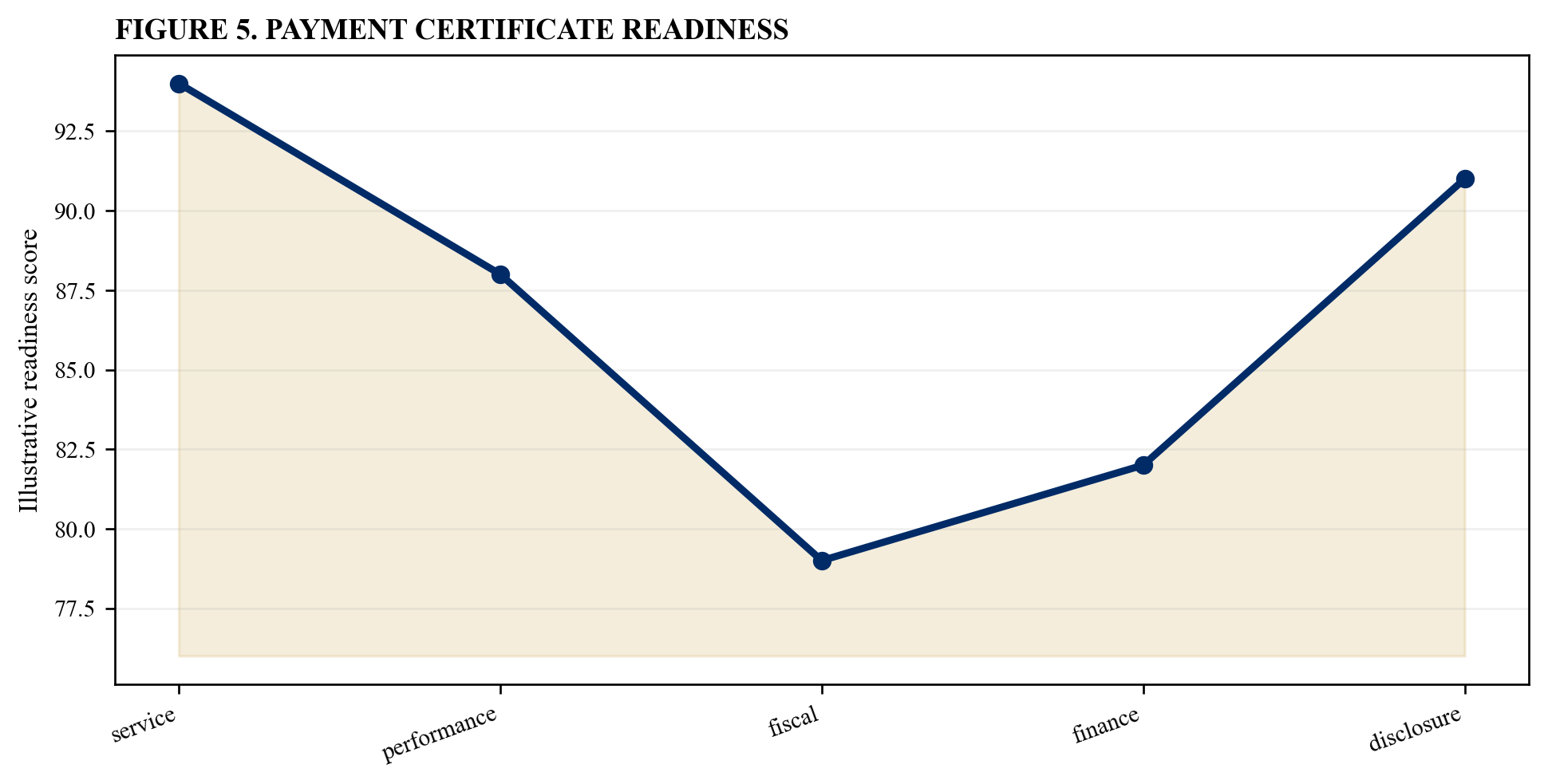
Illustrative analytical scenario; verified project evidence should replace values.
References
- World Bank PPP Resource Center, Payment Mechanism, https://ppp.worldbank.org/payment-mechanism
- World Bank Group, PPP Reference Guide Version 3, https://ppp.worldbank.org/sites/default/files/2024-08/PPP%20Reference%20Guide%20Version%203.pdf
- World Bank PPP Resource Center, Risk Allocation, https://ppp.worldbank.org/risk-allocation
- UK NISTA, PFI Foundations for Contract Managers, https://www.gov.uk/government/publications/pfi-foundations-for-contract-managers/nista-contract-management-guidance-pfi-foundations
- European PPP Expertise Centre, Guide to PPPs, https://www.eib.org/epec/g2g/index.htm
- IMF, PPPs and PFRAM, https://infrastructuregovern.imf.org/content/PIMA/Home/PPPs-and-PFRAM.html
- IMF, Fiscal Transparency Handbook, https://www.imf.org/external/np/fad/trans/
- OECD, Infrastructure Governance, https://www.oecd.org/en/topics/infrastructure-governance.html
- OECD, Assessment of Value for Money and Affordability, https://www.oecd.org/en/publications/2021/07/government-at-a-glance-2021_70df9612/full-report/component-69.html
- World Bank PPP Resource Center, Managing Fiscal Commitments, https://ppp.worldbank.org/managing-fiscal-commitments-ppps
- UK NISTA, PFI Contract Management Guidance, https://www.gov.uk/government/collections/pfi-contract-management-guidance
- UK NISTA, PFI Foundations, https://www.gov.uk/government/publications/pfi-foundations-for-contract-managers
- World Bank PPP Resource Center, Structuring PPP Contracts, https://ppp.worldbank.org/structuring-ppp-contract
- EPEC, Managing PPPs During Their Contract Life, https://www.eib.org/attachments/epec/epec_managing_ppps_during_their_contract_life_en.pdf
- World Bank PPP Resource Center, Managing PPP Contracts, https://ppp.worldbank.org/managing-ppp-contracts
- UK National Audit Office, PFI and PF2, https://www.nao.org.uk/reports/pfi-and-pf2/
- UK NISTA, PFI Contract Management Strategy, https://www.gov.uk/government/publications/pfi-contract-management-strategy/nista-pfi-contract-management-guidance-contract-strategy
- UK Government, Sourcing Playbook, https://www.gov.uk/government/publications/the-sourcing-playbook
- World Bank PPP Resource Center, Sector Resources, https://ppp.worldbank.org/sector
- World Bank PPP Resource Center, Contract Expiry and Asset Handover, https://ppp.worldbank.org/contract-expiry-and-asset-handover
- ISO, ISO 55001 Asset Management, https://www.iso.org/standard/83054.html
- OECD, Recommendation on Governance of Infrastructure, https://legalinstruments.oecd.org/en/instruments/OECD-LEGAL-0460
- IMF, Fiscal Risk Management, https://www.imf.org/en/Topics/fiscal-policies/Fiscal-Risks
- World Bank PPP Resource Center, Government Support, https://ppp.worldbank.org/government-support
- IMF, Analyzing and Managing Fiscal Risks, https://www.imf.org/en/Publications/Policy-Papers/Issues/2016/12/31/Analyzing-and-Managing-Fiscal-Risks-Best-Practices-PP5042
- OECD, Principles for Public Governance of PPPs, https://legalinstruments.oecd.org/public/doc/275/275.en.pdf
- IMF, Public Investment Management Assessment, https://infrastructuregovern.imf.org/content/PIMA/Home/PimaTool.html
- World Bank PPP Resource Center, Payment Mechanisms, https://ppp.worldbank.org/payment-mechanism
- World Bank PPP Resource Center, PPP Finance Structures, https://ppp.worldbank.org/finance-structures-ppp
- World Bank PPP Resource Center, Dispute Resolution, https://ppp.worldbank.org/dispute-resolution
- EPEC, Financing PPPs, https://www.eib.org/epec/what-we-do/financing-ppps.htm
- World Bank PPP Resource Center, Renegotiation, https://ppp.worldbank.org/renegotiation
- World Bank PPP Resource Center, Force Majeure, https://ppp.worldbank.org/force-majeure
- World Bank PPP Resource Center, Termination Provisions, https://ppp.worldbank.org/termination-provisions
- UK Treasury, Standardisation of PFI Contracts, https://www.gov.uk/government/publications/standardisation-of-pfi-contracts-version-4
- IMF, Fiscal Transparency Code, https://www.imf.org/external/np/fad/trans/Code2019.pdf
- IPSASB, IPSAS 32 Service Concession Arrangements, https://www.ipsasb.org/publications/ipsas-32-service-concession-arrangements-grantor
- OECD, Better Regulation of PPPs for Transport Infrastructure, https://www.oecd.org/en/publications/better-regulation-of-public-private-partnerships-for-transport-infrastructure_9789282103951-en.html
- UK NISTA, PFI Expiry Guidance, https://www.gov.uk/government/collections/pfi-contract-management-guidance
- World Bank PPP Resource Center, PPP Contract Management, https://ppp.worldbank.org/ppp-contract-management
