
1. Define the acquisition decision precisely
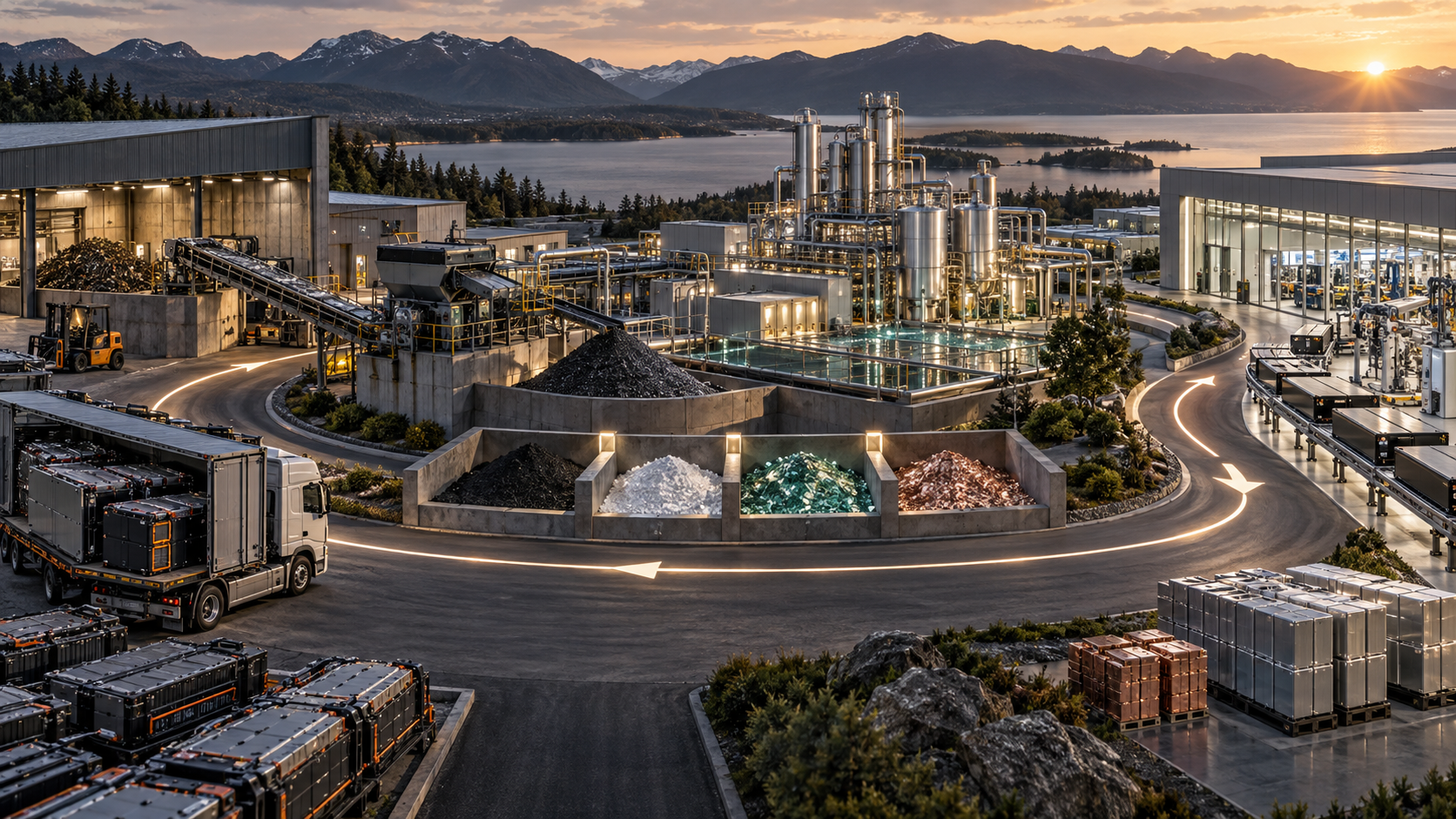
The board decision is whether to acquire a battery-materials recycling business at a price and on terms that remain supportable after feedstock, chemistry, process performance, product quality, offtake, logistics, safety and policy assumptions are tested together. The decision concerns an operating system rather than a furnace, shredder or hydrometallurgical line in isolation.
The transaction perimeter should identify collection agreements, transport permits, sorting and discharge operations, pre-treatment assets, refining assets, laboratories, intellectual property, product qualifications, offtake contracts, producer-responsibility arrangements, grants, tax attributes and environmental obligations. It should also identify which entities hold each licence, contract and operating record.
The investment paper should state the maximum consideration, minimum contracted feedstock, required product qualifications, expected chemistry mix, approved capital plan and the evidence needed before signing and closing. It should distinguish capacity that is installed, commissioned, qualified and economically supplied. Nameplate capacity has little value when feedstock or customers remain uncommitted.
Approval should be expressed through a controlled range. The board can approve a maximum cash-at-close amount, an escrow, a contingent pool, permitted working-capital adjustments and a long-stop date. Each amount should be linked to evidence that can be measured and enforced.
2. Use a Feedstock-to-Value Transaction System
The proposed system has eight gates: feedstock ownership and access; collection and transport; chemistry and condition; pre-treatment and recovery; product quality and offtake; policy and traceability; plant economics and financing; and transaction protection. Each gate has an evidence owner, an independent challenger, a threshold and a response when the threshold is missed.
The first three gates establish what material can lawfully arrive, when it will arrive and what it contains. The next two test conversion into a qualified and payable product. The sixth gate establishes whether recycled content, waste status, cross-border movement and policy support are documented. The final two gates reconcile cash flow, funding and deal terms.
The gates should use one controlled assumptions register. Annual tonnes, chemistry shares, moisture, contamination, payable metal, recovery, yield loss, product price, treatment fee, logistics cost, processing cost and working capital should reconcile across operating records, technical models, customer contracts, financing materials and transaction documents.
The system focuses on decisions. Regulatory compliance is a minimum condition. A buyer still needs to decide which contracts are dependable, which yields are repeatable, which incentives transfer, which liabilities move with the target and which uncertainty prevents closing.
3. Start with feedstock rather than installed capacity
The IEA reported in 2024 that battery-recycling capacity could outpace available feedstock materially before end-of-life electric-vehicle batteries become abundant. Manufacturing scrap dominates near-term supply, while retired vehicle and storage batteries become the largest source later [1]. Capacity and feedstock therefore mature on different timetables.
The buyer should model feedstock by source, counterparty, geography, chemistry, form, state of charge, title, contract term, minimum volume, price formula and collection obligation. Manufacturing scrap can offer predictable quality and short logistics loops, while end-of-life packs require collection, diagnostic, ownership and safety controls.
The model should distinguish contracted, nominated, forecast and speculative tonnes. A framework agreement without minimum volume, exclusivity or economic consequences should not receive the same value as an enforceable supply commitment. Renewal risk should be tested against the plant's payback and debt maturity.
The buyer should also examine the supplier's incentive to divert material. High-value chemistry may attract competing bids when metal prices rise. Low-value chemistry may require a gate fee or producer-responsibility payment. A contract that ignores both conditions can fail in opposite market environments.
4. Build a controlled chain from collection to cash
The evidence chain begins with legal title and safe collection. It continues through classification, discharge, dismantling, shredding, separation, refining, product testing, customer qualification, delivery and cash receipt. Every revenue and cost line should point to a controlled physical step.
The buyer should obtain weighbridge records, chain-of-custody data, battery identifiers, chemistry records, incident logs, laboratory results, mass-balance reports, yield calculations, product certificates, invoices and settlement statements. A static management presentation is insufficient when operational claims cannot be reproduced.
Version control matters because chemistry mix and process settings change. Each batch should identify incoming composition, routing decision, operating parameters, recovered products, residues and reconciliation loss. Commercial models should use the same measurement boundary as customer and regulator reports.
The financial model should preserve lineage. A change in NMC share, lithium recovery or product payability should update revenue, consumables, energy, residues, working capital and customer settlement. Manual valuation overlays weaken the evidence chain.
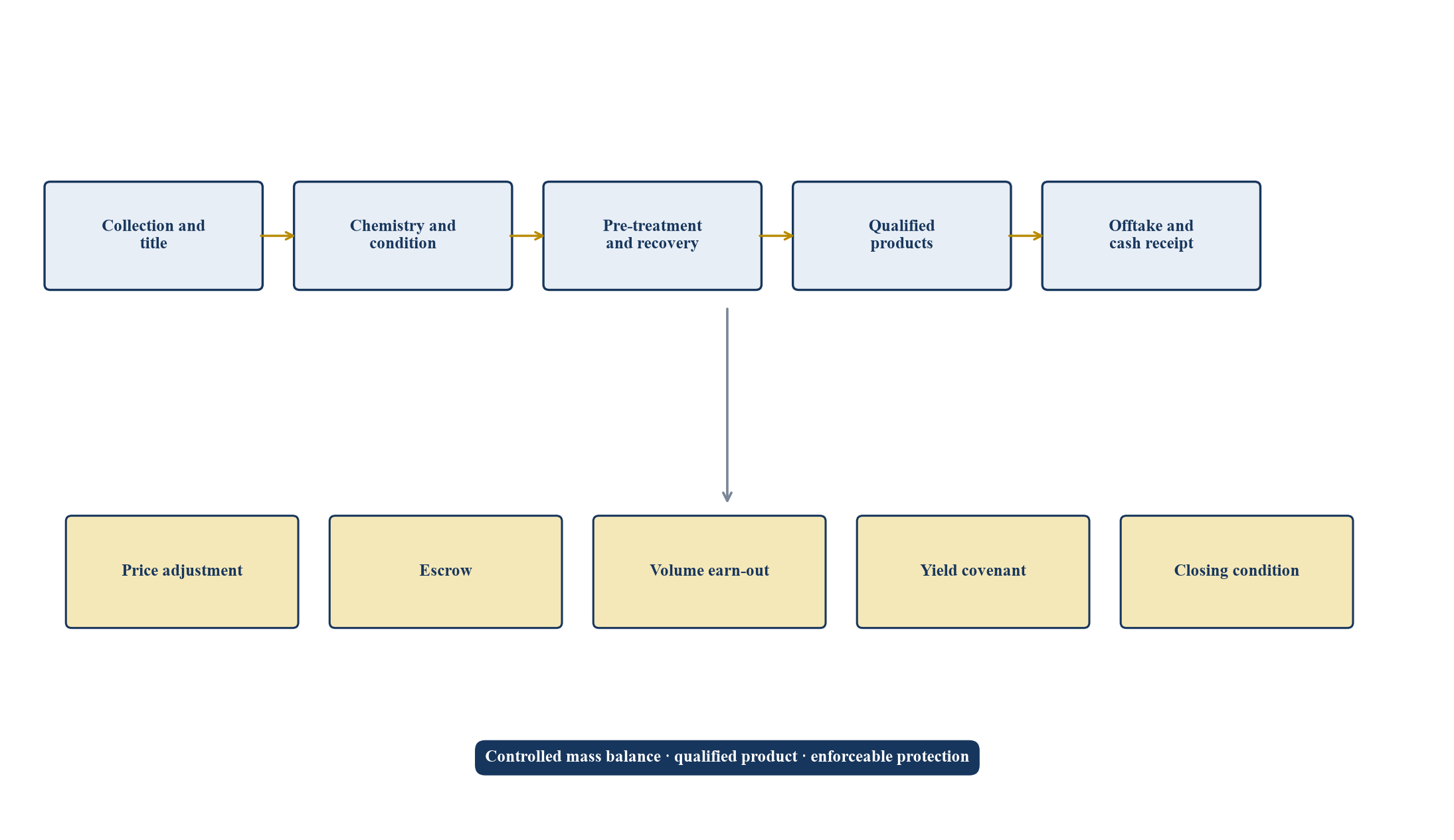
Each link requires controlled evidence, an economic owner and a defined transaction response when the threshold is missed.
5. Reconcile title, waste status and producer responsibility
The buyer should establish who owns each battery or scrap stream at every point. Vehicle owners, manufacturers, producer-responsibility organisations, insurers, repairers, dismantlers and recyclers can hold different rights and obligations. The contract should state when title, risk and environmental responsibility transfer.
Waste classification affects transport, storage, cross-border movement and permitted treatment. The Basel Convention controls transboundary movements of hazardous and other wastes, and its waste-battery technical work continues to develop guidance for batteries beyond lead-acid systems [12]. Local law remains decisive for each route.
Producer-responsibility payments can support collection economics, but the buyer should confirm eligibility, reporting, payment history, audit rights and change-of-control consequences. Policy support should be modelled only when the target has a documented route to claim and retain it.
The diligence should trace material from source to permitted destination. Unrecorded aggregation, informal intermediaries or inaccurate classification can interrupt supply and create remediation, penalty or reputational exposure. A strong volume forecast cannot cure weak legal provenance.
6. Test collection density and reverse logistics
Battery recycling begins with a logistics network. The buyer should map collection points, pack formats, average distance, frequency, load factor, packaging, state-of-charge controls, quarantine and emergency response. Transport economics can determine whether dispersed end-of-life batteries produce margin.
PHMSA states that used lithium batteries offered for disposal or recycling remain subject to transport requirements and that damaged, defective or recalled batteries carry greater fire risk [11]. Similar obligations arise under other national and international regimes. The target should demonstrate trained personnel, compliant packaging and incident controls.
Collection routes should be analysed by cost per tonne and cost per recoverable unit of value. A low-density route can consume the value of recovered material. Backhaul, regional hubs and supplier-owned packaging may improve economics, but each assumption requires evidence.
The transaction model should include accident, rejected-load and quarantine scenarios. Insurance coverage, deductibles, exclusions and claims history should be reviewed. A buyer should avoid valuing a collection network solely from historic volume when the safety or permitting basis is fragile.
7. Segment feedstock by chemistry and form
Lithium-ion is a family of chemistries. Nickel-manganese-cobalt and nickel-cobalt-aluminium batteries contain different valuable materials from lithium-iron-phosphate batteries. Sodium-ion, solid-state and other technologies can alter future streams. Manufacturing scrap, cells, modules, packs and black mass also require different handling.
The IEA noted that LFP represented around 40 per cent of electric-vehicle batteries deployed in 2023 and that its lower material value changes recycling economics [1]. The 2026 EV outlook confirms that recycling still relies heavily on production scrap because end-of-life volumes lag deployment [3].
The buyer should reconcile historic chemistry records with customer and product forecasts. A platform concentrated in high-value nickel-bearing scrap can lose margin as customers shift chemistry. A mixed platform may need flexible routing and commercial terms that compensate for low-value material.
Chemistry should drive pricing. Feedstock purchase formulas can use assay, reference prices, payable percentages, treatment charges and moisture adjustments. Gate or tolling fees may suit streams whose recovered value does not cover safe collection and processing.
8. Validate state of health and second-life routing
Some returned batteries may retain useful capacity. The economic decision is whether to repair, reuse, repurpose or recycle. Diagnostics should measure state of health, safety, provenance, remaining warranty, expected duty cycle and the cost of qualification for the proposed second use.
A second-life route can preserve product value, while delay can also postpone material availability to the recycling plant. The buyer should avoid counting the same pack both as near-term recycling feedstock and as a long-lived repurposed asset. The inventory and forecast should use one approved route.
Liability should be allocated clearly. A repurposed product may create performance, safety and warranty obligations that differ from raw-material recovery. Testing methods, traceability, customer acceptance and insurance should support any second-life revenue.
The transaction model should value second-life activity separately from core recycling. A buyer can require evidence of realised sales, return rates and warranty cost before paying for future margin. Contingent consideration may fit a business that has not yet established repeatable qualification.
9. Test the mass balance before using recovery claims
Recovery should be measured from a defined input to a defined output. The buyer should reconcile gross received weight, packaging, casing, electrolyte, plastics, foils, black mass, recovered salts or metals, residues, moisture and inventory movements. The denominator must be consistent across batches and reporting periods.
The EU Batteries Regulation sets recycling-efficiency and material-recovery targets, while Delegated Regulation 2025/606 establishes calculation and verification methodology [4][5]. A transaction model should distinguish regulatory compliance from the narrower economic question of payable product recovered from the target's actual mix.
Physical recovery, product yield and payability are different. A process can recover a mineral into an intermediate stream that requires further refining, incurs treatment charges or fails customer specification. Revenue should use payable quantity after quality, moisture and settlement adjustments.
The buyer should independently recalculate representative batches. Inventory opening and closing balances, work in progress and residues can distort a short test. A controlled campaign across relevant chemistries provides stronger evidence than a selected laboratory result.
10. Compare process routes and technology maturity
Pyrometallurgical, hydrometallurgical and direct-recycling routes have different feed requirements, products, costs, emissions and technology risks. Pre-treatment can be centralised or distributed. The chosen route should match available chemistry, customer specifications, utilities, permits and scale.
The US Department of Energy established ReCell to advance economic and environmentally sound recycling across the battery lifecycle [8]. Argonne's EverBatt model evaluates closed-loop economic and environmental outcomes across recycling processes [10]. These tools support technical analysis; a buyer still needs plant-specific evidence.
Technology diligence should examine demonstration scale, run hours, uptime, reagent consumption, impurity management, maintenance, scale-up parameters and supplier support. Patent ownership and freedom to operate should be tested where process advantage depends on intellectual property.
A novel route can create value when it improves product quality or cost. It can also create commissioning and qualification risk. The transaction should separate proven throughput from future expansion and stage payment against objective acceptance criteria.
| Evidence area | Core diligence test | Value failure | Possible transaction response |
|---|---|---|---|
| Feedstock | Verify title, minimum volume, term, chemistry and diversion rights | Capacity remains under-supplied | Volume earn-out, price reduction, closing condition |
| Logistics | Reconcile routes, packaging, permits, incidents and insurance | Collection cost or interruption rises | Working-capital adjustment, escrow, covenant |
| Mass balance | Recalculate representative batches from input to payable output | Recovery or yield is overstated | Yield holdback, acceptance test, warranty |
| Product quality | Verify specifications, qualification and settlement history | Product requires discount or rework | Offtake condition, quality-linked earn-out |
| Policy | Confirm eligibility, documentation, transfer and clawback | Grant, credit or recycled-content value is lost | Specific indemnity, exclusion from price |
| Safety and environment | Review permits, fire controls, residues and closure | Shutdown, remediation or uninsured loss | Remediation escrow, condition precedent |
The response depends on materiality, resolution time, seller control and the reliability of post-closing measurement.
11. Underwrite product quality and customer qualification
Recovered lithium, nickel, cobalt, copper, graphite and other products create value only at a recognised specification. The buyer should obtain certificates of analysis, customer qualification protocols, rejection history, reprocessing cost, pricing adjustments and settlement records.
Qualification can take time and may attach to a specific plant, process and product. A change in equipment, feedstock or operating condition can require renewed testing. The transaction schedule should identify which qualifications survive change of control and planned expansion.
Customer concentration should be measured by revenue and by qualified route. A platform with several customers may still depend on one refiner for a particular intermediate. Credit exposure and payment timing should be included in working capital.
The buyer should value unqualified output at a conservative route rather than the target price. A closing condition can require evidence of qualification. An earn-out can use cash settlement from specified products rather than management-reported production.
12. Examine offtake contracts as risk-sharing instruments
Offtake should state product, specification, volume, delivery point, assay, price formula, treatment charges, penalties, quotation period, payment, credit support and dispute resolution. It should also allocate metal-price movements between intake and settlement.
Floor prices can support downside, while formula lags can create working-capital and hedge exposure. Take-or-pay, minimum purchase and exclusivity terms deserve careful interpretation. A buyer should model rights that are enforceable rather than assume that strategic customers will absorb output.
Closed-loop agreements can link a battery manufacturer or vehicle producer to collection, recycling and purchase of recovered material. These arrangements may improve feedstock visibility and customer qualification. They can also create performance obligations across several entities and long periods.
The transaction should identify customer consents, change-of-control rights and termination triggers. Material contracts should remain effective at closing or support a price and risk adjustment. A weak offtake position may require buyer-funded working capital after completion.
13. Reconcile recycled-content rules and battery passports
The EU Batteries Regulation introduces documentation and future minimum recycled-content requirements for cobalt, lithium, nickel and lead in relevant batteries [4]. It also provides for battery-passport information for electric-vehicle, light-transport and industrial batteries within its scope.
The Joint Research Centre's 2026 study addresses harmonised rules for calculating and verifying recycled content [6]. A recycler that expects a premium for traceable secondary material should demonstrate data lineage from eligible waste input through recovered product and customer documentation.
The buyer should test whether digital records correspond to physical batches and commercial invoices. Chain-of-custody claims need controls over aggregation, transformation, inventory and mass balance. Software can support traceability, while assurance still depends on governed data and audit evidence.
Policy value should be separated from base metal value. A recycled-content premium may depend on jurisdiction, customer product, verification and market scarcity. The model should include a zero-premium case and document the conditions required to earn the upside.
14. Test policy support and tax-credit eligibility
Public grants, loans, tax credits and producer payments can improve project economics. They also carry eligibility, domestic-content, timing, documentation, sale, transfer and clawback conditions. The buyer should verify awards and applicable law rather than capitalise announced programmes.
US final regulations under section 45X address production costs and eligible critical minerals and electrode active materials [16]. Whether a recycler's output qualifies depends on the statutory and regulatory conditions, product form, purity, production and sale. Specialist tax advice is required.
The US Department of Energy has funded battery recycling, reprocessing and collection projects under infrastructure programmes [9]. Grants can accelerate capacity, but remaining milestones, cost share, reporting and change-of-control consent should be identified in the transaction model.
The purchase agreement should allocate pre-closing compliance, post-closing obligations and clawback. Expected support should enter valuation only to the extent that entitlement, amount and timing are controlled. A specific indemnity may address seller-caused loss of an awarded benefit.
15. Integrate environmental, health and safety diligence
Battery collection and processing involve electrical energy, flammable electrolyte, reactive material, acids, bases, dust, wastewater and residues. The buyer should review fire prevention, detection, suppression, quarantine, ventilation, worker protection, spill control and emergency response.
Permits should cover accepted feedstock, storage, pre-treatment, refining, emissions, wastewater, residues and hazardous material. Throughput approval should be reconciled with the operating model. A plant permitted for 30,000 tonnes may face lower practical storage or discharge limits.
The OECD environmental due-diligence handbook provides a risk-based framework for mineral supply chains [13]. The buyer should also examine local environmental law, closure obligations, community impact and any off-site contractor used for residues.
Known remediation and upgrade costs should be quantified. A general representation does not fund a fire-water system or contaminated-land remedy. The transaction can use a completion condition, seller-funded work, escrow or specific indemnity according to severity and timing.
16. Assess utilities, reagents and residue outlets
Hydrometallurgical and other recovery routes depend on electricity, water, acids, alkalis, reductants and treatment capacity. The buyer should reconcile contracted supply, tariff, reliability, storage, emissions and waste-water constraints with the central and downside production schedules.
Reagent price and availability can correlate with metal markets and geopolitical disruption. The 2026 IEA outlook noted that sulphur and sulphuric-acid disruption affected critical-mineral production costs [2]. A model should therefore avoid static input costs across every commodity scenario.
Residues require permitted and financially sound outlets. A process that moves valuable material into saleable product can still create hazardous or costly residual streams. Disposal price, transport distance, long-term liability and outlet concentration should be reviewed.
The buyer should identify capacity bottlenecks across utilities, storage and residues. Expansion value should exclude throughput that cannot be supported by these interfaces. Material third-party agreements may require consent or replacement before closing.
17. Build a controlled central acquisition case
The hypothetical target has annual nameplate input capacity of 30,000 tonnes. The central case uses 24,000 tonnes, equal to 80 per cent utilisation. Contracted or minimum-volume arrangements cover 18,000 tonnes. The assumed chemistry mix is 55 per cent nickel-bearing cathodes, 30 per cent LFP and 15 per cent mixed or other material.
Annual recovered-product sales are modelled at USD 132 million. Service, gate and tolling revenue adds USD 18 million, producing total revenue of USD 150 million. Purchased feedstock and inbound logistics are USD 68 million. Processing, reagents and energy are USD 36 million. Fixed site and corporate costs are USD 18 million, giving cash EBITDA of USD 28 million.
Sustaining capital is USD 6 million and cash taxes and other recurring cash items are USD 5 million. Illustrative post-maintenance cash flow is therefore USD 17 million. The central model produces enterprise value of USD 225 million. After USD 35 million of net debt and debt-like items, modelled equity value is USD 190 million.
Proposed equity consideration is USD 170 million, comprising USD 100 million cash at closing, a USD 30 million escrow and up to USD 40 million of contingent consideration. All figures are hypothetical management assumptions. They do not represent a market valuation, forecast or actual acquisition.
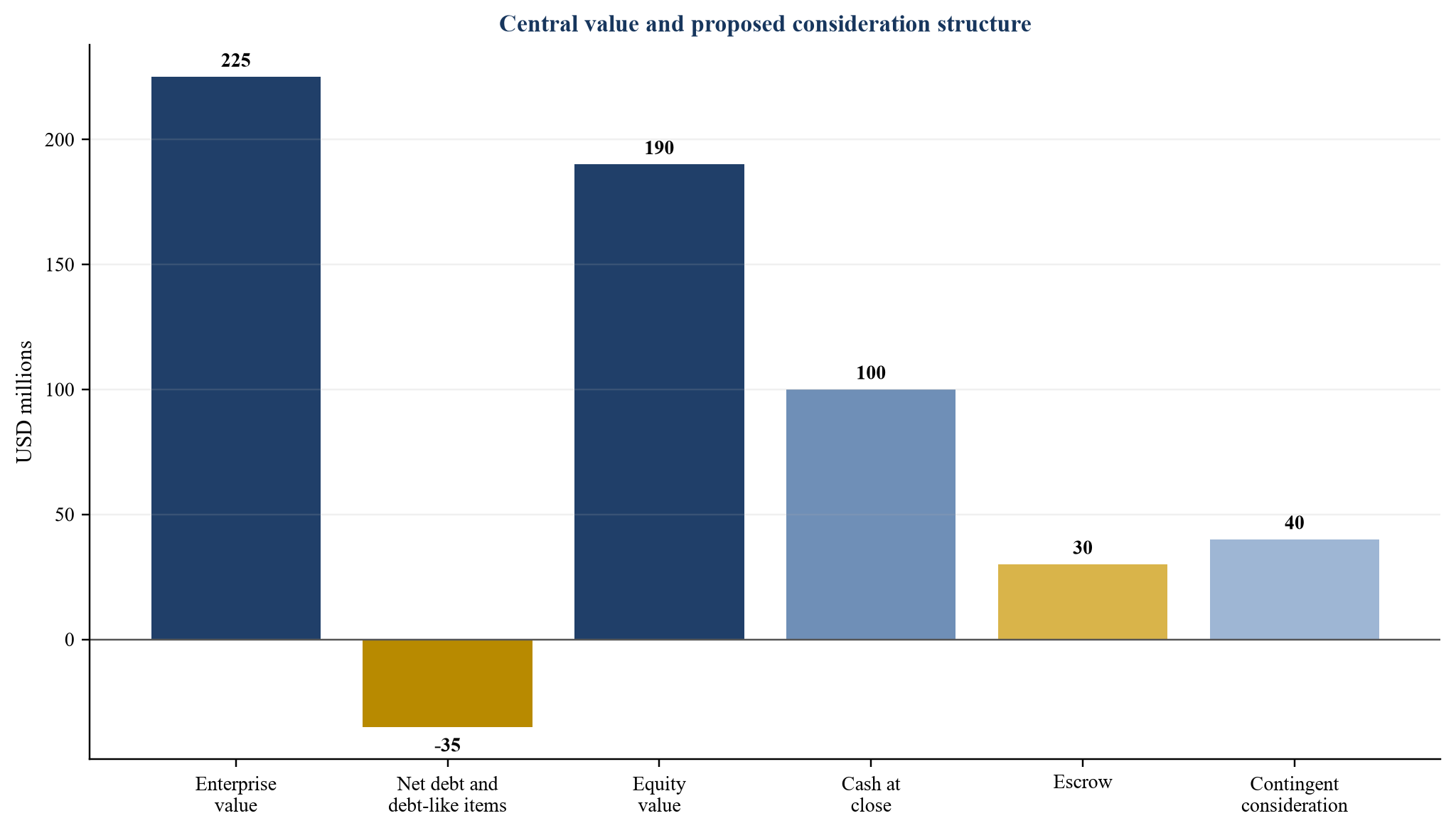
USD millions except operating assumptions. All values are illustrative management assumptions.
18. Build downside cases from physical drivers
The unmitigated downside uses 18,000 tonnes of annual input, equal to 60 per cent utilisation. Nickel-bearing material falls to 40 per cent and LFP rises to 45 per cent. Recovered-product prices are 15 per cent below the central assumption, while logistics and processing cost per tonne increase.
Under those assumptions, recovered-product sales are modelled at USD 82 million and service revenue at USD 15 million. Purchased feedstock and logistics are USD 47 million, processing costs are USD 31 million and fixed costs remain USD 18 million. Cash EBITDA falls to USD 1 million before sustaining capital and other cash items.
The downside model produces enterprise value of USD 120 million. After the same USD 35 million of net debt and debt-like items, modelled equity value is USD 85 million. Paying the full USD 170 million would create an illustrative USD 85 million shortfall relative to that value.
The proposed structure limits cash at close to USD 100 million. A specific indemnity is assumed to recover up to USD 15 million for a defined pre-closing obligation. If fully available, effective protected exposure is USD 85 million. The escrow and contingent consideration remain unavailable to the seller unless specified evidence and performance conditions are met.
19. Use a multidimensional sensitivity model
A recycling business is exposed to volume, chemistry, metal price, recovery, product payability and operating cost. These variables can move together. A decline in nickel-bearing feedstock can reduce value per tonne while fixed cost is spread over lower utilisation.
The buyer should build a scenario cube rather than change one variable at a time. The core axes can be available tonnes, chemistry mix, recovered-product price and payable recovery. Logistics, reagent cost and working capital can be correlated within each state.
The model should distinguish reversible and structural effects. A temporary supplier outage may be covered by liquidity. A permanent shift to lower-value chemistry may require a different commercial model, technology route or gate fee.
Reverse stress testing should identify the combinations that exhaust cash, breach covenants or require new equity. The board should see the point at which a strategic recycling platform becomes a funded turnaround rather than a growth acquisition.
| Measure | Central case | Downside case | Transaction relevance |
|---|---|---|---|
| Annual input | 24,000 tonnes | 18,000 tonnes | Tests feedstock and utilisation |
| Nickel-bearing share | 55 per cent | 40 per cent | Changes recoverable value per tonne |
| LFP share | 30 per cent | 45 per cent | Tests lower-value chemistry economics |
| Total revenue | USD 150 million | USD 97 million | Reconciles material and service income |
| Cash EBITDA | USD 28 million | USD 1 million | Shows fixed-cost absorption |
| Enterprise value | USD 225 million | USD 120 million | Illustrative valuation output |
| Equity value | USD 190 million | USD 85 million | After USD 35 million net debt and debt-like items |
| Protected exposure | USD 155 million total potential | USD 85 million effective close exposure | Escrow, contingent terms and assumed indemnity constrain downside |
Figures are illustrative management assumptions and are not forecasts or observed company data.
20. Interpret the hypothetical model carefully
The central model is a decision illustration. It shows how feedstock, chemistry and product economics connect to consideration. It does not establish a value for any actual recycler. Real outcomes depend on location, technology, contracts, qualification, policy, financing and execution.
The model gives no value to speculative expansion beyond nameplate capacity. It also excludes a separate recycled-content premium. Those decisions keep the base case tied to installed capability and current contractual evidence.
The downside shows why utilisation alone is inadequate. A plant can receive meaningful tonnes and still lose margin when chemistry mix, product price and cost move against it. The buyer needs a value-per-tonne and contribution analysis by stream.
Specialist technical, environmental, legal, tax and accounting work remains necessary. The assumptions register should record the owner, source, effective date and approval status of every material input.
21. Convert each uncertainty into the right deal tool
Known and measurable exposures can adjust price or working capital. Unresolved feedstock volume may suit contingent consideration. Product qualification may be a closing condition. Historic environmental liability may require a specific indemnity and secured escrow.
The tool should match timing and control. A seller should not earn a volume payment from tonnes supplied only because the buyer paid above-market rates. A recovery earn-out should define chemistry, test method, sampling, laboratory, moisture, settlement and dispute rules.
Conditions precedent should cover matters essential to ownership and operation, including permits, material consents, awarded-support approvals and customer qualification where the buyer cannot accept the risk. Long-stop rights should address delay without forcing an uneconomic close.
The agreement should prevent double counting. The same event should not reduce working capital, trigger an indemnity and reduce an earn-out unless the parties intentionally allocate separate losses. The funds-flow and post-closing model should reflect the legal drafting.
22. Design representations around evidence ownership
Representations should address title to feedstock, contract enforceability, permits, mass-balance records, product quality, customer claims, policy applications, grants, tax credits, safety incidents, environmental matters and intellectual property. Disclosure should identify exceptions precisely.
Operational records may sit across suppliers, logistics providers, laboratories and customers. The seller should state which records it controls and whether audit rights survive closing. Missing third-party evidence may require direct confirmation.
Materiality qualifiers should match the risk. A small mass-balance error can be material when it affects regulatory reporting or product qualification. Knowledge qualifiers should identify named individuals and reasonable inquiry where appropriate.
Warranty insurance can support recovery for defined statements. It does not replace a missing permit, failed process or absent feedstock. The buyer should retain direct remedies for matters central to operation and known exposures.
23. Use contingent consideration with objective metrics
Contingent consideration can bridge disagreement about feedstock and recovery when the outcome can be measured after closing. Suitable metrics include delivered eligible tonnes, payable recovered product, qualified customer sales or cash contribution after defined costs.
The metric should resist manipulation. Gross tonnes can reward low-quality or uneconomic feedstock. Revenue can rise through metal prices without operational improvement. EBITDA can change through allocation policy. A contribution measure may need contract schedules for chemistry, price, yield and direct cost.
Governance should specify operating covenants, information rights, accounting principles, customer decisions, capital approvals, audit and disputes. The buyer should retain authority to operate safely and lawfully while avoiding conduct intended primarily to defeat the payment.
IFRS 3 requires acquisition-date recognition and measurement of consideration and identifiable assets and liabilities, including contingent consideration principles [17]. Accounting and tax analysis should be completed before signing.
24. Size escrow and indemnity from exposure
Escrow should reflect identified exposure, evidence quality, claim timing and counterparty credit. Historic contamination, grant clawback, pre-closing waste shipment or customer-quality claims may require different periods and caps.
The buyer should build an exposure schedule with probability, gross loss, mitigation, insurance, tax effect, timing and proposed security. This schedule should reconcile with the purchase agreement and funds flow.
The hypothetical structure uses USD 30 million of escrow and assumes up to USD 15 million of specific-indemnity recovery in the downside. Those figures are modelling assumptions. Actual protection should follow quantified diligence and legal advice.
Escrow should not become a substitute for a closing condition where continued operation is doubtful. Some risks cannot be repaired with a future claim because the buyer needs the permit, customer or process capability on day one.
| Exposure | Evidence needed | Preferred protection | Measurement basis |
|---|---|---|---|
| Contracted feedstock below threshold | Executed contracts and delivery records | Volume earn-out or price reduction | Eligible tonnes received and accepted |
| Recovery below agreed case | Controlled campaign and independent assay | Yield holdback or contingent payment | Payable recovered product by chemistry |
| Product remains unqualified | Customer protocol and acceptance record | Closing condition or deferred payment | Written qualification and cash sales |
| Policy benefit lost | Award, eligibility and compliance file | Specific indemnity | Documented lost benefit and clawback |
| Historic environmental matter | Site investigation and cost estimate | Escrow and specific indemnity | Agreed remediation scope and cost |
| Working-capital shortfall | Inventory, receivables and settlement bridge | Completion adjustment | Defined normal working capital |
The table provides a decision framework; enforceability and tax treatment require specialist advice.
25. Align debt and liquidity with feedstock risk
Debt should be sized from dependable cash flow rather than installed capacity. Lenders may focus on feedstock contracts, offtake, product qualification, permits, commissioning, metal-price exposure and working capital. A thinly capitalised platform can fail while holding valuable inventory.
The model should capture payment timing from feedstock purchase through customer settlement. Assay and quotation periods can create metal exposure. Inventory in transit, work in progress and residues can absorb cash. Margin requirements may arise if the business hedges reference prices.
Covenants should use definitions that management can reproduce. Minimum liquidity, leverage, debt-service coverage and borrowing-base rules should reflect eligible receivables and inventory. A borrowing base should distinguish qualified product from unprocessed or disputed material.
The buyer should fund downside liquidity at closing. An undrawn acquisition facility is weak protection when a covenant breach blocks access. Committed working-capital lines, equity headroom and operating responses should be approved before completion.
26. Preserve fair-value and accounting discipline
IFRS 13 establishes a framework for fair-value measurement [18]. Transaction models should distinguish market-participant assumptions from buyer-specific synergies. Feedstock access, customer relationships, technology, permits and grants may affect identifiable assets or goodwill according to the applicable accounting analysis.
Inventory requires careful treatment. Incoming material, black mass, intermediates and finished products may have different measurement, ownership and price exposure. The completion mechanism should use consistent quantities, assays and accounting policies.
Environmental provisions, closure obligations, leases, grants and contingent consideration can affect acquisition accounting and future earnings. The buyer should identify them before approving consideration.
Post-closing impairment indicators may arise from lost contracts, chemistry change, lower metal prices, failed qualification or policy revision. The board should see how the acquisition case will be monitored against accounting and operating evidence.
27. Run diligence through decision rights
The diligence team should include operations, process engineering, laboratory, environment, safety, commercial, logistics, finance, tax, legal, insurance and integration. Each workstream should have a defined question and escalation threshold.
One transaction office should maintain the assumptions register, issue log, mass-balance bridge, contract map, scenario model and protection schedule. Findings should connect to a quantified value or an explicit decision condition.
Material changes in feedstock, chemistry, yield, qualification or policy should trigger a documented gate. The process should pause when the data set changes materially and models have not been reconciled.
Delegated authority should identify who can accept a waiver, change the price, extend the long-stop date or alter contingent terms. The board should approve deviations outside stated limits.
28. Execute a twenty-four-week transaction roadmap
Weeks one to four should establish perimeter, data protocol, safety access, contract list and baseline mass balance. The buyer should freeze the central assumptions and identify evidence gaps before detailed valuation.
Weeks five to ten should test feedstock, logistics, chemistry, process, product quality and permits. Controlled campaigns and customer confirmations should start early because they can determine whether the asset is financeable.
Weeks eleven to sixteen should complete scenarios, environmental work, policy eligibility, financing and integration design. The team should convert findings into price, escrow, contingent consideration and closing conditions.
Weeks seventeen to twenty-four should finalise documents, consents, confirmatory testing, funds flow, transition controls and board approval. The schedule is illustrative and should change with process maturity and regulatory requirements.
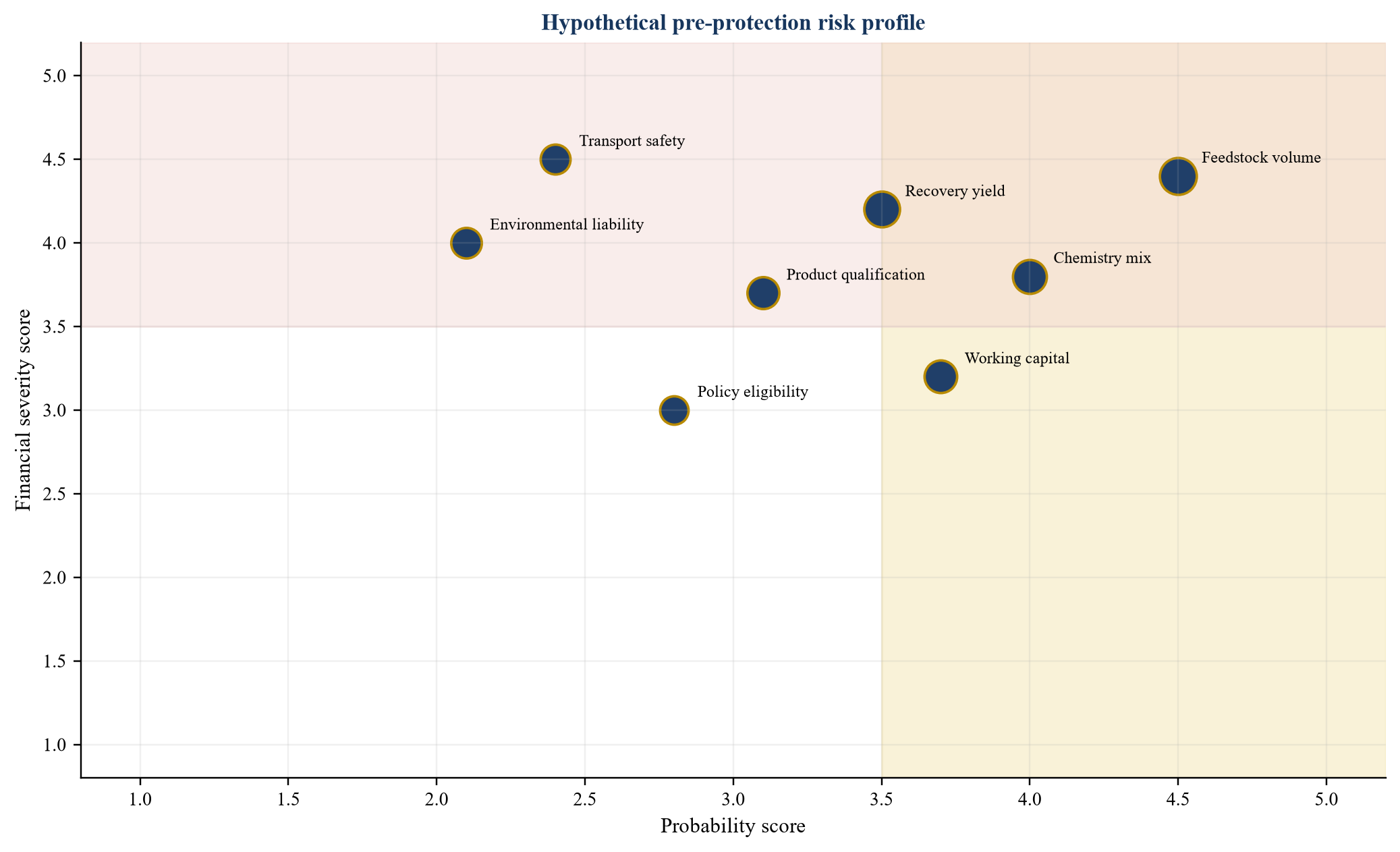
Scores are hypothetical and show how probability, financial severity and control strength can guide transaction response.
29. Establish post-closing operating controls
The buyer should continue the controlled mass balance after closing. Monthly reporting should reconcile tonnes received, chemistry, inventory, recovered products, residues, sales, settlement and cash.
Supplier concentration, contract expiry and delivery variance should be monitored against thresholds. Commercial teams should identify replacement volume before a contract falls below the approved coverage period.
Process reporting should include uptime, recovery, payability, reagent use, energy, incidents, rejects and customer claims by chemistry. A blended plant average can conceal a failing stream.
The integration plan should retain safety and laboratory expertise, preserve permits and customer qualification, and avoid uncontrolled process change. Earn-out governance should use the same records as operating management.
30. Use a board approval matrix
The board pack should state the decision, central and downside value, consideration, funding, feedstock coverage, technology status, policy assumptions, residual exposure and protection. Appendices should contain evidence rather than replace the decision narrative.
Each gate should have an owner and acceptance threshold. The investment committee can approve assumptions and structure within delegated limits, while the board reserves material price, financing, liability and closing decisions.
The board should see the unmitigated downside and protected exposure. This comparison makes the value of escrow, contingent terms and conditions visible.
Approval should expire if material assumptions change before closing. Confirmatory diligence should certify contracts, permits, incidents, product qualification, policy support, debt and cash.
| Gate | Approval evidence | Minimum threshold | Decision owner |
|---|---|---|---|
| Feedstock | Contract map, delivery history and chemistry forecast | Central case supported by controlled tonnes | Investment committee |
| Process and product | Campaign data, mass balance and customer qualification | Payable recovery supports valuation | Investment committee |
| Safety and environment | Permit register, incidents, remediation and insurance | No unmitigated closure or fire-control failure | Board |
| Policy and traceability | Eligibility, reporting and transfer analysis | Base case excludes unsupported benefit | Board |
| Financing and liquidity | Sources, working capital and reverse stress | Downside funding remains available | Board |
| Deal protection | Price, escrow, contingent terms and indemnities | Exposure remains within approved limit | Board on legal advice |
Authority should be tailored to the buyer's governance and transaction documents.
31. Make the acquisition decision
A battery-recycling acquisition should proceed when feedstock access is enforceable, collection is safe, chemistry assumptions are controlled, mass balance is reproducible, products are qualified, offtake is dependable and the capital structure can absorb downside.
The buyer should decline or defer when material title is unclear, transport or plant safety is deficient, recovery cannot be reproduced, core products lack a saleable route, required permits are absent or downside liquidity is unavailable. Strategic importance does not cure an uneconomic or unsafe system.
The Feedstock-to-Value Transaction System creates a practical control loop. It links physical material to commercial settlement, separates policy value from base economics, tests correlated downside and assigns each unresolved matter to an executable transaction response.
The decision memorandum should distinguish evidence available at signing from evidence that can emerge only through continued operation. Historical delivery records, executed feedstock agreements, campaign-level mass balances, customer specifications, permits and incident logs can be tested before signing. Future collection growth, end-of-life battery availability, chemistry evolution, customer qualification of new products and continuation of policy benefits remain forward-looking drivers. The acquisition structure should keep those categories separate. Price paid at closing should reflect verified assets and capabilities. Contingent value should depend on future outcomes that are important, measurable and within a defined governance system.
Management should also reconcile operational scale with financial exposure. A larger plant can amplify fixed-cost absorption when utilisation rises, while the same scale can accelerate cash losses when contracted tonnes, working capital or product outlets fail. Capacity therefore requires a matched view of feedstock duration, chemistry-adjusted contribution, inventory funding, maintenance needs and residue liabilities. The board should see the amount of cash required to survive the downside case, the time available to correct it and the point at which further funding would cease to be rational.
Closing readiness should be evidenced through a single source-of-truth schedule. Every critical assumption should have a source document, accountable owner, testing method, acceptance threshold, expiry date and transaction response. An assumption without evidence remains outside base value. An unresolved matter that can stop operations belongs in a condition or walk-away decision. A quantifiable exposure may be addressed through price, escrow, indemnity or insurance. A future performance outcome may support contingent consideration when the metric is auditable and cannot be shifted between periods or counterparties.
The final decision remains transaction specific. Models and contractual protections support judgement. They do not replace process engineering, environmental and safety review, legal advice, tax analysis, customer diligence, accounting work or accountable board approval.
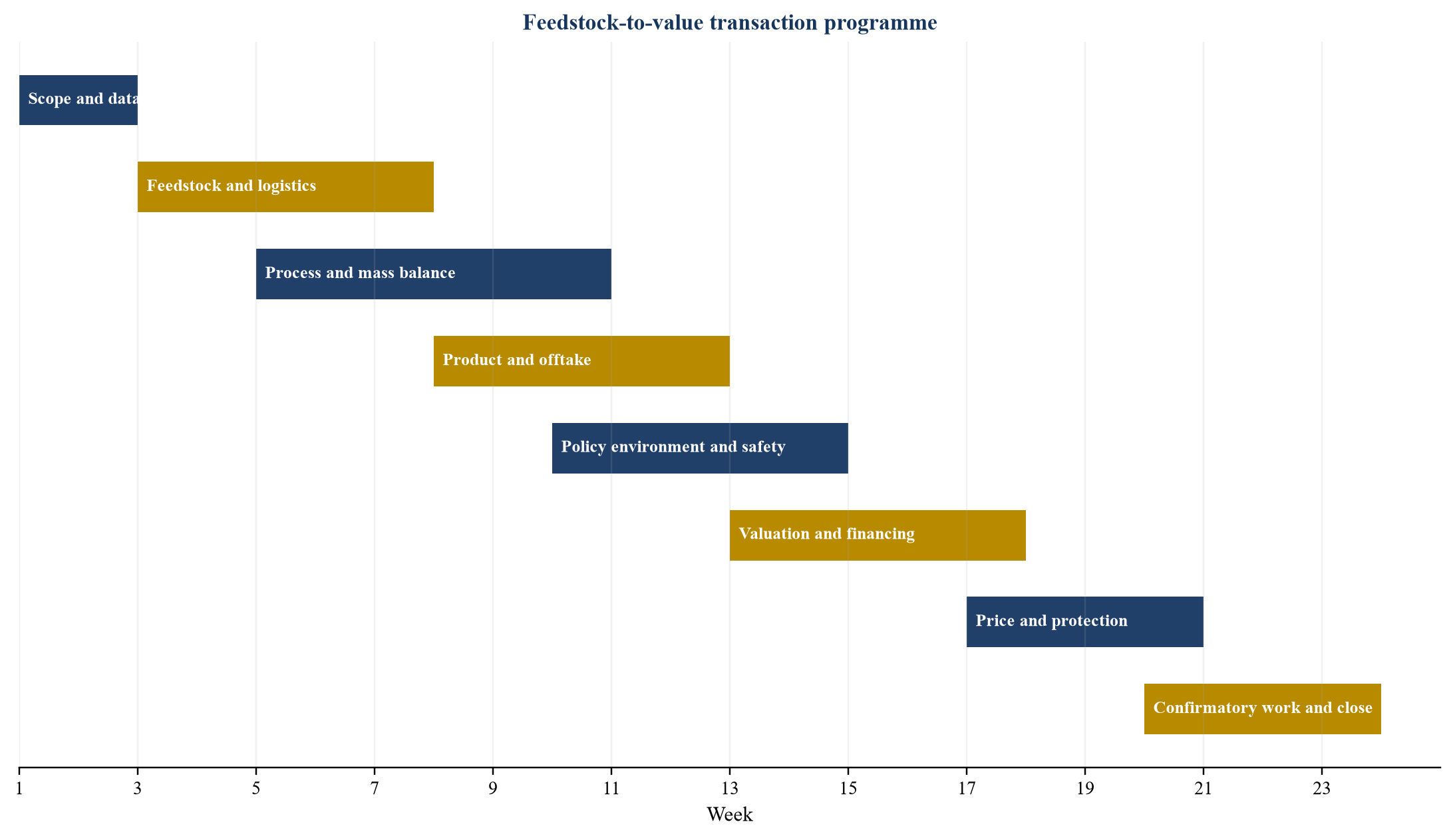
Timing is illustrative and depends on transaction access, technical maturity, regulatory approvals and customer testing.
Sources
- International Energy Agency, Recycling of Critical Minerals, 2024. Read the primary source
- International Energy Agency, Global Critical Minerals Outlook 2026, 2026. Read the primary source
- International Energy Agency, Global EV Outlook 2026: Electric Vehicle Batteries, 2026. Read the primary source
- European Union, Regulation (EU) 2023/1542 concerning batteries and waste batteries. Read the primary source
- European Union, Commission Delegated Regulation (EU) 2025/606 establishing the methodology for calculation and verification of recycling efficiency and material recovery rates. Read the primary source
- European Commission Joint Research Centre, Study on Harmonised Rules for the Calculation and Verification of Recycled Content in Batteries, 2026. Read the primary source
- European Union, Regulation (EU) 2024/1252 establishing a framework for a secure and sustainable supply of critical raw materials. Read the primary source
- United States Department of Energy, ReCell Center and Lithium-Ion Battery Recycling Programme. Read the primary source
- United States Department of Energy, Battery Recycling, Reprocessing and Battery Collection Funding Selections, 2024. Read the primary source
- Argonne National Laboratory, EverBatt Closed-Loop Battery Life-Cycle Model. Read the primary source
- United States Pipeline and Hazardous Materials Safety Administration, Transporting Lithium Batteries. Read the primary source
- Basel Convention, Technical Guidelines on the Environmentally Sound Management of Waste Batteries Other Than Waste Lead-Acid Batteries, draft workstream current in 2026. Read the primary source
- Organisation for Economic Co-operation and Development, Handbook on Environmental Due Diligence in Mineral Supply Chains, 2023. Read the primary source
- United States Geological Survey, Mineral Commodity Summaries 2026. Read the primary source
- United Kingdom Department for Business and Trade, UK Battery Strategy, 2023. Read the primary source
- United States Internal Revenue Service and Department of the Treasury, Final Regulations under Section 45X, Internal Revenue Bulletin 2024-51. Read the primary source
- IFRS Foundation, IFRS 3 Business Combinations. Read the primary source
- IFRS Foundation, IFRS 13 Fair Value Measurement. Read the primary source
