

1. A recycler buys a stream before it sells a metal
A battery-recycling acquisition appears to offer exposure to electric-vehicle growth, critical-mineral security and regulation-driven circularity. The operating company, however, begins each day by obtaining a physical stream of heterogeneous material. That stream determines plant utilisation, process settings, recoverable metals, reagent consumption, waste generation, logistics and working capital.
An acquirer therefore buys more than equipment and process intellectual property. It buys a position in competing supply networks for manufacturing scrap, damaged batteries, recalled packs, end-of-life vehicles, consumer batteries and black mass. Each source has a different chemistry, form, legal classification, transport requirement, contamination profile and commercial formula.
The first transaction question is whether the target controls enough legally deliverable and economically attractive feedstock to operate its assets through the buyer's investment horizon. Nameplate capacity has value only after that question is answered.
2. Capacity and feedstock follow different clocks
The International Energy Agency reported in 2024 that announced global recycling capacity for 2030 could exceed available feedstock by a wide margin. Its 2026 assessment again identifies excess capacity relative to available feedstock and a structural delay of roughly 15 years between battery deployment and comparable end-of-life volumes. Most batteries deployed recently remain in service.
Manufacturing scrap supports many plants during this early phase. The supply can contract when cell factories improve yield, delay ramp-up or cancel expansion. End-of-life batteries later become the larger source, but their arrival depends on vehicle life, second-hand exports, accidents, warranty replacements, second-life use and collection performance.
An acquisition model should therefore contain separate ramp curves for manufacturing scrap, damaged and recalled batteries, end-of-life packs and third-party black mass. A single market-growth curve conceals the timing mismatch between installed processing assets and material that can actually reach them.
3. The global market is regionally fragmented
The IEA estimates that China holds most global battery-recycling capacity and benefits from direct links among battery manufacturers, vehicle producers and recyclers. Europe and North America have announced substantial capacity, yet local feedstock and qualified downstream refining can remain constrained. Cross-border transport rules and hazardous-waste classifications further shape the addressable catchment.
Used vehicles and batteries also move across borders before retirement. The geography of first sale does not establish the geography of end of life. A plant's theoretical national feedstock pool can therefore overstate the material physically available within an economic transport radius.
Buyers should map feedstock by origin, legal status, route, travel distance and alternative bidder. The relevant market is the catchment from which the target can acquire material at a positive contribution after transport, packaging, discharge, storage, treatment and residue cost.
4. Chemistry changes the revenue pool
Nickel-manganese-cobalt and nickel-cobalt-aluminium batteries contain metals whose value has historically supported recycling economics. Lithium-iron-phosphate batteries contain less high-value nickel and cobalt, making economics more sensitive to lithium recovery, service fees, process cost and policy support. Sodium-ion and other chemistries can alter future material value again.
The IEA reported that LFP represented around 40 percent of electric-vehicle batteries deployed in 2023 and remained a major chemistry thereafter. A feedstock forecast expressed only in tonnes can therefore overstate revenue when the future mix shifts toward lower-value material.
Acquisition diligence should convert gross tonnes into chemistry-specific contained-metal tonnes and expected saleable products. The valuation model should then apply recovery, purity, payability and cost by pathway. A tonne of mixed LFP modules and a tonne of high-nickel production scrap are not interchangeable economic units.
5. Quality-adjusted tonnes are the operating currency
Quality-adjusted throughput measures the feedstock that can enter the target's process after accounting for chemistry, state of charge, packaging, contamination, moisture, casing, non-battery material, hazardous components and required preparation. It is the denominator for utilisation and the starting point for the mass balance.
The metric should distinguish gross received weight, payable battery material, active material, black-mass yield and contained metal. Commercial contracts may pay on one basis while production reporting uses another. That mismatch can create apparently attractive recovery percentages alongside weak cash margins.
The buyer should reconstruct at least twelve months of weighbridge tickets, laboratory assays, supplier invoices, production batches, residue records and customer settlements. Reconciliation gaps should be quantified as margin risk. Management summaries can support the review, but batch-level evidence should determine the underwritten yield.
6. Feedstock title and legal status are transaction issues
The seller must have lawful title or a documented right to treat the material. Waste batteries can remain subject to producer-responsibility rules, dangerous-goods requirements, waste permits and shipment controls. A contract labelled as a sale may function economically as a service arrangement in which the supplier retains material ownership or specifies the downstream route.
The EU Batteries Regulation requires collected waste batteries to enter permitted preparation, repurposing or recycling routes and establishes treatment, efficiency and recovery obligations. The applicable rules may follow the material across several facilities. In 2025, the European Commission introduced more specific waste codes and classified black mass as hazardous, with consequences for shipment controls from September 2026.
Diligence should trace title, custody, waste classification, shipment documentation and final destination. A buyer should not assign value to feedstock whose transfer would breach permit, producer-responsibility or cross-border requirements.
7. Contracted volume requires several tests
A supply agreement supports valuation only when the material is committed, identifiable, enforceable and economically deliverable. A memorandum of understanding, preferred-bidder status or non-exclusive framework should not be modelled as firm supply without evidence of actual performance.
Volume commitments can contain broad qualifications. The supplier may deliver only material it generates, only when legally available, or only when the recycler matches competing terms. Minimum volumes may be subject to ramp schedules, factory utilisation, quality acceptance, force majeure, plant qualification or termination for convenience.
The buyer should compare contracted minimums, forecasts and actual monthly deliveries. It should identify whether the supplier has granted the same material to another recycler, whether affiliates are covered, and whether a change of control gives the supplier a termination or consent right.
Table 1. Feedstock agreement diligence for a battery-recycling acquisition
| Contract element | Evidence to review | Valuation question | Possible protection |
|---|---|---|---|
| Legal source and title | Supplier permits, ownership records, producer-responsibility role and shipment documents | Can the target lawfully receive, process and sell the resulting material? | Specific representation, condition precedent and indemnity |
| Volume commitment | Minimums, forecasts, plant-output assumptions and delivery history | How many tonnes are firm, probable or optional by month and chemistry? | Earn-out based on verified delivered tonnes |
| Chemistry and form | Specifications, assay rights, pack formats, state of charge and contamination limits | What products, yields and costs follow from the contracted mix? | Price adjustment and rejection protocol |
| Commercial formula | Benchmark, quotation period, payability, treatment charge, floors and lags | Which party holds commodity and basis risk? | Formula reset, collar or completion adjustment |
| Logistics | Collection point, packaging, transport, insurance and rejected-load responsibility | Is delivered cost consistent with the modelled catchment? | Route schedule and cost-sharing mechanism |
| Exclusivity and alternatives | Territory, competing rights, most-favoured terms and supplier self-processing rights | Can the buyer preserve the stream after closing? | Assignment, consent and non-diversion covenant |
| Duration and termination | Term, renewal, convenience rights, default triggers and change-of-control provisions | Does contract life support the valuation horizon and financing term? | Consent, extension or contingent consideration |
| Credit and operational dependence | Supplier financials, facility ramp, yield and production plans | Will the supplier generate and deliver the stated material? | Diversification threshold and downside haircut |
The table identifies contract questions that affect valuation. Applicable law and the negotiated documents determine the final allocation.
8. Manufacturing scrap is attractive and unstable
Manufacturing scrap is relatively new, concentrated and easier to characterize than mixed end-of-life batteries. It can carry high active-material content and predictable chemistry. These features can make it the preferred early feedstock for a recycler.
The same supply depends on cell and cathode plants continuing to operate and generate losses. As production matures, first-pass yield should improve and scrap per unit of output should fall. Factory delays, chemistry changes and lower demand can reduce tonnes further. A recycler that finances permanent capacity against temporary commissioning scrap can face an abrupt utilisation decline.
The buyer should model scrap as a function of supplier output and process yield, not announced factory capacity. Contract duration should be compared with the factory's ramp and the target's debt maturity. The model should also distinguish unavoidable process scrap from rework retained inside the supplier's production loop.
9. End-of-life supply carries collection and timing risk
End-of-life batteries are distributed across vehicle owners, dismantlers, insurers, fleets, dealers and producer networks. The recycler may need collection infrastructure, safe storage, discharge capability and pack-dismantling labour before active material reaches the process.
Vehicle life extends when repair economics and second-hand demand are strong. Exports can move future feedstock to another jurisdiction. A battery may enter second-life stationary use before recycling. These pathways delay material availability and change location.
An acquirer should review the target's access to dismantler networks, insurance write-offs, fleet returns and producer take-back systems. Forecasts should be cohort based, with explicit assumptions for vehicle survival, export, reuse, collection share and competitive capture. Public vehicle registrations alone do not prove target-level supply.
10. Recalled and damaged batteries need a separate margin model
Recalled, defective and accident-damaged batteries may arrive earlier than ordinary end of life. They can generate service fees because safe handling and liability management matter to the supplier. They can also carry higher fire, transport, quarantine and insurance costs.
Commercial terms should state who decides treatment, who bears emergency response, and whether the recycler receives a service fee, material value or both. Damaged packs may require non-standard packaging and direct routes. Water exposure, thermal events and uncertain state of charge can change processing protocols.
Diligence should review incident records, rejected loads, emergency plans, insurance claims and actual gross margin by source. The buyer should avoid combining fee-paying hazardous-service work with ordinary commodity purchases in one average margin.
11. Black mass is an intermediate product
Commission Delegated Regulation (EU) 2025/606 defines black mass as a cathode fraction or a mixture of cathodic and anodic materials generated through thermo-mechanical treatment. It states that further processing is required to recover the metals and that black mass is an intermediate fraction rather than an output fraction for recovery calculations.
This distinction matters in M&A. A mechanical pretreatment plant can report high mass recovery while selling an intermediate whose price depends on assay, impurities, moisture, particle characteristics and access to qualified refiners. A hydrometallurgical facility may create higher-value salts, but it also assumes process, commissioning, reagent, wastewater and product-qualification risk.
The transaction perimeter should identify where the target stops in the chain. Valuation should follow the actual saleable product and contractual payability rather than attribute downstream battery-grade value to an upstream intermediate.
12. Recovery rate is only one line in the mass balance
Headline recovery rates usually refer to a particular material, process boundary and test condition. They may not equal the proportion of input value converted into paid revenue. The buyer needs separate measures for physical separation, metallurgical recovery, product purity, specification acceptance and commercial payability.
A process can recover a high percentage of lithium into a solution that requires further purification. The plant can also recover saleable nickel and cobalt while incurring disposal costs for fluorine, graphite, plastics or contaminated residues. Moisture and sampling methods can affect apparent input and output mass.
The diligence team should reproduce the calculation using the applicable regulatory methodology and the target's actual process boundary. Each output should be classified as saleable product, internal recycle, further-processing inventory, hazardous residue or ordinary waste.
13. Product qualification can delay revenue
Battery-grade products require customer qualification. A sample that meets chemical specifications does not prove stable production at commercial scale. Customers can require repeated lots, process audits, traceability, quality systems and change notification before accepting material into active-material production.
During qualification, the target may sell at lower payability, ship to a different market or accumulate inventory. A plant commissioning model should reflect this period. The buyer should review certificates of analysis, rejected batches, customer correspondence, provisional pricing and the approved-supplier process.
Long-term offtake can support value when it defines specification, volume, pricing, assay, settlement and remedies. It can also constrain value when the target grants exclusivity, discounts or capacity rights without corresponding feedstock security. Feedstock and offtake should therefore be diligenced as one commercial system.
14. Commodity exposure enters on both sides
Feedstock is often purchased using a formula linked to the contained value of lithium, nickel, cobalt, copper or other metals. Output is sold using another benchmark, quotation period and payability. The recycler earns the difference after recovery, processing, logistics, residues and working capital.
Risk arises when input and output formulas use different benchmarks, currencies, time periods or product bases. A rapid price decline can leave high-cost feedstock in inventory before lower-priced output settles. A price increase can improve output revenue while raising replacement feedstock cost and collateral requirements.
The buyer should build a contract-level exposure map. For every material stream, it should record benchmark, unit, currency, quotation period, assay basis, payability, provisional invoice, final settlement and hedge eligibility.
15. Index lags can create hidden directional positions
A recycler may price feedstock at the month of receipt and sell output at the month after processing. Inventory and conversion time create a commodity position even when both contracts reference the same metal index. Provisional settlements can extend that exposure.
The finance model should calculate value at risk by metal, stage and day. It should include material awaiting assay, work in process, finished product, receivables and supplier payables. The target's accounting inventory value may not reveal the contractual quotation periods that determine cash settlement.
Hedging can reduce some benchmark risk when suitable instruments and credit lines exist. It cannot fully hedge chemistry mix, assay uncertainty, recovery shortfall, location basis, impurity penalties or the spread between battery-grade and intermediate products.
16. Floors and minimum payables can invert the margin
Suppliers often seek a floor that protects the value of contained metals. A recycler may also guarantee a minimum percentage of benchmark value regardless of realized recovery or product qualification. When commodity prices fall or the feedstock mix deteriorates, the floor can consume the processing margin.
The buyer should identify every floor, minimum payable, take-or-pay obligation and retrospective true-up. It should run the formula across historical and downside price curves while holding physical performance constant. This reveals whether the commercial contract preserves margin or transfers downside to the recycler.
A target may describe a contract as commodity neutral because input and output are indexed. Neutrality should be demonstrated through matched price basis, timing, quantity and quality. Unmatched features should enter valuation as explicit risk.
17. Treatment charges can separate service from metal value
A treatment-charge structure pays the recycler for processing while returning recovered value to the feedstock owner or settling it through a formula. This can reduce commodity exposure and support low-value chemistries. It also requires clear measurement of input, recovery, residues and service performance.
The contract should allocate assay, moisture, rejected loads, metal losses, waste cost, product title and timing. A fixed treatment fee can become uneconomic when energy, reagents or disposal costs rise. An indexed fee can protect margin if the index reflects the actual cost driver.
For acquisition valuation, treatment revenue should be separated from metal trading margin. The two streams have different risk, working-capital and multiple characteristics. Historical gross margin should be recast contract by contract.
18. Working capital can absorb acquisition value
Battery recycling can require cash before revenue. The target may pay a provisional feedstock invoice on receipt, incur transport and processing costs, hold intermediate material, await assay and customer qualification, and receive final settlement weeks or months later.
Commodity prices can change during this cycle. Supplier payables, inventory and receivables can therefore move in opposite directions. A plant ramp can increase cash consumption even when accounting EBITDA improves.
The buyer should construct a physical-to-cash bridge by batch. It should test inventory days, assay delay, provisional percentages, customer payment terms, disputed settlements and VAT or customs effects. Completion accounts should distinguish ordinary working capital from excess commodity inventory, construction spares, unusable feedstock and unresolved claims.
19. Technology diligence begins with reproducibility
The target's process should perform across the chemistry and form factors in the acquisition case. Pilot data, vendor guarantees and design simulations provide evidence, but they do not replace sustained commercial operating records.
Diligence should compare design and actual throughput, uptime, recovery, purity, reagent use, energy use, water use, effluent, maintenance, labour and residue. Results should be segmented by feedstock type. Averaging can hide strong performance on clean production scrap and weak performance on mixed end-of-life material.
The buyer should trace each claimed improvement to a dated process change and controlled test. It should understand scale-up assumptions, bottlenecks, single points of failure, critical spares, automation maturity and operator dependence.
20. Intellectual property needs freedom to operate
Process value can reside in patents, trade secrets, recipes, control logic, equipment configuration, supplier knowledge and operating data. The buyer should confirm ownership, employee and contractor assignments, licences, territorial rights and freedom-to-operate analysis.
A patent claim does not prove economic performance, and a high-performing process can depend on tacit knowledge that leaves after closing. The transaction should identify key technical personnel, retention needs, documentation quality and access to source code or control-system support.
Joint-development agreements can allocate improvements to a university, equipment vendor, customer or feedstock supplier. Change-of-control clauses and field-of-use limits should be mapped. The valuation should exclude technology rights that the target cannot transfer or commercialize in the intended geography.
21. Environmental liabilities can follow the site
Battery recycling handles reactive, toxic and corrosive materials. Potential liabilities include soil and groundwater contamination, wastewater non-compliance, air emissions, firewater, hazardous residues, permit breaches and legacy storage. The buyer should review current operations and historic site use.
Environmental diligence should reconcile permits, monitoring data, manifests, incident logs, regulator correspondence, insurance and closure obligations. Physical inspection should test whether actual storage and process flows match permitted conditions. A clean permit file does not establish the absence of unreported releases.
Transaction protections can include remediation covenants, escrow, specific indemnities, insurance and retained sites. Their value depends on scope, duration, credit support and the ability to distinguish pre-closing contamination from post-closing operation.
22. Safety performance affects throughput and insurability
Damaged lithium-ion batteries can retain energy and create thermal-runaway risk. Safe discharge, isolation, storage, fire detection, suppression and emergency response are operational requirements. A serious incident can stop supply, trigger regulatory review, increase insurance cost and damage customer qualification.
The buyer should review near misses as well as reportable incidents. It should test contractor controls, training, battery condition assessment, segregation, damaged-pack quarantine, sensor coverage and emergency drills. Business-interruption assumptions should reflect the time required to investigate, clean, repair and regain approval.
Insurance should be reviewed for battery exclusions, pollution, gradual contamination, product liability, business interruption and maximum foreseeable loss. A policy limit without relevant coverage does not support valuation.
23. Permits define the usable asset
An installed line may not be permitted for every feedstock or output in the business plan. Throughput limits, storage limits, waste codes, water discharge, emissions and operating hours can constrain actual capacity. Expansion may require new consultation, environmental assessment or fire approval.
The acquisition model should use permitted and technically sustainable throughput, whichever is lower. It should identify permit conditions that depend on monitoring, supplier qualification or downstream routes. An expired or challenged permit should be treated as a closing issue.
The buyer should also examine planned regulatory changes. The EU's new black-mass classification and shipment rules can improve local feedstock access for some plants while increasing handling, documentation and route constraints. The effect is facility specific.
24. The transaction perimeter should match the value chain
A target may own collection sites, mechanical pretreatment, hydrometallurgy, laboratories, technology licences, development projects and minority ventures. Combining them in one headline multiple can obscure different maturity and risk.
The buyer should value operating assets, construction projects, development options and corporate functions separately. Intercompany feedstock and offtake contracts should be normalized to arm's-length economics. Shared permits, utilities, laboratories and personnel require a separation or integration plan.
The perimeter should include the contracts and rights needed to operate after closing. A plant without feedstock, product qualification, software, technical staff or environmental data can be physically complete and commercially stranded.
25. Rebuild the mass balance before valuing the target
The buyer should select representative operating periods and reconcile every material flow. Input records should state gross weight, tare, moisture, chemistry, form and assay. Output records should identify black mass, copper, aluminium, steel, plastics, salts, graphite, internal recycle and waste. Inventory movement should bridge the two.
The reconstructed balance should agree with purchase invoices, production reports, waste manifests and customer settlements. Differences may arise from sampling, moisture, unrecorded residues, timing or process loss. Each explanation should be tested.
Recovery should be calculated for each metal and chemistry at the correct process boundary. The result should then be converted to saleable yield after purity and customer acceptance. This exercise links technical diligence directly to revenue and working capital.
26. Normalize utilisation for maintenance and mix
Nameplate capacity often assumes a design feedstock, operating hours and maintenance regime. Actual throughput can be lower because of changeovers, cleaning, blocked material, assay delay, unplanned outage, permit restrictions or lack of feedstock.
Utilisation should be measured against sustainable capacity for the actual mix. A line processing intact packs may have a different bottleneck from a line receiving pre-shredded black mass. Hydrometallurgical residence time, filtration, crystallization and wastewater capacity can constrain output even when shredding has spare capacity.
The buyer should build an availability bridge that separates feedstock starvation, planned maintenance, technical failure, quality hold and commercial curtailment. Each category has a different remedy and valuation implication.
27. Use contribution margin by feedstock cohort
Average EBITDA can conceal cross-subsidies. A profitable service-fee stream can support a loss-making metal-purchase stream. High-value NMC scrap can mask weak LFP economics. One supplier may provide favourable material during qualification and reprice after the target invests in dedicated capacity.
Contribution margin should be calculated by supplier, chemistry, contract and month. It should include delivered feedstock cost, handling, energy, reagents, labour, maintenance, waste, assay, product revenue, hedging and financing cost where material.
The buyer should compare modeled and realized margin using final settlements. Unsettled provisional invoices should remain open exposures. This cohort view identifies the contracts that create value, consume capacity or require renegotiation.
28. A hypothetical acquisition tests the mechanics
Consider a hypothetical target with mechanical pretreatment and hydrometallurgical assets designed for 60,000 tonnes of annual gross feedstock. It processes production scrap, end-of-life packs and third-party black mass. The scenario illustrates underwriting mechanics and does not describe a current company, quotation or market valuation.
The base case assumes 45,000 tonnes of gross input, equal to 75 percent of nameplate capacity. Quality adjustment reduces this to 39,600 processable tonnes after excluded casing, contamination, moisture and rejected material. The model assumes USD 92 million of output and service revenue, USD 55 million of feedstock and logistics cost, and USD 25 million of conversion and site cost. Illustrative EBITDA is USD 12 million.
The model should be rebuilt from contained metals and contract formulas in a real transaction. The simplified values show how utilisation, mix and spread can interact.
29. Feedstock shortfall affects more than volume
In a downside case, gross input falls to 34,000 tonnes because a cell factory ramps slowly and a dismantler contract is not renewed. Lower utilisation raises fixed conversion cost per tonne. The remaining mix contains a larger share of lower-value LFP material.
Illustrative revenue falls to USD 63 million. Feedstock and logistics cost declines to USD 37 million, while conversion and site cost falls only to USD 23 million. EBITDA declines to USD 3 million. A 24 percent decline in gross tonnes therefore produces a 75 percent decline in EBITDA in this hypothetical case.
This operating leverage should inform debt capacity, purchase price and earn-out design. The buyer should test whether management can reduce shifts, labour, utilities and contracted services when feedstock falls.
30. Commodity compression can reduce margin at stable volume
Another downside keeps gross input at 45,000 tonnes but assumes lower metal prices, index lag and minimum supplier payables. Output and service revenue falls to USD 76 million while feedstock and logistics cost remains USD 51 million because contract floors protect suppliers. Conversion and site cost remains USD 25 million. EBITDA falls to zero.
The scenario demonstrates why throughput alone is an incomplete earn-out metric. A seller can deliver tonnes while the buyer earns no conversion return. A purchase-price mechanism should therefore test both verified tonnes and normalized contribution margin.
Commodity scenarios should apply the actual input and output formulas. A flat percentage haircut to revenue can miss floors, lags, provisional settlements and different chemistry exposure.
Table 2. Hypothetical operating sensitivity for a 60,000-tonne battery-recycling platform
| Scenario | Gross feedstock | Quality-adjusted feedstock | Revenue | Feedstock and logistics | Conversion and site cost | EBITDA |
|---|---|---|---|---|---|---|
| Base case | 45,000 t | 39,600 t | USD 92m | USD 55m | USD 25m | USD 12m |
| Feedstock shortfall | 34,000 t | 28,900 t | USD 63m | USD 37m | USD 23m | USD 3m |
| Commodity compression | 45,000 t | 39,600 t | USD 76m | USD 51m | USD 25m | USD 0m |
| Yield and qualification delay | 45,000 t | 39,600 t | USD 81m | USD 55m | USD 28m | minus USD 2m |
| Integrated upside | 50,000 t | 44,500 t | USD 106m | USD 61m | USD 28m | USD 17m |
All monetary values, volumes and operating assumptions are illustrative. They are not forecasts, quotations or evidence of current market pricing.
31. Yield and qualification can fail together
A new hydrometallurgical circuit may achieve target recovery in controlled tests while producing off-specification lots during ramp-up. Lower saleable yield, repeated processing, higher reagent use and delayed customer qualification can occur together.
The hypothetical yield case keeps input volume stable but reduces saleable product and adds processing cost. Revenue is USD 81 million, feedstock and logistics cost remains USD 55 million, and conversion and site cost rises to USD 28 million. EBITDA becomes negative USD 2 million.
The buyer should model technical ramp by product, not one aggregate utilisation curve. Completion tests, vendor guarantees and holdbacks should reference sustained saleable output, product specification and cost, rather than equipment start-up alone.
32. Integrated ownership can create option value
An industrial buyer may own mines, smelters, traders, cathode plants, battery manufacturing or customer relationships. Integration can improve feedstock access, product placement, blending, hedging, working capital and technical support.
These benefits should be valued only where the buyer can implement them. The hypothetical integrated case assumes 50,000 gross tonnes, better mix and stronger product placement. Revenue reaches USD 106 million, feedstock and logistics cost USD 61 million, conversion and site cost USD 28 million, and EBITDA USD 17 million.
Synergy value belongs primarily to the buyer unless competition requires sharing it. The deal team should distinguish target standalone value from buyer-specific value and execution cost.
33. Build the valuation in layers
The first layer values normalized cash flow from operating assets under contract-supported feedstock and qualified products. The second values near-term improvement that has evidence, such as signed supplier ramps, completed debottlenecking or customer qualification milestones. The third covers construction and development projects using risk-adjusted cash flows.
Technology option value should be separated from operating value. It may reflect licensing, process expansion or future chemistries, subject to ownership and technical evidence. Regulatory credits and grants should be valued according to eligibility, performance conditions and transferability.
Environmental liabilities, excess working capital, net debt, litigation and unfunded capital expenditure should be treated explicitly. A single EBITDA multiple can conceal these items and reward unproven capacity.
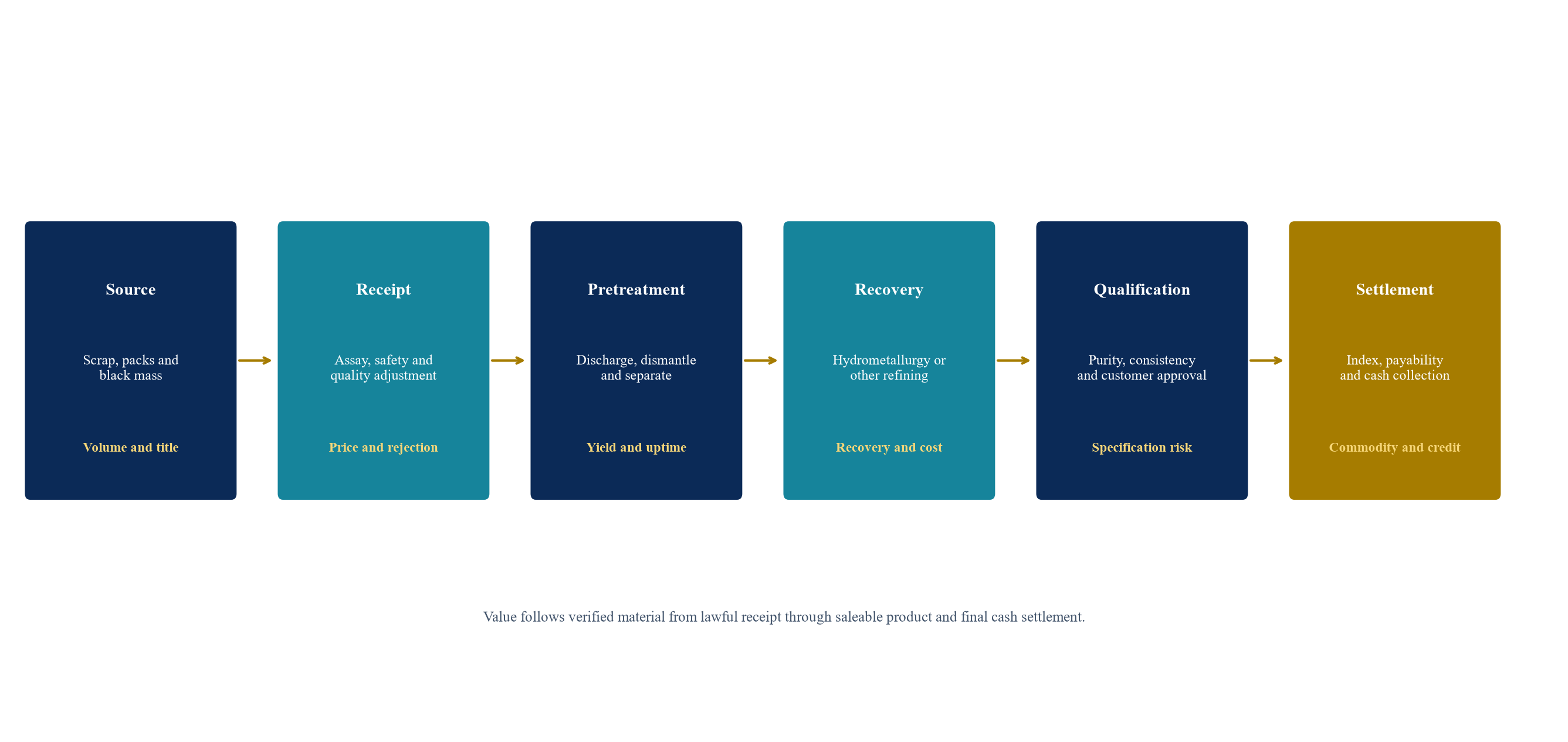
The buyer should connect each physical stage to its contract, evidence, cash timing and responsible party.
34. Discount uncontracted capacity explicitly
Spare capacity can have strategic value when feedstock is expected to grow, but the buyer should separate it from current earnings. The option depends on future material, collection share, permitting, working capital, customer qualification and competition.
A probability-weighted model can value future cohorts by year. It should include the cost of maintaining idle assets and the risk that technology or chemistry changes before the material arrives. Assets designed around high-nickel feedstock may require adaptation as LFP volumes increase.
Paying a full operating multiple for empty capacity transfers future execution value to the seller. Contingent consideration can bridge differing views while preserving payment for evidence.
35. Choose transaction protections that follow the risk
Representations should address title, permits, contracts, environmental compliance, intellectual property, product specifications, grants, inventory and undisclosed liabilities. Specific indemnities may be appropriate for known contamination, permit breaches or supplier disputes.
Operational uncertainty is often better addressed through price structure than a broad warranty. Earn-outs can depend on quality-adjusted tonnes, realized contribution margin, saleable yield, product qualification and plant availability. Milestones should be objectively measurable and resistant to post-closing accounting choices.
Holdbacks can support unresolved settlements or remediation. Warranty and indemnity insurance may exclude known environmental, technical and forward-looking performance risks. The buyer should identify residual exposure after insurance.
36. Completion accounts need material definitions
Inventory should be categorized by location, chemistry, ownership, assay status, condition and processing stage. Feedstock subject to provisional pricing should be marked to the contractual formula and quotation period. Off-specification output, residues and quarantined material require separate treatment.
Receivables and payables should include expected final assay and price adjustments. The parties should agree whether commodity movements between the locked-box date and closing are ordinary trading or value leakage.
Net debt definitions should capture inventory financing, supplier advances, equipment leases, environmental bonds and government-loan obligations where appropriate. The accounting label should not determine economic treatment.
37. Debt capacity should follow contracted margin
Lenders should size debt against cash flow supported by enforceable feedstock, sustainable plant performance and qualified offtake. Forecast tonnes without contract life, supplier credit or demonstrated collection should receive a haircut.
Commodity exposure affects borrowing-base design. Eligible inventory may require verified title, assay, hedge coverage, approved storage and customer route. Provisional settlements and disputed assays can reduce advance rates.
Covenants can monitor minimum liquidity, contracted feedstock cover, plant availability, saleable yield, environmental compliance and hedging. Distribution tests should protect working capital during commodity moves and ramp-up.
38. Integration should secure the commercial chain first
Day-one integration should preserve supplier confidence, waste-transfer documentation, product qualification, permits, insurance and technical staffing. A change in legal entity, route, process or control can require consent or requalification.
The buyer should create a contract-consent map before closing. It should communicate how supplier data, intellectual property and customer specifications will be protected. Procurement integration can then address benchmark consistency, transport, assay providers, reagents and maintenance.
Systems integration should preserve batch traceability. Combining enterprise systems without reconciled identifiers can break the evidence chain between incoming material and customer settlement.
39. The first hundred days should prove the model
The integration team should validate the opening inventory, repeat the mass balance, confirm every major supplier and customer, and establish weekly quality-adjusted throughput and margin reporting. It should reconcile physical tonnes to contracts and cash.
Technical work should focus on bottlenecks, yield variation, product rejection, reagent use, residue and safety events. Commercial work should reprice formulas on a common basis and identify renegotiation priorities. Finance should establish commodity exposure and working-capital limits.
The buyer should avoid accelerating capacity before these controls operate. Early evidence can determine whether capital should go to debottlenecking, feedstock origination, product qualification or environmental improvement.
40. Use an investment committee evidence map
The investment committee should receive evidence for six linked questions: what material is controlled, what usable product the process creates, what margin remains after all payables and costs, what cash is tied up, what liabilities transfer, and what rights survive closing.
Each answer should link to a source document and an owner. Feedstock volume should link to contracts and delivery history. Yield should link to batch records. Revenue should link to customer settlements. Environmental exposure should link to site and regulator evidence.
An unresolved item should carry a quantified valuation treatment, condition precedent or specific post-closing action. General comfort language should not substitute for evidence.
41. Apply seven acquisition gates
The first gate confirms lawful, transferable feedstock. The second confirms a reconciled mass balance. The third confirms sustainable throughput and saleable product. The fourth confirms positive margin under contract-level commodity scenarios. The fifth confirms permits, safety and environmental acceptability. The sixth confirms product qualification and cash conversion. The seventh confirms that price and protections reflect residual risk.
Conditional approval should identify the missing evidence, responsible party, deadline and valuation consequence. A failed title, permit or safety gate should stop the relevant asset or transaction perimeter. A feedstock or margin gap may support a lower price or contingent consideration.
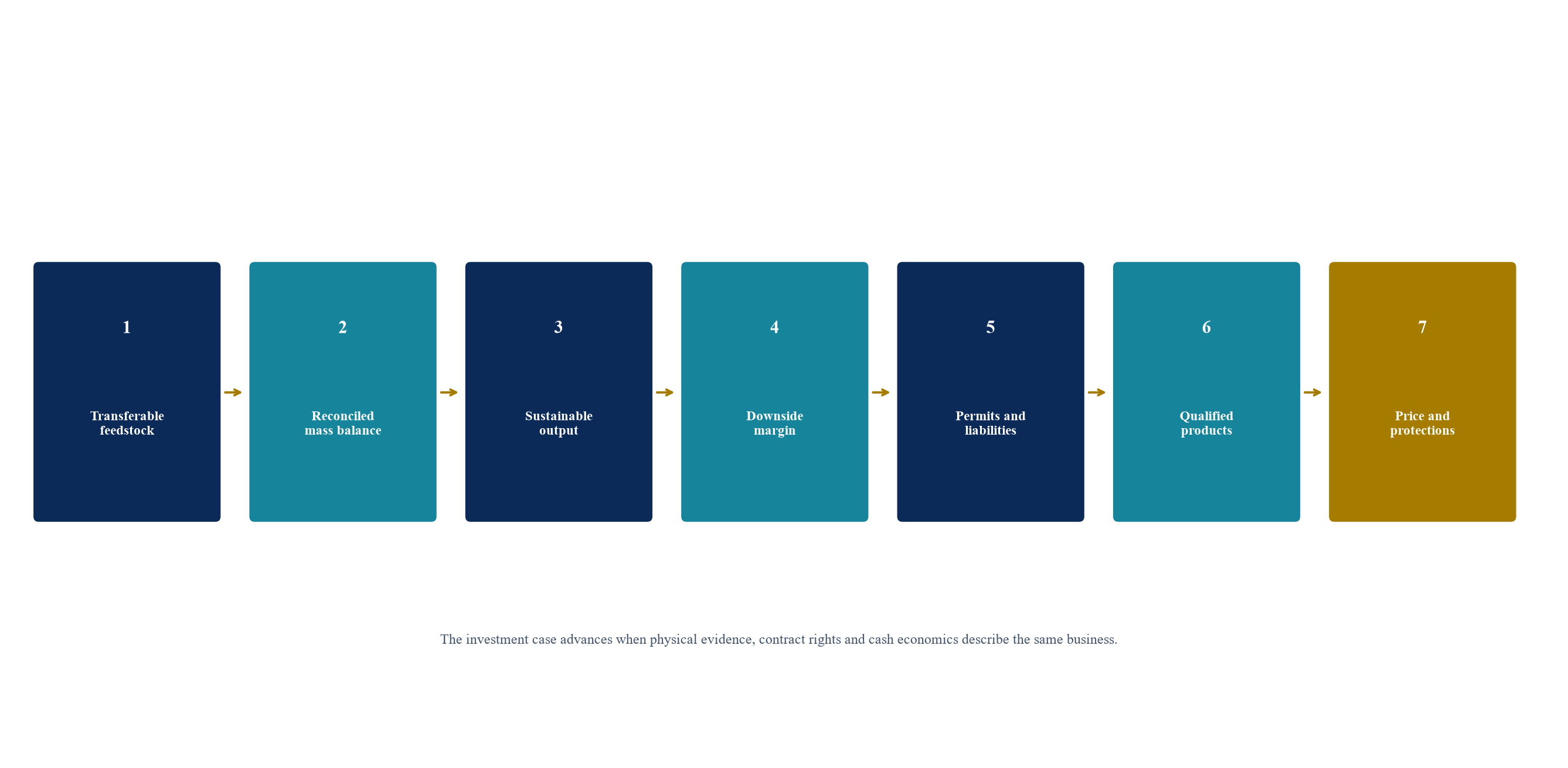
Each gate requires documentary and operating evidence. Conditional approval should state the financial consequence of the missing proof.
Table 3. Transaction risk allocation for a battery-recycling acquisition
| Risk | Primary evidence | Valuation treatment | Transaction mechanism | Post-closing control |
|---|---|---|---|---|
| Feedstock volume | Executed contracts and delivery history | Probability-weighted quality-adjusted tonnes | Earn-out and supplier-consent condition | Monthly contract-cover report |
| Chemistry and quality | Assays, specifications and rejection data | Cohort margin and yield haircut | Inventory adjustment and specification warranty | Intake assay and exception dashboard |
| Commodity basis | Input and output formulas and settlements | Contract-level price scenarios | Collar, formula reset or contingent price | Exposure and hedge limit |
| Process performance | Batch mass balance and sustained operating tests | Sustainable throughput and saleable yield | Completion test, holdback or vendor recourse | Weekly mass-balance reconciliation |
| Product qualification | Customer approvals and rejected lots | Ramp and payability discount | Milestone payment | Qualification plan and lot tracking |
| Environmental liability | Site assessment, permits and incidents | Specific cost and risk reserve | Indemnity, escrow or retained site | Compliance and remediation programme |
| Construction and capex | EPC contracts, schedule and cost-to-complete | Risk-adjusted project value | Deferred consideration and cost overrun allocation | Stage-gated capital governance |
| Key capability | IP rights, documentation and personnel | Retention and replacement cost | Retention, licence and escrow | Process documentation and succession |
The appropriate mechanism depends on jurisdiction, bargaining position, diligence findings and the transaction documents.
42. Seller preparation can increase transaction value
A seller should organize contracts, permits, batch data, assays, settlements and site evidence before launching a process. It should reconcile reported recovery rates to saleable output and customer cash. Variances should be explained with dated operational evidence.
The seller can segment earnings by feedstock cohort and disclose commodity formulas transparently. This allows bidders to distinguish conversion capability from directional price exposure. It also reduces broad diligence discounts.
Commercial preparation should address consent and change-of-control rights early. Technical preparation should document process changes and prove repeatability. Environmental preparation should resolve record gaps before buyers price them as worst-case liabilities.
43. Market consolidation is an operating signal
The IEA has warned that excess recycling capacity and limited near-term feedstock can create financial pressure and consolidation. Glencore's acquisition of Li-Cycle in August 2025 provides a public example of an industrial owner combining recycling assets with broader commodity and processing capabilities.
One transaction does not establish a universal valuation multiple or preferred structure. It illustrates why access to feedstock, offtake, trading, technical support and capital can matter alongside process assets. Public filings before the acquisition also described feedstock dependence, commodity-price exposure, financing needs and project risk.
Buyers should use market transactions to identify questions rather than copy headline valuations. Deal terms, liabilities, capital requirements and strategic synergies can differ substantially.
44. Limits and areas for further research
Public evidence cannot establish the value or performance of a specific target. Feedstock contracts are often confidential, assays vary, and plant-level economics depend on local energy, labour, logistics, permits and product routes. The hypothetical case in this paper demonstrates mechanics rather than current market pricing.
Further research should compare realized collection and recycling cohorts, publish consistent mass-balance definitions, measure commercial recovery and payability by chemistry, and examine how black-mass shipment rules affect regional pricing. Comparable disclosure on safety, working capital and environmental costs would improve transaction analysis.
Investors should confirm current law, permits, tax treatment and environmental obligations with qualified advisers in each jurisdiction. Technology claims require independent testing under the target's actual feedstock mix.
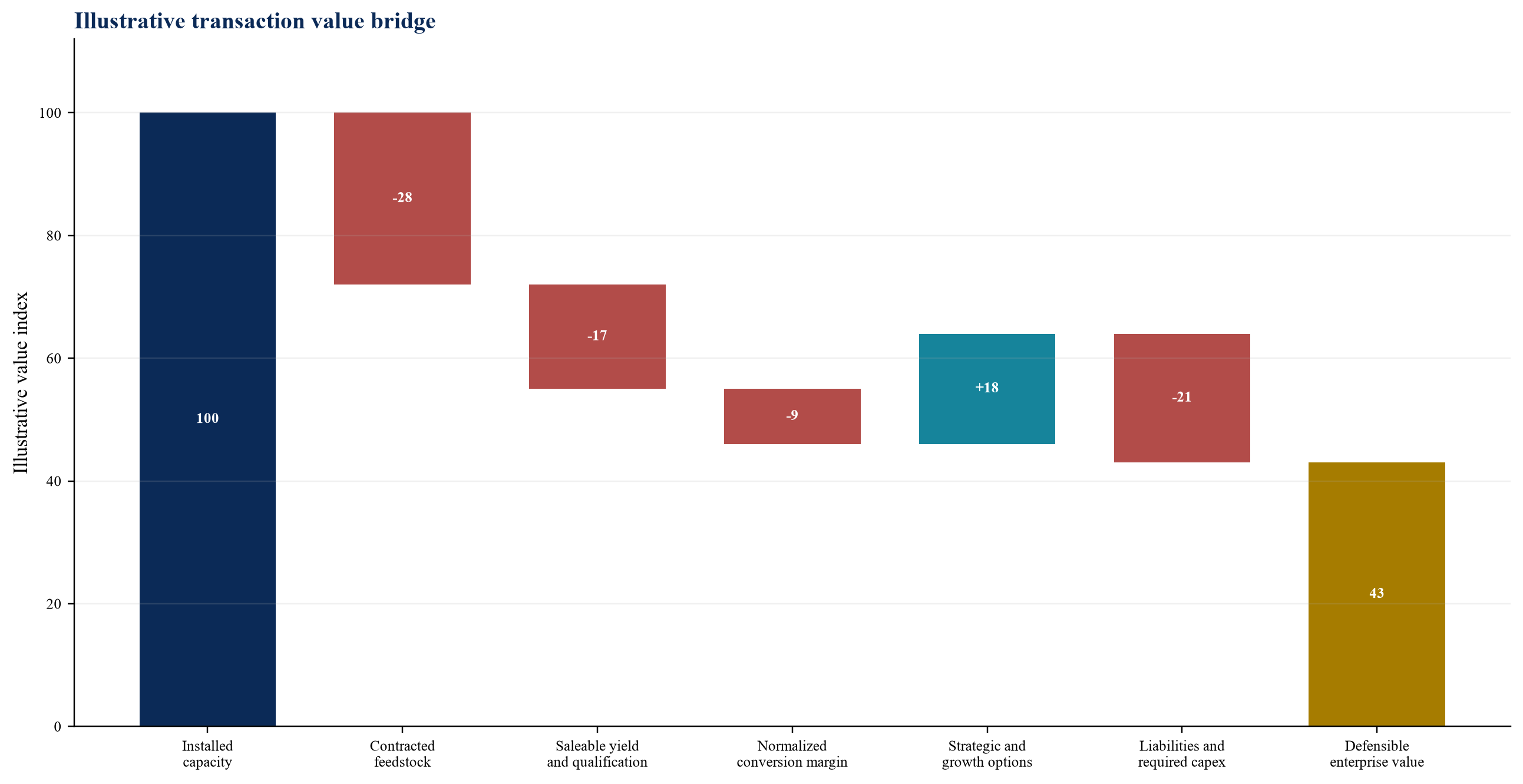
The bridge separates proven operating value from execution-dependent options and explicit liabilities.
45. Conclusion
Battery-recycling M&A should be underwritten from feedstock to cash. Installed capacity becomes valuable when the target controls lawful and economically attractive material, converts it at repeatable yield and cost, qualifies saleable products, and settles contracts without uncontrolled commodity or working-capital exposure.
Quality-adjusted tonnes provide a more useful operating measure than gross nameplate capacity. Recovery claims should be reconciled to commercial payability, product specification and residue cost. Contract formulas should be tested for benchmark, timing, floor, assay and currency differences. Environmental and safety evidence should cover both current operation and historic site use.
A defensible purchase price separates proven standalone earnings from construction, technology and strategic options. Earn-outs, holdbacks and specific protections should follow the risks that evidence cannot resolve before closing. The strongest investment case links each tonne, yield assumption and price formula to a contract, batch record and cash settlement.
References
- International Energy Agency, Electric Vehicle Batteries, Global EV Outlook 2026, 2026. https://www.iea.org/reports/global-ev-outlook-2026/electric-vehicle-batteries
- International Energy Agency, Recycling of Critical Minerals, 2024. https://www.iea.org/reports/recycling-of-critical-minerals
- International Energy Agency, Outlook for Battery and Energy Demand, Global EV Outlook 2024, 2024. https://www.iea.org/reports/global-ev-outlook-2024/outlook-for-battery-and-energy-demand
- International Energy Agency, Electric Vehicle Batteries, Global EV Outlook 2025, 2025. https://www.iea.org/reports/global-ev-outlook-2025/electric-vehicle-batteries
- European Parliament and Council, Regulation (EU) 2023/1542 Concerning Batteries and Waste Batteries, consolidated text. https://eur-lex.europa.eu/eli/reg/2023/1542/2025-07-31/eng
- European Commission, Commission Delegated Regulation (EU) 2025/606 Establishing the Methodology for Recycling Efficiency and Recovery of Materials, 21 March 2025. https://eur-lex.europa.eu/legal-content/EN/TXT/?uri=CELEX:32025R0606
- European Commission, Battery-related Waste Codes Update Set to Boost Circular Economy, 5 March 2025. https://environment.ec.europa.eu/news/battery-related-waste-codes-update-set-boost-circular-economy-2025-03-05_en
- European Commission, Assessment of Recycling Efficiency and Recovery Targets under Article 71(5) of Regulation (EU) 2023/1542, 2026. https://eur-lex.europa.eu/legal-content/EN/TXT/?uri=CELEX:52026DC0470
- United States Department of Energy, Li-Cycle Loan Programs Office Project, 2024. https://www.energy.gov/edf/li-cycle
- United States Department of Energy, ReCell Lithium-Ion Battery Recycling Research Plan. https://www.energy.gov/eere/vehicles/articles/eeres-vehicle-technologies-office-releases-research-plan-reduce-recycle-and
- Argonne National Laboratory, EverBatt Model Overview, 2019. https://publications.anl.gov/anlpubs/2019/07/153050.pdf
- Argonne National Laboratory, EverBatt Closed-Loop Battery Life-Cycle Model. https://www.anl.gov/egs/everbatt
- Glencore, Li-Cycle, acquisition effective 8 August 2025. https://www.glencore.com/what-we-do/recycling/li-cycle
- Li-Cycle Holdings Corp., Annual Report on Form 10-K for the year ended 31 December 2024. https://www.sec.gov/Archives/edgar/data/1828811/000182881125000009/licy-20241231.htm
- United States Environmental Protection Agency, Used Lithium-Ion Batteries. https://www.epa.gov/recycle/used-lithium-ion-batteries
- United Kingdom Environment Agency, Waste Batteries Appropriate Measures for Permitted Facilities, 2026. https://www.gov.uk/guidance/waste-batteries-appropriate-measures-for-permitted-facilities
- Harper, G. et al., Recycling Lithium-Ion Batteries from Electric Vehicles, Nature, 2019. https://doi.org/10.1038/s41586-019-1682-5
- Gaines, L., Lithium-Ion Battery Recycling Processes: Research towards a Sustainable Course, Sustainable Materials and Technologies, 2018. https://doi.org/10.1016/j.susmat.2018.e00068
- Thompson, D. et al., The Importance of Design in Lithium Ion Battery Recycling, Green Chemistry, 2020. https://doi.org/10.1039/D0GC02745F
- Dunn, J. et al., Circularity of Lithium-Ion Battery Materials in Electric Vehicles, Environmental Science and Technology, 2022. https://doi.org/10.1021/acs.est.1c07030
- Slattery, M. et al., The Role of Lithium-Ion Battery Recycling in the Circular Economy, Resources, Conservation and Recycling, 2021. https://doi.org/10.1016/j.resconrec.2021.105736
- Basel Convention, Technical Guidelines on the Environmentally Sound Management of Waste Batteries Other Than Waste Lead-Acid Batteries. https://www.basel.int/Implementation/TechnicalMatters/DevelopmentofTechnicalGuidelines
About the Author
Chennakeshav (CK) is a corporate finance and investment banking executive with 25+ years of global experience in deal origination, structuring and execution across M&A, growth capital and corporate strategy. He has led value-creation mandates for founders, corporates and funds — bridging the boardroom view to hands-on execution and close.
His career spans Morgan Stanley, HSBC, Lloyds Banking Group, EWEC, ADQ portfolio companies and Emirates Growth Fund, across TMT, real estate, fintech, deeptech, cleantech, infrastructure and energy. He has partnered with C-suite leaders, private equity and venture funds, sovereign wealth funds and family offices to finance complex fund raises and scale-up ventures, and has led M&A due diligence, post-merger integration and business-transformation initiatives to create value.
At Matchpoint Partners he is Managing Partner, leading the firm's corporate finance, M&A and capital-raising practice. He holds an MBA from London Business School, an engineering degree from VTU and a Master of Laws (LLM, in progress) from UCL London.
An active start-up mentor, CK mentors at Techstars, DIFC FinTech Hive, Startup Grind, Founder Institute and IN5, serves as Entrepreneur Mentor in Residence (EMiR) at London Business School, and judges the Entrepreneurship World Cup.
LinkedIn: https://www.linkedin.com/in/ckadya/
Profile: https://www.matchpoint-partners.com/team/ck-adya.html
