

1. The board decision behind bid selection
An accelerated sale often produces an apparently simple question: which bidder has offered the highest price? The board faces a wider decision. It must choose the offer that can become available proceeds within the remaining liquidity, legal authority and operating runway. Funding gaps, regulatory approvals, lender consents, diligence conditions, transition dependencies and weak documentation can turn a premium headline into a failed process. Failure may consume the cash and stakeholder confidence needed to complete with a second bidder.
Bid selection should therefore compare executable economic outcomes. The relevant amount is the value available after identified leakage, required support, transaction costs, delay and route-specific obligations. The relevant timetable begins with the next funding requirement and ends when consideration is irrevocably available and control can lawfully transfer. The seller also needs to understand the residual outcome if the preferred bidder fails.
This paper proposes an evidence-led bid-certainty system for distressed and accelerated M&A. It combines a bidder evidence map, weighted scorecard, route model, weekly cash overlay, risk-control matrix and ten-business-day implementation plan. The numerical example is hypothetical. Applicable insolvency, corporate, takeover, competition, national-security, financing, employment, pension, tax and sector rules require current specialist advice.
2. Headline price is one term in a contingent instrument
A bid is a contingent instrument rather than cash at signing. Its value depends on the consideration form, funding sources, conditions, approvals, adjustments, deferred amounts, security, buyer obligations and enforceability. A USD 120 million indication with uncommitted financing, broad diligence rights and several approvals may deliver less than a USD 101 million fully funded offer that can close before liquidity expires.
The seller should translate every offer into a common economic bridge. Starting with headline consideration, the bridge identifies assumed debt and liabilities, working-capital or cash adjustments, cure costs, employee and pension payments, retention, transitional services, regulatory remedies, leakage, escrow, holdback, deferred consideration, execution cost and time-dependent cash burn. Each amount needs a source, owner, range, payer and payment date.
The bridge should preserve uncertainty. A number supported by a signed facility and verified funds is different from a management estimate. A regulatory remedy with an agreed perimeter is different from a general risk reserve. The board pack should show evidence quality and the conditions that move each estimate. Combining all uncertainty into one discount obscures the decisions required to improve the offer.
Table 1. Proposed bid normalisation bridge
| Component | Evidence | Economic treatment | Escalation trigger |
|---|---|---|---|
| Headline consideration | Signed offer and consideration schedule | Starting value by form and currency | Non-binding amount or unclear payer |
| Funding | Equity commitment, facility and funds flow | Deduct gaps, fees and draw conditions | Commitment expires before closing |
| Purchase-price mechanics | Draft agreement and reference accounts | Model working-capital, cash and debt effects | Undefined accounting policies |
| Assumed obligations | Liability schedule and legal analysis | Allocate cure, employee, pension and tax cost | Liability cannot lawfully remain behind |
| Deferred value | Security, covenant and payment schedule | Scenario-test collectability and timing | Payment depends on buyer performance |
| Delay and transition | Weekly cash and operating plan | Deduct burn and required support | Runway ends before executable close |
Every amount requires current transaction evidence and specialist validation.
3. Establish authority and the decision standard
The board should approve the decision standard before final bids arrive. In a solvent process, directors apply the duties relevant to the company and transaction. Where financial distress deepens, creditor interests, insolvency risk and the authority of any office holder require specific advice. Government guidance on corporate financial distress recognises that advisers may support accelerated M&A, pre-pack sales and contingency planning, and that cash-flow insolvency can determine the available route [1].
The decision mandate should identify who can receive and clarify bids, verify financing, contact regulators, negotiate conditions, approve information, incur costs and recommend a preferred bidder. It should state the valuation date, available liquidity, minimum continuity requirements, creditor or stakeholder objectives, conflicts process and evidence threshold for changing the recommendation.
The record should distinguish the commercial recommendation from the legal decision. Advisers can prepare evidence and test alternatives. The authorised board or office holder decides within the applicable duties. Minutes should record the offers considered, information available, conflicts, uncertainties, downside case, reasons for the chosen route and actions required before signing or completion.
4. Build the bidder evidence map before scoring
A scorecard is useful only when it rests on evidence. Each bidder should provide a structured package covering identity, ownership, beneficial ownership, authority, funding, approvals, diligence, conditions, transaction documents, operating plan, transition needs and prior execution. The seller should set a cut-off time and require the same core evidence from every bidder, with controlled follow-up for offer-specific matters.
Funding evidence includes the equity source, debt commitment, draw conditions, expiry, syndication or market-flex exposure, currency, hedging, security, guarantees and funds-flow mechanics. Regulatory evidence includes each filing, responsible party, threshold analysis, draft submission status, likely timetable, remedy authority and long-stop compatibility. Diligence evidence should show questions resolved, advisers engaged, data accessed and outstanding confirmation.
Claims about speed or experience require verification. The seller can request named prior transactions, references, investment-committee or board approvals, adviser mandates and draft documents. Public reputation may inform diligence but cannot replace transaction-specific evidence. Missing evidence should reduce the relevant score and create an action, rather than produce a general impression that the bidder is weak.
5. Funding certainty must be tested through the funds flow
Funding certainty is more than a bank letter. The seller needs to trace the sources and uses from committed capital to the completion account. The model should show purchase price, refinancing, fees, taxes, cure payments, employee obligations, pensions, working capital, transition funding and minimum cash. It should identify which party funds each amount and when the money becomes available.
The UK Takeover Code provides a demanding public-offer reference point. Rule 2.7 and related practice require a firm offeror to have every reason to believe it can implement the offer, while a cash offer normally carries a third-party cash confirmation. The confirming party and offeror must take reasonable steps to establish that resources are available [3]. The precise regime does not automatically govern a private distressed sale, yet its evidential discipline illustrates what genuine funding readiness entails.
Private-sale funding may contain conditions precedent, material adverse change provisions, market flex, investment-committee approvals, equity call mechanics, limited-partner excuse rights, sanctions checks or currency constraints. The seller should not label funding committed until the documents, conditions, expiry and enforcement position support that conclusion. Qualified counsel and financial advisers should verify the package.
6. Conditions should be classified by control and consequence
Conditions differ in controllability. Some depend mainly on the buyer, such as final investment-committee approval or execution of financing documents. Some depend on the seller, such as specified diligence delivery or third-party consent requests. Others depend on regulators, courts, creditors, shareholders or counterparties. The bid model should classify each condition by decision maker, evidence required, earliest completion, outside date and failure consequence.
Broad conditions create option value for the bidder and uncertainty for the seller. A condition framed around buyer satisfaction, continuing diligence or a general absence of adverse change may allow repricing or withdrawal after other bidders disengage. The seller should narrow subjective conditions, define objective evidence, allocate effort obligations, include progress reporting and preserve remedies where appropriate.
The Takeover Code restricts the invocation of many offer conditions and generally requires material significance in the context of the offer, subject to defined exceptions [4]. Private transactions follow their own documents and law. The broader decision lesson is that the right to exit should be explicit, evidence-based and priced into bid selection.
7. Regulatory readiness is a liquidity issue
Competition, national-security, foreign-investment, foreign-subsidy and sector approvals can outlast the seller's cash. The team should create a jurisdiction and consent matrix before choosing the preferred bidder. It should cover filing thresholds, standstill rules, review periods, information requirements, control or ownership concerns, remedies, interim operating restrictions and possible waiver or alternative structure.
UK merger notification is generally voluntary, while the Competition and Markets Authority keeps merger activity under review and may investigate qualifying mergers. Its process includes pre-notification engagement and evidence gathering [5]. The 2026 Merger Assessment Guidelines emphasise case-specific analysis and current evidence [6]. The National Security and Investment regime can require mandatory notification in specified areas and recommends filing when transaction terms are sufficiently stable, with review and possible assessment periods [7].
Regulatory work should connect to liquidity. Each approval receives a base, faster and slower date; information dependencies; probability-free decision gates; cash cost; financing-expiry check; and structural alternative. The board then sees whether the bidder can close within the cash envelope or requires committed interim funding.
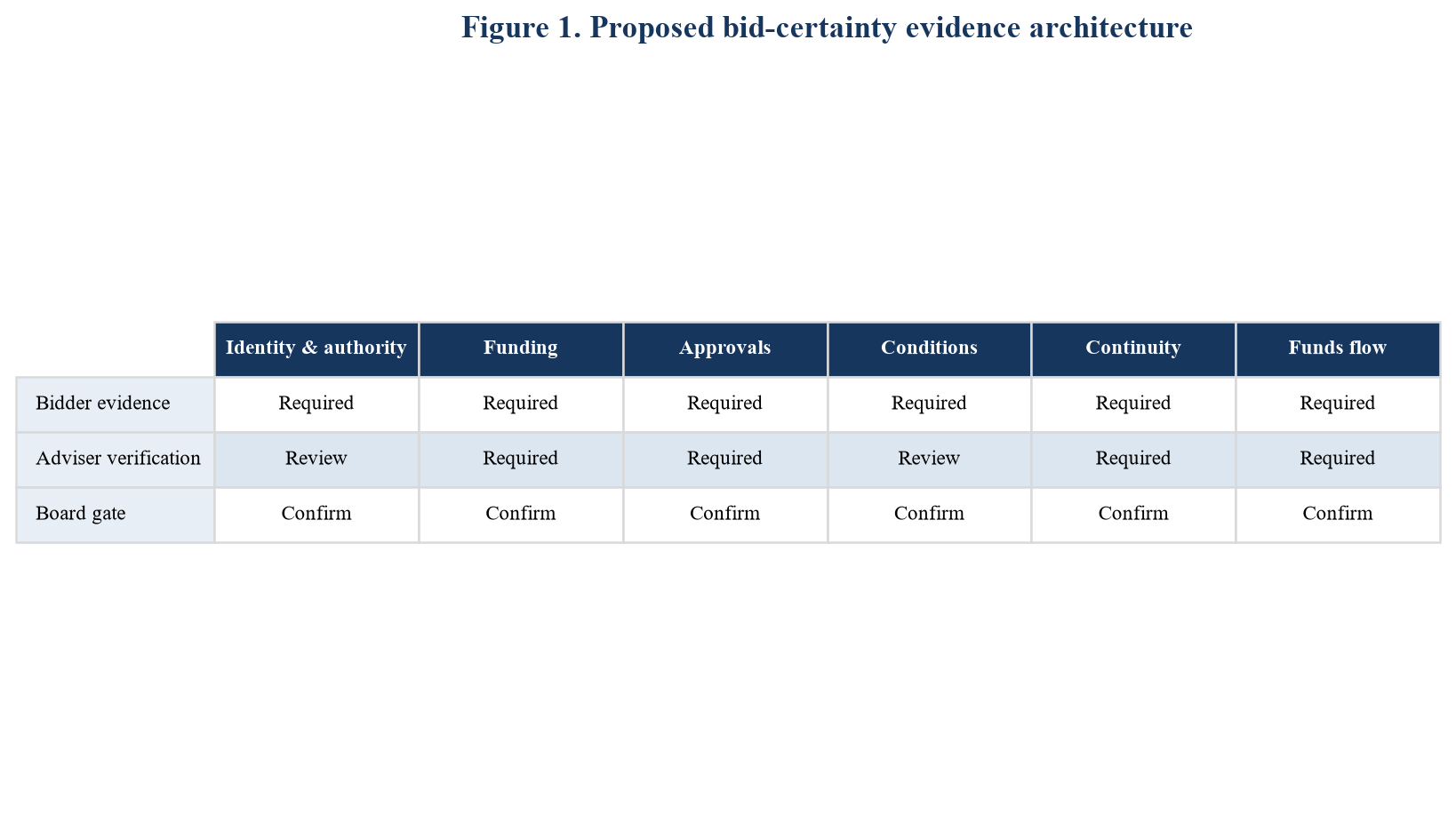
The architecture is a decision framework. Applicable duties and approval requirements remain controlling.
8. Diligence maturity predicts the work remaining
A bidder that has completed substantive diligence has fewer unresolved reasons to retrade. The seller should measure diligence maturity by workstream. Financial, commercial, tax, legal, employment, pensions, technology, cybersecurity, environmental, regulatory and operational reviews can each be classified as unopened, in progress, substantially complete or confirmed subject only to specified items.
Question volume is an imperfect signal. A disciplined bidder may ask fewer, sharper questions. The evidence lies in adviser engagement, access history, issue lists, draft schedules, marked transaction documents, quantified exceptions and stated completion requirements. The seller should ask each bidder to convert open diligence into a closed list with consequence and deadline.
Accelerated processes need a minimum evidence set. Speed does not justify concealment or unsupported reliance. The seller should prioritise information that affects title, authority, cash, liabilities, continuity, regulation and buyer funding. Missing records should be identified and allocated through price, condition, escrow, indemnity, structure or explicit risk acceptance.
9. Documentation maturity turns intent into executable terms
A high headline bid contained in a short email may conceal weeks of negotiation. The board should compare the maturity of the sale agreement, disclosure process, transitional-services agreement, funding documents, equity commitment, guarantees, escrow, licences, consents and completion deliverables. Marked documents reveal where the bidder is seeking optionality or transferring risk.
Key drafting areas include price mechanics, debt and cash definitions, working-capital targets, assumed liabilities, employee allocation, pension treatment, warranties, indemnities, limitations, conduct covenants, access, conditions, termination, efforts standards, long-stop, specific performance, reverse termination fees and funds flow. The appropriate package depends on route, law and bargaining power.
The seller should maintain a red-flag schedule rather than treat total mark-up length as the metric. Each issue should state economic effect, decision owner, evidence, proposed resolution and whether it can prevent signing or completion. A mature bid is one where material issues are understood and allocated, even if several drafting points remain.
10. Operating continuity belongs in the bid comparison
The buyer must be able to own and operate the acquired business on day one. The offer should identify licences, employees, systems, bank arrangements, insurance, customers, suppliers, premises, intellectual property, data, safety responsibilities and shared services required for continuity. A buyer requiring extensive seller support may consume value or create failure points after legal completion.
The continuity plan should assign every dependency to transfer, replacement, consent, transitional service or temporary workaround. It needs an owner, evidence, cost, start date, duration and failure response. The seller should model the resources retained to support the buyer and any stranded cost or liability.
Continuity can affect creditor outcomes and transaction value. A lower-price bidder with an established operating platform may reduce customer attrition, employee departures and transition spend. The comparison should use verified capabilities and a costed plan. Strategic fit alone is insufficient evidence of readiness.
11. Deferred consideration needs a recovery analysis
Deferred consideration, earn-outs, vendor loans and contingent payments can inflate headline value. The seller should separate cash at completion from later amounts and analyse obligor credit, security, priority, covenants, control over performance, information rights, set-off, subordination, currency, tax and enforcement jurisdiction.
In an administration sale to a connected person, UK guidance on independent scrutiny notes that an evaluator may request a viability statement or business plan where instalments are proposed, because these materials help assess the reasonableness of deferred consideration and the purchaser's ability to pay [8]. This is a specific regime, yet the underlying economic question applies more broadly.
The board should show nominal deferred value, modeled collection dates and scenarios based on explicit assumptions. It should avoid converting an unsupported future payment into cash-equivalent value. Security and control rights may improve recoverability, while dependence on the buyer's future performance or discretion increases exposure.
12. Purchase-price mechanics can reverse the ranking
Two bids with similar headline prices may use different definitions of cash, debt and working capital. One may assume normalised working capital that the distressed company cannot deliver. Another may treat overdue suppliers, customer deposits, pension arrears, leases, tax, factoring, bonuses or restructuring liabilities as debt-like items. The board needs a bid-by-bid bridge based on common accounting policies.
The bridge should use a current balance sheet, thirteen-week cash forecast and projected completion statement. Every adjustment should identify the contractual definition, accounting source, cut-off, dispute mechanism and sensitivity. The seller should model how delay changes the result because collections, supplier payments, payroll and emergency funding continue.
Locked-box structures require leakage controls and a credible reference balance sheet. Completion accounts require definitions, estimates and a post-close dispute process. In a compressed sale, a carefully defined fixed price may provide more certainty than an apparently higher offer with an aggressive completion adjustment.
Table 2. Proposed bid-certainty scorecard
| Dimension | Weight | Evidence question | Scoring anchor |
|---|---|---|---|
| Funding certainty | 25% | Are all sources committed through the executable close? | 1 unsupported to 5 fully evidenced |
| Regulatory readiness | 20% | Are filings, risks, remedies and dates decision-ready? | 1 unknown to 5 prepared |
| Conditionality | 15% | Can the buyer exit or reprice for unresolved matters? | 1 broad optionality to 5 narrow objective terms |
| Diligence maturity | 10% | Is the open issue list closed and quantified? | 1 early stage to 5 substantially complete |
| Operating continuity | 10% | Can the business trade on day one? | 1 dependent to 5 rehearsed |
| Stakeholder execution | 10% | Are lender, creditor and counterparty actions mapped? | 1 untested to 5 supported |
| Documentation maturity | 5% | Are material drafting issues allocated? | 1 indicative to 5 executable |
| Bidder behaviour | 5% | Has conduct matched stated commitments and dates? | 1 unreliable to 5 consistently evidenced |
Weights and scores are author assumptions for the hypothetical case and require transaction-specific redesign.
13. Stakeholder support changes closing capacity
Secured lenders, asset-based financiers, landlords, key suppliers, customers, pension trustees, employees and public authorities may control approvals, releases, continued supply or operating permissions. The bidder's offer should identify which stakeholder actions are conditions, completion deliverables or post-close tasks. The seller should avoid promising consents before authorised engagement.
A stakeholder map records claim, security, contract rights, control points, current position, information needs, decision process and timing. It also records who bears any payment or concession. A bid that assumes universal cooperation without a funded plan should score poorly even if the headline price is attractive.
Communication must be controlled. Premature disclosure can destabilise the business, while late engagement can make completion impossible. The board should approve contact sequencing based on legal duties, confidentiality, market rules, employee processes and operational need. Statements should distinguish verified facts, proposals and conditions.
14. Connected-party and conflict risks require additional evidence
A connected-party bid may offer speed and operational familiarity, while also creating conflicts and creditor-scrutiny risk. The process should identify relationships, management participation, access advantages, funding links, competing interests and information asymmetry. Independent advice, valuation, marketing evidence and conflict protocols may be required.
UK rules restrict certain substantial disposals to connected persons during the first eight weeks of administration unless creditor approval or a qualifying evaluator report is obtained. The administrator must consider the report, and material changes to the proposed disposal may require a further report [8]. The exact statutory requirements and professional standards should be confirmed for the case.
The scorecard should not mechanically penalise connection. It should demand the evidence needed to demonstrate that the offer and process support the relevant statutory purpose and stakeholder outcome. A connected bidder with verified funding and a robust operating plan may remain executable. The record needs to show how alternatives and conflicts were handled.
15. Cross-border bids multiply interfaces
A cross-border buyer may require approvals, financing, currency transfers, tax clearances, beneficial-ownership review, sanctions checks, local licences and foreign-investment filings across several jurisdictions. The seller should maintain a country-level closing matrix and a central dependency map. A condition satisfied in one country may still depend on a group reorganisation or approval elsewhere.
The European Union Merger Regulation contains notification and procedural rules for concentrations with an EU dimension, including a standstill framework [9]. The Foreign Subsidies Regulation can impose a separate notification and standstill obligation for qualifying concentrations [10]. In the United States, reportable transactions under the Hart-Scott-Rodino regime require premerger notification and the applicable waiting period, including a shorter statutory period for certain cash tender offers or bankruptcy transactions [11].
The model should avoid assuming that every process runs in parallel. Filing acceptance may depend on complete information, and remedies can affect financing or the acquired perimeter. The bidder should provide local advisers, draft forms, document ownership, timetable logic and authority to offer solutions.
16. Bidder conduct is evidence
Behaviour during the process can reveal execution capacity. The seller should record whether the bidder met deadlines, mobilised advisers, resolved questions, supplied approvals, narrowed conditions, produced mark-ups and escalated issues accurately. A pattern of missed dates or changing explanations should affect the score because it changes the expected work remaining.
Conduct should be measured through a factual log rather than personal impressions. Each commitment has a date, owner, delivery and consequence. The log also protects fair process by applying consistent standards across bidders. One missed administrative deadline should not outweigh strong evidence, while repeated failures on funding or authority deserve material weight.
The team should distinguish negotiation from unreliability. A bidder may rationally seek price protection or allocate unknown risk. The seller's task is to understand the remaining option and decide whether the economic and timing package is acceptable. Clear issue logs allow productive negotiation without disguising execution risk.
17. The model compares routes rather than predicting outcomes
The hypothetical company begins with USD 14 million of unrestricted cash and three offers. Offer A has a USD 120 million headline price, unresolved financing and regulatory work, broad conditions and significant continuity dependency. Offer B offers USD 108 million with committed funding and a developed operating plan. Offer C offers USD 101 million in cash with the narrowest conditions and earliest executable completion.
The model deducts assumed workforce, financing, delay, condition and continuity effects from headline price. It then combines each modeled completion value with a downside route using an illustrative decision weight. The weight is not a probability estimate. It is a transparent author assumption designed to show how the board can compare completion and failure paths without presenting headline consideration as certain cash.
All values, scores, timing, cash paths and weights are hypothetical and have no empirical calibration. They do not estimate market practice, transaction value, regulatory outcome, financing availability, completion probability, creditor recovery or solvency. A live case must replace every input with verified transaction evidence.
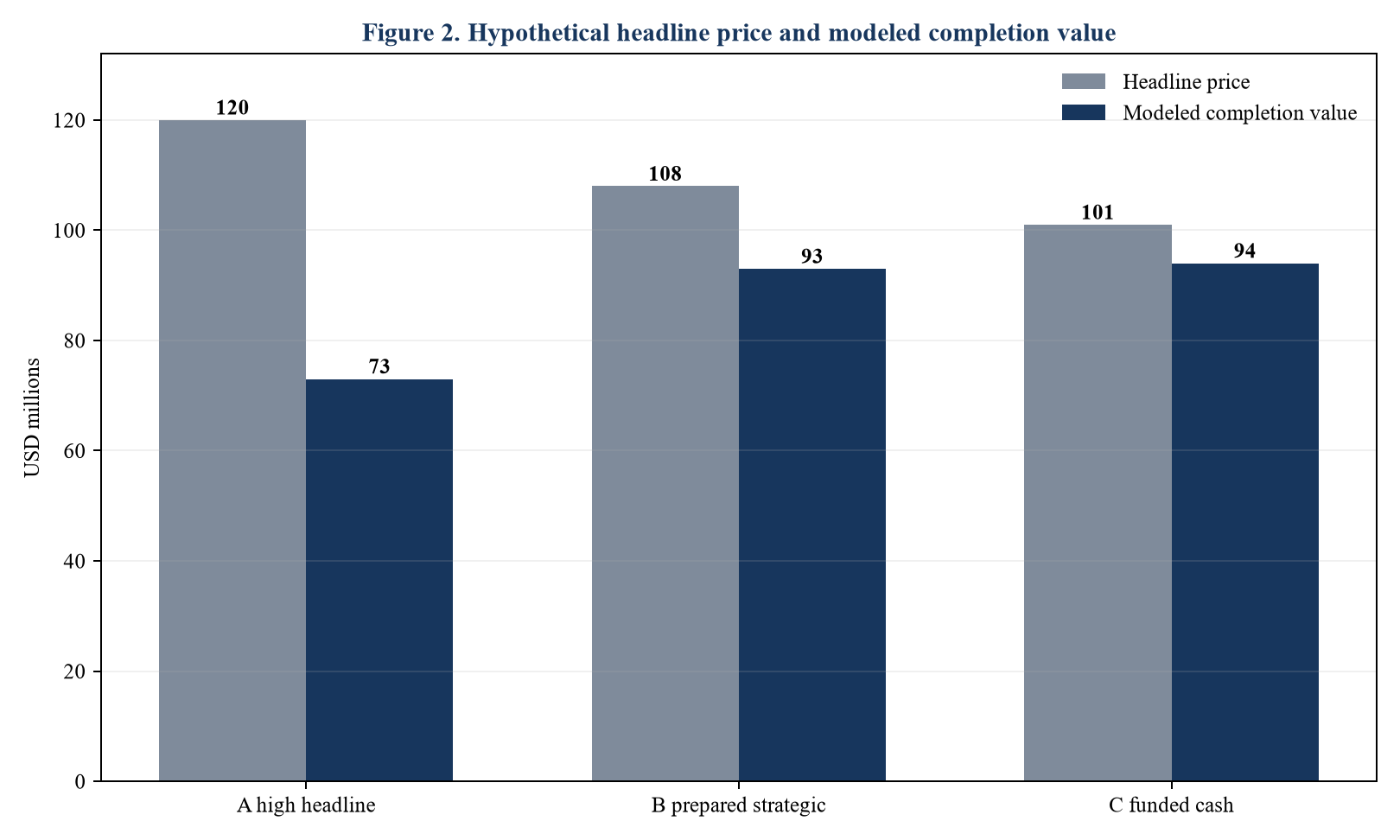
Author assumptions in USD millions. Modeled values are decision illustrations, not valuation conclusions.
18. The highest bid loses value through unresolved dependencies
Offer A begins at USD 120 million and appears dominant. The model deducts USD 28 million for financing and funding uncertainty, USD 8 million for approval and delay effects, USD 7 million for condition and adjustment exposure, and USD 4 million for continuity and execution requirements. The modeled completion value becomes USD 73 million.
The illustrative decision weight for the closing route is 45 per cent. The remaining weight uses a USD 50 million downside route after delay and process damage. The resulting decision value is USD 60.35 million under the stated arithmetic. This number is a consequence of assumptions, not a market estimate or forecast.
The offer may still be selected if the bidder cures the evidence gaps. A signed financing package, narrowed conditions, completed filings, a funded bridge and an executable operating plan could materially change the route. The model makes those value-improving actions explicit before exclusivity removes competitive leverage.
19. The middle bid becomes credible through preparation
Offer B begins at USD 108 million. The model deducts USD 4 million of financing exposure, USD 5 million of approval and delay effects, USD 3 million of conditions and adjustments, and USD 3 million of continuity cost. The modeled completion value is USD 93 million.
Its illustrative closing-route weight is 78 per cent, combined with a USD 58 million downside route. The arithmetic produces an illustrative decision value of USD 85.3 million. The stronger outcome comes from narrower evidence gaps, earlier regulatory work and a more developed operating plan rather than a claim that strategic bidders are inherently more reliable.
The board should still test concentration, national-security, integration and remedy risk. A strategic buyer can face complex approvals or seek a perimeter change that damages value. The scorecard provides a current view and must update as evidence changes.
20. The lower bid leads when cash and conditions are verified
Offer C begins at USD 101 million. The model deducts USD 1 million for financing exposure, USD 2 million for approval and delay, USD 2 million for conditions and adjustments, and USD 2 million for continuity. The modeled completion value is USD 94 million.
Its illustrative closing-route weight is 88 per cent, combined with a USD 60 million downside route, producing an illustrative decision value of USD 89.92 million. The result follows directly from the assumptions. It does not prove that cash buyers or financial sponsors close more reliably.
Offer C may also have limitations. It could require management support, transitional services, licence changes or post-close financing. The seller should verify its ownership, authority, sanctions position, operating plan and funds flow. A lower headline deserves preference only when the evidence supports the economic and timing conclusion.
Table 3. Hypothetical bid-route assumptions and outputs
| Offer | Headline | Modeled completion value | Closing-route weight | Downside route | Illustrative decision value |
|---|---|---|---|---|---|
| A high headline | 120.0 | 73.0 | 45% | 50.0 | 60.35 |
| B prepared strategic | 108.0 | 93.0 | 78% | 58.0 | 85.30 |
| C funded cash | 101.0 | 94.0 | 88% | 60.0 | 89.92 |
USD millions except decision weights. Every figure is an author assumption without empirical calibration.
21. Liquidity determines the time available to improve a bid
The seller's weekly cash forecast should include receipts, payroll, taxes, critical suppliers, rent, insurance, professional fees, retention, cure payments, pension contributions, financing costs and transaction expenses. Each offer adds a route-specific spending and completion profile. The forecast should identify the first week in which an obligation cannot be met without new funding.
The hypothetical paths begin with USD 14 million. Offer A consumes cash through a longer unresolved process and reaches negative USD 10.4 million by week thirteen. Offer B incurs preparation cost and closes in the modeled seventh week, ending with USD 6.7 million after assumed buyer support. Offer C closes in the modeled fourth week and ends with USD 10.4 million. These paths are arithmetic illustrations only.
Liquidity changes bid strategy. The board can ask a slower bidder to fund a deposit, bridge, expense reimbursement or other lawful support. It can preserve a backup bidder, narrow exclusivity, set evidence milestones or choose the faster route. Every mechanism requires legal, tax, financing and insolvency analysis.
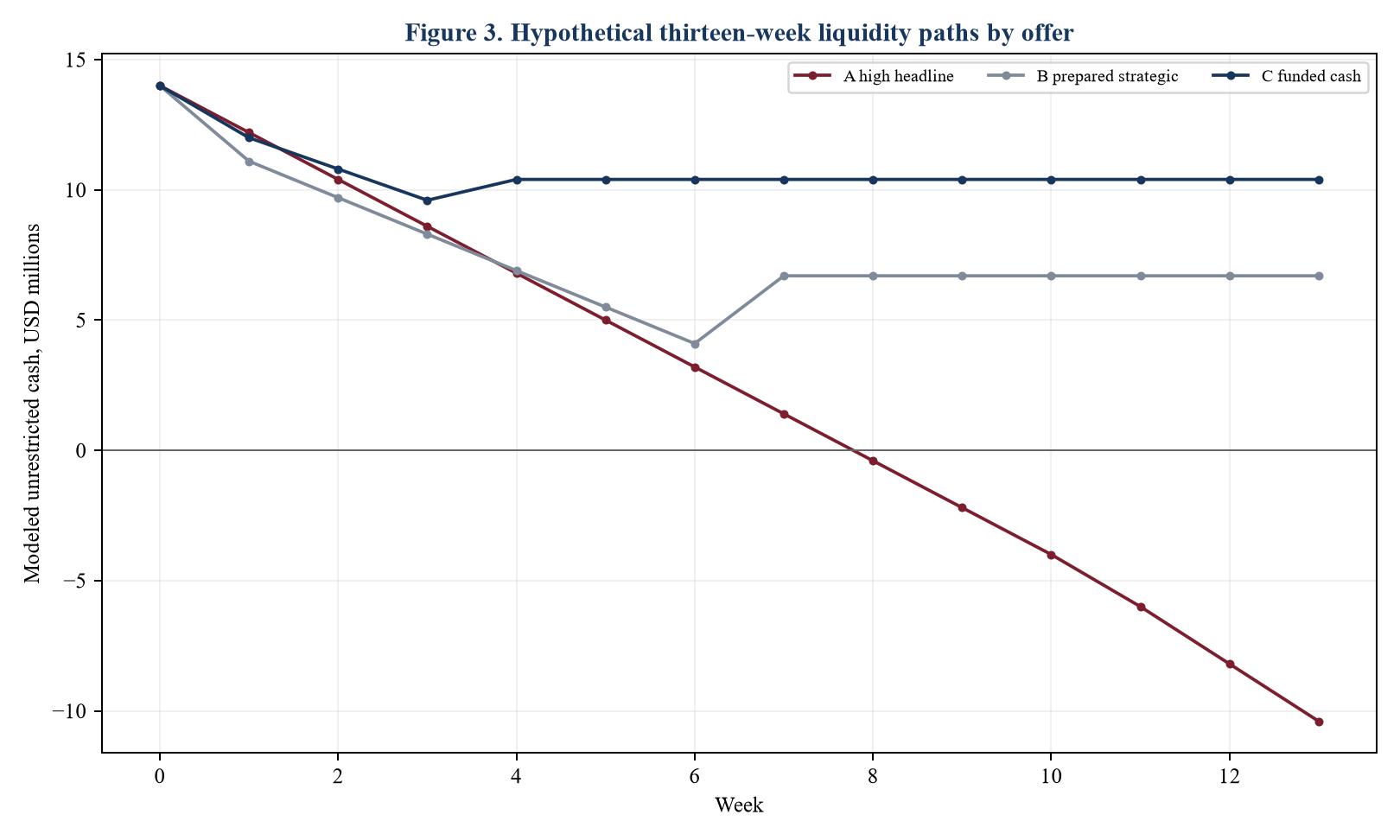
Author assumptions. Negative cash indicates a need for additional funding or an earlier route decision.
22. Exclusivity should purchase measurable progress
Exclusivity transfers option value to the preferred bidder. The seller should receive specific progress in return. The agreement can include funding evidence, regulatory submissions, diligence completion, document turns, approval dates, deposits, cost coverage, reverse termination protection or staged exclusivity. The appropriate provisions depend on bargaining power and law.
Milestones should be objective and linked to consequences. If a bidder misses a funding confirmation or filing date, the seller may regain the right to engage alternatives, shorten the long-stop, require additional support or terminate. The board should understand whether enforcement is commercially useful before relying on a contractual remedy.
A backup route needs active maintenance. Data access, management time and confidentiality should be controlled, but a credible alternative may protect stakeholders if the preferred bidder fails. The cost and operational disruption of keeping another bidder warm should enter the decision model.
23. Reverse termination fees and deposits have limits
A reverse termination fee can allocate some buyer-side failure risk. Its usefulness depends on amount, trigger, credit support, enforceability, exclusivity cost and the damage created by delay. A fee does not fund payroll unless it is available when needed, and it may be insufficient if the business loses customers, employees or licences.
Deposits, escrow and equity guarantees can provide stronger cash evidence. The seller should examine refund conditions, draw rights, priority, insolvency treatment and governing law. A deposit that can be reclaimed following broad diligence dissatisfaction provides limited protection.
The board should avoid double counting. A reverse fee may improve the downside route without increasing completion value. A funded deposit may support liquidity and reduce financing exposure. The model should show the mechanism once, in the location where it changes cash or recovery.
24. Stop conditions prevent a failing bid from consuming the estate
The preferred-bid process should have stop conditions. Examples include expired financing, failure to submit a required filing, unresolved authority, refusal to narrow a fundamental condition, missing interim funding, loss of a critical licence, an unworkable funds flow or cash falling below the minimum operating threshold.
Each stop condition requires a test date, owner, evidence and pre-agreed response. The response may be cure, revised structure, parallel route, creditor engagement, formal insolvency step or termination. Qualified advisers should determine which actions are available and who has authority.
Stop conditions create discipline because optimism otherwise compounds under pressure. The seller may continue spending on a bid because substantial effort has already been invested. A current evidence gate directs attention to the next executable decision rather than sunk cost.
Table 4. Proposed bid-certainty risk-control matrix
| Failure mode | Early indicator | Control | Evidence retained |
|---|---|---|---|
| Financing does not fund | Conditions or approvals remain open near expiry | Funds-flow verification and milestone gate | Commitments, approvals and draw checklist |
| Approval misses runway | Filing cannot be accepted or remedy authority is absent | Regulatory critical path and funded bridge | Draft filings, timetable and authority record |
| Bidder retrades | Broad diligence or adjustment rights remain | Closed issue list and objective definitions | Mark-ups, issue log and model bridge |
| Business cannot transfer | Day-one dependencies lack owners or funding | Continuity map and rehearsal | Cut-over plan and signed services |
| Preferred bidder fails late | Backup route has gone cold | Controlled parallel readiness | Alternative timetable and contact log |
| Board relies on unsupported score | Evidence is missing or stale | Source-linked scorecard with review dates | Versioned score and decision minutes |
Controls require adaptation to the transaction, duties, documents and jurisdictions.
25. The board pack should show change, not a static ranking
The bid-certainty dashboard should include headline price, modeled completion value, decision value, liquidity path, weighted score, conditions, filings, funding, diligence, documentation, continuity, stakeholder actions and stop conditions. It should show changes since the prior meeting and the evidence causing each change.
A high aggregate score can conceal a fatal issue. The dashboard therefore needs red-line gates for authority, funding, legality, minimum continuity and liquidity. A bidder cannot compensate for an unexecutable funds flow through a strong score elsewhere. The board should see both the weighted comparison and the hard gates.
The pack should preserve prior versions. This creates a record of how bids improved, deteriorated or changed following clarification. It also helps advisers identify whether a revised price merely shifts risk into adjustments, deferred consideration or seller support.
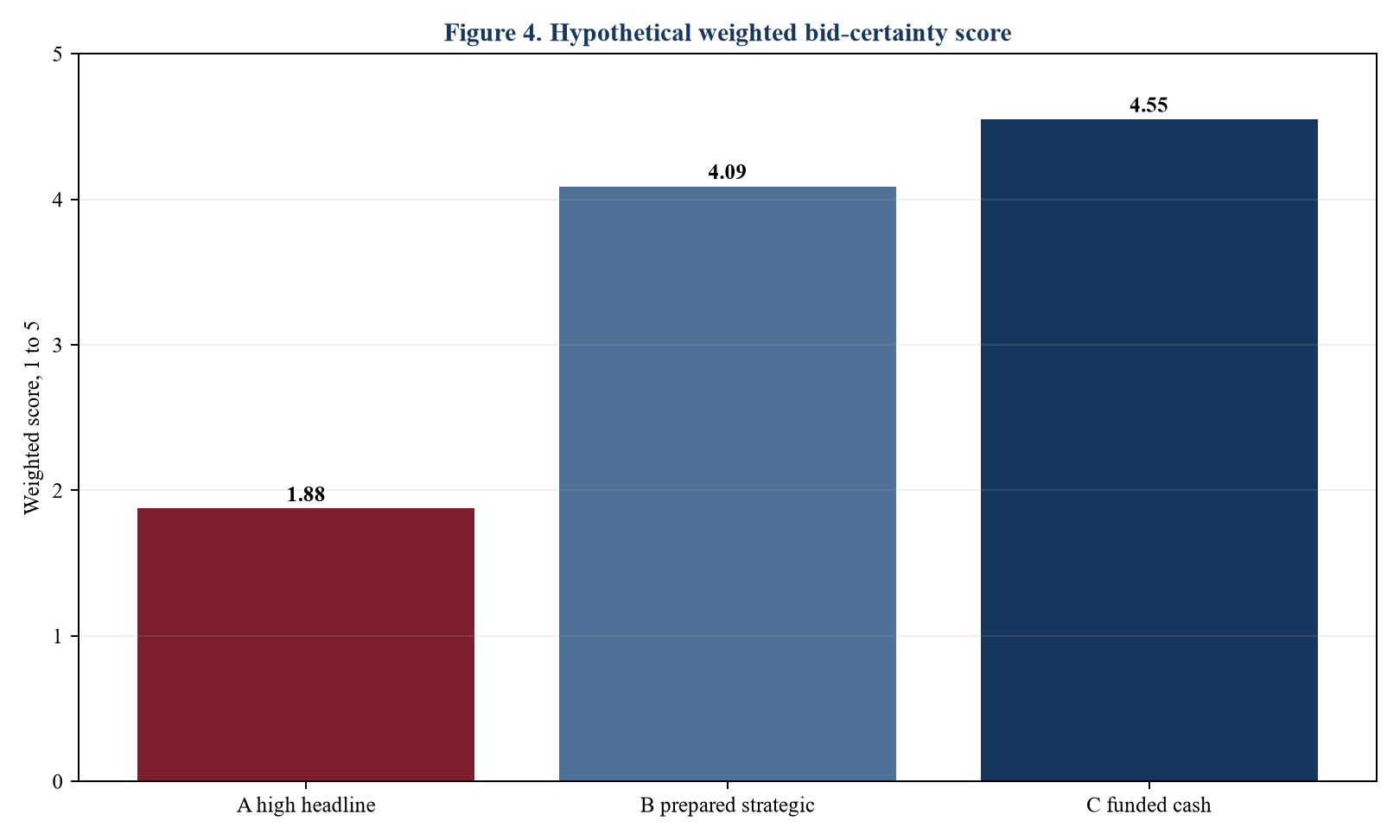
Weights and scores are author assumptions. The chart illustrates transparent comparison and does not predict completion.
26. A ten-business-day implementation roadmap
Days one and two establish authority, duties, liquidity and a common bid template. The team confirms decision makers, conflicts, cash runway, minimum continuity and the evidence required from each bidder. It builds the first normalisation bridge and regulatory map.
Days three to five verify identity, funding, approvals and diligence. Advisers review commitments, conditions, filings, marked documents and open issues. Operations maps day-one dependencies, while finance connects each route to weekly cash. Management requests precise cures rather than general assurances.
Days six to eight update the scorecard, negotiate conditions and test funds flow. The team prepares the stakeholder plan, continuity rehearsal and backup route. The board receives completion and failure scenarios with explicit assumptions.
Days nine and ten complete final evidence, identify stop conditions and approve the preferred route. The decision record explains why the selected bid offers the strongest executable outcome. The ten-day cycle establishes control; regulatory, consultation, court, creditor or financing processes may continue beyond it.
Table 5. Proposed ten-business-day bid-certainty roadmap
| Period | Core action | Required output | Board gate |
|---|---|---|---|
| Days 1 to 2 | Confirm authority, liquidity and bid template | Mandate, cash runway and normalisation bridge | Approve decision standard |
| Days 3 to 5 | Verify funding, approvals and diligence | Evidence map, filing path and closed issue list | Identify required cures |
| Days 6 to 8 | Negotiate and test executable routes | Updated model, documents and continuity plan | Preserve or change preferred route |
| Days 9 to 10 | Complete recommendation and contingency | Final scorecard, funds flow and stop conditions | Select, defer or reject bid |
Mandatory legal, regulatory, financing and stakeholder timetables remain controlling.
27. Role of technology and AI
Authorised technology can reconcile bid terms, extract conditions, compare document versions, maintain evidence links, model sensitivities and flag missed milestones. It can connect purchase-price definitions to financial data, map regulatory requirements and produce controlled updates from approved source records.
Natural-language systems can help classify diligence questions, summarise mark-ups and identify inconsistent bidder statements. They should operate inside access, privilege, confidentiality, data-protection and retention controls. Transaction data may contain personal, competitively sensitive and market-sensitive information.
Human review remains essential. Systems should not select the winning bidder, determine legal duties, conclude that financing is committed, make regulatory assessments, decide creditor outcomes or release communications autonomously. The audit trail should preserve source documents, model assumptions, prompt or rule versions, reviewer decisions and final outputs.
28. How the framework travels across deal types
The framework can support share sales, asset sales, administration disposals, pre-packs, public offers and cross-border carve-outs. The common elements are authority, bid normalisation, funding, approvals, conditions, continuity, cash and contingency. The legal standards and stakeholder objectives differ by route.
In a public offer, takeover rules may impose specific financing, announcement, timetable and condition requirements. In an administration, the statutory purpose, creditor outcome, marketing, valuation and connected-party rules require specialist attention. A sale under section 363 of the United States Bankruptcy Code involves court process and statutory provisions concerning use, sale or lease of estate property [13].
The board should retain the common decision architecture and replace every legal conclusion with route-specific advice. This enables comparison across alternatives without assuming that procedures or creditor priorities are interchangeable.
29. Limitations
This paper provides a general transaction decision framework. It is not legal, insolvency, regulatory, competition, national-security, financing, accounting, tax, employment, pensions, investment or valuation advice. The cited materials apply in their stated jurisdictions and contexts and may change. A live transaction requires current advice based on its parties, documents, duties, assets, liabilities and regulatory perimeter.
All bid amounts, deductions, weights, scores, timings, cash paths and outcomes in the hypothetical model are author assumptions without empirical calibration. They do not estimate market practice, bidder behaviour, financing availability, regulatory outcomes, completion probability, transaction value, creditor recovery or solvency. The model excludes many relevant facts and cannot establish fairness or the best available outcome.
Management should rebuild every schedule from verified records and preserve alternative cases. The framework can improve transparency, evidence and sequencing. It cannot guarantee funding, approval, completion, continuity, recoveries or price.
30. Conclusion
The strongest bid is the offer that can become lawful, funded and operationally executable proceeds within the seller's remaining runway. Headline price begins the comparison. Funding, approvals, conditions, diligence, documentation, continuity, stakeholder actions, adjustments and failure consequences determine the available outcome.
An evidence-led process gives the board a normalised value bridge, bidder evidence map, weighted scorecard, route-specific cash forecast, stop conditions and backup plan. It also identifies the precise actions through which a bidder can improve certainty before exclusivity or signing.
This discipline protects decision quality when time and cash are scarce. It shows why a premium offer may destroy value, why a lower bid may preserve it, and what evidence is needed to support the choice. The resulting record is clearer for boards, office holders, creditors, buyers and advisers.
References
- UK Government. Corporate Financial Distress Guidance Note. Updated 15 June 2026; accessed 6 September 2026. https://www.gov.uk/government/publications/the-sourcing-and-consultancy-playbooks/corporate-financial-distress-guidance-note-html
- United Nations Commission on International Trade Law. Legislative Guide on Insolvency Law. Accessed 6 September 2026. https://uncitral.un.org/en/texts/insolvency/legislativeguides/insolvency_law
- The Takeover Panel. Practice Statement 10: Cash offers financed by the issue of offeror securities. Accessed 6 September 2026. https://code.thetakeoverpanel.org.uk/tp/ps/ps-10.html
- The Takeover Panel. Rule 13.5: Invoking conditions and pre-conditions. Accessed 6 September 2026. https://code.thetakeoverpanel.org.uk/tp/rules/rule-13/rule-13-5.html
- Competition and Markets Authority. Mergers: how they are investigated. Accessed 6 September 2026. https://www.gov.uk/government/publications/mergers-how-they-are-investigated/mergers-how-they-are-investigated
- Competition and Markets Authority. Merger Assessment Guidelines. Updated 3 September 2026; accessed 6 September 2026. https://www.gov.uk/government/publications/merger-assessment-guidelines/merger-assessment-guidelines-html-version
- UK Government. National Security and Investment Act guidance on acquisitions. Accessed 6 September 2026. https://www.gov.uk/guidance/national-security-and-investment-act-guidance-on-acquisitions
- The Insolvency Service. Requirements for independent scrutiny of disposals in administration, including pre-pack sales. Accessed 6 September 2026. https://www.gov.uk/government/publications/requirements-for-independent-scrutiny-of-the-disposal-of-assets-in-administration-including-pre-pack-sales/requirements-for-independent-scrutiny-of-the-disposal-of-assets-in-administration-including-pre-pack-sales
- European Commission. EU Merger Regulation and implementing legislation. Accessed 6 September 2026. https://competition-policy.ec.europa.eu/mergers/legislation_en
- European Commission. Foreign Subsidies Regulation questions and answers. Accessed 6 September 2026. https://competition-policy.ec.europa.eu/foreign-subsidies-regulation/questions-and-answers_en
- United States Federal Trade Commission. Premerger Notification and the Merger Review Process. Accessed 6 September 2026. https://www.ftc.gov/advice-guidance/competition-guidance/guide-antitrust-laws/mergers/premerger-notification-merger-review-process
- United States Federal Trade Commission. New HSR thresholds and filing fees for 2026. Published January 2026; accessed 6 September 2026. https://www.ftc.gov/enforcement/competition-matters/2026/01/new-hsr-thresholds-filing-fees-2026
- United States Code. Title 11, section 363: Use, sale, or lease of property. Accessed 6 September 2026. https://uscode.house.gov/view.xhtml?req=granuleid:USC-prelim-title11-section363&num=0&edition=prelim
- Financial Conduct Authority. DTR 2: Disclosure and control of inside information by issuers. Accessed 6 September 2026. https://handbook.fca.org.uk/handbook/DTR/2/
- Information Commissioner's Office. Due diligence when sharing data following mergers and acquisitions. Accessed 6 September 2026. https://ico.org.uk/for-organisations/uk-gdpr-guidance-and-resources/data-sharing/data-sharing-a-code-of-practice/due-diligence/
- UK Parliament. The Administration (Restrictions on Disposal etc. to Connected Persons) Regulations 2021. Accessed 6 September 2026. https://www.legislation.gov.uk/uksi/2021/427/contents
