

1. Give the review a decision mandate
A portfolio review is a capital-allocation decision process. It should begin with the board's mandate, available resources and decision rights. A collection of business presentations can describe performance without resolving the central questions: which activities deserve more capital, which capabilities should be sourced externally, which businesses require a bounded repair, and which positions should be sold or closed.
The G20/OECD Principles of Corporate Governance assign boards responsibility for reviewing strategy, major plans, budgets and performance, and for overseeing major capital expenditure, acquisitions and divestitures.[1] The UK Corporate Governance Code 2024 and its guidance place long-term sustainable success, resilience, future prospects and investment plans within the board's strategic work.[2][3] Saudi Arabia's Corporate Governance Regulations allocate approval of comprehensive strategy, principal business plans and risk-management policies to the board, while executive management proposes and implements plans, capital structure and major capital expenditure.[4] The UAE Securities and Commodities Authority's governance framework similarly defines board, executive, control and risk responsibilities for companies within its scope.[5][6]
The board should approve a short review charter before analysis begins. The charter should state:
1. the units to be reviewed and the economic perimeter of each; 2. the strategic horizon and capital constraints; 3. the common financial, strategic and risk measures; 4. the five available routes and their approval gates; 5. the matters reserved for the board, committees and management; 6. the evidence required for a final decision; and 7. the dates on which capital can be committed, withheld or reallocated.
The mandate should include the parent itself. Headquarters consumes cost and attention, sets incentives, imposes controls and can create or destroy value through resource allocation. A review that treats parent activity as costless will favour complexity. A review that attributes every central cost mechanically can obscure genuine shared capabilities. The board needs a transparent rule for both.
2. Define the unit of analysis before assigning an option
Legal entities, operating segments, management reporting units, brands, capabilities and market positions are different objects. The appropriate unit depends on the decision. A legal entity may contain several businesses. A business may rely on capabilities owned elsewhere in the group. A market position may have strategic value even when it does not yet meet the threshold for a reportable operating segment.
IFRS 8 requires qualifying entities to disclose information that allows users to evaluate the nature and financial effects of different business activities and economic environments. Its management approach draws operating segments from information reviewed by the chief operating decision maker.[7] That information is an important starting point. It does not automatically produce the unit required for an ownership decision. The board may need to disaggregate a segment by customer proposition, geography, asset base or capability, or aggregate inseparable activities whose economics cannot be evaluated independently.
Each review unit should have a boundary sheet that identifies revenue, direct cost, attributable assets, working capital, capital expenditure, cash flow, debt and guarantees, people, systems, contracts, licences, intellectual property, shared services and intercompany dependencies. The boundary should reconcile to audited or controlled management information. Any allocation should identify its driver and the sensitivity of the conclusion to that driver.
The unit sheet should also distinguish three forms of capital:
- capital already employed and exposed to impairment or loss;
- maintenance capital needed to preserve safe and lawful operations; and
- discretionary capital sought for growth, acquisition, repair or transition.
This distinction prevents sunk investment from becoming a reason to continue and prevents essential maintenance from being presented as growth.
Table 1. Decision-grade evidence pack for each review unit
| Evidence stream | Core measures | Reconciliation | Decision question |
|---|---|---|---|
| market and customers | addressable demand, growth drivers, share, concentration, retention and pricing | external sources to order, invoice and customer records | is the position intrinsically attractive? |
| economics | revenue, contribution, EBITDA, operating cash flow, working capital and capital expenditure | management accounts to general ledger and cash | does the unit earn an adequate cash return? |
| capital and risk | capital employed, guarantees, liquidity need, downside exposure and compliance obligations | asset, debt, covenant, claims and risk registers | how much capital and risk capacity are committed? |
| parent contribution | shared customers, brand, procurement, data, talent, funding and governance | benefit owner, baseline and transfer mechanism | does this owner create a measurable advantage? |
| separability | contracts, people, licences, systems, data, sites and shared services | legal perimeter and dependency map | can the unit be bought, partnered, repaired or exited? |
| execution | leadership, milestones, approvals, cost, time and reversibility | accountable plan and evidence gates | can the proposed route be delivered? |
The evidence categories are a management starting point. The applicable reporting, legal and regulatory requirements may require additional work.
3. Establish one economic baseline
Comparability is the discipline at the centre of portfolio review. Business units often use different definitions of growth, contribution, capital employed and strategic value. The board should require a common baseline before comparing options.
Reported EBITDA is insufficient on its own. It can omit working-capital absorption, maintenance capital, lease economics, restructuring cash, guarantees and central services. A practical economic baseline can include revenue growth, gross and contribution margin, operating cash conversion, return on invested capital, incremental return on new capital, free cash flow, cash-flow volatility and downside funding need. The board should show both accounting and cash measures and reconcile differences.
IAS 36 requires assets within its scope to be carried at no more than recoverable amount, defined through value in use and fair value less costs of disposal.[8] Impairment analysis and a strategic ownership review answer related questions from different perspectives. A unit can pass an accounting impairment test and still be a weak use of incremental capital. A unit can also have strategic option value that is difficult to recognise in financial statements. The review should state these distinctions rather than blending them into one score.
The baseline should use a common planning date and currency, with transparent foreign-exchange assumptions. Historical actuals, current run rate, approved forecast and scenario cases should be separated. One-off adjustments need source evidence and board-approved rules. Shared benefits should appear only when the receiving unit, mechanism, timing and cost are identifiable.
Capital charges should reflect the nature of the cash flows and the group's financing constraints. A single hurdle rate can be useful for screening, yet it should not imply that every business has the same operating, country, duration or liquidity risk. The board can show a base hurdle plus explicit risk and liquidity considerations, supported by treasury, valuation and risk advice.
The baseline should also identify where measurement can be influenced by the proposed route. A business seeking growth capital may defer maintenance, classify central support as a synergy or use a terminal value that carries most of the investment case. A unit proposed for exit may be burdened with allocations that would remain with the group. The review team should therefore prepare a bridge from reported results to decision economics, with each adjustment labelled by amount, source, recurrence and cash timing.
Management incentives and conflicts deserve a separate register. Executives may prefer to retain scale, avoid the disruption of a sale, protect a favoured initiative or pursue an acquisition that expands responsibility. These motives do not invalidate a proposal, although they can affect how evidence is selected and presented. Independent challenge, comparable definitions and pre-agreed criteria help the board evaluate the route on company-level evidence. Directors and advisers with a material interest should follow the applicable disclosure, abstention and approval requirements.
4. Use a two-axis portfolio matrix as a question map
The portfolio matrix compares intrinsic attractiveness with ownership advantage. Intrinsic attractiveness asks whether the market position can generate durable cash returns after required investment and risk. Ownership advantage asks whether this group can create more value from the unit than a capable alternative owner, partner or independent management team.
Market attractiveness should include demand quality, industry economics, competitive intensity, customer power, regulation, technology exposure and capital intensity. Parent advantage can arise from customer access, licences, brand, data, procurement, operating systems, talent, funding, risk management or a transferable capability. Size, history and management preference do not establish parent advantage.
Figure 1 illustrates five anonymous review units. Bubble size represents capital employed. Positions and values are illustrative. The matrix organises questions; it does not make the decision.
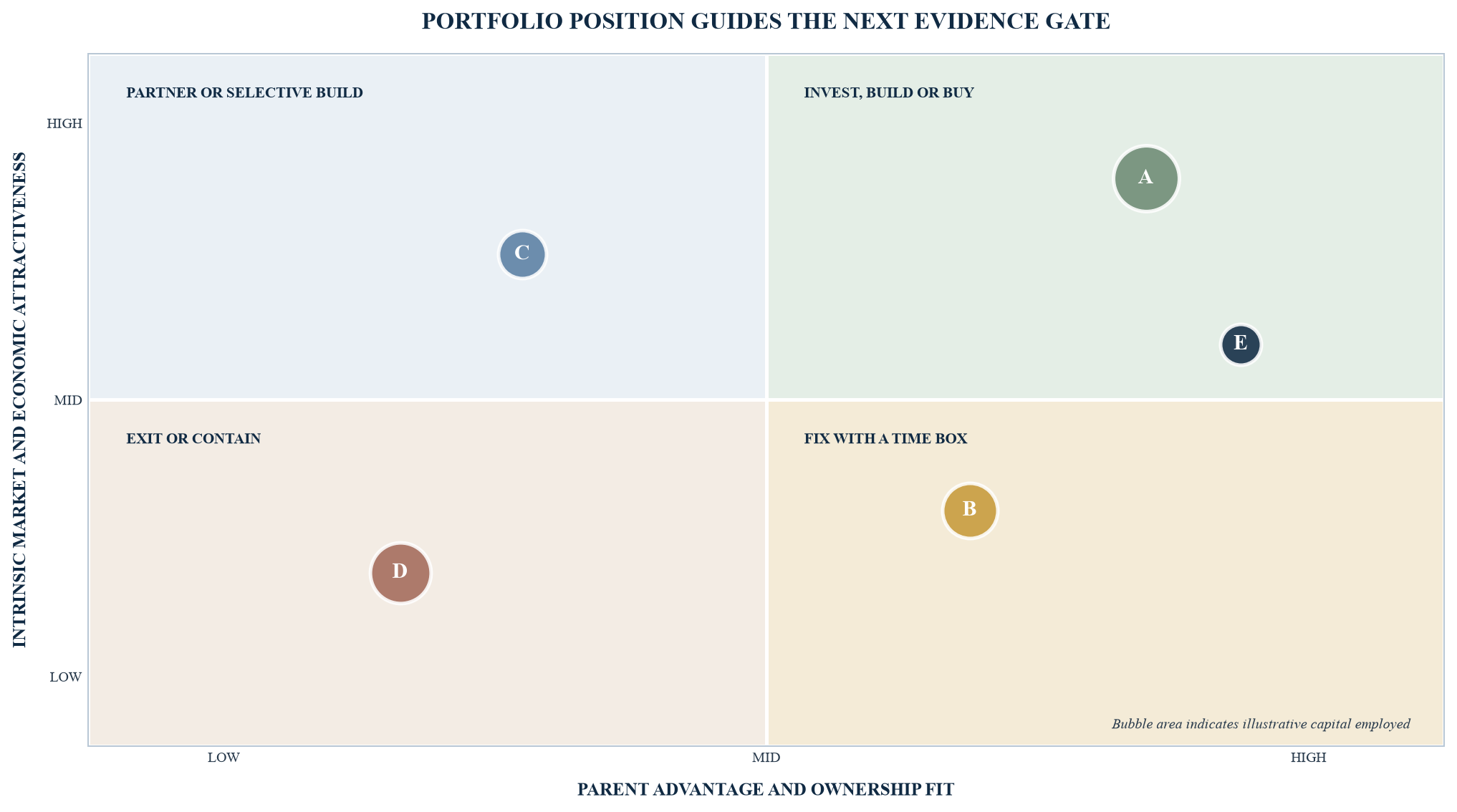
Unit positions and bubble sizes are hypothetical. Scores should be replaced with verified evidence and board-approved criteria.
The upper-right quadrant is not an automatic investment instruction. The board still needs to compare incremental returns and execution capacity with alternatives. The lower-left quadrant is not an automatic sale instruction. Legal obligations, customer continuity, stranded cost, marketability and timing can favour containment, orderly closure or a staged separation. Every quadrant leads to a defined option test.
5. Separate market quality from parenting advantage
Diversified groups can create value by allocating capital and capabilities across units. They can also misallocate resources through internal bargaining, weak measurement and subsidies that conceal poor economics. Stein's model of internal capital markets describes how headquarters control rights can support winner-picking among projects, while noting that focus can improve this process.[13] Rajan, Servaes and Zingales model how diversity in divisional resources and opportunities can distort internal allocation.[14] Villalonga's establishment-level evidence cautions against assuming that observed diversification discounts establish value destruction; measurement and selection materially affect the conclusion.[15]
These studies support disciplined questions. They do not provide a universal valuation rule for a GCC group. Their data, periods and methods differ from the company under review. The board should test parent advantage directly.
For each claimed advantage, management should identify the baseline, causal mechanism, receiving unit, annual cash effect, investment required, accountable owner and evidence date. Examples include a customer introduced and converted, procurement savings realised in invoices, reduced funding cost supported by actual terms, a licence that permits market access, or a management system that improves working capital.
The review should also record parent disadvantage. Central approvals can slow pricing. Group guarantees can expose strong units to weak ones. Shared technology can delay separation. Related-party arrangements can obscure transfer pricing or conflicts. A brand can constrain a unit's customer positioning. These effects belong in the ownership analysis.
Table 2. Parent-advantage evidence test
| Claimed parent effect | Evidence required | Cash or risk measure | Failure test |
|---|---|---|---|
| cross-selling | named opportunities, conversion and incremental margin | realised contribution and cash collection | benefit does not exceed coordination cost |
| procurement | comparable specification, volume and invoice evidence | net cash saving after implementation | supplier concentration or quality loss offsets saving |
| funding | actual terms, guarantees and liquidity allocation | all-in cost and capital at risk | group support transfers hidden risk |
| capability transfer | documented process, trained team and adoption | measured performance change | capability cannot be replicated in the unit |
| licence or market access | legal right, scope, duration and compliance | revenue enabled and renewal cost | right is non-transferable or too restrictive |
| governance and control | decision rights, reporting and intervention evidence | reduced loss, volatility or compliance exposure | control burden exceeds benefit |
Claimed benefits and costs should be supported by evidence. The examples do not establish value for a particular group.
6. Define the five strategic routes
Buy, build, partner, fix and exit describe different answers to ownership, capability and timing. They should be compared on the same need, rather than presented as unrelated initiatives.
Buy is appropriate for consideration when control, speed, scarce assets or an existing market position matter and an acceptable target exists. The board needs an acquisition thesis, valuation range, integration route, regulatory map, funding case and a clear explanation of why ownership creates more value than contracting or partnership.
Build is relevant when the capability is close to the group's existing base, talent and data can be assembled, time is available and learning has value. The business case should include ramp time, failure cost, operating dependencies and a milestone at which continued investment is reconsidered.
Partner can preserve flexibility when capabilities are complementary, uncertainty is high or neither party should own the entire activity. IFRS 11 defines joint control through contractually agreed sharing of control, with decisions about relevant activities requiring unanimous consent of the parties sharing control.[11] Commercial labels do not determine accounting or legal treatment. The board should specify contributions, economics, reserved matters, information rights, deadlock, intellectual property, funding and exit.
Fix applies when strategic relevance and ownership advantage remain credible, while current performance is below potential for identifiable and addressable reasons. A fix requires a cash baseline, a small number of operational levers, funded milestones, leadership accountability and a stop date. Open-ended improvement programmes defer the ownership decision.
Exit applies when the group lacks a defensible ownership advantage, incremental capital has a stronger use elsewhere, risk is unacceptable or another owner can create more value. Exit can mean sale, carve-out, spin, run-off, closure or transfer into a partnership. The route must include stranded cost, liabilities, employee and customer effects, tax, approvals and transition.
The comparison should use one clock. An acquisition may deliver market access quickly after completion, while diligence, approvals and integration extend the period before cash benefits appear. An internal build may begin immediately, yet customer adoption and capability development can take longer. A partnership may reach the market with less initial capital, while negotiation, governance and dependency constrain later choices. A fix can protect continuity, although its opportunity cost grows when management attention remains tied to a structurally weak position. An exit can release capital, subject to preparation, market conditions and separation work.
The board should show the first irreversible action for every route. It may be signing exclusivity, hiring a specialist team, transferring intellectual property, committing partner capital, closing a site or launching a sale. Evidence gates should occur before that action wherever practical. Costs incurred to learn should be separated from costs that lock the group into the route.
Route combinations can be valid when sequenced explicitly. A group may partner to test demand before building, fix a unit before exit, acquire a capability and retain the founder through a structured partnership, or carve out a unit before a sale. The option paper should state the sequence, dependencies, total exposure and decision points. Calling a programme a hybrid does not resolve conflicting control rights or conceal the capital required for each stage.
The board should also examine the counterfactual. For each route, the paper should describe what happens if the group takes no action for twelve to eighteen months. The counterfactual includes lost customers, capability decay, maintenance capital, employee attrition, covenant pressure, regulatory exposure and foregone opportunities where evidence supports them. It prevents urgency from being asserted without a measurable consequence and allows delay to be evaluated as an option with costs and risks.
7. Score options without outsourcing judgement
A scorecard makes assumptions visible. It should never substitute arithmetic for board judgement. Criteria and weights should be approved before management sees the result, reducing the temptation to design a score around a preferred route.
The illustrative scorecard in Figure 2 uses six criteria. A score of five represents the strongest evidence on the stated criterion. The weights and scores are hypothetical. Mandatory legal, integrity, liquidity and control gates sit outside the weighted score.
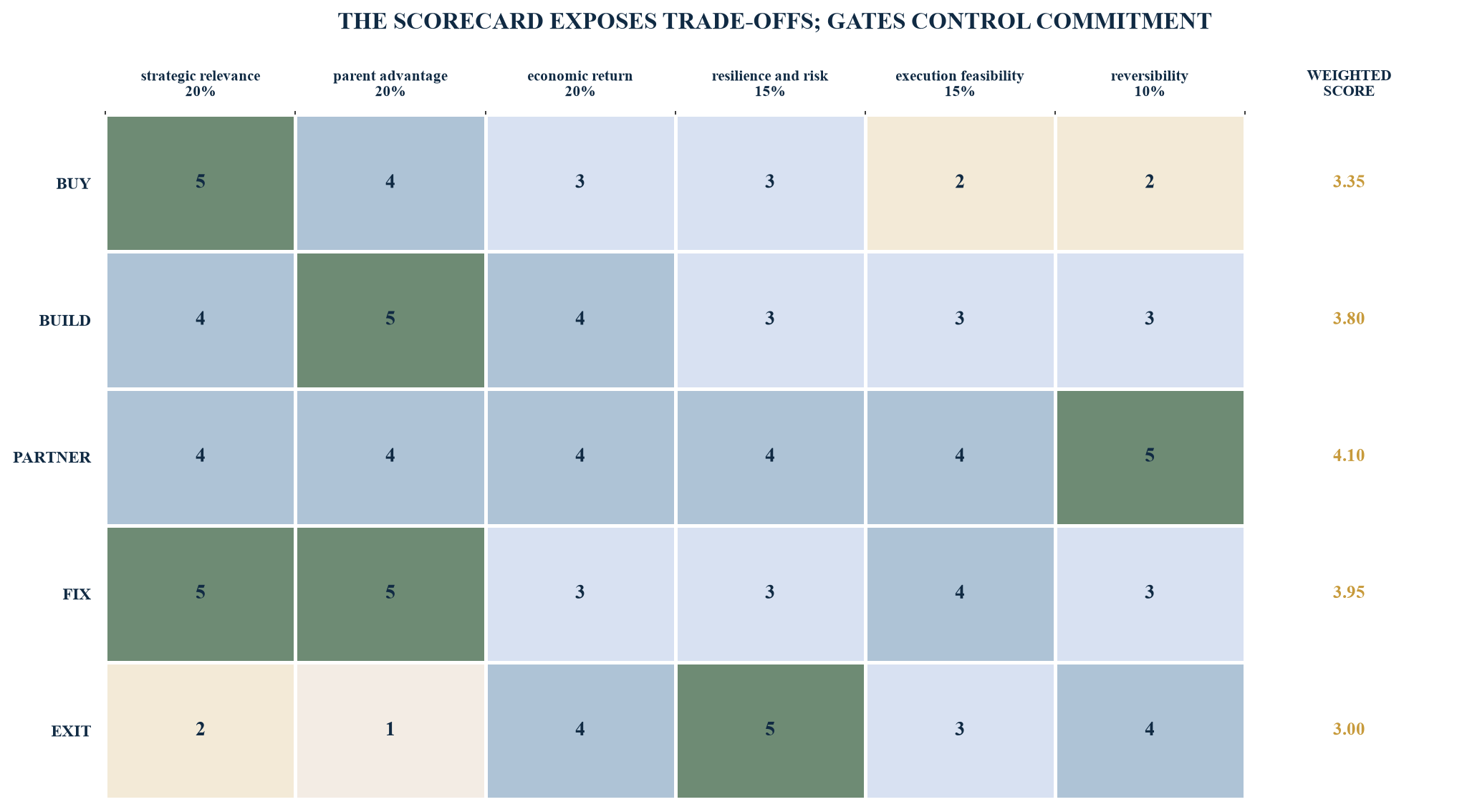
Weights and scores are management assumptions for demonstration. Mandatory gates can reject an option regardless of its weighted total.
Table 3. Option gate definitions
| Route | Evidence gate | Capital condition | Stop or redesign trigger |
|---|---|---|---|
| buy | target, price, approvals, integration and ownership advantage evidenced | total acquisition and integration funding within approved envelope | control, value, approval or integration case fails |
| build | capability gap, customer need, talent and ramp plan evidenced | staged funding released by learning milestones | adoption, unit economics or delivery threshold fails |
| partner | complementary contributions and governance documented | exposure capped with funding and remedy rights | deadlock, dependency or economic alignment fails |
| fix | root causes, leadership and operating levers evidenced | time-boxed repair funded with weekly measures | milestone, cash or control threshold fails |
| exit | marketability, separation, liabilities and transition evidenced | costs and stranded exposure funded | value, consent or continuity case requires another route |
The gates are illustrative. Boards should calibrate them to their duties, strategy, liquidity and risk framework.
Capron and Mitchell's research on capability sourcing examines how capability gaps and internal social frictions affect choices between internal development and external sourcing.[16] It supports treating sourcing mode as a capability in itself. Its historical sample and research design do not determine which route a particular board should select.
8. Allocate capital through a waterfall
The board should start with cash and risk capacity, rather than adding all requested investments and solving the funding problem afterwards. The capital-allocation waterfall protects minimum liquidity, mandatory obligations and already-authorised commitments before discretionary deployment.
The available-capital definition should reconcile unrestricted cash, committed facilities, covenant headroom, distributions, refinancing needs, maintenance investment, legal obligations and contingency. The group should avoid counting forecast disposals, uncommitted debt or uncertain dividends as available capital until evidence supports them.
Figure 3 shows an illustrative AED 500 million gross capacity. The amounts do not describe an actual group. They demonstrate sequence and residual option capacity.
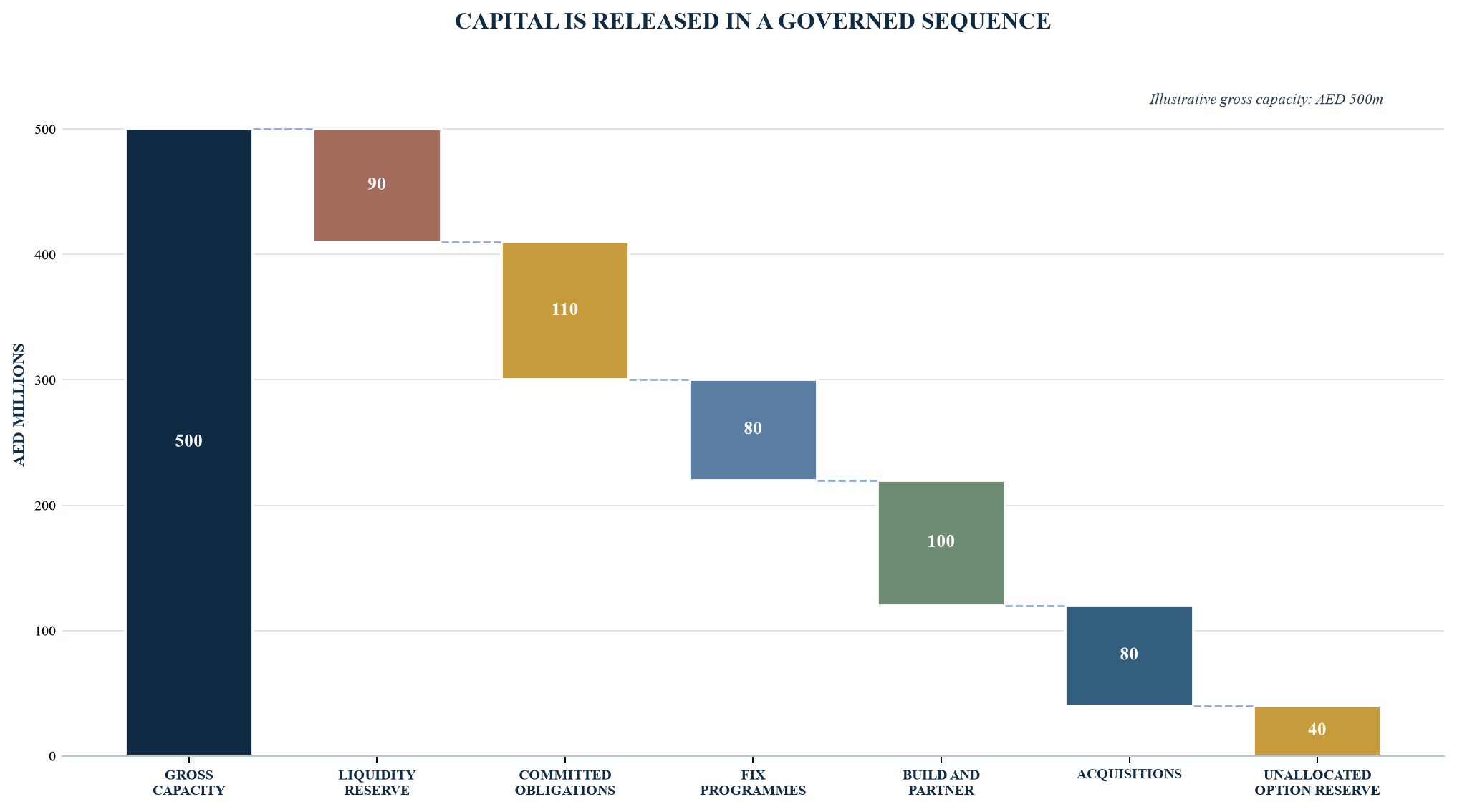
Amounts are hypothetical and expressed in AED millions. They do not represent a forecast, recommendation or available funding for any company.
Each discretionary programme should state gross capital, net cash exposure, peak funding, time to evidence, downside funding, reversibility and expected cash-return range. Benefits from disposal or repair should remain separate from funding sources until realised. A board can then compare a purchase, an internal build, a partnership commitment and a turnaround on the same cash timeline.
9. Apply accounting, regulatory and transaction boundaries
Strategic choice creates reporting and legal consequences that should be identified before commitment. IFRS 3 establishes the acquisition method for transactions that meet the definition of a business combination.[9] IFRS 11 distinguishes joint operations and joint ventures according to rights and obligations, following the arrangement and relevant facts.[11] IFRS 5 sets conditions for classifying non-current assets or disposal groups as held for sale and addresses discontinued operations.[10] IAS 36 continues to govern impairment within its scope.[8] The board should obtain technical accounting analysis for the chosen route.
Competition review can affect acquisitions, joint ventures and some partnership structures. The UAE's Federal Decree-Law No. 36 of 2023 regulates economic concentration, with Cabinet Decision No. 3 of 2025 addressing thresholds under the law.[17][18] Saudi Arabia's General Authority for Competition explains notification and substantive review of economic concentrations in its current guidelines.[19] The board should calculate filing and standstill requirements from verified parties, group revenues, control rights, markets and transaction terms.
Directors should receive entity-specific advice on duties. Section 172 of the UK Companies Act 2006, for example, requires a director within its scope to act in good faith in the way considered most likely to promote the success of the company for members as a whole, while having regard to listed long-term and stakeholder matters.[20] UAE, Saudi, financial-free-zone and other company laws contain their own duties, approvals and procedures. Group benefit should not be assumed to resolve subsidiary-level duties, solvency or minority interests.
An exit route also requires an execution perimeter. The board should identify title, consents, employee and pension issues, licences, data, intellectual property, transitional services, guarantees, stranded cost, tax, separation expenditure and liabilities retained. A high strategic score cannot compensate for an unlawful or unfunded route.
10. Run a recurring board decision calendar
Portfolio review should be a recurring governance cycle. Annual strategy and budget processes can establish direction, yet market events, acquisitions, covenant pressure, regulatory changes and operating underperformance require interim decisions.
The calendar in Figure 4 uses four quarterly gates and monthly evidence updates. Timing is illustrative. The board should align it with financial reporting, budgeting, risk, liquidity and transaction calendars.
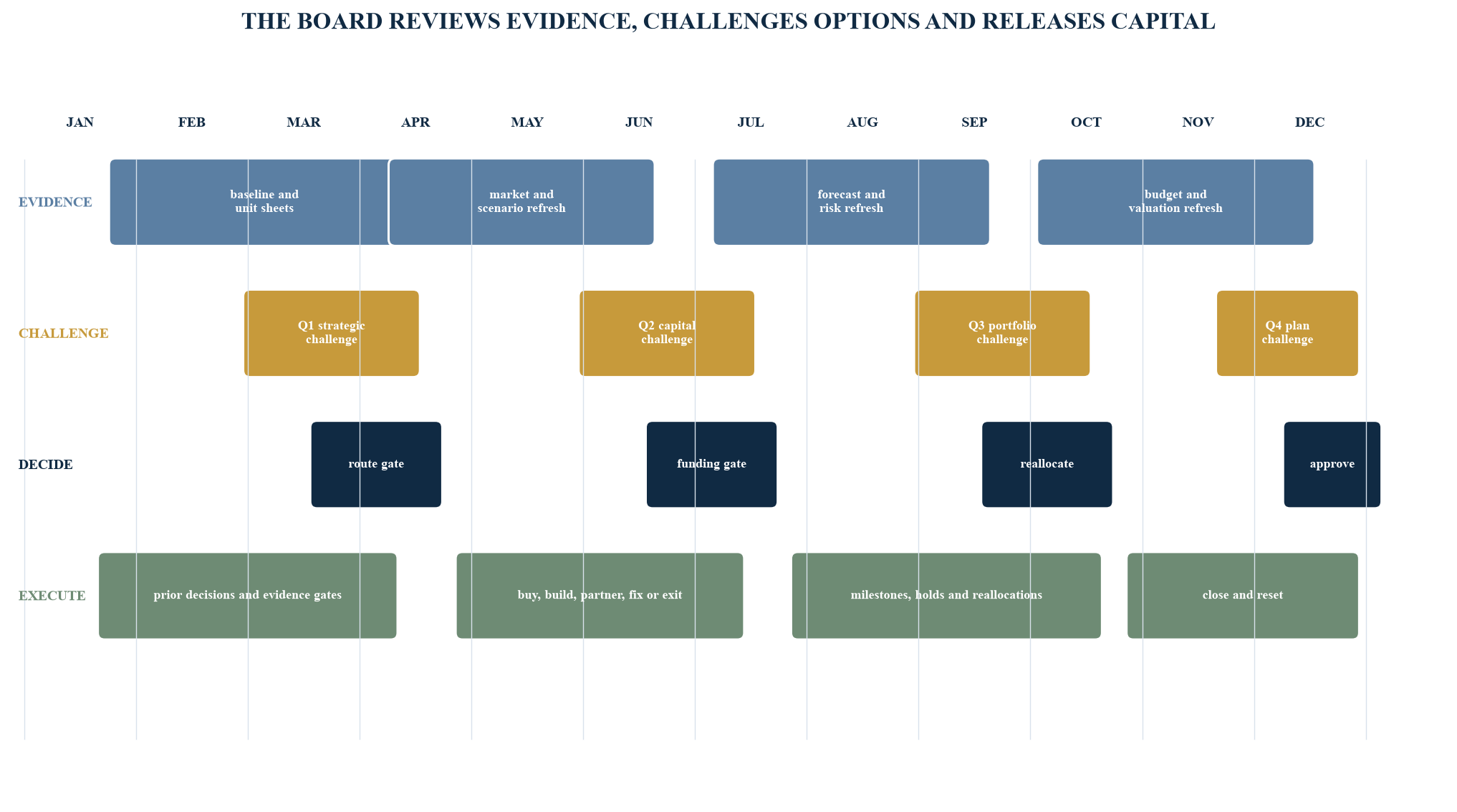
The cadence is a management example. Company law, listing rules, board terms and events determine the actual timetable and approvals.
The pack should arrive with sufficient time for independent review. Management presentations should show the evidence source, deviations from prior assumptions, unresolved matters and the requested decision. The board should distinguish discussion, direction, conditional approval and final commitment in its minutes and action register.
COSO's Enterprise Risk Management framework connects risk with strategy and performance and emphasises improved board and executive risk reporting.[12] In a portfolio review, risk should therefore influence option design and capital exposure. It should not be a late compliance appendix.
11. Convert decisions into an action register
A decision is complete only when it changes authority, capital, work and evidence. The action register should identify the review unit, approved route, accountable executive, capital envelope, first irreversible action, evidence gates, dependencies, next board date and stop authority.
Reserved matters should reflect consequence. The board may retain acquisitions, disposals, closures, new-country entries, material partnerships, capital above thresholds and changes to the approved portfolio thesis. Management can receive delegated authority for diligence, negotiations and staged spending within the approved envelope. The register should record when a delegation expires.
Table 4. Decision rights for the portfolio review
| Decision stage | Management responsibility | Board or committee responsibility | Evidence recorded |
|---|---|---|---|
| screen | prepare unit sheet and route alternatives | approve criteria and request deeper work | source register and screening result |
| shape | build economics, risk, perimeter and execution plan | challenge thesis and set conditions | option paper and unresolved issues |
| authorise | negotiate and prepare implementation within delegation | approve route, capital envelope and reserved matters | resolution, conditions and delegation |
| release capital | satisfy milestones and confirm funding need | approve material commitment or delegated release rules | condition evidence and funds schedule |
| monitor | report actuals, risks, milestones and deviations | hold, redesign, expand or stop | action register and decision log |
| close review | confirm outcome and lessons | approve closure or next cycle | benefits, cash, residual risks and lessons |
Rights and thresholds are illustrative and should be aligned with constitutional documents, law, listing rules and the board's delegation framework.
Figure 5 shows a compact action-register design. It places evidence before the capital release and gives every route a dated board gate.
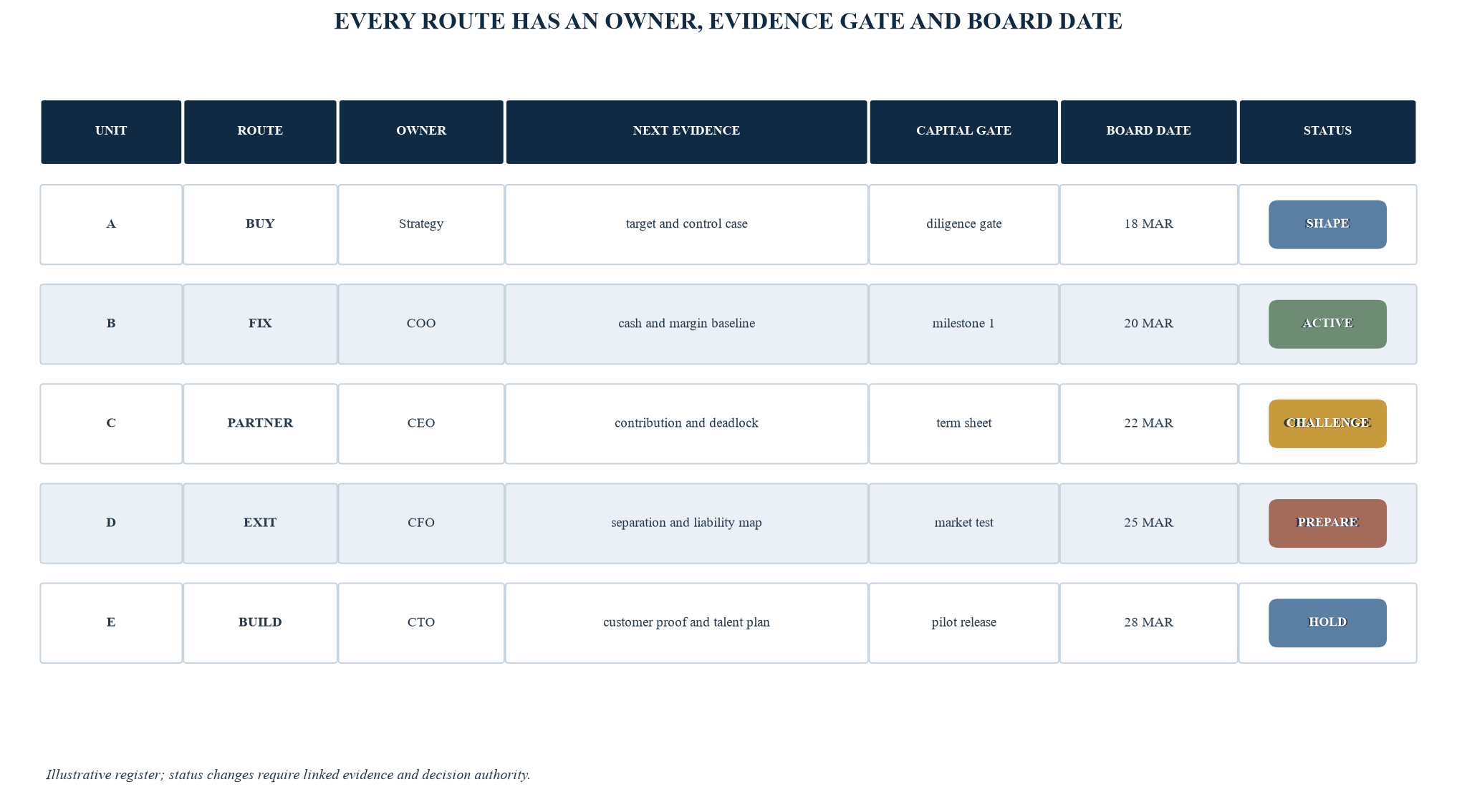
Units, owners, timing and statuses are hypothetical. The live register should link each status to source evidence and approval.
12. Apply the framework to an illustrative group
Consider a hypothetical GCC-headquartered group with five review units and AED 500 million of gross capital capacity over the next 18 months. The group is assumed to have a board-approved minimum liquidity reserve of AED 90 million and committed obligations of AED 110 million. These figures are illustrative management assumptions. They do not describe an actual company, funding commitment or forecast.
Unit A is an established regional distribution business with strong customer access, positive cash conversion and an opportunity to acquire a complementary specialist. Unit B is a service business with attractive customers and declining margin caused by pricing leakage, under-utilisation and slow collections. Unit C is a fast-growing digital capability with customer demand but limited internal product talent. Unit D is a capital-intensive legacy activity with weak cash returns, high maintenance needs and limited group synergies. Unit E is an adjacent Saudi market position where the group has customer relationships but lacks local operating depth.
The portfolio matrix places Unit A high on attractiveness and parent advantage. The board requests a buy-versus-build paper for the missing specialist capability and reserves AED 80 million subject to valuation, diligence, competition and integration gates. Unit B remains strategically relevant and has credible parent advantage. It receives an AED 80 million time-boxed fix envelope, released against cash, margin and customer milestones.
Unit C receives a partner route. The hypothetical group contributes customer access and data under lawful arrangements; a specialist partner contributes product capability and talent. The board requires contribution economics, intellectual-property rights, reserved matters, unanimous decisions, data controls, funding limits, deadlock and exit terms before approval.
Unit D moves to exit preparation. Management must verify marketability, liabilities, employee and customer continuity, asset condition, licences, separation, guarantees, tax and stranded cost before launching a process. Capital requested for maintenance is separated from capital sought to improve sale appearance. The board retains authority to select sale, run-off or controlled closure.
Unit E remains at the build-versus-partner gate. The board authorises a customer-validation sprint and a partner search. No acquisition capital is released until the group establishes the licence, regulatory, market, talent and ownership case.
Table 5. Illustrative portfolio decision record
| Unit | Initial route | Illustrative capital envelope | Evidence before release | Next decision |
|---|---|---|---|---|
| A: regional distribution | buy or build | AED 80m | target economics, ownership advantage, approvals and integration case | approve diligence or internal build |
| B: services | fix | AED 80m | cash baseline, margin bridge, leadership and 90-day milestones | release stages or stop repair |
| C: digital capability | partner | AED 40m | contributions, governance, data, intellectual property and exit | approve term sheet or build test |
| D: legacy activity | exit | AED 20m transition reserve | separation, liabilities, market test and stranded cost | sale, run-off or closure route |
| E: Saudi adjacency | build or partner | AED 40m option envelope | customer proof, licence, operating model and partner evidence | pilot, partner or stop |
Units, amounts and decisions are hypothetical. Actual decisions require verified evidence, board authority and professional advice.
The remaining illustrative capacity consists of the liquidity reserve, committed obligations, other build and partnership programmes, and an unallocated option reserve. The board should reconcile the total to treasury capacity and downside liquidity before approving any route.
13. State the model's assumptions and limitations
The framework is a governance and management tool. It does not estimate enterprise value or determine fiduciary compliance. The matrix converts qualitative and quantitative evidence into two summary dimensions; this simplification can conceal differences in duration, volatility, liquidity, regulation and tail risk.
Scores depend on the quality of evidence and board judgement. A weighted total can create false precision. Mandatory gates should therefore remain outside the score, sensitivities should show how results change under reasonable weights, and board minutes should record the reasons for overriding a mechanical ranking.
Capital envelopes in the scenario assume that funding remains available and that actions occur within the stated amounts and timing. Actual liquidity can change through trading, covenants, refinancing, distributions, claims, tax, regulation and market conditions. Disposal proceeds and transaction completion should remain outside available capital until realised or firmly supported.
Academic research cited in this paper uses historical samples and models that may not transfer to a particular GCC group.[13][14][15][16] Accounting standards describe reporting requirements within their scope; they do not make the strategic decision.[7][8][9][10][11] Governance codes and laws apply according to their jurisdiction, entity type and facts.[1][2][3][4][5][6][17][18][19][20]
14. Implement the review in twelve weeks
Weeks 1 and 2 establish the charter, decision rights, unit boundaries, source register and common definitions. Finance reconciles segment and unit data. Strategy and business leaders define market and ownership hypotheses. Legal, tax, risk and accounting leaders identify route-specific requirements.
Weeks 3 to 5 build unit sheets and the parent-advantage evidence. Management should resolve data gaps before scoring. Each unit receives a preliminary matrix position and at least two credible routes. A route with no alternative has not been tested.
Weeks 6 and 7 challenge market assumptions, cash returns, capital employed, downside funding and separability. Independent directors should receive direct access to material assumptions and advisers where required. Conflicts of interest, subsidiary duties and related-party considerations should be recorded.
Weeks 8 and 9 complete option scorecards, capital envelopes, accounting and regulatory maps, and execution plans. The review team should show sensitivities for weights, forecasts, exit proceeds, funding cost and timing. It should also identify which decisions are reversible.
Weeks 10 and 11 conduct board challenge and resolve conditions. Management prepares resolutions, delegations, capital-release rules and the action register. A preliminary decision should be labelled conditional until every required gate has evidence.
Week 12 records final decisions and activates the calendar. Buy, build, partner, fix and exit workstreams receive owners, resources, dates and stop authority. The board should schedule the first evidence review before the team takes an irreversible action.
15. Implementation conclusion
A board portfolio review converts strategy into comparative ownership and capital decisions. The mandate defines the units, resources, options and authority. The economic baseline reconciles accounting performance to cash and capital employed. The matrix separates market attractiveness from parent advantage. The option scorecard exposes trade-offs across buy, build, partner, fix and exit. The waterfall protects liquidity before discretionary commitment. The calendar and action register make decisions executable.
The quality of the process depends on evidence. Market narratives should reconcile to customers and orders. Returns should reconcile to cash and capital. Claimed synergies should identify mechanism and owner. Fix programmes should have stop dates. Partnerships should have governance and exit. Acquisitions should have a control and integration thesis. Exits should have a funded separation perimeter.
The board's final record should state why the group is the appropriate owner, what capital is exposed, which assumptions matter, what evidence is missing, who can commit funds, and when the decision returns for review. That record allows the board to reallocate capital as facts change and to govern the portfolio as one system.
References
- [1] OECD, G20/OECD Principles of Corporate Governance 2023, Chapter V: The Responsibilities of the Board. https://www.oecd.org/en/publications/g20-oecd-principles-of-corporate-governance-2023_ed750b30-en/full-report/component-8.html
- [2] Financial Reporting Council, UK Corporate Governance Code 2024. https://www.frc.org.uk/library/standards-codes-policy/corporate-governance/uk-corporate-governance-code/
- [3] Financial Reporting Council, Corporate Governance Code Guidance. https://www.frc.org.uk/library/standards-codes-policy/corporate-governance/corporate-governance-code-guidance/
- [4] Capital Market Authority of Saudi Arabia, Corporate Governance Regulations. https://cma.org.sa/en/RulesRegulations/Regulations/Documents/CorporateGovernanceRegulations1.pdf
- [5] Securities and Commodities Authority of the UAE, Public Joint-Stock Companies Governance Guide and amendments. https://www.sca.gov.ae/en/regulations/regulations-listing/amendments.aspx?id=147
- [6] Securities and Commodities Authority of the UAE, Annual Report 2024, corporate governance developments. https://www.sca.gov.ae/assets/download/27cc1e3b/sca-annual-report-english-2024.aspx
- [7] IFRS Foundation, IFRS 8 Operating Segments. https://www.ifrs.org/issued-standards/list-of-standards/ifrs-8-operating-segments/
- [8] IFRS Foundation, IAS 36 Impairment of Assets. https://www.ifrs.org/issued-standards/list-of-standards/ias-36-impairment-of-assets/
- [9] IFRS Foundation, IFRS 3 Business Combinations. https://www.ifrs.org/issued-standards/list-of-standards/ifrs-3-business-combinations/
- [10] IFRS Foundation, IFRS 5 Non-current Assets Held for Sale and Discontinued Operations. https://www.ifrs.org/issued-standards/list-of-standards/ifrs-5-non-current-assets-held-for-sale-and-discontinued-operations/
- [11] IFRS Foundation, IFRS 11 Joint Arrangements. https://www.ifrs.org/issued-standards/list-of-standards/ifrs-11-joint-arrangements/
- [12] Committee of Sponsoring Organizations of the Treadway Commission, Enterprise Risk Management: Integrating with Strategy and Performance. https://www.coso.org/enterprise-risk-management
- [13] Jeremy C. Stein, Internal Capital Markets and the Competition for Corporate Resources, Journal of Finance 52(1), 1997, 111-133. https://doi.org/10.1111/j.1540-6261.1997.tb03810.x
- [14] Raghuram Rajan, Henri Servaes and Luigi Zingales, The Cost of Diversity: The Diversification Discount and Inefficient Investment, Journal of Finance 55(1), 2000, 35-80. https://pages.stern.nyu.edu/~eofek/PhD/papers/RSZ_The_JF.pdf
- [15] Belen Villalonga, Diversification Discount or Premium? New Evidence from the Business Information Tracking Series, Journal of Finance 59(2), 2004, 479-506. https://doi.org/10.1111/j.1540-6261.2004.00640.x
- [16] Laurence Capron and Will Mitchell, Selection Capability: How Capability Gaps and Internal Social Frictions Affect Internal and External Strategic Renewal, Organization Science 20(2), 2009, 294-312. https://doi.org/10.1287/orsc.1070.0328
- [17] UAE Ministry of Economy, Federal Decree-Law No. 36 of 2023 on the Regulation of Competition. https://www.moec.gov.ae/regulation-of-competition
- [18] UAE Ministry of Economy, Competition legislation including Cabinet Decision No. 3 of 2025 on thresholds. https://www.moec.gov.ae/en/regulation-of-competition-legislations
- [19] Saudi General Authority for Competition, Economic Concentration Review Guidelines. https://gacbep.gac.gov.sa/cms/b9376edc-79a1-4573-a36d-4f3effaba838.pdf
- [20] United Kingdom, Companies Act 2006, section 172 and related directors' duties. https://www.legislation.gov.uk/ukpga/2006/46/section/172
About the Author
Chennakeshav Adya is an independent researcher whose work focuses on corporate finance, value creation, private capital and transaction execution. His research translates financial, commercial and operating evidence into decision frameworks for boards, investors and management teams.
Appendix A: Board Portfolio Review opening checklist
- Approve the review charter, units, economic definitions, options, evidence standard and decision rights.
- Reconcile revenue, profit, cash flow, capital employed, liquidity, guarantees and risk for every unit.
- Test intrinsic attractiveness and parent advantage separately, including parent disadvantage and separability.
- Compare buy, build, partner, fix and exit against one need and one common set of criteria.
- Protect liquidity and committed obligations before allocating discretionary capital.
- Assign every route an owner, capital envelope, evidence gate, board date and stop authority.
Appendix B: Option paper checklist
- State the strategic need, current capability gap and credible alternative routes.
- Show baseline economics, incremental cash returns, peak funding, downside case and reversibility.
- Identify legal, accounting, tax, competition, sector, data, employment and shareholder requirements.
- Document ownership advantage, contribution mechanism, control rights, separability and exit.
- Set milestones, evidence sources, conditions, delegation, capital-release rules and failure triggers.
- Record the decision, reasons, dissent, unresolved matters and the next review date.
