

1. Introduction
Acquisition intent creates a demanding operating problem. A board may approve a sector thesis and a capital envelope, yet the route to a signed agreement requires hundreds of linked decisions. The buyer must define what it wants, identify credible targets, secure access, value incomplete information, test the commercial case, understand regulation, arrange financing, negotiate protection and prepare for ownership. Each workstream changes the others. A customer-concentration issue can change price, structure, warranties and the first 100 days. A merger-control issue can change timing, conditions precedent and the credibility of the bid. A financing condition can weaken the buyer's negotiating position.
Many GCC buyers encounter this problem intermittently. A family group may undertake one material acquisition every few years. A portfolio holding company may pursue several themes without maintaining a full internal corporate-development team. An international company may enter the region through acquisition while its global deal team has limited local execution capacity. These circumstances support a retained acquisition office: a small, accountable team that maintains the process, evidence and decision cadence from thesis to signing.
The 90-day period in this paper is a management architecture rather than a promise. Transaction access, seller readiness, financing, regulatory review and diligence findings can extend the timetable. The office uses ninety days as a control horizon so that every week has a defined decision purpose. The buyer should extend the timetable when evidence requires it and stop when the risk-adjusted case no longer meets the approved thesis.
The framework is designed for private and public-market transactions across the GCC. Local legal requirements vary. UAE Federal Decree-Law No. 36 of 2023 establishes the competition-law framework, while Cabinet Decision No. 3 of 2025 sets economic-concentration notification thresholds at AED 300 million of relevant annual sales or a 40 percent market share, subject to the law's scope and calculation rules.[1][2] Saudi Arabia's General Authority for Competition publishes economic-concentration review guidelines, and the Capital Market Authority maintains specific merger and acquisition regulations for listed-company transactions.[3][4] These sources show why jurisdictional analysis belongs at the front of the process.
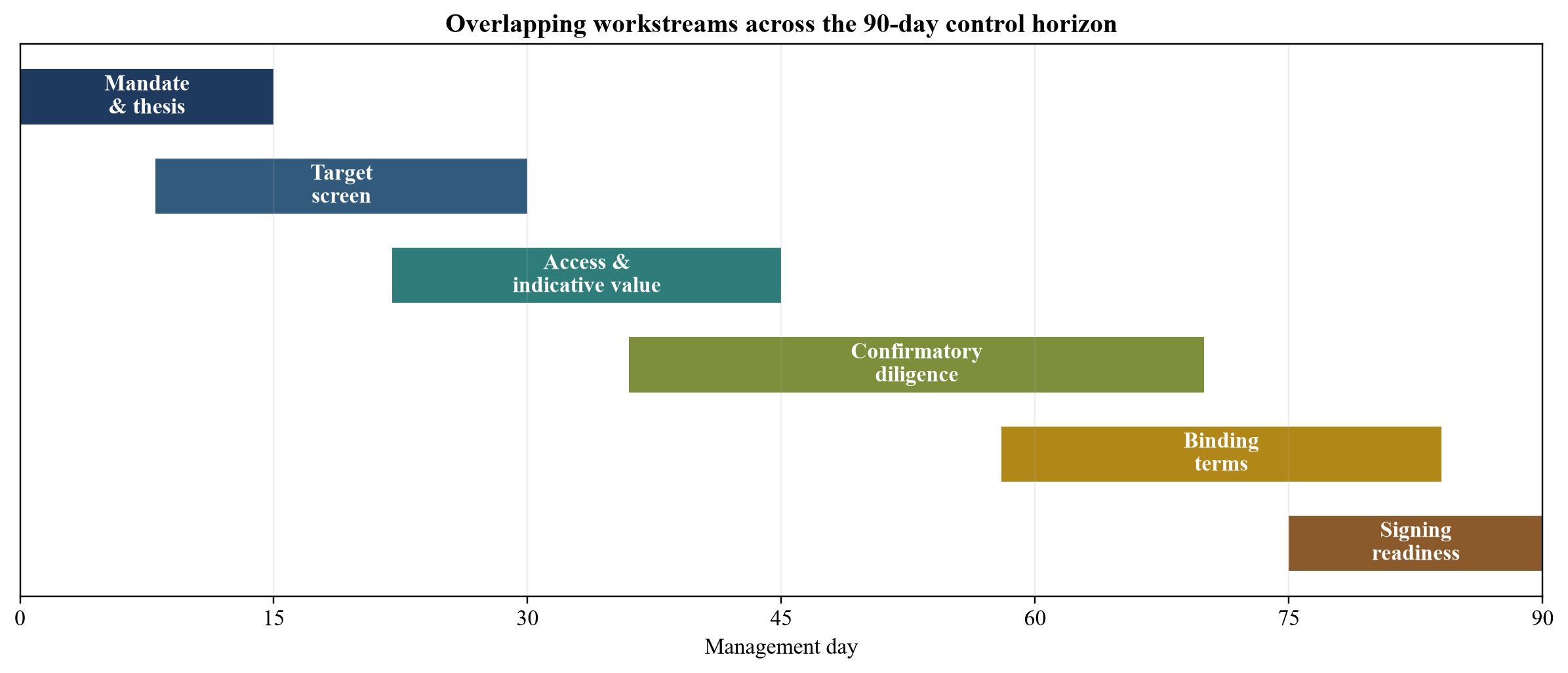
Management framework. The overlapping bands show when workstreams begin; actual duration depends on the transaction.
2. The acquisition office mandate
The office needs an explicit mandate before target work begins. The mandate states the strategic objective, preferred business model, geography, ownership range, capital envelope, return threshold, acceptable leverage, excluded risks and board authority. A vague instruction to find attractive companies creates uncontrolled scope. A useful mandate defines both the positive case and the reasons to stop.
The office owns orchestration and evidence. It does not replace specialist accountability. Legal counsel owns legal advice and the transaction documents. Tax advisers own tax conclusions. Accountants support financial and accounting analysis. Technical, cyber, environmental and regulatory specialists address their disciplines. Management remains accountable for the acquisition recommendation, and the board retains its statutory and governance responsibilities. The office connects these parties through one question set, one issue taxonomy, one timetable and one decision log.
The mandate should also define confidentiality and conflicts. Target names, indicative values, management observations and financing discussions require controlled access. The data environment should use role-based permissions, document versioning and a disclosure record. The office maintains a source index for every material statement presented to the board. Recent research on financial reporting indicates that reporting quality can function as a management technology by improving internal information and efficiency.[5] The same logic applies to transaction evidence: precise information improves the quality of decisions and makes challenge more productive.
Table 1. Minimum acquisition-office mandate
| Mandate element | Required decision | Evidence recorded | Stop condition |
|---|---|---|---|
| Strategic objective | Capability, market, product, customer or scale outcome | Approved investment thesis | Target cannot advance the objective |
| Target perimeter | Geography, sector, ownership and size | Screen criteria and exclusions | Target falls outside approved perimeter |
| Capital envelope | Equity, debt and total consideration limits | Funding sources and headroom | Executable funding is unavailable |
| Return requirement | Base, downside and upside thresholds | Valuation model and sensitivities | Downside case breaches board threshold |
| Risk appetite | Regulatory, concentration, technology and people limits | Risk taxonomy and escalation rules | Unmitigated red-line issue |
| Decision rights | Management, committee and board authorities | Approval matrix and meeting calendar | Required authority cannot be obtained |
The board can add sector-specific constraints. Each item should have an accountable owner and approval date.
3. Six gates across ninety days
The office uses gates to preserve decision quality. A gate is a documented decision supported by defined evidence. It is not a ceremonial meeting. The evidence pack contains the current thesis, valuation range, key findings, open questions, regulatory position, financing status, integration implications and the requested decision. The decision may be proceed, proceed with conditions, hold, re-scope or stop.
Gate One approves the mandate and thesis. Gate Two approves a prioritised target list and access strategy. Gate Three approves indicative value and the conditions for a non-binding offer. Gate Four approves confirmatory diligence and the binding-offer range. Gate Five approves final contractual parameters and signing authority. Gate Six confirms that financing, approvals, conditions, disclosure schedules, funds flow and Day-One obligations are ready.
The gates overlap with workstreams. Regulatory screening starts during Gate Two. Integration hypotheses begin during Gate Three because the buyer needs to know whether value depends on operational combination, customer access, cost reduction or preservation of autonomy. Financing begins early enough to identify lender information requirements and approval timing. Contract drafting can begin before diligence closes, with open clauses linked to the issue ledger.
Table 2. The six acquisition gates
| Gate | Indicative timing | Board or committee question | Minimum output |
|---|---|---|---|
| 1. Mandate | Days 0 to 5 | What are we seeking and within which constraints? | Approved thesis, capital envelope and authority matrix |
| 2. Target screen | Days 6 to 20 | Which targets merit confidential access? | Ranked target list, outreach route and conflict check |
| 3. Indicative value | Days 21 to 35 | What value range supports an initial proposal? | Initial model, strategic case, risk screen and access conditions |
| 4. Confirmatory diligence | Days 36 to 60 | Does evidence support ownership and a binding bid? | Integrated findings, downside case and protection plan |
| 5. Binding terms | Days 61 to 80 | Which price, structure and protections remain acceptable? | Final value range, mark-up positions and financing approval |
| 6. Signing readiness | Days 81 to 90 | Can authorised parties sign and perform? | Execution versions, approvals, funds flow and Day-One obligations |
Day ranges are a management baseline. Seller access and regulatory review may require a longer process.
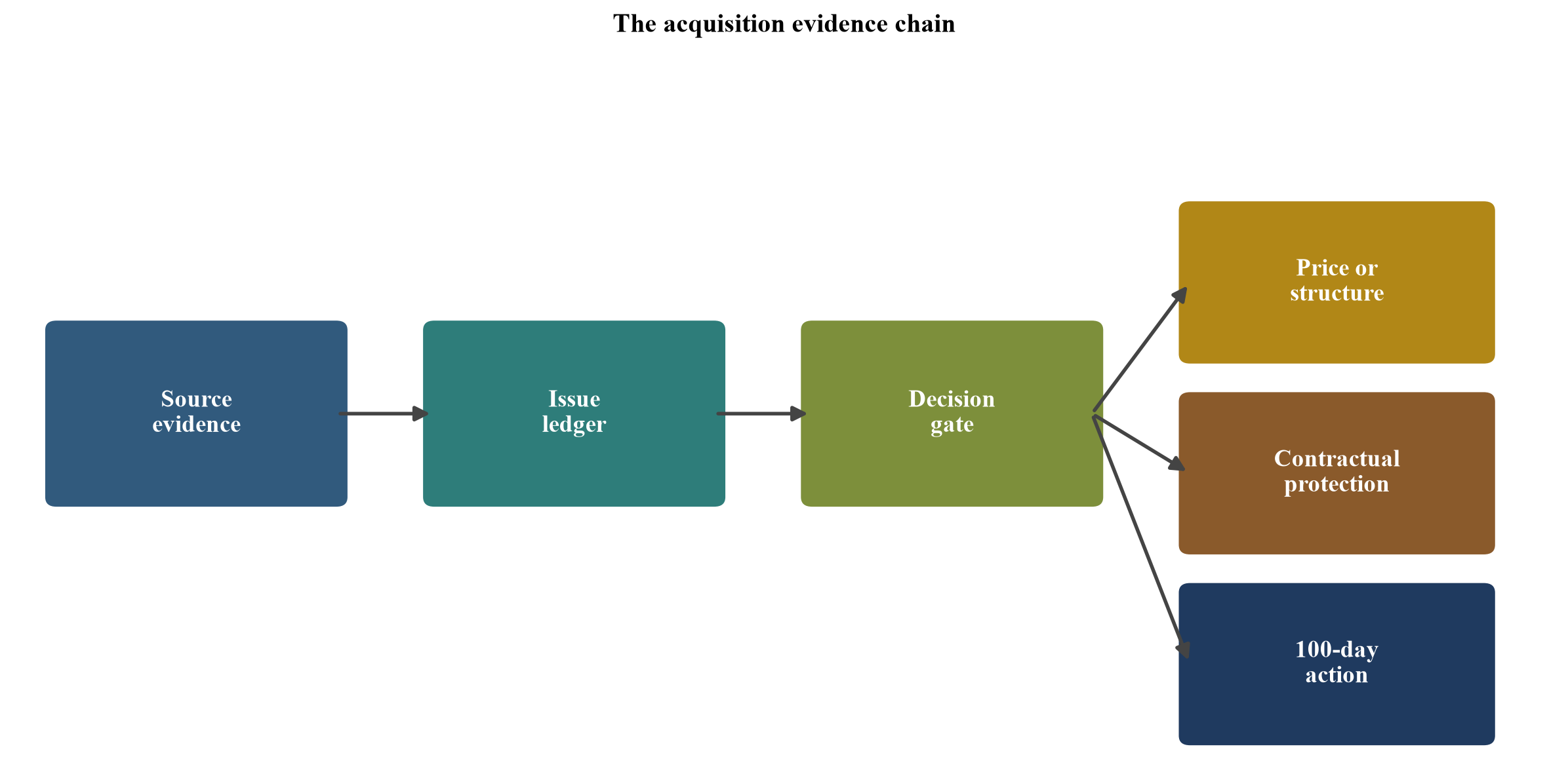
Management framework. Every material finding should produce a disposition rather than remain as an isolated diligence observation.
4. Days 0 to 20: thesis and target screen
The target screen converts strategy into observable criteria. A capability acquisition needs a different screen from a consolidation play. A route-to-market acquisition may prioritise customer access, licences and distribution density. A vertical-integration thesis may prioritise supply security, margin transfer and control of critical assets. The office defines the criteria before target names dominate the discussion.
A balanced scorecard should cover strategic fit, market quality, business economics, ownership feasibility, regulatory complexity, management depth, integration burden and likely value. Each score must have a source and confidence level. Public information provides an initial view. Private evidence replaces assumptions as access improves. A high score with weak evidence should remain provisional.
Target sourcing combines databases, industry mapping, supply-chain analysis, adviser networks, customer and supplier intelligence, management relationships and public corporate disclosures. The office records provenance and conflicts. The purpose is a broad, defensible market map followed by deliberate concentration of time. A screen that starts with familiar names can miss better assets and can embed relationship bias.
The outreach route matters. A direct principal-to-principal approach may be appropriate in a family-owned company. An adviser-led process may be necessary where confidentiality, governance or competitive dynamics are sensitive. The initial message should explain strategic credibility, decision authority, funding capacity and confidentiality. It should avoid premature price anchoring when information is limited.
Table 3. Example target-screen scorecard
| Dimension | Illustrative weight | Evidence examples | Critical question |
|---|---|---|---|
| Strategic fit | 25% | Capability map, customer overlap, market position | Does ownership advance the approved thesis? |
| Market quality | 15% | Growth, regulation, competition, substitution | Is the addressable profit pool durable? |
| Economics | 20% | Revenue quality, margin, cash conversion, capital intensity | Can the business fund value creation? |
| Ownership feasibility | 10% | Shareholders, succession, process status | Is a transaction realistically available? |
| Regulatory complexity | 10% | Market shares, licences, foreign-ownership issues | Can the buyer obtain approvals on acceptable terms? |
| Management depth | 10% | Leadership roles, incentives, dependency | Can the business perform through ownership change? |
| Integration burden | 10% | Systems, operations, culture, geography | Can required change be executed without value leakage? |
Weights are illustrative. The board should approve weights before scoring named targets.
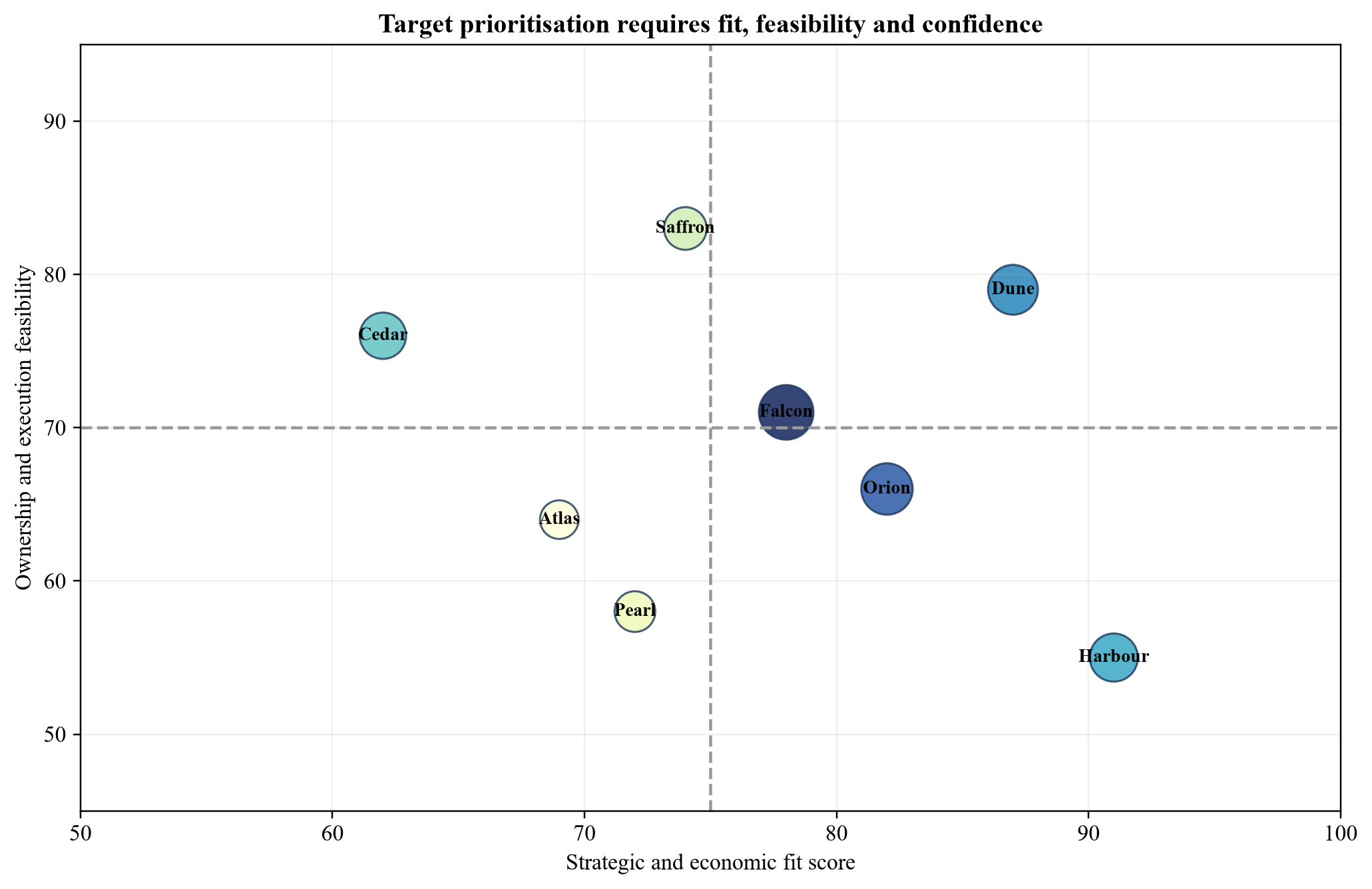
Illustrative scores only. Bubble size represents evidence confidence rather than deal size.
5. Days 15 to 35: access and indicative value
Access changes the process from market intelligence to transaction evidence. The office agrees a confidentiality protocol, establishes authorised users and issues a focused initial information request. The request should be proportionate. A long generic list can delay access and obscure the few facts that determine whether the buyer should proceed.
The first information set should test revenue quality, customer concentration, recurring versus project income, gross margin, working capital, capital expenditure, debt, tax status, licences, ownership, material contracts, management dependency and known disputes. The office prepares an initial quality-of-earnings bridge and a cash-conversion view. It identifies adjustments proposed by the seller and records whether they are recurring, evidenced and controllable.
Indicative value combines an enterprise-value range with the expected path to equity value. The model should show reference multiples, maintainable earnings, debt-like items, cash-like items, normal working capital, contingent consideration and required investment. IFRS 3 requires an acquirer to recognise and measure acquired identifiable assets and liabilities and to recognise goodwill or a bargain purchase under the acquisition method.[6] Transaction valuation and accounting serve different purposes, yet the accounting workstream can reveal data requirements and balance-sheet consequences that need early attention.
The non-binding proposal should state the basis of value, assumed debt and working capital, funding status, diligence scope, exclusivity request, timetable, required approvals and intended structure. A single headline number without these assumptions invites later conflict. The proposal should preserve room to respond to evidence while remaining credible to the seller.
Table 4. Indicative-value bridge
| Layer | Core question | Evidence required | Decision use |
|---|---|---|---|
| Maintainable earnings | Which earnings recur under new ownership? | Monthly results, contracts, customer cohorts, adjustments | Base enterprise value |
| Reference multiple | Which transactions or companies are comparable? | Business mix, growth, margin, capital intensity, geography | Valuation range |
| Net debt | Which obligations transfer economically? | Facilities, leases, guarantees, shareholder balances | Equity-value bridge |
| Normal working capital | What operating liquidity belongs in the business? | Monthly balances, seasonality, ageing, supplier terms | Completion mechanism |
| Required investment | Which near-term spending is necessary? | Capex plan, systems, maintenance, regulatory commitments | Funding and price |
| Contingent value | Which uncertainty can be shared? | Milestones, measurement rules, control and audit rights | Earn-out or deferred consideration |
Illustrative structure. Values and treatment depend on the transaction and accounting advice.
6. Days 30 to 60: confirmatory diligence as one system
Confirmatory diligence should answer ownership questions. Each workstream starts with a set of hypotheses and decisions rather than a catalogue of documents. Commercial diligence tests market attractiveness, customer durability, competitive position, price and growth. Financial diligence tests earnings, cash conversion, working capital, debt and forecast integrity. Legal diligence tests title, authority, contracts, liabilities and enforceability. Tax diligence tests historical exposure and transaction consequences. Operational and technology diligence test continuity, capacity, security, scalability and required investment. People diligence tests critical roles, incentives, succession and work-authorisation continuity.
The issue ledger is the office's central control. Every material issue has a statement, source, financial range, probability or confidence, owner, due date and disposition. The disposition may change price, structure, a contractual clause, a closing condition, an integration action, a financing assumption or the decision to stop. Duplicate findings across advisers should be consolidated. Conflicting conclusions should be escalated with the underlying evidence.
Recent research into synergy construction warns that estimates can become part of the transaction narrative and can disconnect from post-acquisition performance improvement.[7] A separate 2026 study examines synergy disclosure across 12,176 announced US mergers and acquisitions and links disclosure characteristics to transaction attributes and subsequent realisation.[8] These studies support a disciplined rule: every material synergy needs a baseline, an owner, a timing assumption, an implementation cost and a measurement method. The buyer should carry dis-synergies and execution costs in the same model.
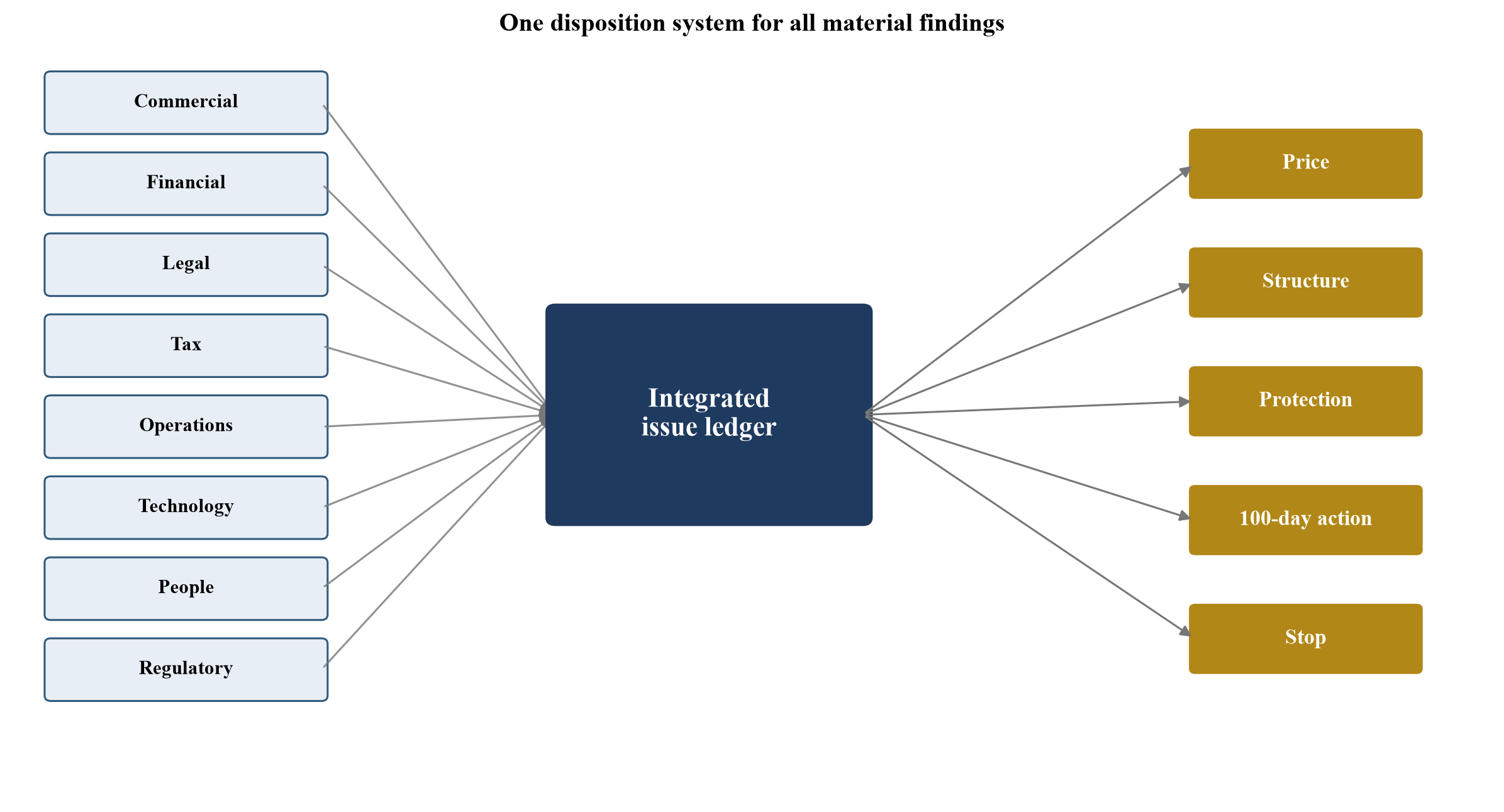
Management framework. Specialist reports remain authoritative within their disciplines; the ledger governs cross-workstream disposition.
Table 5. Issue-ledger disposition rules
| Finding | Quantification | Primary disposition | Secondary disposition |
|---|---|---|---|
| Customer concentration | Revenue and contribution at risk | Price or earn-out | Retention and diversification plan |
| Understated maintenance capex | Catch-up spend and timing | Price and funding | 100-day capex governance |
| Working-capital deficit | Cash required to reach normal level | Completion adjustment | Post-close cash controls |
| Change-of-control consent | Revenue, licence or financing exposure | Condition precedent | Stakeholder engagement plan |
| Key-person dependency | Earnings and continuity exposure | Retention or deferred value | Delegation and succession plan |
| Cyber-control gap | Remediation cost and interruption exposure | Warranty, indemnity or price | Day-One containment and remediation |
Contractual drafting and professional conclusions remain the responsibility of qualified advisers.
7. Regulatory workstream from screening onward
Merger control can determine whether the buyer can sign, close or integrate. The office should collect jurisdictional turnover, market-definition information, market shares, ownership links, transaction structure and anticipated control rights during screening. Counsel then determines notification obligations, timing, standstill restrictions and documentary requirements.
The UAE's current framework combines a turnover threshold and a market-share threshold. Cabinet Decision No. 3 of 2025 states an AED 300 million threshold for total annual sales in the relevant market during the last fiscal year and a 40 percent threshold for the parties' combined relevant-market share.[2] The application remains fact-specific; relevant-market definition, scope, exemptions, group calculation and control analysis require legal advice. The Ministry of Economy and Tourism describes the notification process and publishes the governing legislation and procedures.[1][9]
Saudi Arabia's GAC guidelines explain the review of economic concentrations and the information needed for assessment.[3] Listed-company transactions may also fall within the Capital Market Authority's merger and acquisition regulations.[4] A cross-border deal can create filings and sector approvals in several jurisdictions. The office therefore treats the regulatory plan as a workstream with its own assumptions, evidence, owners, critical path and closing conditions.
The buyer should maintain behavioural discipline before clearance. Information sharing, coordination, customer contact and integration planning need protocols agreed with counsel. Clean teams may be required for competitively sensitive information. The office records these controls in the access matrix and decision log.
Table 6. Regulatory-screening file
| Information set | Why it matters | Owner | Timing |
|---|---|---|---|
| Party and group structure | Control, affiliates and jurisdictional scope | Legal and corporate secretary | Gate 1 |
| Turnover by jurisdiction and market | Threshold analysis | Finance and legal | Gate 2 |
| Product, customer and geographic overlap | Relevant-market analysis | Commercial and legal | Gate 2 |
| Estimated market shares and sources | Concentration assessment | Commercial and economist | Gates 2 to 3 |
| Sector licences and foreign-ownership rules | Transaction feasibility and consents | Regulatory counsel | Gates 2 to 4 |
| Information-sharing protocol | Pre-closing conduct and confidentiality | Legal and office lead | Before diligence access |
| Filing timetable and remedies | Critical path and closing conditions | Legal and board sponsor | Gates 3 to 5 |
This management checklist does not determine legal obligations.
8. Financing, valuation and downside control
Funding credibility influences access and negotiation. The office prepares a sources-and-uses model, identifies committed and conditional sources, maps lender approvals and lists information requirements. The model should include purchase consideration, debt repayment, fees, taxes, minimum cash, working-capital funding, Day-One capex and integration costs. Headroom belongs in the plan because closing mechanics and initial ownership can consume cash beyond the headline price.
Valuation should remain a range connected to evidence. The base case uses maintainable performance and initiatives supported by owners and resources. The downside case tests revenue loss, margin pressure, delayed synergies, higher capex, working-capital absorption and slower exit. The upside case can inform negotiation while the board's approval should remain anchored in an acceptable base and downside.
The office maintains a value bridge from unaffected enterprise value to offered value and then to expected owner returns. Acquisition premium, synergy value, implementation cost, tax, financing cost and execution risk should remain visible. A low purchase multiple can still destroy value when the business needs large investment or cannot transfer its customer relationships. A high-quality asset can support a higher multiple when evidence shows durable economics and feasible ownership value.
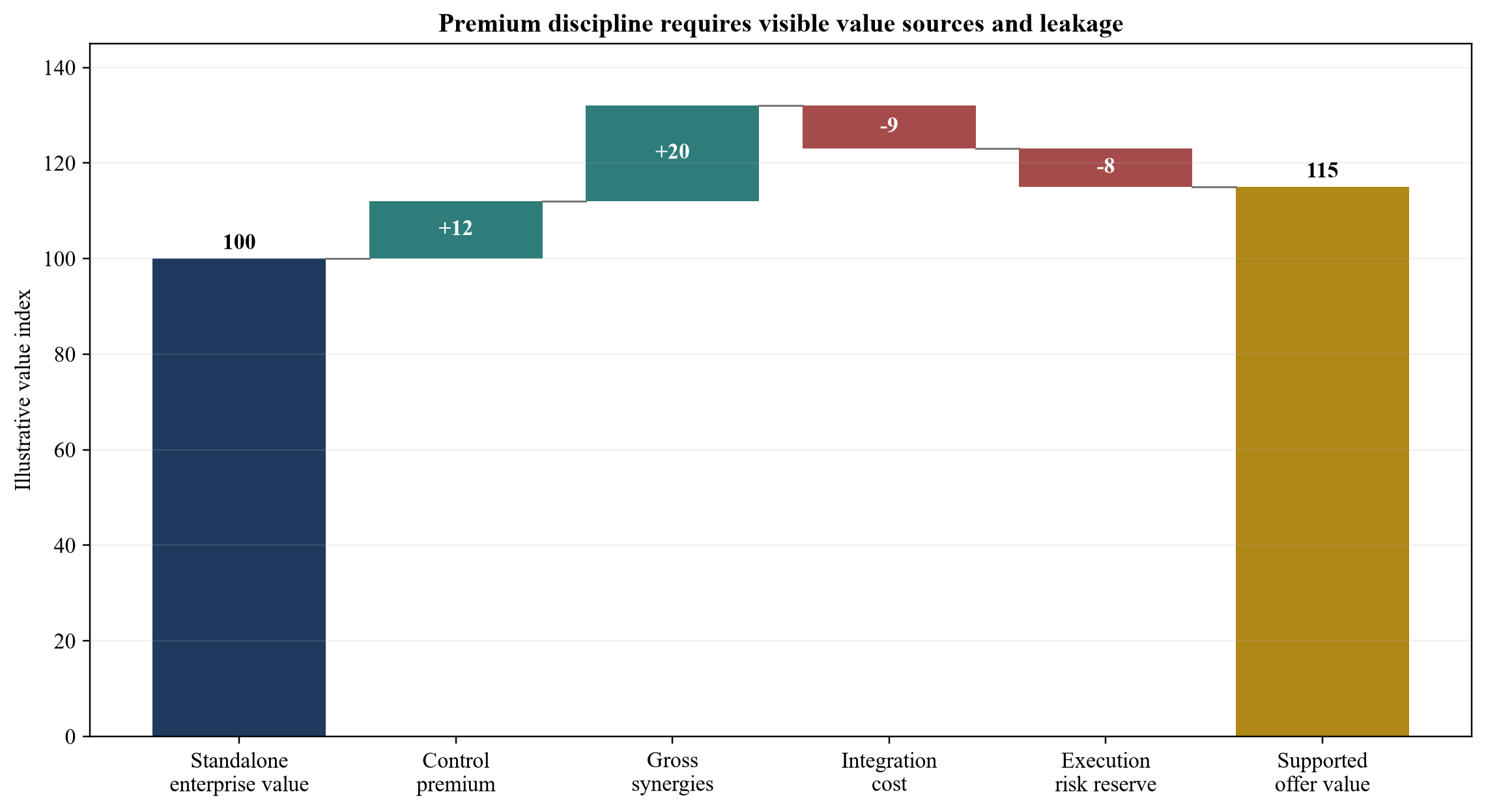
Illustrative management model; figures do not represent a transaction or market forecast.
9. Binding terms and the signing gate
Binding terms convert the economic and risk conclusions into contractual positions. The office keeps a term matrix that connects each issue to price, structure, conditions precedent, warranties, indemnities, covenants, retention arrangements, escrow, earn-out or termination rights. Counsel drafts the agreement. The office maintains the commercial rationale and ensures that changing terms flow back into valuation, financing and approvals.
The completion mechanism should reflect the economics of the business and the quality of available information. A locked-box structure requires confidence in the reference balance sheet and leakage protection. Completion accounts can adjust for actual cash, debt and working capital at closing, while definitions, accounting policies, dispute procedures and data readiness determine whether the mechanism works. The office runs the mechanism through worked examples before approval.
Signing readiness requires more than an agreed mark-up. The authorised signatories, board resolutions, financing approvals, disclosure schedules, ancillary documents, escrow or payment arrangements, regulatory submissions and communications plan must be ready. Day-One obligations should have owners. The transaction should enter signing with a controlled list of open points and no hidden dependency.
Table 7. Signing-readiness control
| Control area | Evidence at signing gate | Accountable party |
|---|---|---|
| Economics | Final model, price bridge, downside case and approval | CFO and board sponsor |
| Agreement | Agreed execution version and issues list closed | Legal counsel |
| Authority | Resolutions, powers and authorised signatories | Corporate secretary |
| Financing | Committed sources, conditions and funds-flow readiness | CFO and finance providers |
| Regulatory | Filing plan, conditions and conduct protocol | Regulatory counsel |
| Disclosure | Agreed schedules and indexed supporting documents | Seller, buyer and counsel |
| Ownership readiness | Day-One controls, leadership communication and critical actions | CEO and integration lead |
Legal counsel confirms legal sufficiency; the acquisition office confirms operating completeness.
10. The retained operating cadence
A retained acquisition office earns its value through continuity. The monthly retainer supports a stable team, controlled information environment, recurring market screen, target pipeline, management cadence and board-quality evidence. Transaction-specific specialists and success-linked economics can sit alongside the retainer where lawful, disclosed and aligned with professional obligations.
The operating rhythm should be fixed. A short daily workstream call manages immediate dependencies during intensive phases. A twice-weekly issue review resolves evidence gaps and dispositions. A weekly steering meeting approves scope, resources and negotiation positions. A scheduled board or investment-committee gate protects decision time. The office publishes a single status pack that shows stage, value range, top issues, regulatory critical path, financing status, decisions due and next actions.
The retainer should specify deliverables, capacity, exclusions, response times, confidentiality, conflicts, specialist budgets and termination. It should avoid the ambiguity of an unlimited advisory promise. The buyer receives an operating system and accountable output; the office receives sufficient continuity to maintain quality and pace.
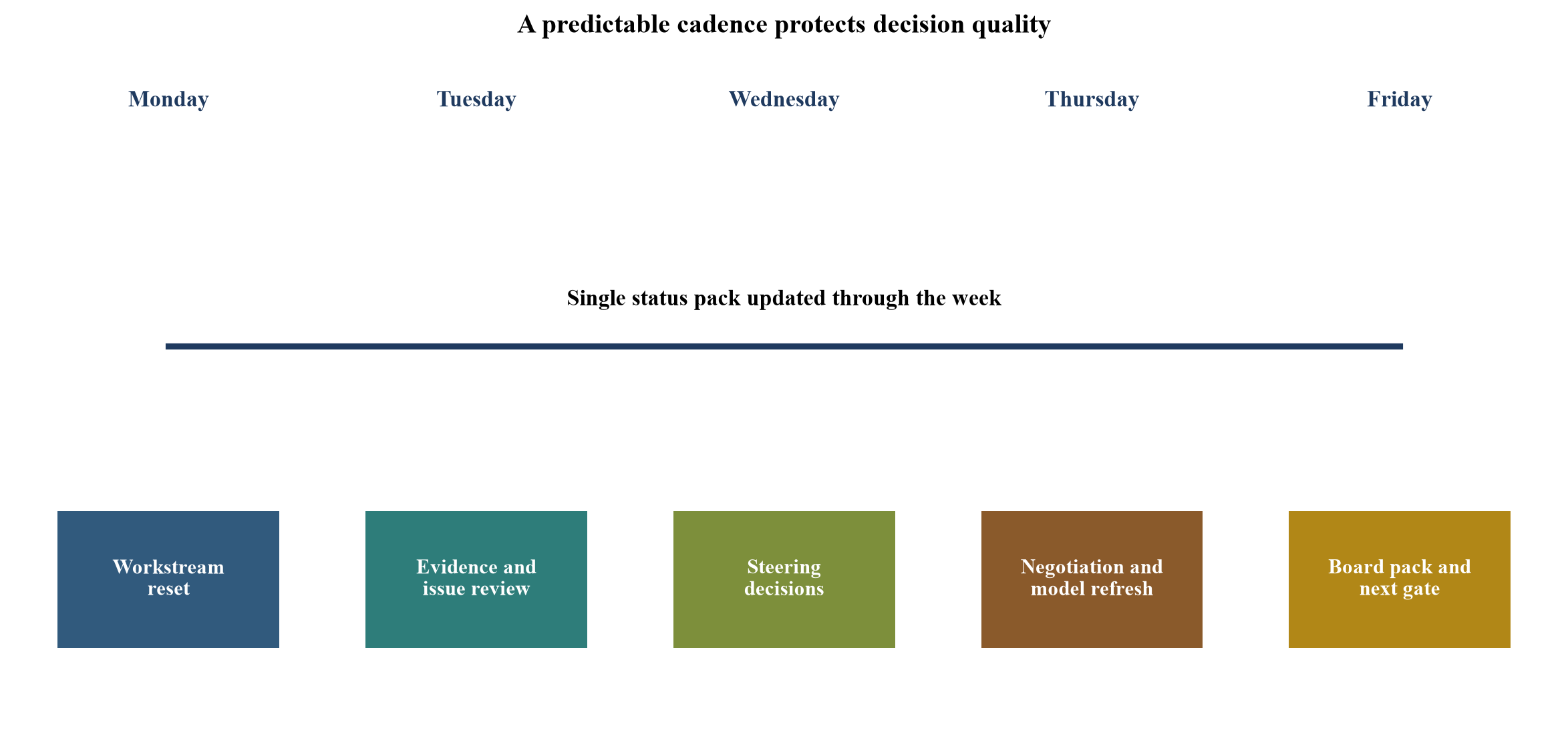
Management model. Meeting frequency increases during binding negotiation and signing.
Table 8. Example retained acquisition-office service architecture
| Workstream | Recurring output | Transaction-phase output | Evidence of completion |
|---|---|---|---|
| Market and targets | Updated market map and prioritised pipeline | Target profile and access strategy | Source-indexed target register |
| Process control | Calendar, RACI, issues and decisions | Gate packs and critical-path management | Approved decision log |
| Analysis | Standard screening and valuation models | Integrated valuation and downside case | Version-controlled model |
| Diligence | Question architecture and adviser coordination | Integrated issue ledger | Disposition for every material issue |
| Negotiation | Position framework and authority limits | Commercial term matrix | Approved positions and changes |
| Ownership readiness | Integration hypotheses and leadership map | Day-One and first-100-day priorities | Named owners and funded actions |
Commercial terms should reflect scope, complexity, seniority, specialist needs and applicable professional rules.
11. Illustrative transaction
Consider a UAE holding company seeking a controlling stake in a regional business-services platform. The management model assumes annual revenue of AED 180 million, maintainable EBITDA of AED 27 million, moderate customer concentration and operations in the UAE and Saudi Arabia. These figures are illustrative and do not describe a client, target or market forecast.
During the first ten days, the board approves a capability-and-scale thesis, a maximum equity cheque and a requirement that the combined business remain within an approved leverage range. The target screen identifies eight companies. Three receive high strategic scores, and two have credible ownership routes. Regulatory counsel begins overlap analysis using revenue, service-line and market information.
By Day 30, one target grants access. Initial information supports an indicative enterprise-value range, subject to maintainable earnings, normal working capital and customer retention. The buyer issues a non-binding proposal with funding evidence, a focused diligence plan and an exclusivity request. The office records a downside case that assumes the loss of one major customer, a delay in procurement savings and higher systems investment.
Confirmatory diligence identifies three material issues. First, a major contract requires change-of-control consent. Second, receivables ageing indicates that the seller's working-capital assumption is insufficient. Third, the target's chief operating officer holds process knowledge that is not documented. The office assigns each finding a disposition: the consent becomes a condition precedent; working capital enters the completion mechanism; management dependency produces a retention plan, documentation sprint and Day-One delegation programme.
By Day 70, regulatory advice, financing and the integrated valuation support a binding range below the initial seller expectation. The buyer offers a combination of cash and contingent consideration linked to retained gross profit from specified customers, with measurement and control provisions drafted by counsel. Signing occurs after approvals, disclosure schedules, funds flow and Day-One obligations are complete. The first-100-day plan already contains the customer, cash and operating-control actions identified during diligence.
The example shows how the office creates value through avoided rework, earlier stop decisions, clearer negotiation and ownership readiness. It provides no guarantee of transaction completion or investment performance.
12. Implementation roadmap
The buyer can establish the office in four steps. First, appoint a board sponsor and an accountable office lead. Second, approve the mandate, authority matrix, confidentiality design and gate calendar. Third, configure the target register, evidence index, issue ledger, valuation model and status pack. Fourth, test the system on one active theme before expanding the target pipeline.
The office should begin with a small core. The core usually includes a senior transaction lead, an execution manager and analytical support, with finance, legal and business leaders embedded through decision rights. Specialist resources join when the target and issues require them. The buyer should retain institutional memory after a transaction by archiving the source index, decisions, model versions, issues, negotiation positions and post-close lessons.
Performance measures should focus on decision quality and execution. Useful measures include screened targets with source-complete profiles, time from access to gate decision, material issues with dispositions, board decisions made on schedule, forecast-to-actual diligence effort, valuation changes traced to evidence, regulatory critical-path accuracy and Day-One actions owned before signing. Deal count alone can reward activity without value.
13. Limitations and directions for further research
The framework is a management model. It does not determine whether a transaction is legally permissible, financially attractive or suitable for a specific buyer. Regulatory thresholds, accounting treatment, tax consequences, foreign-ownership rules, sector licences, financing conditions and contractual remedies require transaction-specific professional advice.
The ninety-day horizon assumes a cooperative process and timely information. Auctions, public-company rules, hostile approaches, complex carve-outs, distressed situations and multi-jurisdiction remedies can require materially different timetables and governance. The illustrative scorecards and value bridges show methods rather than market benchmarks.
Further research could test the relationship between acquisition-office maturity and outcomes across GCC transactions. Useful measures would include screening breadth, time to stop, valuation revisions, diligence rework, regulatory delays, integration readiness, management retention and realised synergies. Longitudinal evidence could distinguish disciplined speed from rushed execution.
14. Conclusion
A 90-day acquisition office gives an acquisitive GCC company a practical way to convert strategic intent into governed execution. It starts with a precise mandate, builds a defensible target screen, secures evidence in stages, integrates specialist diligence, begins regulatory and financing work early, and carries every material finding into price, protection or ownership action.
The office works when decision rights are real, evidence remains traceable and stop conditions are respected. A retained model supports continuity between transactions and creates a repeatable corporate-development capability. The output at Day 90 is a controlled decision: sign an executable agreement, extend the process for defined evidence, or stop with capital and management attention preserved.
References
- UAE Ministry of Economy and Tourism. Economic Concentration. Current procedures and official resources. https://www.moec.gov.ae/en/economic-concentration
- UAE Legislation. Cabinet Decision No. 3 of 2025 concerning thresholds for the application of provisions on economic concentration. https://uaelegislation.gov.ae/en/legislations/2788
- General Authority for Competition, Saudi Arabia. Economic Concentration Review Guidelines. https://gacbep.gac.gov.sa/cms/b9376edc-79a1-4573-a36d-4f3effaba838.pdf
- Capital Market Authority, Saudi Arabia. Merger and Acquisition Regulations. https://cma.org.sa/en/RulesRegulations/Regulations/Documents/Merger%20and%20Acquisition%20Regulations.pdf
- Barrios, J. M., Fujiy, B. C., Lisowsky, P., and Minnis, M. Measurement Matters: Financial Reporting and Productivity. NBER Working Paper 34536, 2025. https://www.nber.org/papers/w34536
- IFRS Foundation. IFRS 3 Business Combinations. https://www.ifrs.org/issued-standards/list-of-standards/ifrs-3-business-combinations/
- Paugam, L., Wang, Y., Stolowy, H., and Binder, C. The Construction of Financial Value: Crafting Synergy Estimates in Acquisitions. 2026. https://papers.ssrn.com/sol3/Delivery.cfm/6149046.pdf?abstractid=6149046
- Ellahie, A., Huang, X., Tuna, A. I., and Vincenzi, R. Are Merger Synergy Disclosures Credible? 2026. https://papers.ssrn.com/sol3/Delivery.cfm/6815098.pdf?abstractid=6815098
- UAE Legislation. Federal Decree-Law No. 36 of 2023 Regulating Competition. https://uaelegislation.gov.ae/en/legislations/2117
- Securities and Commodities Authority, UAE. Annual Report 2024, corporate-governance developments. https://www.sca.gov.ae/assets/download/27cc1e3b/sca-annual-report-english-2024.aspx
- Capital Market Authority, Saudi Arabia. Corporate Governance Regulations. https://cma.org.sa/en/RulesRegulations/Regulations/Documents/CorporateGovernanceRegulations1.pdf
- Bloom, N., and Van Reenen, J. Measuring and Explaining Management Practices Across Firms and Countries. NBER Working Paper 12216. https://www.nber.org/papers/w12216
- McKenzie, D. J., and Woodruff, C. Business Practices in Small Firms in Developing Countries. World Bank Policy Research Working Paper 7405. https://documents.worldbank.org/en/publication/documents-reports/documentdetail/812381467999130334
About the Author
Chennakeshav Adya is an independent researcher and corporate finance practitioner with more than twenty years of international experience across business strategy, transformation, investment banking, family-office operations, risk, technology and cross-border transactions. His research focuses on practical decision systems for private capital, corporate finance and transaction execution. The views expressed in this paper are his own.
Appendix A. Acquisition-Office Launch Checklist: . Governance
- Board sponsor and office lead appointed.
- Investment thesis, capital envelope and stop conditions approved.
- Authority matrix and recurring gate calendar approved.
- Conflicts, confidentiality and information-sharing protocols confirmed.
. Evidence system
- Target register configured with source and confidence fields.
- Information-request architecture aligned to ownership questions.
- Issue ledger connected to price, structure, protection and first-100-day actions.
- Valuation model, source index and version controls established.
. Execution readiness
- Legal, tax, accounting, commercial, technology and regulatory advisers scoped.
- Funding routes, lender information needs and approval timing mapped.
- Regulatory screening begins before indicative value is approved.
- Day-One and integration hypotheses are documented before binding terms.
Appendix B. Board Gate Questions: . Proceed questions
- Which new evidence supports the strategic and economic case?
- Which assumptions remain weak, and when will they be tested?
- Which material findings have changed value, structure, protection or ownership action?
- Is the regulatory and financing critical path executable?
- Does the downside case remain within the approved threshold?
. Stop questions
- Has the target moved outside the approved thesis or risk appetite?
- Has required evidence remained unavailable beyond the agreed gate?
- Has the seller's expectation moved beyond supported value?
- Has an approval, consent, funding source or management dependency become impracticable?
- Does management attention have a higher-value alternative use?
