

1. Define the transaction question before accepting the revenue story
A BPO acquisition can pursue scale, sector expertise, client access, geographic delivery, digital capability, proprietary workflow assets or a platform for consolidation. The diligence mandate should state which value thesis is being tested and which evidence could disprove it. A buyer seeking stable cash generation asks different questions from a buyer seeking an AI-enabled transformation platform. The first may prioritise renewal, collections and capacity utilisation. The second must also test technology ownership, productisation, data rights, implementation capability and the cost of changing delivery.
The legal perimeter should identify the acquired entities, branches, service centres, intellectual property, employees, subcontractors, customer contracts and shared group services. The financial perimeter should reconcile statutory accounts, management reporting, revenue ledgers, contract assets, deferred revenue, receivables, pass-through amounts and acquisition effects. Delivery analysis should map service towers, processes, languages, shifts, locations, client systems and business-continuity dependencies.
Materiality should reflect mechanism as well as amount. A modest client may control entry into a regulated vertical or provide credentials used to win other work. A small technology licence may be embedded across major processes. A narrow group of subject-matter experts may own transition knowledge that cannot be replaced within the transaction timetable. Diligence should connect each risk to purchase price, financing, contractual protection, integration or the decision to stop.
The final decision questions should be falsifiable. Examples include whether contracted revenue is economically committed, whether gross margin survives renewal and automation, whether the largest clients are independently renewable, whether data processing can continue after control changes, and whether the buyer can fund the technology and people required to realise the deal case.
2. Build the evidence lineage from contract to cash
Revenue quality begins with a controlled population. Each customer, legal agreement, statement of work, work order, service tower, pricing schedule, invoice and receipt should receive a stable identifier. The population should reconcile the customer register, contract repository, project system, time records, general ledger, receivables ledger and bank evidence. Acquired businesses commonly use different names for the same customer or aggregate several economic buyers under one group account.
The lineage register should record source owner, system, period, extraction date, file hash or immutable identifier, currency, transformation rule, reviewer and unresolved exception. Contract amendments, commercial emails and service-level credits should be linked to the governing agreement. Manual revenue adjustments require the previous value, revised value, reason and approval. Derived measures such as annual contract value, gross retention and automation-adjusted margin should remain reproducible from the underlying population.
AI can classify documents, extract clauses, match invoices to contracts, identify duplicate customers and detect inconsistent pricing or service descriptions. These outputs remain analytical leads until the source and commercial meaning are reviewed. A model can recognise a termination clause while missing that a side letter changes the notice period. It can group legal entities that share a brand while failing to identify separate procurement authority.
The decision record should distinguish sourced fact, calculated result, professional judgement and hypothetical scenario. This separation prevents a model score from acquiring the authority of a contract interpretation or audit opinion and allows the investment committee to see which conclusions depend on incomplete evidence.
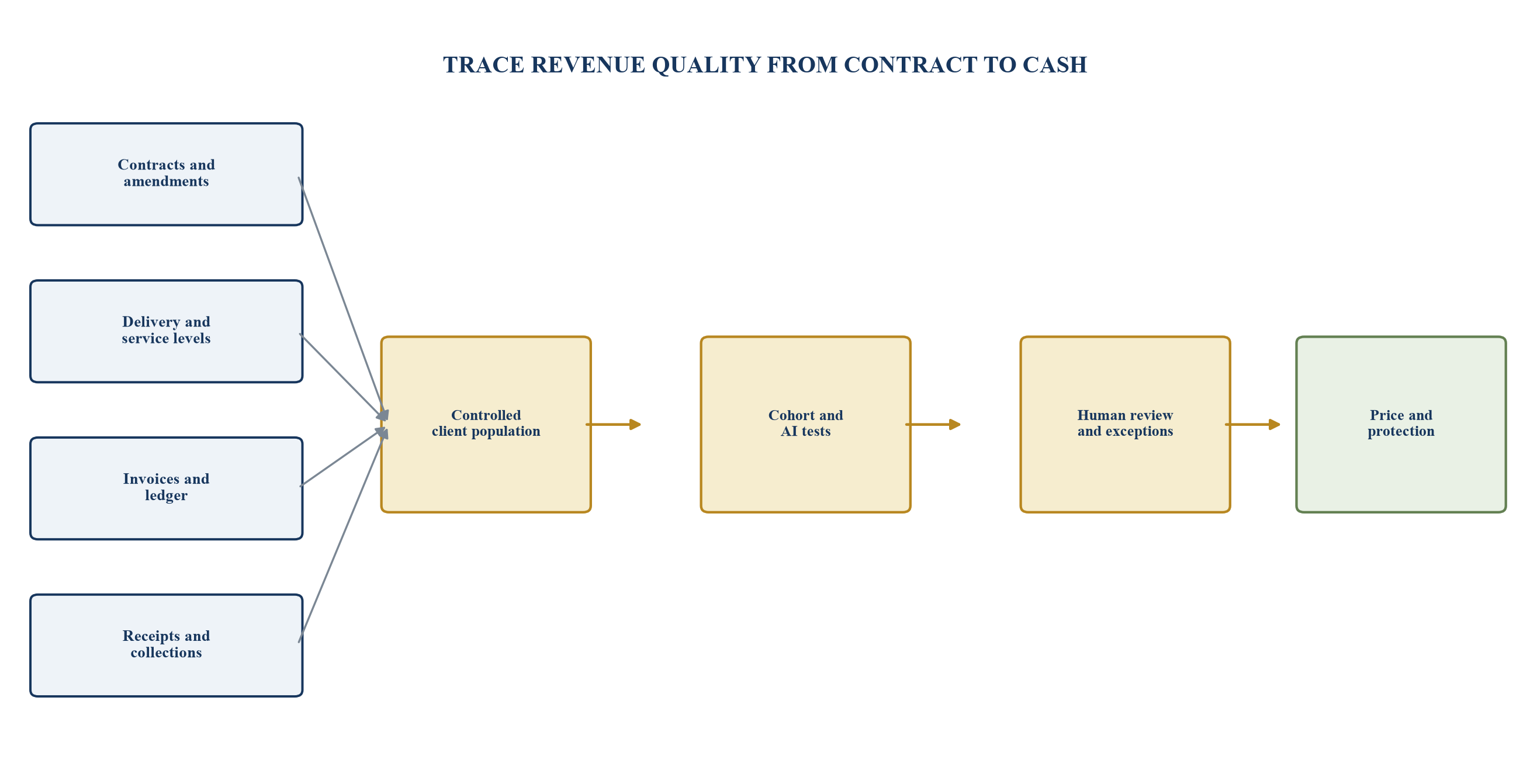
Each material conclusion retains source, transformation, reviewer and exception ownership.
3. Reconstruct revenue by contract cohort
Reported revenue should be rebuilt at the lowest reliable economic level. Useful dimensions include customer group, contracting entity, statement of work, service tower, delivery country, pricing mechanism, start date, renewal date, notice period, currency and collection status. The cohort should identify new scope, expansion, contraction, price movement, pass-through, acquisition and foreign-exchange effects separately.
Contracted revenue is not a single category. A committed minimum volume is different from an estimate, purchase-order ceiling, historic run rate or framework agreement without an awarded work order. A multi-year term may contain annual benchmarking, productivity commitments, most-favoured pricing, discretionary volumes, termination for convenience, transition assistance or technology-driven gainsharing. Each feature changes the amount and margin that can reasonably enter a transaction model.
The reviewer should calculate gross revenue retention, net revenue retention, logo retention, price, volume, mix and cash collection on consistent eligible populations. A customer should not enter the denominator before the service is live or disappear merely because it moves between legal entities. Revenue that ends through an agreed transition should remain visible as churn. Expansion from a new service should be shown separately from price escalation.
IFRS 15 provides the accounting framework for identifying contracts and performance obligations, determining transaction price and recognising revenue as promised services transfer. Transaction diligence adds questions about economic commitment, renewal, collectability and future delivery cost. Accounting recognition alone does not establish that revenue will persist after a change of control.
Table 1. Revenue-cohort fields for BPO transaction diligence
| Field | Stronger evidence | Diligence test | Transaction relevance |
|---|---|---|---|
| committed scope | executed agreement and work order | minimum volume, termination and repricing | forecast eligibility |
| delivered service | operational records and service levels | acceptance, credits and backlog | revenue and margin quality |
| billed amount | invoice and ledger | cut-off, pass-through and disputes | working capital |
| collected cash | bank receipt and allocation | ageing, set-off and deductions | liquidity and valuation |
| renewal exposure | notice calendar and client evidence | budget, procurement and competition | retention scenario |
Cohort measures should reconcile contract, service delivery, invoice and cash evidence.
4. Test contract durability rather than contract length
Headline contract duration can overstate economic protection. Diligence should review termination for convenience, volume flexibility, benchmarking, continuous-improvement obligations, price resets, service credits, step-in rights, change-of-control consent, assignment, subcontracting, transition assistance and ownership of transformed processes. A nominal five-year agreement with annual repricing and freely variable volumes can behave like a short-duration contract.
The analysis should distinguish the legal customer from the operating sponsor and the budget owner. Renewal may depend on procurement, technology, risk, data protection and business-unit leaders with different incentives. Customer references selected by the buyer should test service criticality, switching cost, satisfaction, automation roadmap, insourcing intent and approval path. Responses should be reconciled to usage, ticket, quality, invoice and cash evidence.
Service-level history matters because credits and chronic misses can reveal operational fragility before formal termination. The reviewer should assess whether reported performance excludes disputed tickets, planned outages, transition periods or client-caused delays. Improvement plans should have dated actions, owners and evidence. A favourable average can hide repeated failure in a critical process or country.
Renewal probability should not be reduced to a single unsupported percentage. The decision model can present a base, downside and loss case by contract, with explicit timing, notice, transition cost and stranded capacity. Material clients require named evidence and an accountable owner before their revenue is accepted in the deal case.
5. Measure client concentration as correlated exposure
Traditional concentration measures such as the largest customer, top five share and Herfindahl index provide a useful starting point. They can still understate risk when several contracts depend on the same end market, procurement programme, technology platform or executive sponsor. Legal entities within one group may negotiate together. Apparently unrelated customers may share a regulated event, cyclical industry or common prime contractor.
The concentration map should therefore include ultimate parent, sector, geography, service tower, delivery location, pricing model, renewal window, currency, platform and data regime. It should show revenue, gross margin, receivables, contract assets, committed capacity and termination cost. A lower-revenue customer can be more material if it absorbs specialised staff or owns a critical reference relationship.
Public disclosures illustrate why this matters. WNS described dependence on a relatively small group of major clients and disclosed an example in which a top-five customer served a termination notice. Genpact discloses bookings and segment revenue to help investors understand growth composition. These disclosures do not determine another target's risk; they show the value of specific cohort evidence and transparent definitions.
The transaction model should run single-client and correlated-cluster losses. It should estimate contribution margin lost, avoidable labour, notice-period receipts, transition cost, facility and technology commitments, receivable recovery and replacement-sales timing. The output is a cash and EBITDA bridge, rather than a concentration percentage presented without consequence.
Concentration should also be examined through negotiation behaviour. A customer with a modest revenue share may repeatedly secure discounts, free transformation work or extended payment terms because its brand is strategically important. The cohort should therefore show realised price, service credits, unpaid change requests and sales effort alongside revenue. Where several accounts are managed by the same executive or depend on one industry credential, the buyer should test whether a departure or reference loss could affect the wider book. This commercial view can reveal concentration that the accounting ledger does not display.
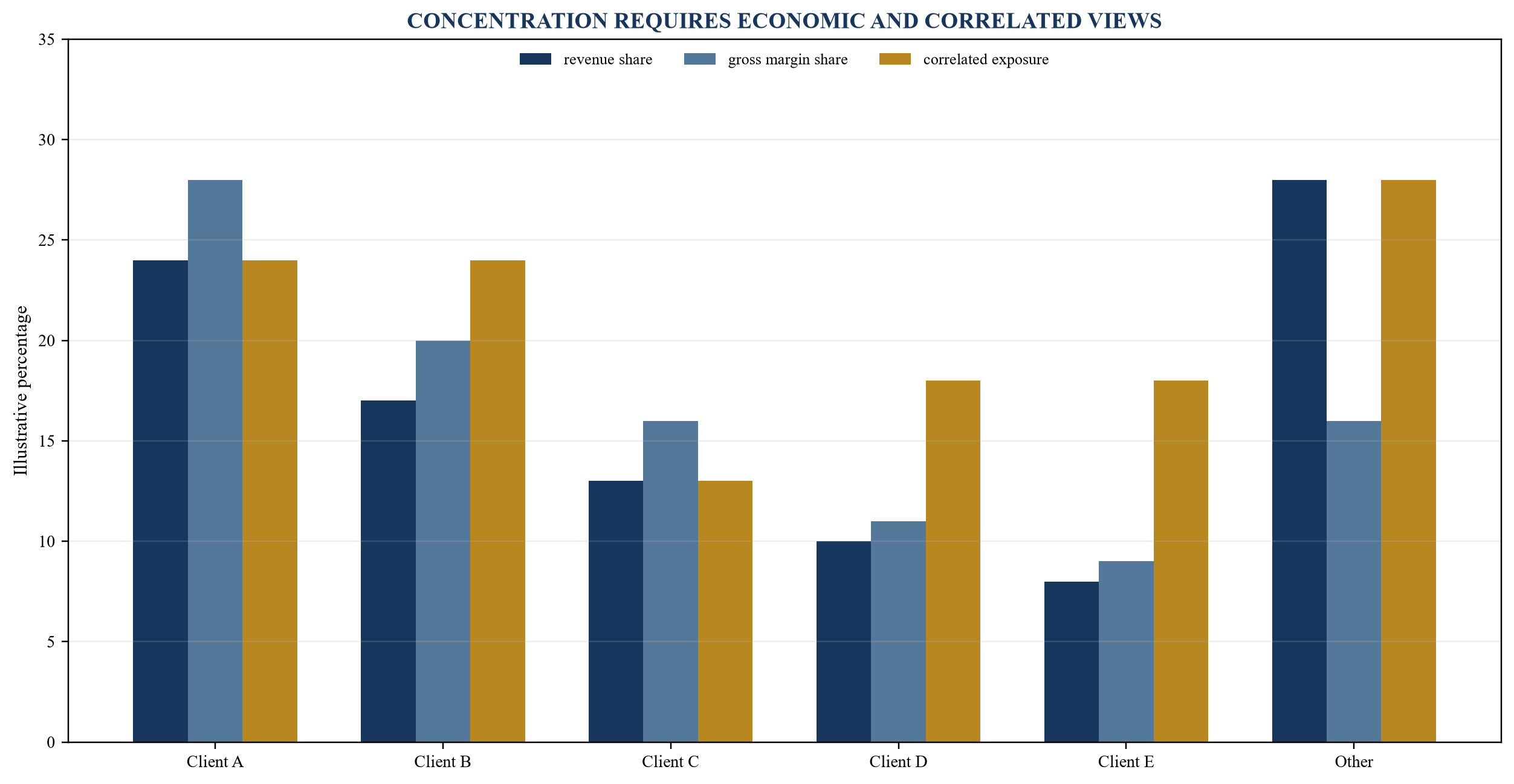
Values are hypothetical analytical assumptions and do not represent an actual company.
6. Separate recurring operations from transition and project revenue
BPO income statements can combine steady-state managed services with implementation, consulting, transformation, licence, pass-through and gainshare revenue. Each stream has different duration, margin, working-capital and renewal characteristics. Diligence should map revenue to the underlying obligation and delivery phase, rather than relying on labels such as digital, platform or recurring.
Transition work may support a durable managed-services relationship, yet it can carry lower margin, milestone risk and upfront staffing. Consulting can create follow-on scope, while remaining discretionary and capacity-sensitive. Licence or platform revenue may depend on third-party technology, client-specific configuration or bundled labour. Gainshare can be attractive but requires a verified baseline, measurement period, approval process and collection history.
The cohort bridge should show contracted recurring operations, variable managed services, implementation, project work, technology, pass-through and other items. Revenue and direct cost should use the same definitions. A service cannot be described as asset-light if delivery depends on client-dedicated facilities, minimum cloud commitments, licensed tools or non-redeployable staff.
The investment committee should receive both historical composition and the expected exit mix. Value should follow the cash durability and competitive advantage of each stream. A higher multiple on a small technology component cannot be applied to an entire business without evidence that the capability changes contract economics across the portfolio.
7. Test pricing mechanics and contractual productivity givebacks
BPO pricing may use full-time equivalents, transactions, outcomes, subscriptions, consumption, fixed fees or hybrid structures. Each mechanism allocates volume, productivity, quality and automation benefits differently. A per-FTE contract can protect near-term revenue while encouraging clients to demand productivity reductions. A per-transaction model can scale with volume but exposes the provider to automation efficiency. Outcome pricing can create upside while increasing measurement and dispute risk.
Contracts often include annual rate cards, inflation clauses, benchmarking, continuous-improvement commitments, gainshare, service credits and technology pass-through. Diligence should reconstruct realised price by service and location, including discounts, credits, free transition work and unbilled effort. Rate increases should be separated from currency translation and mix.
The reviewer should identify who captures automation value. If the provider must deliver an annual productivity reduction, AI adoption may protect margin only by meeting an existing obligation. If price falls with headcount, reducing labour can reduce revenue before fixed cost is removed. If the contract shares verified savings, data quality and baseline governance become direct cash-flow drivers.
The deal model should therefore link each automation initiative to the relevant pricing clause, implementation cost, timing, revenue effect, labour release, quality control and client approval. Unsupported gross savings should not enter sustainable EBITDA.
8. Build a wage, attrition and capacity bridge
Labour remains a major BPO cost even when automation grows. The workforce model should map employees and contractors by legal employer, location, role, skill, grade, tenure, shift, customer, process and cost. Payroll should reconcile headcount, joining, exits, overtime, incentives, benefits, subcontractors and capitalised labour. Average cost alone can hide shortages in specialised, regulated or language-specific roles.
India and the UK have different labour markets, employment rules, cost structures and delivery roles. The analysis should avoid treating one country as a uniform cost pool. Indian delivery centres can contain high-volume operations, analytics, engineering, domain experts and management. UK teams may hold client relationships, regulated functions, design, transition and specialist knowledge. Work can move only when contracts, data, language, resilience and client consent permit it.
Attrition should be analysed by voluntary and involuntary exit, regretted loss, tenure, manager, process, client and hiring cohort. Low attrition can coexist with weak capability if hiring has stopped or work is declining. High attrition can create recruitment, training, overtime, quality and service-credit cost before it appears in the income statement.
Capacity utilisation should distinguish productive, training, transition, bench, leave and unavailable time. The transaction model needs a monthly bridge from current payroll to sustainable delivery cost, including wage inflation, hiring, automation, redeployment, redundancy, retention, facilities and management spans.
Recruitment evidence should include requisitions, time to hire, offer acceptance, joining, training completion and early attrition. A target can protect current service levels by paying signing bonuses, using contractors or carrying overtime that later appears as margin pressure. Location comparisons should use fully loaded cost and comparable productivity, quality and availability. A lower salary does not create economic advantage if training, supervision, rework, client restrictions or night-shift premiums absorb the difference. The buyer should identify which roles can be moved, which can be redesigned and which must remain close to the customer.
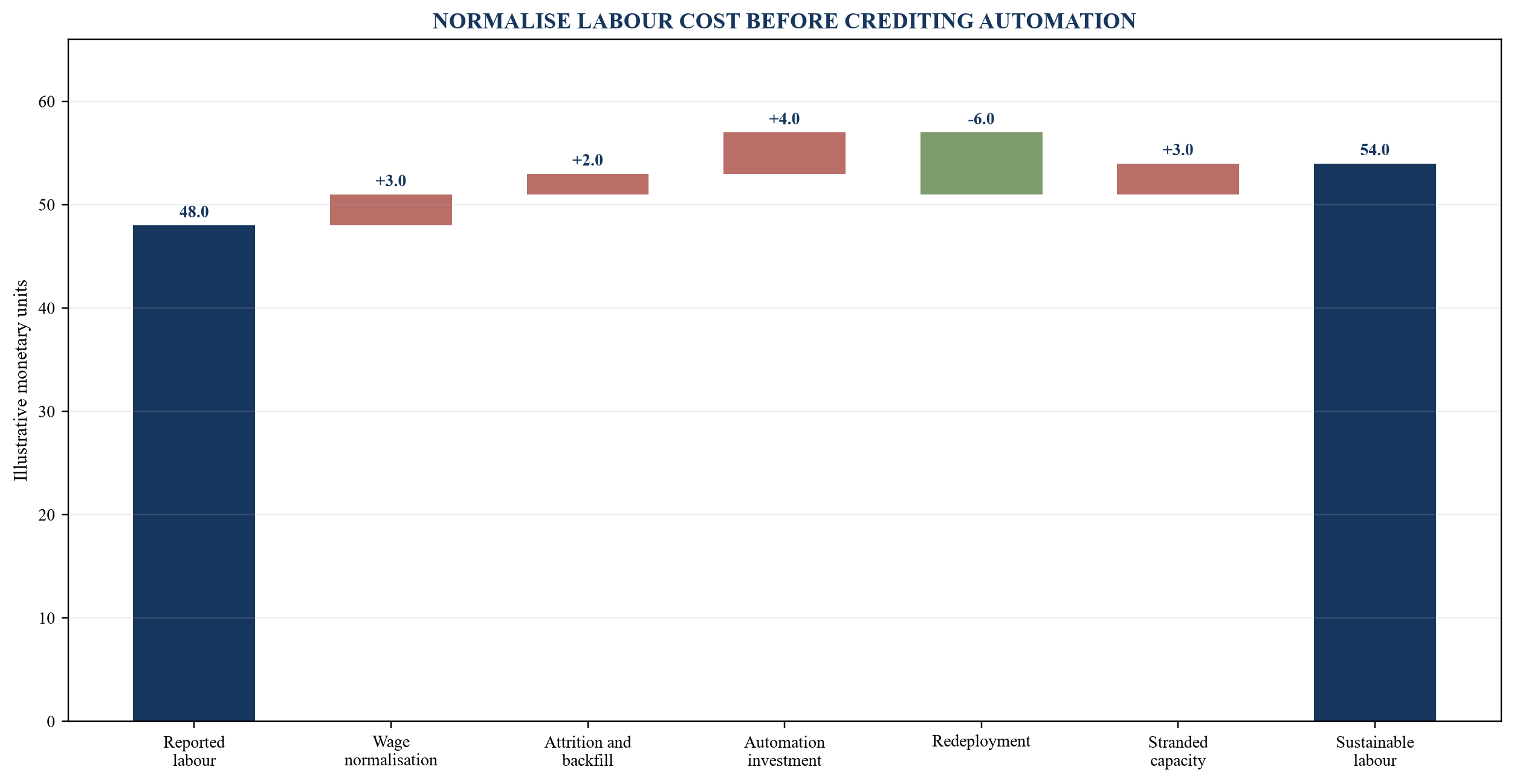
Amounts are hypothetical analytical assumptions and demonstrate the bridge only.
9. Analyse AI automation as a contract and operating-model change
AI exposure should be assessed process by process. Relevant dimensions include task standardisation, input quality, language, exception rate, regulatory consequence, customer tolerance, integration, human review and auditability. A process with high technical automation potential may remain economically unsuitable because errors are costly, data access is restricted or the client retains approval.
The target should provide an automation register with use case, owner, customer, process, baseline, technology, data, validation, production status, cost, benefit, incident history and contractual treatment. Demonstrations and pilot percentages are insufficient. Diligence should reconcile production logs, service levels, labour hours, client invoices and realised cash outcomes.
AI can create new revenue through advisory, data engineering, workflow redesign, managed models and outcome services. It can also compress existing effort, reduce FTE-linked revenue, increase cloud and software cost, create model risk and accelerate client insourcing. The analysis should show both sides. Genpact's 2025 disclosures separately reported advanced technology solutions and core business services, illustrating the value of transparent revenue definitions when a services company is changing its portfolio.
The buyer should test whether capability resides in transferable systems, documented methods and repeatable teams. A collection of client-specific scripts, third-party licences and a few specialists may support delivery while providing limited platform value. Sustainable value requires contractual rights, deployment evidence, measurable outcomes, security, governance and distribution across more than one customer.
Automation timing deserves a separate implementation curve. Discovery, process redesign, data preparation, integration, validation, client approval, workforce change and stabilisation can span several reporting periods. Benefits should follow the slowest required dependency and should be reduced for exception handling, monitoring and human review. A portfolio of pilots does not provide immediate capacity release when each customer has a different control environment. The transaction model should also reserve for failed or deferred use cases so the portfolio is not valued as though every initiative reaches production.
Table 2. AI automation exposure matrix for BPO diligence
| Dimension | Evidence | Upside test | Downside test |
|---|---|---|---|
| process suitability | task map, volumes and exceptions | effort reduction and quality | error, escalation and excluded work |
| contract economics | pricing and productivity clauses | retained savings or new scope | repricing, giveback or revenue loss |
| technology | architecture, licences and logs | repeatable deployment | dependency and change cost |
| data and controls | rights, lineage and validation | scalable learning and assurance | restriction, bias, privacy and incident |
| people | skills, ownership and succession | redeployment and productisation | key-person loss and stranded capacity |
Automation value depends on realised economics and contractual allocation.
10. Validate proprietary technology and third-party dependency
Technology diligence should inventory applications, models, data pipelines, orchestration, licences, cloud services, client systems, interfaces and operational tools. Each asset needs an owner, purpose, user base, contract, cost, support model, security classification, development history and transfer status. The buyer should distinguish owned source code from configured third-party products, client-owned components and open-source dependencies.
Claims of proprietary platforms require production evidence. The reviewer should examine active customers, usage, release history, incident records, service levels, implementation effort, gross-margin effect and client willingness to pay. Code volume, patents or branded interfaces do not establish commercial value. A platform can be strategically useful while functioning mainly as a delivery accelerator whose benefit is already returned to the client through price.
Third-party terms can create change-of-control consent, minimum commitments, geographic restrictions, audit obligations and price resets. Client-specific licences may not transfer. Models can depend on externally hosted services whose availability, pricing or terms change. A deal model should include replacement and migration cost where continued rights are uncertain.
Technical debt should be translated into transaction consequences. Unsupported software, weak access controls, undocumented integrations and single-person ownership can affect separation, continuity, investment and valuation. Remediation needs a dated plan, accountable owner and cost estimate before closing protection is designed.
11. Reconcile reported EBITDA to a sustainable base
Reported EBITDA should be bridged from audited or statutory results to management reporting, then to a transaction-specific sustainable base. The bridge should identify revenue cut-off, pass-through, acquisition effects, foreign exchange, capitalised cost, provisions, restructuring, related parties, share-based compensation, leases and non-recurring items. The same issue should not be counted in both earnings and net debt.
The operating bridge then incorporates contract losses, volume elasticity, renewal pricing, service credits, wage normalisation, attrition, subcontracting, automation cost, productivity, facilities, transition and corporate allocations. Automation benefit should enter only when the process, timing, contractual allocation and cost to achieve are evidenced. Stranded labour and facilities should remain until a feasible removal or redeployment plan is funded.
Working capital matters because accounting revenue can precede billing or collection. Contract assets, unbilled revenue, receivables, deferred revenue, client advances and accrued delivery cost require separate analysis. Ageing should start from the contractual trigger, rather than invoice date alone. Cash collection after the diligence date can provide strong evidence where allocations and subsequent disputes are understood.
The committee should receive reported, adjusted, sustainable and downside EBITDA with a line-by-line evidence register. Each adjustment needs an owner, source, recurrence conclusion and treatment in price, financing, protection or integration. A balanced bridge includes positive and negative items and avoids presenting management initiatives as achieved results.
Quality of earnings should also examine how commercial investments are classified. Bid teams, transition specialists, solution architects and platform engineers may be included in delivery, selling expense, capitalised development or central overhead depending on the organisation. A buyer planning growth cannot remove these costs simply because they are described as discretionary. The sustainable base should retain the resources needed to renew contracts, win replacement work, maintain controls and operate the technology estate. Any proposed synergy should identify the activity that ceases, the service consequence and the date cash is actually released.
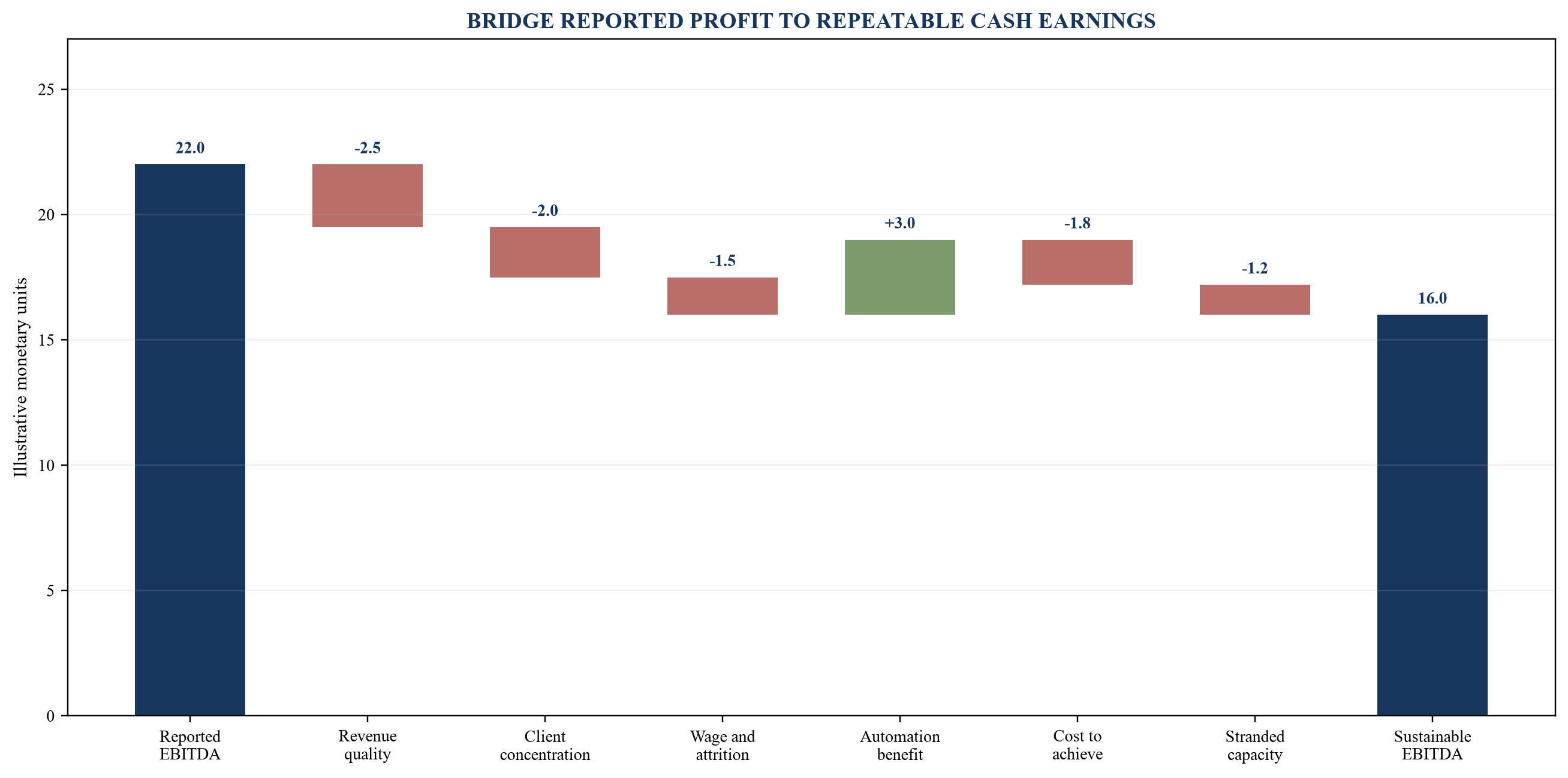
Amounts are hypothetical analytical assumptions and do not represent an actual target.
12. Test revenue-to-cash conversion and working capital
BPO cash conversion can be affected by milestone approval, time-sheet acceptance, service credits, disputes, client procurement, foreign-exchange controls and collection practices. The reviewer should reconstruct billing eligibility by contract and compare service delivery, acceptance, invoice, ledger and bank receipt. A favourable days-sales-outstanding metric can hide factoring, netting, disputed balances or a growing contract-asset population.
Receivables should be grouped by customer, invoice, service period, contractual due date, dispute, credit note, currency and subsequent receipt. Contract assets and unbilled revenue need the underlying performance obligation, approval status and expected invoice date. Deferred revenue and client advances may support liquidity while creating delivery obligations that reduce free cash.
Customer concentration can amplify working-capital risk because a single procurement hold or contract dispute affects both revenue and collections. The model should stress simultaneous volume reduction, delayed payment and stranded cost. Recoverability conclusions require contract, correspondence and subsequent cash evidence, rather than ageing alone.
Completion accounts or locked-box structures should define treatment of contract assets, deferred revenue, accrued incentives, service credits, transition balances, employee obligations and related-party settlements. The transaction agreement should avoid a definition that rewards revenue recognition without the corresponding future delivery or collection burden.
13. Examine delivery resilience and location concentration
Delivery concentration can exist at city, facility, network, cloud region, utility, transport or management level. The location map should show clients, processes, headcount, shifts, seats, remote work, systems, data restrictions and recovery arrangements. A nominally distributed workforce may still depend on one identity service, telecommunications provider, knowledge team or approval centre.
Business-continuity evidence should include tested recovery plans, incident history, recovery time and point objectives, alternate capacity, remote-access controls, client approvals and remediation. Tabletop exercises do not prove that a regulated or high-volume process can move. The buyer should review actual failovers, concurrent-event assumptions, supplier dependencies and the capacity available during peak periods.
UK and Indian delivery locations may form an integrated operating chain. Client-facing teams, domain experts and regulated activities can sit in the UK while high-volume processing, analytics and technology are delivered from India. The transaction model should reflect the cost and risk of that chain, including travel, time zones, language, data transfer, supervision and duplicated resilience.
Post-close integration should preserve client-approved controls until changes are authorised. Rapid platform or facility consolidation can interrupt service and breach contract, data or regulatory requirements. Synergy timing should therefore follow a dependency plan with client consent, tested migration and a funded fallback.
14. Test data rights, privacy and information security
BPO providers often process customer, employee, financial, health or other sensitive data. Diligence should identify data controller and processor roles, purposes, lawful bases, categories, locations, retention, subcontractors, transfer mechanisms, audit rights, incidents and deletion obligations. The legal and technical data map should reconcile contracts with actual system flows.
India's Digital Personal Data Protection Rules 2025 and their notified enforcement timetable form part of the current Indian compliance environment. UK operations remain subject to the UK data-protection framework and guidance from the Information Commissioner's Office. A transaction-specific analysis should determine which regimes, sector rules and client commitments apply. General compliance statements do not replace evidence of implementation.
AI introduces additional questions about training data, prompts, outputs, model providers, human review, automated decisions and retention. Customer information used to improve a shared model may exceed the permitted purpose. Public or synthetic data can still create intellectual-property, confidentiality or re-identification concerns. The buyer should test access logs, model configuration, incident response and deletion controls for each material use case.
Cyber findings should be connected to service continuity, customer consent, remediation cost, insurance, indemnity and price. Penetration tests and certifications provide useful evidence within their scope and date. They do not prove that every client environment, acquisition system or subcontractor is controlled.
Data separation can become a closing and integration constraint. Shared environments may contain information for customers that have different residency, retention and access obligations. The buyer should determine whether records, models, logs and backups can be identified and segregated without interrupting service. Transitional service arrangements need measurable scope, security, audit, incident and exit provisions. If the seller retains systems or personnel, the transaction model should include duplicated operating cost and the time required to establish independent controls. These dependencies belong in the separation plan before the legal perimeter is finalised.
15. Assess people transfer, retention and knowledge dependency
People diligence should identify who owns client relationships, process design, transition, automation, quality, workforce management and regulatory knowledge. Organisation charts should be reconciled to payroll, time allocation, customer responsibilities and succession. A role can be critical because it controls a specialised process or client confidence even when its salary is immaterial to the deal.
The buyer should analyse retention by role, tenure, performance, location and client. Change-of-control payments, notice, non-compete enforceability, deferred incentives, leave, pensions and employee consultation need jurisdiction-specific review. UK transactions may involve employee-transfer considerations, while Indian operations require analysis of local employment terms, social-security obligations and establishment practices.
Knowledge should be tested through documentation, shadow coverage, training records, access rights and the ability to operate during absence. A named backup who has never performed the process provides weak resilience. Automation can concentrate dependency in engineers, model owners and domain experts even as total headcount declines.
Retention packages should follow a role-based continuity plan, with service milestones and knowledge transfer. Broad retention pools can overpay replaceable roles while missing the individuals who protect renewal, transition or model integrity. Cost belongs in the transaction and integration model.
Table 3. People and knowledge continuity matrix
| Role population | Evidence | Principal risk | Transaction response |
|---|---|---|---|
| client leadership | account plans, renewal history and references | relationship or pipeline loss | retention and named succession |
| process experts | procedures, certifications and error history | service failure and rework | knowledge transfer and dual coverage |
| automation owners | repositories, access and deployment records | model or platform interruption | vesting, documentation and control transfer |
| workforce managers | rosters, forecasts and utilisation | capacity and service-level failure | continuity plan and reporting |
| control functions | audits, incidents and approvals | regulatory or contractual breach | authority mapping and staged integration |
Retention priority should follow operational consequence and replacement time.
16. Evaluate sales pipeline and client expansion separately
Pipeline should be reconstructed from opportunity creation, qualification, proposal, procurement, award, implementation and revenue. Each stage needs a defined criterion and historical conversion. The reviewer should distinguish signed scope, preferred-bidder status, proposal, cross-sell idea and management target. Forecast quality should be measured by cohort, seller, client, service, geography and expected start date.
Expansion within an existing customer can be attractive because relationships and delivery infrastructure exist. It can also deepen concentration or rely on work that cannibalises the current scope. Diligence should identify the economic buyer, budget, procurement route, competing providers, implementation capacity, pricing and expected margin.
AI-related pipeline deserves particular care. Demonstrations, assessments and pilots can generate activity before production revenue. The target should show paid engagement, deployment scope, customer acceptance, production usage, recurring economics and the associated decline, if any, in legacy effort. A pipeline that assumes every client will buy transformation services can overstate both growth and automation benefit.
The transaction model should use evidence-weighted scenarios rather than management stage labels alone. Backlog and pipeline should not be added to recurring revenue without removing overlap. Capacity required to deliver wins should be included alongside the revenue.
17. Analyse subcontractors, captive centres and partner ecosystems
Subcontractors can provide specialist skills, language coverage, surge capacity and geographic reach. They can also weaken margin, control, data governance and client consent. The population should include supplier, service, client, location, spend, term, notice, dependency, audit, data access and replacement time. Invoices should reconcile to delivered work and customer billing.
Client captive centres create a distinct competitive and transition risk. A customer can insource work when technology, strategic control or economics change. The reviewer should assess which processes are easiest to repatriate, whether key staff can be hired by the client, who owns tools and documentation, and what transition support the contract requires.
Technology and consulting partners may generate referrals, licences, delivery capability or co-developed assets. Diligence should test whether the relationship transfers, whether rebates or minimum commitments exist, and whether the partner also competes for the same client. Channel concentration can resemble customer concentration when a small number of partners determine access to new work.
The sustainable model should include subcontractor repricing, conversion to employees, insourcing loss and partner replacement. Synergies based on eliminating suppliers require evidence that the buyer has equivalent capacity, client approval and a viable migration plan.
18. Test accounting policies, provisions and cut-off
Accounting diligence should examine revenue recognition by contract type, principal-versus-agent conclusions, variable consideration, contract modifications, capitalised contract cost, software development, provisions, foreign exchange and intercompany allocations. Policies should be compared with actual contract terms and applied consistently across legal entities and periods.
Cut-off testing should connect work performed, customer acceptance, time records, invoices, credit notes and subsequent cash. Manual journals around period end, changes in estimates and large unbilled balances deserve focused review. A valid policy can still produce an earnings profile that is unsuitable for a transaction forecast if the underlying scope is ending or collectability is weakening.
Provisions should cover service credits, disputes, onerous delivery, employee obligations, restructuring, tax, litigation and data incidents where applicable. Releases and reversals can inflate profit without reflecting current operations. The reviewer should bridge opening, use, additions, releases and closing balances by matter.
IFRS 3 governs recognition and measurement in a business combination, while IFRS 15 addresses customer-contract revenue. Deal conclusions require company-specific accounting advice. The diligence report should identify judgements and sensitivities, rather than converting standards into a mechanical valuation adjustment.
19. Address India and UK transaction approvals early
The regulatory map should begin during deal design. In India, acquisitions that meet the applicable combination criteria may require notification to the Competition Commission of India before consummation. The 2024 combinations framework includes asset and turnover tests, a deal-value threshold where substantial business operations in India are present, and procedural rules. Thresholds, exemptions, control and connected steps require current legal analysis.
UK merger control and sector regulation may also apply. The National Security and Investment Act can require notification for qualifying acquisitions in defined sensitive areas and permits review of other qualifying acquisitions that may create national-security risk. A BPO target can touch sensitive sectors through data, technology, government work or supply-chain relationships even when its headline category appears to be business services.
The buyer should map merger-control, national-security, foreign-investment, data, employment, tax and sector approvals by legal entity and activity. The map should show filing trigger, responsible counsel, information needed, expected timing, standstill, long-stop date, interim operating covenant and remedy risk.
Regulatory risk should affect timetable, financing and transaction documents before signing. A generic condition precedent may be insufficient if the business cannot tolerate a long review, clean-team restrictions or a divestment remedy. The board should see the operational consequence of each approval path.
Clean-team design is especially important when competitors exchange customer, pricing, employee or capacity information before closing. Access should follow a documented purpose, approved membership, aggregation rule and destruction or return process. Interim operating covenants should preserve the target while allowing ordinary-course renewal, hiring and technology decisions. The parties should identify which client communications require consent and which regulatory submissions depend on sensitive operational data. A delayed approval can change renewal timing, financing cost and employee retention, so the long-stop scenario should be modelled as an operating case rather than a legal date alone.
20. Translate diligence into purchase-price mechanics
Revenue-quality findings can affect enterprise value, working capital, net debt, provisions, contingent consideration and specific protection. The bridge should avoid double counting. A client loss reflected in sustainable EBITDA should not also become a full balance-sheet provision unless it represents a separate obligation. Contract assets and deferred revenue require treatment consistent with the completion-account definitions and future delivery burden.
Contingent consideration can allocate renewal or performance uncertainty when the measure is objective, auditable and difficult to manipulate. Client-specific earn-outs should define eligible revenue, pricing, scope changes, pass-through, acquisitions, currency, bad debt, cost allocation and buyer conduct. EBITDA earn-outs can create disputes when integration changes staffing, platforms or allocations.
Escrow, holdback, indemnity or warranty protection may address identified tax, data, employment, litigation or contract-consent risks. Price protection cannot replace a funded continuity plan where a service failure would destroy customer value. The response should match the mechanism and expected loss.
Locked-box and completion-account structures each need leakage and balance-sheet definitions that fit the BPO model. Receivables, contract assets, deferred revenue, bonus accruals, leave, subcontractors, cloud commitments, transition cost and restructuring should be considered explicitly.
Table 4. Transaction response to BPO diligence findings
| Finding | Valuation effect | Possible protection | Post-close control |
|---|---|---|---|
| weak contract commitment | lower forecast revenue | earn-out or price reduction | contract-level retention reporting |
| correlated client concentration | higher downside and volatility | contingent consideration or reserve | executive renewal plan |
| unverified automation savings | exclude unsupported benefit | cost-to-achieve funding condition | benefit ledger and validation |
| wage and attrition pressure | lower sustainable margin | working-capital or price adjustment | monthly workforce bridge |
| data or consent gap | remediation and delay cost | condition, indemnity or escrow | controlled migration gate |
The selected mechanism depends on evidence, materiality and transaction structure.
21. Design financing around cash durability
Acquisition financing should reflect the target's contract and cash profile. Lenders may focus on recurring cash flow, customer concentration, renewal windows, receivables, minimum liquidity, leverage and debt-service coverage. Headline EBITDA can provide weak protection when a few contracts can reprice or terminate, working capital is volatile, or automation requires near-term investment.
The financing model should align downside timing with covenant testing and liquidity. A client loss can reduce revenue before labour, facilities and technology costs are removed. Integration can add retention, redundancy, migration and professional fees. The model should include covenant headroom after these cash effects, rather than applying a simple revenue haircut.
Receivables facilities, revolving credit, term debt, vendor financing and contingent consideration have different risk allocations. Eligible receivables depend on contract, invoice, dispute, concentration and jurisdiction. Earn-outs can reduce opening leverage while increasing future cash demands. Sponsor equity may be needed to fund technology and restructuring before benefits arise.
Financing conditions should connect to material consents, renewal evidence, minimum liquidity, cyber remediation and the integration budget. Ongoing reporting can include client cohorts, contract renewal, service levels, cash conversion, automation benefit and workforce capacity.
22. Build a controlled integration plan before signing
Integration planning should begin with the value thesis and diligence findings. Workstreams typically include client, service delivery, people, technology, data, finance, legal entities, facilities, procurement and governance. Each initiative needs baseline, owner, dependency, cost, timing, risk, evidence and decision authority.
Client continuity should govern sequencing. Account leaders need an approved communication plan, renewal calendar, consent strategy and escalation path. Changes to service, platform, location or staff should follow contract and regulatory requirements. A rapid announcement without an operational answer can accelerate procurement review or insourcing.
Technology integration should separate identity, security, reporting and critical control improvements from later platform consolidation. Data migration requires mapping, lawful processing, client approval, testing, reconciliation and rollback. Workforce actions should follow knowledge transfer and service dependencies.
The integration value ledger should distinguish opportunity, approved plan, implemented change, validated run rate and realised cash. Automation savings, cross-sell and facility consolidation require their own evidence. The board should receive gross benefit, cost to achieve, dis-synergy, timing and cash impact.
Integration capacity should be tested against the target's existing transformation commitments. The same engineers, process experts and client leaders may be needed for renewals, automation and buyer-led migration. A plan that assigns one person to several critical initiatives can delay all of them. Resource loading should therefore show named owners, peak demand, external support and decision priorities. Where the buyer intends to introduce its own sales channel or platform, the plan should define customer qualification, implementation support and service accountability before revenue synergy is scheduled.
Day-one control should focus on authority, cash, access, incident response and customer service. Broader operating-model changes can follow evidence-based waves. Each wave needs entry criteria, reconciliation, user acceptance, rollback and a period of stable operation. This sequence protects the revenue base while preserving a route to value creation.
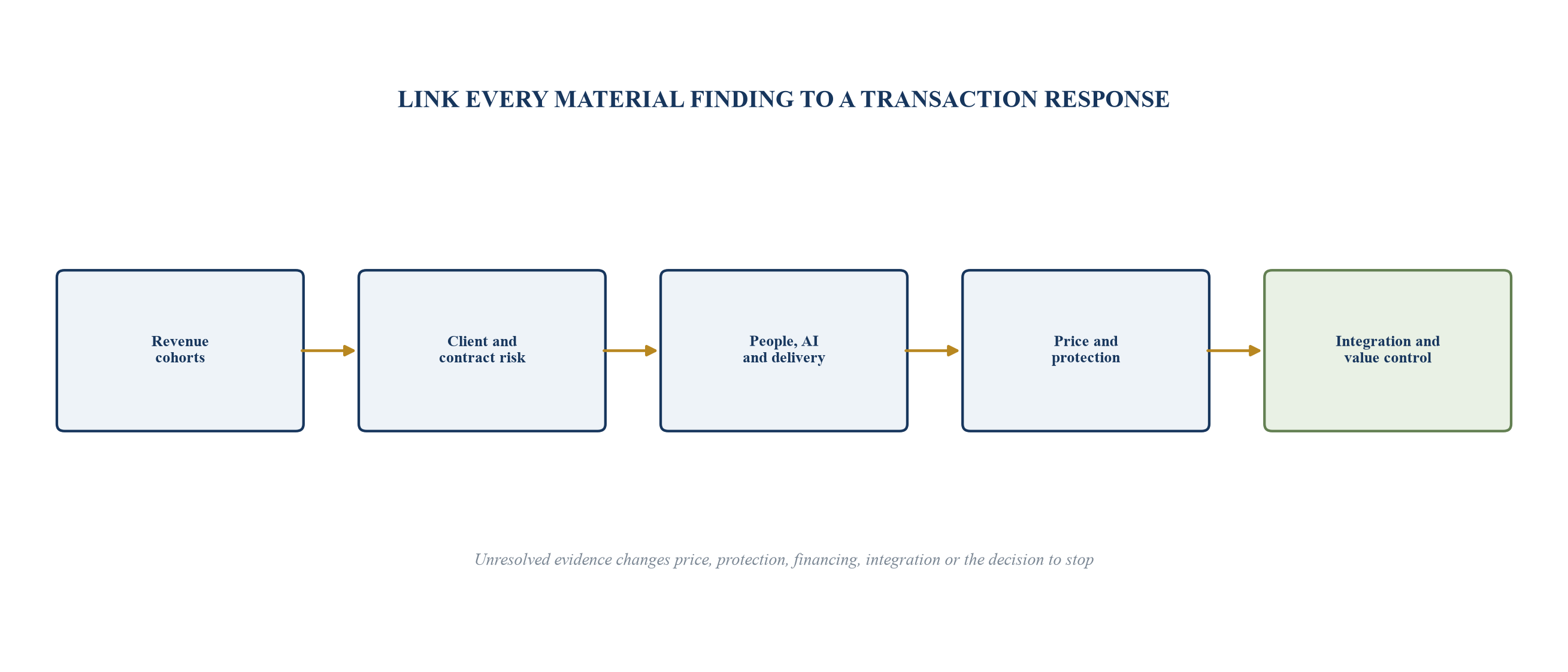
Every gate has a named owner, evidence standard and consequence.
23. Apply the framework to a worked example
Consider a hypothetical BPO target with reported revenue of 120 monetary units and EBITDA of 22. The largest five customers represent 56 per cent of revenue. Management describes 85 per cent of revenue as recurring and expects three units of annual automation benefit. The example exists solely to demonstrate the framework.
The contract cohort identifies four adjustments. Two units of revenue are pass-through, three depend on a work order that has not been awarded, and four sit within a client cluster whose procurement is coordinated. A further customer has issued a benchmarking notice that may reduce price. The evidence-supported base remains sizeable, while the downside is more concentrated than the headline measure suggests.
The wage bridge adds three units for current market rates and two for attrition, backfill and overtime. Automation validation supports three units of gross benefit, accompanied by 1.8 units of recurring technology and control cost. Six units of labour can be removed or redeployed only after client approval and transition. Until then, one unit of stranded capacity remains in the sustainable case.
The illustrative EBITDA waterfall moves from 22 to 16 after revenue quality, correlated concentration, wage, automation, cost to achieve and stranded capacity are reflected. This is not a valuation conclusion. A buyer would still need verified forecasts, contract and client evidence, accounting, tax, legal, technology, data, employment and financing advice.
The hypothetical transaction response includes a lower base EBITDA, client-specific contingent consideration, funded automation and retention plans, a data-remediation condition and monthly cohort reporting. The integration plan delays platform consolidation until service and data gates are passed. The example demonstrates how the same evidence changes price, protection, financing and execution together.
24. Establish governance for recurring portfolio use
A repeatable acquisition programme should maintain a client-contract dictionary, revenue-cohort method, adjustment taxonomy, automation-benefit ledger and integration value ledger. Definitions should remain stable across targets so the investment committee can compare contract durability, concentration, wage exposure and cash conversion without relying on presentation labels.
Model governance should record purpose, owner, data version, assumptions, validation, approved users and review date. AI used for contract extraction, entity matching, anomaly detection or narrative synthesis needs task-specific testing and human review. Accuracy should be assessed on representative contracts, languages, document quality and failure consequence.
Periodic back-testing compares diligence estimates with renewal, margin, cash, attrition, automation and integration outcomes. Variance can improve assumptions and expose recurring optimism. Results should preserve the information available at the original decision date, rather than rewriting the record with hindsight.
Third-party advisers and technology providers require confidentiality, access, security, model-change, subcontracting, audit, incident, continuity and exit controls. Transaction responsibility remains with the named decision-makers and qualified professionals. Provider assurance supports the control environment and does not transfer accountability.
25. Use a final transaction decision record
The final record should state the controlled target and contract population; evidence date; revenue-cohort reconciliation; contract durability; client and correlated concentration; wage, attrition and capacity bridge; AI and technology validation; sustainable EBITDA; cash conversion; regulatory path; financing; protection and integration plan.
Each unresolved issue should have an amount, timing, probability range or evidence consequence. The response should identify whether it changes enterprise value, working capital, net debt, contingent consideration, escrow, indemnity, covenant, condition, integration action or the decision to stop. Material issues need an accountable owner and deadline.
The investment committee should receive a base case, downside case and evidence range. The range should reflect contract elasticity, correlated client loss, wage and attrition, automation allocation, technology cost, collection and integration, rather than a generic confidence score. The report should also identify where specialist legal, tax, accounting, technology, data, employment or valuation advice remains required.
The closing approval should record changes since the evidence cut-off and the person responsible for confirming that conditions remain satisfied. Post-close reporting should preserve contract cohorts, client renewal, service levels, workforce, automation, cash and value-capture controls. This creates a defensible bridge from diligence to ownership.
Material changes after signing should trigger a documented review before closing authority is reconfirmed.
Table 5. Final BPO transaction decision record
| Decision area | Required evidence | Downside question | Decision response |
|---|---|---|---|
| revenue quality | contract, service, invoice and cash cohort | what revenue is economically committed? | forecast correction or contingent value |
| client concentration | group and correlated exposure map | what fails together? | price, reserve and renewal plan |
| sustainable EBITDA | wage, automation and capacity bridge | which cost or benefit is not repeatable? | valuation and funding adjustment |
| data and delivery | rights, controls and resilience tests | can service continue after control changes? | condition, remediation and staged integration |
| governance | named owners, approvals and monitoring | who acts when evidence deteriorates? | covenant, escalation and board control |
Every approval field should link to source evidence and an accountable reviewer.
References
- IFRS Foundation, IFRS 15 Revenue from Contracts with Customers, https://www.ifrs.org/issued-standards/list-of-standards/ifrs-15-revenue-from-contracts-with-customers/
- IFRS Foundation, IFRS 3 Business Combinations, https://www.ifrs.org/issued-standards/list-of-standards/ifrs-3-business-combinations/
- IFRS Foundation, IAS 36 Impairment of Assets, https://www.ifrs.org/issued-standards/list-of-standards/ias-36-impairment-of-assets/
- IFRS Foundation, IAS 37 Provisions, Contingent Liabilities and Contingent Assets, https://www.ifrs.org/issued-standards/list-of-standards/ias-37-provisions-contingent-liabilities-and-contingent-assets/
- Competition Commission of India, Regulation of Combinations, https://cci.gov.in/regulation-of-combination
- Competition Commission of India, Combinations Regulations 2024, https://cci.gov.in/images/legalframeworkregulation/en/gazette-notification-published-on-09-september-2024-regarding-the-competition-commission-of-india1731298584.pdf
- Competition Commission of India, General Statement on Combinations Regulations 2024, https://cci.gov.in/images/whatsnew/en/general-statement-combination-regulations1725954145.pdf
- Competition Commission of India, Frequently Asked Questions, https://www.cci.gov.in/faqs
- UK Cabinet Office, National Security and Investment Act 2021 guidance collection, https://www.gov.uk/government/collections/national-security-and-investment-act
- UK Cabinet Office, Guidance on acquisitions that could harm national security, updated 15 July 2026, https://www.gov.uk/guidance/national-security-and-investment-act-guidance-on-acquisitions
- UK Government, National Security and Investment Act alongside regulatory requirements, https://www.gov.uk/government/publications/the-national-security-and-investment-act-alongside-regulatory-requirements/the-national-security-and-investment-act-alongside-regulatory-requirements
- Competition and Markets Authority, Mergers guidance and information, https://www.gov.uk/topic/competition/mergers
- Ministry of Electronics and Information Technology, Digital Personal Data Protection Rules 2025, https://www.meity.gov.in/documents/act-and-policies/digital-personal-data-protection-rules-2025-gDOxUjMtQWa
- Ministry of Electronics and Information Technology, Explanatory note to Digital Personal Data Protection Rules 2025, https://www.meity.gov.in/writereaddata/files/Explanatory-Note-DPDP-Rules-2025.pdf
- Information Commissioner's Office, Guidance on AI and data protection, https://ico.org.uk/for-organisations/uk-gdpr-guidance-and-resources/artificial-intelligence/guidance-on-ai-and-data-protection/
- National Cyber Security Centre, Guidelines for secure AI system development, https://www.ncsc.gov.uk/collection/guidelines-secure-ai-system-development
- Department for Science, Innovation and Technology and AI Security Institute, Assessment of AI capabilities and the impact on the UK labour market, 28 January 2026, https://www.gov.uk/government/publications/assessment-of-ai-capabilities-and-the-impact-on-the-uk-labour-market
- Department for Science, Innovation and Technology, AI Labour Market Survey 2025, 28 January 2026, https://www.gov.uk/government/publications/ai-labour-market-survey-2025-report
- Department for Science, Innovation and Technology, AI Adoption Research, 2026, https://www.gov.uk/government/publications/ai-adoption-research/ai-adoption-research
- Ministry of Statistics and Programme Implementation, Periodic Labour Force Survey Annual Report 2025, https://mospi.gov.in/uploads/publications_reports/publications_reports1780040415321_0624fb13-fb47-40bc-b470-7c7e9635c3ef_PLFS_2025_F_REV_29052026.pdf
- Ministry of Statistics and Programme Implementation, Press Note on the Annual Survey of Service Sector Enterprises, 30 April 2025, https://www.mospi.gov.in/sites/default/files/press_release/Press%20Note_%20ASSSE_30.04.2025.pdf
- Genpact Limited, Annual Report on Form 10-K for the year ended 31 December 2025, https://www.sec.gov/Archives/edgar/data/1398659/000139865926000004/g-20251231.htm
- Genpact Limited, Fourth Quarter and Full Year 2025 Results, 5 February 2026, https://www.sec.gov/Archives/edgar/data/1398659/000139865926000002/genpactltdexhibit991q425.htm
- WNS Holdings Limited, Annual Report on Form 10-K for the year ended 31 March 2025, https://www.sec.gov/Archives/edgar/data/1356570/000119312525118506/d897405d10k.htm
- WNS Holdings Limited, Fiscal 2025 Results, 24 April 2025, https://www.sec.gov/Archives/edgar/data/1356570/000119312525092158/d946724dex991.htm
- Capgemini, Completion of the acquisition of WNS, 17 October 2025, https://www.capgemini.com/news/press-releases/capgemini-completes-the-acquisition-of-wns-and-creates-a-global-leader-in-agentic-ai-powered-intelligent-operations/
- National Institute of Standards and Technology, Artificial Intelligence Risk Management Framework 1.0, https://www.nist.gov/publications/artificial-intelligence-risk-management-framework-ai-rmf-10
