

1 Put the obligation inside the transaction
Environmental diligence becomes useful when it changes a decision before signing. The buyer must know which legal entity owns each site and permit, which party caused or controls an impact, what action a regulator may require, when cash could leave the business and who can fund that payment. A long technical report can identify a contaminated aquifer or an ageing offshore structure without telling the investment committee whether to reduce the bid, require a funded reserve, change the perimeter or stop the transaction. The transaction team should join the technical, legal and financial analyses while the bid can still change.
The unit of analysis is an obligation linked to an asset, period and responsible party. For each material issue, record the triggering event, legal basis, evidence, engineering scope, estimated cash profile, uncertainty, existing accounting treatment, contractual allocation and financing consequence. If an estimate is a management forecast, label it as such in the diligence record. If a regulator has not ordered work, do not describe the cost as an approved remediation budget. The board can then see the difference between a known present obligation, a contingent exposure and discretionary investment in a cleaner operating asset.
Energy portfolios make this discipline valuable because they combine long-lived physical assets with short transaction timetables. A fossil-fuel asset may carry wells, pipelines, tanks, contaminated land and eventual abandonment. A renewable asset can carry habitat, blade, battery, foundation or cable obligations. A thermal plant may require emissions-control capital and site restoration. The applicable duties depend on the jurisdiction, instrument, operating history and transaction structure. No asset type is inherently free of environmental cost.
The decision proposed here is a bid with a documented liability bridge. It starts with an independently supportable operating valuation. It subtracts environmental cash flows missing from that valuation, tests which exposures can be transferred or secured, and identifies any conditions that must be fulfilled before the buyer takes control. A seller can use the same framework to prepare evidence and resolve issues before an auction. The result is a negotiation anchored in specific work and financing terms.
2 Fix the perimeter before requesting documents
A share purchase generally leaves the target company's assets, permits, contracts and obligations in that company, subject to the local legal consequences of control. An asset purchase may transfer selected rights and obligations, yet public-law liabilities, property interests, permits and contractual commitments require separate analysis. A carve-out adds shared infrastructure, services, data and people. A joint venture can divide economic exposure while leaving the operator's public-law responsibilities intact.
Draw a perimeter map with five layers. The corporate layer shows every operating and property-holding entity. The physical layer lists facilities, wells, pipelines, substations, storage, waste areas and neighbouring land. The rights layer records leases, easements, mineral rights, consents and security. The permit layer identifies the named operator, conditions, monitoring and surrender requirements. The historical layer identifies former owners, releases, regulatory notices, claims and previous remedial work. An apparently remote parcel or dormant subsidiary can become central when it holds the site's discharge permit or an abandoned well.
The UK Environment Agency explains that an installation, waste or mining-waste permit transfer requires the incoming legal operator to meet competence requirements; separate forms and declarations apply [3]. Transferability is therefore an execution question with a named authority and process. In a UK offshore petroleum transaction, the Petroleum Act 1998 and related guidance require analysis of notices, decommissioning programmes and potential former-party exposure [4,5]. In a US land acquisition, EPA's all-appropriate-inquiries regime may be relevant to a purchaser seeking particular CERCLA liability protections; the timing and continuing obligations matter [1,2]. These examples are jurisdiction-specific. Counsel should complete a local transfer-and-liability schedule for the actual deal.
The perimeter map also fixes the valuation boundary. If a buyer acquires a wind farm but excludes an adjacent battery, the shared grid connection, fire-water system and land-restoration duties need explicit allocation. If a buyer acquires an oilfield interest but the seller retains a pipeline, the abandonment programme may still depend on that line. A high-level asset list cannot support a clean working-capital or environmental-liability adjustment until these interfaces are resolved.
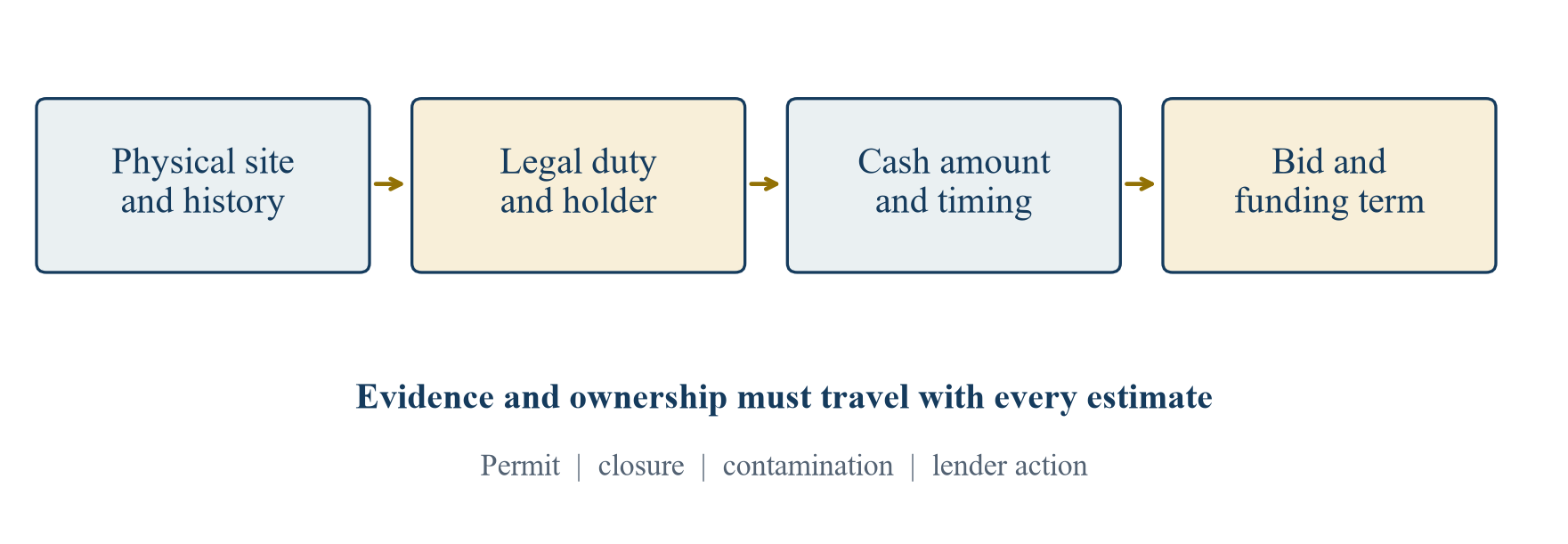
Author-developed transaction map. Jurisdiction-specific obligations require legal and technical confirmation.
3 Build a document-backed liability register
The diligence register should be a decision instrument, not a catalogue of every environmental file. Give each issue a permanent identifier, location, asset, regulator, evidence date, legal owner, technical conclusion, cost range, expected cash date, model treatment and transaction action. Attach the original permit, notice, engineering report or site assessment. A buyer's adviser should record what was not inspected and why. This allows the valuation team to distinguish an unresolved issue from a clean finding.
The first evidence stream is operating compliance: permits, inspection reports, emissions and discharge records, incident logs, enforcement correspondence, waste manifests and required monitoring. The second is physical condition: site investigations, well-integrity records, spill history, asbestos or chemical inventories, ecological surveys, asset age and design lives. The third is end-of-life scope: approved closure plans, contractor estimates, security agreements, restoration standards and any residual monitoring. The fourth is financial and contractual treatment: provisions, insurance, indemnities, guarantees, bonds, letters of credit and restrictions in financing documents.
A Phase I environmental site assessment has a defined role in US property acquisition. EPA says all appropriate inquiries evaluate property conditions and potential contamination liability, and recognises ASTM E1527-21 and E2247-23 as consistent routes to its rule [1]. A Phase I review does not quantify every remediation requirement. If it identifies a recognised condition, intrusive work or specialist analysis may be necessary for a decision. EPA also states that a bona fide prospective purchaser must satisfy both threshold and continuing obligations [2]. Transaction counsel must determine whether the protection is available to this purchaser and transaction structure.
Evidence age matters. A historical clean assessment may predate a spill, a new operator, a changed permit or a regulator's revised view. A closure estimate may use obsolete vessel rates or assume equipment can remain in place. An insurance certificate may expire before the period of greatest exposure. The register should therefore show the last verification date and the next event that could change the conclusion. A lender can use that register to monitor conditions after close.
Table 1. Diligence heatmap and the resulting transaction question
| Exposure | Minimum decision evidence | Buyer question | Potential treatment |
|---|---|---|---|
| Contaminated land or groundwater | Site history, current assessment, regulator record, investigation scope | Is action required, by whom and when? | Price, escrow, specific indemnity or hold |
| Offshore wells and structures | Well inventory, notices, programme, independent cost estimate | Who may be called upon after transfer? | Security, guarantee, price or perimeter |
| Permit or operator change | Current permit, transfer rule, compliance and competence record | Can the buyer operate at completion? | Condition precedent and interim protocol |
| Biodiversity and community impact | Baseline survey, consent conditions, stakeholder record | Can required mitigation be delivered? | Funded plan, covenant and monitoring |
| Insurance and financial assurance | Policy wording, exclusions, collateral and renewal terms | Does protection cover the relevant event and period? | Replacement cover or funded reserve |
Author-developed checklist; the applicable law, technical scope and materiality threshold are deal-specific.
4 Separate public liability from private allocation
An indemnity allocates economic loss between buyer and seller. It does not by itself bind a regulator, affected community or other claimant. The legal duty to investigate, prevent, remediate or decommission may rest on the operating entity, landholder, licence participant or a former responsible party under the relevant law. The diligence team must establish that public-law position before treating a purchase agreement as a complete solution.
The EU Environmental Liability Directive provides an example of a public-law framework. The European Commission describes a regime for prevention and remedy of specified damage to protected species and habitats, water and soil, implemented by member-state authorities [6]. Activities within its Annex III can attract strict liability under the Directive, subject to causation and national implementation. It does not replace every national contamination, planning or civil-liability rule. A buyer of assets in two member states should obtain two local analyses, not one generic EU label.
UK offshore decommissioning illustrates why a historic owner cannot assume that a sale ends every exposure. The Petroleum Act 1998 provides for decommissioning notices and programmes [4]. A 2019 UK government consultation describes circumstances in which a former section 29 notice holder may still face a call to perform [5]. Contractual release, regulator action and retained security should therefore be separately documented. The North Sea Transition Authority reported a £43.4 billion estimate for remaining UK Continental Shelf decommissioning costs in its August 2026 update [9]. That aggregate describes the basin, not the liability of a particular asset.
For a US contaminated-property acquisition, EPA's bona fide prospective purchaser information shows that knowledge of contamination does not automatically preclude a statutory protection, provided the purchaser meets specified conditions and ongoing duties [2]. The protection is neither automatic nor a valuation credit until counsel has analysed the facts. The relevant party may need reasonable steps to address ongoing releases after closing. A seller-funded clean-up can help finance those steps, but it cannot substitute for them.
The transaction register should have separate columns for legal duty, financial burden under the acquisition agreement and financial assurance. A buyer might be the operator that must perform a closure programme, while the seller promises to reimburse part of the cost and a letter of credit supports the reimbursement. These are three distinct rights and risks. The purchaser should price collectibility, timing, exclusions and expiry, as well as the underlying engineering cost.
5 Make end-of-life estimates current and executable
Decommissioning estimates need an asset list, required end state, work method, schedule, contractor capacity and contingency. A single line called abandonment reserve can conceal materially different tasks: plugging wells, removing topsides, cutting pipelines, restoring habitats, handling hazardous materials and monitoring after closure. The buyer should ask whether the estimate covers the legal standard now in force and the physical condition observed. The seller's accounting provision may be a starting point; it is not a full engineering scope.
The NSTA's 2026 update reports UKCS decommissioning expenditure of £2.6 billion in 2025 and a remaining programme estimate of £43.4 billion, with about £21 billion expected through 2032 [9]. Those figures demonstrate the scale and near-term work profile of one mature basin. They do not estimate the cost of any asset in this paper. A bidder needs the regulator's programme, well-level records and an independently priced schedule for the specific field. Specialist-vessel availability, weather windows and shared infrastructure can affect timing.
Renewables also need end-of-life analysis. The US Bureau of Ocean Energy Management says its 2024 offshore renewable-energy regulation updated financial-assurance requirements to better reflect decommissioning risk [10]. A renewable-generation acquisition should review foundations, cables, subsea equipment, batteries, hazardous components, recycling contracts, land leases and security. Onshore and offshore requirements differ, and a design assumption that material will have resale value should be separately evidenced.
IFRS guidance helps identify where a financial statement may reflect end-of-life duties. IAS 37 describes provisions for uncertain timing or amount, including clean-up and restoration obligations [7]. IFRIC 1 addresses changes in estimates of existing decommissioning, restoration and similar liabilities, including changes in expected outflow and discount rate [8]. A bid model must reconcile the accounting number with an engineering cash-flow schedule. It should not equate the carrying amount with the purchase-price deduction without checking the valuation basis and any liability already included in enterprise cash flows.
The closing model should also show required security. A letter of credit may consume bank capacity or collateral; a trust requires cash; a parent guarantee depends on the guarantor's credit. Security can be more immediate than the underlying closure outflow. The buyer needs the cash and covenant headroom to replace the seller's instrument at closing. This funding requirement can determine whether a transaction is financeable even if the long-run net present value remains attractive.
6 Treat permits as operating assets with conditions
A permit has commercial value only if it covers the intended operation and remains usable through the transaction. The buyer should catalogue each authorisation, named operator, expiry, production limit, discharge standard, monitoring duty and change-control provision. A data room containing a scanned permit without its variations and regulator correspondence is incomplete. Compliance history matters because a permit can remain legally valid while its operator faces corrective works or enhanced monitoring.
The England Environment Agency's guidance describes transfer and variation procedures for different permit types [3]. The process for an installation or waste activity differs from that for a standalone water discharge or flood-risk activity. The incoming party must be the legal operator and meet competence requirements for certain transfers. An energy acquisition spanning multiple facilities may therefore have different completion dependencies on each site. Counsel should maintain a permit schedule with responsible person, application date, expected regulator response and fallback operation plan.
An unresolved permit can affect price in several ways. If the asset must curtail output until a variation is granted, model the lost contribution margin and any extra capital. If the permit is essential for lawful operation, make transfer or replacement a condition precedent rather than assign a speculative probability to illegal operation. If compliance work can occur after closing, fund it and name the party responsible. If a regulator has discretion to impose additional conditions, present a range and a process to test it before final bid.
Permits also interact with physical climate and biodiversity exposures. A coastal power station may need new flood protection; a wind project may have seasonal habitat conditions; a battery installation may need a fire-response plan. These are examples of questions for site-specific review, not claims about a named asset. IFC Performance Standard 1 provides a framework for identifying, managing and monitoring environmental and social risks through a management system [11]. Its relevance to a financing depends on lender policy and project scope.
The buyer should ask the operator to demonstrate routine compliance, not simply provide the original consent. Compare actual operating data with permitted limits, investigate excursions and examine the budget for corrective action. Bring material covenant or consent issues into the financing term sheet early. A lender that discovers a critical permit condition after credit approval may require extra equity, a reserve or delayed drawdown.
7 Value the liability without counting it twice
Start from the valuation model as it exists, not from a list of environmental concerns. Determine whether the base enterprise value already reflects closure cash flows, environmental operating costs, remediation capex or output restrictions. Then create one row for each additional exposure with source, expected amount, date, tax treatment, discount method and existing model location. A cost in the discounted cash flow should not also be subtracted as debt-like debt in the equity bridge. The same principle applies to a seller-funded reserve: its economic benefit must be matched to the obligation it covers.
There are four common cost patterns. A known required payment can be scheduled directly. An uncertain scope can be represented by bounded cases and an investigation gate. A low-frequency event may require scenarios with explicitly author-assumed probabilities, provided the team acknowledges that the probabilities are not empirical. A possible loss with no credible numerical basis should be kept visible as a condition, indemnity or stop item rather than converted into a precise discount percentage. The purpose of valuation is to expose the decision, not to manufacture certainty.
Accounting and bid valuation answer different questions. IAS 37 defines recognition and measurement of provisions and disclosure of contingent liabilities [7]. IFRS 3 governs acquisition-date recognition and measurement in business combinations [12]. The buyer's economic ceiling additionally depends on contractual recovery, future cash flows, financing requirements and the buyer's return threshold. An unrecognised contingent liability can still matter to a bid. An accounting provision can be included in a seller's enterprise-value calculation, and a second deduction would understate value.
The diligence team should document discount rates rather than import one rate for every item. A near-certain two-year remediation payment and a remote eight-year outcome may require different treatment. The illustrative model below uses 10% for all items solely to make the arithmetic transparent. A real investment committee should select methods suited to the liability, financing and jurisdiction, with accountants reviewing accounting entries and valuation specialists reviewing the economic bridge.
Table 2. Fictional acquisition value bridge before seller protection
| Value component | Assumed gross cash | Assumed timing | Present value at 10% |
|---|---|---|---|
| Starting enterprise value | 500.00 | Today | 500.00 |
| Known remediation programme | 40.00 outflow | Year 2 | 33.06 deduction |
| Incremental closure work | 36.00 outflow | Year 8 | 16.79 deduction |
| Required compliance capital | 12.00 outflow | Year 1 | 10.91 deduction |
| One-year permit-related lost margin | 20.00 outflow equivalent | Year 1 | 18.18 deduction |
| Contingent event with assumed 20% chance | 50.00 if event occurs | Year 3 | 7.51 deduction |
| Illustrative unprotected value ceiling | 413.54 |
USD millions. Every value, probability, date and discount rate is an author assumption. Rounded outputs are educational arithmetic, not transaction evidence.
8 Read the fictional bridge correctly
The fictional case begins with a USD 500 million enterprise value that excludes all five listed cash effects. It assumes a USD 40 million known remediation payment in year two, an incremental USD 36 million closure payment in year eight, USD 12 million of compliance capital in year one, USD 20 million of lost margin from a one-year permit delay, and a USD 50 million event with an author-assumed 20% chance in year three. At 10%, their present values are about USD 33.06 million, USD 16.79 million, USD 10.91 million, USD 18.18 million and USD 7.51 million. Their unrounded sum is about USD 86.46 million, leaving an unprotected value ceiling of USD 413.54 million. Individually rounded table rows differ by USD 0.01 million.
These are invented numbers for method demonstration. The 20% event probability has no observed basis. The model omits tax, inflation, working capital, financing, replacement capital, alternative operating responses and any seller protection. It does not estimate environmental costs in a market or project. The apparent precision of the final two decimals should not be taken as confidence. A live bid would use ranges and a decision on the unresolved event.
Consider what changes if the seller agrees to fund USD 30 million of the year-two remediation through a controlled escrow. The buyer's expected economic exposure could fall by the recoverable present value of that funded amount if the wording, priority, period and release mechanics match the work. The escrow is part of transaction consideration and cash funding; it is not free value. A headline purchase price should state whether the seller funds the escrow from its proceeds and whether the buyer can draw it without a contested claim. Compare full economics, including fees and liquidity, before claiming an improvement.
Similarly, a specific indemnity against an uncapped contamination claim may look strong in a purchase agreement while providing little practical protection if the seller is a thinly capitalised special-purpose vehicle. A parental guarantee, funded escrow, surety or insurance may improve recovery, but each has exclusions and cost. A buyer should not add the face amount of an unsecured promise to its valuation. Record the recovery scenario separately and ask a credit specialist to test it.
The value bridge should be reconciled to the equity purchase price. Deduct financial debt and add cash in the usual way only after confirming the perimeter and accounting conventions. If a decommissioning provision is treated as debt-like in the sale agreement, remove the same cash flow from any valuation deduction already applied. An agreed bridge with named rows gives both sides a route to negotiate rather than a vague ESG haircut.
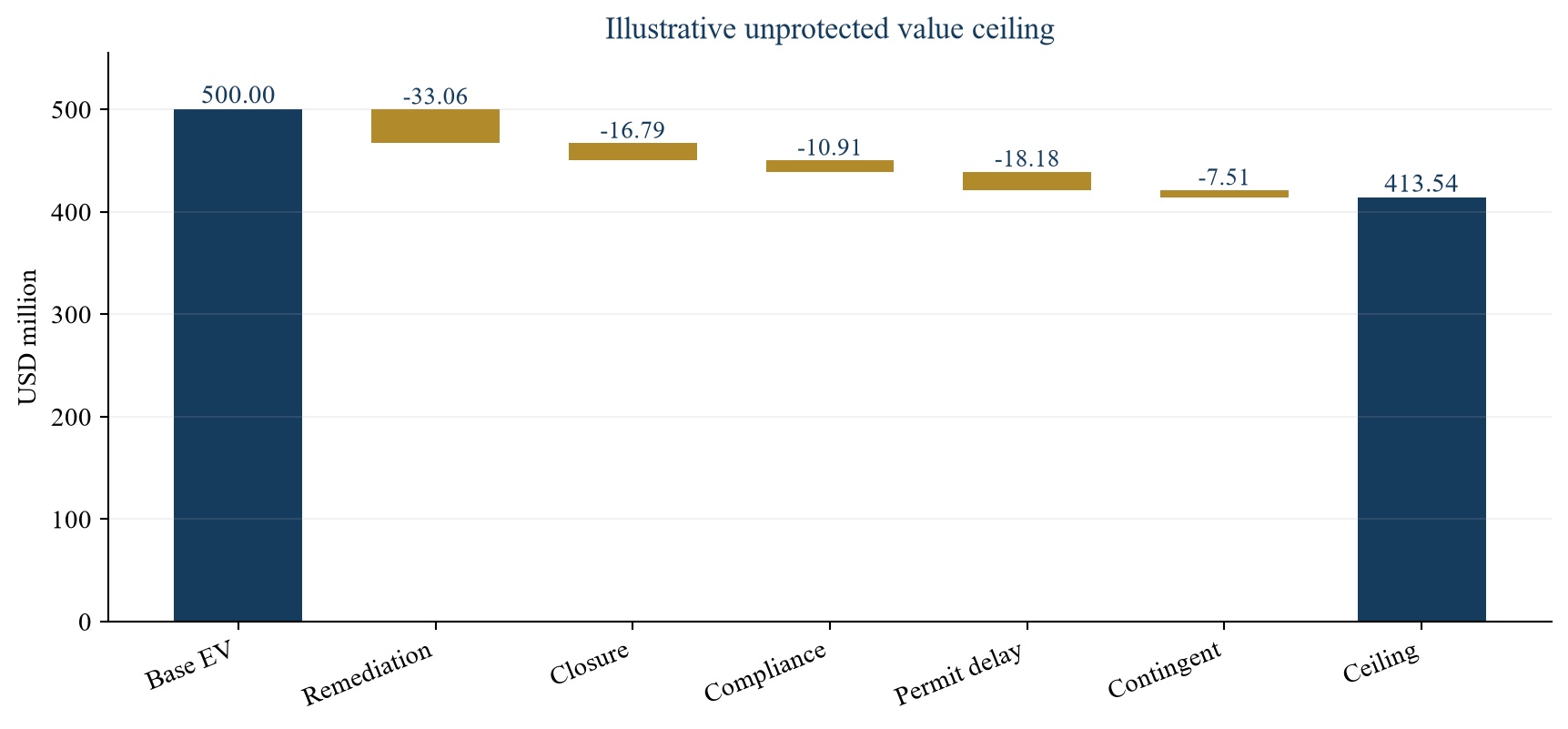
Author-assumed arithmetic; 10% discount rate and USD millions. Bars do not represent market evidence.
9 Design the sale agreement around each exposure
The purchase agreement should use a liability schedule that mirrors the diligence register. A general environmental warranty can establish a disclosure baseline, yet a known contamination plume or specific abandonment duty often needs a tailored covenant, price item or indemnity. Set the relevant site, period, loss definition, control of remediation, regulator communications, third-party claims, deductible, cap, survival period and dispute mechanism. Counsel must test enforceability under the applicable law and against existing insurance.
Allocate obligations by time and control. The seller may control a pre-close remediation programme and provide evidence of completion before closing. The buyer may control post-close operations and new incidents. A historical condition can straddle both periods. A contract that requires the seller to pay but lets it veto a regulator-required action can create operational risk. The agreement should state who directs the work, how costs are verified and when the other party must be notified.
Escrow is useful when the expected work can be scoped, priced and completed within a defined period. A reserve may be preferable when the buyer will perform the work over a longer horizon. A closing condition is appropriate when the buyer cannot lawfully operate without a transfer or material regulator consent. Insurance can address a specified fortuitous event, subject to coverage and exclusions; it may not fund known remediation. A deferred or contingent payment can keep unresolved permit or closure facts out of the upfront price. Each instrument should have one stated purpose.
The contract must also address financial assurance. If the seller's guarantee or letter of credit is cancelled at completion, the buyer may need replacement collateral before the regulator accepts the new operator. A purchase agreement can require delivery of the new instrument as a condition, with a transition service if lawful. Do not leave a gap between release of seller security and availability of buyer security. The closing funds flow must identify who posts cash and who recovers any unused balance.
For a carve-out, environmental data and operational capability can be as important as indemnity. The buyer needs historic monitoring data, site-condition reports, permit correspondence, engineering models and access to people who understand unresolved incidents. A transitional service agreement should preserve reporting and response responsibilities while systems are separated. Missing records can make an otherwise priced obligation difficult to manage or defend.
10 Put lender requirements on the critical path
An acquisition lender may assess environmental risk through its own policy, the Equator Principles where applicable, and project-specific independent advice. The Equator Principles cover certain project-related refinance and acquisition-finance transactions only when defined criteria are met; their scope should be checked rather than assumed for every corporate acquisition [13]. IFC Performance Standard 1 provides an assessment-and-management framework often relevant to project-level review [11]. These frameworks can influence conditions, reserves and monitoring even where local law permits the transaction.
The lender's core question is whether the acquired cash flows can service debt after required environmental spending and without unquantified shutdown exposure. Prepare a cash waterfall with remediation, compliance capex, closure security and debt service in the same calendar. A reserve funded from closing equity can protect cash available for operations. A mandatory draw condition can require permit transfer, completed investigation or independent sign-off before acquisition debt is released. A distribution lock can protect future closure funding.
Some liabilities affect collateral rather than annual cash. A site with restricted use, contested title or unresolved contamination may have a lower enforcement value. An insurer's exclusion can leave a lender relying on a weak sponsor. A regulator may require additional security after a change of control. The finance team should give lenders the exact scope and amount of each unresolved issue, the proposed contractual protection and the responsible party's credit. Concealing a material exception until documentation is late raises execution risk.
Social and biodiversity issues should have a documented route through lender diligence. IFC Performance Standard 6 addresses biodiversity and ecosystem services across the project life cycle [14]. Where a project affects a protected habitat or community, a lender may require an action plan, independent monitoring or engagement evidence. The transaction team should price the activities actually required, identify consent conditions and state who will carry them out. A broad statement of ESG compliance is not a substitute for a funded plan.
The financing commitment should be tested against the final bid structure. A larger seller escrow can reduce one exposure while also reducing cash available to pay the seller. A lower price can free buyer equity but leave the remediation work and security posting unfunded. A lender covenant may restrict distributions until a reserve is filled. The bidder should compare sources and uses, not just a headline leverage multiple.
11 Assign one remedy to each material finding
A transaction team can lose clarity by layering every possible remedy onto one issue. A known, priced clean-up programme may need a direct deduction or funded closing reserve. A permit without which operation is unlawful needs a condition precedent. A low-probability, high-severity historical claim may call for a specific indemnity with credible security and a carefully tested insurance option. An uncertain engineering scope may justify a bounded pre-signing investigation and a revised bid. The chosen remedy should follow the evidence and be understandable to the person who must administer it after close.
The matrix below separates protection from performance. A purchase-price reduction compensates the buyer economically but does not perform the remediation. An escrow supplies cash but needs release conditions and a work owner. An indemnity creates a reimbursement claim but has counterparty credit risk. Insurance can transfer a defined risk within policy limits but may exclude the known condition. A covenant can require action but needs milestones and enforcement. A condition precedent postpones closing until a requirement is met and needs a long-stop date and termination right. A post-close capital plan funds an issue that cannot practically be finished before transfer.
Where the asset is strategically important, the buyer may accept a bounded liability with a clear remedy and an appropriate return. Where essential permits, site access or loss magnitude cannot be established, a stop or reprice decision can be rational. The investment committee should see the difference between a risk it has priced and one it has merely named. The latter belongs on a red-flag list until evidence changes.
Table 3. Match environmental findings to transaction and finance controls
| Finding | Primary control | Additional condition | Evidence for release |
|---|---|---|---|
| Known remediation scope | Price or seller-funded reserve | Work covenant and independent verification | Agreed completion record and actual cost |
| Material permit transfer | Condition precedent | Interim operating protocol if lawful | Authority approval and competent operator |
| Uncertain legacy claim | Specific indemnity with security | Insurance review and claim procedure | Liability resolution or survival expiry |
| Closure cost and security gap | Repriced cash flow and funded assurance | Lender reserve and distribution restriction | Regulator-accepted instrument and updated scope |
| Biodiversity mitigation | Funded action plan | Lender monitoring covenant | Baseline, milestones and third-party review |
Author-developed decision matrix; all contractual and financing terms require deal-specific advice.
12 Turn diligence findings into a closing sequence
The environmental workstream should begin before the final price is fixed. At initial screening, identify sites and permits that could change the transaction perimeter or the ability to operate. Before a binding bid, obtain current assessments and an independent scope for the largest exposures. Before signing, agree the liability register, bid adjustment, warranties and specific protections. Between signing and closing, fulfil permit and assurance conditions, confirm no material new incident and refresh estimates that depend on seasonal or site data. After closing, transfer records and fund the promised action plan.
Each gate needs a responsible person and a document. The site engineer owns the physical scope, counsel owns the legal route, the accountant owns the provision reconciliation, the valuation lead owns the cash bridge, treasury owns security and insurance, and the transaction lead owns the price and agreement. A single person can coordinate the register, yet each professional judgment should retain its source and date. If a report is subject to a reliance limitation, obtain an appropriate reliance letter or commission independent work before lenders use it.
A red-flag escalation should be specific. A newly identified underground release may require a Phase II investigation or regulator dialogue. A permit that cannot transfer may require an alternative operator or a change to closing sequence. An unexpectedly high decommissioning security requirement may require more equity. A community objection can delay a consent or alter mitigation. The escalation note should state what is known, what remains unknown, the cost of finding out, the deadline and the available deal responses.
A physical site visit has a distinct function. It can compare the data room's asset list with observed tanks, waste areas, laydown yards, wells and monitoring points. It cannot alone prove a clean subsurface or that no historical release occurred. Interviews with operators and contractors can identify undocumented practices, but assertions should be checked against logs, permits and technical records. A diligence pack that combines documents, field observation and source-qualified interviews is more useful than an undifferentiated ESG score.
The closing checklist should include an environmental handover. Record regulators' contact details, reporting calendars, open notices, monitoring systems, sampling protocols, emergency response and security-renewal dates. Preserve the original data and the assumptions behind the buyer's model. A bid can be correctly priced at signing and still lose value if the buyer misses a reporting deadline or cannot access the records needed to manage the obligation.
13 Reconcile accounting, cash and contractual recovery
Financial statements may show a decommissioning or remediation provision, a contingent-liability disclosure, an impairment or no entry for an issue still under investigation. The acquisition model should not use the absence of a booked provision as evidence that no cash risk exists. IAS 37 distinguishes present provisions from contingent liabilities and specifies a present-value measurement for provisions [7]. IFRIC 1 addresses subsequent estimate changes for existing restoration obligations [8]. IFRS 3 provides the acquisition-accounting framework for identifiable acquired assets and assumed liabilities [12]. The precise entries belong to the accountants.
Build a three-column reconciliation. The first column is the seller's reported carrying amount and disclosure. The second is the buyer's engineering or legal cash schedule. The third is the purchase agreement's economic allocation, including price, escrow and indemnity. A reconciliation item may be an assumption difference, timing difference, discount-rate difference, tax effect, perimeter difference or an unrecognised exposure. Require a narrative and evidence reference for every material gap. This lets the buyer explain why a USD 20 million provision may correspond to a larger undiscounted future spend without treating the difference as fraud or as an automatic purchase-price reduction.
Independent review is especially important when closure dates move. A longer operating life delays cash outflow but may add maintenance and monitoring. A higher discount rate can lower a reported present-value liability without reducing the future physical work. A new regulatory standard can change the work scope. IFRIC 1 explicitly addresses changes in timing, amount and discount rate for existing decommissioning liabilities [8]. The bid committee should compare physical obligations and cash need, not merely two accounting snapshots.
Contractual recovery belongs in a separate schedule. An indemnity should have a counterparty, security, notification process, claim definition and expected cash timing. The team should distinguish gross liability, expected claim, collectible amount and net buyer cost. The model should deduct only the net economic amount once, with the gross liquidity requirement still visible. A buyer can face an urgent regulatory payment even when a solvent seller ultimately reimburses it.
The post-close finance team needs the same reconciliation. It should know which reserve funds which obligation, whether a lender controls withdrawals, when a guarantee expires and what event calls for an updated cost estimate. Environmental liabilities are long-duration items; purchase accounting closes earlier than some claims. A controlled register survives the transaction team and reduces the chance that a known issue becomes an unbudgeted operational emergency.
14 Preserve biodiversity and social obligations in the financial model
An energy asset's environmental and social commitments can generate cash flows that are missing from a narrow engineering estimate. A consent may require habitat restoration, seasonal construction limits, monitoring or community benefits. A lender may require a management system or action plan under its standards. IFC Performance Standard 1 calls for assessment and management of environmental and social impacts across the project life cycle [11]. Performance Standard 6 addresses biodiversity and ecosystem services [14]. Applicability depends on project and finance structure; the transaction should identify the actual commitments in force.
Build a commitments register from permits, environmental assessments, project agreements and lender documents. Show the specific action, location, performance measure, responsible party, date and annual or one-time cost. If a mitigation cost is included in the operating budget, record its model cell so it is not subtracted again. If an unfulfilled commitment is a condition of continued operation, assess schedule and interruption risk. If the seller has funded a trust or bond, verify that it transfers or can be replaced.
Community issues should be represented through observed process and obligations. Review consultation records, complaints, land access, employment commitments and unresolved disputes. A statement that an asset has a social licence is too broad for a transaction committee. A better record states which parties were consulted, what agreement was made, which conditions remain and what the operator must do. Where a complaint may become litigation, counsel should distinguish legal exposure from relationship-management spending.
Biodiversity risk can vary within one portfolio. A wind project may face habitat-related operating restrictions, while a thermal plant's most material issue may be emissions or land remediation. A pipeline can cross multiple sensitive areas. Avoid applying the same ESG discount to every megawatt. Price the identified mitigation, assess permit conditions and disclose unresolved survey periods. A seasonally constrained survey may be impossible to complete within a short auction; in that case the buyer needs a condition, reserve or conservative scenario.
For a lender, a funded action plan can be more useful than a generic sustainability statement. It names the action, cost, deadline and independent verification. The acquisition model can include the expenditure and any revenue effect. The loan agreement can define reporting and cure periods. This connection between a specific commitment and the finance terms is the practical route from ESG diligence to execution.
15 Test physical and transition risks without invented forecasts
Climate-related physical and transition risks can influence an energy asset's cash flows, access to finance and cost of capital. IFRS S2 describes disclosure of material climate-related risks and opportunities, including physical and transition risks, and the entity's governance, strategy, processes and performance [15]. It is a disclosure standard whose adoption depends on jurisdiction. It does not prescribe a single purchase-price discount or determine a site's engineering resilience.
A buyer should identify a decision pathway. For flood or heat, obtain site elevation, design standard, historic incidents, insurer terms and a qualified engineering assessment. For a carbon-intensive plant, identify actual permits, fuel and emissions contracts, applicable policy instruments and announced capital plans. For renewable assets, examine grid curtailment, component supply and end-of-life obligations. Each identified risk should move into cash flow, capex, insurance, covenant or a sensitivity. Do not infer a regulatory cost from a policy headline without a binding instrument and applicable date.
Scenario analysis can be useful when long-lived assets face uncertain rules or hazards. State the scenario source, assumptions and interval; do not describe a model output as a forecast. A base case should follow the most supportable evidence, while downside cases show the effect of a defined event. If a stranded-asset claim is material, identify whether the risk arises from demand, regulation, technology, contract expiry or physical limitation. The response might be a lower terminal value, repowering plan, shorter debt tenor or staged consideration.
An environmental liability can interact with transition value. A depleted field may have potential reuse for storage, but reuse requires separate rights, technical suitability, permits and capital. The buyer should not net an unproved reuse upside against a current decommissioning obligation. It can value the reuse option separately at its evidence stage. A renewable project may claim recyclable equipment proceeds at closure; those proceeds require a market, ownership and collection route. Keep speculative credits outside the firm liability funding plan.
The board should receive a clear distinction among current compliance duties, contractual commitments and strategic adaptation choices. This makes the environmental cost model auditable. It also prevents the word ESG from hiding whether the issue is a legal liability, a commercial scenario or a proposed investment.
16 Use data and AI to improve traceability
Energy diligence generates documents with different units, dates and legal meanings. A controlled data process can extract permit limits, map facility identifiers to subsidiaries, match decommissioning estimates to equipment registers and flag missing monitoring periods. Machine learning may help search and classify a large data room. Its output should link back to the original document, page, issuer, date and reviewer. A model-generated summary is a triage aid; the engineer or lawyer responsible for the decision must confirm the source and meaning.
The first useful data product is a geospatial asset register. It can connect wells, tanks, cables, discharge points, protected habitats, land parcels and permits. The second is a cost schedule that ties each physical component to a closure task, unit quantity, rate, contractor quote and cash date. The third is a transaction register linking the issue to a valuation model cell and contract clause. Together these records let a diligence team find a missing asset or a duplicate deduction. Their value comes from provenance and review, not from an opaque risk score.
Automation can test consistency. A script can compare the well inventory with a regulator's notice list, compare permitted discharge volumes with operational reporting, and identify when an insurance policy expires before the expected closure date. It can recalculate the valuation bridge after a changed cost estimate. Such tests should produce exceptions for human review. A false match between two similarly named sites could misallocate a liability, so the workflow needs unique identifiers and a documented resolution log.
AI can also help prepare a red-flag summary for an investment committee, provided every material statement points to the relevant primary record and uncertainty is retained. Confidential data, third-party rights and legal privilege require access controls and review. A seller's data room terms may restrict model training or external processing. The transaction team should check those terms before uploading documents to any service. The paper does not claim that a particular AI tool improves due diligence outcomes.
After closing, the register should move to the operator's controls. Permit obligations, security renewals, remediation milestones and lender reports are recurring tasks. A dated source trail allows a new management team to distinguish the seller's assertion from an authority's condition and a contractor's estimate. That is a practical use of data in M&A: fewer unsupported assumptions can enter the price, and obligations remain visible after the advisers leave.
17 Compare asset archetypes without importing the wrong rule
The same transaction method can be used across energy, but the questions change with the asset. An offshore hydrocarbon field requires well and installation inventories, decommissioning notices, shared infrastructure, tax and security analysis. A thermal power station requires air and water permits, fuel and waste handling, emissions-control assets and land condition. A wind portfolio requires lease and consent obligations, habitat monitoring, component and foundation removal, and grid interfaces. A battery or hydrogen project may have specialist safety, chemistry and permit issues. The relevant authority and law must be confirmed for each location.
Cross-border groups require an entity-by-entity schedule. A US federal property-law protection does not apply automatically to a UK offshore field. An EU directive requires national implementation and may coexist with national regimes [6]. An IFC standard may be a financing requirement even when it is not local law [11,14]. A consolidated provision can aggregate obligations while masking which subsidiary and creditor has a claim. The buyer should locate each duty and each source of funds.
Transaction type changes the remedy. In a corporate acquisition, the buyer controls the target's balance sheet and may face historical obligations inside it. In a selected asset purchase, the buyer may seek to exclude liabilities, subject to statutory rules and regulator approval. In a minority investment, the investor may have limited operational control yet still need information rights and protective covenants. In a project refinancing, no sale occurs but lenders may require a refreshed environmental assessment and security. Treat these as different deal structures, not variations of one checklist.
The output is a comparable obligation ledger, not a claim that every energy deal has the same risk profile. The buyer can then allocate capital where the evidence supports operating value, reserve cash where obligations are real and pause where rights or cost cannot be established within the transaction timetable.
18 Set decision rights for the first year after close
The acquisition agreement can assign historical cost, but the buyer's operator must manage the site from day one. Name a post-close accountable executive for permits, monitoring, incidents, remediation and closure security. The legal team should deliver a schedule of reporting and notices. Treasury should record every bond, trust, insurance renewal and guarantee expiry. The engineering team should inherit models and raw data, not just a slide deck. These controls protect the assumptions that supported the bid.
An integration plan should identify the first ninety days of environmental work. Confirm contact with regulators, receive all open case files, validate monitoring equipment, review the emergency response plan and reconcile the asset register. Where the seller retains work responsibility, agree access and site-safety protocols. A seller cannot remediate without access, and an incoming operator cannot meet its permit obligations without knowing what the seller is doing on site. The agreement needs a clear interface.
Changes in scope require governance. If a new contaminant, unregistered well or damaged cable is discovered, the operator should secure the site, comply with applicable reporting duties, obtain qualified advice and update the cost schedule. The transaction lead should determine whether the finding falls within an indemnity or escrow. The finance lead should assess reserve and covenant effects. The board should see the cash and timetable change rather than a generic red risk rating.
Review the environmental bridge at least when major new evidence arrives. The original bid estimate is a baseline, not a permanent truth. IFRIC 1 recognises that restoration estimates can change with timing, amount and discount-rate assumptions [8]. A purchase agreement may allow a post-close claim or true-up; its deadlines can be shorter than the engineering work. Keep both calendars visible. Delayed quantification can cause a valid claim to expire.
The first year should end with an obligation reconciliation: what was paid, what work was completed, what remains, which security is still in place and how forecasts have changed. This is a performance measure for the acquisition thesis and a usable starting point for the next transaction. It also gives the lender an auditable record of compliance and funded future work.
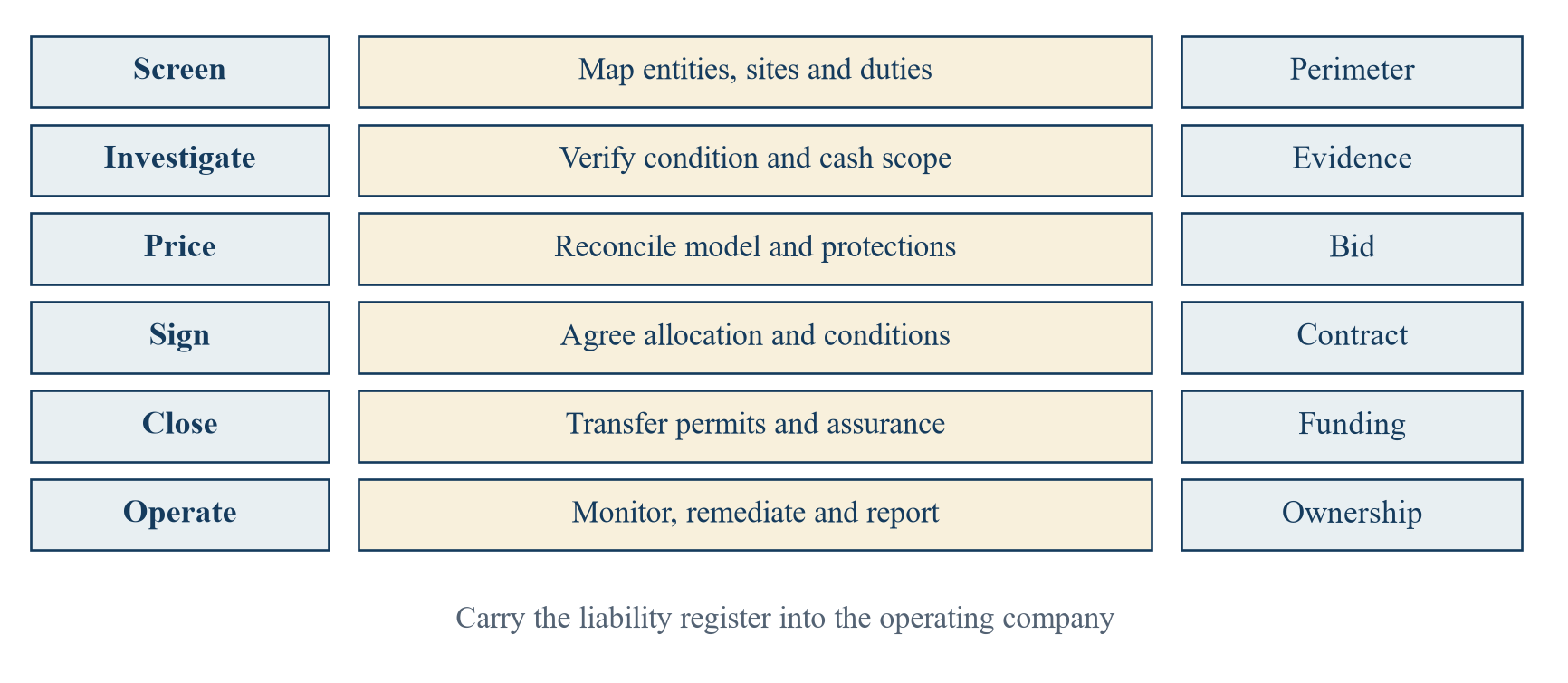
Author-developed stage-gate roadmap. Actual transaction sequencing and consent requirements vary.
19 Limitations and further research
This paper supplies a decision method, not a site assessment, legal opinion, purchase-price recommendation or accounting conclusion for any named deal. The cited rules have different scope and can be amended. The UK, US and EU examples cannot be copied into another jurisdiction without local review. IFC and Equator Principles material has contractual or institutional applicability that must be checked transaction by transaction. Public aggregate decommissioning data cannot be applied to an individual facility without its asset condition and programme.
The fictional value bridge is intentionally narrow. It assumes fixed cash dates, one 10% discount rate, no tax or inflation and no interaction among risks. The event probability is invented. The displayed two-decimal value is arithmetic and does not convey forecast precision. A live valuation requires site-specific engineering, current contractor prices, legal obligations, cash-flow integration, financing terms and supportable uncertainty analysis. The buyer should retain a range when evidence does not justify a point estimate.
Empirical research could improve environmental risk pricing if confidential transaction data were made available under appropriate safeguards. A useful dataset would connect site type, location, age, permit conditions, actual remediation and decommissioning spend, time to regulatory closure, insurance recoveries and consideration terms. It should include failed and delayed transactions, as well as completed deals, to avoid selection bias. Public announcements rarely disclose enough to estimate an environmental-liability premium on their own.
Further research could also test whether earlier independent engineering reduces bid dispersion or improves closing certainty. That would require comparable transaction samples and a way to separate diligence quality from asset quality and market conditions. The paper makes no such empirical claim. Its contribution is an auditable bridge that a transaction team can apply now: every material exposure has a physical source, legal owner, cash consequence and explicit treatment.
20 Conclusion
An energy acquisition price is credible when the buyer can explain the obligations it inherits, the work those obligations require, the cash date and the funding source. Environmental diligence should produce that explanation before the bid is final. The analysis begins with the legal and physical perimeter, moves through independent condition and closure evidence, and ends with one reconciled liability register that informs valuation, contract terms and debt conditions.
The fictional bridge shows the cost of leaving known items outside a model. Its USD 413.54 million unprotected ceiling follows author-assumed inputs and simplified arithmetic, not market evidence. A negotiated price can differ when the seller performs work, funds an escrow or provides enforceable security. The buyer still needs the liquidity and operational capability to discharge duties that public authorities or lenders may impose.
The execution rule is simple: bring each material liability into the bid as a specific amount or unresolved decision. Price what is supportable; investigate what can be resolved; secure what is transferred; make essential permits and funding conditions explicit. Carry the same register into the operating company after close. This gives the board, seller, regulator and lender a common account of what the transaction includes and who will deliver the work.
References
- US Environmental Protection Agency. Brownfields All Appropriate Inquiries. Accessed 6 October 2026. https://www.epa.gov/brownfields/brownfields-all-appropriate-inquiries
- US Environmental Protection Agency. Bona Fide Prospective Purchasers. Accessed 6 October 2026. https://www.epa.gov/enforcement/bona-fide-prospective-purchasers
- UK Environment Agency. Change, Transfer or Cancel Your Environmental Permit. Accessed 6 October 2026. https://www.gov.uk/guidance/change-transfer-or-cancel-your-environmental-permit
- United Kingdom. Petroleum Act 1998, Part IV, including sections 29 and 34. Accessed 6 October 2026. https://www.legislation.gov.uk/ukpga/1998/17/part/IV
- UK Department for Business, Energy and Industrial Strategy. Re-use of Oil and Gas Assets for Carbon Capture, Usage and Storage Projects: Consultation, 2019, paragraphs 27-30 describing the then-current section 29 and section 34 framework. Accessed 6 October 2026. https://assets.publishing.service.gov.uk/government/uploads/system/uploads/attachment_data/file/819901/reuse-oil-gas-assets-ccus-projects.pdf
- European Commission. Environmental Liability. Accessed 6 October 2026. https://environment.ec.europa.eu/law-and-governance/environmental-compliance-assurance/environmental-liability_en
- IFRS Foundation. IAS 37 Provisions, Contingent Liabilities and Contingent Assets. Accessed 6 October 2026. https://www.ifrs.org/issued-standards/list-of-standards/ias-37-provisions-contingent-liabilities-and-contingent-assets/
- IFRS Foundation. IFRIC 1 Changes in Existing Decommissioning, Restoration and Similar Liabilities. Accessed 6 October 2026. https://www.ifrs.org/issued-standards/list-of-standards/ifric-1-changes-in-existing-decommissioning-restoration-and-similar-liabilities/
- North Sea Transition Authority. UKCS Decommissioning Cost and Performance Update, published 13 August 2026. Accessed 6 October 2026. https://www.nstauthority.co.uk/regulatory-information/decommissioning/cost-estimate/
- US Bureau of Ocean Energy Management. Renewable Energy Guidance and 2024 Modernization Rule. Accessed 6 October 2026. https://www.boem.gov/oil-gas-energy/risk-management/renewable-energy-guidance
- International Finance Corporation. Performance Standard 1: Assessment and Management of Environmental and Social Risks and Impacts. Accessed 6 October 2026. https://www.ifc.org/en/insights-reports/2012/ifc-performance-standard-1
- IFRS Foundation. IFRS 3 Business Combinations. Accessed 6 October 2026. https://www.ifrs.org/issued-standards/list-of-standards/ifrs-3-business-combinations/
- Equator Principles. About the Equator Principles and scope of project-related acquisition finance. Accessed 6 October 2026. https://equator-principles.com/about-the-equator-principles/
- International Finance Corporation. Performance Standard 6: Biodiversity Conservation and Sustainable Management of Living Natural Resources. Accessed 6 October 2026. https://www.ifc.org/content/dam/ifc/doc/2010/2012-ifc-performance-standard-6-en.pdf
- IFRS Foundation. IFRS S2 Climate-related Disclosures. Accessed 6 October 2026. https://www.ifrs.org/issued-standards/ifrs-sustainability-standards-navigator/ifrs-s2-climate-related-disclosures/
About the Author
Chennakeshav (CK) is a corporate finance and investment banking executive with 25+ years of global experience in deal origination, structuring and execution across M&A, growth capital and corporate strategy. He has led value-creation mandates for founders, corporates and funds — bridging the boardroom view to hands-on execution and close.
His career spans Morgan Stanley, HSBC, Lloyds Banking Group, EWEC, ADQ portfolio companies and Emirates Growth Fund, across TMT, real estate, fintech, deeptech, cleantech, infrastructure and energy. He has partnered with C-suite leaders, private equity and venture funds, sovereign wealth funds and family offices to finance complex fund raises and scale-up ventures, and has led M&A due diligence, post-merger integration and business-transformation initiatives to create value.
At Matchpoint Partners he is Managing Partner, leading the firm's corporate finance, M&A and capital-raising practice. He holds an MBA from London Business School, an engineering degree from VTU and a Master of Laws (LLM, in progress) from UCL London.
An active start-up mentor, CK mentors at Techstars, DIFC FinTech Hive, Startup Grind, Founder Institute and IN5, serves as Entrepreneur Mentor in Residence (EMiR) at London Business School, and judges the Entrepreneurship World Cup.
