

Introduction
Investment in the energy transition now operates at industrial scale. The International Energy Agency estimated global energy investment of USD 3.3 trillion in 2025, including about USD 2.2 trillion for renewables, nuclear, grids, storage, low-emissions fuels, efficiency and electrification. That capital includes new clean assets and the conversion of existing businesses whose current emissions, equipment or products do not meet a lower-carbon operating model.
The second category presents a difficult investment question. An emissions-intensive asset may own scarce permits, land, grid access, customer relationships, logistics, engineering knowledge and replacement-cost advantages. It may also carry ageing equipment, uncertain transition capital, carbon-price exposure, environmental liabilities and products that face declining demand. A fund can create value by changing the asset. It can also misclassify market movement, leverage or a disposal as transition value.
Fund-level reporting usually begins with internal rate of return, multiples and net asset value. Climate reporting begins with absolute emissions, intensity, financed emissions, targets and alignment. These systems answer different questions. A conversion strategy needs a common evidence trail that connects the physical intervention to operating cash flow, financing, residual risk, valuation and distributions.
This paper sets out that evidence trail. It is designed for investment committees, portfolio teams, limited partners, lenders, valuers and boards reviewing a portfolio of transition assets. The framework supports decisions at acquisition, during ownership and at exit. It does not create an accounting standard or a climate claim. Each fund should apply the law, accounting rules, valuation standards, fund documents and sector methods that govern its assets.
1. Define the conversion mandate
A fund should state which changes qualify as conversion before it acquires an asset. The mandate can cover industrial efficiency, fuel switching, electrification, methane control, waste-heat recovery, renewable supply, storage, low-carbon products, water reuse, circular inputs, managed phaseout or replacement of high-emitting capacity. Each route has a different capital profile and evidence requirement.
The mandate should also define exclusions. A marginal efficiency project can extend the life of an asset whose long-term economics remain incompatible with the fund's stated pathway. A change in ownership can reduce reported portfolio emissions while the asset continues operating unchanged. A production decline can lower absolute emissions while weakening the business. A fund needs rules for these cases before performance creates incentives to reclassify them.
The OECD describes transition finance as financing a dynamic process of becoming sustainable and grounds credibility in a time-bound corporate transition plan. Its guidance emphasises targets, metrics, business-plan alignment, governance, transparency, verification, safeguards and measures to prevent carbon lock-in. GFANZ materials distinguish finance for climate solutions, aligned companies, real-economy transition and managed phaseout. These categories help a fund define the economic role of each asset.
The investment committee should approve a conversion charter. It should specify eligible sectors and interventions, the applicable pathway, minimum evidence, prohibited activities, carbon-credit treatment, social safeguards, milestone governance and exit conditions. The charter should name the financial and physical measures that will be reported to investors.
2. Establish the acquisition baseline
Conversion performance requires a dated baseline. The baseline should describe the asset as acquired, using the ownership, operating boundary, production volume, emissions, energy use, water, waste, revenue, cost, maintenance, capital needs, contracts and liabilities known at closing.
The financial baseline should reconcile to the acquisition model and opening balance sheet. It should include purchase price, transaction costs, debt, working capital, deferred consideration, committed transition capital and any liabilities retained by the seller. The operating baseline should use normalised production and cost data with stated adjustments. A recent disruption, maintenance outage or commodity spike should remain visible rather than disappear into a single adjusted earnings figure.
The emissions baseline should identify scopes, gases, organisational boundary, operational control, consolidation method, emission factors, estimates and data quality. PCAF provides methods for attributing financed emissions to loans and investments. The GHG Protocol provides the corporate inventory framework. A fund should preserve the distinction between the company's inventory and the fund's attributed share.
The baseline also needs a counterfactual for decision analysis. The counterfactual describes the expected financial and operating path without the proposed conversion. It may include maintenance capital, carbon cost, lost customers, declining utilisation, compliance spending or closure. Counterfactuals contain uncertainty and should be approved as scenarios. They should never overwrite the observed acquisition baseline.
3. Separate inventory change from avoided emissions
Inventory emissions report the emissions allocated to an entity within a defined reporting boundary. Avoided emissions estimate the difference between an intervention and a counterfactual system. The GHG Protocol requires these concepts to be reported separately. PCAF likewise treats avoided emissions separately from the core financed-emissions inventory.
This separation matters at asset and fund level. A plant can reduce its inventory emissions by replacing fossil heat with electric equipment. The system effect depends on electricity supply, timing and the counterfactual. A fund can finance a low-carbon product that displaces a higher-emitting alternative. The product's avoided emissions do not reduce the fund's financed-emissions inventory.
The conversion dashboard should therefore maintain at least three measures. The first is observed absolute inventory emissions. The second is an intensity measure linked to physical output, revenue or another sector denominator. The third is a separately reported project or product impact against an approved counterfactual. Each measure should show boundary, methodology, data quality and assurance status.
Asset sales require a fourth reconciliation. The fund should show emissions removed through disposal separately from emissions reduced within continuing assets. Acquisitions should enter the same bridge. A portfolio can then explain opening emissions, acquisitions, disposals, operating volume, methodology changes and verified asset reductions.
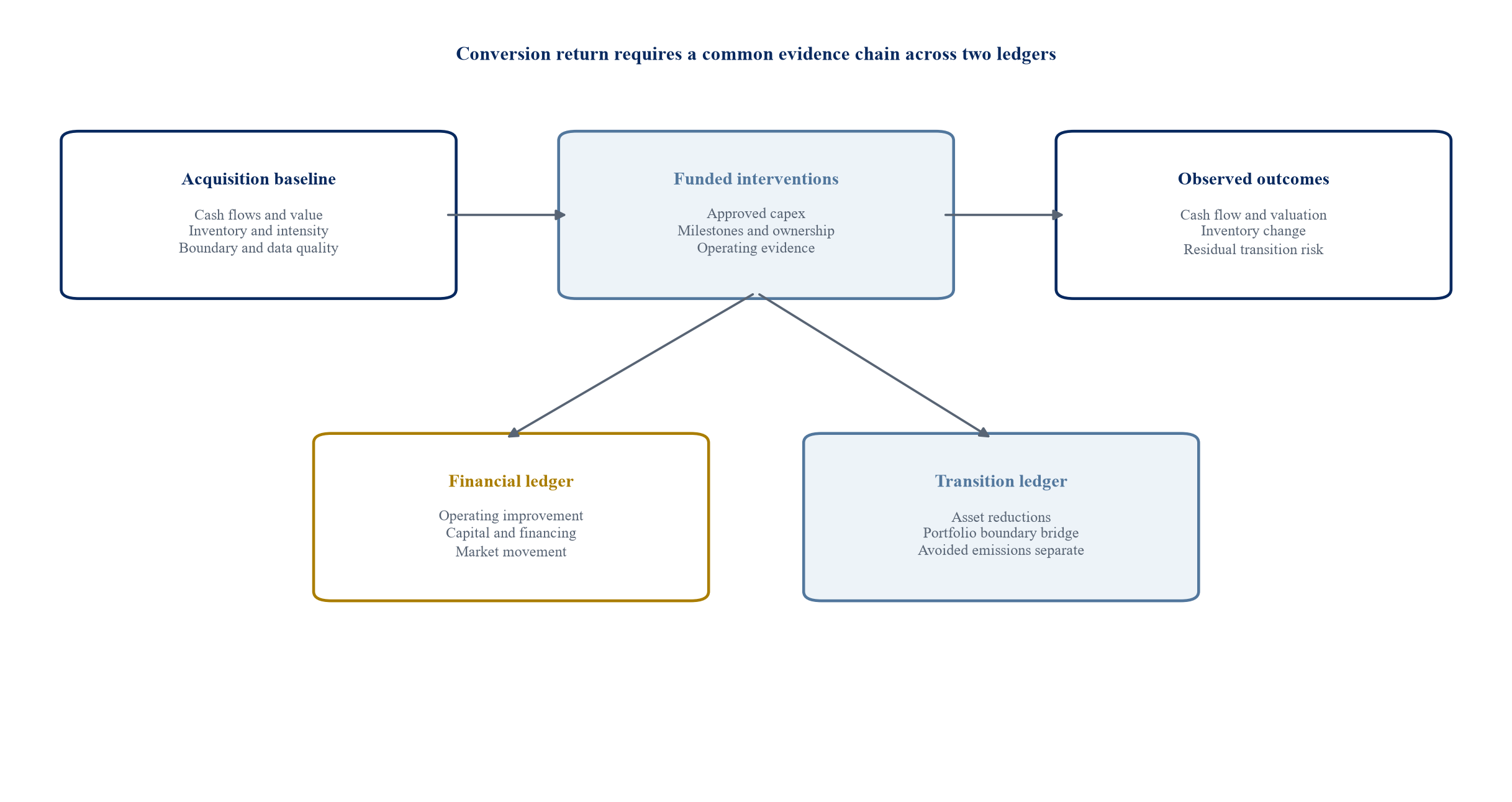
Each transition claim should reconcile to observed asset data and a separately governed financial value bridge.
4. Translate the plan into funded interventions
A transition plan becomes investable when actions, cash, timing and accountability are explicit. IFRS S2 guidance asks an entity with a transition strategy to disclose material information about climate-related risks, opportunities, current financial effects and anticipated effects on financial performance and cash flows. The same discipline improves acquisition underwriting.
Each intervention should have a technical scope, baseline, expected operating effect, capital budget, schedule, dependency, evidence source and accountable owner. Dependencies can include grid capacity, permits, feedstock, customer qualification, equipment guarantees, engineering integration, workforce capability and financing. The plan should distinguish committed contracts from management estimates.
The budget should include direct equipment, installation, owner costs, downtime, working capital, financing carry, contingency, verification and decommissioning. It should also identify ordinary maintenance that would occur without the transition. Combining maintenance and conversion spending can overstate the capital attributed to the strategy or hide expenditure required to preserve the asset.
Funding should match the risk. Early engineering and permitting may use equity. Proven equipment under a fixed-price contract may support debt or asset finance. Grants, tax credits, guarantees, contracts for difference and carbon revenues can improve economics when eligibility and timing are evidenced. The base case should avoid treating uncommitted support as cash.
5. Build the conversion milestone account
The fund should create a milestone account for every asset. Milestones should represent evidence that changes investment risk. Examples include final engineering, permit approval, binding supply contract, grid agreement, financed notice to proceed, commissioning, verified output, customer qualification and sustained emissions performance.
Each milestone should have an objective definition, evidence owner, target date, capital release, decision consequence and independent-review requirement. Milestones based solely on management certification can weaken control. Milestones tied to operating evidence support both financing and performance attribution.
The account should also record failed and deferred milestones. A transition plan can change as technology, policy and markets evolve. The board should approve changes with a revised economic case. Quietly replacing milestones after underperformance damages comparability and can convert an investment thesis into a moving target.
Stage gates protect capital. The fund can release engineering capital before full construction capital, or acquire an option before acquiring the entire asset. A stop decision can preserve value when the project cannot secure essential inputs, permits, customer demand or financing.
6. Measure operating value creation
Operating improvement can create value through volume, price, energy use, yield, reliability, maintenance, labour, waste, water, product mix and customer retention. A conversion programme should identify which drivers the intervention can influence and which drivers remain external.
The fund should build a driver-based bridge from the acquisition baseline to current earnings and cash flow. Energy savings should equal verified consumption change multiplied by the relevant price, adjusted for production and weather where material. Product premium should reflect realised sales and customer contracts. Reliability value should reconcile to avoided downtime or additional output. Carbon-cost savings should use applicable policy and verified emissions.
Attribution requires a counterfactual or control. A site-level engineering baseline may work for equipment efficiency. Comparable lines, facilities or periods may help where production conditions differ. A causal claim deserves more scrutiny when several initiatives occur together. The fund can report a residual category where the evidence cannot allocate the result reliably.
Operating value should enter the financial model through cash flow. A reported emissions reduction has no automatic monetary value. It can affect cost, revenue, asset life, financing, risk or terminal value. The model should state the mechanism and avoid assigning the same benefit to more than one line.
7. Measure avoided downside separately
Some conversion capital preserves value rather than increasing current earnings. It can avoid a compliance shutdown, loss of licence, customer exit, carbon cost, stranded equipment or an unfunded decommissioning liability. Avoided downside is decision-relevant and counterfactual.
The fund should define the adverse event, probability, timing, exposure and mitigation. It should compare the approved pre-intervention risk case with current evidence. A lower risk estimate should have a documented cause, such as a permit, customer contract, technical completion or policy compliance.
Avoided downside should not enter realised return as though a loss occurred and was recovered. It can support valuation when market participants would price the risk and mitigation. IFRS 13 requires fair value to reflect assumptions market participants would use under current market conditions. IVS 2025 requires relevant ESG factors and regulatory costs to be considered when measurable and reasonable.
The investment committee should see avoided downside as a separate bridge. This prevents a fund from combining realised cash benefits with probability-weighted preservation and reporting the total as earned transition profit.
8. Control carbon-price and policy exposure
Carbon prices, product standards, border measures, subsidies, permits and market rules can change asset cash flows. The World Bank reported that direct carbon pricing covered around 28 percent of global greenhouse gas emissions in 2025 and raised more than USD 100 billion for public budgets in 2024. Coverage and prices vary substantially across jurisdictions and sectors.
The model should use the asset's applicable policies rather than a universal carbon price. It should identify taxable or allowance-covered emissions, free allocation, pass-through, hedging, customer response and implementation dates. A shadow price can test exposure outside a current scheme. It should remain a scenario assumption.
Support mechanisms require the same discipline. Grants, production credits, accelerated depreciation, guarantees and regulated tariffs can improve returns. Eligibility, appropriation, application, performance conditions and clawback should be documented. Political or administrative uncertainty belongs in the downside case.
NGFS scenarios can support consistent macroeconomic, energy and climate variables. They do not replace asset-specific forecasts. A fund should use several scenarios to understand sensitivity to policy timing, demand, fuel price, technology cost, interest rate and physical risk.
9. Prevent carbon lock-in
Conversion finance can extend an asset's life. That outcome may support a credible pathway or preserve an incompatible operating model. The OECD identifies carbon lock-in as a central risk in transition finance and recommends credible plans, sector pathways, capital alignment and safeguards.
The fund should test the intervention against asset life, sector pathway, residual emissions and available alternatives. A project that reduces intensity while expanding total emissions may still increase transition exposure. A gas conversion can lower near-term emissions relative to coal while creating long-lived fuel and infrastructure dependence. The investment decision should state the pathway and retirement or further-conversion plan.
The capital model should include future stages needed to reach the stated end state. Funding only the first stage can create an incomplete asset whose later economics depend on uncommitted technology or policy. The fund should show the remaining capital, technical readiness and decision dates.
A lock-in test can include five questions: whether the asset remains within a credible sector pathway, whether a feasible lower-emission alternative exists, whether the intervention delays that alternative, whether residual emissions are funded and governed, and whether closure liabilities are covered.
10. Integrate environmental and social safeguards
Transition value can be destroyed by environmental damage, community conflict, unsafe work, land disputes or an unmanaged workforce transition. The IFC Performance Standards and Equator Principles provide widely used frameworks for environmental and social assessment, labour, community health, land, biodiversity, Indigenous Peoples and cultural heritage.
The fund should complete an environmental and social gap assessment at acquisition. The action plan should identify legal obligations, lender standards, permits, remediation, consultation, grievances, workforce effects and cost. Material actions should enter the conversion budget and milestone account.
The EU Taxonomy illustrates a structured approach through substantial contribution, do-no-significant-harm criteria, minimum safeguards and technical screening. A fund may use other frameworks depending on jurisdiction and mandate. It should avoid describing an activity as aligned without testing the applicable criteria.
Just-transition measures can have financial effects. Redeployment, training, severance, community investment and supplier change require cash and management capacity. They can also protect operating continuity and licence to operate. The model should state these effects where evidence supports them.
11. Design the evidence matrix
The fund needs a common evidence structure across assets. The matrix should connect each conversion claim to a baseline, intervention, observed outcome, financial effect, valuation treatment, data quality and approval.
Table 1. Conversion-return evidence matrix
| Claim area | Minimum evidence | Financial treatment | Transition treatment |
|---|---|---|---|
| Energy efficiency | Metered consumption, production normalisation, equipment commissioning | Realised cost saving after operating adjustment | Inventory reduction within the stated boundary |
| Low-carbon product | Qualified product, realised volume, price and margin | Realised revenue and contribution margin | Product metric; avoided emissions reported separately |
| Carbon cost | Covered emissions, applicable price, allocation and pass-through | Realised or scenario cash cost | Policy exposure and asset pathway |
| Reliability | Baseline outages, current availability, causal engineering evidence | Cash flow from verified output or cost | Operational resilience metric |
| Avoided closure | Legal or customer trigger, probability and mitigation evidence | Separate probability-weighted valuation bridge | Residual transition risk |
| Asset disposal | Sale proceeds and deconsolidation date | Realised proceeds and gain or loss | Boundary change; never operational reduction |
| Renewable supply | Contract, meter, certificate and matching method | Energy cost and contract value | Scope 2 method and separate system-impact estimate |
| Decommissioning | Approved plan, security and cost estimate | Provision, cash funding and residual liability | Managed-phaseout milestone |
Required evidence varies by asset, sector, jurisdiction and fund mandate.
The matrix should use the strongest available evidence. Metered data is stronger than engineering estimates for an operating period. Executed contracts are stronger than indicative terms. Independent verification can improve credibility where the claim affects valuation or investor reporting.
Data quality should be scored and disclosed. PCAF's data-quality approach illustrates how estimated emissions can remain usable while encouraging better source data. The fund should avoid false precision. A range or confidence grade can be more informative than a precise number built on weak inputs.
12. Build the asset value bridge
The asset value bridge begins with value at acquisition and ends with current or exit value. It should identify cash invested, cash distributed, operating change, transition intervention, market movement, financing, tax, foreign exchange, acquisitions, disposals and residual estimation.
The bridge should distinguish enterprise value from equity value. Transition capital can increase enterprise cash flow while new debt changes equity return. A lower discount rate can increase value without an operating change. Commodity prices and market multiples can dominate the result. The fund should show these effects explicitly.
Market-participant evidence should support valuation. IFRS 13 defines fair value as an exit price in an orderly transaction and requires assumptions that market participants would use. IVS recognises that ESG and sustainability factors can affect value through risks, opportunities, regulation and resilience. The valuer should identify where those factors enter revenue, cost, capital expenditure, asset life, discount rate or terminal value.
The fund should avoid a separate undifferentiated green premium. A premium can be supported when transactions, financing or contracts demonstrate that market participants pay more for the relevant characteristics. The model should prevent double counting between cash-flow improvement and a changed multiple.
13. Attribute conversion value
Conversion value is the portion of value change supported by evidence linking an approved transition intervention to financial outcomes. It can include realised operating cash, contracted future cash, reduced required capital, lower verified liability, additional asset life or a market-supported reduction in risk.
The attribution process should begin at the asset. It should reconcile intervention cost, timing and milestone completion to observed outcomes. It should then apply the valuation treatment approved for that outcome. The portfolio team should record unsupported residual movement separately.
The bridge can use six categories: operating conversion, commercial conversion, transition liability, financing, external market movement and residual. Operating conversion includes verified efficiency, yield and reliability. Commercial conversion includes qualified low-carbon products and contracts. Transition liability includes carbon cost, remediation and closure. Financing includes debt terms and incentives. External movement includes commodity prices, rates, foreign exchange and market multiples.
Causal confidence should govern reporting language. A high-confidence attribution can use metered data and a stable engineering baseline. A medium-confidence attribution can use a comparable asset or approved model. A low-confidence estimate should remain a scenario. The fund should avoid aggregating low-confidence estimates into a precise return claim.
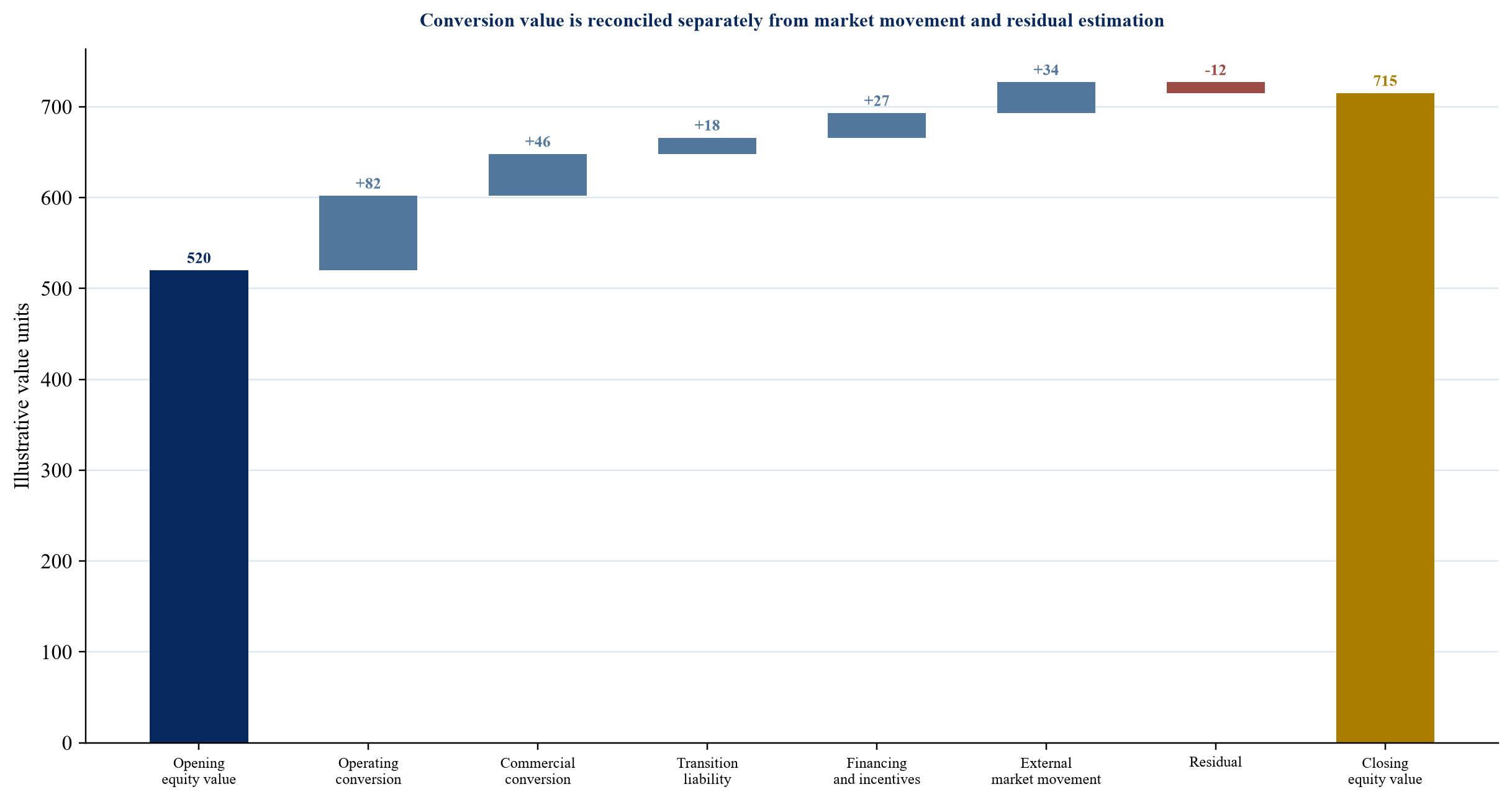
Categories separate fund action from external movement and residual estimation.
14. Reconcile asset value to fund return
Fund return depends on timing, fees, financing, cash management and ownership. Asset value creation does not equal limited-partner return. ILPA's Performance Template standardises fund and portfolio cash-flow metrics and distinguishes results with and without subscription facilities. Invest Europe guidance distinguishes gross and net IRR and explains MOIC at investment level.
The fund should report recognised return measures under its governing documents and accounting policy. It can add a conversion attribution schedule as a supplementary analysis. The schedule should reconcile asset-level conversion value to gross portfolio value, fund expenses, management fees, carried interest, subscription facilities, taxes, foreign exchange and net investor cash flows.
IRR is sensitive to timing. A bridge facility can accelerate capital calls and change reported IRR without changing underlying asset cash flow. MOIC can clarify total value, while distributions and residual value show realised and unrealised components. A conversion strategy should present several measures rather than select the one that appears strongest.
The schedule should distinguish realised conversion return from unrealised conversion value. Realised return comes from cash distributions and sale proceeds. Unrealised value depends on current assumptions. The fund should disclose valuation date, method, market evidence and uncertainty.
15. Allocate transition capital across the portfolio
A fund cannot treat every transition project as equally attractive. It should allocate capital using expected financial return, emissions effect, strategic option value, downside protection, evidence quality, execution capacity and liquidity.
The portfolio model should identify mandatory capital, high-return capital, enabling capital and optional capital. Mandatory capital preserves legal or safe operation. High-return capital produces evidence-supported cash benefits. Enabling capital creates permits, grid, data or customer qualification required for later value. Optional capital depends on future conditions.
The fund should compare projects on a consistent basis. Net present value, IRR, payback and downside liquidity remain relevant. Physical metrics can include absolute reduction, intensity change, percentage of asset emissions addressed and capital per tonne. These metrics should not be combined into a single score unless weights and tradeoffs are approved.
Capital rationing should consider concentration. Several assets may depend on the same technology, contractor, commodity, subsidy or policy. A portfolio that appears diversified by company can share a common transition bottleneck.
16. Structure financing around conversion evidence
Transition finance can include senior debt, project finance, asset finance, green loans, sustainability-linked facilities, mezzanine debt, vendor finance, guarantees and public support. The instrument should match the asset's cash flow and milestone risk.
Use-of-proceeds instruments can ring-fence eligible investment. Sustainability-linked instruments can change pricing based on performance targets. The fund should avoid using a financing label as evidence of asset conversion. Eligibility, target ambition, verification, reporting and consequences determine credibility.
Debt can improve equity returns and increase downside exposure. The financing case should test completion cost, delayed savings, covenant headroom, carbon price, refinancing and exit. A project with a positive long-term conversion case can fail if near-term liquidity is insufficient.
Lender controls can reinforce the milestone account. Conditions precedent, draw tests, technical certificates, reserve accounts and information covenants can connect funding to evidence. The fund should retain enough flexibility to change a project when technical learning supports a better route.
17. Govern methodology and conflicts
Conversion reporting creates incentives. Deal teams may prefer a higher baseline, portfolio teams may prefer a broader attribution and valuation teams may prefer optimistic milestones. Governance should separate origination, execution, measurement, valuation and approval.
The fund should maintain a methodology manual approved by the investment committee or valuation committee. It should define baselines, boundaries, attribution categories, evidence grades, counterfactuals, carbon-credit treatment, asset sales, methodology changes and restatements.
Material changes should receive independent review. Examples include a revised baseline, a new emissions method, a changed pathway, a large valuation attribution or reclassification of maintenance as transition capital. The fund should preserve prior values and explain the effect of the change.
Investor reporting should reconcile to board and asset data. A marketing claim should not exceed the evidence used for investment and risk decisions. External assurance can be useful for selected metrics. Assurance scope and limitations should remain visible.
18. Use portfolio cohorts
Portfolio aggregation can hide weak assets behind strong ones. Cohorts allow a fund to compare assets with similar starting conditions, technologies, geographies or conversion routes.
Useful cohorts can include acquired high-emitting assets, early conversion, commissioned conversion, stabilised operation, managed phaseout and exited assets. The fund can report capital, value, emissions and milestone performance for each cohort. Movement between cohorts should depend on objective evidence.
Cohort analysis also improves forecasting. A fund can compare expected and actual engineering time, cost, savings, commissioning and valuation. The evidence can improve the next acquisition model. A small number of assets may limit statistical conclusions, so the fund should avoid presenting a narrow sample as a market benchmark.
Vintage effects matter. Technology cost, interest rates, carbon policy and energy prices can change between acquisitions. The fund should report these external conditions when comparing cohorts.
19. Design the fund dashboard
The dashboard should show financial performance, transition performance and evidence quality together. A board should be able to trace a reported result to the assets and milestones that produced it.
Core financial measures include invested capital, distributions, residual value, gross and net IRR, MOIC, liquidity, leverage and capital remaining. Conversion measures include approved capital, spent capital, commissioned capital, operating cash benefit, conversion value attribution, inventory emissions, intensity, boundary changes and milestones.
The dashboard should show forecast, actual and variance. Each material variance should have an owner and decision consequence. Portfolio totals should reconcile to asset records and fund reporting. Any difference should be explained as timing, ownership, foreign exchange, methodology or residual.
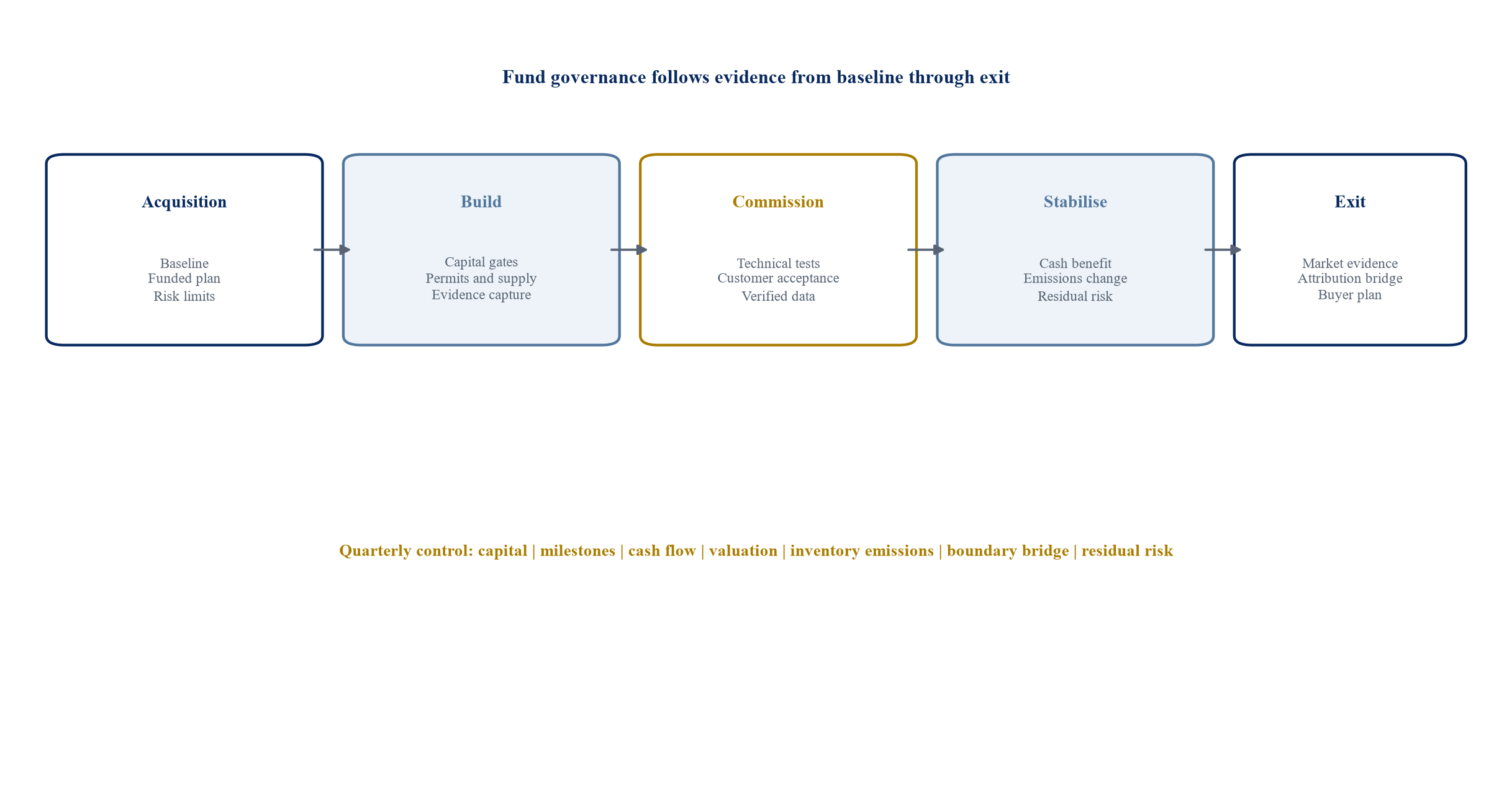
Stage movement depends on evidence, funded economics and approved risk limits.
20. Prepare the exit evidence pack
A buyer will assess the converted asset under its own return requirements, financing and transition obligations. The exit evidence pack should make the operating and transition history auditable.
The pack should include baseline data, technical design, permits, contracts, capital history, commissioning, operating performance, emissions methods, transition-plan progress, liabilities, assurance and remaining capital. It should distinguish completed work from future plans.
The valuation should use current market evidence. A strategic buyer may value synergies, feedstock, customer access or avoided compliance capital. These buyer-specific benefits should be shown separately from standalone value. A fund should avoid claiming that every future buyer will pay for the same transition attributes.
Remaining risk should be clear. Residual emissions, future stages, carbon-price exposure, decommissioning, technology warranties and community obligations can affect price and transaction structure. Deferred consideration or warranties can address specific uncertainty.
21. Hypothetical five-asset fund case
Consider a hypothetical infrastructure and industrial-transition fund that acquires five assets for 520 illustrative equity-value units. The portfolio includes an industrial heat asset, a mixed-generation utility, a logistics terminal, a materials plant and an ageing power asset with a managed-phaseout plan. The example is educational. It does not describe an actual fund, transaction, valuation or forecast.
The fund commits 210 units of transition capital over four years. The plan includes electrification, process efficiency, renewable supply, storage, methane control, product qualification, remediation and decommissioning security. The fund also budgets ordinary maintenance separately.
At the measurement date, 176 units have been spent. Three assets have commissioned major interventions, one remains in construction and one has completed the first phase of managed phaseout. Reported portfolio inventory emissions have fallen from 1.00 million to 0.72 million illustrative tonnes of carbon dioxide equivalent on a like-for-like boundary. Disposal contributes zero to that reduction because no asset has been sold.
The fund estimates closing equity value of 715 units. The value bridge attributes 82 units to verified operating conversion, 46 to qualified products and contracts, 18 to lower transition liability, 27 to financing and committed incentives, 34 to external market movement and negative 12 to residual adjustments. The total is illustrative and depends on the stated assumptions.
Table 2. Hypothetical fund conversion-return attribution
| Component | Illustrative value units | Evidence basis | Reporting treatment |
|---|---|---|---|
| Opening equity value | 520 | Acquisition model and opening valuation | Starting point |
| Verified operating conversion | 82 | Metered savings, output, reliability and margins | Conversion value |
| Qualified products and contracts | 46 | Realised sales and executed customer agreements | Conversion value |
| Lower transition liability | 18 | Permits, remediation and funded phaseout | Separate preservation bridge |
| Financing and committed incentives | 27 | Executed facilities and awarded support | Financing contribution |
| External market movement | 34 | Rates, commodities, foreign exchange and multiples | External contribution |
| Residual adjustments | (12) | Unallocated model and timing effects | Residual; no conversion claim |
| Closing equity value | 715 | Current valuation using market-participant assumptions | Unrealised value |
| Like-for-like inventory emissions | 1.00 to 0.72 million tonnes | Asset inventories and boundary bridge | Transition ledger |
Amounts and emissions are illustrative and do not represent an actual fund or benchmark.
The attribution does not claim that the 28 percent inventory reduction caused the entire conversion value. The financial bridge uses asset evidence for specific cash-flow and liability effects. The emissions ledger reports physical change under its own boundary and method.
22. Stress the hypothetical case
The downside assumes a two-year delay at the materials plant, lower customer uptake for a converted product, higher electricity prices, reduced policy support and a higher exit discount rate. A planned 24-unit operating benefit falls to 9 units. Additional capital rises by 38 units. Closing value falls below the central case.
The fund should test correlated shocks. Delayed grid capacity can postpone commissioning, increase financing carry and lose customer volume. Higher power prices can reduce the benefit of electrification. Weak demand can lower plant utilisation and emissions simultaneously. The fund should avoid treating that emissions decline as transition success.
The downside also tests a methodology change. Improved supplier data raises reported Scope 3 emissions. The fund should show the restatement and preserve the asset's observed operational progress. Data improvement can increase reported emissions without an adverse physical event.
Table 3. Hypothetical conversion-risk triggers and responses
| Trigger | Central assumption | Illustrative stop or restructure threshold | Response |
|---|---|---|---|
| Remaining transition capital | 34 units | More than 72 without committed funding | Rephase, resize or stop project |
| Commissioning | Two assets within 12 months | Delay beyond 24 months | Reset liquidity and value attribution |
| Product qualification | Executed customer trials | No qualified customer by long-stop date | Remove commercial-conversion value |
| Carbon-price exposure | Current applicable schemes | Downside exceeds approved asset return | Hedge, reprice or redesign |
| Inventory boundary | Stable ownership and method | Disposal or material method change | Publish a separate boundary bridge |
| Conversion attribution | High or medium evidence | Low-confidence estimate exceeds 10 percent of value | Keep as scenario; exclude from reported attribution |
| Liquidity | Funded central and downside cases | Downside cannot be funded | Add capital, sell or abandon intervention |
Thresholds are illustrative and require asset-specific approval.
The fund response should protect liquidity and evidence integrity. A lower value can require repricing, additional equity, a smaller intervention, customer-linked capital or an earlier exit. The fund should not preserve a return narrative by changing the baseline without approval.
23. Report to limited partners
Limited partners need fund performance under the governing documents and enough information to assess the conversion thesis. The quarterly report should present recognised financial metrics first, followed by the supplementary conversion schedule.
The schedule should show invested transition capital, realised cash benefit, unrealised conversion value, external market movement, residual, inventory emissions, boundary change, intensity, milestones and data quality. It should reconcile to the previous period.
Claims should remain proportionate. A fund can report that an asset completed an intervention and reduced measured emissions within a defined boundary. It should avoid claiming a broader system impact without a separate counterfactual method. It should disclose where estimates, proxies or management assumptions remain.
The fund should also report setbacks. Delays, cost increases, failed technologies, target changes and disposals are material to the strategy. A complete record improves the credibility of successful outcomes and helps investors compare the fund's underwriting with execution.
24. Apply the investment committee framework
The investment committee should approve the conversion case through a defined sequence. What asset boundary is being acquired? What is the observed financial and emissions baseline? Which pathway and end state apply? Which interventions are funded? What evidence links each intervention to cash flow and physical performance? Which benefits are realised, contracted, probability-weighted or speculative? Which external variables drive value? What residual risks remain? How does the result reach fund cash flows and investor return?
The committee pack should include the acquisition baseline, transition plan, capital schedule, milestone account, environmental and social action plan, asset value bridge, emissions ledger, downside liquidity, methodology note and reporting template. Each assumption should have an owner and evidence grade.
Approval should specify maximum capital, required milestones, return floor, liquidity floor, emissions boundary, methodology, stop conditions and change control. The committee should reconvene when a material assumption changes.
Exit approval should reconcile the original thesis to realised and unrealised outcomes. The bridge should identify which value came from asset conversion, external markets, financing and residual estimation. It should preserve unsuccessful capital and write-offs in the record.
25. Recognise the limits of the framework
Conversion-return measurement depends on data, counterfactuals and valuation assumptions. The framework cannot prove causality where several actions and external conditions change together. It cannot establish legal compliance, fair value, tax treatment, emissions assurance, pathway alignment or environmental integrity for a specific fund.
Standards and policy continue to evolve. GHG Protocol is updating corporate, Scope 2 and action-accounting guidance. PCAF published a third edition of its financed-emissions standard in 2025. Jurisdictions are adopting sustainability disclosure and taxonomy rules at different speeds. A fund should use the requirements in force for its reporting period.
Scenario analysis does not predict the future. Carbon price, technology cost, customer demand, energy price and policy can differ materially from the cases modelled. The investment committee should approve ranges and maintain liquidity for adverse outcomes.
The hypothetical case demonstrates structure. Its amounts, emissions and thresholds should not be transferred to another fund. A fund-specific framework should use verified contracts, asset data, approved management estimates and qualified professional advice.
Conclusion
A brown-to-green fund creates an investable record when physical change, cash flow, valuation and investor returns reconcile. The fund needs a dated acquisition baseline, a funded transition plan, objective milestones and two coordinated ledgers.
The financial ledger should separate operating conversion, commercial conversion, transition liabilities, financing, external market movement and residual estimation. The transition ledger should separate inventory emissions, intensity, boundary changes and counterfactual avoided emissions. Asset sales and lower production should remain visible.
Fund reporting should preserve standard IRR, MOIC, distributions and net asset value. A supplementary conversion schedule can explain how the investment thesis affected those results. Realised cash and unrealised value should remain separate. Causal confidence and data quality should govern the language used.
The investment committee should release capital against evidence and stop or restructure projects that cannot meet funded economics, pathway, safeguard or liquidity requirements. Exit reporting should reconcile the original thesis to the final result and disclose remaining transition obligations.
Frequently Asked Questions
1. What is a fund-level conversion return?
It is a supplementary attribution of financial value supported by evidence that links approved transition interventions to asset cash flow, liabilities, risk and valuation. It should reconcile to recognised fund performance metrics.
2. Can emissions reduction be converted directly into financial return?
No automatic conversion exists. Emissions can affect cost, revenue, capital, financing, risk or terminal value. The model should identify and evidence the specific financial mechanism.
3. How should a fund treat asset sales?
The fund should report sale proceeds in the financial ledger and show the emissions removed through disposal as a portfolio boundary change. The disposal should not be reported as operational emissions reduction.
4. Should avoided emissions reduce the fund's financed-emissions inventory?
No. GHG Protocol and PCAF materials require avoided emissions to be reported separately from inventory emissions. The avoided-emissions estimate also needs an explicit counterfactual method.
5. Which return measures should be reported?
The fund should report the measures required by its documents and reporting standards, including relevant IRR, MOIC, distributions and residual value. The conversion schedule should supplement and reconcile to them.
6. How should the fund value avoided downside?
The fund should define the adverse event, probability, timing, exposure and mitigation. Any valuation effect should use market-participant assumptions and remain separate from realised operating cash.
7. What evidence is strong enough for conversion attribution?
Strong evidence can include metered data, executed contracts, commissioned equipment, verified operating performance and independently reviewed models. Estimates should carry a data-quality grade and remain scenarios when evidence is weak.
8. What should make the investment committee stop a conversion project?
Stop conditions can include unavailable permits or inputs, unfunded capital, failed customer qualification, incompatible pathway, unresolved environmental or social exposure, insufficient liquidity or a return below the approved threshold.
References
- International Energy Agency. World Energy Investment 2025. https://www.iea.org/reports/world-energy-investment-2025
- International Energy Agency. Who is investing in energy around the world, and who is financing it? 2024. https://www.iea.org/commentaries/who-is-investing-in-energy-around-the-world-and-who-is-financing-it
- IFRS Foundation. IFRS S2 Climate-related Disclosures. https://www.ifrs.org/issued-standards/ifrs-sustainability-standards-navigator/ifrs-s2-climate-related-disclosures/
- IFRS Foundation. Disclosing information about an entity's climate-related transition, including information about transition plans, 2025. https://www.ifrs.org/content/dam/ifrs/supporting-implementation/ifrs-s2/transition-plan-disclosure-s2.pdf
- IFRS Foundation. IFRS 13 Fair Value Measurement. https://www.ifrs.org/issued-standards/list-of-standards/ifrs-13-fair-value-measurement/
- Partnership for Carbon Accounting Financials. Financed Emissions Standard, third edition, 2025. https://carbonaccountingfinancials.com/files/standard-launch-2025/PCAF-PartA-2025-Full-Document-Clean.pdf
- Greenhouse Gas Protocol. Corporate Standard. https://ghgprotocol.org/corporate-standard
- Greenhouse Gas Protocol. Project Protocol. https://ghgprotocol.org/project-protocol
- Greenhouse Gas Protocol. Inventory and Project Accounting: A Comparative Review. https://ghgprotocol.org/blog/inventory-and-project-accounting
- Greenhouse Gas Protocol. Estimating and Reporting Avoided Emissions. https://ghgprotocol.org/estimating-and-reporting-avoided-emissions
- Glasgow Financial Alliance for Net Zero. Financial Institution Net-zero Transition Plans. https://www.gfanzero.com/our-work/financial-institution-net-zero-transition-plans/
- Glasgow Financial Alliance for Net Zero. The Managed Phaseout of High-emitting Assets. https://www.gfanzero.com/our-work/financial-institution-net-zero-transition-plans/
- OECD. Guidance on Transition Finance: Ensuring Credibility of Corporate Climate Transition Plans, 2022. https://doi.org/10.1787/7c68a1ee-en
- OECD. Mechanisms to Prevent Carbon Lock-in in Transition Finance, 2023. https://www.oecd.org/en/publications/mechanisms-to-prevent-carbon-lock-in-in-transition-finance_d5c49358-en.html
- World Bank Group. State and Trends of Carbon Pricing 2025. https://openknowledge.worldbank.org/bitstreams/c65f581d-d94b-4f3f-91fc-c0f3250650df/download
- Network for Greening the Financial System. NGFS Climate Scenarios. https://www.ngfs.net/ngfs-scenarios-portal/
- International Valuation Standards Council. International Valuation Standards 2025: IVS 104 Data and Inputs Appendix. https://www.ivsc.org/wp-content/uploads/2024/05/International-Valuation-Standards-2025-%E2%80%93-IVS-104-Appendix-ESG.pdf
- International Valuation Standards Council. ESG and Real Asset Valuation, 2024. https://ivsc.org/esg-perspectives/
- International Valuation Standards Council. A Framework to Assess ESG Value Creation, 2021. https://ivsc.org/a-framework-to-assess-esg-value-creation/
- Institutional Limited Partners Association. ILPA Performance Template. https://ilpa.org/industry-guidance/templates-standards-model-documents/ilpa-templates-hub/ilpa-performance-template/
- Invest Europe. Performance Measurement and Reporting. https://www.investeurope.eu/investor-reporting-guidelines/performance-measurement-and-reporting/
- European Commission. Taxonomy Regulation and Delegated Acts. https://finance.ec.europa.eu/regulation-and-supervision/financial-services-legislation/implementing-and-delegated-acts/taxonomy-regulation_en
- International Finance Corporation. Performance Standards on Environmental and Social Sustainability. https://www.ifc.org/en/insights-reports/2012/ifc-performance-standards
- Equator Principles Association. The Equator Principles. https://equator-principles.com/about-the-equator-principles/
- Principles for Responsible Investment. Climate Change Resources for Private Markets Investors. https://public.unpri.org/climate-change-resources-for-private-markets-investors/8398.article
About the Author
Chennakeshav (CK) is a corporate finance and investment banking executive with 25+ years of global experience in deal origination, structuring and execution across M&A, growth capital and corporate strategy. He has led value-creation mandates for founders, corporates and funds — bridging the boardroom view to hands-on execution and close.
His career spans Morgan Stanley, HSBC, Lloyds Banking Group, EWEC, ADQ portfolio companies and Emirates Growth Fund, across TMT, real estate, fintech, deeptech, cleantech, infrastructure and energy. He has partnered with C-suite leaders, private equity and venture funds, sovereign wealth funds and family offices to finance complex fund raises and scale-up ventures, and has led M&A due diligence, post-merger integration and business-transformation initiatives to create value.
At Matchpoint Partners he is Managing Partner, leading the firm's corporate finance, M&A and capital-raising practice. He holds an MBA from London Business School, an engineering degree from VTU and a Master of Laws (LLM, in progress) from UCL London.
An active start-up mentor, CK mentors at Techstars, DIFC FinTech Hive, Startup Grind, Founder Institute and IN5, serves as Entrepreneur Mentor in Residence (EMiR) at London Business School, and judges the Entrepreneurship World Cup.
