

1. Define the market-enablement problem
The board decision is whether a proposed W&I placement can operate as part of the transaction's risk architecture. Capacity, policy wording, diligence, disclosure, contractual recourse, governing law, dispute resolution and claims evidence must form one coherent system. A quotation alone does not answer that question.
The GCC is not one insurance jurisdiction. A regional transaction may involve an onshore UAE buyer, a DIFC acquisition vehicle, a Saudi operating company, a QFC-regulated intermediary, a Bahraini subsidiary, an overseas insurer and advisers in several legal systems. The location of the insured risk, identity and licence of the insurer or intermediary, place of contracting, governing law and distribution route require transaction-specific analysis. [1][2][4][8][9][10]
Market development therefore has two dimensions. The first is regulated access: whether the participants may lawfully arrange, write and service the risk. The second is execution quality: whether the transaction record is good enough for underwriting and a later claim. Both dimensions need documented decisions.
The practical objective is repeatability. A buyer, seller, broker, insurer and adviser should be able to identify the risk perimeter, obtain dependable evidence, allocate excluded matters and transfer ownership of the policy after completion. Standardised work products can reduce avoidable friction while preserving jurisdiction-specific review.
The reviewed public sources do not provide a dedicated GCC-wide W&I policy-count, premium or loss-ratio series. This paper consequently avoids claims about regional adoption rates. It uses regulatory texts for legal and market-access architecture and clearly attributed insurer or broker datasets for claims observations.
2. Separate capacity from insurability
Available underwriting capacity does not establish that a particular deal is insurable. An underwriter must understand the target, transaction structure, diligence scope, disclosure process, management access, contractual warranties, known issues, exclusions and claims environment. Evidence gaps can narrow cover, increase retention, create exclusions or prevent placement.
The transaction team should test insurability at the start of diligence. The test should ask whether the target can produce reliable financial, tax, legal, commercial, cyber, employment, regulatory and operational records. It should identify subsidiaries and jurisdictions, data restrictions, management availability and known issues. The result should inform adviser scopes and the timetable.
The policy is normally designed for unknown risk within its wording. Known matters require separate treatment. A disclosed tax exposure, permit failure, environmental condition or customer dispute may be addressed through price, escrow, specific indemnity, contingent consideration, remediation or buyer retention. Attempting to place a known loss inside a general W&I perimeter weakens execution discipline.
Insurability is also affected by deal mechanics. Locked-box pricing, completion accounts, earn-outs, carve-outs, minority investments and reorganisations create different evidence and warranty questions. The broker and counsel should identify how the proposed structure changes the policy and diligence requirements before documents are finalised.
A market-enablement process should therefore use an early screen. A deal proceeds to full placement only when the parties can show a lawful route to capacity, a sufficiently stable structure, a credible diligence plan, a manageable known-risk schedule and accountable owners.
3. Map the regulated insurance chain
Every placement should have a written regulatory map covering the insurer, reinsurer, broker, intermediary, policyholder, insured entities, risk location and servicing route. The map should state the legal basis on which each participant acts and identify local restrictions.
The Central Bank of the UAE publishes the federal insurance framework, including Federal Decree-Law No. 6 of 2025. [1] The DFSA states that authorised firms may conduct insurance or reinsurance business from the DIFC, while restrictions apply to UAE-onshore risks. [2] Lloyd's market-access guidance similarly distinguishes open-market DIFC and ADGM risks from UAE-onshore risks outside the financial free zones. [4] These sources support a perimeter analysis; they do not replace advice on a particular policy.
Saudi Arabia's Insurance Authority regulates and licenses insurance activity. [8] Qatar's QFC Regulatory Authority maintains separate rulebooks for insurance business, insurance mediation and captive insurance within its framework. [9] Bahrain's Central Bank publishes Volume 3 of its rulebook for insurance licensees. [10] A regional deal can therefore require several analyses rather than a single GCC conclusion.
The team should record who approaches the insured, who advises, who binds, who issues the policy, who collects premium, who handles claims and where records are maintained. It should verify permissions at the relevant date. Corporate groups and brand names can obscure which legal entity performs each function.
The regulatory map should be approved before binding. Any uncertainty should have an owner, legal view and closing condition. Post-completion servicing should remain within the approved route.
| Location or framework | Public regulatory anchor | Questions for the transaction file | Evidence required before binding |
|---|---|---|---|
| UAE onshore | Central Bank of the UAE and Federal Decree-Law No. 6 of 2025 | Where is the risk situated; which entity may write or distribute; how will claims be serviced? | Current licence checks, risk-location analysis, approved distribution route and policyholder map |
| DIFC or ADGM | Relevant financial-services regulator and applicable rules | Is the risk within the permitted financial-free-zone route; which insured entities and interests fall within it? | Entity and asset map, regulatory advice, authorised-firm confirmation and policy schedule |
| Saudi Arabia | Insurance Authority regulations and licensing | Which local permissions apply to insurer, reinsurer and intermediary activity; what local issuance or servicing is required? | Licence evidence, local advice, insured-risk analysis and approved claims route |
| Qatar or QFC | QFCRA insurance and mediation rulebooks, plus applicable state law | Is the participant operating within the QFC framework; where is the insured risk and policyholder? | Authorisation check, entity map, contracting route and local advice |
| Bahrain | Central Bank of Bahrain Volume 3 Insurance Rulebook | Which licence category and conduct rules apply; how will cross-border capacity participate? | Licence evidence, distribution analysis, policy route and servicing protocol |
This is a decision matrix, not a legal conclusion. Current local advice is required for every transaction.
4. Determine risk location and policy architecture
Risk location can affect which insurer may participate, which taxes apply, how premium is allocated and how claims are serviced. A policy covering a holding company, several operating subsidiaries and assets in multiple countries requires a defensible allocation method.
The deal team should build an insured-interest schedule. It should list each insured entity, incorporation, principal operations, assets, revenue, employees, acquisition role and proposed interest under the policy. The schedule should reconcile to the acquisition agreement and group chart. Uninsured entities and excluded territories should be explicit.
The analysis should also distinguish policyholder location from underlying risk. A financial-free-zone acquisition vehicle does not by itself determine the location of every insured interest. Counsel, the broker and the insurer should document the selected approach and any local-policy or master-policy arrangement.
Premium allocation should follow the approved risk analysis and tax advice. The transaction file should preserve calculations, exchange rates, invoices and payment evidence. A later claim should be traceable to the insured entity and applicable policy layer.
The policy architecture may use one primary form, local policies, endorsements or reinsurance participation. Operational simplicity matters, yet simplicity cannot displace regulatory compliance. The board should receive a plain-language map showing who is insured, where cover attaches, which insurer owes the obligation and how notice must be delivered.
5. Align acquisition agreement and policy
The acquisition agreement and W&I policy should be negotiated as connected instruments. The definitions of loss, knowledge, disclosure, fraud, materiality, tax, leakage, third-party claims and limitation periods can interact. Inconsistency can create a recovery gap.
The transaction team should maintain a clause interface matrix. For every insured warranty it should record the agreement wording, disclosure treatment, policy enhancement or exclusion, seller liability, retention, limit and claims route. The final matrix should use executed documents.
Seller recourse should be deliberate. A synthetic limitation or nominal seller cap may support a clean exit, while fraud, title, leakage, specific indemnities or covenant breaches may retain direct recourse. The policy cannot be assumed to reproduce every contractual remedy. Counsel should explain any difference in measure of loss, survival, conduct or subrogation.
The signing timetable should allow the underwriter to review final documents. Material late changes to price, structure, warranties, disclosure or diligence should return to the insurer. The binder, no-claims declaration and policy issuance process should identify required approvals and evidence.
The board paper should show three layers: insured unknown risk, seller-supported risk and buyer-retained risk. Each layer needs an amount, mechanism, legal owner and expected enforcement route. Unallocated risk should be treated as an unresolved transaction issue.
6. Select governing law, forum and dispute route
Governing law, court jurisdiction and arbitration are separate choices. The acquisition agreement and policy may use different systems, creating parallel interpretation and evidence questions. The parties should understand that design before signing.
DIFC Courts publish opt-in guidance and model clauses. Their Practice Direction No. 1 of 2015 describes the need for a specific, clear and express written jurisdiction agreement. [6] The UAE Arbitration Law provides the federal statutory framework for arbitration. [7] The suitability of either route depends on the documents, parties, assets, enforcement path and policy wording.
The team should map disputes among buyer and seller, insured and insurer, group entities and third parties. It should identify forum, governing law, seat, language, service, interim measures, confidentiality, consolidation and enforcement. The policy's dispute route should be reviewed alongside the acquisition agreement rather than after a claim arises.
Evidence should be usable in the selected forum. Translation, notarisation, legalisation, privilege, expert evidence and electronic-record rules can affect cost and timing. The archive should preserve originals, authenticated copies and metadata where appropriate.
The decision should be recorded in a jurisdiction memorandum. The memorandum should state alternatives considered, reasons, limitations and the clauses implemented. A model clause should be checked against the final transaction rather than inserted mechanically.
7. Create an underwriting evidence standard
An underwriting evidence standard tells every workstream what a decision-ready file contains. It should cover source reliability, period, scope, exceptions, reviewer competence, management access and reconciliation to the transaction documents.
The core package normally includes final diligence reports, material source documents, management Q&A, data-room index, disclosure letter, acquisition agreement, structure chart, financial information and known-risk schedule. The underwriter may request additional evidence. The policy and live underwriting instructions control.
Every diligence conclusion should identify the question, population reviewed, sample, period, source, exception and limitation. A statement that no issues were found has limited value without the scope. Material management representations should be supported or identified as such.
The data-room index should be preserved at signing and completion. Version history matters. The buyer should be able to reproduce which document was available, when, to whom and how it affected diligence. Links that expire after closing should be replaced with a controlled archive, subject to rights and data restrictions.
Evidence quality should be graded. A verified primary record has different weight from an interview, unaudited schedule or management estimate. The grade should drive follow-up, exclusion, retention or alternative allocation.
| Workstream | Minimum evidence package | Reliability test | Escalation outcome |
|---|---|---|---|
| Financial | Audited statements, ledgers, quality-of-earnings analysis, debt and working-capital support | Reconcile reported results to source systems and explain adjustments | Exclusion, price protection, enhanced diligence or narrower warranty |
| Tax | Returns, assessments, correspondence, structure and adviser analysis | Confirm periods, jurisdictions, filing status and known disputes | Specific indemnity, escrow, tax insurance or retained risk |
| Legal and regulatory | Material contracts, permits, litigation, compliance records and ownership evidence | Verify completeness, authority, change-of-control and enforcement | Condition precedent, remediation, exclusion or seller support |
| Commercial | Customer contracts, cohort data, pipeline, churn and concentration analysis | Reconcile management data to contracts and billing | Price adjustment, earn-out, exclusion or targeted warranty |
| Technology and cyber | Architecture, licences, incidents, controls, logs and testing | Validate ownership, security evidence, dependencies and remediation | Remediation plan, cyber cover, exclusion or retention |
| People and operations | Employment terms, incentives, claims, sites, supply chain and controls | Test population completeness and local-law exposure | Covenant, retention plan, specific indemnity or buyer reserve |
Requirements should be adapted to the target, transaction, policy and jurisdiction.
8. Make diligence reliance-ready
Reliance-ready diligence has a defined client, purpose, duty and permitted recipient. The insurer's ability to use a report should be agreed through reliance letters, non-reliance acknowledgements or other approved arrangements. The legal effect depends on the documents and applicable law.
Adviser scopes should be designed with underwriting in mind. Material subsidiaries, jurisdictions and periods should be explicit. Sampling should state population and method. Excluded areas should be visible. A red-flag report can support decision-making, though it may leave evidence gaps if the policy expects fuller work.
Cross-workstream reconciliation is essential. Financial diligence may rely on customer data, legal diligence on contract population and tax diligence on entity structure. Inconsistent populations should be resolved before underwriting. The data-room index and transaction perimeter should be common references.
The buyer should maintain a diligence exception register. Each exception should record materiality, owner, evidence, underwriter response and transaction treatment. Closed exceptions should preserve the basis for closure. Open exceptions should flow into disclosure, exclusion or specific risk allocation.
Reliance should survive completion. Final reports, reliance documents, engagement letters and source references belong in the policy archive. If an adviser cannot provide reliance, the team should establish what alternative evidence the underwriter accepts.
9. Control disclosure and knowledge
Disclosure should present material facts through a controlled process. The disclosure letter, data room, management Q&A and underwriting submission must be consistent. The policy should state how disclosure affects cover.
Knowledge definitions require special care. The acquisition agreement may define a seller knowledge group, while the policy may use insured knowledge or underwriting awareness. The team should identify named persons, enquiry standards and timing. Changes in personnel before completion should be addressed.
The disclosure process should have owners by workstream and entity. Each disclosure should link to source evidence and the relevant warranty. Data-room dumping without signposting can create uncertainty over whether a matter was fairly disclosed. Counsel should determine the applicable legal standard.
The no-claims declaration should follow a documented bring-down. Management and buyer representatives should receive the final warranties, disclosure updates and known-issue schedule. Responses should be collected and escalated before signature. Unsupported confirmations create risk.
The buyer should preserve the underwriting narrative. If an issue was discussed orally, the file should record participants, date, substance and response. Final insurer questions and answers should be archived with attachments and version history.
10. Allocate known and unknown risk
Unknown risk may fit the W&I perimeter. Known risk requires a defined commercial solution. The allocation process should prevent gaps and double counting.
Each known matter should have a quantified range, evidence grade, legal route, funding source, duration and owner. Possible tools include price reduction, escrow, retention, specific indemnity, contingent consideration, condition precedent, remediation covenant, separate insurance or buyer assumption.
The chosen tool should match the risk. A short-duration completion uncertainty may suit an escrow. A tax exposure may require a specific indemnity or tax policy. A commercial performance uncertainty may suit contingent pricing. A regulatory defect may require remediation or a condition precedent.
Security quality matters. A seller indemnity without credit support can leave collection risk. Escrow terms should define release, claims and dispute procedures. Contingent consideration should use auditable metrics and governance. Separate insurance should be tested for exclusions and interaction with W&I.
The allocation register should reconcile to price and funding. The board should see the total risk retained by the buyer, its peak cash requirement and the events that release or increase exposure.
11. Establish the hypothetical regional case
The hypothetical buyer acquires a services and technology group operating across the UAE, Saudi Arabia and Qatar or Bahrain. Enterprise value is USD 520.0 million and equity purchase price is USD 395.0 million. These figures are scenario assumptions.
The proposed W&I limit is USD 50.0 million and retention is USD 4.0 million. Assumed premium, insurance tax and underwriting cost is USD 1.3 million. These assumptions do not represent a market quotation.
Diligence identifies USD 18.0 million of known-risk exposure. The scenario allocates USD 10.0 million to a specific indemnity or escrow, USD 5.0 million to contingent pricing and USD 3.0 million to buyer-funded residual risk. General W&I is not assumed to cover those known matters.
The underwriting package includes financial, tax, legal, regulatory, commercial, technology, cyber, employment and operational diligence. The regulatory map identifies the licensed route for each insured interest. The agreement-policy matrix records warranty treatment, exclusions, seller liability and notice.
The case is a governance model. It does not predict whether an insurer would offer cover, what terms would apply or whether a claim would be paid. Live outcomes depend on the facts, policy and law.
12. Model the allocation waterfall
| Component | Amount | Mechanism | Principal evidence |
|---|---|---|---|
| Enterprise value | 520.0 | Transaction valuation | Valuation model, debt and cash bridge |
| Equity purchase price | 395.0 | Consideration at completion | Funds flow and completion statement |
| Proposed W&I limit | 50.0 | Policy subject to wording | Executed policy and schedule |
| Retention | 4.0 | Buyer-funded first layer | Policy wording and liquidity reserve |
| Premium, tax and underwriting cost | 1.3 | Transaction cost assumption | Quotation, tax advice and invoices |
| Known-risk exposure | 18.0 | Outside general W&I in the scenario | Known-risk register and diligence evidence |
| Specific indemnity or escrow | 10.0 | Seller-supported protection | Agreement, escrow terms and security evidence |
| Contingent pricing | 5.0 | Consideration adjustment | Earn-out or contingent-payment provisions |
| Buyer-funded residual | 3.0 | Retained risk | Board approval and reserve |
All values are scenario assumptions in USD millions. They do not represent market pricing, expected loss or expected recovery.
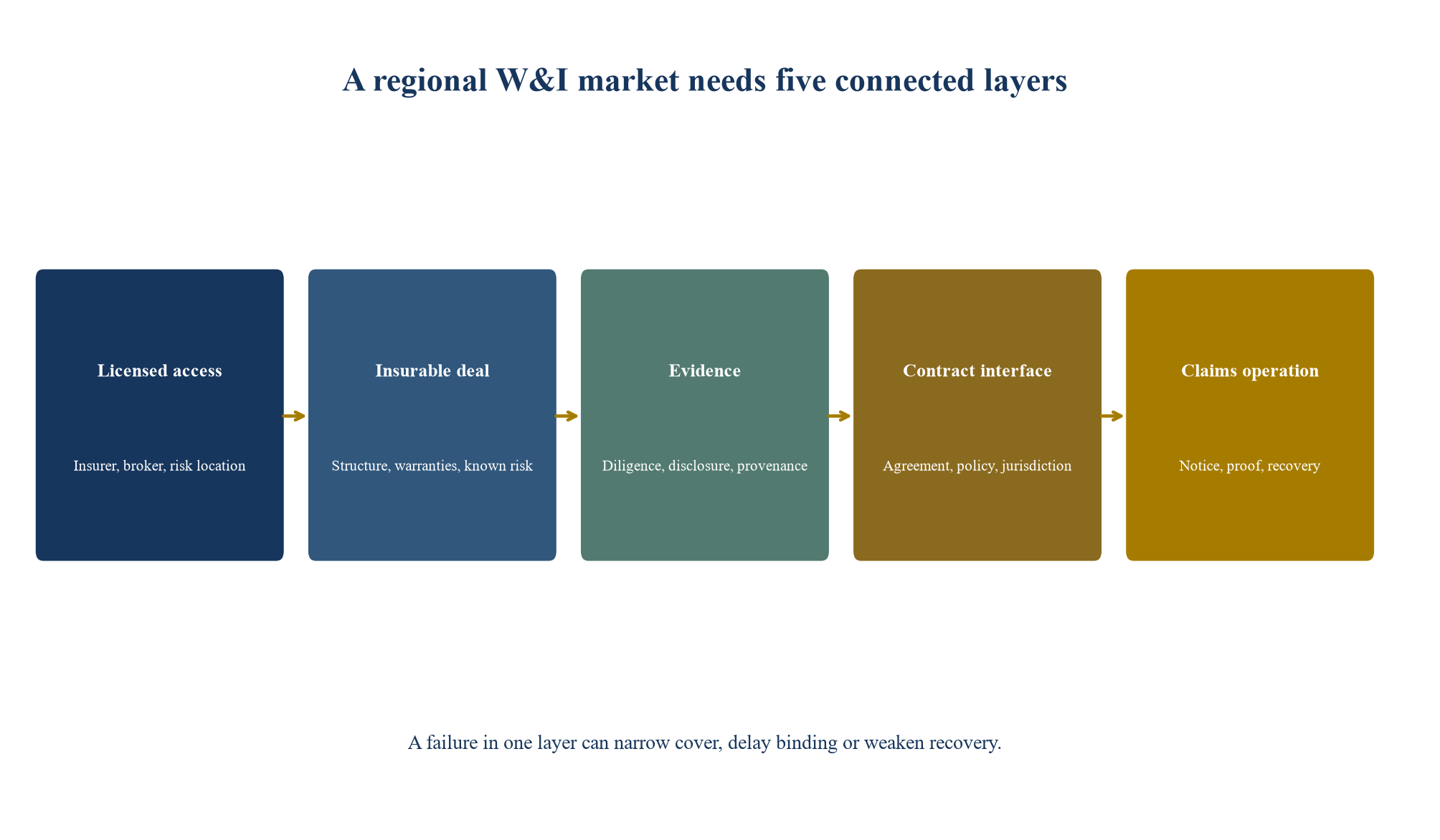
Original framework. Every layer requires transaction-specific legal, insurance and regulatory review.
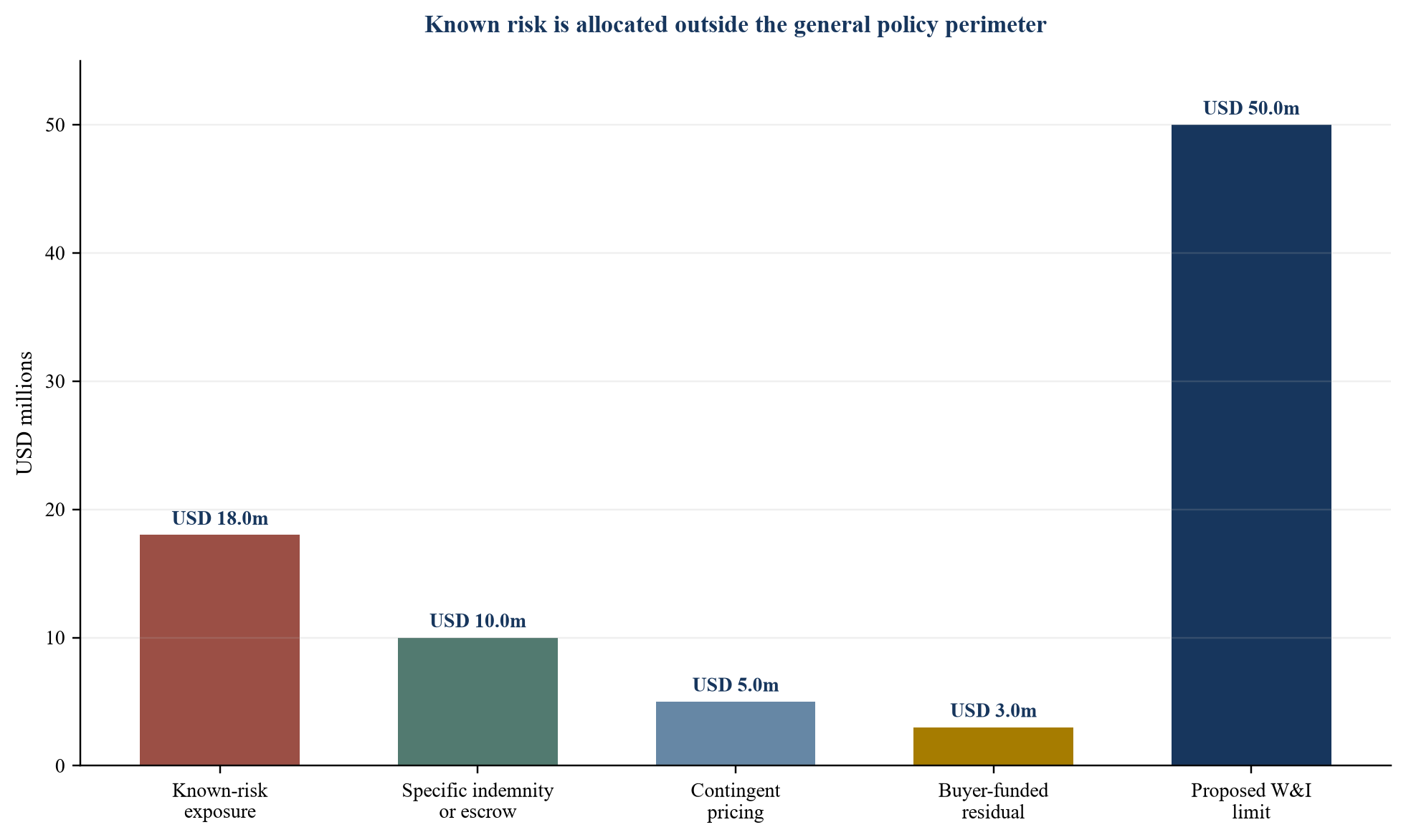
Values are scenario assumptions. General W&I is not assumed to cover the known-risk exposures.
The waterfall should be read by mechanism and timing. The USD 10.0 million seller-supported layer depends on enforceable documentation and security. The USD 5.0 million contingent layer depends on measurable conditions. The USD 3.0 million residual is a direct buyer exposure. The USD 50.0 million policy limit remains subject to retention, exclusions, sublimits and all policy terms.
The finance team should model peak cash. Premium and costs are paid near placement. Retained and known-risk costs may arise before an escrow or claim pays. A limit is not cash on demand. Liquidity planning should use timing scenarios.
13. Build claims-ready evidence from signing
Claims readiness begins with the underwriting record. The final archive should include the acquisition agreement, disclosure letter, policy, endorsements, underwriting submission, diligence reports, management Q&A, data-room index, source documents, no-claims declaration, signing and completion materials.
The archive should preserve version, provenance and access. A later reviewer should identify what the insurer received and the basis for each underwriting answer. Expired links, lost mailboxes and undocumented oral exchanges create avoidable uncertainty.
The policy should be converted into an operating matrix. The matrix should list notice addresses, methods, deadlines, information duties, consent rights, mitigation, defence, settlement, subrogation and dispute route. Owners and deputies should be named.
An issue-discovery protocol should connect operating teams to the policy owner. Tax assessments, customer disputes, cyber incidents, accounting discrepancies and regulatory enquiries should be triaged promptly. Operators should report facts; counsel and insurance specialists should assess cover.
The buyer should preserve evidence before remediation changes it, subject to safety and legal duties. Collection, custody and access should be documented. The claim model should separate breach, causation, loss, mitigation and other recovery.
Public claims studies reinforce the focus on evidence. Marsh reported, within its 2024 client claims dataset, that tax and financial-statements matters each represented 20% of notifications and financial-statements matters represented 45% of payments. [11] These are Marsh portfolio observations, not GCC market statistics.
14. Address tax, sanctions, AML and ownership
Tax affects structure, warranties, premium allocation, insurance tax, claims proceeds and known-risk treatment. The tax workstream should map entities, jurisdictions, filings, audits, transfer pricing, withholding, indirect taxes and transaction steps.
Known tax exposures should be quantified by period and jurisdiction. The team should determine whether a specific indemnity, escrow, tax policy, price adjustment or buyer retention is appropriate. Conduct rights for tax disputes should align across the acquisition agreement and policy.
Sanctions and anti-money-laundering controls apply to parties, beneficial owners, funds flow, insurers, brokers and claim payments. Screening should occur at defined stages and be refreshed for material changes. The file should preserve the sources, date, reviewer and disposition of alerts.
Beneficial ownership can be complex across family, sovereign, fund and nominee structures. The transaction team should establish ownership and control to the standard required by each regulated participant. Unresolved ownership should be an escalation item.
The policy should not be treated as a route around legal restrictions. Sanctions clauses, payment limitations and reporting duties require current advice. The funds-flow memorandum should identify payer, recipient, bank, currency, purpose and approval.
15. Control data and cross-border transfer
Underwriting and claims can require sensitive commercial, personal and security information to move across entities and borders. The team should define purpose, lawful basis, access, retention, security and permitted recipients under applicable law.
The data map should identify data-room hosting, adviser locations, insurer access, employee data, customer data and regulated information. It should distinguish documents that can be shared from those requiring redaction, aggregation, consent or secure review.
Cyber diligence should protect the target while producing useful evidence. Credentials, vulnerability details and incident records should use restricted channels. Access should be logged and removed after purpose ends.
Language and format matter. Key records may require accurate translation while originals remain preserved. Machine translation can assist triage, but material legal and technical documents require qualified review. The archive should link translation to source and reviewer.
The data plan should survive a claim. Retention periods should cover contractual and legal needs. Routine deletion should not destroy a material record after a preservation duty arises. Counsel should define holds and release.
16. Develop insurer participation and capacity
A durable market needs insurers and reinsurers that understand regional transactions, sector risks and enforcement environments. Participation can be developed through transparent pipelines, reliable evidence and consistent execution rather than through unsupported assumptions about demand.
Brokers should present transactions early enough for capacity planning. The submission should include sector, jurisdictions, value, structure, timetable, adviser scopes and known issues. Insurers can then state information requirements and appetite before diligence is complete.
Portfolio learning should be structured. Insurers and brokers can record anonymised reasons for declination, exclusions, delayed binding and claims friction, subject to confidentiality and competition requirements. Aggregated learning can improve diligence templates and product design.
Risk codes and reporting support visibility. Lloyd's announced dedicated transactional-liability risk codes for W&I, tax and contingent-risk insurance from 2026. [5] The classification can improve reporting within that market, though it does not by itself measure GCC adoption.
Capacity should be assessed by legal entity and layer. A tower may involve several insurers with different approval, wording and claims processes. The lead and excess relationship should be documented. The insured should know whether notices to the lead reach every participant.
17. Standardise broker and adviser execution
Standardisation should focus on work products, decision rights and evidence. It should preserve professional judgement and local-law review.
The broker should own the placement plan, capacity approach, quotation comparison, underwriting calendar, policy negotiation record and handover. Counsel should own the agreement-policy interface, regulatory advice, jurisdiction analysis and claims provisions. Diligence advisers should own scope, evidence and limitations. Management should own accurate information and access.
A standard request list can accelerate mobilisation. It should remain proportionate to sector and deal. An infrastructure target requires different technical evidence from a software company or regulated financial institution.
Quotation comparison should extend beyond premium. The team should compare insurer identity, limit, retention, warranty coverage, exclusions, knowledge, disclosure, claims control, governing law, dispute route, security and service. Material differences should be presented to the board.
The file should record negotiations and rejected positions. This assists interpretation and future execution, subject to privilege. Final handover should identify every continuing obligation and contact.
18. Govern decisions and conflicts
The placement should have an accountable executive, supported by legal, insurance, tax, finance, diligence and integration leads. Authority should cover insurer selection, exclusions, retained risk, premium, seller recourse and binding.
Conflicts can arise. A seller may prioritise a clean exit, a buyer broad cover, an insurer reliable evidence and advisers limited reliance. The governance process should surface these interests and record commercial decisions.
The decision register should distinguish verified fact, adviser conclusion, scenario assumption and open question. Each decision should cite the evidence, owner, date and approval. Material changes should return to the appropriate authority.
The board pack should show regulatory route, insurability assessment, key exclusions, known-risk allocation, policy economics, claims process, liquidity and residual exposure. A policy limit without this context can mislead.
After completion, ownership should transfer to operations. The policy owner, notice route, archive, calendar and known-risk register should be accepted by named recipients. Training should use realistic scenarios.
19. Operate five decision gates
Gate one is feasibility. The team confirms the regulated route, target evidence, adviser scopes, capacity interest and known-risk perimeter. Failure requires structure change, more diligence or a different allocation.
Gate two is underwriting readiness. Reports, source records, management access and draft transaction documents are sufficiently stable. Exceptions have owners and proposed treatment.
Gate three is binding. Licences, insured entities, risk location, policy wording, premium, taxes, disclosure, no-claims process and authority are complete. Binding evidence is preserved.
Gate four is completion handover. Final documents, policy, archive, contacts, deadlines and known risks transfer to operating owners. Any open issuance or endorsement item remains controlled.
Gate five is claims readiness. The organisation can identify a potential matter, preserve evidence, deliver notice, obtain consents, quantify loss and coordinate seller and insurer rights.
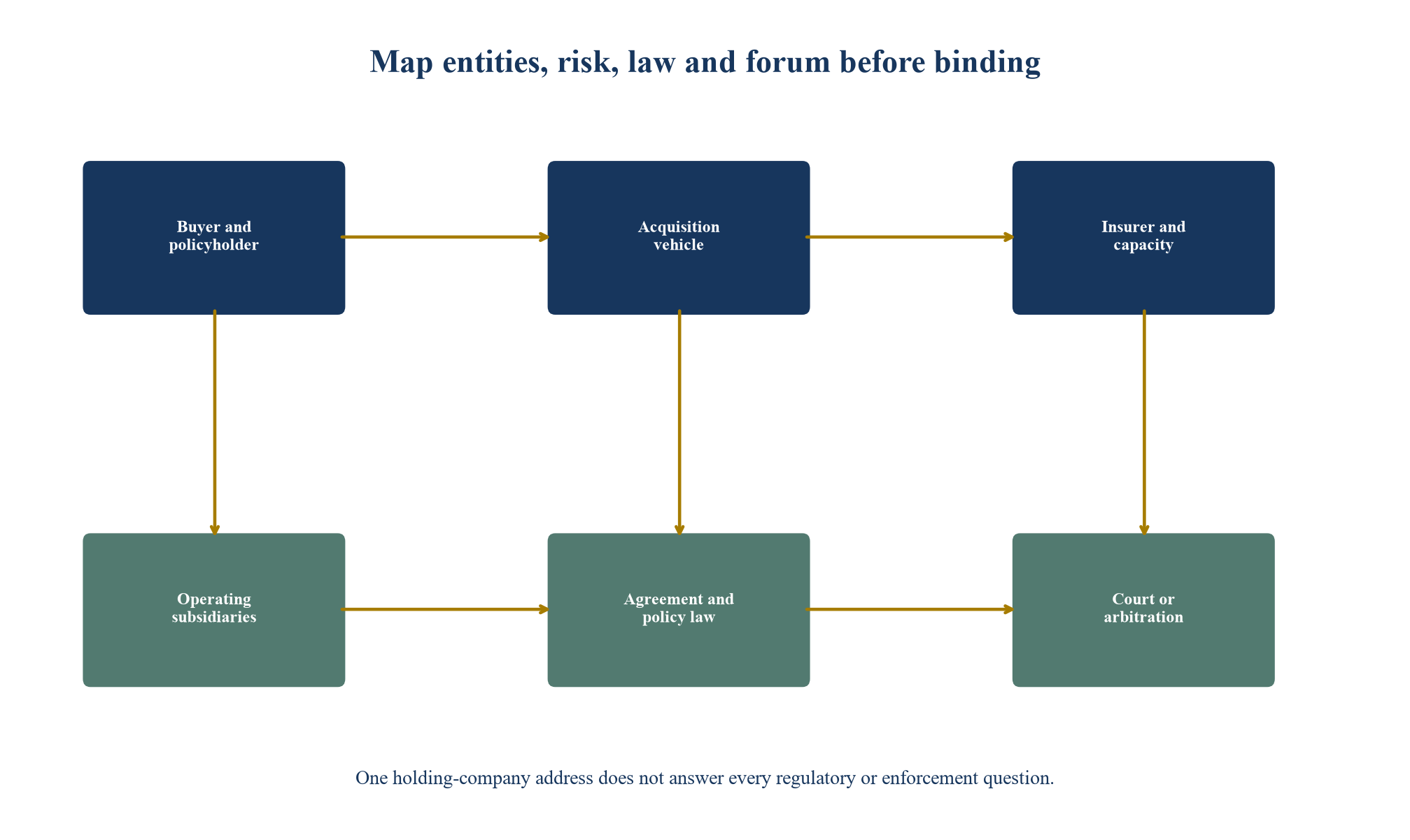
Original decision map. Arrows identify questions requiring current transaction-specific advice.
The gates should have entry evidence, decision authority and an exception route. Urgency should not erase the record. If a deadline requires conditional approval, conditions, owner and expiry should be explicit.
20. Implement the market architecture
| Phase | Principal output | Accountable participants | Decision evidence |
|---|---|---|---|
| Diagnose | Regulatory map, insurability screen and market-gap register | Counsel, broker, buyer and seller leads | Written perimeter analysis and approved issue list |
| Design | Agreement-policy matrix, diligence scopes, known-risk allocation and jurisdiction memorandum | Transaction counsel, advisers, insurer and finance | Board-approved structure and underwriting plan |
| Underwrite | Evidence package, disclosure record, quotation comparison and negotiated wording | Broker, underwriter, management and advisers | Final underwriting file and decision register |
| Bind and hand over | Executed policy, premium evidence, archive, contacts, calendar and training | Authorised signatories and operating owners | Binding confirmation and handover acceptance |
| Operate and learn | Claims protocol, readiness tests, anonymised lessons and template improvements | Policy owner, legal, finance, insurer and broker | Test results, action closure and governance review |
Timing is indicative. Regulatory and transaction requirements control the actual sequence.
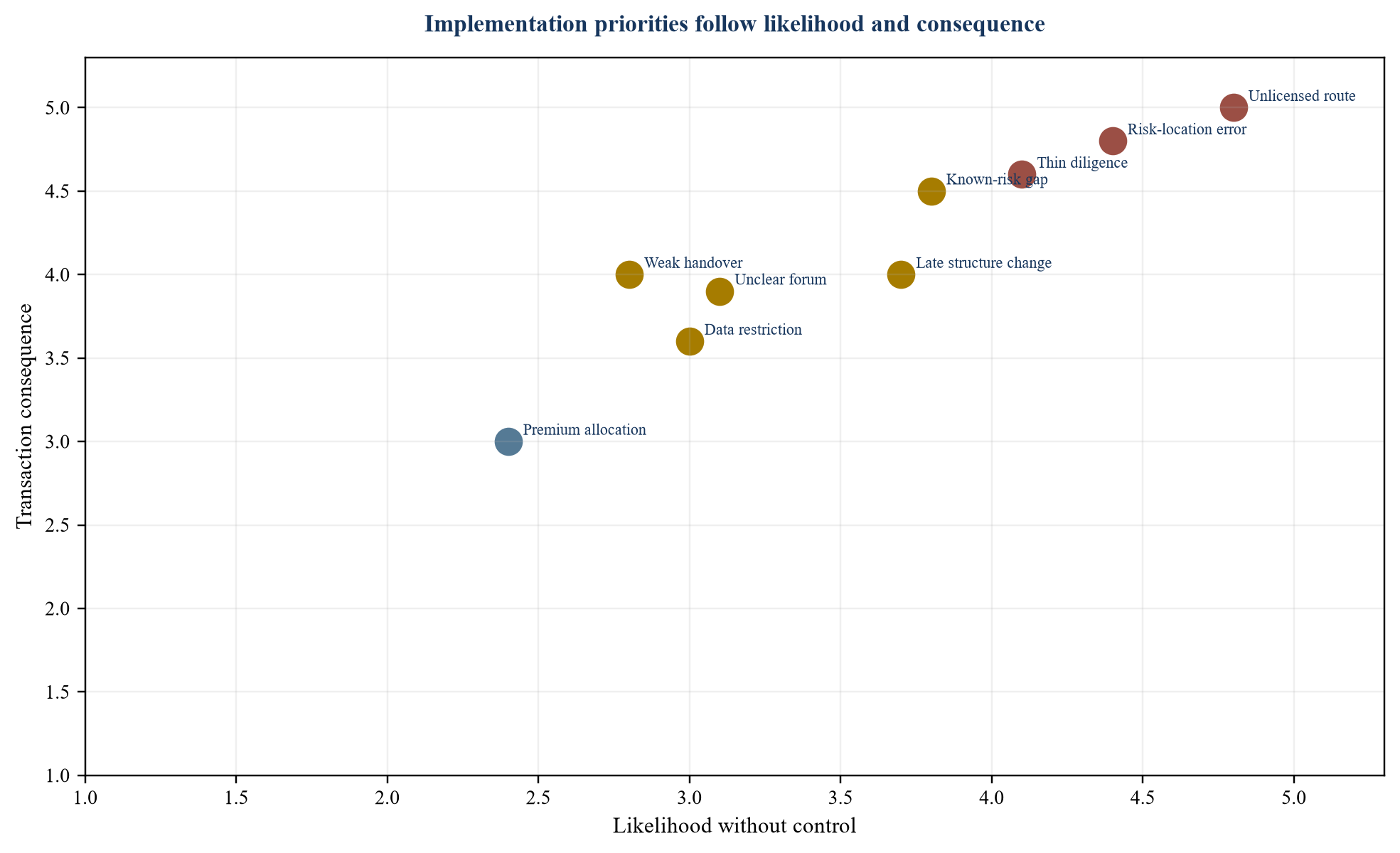
Positions are illustrative judgements for the hypothetical case, not observed market data.
Implementation should begin with a small number of well-controlled transactions. Each should produce structured lessons on regulatory route, diligence gaps, exclusions, timing and claims readiness. Lessons should improve templates without disclosing confidential deal information.
The market-gap register should identify issues that no single transaction can solve, such as limited local claims experience, inconsistent reliance processes, shortage of specialist advisers or unclear product classification. Industry participants can address these through guidance, training and regulator engagement within competition and confidentiality boundaries.
Metrics should measure execution quality. Useful measures include days from launch to underwriting readiness, unresolved regulatory questions at binding, diligence exceptions without treatment, material late changes, policy issuance delay, incomplete handovers and claims tests passed. Premium volume alone cannot demonstrate quality.
The operating model should include annual review. Regulatory change, new risk codes, claims experience and court or arbitration developments may alter the framework. Owners should update templates and training with documented approval.
Sector adaptation is necessary because evidence quality and loss pathways vary. A technology target may require proof of intellectual-property ownership, open-source compliance, cybersecurity controls, data rights, customer metrics and recurring-revenue definitions. A healthcare target may require licensing, clinical governance, reimbursement and patient-data analysis. An industrial target may require environmental, safety, product, supply-chain and asset-condition evidence. A financial-services target may require regulatory capital, conduct, client-money and change-of-control approvals. The core architecture remains stable while the underwriting questions and experts change.
The sector module should begin with a risk taxonomy. The team should list the representations most capable of producing material loss, the records that prove them and the operating events that could reveal a breach. That taxonomy should inform the diligence scope, warranty schedule, policy negotiation and completion handover. It should also identify risks better addressed by specialised cover, technical remediation or contractual protection.
Management access should be planned. Underwriters and advisers need people who understand the records and can explain exceptions. The schedule should allow management to prepare accurate responses without coaching them toward a desired answer. Questions and answers should be captured in a controlled record. Material corrections should be communicated promptly and incorporated into disclosure.
Smaller transactions require proportionality rather than weak evidence. A lower-value target may lack audited accounts, sophisticated systems or a mature compliance function. The placement team can respond through focused source testing, management verification, targeted specialist work and clearly defined exclusions. The evidence plan should match the risk, value and available records. It should state where assurance remains limited.
Carve-outs create additional challenges. Historical financial information may depend on allocations from the seller. Contracts, employees, licences, systems and data may need transfer or replication. Transitional service agreements can affect operations after completion. The underwriting package should distinguish the business as operated historically from the perimeter the buyer will own. Separation plans and stranded-cost assumptions should reconcile to the purchase price and warranties.
Minority acquisitions also require tailored design. The insured may have limited control over information, remediation and claims conduct. Shareholder agreements, information rights and board access can affect evidence after completion. The policy and transaction documents should identify who may notify, investigate and pursue recovery. The buyer should test whether it can preserve documents and obtain cooperation from the target and other shareholders.
Public-to-private transactions can involve disclosure, timing and market-conduct constraints. The diligence and underwriting process may have restricted access before announcement. Clean teams, public information and phased underwriting can help manage the timetable, subject to law and policy requirements. The team should plan how cover is brought down between announcement and completion and how new public information is treated.
Competitive auctions create pressure for speed and limited seller recourse. A bidder should establish its insurance strategy before the final bid. Indicative terms should identify evidence assumptions and material exclusions. The bidder should price residual risk alongside consideration and financing. A promised clean exit should be supported by executable policy and contractual terms rather than a late expectation that insurance will absorb every issue.
Financing documents should recognise the policy without overstating its value. Lenders may request information about material claims, proceeds or security. The buyer should examine whether proceeds are assigned, pledged or included in cash sweeps and whether policy obligations could conflict with finance covenants. Claim timing should be modelled separately from debt-service obligations. Any lender reliance on expected recovery should be explicit and conservative.
Accounting governance also matters. Premium and transaction costs, contingent consideration, escrows, indemnification assets and insurance recoveries can have different recognition and disclosure treatment. The transaction model should not determine the accounting conclusion. Finance and auditors should evaluate the applicable standards and facts. The board should see the commercial allocation, accounting treatment and cash timing as separate views.
Claims simulations can improve readiness before a live loss. A tabletop exercise can introduce a tax assessment, customer-contract discrepancy or cyber incident. Participants should locate the warranty and policy, preserve evidence, identify notice recipients, assess seller rights and prepare a preliminary loss bridge. The exercise should record elapsed time, missing documents, ambiguous authority and data-access failures. Remediation should have owners and completion evidence.
Market confidence can be supported through anonymised, aggregated learning. Regulators, insurers, brokers and advisers may be able to publish guidance on common evidence gaps, execution timelines and claims themes while protecting confidentiality and competition. The data should state population, period, methodology and limitations. A small or selected portfolio should never be presented as the entire GCC market.
Training should serve several audiences. Deal teams need to understand insurability and policy negotiation. Management needs accurate disclosure and bring-down procedures. Operating leaders need escalation triggers. Finance needs loss and liquidity controls. Records and technology teams need preservation rules. Boards need a concise view of residual exposure and decision authority. Role-specific instruction is more useful than circulating a full policy without explanation.
Product innovation should follow observed problems. Options may include sector-specific questionnaires, streamlined processes for repeat sponsors, local-policy coordination, tax or contingent-risk solutions and digital evidence rooms. Every innovation should retain underwriting discipline and regulatory approval. Faster execution has value only when the resulting policy remains lawful, intelligible and capable of supporting a claim.
The final implementation principle is ownership. Templates, technology and market capacity cannot replace accountable decisions. Every regulatory question, diligence exception, exclusion, known risk, notice route and post-completion obligation should have a named owner and deadline. Governance converts a collection of documents into an operating risk-transfer system.
21. Conclusion
A functioning GCC W&I market requires connected legal, insurance and transaction infrastructure. Licensed access, risk location, diligence evidence, agreement-policy alignment, jurisdiction design, known-risk allocation and claims readiness determine whether capacity can support a transaction.
The hypothetical case shows the board-level architecture. A USD 520.0 million enterprise-value acquisition uses a proposed USD 50.0 million policy limit and a USD 4.0 million retention. USD 18.0 million of known risk is allocated through a USD 10.0 million specific indemnity or escrow, USD 5.0 million of contingent pricing and USD 3.0 million of buyer-funded residual exposure. Every figure is hypothetical.
The implementation method is direct. Map the regulated chain. Locate the risks. Test insurability early. Build reliance-ready diligence. Control disclosure and knowledge. Align the agreement and policy. Select law and forum deliberately. Allocate known risk outside the general policy perimeter. Preserve the underwriting record. Transfer the claims operating model at completion.
Public regulatory materials provide the perimeter for local analysis. Insurer and broker studies provide attributed observations about claims and evidence. Neither source category supports an unsupported GCC-wide adoption claim. Market credibility depends on accurate scope and transparent limitations.
Repeatable transactions can build confidence among buyers, sellers, insurers and advisers. The durable asset is the execution system: evidence that can be underwritten, obligations that can be operated and risk allocation that can be enforced.
Sources
- Central Bank of the UAE, Legislation, including Federal Decree-Law No. 6 of 2025, Read the primary source
- Dubai Financial Services Authority, Insurance Supervision Summary, Read the primary source
- Dubai Financial Services Authority, Legislation and Legal Resources, Read the primary source
- Lloyd's, United Arab Emirates market access, Read the primary source
- Lloyd's, Transactional Liability Risk Codes Market Bulletin, 16 June 2025, Read the primary source
- DIFC Courts, Practice Direction No. 1 of 2015 and opt-in guidance, Read the primary source
- United Arab Emirates, Federal Law No. 6 of 2018 on Arbitration, Read the primary source
- Saudi Insurance Authority, Regulations and Licensing, Read the primary source
- Qatar Financial Centre Regulatory Authority, Rules for Business Sectors and Authorised Firms, Read the primary source
- Central Bank of Bahrain, Volume 3 Insurance Rulebook, Read the primary source
- Marsh, Global Transactional Risk Insurance Claims Report 2024, Read the primary source
- AIG, M&A Claims Reports, Read the primary source
- AIG, 2023 W&I Claims Intelligence Series, Read the primary source
- Howden, M&A Annual Review 2025, Read the primary source
- Marsh, Global Transactional Risk Insurance Market 2024, Read the primary source
