

1. Frame the Monday morning decision
The transaction team should define the first normal trading day, operating hours, customer promises, cash movements and regulatory obligations that must occur after completion. Evidence should come from transaction timetable, operating calendar, service commitments, cash forecast, licences and current legal advice. The controlling question is what the acquired business must be able to do at opening time. The answer should be dated, attributed and linked to the legal entity, asset, liability or operating dependency it describes [139][148][149][150].
The controlled output is a Day One trading definition and acceptance test. It should state the source, calculation method, owner, exceptions, required approvals and the next irreversible deadline. This allows a board, officeholder, creditor or buyer to reproduce the conclusion when facts change.
The principal risk is that teams can equate legal completion with operational readiness. The team should quantify the effect on liquidity, stand-alone earnings, creditor recoveries, operating continuity and completion probability. A material exception should update the perimeter and funding plan.
2. Fix the transaction route and operating entity
This workstream requires the company and its advisers to identify the buyer, seller, office holder, acquired entities and asset-transfer path together with the authority to operate, using structure paper, corporate records, insolvency appointments, sale documents, licences and board approvals. The practical test is which legal entity performs every critical activity after closing. Analysis should use one cut-off date so that cash, claims, contracts, people and transaction documents reconcile [1][2][109][117].
Decision-makers should maintain an entity-to-operation responsibility map. It should distinguish legal ownership from economic allocation, current evidence from forecast assumptions and committed funding from indications. Qualified advisers retain responsibility for legal, insolvency, tax, pensions, accounting and regulatory judgements.
Execution can fail when capabilities can remain stranded in a seller or affiliate outside the perimeter. Each dependency needs a control, evidence threshold, escalation route and decision time. The transaction remains viable only while the funded separation plan can absorb a credible delay or shortfall.
3. Define the minimum viable operating perimeter
The readiness team should identify the smallest set of people, assets, premises, systems, suppliers, data and permissions needed to fulfil the first stable trading cycle. The evidence base includes process maps, service catalogue, contracts, asset register, staffing model, system inventory and site inspection. The central question is which dependencies are indispensable before scale or optimisation work begins. Conclusions should remain at entity and dependency level because the failing group may have pooled cash, shared rights and cross-guarantees [139][148][149][150].
The required deliverable is a minimum viable operating perimeter. It should connect the proposed sale documents to the stand-alone operating model and the residual estate. Every material assumption should show its source and sensitivity.
The downside is that broad function names can hide a single point whose loss stops the business. Management should test the base case and a combined downside against minimum cash, customer continuity and the completion timetable. Unsupported benefits should not be treated as available funding.
4. Build the Day One dependency map
The seller should connect each critical activity to its cash, person, supplier, location, system, licence, data and decision dependencies. Relevant evidence includes operating procedures, interviews, contracts, access records, registers, bank data and resilience plans. The decision asks what must work together for each customer and cash outcome. A reliable answer links financial analysis to title, transfer mechanics, operating capability and the applicable approval process [15][16][139][148].
The decision pack should contain a source-linked Day One dependency map. It should show calculation dates, owners, dependencies and the documents that implement the conclusion. This creates a defensible record for later scrutiny and post-completion reconciliation.
A material failure occurs when isolated diligence workstreams may each pass while their combined process fails. The response should identify a funded cure, alternative perimeter or fallback route. Continuing without one can reduce going-concern value and creditor recovery.
Table 1. Minimum viable operating perimeter
| Capability | Opening test | Failure effect | Control |
|---|---|---|---|
| cash | payments and receipts execute | operations stop | funded bank control |
| people | critical roles present | decisions or service fail | retention and authority |
| systems | end-to-end process passes | orders or fulfilment fail | access and cutover |
| licences | activity is authorised | trading becomes unlawful | approval or controlled bridge |
Values and scores are analytical scenarios; transaction evidence should replace model values.
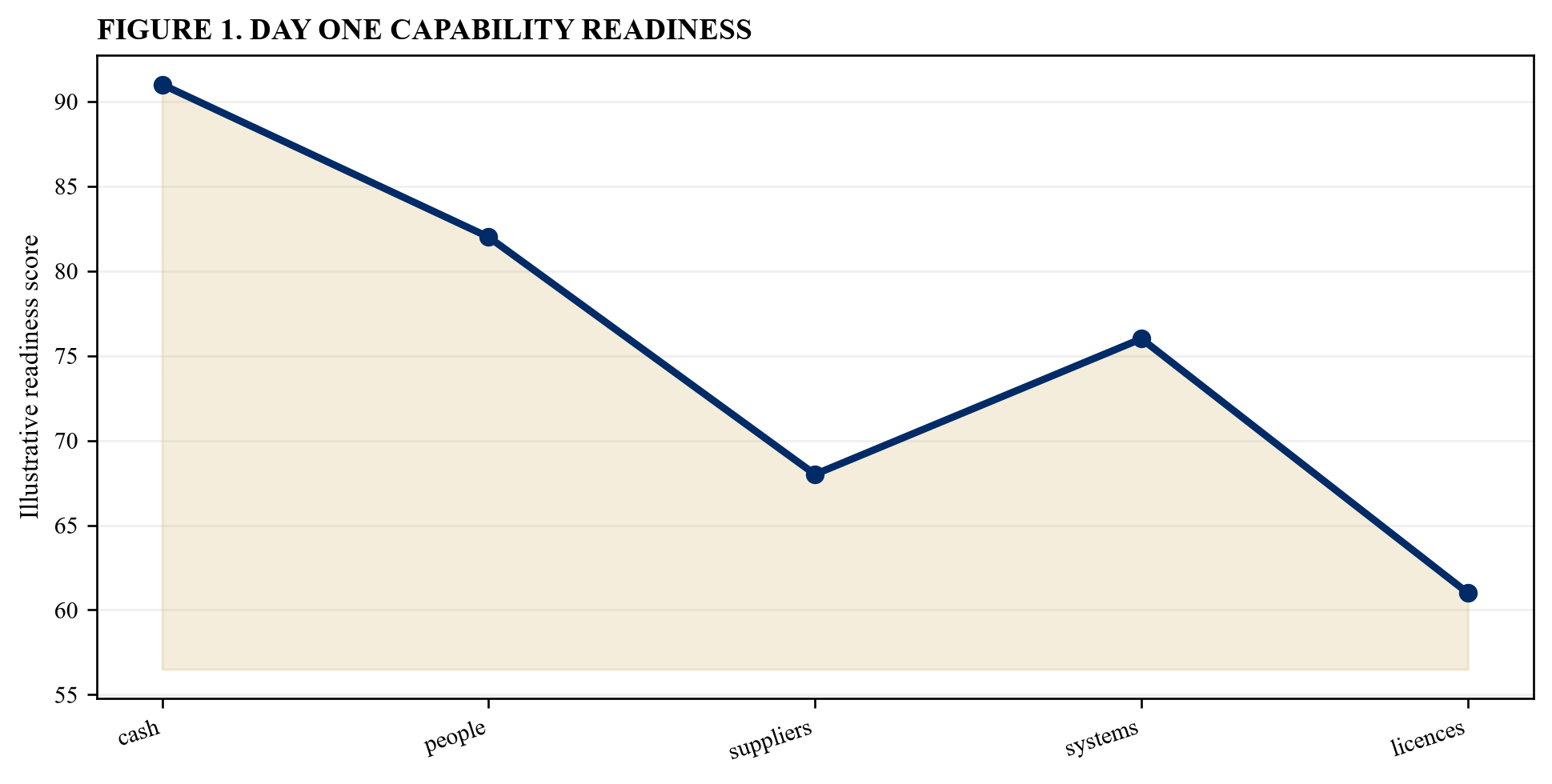
Illustrative analytical scenario; transaction evidence should replace model values.
5. Establish liquidity through the first stable cycle
The transaction team should forecast receipts, payroll, supplier cures, utilities, rent, tax, inventory, capex and contingency by day and legal entity. Evidence should come from thirteen-week cash flow, bank statements, aged balances, commitments, funding agreements and downside cases. The controlling question is how much committed accessible liquidity keeps the acquired business trading. The answer should be dated, attributed and linked to the legal entity, asset, liability or operating dependency it describes [5][39][40][139].
The controlled output is a legal-entity liquidity runway and sources-and-uses model. It should state the source, calculation method, owner, exceptions, required approvals and the next irreversible deadline. This allows a board, officeholder, creditor or buyer to reproduce the conclusion when facts change.
The principal risk is that purchase consideration can consume the cash needed to survive the first operating cycle. The team should quantify the effect on liquidity, stand-alone earnings, creditor recoveries, operating continuity and completion probability. A material exception should update the perimeter and funding plan.
6. Secure bank accounts payment rails and collection control
This workstream requires the company and its advisers to verify account ownership, mandates, security, sweeps, merchant acquiring, direct debits, cash pooling and new signing authority, using bank confirmations, mandates, facilities, gateway contracts, statements and test transactions. The practical test is whether the buyer can receive, protect and pay cash from opening time. Analysis should use one cut-off date so that cash, claims, contracts, people and transaction documents reconcile [37][38][39][127].
Decision-makers should maintain a bank-control and payment-rail readiness schedule. It should distinguish legal ownership from economic allocation, current evidence from forecast assumptions and committed funding from indications. Qualified advisers retain responsibility for legal, insolvency, tax, pensions, accounting and regulatory judgements.
Execution can fail when reported cash and customer payments may remain outside buyer control. Each dependency needs a control, evidence threshold, escalation route and decision time. The transaction remains viable only while the funded separation plan can absorb a credible delay or shortfall.
7. Design opening cash controls
The readiness team should set payment authority, emergency limits, dual control, fraud checks, daily reconciliation and escalation for the transition period. The evidence base includes delegations, bank roles, payment files, vendor master, controls testing and insurance requirements. The central question is how urgent payments are made without weakening cash protection. Conclusions should remain at entity and dependency level because the failing group may have pooled cash, shared rights and cross-guarantees [24][38][39][108].
The required deliverable is an opening treasury-control protocol. It should connect the proposed sale documents to the stand-alone operating model and the residual estate. Every material assumption should show its source and sensitivity.
The downside is that distress and cutover pressure can increase payment error and fraud exposure. Management should test the base case and a combined downside against minimum cash, customer continuity and the completion timetable. Unsupported benefits should not be treated as available funding.
8. Fund payroll and employment obligations
The seller should reconcile employer, payroll population, pay date, bank file, deductions, benefits, arrears and funding source. Relevant evidence includes HRIS, payroll, contracts, bank files, tax data, employee claims and finance forecast. The decision asks whether every transferring or retained worker can be paid accurately and on time. A reliable answer links financial analysis to title, transfer mechanics, operating capability and the applicable approval process [54][55][56][140].
The decision pack should contain a payroll funding and execution certificate. It should show calculation dates, owners, dependencies and the documents that implement the conclusion. This creates a defensible record for later scrutiny and post-completion reconciliation.
A material failure occurs when a missed or incorrect payroll can trigger immediate capability loss and legal claims. The response should identify a funded cure, alternative perimeter or fallback route. Continuing without one can reduce going-concern value and creditor recovery.
9. Retain critical people and decision authority
The transaction team should identify roles whose absence stops safety, systems, customer service, cash, production or regulated activity and confirm their authority. Evidence should come from organisation charts, role maps, licences, rosters, retention terms, access logs and interviews. The controlling question is who must be present and empowered during the first trading week. The answer should be dated, attributed and linked to the legal entity, asset, liability or operating dependency it describes [54][56][139][140].
The controlled output is a critical-role retention and authority plan. It should state the source, calculation method, owner, exceptions, required approvals and the next irreversible deadline. This allows a board, officeholder, creditor or buyer to reproduce the conclusion when facts change.
The principal risk is that headcount retention can mask the departure or disempowerment of indispensable individuals. The team should quantify the effect on liquidity, stand-alone earnings, creditor recoveries, operating continuity and completion probability. A material exception should update the perimeter and funding plan.
10. Apply workforce transfer and consultation requirements
This workstream requires the company and its advisers to analyse employee transfer, information, consultation, insolvency exceptions and proposed changes for the chosen route, using worker lists, contracts, process evidence, consultation records, legal advice and government guidance. The practical test is which employees and obligations transfer and what actions are required before and after closing. Analysis should use one cut-off date so that cash, claims, contracts, people and transaction documents reconcile [54][55][112][140].
Decision-makers should maintain a lawful workforce-transfer implementation plan. It should distinguish legal ownership from economic allocation, current evidence from forecast assumptions and committed funding from indications. Qualified advisers retain responsibility for legal, insolvency, tax, pensions, accounting and regulatory judgements.
Execution can fail when incorrect assumptions can create claims, delay and loss of trust or capability. Each dependency needs a control, evidence threshold, escalation route and decision time. The transaction remains viable only while the funded separation plan can absorb a credible delay or shortfall.
11. Rank suppliers by continuity criticality
The readiness team should score vendors by operational impact, substitutability, lead time, arrears, contract rights, concentration and information-system dependence. The evidence base includes aged payables, purchase data, contracts, stock, production plan, supplier communications and site evidence. The central question is which suppliers can stop trading within hours or days. Conclusions should remain at entity and dependency level because the failing group may have pooled cash, shared rights and cross-guarantees [48][49][50][139].
The required deliverable is a critical-supplier heat map. It should connect the proposed sale documents to the stand-alone operating model and the residual estate. Every material assumption should show its source and sensitivity.
The downside is that small suppliers or service providers can control disproportionately large revenue flows. Management should test the base case and a combined downside against minimum cash, customer continuity and the completion timetable. Unsupported benefits should not be treated as available funding.
Table 2. Illustrative supplier criticality
| Supplier | Hours to impact | Substitutability | Readiness score |
|---|---|---|---|
| power and utilities | 2 | low | 95 |
| cloud platform | 4 | low | 88 |
| primary logistics | 12 | medium | 74 |
| packaging | 48 | high | 61 |
Values and scores are analytical scenarios; transaction evidence should replace model values.
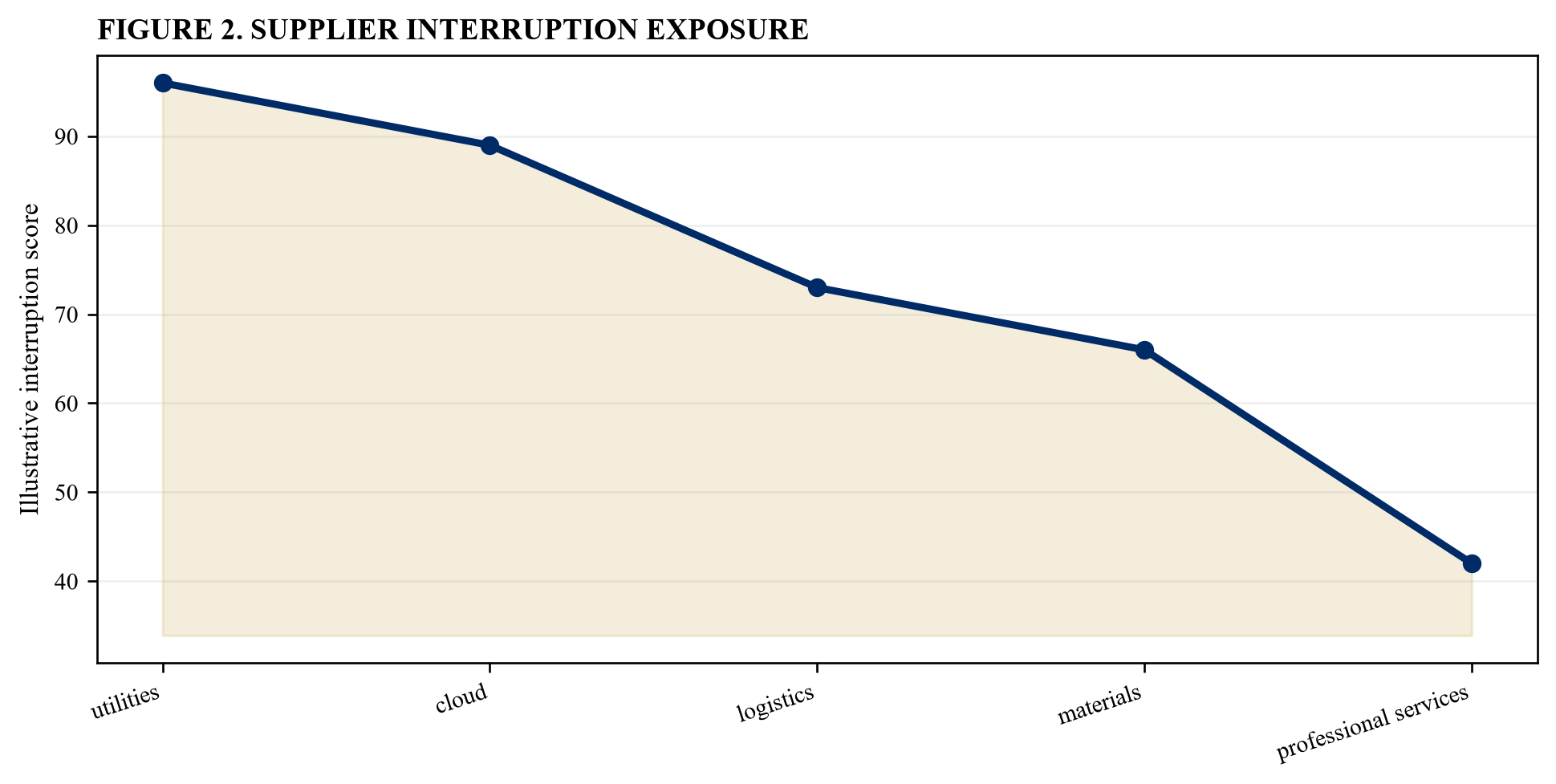
Illustrative analytical scenario; transaction evidence should replace model values.
12. Negotiate supplier cures and new terms
The seller should determine arrears, retention-of-title, set-off, deposits, price changes, shortened terms and the evidence required to resume supply. Relevant evidence includes supplier statements, contracts, invoices, correspondence, stock ownership and funded cure model. The decision asks what payment or agreement delivers reliable continuity. A reliable answer links financial analysis to title, transfer mechanics, operating capability and the applicable approval process [48][49][111][139].
The decision pack should contain a supplier cure and confirmation schedule. It should show calculation dates, owners, dependencies and the documents that implement the conclusion. This creates a defensible record for later scrutiny and post-completion reconciliation.
A material failure occurs when cash may be paid without securing future supply or release of claimed goods. The response should identify a funded cure, alternative perimeter or fallback route. Continuing without one can reduce going-concern value and creditor recovery.
13. Secure utilities and essential site services
The transaction team should identify electricity, water, gas, telecoms, waste, security, maintenance and other services required at every location. Evidence should come from utility contracts, account status, meters, arrears, service notices, deposits and provider confirmations. The controlling question is whether each service remains live or can be transferred and funded. The answer should be dated, attributed and linked to the legal entity, asset, liability or operating dependency it describes [139][143][144][148].
The controlled output is a utility continuity and fallback plan. It should state the source, calculation method, owner, exceptions, required approvals and the next irreversible deadline. This allows a board, officeholder, creditor or buyer to reproduce the conclusion when facts change.
The principal risk is that loss of a basic service can close an otherwise viable site immediately. The team should quantify the effect on liquidity, stand-alone earnings, creditor recoveries, operating continuity and completion probability. A material exception should update the perimeter and funding plan.
14. Confirm premises access and operating rights
This workstream requires the company and its advisers to verify title or occupation right, landlord consent, keys, security, access hours, rent cure, deposits and health-and-safety control, using leases, licences, title records, landlord correspondence, access records, inspection and insurance. The practical test is whether staff, customers and suppliers can lawfully and physically use each site. Analysis should use one cut-off date so that cash, claims, contracts, people and transaction documents reconcile [90][118][121][128].
Decision-makers should maintain a premises access and occupancy certificate. It should distinguish legal ownership from economic allocation, current evidence from forecast assumptions and committed funding from indications. Qualified advisers retain responsibility for legal, insolvency, tax, pensions, accounting and regulatory judgements.
Execution can fail when the buyer can acquire assets while lacking secure access to the premises containing them. Each dependency needs a control, evidence threshold, escalation route and decision time. The transaction remains viable only while the funded separation plan can absorb a credible delay or shortfall.
15. Transfer licences permits and regulated permissions
The readiness team should inventory holder entity, scope, conditions, arrears, breaches, transfer route, approval timing and interim arrangements. The evidence base includes official registers, licences, applications, regulator correspondence, compliance files and specialist advice. The central question is whether each regulated activity can continue after completion. Conclusions should remain at entity and dependency level because the failing group may have pooled cash, shared rights and cross-guarantees [66][67][68][145].
The required deliverable is a permission-transfer critical path. It should connect the proposed sale documents to the stand-alone operating model and the residual estate. Every material assumption should show its source and sensitivity.
The downside is that trading can become unlawful even where assets, staff and customers are present. Management should test the base case and a combined downside against minimum cash, customer continuity and the completion timetable. Unsupported benefits should not be treated as available funding.
16. Create lawful interim operating arrangements
The seller should design transition, agency, subcontract, licensed-service or temporary-authority structures where permanent permissions cannot move by Day One. Relevant evidence includes regulatory advice, signed agreements, controls, insurance, pricing and exit milestones. The decision asks what authorised bridge supports continuity without obscuring responsibility. A reliable answer links financial analysis to title, transfer mechanics, operating capability and the applicable approval process [66][67][145][147].
The decision pack should contain an interim operating arrangement with clear controls and expiry. It should show calculation dates, owners, dependencies and the documents that implement the conclusion. This creates a defensible record for later scrutiny and post-completion reconciliation.
A material failure occurs when informal workarounds can create unlicensed activity, liability and weak customer accountability. The response should identify a funded cure, alternative perimeter or fallback route. Continuing without one can reduce going-concern value and creditor recovery.
17. Protect customer service continuity
The transaction team should map enquiry, order, onboarding, fulfilment, billing, complaints, refunds, warranties and incident response across the cutover. Evidence should come from journey maps, service levels, contact channels, case queues, staffing, systems and customer data. The controlling question is whether a customer can complete every essential interaction from opening time. The answer should be dated, attributed and linked to the legal entity, asset, liability or operating dependency it describes [45][46][47][139].
The controlled output is a Day One customer-service operating script. It should state the source, calculation method, owner, exceptions, required approvals and the next irreversible deadline. This allows a board, officeholder, creditor or buyer to reproduce the conclusion when facts change.
The principal risk is that revenue can deteriorate quickly when customers cannot place orders or receive support. The team should quantify the effect on liquidity, stand-alone earnings, creditor recoveries, operating continuity and completion probability. A material exception should update the perimeter and funding plan.
18. Sequence customer and stakeholder communications
This workstream requires the company and its advisers to identify who must be told what, when and through which approved channel without creating misleading assurances, using sale documents, disclosure obligations, customer segments, scripts, approvals and contingency scenarios. The practical test is which communication protects trust and guides action during the transition. Analysis should use one cut-off date so that cash, claims, contracts, people and transaction documents reconcile [48][84][139][148].
Decision-makers should maintain an authorised stakeholder communication plan. It should distinguish legal ownership from economic allocation, current evidence from forecast assumptions and committed funding from indications. Qualified advisers retain responsibility for legal, insolvency, tax, pensions, accounting and regulatory judgements.
Execution can fail when silence, inconsistency or premature claims can accelerate churn and disputes. Each dependency needs a control, evidence threshold, escalation route and decision time. The transaction remains viable only while the funded separation plan can absorb a credible delay or shortfall.
19. Keep order-to-cash operating
The readiness team should test pricing, quotation, order acceptance, credit approval, fulfilment, invoicing, tax, collections, refunds and reconciliation. The evidence base includes process records, system tests, contracts, bank data, tax rules and sample transactions. The central question is whether a complete revenue and cash cycle works in the buyer-controlled environment. Conclusions should remain at entity and dependency level because the failing group may have pooled cash, shared rights and cross-guarantees [17][45][46][141].
The required deliverable is an end-to-end order-to-cash test certificate. It should connect the proposed sale documents to the stand-alone operating model and the residual estate. Every material assumption should show its source and sensitivity.
The downside is that individual systems can function while the full commercial process fails at an interface. Management should test the base case and a combined downside against minimum cash, customer continuity and the completion timetable. Unsupported benefits should not be treated as available funding.
20. Verify inventory availability and ownership
The seller should reconcile quantity, condition, location, reservation, title, retention claims, consignment and release rights. Relevant evidence includes counts, warehouse records, supplier terms, invoices, custody agreements, confirmations and inspection. The decision asks what stock the buyer can lawfully access and use to serve customers. A reliable answer links financial analysis to title, transfer mechanics, operating capability and the applicable approval process [51][111][129][130].
The decision pack should contain an available-to-promise inventory bridge. It should show calculation dates, owners, dependencies and the documents that implement the conclusion. This creates a defensible record for later scrutiny and post-completion reconciliation.
A material failure occurs when book stock can include inaccessible, damaged or third-party goods. The response should identify a funded cure, alternative perimeter or fallback route. Continuing without one can reduce going-concern value and creditor recovery.
21. Keep logistics and fulfilment routes live
The transaction team should confirm carriers, warehouses, customs, ports, couriers, fleet, route permits, fuel, payment terms and system integrations. Evidence should come from contracts, bookings, licences, customs records, tracking, capacity data and provider confirmations. The controlling question is whether goods or services can move through each critical route. The answer should be dated, attributed and linked to the legal entity, asset, liability or operating dependency it describes [48][65][68][139].
The controlled output is a logistics continuity and fallback map. It should state the source, calculation method, owner, exceptions, required approvals and the next irreversible deadline. This allows a board, officeholder, creditor or buyer to reproduce the conclusion when facts change.
The principal risk is that inventory and orders have little value when fulfilment routes are suspended or unpaid. The team should quantify the effect on liquidity, stand-alone earnings, creditor recoveries, operating continuity and completion probability. A material exception should update the perimeter and funding plan.
22. Map the technology estate and operating ownership
This workstream requires the company and its advisers to inventory applications, infrastructure, devices, networks, cloud, domains, source code, licences, support and data interfaces by owner, using architecture, contracts, asset records, configuration exports, invoices, repositories and technical interviews. The practical test is which technology capability remains available and controlled after closing. Analysis should use one cut-off date so that cash, claims, contracts, people and transaction documents reconcile [20][80][81][82].
Decision-makers should maintain a technology ownership and dependency map. It should distinguish legal ownership from economic allocation, current evidence from forecast assumptions and committed funding from indications. Qualified advisers retain responsibility for legal, insolvency, tax, pensions, accounting and regulatory judgements.
Execution can fail when systems can sit with affiliates, founders or providers outside the sale perimeter. Each dependency needs a control, evidence threshold, escalation route and decision time. The transaction remains viable only while the funded separation plan can absorb a credible delay or shortfall.
23. Transfer identity access and privileged control
The readiness team should verify user populations, administrators, service accounts, authentication, certificates, encryption keys, domain control and emergency access. The evidence base includes identity exports, role matrices, privileged-access logs, key inventories, technical tests and sign-off. The central question is whether authorised buyer personnel can operate and recover every critical system. Conclusions should remain at entity and dependency level because the failing group may have pooled cash, shared rights and cross-guarantees [80][81][82][142].
The required deliverable is an access-transfer and privileged-control certificate. It should connect the proposed sale documents to the stand-alone operating model and the residual estate. Every material assumption should show its source and sensitivity.
The downside is that legal ownership without credentials can leave the business unable to operate or recover. Management should test the base case and a combined downside against minimum cash, customer continuity and the completion timetable. Unsupported benefits should not be treated as available funding.
Table 3. Systems cutover evidence
| Control | Evidence | Owner | Fallback |
|---|---|---|---|
| identity | admin test and role export | technology lead | break-glass account |
| payments | signed test transaction | treasury lead | controlled manual run |
| orders | end-to-end sample | commercial lead | approved order log |
| recovery | restore test | security lead | isolated recovery environment |
Values and scores are analytical scenarios; transaction evidence should replace model values.
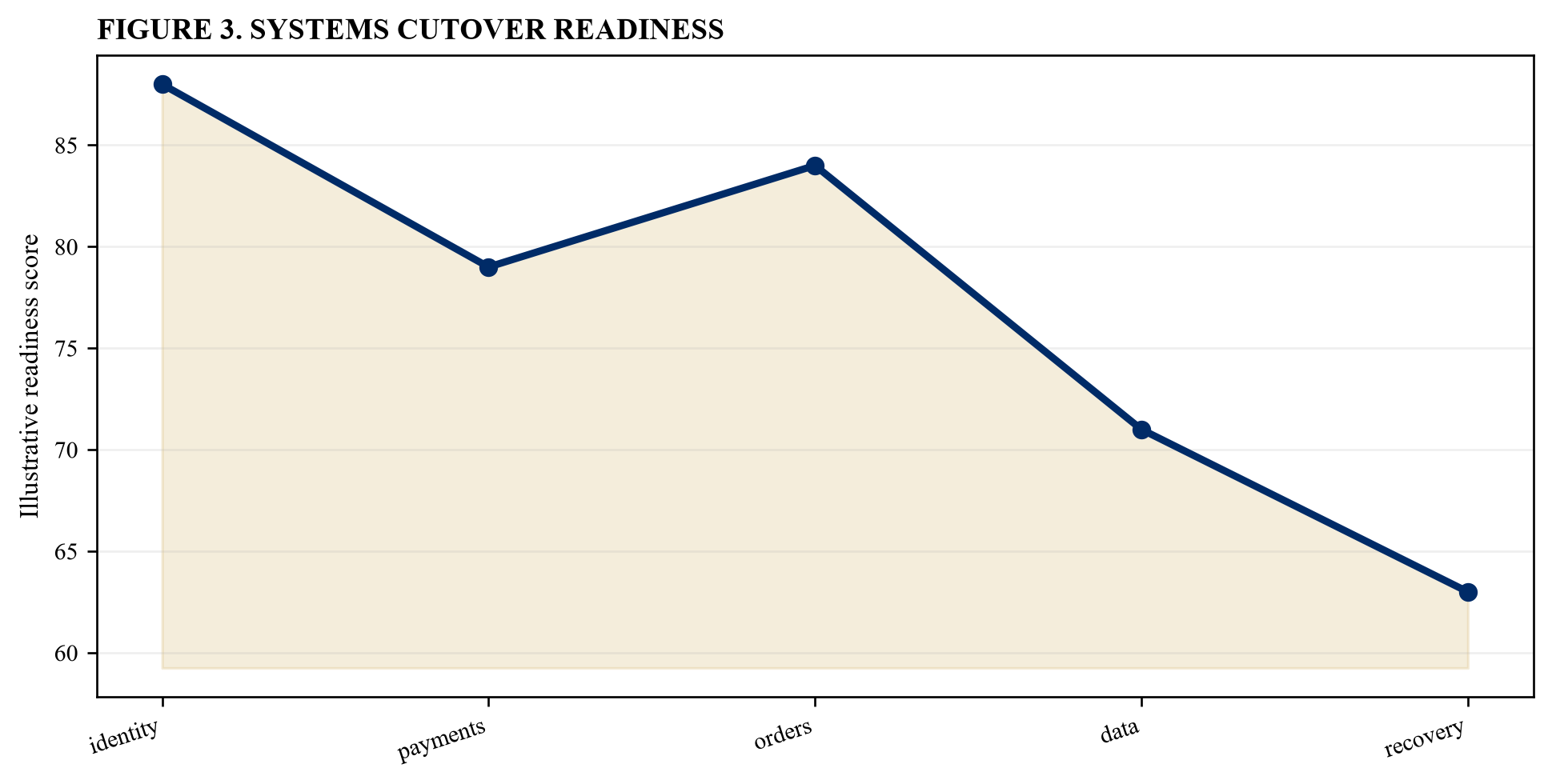
Illustrative analytical scenario; transaction evidence should replace model values.
24. Establish cybersecurity and incident readiness
The seller should identify active incidents, vulnerabilities, monitoring, backups, security tooling, responders, notifications and containment authority. Relevant evidence includes incident logs, scans, contracts, backup tests, access data, insurance and response plans. The decision asks whether the acquired environment can detect, contain and recover from a cyber event. A reliable answer links financial analysis to title, transfer mechanics, operating capability and the applicable approval process [80][81][88][142].
The decision pack should contain a Day One cyber defence and incident protocol. It should show calculation dates, owners, dependencies and the documents that implement the conclusion. This creates a defensible record for later scrutiny and post-completion reconciliation.
A material failure occurs when distress and hurried access changes can widen attack paths and delay response. The response should identify a funded cure, alternative perimeter or fallback route. Continuing without one can reduce going-concern value and creditor recovery.
25. Transfer data lawfully and securely
The transaction team should confirm controller roles, purposes, lawful basis, notices, retention, transfer restrictions, data quality and security for acquired data. Evidence should come from data maps, privacy notices, records of processing, contracts, consent records, access logs and advice. The controlling question is what data can be transferred and used for each post-close purpose. The answer should be dated, attributed and linked to the legal entity, asset, liability or operating dependency it describes [83][84][85][141].
The controlled output is a lawful data-transfer and governance plan. It should state the source, calculation method, owner, exceptions, required approvals and the next irreversible deadline. This allows a board, officeholder, creditor or buyer to reproduce the conclusion when facts change.
The principal risk is that the buyer can inherit operational dependence on data it cannot lawfully or reliably use. The team should quantify the effect on liquidity, stand-alone earnings, creditor recoveries, operating continuity and completion probability. A material exception should update the perimeter and funding plan.
26. Secure cloud and technology vendors
This workstream requires the company and its advisers to verify tenant ownership, subscriptions, arrears, service levels, assignment, support, renewal, data export and exit rights, using vendor contracts, billing records, account consoles, support tickets, architecture and confirmations. The practical test is which external technology services remain available through cutover. Analysis should use one cut-off date so that cash, claims, contracts, people and transaction documents reconcile [16][48][80][139].
Decision-makers should maintain a cloud-and-vendor continuity schedule. It should distinguish legal ownership from economic allocation, current evidence from forecast assumptions and committed funding from indications. Qualified advisers retain responsibility for legal, insolvency, tax, pensions, accounting and regulatory judgements.
Execution can fail when a low-value unpaid subscription can disable a critical commercial process. Each dependency needs a control, evidence threshold, escalation route and decision time. The transaction remains viable only while the funded separation plan can absorb a credible delay or shortfall.
27. Design transition services with executable detail
The readiness team should define each temporary service, input, output, volume, standard, access right, cost, duration, dependency, governance and exit test. The evidence base includes separation plan, service inventory, agreements, cost model, system map and operating procedures. The central question is what the seller or affiliate must provide until the buyer stands alone. Conclusions should remain at entity and dependency level because the failing group may have pooled cash, shared rights and cross-guarantees [14][15][16][103].
The required deliverable is an executable transition-services agreement and exit plan. It should connect the proposed sale documents to the stand-alone operating model and the residual estate. Every material assumption should show its source and sensitivity.
The downside is that broad service labels can conceal missing inputs, weak accountability and indefinite dependence. Management should test the base case and a combined downside against minimum cash, customer continuity and the completion timetable. Unsupported benefits should not be treated as available funding.
28. Control other third-party dependencies
The seller should capture outsourced operations, advisers, agents, distributors, franchisees, payment processors, data providers and critical subcontractors. Relevant evidence includes contracts, invoices, performance data, access rights, compliance records and confirmations. The decision asks which external relationships must transfer, consent, continue or be replaced. A reliable answer links financial analysis to title, transfer mechanics, operating capability and the applicable approval process [47][48][68][139].
The decision pack should contain a third-party continuity and consent matrix. It should show calculation dates, owners, dependencies and the documents that implement the conclusion. This creates a defensible record for later scrutiny and post-completion reconciliation.
A material failure occurs when unmapped counterparties can interrupt a process after all visible assets transfer. The response should identify a funded cure, alternative perimeter or fallback route. Continuing without one can reduce going-concern value and creditor recovery.
29. Confirm insurance and claims continuity
The transaction team should verify policyholder, insured entities, assets, activities, limits, exclusions, premiums, notifications, run-off and claims control. Evidence should come from policies, endorsements, broker confirmations, claims history, payment evidence and advice. The controlling question is what cover applies before, during and after completion. The answer should be dated, attributed and linked to the legal entity, asset, liability or operating dependency it describes [99][100][101][102].
The controlled output is an insurance continuity and claims-control schedule. It should state the source, calculation method, owner, exceptions, required approvals and the next irreversible deadline. This allows a board, officeholder, creditor or buyer to reproduce the conclusion when facts change.
The principal risk is that gaps in insured entity, period or activity can leave immediate exposures unfunded. The team should quantify the effect on liquidity, stand-alone earnings, creditor recoveries, operating continuity and completion probability. A material exception should update the perimeter and funding plan.
30. Control health safety and environmental obligations
This workstream requires the company and its advisers to identify responsible entity, competent people, permits, hazardous activities, maintenance, incidents, emergency plans and regulator directions, using risk assessments, permits, inspection records, training, site evidence, incident logs and specialist reports. The practical test is whether every site and activity can operate safely and lawfully on Day One. Analysis should use one cut-off date so that cash, claims, contracts, people and transaction documents reconcile [92][93][94][146].
Decision-makers should maintain a safety-and-environment opening certificate. It should distinguish legal ownership from economic allocation, current evidence from forecast assumptions and committed funding from indications. Qualified advisers retain responsibility for legal, insolvency, tax, pensions, accounting and regulatory judgements.
Execution can fail when commercial urgency can expose workers, customers, directors and the environment to uncontrolled harm. Each dependency needs a control, evidence threshold, escalation route and decision time. The transaction remains viable only while the funded separation plan can absorb a credible delay or shortfall.
31. Open financial reporting tax and compliance controls
The readiness team should establish opening balances, accounting systems, invoice rules, tax registrations, payroll reporting, delegations and regulatory reporting. The evidence base includes completion accounts, ledgers, registrations, control matrices, calendars and adviser confirmations. The central question is whether transactions are recorded, taxed, approved and reported from the first day. Conclusions should remain at entity and dependency level because the failing group may have pooled cash, shared rights and cross-guarantees [17][24][62][108].
The required deliverable is an opening finance and compliance control pack. It should connect the proposed sale documents to the stand-alone operating model and the residual estate. Every material assumption should show its source and sensitivity.
The downside is that trading can continue while errors accumulate into cash, tax and regulatory failures. Management should test the base case and a combined downside against minimum cash, customer continuity and the completion timetable. Unsupported benefits should not be treated as available funding.
32. Create the Day One command centre
The seller should set decision rights, meeting cadence, workstream leads, information standards, issue severity, communication channels and executive escalation. Relevant evidence includes governance charter, contact directory, dashboards, cutover plan and rehearsals. The decision asks who decides and coordinates when a dependency fails. A reliable answer links financial analysis to title, transfer mechanics, operating capability and the applicable approval process [15][16][108][148].
The decision pack should contain an authorised operational command-centre protocol. It should show calculation dates, owners, dependencies and the documents that implement the conclusion. This creates a defensible record for later scrutiny and post-completion reconciliation.
A material failure occurs when fast-moving issues can remain ownerless or receive contradictory responses. The response should identify a funded cure, alternative perimeter or fallback route. Continuing without one can reduce going-concern value and creditor recovery.
33. Build the continuity exception register
The transaction team should record each missing, adverse or contradictory item with impact, probability, owner, deadline, evidence threshold, remedy and escalation. Evidence should come from dependency map, tests, adviser reports, Q and A, confirmations and readiness reviews. The controlling question is which gaps can be cured, funded, worked around or must stop completion. The answer should be dated, attributed and linked to the legal entity, asset, liability or operating dependency it describes [108][139][148][149].
The controlled output is an authorised continuity exception register. It should state the source, calculation method, owner, exceptions, required approvals and the next irreversible deadline. This allows a board, officeholder, creditor or buyer to reproduce the conclusion when facts change.
The principal risk is that open issues can disappear inside email traffic and broad workstream status reports. The team should quantify the effect on liquidity, stand-alone earnings, creditor recoveries, operating continuity and completion probability. A material exception should update the perimeter and funding plan.
34. Model downside interruption and recovery
This workstream requires the company and its advisers to quantify revenue delay, margin loss, cure cash, replacement cost, customer churn, restart time and liquidity impact under credible failures, using cash model, service data, supplier terms, system recovery tests, customer evidence and scenarios. The practical test is how much financial and operating resilience the transaction requires. Analysis should use one cut-off date so that cash, claims, contracts, people and transaction documents reconcile [5][40][142][148].
Decision-makers should maintain a probability-weighted continuity downside model. It should distinguish legal ownership from economic allocation, current evidence from forecast assumptions and committed funding from indications. Qualified advisers retain responsibility for legal, insolvency, tax, pensions, accounting and regulatory judgements.
Execution can fail when a base case can assume simultaneous success across fragile dependencies. Each dependency needs a control, evidence threshold, escalation route and decision time. The transaction remains viable only while the funded separation plan can absorb a credible delay or shortfall.
35. Compare bids after continuity adjustments
The readiness team should bridge headline price through cure, working capital, replacement, transition, downtime, contingency and completion probability using common definitions. The evidence base includes bid terms, continuity map, funding evidence, timetable, service plans and downside model. The central question is which bid delivers the highest reliable net value and operational viability. Conclusions should remain at entity and dependency level because the failing group may have pooled cash, shared rights and cross-guarantees [12][17][40][139].
The required deliverable is a continuity-adjusted bid comparison. It should connect the proposed sale documents to the stand-alone operating model and the residual estate. Every material assumption should show its source and sensitivity.
The downside is that the highest offer can produce the lowest recovery when operational funding and execution are weak. Management should test the base case and a combined downside against minimum cash, customer continuity and the completion timetable. Unsupported benefits should not be treated as available funding.
Table 4. Illustrative continuity-adjusted bid bridge
| Measure | Bid A | Bid B | Bid C |
|---|---|---|---|
| headline price | 120 | 114 | 108 |
| cures and working capital | -22 | -14 | -9 |
| transition and downtime | -13 | -7 | -4 |
| probability-weighted net value | 64 | 77 | 84 |
Values and scores are analytical scenarios; transaction evidence should replace model values.
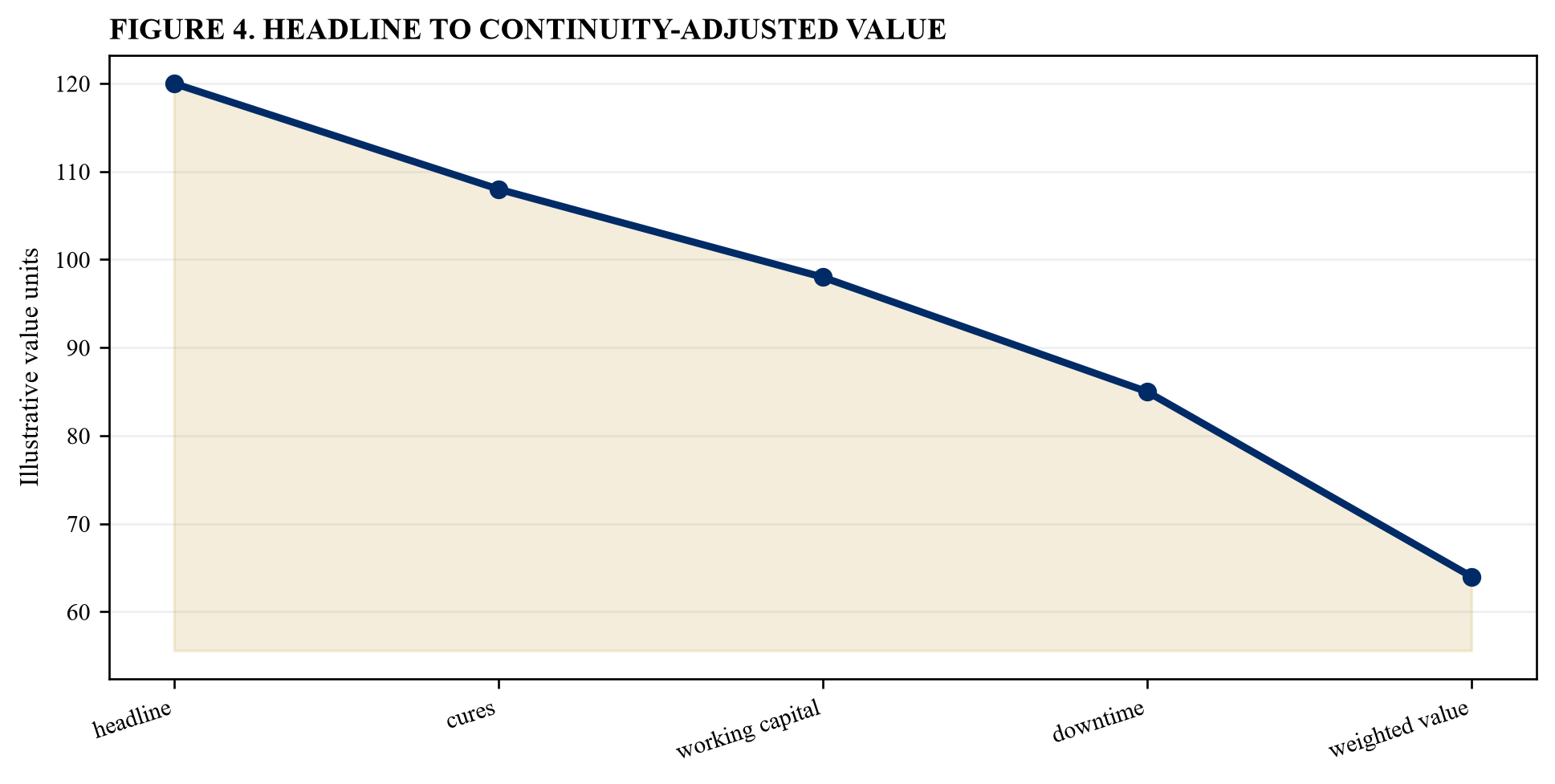
Illustrative analytical scenario; transaction evidence should replace model values.
36. Convert readiness gaps into closing conditions
The seller should match each critical gap to a condition, direct payment, consent, transition service, retention, escrow, holdback, covenant or walk right. Relevant evidence includes exception register, legal advice, negotiation log, funding model and counterparty evidence. The decision asks what must be true or funded before ownership changes. A reliable answer links financial analysis to title, transfer mechanics, operating capability and the applicable approval process [14][23][105][106].
The decision pack should contain a readiness-to-protection matrix linked to transaction documents. It should show calculation dates, owners, dependencies and the documents that implement the conclusion. This creates a defensible record for later scrutiny and post-completion reconciliation.
A material failure occurs when generic warranties may provide little practical protection during distress. The response should identify a funded cure, alternative perimeter or fallback route. Continuing without one can reduce going-concern value and creditor recovery.
37. Build the hour-by-hour Day One playbook
The transaction team should sequence completion, control transfers, bank actions, communications, access changes, supplier confirmations, system tests and customer operations. Evidence should come from signed completion documents, cutover checklist, rosters, contact tree, scripts and fallback procedures. The controlling question is what happens from the last pre-close hour through the first end-of-day reconciliation. The answer should be dated, attributed and linked to the legal entity, asset, liability or operating dependency it describes [15][16][107][148].
The controlled output is an executable Day One cutover plan. It should state the source, calculation method, owner, exceptions, required approvals and the next irreversible deadline. This allows a board, officeholder, creditor or buyer to reproduce the conclusion when facts change.
The principal risk is that a list of tasks without timing and dependencies can fail at hand-offs. The team should quantify the effect on liquidity, stand-alone earnings, creditor recoveries, operating continuity and completion probability. A material exception should update the perimeter and funding plan.
38. Run the first seventy-two hours as a controlled stabilisation
This workstream requires the company and its advisers to monitor cash, payroll, orders, fulfilment, service levels, suppliers, systems, incidents and workforce sentiment at high frequency, using daily cash, operating dashboards, issue log, customer contacts, technical monitoring and leadership reviews. The practical test is which early signals require intervention before they become business interruption. Analysis should use one cut-off date so that cash, claims, contracts, people and transaction documents reconcile [5][16][139][142].
Decision-makers should maintain a seventy-two-hour stabilisation dashboard. It should distinguish legal ownership from economic allocation, current evidence from forecast assumptions and committed funding from indications. Qualified advisers retain responsibility for legal, insolvency, tax, pensions, accounting and regulatory judgements.
Execution can fail when small variances can compound quickly while teams focus on completion celebrations. Each dependency needs a control, evidence threshold, escalation route and decision time. The transaction remains viable only while the funded separation plan can absorb a credible delay or shortfall.
39. Close stand-alone gaps through the first thirty days
The readiness team should complete consents, licences, vendor novations, access transfers, payroll, controls, data governance, insurance and priority system separation. The evidence base includes closure evidence, receipts, contracts, access tests, reconciliations, customer metrics and board reporting. The central question is which transitional dependencies remain and when each will close. Conclusions should remain at entity and dependency level because the failing group may have pooled cash, shared rights and cross-guarantees [15][16][108][141].
The required deliverable is a thirty-day stand-alone readiness plan. It should connect the proposed sale documents to the stand-alone operating model and the residual estate. Every material assumption should show its source and sensitivity.
The downside is that temporary arrangements can become expensive and risky permanent dependencies. Management should test the base case and a combined downside against minimum cash, customer continuity and the completion timetable. Unsupported benefits should not be treated as available funding.
40. Protect value through the first hundred days
The seller should link continuity closure to revenue retention, margin, cash conversion, customer trust, workforce stability and the investment case. Relevant evidence includes operating KPIs, cash forecast, customer data, transition costs, risk register and value plan. The decision asks whether the business has moved from survival to controlled value creation. A reliable answer links financial analysis to title, transfer mechanics, operating capability and the applicable approval process [15][40][108][148].
The decision pack should contain a hundred-day continuity and value-protection scorecard. It should show calculation dates, owners, dependencies and the documents that implement the conclusion. This creates a defensible record for later scrutiny and post-completion reconciliation.
A material failure occurs when issues can leave the command centre before their economic consequences are resolved. The response should identify a funded cure, alternative perimeter or fallback route. Continuing without one can reduce going-concern value and creditor recovery.
Table 5. Continuity control horizon
| Horizon | Priority | Evidence of control |
|---|---|---|
| pre-close | minimum perimeter and funding | signed readiness evidence |
| Day One | cutover and customer service | acceptance tests |
| 72 hours | stabilise cash and operations | high-frequency dashboard |
| 100 days | stand-alone value protection | closed dependencies and KPIs |
Values and scores are analytical scenarios; transaction evidence should replace model values.
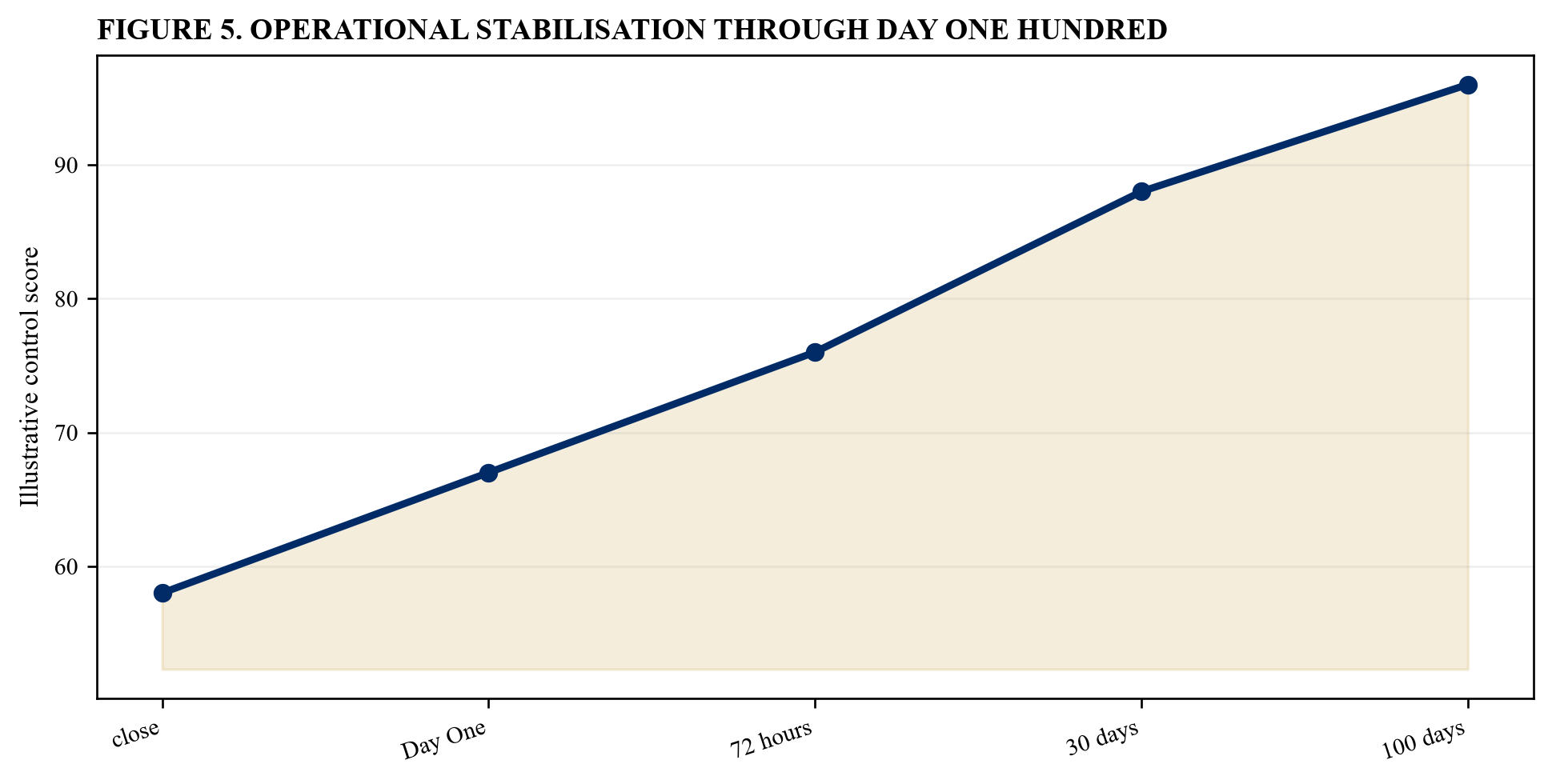
Illustrative analytical scenario; transaction evidence should replace model values.
References
- UK Parliament, Insolvency Act 1986, https://www.legislation.gov.uk/ukpga/1986/45/contents
- UK Parliament, Insolvency Rules 2016, https://www.legislation.gov.uk/uksi/2016/1024/contents
- UNCITRAL, Model Law on Enterprise Group Insolvency, https://uncitral.un.org/en/MLEGI
- World Bank, Principles for Effective Insolvency and Creditor Debtor Regimes, https://www.worldbank.org/en/brief/2026/02/24/the-world-bank-principles-for-effective-insolvency-and-creditor-rights
- UK Government, Corporate Financial Distress Guidance, https://www.gov.uk/government/publications/the-sourcing-and-consultancy-playbooks/corporate-financial-distress-guidance-note-html
- UK Insolvency Service, Spotting the Signs of Company Distress, https://www.gov.uk/guidance/director-information-hub-spotting-the-signs-of-company-distress
- UK Government, Put Your Company into Administration, https://www.gov.uk/put-your-company-into-administration
- UNCITRAL, Legislative Guide on Insolvency Law, https://uncitral.un.org/en/texts/insolvency/legislativeguides/insolvency_law
- UK Companies House, Search the Register, https://find-and-update.company-information.service.gov.uk/
- UK Parliament, Companies Act 2006, https://www.legislation.gov.uk/ukpga/2006/46/contents
- SEC, Search Filings, https://www.sec.gov/search-filings
- IFRS Foundation, IFRS 13 Fair Value Measurement, https://www.ifrs.org/issued-standards/list-of-standards/ifrs-13-fair-value-measurement/
- International Valuation Standards Council, Standards, https://www.ivsc.org/standards/
- ISO, ISO 9001 Quality Management, https://www.iso.org/standard/62085.html
- ISO, ISO 22301 Business Continuity, https://www.iso.org/standard/75106.html
- COSO, Internal Control Framework, https://www.coso.org/guidance-on-ic
- IFRS Foundation, IFRS Accounting Standards, https://www.ifrs.org/issued-standards/list-of-standards/
- PCAOB, Audit Evidence AS 1105, https://pcaobus.org/oversight/standards/auditing-standards/details/AS1105
- IAASB, International Standards on Auditing, https://www.iaasb.org/publications
- NIST, Digital Evidence and Forensics, https://www.nist.gov/programs-projects/digital-and-multimedia-forensics
- UK National Archives, Records Management, https://www.nationalarchives.gov.uk/information-management/
- ISO, ISO 15489 Records Management, https://www.iso.org/standard/62542.html
- UK Government, Managing Public Money, https://www.gov.uk/government/publications/managing-public-money
- US GAO, Standards for Internal Control, https://www.gao.gov/products/gao-14-704g
- UK Companies House, People with Significant Control, https://www.gov.uk/guidance/people-with-significant-control-pscs
- FATF, Beneficial Ownership of Legal Persons, https://www.fatf-gafi.org/en/publications/Fatfrecommendations/Guidance-Beneficial-Ownership-Legal-Persons.html
- FATF, Recommendations, https://www.fatf-gafi.org/en/publications/Fatfrecommendations/Fatf-recommendations.html
- UK Government, Director Responsibilities, https://www.gov.uk/company-director-responsibilities
- Delaware Code, General Corporation Law, https://delcode.delaware.gov/title8/c001/
- WIPO, Intellectual Property and Business, https://www.wipo.int/sme/en/
- HM Land Registry, Search the Register, https://www.gov.uk/get-information-about-property-and-land/search-the-register
- HM Land Registry, How to Read a Title Register and Plan, https://www.gov.uk/government/publications/how-to-read-a-title-register-and-title-plan
- UK Companies House, Register a Charge, https://www.gov.uk/government/publications/register-particulars-of-a-charge-mr01
- US Code, Bankruptcy Code Section 506, https://uscode.house.gov/view.xhtml?req=granuleid:USC-prelim-title11-section506
- UNCITRAL, Model Law on Secured Transactions, https://uncitral.un.org/en/texts/securityinterests/modellaw/secured_transactions
- World Bank, Secured Transactions and Collateral Registries, https://www.worldbank.org/en/topic/financialsector/brief/collateral-registries
- FCA, Client Assets, https://www.fca.org.uk/firms/client-money-assets
- UK Finance, Confirmation of Payee, https://www.ukfinance.org.uk/policy-and-guidance/guidance/confirmation-payee
- Federal Reserve, Account Services, https://www.frbservices.org/financial-services/accounting
- IFRS Foundation, IAS 7 Statement of Cash Flows, https://www.ifrs.org/issued-standards/list-of-standards/ias-7-statement-of-cash-flows/
- UK Government, Cash Flow Forecasting Guidance, https://www.gov.uk/guidance/cash-flow-forecasting
- Loan Market Association, Documents and Guidelines, https://www.lma.eu.com/documents-guidelines/documents
- Federal Reserve, Supervision and Regulation, https://www.federalreserve.gov/supervisionreg.htm
- US Code, Bankruptcy Code Section 507, https://uscode.house.gov/view.xhtml?req=granuleid:USC-prelim-title11-section507
- IFRS Foundation, IFRS 15 Revenue, https://www.ifrs.org/issued-standards/list-of-standards/ifrs-15-revenue-from-contracts-with-customers/
- SEC, Revenue Recognition Staff Accounting Bulletin 116, https://www.sec.gov/files/sab116.pdf
- UK Parliament, Contracts Rights of Third Parties Act 1999, https://www.legislation.gov.uk/ukpga/1999/31/contents
- UNIDROIT, Principles of International Commercial Contracts, https://www.unidroit.org/instruments/commercial-contracts/unidroit-principles-2016/
- UK Government, Supplier Failure Contingency Planning, https://www.gov.uk/government/publications/corporate-financial-distress
- ISO, ISO 28000 Security and Resilience, https://www.iso.org/standard/79612.html
- IFRS Foundation, IAS 2 Inventories, https://www.ifrs.org/issued-standards/list-of-standards/ias-2-inventories/
- IFRS Foundation, IAS 1 Presentation of Financial Statements, https://www.ifrs.org/issued-standards/list-of-standards/ias-1-presentation-of-financial-statements/
- PCAOB, Auditing Inventories AS 2510, https://pcaobus.org/oversight/standards/auditing-standards/details/AS2510
- UK Parliament, Transfer of Undertakings Regulations 2006, https://www.legislation.gov.uk/uksi/2006/246/contents
- UK Government, Transfers of Employment Contracts, https://www.gov.uk/transfers-takeovers/transfers-of-employment-contracts
- US Department of Labor, WARN Act, https://www.dol.gov/agencies/eta/layoffs/warn
- UK Government, Right to Work Checks, https://www.gov.uk/check-job-applicant-right-to-work
- IFRS Foundation, IAS 19 Employee Benefits, https://www.ifrs.org/issued-standards/list-of-standards/ias-19-employee-benefits/
- The Pensions Regulator, Employers, https://www.thepensionsregulator.gov.uk/en/employers
- Pension Protection Fund, Section 179 Guidance, https://www.ppf.co.uk/section-179-valuation-guidance
- PBGC, Plan Terminations, https://www.pbgc.gov/employers-practitioners/plan-terminations
- UK Government, Corporation Tax, https://www.gov.uk/corporation-tax
- OECD, Transfer Pricing Guidelines, https://www.oecd.org/tax/transfer-pricing/oecd-transfer-pricing-guidelines-for-multinational-enterprises-and-tax-administrations-20769717.htm
- IRS, Businesses, https://www.irs.gov/businesses
- European Commission, Taxation and Customs, https://taxation-customs.ec.europa.eu/index_en
- FCA, Financial Services Register, https://register.fca.org.uk/
- FCA, Submit a Change in Control Notification, https://www.fca.org.uk/firms/change-control/submit-notification
- Ofgem, Licences and Licence Conditions, https://www.ofgem.gov.uk/energy-policy-and-regulation/industry-licensing
- Ofcom, Licensing, https://www.ofcom.org.uk/spectrum/frequencies/licensing/
- UK CMA, Merging Your Business, https://www.gov.uk/guidance/merging-your-business
- European Union, Council Regulation 139/2004, https://eur-lex.europa.eu/eli/reg/2004/139/oj
- UK Government, National Security and Investment Act Guidance, https://www.gov.uk/guidance/national-security-and-investment-act-guidance-on-acquisitions
- US Treasury, CFIUS Laws and Guidance, https://home.treasury.gov/policy-issues/international/the-committee-on-foreign-investment-in-the-united-states-cfius/cfius-laws-and-guidance
- UK Government, UK Sanctions List, https://www.gov.uk/government/publications/the-uk-sanctions-list
- OFAC, Sanctions Programs, https://ofac.treasury.gov/sanctions-programs-and-country-information
- FinCEN, Customer Due Diligence, https://www.fincen.gov/resources/statutes-and-regulations/cdd-final-rule
- WIPO, Global Brand Database, https://branddb.wipo.int/
- WIPO, PATENTSCOPE, https://patentscope.wipo.int/
- UK IPO, Search for a Patent, https://www.gov.uk/search-for-patent
- ISO, ISO IEC 25010 Systems and Software Quality, https://www.iso.org/standard/78176.html
- NIST, Cybersecurity Framework 2.0, https://www.nist.gov/cyberframework
- NIST, Secure Software Development Framework, https://csrc.nist.gov/Projects/ssdf
- CISA, Software Bill of Materials, https://www.cisa.gov/sbom
- ICO, Data Sharing Code of Practice, https://ico.org.uk/for-organisations/uk-gdpr-guidance-and-resources/data-sharing/data-sharing-a-code-of-practice/
- European Union, General Data Protection Regulation, https://eur-lex.europa.eu/eli/reg/2016/679/oj
- European Data Protection Board, Guidelines, https://www.edpb.europa.eu/our-work-tools/general-guidance/guidelines-recommendations-best-practices_en
- UK Parliament, Data Use and Access Act 2025, https://www.legislation.gov.uk/ukpga/2025/18/contents
- CISA, Cybersecurity Performance Goals, https://www.cisa.gov/cross-sector-cybersecurity-performance-goals
- NIST, Incident Response, https://csrc.nist.gov/pubs/sp/800/61/r3/final
- HM Land Registry, Official Copies, https://www.gov.uk/government/publications/official-copies-of-register-or-plan-registration-oc1
- UK Government, Commercial Property Standard Enquiries, https://www.gov.uk/government/publications/commercial-property-standard-enquiries
- UK Environment Agency, Environmental Permits, https://www.gov.uk/guidance/environmental-permits-how-to-apply
- US EPA, Environmental Permitting, https://www.epa.gov/permits
- UK HSE, Managing Risks and Risk Assessment, https://www.hse.gov.uk/simple-health-safety/risk/
- ISO, ISO 14001 Environmental Management, https://www.iso.org/standard/60857.html
- UK Courts and Tribunals, Find a Court or Tribunal, https://www.gov.uk/find-court-tribunal
- PACER, Public Access to Court Electronic Records, https://pacer.uscourts.gov/
- SEC, Enforcement, https://www.sec.gov/enforcement
- FCA, Insurance Conduct of Business Sourcebook, https://www.handbook.fca.org.uk/handbook/ICOBS/
- EIOPA, Solvency II, https://www.eiopa.europa.eu/browse/regulation-and-policy/solvency-ii_en
- NAIC, Insurance Topics, https://content.naic.org/insurance-topics
- UK Government, Employers Liability Insurance, https://www.gov.uk/employers-liability-insurance
- European Commission, Restructuring and Insolvency Directive, https://eur-lex.europa.eu/eli/dir/2019/1023/oj
- IFRS Foundation, IFRS 3 Business Combinations, https://www.ifrs.org/issued-standards/list-of-standards/ifrs-3-business-combinations/
- UK Parliament, Misrepresentation Act 1967, https://www.legislation.gov.uk/ukpga/1967/7/contents
- UK Parliament, Sale of Goods Act 1979, https://www.legislation.gov.uk/ukpga/1979/54/contents
- UK Law Society, Completion Code, https://www.lawsociety.org.uk/topics/property/completion-code
- ISO, ISO 37301 Compliance Management Systems, https://www.iso.org/standard/75080.html
- United States Code, 11 USC 363 Use Sale or Lease of Property, https://uscode.house.gov/view.xhtml?edition=prelim&num=0&req=granuleid%3AUSC-prelim-title11-section363
- Companies House, Register a Charge for a Limited Company, https://www.gov.uk/guidance/register-a-charge-mortgage-for-a-limited-company
- UNCITRAL, Legislative Guide on Secured Transactions, https://uncitral.un.org/en/texts/securityinterests/legislativeguides/secured_transactions
- UK Government, Business Transfers Takeovers and TUPE: Insolvent Businesses, https://www.gov.uk/transfers-takeovers/insolvent-businesses
- The Pensions Regulator, Clearance, https://www.thepensionsregulator.gov.uk/en/document-library/scheme-management-detailed-guidance/communications-and-reporting-detailed-guidance/clearance
- HM Revenue and Customs, Transfer of a Business as a Going Concern, https://www.gov.uk/guidance/insolvency-practitioner-s-handbook/18-transfer-of-a-business-as-a-going-concern
- HM Revenue and Customs, VAT Notice 700/9 Transfer of a Business as a Going Concern, https://www.gov.uk/guidance/transfer-a-business-as-a-going-concern-and-vat-notice-7009
- United States Environmental Protection Agency, Potentially Responsible Party Search Manual Chapter 3, https://www.epa.gov/sites/default/files/2017-10/documents/prp-man-chap3-17.pdf
- UK Insolvency Service, Requirements for Independent Scrutiny of Disposals in Administration, https://www.gov.uk/government/publications/requirements-for-independent-scrutiny-of-the-disposal-of-assets-in-administration-including-pre-pack-sales
- United States Code, 11 USC 365 Executory Contracts and Unexpired Leases, https://uscode.house.gov/view.xhtml?edition=prelim&num=0&req=granuleid%3AUSC-prelim-title11-section365
- The Pensions Regulator, Material Detriment Employer Insolvency and Employer Resources, https://www.thepensionsregulator.gov.uk/en/document-library/scheme-management-detailed-guidance/administration-detailed-guidance/material-detriment-test
- UK Parliament, Administration Restrictions on Disposal to Connected Persons Regulations 2021, https://www.legislation.gov.uk/uksi/2021/427/contents/made
- HM Land Registry, Search the Register, https://www.gov.uk/get-information-about-property-and-land/search-the-register
- HM Land Registry, Portal Guidance for Official Copies, https://www.gov.uk/guidance/land-registry-portal-how-to-request-official-copies
- UK Intellectual Property Office, Search for a Trade Mark, https://www.gov.uk/search-for-trademark
- Companies House, Company Information Service, https://find-and-update.company-information.service.gov.uk/
- UNCITRAL, Model Law on Secured Transactions, https://uncitral.un.org/en/texts/securityinterests/modellaw/secured_transactions
- UNCITRAL, Guide on the Implementation of a Security Rights Registry, https://uncitral.un.org/en/texts/securityinterests/legislativeguides/security_rights_registry
- United States Code, 11 USC 363 Cash Collateral and Sale Provisions, https://uscode.house.gov/view.xhtml?edition=prelim&num=0&req=granuleid%3AUSC-prelim-title11-section363
- HM Land Registry, About Our Services, https://www.gov.uk/government/organisations/land-registry/about/about-our-services
- UK Civil Aviation Authority, Aircraft Mortgages Register, https://www.caa.co.uk/commercial-industry/aircraft/airworthiness/aircraft-registration/aircraft-mortgages/
- UK Ship Register, Register a Vessel, https://www.gov.uk/register-a-boat/the-uk-ship-register
- WIPO, Global Brand Database, https://branddb.wipo.int/
- UK Information Commissioner's Office, Data Sharing Code of Practice, https://ico.org.uk/for-organisations/uk-gdpr-guidance-and-resources/data-sharing/data-sharing-a-code-of-practice/
- UK Government, Licence Finder, https://www.gov.uk/licence-finder
- HM Courts and Tribunals Service, Find a Court or Tribunal, https://www.gov.uk/find-court-tribunal
- HM Revenue and Customs, Check if You Owe HMRC, https://www.gov.uk/check-income-tax-current-year
- Environment Agency, Environmental Permits Guidance, https://www.gov.uk/guidance/environmental-permits-how-to-apply
- UK Government, Business Transfers and Takeovers, https://www.gov.uk/transfers-takeovers
- ISO, ISO 37301 Compliance Management Systems, https://www.iso.org/standard/75080.html
- UK Government Commercial Function, Corporate Financial Distress Guidance Note, https://www.gov.uk/government/publications/the-sourcing-and-consultancy-playbooks/corporate-financial-distress-guidance-note-html
- UK Government, Business Transfers Takeovers and TUPE for Insolvent Businesses, https://www.gov.uk/transfers-takeovers/insolvent-businesses
- Information Commissioner's Office, Due Diligence when Sharing Data Following Mergers and Acquisitions, https://ico.org.uk/for-organisations/uk-gdpr-guidance-and-resources/data-sharing/data-sharing-a-code-of-practice/due-diligence/
- UK National Cyber Security Centre, CEO Guidance for Responding to Cyber Incidents, https://www.ncsc.gov.uk/guidance/ceos-responding-to-cyber-incidents
- United States Code, 11 USC 365 Executory Contracts and Unexpired Leases, https://uscode.house.gov/view.xhtml?edition=prelim&num=0&req=granuleid%3AUSC-prelim-title11-section365
- United States Code, 11 USC 366 Utility Service, https://uscode.house.gov/view.xhtml?edition=prelim&num=0&req=granuleid%3AUSC-prelim-title11-section366
- UK Government, Licence Finder, https://www.gov.uk/licence-finder
- UK Health and Safety Executive, Managing Risks and Risk Assessment, https://www.hse.gov.uk/simple-health-safety/risk/
- Financial Conduct Authority, Change in Control, https://www.fca.org.uk/firms/change-control
- ISO, ISO 22301 Security and Resilience Business Continuity Management Systems, https://www.iso.org/standard/75106.html
- United States Cybersecurity and Infrastructure Security Agency, Business Continuity Planning, https://www.cisa.gov/topics/risk-management/business-continuity
- United States Federal Emergency Management Agency, Business Continuity Planning, https://www.ready.gov/business-continuity-planning-suite
