

1 Treat appointment timing as an owner decision
The question is not simply how far ahead of an expected sale date a founder should call an adviser. The founder chooses when to explore a sale, how much preparation to commission, which information to disclose and when to invite bids. A credible answer must identify those decisions separately. An owner who calls an adviser twelve months before a sale but withholds the accounts until the final quarter has not bought twelve months of useful preparation. An owner who retains a lawyer and finance team to clean the records before engaging a transaction adviser has undertaken substantial readiness work without a sell-side mandate. A calendar date alone cannot describe the intervention.
The decision is especially consequential when the owner remains the chief executive, the principal client contact and the person who can approve every concession. A founder may want liquidity, succession, a strategic partner or protection from a weakening market. Those objectives imply different launch dates and different tolerances for an interrupted process. The owner should write down the intended transaction, the minimum acceptable cash outcome, non-financial conditions and the credible hold or financing alternative. Without this decision record, adviser appointment may become the event that silently determines whether the company is sold at all.
The paper's setting is a privately held operating business considering a full or controlling sale. The examples use a UAE legal and commercial setting because governance, data and approval questions must be assessed somewhere concrete. A regulated, free-zone or cross-border transaction needs additional jurisdiction-specific work. The term mid-market is descriptive; no universal revenue or enterprise-value threshold is assumed. Sector, entity perimeter, owner objectives and likely buyer capability determine how much preparation is proportionate.
This paper asks whether early, staged or late adviser involvement changes three observable outcomes: the number and quality of credible bidders, the amount of diligence work repeated after launch, and time from approved launch to completion. It does not claim to answer that question empirically. It gives the owner a way to define the choice before signing an engagement and a protocol for research once a consented sample exists.
2 Locate the evidence and the missing comparison
Published work explains why timing might matter without measuring this decision directly. Jennings and Mazzeo examine takeover bids and report an association between the cost of obtaining information about a target and observed competition in their public-company setting [1]. Povel and Singh model contests in which bidders have asymmetric information [2]. Kim and Zheng consider the costs of a sale process, including disclosure to potential rivals, in US public-company transactions [3]. These sources motivate a question about the readiness and controlled release of seller information. Their results cannot be transplanted into a price premium for an advised UAE private-company sale.
Research on financial advisers likewise covers different populations and outcomes. Ismail studies adviser reputation in US announced M&A deals and finds that implications differ for target and acquirer clients [4]. Xu examines adviser contracts and the potential tension between faster completion and seller pricing in a particular research sample [5]. A finding about adviser identity or contractual incentives is not an estimate of the effect of appointing the same adviser six months earlier. The owner should resist converting these studies into a promise that an early mandate increases proceeds.
Public preparation guidance identifies specific materials that investors or buyers may request. A UK government data-room checklist recommends current records, clear indexing, ownership, version control and a mock review before disclosure [6]. It is a preparation guide, published for investment readiness in a particular sector, rather than a controlled experiment on sale outcomes. The practical implication is testable: if the same claim appears differently in accounts, tax records and a management presentation, that contradiction can be found before a bidder sees it. The existence of a checklist is not evidence that earlier adviser appointment caused the correction.
No consented UAE sample of early and late adviser mandates, failed sale attempts and owner-led sales was available for this paper. We do not report a coefficient, an average time saving, a bid uplift or a probability of completion. Even with a sample, the date of appointment is chosen by owners facing different business conditions. A company in distress may call early precisely because its exit is difficult. An unsolicited strategic bid may trigger a late appointment even when a sale is easy. Those differences create a selection problem that the research design later addresses.
3 Separate the sale clock from the business clock
A founder often speaks of an exit date as though all preparations can be counted backwards from it. The business has its own clock. Audited accounts may close on a fixed cycle. A customer contract may renew after a consent window. A licence, lease or shareholder agreement may require notice. A chief executive who is indispensable to every major client relationship cannot create a second management layer in a few weeks. The sale clock begins when the owner authorises contact with bidders; the business clock starts much earlier and continues after any transaction. Appointment timing should be set against the work that can actually change before outreach.
The owner can create a dependency map. Identify each issue that could alter value, structure, timetable or buyer eligibility. Record the evidence required to resolve it, the person able to act, the earliest completion date and the decision that depends on it. A missing board minute may be corrected quickly. A customer concentration problem may require a year of trading to change. A property title dispute may need specialist advice and cannot be “packaged away.” This map distinguishes sale preparation from operating change. It also prevents an adviser from presenting a polished information memorandum as proof that underlying weaknesses have been resolved.
There are at least three time anchors. The first is the date on which the owner authorises an adviser to diagnose readiness. The second is the approved market launch, when bidder-facing material and an outreach list are released. The third is signing or completion. Collapsing these dates makes a mandate appear faster or slower according to where measurement starts. A process that spends six months cleaning records and then closes rapidly may be better prepared, but the elapsed time from first decision is longer than a rushed launch. Both intervals should be reported.
The adviser may enter at any point in this chain. Early involvement has value only if the adviser has a clear diagnostic and coordination role, can identify decisions that specialists must take, and leaves the owner with a genuine option not to sell. Late involvement can still be effective if records and management capacity are ready. The purpose of the timing framework is to place the mandate beside the critical path rather than place a fixed month on a calendar.
4 Map the appointment choices
Three broad routes can be compared. An owner-led route asks management, counsel and accountants to assemble records first, then selects a transaction adviser when the owner wants access to bidders and execution capability. An early limited mandate commissions a readiness diagnostic, transaction perimeter, buyer-market test or valuation range without requiring an immediate sale. A full mandate from the outset combines preparation and execution under one team. Each route can work; the choice depends on the evidence gap, management capacity and the cost of committing to a process before a decision to sell is firm.
The routes should not be described as mutually exclusive. A short diagnostic can end with an owner-led remediation phase and a later tender for a full mandate. An owner-led phase may reveal that commercial diligence, not financial presentation, is the critical issue. A full mandate can include a contractual stop after readiness review. The appointment decision is then staged, with different price and decision rights at each point. Staging is useful when the owner can define an output and can stop without an open-ended fee or an automatic claim on a later sale.
The apparent cost of an early adviser is more than its retainer. Management hours, specialist fees, data-room access, exclusivity and a possible transaction tail all matter. The apparent benefit is more than presentation quality. It may be the discovery of a consent requirement before a bidder sets a deadline, a coherent buyer universe, or a realistic decision to postpone sale. None of these benefits should be monetised as a guaranteed increase in enterprise value. They can be assessed as completed work and improved decision quality.
An appointment matrix should record the business case for each route, who performs the readiness work, which expenses are authorised, how conflicts are checked, what triggers outreach and how the owner exits the engagement. The founder should compare the same business scenario under each route. A proposal that starts with buyer calls cannot be compared fairly with a proposal that includes six months of operational preparation, even if their fee percentages look similar.
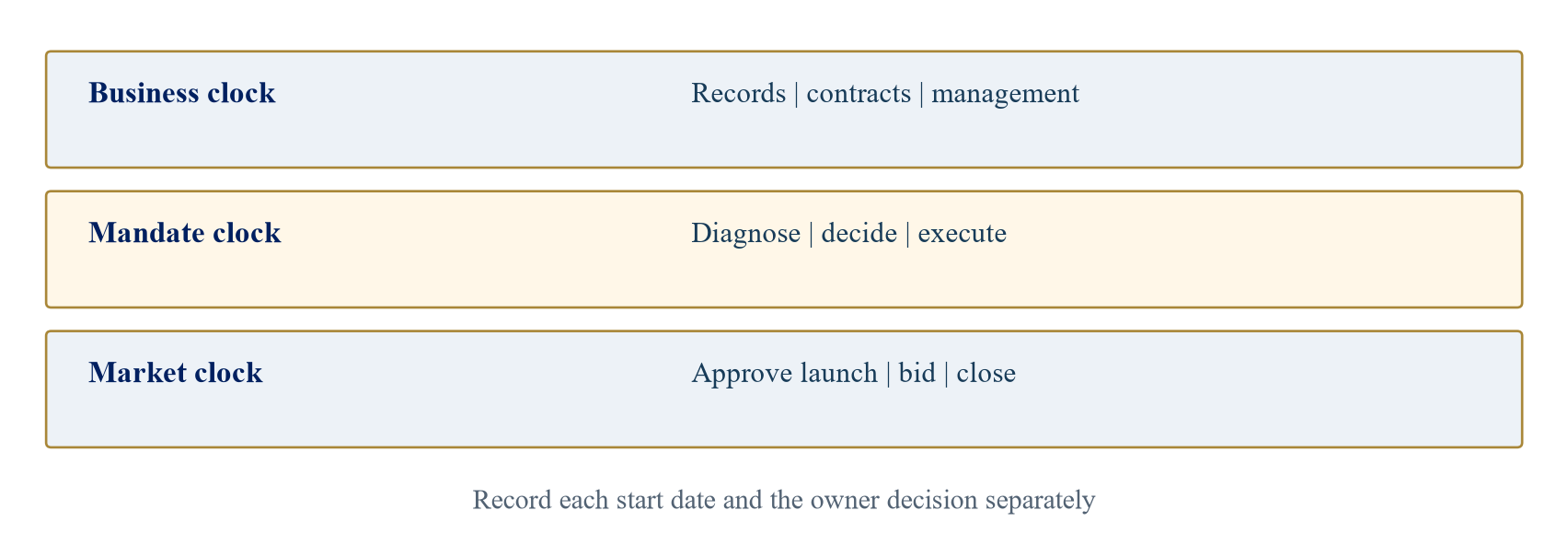
Author-developed timing map; widths are conceptual and are not empirical durations.
5 Establish a readiness baseline before appointing anyone
The founder should commission a short baseline review before treating an adviser proposal as an execution plan. It can be owner-led if the finance and legal functions have capacity. It should define the sale perimeter, reconcile historical reporting, list material contracts and ownership rights, map required consents, identify key people and state the cash need or succession objective. The output is not a glossy pitch. It is a dated exception register showing what is verified, what remains contested and which matters could block a sale. A prospective adviser can then price a known workload.
The baseline helps distinguish inability from unwillingness. Records may exist but be dispersed among a founder, finance manager and outside accountant. A contract may be signed but held in a subsidiary that the owner did not intend to sell. A forecast may be sound but uses a different revenue perimeter from the audited accounts. Those are coordination problems. Missing licences, disputed intellectual property or unresolved tax exposures require specialist investigation. It is important to mark who can resolve each item and whether a bidder would receive an accurate disclosure if outreach began today.
A readiness score should not be a single number. A numeric average can conceal a fatal defect. The baseline should use gates: entity and ownership clarity, financial reconciliations, commercial evidence, management continuity, legal and regulatory permissions, and a safe disclosure protocol. For each gate, the owner should record the underlying source, last update, accountable person, outstanding question and the consequence if unresolved. The result is a decision file. It can be reviewed by an adviser, but the owner and specialists retain responsibility for the underlying facts.
The baseline should also capture why the owner is considering a sale now. If a refinancing deadline or health event dictates a short timetable, the opportunity to improve readiness may be limited. The adviser can help choose a controlled approach and set realistic bidder expectations. If the sale is discretionary, the owner may gain more by improving the business before launch. The framework does not presume that delay is always beneficial; time can also erode performance or close a buyer window.
Table 1. Evidence gates before a market launch
| Gate | Owner evidence | Decision if incomplete | Accountable reviewer |
|---|---|---|---|
| Sale perimeter | Entity chart, shares, assets, debt and related-party arrangements | Define or narrow transaction scope | Owners and counsel |
| Financial bridge | Audited and management accounts, tax records, debt and cash reconciliation | Correct, explain or defer launch | Finance lead and accountant |
| Commercial durability | Customer and supplier contracts, revenue cohorts and concentration | Test buyer claim and disclosure | Commercial lead |
| Management continuity | Delegations, key-person roles and retention plan | Address dependency or price it | Board and HR adviser |
| Permissions | Change-of-control, lender, partner and regulatory consents | Map sequence and obtain advice | Counsel and relevant specialist |
| Disclosure control | Approved data room, access tiers, logs and personal-data review | Restrict or postpone release | Owner, counsel and data lead |
Author-developed readiness checklist. A gate is passed only against transaction-specific source evidence and specialist review where required.
6 Reconcile the financial story before it travels
A buyer will compare financial statements, management accounts, tax submissions, bank movements, debt agreements and forecasts. An adviser who arrives early can help structure the reconciliation, but accountants and management must own its accuracy. The first question is whether the same legal entities and accounting periods are represented in every table. A shift in perimeter can make a growth chart appear attractive while the buyer later discovers that a high-margin subsidiary was omitted from the shares offered. The second question is how recurring earnings and cash conversion are defined. A normalization adjustment needs evidence and a clear bridge back to recorded figures.
An owner should create a claims register. Each prospective buyer-facing statement should name its source, date, responsible verifier and permitted caveat. Examples include customer retention, order backlog, margin by service, maintenance capital expenditure and working-capital seasonality. A slide saying “contracted revenue” should not include unsigned pipeline unless that distinction is visible. A margin improvement attributed to technology should be supported by costs and implementation dates. This work is more demanding than changing the wording of a sale memorandum. It may reveal that the owner should wait for another reporting period or offer a different transaction structure.
Timing matters because corrections have different lead times. A forecast explanation can be written in a day. An audit adjustment may require board approval and an auditor's work. A weak month cannot be replaced with a favourable hypothetical run rate. If the adviser is appointed after an unsolicited bid arrives, management may have only a narrow window to create a defensible bridge. If appointed much earlier, the adviser should be paid for clearly bounded diagnostic work, with a stop if the underlying records cannot support the proposed valuation case.
The owner should not assume that earlier engagement automatically reduces diligence rework. If an adviser builds a data room around untested management claims, the same issues may return after an offer. The useful measure is the number and severity of post-launch revisions to statements already presented as verified. Versioned claims and reconciliations allow that measure to be observed. A process that found a weakness before launch and disclosed it honestly may have more preparation work but less avoidable rework with bidders.
7 Resolve legal perimeter and consent dependencies
A private-company sale can fail on matters that are absent from the management forecast. The shares offered may not carry the rights assumed. Intellectual property may sit with a founder personally or a contractor. A property or licence may belong to an excluded affiliate. A major customer or lender may have a change-of-control clause. Each issue should be mapped to a source document, an affected entity, a needed consent and a person authorised to act. Legal specialists should determine the actual requirements; an adviser can coordinate the transaction timetable and represent the commercial effect to owners.
The UAE federal competition framework and its implementing rules are relevant where a transaction falls within their scope; counsel must test jurisdiction, thresholds and the specific concentration before any filing conclusion [7-9]. The personal-data framework is relevant when a data room contains employee, customer or other identifiable records, subject to the actual entities and exemptions [10]. These references do not mean every private sale needs the same filing or disclosure process. Free-zone, sectoral and foreign-law rules may also apply. The owner should identify the applicable rules for the transaction rather than copy a generic checklist.
A late adviser can still create a strong commercial process, but it cannot compress the legal time needed for approvals by rewriting a schedule. An early adviser can ask counsel for a permissions map before launch. The map should distinguish consents needed before outreach, before signing and before completion. It should state who contacts the counterparty and how confidentiality is protected. An early appointment is valuable only if it triggers this review while the owner has room to change the structure or timetable.
The founder should avoid contacting potential buyers while material perimeter questions remain unexplained. An incomplete teaser may be acceptable if it accurately limits claims, but a bidder that builds an offer on a false perimeter may retrade or withdraw. The adviser should maintain a record of representations, corrections and access. A later buyer dispute can then be assessed against what was actually disclosed rather than a retrospective impression of the sale story.
8 Test commercial durability and management transfer
Financial forecasts are claims about people, contracts and operations. If customers buy because they trust the founder personally, the buyer must understand whether those relationships transfer. If revenue depends on a few contracts, their term, renewal rights, termination provisions and counterparty concentration matter. If the chief operating officer has no documented authority, an apparent management team may not be able to run the company during diligence. These are not presentation issues. They are operational facts that can take time to change.
The readiness review should identify which relationships are institutional and which are personal. It should map who negotiates, prices, fulfils and renews major contracts. Evidence can include signed agreements, account plans, delegation records and a period of observed management ownership. A founder who wants a clean exit may need to strengthen a second line before approaching buyers. A founder willing to remain for a transition can state the proposed role and constraints. Neither solution is universally preferable; each changes offer terms and the buyer's assessment of continuity.
An early adviser can help frame a credible management and succession plan and identify what a buyer will ask. It should not claim that a slide deck has solved key-person risk. Management may need time to demonstrate independent performance. Conversely, an adviser appointed late may discover the risk at once and propose an earn-out, retention arrangement or transitional services. Those mechanisms can bridge a buyer concern, but they can transfer future performance risk back to the seller. The founder should model the personal, cash and governance consequences before agreeing.
Commercial diligence also has a disclosure sequence. Revealing customer prices or supplier terms to a competitor may damage the business if no deal closes. The adviser and counsel should agree what can be described in aggregated form, what requires a clean team and when detailed records become available. Earlier preparation can build redacted or tiered materials in advance. The value of this work is process control and accuracy; a causal effect on bid depth remains to be tested.
9 Control the transition from preparation to market
The launch decision should be explicit. An adviser may have completed a valuation range and a buyer list, while legal consents or a financial bridge remain open. A founder may be impatient to test price, particularly after an unsolicited expression of interest. A launch meeting should decide what the seller is actually offering, what evidence supports the main claims, which issues are disclosed, who can receive information and what timetable is credible. The decision should be minuted and capable of being reversed if a gate fails.
The owner should approve an initial information package, buyer eligibility criteria, contact order, confidentiality terms, management capacity and an issue-escalation path. These approval items are more informative than a single “ready” badge. Some questions can remain open if they are honestly described and do not invalidate the core sale perimeter. Others, such as uncertain share ownership or a missing material licence, may justify postponement. The relevant threshold is transaction-specific and should be set with legal, accounting and sector advice where needed.
The transition is where an early adviser can create an unintended commitment. If its fee economics or internal targets depend on launch, it may favour approaching bidders once a narrative is polished. A staged engagement can counter that incentive with a separate owner approval gate and transparent fee consequences if the process stops. The alternative risk is endless preparation. The owner should set a decision date, define the evidence required to launch and ask what information gap actually prevents a credible offer. A process can lose relevance if the business changes faster than its data room.
An adviser appointed late may inherit decisions that management already made informally. Existing buyer contact, verbal price discussion or documents shared without an NDA can constrain a later competitive process. The mandate should inventory those interactions at the outset. A clean buyer-contact log and consistent disclosure plan can restore some order, but the first buyer may already possess more information than later participants. The adviser should describe that asymmetry and avoid promising a perfectly level process.
10 Design buyer outreach around credible capacity
The owner should distinguish a long list from a contest. A qualified buyer has an investment or acquisition rationale, a decision-making route, plausible financing, acceptable confidentiality controls and the ability to complete within a meaningful window. This does not mean every buyer must provide committed financing at the teaser stage. It means the adviser should explain why each name is worth the cost and disclosure risk of contact. Published takeover research on information costs and bidder asymmetry reinforces that buyer entry and disclosure are part of process design [1-3]. The evidence comes from different settings; the private founder decision remains case-specific.
Early appointment can expand the time available to research buyer capability and resolve potential conflicts. It can also produce a stale list if the market changes before launch. The buyer map should therefore be dated and refreshed at the launch gate. Late appointment can use a live unsolicited buyer as a reference point but may leave little time to create competition before the first bidder demands exclusivity. A founder should ask whether the apparent deadline is contractual, financing-driven or merely the bidder's preferred negotiating timetable.
The outreach wave should follow information risk. Potential strategic buyers who compete with the target may need a narrower initial package. Financial investors may focus on management continuity, debt capacity and a clear route to ownership. A buyer may be credible yet unable to acquire the precise licensed entity. The adviser should record qualification outcomes rather than count outreach volume. A useful funnel records owner-approved names, actual contacts, NDA execution, access tier, management meetings, indications and executable offers.
The founder should retain the right to stop or redirect outreach. A process that produces no credible offer may reveal a valuation mismatch or an information gap, not adviser failure alone. The owner should compare the new evidence with the hold alternative and the cost of continuing. Early adviser involvement is useful when it helps create and preserve choices. It is less useful if it converts uncertain interest into an irreversible sale commitment.
11 Contract for a diagnostic before a sale commitment
An owner who wants advice early can buy a defined diagnostic. The scope can include the sale perimeter, financial bridge, readiness gaps, preliminary buyer logic, feasible transaction structures and an estimated timetable. The deliverable should be a document the owner can use whether or not the same firm later receives an execution mandate. It should identify source evidence, open questions and the adviser’s assumptions. A valuation range can be included if its limitations and inputs are visible. The owner should know which specialists will validate legal, tax, accounting and technical matters.
The engagement should state the term, price, expense cap, data rights, confidentiality rules, conflicts process and termination route. If the adviser later becomes the sell-side lead, the diagnostic fee may or may not credit against another fee; that is a commercial negotiation to be stated clearly. A tail clause should be tested against realistic cases: no sale, a later sale to a buyer the owner already knew, a financing instead of a sale and a transaction materially outside the original mandate. Legal review of the actual contract is needed. The objective is to make stopping a feasible decision, not a breach of an unstated expectation.
The adviser’s independence and capacity matter during a diagnostic. The owner should ask who performs the work, what relationships the firm has with likely buyers or lenders and how those interests are managed. The DFSA has published a thematic review of conflicts for firms within its remit [11]. That review is a relevant warning against undocumented conflicts, though it does not define every UAE adviser’s regulatory status. The actual contracting entity and applicable permissions should be checked before appointment.
A diagnostic can conclude that the business is not ready for a competitive sale. That is a legitimate output if supported by evidence and an action plan. It may recommend a later sale, a minority investment, refinancing or continued ownership. The owner should record the reason, expected preparation work and point at which the decision will be revisited. An adviser who can only recommend an immediate full mandate has offered less information than a process with a credible stop option.
12 Model fees and timing against the owner's alternatives
Appointment timing has a cash cost even if no transaction occurs. A comparison should include retainer, diagnostic price, contingent fee, expenses, external specialists, management time and any fee payable on an alternative transaction. It should also identify costs the company would have incurred without a sale, such as an overdue audit or ordinary contract remediation. Charging every improvement to the adviser mandate overstates its cost; treating every improvement as adviser-created overstates its benefit. The owner can show both the total cash budget and the incremental cost of the specific route.
The fee base deserves attention. A percentage of enterprise value can differ sharply from a percentage of cash received by owners. Shareholder loans, assumed debt, rollover equity, earn-outs, escrow, deferred consideration and working-capital adjustments can change the outcome. An early diagnostic should not create ambiguity about who is paid if the owner later chooses a capital raise. The founder should run a small set of sale and no-sale cases through the precise proposed engagement terms. A contract that cannot be modelled before signature will be difficult to govern after a bid arrives.
Time has a financial dimension too. A delayed sale may expose the company to trading risk or allow operating improvements to mature. A rushed process may consume management capacity and weaken current performance. The owner can set a monthly cash runway, investment requirement and forecast downside to understand how long preparation is affordable. These figures are business-specific. No generic “optimal number of months before exit” follows from this paper. A strategic buyer may appear unexpectedly; the owner should know whether the preparation plan can respond without abandoning evidence controls.
The decision is better expressed as a contingent sequence than a single cost-benefit sum. Pay for a bounded diagnostic if it changes a near-term decision. Fund remediation when the issue is material and fixable. Authorise outreach only when the launch gate is met or when a clearly documented exception is acceptable. Price the full mandate against scope, team and seller objectives. The owner can then observe each expenditure and decide whether the next one is justified.
Table 2. Mandate alternatives and owner decision rights
| Route | Initial scope | Owner's stop point | Main risk to test |
|---|---|---|---|
| Owner-led first | Internal finance, legal and operating preparation | Before selecting an execution adviser | Internal capacity and unseen buyer questions |
| Early diagnostic | Defined readiness, perimeter and buyer logic | After a dated exception report | Diagnostic fee, tail, conflicts and premature launch pressure |
| Full mandate now | Preparation plus approved market execution | Contractual review and launch gate | Open-ended scope, exclusivity and team availability |
| Adviser after bid | Bid assessment and controlled negotiation | Before exclusivity or binding terms | Short diligence window and weak alternative bids |
Author-developed comparison; fees and timing must be populated from actual proposals and business records.
13 Define the launch gate as an option
A company that has prepared well is able to approach buyers; it is not obliged to do so. This is an option with practical value. The owner can wait for a trading milestone, test a partial sale, refinance or decline a weak market. To preserve that choice, the adviser agreement must allow the owner to approve each external contact and withhold launch without losing control of company materials. The preparation team should deliver reusable outputs rather than an irreversible campaign. A data-room index, financial bridge and permissions map retain value even when the owner waits.
The option has an expiry and a maintenance cost. Buyer hypotheses become stale. Financial periods close and new figures must be reconciled. Permissions and contracts can change. A founder may be tempted to keep preparing indefinitely because the company's prospects or ownership plan remain uncertain. Set a review date, an update owner and a list of triggers for a new launch decision. Examples are a completed audit, customer renewal, management succession, debt maturity or credible unsolicited interest. These are triggers for reassessment, not automatic instructions to sell.
An early adviser should report readiness separately from market attractiveness. The company can be ready to disclose, while current bids are unlikely to satisfy the owner's conditions. It can also be commercially attractive while a material legal defect prevents a responsible launch. Conflating the two allows a narrow window of interest to excuse unsupported claims. The owner should see a two-part recommendation: the evidence gate, and the process case for approaching identified buyers now.
The owner can also define an exception procedure. If a real bidder offers a time-sensitive proposal before all gates are complete, the board can authorise a limited, accurate disclosure and a short exclusivity-free assessment. It should record which missing evidence is material, what the bidder is told, who will verify the issue and when the owner can stop. The exception should not be used to pretend the target was fully prepared. The resulting bid may have more conditions and a different price, which the owner must compare on that basis.
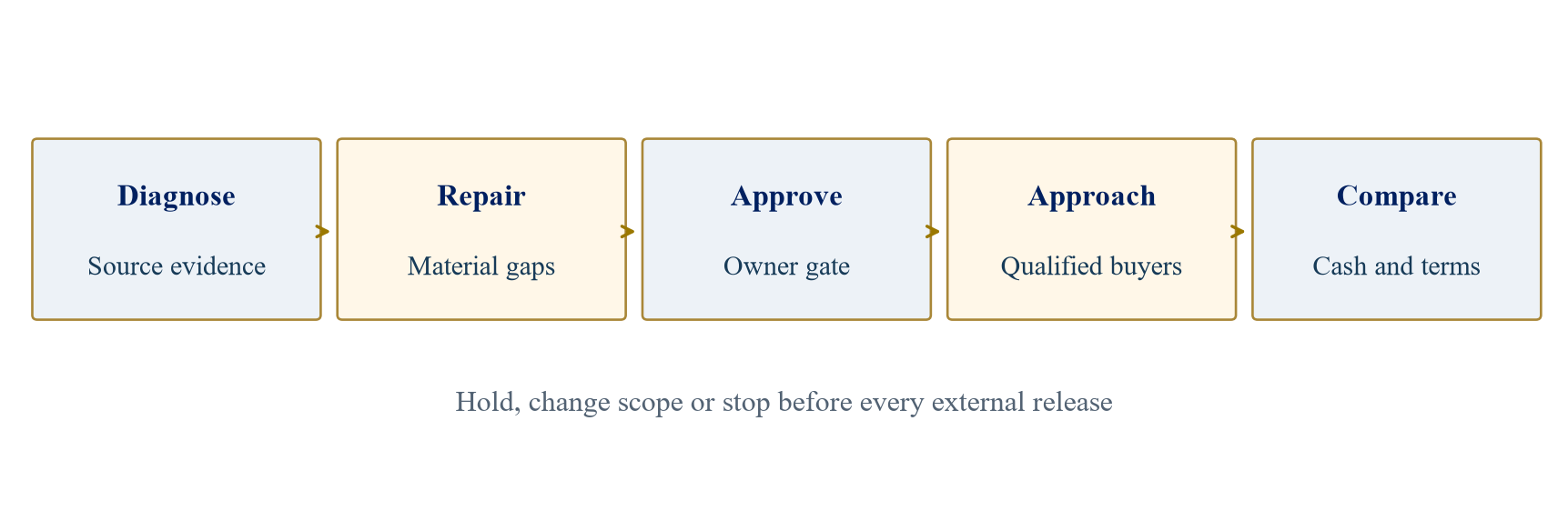
Author-developed process architecture; the gates are questions, not observed success rates.
14 Compare two hypothetical calendars without claiming an effect
Consider a founder with complete audited accounts but fragmented customer contracts and an undocumented shareholder loan. The owner hopes to explore a sale within the next year. In one hypothetical route, a limited adviser diagnostic begins in month zero. The finance and legal teams reconcile the loan and contract register in months one to three. The owner approves a launch after a further review and begins qualified outreach in month four. In a second hypothetical route, the owner waits until month four to appoint a full adviser, then spends months five to seven doing the same evidentiary work before outreach. These month labels are author assumptions for illustration, not observed UAE transaction durations.
The first route may reach the market earlier if diagnostic work actually identifies the critical issues and specialist teams act. It may also arrive later if an early adviser adds unnecessary work or the owner does not resolve the issues. The second route may be efficient if the business had quietly prepared the records before the adviser arrived. The comparison therefore needs task completion dates, not just adviser appointment dates. An honest model should allow the same work to be done by different people and should record the effort and cost in both routes.
Now add an unsolicited buyer in month two. The owner could use the early diagnostic to decide whether to engage, but the adviser should still examine buyer capacity, information access and the hold alternative. A late adviser might be appointed immediately to assess the proposal. In both routes, the owner must decide whether to grant exclusivity before other credible buyers can be contacted. A timetable that closes quickly after conceding exclusivity may be commercially sound or costly; elapsed days do not establish which. The cash terms, conditions and retained risk are needed.
The useful lesson from the illustration is definitional. Record elapsed time from the first exit decision, appointment, approved launch, first bid, signing and completion. Measure how many claims changed after disclosure and how many buyer requests were repeats caused by missing or inconsistent information. Measure bidder depth as qualified independent offers with credible financing and executable terms. These measures can be gathered prospectively. Their values cannot be inferred from the hypothetical calendar.
15 Measure rework before measuring speed
“Faster closing” sounds attractive but can disguise a smaller or riskier deal. A founder needs a paired measure of process speed and information quality. Diligence rework can be defined as a material correction or repeat request arising because a previously supplied source was absent, inconsistent, outdated or incorrectly described. A new question caused by a buyer's unique strategy is not necessarily rework. A change in trading after launch is new information, even if it leads to repricing. These distinctions matter if a future study compares early and late appointment.
Create a versioned issue log before outreach. Each item should include the buyer's request, subject, source document, first response date, owner, revision reason, whether it changes a valuation claim and whether specialist sign-off is required. A separate chronology should note when the problem was first known internally. This lets an owner see whether the adviser identified an issue during preparation, whether management failed to resolve it or whether the buyer uncovered something neither party had noticed. Blaming or crediting an adviser for every post-launch question would be inaccurate.
Bidder depth also needs qualification. Count independent parties that submitted offers consistent with the authorised perimeter and capable of proceeding, not teaser recipients or unsigned expressions of curiosity. Record the number of eligible buyers in the addressable universe, contacts approved by the owner, signed NDAs, data-room access, management meetings and proposals. A private process with one strategic buyer can be rational if broader disclosure would be harmful. The paper does not prescribe a minimum bid count. It asks the founder to know what competitive alternative was realistically available.
Time to close should be recorded in intervals. Preparation from decision to launch measures readiness work. Launch to initial offer measures market response. Offer to signing measures negotiation and diligence. Signing to completion measures consents and conditions. A delay in the final interval may have little connection to the original adviser appointment. Separating intervals prevents a single total-duration figure from obscuring the actual bottleneck.
16 Put founder capacity into the causal story
Adviser timing is selected in part because a founder is busy, confident, under pressure or uncertain about succession. These characteristics also affect the transaction outcome. A founder with a capable finance director may complete most preparation internally and hire late; the sale may still run smoothly. A founder with thin records may hire early because the sale is difficult. A simple comparison could then make early appointment appear associated with worse outcomes, even if it helped. The reverse is also possible if successful founders are more likely to hire advisers early.
Management bandwidth should be measured. Record the people allocated to the sale, hours spent on preparation, ability to maintain customer service and whether advisers or specialists took over defined tasks. A rushed process can harm trading, which then changes buyer views. A long preparation phase can also divert resources. The owner should ask what the adviser actually substitutes for and what remains management's work. A promise that “we handle the process” needs a responsibility matrix, not a slogan.
Decision rights are equally important. Research based on private-company executives finds that leaders often retain direct involvement in acquisition decisions [12]. That study concerns corporate financial decisions, not this specific founder sell-side population. It nevertheless underlines the need to record who approved outreach, disclosures, exclusivity and price changes. An adviser cannot create a timely process if an owner cannot decide. An owner should not surrender strategic control merely to increase apparent speed. The workplan can set response windows and escalation routes while preserving final authority.
A future timing study should include indicators of owner succession, financial reporting capacity, urgent liquidity need and prior unsolicited interest. These factors are imperfect proxies for why the adviser was hired at a particular moment. Confidential interviews could clarify the decision, but they introduce recall and selection problems. A prospective register at the first adviser contact would be stronger than asking only completed sellers to reconstruct their motives later.
17 Design a consented study of timing and outcomes
The unit of analysis should be a serious owner decision to explore a sale, not only a completed transaction. The sample frame would include owner-led preparation, limited diagnostic mandates, full mandates appointed before readiness work, full mandates appointed after readiness work and processes triggered by unsolicited buyers. Withdrawn, abandoned and never-launched processes must be recorded. Otherwise the sample would condition on success and make early preparation look more effective by omitting the owners who discovered a reason not to sell.
At baseline, researchers would record entity and sector, approximate deal size, owner objectives, financial reporting state, sale perimeter, management depth, major consents, liquidity urgency and the first credible buyer contact. The intervention is a dated mandate with documented scope, team, fee structure and any changes. The process record would capture preparation tasks, launch approval, buyer contacts, disclosures, bid terms, exclusivity, issue logs, signing and actual consideration received. For a no-sale case, the record should state the stopping reason and what happened to the business. Consent from owners, advisers and, where necessary, other affected parties would be essential.
The primary outcomes could be qualified bidder depth, count and severity of avoidable diligence rework, launch-to-completion time, total decision-to-completion time and net cash received by owners. The latter requires a bridge from price to debt, fees, tax and contingent or deferred payments. Research should report missing values and distinguish contractual consideration from money actually received. A founder who chooses not to sell after a diagnostic is not a failed data point if the original objective was to make an informed decision.
Analysis could compare matched cases by pre-appointment readiness, sector, size, urgency and buyer contact, and use timing as an exposure rather than a crude early/late label. A prospective design could compare companies at the same decision stage while documenting the reasons for appointment. Even careful matching cannot remove unobserved differences, such as founder quality or private buyer interest. Results should therefore be described as associations unless a defensible identification strategy supports a causal claim. Pre-registering definitions and reporting all eligible cases would reduce selective storytelling.
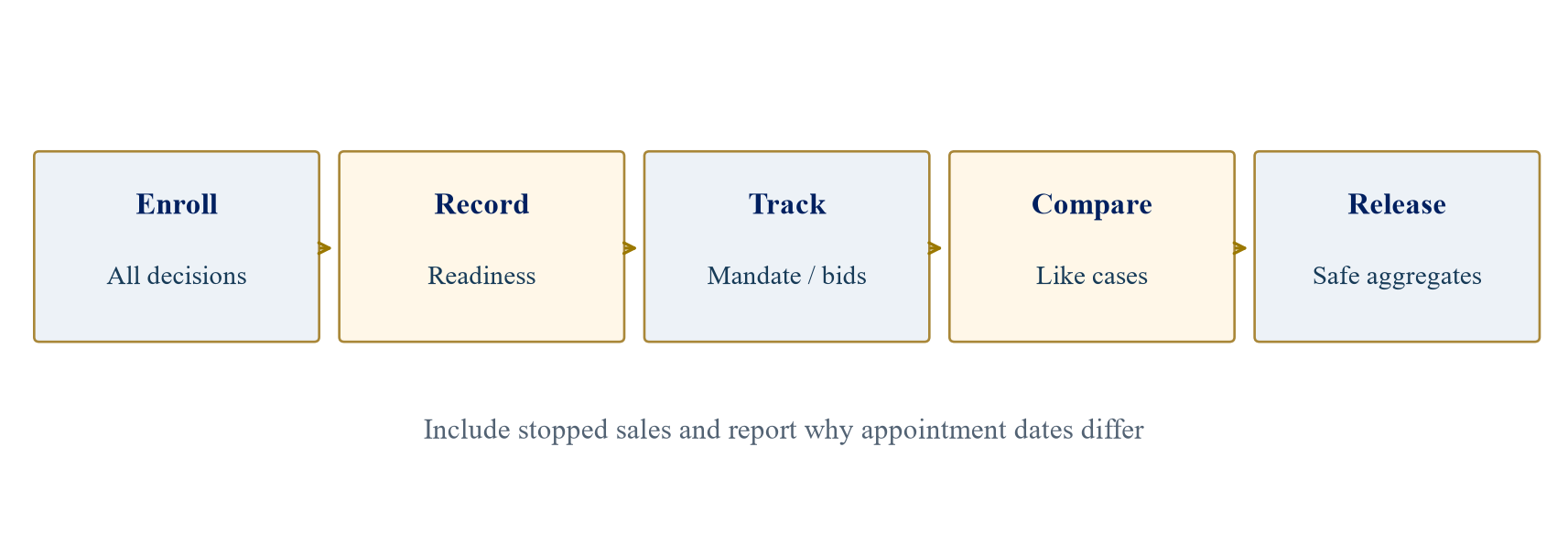
Author-developed research protocol. No transaction cohort or timing effect has been estimated.
18 Protect confidential information and the integrity of the test
Transaction files are sensitive. Engagement letters reveal fees and potential conflicts. Bid records reveal buyers and strategy. Data rooms contain personal and commercially confidential information. A study should seek permission before extracting records, limit access to named researchers, minimise identifiable fields and define retention and deletion rules. The applicable UAE federal personal-data framework and any other relevant jurisdictional obligations require specialist review [10]. Anonymising a narrow sector, deal size and date may still allow re-identification. Publication of aggregate results needs a disclosure check, not just removal of company names.
The research design also needs an independence plan. An adviser studying its own transactions has incentives to select favourable cases and classify work generously. A neutral data custodian or independent review panel could predefine the coding of readiness, rework and completion. The study should retain source documents so a disagreement can be adjudicated without publishing a client's confidential material. Consent forms must state whether withdrawal is possible and which already aggregated results, if any, cannot be removed. These are design requirements, not evidence that a consented cohort presently exists.
Negative cases are especially important. A company that appointed early and then stopped after finding an ownership defect may have avoided a costly market process. A company that appointed late and sold rapidly may have benefited from years of unrecorded preparation. A dataset containing only closed deals would miss both mechanisms. The analysis should describe the flow of all eligible owner decisions, including the number not approached, not consenting and lacking usable records. Selection at the consent stage can bias a result even if every retained record is accurate.
The paper itself contains no proprietary client transaction data. Its figures are author-developed frameworks, and its calendar is wholly hypothetical. It offers research questions that could be tested when lawful access and a defensible sample exist. An owner may apply the decision tools immediately, while recognising that they are process controls rather than predicted returns.
19 Use a founder-controlled appointment checklist
Before a first adviser meeting, the founder can prepare a one-page decision brief: intended sale or alternative, desired role after completion, minimum cash need, entities and assets in scope, existing buyer contact, deadline drivers, confidentiality constraints and the capacity of internal management. The brief should identify which facts are verified and which require specialist review. Sending the same brief to each prospective adviser makes proposals comparable. It also prevents an adviser from quietly redefining the owner’s objective around its preferred process.
During the meeting, ask for a proposed sequence, not only a valuation headline. Which records would the team request first? Which defect would cause it to recommend postponement? Who will verify the financial bridge? How will buyer names be qualified and approved? What is the earliest responsible launch date and what evidence determines it? Which named team members will do the work? What conflicts or other mandates may matter? How would a limited diagnostic, a full sale and a stopped process be billed? Written answers can be compared against the actual engagement letter.
At the diagnostic gate, the owner should receive a source-linked exception report and a proposed timetable. Each material issue should have an owner, cost estimate where available, specialist sign-off path and effect on the launch decision. The adviser should state which claims can be made now and which cannot. The board or owners should record whether to remediate, launch with an accurately disclosed limitation, change structure or stop. This is a commercial judgement supported by evidence; it is not a mechanical score from a model.
At the launch gate, confirm the buyer map, information package, confidentiality protections, management capacity, bid instructions and decision rights. At the offer gate, compare cash at completion, deferred and contingent value, financing, approvals, employment or founder obligations, fees and retained liabilities. The owner should repeat the hold alternative. A sale that takes longer may still meet the owner's objectives; a fast sale may still be acceptable. The checklist is designed to preserve that decision deliberately.
Table 3. Founder questions and evidence before each commitment
| Commitment | Question to answer | Minimum evidence | Decision record |
|---|---|---|---|
| Hire for diagnosis | What specific uncertainty will this work reduce? | Scope, team, price, conflicts and stop terms | Signed diagnostic mandate |
| Fund remediation | Which issue changes the sale decision? | Source-linked exception and specialist route | Budget and accountable owner |
| Launch outreach | Can the company support the claims made to buyers? | Financial bridge, permissions map and approved materials | Owner launch approval |
| Grant exclusivity | What credible alternative is being surrendered? | Buyer funding, terms, diligence plan and other interest | Limited exclusivity authority |
| Sign and complete | What cash, conditions and obligations survive? | Agreed proceeds bridge and specialist sign-offs | Board or shareholder approval |
Author-developed governance checklist; apply with transaction-specific legal and financial advice.
20 State the decision boundary and the research limit
Early adviser involvement can be sensible when the owner needs an independent readiness diagnosis, lacks transaction capacity or faces a complex sale perimeter. Late engagement can be sensible when management and specialists have already built reliable evidence and the principal need is bidder access and execution. A staged mandate can separate diagnostic work from the decision to sell. None is a universal rule. The business's records, objectives, alternatives, urgency and proposed engagement terms determine the choice.
This paper's original contribution is a timing framework with observable gates and outcomes. It does not report a UAE sell-side cohort or a causal estimate of bidder depth, rework, speed or proceeds. The cited studies examine other populations, and the UK government guidance serves as a preparation reference rather than UAE-specific law. The hypothetical calendar is an author assumption. The legal references identify issues to review; they do not provide a transaction-specific filing conclusion. Owners need appropriate legal, tax, accounting, regulatory and valuation advice for a live sale.
The immediate action is modest and concrete. Define the owner's decision, compile a dated baseline, identify the critical path, commission bounded help when it answers a real uncertainty, and require a separate launch approval. Record appointment, preparation, outreach, bid and completion dates so later conclusions about timing can be checked. The founder should know what the adviser changed before asking whether the sale outcome changed. A future consented study could test the latter question with an honest sample and a transparent counterfactual.
References
- Jennings, R. H. and Mazzeo, M. A. “Competing Bids, Target Management Resistance, and the Structure of Takeover Bids.” Review of Financial Studies 6(4), 1993, 883-909. Accessed 6 October 2026. https://academic.oup.com/rfs/article-abstract/6/4/883/1583242
- Povel, P. and Singh, R. “Takeover Contests with Asymmetric Bidders.” Review of Financial Studies 19(4), 2006, 1399-1431. Accessed 6 October 2026. https://academic.oup.com/rfs/article-abstract/19/4/1399/1580527
- Kim, D.-H. and Zheng, Y. “How Costly to Sell a Company? A Structural Analysis of Takeover Auctions.” Working paper revised 2025. Accessed 6 October 2026. https://papers.ssrn.com/sol3/papers.cfm?abstract_id=3505106
- Ismail, A. “Are Good Financial Advisors Really Good? The Performance of Investment Banks in the M&A Market.” Review of Quantitative Finance and Accounting 35, 2010, 411-429. Accessed 6 October 2026. https://papers.ssrn.com/sol3/papers.cfm?abstract_id=1154532
- Xu, J. “The Double Agency Problem in Mergers and Acquisitions: An Examination of Advisor Contracts.” Working paper, 2023. Accessed 6 October 2026. https://papers.ssrn.com/sol3/papers.cfm?abstract_id=4556840
- UK Government. “Track 1: Data Room Essentials & Documents Checklist.” Published 2 December 2025. Accessed 6 October 2026. https://www.gov.uk/government/publications/unlocking-space-for-investment-growth-hub/track-1-data-room-essentials-documents-checklist
- United Arab Emirates. Federal Decree-Law No. 36 of 2023 Regarding Regulating Competition. Accessed 6 October 2026. https://uaelegislation.gov.ae/en/legislations/2117
- United Arab Emirates. Cabinet Resolution No. 3 of 2025 Regarding Ratios Related to Competition. Accessed 6 October 2026. https://www.uaelegislation.gov.ae/en/legislations/2788/download
- United Arab Emirates. Cabinet Resolution No. 59 of 2026 Regarding Executive Regulations of the Competition Decree-Law. Accessed 6 October 2026. https://uaelegislation.gov.ae/en/legislations/4451/download
- United Arab Emirates. Federal Decree-Law No. 45 of 2021 Concerning the Protection of Personal Data. Accessed 6 October 2026. https://www.uaelegislation.gov.ae/en/legislations/1972/download
- Dubai Financial Services Authority. “New DFSA Thematic Review: Conflicts of Interest across DIFC Firms.” 9 January 2026. Accessed 6 October 2026. https://www.dfsa.ae/news/new-dfsa-thematic-review-conflict-interest-across-difc-firms
- Graham, J. R., Harvey, C. R. and Puri, M. “Capital Allocation and Delegation of Decision-Making Authority within Firms.” NBER Working Paper 17370, 2011. Accessed 6 October 2026. https://www.nber.org/papers/w17370
- Boone, A. L. and Mulherin, J. H. “Do Termination Provisions Truncate the Takeover Bidding Process?” Review of Financial Studies 20(2), 2007, 461-489. Accessed 6 October 2026. https://academic.oup.com/rfs/article-abstract/20/2/461/1573538
- Galpin, T. “Consummate to Reach Transaction Close.” In Winning at the Acquisition Game, Oxford University Press, 2020. Accessed 6 October 2026. https://academic.oup.com/book/31964/chapter/267697961
About the Author
Chennakeshav (CK) is a corporate finance and investment banking executive with 25+ years of global experience in deal origination, structuring and execution across M&A, growth capital and corporate strategy. He has led value-creation mandates for founders, corporates and funds — bridging the boardroom view to hands-on execution and close.
His career spans Morgan Stanley, HSBC, Lloyds Banking Group, EWEC, ADQ portfolio companies and Emirates Growth Fund, across TMT, real estate, fintech, deeptech, cleantech, infrastructure and energy. He has partnered with C-suite leaders, private equity and venture funds, sovereign wealth funds and family offices to finance complex fund raises and scale-up ventures, and has led M&A due diligence, post-merger integration and business-transformation initiatives to create value.
At Matchpoint Partners he is Managing Partner, leading the firm's corporate finance, M&A and capital-raising practice. He holds an MBA from London Business School, an engineering degree from VTU and a Master of Laws (LLM, in progress) from UCL London.
An active start-up mentor, CK mentors at Techstars, DIFC FinTech Hive, Startup Grind, Founder Institute and IN5, serves as Entrepreneur Mentor in Residence (EMiR) at London Business School, and judges the Entrepreneurship World Cup.
