

1. Define what cash-free, debt-free can achieve
The transaction team should state the enterprise-to-equity convention, the agreed cash and debt definitions, the measurement time and the adjustment process. Evidence should come from indicative offer, valuation model, definitions schedule, balance sheet, facility documents and current legal advice. The controlling question is which amounts change price and which obligations remain legal or operational exposures. The answer should be dated, attributed and linked to the legal entity, asset, liability or operating dependency it describes [104][105][109].
The controlled output is a cash, debt and liability definitions memorandum. It should state the source, calculation method, owner, exceptions, required approvals and the next irreversible deadline. This allows a board, officeholder, creditor or buyer to reproduce the conclusion when facts change.
The principal risk is that the parties may treat a valuation convention as a complete allocation of liabilities. The team should quantify the effect on liquidity, stand-alone earnings, creditor recoveries, operating continuity and completion probability. A material exception should update the perimeter and funding plan.
2. Fix the legal transaction route
This workstream requires the company and its advisers to distinguish a share acquisition, asset acquisition, business transfer, administrator sale, receiver sale and court-authorised disposal, using structure paper, corporate records, insolvency appointments, court orders and jurisdiction-specific advice. The practical test is which legal person sells which interest under which powers. Analysis should use one cut-off date so that cash, claims, contracts, people and transaction documents reconcile [1][2][8][109].
Decision-makers should maintain a transaction-route decision map. It should distinguish legal ownership from economic allocation, current evidence from forecast assumptions and committed funding from indications. Qualified advisers retain responsibility for legal, insolvency, tax, pensions, accounting and regulatory judgements.
Execution can fail when the chosen route may preserve unwanted liabilities or fail to transfer essential rights. Each dependency needs a control, evidence threshold, escalation route and decision time. The transaction remains viable only while the funded separation plan can absorb a credible delay or shortfall.
3. Establish authority and duties
The readiness team should verify board, shareholder, office-holder, secured-creditor, court and regulatory powers together with conflicts and decision standards. The evidence base includes constitutions, appointments, security documents, court records, minutes and engagement terms. The central question is who can market, disclose, negotiate, sell, release and bind each relevant entity. Conclusions should remain at entity and dependency level because the failing group may have pooled cash, shared rights and cross-guarantees [1][2][28][110].
The required deliverable is an authority and duties matrix. It should connect the proposed sale documents to the stand-alone operating model and the residual estate. Every material assumption should show its source and sensitivity.
The downside is that an apparently signed deal may exceed power or omit a controlling stakeholder. Management should test the base case and a combined downside against minimum cash, customer continuity and the completion timetable. Unsupported benefits should not be treated as available funding.
4. Build the liability-survival map
The seller should classify each exposure by legal transfer, asset attachment, economic dependence, crystallisation trigger, cash date and remedy. Relevant evidence includes contracts, ledgers, registers, claims, licences, payroll, tax and specialist reports. The decision asks how each liability can reach value, cash or continuity after completion. A reliable answer links financial analysis to title, transfer mechanics, operating capability and the applicable approval process [1][8][103][109].
The decision pack should contain a six-dimension liability-survival register. It should show calculation dates, owners, dependencies and the documents that implement the conclusion. This creates a defensible record for later scrutiny and post-completion reconciliation.
A material failure occurs when excluded wording may hide a burden that follows the assets or operating model. The response should identify a funded cure, alternative perimeter or fallback route. Continuing without one can reduce going-concern value and creditor recovery.
Table 1. Liability-survival classification
| Exposure | Legal route | Economic route | Control |
|---|---|---|---|
| secured debt | payoff and release | funding withdrawal | simultaneous discharge |
| supplier arrears | may remain excluded | critical supply can stop | cure or replacement |
| employee claims | route-specific transfer | capability can leave | consultation and funding |
| environment | statutory and fact-specific | site use may be constrained | specialist diligence and remediation |
Values and scores are analytical scenarios; transaction evidence should replace model values.
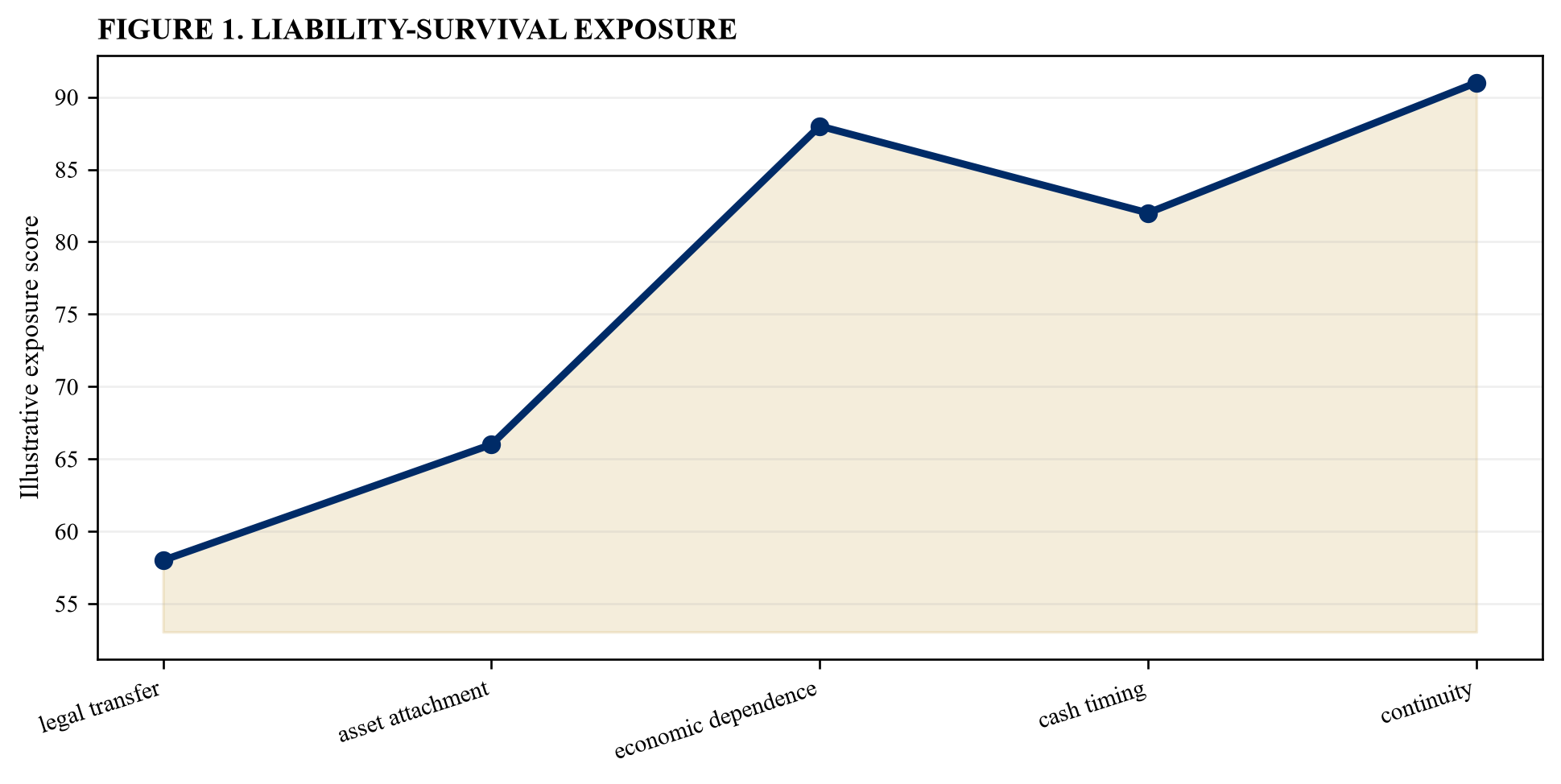
Illustrative analytical scenario; transaction evidence should replace model values.
5. Separate legal transfer from economic burden
The transaction team should test whether an obligation remains with the seller while its non-payment still prevents the buyer from trading. Evidence should come from supplier, landlord, customer, employee, utility, licence and system evidence. The controlling question is which excluded claims must be settled, replaced or supported to preserve operations. The answer should be dated, attributed and linked to the legal entity, asset, liability or operating dependency it describes [5][48][66][103].
The controlled output is an economic-dependency schedule. It should state the source, calculation method, owner, exceptions, required approvals and the next irreversible deadline. This allows a board, officeholder, creditor or buyer to reproduce the conclusion when facts change.
The principal risk is that a buyer may avoid the claim legally and still lose the business economically. The team should quantify the effect on liquidity, stand-alone earnings, creditor recoveries, operating continuity and completion probability. A material exception should update the perimeter and funding plan.
6. Set the measurement and cut-off rules
This workstream requires the company and its advisers to define cut-off time, accounting basis, foreign exchange, accrual policy, estimation rules and post-close information rights, using draft agreement, completion accounts policies, trial balance, bank data and historical closing procedures. The practical test is which period and evidence control each adjustment. Analysis should use one cut-off date so that cash, claims, contracts, people and transaction documents reconcile [17][40][104][105].
Decision-makers should maintain a locked measurement protocol. It should distinguish legal ownership from economic allocation, current evidence from forecast assumptions and committed funding from indications. Qualified advisers retain responsibility for legal, insolvency, tax, pensions, accounting and regulatory judgements.
Execution can fail when movements near completion may be counted twice, omitted or strategically timed. Each dependency needs a control, evidence threshold, escalation route and decision time. The transaction remains viable only while the funded separation plan can absorb a credible delay or shortfall.
7. Reconcile share capital and ownership
The readiness team should trace issued shares, options, convertibles, preferences, warrants, beneficial ownership and transfer restrictions. The evidence base includes statutory books, filings, agreements, cap tables, certificates and approvals. The central question is what equity is legally and economically acquired. Conclusions should remain at entity and dependency level because the failing group may have pooled cash, shared rights and cross-guarantees [9][25][26][27].
The required deliverable is a fully diluted ownership and proceeds schedule. It should connect the proposed sale documents to the stand-alone operating model and the residual estate. Every material assumption should show its source and sensitivity.
The downside is that purchase price may be allocated against an incomplete or disputed capital structure. Management should test the base case and a combined downside against minimum cash, customer continuity and the completion timetable. Unsupported benefits should not be treated as available funding.
8. Trace security over shares and assets
The seller should map fixed and floating charges, mortgages, pledges, liens, negative pledges, account control and priority. Relevant evidence includes public registers, security instruments, title registers, intercreditor documents and confirmations. The decision asks what must be repaid, released, consented or sold subject to security. A reliable answer links financial analysis to title, transfer mechanics, operating capability and the applicable approval process [33][34][35][110].
The decision pack should contain a security and release matrix. It should show calculation dates, owners, dependencies and the documents that implement the conclusion. This creates a defensible record for later scrutiny and post-completion reconciliation.
A material failure occurs when an encumbrance may survive, block transfer or divert proceeds. The response should identify a funded cure, alternative perimeter or fallback route. Continuing without one can reduce going-concern value and creditor recovery.
9. Map lender debt and payoff mechanics
The transaction team should reconcile principal, accrued interest, default interest, fees, hedging, break costs, cash sweeps and contingent utilisation. Evidence should come from facilities, statements, notices, hedge confirmations, agent letters and payoff calculations. The controlling question is what amount secures valid discharge at the completion timestamp. The answer should be dated, attributed and linked to the legal entity, asset, liability or operating dependency it describes [33][34][42][43].
The controlled output is a lender-by-lender payoff and release schedule. It should state the source, calculation method, owner, exceptions, required approvals and the next irreversible deadline. This allows a board, officeholder, creditor or buyer to reproduce the conclusion when facts change.
The principal risk is that ledger debt may understate the cash required for an effective release. The team should quantify the effect on liquidity, stand-alone earnings, creditor recoveries, operating continuity and completion probability. A material exception should update the perimeter and funding plan.
10. Find quasi-debt beyond funded facilities
This workstream requires the company and its advisers to screen leases, hire purchase, factoring, supply-chain finance, deferred consideration, overdue capex, grants and shareholder support, using general ledger, contracts, bank flows, fixed-asset register, aged balances and commitments. The practical test is which financing-like obligations reduce equity value or require continuity funding. Analysis should use one cut-off date so that cash, claims, contracts, people and transaction documents reconcile [41][42][51][104].
Decision-makers should maintain a quasi-debt bridge with evidence grades. It should distinguish legal ownership from economic allocation, current evidence from forecast assumptions and committed funding from indications. Qualified advisers retain responsibility for legal, insolvency, tax, pensions, accounting and regulatory judgements.
Execution can fail when economically equivalent financing may be classified outside debt accounts. Each dependency needs a control, evidence threshold, escalation route and decision time. The transaction remains viable only while the funded separation plan can absorb a credible delay or shortfall.
Table 2. Illustrative quasi-debt bridge
| Item | Book amount | Verified amount | Completion use |
|---|---|---|---|
| funded debt | 58 | 61 | 61 |
| leases and hire purchase | 11 | 14 | 8 |
| factoring and recourse | 7 | 12 | 10 |
| arrears and commitments | 6 | 15 | 13 |
Values and scores are analytical scenarios; transaction evidence should replace model values.
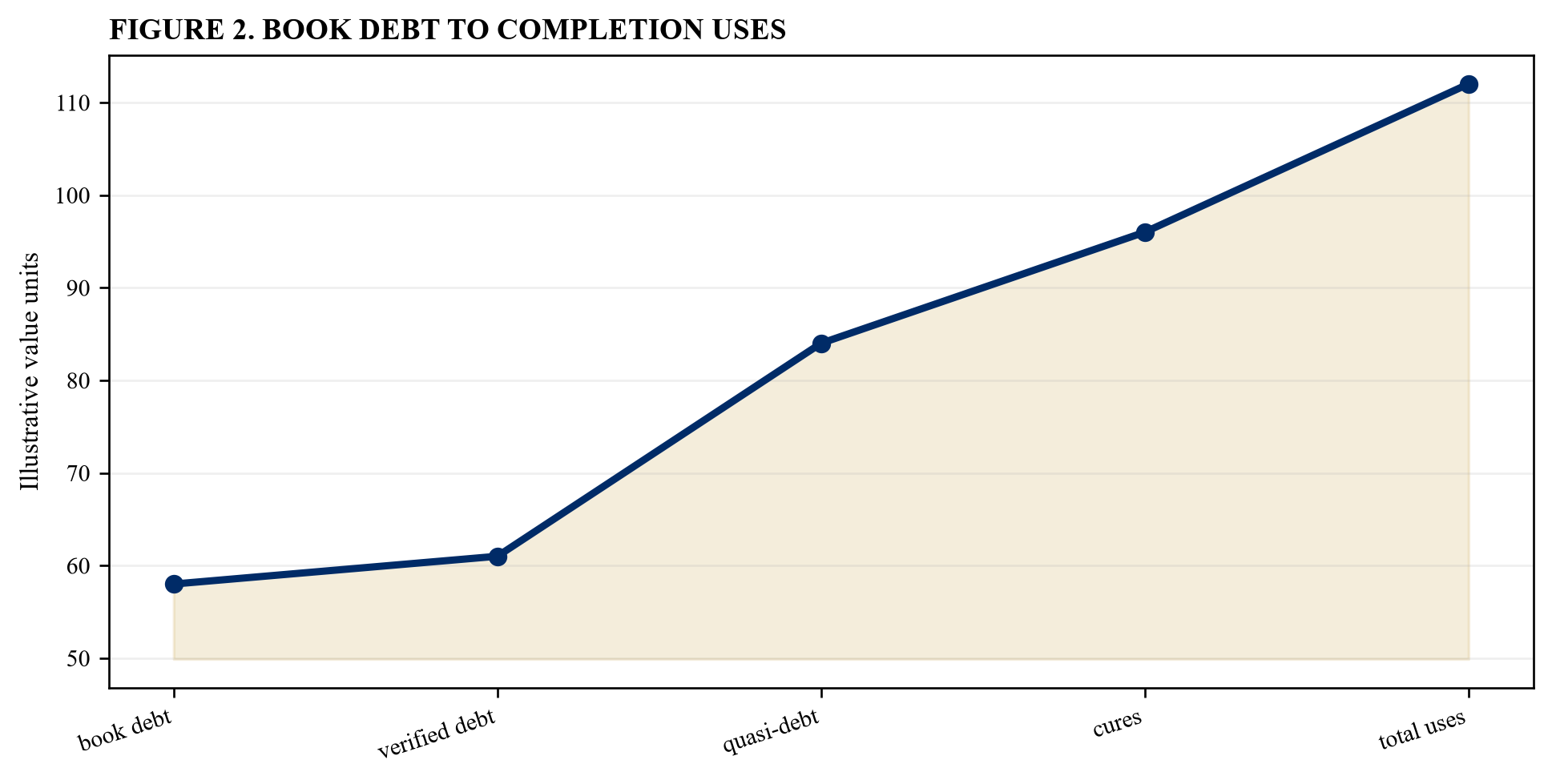
Illustrative analytical scenario; transaction evidence should replace model values.
11. Capture accrued and contingent financing cost
The readiness team should calculate commitment fees, waiver fees, professional costs, make-wholes, breakage, guarantee fees and unbilled default interest. The evidence base includes facility terms, adviser engagements, lender correspondence, hedge data and invoices. The central question is what financing cost has accrued or crystallises on completion. Conclusions should remain at entity and dependency level because the failing group may have pooled cash, shared rights and cross-guarantees [33][42][43][105].
The required deliverable is an accrued financing-cost schedule. It should connect the proposed sale documents to the stand-alone operating model and the residual estate. Every material assumption should show its source and sensitivity.
The downside is that the payoff may rise materially between bid date and closing. Management should test the base case and a combined downside against minimum cash, customer continuity and the completion timetable. Unsupported benefits should not be treated as available funding.
12. Control bank accounts and trapped cash
The seller should verify ownership, restrictions, set-off, sweeps, blocked balances, merchant reserves, client money and local repatriation constraints. Relevant evidence includes bank confirmations, mandates, reconciliations, facility terms and regulatory rules. The decision asks which cash is genuinely distributable at completion. A reliable answer links financial analysis to title, transfer mechanics, operating capability and the applicable approval process [37][38][39][74].
The decision pack should contain an available-cash and control matrix. It should show calculation dates, owners, dependencies and the documents that implement the conclusion. This creates a defensible record for later scrutiny and post-completion reconciliation.
A material failure occurs when reported cash may be pledged, restricted, swept or unavailable to the acquired business. The response should identify a funded cure, alternative perimeter or fallback route. Continuing without one can reduce going-concern value and creditor recovery.
13. Classify leases and hire-purchase obligations
The transaction team should separate property, equipment, vehicle, software and embedded leases; then test arrears, deposits, termination and assignment. Evidence should come from lease population, IFRS 16 schedules, contracts, invoices, asset registers and landlord correspondence. The controlling question is which use rights and cash obligations continue or must be replaced. The answer should be dated, attributed and linked to the legal entity, asset, liability or operating dependency it describes [41][51][90][91].
The controlled output is a lease transfer and funding schedule. It should state the source, calculation method, owner, exceptions, required approvals and the next irreversible deadline. This allows a board, officeholder, creditor or buyer to reproduce the conclusion when facts change.
The principal risk is that accounting lease balances may diverge from cure, consent and replacement economics. The team should quantify the effect on liquidity, stand-alone earnings, creditor recoveries, operating continuity and completion probability. A material exception should update the perimeter and funding plan.
14. Review retention-of-title and consignment claims
This workstream requires the company and its advisers to identify goods held subject to title retention, consignment, bailment, warehouse liens and reclamation rights, using supplier contracts, invoices, stock records, site inspection, correspondence and security analysis. The practical test is which inventory can be transferred, consumed or sold free of third-party claims. Analysis should use one cut-off date so that cash, claims, contracts, people and transaction documents reconcile [30][33][49][111].
Decision-makers should maintain a title-to-inventory schedule. It should distinguish legal ownership from economic allocation, current evidence from forecast assumptions and committed funding from indications. Qualified advisers retain responsibility for legal, insolvency, tax, pensions, accounting and regulatory judgements.
Execution can fail when physical possession may be mistaken for ownership. Each dependency needs a control, evidence threshold, escalation route and decision time. The transaction remains viable only while the funded separation plan can absorb a credible delay or shortfall.
15. Test receivables assignments and factoring
The readiness team should trace disclosed and undisclosed assignments, recourse, reserves, dilution, collection accounts and notification duties. The evidence base includes factoring agreements, receivables ledgers, bank flows, customer notices and confirmations. The central question is who owns collections and what recourse survives the transaction. Conclusions should remain at entity and dependency level because the failing group may have pooled cash, shared rights and cross-guarantees [42][45][51][111].
The required deliverable is a receivables ownership and funding bridge. It should connect the proposed sale documents to the stand-alone operating model and the residual estate. Every material assumption should show its source and sensitivity.
The downside is that the buyer may value cash flows already sold or subject to set-off. Management should test the base case and a combined downside against minimum cash, customer continuity and the completion timetable. Unsupported benefits should not be treated as available funding.
16. Reconcile customer deposits and deferred revenue
The seller should map deposits, subscriptions, gift balances, milestones, warranties and prepaid service obligations. Relevant evidence includes customer contracts, subledgers, bank receipts, fulfilment data and complaints. The decision asks what cash was received before completion and what performance remains after it. A reliable answer links financial analysis to title, transfer mechanics, operating capability and the applicable approval process [17][45][46][104].
The decision pack should contain a customer-funding and fulfilment schedule. It should show calculation dates, owners, dependencies and the documents that implement the conclusion. This creates a defensible record for later scrutiny and post-completion reconciliation.
A material failure occurs when cash retained by the seller may finance obligations performed by the buyer. The response should identify a funded cure, alternative perimeter or fallback route. Continuing without one can reduce going-concern value and creditor recovery.
17. Map supplier arrears and critical-input continuity
The transaction team should rank overdue suppliers by legal leverage, substitutability, lead time, operational criticality and required cure. Evidence should come from aged payables, contracts, purchase orders, correspondence, stock and operating plans. The controlling question is which payments or agreements are required for uninterrupted trade. The answer should be dated, attributed and linked to the legal entity, asset, liability or operating dependency it describes [5][48][49][50].
The controlled output is a critical-supplier cure plan. It should state the source, calculation method, owner, exceptions, required approvals and the next irreversible deadline. This allows a board, officeholder, creditor or buyer to reproduce the conclusion when facts change.
The principal risk is that small arrears can stop an entire production or service chain. The team should quantify the effect on liquidity, stand-alone earnings, creditor recoveries, operating continuity and completion probability. A material exception should update the perimeter and funding plan.
18. Treat working-capital shortfalls as funded uses
This workstream requires the company and its advisers to normalise receivables, inventory, payables, accruals, deferred revenue and seasonal needs under distress, using subledgers, counts, invoices, cash history, forecast and historical norms. The practical test is how much working capital the buyer must inject through the first stable cycle. Analysis should use one cut-off date so that cash, claims, contracts, people and transaction documents reconcile [17][40][51][52].
Decision-makers should maintain a normalised working-capital and liquidity bridge. It should distinguish legal ownership from economic allocation, current evidence from forecast assumptions and committed funding from indications. Qualified advisers retain responsibility for legal, insolvency, tax, pensions, accounting and regulatory judgements.
Execution can fail when a nominally debt-free acquisition may require immediate rescue funding. Each dependency needs a control, evidence threshold, escalation route and decision time. The transaction remains viable only while the funded separation plan can absorb a credible delay or shortfall.
19. Reconcile payroll and employee claims
The readiness team should verify employer, status, pay, holiday, bonus, commission, expenses, redundancy, litigation and immigration matters. The evidence base includes HRIS, payroll, contracts, tax data, claims and employee communications. The central question is which employment costs transfer, remain, crystallise or require day-one funding. Conclusions should remain at entity and dependency level because the failing group may have pooled cash, shared rights and cross-guarantees [54][55][56][112].
The required deliverable is a worker-level liability and continuity file. It should connect the proposed sale documents to the stand-alone operating model and the residual estate. Every material assumption should show its source and sensitivity.
The downside is that headcount totals can conceal statutory and contractual obligations. Management should test the base case and a combined downside against minimum cash, customer continuity and the completion timetable. Unsupported benefits should not be treated as available funding.
20. Test workforce transfer and insolvency exceptions
The seller should apply the relevant transfer rules to the chosen route, insolvency process and proposed changes. Relevant evidence includes legal advice, employee lists, consultation records, business-transfer evidence and government guidance. The decision asks which employees and obligations move and what consultation or information is required. A reliable answer links financial analysis to title, transfer mechanics, operating capability and the applicable approval process [54][55][56][112].
The decision pack should contain an employee-transfer implementation plan. It should show calculation dates, owners, dependencies and the documents that implement the conclusion. This creates a defensible record for later scrutiny and post-completion reconciliation.
A material failure occurs when incorrect assumptions can create claims, delay or loss of critical capability. The response should identify a funded cure, alternative perimeter or fallback route. Continuing without one can reduce going-concern value and creditor recovery.
21. Map pension and benefit exposure
The transaction team should reconcile contributions, scheme status, insured benefits, defined-benefit covenant, withdrawal, guarantees and regulatory powers. Evidence should come from scheme rules, actuarial reports, trustee correspondence, payroll, accounts and regulator guidance. The controlling question is what exposure transfers, crystallises or requires mitigation around the transaction. The answer should be dated, attributed and linked to the legal entity, asset, liability or operating dependency it describes [58][59][60][113].
The controlled output is a pension and benefits risk bridge. It should state the source, calculation method, owner, exceptions, required approvals and the next irreversible deadline. This allows a board, officeholder, creditor or buyer to reproduce the conclusion when facts change.
The principal risk is that book provisions may understate transaction cash and regulatory exposure. The team should quantify the effect on liquidity, stand-alone earnings, creditor recoveries, operating continuity and completion probability. A material exception should update the perimeter and funding plan.
22. Reconcile tax and VAT positions
This workstream requires the company and its advisers to map direct tax, VAT, payroll taxes, withholding, customs, group liabilities, audits, losses and transaction taxes, using returns, authority accounts, assessments, ledgers, advice and correspondence. The practical test is which amounts remain, transfer, attach or affect structure and price. Analysis should use one cut-off date so that cash, claims, contracts, people and transaction documents reconcile [62][63][64][114].
Decision-makers should maintain a tax liability and clearance matrix. It should distinguish legal ownership from economic allocation, current evidence from forecast assumptions and committed funding from indications. Qualified advisers retain responsibility for legal, insolvency, tax, pensions, accounting and regulatory judgements.
Execution can fail when historic or group exposures may sit outside the visible trial balance. Each dependency needs a control, evidence threshold, escalation route and decision time. The transaction remains viable only while the funded separation plan can absorb a credible delay or shortfall.
23. Test transfer-of-going-concern assumptions
The readiness team should verify that the assets, buyer status, intended use and transaction steps satisfy applicable VAT treatment. The evidence base includes sale perimeter, registrations, operating plan, property elections and tax advice. The central question is whether the transfer qualifies and who funds tax if the analysis changes. Conclusions should remain at entity and dependency level because the failing group may have pooled cash, shared rights and cross-guarantees [62][63][114][115].
The required deliverable is a documented VAT treatment and fallback funds flow. It should connect the proposed sale documents to the stand-alone operating model and the residual estate. Every material assumption should show its source and sensitivity.
The downside is that an incorrect assumption can create an immediate and material completion funding gap. Management should test the base case and a combined downside against minimum cash, customer continuity and the completion timetable. Unsupported benefits should not be treated as available funding.
24. Identify environmental and remediation exposure
The seller should map permits, contamination, waste, emissions, decommissioning, restoration and regulator directions at each site. Relevant evidence includes permits, audits, site reports, monitoring, title, insurance and regulator correspondence. The decision asks which obligations attach to ownership, operation, conduct or successor status. A reliable answer links financial analysis to title, transfer mechanics, operating capability and the applicable approval process [92][93][95][116].
The decision pack should contain an environmental liability and remediation model. It should show calculation dates, owners, dependencies and the documents that implement the conclusion. This creates a defensible record for later scrutiny and post-completion reconciliation.
A material failure occurs when private indemnities may not bind regulators or eliminate statutory exposure. The response should identify a funded cure, alternative perimeter or fallback route. Continuing without one can reduce going-concern value and creditor recovery.
25. Map product warranty recall and consumer claims
The transaction team should reconcile installed base, warranty terms, returns, recalls, safety notices, service commitments and reserves. Evidence should come from sales data, product records, complaints, claims, regulatory files and actuarial estimates. The controlling question is what historic sales can generate future cash or operational duties. The answer should be dated, attributed and linked to the legal entity, asset, liability or operating dependency it describes [17][94][96][104].
The controlled output is a product-liability and service-cost model. It should state the source, calculation method, owner, exceptions, required approvals and the next irreversible deadline. This allows a board, officeholder, creditor or buyer to reproduce the conclusion when facts change.
The principal risk is that an excluded historic claim may still damage the acquired brand and customer base. The team should quantify the effect on liquidity, stand-alone earnings, creditor recoveries, operating continuity and completion probability. A material exception should update the perimeter and funding plan.
26. Test licences permits and regulated permissions
This workstream requires the company and its advisers to inventory permissions, holder entity, conditions, arrears, breaches, transfer route and change-of-control approval, using official registers, licences, filings, correspondence, audits and legal advice. The practical test is whether the buyer can lawfully operate every material activity on day one. Analysis should use one cut-off date so that cash, claims, contracts, people and transaction documents reconcile [66][67][68][69].
Decision-makers should maintain a permission-transfer critical path. It should distinguish legal ownership from economic allocation, current evidence from forecast assumptions and committed funding from indications. Qualified advisers retain responsibility for legal, insolvency, tax, pensions, accounting and regulatory judgements.
Execution can fail when asset ownership may transfer without operating authority. Each dependency needs a control, evidence threshold, escalation route and decision time. The transaction remains viable only while the funded separation plan can absorb a credible delay or shortfall.
Table 3. Permission and consent matrix
| Dependency | Transfer route | Timing | Fallback |
|---|---|---|---|
| regulated licence | prior approval | pre-close | licensed service arrangement |
| customer contract | consent or novation | signing to close | replacement contract |
| property lease | assignment consent | pre-close | temporary occupation |
| software licence | novation or new licence | day one | stand-alone subscription |
Values and scores are analytical scenarios; transaction evidence should replace model values.
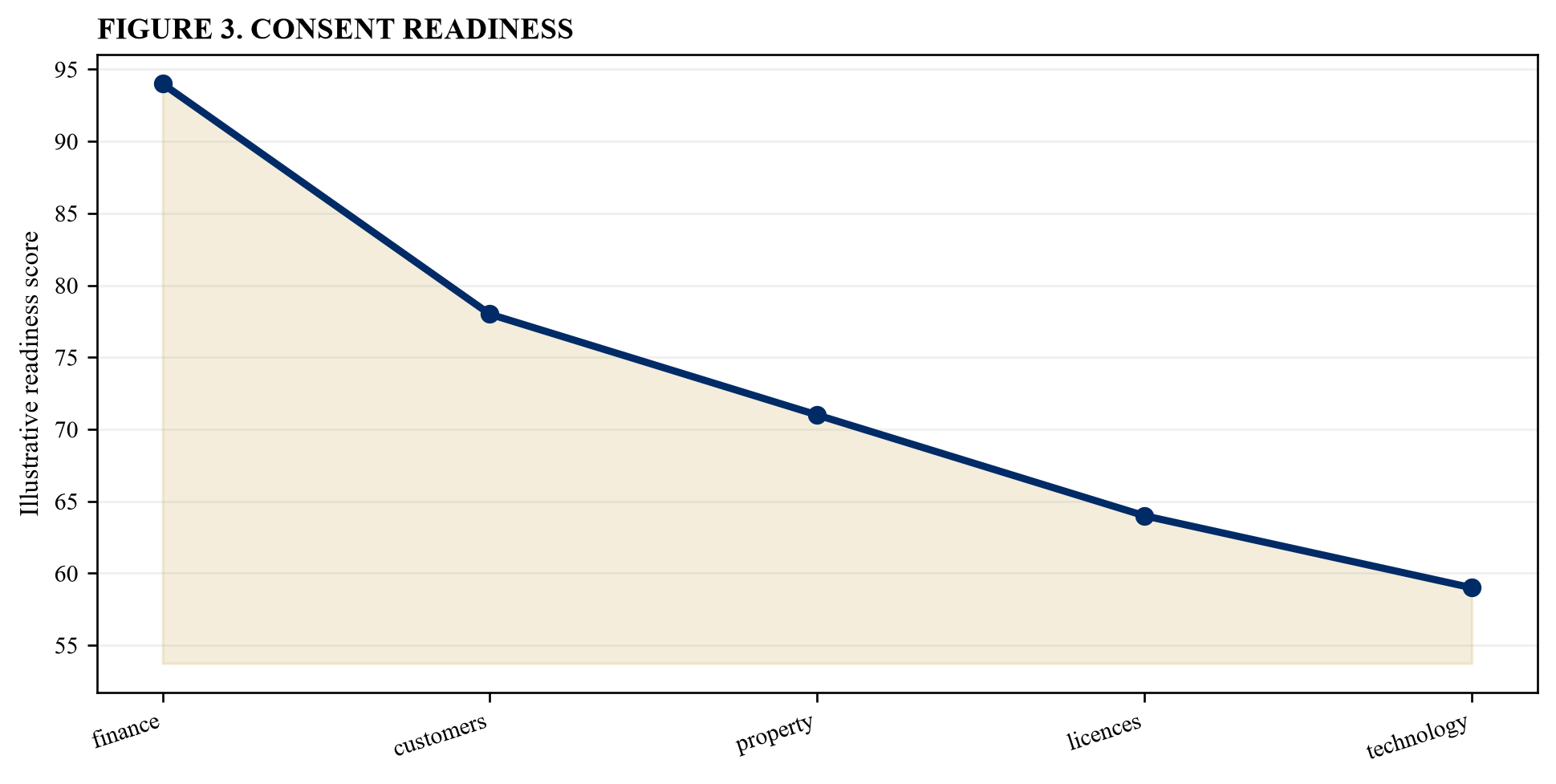
Illustrative analytical scenario; transaction evidence should replace model values.
27. Review change-of-control and assignment restrictions
The readiness team should screen customer, supplier, property, finance, IP, technology and joint-venture contracts for consent and termination rights. The evidence base includes executed contracts, amendments, notices, waivers and counterparty correspondence. The central question is which rights transfer automatically and which require consent, novation or replacement. Conclusions should remain at entity and dependency level because the failing group may have pooled cash, shared rights and cross-guarantees [14][45][47][48].
The required deliverable is a consent and contract-continuity matrix. It should connect the proposed sale documents to the stand-alone operating model and the residual estate. Every material assumption should show its source and sensitivity.
The downside is that valuable contracts may terminate or become renegotiation leverage. Management should test the base case and a combined downside against minimum cash, customer continuity and the completion timetable. Unsupported benefits should not be treated as available funding.
28. Map data privacy and cyber obligations
The seller should identify controller roles, lawful bases, transfer restrictions, breach history, retention, access and separation duties. Relevant evidence includes data maps, notices, contracts, processing records, incident files, logs and access exports. The decision asks what data can be disclosed, transferred and used after completion. A reliable answer links financial analysis to title, transfer mechanics, operating capability and the applicable approval process [81][82][84][85].
The decision pack should contain a lawful data and cyber transition plan. It should show calculation dates, owners, dependencies and the documents that implement the conclusion. This creates a defensible record for later scrutiny and post-completion reconciliation.
A material failure occurs when the transaction may transfer operational dependence without lawful data rights or secure control. The response should identify a funded cure, alternative perimeter or fallback route. Continuing without one can reduce going-concern value and creditor recovery.
29. Prove intellectual-property ownership and licences
The transaction team should trace employee and contractor creation, assignments, registrations, open-source use, licences, security and disputes. Evidence should come from registers, agreements, repositories, payroll, invoices, scans and claims. The controlling question is which rights are owned, transferable, encumbered or replaceable. The answer should be dated, attributed and linked to the legal entity, asset, liability or operating dependency it describes [77][78][79][83].
The controlled output is an intellectual-property chain-of-title and licence schedule. It should state the source, calculation method, owner, exceptions, required approvals and the next irreversible deadline. This allows a board, officeholder, creditor or buyer to reproduce the conclusion when facts change.
The principal risk is that core technology may sit with an individual, affiliate or terminating licence. The team should quantify the effect on liquidity, stand-alone earnings, creditor recoveries, operating continuity and completion probability. A material exception should update the perimeter and funding plan.
30. Identify litigation investigations and contingent claims
This workstream requires the company and its advisers to capture filed, threatened and unasserted matters, undertakings, evidence holds, settlements and defence costs, using court and regulator searches, counsel letters, correspondence, board records and provisions. The practical test is what can crystallise, restrict assets, consume management or impair licences. Analysis should use one cut-off date so that cash, claims, contracts, people and transaction documents reconcile [17][96][97][98].
Decision-makers should maintain a disputes and contingent-liability model. It should distinguish legal ownership from economic allocation, current evidence from forecast assumptions and committed funding from indications. Qualified advisers retain responsibility for legal, insolvency, tax, pensions, accounting and regulatory judgements.
Execution can fail when the accounting provision may omit probability ranges, defence cost and business interruption. Each dependency needs a control, evidence threshold, escalation route and decision time. The transaction remains viable only while the funded separation plan can absorb a credible delay or shortfall.
31. Reconcile insurance and recoveries
The readiness team should verify policyholder, period, limits, exclusions, deductibles, notification, premiums, claims and run-off terms. The evidence base includes policies, endorsements, broker confirmations, claims history and payment evidence. The central question is which historic and future exposures have collectible coverage. Conclusions should remain at entity and dependency level because the failing group may have pooled cash, shared rights and cross-guarantees [99][100][101][102].
The required deliverable is an insurance continuity and recovery schedule. It should connect the proposed sale documents to the stand-alone operating model and the residual estate. Every material assumption should show its source and sensitivity.
The downside is that policy existence may be treated as certain recovery despite exclusions or notice failures. Management should test the base case and a combined downside against minimum cash, customer continuity and the completion timetable. Unsupported benefits should not be treated as available funding.
32. Map guarantees letters of support and cross-defaults
The seller should identify upstream, downstream and third-party guarantees, comfort letters, bonds, indemnities and default linkages. Relevant evidence includes finance documents, board records, bank files, contract registers, filings and confirmations. The decision asks which contingent obligations are released, remain or are triggered by the sale. A reliable answer links financial analysis to title, transfer mechanics, operating capability and the applicable approval process [33][34][42][43].
The decision pack should contain a contingent-credit support map. It should show calculation dates, owners, dependencies and the documents that implement the conclusion. This creates a defensible record for later scrutiny and post-completion reconciliation.
A material failure occurs when a guarantee outside the acquired entity can still disrupt essential funding or supply. The response should identify a funded cure, alternative perimeter or fallback route. Continuing without one can reduce going-concern value and creditor recovery.
33. Test group cash pooling and intercompany balances
The transaction team should reconstruct sweeps, netting, treasury loans, tax allocations, service charges and settlement priorities. Evidence should come from bank data, treasury agreements, intercompany ledgers, invoices, tax files and board approvals. The controlling question is what cash and debt exist between perimeter entities and the residual group. The answer should be dated, attributed and linked to the legal entity, asset, liability or operating dependency it describes [37][38][39][103].
The controlled output is an intercompany settlement and separation plan. It should state the source, calculation method, owner, exceptions, required approvals and the next irreversible deadline. This allows a board, officeholder, creditor or buyer to reproduce the conclusion when facts change.
The principal risk is that net balances may mask gross legal claims and day-one liquidity loss. The team should quantify the effect on liquidity, stand-alone earnings, creditor recoveries, operating continuity and completion probability. A material exception should update the perimeter and funding plan.
34. Separate excluded liabilities from operating dependencies
This workstream requires the company and its advisers to link every excluded legal obligation to the asset, contract, person, licence, supplier or service on which the buyer relies, using sale schedules, operating maps, contracts, claims and transition plans. The practical test is what the buyer needs despite contractual exclusion. Analysis should use one cut-off date so that cash, claims, contracts, people and transaction documents reconcile [14][49][80][103].
Decision-makers should maintain an exclusion-to-dependency matrix. It should distinguish legal ownership from economic allocation, current evidence from forecast assumptions and committed funding from indications. Qualified advisers retain responsibility for legal, insolvency, tax, pensions, accounting and regulatory judgements.
Execution can fail when legal drafting may allocate a liability while leaving no practical continuity solution. Each dependency needs a control, evidence threshold, escalation route and decision time. The transaction remains viable only while the funded separation plan can absorb a credible delay or shortfall.
35. Model completion and post-close funding
The readiness team should forecast payoff, cure, tax, payroll, working capital, capex, separation, remediation and contingency cash by date. The evidence base includes liability map, cash flow, bids, lender terms, integration plan and scenario assumptions. The central question is how much committed liquidity is required under base and downside cases. Conclusions should remain at entity and dependency level because the failing group may have pooled cash, shared rights and cross-guarantees [5][6][40][104].
The required deliverable is a source-linked uses and funding model. It should connect the proposed sale documents to the stand-alone operating model and the residual estate. Every material assumption should show its source and sensitivity.
The downside is that purchase consideration may consume funds required to make the acquired business viable. Management should test the base case and a combined downside against minimum cash, customer continuity and the completion timetable. Unsupported benefits should not be treated as available funding.
36. Compare bids on a common-basis value bridge
The seller should adjust headline price for debt, quasi-debt, assumed liabilities, working capital, continuity funding, delay and execution probability. Relevant evidence includes bid terms, diligence evidence, funding commitments, legal structure and scenarios. The decision asks which bid maximises risk-adjusted value and deliverability. A reliable answer links financial analysis to title, transfer mechanics, operating capability and the applicable approval process [12][17][40][104].
The decision pack should contain a comparable net-value and recovery bridge. It should show calculation dates, owners, dependencies and the documents that implement the conclusion. This creates a defensible record for later scrutiny and post-completion reconciliation.
A material failure occurs when the highest headline bid may produce the lowest reliable recovery. The response should identify a funded cure, alternative perimeter or fallback route. Continuing without one can reduce going-concern value and creditor recovery.
Table 4. Illustrative common-basis bid bridge
| Measure | Bid A | Bid B | Bid C |
|---|---|---|---|
| headline price | 120 | 113 | 105 |
| debt and quasi-debt | -31 | -20 | -12 |
| continuity and working capital | -17 | -11 | -7 |
| probability-weighted net value | 61 | 70 | 76 |
Values and scores are analytical scenarios; transaction evidence should replace model values.
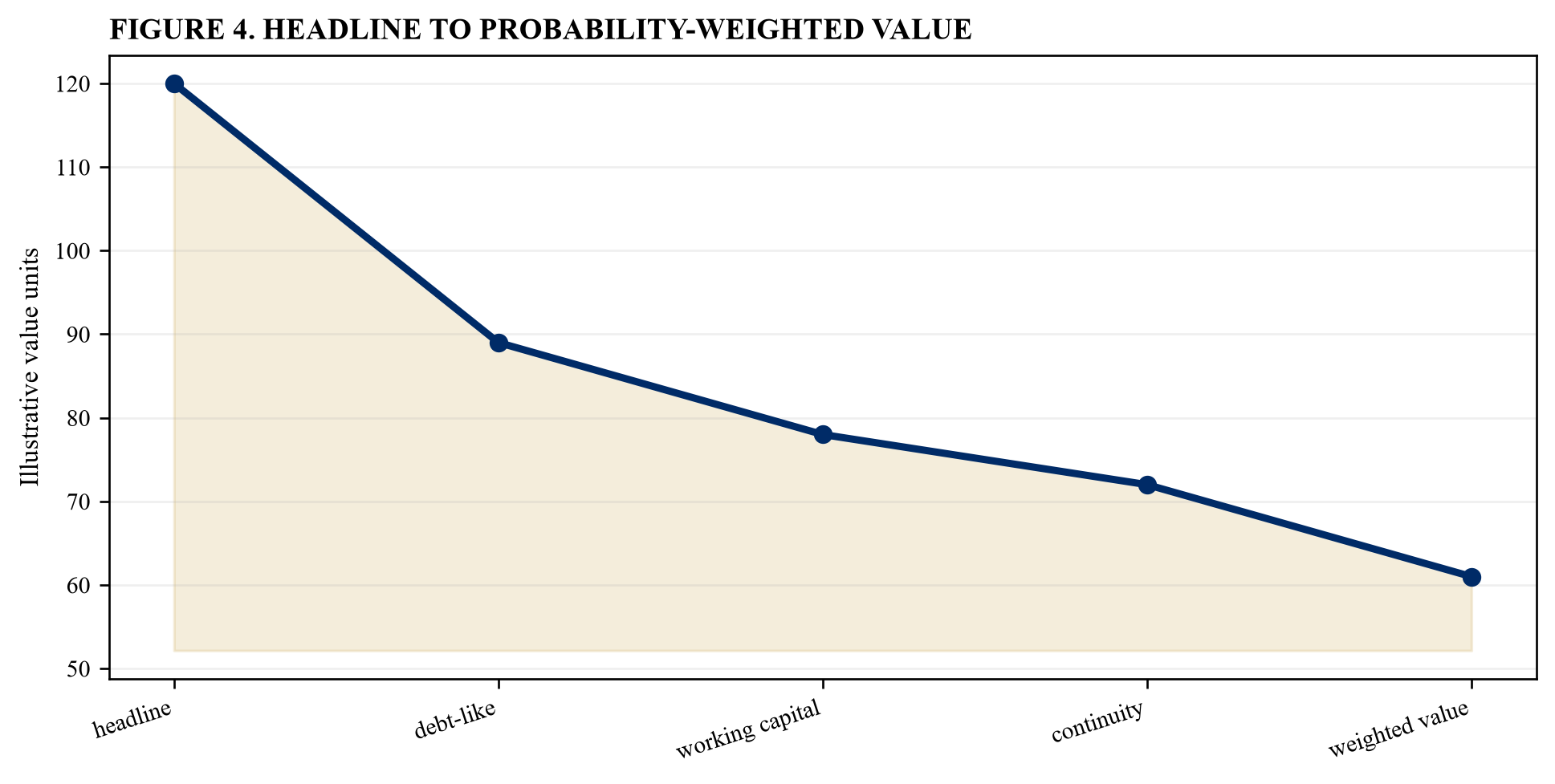
Illustrative analytical scenario; transaction evidence should replace model values.
37. Convert findings into transaction protections
The transaction team should map each quantified exposure to price, condition, covenant, indemnity, escrow, holdback, insurance, direct payment or walk right. Evidence should come from exception register, legal advice, negotiation log, model and financing terms. The controlling question is who bears each risk, within what cap and for how long. The answer should be dated, attributed and linked to the legal entity, asset, liability or operating dependency it describes [14][23][105][106].
The controlled output is a liability-allocation matrix linked to drafting. It should state the source, calculation method, owner, exceptions, required approvals and the next irreversible deadline. This allows a board, officeholder, creditor or buyer to reproduce the conclusion when facts change.
The principal risk is that generic protections may fail to match the exposure or the seller's credit quality. The team should quantify the effect on liquidity, stand-alone earnings, creditor recoveries, operating continuity and completion probability. A material exception should update the perimeter and funding plan.
38. Build the funds flow and release evidence book
This workstream requires the company and its advisers to sequence sources, payments, payoff letters, security releases, consents, tax, payroll, adviser costs and residual cash, using signed documents, bank instructions, completion statements, certificates and third-party confirmations. The practical test is whether every payment and release is authorised, funded and simultaneous. Analysis should use one cut-off date so that cash, claims, contracts, people and transaction documents reconcile [28][33][107][110].
Decision-makers should maintain a controlled funds flow and completion evidence book. It should distinguish legal ownership from economic allocation, current evidence from forecast assumptions and committed funding from indications. Qualified advisers retain responsibility for legal, insolvency, tax, pensions, accounting and regulatory judgements.
Execution can fail when cash can move while a charge, guarantee, consent or operational dependency remains open. Each dependency needs a control, evidence threshold, escalation route and decision time. The transaction remains viable only while the funded separation plan can absorb a credible delay or shortfall.
39. Govern open exceptions through completion
The readiness team should assign owner, evidence threshold, deadline, decision authority, fallback and escalation for every unresolved item. The evidence base includes exception register, meeting cadence, data-room log, models, approvals and completion checklist. The central question is which gaps are cured, allocated, waived or stop the transaction. Conclusions should remain at entity and dependency level because the failing group may have pooled cash, shared rights and cross-guarantees [12][14][23][24].
The required deliverable is an authorised exception-control dashboard. It should connect the proposed sale documents to the stand-alone operating model and the residual estate. Every material assumption should show its source and sensitivity.
The downside is that open issues may be lost inside drafting and email traffic. Management should test the base case and a combined downside against minimum cash, customer continuity and the completion timetable. Unsupported benefits should not be treated as available funding.
40. Close liability and continuity gaps in the first hundred days
The seller should sequence bank control, statutory updates, supplier cure, employee integration, licence transfer, data access, claims and remediation. Relevant evidence includes completion book, transition plan, operating KPIs, cash model and closure evidence. The decision asks who owns each surviving obligation and what proves closure. A reliable answer links financial analysis to title, transfer mechanics, operating capability and the applicable approval process [15][49][88][108].
The decision pack should contain a hundred-day liability closure and value plan. It should show calculation dates, owners, dependencies and the documents that implement the conclusion. This creates a defensible record for later scrutiny and post-completion reconciliation.
A material failure occurs when ownership changes can cause unresolved exposures to disappear from governance before they disappear economically. The response should identify a funded cure, alternative perimeter or fallback route. Continuing without one can reduce going-concern value and creditor recovery.
Table 5. Liability-control implementation
| Horizon | Priority | Evidence of control |
|---|---|---|
| 48 hours | route, authority, security and runway | mandates, registers and bank evidence |
| days 3 to 7 | quasi-debt and continuity | reconciled liability map |
| to completion | funding, releases and consents | signed evidence book |
| day 1 to 100 | closure and value protection | owners, KPIs and verified closure |
Values and scores are analytical scenarios; transaction evidence should replace model values.
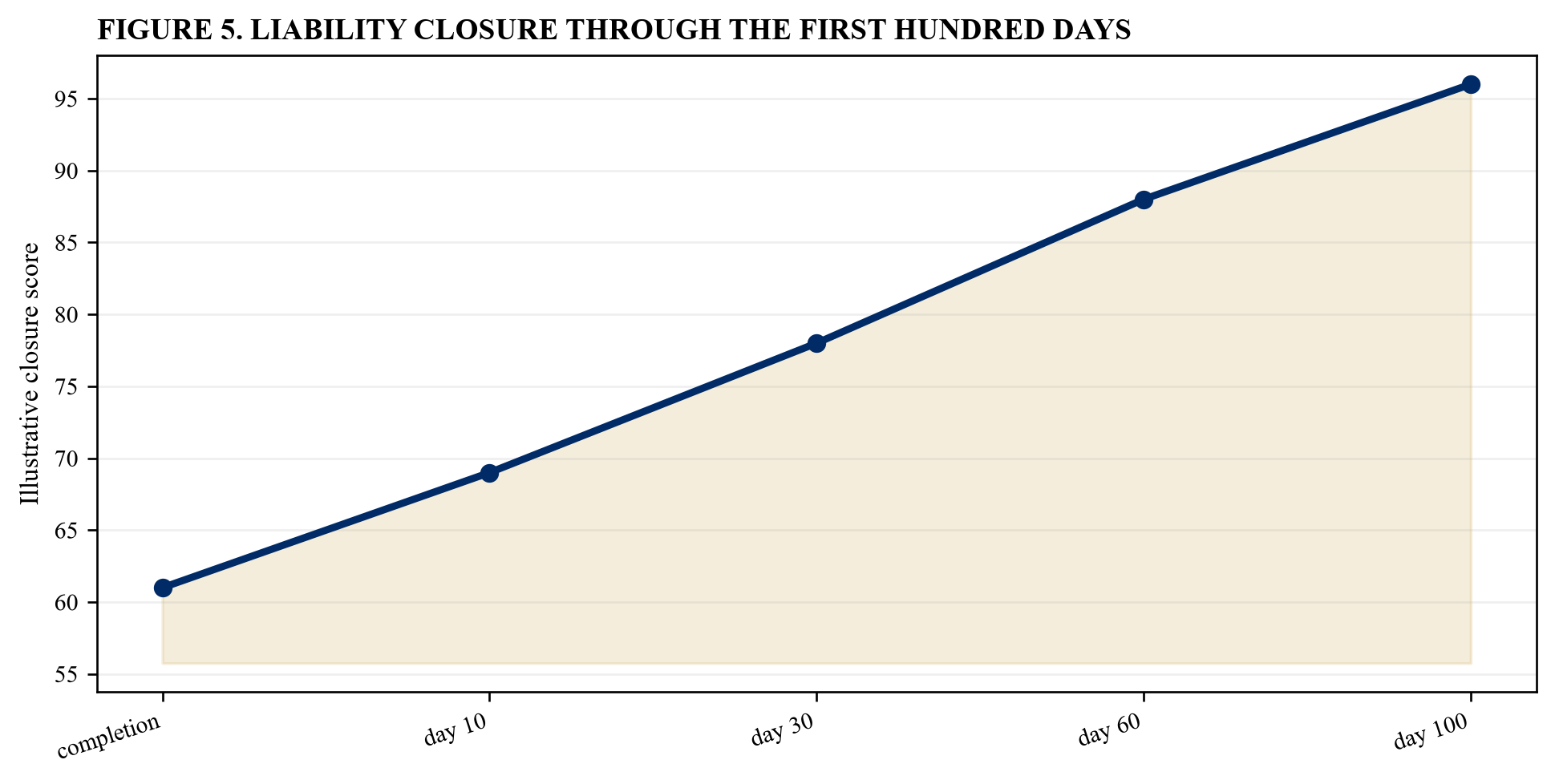
Illustrative analytical scenario; transaction evidence should replace model values.
References
- UK Parliament, Insolvency Act 1986, https://www.legislation.gov.uk/ukpga/1986/45/contents
- UK Parliament, Insolvency Rules 2016, https://www.legislation.gov.uk/uksi/2016/1024/contents
- UNCITRAL, Model Law on Enterprise Group Insolvency, https://uncitral.un.org/en/MLEGI
- World Bank, Principles for Effective Insolvency and Creditor Debtor Regimes, https://www.worldbank.org/en/brief/2026/02/24/the-world-bank-principles-for-effective-insolvency-and-creditor-rights
- UK Government, Corporate Financial Distress Guidance, https://www.gov.uk/government/publications/the-sourcing-and-consultancy-playbooks/corporate-financial-distress-guidance-note-html
- UK Insolvency Service, Spotting the Signs of Company Distress, https://www.gov.uk/guidance/director-information-hub-spotting-the-signs-of-company-distress
- UK Government, Put Your Company into Administration, https://www.gov.uk/put-your-company-into-administration
- UNCITRAL, Legislative Guide on Insolvency Law, https://uncitral.un.org/en/texts/insolvency/legislativeguides/insolvency_law
- UK Companies House, Search the Register, https://find-and-update.company-information.service.gov.uk/
- UK Parliament, Companies Act 2006, https://www.legislation.gov.uk/ukpga/2006/46/contents
- SEC, Search Filings, https://www.sec.gov/search-filings
- IFRS Foundation, IFRS 13 Fair Value Measurement, https://www.ifrs.org/issued-standards/list-of-standards/ifrs-13-fair-value-measurement/
- International Valuation Standards Council, Standards, https://www.ivsc.org/standards/
- ISO, ISO 9001 Quality Management, https://www.iso.org/standard/62085.html
- ISO, ISO 22301 Business Continuity, https://www.iso.org/standard/75106.html
- COSO, Internal Control Framework, https://www.coso.org/guidance-on-ic
- IFRS Foundation, IFRS Accounting Standards, https://www.ifrs.org/issued-standards/list-of-standards/
- PCAOB, Audit Evidence AS 1105, https://pcaobus.org/oversight/standards/auditing-standards/details/AS1105
- IAASB, International Standards on Auditing, https://www.iaasb.org/publications
- NIST, Digital Evidence and Forensics, https://www.nist.gov/programs-projects/digital-and-multimedia-forensics
- UK National Archives, Records Management, https://www.nationalarchives.gov.uk/information-management/
- ISO, ISO 15489 Records Management, https://www.iso.org/standard/62542.html
- UK Government, Managing Public Money, https://www.gov.uk/government/publications/managing-public-money
- US GAO, Standards for Internal Control, https://www.gao.gov/products/gao-14-704g
- UK Companies House, People with Significant Control, https://www.gov.uk/guidance/people-with-significant-control-pscs
- FATF, Beneficial Ownership of Legal Persons, https://www.fatf-gafi.org/en/publications/Fatfrecommendations/Guidance-Beneficial-Ownership-Legal-Persons.html
- FATF, Recommendations, https://www.fatf-gafi.org/en/publications/Fatfrecommendations/Fatf-recommendations.html
- UK Government, Director Responsibilities, https://www.gov.uk/company-director-responsibilities
- Delaware Code, General Corporation Law, https://delcode.delaware.gov/title8/c001/
- WIPO, Intellectual Property and Business, https://www.wipo.int/sme/en/
- HM Land Registry, Search the Register, https://www.gov.uk/get-information-about-property-and-land/search-the-register
- HM Land Registry, How to Read a Title Register and Plan, https://www.gov.uk/government/publications/how-to-read-a-title-register-and-title-plan
- UK Companies House, Register a Charge, https://www.gov.uk/government/publications/register-particulars-of-a-charge-mr01
- US Code, Bankruptcy Code Section 506, https://uscode.house.gov/view.xhtml?req=granuleid:USC-prelim-title11-section506
- UNCITRAL, Model Law on Secured Transactions, https://uncitral.un.org/en/texts/securityinterests/modellaw/secured_transactions
- World Bank, Secured Transactions and Collateral Registries, https://www.worldbank.org/en/topic/financialsector/brief/collateral-registries
- FCA, Client Assets, https://www.fca.org.uk/firms/client-money-assets
- UK Finance, Confirmation of Payee, https://www.ukfinance.org.uk/policy-and-guidance/guidance/confirmation-payee
- Federal Reserve, Account Services, https://www.frbservices.org/financial-services/accounting
- IFRS Foundation, IAS 7 Statement of Cash Flows, https://www.ifrs.org/issued-standards/list-of-standards/ias-7-statement-of-cash-flows/
- UK Government, Cash Flow Forecasting Guidance, https://www.gov.uk/guidance/cash-flow-forecasting
- Loan Market Association, Documents and Guidelines, https://www.lma.eu.com/documents-guidelines/documents
- Federal Reserve, Supervision and Regulation, https://www.federalreserve.gov/supervisionreg.htm
- US Code, Bankruptcy Code Section 507, https://uscode.house.gov/view.xhtml?req=granuleid:USC-prelim-title11-section507
- IFRS Foundation, IFRS 15 Revenue, https://www.ifrs.org/issued-standards/list-of-standards/ifrs-15-revenue-from-contracts-with-customers/
- SEC, Revenue Recognition Staff Accounting Bulletin 116, https://www.sec.gov/files/sab116.pdf
- UK Parliament, Contracts Rights of Third Parties Act 1999, https://www.legislation.gov.uk/ukpga/1999/31/contents
- UNIDROIT, Principles of International Commercial Contracts, https://www.unidroit.org/instruments/commercial-contracts/unidroit-principles-2016/
- UK Government, Supplier Failure Contingency Planning, https://www.gov.uk/government/publications/corporate-financial-distress
- ISO, ISO 28000 Security and Resilience, https://www.iso.org/standard/79612.html
- IFRS Foundation, IAS 2 Inventories, https://www.ifrs.org/issued-standards/list-of-standards/ias-2-inventories/
- IFRS Foundation, IAS 1 Presentation of Financial Statements, https://www.ifrs.org/issued-standards/list-of-standards/ias-1-presentation-of-financial-statements/
- PCAOB, Auditing Inventories AS 2510, https://pcaobus.org/oversight/standards/auditing-standards/details/AS2510
- UK Parliament, Transfer of Undertakings Regulations 2006, https://www.legislation.gov.uk/uksi/2006/246/contents
- UK Government, Transfers of Employment Contracts, https://www.gov.uk/transfers-takeovers/transfers-of-employment-contracts
- US Department of Labor, WARN Act, https://www.dol.gov/agencies/eta/layoffs/warn
- UK Government, Right to Work Checks, https://www.gov.uk/check-job-applicant-right-to-work
- IFRS Foundation, IAS 19 Employee Benefits, https://www.ifrs.org/issued-standards/list-of-standards/ias-19-employee-benefits/
- The Pensions Regulator, Employers, https://www.thepensionsregulator.gov.uk/en/employers
- Pension Protection Fund, Section 179 Guidance, https://www.ppf.co.uk/section-179-valuation-guidance
- PBGC, Plan Terminations, https://www.pbgc.gov/employers-practitioners/plan-terminations
- UK Government, Corporation Tax, https://www.gov.uk/corporation-tax
- OECD, Transfer Pricing Guidelines, https://www.oecd.org/tax/transfer-pricing/oecd-transfer-pricing-guidelines-for-multinational-enterprises-and-tax-administrations-20769717.htm
- IRS, Businesses, https://www.irs.gov/businesses
- European Commission, Taxation and Customs, https://taxation-customs.ec.europa.eu/index_en
- FCA, Financial Services Register, https://register.fca.org.uk/
- FCA, Submit a Change in Control Notification, https://www.fca.org.uk/firms/change-control/submit-notification
- Ofgem, Licences and Licence Conditions, https://www.ofgem.gov.uk/energy-policy-and-regulation/industry-licensing
- Ofcom, Licensing, https://www.ofcom.org.uk/spectrum/frequencies/licensing/
- UK CMA, Merging Your Business, https://www.gov.uk/guidance/merging-your-business
- European Union, Council Regulation 139/2004, https://eur-lex.europa.eu/eli/reg/2004/139/oj
- UK Government, National Security and Investment Act Guidance, https://www.gov.uk/guidance/national-security-and-investment-act-guidance-on-acquisitions
- US Treasury, CFIUS Laws and Guidance, https://home.treasury.gov/policy-issues/international/the-committee-on-foreign-investment-in-the-united-states-cfius/cfius-laws-and-guidance
- UK Government, UK Sanctions List, https://www.gov.uk/government/publications/the-uk-sanctions-list
- OFAC, Sanctions Programs, https://ofac.treasury.gov/sanctions-programs-and-country-information
- FinCEN, Customer Due Diligence, https://www.fincen.gov/resources/statutes-and-regulations/cdd-final-rule
- WIPO, Global Brand Database, https://branddb.wipo.int/
- WIPO, PATENTSCOPE, https://patentscope.wipo.int/
- UK IPO, Search for a Patent, https://www.gov.uk/search-for-patent
- ISO, ISO IEC 25010 Systems and Software Quality, https://www.iso.org/standard/78176.html
- NIST, Cybersecurity Framework 2.0, https://www.nist.gov/cyberframework
- NIST, Secure Software Development Framework, https://csrc.nist.gov/Projects/ssdf
- CISA, Software Bill of Materials, https://www.cisa.gov/sbom
- ICO, Data Sharing Code of Practice, https://ico.org.uk/for-organisations/uk-gdpr-guidance-and-resources/data-sharing/data-sharing-a-code-of-practice/
- European Union, General Data Protection Regulation, https://eur-lex.europa.eu/eli/reg/2016/679/oj
- European Data Protection Board, Guidelines, https://www.edpb.europa.eu/our-work-tools/general-guidance/guidelines-recommendations-best-practices_en
- UK Parliament, Data Use and Access Act 2025, https://www.legislation.gov.uk/ukpga/2025/18/contents
- CISA, Cybersecurity Performance Goals, https://www.cisa.gov/cross-sector-cybersecurity-performance-goals
- NIST, Incident Response, https://csrc.nist.gov/pubs/sp/800/61/r3/final
- HM Land Registry, Official Copies, https://www.gov.uk/government/publications/official-copies-of-register-or-plan-registration-oc1
- UK Government, Commercial Property Standard Enquiries, https://www.gov.uk/government/publications/commercial-property-standard-enquiries
- UK Environment Agency, Environmental Permits, https://www.gov.uk/guidance/environmental-permits-how-to-apply
- US EPA, Environmental Permitting, https://www.epa.gov/permits
- UK HSE, Managing Risks and Risk Assessment, https://www.hse.gov.uk/simple-health-safety/risk/
- ISO, ISO 14001 Environmental Management, https://www.iso.org/standard/60857.html
- UK Courts and Tribunals, Find a Court or Tribunal, https://www.gov.uk/find-court-tribunal
- PACER, Public Access to Court Electronic Records, https://pacer.uscourts.gov/
- SEC, Enforcement, https://www.sec.gov/enforcement
- FCA, Insurance Conduct of Business Sourcebook, https://www.handbook.fca.org.uk/handbook/ICOBS/
- EIOPA, Solvency II, https://www.eiopa.europa.eu/browse/regulation-and-policy/solvency-ii_en
- NAIC, Insurance Topics, https://content.naic.org/insurance-topics
- UK Government, Employers Liability Insurance, https://www.gov.uk/employers-liability-insurance
- European Commission, Restructuring and Insolvency Directive, https://eur-lex.europa.eu/eli/dir/2019/1023/oj
- IFRS Foundation, IFRS 3 Business Combinations, https://www.ifrs.org/issued-standards/list-of-standards/ifrs-3-business-combinations/
- UK Parliament, Misrepresentation Act 1967, https://www.legislation.gov.uk/ukpga/1967/7/contents
- UK Parliament, Sale of Goods Act 1979, https://www.legislation.gov.uk/ukpga/1979/54/contents
- UK Law Society, Completion Code, https://www.lawsociety.org.uk/topics/property/completion-code
- ISO, ISO 37301 Compliance Management Systems, https://www.iso.org/standard/75080.html
- United States Code, 11 USC 363 Use Sale or Lease of Property, https://uscode.house.gov/view.xhtml?edition=prelim&num=0&req=granuleid%3AUSC-prelim-title11-section363
- Companies House, Register a Charge for a Limited Company, https://www.gov.uk/guidance/register-a-charge-mortgage-for-a-limited-company
- UNCITRAL, Legislative Guide on Secured Transactions, https://uncitral.un.org/en/texts/securityinterests/legislativeguides/secured_transactions
- UK Government, Business Transfers Takeovers and TUPE: Insolvent Businesses, https://www.gov.uk/transfers-takeovers/insolvent-businesses
- The Pensions Regulator, Clearance, https://www.thepensionsregulator.gov.uk/en/document-library/scheme-management-detailed-guidance/communications-and-reporting-detailed-guidance/clearance
- HM Revenue and Customs, Transfer of a Business as a Going Concern, https://www.gov.uk/guidance/insolvency-practitioner-s-handbook/18-transfer-of-a-business-as-a-going-concern
- HM Revenue and Customs, VAT Notice 700/9 Transfer of a Business as a Going Concern, https://www.gov.uk/guidance/transfer-a-business-as-a-going-concern-and-vat-notice-7009
- United States Environmental Protection Agency, Potentially Responsible Party Search Manual Chapter 3, https://www.epa.gov/sites/default/files/2017-10/documents/prp-man-chap3-17.pdf
- UK Insolvency Service, Requirements for Independent Scrutiny of Disposals in Administration, https://www.gov.uk/government/publications/requirements-for-independent-scrutiny-of-the-disposal-of-assets-in-administration-including-pre-pack-sales
- United States Code, 11 USC 365 Executory Contracts and Unexpired Leases, https://uscode.house.gov/view.xhtml?edition=prelim&num=0&req=granuleid%3AUSC-prelim-title11-section365
- The Pensions Regulator, Material Detriment Employer Insolvency and Employer Resources, https://www.thepensionsregulator.gov.uk/en/document-library/scheme-management-detailed-guidance/administration-detailed-guidance/material-detriment-test
- UK Parliament, Administration Restrictions on Disposal to Connected Persons Regulations 2021, https://www.legislation.gov.uk/uksi/2021/427/contents/made
