

1. Convert environmental and operating risk into a transaction question
A chemicals acquisition can appear attractive on reported EBITDA while carrying obligations and operating weaknesses that surface only after control changes. The central diligence question is whether the target can continue producing the contracted product mix safely, legally and reliably at the cash cost assumed in the valuation. That question requires one evidence chain across permits, process safety, asset integrity, maintenance, production, quality, inventory, receivables and transaction structure.
Environmental diligence should begin with the actual operating configuration. The legal entity, site boundary, products, production steps, hazardous materials, storage quantities, utilities, waste streams, effluent routes and logistics interfaces must match the approvals and records relied upon. A valid document does not establish compliant operation by itself. The buyer should reconcile permitted conditions with recent production, monitoring, inspection, incident and correspondence evidence.
Operating diligence should rebuild plant performance from physical data. Nameplate capacity, management availability and budgeted yield are starting points. Shift logs, distributed-control-system records, trip history, laboratory results, material balances, maintenance work orders, stores issues and customer claims provide stronger evidence of saleable output and the capital required to sustain it.
The findings should then reach the transaction model. A recurring yield loss belongs in normalised earnings. A defined remediation programme may require a price adjustment or funded closing plan. An uncertain historic contamination exposure may require specific contractual allocation and security. A working-capital shortfall should flow through the agreed completion mechanism. Qualified legal, environmental, technical, tax and accounting advisers should determine treatment using the target's verified facts.
2. Reconcile the legal, site and operating perimeter
The diligence perimeter should be fixed before detailed testing. It should identify every acquired entity, manufacturing site, warehouse, laboratory, utility connection, leased parcel, shared facility, pipeline, effluent-treatment asset, waste-storage area and logistics dependency. The buyer should also identify excluded assets, seller-owned utilities, transitional services and permits that cannot transfer automatically.
The operating perimeter must follow product and process flow. A site may manufacture intermediates for another group entity, depend on a common boiler or treatment plant, use contract storage, or receive critical inputs through a seller-controlled arrangement. These dependencies can change standalone cost, permit responsibility, business interruption exposure and Day One readiness. The separation plan should state who owns each asset, contract, licence, employee, record and control after closing.
The legal perimeter should record the authority, consent, approval, registration, return and inspection relevant to each site and activity. Applicable requirements vary by location, substance, threshold and process. The Ministry of Environment, Forest and Climate Change, Central Pollution Control Board, state pollution control boards, factory and local authorities can each be relevant. Counsel and technical advisers should confirm the current obligations and any consent required for the transaction or change of control.
The commercial perimeter should extend to critical feedstocks, toll manufacturers, transporters, waste contractors, customers and insurers. The buyer should map concentration, qualification requirements, change-of-control rights and alternate routes. The resulting perimeter memo becomes the control document for diligence scope, valuation, conditions precedent, transitional arrangements and the first one hundred days.
3. Build the environmental-liability map
An environmental-liability map should convert dispersed records into a site-by-site decision tool. Each entry should identify the activity or condition, applicable approval or obligation, physical evidence, potential consequence, responsible entity, evidence quality, estimated timing and proposed transaction response. Known, probable, possible and remote outcomes should remain distinct, with qualified advisers determining legal and accounting classification.
The map should cover emissions, effluent, hazardous chemicals, waste, contaminated land, groundwater, process incidents, worker and community claims, environmental compensation, remediation orders and contractual allocation to third parties. It should also capture legacy use before the target's ownership, because historic operations can create obligations or disputes that are absent from current production records.
Evidence quality matters as much as the listed issue. A clean regulator letter may address a limited period or parameter. A consultant report may rely on incomplete sampling. A provision may cover an accounting estimate without establishing the engineering scope. The team should record what each document proves, what it does not prove, and which additional inspection, sampling, legal opinion or cost estimate is required.
The map should connect directly to value. A costed and time-bound corrective action can enter the capital plan and cash model. An operating restriction can affect volume, mix or customer service. A historic liability with uncertain timing may require a scenario range, specific indemnity, escrow or insurance review. The investment committee should see the residual exposure after price, contract, financing and ownership controls, rather than a standalone red-amber-green score.
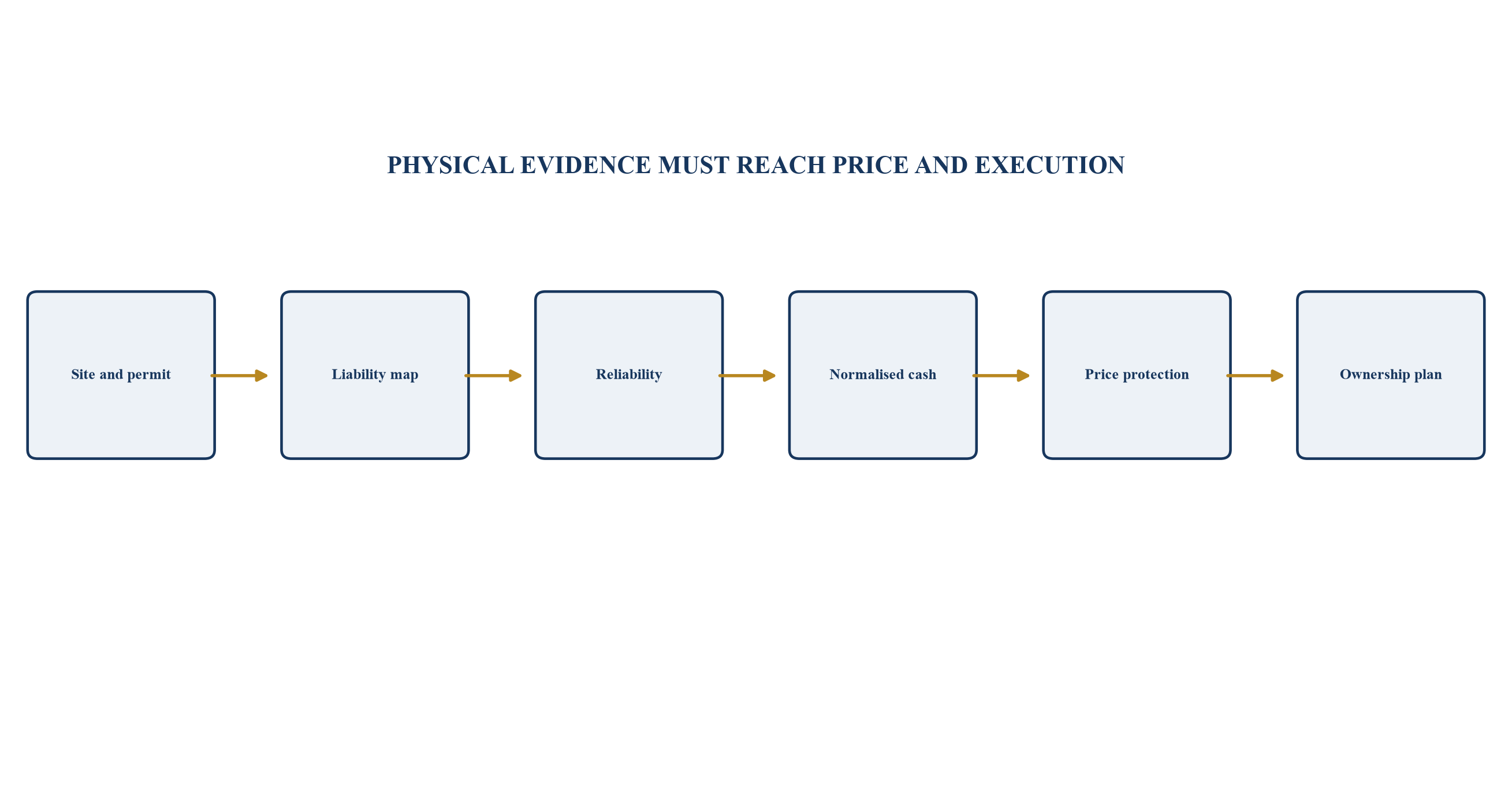
The sequence is an analytical framework; each gate requires target-specific verification.
Table 1. Environmental-liability map
| Evidence family | Verification | Value risk | Transaction response |
|---|---|---|---|
| permits and consents | scope, validity, conditions and actual operations | suspension, capex or delay | condition, covenant or price |
| emissions and effluent | monitoring, exceedance and treatment capacity | remediation and operating constraint | reserve and first-hundred-day action |
| waste and land | inventory, manifests, disposal and contamination | clean-up and third-party claim | indemnity, escrow or exclusion |
| incidents and notices | regulator, community, worker and insurer records | penalty, shutdown and reputation | specific protection and governance |
Requirements depend on site, activity and applicable law.
4. Test permits against actual operations
Permit diligence should reconcile legal scope with actual operation. The buyer should obtain complete approvals, applications, amendments, renewals, returns, monitoring reports, inspection correspondence, notices, hearing records and evidence of fee payment. The schedule should state the approved product, capacity, process, fuel, emission source, discharge route, waste category, storage quantity and operating condition where those fields apply.
Actual operations should be rebuilt from production records, raw-material consumption, utility use, laboratory data, waste manifests, maintenance changes and debottlenecking projects. Differences between approved and actual product mix, capacity or process require prompt legal and technical review. A consent may be current while a production change, additional storage area or bypass arrangement falls outside its documented basis.
Permit conditions should also be tested for operational feasibility. Monitoring frequency, treatment capacity, disposal route, emergency equipment, online reporting, storage segregation and record retention can require continuing people, systems and capital. The buyer should identify conditions that depend on seller personnel, group infrastructure or contracts that will not remain after closing.
Transaction consequences vary. A readily curable filing gap can enter a pre-close action plan. An uncertain approval or material operating mismatch may affect timing, valuation, financing or the decision to proceed. The sale agreement should define the evidence required at signing and closing, responsibility for corrective action, access to records and consequences if an approval or consent is delayed. Qualified counsel should verify the current statutory and transaction requirements.
Table 2. Permit-to-operation reconciliation
| Permit field | Site evidence | Diligence test | Escalation |
|---|---|---|---|
| approved product and capacity | actual product, throughput and debottlenecking | compare consent with operation | legal review and amendment plan |
| discharge and emission limit | continuous and laboratory records | reconcile exceedance and bypass | capex, reserve and condition |
| hazardous materials | storage, inventory and emergency plan | test thresholds and preparedness | corrective action before close |
| renewal and reporting | filings, fees and correspondence | identify lapse and disputed status | closing evidence |
Qualified advisers should confirm the current legal requirements.
5. Verify hazardous-chemical and emergency obligations
Hazardous-chemical diligence should begin with a verified substance and quantity inventory by location. Product names alone are insufficient. The team should reconcile chemical identity, concentration, maximum and typical storage, physical state, process conditions, storage design, transfer routes, incompatibilities and safety data with procurement, stock, production and emergency records.
India's Manufacture, Storage and Import of Hazardous Chemical Rules and Chemical Accidents rules form part of the official chemical-safety framework. Their application depends on the verified activity, substance and threshold. The buyer should confirm whether each installation is classified as a major-accident-hazard unit, what on-site and off-site emergency arrangements apply, and whether required notifications, safety reports, drills and updates are current. Qualified legal and process-safety advisers should confirm applicability.
Document review should be tested against the plant. The team should inspect containment, detection, isolation, relief, venting, firewater, emergency power, control-room protection, access, signage, personal protective equipment and mutual-aid arrangements. Alarm, trip, bypass and impairment records can show whether designed safeguards remain available. Emergency plans should name current personnel and reflect actual neighbouring communities, transport routes and response capacity.
Transaction modelling should include overdue corrective work, critical spares, specialist resources, insurance implications and the cash effect of an outage or restricted operation. Known gaps need accountable owners and completion evidence. Material unresolved exposure may require a condition, price response, indemnity, escrow or defined post-close capital plan. Day One governance should preserve command authority and incident-reporting lines without interruption.
6. Reconstruct waste, contaminated land and remediation exposure
Waste and land diligence should follow each material from generation to final recovery, treatment, storage or disposal. The buyer should reconcile waste categories and quantities to production, inventory adjustments, manifests, transporter records, authorised facility receipts, invoices and regulatory returns. Gaps can indicate unrecorded accumulation, unauthorised routing, under-accrued cost or weak control over third parties.
On-site inspection should cover storage condition, labelling, segregation, secondary containment, maximum holding periods, closed or buried areas, lagoons, drains, loading points and evidence of spills. Satellite images, historic site plans, prior ownership records, incident logs and employee interviews can help identify former process areas or disposal practices. Sampling should be designed and interpreted by qualified environmental professionals because location, depth, analyte and chain of custody affect what the result supports.
Remediation exposure should separate investigation, containment, clean-up, monitoring, disposal, restoration and business interruption. The estimate should state scope, unit costs, access, shutdown requirement, approval path, schedule and uncertainty. The accounting provision may differ from the buyer's cash case because the transaction model also considers timing, financing, operational constraint and downside scenarios.
The allocation should recognise control and evidence. A known historic issue may support specific protection backed by escrow, retention, guarantee or insurance review. A current operating practice may be better handled through price and a funded ownership plan. The buyer should preserve access to records, personnel and sites needed to defend claims or pursue recovery after closing. Qualified advisers should determine legal responsibility and the availability of contractual recourse.
7. Analyse emissions, effluent and water controls
Emissions, effluent and water diligence should connect regulatory limits to treatment performance and production economics. The buyer should inventory each source, discharge point, monitoring instrument, treatment stage and reuse stream. It should reconcile laboratory and online data to production volume, operating hours, chemical dosing, energy use, sludge generation, maintenance and bypass events.
Trend analysis should look beyond reported averages. Peak loads, start-up and shutdown conditions, monsoon effects, product campaigns, equipment outages and laboratory detection limits can reveal constraints that monthly summaries conceal. The team should test calibration, sampling location, chain of custody, data completeness and the treatment of missing or invalid readings. Any exceedance should be linked to root cause, response, regulator communication and recurrence risk.
Water availability can constrain throughput even where the plant meets discharge requirements. The buyer should verify source rights, allocation, supplier dependency, seasonal reliability, quality, storage, recycling and emergency supply. Treatment capacity should be tested against the underwritten product mix and expansion case. Additional production can require disproportionate utility, treatment and disposal cost when the system is near its hydraulic or contaminant limit.
The cash model should reflect recurring treatment expense, environmental monitoring, maintenance, sludge or waste disposal, water procurement and identified capital. A forecast that assumes higher output should include the corresponding mass balance and treatment capacity. Customer qualification, financing and sustainability reporting may also depend on reliable evidence. The transaction team should use the same controlled dataset across diligence, valuation, lender materials and public disclosures.
8. Rebuild the plant-reliability curve
Plant reliability should be reconstructed from equipment-level evidence rather than management availability alone. The buyer should obtain planned and unplanned outage logs, production records, maintenance work orders, inspection findings, alarm history, trip reports, bottleneck studies and operator interviews. Each event should connect lost hours to lost output, yield, energy, reprocessing, waste and customer delivery.
Availability requires a defined denominator. Scheduled turnarounds, feedstock interruption, utility loss, market curtailment and internal equipment failure should be shown separately. A plant can report high availability by excluding events that still reduce cash. The buyer should calculate service factor, utilisation and saleable-output yield under consistent definitions and reconcile them to invoices and inventory.
Reliability curves should be built by critical system and failure mode. Repeated seal, corrosion, fouling, heat-exchanger, control-system or utility events can indicate structural weakness. The maintenance backlog should identify safety-critical, production-critical and discretionary work with cost, outage requirement and accountable owner.
The valuation case should distinguish a stable plant, a remediable plant and a plant requiring major reinvestment. Historical EBITDA receives less credit where safe production depends on deferred integrity work or extraordinary operator intervention.
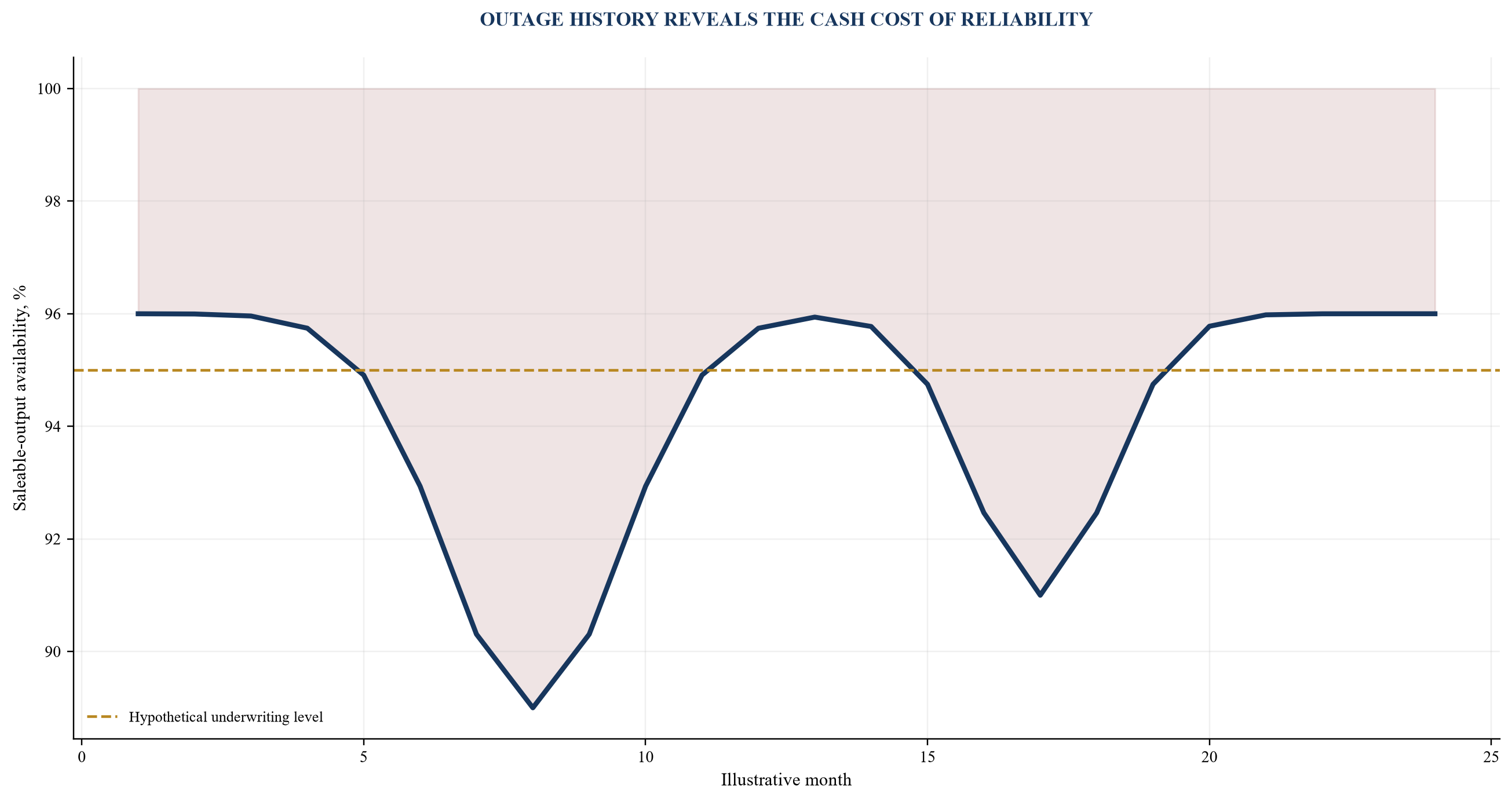
Values are hypothetical analytical assumptions and do not represent a target.
9. Separate maintenance expense, capital expenditure and deferred work
Maintenance accounting can distort both earnings and future cash. Routine inspection, repair and replacement may be expensed, while qualifying major components or improvements may be capitalised under the applicable accounting policy. The diligence team should reconcile work orders, purchase orders, fixed assets, contractor invoices, stores issues and shutdown budgets to the general ledger.
The buyer should identify deferred work by equipment criticality, due date, consequence and outage dependency. A low maintenance expense can reflect efficiency, or a decision to postpone work. Capitalised amounts should be tested for useful life, componentisation, impairment and whether they merely restore original performance. Qualified accountants should determine treatment under verified facts.
Turnaround cost needs a normalisation policy. A multi-year shutdown can create uneven cash and accounting expense. The valuation model should include the full cycle and the next due event. Seller-funded completion, a price reduction, escrow or a specific indemnity may be considered where overdue work is identified.
The first-hundred-day plan should protect critical maintenance from integration-related delay. Procurement, permits, specialist resources and spares can have long lead times. Closing liquidity should include the verified catch-up programme.
10. Translate outages and yield loss into normalised earnings
Production loss should be decomposed into rate, availability, yield, quality and mix. Nameplate capacity is only a reference. The buyer should rebuild input, intermediate and saleable output by product and period, then reconcile production to inventory movement and sales. Off-spec material, rework, flaring, disposal and downgraded sales belong in the bridge.
Yield can deteriorate through feedstock variation, catalyst condition, fouling, operator practice, equipment performance or product slate. A favourable mix can conceal lower physical efficiency. Energy and utility consumption should be measured per saleable unit because additional steam, power, water or effluent cost can offset reported volume.
Normalised earnings should use a supportable operating envelope, not the best month. The model should show proven current performance, achievable remediation and speculative upside. Each improvement requires capital, outage, expertise and timing. Lost contribution during implementation should be included.
Where seller forecasts assume immediate reliability recovery, transaction structure can defer value until evidence emerges. The buyer should avoid paying at closing for output that depends on unresolved technical work.
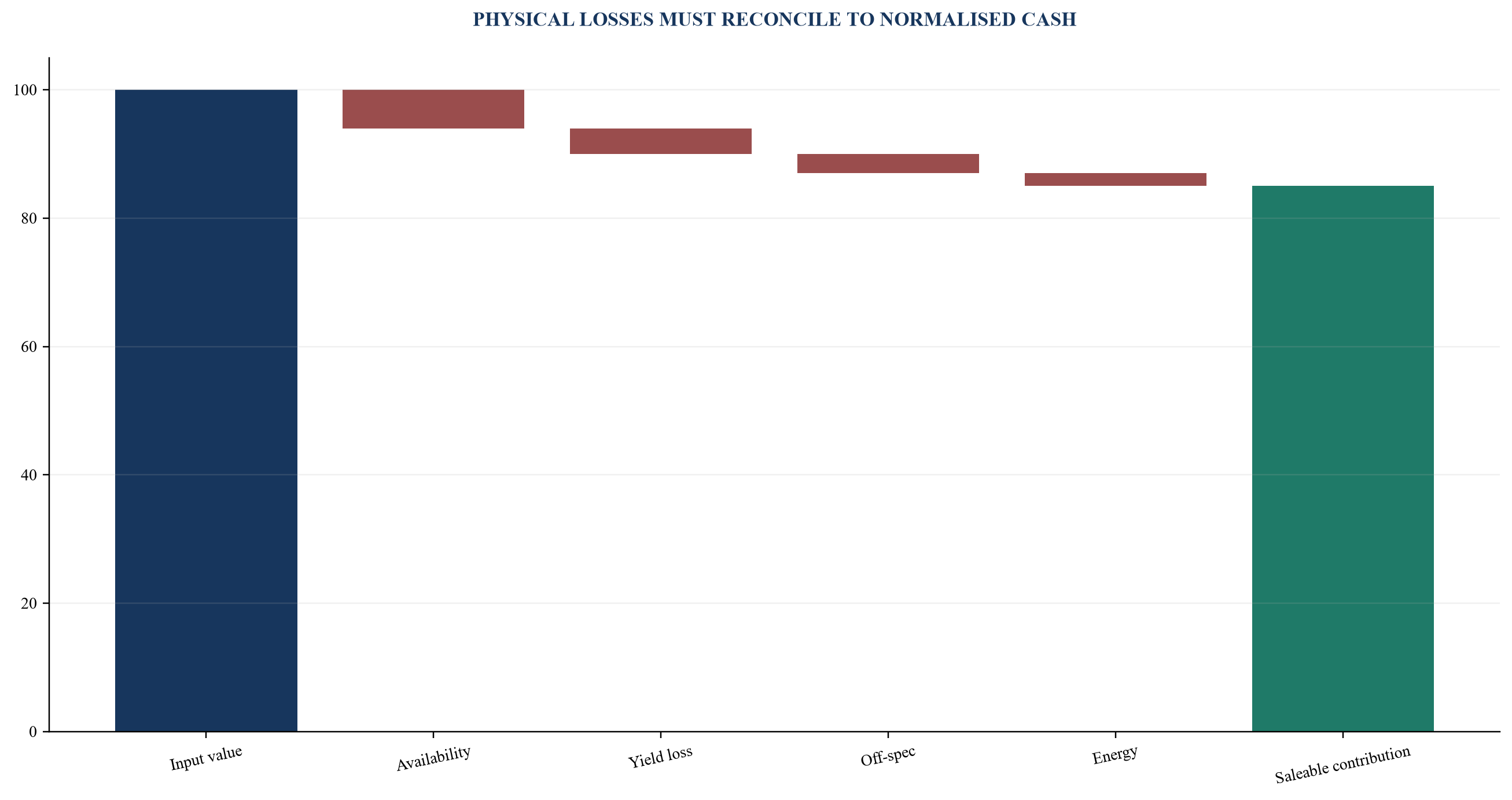
Values are hypothetical analytical assumptions.
11. Test process safety, incidents and insurance recovery
Process-safety diligence should test whether the target controls low-frequency, high-consequence events and learns from smaller failures. The buyer should obtain incident and near-miss records, loss-of-containment data, process hazard analyses, management-of-change files, integrity inspections, safety-critical maintenance, alarm and trip history, emergency drills, contractor records and regulator correspondence.
The analysis should distinguish personal safety from process safety. A low lost-time-injury rate does not establish control of containment, reaction, pressure, temperature, corrosion or incompatible-material risk. Leading indicators should include overdue safety-critical work, impaired safeguards, temporary repairs, repeated alarms, bypassed interlocks, relief-device findings and closure quality for investigation actions.
Insurance evidence should include policies, schedules, engineering surveys, declared values, business-interruption assumptions, deductibles, exclusions, sublimits, claims and renewal indications. Coverage may reduce a defined loss subject to policy terms and collection. It does not restore production immediately or remove legal, customer and reputation consequences. The model should show uninsured loss, waiting periods, coverage limits and the liquidity required before recovery.
Material incidents should be reconciled across site logs, board papers, insurer files, customer communication, financial statements and regulator records. Differences require resolution before reliance. The transaction response can include price, specific protection, a closing condition, evidence preservation, access to former personnel, and a funded corrective plan. Day One should preserve emergency command, notifications, site access and insurer requirements.
12. Reconcile inventory quantity, quality, age and net realisable value
The peg represents the ordinary working capital required to support the business at completion. A historical average is a useful starting point and rarely the full answer. The selected period, data frequency and adjustments can change the result materially.
A disciplined analysis normally uses at least 24 months of monthly data where available. The analyst should reconcile every month to source ledgers, identify changes in accounting policy or chart of accounts, and split the components into operational drivers. Receivables can be analysed through revenue, billing timing, days sales outstanding and ageing. Inventory can be analysed through purchases, usage, turns, obsolescence and supply lead times. Payables can be analysed through cost of sales, payment terms, overdue balances and supplier concentration. Accruals and deferred income should be linked to the services or costs they represent.
The team should then identify adjustments to history. Examples include a non-recurring project, a delayed government receivable, a one-off stock build, a supply disruption, a temporary payment holiday, owner-managed collection practices, a new revenue model or a material acquisition. Every normalisation should have a quantified basis, source documents and a stated direction of effect. Symmetry matters. A buyer should not remove an adverse historical event while retaining a favourable one that arises from the same cause.
The peg also needs to reflect the operating scale expected at completion. A rapidly growing business may require more receivables and inventory than its trailing average. A declining or contracting operation may require less. A ratio-based cross-check can help, but a single percentage of revenue can conceal different cycles across business units. The preferred approach links each working-capital component to the driver that creates it.
Table 3. Inventory and receivables quality matrix
| Item | Core evidence | Normalisation | Price-mechanism treatment |
|---|---|---|---|
| raw materials | quantity, age, quality and title | exclude unusable or excess stock | defined working capital |
| off-spec and slow stock | tests, rework and recovery route | net realisable value haircut | specific exclusion or reserve |
| trade receivables | invoice, acceptance, dispute and collection | ageing and subsequent receipt | eligibility and bad-debt adjustment |
| rebates and claims | contract, calculation and collection | probability and timing | debt-like or excluded item |
Classification and accounting treatment require verified records and qualified advice.
13. Rebuild receivables, rebates, claims and customer concentration
The working-capital schedule should begin with ledger accounts. The deal team should map each balance-sheet account into one of five categories: included working capital, cash, debt or debt-like, another specific adjustment, or excluded. The map should state whether the balance is gross or net, how provisions are treated, which entities and branches are in scope, the currency conversion rule and whether intercompany amounts survive completion.
A common starting formula is operating current assets less operating current liabilities. Trade receivables, ordinary inventory, prepayments and certain contract assets may be included. Trade payables, operating accruals, deferred income and certain contract liabilities may also be included. Tax balances, financing items, transaction costs, shareholder balances, capital expenditure creditors and employee liabilities can require specific treatment. Their classification depends on the economics, the enterprise-value premise and the transaction's negotiated terms.
The included schedule should reconcile to the trial balance and to each historical balance sheet used to estimate the peg. Unreconciled management schedules weaken the analysis because an apparent working-capital trend may be caused by account reclassifications or inconsistent consolidation. The team should retain an audit trail from the general ledger to the final calculation.
Accounting standards help identify measurement questions. IAS 2 requires inventory to be measured at the lower of cost and net realisable value and describes the costs included in inventory. IFRS 9 addresses the recognition and measurement of financial assets and liabilities, including expected credit losses. IFRS 15 governs revenue from customer contracts and the related contract assets and liabilities. IAS 37 covers provisions with uncertain timing or amount. These standards identify estimates and judgements that the parties should address in the accounting hierarchy. The acquisition agreement supplies the transaction definition.
14. Test payables, provisions and debt-like obligations
The most consequential completion disputes often arise at classification boundaries. If a liability reduces working capital and is also deducted as debt-like, the buyer receives the adjustment twice. If it sits in neither schedule, the seller may receive value for an obligation that the buyer funds after completion. A classification register should therefore cover every relevant account once and record the rationale.
Debt-like analysis focuses on obligations that are economically similar to financing or that relate to value already consumed before completion. Examples considered in transaction negotiations can include unpaid transaction bonuses, deferred consideration, shareholder loans, unpaid dividends, overdue taxes, certain capital expenditure creditors, factoring balances, finance leases and obligations for pre-completion services. The label does not settle the treatment. The parties should identify who receives the economic benefit, when the cash is paid, whether the item is reflected in enterprise value, and whether it is already included in working capital.
Cash also requires a usable definition. Bank balances can be restricted, pledged, trapped, held for customers or subject to local access arrangements. Deposits may have notice periods. Cheques in transit and overdrafts may require bank-level netting rules. The schedule should reconcile bank statements, the ledger and the proposed completion statement. Currency conversion should follow an identified source and time.
The same discipline applies to tax. Pre-completion corporate tax, withholding tax, VAT and customs exposures are generally addressed through a combination of price mechanics, specific indemnities, covenants and tax provisions. Their treatment should be coordinated across the tax deed, completion accounts and debt-like schedule. The economic exposure should appear once in the value bridge and remain subject to the protections agreed by the parties.
15. Set a working-capital peg using comparable periods
The working-capital peg should represent the recurring operating investment required to deliver the underwritten product mix at completion. A simple twelve-month average can be distorted by feedstock prices, campaigns, shutdowns, seasonality, customer qualification, export timing, abnormal stock builds or delayed collections. The buyer should select comparable periods and explain every exclusion or weighting.
Inventory should be analysed by material class, product, batch, age, location, ownership, specification and recoverable route. Safety stock and campaign stock may be ordinary for one process and excessive for another. Off-spec, expired, contaminated, slow-moving or customer-specific material needs a supportable net-realisable-value assessment. The peg should avoid rewarding a seller for building unusable stock before closing.
Receivables should be analysed by customer, invoice, acceptance, dispute, credit note, rebate, claim and subsequent collection. Payables should be tested for cut-off, overdue status, vendor holds, capital items and unrecorded liabilities. The team should reconcile ledger balances to contracts, invoices, goods movements, bank receipts and post-period transactions. Related-party and one-off balances should remain visible.
The illustrative completion statement should apply the proposed definitions to a recent month-end before signing. This dry run exposes classification gaps and data limitations while the parties can still resolve them. The sale agreement should state the account mapping, hierarchy of accounting policies, cut-off, estimation rules, expert process and timetable. The operating cash plan should remain separate from the price adjustment so the acquired business has adequate liquidity after completion.
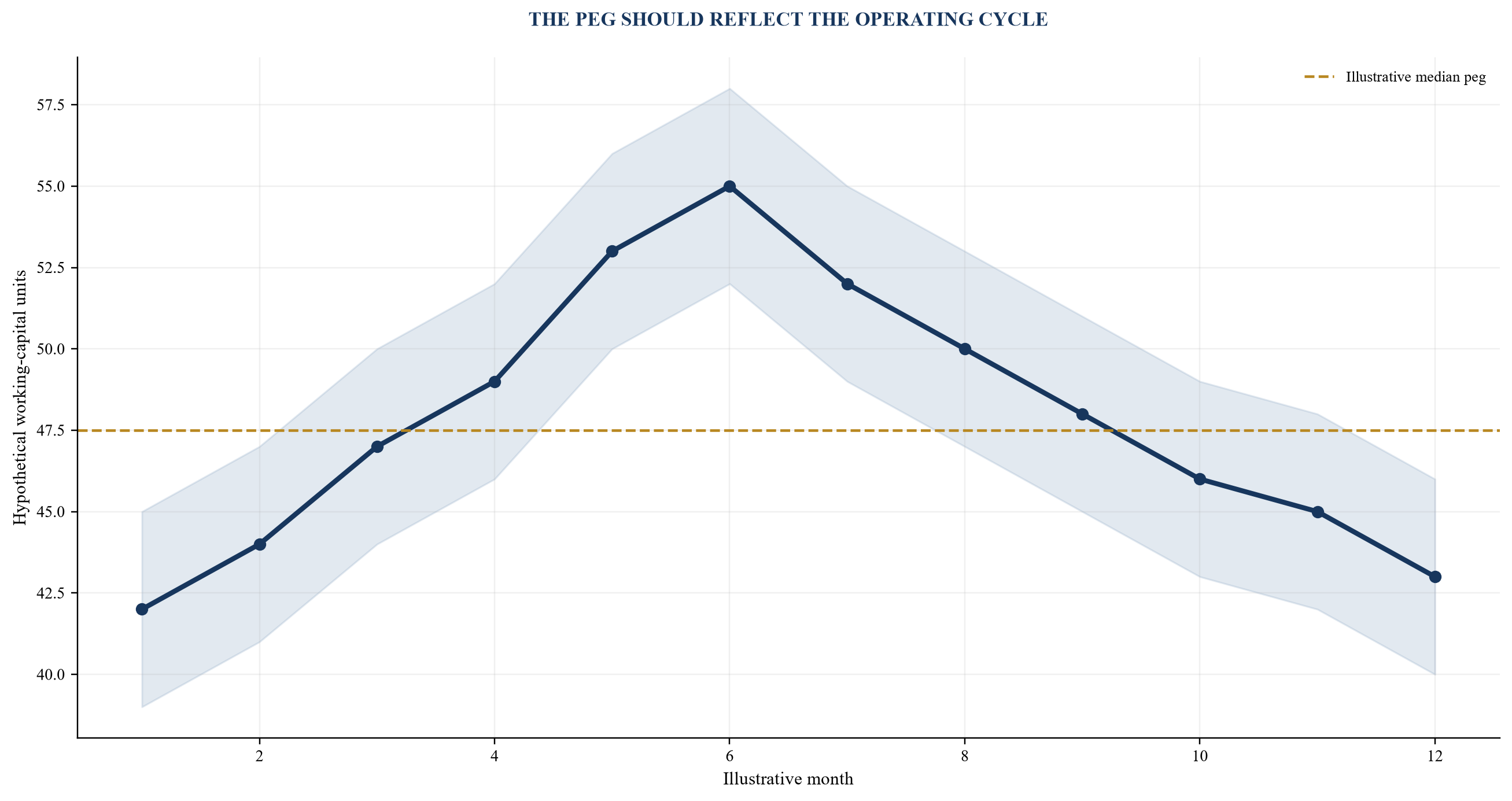
Values are hypothetical analytical assumptions.
16. Link environmental and reliability findings to the cash model
Environmental and reliability findings should enter the same model used to approve the acquisition. Each finding needs an owner, evidence reference, affected forecast line, timing, scenario, tax treatment, financing effect and proposed response. This prevents the technical report from remaining detached from price and the ownership plan.
Revenue effects can arise from restricted capacity, unplanned outages, off-spec production, delayed customer qualification or lost contracts. Cost effects can include feedstock loss, additional energy and water, reprocessing, waste disposal, maintenance, monitoring, insurance and specialist staff. Cash effects can include remediation, turnaround capital, spare parts, inventory buffers and delayed receivable collection.
The model should avoid double counting. A recurring yield loss included in normalised EBITDA should not also be deducted as a full standalone liability. A deferred maintenance programme can affect both near-term cash and sustainable earnings, so the bridge should state which component sits in price, capex and financing. A specific historic remediation cost may be outside ordinary operations and require separate treatment.
Scenario design should use verified operating boundaries. The base case can reflect demonstrated performance and committed actions. An improvement case requires cost, resources, outage time, approval and customer evidence. A downside case should test credible failure modes and liquidity. The investment committee should see the residual value range after proposed contractual and financing protections, together with the first one hundred days required to protect the case.
17. Build the purchase-price bridge
The purchase-price bridge should begin with the agreed enterprise-value methodology and reconcile every diligence adjustment to equity value and completion cash. Typical categories include normalised earnings, sustainable maintenance, environmental remediation, working capital, debt and debt-like items, cash, tax, pension or employee items, and transaction-specific leakage or separation costs.
Normalised earnings should reflect sustainable saleable output, product mix, yield, energy, waste, maintenance and customer economics. The bridge should show the valuation multiple or cash-flow effect applied to each recurring adjustment. One-time cash requirements should be timed separately. Uncertain exposures should use scenario ranges or expected cash with transparent assumptions rather than an unsupported single number.
The working-capital adjustment should use defined accounts and policies. Inventory requires quantity, specification, age, title and net-realisable-value testing. Receivables require evidence of acceptance, dispute, ageing and subsequent collection. Rebates, claims, customer advances, overdue creditors and provisions need explicit classification to prevent double counting between working capital and debt-like items.
The bridge should also show how the buyer is protected. A price reduction transfers value at closing. Completion accounts adjust specified balances. An escrow or retention secures agreed claims. A specific indemnity allocates defined historic exposure subject to negotiated terms. Contingent consideration can defer value that depends on future performance. Qualified legal, tax and accounting advisers should align the bridge with the sale agreement and acquisition financing.
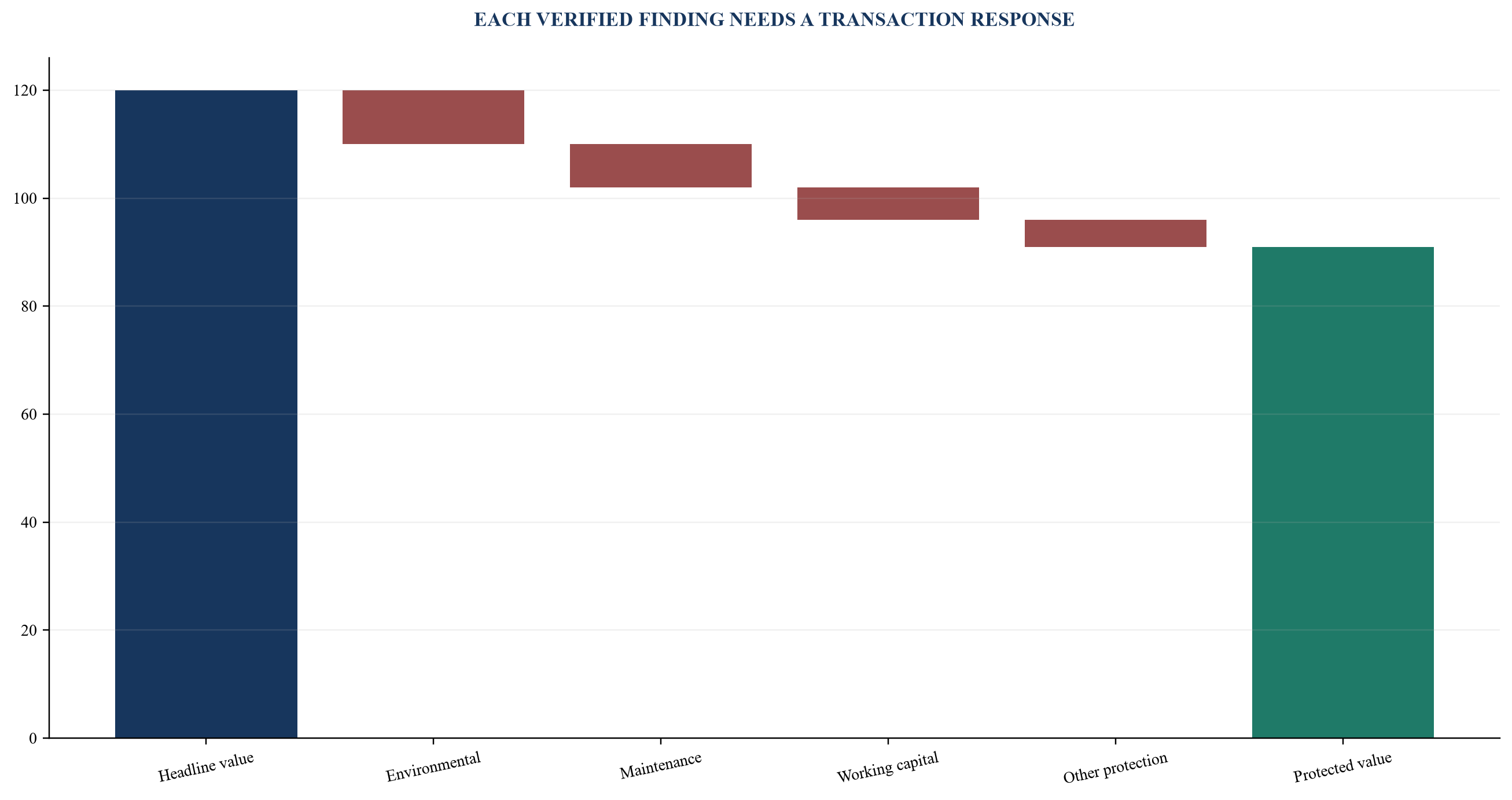
Values are hypothetical analytical assumptions and do not represent a valuation.
18. Allocate risk through SPA protections
Contractual protection should follow the nature of the verified risk. General warranties support the accuracy of disclosed facts, subject to negotiated scope and limitations. Specific indemnities can allocate identified historic exposure. Covenants can require action before or after closing. Conditions can prevent completion until critical evidence, approval or remediation exists. Escrow, retention, guarantee or insurance can support recovery where credit risk matters.
Environmental drafting should identify the covered site, period, substance, activity, authority, loss and required action. Ambiguous labels can create disputes over whether investigation, monitoring, business interruption, third-party claims, fines, clean-up or diminution in value are included. The agreement should address control of remediation, regulator engagement, access, privilege, settlement and evidence retention.
Operational issues need a different response. Deferred maintenance, reliability recovery and yield improvement often depend on future execution. The buyer may require seller completion before closing, a documented capital programme, a price response or contingent value. A warranty cannot make future production certain. The investment case should retain the operating risk that remains under buyer control.
The working-capital and debt definitions should align with the diligence schedule and illustrative completion statement. Specific accounting policies, cut-off rules, dispute procedures, expert determination and timing should be written clearly. The full structure should be tested against acquisition financing, tax and corporate approvals. Counsel should determine enforceability and the appropriate allocation under the transaction's actual facts.
Table 4. Finding-to-protection matrix
| Finding | Price response | Contract response | Ownership response |
|---|---|---|---|
| quantified remediation | value deduction | specific indemnity or escrow | approved remediation plan |
| deferred maintenance | normalised earnings and capex | condition or covenant | funded reliability programme |
| working-capital shortfall | peg or completion adjustment | definition and dispute process | liquidity control |
| uncertain historic liability | scenario sensitivity | representation and indemnity | evidence preservation |
Terms are illustrative and require transaction-specific legal, tax and accounting advice.
19. Test financing and lender implications
Acquisition financing should incorporate environmental, safety, reliability and working-capital findings before lender approval. The lender may focus on cash-flow resilience, collateral condition, permits, insurance, information quality, capital needs and the borrower's ability to continue operating after a downside event. Late disclosure can change leverage, conditions, pricing or timetable.
The base financing case should use the same normalised earnings and cash assumptions approved for valuation. It should include scheduled turnaround cost, remediation, maintenance catch-up, working-capital seasonality, insurance deductibles and realistic recovery timing. Availability, yield and customer-service downside should be tested through covenant and liquidity headroom rather than shown only as an operational sensitivity.
Conditions precedent can include permits, insurance, technical reports, environmental evidence, completion of defined actions, equity funding and delivery of a controlled funds-flow statement. Post-close undertakings can require remediation, reporting, capital expenditure, inspection access or limits on distributions. The borrower should confirm that these obligations are operationally achievable and consistent with the sale agreement.
Security diligence should verify title, access, lease terms, shared infrastructure and any constraint on enforcement or transfer. Historic contamination, third-party ownership or essential seller-controlled utilities can affect collateral value and continuity. The financing plan should also reserve liquidity for Day One and the first one hundred days. Qualified finance, legal and technical advisers should align the documents with the verified risk and ownership plan.
20. Design closing evidence and the true-up process
The completion process should begin before signing. The finance workstream needs a dry run using a recent month-end, supported by the same ledgers and schedules expected at completion. The dry run tests the definition, account mapping, sign conventions, data availability, estimated preparation effort and likely disagreements. It also exposes where the seller's monthly close process relies on spreadsheets or late adjustments.
The closing data pack should include the trial balance, account-by-account mapping, bank reconciliations, debt statements, receivables and payables ageing, subsequent receipts and payments, stock reports and count evidence, accrual schedules, contract asset and liability analysis, tax balances, intercompany reconciliations, cut-off testing and foreign-exchange calculations. Each schedule should show preparer, reviewer, source system, extraction date and reconciliation status.
The transaction documents should state the measurement time. Midnight, close of business and immediately before legal completion can produce different results. They should also state whether the accounts are prepared on a going-concern basis, how post-balance-sheet information is used and whether events between the measurement time and completion are reflected.
Preparation and review timetables require operational realism. An unachievable deadline creates uncertainty and delays resolution. The parties should specify the form of the statement, access to books and people, the notice of disagreement, the scope of disputed items, the role of an independent expert, allocation of expert costs, payment timing and interest. The expert's mandate should distinguish accounting determination from legal interpretation because the forum and standard may differ.
Management should also decide who controls the cash implications. The price-adjustment team needs authority to reserve the disputed amount, approve settlement within a defined range and escalate material legal or tax interpretations. A decision log should record the amount, evidence, policy, contractual clause, owner and status of each issue.
Once control transfers, the buyer often controls the systems and employees needed to prepare or review completion accounts. The agreement should preserve the seller's access to relevant records while protecting the business. A data room for the closing statement can contain frozen extracts, supporting schedules, questions, responses and version history.
The preparer should begin with the agreed form and account mapping. New accounts opened between signing and completion should be mapped through the documented escalation process. The calculation should reconcile to the closing trial balance and include a bridge from the estimate used at completion, if any, to the proposed final amount.
The reviewer should distinguish factual errors, accounting-policy questions, classification questions and contractual interpretations. Each objection needs an amount, evidence and proposed correction. A general reservation can preserve uncertainty without helping resolution. Early issue meetings can narrow the matters sent to an independent expert.
The transaction team should track gross claims and likely outcomes separately. A large list of objections may contain offsetting items or issues with different evidence strength. The board needs the expected cash range, legal and expert costs, timing, collection risk and operational consequences. Settlement authority should be approved before negotiations begin.
After final determination, the business should record the payment, accounting entry, tax treatment and release of any escrow or retention. The team should also close the control gaps identified by the dispute. A recurring data-quality weakness that affected the adjustment can continue to affect cash forecasting and management reporting after completion.
21. Preserve safe operations through Day One
The Day-One forecast should begin with verified opening bank balances and available facilities. Weekly receipts should be connected to customer-level collection assumptions. Payments should reflect payroll, suppliers, tax, rent, capital expenditure, integration costs, financing and transaction commitments. Restricted balances and undrawn facilities should be shown separately from immediately available cash.
Forecast ownership must be operational. Sales or collections teams own customer receipt assumptions. Procurement and finance own supplier runs. Human resources and payroll owners validate employee payments. Tax advisers and finance validate filing and payment dates. The integration office controls one weekly version, records variances and escalates headroom breaches.
Three cases are usually useful: a management case, a downside case and a severe but plausible case. Scenario variables can include delayed collections, inventory replenishment, supplier-term normalisation, customer churn, one-off professional fees and integration expenditure. The purpose is to identify decisions and trigger points. The scenario is not a prediction.
The weekly review should compare forecast and actual receipts and payments, explain the variance and update the remaining horizon. A cash committee can approve collection actions, supplier prioritisation, facility drawings, discretionary spending and integration timing within delegated authority. Material covenant, solvency or funding concerns require immediate specialist advice.
22. Execute the first one hundred days
The first one hundred days should convert diligence findings into controlled execution. Workstreams should cover legal and permit continuity, process safety, asset integrity, environmental controls, production reliability, quality, inventory, receivables, liquidity, insurance and customer communication. Each action needs an accountable owner, budget, evidence output, decision date and escalation threshold.
The first phase should secure authority and visibility. The buyer should confirm site command, emergency roles, banking, payments, key contracts, critical maintenance, permits, incident reporting and the daily production and cash dashboard. Urgent safety or compliance actions should receive priority over synergy initiatives. Records needed for historic claims and seller recourse should be copied and controlled.
The second phase should approve the costed remediation and reliability programme. Technical scope, shutdown windows, procurement, spares, contractor capacity and approval dependencies should be reconciled to the cash forecast. Inventory and receivables actions should protect service while reducing unusable stock, disputes and collection delay. Customer-facing changes should respect qualification and change-control requirements.
The board should receive a compact value-creation report linking physical measures to cash. Suggested measures include saleable-output availability, yield, off-spec rate, critical maintenance overdue, environmental exceedance, waste intensity, inventory at risk, overdue receivables, liquidity headroom and action closure. The report should preserve baseline definitions so improvement is measurable and exit evidence begins at acquisition.
Table 5. First-hundred-day ownership plan
| Period | Primary work | Evidence output | Board gate |
|---|---|---|---|
| days 1-20 | authority, permits, integrity and liquidity | controlled baseline and urgent actions | safe continuity |
| days 21-45 | environmental and reliability remediation | costed programme and owners | capital approval |
| days 46-70 | inventory, receivables and cash controls | verified working-capital bridge | value protection |
| days 71-100 | governance, reporting and exit evidence | dashboard and assurance plan | sustained ownership control |
Timing is illustrative and should follow safety and legal priorities.
23. Prepare exit evidence from acquisition date
Exit readiness begins when the acquisition closes. A future buyer or lender is likely to test the same permits, liabilities, reliability, maintenance, yield, inventory, receivables and governance. The portfolio company should maintain an evidence room that records the opening baseline, completed actions, cost, operating result and remaining exposure.
Environmental records should connect approvals, monitoring, incidents, corrective actions and regulator correspondence. Reliability records should connect failure modes, maintenance, capital and resulting availability or yield. Working-capital records should preserve stock counts, ageing, provisioning, collection, supplier terms and the basis for management adjustments. Consistent definitions reduce the risk of an exit process reopening settled questions.
Value-creation claims need controlled evidence. If a programme improved yield or reduced waste, the company should show the material balance, baseline, implementation cost, production mix and cash result. If remediation closed an exposure, it should retain qualified reports, authority communication and continuing-monitoring obligations. Management presentations should reconcile to books, operational systems and board reporting.
The exit plan should also identify residual issues early enough to resolve them before diligence. A late permit amendment, open incident, overdue turnaround or unexplained inventory reserve can affect buyer confidence and timetable. Periodic red-team review can test whether an independent acquirer could reproduce the evidence chain from site condition to sustainable cash and transaction value.
24. Apply red-team tests to management claims
A red-team review should challenge the evidence chain before the investment committee relies on it. The first test is perimeter completeness: every acquired site, asset, product, shared service and material third party should appear in the diligence map. The second is permit reconciliation: actual operations should fit the documented approvals and conditions.
The third test is physical-to-financial consistency. Production, yield, utilities, waste, inventory and sales should reconcile across operating and accounting records. The fourth is maintenance realism: reported earnings should not depend on deferred safety-critical or production-critical work. The fifth is liability completeness: incidents, notices, sampling, provisions, insurance and board papers should tell a coherent story.
The sixth test is transaction mechanics. Each material finding should have one primary treatment in earnings, price, working capital, debt-like items, contract, financing or the ownership plan. Double counting and unallocated exposure should be flagged. The seventh is execution: every assumed improvement should have approved capital, outage time, resources, permits and accountable ownership.
The eighth test is document consistency. The investment paper, model, sale agreement, financing, disclosure schedules, funds flow and Day One plan should use aligned numbers and definitions. The ninth is downside liquidity. The buyer should know the cash required if remediation, recovery or collection takes longer. The final test is evidence quality. Unsupported management statements should remain assumptions and should not be priced as verified performance.
25. Use a final investment-committee checklist
The investment committee should receive a concise decision record supported by the complete diligence file. It should identify the transaction perimeter, material environmental and operating findings, evidence quality, sustainable production case, normalised earnings, working-capital requirement, capital plan, purchase-price bridge, contractual protection, financing headroom and first-one-hundred-day ownership plan.
The committee should confirm that permits and actual operations have been reconciled by qualified advisers; hazardous-chemical and emergency obligations have been tested; waste, land, emissions, effluent and water exposures have been mapped; process-safety and reliability evidence supports the operating case; and maintenance and turnaround cash are included. Open items should have clear consequences and owners.
The valuation decision should distinguish demonstrated performance, funded improvement and speculative upside. It should show how outages, yield, quality, inventory, receivables and remediation affect cash. The completion mechanism should define working capital, debt, cash and debt-like items without overlap. Known historic exposures should have a deliberate price or contractual response supported by enforceable security where required.
Approval should specify the maximum price, financing conditions, required closing evidence, unacceptable findings and Day One liquidity. It should also define the board dashboard and escalation thresholds after closing. A defensible chemicals acquisition connects site evidence to sustainable cash, transaction protection and controlled execution. The record should state the residual risks that the buyer accepts and the evidence that supports that decision.
References
- Ministry of Environment, Forest and Climate Change, Government of India. Rules and Regulations. https://moef.gov.in/index.php/rules-regulations-3
- Ministry of Environment, Forest and Climate Change. Manufacture, Storage and Import of Hazardous Chemical Rules, 1989. https://moef.gov.in/rules-regulations-3
- Ministry of Environment, Forest and Climate Change. Chemical Accidents (Emergency Planning, Preparedness and Response) Rules, 1996. https://moef.gov.in/rules-regulations-3
- Ministry of Environment, Forest and Climate Change. Hazardous and Other Wastes Rules and Amendments. https://moef.gov.in/rules-regulations-3
- Central Pollution Control Board. Profile and Type of Industry: Chemical Industries. https://www.cpcb.nic.in/profile-and-type-of-industry/
- Central Pollution Control Board. Environmental Standards. https://cpcb.nic.in/openpdffile.php?id=UHVibGljYXRpb25GaWxlLzY4Nl8xNTcxMzgzNDAxX0Vudmlyb25tZW50YWwgU3RhbmRhcmRzLnBkZg%3D%3D
- Ministry of Corporate Affairs. Indian Accounting Standard 37, Provisions, Contingent Liabilities and Contingent Assets. https://www.mca.gov.in/Ministry/pdf/IndAS37_2020_10112020.pdf
- Ministry of Corporate Affairs. Indian Accounting Standard 2, Inventories. https://www.mca.gov.in/Ministry/pdf/INDAS2.pdf
- Ministry of Corporate Affairs. Indian Accounting Standard 103, Business Combinations. https://www.mca.gov.in/Ministry/pdf/IndAS103_2020_10112020.pdf
- Ministry of Corporate Affairs. Indian Accounting Standard 16, Property, Plant and Equipment. https://www.mca.gov.in/Ministry/pdf/INDAS16.pdf
- Securities and Exchange Board of India. BRSR Core Framework, 2023. https://www.sebi.gov.in/web/?file=https%3A%2F%2Fwww.sebi.gov.in%2Fsebi_data%2Fattachdocs%2Fjul-2023%2F1689166456465.pdf
- Securities and Exchange Board of India. Corporate Filings. https://www.sebi.gov.in/curation/corporate_filings.html
- IFRS Foundation. IAS 37 Provisions, Contingent Liabilities and Contingent Assets. https://www.ifrs.org/issued-standards/list-of-standards/ias-37-provisions-contingent-liabilities-and-contingent-assets/
- IFRS Foundation. IAS 2 Inventories. https://www.ifrs.org/issued-standards/list-of-standards/ias-2-inventories/
- IFRS Foundation. IFRS 3 Business Combinations. https://www.ifrs.org/issued-standards/list-of-standards/ifrs-3-business-combinations/
- IFRS Foundation. IAS 16 Property, Plant and Equipment. https://www.ifrs.org/issued-standards/list-of-standards/ias-16-property-plant-and-equipment/
- International Finance Corporation. Environmental, Health, and Safety Guidelines: Chemicals. https://www.ifc.org/en/insights-reports/general-environmental-health-and-safety-guidelines/ehs-guidelines-chemicals
- International Finance Corporation. Performance Standards on Environmental and Social Sustainability. https://www.ifc.org/en/insights-reports/2012/ifc-performance-standards
- OECD. Due Diligence Guidance for Responsible Business Conduct. https://www.oecd.org/investment/due-diligence-guidance-for-responsible-business-conduct.htm
- Securities and Exchange Board of India. Substantial Acquisition of Shares and Takeovers Regulations. https://www.sebi.gov.in/legal/regulations.html
- Insolvency and Bankruptcy Board of India. Insolvency and Bankruptcy Code and Regulations. https://ibbi.gov.in/legal-framework/act
- Competition Commission of India. Combination Regulations and Guidance. https://www.cci.gov.in/combination/legal-framwork/regulations
