

1. Define the bankable project perimeter
Project finance depends on a legally and operationally coherent perimeter. The financing memorandum should identify the borrower, sponsors, site, land rights, process units, storage, utilities, pipelines, port or road links, laboratories, waste systems, workforce facilities and shared infrastructure. It should state which assets sit inside the project company and which are supplied under external contracts.
The perimeter should reconcile four views. The legal view identifies entities, ownership, licences and contracts. The physical view follows feedstock through process units to products, by-products, emissions and waste. The financial view allocates capital cost, operating cost, working capital, revenue and taxes. The lender-security view identifies assets, accounts, insurance, contract rights and shares that can support the financing under applicable law.
Interface risk appears when these views differ. A utility may be essential but owned by an affiliate. A jetty may be shared but lack firm capacity rights. A process unit may depend on a sponsor service that is absent from the project budget. The diligence register should record every dependency, responsible party, evidence and fallback.
The board should approve the perimeter before financial close. Scope changes after debt sizing can alter capital cost, completion tests, permits and security. A controlled change process should show cost, schedule, performance and financing effect before approval.
The project company should also maintain a responsibility matrix for every boundary. The matrix identifies the party that designs, procures, builds, owns, operates, maintains, insures and replaces each system. It should identify access, land, capacity and data rights needed for those responsibilities. A shared facility can sit outside the borrower while remaining essential to cash generation; its contract and technical interface should therefore receive a credit assessment proportionate to its importance.
The perimeter decision should include decommissioning and residual obligations. Closure, remediation, waste, dismantling and land restoration may create long-dated cash requirements. The financing team should understand which party bears them, how they are estimated and whether security or reserves are required. Excluding those obligations from the project company does not remove economic exposure where licences, guarantees or contracts return the risk.
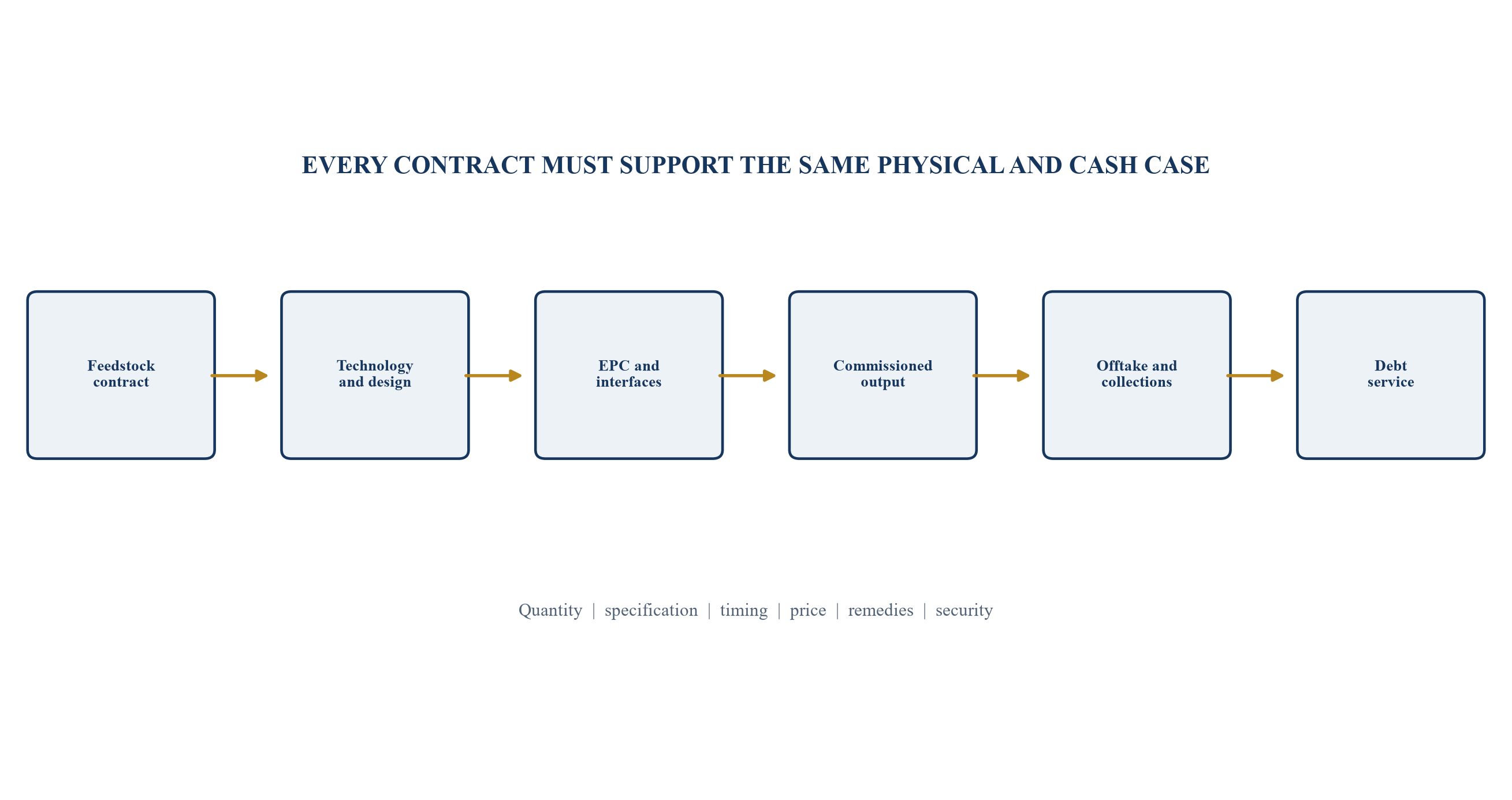
The sequence is an analytical framework; each link requires project-specific verification.
2. Convert the process design into a financeable mass balance
The base model should begin with physical units. Feedstock quantity and composition drive product yield, utilities, catalyst use, emissions and waste. A lender should be able to trace each material input through the process to saleable products and residual streams. The model should reconcile engineering design, vendor guarantees, environmental permits and the financial forecast.
The mass balance needs operating states. Nameplate capacity is not the same as saleable output. Start-up, turndown, planned maintenance, unplanned outage, catalyst degradation, off-spec production and product transitions change yield and cost. The financing case should use a realistic availability and ramp profile supported by comparable plants and qualified technical review.
Uncertainty should be explicit. Feedstock composition can change within a contractual range. Technology performance can vary with temperature, pressure, contamination and operator experience. The model should show how each variable affects volume, quality, energy and cash. A single deterministic yield can hide a material downside.
The mass-balance workbook should be controlled, versioned and owned jointly by technical and finance teams. Changes to design data should flow through capital cost, operating cost, inventory, revenue and debt service. This creates one auditable source for lender cases and completion testing.
3. Make the feedstock contract a financing document
Feedstock availability is a central credit risk. The contract should identify supplier, delivery point, term, quantity, quality, nomination, measurement, title, credit, interruption, force majeure and termination. The plant's permitted specification range should match the contract. A broad supplier specification can be inconsistent with the process guarantee.
Pricing should be translated into the product-margin model. Fixed price, formula price, index linkage, discounts, floors, caps, currency, taxes and transport determine exposure. A feedstock formula linked to one commodity and an offtake formula linked to another can create basis risk. Lenders should see historical relationships and downside correlations without assuming they remain stable.
Interruption rights require operational analysis. The team should test inventory capacity, alternative supply, pipeline redundancy, truck or ship logistics, restart time and contractual remedies. Damages may not replace lost margin or debt service. Supplier credit quality and strategic importance should be assessed, while recognising that a strong name does not cure an unfavourable contract.
Change-of-control, assignment and lender step-in rights should be compatible with financing. Consent timing can become a condition precedent. The lender's direct agreement should preserve notice, cure and continuity where legally and commercially possible.
Table 1. Feedstock contract bankability matrix
| Dimension | Evidence | Failure mode | Financing response |
|---|---|---|---|
| quantity and term | firm commitment, nominations and capacity rights | plant underutilisation | minimum supply, reserve and alternative plan |
| specification | tested range aligned to process guarantee | yield loss or off-spec output | quality remedies and technical acceptance |
| price formula | index, currency, floors, caps and transport | margin basis risk | stress, hedge policy and cash reserve |
| interruption | priority, force majeure, storage and fallback | lost production and restart cost | continuity plan and sponsor support |
| transfer and security | assignment, direct agreement and cure | contract loss after default | consent before drawdown |
Contract requirements depend on product, process, supplier, infrastructure and applicable law.
4. Align technology licence with project obligations
A chemicals facility may depend on proprietary process technology, catalyst, software, specialist engineering and operating know-how. The licence should cover the project company, location, capacity, product, term, improvements, intellectual property, confidentiality, technical support and transfer. Restrictions must be compatible with financing, expansion and lender enforcement.
Performance guarantees should use the same definitions as the financial model. Capacity, yield, consumption, product quality, emissions and reliability may be tested under specified feedstock and operating conditions. If the test conditions are narrower than the feedstock contract, the sponsor retains a gap. Remedies should be sized and structured with the economic consequence in mind, subject to negotiation and legal advice.
Technology maturity affects completion risk. A first-of-a-kind configuration may create valuable differentiation and a longer debugging period. Lenders can require independent technical review, pilot evidence, reference plants, additional contingency, sponsor support or delayed term conversion. The project should distinguish proven modules from novel interfaces.
The licensor's obligations must continue through commissioning and early operation. Access to experts, catalyst replacement, software, spares and troubleshooting can be essential. Direct agreement, notice and cure rights can protect continuity if a dispute arises.
5. Close the EPC interface map
The engineering, procurement and construction structure should allocate scope across process units, utilities, storage, buildings, pipelines, grid connection, water, waste, logistics and commissioning. Multiple packages can create cost or schedule flexibility, while leaving the project company with integration risk. A single wrapper can reduce interfaces but may carry exclusions and caps.
The interface register should name the information, physical connection, schedule dependency, testing obligation and owner for every boundary. Battery limits, design criteria, tie-ins, temporary facilities and control-system integration deserve particular attention. An unowned gap can appear late when rectification is expensive.
Price and schedule protection should be examined together. Lump-sum language can contain escalation, provisional sums, owner-supplied equipment, change rights and excluded conditions. Delay liquidated damages should be compared with interest during construction, fixed operating cost, lost margin and debt-service delay. Performance liquidated damages should connect to the modelled economic loss.
Security can include performance bonds, advance-payment guarantees, retention, parent support, insurance and contractor equity. The complete package should be evaluated against contractor credit quality and claim enforceability. A nominal remedy has limited value if it is capped, delayed or disputed.
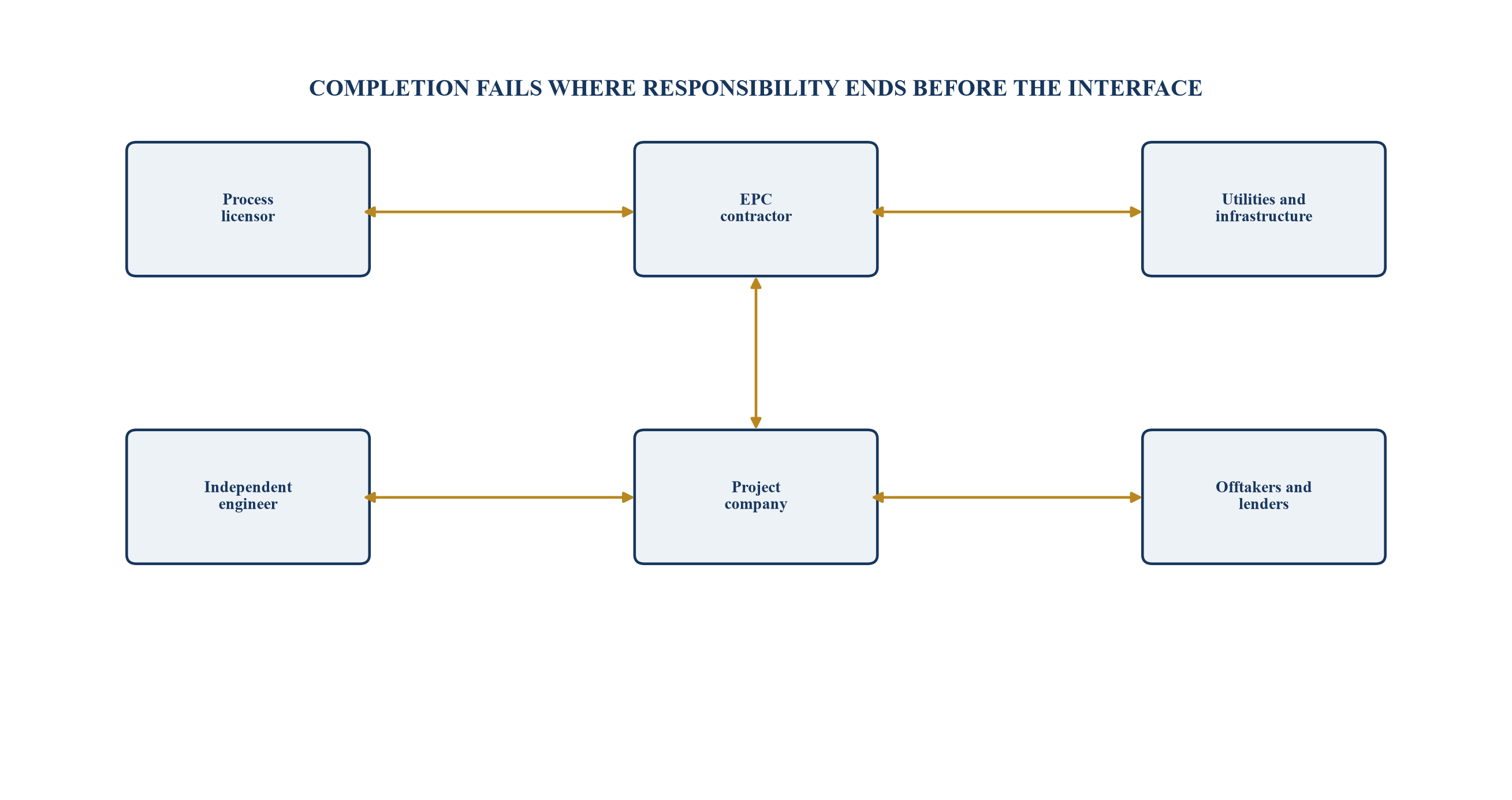
The diagram is illustrative; actual responsibility follows executed project documents.
6. Build a complete capital-cost baseline
Capital cost should be assembled from controlled quantities, contracts and estimates rather than one headline EPC number. The baseline includes process units, utilities, offsites, storage, logistics, land, owner costs, technology, spares, commissioning, initial catalyst, insurance, financing fees, interest during construction, taxes, duties and contingency.
Each item should have estimate class, currency, escalation basis, tax treatment, committed status, payment schedule and owner. Imported equipment can create currency and logistics exposure. Local-content commitments can affect vendor selection, price and schedule. The financial model should reconcile purchase orders, certificates and drawdowns to the baseline.
Contingency should reflect risk maturity. Identified scope, quantity growth, market escalation, schedule delay and technical uncertainty can be modelled separately. A single percentage can conceal whether the reserve covers known risks. The lenders' contingency and the sponsor's management reserve may have different control rules.
Cost-to-complete should be recalculated at each draw. Paid cost, committed cost, forecast final cost, available contingency and undrawn funding should reconcile. If the remaining financing is below the prudent cost-to-complete estimate, further debt drawdown should pause until the shortfall is cured.
7. Secure power, water and industrial infrastructure
Chemicals projects can require continuous power, steam, cooling water, process water, demineralised water, industrial gases, waste treatment, flare, communications and emergency services. A site allocation or preliminary utility letter is not equivalent to an executable supply contract and commissioned connection.
The utility matrix should state provider, capacity, pressure or quality, delivery point, redundancy, tariff, indexation, connection works, schedule, interruption and remedies. The plant design should match supply parameters. Shared networks can introduce priority and expansion risk. Backup systems need fuel, testing and operating procedures.
Water and wastewater deserve a full mass balance. Intake, recycling, evaporation, effluent quality, hazardous streams, disposal and zero-liquid-discharge requirements can affect technology and cost. Climate and local water constraints should be considered through applicable permits and lender standards.
Infrastructure milestones should enter the integrated schedule and completion tests. If the project company does not control the provider's works, lenders may require alternative evidence, long-stop dates, sponsor support and delay reserves. Commissioning cannot be treated as an EPC-only event when external utilities remain uncertain.
8. Treat permits and environmental controls as critical-path assets
The permit register should cover land, construction, industrial operation, environmental approvals, hazardous materials, emissions, water, waste, transport, civil defence, workforce and product-specific requirements. Each permit needs authority, scope, status, conditions, owner, dependency and renewal date. Qualified advisers should confirm the actual Saudi requirements.
IFC's chemicals-sector environmental, health and safety guidelines provide lender-relevant reference material on emissions, effluent, hazardous materials, occupational safety and community risk.[7] The Equator Principles and OECD Common Approaches may influence financial institutions and export-credit agencies.[8][9] Applicable standards depend on the financing parties and project.
The environmental and social impact assessment should match the final design and cumulative infrastructure. Mitigation commitments should become budgeted tasks, contract obligations and monitoring. Community and worker grievance systems, emergency planning and disclosure can affect schedule and lender approval.
Conditions precedent should distinguish permits needed before construction, commissioning and operation. A material permit based on an earlier design can require amendment. The project should not consume contingency for predictable compliance that was omitted from scope.
9. Prove a bankable product and market case
The market study should define each product by specification, grade, packaging, customer, geography and competing supply. A broad chemicals-demand forecast cannot demonstrate the addressable market for the exact output. The team should reconcile nameplate production with contracted sales, qualified customer demand and realistic spot-market capacity.
Cost position matters across cycles. The project should be compared with incumbent and announced capacity using feedstock, energy, logistics, yield, scale, co-products and carbon or compliance cost. Competitor shutdowns and delays should not be assumed without evidence. Imports and exports introduce freight, duties, trade measures and port constraints.
Price forecasts should be transparent. Historical spreads, cycle duration, new capacity, substitution and demand drivers belong in the downside. Correlated feedstock and product prices can protect margin in some periods and compress it in others. The model should test absolute prices and spreads.
The market adviser should state sources, date, assumptions and conflicts. Lenders need an independent view of volume, price and fallback routes, while the sponsor remains responsible for the business case.
10. Convert offtake into collectible cash
An offtake contract should specify product, quality, volume, term, delivery, title, price, payment, credit support, rejection, force majeure, termination and change of control. Take-or-pay language should be tested for conditions, caps, make-up rights and buyer remedies. A framework agreement without binding nominations may provide limited debt support.
Price formulas should align with feedstock and logistics. Floors, caps, lags, currency and benchmark disruption can create basis risk. Delivery terms determine freight, insurance, working capital and transfer risk. Product qualification may delay sales after mechanical completion.
Buyer credit should be assessed with the contract. Payment terms, guarantees, letters of credit, collateral, set-off and concentration determine collection risk. A strong buyer can still have termination or rejection rights that weaken cash certainty. Related-party offtake needs arm's-length economics and enforceability.
The fallback plan should identify alternative customers, storage, repackaging, export routes and spot discounts. Unsold product can constrain production and increase working capital. Lenders should see the operating response before debt-service coverage deteriorates.
Table 2. Offtake quality scorecard
| Dimension | Strong evidence | Weak evidence | Downside test |
|---|---|---|---|
| volume | firm minimum with limited conditions | forecast or best efforts | reduced nominations and make-up |
| price | transparent formula aligned to costs | discretionary or mismatched index | basis and benchmark disruption |
| credit | supported payment and short tenor | unsecured concentration | delayed collection and default |
| logistics | firm capacity and clear delivery point | unallocated shared infrastructure | port, storage and transport outage |
| remedies | enforceable damages, cure and continuity | broad termination or rejection | contract loss after disruption |
The scorecard is a diligence aid; legal effect follows the executed contract and applicable law.
11. Integrate logistics, storage and export readiness
Physical sale depends on tanks, warehouses, packaging, loading, pipelines, roads, rail, port slots, vessels and customs. The logistics plan should follow each product from battery limit to customer delivery. Capacity, compatibility, turnaround time, loss, contamination and maintenance should be quantified.
Shared infrastructure can constrain ramp. A port or pipeline allocation should state firm capacity, priority, schedule, tariff, operating rules and expansion rights. Dangerous-goods transport and product handling require approved procedures and trained contractors. Incidents can stop production even when the process unit performs.
Storage provides resilience but consumes capital and can create degradation, safety and insurance risk. Minimum and maximum stock should connect to batch size, shipment frequency, customer qualification and shutdown response. The cash model should include inventory value and payment timing.
Export readiness includes product certification, documentation, origin, trade rules, customs, sanctions screening and destination requirements. The project should test alternative routes and customers where concentration is material. Logistics agreements may need lender direct agreements if they are essential to continuity.
12. Design completion as a multi-dimensional test
Mechanical completion confirms construction status, while financial completion requires evidence that the project can operate and service debt. The completion regime should include physical completion, permits, utilities, feedstock, performance, reliability, product quality, environmental compliance, offtake readiness, accounts, insurance and funding adequacy.
Performance tests should use agreed feedstock, duration, measurement, correction factors and independent witnessing. Capacity, yield, consumption and quality should align with model assumptions. A short successful run can miss reliability and degradation, so a sustained test may be required. Retesting rights and consequences should be clear.
Completion should also require a prudent cost-to-complete and working-capital position. Outstanding punch-list items, claims and warranties need categorisation. Minor items can be reserved; material safety, performance or permit issues should prevent completion.
If tests are missed, the documents should define cure, retest, liquidated damages, sponsor funding, debt reduction and long-stop consequences. The objective is a predictable transition from construction risk to operating risk.
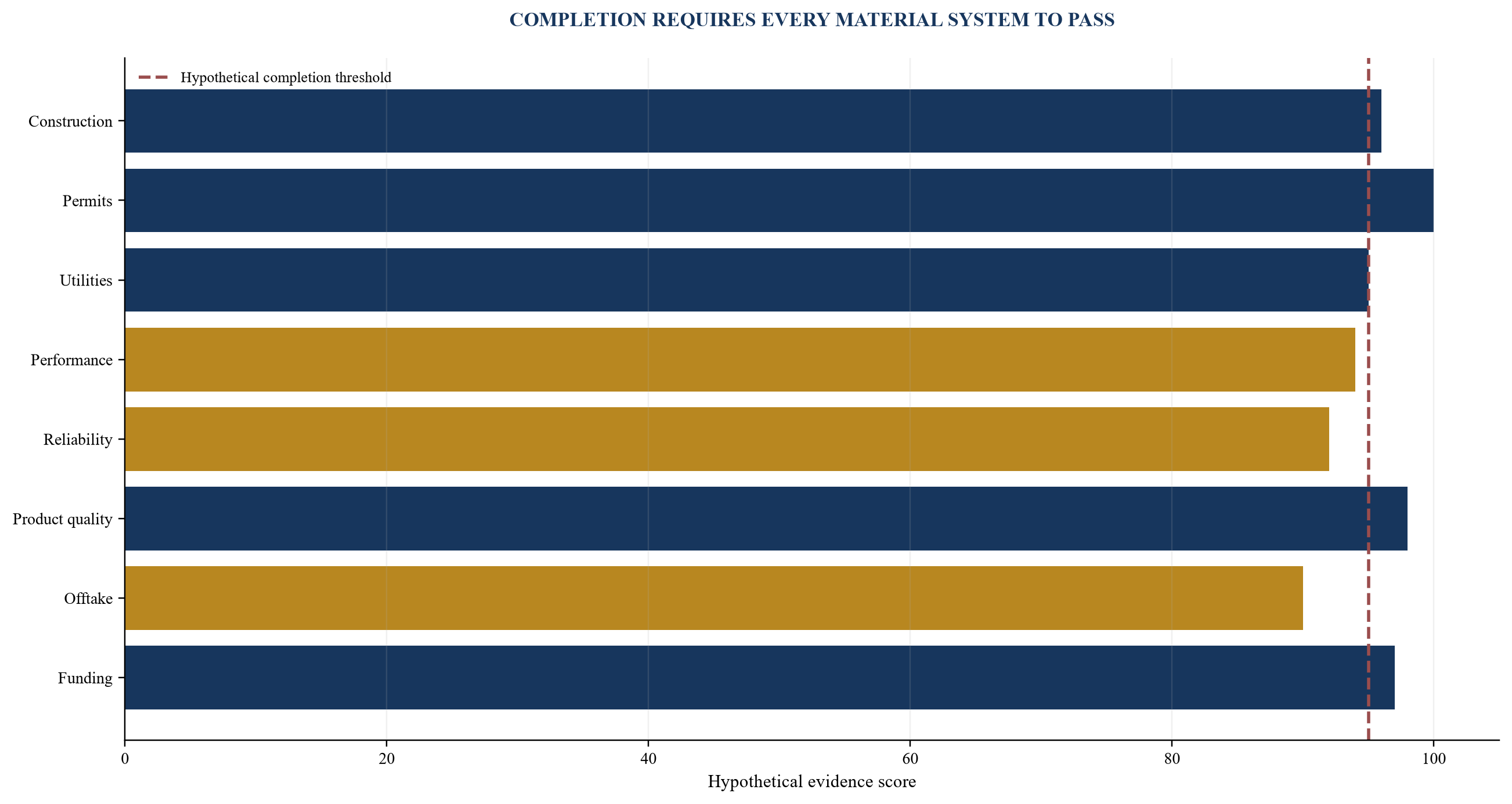
Thresholds are project-specific; the figure shows the required integration of evidence.
13. Build a commissioning and ramp cash curve
Commissioning consumes feedstock, utilities, catalyst, chemicals and labour before steady saleable production. Output can be off-spec, yields can be low and equipment can require repeated shutdown. The financing model should show commissioning by system and month, with explicit assumptions for consumption, production, rejection, inventory and cash collection.
The integrated schedule should connect energisation, utilities, feedstock introduction, unit start-up, product qualification, performance testing and commercial operations. Float should be visible. A delay in one common utility can affect several units and extend interest during construction. Long-lead spares and specialist mobilisation need confirmation.
The cash curve should include fixed operating cost, contractor demobilisation, retained payments, claims, taxes, insurance, debt interest and working capital. Offtake cash may arrive weeks after production. A facility can pass a technical milestone while remaining cash-negative.
The funding plan should preserve a commissioning reserve and a minimum liquidity floor. Drawdowns can be tied to observable readiness rather than calendar dates. If actual ramp falls behind, management should update the cost-to-complete, debt-service case and sponsor-support requirement before spending further discretionary capital.
14. Size working capital for an industrial cash cycle
Working capital begins before revenue. The project may prepay feedstock, catalyst, packaging, freight, insurance and taxes. It may build raw-material, intermediate and finished-goods inventory. Customers may pay after delivery, inspection and document acceptance. Value-added tax or customs timing can add a separate cash requirement.
The model should calculate days and physical quantities for each component. A single percentage of revenue is unsuitable during ramp because production, qualification, inventory and collections mature at different speeds. Currency and price changes can increase the cash tied to the same volume.
Receivables should be modelled by customer and instrument. Letters of credit, guarantees, credit insurance and collection accounts can reduce risk but have conditions and costs. Inventory financing may be available after title, quality, storage and control are verified. The project should avoid assuming that all working capital is debt-eligible.
Downside cases should combine slower commissioning, off-spec output, lower price and delayed collection. A working-capital reserve or revolving facility needs availability through this trough. The lender should understand priority, security and draw conditions across all facilities.
Table 3. Commissioning and working-capital funding map
| Cash item | Trigger | Evidence | Funding control |
|---|---|---|---|
| commissioning feedstock | unit start-up plan | approved schedule and storage readiness | draw against witnessed readiness |
| utilities and specialists | system energisation | contracts, mobilisation and permits | controlled reserve |
| off-spec and qualification stock | initial production | laboratory, customer and disposal plan | conservative recovery value |
| receivables | accepted delivery | invoice, acceptance and credit support | eligibility and concentration limits |
| minimum liquidity | delay or ramp downside | updated thirteen-week cash forecast | cash floor before further draw |
Amounts and timing require project-specific engineering, contract and cash evidence.
15. Separate construction debt from operating debt
Construction financing carries completion risk and typically relies on sponsor support, fixed funding and controlled drawdowns. Operating debt relies more heavily on project cash flow. The conversion between these states should occur only after the completion tests, documentation and funding conditions are satisfied.
The capital structure may combine sponsor equity, shareholder loans, Saudi industrial finance, commercial banks, Islamic facilities, export-credit support and working-capital lines. Each instrument has its own eligibility, security, tenor, currency, draw and repayment. The intercreditor framework should reconcile priority and decision rights.
Debt sizing should use a downside cash case with appropriate coverage, reserve and life constraints. The model should state whether repayment is sculpted to cash flow, amortising on a fixed schedule or exposed to refinancing. Commodity and volume uncertainty requires headroom. A high base-case coverage ratio can be misleading if the downside is correlated across feedstock, product and operations.
The Saudi Industrial Development Fund publishes project-financing information and evaluates technical, financial and marketing aspects.[3] Actual eligibility, amount and conditions require direct review. Public or development finance should be integrated with the complete funding plan rather than treated as automatic capital.
16. Govern drawdowns through evidence gates
Each debt and equity draw should fund approved cost within the project perimeter and leave the project fully funded to the next gate. The draw package can include engineer certification, invoices, sponsor equity, permits, insurance, no default, updated budget, schedule and cost-to-complete.
The sources-and-uses account should reconcile cumulative cost, paid amount, committed amount, contingency, interest and undrawn finance. Equity-first or pro-rata rules should be explicit. Sponsor funding for overruns should arrive before debt where the documents require it. Waivers should record the rationale and remaining protection.
Gates can follow notice to proceed, foundation, major equipment, mechanical completion, utility readiness, feedstock introduction, performance test and financial completion. Calendar-based draws can release funds despite missing dependencies. Observable gates connect capital to risk reduction.
Change orders and claims require special control. The independent engineer should assess scope, price, schedule and responsibility. The finance parties should know whether the cost sits inside contingency, sponsor support or additional funding. The project should not create an unfunded change backlog.
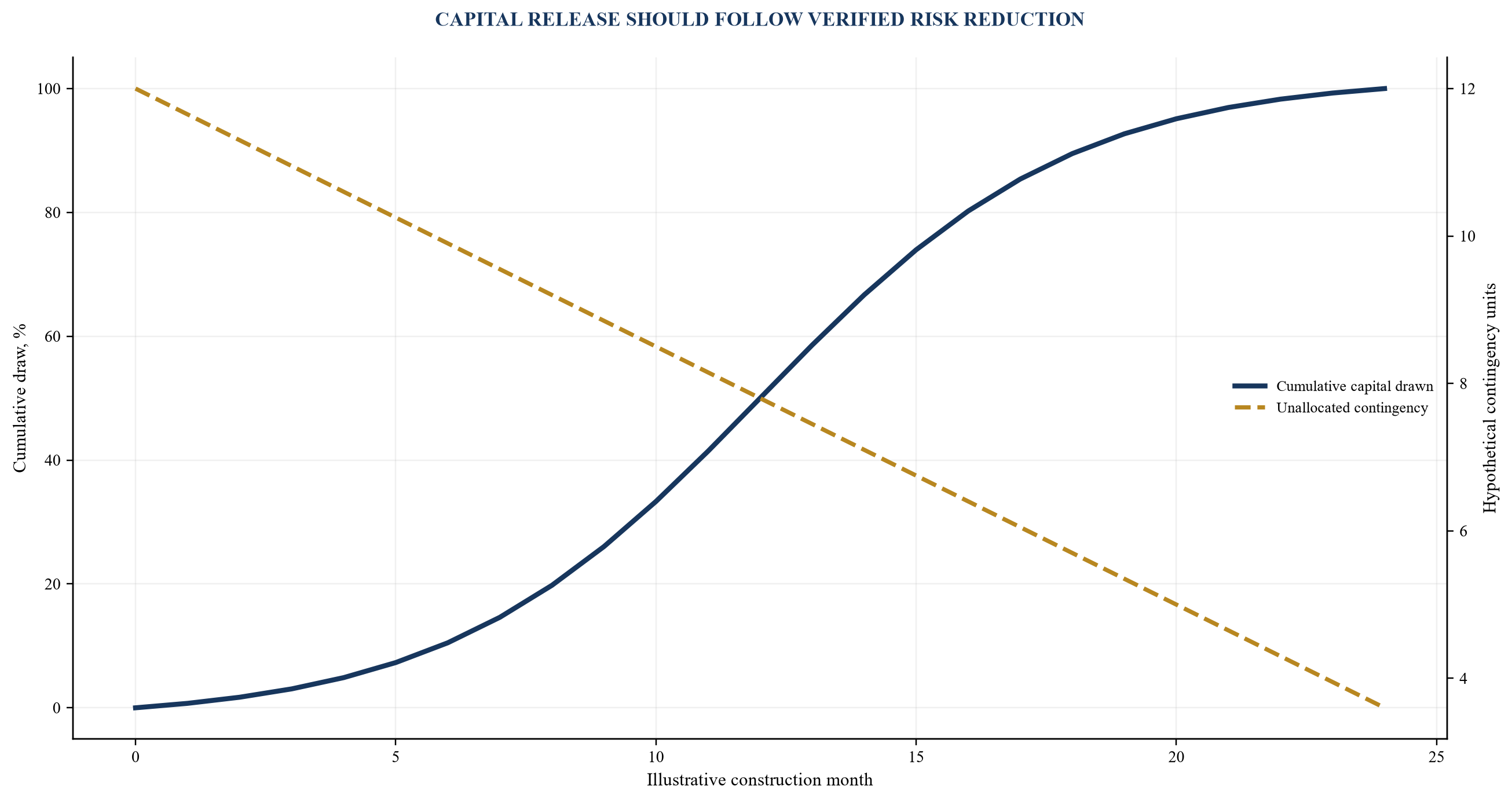
Values are hypothetical analytical assumptions and do not represent a project forecast.
17. Allocate completion support to the party that controls risk
Sponsors commonly support cost overruns, delay, performance shortfall and debt service before completion. The support package should define amount, term, call mechanics, credit quality, security and release. A broad commitment can contain conditions that make it unavailable when needed.
Risk should sit with the party best able to control it. EPC contractors can bear defined scope, schedule and performance risk within negotiated caps. Technology licensors can support guaranteed process outcomes. Utility providers and feedstock suppliers can carry contracted service obligations. Sponsors retain integration, market and residual risk. Lenders should identify gaps after all remedies and caps.
Support can take equity commitments, letters of credit, guarantees, subordinated loans, contingent facilities or cash reserves. Currency and timing should match the exposure. The project should test whether a sponsor's financial capacity remains available under the same market conditions that affect the plant.
Release should follow completion evidence and absence of unresolved liabilities. A performance test passed during a short favourable period may not justify releasing all support. Retained support for warranties, environmental obligations or working capital can be appropriate where risks remain.
18. Manage commodity, currency and interest-rate exposure
The project's margin can depend on feedstock, product, freight, currency and energy prices. The risk map should show each index, volume, timing, currency and contractual pass-through. Natural hedges can exist when input and output move together, while basis and timing gaps remain.
Financial hedging should match the underlying exposure and financing documents. Volume uncertainty, margin calls, collateral, accounting and early termination can create new liquidity risk. Qualified advisers should assess hedge structure and treatment. A hedge should protect debt capacity rather than create a speculative position.
Imported equipment and foreign debt can expose construction cost and debt service to currency. The project should distinguish committed and forecast exposure, then align procurement, equity and hedging. Interest-rate assumptions should include base rate, margin, fees, commitment, reserve earnings and refinancing.
Stress tests should combine adverse variables rather than change one at a time. Low product spread can coincide with slow ramp, high rates and working-capital pressure. The board should identify actions, covenant headroom and sponsor capacity under the combined case.
19. Build a downside debt-service model
The downside model should follow physical drivers. Lower availability reduces saleable volume. Feedstock or utility interruption can cause restart cost and inventory loss. Offtake weakness can reduce price and extend receivables. Each operational event should flow to cash and debt service.
Coverage ratios should be calculated from defined cash available for debt service. The model should show reserve movements, maintenance, taxes, working capital and permitted distributions. Average ratios can conceal a short-period breach. Monthly or quarterly detail is important during ramp and maintenance.
The downside should test delay, capital overrun, yield shortfall, price spread, buyer default, utility interruption and refinancing. Correlation and recovery timing matter. Insurance proceeds and damages should enter only when coverage, exclusions, waiting period and collection are credible.
The result should drive debt amount, repayment, reserve, covenant and support. A case that fails can be restructured through more equity, slower amortisation, stronger contracts, additional reserves or reduced scope. The purpose is to find a financeable allocation of risk rather than force a predetermined leverage amount.
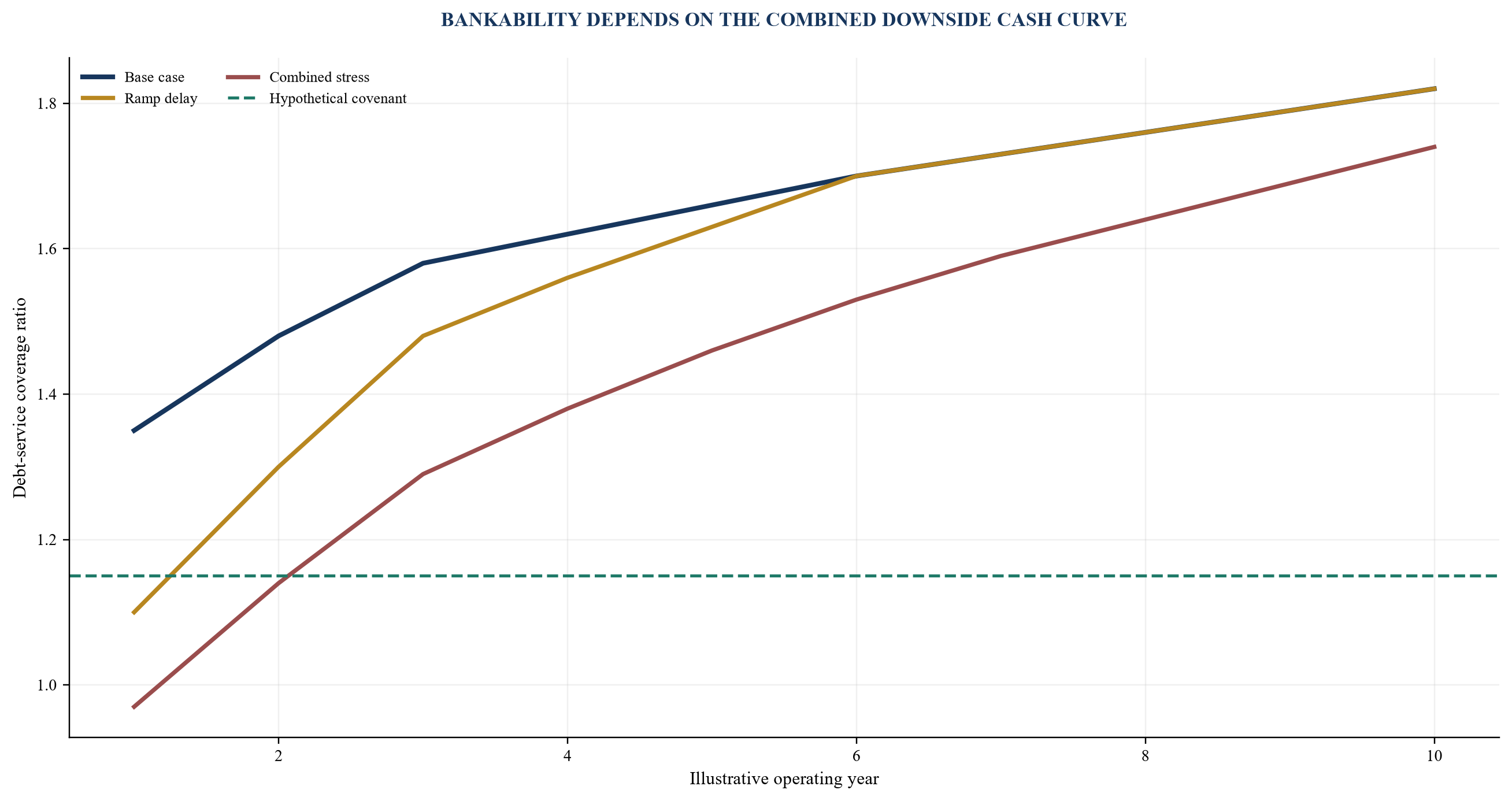
Values are hypothetical analytical assumptions and do not represent a financing forecast.
20. Integrate insurance with the risk register
Insurance should follow the physical and contractual risk map. Construction all risks, delay in start-up, marine cargo, third-party liability, property damage, business interruption, environmental and other covers may be relevant. The exact programme depends on project facts and market availability.
The insurance adviser should test insured values, limits, deductibles, waiting periods, exclusions, aggregation, sublimits and insurer credit. Delay-in-start-up coverage depends on an insured physical event and a documented critical path. It does not replace a general schedule overrun reserve.
Lender interests, loss-payee arrangements, proceeds accounts and reinstatement decisions should align with financing documents. Claims procedures need evidence, notice and coordination. Contractors' policies should be checked for gaps and compatibility with the project programme.
Residual risks remain with the project and sponsors. The financial model should avoid assuming full and immediate recovery. A realistic claim timeline and uninsured amount belong in liquidity and debt-service stress.
21. Establish accounts, security and cash control
The financing accounts can include equity, proceeds, construction, revenue, operating, tax, debt service, reserve, insurance and distribution accounts. The waterfall should define permitted payments, transfers, replenishment and lock-up. It should support operations while protecting scheduled debt service.
Security may cover project-company shares, accounts, receivables, movable assets, insurance and contract rights, subject to Saudi law, licences, counterpart consent and other applicable requirements. Qualified counsel should confirm creation, perfection, priority and enforcement. A security schedule should identify evidence and renewal.
Direct agreements with material counterparties can provide notice, cure, step-in and continuity. The lender should prioritise contracts whose loss would stop construction or operation. Overly broad requirements can delay financial close; risk ranking helps focus effort.
Distribution tests should use updated forecasts, reserves, covenants, no default and completed obligations. Cash should not leave the project while a known cost-to-complete or working-capital shortfall exists. The waterfall should be modelled and tested before closing.
22. Govern operations after commercial completion
Operating readiness includes organisation, competency, procedures, maintenance, spares, laboratory, digital systems, cyber security, process safety, emergency response and vendor support. Recruitment and training should follow the commissioning schedule. Reliance on sponsor staff should be formalised through services and transition.
The maintenance strategy should identify planned shutdowns, critical spares, long-lead replacements and warranties. Reliability-centred maintenance can protect availability, while underfunding can create an early cash benefit and later failure. Major maintenance reserves should align with the debt model.
Process safety requires leadership, hazard studies, management of change, permit to work, mechanical integrity and incident learning. Environmental and social commitments continue after construction. Performance reporting should include leading indicators as well as production and cash.
The board dashboard should reconcile production, yield, energy, quality, sales, working capital, maintenance, safety, environment, liquidity and covenant forecast. Early operating variance should trigger technical and financial action before reserve erosion.
23. Prepare for restructuring before a stress occurs
A project can face delayed completion, cost overrun, feedstock interruption, low spread, buyer default or prolonged outage. The financing documents and management plan should identify information, standstill, cure, voting and enforcement pathways. Early transparency can preserve options.
The first response is a verified recovery case. The project updates physical status, cost-to-complete, schedule, contracts, claims, liquidity and market. It distinguishes temporary timing from structural unbankability. Stakeholders can then assess sponsor funding, contractor recovery, covenant relief, maturity extension, debt reduction, asset sale or operating change.
Priority should preserve safety, environment, asset integrity and critical operations. Cutting maintenance or compliance can increase loss. A restructuring should use realistic cash and independent technical evidence. Additional capital needs clear priority, conditions and governance.
The original financing can improve resilience through reserves, support, information rights, cash control and orderly intercreditor decisions. These provisions cannot remove risk, but they can shorten response time and protect enterprise value.
24. Execute through a one-hundred-day financing programme
The first twenty days establish perimeter, mass balance, contracts, permits, design basis, capital cost and schedule. The team creates a common data room, issue register and decision log. Missing evidence is assigned to an owner and a financing consequence.
Days twenty-one to forty-five complete independent technical, market, environmental, insurance, tax, accounting and legal review. Feedstock, technology, EPC, utilities and offtake are compared through one interface matrix. The financial model is rebuilt from physical drivers.
Days forty-six to seventy develop financing cases, security, accounts, support and draw conditions. Term sheets are reconciled across lenders, public finance and export-credit parties. The sponsor approves the downside, funding commitment and covenant headroom.
Days seventy-one to one hundred close remaining contracts, consents, permits and conditions. The team runs a drawdown rehearsal, completion-test rehearsal and downside liquidity test. Financial close occurs only when the project can fund the approved scope and execute the evidence gates.
Table 4. One-hundred-day chemicals project-finance programme
| Period | Primary work | Required output | Gate |
|---|---|---|---|
| days 1-20 | perimeter, mass balance and source records | controlled project baseline | scope and evidence accepted |
| days 21-45 | technical, market, legal and environmental diligence | integrated risk and contract matrix | bankability gaps allocated |
| days 46-70 | model, terms, security, support and accounts | downside financing structure | funding and risk approved |
| days 71-100 | consents, conditions and rehearsals | executable close and draw package | fully funded project at close |
Timing is illustrative and should be adapted to project maturity, procurement and financing parties.
25. Apply an investment and lender decision checklist
The decision paper should identify borrower, sponsors, site, assets, products, feedstock, technology, contractors, utilities, offtakers and financing. It should reconcile legal, physical, financial and security perimeters. Every material contract should connect to the same quantity, specification, timing, price and remedy assumptions.
Technical evidence should include design basis, mass balance, maturity, references, capital cost, schedule, interfaces, permits, environmental controls and completion tests. Commercial evidence should include product qualification, cost position, offtake, buyer credit, logistics and market fallback. Financial evidence should include construction cost, working capital, downside, reserves, debt service, taxes and funding commitments.
The committee should ask what must be true for completion and debt service, which evidence proves it, who controls the risk and what happens if the assumption fails. Conditions precedent, draw gates, support and covenants should answer those questions in executable form. Open issues should have owners, deadlines and quantified consequences.
Bankability arises from alignment. Feedstock, technology, EPC, utilities, permits, offtake, commissioning and financing must describe one operable project. A strategic industrial narrative can attract attention; the integrated evidence system determines whether capital can be released with controlled risk.
The decision should be recorded through a signed assumptions register. Each entry identifies the source, date, verification status, owner, sensitivity and document that allocates the risk. Management estimates remain visible as estimates until evidence replaces them. The investment committee can then revisit a decision when contracts, prices, design or schedule change without reconstructing the original logic.
Table 5. Final bankability decision checklist
| Decision area | Approval evidence | Stop or resize trigger | Responsible review |
|---|---|---|---|
| physical project | reconciled scope, mass balance and interfaces | unresolved critical dependency | independent engineer |
| contracts | aligned feedstock, EPC, utilities and offtake | material quantity, price or remedy gap | legal and commercial teams |
| completion | test regime, schedule, permits and operating readiness | untestable performance or unfunded delay | technical and lender advisers |
| financing | fully funded base and downside with reserves | cost-to-complete or liquidity shortfall | finance parties and board |
| environment and safety | approved studies, permits, controls and budget | unacceptable impact or missing approval | qualified specialists |
The checklist supports governance and does not replace technical, legal, financial or regulatory advice.
References
- Saudi Vision 2030. National Industrial Strategy. https://www.vision2030.gov.sa/media/t0uiiudv/nsd_en.pdf
- Saudi Vision 2030. National Industrial Development and Logistics Program Delivery Plan. https://www.vision2030.gov.sa/media/bsan2azp/2021-2025-national-industrial-development-and-logistics-program-delivery-plan-en.pdf
- Saudi Industrial Development Fund. Project Financing. https://www.sidf.gov.sa/FinancialSolutions/financialSolutionsServices/ProjectFinancing
- Saudi Industrial Development Fund. Industry Sector Financing. https://sidf.gov.sa/ar/servicesforinvestors/sectors/pages/industry.aspx
- Saudi Aramco. Chemicals. https://www.aramco.com/en/what-we-do/energy-products/chemicals
- Saudi Aramco. Crude Oil to Chemicals. https://www.aramco.com/en/what-we-do/energy-innovation/advancing-energy-solutions/crude-oil-to-chemicals
- International Finance Corporation. Environmental, Health, and Safety Guidelines: Chemicals. https://www.ifc.org/en/insights-reports/general-environmental-health-and-safety-guidelines/ehs-guidelines-chemicals
- Equator Principles Association. The Equator Principles, EP4. https://equator-principles.com/app/uploads/The-Equator-Principles_EP4_July2020.pdf
- OECD. Recommendation of the Council on Common Approaches for Officially Supported Export Credits and Environmental and Social Due Diligence. https://legalinstruments.oecd.org/en/instruments/OECD-LEGAL-0393
- OECD. Arrangement on Officially Supported Export Credits. https://www.oecd.org/en/topics/sub-issues/financing-terms-and-conditions/the-arrangement-on-officially-supported-export-credits.html
- International Finance Corporation. Performance Standards on Environmental and Social Sustainability. https://www.ifc.org/en/insights-reports/2012/ifc-performance-standards
- World Bank. Private Participation in Infrastructure Database. https://ppi.worldbank.org/en/ppi
- World Bank. Guidance on PPP Contractual Provisions. https://ppp.worldbank.org/public-private-partnership/library/guidance-ppp-contractual-provisions-2019
- UNCITRAL. Legislative Guide on Public-Private Partnerships. https://uncitral.un.org/en/lgppp
- International Energy Agency. The Future of Petrochemicals. https://www.iea.org/reports/the-future-of-petrochemicals
- International Energy Agency. Chemicals. https://www.iea.org/energy-system/industry/chemicals
- IFRS Foundation. IFRS 15 Revenue from Contracts with Customers. https://www.ifrs.org/issued-standards/list-of-standards/ifrs-15-revenue-from-contracts-with-customers/
- IFRS Foundation. IAS 23 Borrowing Costs. https://www.ifrs.org/issued-standards/list-of-standards/ias-23-borrowing-costs/
- IFRS Foundation. IFRIC 12 Service Concession Arrangements. https://www.ifrs.org/issued-standards/list-of-standards/ifric-12-service-concession-arrangements/
- Basel Committee on Banking Supervision. Basel Framework: Specialised Lending. https://www.bis.org/basel_framework/
- International Chamber of Commerce. Uniform Rules for Demand Guarantees, URDG 758. https://iccwbo.org/business-solutions/rules-standards/urdg-758/
- International Chamber of Commerce. Uniform Customs and Practice for Documentary Credits, UCP 600. https://iccwbo.org/business-solutions/rules-standards/ucp-600/
