

1. Define the strategic access and execution gap
The market-entry sponsor, proposed partners and advisers should state the customers, capabilities, approvals, capital, assets, people, delivery capacity and risks the venture must solve. The controlled deliverable is a joint-venture requirement statement. Record the evidence source, accountable contributor, verification method, commercial assumption, approval owner, unresolved dependency, decision date and refresh trigger [1][2].
Translate every relationship or capability claim into a measurable contribution and a testable obligation. Reconcile corporate records, licences, contracts, customer evidence, financial information, delivery references, ownership, policies and independent sources.
The principal execution risk is that a partner can be selected before the venture's non-substitutable need is defined. Measure the effect on access, time to revenue, delivery capacity, capital, control, compliance, cash conversion, reputation, strategic flexibility, exit value and the economics borne by each shareholder.
Convert the conclusion into the partner score, valuation, term sheet, shareholders' agreement, operating agreements, conditions precedent, governance calendar, performance dashboard, escalation rights and exit plan. Retain a dated evidence trail and obtain specialist advice for the relevant activity, entity and agreements.
2. Compare acquisition, greenfield, alliance and joint venture
The market-entry sponsor, proposed partners and advisers should test control, speed, reversibility, capital, learning, regulation, integration and exit under each route. The controlled deliverable is an entry-route decision memorandum. Record the evidence source, accountable contributor, verification method, commercial assumption, approval owner, unresolved dependency, decision date and refresh trigger [2][3].
Translate every relationship or capability claim into a measurable contribution and a testable obligation. Reconcile corporate records, licences, contracts, customer evidence, financial information, delivery references, ownership, policies and independent sources.
The principal execution risk is that a joint venture can be used by habit when another structure offers clearer control or lower dependence. Measure the effect on access, time to revenue, delivery capacity, capital, control, compliance, cash conversion, reputation, strategic flexibility, exit value and the economics borne by each shareholder.
Convert the conclusion into the partner score, valuation, term sheet, shareholders' agreement, operating agreements, conditions precedent, governance calendar, performance dashboard, escalation rights and exit plan. Retain a dated evidence trail and obtain specialist advice for the relevant activity, entity and agreements.
3. Build the partner universe
The market-entry sponsor, proposed partners and advisers should identify corporates, family businesses, funds, operators, distributors, contractors and public-sector counterparties that meet minimum criteria. The controlled deliverable is a documented longlist. Record the evidence source, accountable contributor, verification method, commercial assumption, approval owner, unresolved dependency, decision date and refresh trigger [4][5].
Translate every relationship or capability claim into a measurable contribution and a testable obligation. Reconcile corporate records, licences, contracts, customer evidence, financial information, delivery references, ownership, policies and independent sources.
The principal execution risk is that the search can stop at familiar names and miss stronger evidence-based candidates. Measure the effect on access, time to revenue, delivery capacity, capital, control, compliance, cash conversion, reputation, strategic flexibility, exit value and the economics borne by each shareholder.
Convert the conclusion into the partner score, valuation, term sheet, shareholders' agreement, operating agreements, conditions precedent, governance calendar, performance dashboard, escalation rights and exit plan. Retain a dated evidence trail and obtain specialist advice for the relevant activity, entity and agreements.
4. Test legal eligibility and ownership constraints
The market-entry sponsor, proposed partners and advisers should verify permitted foreign ownership, strategic-impact treatment, nationality conditions, legal form and sector requirements. The controlled deliverable is an eligibility matrix. Record the evidence source, accountable contributor, verification method, commercial assumption, approval owner, unresolved dependency, decision date and refresh trigger [5][6].
Translate every relationship or capability claim into a measurable contribution and a testable obligation. Reconcile corporate records, licences, contracts, customer evidence, financial information, delivery references, ownership, policies and independent sources.
The principal execution risk is that commercial agreement can precede confirmation that the proposed ownership is licensable. Measure the effect on access, time to revenue, delivery capacity, capital, control, compliance, cash conversion, reputation, strategic flexibility, exit value and the economics borne by each shareholder.
Convert the conclusion into the partner score, valuation, term sheet, shareholders' agreement, operating agreements, conditions precedent, governance calendar, performance dashboard, escalation rights and exit plan. Retain a dated evidence trail and obtain specialist advice for the relevant activity, entity and agreements.
5. Map approvals and competition exposure
The market-entry sponsor, proposed partners and advisers should identify incorporation, sector, land, merger-control, foreign-investment and government-consent requirements. The controlled deliverable is an approval critical path. Record the evidence source, accountable contributor, verification method, commercial assumption, approval owner, unresolved dependency, decision date and refresh trigger [6][7].
Translate every relationship or capability claim into a measurable contribution and a testable obligation. Reconcile corporate records, licences, contracts, customer evidence, financial information, delivery references, ownership, policies and independent sources.
The principal execution risk is that the parties can create control or exclusivity effects before required approvals are effective. Measure the effect on access, time to revenue, delivery capacity, capital, control, compliance, cash conversion, reputation, strategic flexibility, exit value and the economics borne by each shareholder.
Convert the conclusion into the partner score, valuation, term sheet, shareholders' agreement, operating agreements, conditions precedent, governance calendar, performance dashboard, escalation rights and exit plan. Retain a dated evidence trail and obtain specialist advice for the relevant activity, entity and agreements.
6. Investigate integrity and reputation
The market-entry sponsor, proposed partners and advisers should review litigation, insolvency, regulatory findings, adverse information, political exposure, conduct and references using reliable sources. The controlled deliverable is an integrity assessment. Record the evidence source, accountable contributor, verification method, commercial assumption, approval owner, unresolved dependency, decision date and refresh trigger [8][9].
Translate every relationship or capability claim into a measurable contribution and a testable obligation. Reconcile corporate records, licences, contracts, customer evidence, financial information, delivery references, ownership, policies and independent sources.
The principal execution risk is that prominence or proximity can substitute for verifiable conduct and delivery evidence. Measure the effect on access, time to revenue, delivery capacity, capital, control, compliance, cash conversion, reputation, strategic flexibility, exit value and the economics borne by each shareholder.
Convert the conclusion into the partner score, valuation, term sheet, shareholders' agreement, operating agreements, conditions precedent, governance calendar, performance dashboard, escalation rights and exit plan. Retain a dated evidence trail and obtain specialist advice for the relevant activity, entity and agreements.
7. Verify beneficial ownership and sanctions exposure
The market-entry sponsor, proposed partners and advisers should trace natural-person control, nominees, trusts, affiliates, sanctions ownership and payment relationships. The controlled deliverable is an ownership-and-screening file. Record the evidence source, accountable contributor, verification method, commercial assumption, approval owner, unresolved dependency, decision date and refresh trigger [9][10].
Translate every relationship or capability claim into a measurable contribution and a testable obligation. Reconcile corporate records, licences, contracts, customer evidence, financial information, delivery references, ownership, policies and independent sources.
The principal execution risk is that opaque control or indirect sanctions exposure can undermine banking, approvals and counterparties. Measure the effect on access, time to revenue, delivery capacity, capital, control, compliance, cash conversion, reputation, strategic flexibility, exit value and the economics borne by each shareholder.
Convert the conclusion into the partner score, valuation, term sheet, shareholders' agreement, operating agreements, conditions precedent, governance calendar, performance dashboard, escalation rights and exit plan. Retain a dated evidence trail and obtain specialist advice for the relevant activity, entity and agreements.
8. Evidence technical and operating capability
The market-entry sponsor, proposed partners and advisers should test licences, people, facilities, systems, certifications, subcontractors, capacity and comparable delivery. The controlled deliverable is a capability evidence pack. Record the evidence source, accountable contributor, verification method, commercial assumption, approval owner, unresolved dependency, decision date and refresh trigger [11][12].
Translate every relationship or capability claim into a measurable contribution and a testable obligation. Reconcile corporate records, licences, contracts, customer evidence, financial information, delivery references, ownership, policies and independent sources.
The principal execution risk is that presentation material can overstate resources actually available to the venture. Measure the effect on access, time to revenue, delivery capacity, capital, control, compliance, cash conversion, reputation, strategic flexibility, exit value and the economics borne by each shareholder.
Convert the conclusion into the partner score, valuation, term sheet, shareholders' agreement, operating agreements, conditions precedent, governance calendar, performance dashboard, escalation rights and exit plan. Retain a dated evidence trail and obtain specialist advice for the relevant activity, entity and agreements.
Table 1. Partner contribution architecture
| Contribution | Primary evidence | Performance gate |
|---|---|---|
| customer access | attributable pipeline | qualified conversion |
| delivery | people and references | milestone acceptance |
| capital | funding evidence | cash received |
| licence or asset | title and permission | effective availability |
Statutory periods are stated where labelled; other entries are analytical controls.
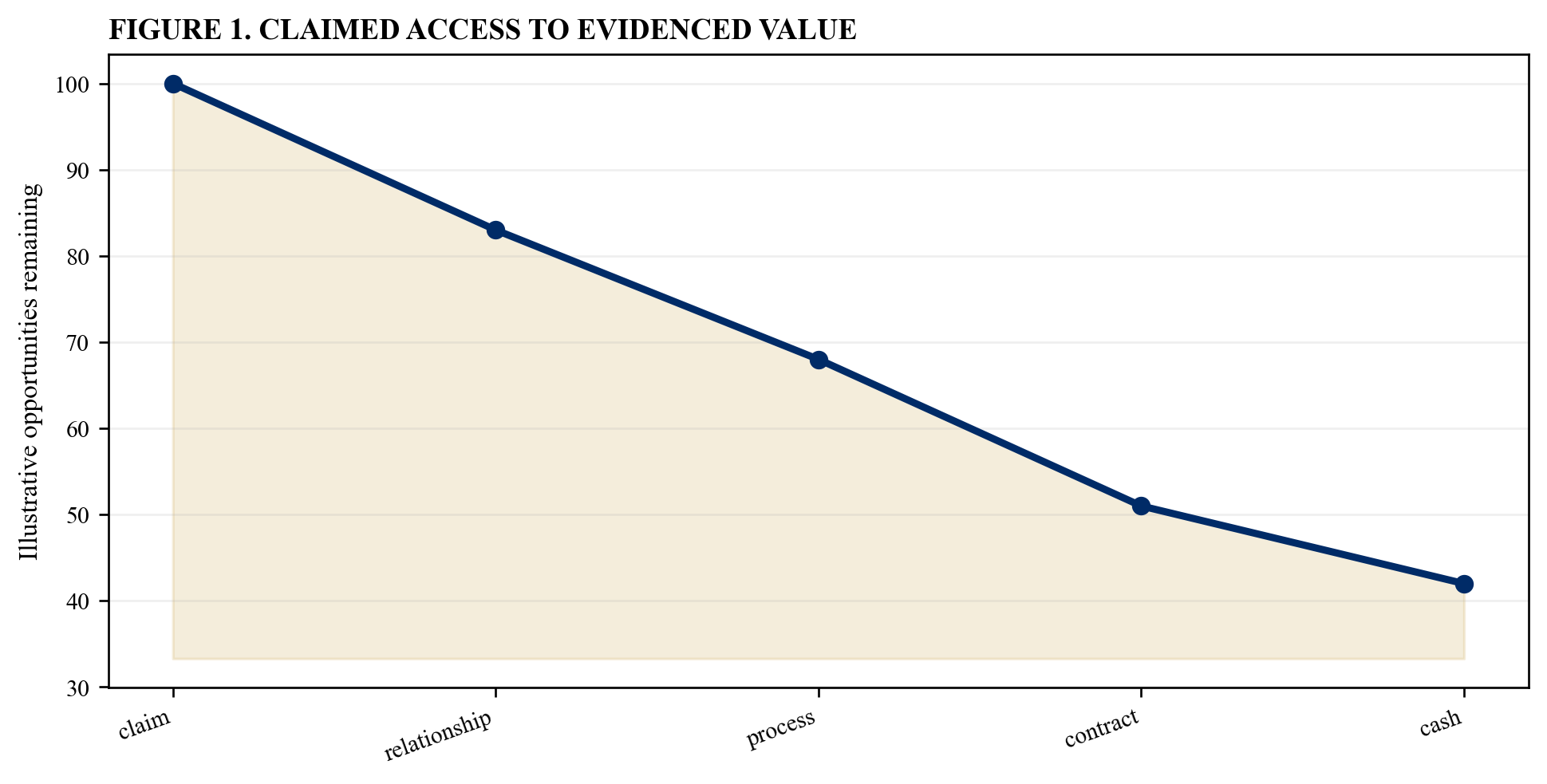
Illustrative analytical scenario; transaction evidence should replace model values.
9. Verify customer access
The market-entry sponsor, proposed partners and advisers should attribute relationships to named decision processes, contract history, pipeline evidence, channel rights and conversion responsibility. The controlled deliverable is an access-to-revenue bridge. Record the evidence source, accountable contributor, verification method, commercial assumption, approval owner, unresolved dependency, decision date and refresh trigger [13][14].
Translate every relationship or capability claim into a measurable contribution and a testable obligation. Reconcile corporate records, licences, contracts, customer evidence, financial information, delivery references, ownership, policies and independent sources.
The principal execution risk is that general connections can be valued as contracted or exclusive customer access. Measure the effect on access, time to revenue, delivery capacity, capital, control, compliance, cash conversion, reputation, strategic flexibility, exit value and the economics borne by each shareholder.
Convert the conclusion into the partner score, valuation, term sheet, shareholders' agreement, operating agreements, conditions precedent, governance calendar, performance dashboard, escalation rights and exit plan. Retain a dated evidence trail and obtain specialist advice for the relevant activity, entity and agreements.
10. Map government and stakeholder access
The market-entry sponsor, proposed partners and advisers should identify lawful engagement pathways, tender rules, public-sector approvals, community interests and accountable relationship owners. The controlled deliverable is a stakeholder engagement plan. Record the evidence source, accountable contributor, verification method, commercial assumption, approval owner, unresolved dependency, decision date and refresh trigger [14][15].
Translate every relationship or capability claim into a measurable contribution and a testable obligation. Reconcile corporate records, licences, contracts, customer evidence, financial information, delivery references, ownership, policies and independent sources.
The principal execution risk is that informal access claims can create integrity, procurement or reputational exposure. Measure the effect on access, time to revenue, delivery capacity, capital, control, compliance, cash conversion, reputation, strategic flexibility, exit value and the economics borne by each shareholder.
Convert the conclusion into the partner score, valuation, term sheet, shareholders' agreement, operating agreements, conditions precedent, governance calendar, performance dashboard, escalation rights and exit plan. Retain a dated evidence trail and obtain specialist advice for the relevant activity, entity and agreements.
11. Test permits and local-content execution
The market-entry sponsor, proposed partners and advisers should verify activity licences, classifications, registrations, national-value requirements, workforce commitments and bid eligibility. The controlled deliverable is a permit-and-local-content map. Record the evidence source, accountable contributor, verification method, commercial assumption, approval owner, unresolved dependency, decision date and refresh trigger [5][16].
Translate every relationship or capability claim into a measurable contribution and a testable obligation. Reconcile corporate records, licences, contracts, customer evidence, financial information, delivery references, ownership, policies and independent sources.
The principal execution risk is that the partner can promise eligibility that depends on unverified classifications or future staffing. Measure the effect on access, time to revenue, delivery capacity, capital, control, compliance, cash conversion, reputation, strategic flexibility, exit value and the economics borne by each shareholder.
Convert the conclusion into the partner score, valuation, term sheet, shareholders' agreement, operating agreements, conditions precedent, governance calendar, performance dashboard, escalation rights and exit plan. Retain a dated evidence trail and obtain specialist advice for the relevant activity, entity and agreements.
12. Reconstruct the execution record
The market-entry sponsor, proposed partners and advisers should test completed projects, schedule, quality, claims, safety, collections, customer references and lessons from failed delivery. The controlled deliverable is an attributable track-record ledger. Record the evidence source, accountable contributor, verification method, commercial assumption, approval owner, unresolved dependency, decision date and refresh trigger [11][17].
Translate every relationship or capability claim into a measurable contribution and a testable obligation. Reconcile corporate records, licences, contracts, customer evidence, financial information, delivery references, ownership, policies and independent sources.
The principal execution risk is that group-level credentials can be assigned to an entity or team that did not deliver them. Measure the effect on access, time to revenue, delivery capacity, capital, control, compliance, cash conversion, reputation, strategic flexibility, exit value and the economics borne by each shareholder.
Convert the conclusion into the partner score, valuation, term sheet, shareholders' agreement, operating agreements, conditions precedent, governance calendar, performance dashboard, escalation rights and exit plan. Retain a dated evidence trail and obtain specialist advice for the relevant activity, entity and agreements.
13. Assess capital capacity and funding conduct
The market-entry sponsor, proposed partners and advisers should review audited accounts, liquidity, debt, guarantees, commitments, defaults, related-party support and funding behaviour. The controlled deliverable is a partner funding capacity file. Record the evidence source, accountable contributor, verification method, commercial assumption, approval owner, unresolved dependency, decision date and refresh trigger [18][19].
Translate every relationship or capability claim into a measurable contribution and a testable obligation. Reconcile corporate records, licences, contracts, customer evidence, financial information, delivery references, ownership, policies and independent sources.
The principal execution risk is that headline wealth or enterprise size can conceal inability or unwillingness to fund the venture. Measure the effect on access, time to revenue, delivery capacity, capital, control, compliance, cash conversion, reputation, strategic flexibility, exit value and the economics borne by each shareholder.
Convert the conclusion into the partner score, valuation, term sheet, shareholders' agreement, operating agreements, conditions precedent, governance calendar, performance dashboard, escalation rights and exit plan. Retain a dated evidence trail and obtain specialist advice for the relevant activity, entity and agreements.
14. Value every proposed contribution
The market-entry sponsor, proposed partners and advisers should price cash, assets, licences, contracts, intellectual property, people, services, guarantees and access on comparable bases. The controlled deliverable is a contribution valuation bridge. Record the evidence source, accountable contributor, verification method, commercial assumption, approval owner, unresolved dependency, decision date and refresh trigger [20][21].
Translate every relationship or capability claim into a measurable contribution and a testable obligation. Reconcile corporate records, licences, contracts, customer evidence, financial information, delivery references, ownership, policies and independent sources.
The principal execution risk is that equity can be awarded for soft promises while the other party contributes funded assets or technology. Measure the effect on access, time to revenue, delivery capacity, capital, control, compliance, cash conversion, reputation, strategic flexibility, exit value and the economics borne by each shareholder.
Convert the conclusion into the partner score, valuation, term sheet, shareholders' agreement, operating agreements, conditions precedent, governance calendar, performance dashboard, escalation rights and exit plan. Retain a dated evidence trail and obtain specialist advice for the relevant activity, entity and agreements.
15. Score partners against the mandate
The market-entry sponsor, proposed partners and advisers should weight strategic fit, access, execution, integrity, capital, governance, conflicts and exit compatibility with evidence thresholds. The controlled deliverable is a decision-grade partner scorecard. Record the evidence source, accountable contributor, verification method, commercial assumption, approval owner, unresolved dependency, decision date and refresh trigger [21][22].
Translate every relationship or capability claim into a measurable contribution and a testable obligation. Reconcile corporate records, licences, contracts, customer evidence, financial information, delivery references, ownership, policies and independent sources.
The principal execution risk is that subjective enthusiasm can override a weak result on non-negotiable risks. Measure the effect on access, time to revenue, delivery capacity, capital, control, compliance, cash conversion, reputation, strategic flexibility, exit value and the economics borne by each shareholder.
Convert the conclusion into the partner score, valuation, term sheet, shareholders' agreement, operating agreements, conditions precedent, governance calendar, performance dashboard, escalation rights and exit plan. Retain a dated evidence trail and obtain specialist advice for the relevant activity, entity and agreements.
16. Run pilots and reference tests
The market-entry sponsor, proposed partners and advisers should use limited demonstrations, customer validation, work packages, data-room proof and reference calls before irreversible commitment. The controlled deliverable is a validation programme. Record the evidence source, accountable contributor, verification method, commercial assumption, approval owner, unresolved dependency, decision date and refresh trigger [12][23].
Translate every relationship or capability claim into a measurable contribution and a testable obligation. Reconcile corporate records, licences, contracts, customer evidence, financial information, delivery references, ownership, policies and independent sources.
The principal execution risk is that full exclusivity or equity can be granted before claimed capabilities are tested. Measure the effect on access, time to revenue, delivery capacity, capital, control, compliance, cash conversion, reputation, strategic flexibility, exit value and the economics borne by each shareholder.
Convert the conclusion into the partner score, valuation, term sheet, shareholders' agreement, operating agreements, conditions precedent, governance calendar, performance dashboard, escalation rights and exit plan. Retain a dated evidence trail and obtain specialist advice for the relevant activity, entity and agreements.
Table 2. Evidence-based partner scorecard
| Dimension | Weight | Minimum evidence |
|---|---|---|
| access | 25 | named pathway |
| execution | 25 | relevant delivery |
| integrity | 20 | clean diligence |
| capital and governance | 30 | funding and alignment |
Statutory periods are stated where labelled; other entries are analytical controls.
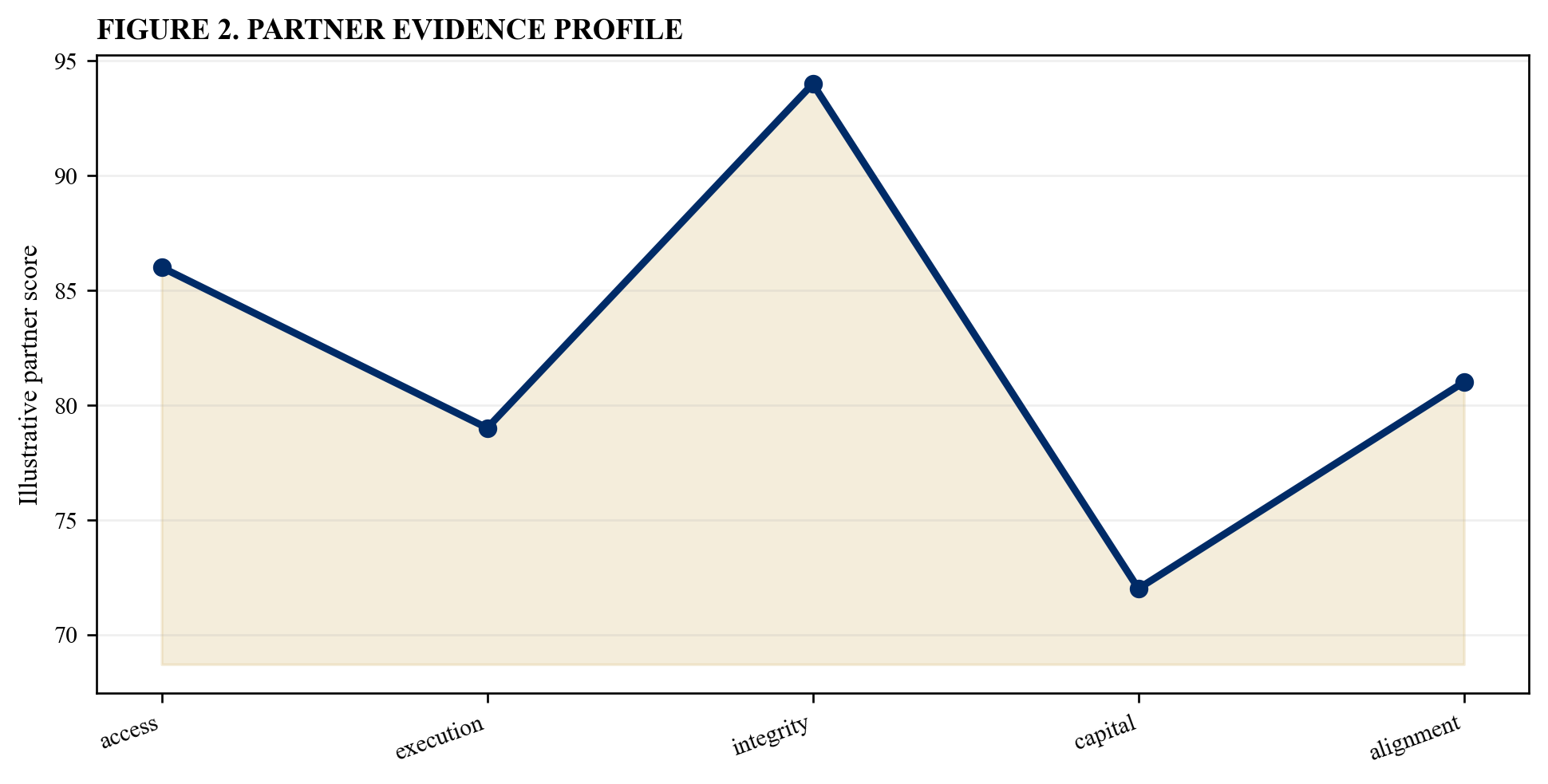
Illustrative analytical scenario; transaction evidence should replace model values.
17. Choose the venture entity and legal form
The market-entry sponsor, proposed partners and advisers should compare mainland, free-zone, financial-centre, incorporated and contractual arrangements for liability, licensing and control. The controlled deliverable is an entity-architecture memorandum. Record the evidence source, accountable contributor, verification method, commercial assumption, approval owner, unresolved dependency, decision date and refresh trigger [1][24].
Translate every relationship or capability claim into a measurable contribution and a testable obligation. Reconcile corporate records, licences, contracts, customer evidence, financial information, delivery references, ownership, policies and independent sources.
The principal execution risk is that the chosen vehicle can create tax, licensing, enforcement or operational constraints absent from the commercial model. Measure the effect on access, time to revenue, delivery capacity, capital, control, compliance, cash conversion, reputation, strategic flexibility, exit value and the economics borne by each shareholder.
Convert the conclusion into the partner score, valuation, term sheet, shareholders' agreement, operating agreements, conditions precedent, governance calendar, performance dashboard, escalation rights and exit plan. Retain a dated evidence trail and obtain specialist advice for the relevant activity, entity and agreements.
18. Design equity and economic rights
The market-entry sponsor, proposed partners and advisers should align ownership, profit, distributions, liquidation priority, dilution, service fees and value accrual with funded contribution and risk. The controlled deliverable is an economic-rights schedule. Record the evidence source, accountable contributor, verification method, commercial assumption, approval owner, unresolved dependency, decision date and refresh trigger [20][25].
Translate every relationship or capability claim into a measurable contribution and a testable obligation. Reconcile corporate records, licences, contracts, customer evidence, financial information, delivery references, ownership, policies and independent sources.
The principal execution risk is that headline equity can diverge from cash returns, control and downside exposure. Measure the effect on access, time to revenue, delivery capacity, capital, control, compliance, cash conversion, reputation, strategic flexibility, exit value and the economics borne by each shareholder.
Convert the conclusion into the partner score, valuation, term sheet, shareholders' agreement, operating agreements, conditions precedent, governance calendar, performance dashboard, escalation rights and exit plan. Retain a dated evidence trail and obtain specialist advice for the relevant activity, entity and agreements.
19. Build the board and management model
The market-entry sponsor, proposed partners and advisers should define composition, appointment, removal, chair, quorum, committees, delegations, executive roles and accountability. The controlled deliverable is a governance operating manual. Record the evidence source, accountable contributor, verification method, commercial assumption, approval owner, unresolved dependency, decision date and refresh trigger [26][27].
Translate every relationship or capability claim into a measurable contribution and a testable obligation. Reconcile corporate records, licences, contracts, customer evidence, financial information, delivery references, ownership, policies and independent sources.
The principal execution risk is that equal board seats can mask unequal information, resources or management control. Measure the effect on access, time to revenue, delivery capacity, capital, control, compliance, cash conversion, reputation, strategic flexibility, exit value and the economics borne by each shareholder.
Convert the conclusion into the partner score, valuation, term sheet, shareholders' agreement, operating agreements, conditions precedent, governance calendar, performance dashboard, escalation rights and exit plan. Retain a dated evidence trail and obtain specialist advice for the relevant activity, entity and agreements.
20. Define reserved matters
The market-entry sponsor, proposed partners and advisers should set approval rights for strategy, budgets, financing, contracts, people, related parties, assets, litigation, IP, distributions and exit. The controlled deliverable is a reserved-matters matrix. Record the evidence source, accountable contributor, verification method, commercial assumption, approval owner, unresolved dependency, decision date and refresh trigger [26][28].
Translate every relationship or capability claim into a measurable contribution and a testable obligation. Reconcile corporate records, licences, contracts, customer evidence, financial information, delivery references, ownership, policies and independent sources.
The principal execution risk is that an overbroad veto list can paralyse ordinary execution while missing genuinely irreversible decisions. Measure the effect on access, time to revenue, delivery capacity, capital, control, compliance, cash conversion, reputation, strategic flexibility, exit value and the economics borne by each shareholder.
Convert the conclusion into the partner score, valuation, term sheet, shareholders' agreement, operating agreements, conditions precedent, governance calendar, performance dashboard, escalation rights and exit plan. Retain a dated evidence trail and obtain specialist advice for the relevant activity, entity and agreements.
21. Agree the business plan and budget process
The market-entry sponsor, proposed partners and advisers should set planning assumptions, operating milestones, approvals, reforecasting, variance thresholds and recovery actions. The controlled deliverable is a controlled planning calendar. Record the evidence source, accountable contributor, verification method, commercial assumption, approval owner, unresolved dependency, decision date and refresh trigger [18][29].
Translate every relationship or capability claim into a measurable contribution and a testable obligation. Reconcile corporate records, licences, contracts, customer evidence, financial information, delivery references, ownership, policies and independent sources.
The principal execution risk is that the first material disagreement can emerge only after costs and commitments are incurred. Measure the effect on access, time to revenue, delivery capacity, capital, control, compliance, cash conversion, reputation, strategic flexibility, exit value and the economics borne by each shareholder.
Convert the conclusion into the partner score, valuation, term sheet, shareholders' agreement, operating agreements, conditions precedent, governance calendar, performance dashboard, escalation rights and exit plan. Retain a dated evidence trail and obtain specialist advice for the relevant activity, entity and agreements.
22. Specify funding obligations and default
The market-entry sponsor, proposed partners and advisers should define equity calls, shareholder loans, guarantees, limits, timing, dilution, cure, emergency funding and default consequences. The controlled deliverable is a funding protocol. Record the evidence source, accountable contributor, verification method, commercial assumption, approval owner, unresolved dependency, decision date and refresh trigger [19][30].
Translate every relationship or capability claim into a measurable contribution and a testable obligation. Reconcile corporate records, licences, contracts, customer evidence, financial information, delivery references, ownership, policies and independent sources.
The principal execution risk is that one party can block the venture by refusing funds while retaining governance and economic rights. Measure the effect on access, time to revenue, delivery capacity, capital, control, compliance, cash conversion, reputation, strategic flexibility, exit value and the economics borne by each shareholder.
Convert the conclusion into the partner score, valuation, term sheet, shareholders' agreement, operating agreements, conditions precedent, governance calendar, performance dashboard, escalation rights and exit plan. Retain a dated evidence trail and obtain specialist advice for the relevant activity, entity and agreements.
23. Allocate intellectual property and data rights
The market-entry sponsor, proposed partners and advisers should identify background IP, developed IP, licences, improvements, data control, cybersecurity, confidentiality and post-exit use. The controlled deliverable is an IP-and-data schedule. Record the evidence source, accountable contributor, verification method, commercial assumption, approval owner, unresolved dependency, decision date and refresh trigger [31][32].
Translate every relationship or capability claim into a measurable contribution and a testable obligation. Reconcile corporate records, licences, contracts, customer evidence, financial information, delivery references, ownership, policies and independent sources.
The principal execution risk is that the venture can create value in assets that neither party can use or transfer after breakdown. Measure the effect on access, time to revenue, delivery capacity, capital, control, compliance, cash conversion, reputation, strategic flexibility, exit value and the economics borne by each shareholder.
Convert the conclusion into the partner score, valuation, term sheet, shareholders' agreement, operating agreements, conditions precedent, governance calendar, performance dashboard, escalation rights and exit plan. Retain a dated evidence trail and obtain specialist advice for the relevant activity, entity and agreements.
24. Design people and secondment arrangements
The market-entry sponsor, proposed partners and advisers should define employers, roles, costs, incentives, visas, authority, confidentiality, performance, replacement and knowledge transfer. The controlled deliverable is a workforce and secondment plan. Record the evidence source, accountable contributor, verification method, commercial assumption, approval owner, unresolved dependency, decision date and refresh trigger [33][34].
Translate every relationship or capability claim into a measurable contribution and a testable obligation. Reconcile corporate records, licences, contracts, customer evidence, financial information, delivery references, ownership, policies and independent sources.
The principal execution risk is that critical capability can remain employed and controlled by a parent with different priorities. Measure the effect on access, time to revenue, delivery capacity, capital, control, compliance, cash conversion, reputation, strategic flexibility, exit value and the economics borne by each shareholder.
Convert the conclusion into the partner score, valuation, term sheet, shareholders' agreement, operating agreements, conditions precedent, governance calendar, performance dashboard, escalation rights and exit plan. Retain a dated evidence trail and obtain specialist advice for the relevant activity, entity and agreements.
Table 3. Governance control map
| Decision | Ordinary control | Protected right |
|---|---|---|
| operations | approved management | budget limits |
| strategy | board recommendation | reserved approval |
| funding | agreed protocol | default remedies |
| conflicts | independent review | affected party abstains |
Statutory periods are stated where labelled; other entries are analytical controls.
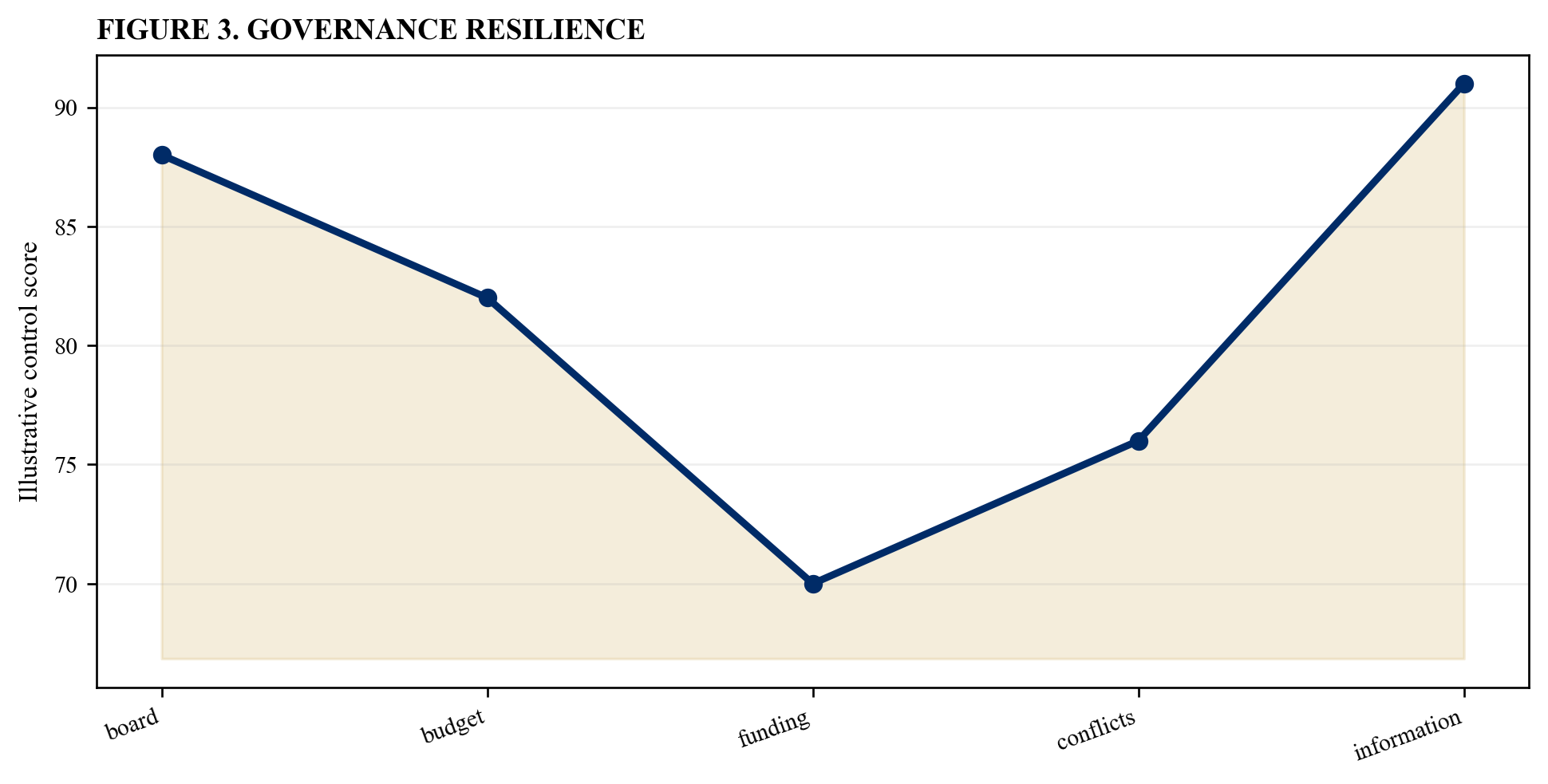
Illustrative analytical scenario; transaction evidence should replace model values.
25. Set exclusivity and non-compete boundaries
The market-entry sponsor, proposed partners and advisers should limit product, customer, territory, duration, exceptions, performance conditions and competition-law exposure. The controlled deliverable is a proportionate exclusivity schedule. Record the evidence source, accountable contributor, verification method, commercial assumption, approval owner, unresolved dependency, decision date and refresh trigger [7][35].
Translate every relationship or capability claim into a measurable contribution and a testable obligation. Reconcile corporate records, licences, contracts, customer evidence, financial information, delivery references, ownership, policies and independent sources.
The principal execution risk is that broad restrictions can trap the entrant without producing reciprocal performance. Measure the effect on access, time to revenue, delivery capacity, capital, control, compliance, cash conversion, reputation, strategic flexibility, exit value and the economics borne by each shareholder.
Convert the conclusion into the partner score, valuation, term sheet, shareholders' agreement, operating agreements, conditions precedent, governance calendar, performance dashboard, escalation rights and exit plan. Retain a dated evidence trail and obtain specialist advice for the relevant activity, entity and agreements.
26. Control conflicts and related-party dealings
The market-entry sponsor, proposed partners and advisers should identify competing businesses, referrals, procurement, service agreements, financing, family interests and approval procedures. The controlled deliverable is a conflicts register. Record the evidence source, accountable contributor, verification method, commercial assumption, approval owner, unresolved dependency, decision date and refresh trigger [26][36].
Translate every relationship or capability claim into a measurable contribution and a testable obligation. Reconcile corporate records, licences, contracts, customer evidence, financial information, delivery references, ownership, policies and independent sources.
The principal execution risk is that the partner can extract value through affiliates while reported venture economics deteriorate. Measure the effect on access, time to revenue, delivery capacity, capital, control, compliance, cash conversion, reputation, strategic flexibility, exit value and the economics borne by each shareholder.
Convert the conclusion into the partner score, valuation, term sheet, shareholders' agreement, operating agreements, conditions precedent, governance calendar, performance dashboard, escalation rights and exit plan. Retain a dated evidence trail and obtain specialist advice for the relevant activity, entity and agreements.
27. Establish compliance and integrity controls
The market-entry sponsor, proposed partners and advisers should align anti-bribery, AML, sanctions, procurement, gifts, agents, whistleblowing, investigations and reporting across both parents. The controlled deliverable is a joint compliance framework. Record the evidence source, accountable contributor, verification method, commercial assumption, approval owner, unresolved dependency, decision date and refresh trigger [8][37].
Translate every relationship or capability claim into a measurable contribution and a testable obligation. Reconcile corporate records, licences, contracts, customer evidence, financial information, delivery references, ownership, policies and independent sources.
The principal execution risk is that the venture can inherit the weaker parent's standards at the point of customer and government interaction. Measure the effect on access, time to revenue, delivery capacity, capital, control, compliance, cash conversion, reputation, strategic flexibility, exit value and the economics borne by each shareholder.
Convert the conclusion into the partner score, valuation, term sheet, shareholders' agreement, operating agreements, conditions precedent, governance calendar, performance dashboard, escalation rights and exit plan. Retain a dated evidence trail and obtain specialist advice for the relevant activity, entity and agreements.
28. Secure information, accounting and audit rights
The market-entry sponsor, proposed partners and advisers should define accounting standards, systems, bank access, management information, audit, inspection, retention and regulator access. The controlled deliverable is an information-rights protocol. Record the evidence source, accountable contributor, verification method, commercial assumption, approval owner, unresolved dependency, decision date and refresh trigger [18][38].
Translate every relationship or capability claim into a measurable contribution and a testable obligation. Reconcile corporate records, licences, contracts, customer evidence, financial information, delivery references, ownership, policies and independent sources.
The principal execution risk is that a minority or non-operating shareholder can carry risk without timely evidence. Measure the effect on access, time to revenue, delivery capacity, capital, control, compliance, cash conversion, reputation, strategic flexibility, exit value and the economics borne by each shareholder.
Convert the conclusion into the partner score, valuation, term sheet, shareholders' agreement, operating agreements, conditions precedent, governance calendar, performance dashboard, escalation rights and exit plan. Retain a dated evidence trail and obtain specialist advice for the relevant activity, entity and agreements.
29. Translate strategy into performance commitments
The market-entry sponsor, proposed partners and advisers should set revenue, margin, customer, delivery, cash, quality, safety, innovation, local-content and capability-transfer measures. The controlled deliverable is a balanced performance scorecard. Record the evidence source, accountable contributor, verification method, commercial assumption, approval owner, unresolved dependency, decision date and refresh trigger [13][29].
Translate every relationship or capability claim into a measurable contribution and a testable obligation. Reconcile corporate records, licences, contracts, customer evidence, financial information, delivery references, ownership, policies and independent sources.
The principal execution risk is that relationship activity can be celebrated while the venture fails to create economic value. Measure the effect on access, time to revenue, delivery capacity, capital, control, compliance, cash conversion, reputation, strategic flexibility, exit value and the economics borne by each shareholder.
Convert the conclusion into the partner score, valuation, term sheet, shareholders' agreement, operating agreements, conditions precedent, governance calendar, performance dashboard, escalation rights and exit plan. Retain a dated evidence trail and obtain specialist advice for the relevant activity, entity and agreements.
30. Design the deadlock ladder
The market-entry sponsor, proposed partners and advisers should sequence management resolution, board escalation, senior negotiation, mediation, expert determination and final remedies. The controlled deliverable is a timed deadlock protocol. Record the evidence source, accountable contributor, verification method, commercial assumption, approval owner, unresolved dependency, decision date and refresh trigger [39][40].
Translate every relationship or capability claim into a measurable contribution and a testable obligation. Reconcile corporate records, licences, contracts, customer evidence, financial information, delivery references, ownership, policies and independent sources.
The principal execution risk is that an immediate shotgun mechanism can reward the party with greater liquidity rather than solve the operating issue. Measure the effect on access, time to revenue, delivery capacity, capital, control, compliance, cash conversion, reputation, strategic flexibility, exit value and the economics borne by each shareholder.
Convert the conclusion into the partner score, valuation, term sheet, shareholders' agreement, operating agreements, conditions precedent, governance calendar, performance dashboard, escalation rights and exit plan. Retain a dated evidence trail and obtain specialist advice for the relevant activity, entity and agreements.
31. Control transfers and changes of control
The market-entry sponsor, proposed partners and advisers should define lock-ups, pre-emption, permitted transfers, tag, drag, competitor restrictions, controller approvals and indirect transfers. The controlled deliverable is a transfer-rights schedule. Record the evidence source, accountable contributor, verification method, commercial assumption, approval owner, unresolved dependency, decision date and refresh trigger [1][6].
Translate every relationship or capability claim into a measurable contribution and a testable obligation. Reconcile corporate records, licences, contracts, customer evidence, financial information, delivery references, ownership, policies and independent sources.
The principal execution risk is that economic control can change through an upstream transaction outside the nominal transfer clause. Measure the effect on access, time to revenue, delivery capacity, capital, control, compliance, cash conversion, reputation, strategic flexibility, exit value and the economics borne by each shareholder.
Convert the conclusion into the partner score, valuation, term sheet, shareholders' agreement, operating agreements, conditions precedent, governance calendar, performance dashboard, escalation rights and exit plan. Retain a dated evidence trail and obtain specialist advice for the relevant activity, entity and agreements.
32. Set the exit valuation method
The market-entry sponsor, proposed partners and advisers should define enterprise-to-equity bridge, normalisation, debt, working capital, discounts, synergies, valuer appointment and dispute scope. The controlled deliverable is an exit valuation protocol. Record the evidence source, accountable contributor, verification method, commercial assumption, approval owner, unresolved dependency, decision date and refresh trigger [20][41].
Translate every relationship or capability claim into a measurable contribution and a testable obligation. Reconcile corporate records, licences, contracts, customer evidence, financial information, delivery references, ownership, policies and independent sources.
The principal execution risk is that an undefined fair-value standard can produce years of dispute when the relationship has already failed. Measure the effect on access, time to revenue, delivery capacity, capital, control, compliance, cash conversion, reputation, strategic flexibility, exit value and the economics borne by each shareholder.
Convert the conclusion into the partner score, valuation, term sheet, shareholders' agreement, operating agreements, conditions precedent, governance calendar, performance dashboard, escalation rights and exit plan. Retain a dated evidence trail and obtain specialist advice for the relevant activity, entity and agreements.
Table 4. Illustrative downside economics
| Scenario | Value index | Delay months | Exit friction |
|---|---|---|---|
| full delivery | 118 | 0 | 8 |
| access under-delivery | 87 | 4 | 31 |
| funding default | 62 | 9 | 58 |
| deadlock | 34 | 18 | 89 |
Statutory periods are stated where labelled; other entries are analytical controls.
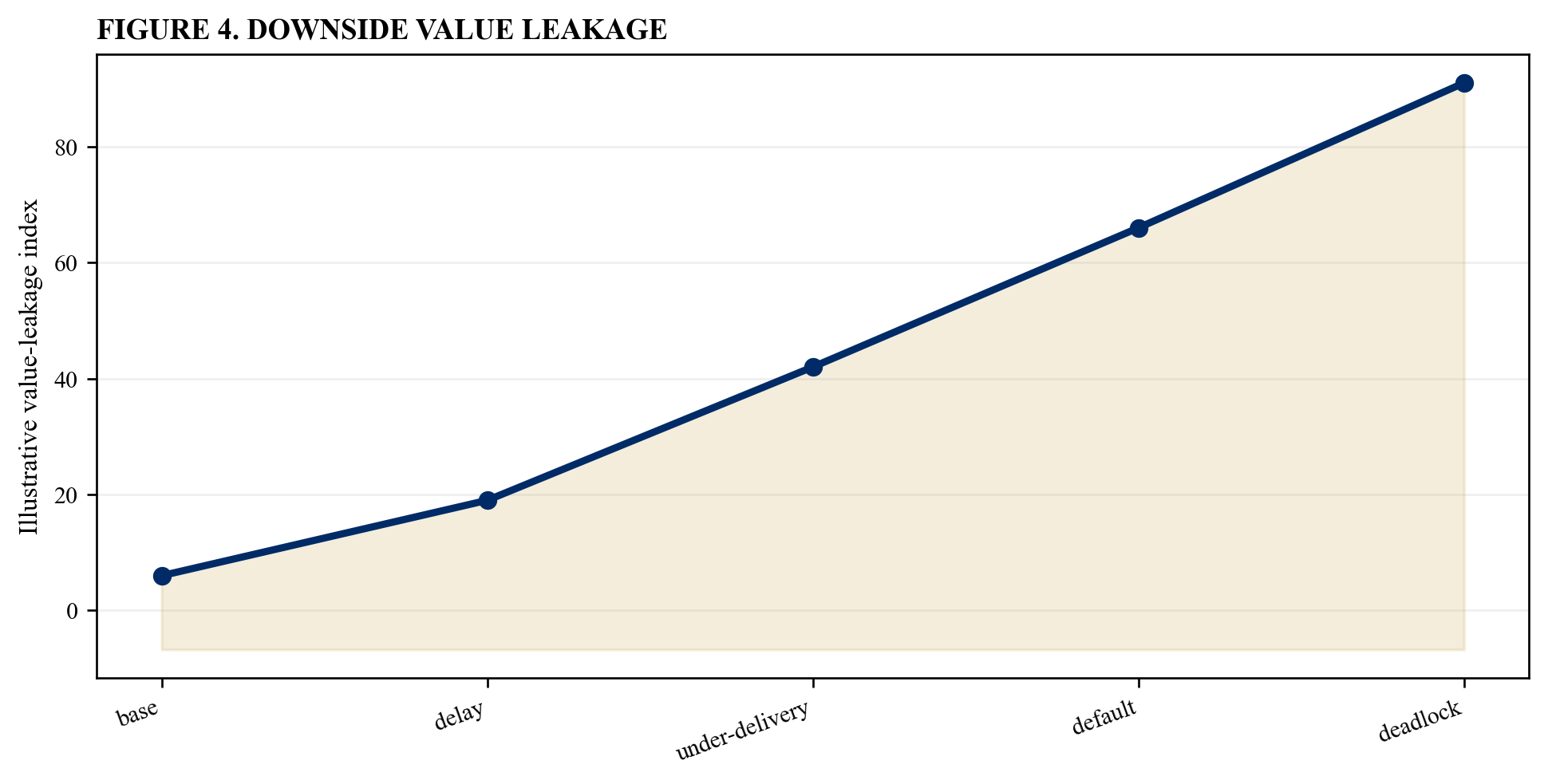
Illustrative analytical scenario; transaction evidence should replace model values.
33. Define put, call and default triggers
The market-entry sponsor, proposed partners and advisers should link material breach, non-funding, insolvency, sanctions, change of control, KPI failure and regulatory loss to proportionate rights. The controlled deliverable is a trigger-and-remedy matrix. Record the evidence source, accountable contributor, verification method, commercial assumption, approval owner, unresolved dependency, decision date and refresh trigger [30][42].
Translate every relationship or capability claim into a measurable contribution and a testable obligation. Reconcile corporate records, licences, contracts, customer evidence, financial information, delivery references, ownership, policies and independent sources.
The principal execution risk is that punitive or ambiguous options can be unenforceable, unfundable or strategically unusable. Measure the effect on access, time to revenue, delivery capacity, capital, control, compliance, cash conversion, reputation, strategic flexibility, exit value and the economics borne by each shareholder.
Convert the conclusion into the partner score, valuation, term sheet, shareholders' agreement, operating agreements, conditions precedent, governance calendar, performance dashboard, escalation rights and exit plan. Retain a dated evidence trail and obtain specialist advice for the relevant activity, entity and agreements.
34. Plan termination and wind-down
The market-entry sponsor, proposed partners and advisers should allocate customers, employees, assets, data, IP, contracts, liabilities, licences, cash and continuing obligations. The controlled deliverable is a separation blueprint. Record the evidence source, accountable contributor, verification method, commercial assumption, approval owner, unresolved dependency, decision date and refresh trigger [31][43].
Translate every relationship or capability claim into a measurable contribution and a testable obligation. Reconcile corporate records, licences, contracts, customer evidence, financial information, delivery references, ownership, policies and independent sources.
The principal execution risk is that termination can destroy more value than the underlying dispute because continuity was never designed. Measure the effect on access, time to revenue, delivery capacity, capital, control, compliance, cash conversion, reputation, strategic flexibility, exit value and the economics borne by each shareholder.
Convert the conclusion into the partner score, valuation, term sheet, shareholders' agreement, operating agreements, conditions precedent, governance calendar, performance dashboard, escalation rights and exit plan. Retain a dated evidence trail and obtain specialist advice for the relevant activity, entity and agreements.
35. Choose governing law and dispute resolution
The market-entry sponsor, proposed partners and advisers should specify law, courts or arbitration, seat, institution, language, interim relief, experts, confidentiality and enforcement. The controlled deliverable is a dispute-resolution architecture. Record the evidence source, accountable contributor, verification method, commercial assumption, approval owner, unresolved dependency, decision date and refresh trigger [39][44].
Translate every relationship or capability claim into a measurable contribution and a testable obligation. Reconcile corporate records, licences, contracts, customer evidence, financial information, delivery references, ownership, policies and independent sources.
The principal execution risk is that mixed documents can send related disputes to inconsistent forums and remedies. Measure the effect on access, time to revenue, delivery capacity, capital, control, compliance, cash conversion, reputation, strategic flexibility, exit value and the economics borne by each shareholder.
Convert the conclusion into the partner score, valuation, term sheet, shareholders' agreement, operating agreements, conditions precedent, governance calendar, performance dashboard, escalation rights and exit plan. Retain a dated evidence trail and obtain specialist advice for the relevant activity, entity and agreements.
36. Model tax and free-zone consequences
The market-entry sponsor, proposed partners and advisers should test juridical status, partnership transparency, qualifying income, transfer pricing, withholding, VAT, customs and permanent establishment. The controlled deliverable is a tax-and-structure model. Record the evidence source, accountable contributor, verification method, commercial assumption, approval owner, unresolved dependency, decision date and refresh trigger [24][45].
Translate every relationship or capability claim into a measurable contribution and a testable obligation. Reconcile corporate records, licences, contracts, customer evidence, financial information, delivery references, ownership, policies and independent sources.
The principal execution risk is that commercial allocations can produce unexpected taxable income or fail arm's-length requirements. Measure the effect on access, time to revenue, delivery capacity, capital, control, compliance, cash conversion, reputation, strategic flexibility, exit value and the economics borne by each shareholder.
Convert the conclusion into the partner score, valuation, term sheet, shareholders' agreement, operating agreements, conditions precedent, governance calendar, performance dashboard, escalation rights and exit plan. Retain a dated evidence trail and obtain specialist advice for the relevant activity, entity and agreements.
37. Quantify venture and downside economics
The market-entry sponsor, proposed partners and advisers should model base, under-delivery, non-funding, delay, conflict, deadlock, buyout and wind-down with probabilities and cash effects. The controlled deliverable is a probability-weighted venture model. Record the evidence source, accountable contributor, verification method, commercial assumption, approval owner, unresolved dependency, decision date and refresh trigger [21][29].
Translate every relationship or capability claim into a measurable contribution and a testable obligation. Reconcile corporate records, licences, contracts, customer evidence, financial information, delivery references, ownership, policies and independent sources.
The principal execution risk is that upside can be modelled precisely while dependence and exit costs remain unpriced. Measure the effect on access, time to revenue, delivery capacity, capital, control, compliance, cash conversion, reputation, strategic flexibility, exit value and the economics borne by each shareholder.
Convert the conclusion into the partner score, valuation, term sheet, shareholders' agreement, operating agreements, conditions precedent, governance calendar, performance dashboard, escalation rights and exit plan. Retain a dated evidence trail and obtain specialist advice for the relevant activity, entity and agreements.
38. Negotiate from evidence and alternatives
The market-entry sponsor, proposed partners and advisers should rank non-negotiables, tradable rights, objective standards, fallback structures and walk-away conditions for both parties. The controlled deliverable is a negotiation mandate. Record the evidence source, accountable contributor, verification method, commercial assumption, approval owner, unresolved dependency, decision date and refresh trigger [22][28].
Translate every relationship or capability claim into a measurable contribution and a testable obligation. Reconcile corporate records, licences, contracts, customer evidence, financial information, delivery references, ownership, policies and independent sources.
The principal execution risk is that deal momentum can convert unverified partner claims into permanent rights. Measure the effect on access, time to revenue, delivery capacity, capital, control, compliance, cash conversion, reputation, strategic flexibility, exit value and the economics borne by each shareholder.
Convert the conclusion into the partner score, valuation, term sheet, shareholders' agreement, operating agreements, conditions precedent, governance calendar, performance dashboard, escalation rights and exit plan. Retain a dated evidence trail and obtain specialist advice for the relevant activity, entity and agreements.
39. Control formation and closing
The market-entry sponsor, proposed partners and advisers should align definitive agreements, approvals, licences, contributions, accounts, people, contracts, insurance, policies and launch gates. The controlled deliverable is a joint-venture closing checklist. Record the evidence source, accountable contributor, verification method, commercial assumption, approval owner, unresolved dependency, decision date and refresh trigger [1][5].
Translate every relationship or capability claim into a measurable contribution and a testable obligation. Reconcile corporate records, licences, contracts, customer evidence, financial information, delivery references, ownership, policies and independent sources.
The principal execution risk is that the entity can launch before committed access, assets, funding and controls are legally effective. Measure the effect on access, time to revenue, delivery capacity, capital, control, compliance, cash conversion, reputation, strategic flexibility, exit value and the economics borne by each shareholder.
Convert the conclusion into the partner score, valuation, term sheet, shareholders' agreement, operating agreements, conditions precedent, governance calendar, performance dashboard, escalation rights and exit plan. Retain a dated evidence trail and obtain specialist advice for the relevant activity, entity and agreements.
40. Issue the partner-and-venture certificate
The market-entry sponsor, proposed partners and advisers should reconcile selection evidence, contributions, approvals, economics, governance, funding, controls, performance, deadlock and exit. The controlled deliverable is an auditable formation certificate. Record the evidence source, accountable contributor, verification method, commercial assumption, approval owner, unresolved dependency, decision date and refresh trigger [26][38].
Translate every relationship or capability claim into a measurable contribution and a testable obligation. Reconcile corporate records, licences, contracts, customer evidence, financial information, delivery references, ownership, policies and independent sources.
The principal execution risk is that boards can approve a relationship narrative without one accountable record of what each party must deliver. Measure the effect on access, time to revenue, delivery capacity, capital, control, compliance, cash conversion, reputation, strategic flexibility, exit value and the economics borne by each shareholder.
Convert the conclusion into the partner score, valuation, term sheet, shareholders' agreement, operating agreements, conditions precedent, governance calendar, performance dashboard, escalation rights and exit plan. Retain a dated evidence trail and obtain specialist advice for the relevant activity, entity and agreements.
Table 5. Partner-and-venture certificate
| Domain | Evidence | Decision owner |
|---|---|---|
| selection | score and references | sponsor board |
| contribution | valued commitments | deal committee |
| governance | rights and controls | shareholders |
| downside | deadlock and exit | legal and finance |
Statutory periods are stated where labelled; other entries are analytical controls.
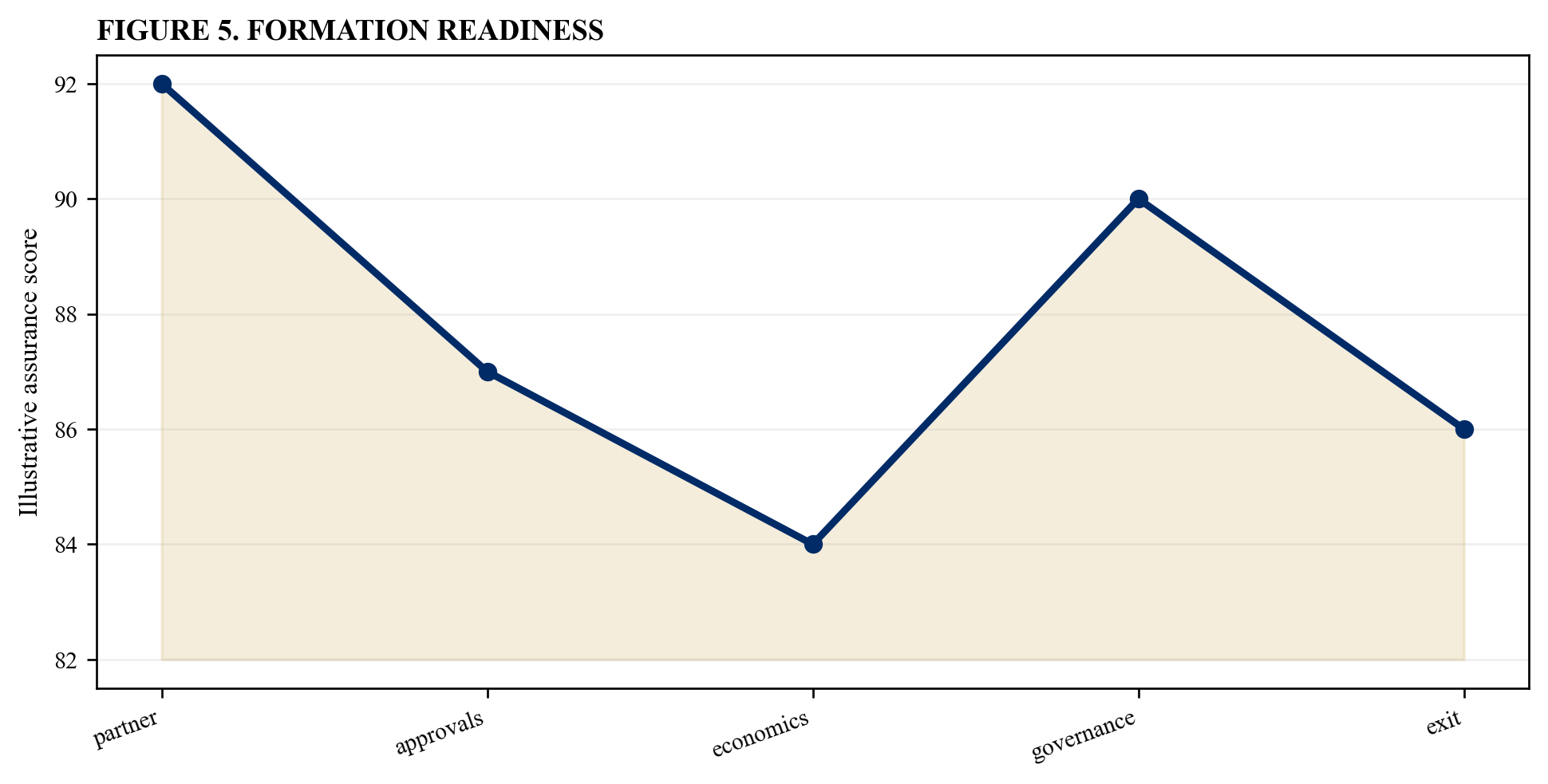
Illustrative analytical scenario; transaction evidence should replace model values.
References
- UAE Legislation, Federal Decree-Law No. 32 of 2021 on Commercial Companies, https://www.uaelegislation.gov.ae/en/legislations/1542/download
- World Bank Group, Joint Ventures and Strategic Alliances, https://www.ifc.org/en/what-we-do/products-and-services
- UAE Ministry of Economy and Tourism, Investment and Business Establishment, https://www.moet.gov.ae/en/investment
- UAE Ministry of Economy and Tourism, Promising Sectors, https://www.moet.gov.ae/en/promising-sectors
- UAE Government, Bashr Business Establishment Service, https://u.ae/en/information-and-services/business/starting-a-business-in-the-uae
- UAE Ministry of Economy and Tourism, Strategic Impact Activities, https://www.moet.gov.ae/en/promising-sectors
- UAE Legislation, Federal Decree-Law No. 36 of 2023 Regulating Competition, https://uaelegislation.gov.ae/en/legislations/2161
- OECD, Guidelines for Multinational Enterprises on Responsible Business Conduct, https://mneguidelines.oecd.org/
- UAE Legislation, Federal Decree-Law No. 10 of 2025 Regarding AML, CFT and Proliferation Financing, https://www.moet.gov.ae/en/financial-crimes-legislations
- UAE Executive Office for Control and Non-Proliferation, Targeted Financial Sanctions, https://www.uaeiec.gov.ae/en-us/our-work/targeted-financial-sanctions/
- ISO, ISO 9001 Quality Management Systems, https://www.iso.org/iso-9001-quality-management.html
- ISO, ISO 31000 Risk Management, https://www.iso.org/iso-31000-risk-management.html
- ICC, Model Commercial Agency Contract, https://iccwbo.org/business-solutions/model-contracts-clauses/
- World Bank, Benchmarking Infrastructure Development, https://bpp.worldbank.org/
- OECD, Recommendation on Public Integrity, https://www.oecd.org/gov/ethics/recommendation-public-integrity/
- UAE Ministry of Industry and Advanced Technology, National In-Country Value Program, https://moiat.gov.ae/en/programs/icv
- International Federation of Consulting Engineers, Contracts and Guidance, https://fidic.org/books
- IFRS Foundation, IFRS Accounting Standards, https://www.ifrs.org/issued-standards/list-of-standards/
- OECD, Principles of Corporate Governance 2023, https://www.oecd.org/corporate/principles-corporate-governance/
- IVSC, International Valuation Standards, https://www.ivsc.org/standards/
- CFA Institute, Investment Foundations and Valuation Principles, https://www.cfainstitute.org/en/programs/investment-foundations
- OECD, Due Diligence Guidance for Responsible Business Conduct, https://mneguidelines.oecd.org/due-diligence-guidance-for-responsible-business-conduct.htm
- ISO, ISO 56002 Innovation Management Systems, https://www.iso.org/standard/68221.html
- UAE Federal Tax Authority, Taxation of Partnerships Guide, https://tax.gov.ae/Datafolder/Files/Guides/CT/CT%20Guide%20-%20Partnerships%20-%2004%2003%202024%20-%20for%20publishing.pdf
- IASB, IFRS 11 Joint Arrangements, https://www.ifrs.org/issued-standards/list-of-standards/ifrs-11-joint-arrangements/
- OECD, G20/OECD Principles of Corporate Governance, https://www.oecd.org/corporate/principles-corporate-governance/
- UAE Legislation, Commercial Companies Law Governance Provisions, https://uaelegislation.gov.ae/en/legislations/1542
- ICC, Shareholders Agreements and Model Clauses, https://iccwbo.org/business-solutions/model-contracts-clauses/
- Project Management Institute, The Standard for Project Management, https://www.pmi.org/pmbok-guide-standards
- UNCITRAL, Legislative Guide on Insolvency Law, https://uncitral.un.org/en/texts/insolvency/legislativeguides/insolvency_law
- WIPO, Joint Research and Collaboration Agreements, https://www.wipo.int/technology-transfer/en/agreements.html
- UAE Legislation, Federal Decree-Law No. 45 of 2021 Regarding Personal Data Protection, https://uaelegislation.gov.ae/en/legislations/1972
- UAE Government, Employment Laws and Regulations, https://u.ae/en/information-and-services/jobs/employment-in-the-private-sector
- UAE Government, Work Permits and Visas, https://u.ae/en/information-and-services/visa-and-emirates-id
- OECD, Competition Assessment Toolkit, https://www.oecd.org/competition/assessment-toolkit.htm
- IASB, IAS 24 Related Party Disclosures, https://www.ifrs.org/issued-standards/list-of-standards/ias-24-related-party-disclosures/
- ISO, ISO 37001 Anti-Bribery Management Systems, https://www.iso.org/iso-37001-anti-bribery-management.html
- IASB, IFRS 12 Disclosure of Interests in Other Entities, https://www.ifrs.org/issued-standards/list-of-standards/ifrs-12-disclosure-of-interests-in-other-entities/
- UAE Legislation, Federal Law No. 6 of 2018 on Arbitration, https://uaelegislation.gov.ae/en/legislations/1069
- arbitrateAD, Arbitration Rules, https://www.arbitratead.ae/files/arbitration-rules.pdf
- IVSC, Business and Business Interests Valuation, https://www.ivsc.org/standards/
- UNIDROIT, Principles of International Commercial Contracts 2016, https://www.unidroit.org/instruments/commercial-contracts/unidroit-principles-2016/
- WIPO, IP Issues in Joint Ventures, https://www.wipo.int/sme/en/
- New York Convention, Contracting States and Enforcement, https://www.newyorkconvention.org/
- UAE Federal Tax Authority, Corporate Tax Guides and References, https://tax.gov.ae/en/taxes/corporate.tax/corporate.tax.guides.references.aspx
