

1. Define the essential service and resilience objective
The project team should specify the public service, users, minimum continuity standard, recovery time and acceptable residual risk. The required output is a service-resilience charter. Record the accountable party, evidence, assumption, contractual right, cash-flow consequence, approval and review date [1][2].
Test the proposed treatment against current hazard evidence, engineering tolerances, service criticality, asset condition, interdependencies, insurance terms, affordability, lender requirements, fiscal capacity and applicable law. Preserve the source, scenario, date, uncertainty range and reason for every material judgement.
The principal risk is that asset protection can be optimised without preserving the service that communities actually need. Quantify effects on service availability, recovery time, lifecycle cost, demand, revenue, insurance proceeds, debt-service coverage, equity returns, contingent public liabilities and user welfare. Compare the chosen response with credible prevention, transfer, sharing, reserve and public-support alternatives.
Translate the conclusion into design requirements, performance standards, payment terms, insurance obligations, adaptation triggers, financing assumptions, monitoring, relief, dispute and termination provisions. Refresh it when hazard evidence, asset performance, standards, insurance markets, technology or public-service needs change.
2. Create the climate evidence baseline
The project team should assemble observed hazards, downscaled projections, exposure data, asset condition, interdependencies and uncertainty ranges. The required output is an evidence-dated climate baseline. Record the accountable party, evidence, assumption, contractual right, cash-flow consequence, approval and review date [3][4].
Test the proposed treatment against current hazard evidence, engineering tolerances, service criticality, asset condition, interdependencies, insurance terms, affordability, lender requirements, fiscal capacity and applicable law. Preserve the source, scenario, date, uncertainty range and reason for every material judgement.
The principal risk is that historical averages can understate changing and compound physical risks. Quantify effects on service availability, recovery time, lifecycle cost, demand, revenue, insurance proceeds, debt-service coverage, equity returns, contingent public liabilities and user welfare. Compare the chosen response with credible prevention, transfer, sharing, reserve and public-support alternatives.
Translate the conclusion into design requirements, performance standards, payment terms, insurance obligations, adaptation triggers, financing assumptions, monitoring, relief, dispute and termination provisions. Refresh it when hazard evidence, asset performance, standards, insurance markets, technology or public-service needs change.
3. Separate chronic stress from acute shock
The project team should distinguish heat, aridity, sea-level rise and gradual degradation from flood, storm, wildfire and abrupt failure. The required output is a hazard-classification register. Record the accountable party, evidence, assumption, contractual right, cash-flow consequence, approval and review date [5][6].
Test the proposed treatment against current hazard evidence, engineering tolerances, service criticality, asset condition, interdependencies, insurance terms, affordability, lender requirements, fiscal capacity and applicable law. Preserve the source, scenario, date, uncertainty range and reason for every material judgement.
The principal risk is that one broad natural-disaster label can produce ambiguous design and relief obligations. Quantify effects on service availability, recovery time, lifecycle cost, demand, revenue, insurance proceeds, debt-service coverage, equity returns, contingent public liabilities and user welfare. Compare the chosen response with credible prevention, transfer, sharing, reserve and public-support alternatives.
Translate the conclusion into design requirements, performance standards, payment terms, insurance obligations, adaptation triggers, financing assumptions, monitoring, relief, dispute and termination provisions. Refresh it when hazard evidence, asset performance, standards, insurance markets, technology or public-service needs change.
4. Map hazard, vulnerability and consequence
The project team should connect each hazard to asset components, failure modes, service interruption, safety, environment and cash flow. The required output is a hazard-to-consequence map. Record the accountable party, evidence, assumption, contractual right, cash-flow consequence, approval and review date [7][8].
Test the proposed treatment against current hazard evidence, engineering tolerances, service criticality, asset condition, interdependencies, insurance terms, affordability, lender requirements, fiscal capacity and applicable law. Preserve the source, scenario, date, uncertainty range and reason for every material judgement.
The principal risk is that high hazard does not always imply high loss, while small exposures can disable critical interfaces. Quantify effects on service availability, recovery time, lifecycle cost, demand, revenue, insurance proceeds, debt-service coverage, equity returns, contingent public liabilities and user welfare. Compare the chosen response with credible prevention, transfer, sharing, reserve and public-support alternatives.
Translate the conclusion into design requirements, performance standards, payment terms, insurance obligations, adaptation triggers, financing assumptions, monitoring, relief, dispute and termination provisions. Refresh it when hazard evidence, asset performance, standards, insurance markets, technology or public-service needs change.
5. Test critical interdependencies
The project team should identify dependence on grid, water, telecoms, transport, suppliers, emergency services and public access. The required output is an infrastructure dependency map. Record the accountable party, evidence, assumption, contractual right, cash-flow consequence, approval and review date [9][10].
Test the proposed treatment against current hazard evidence, engineering tolerances, service criticality, asset condition, interdependencies, insurance terms, affordability, lender requirements, fiscal capacity and applicable law. Preserve the source, scenario, date, uncertainty range and reason for every material judgement.
The principal risk is that the contracted asset can remain intact while an external network prevents service delivery. Quantify effects on service availability, recovery time, lifecycle cost, demand, revenue, insurance proceeds, debt-service coverage, equity returns, contingent public liabilities and user welfare. Compare the chosen response with credible prevention, transfer, sharing, reserve and public-support alternatives.
Translate the conclusion into design requirements, performance standards, payment terms, insurance obligations, adaptation triggers, financing assumptions, monitoring, relief, dispute and termination provisions. Refresh it when hazard evidence, asset performance, standards, insurance markets, technology or public-service needs change.
6. Set a transparent design basis
The project team should translate climate evidence into return periods, temperature ranges, rainfall intensity, wind, drought and freeboard criteria. The required output is a climate-adjusted design basis. Record the accountable party, evidence, assumption, contractual right, cash-flow consequence, approval and review date [11][12].
Test the proposed treatment against current hazard evidence, engineering tolerances, service criticality, asset condition, interdependencies, insurance terms, affordability, lender requirements, fiscal capacity and applicable law. Preserve the source, scenario, date, uncertainty range and reason for every material judgement.
The principal risk is that design standards can lag the conditions expected over the contract life. Quantify effects on service availability, recovery time, lifecycle cost, demand, revenue, insurance proceeds, debt-service coverage, equity returns, contingent public liabilities and user welfare. Compare the chosen response with credible prevention, transfer, sharing, reserve and public-support alternatives.
Translate the conclusion into design requirements, performance standards, payment terms, insurance obligations, adaptation triggers, financing assumptions, monitoring, relief, dispute and termination provisions. Refresh it when hazard evidence, asset performance, standards, insurance markets, technology or public-service needs change.
7. Allocate foreseeable physical risk
The project team should assign ordinary and design-basis events to the party controlling design, construction, maintenance and operations. The required output is a foreseeable-risk allocation. Record the accountable party, evidence, assumption, contractual right, cash-flow consequence, approval and review date [13][14].
Test the proposed treatment against current hazard evidence, engineering tolerances, service criticality, asset condition, interdependencies, insurance terms, affordability, lender requirements, fiscal capacity and applicable law. Preserve the source, scenario, date, uncertainty range and reason for every material judgement.
The principal risk is that routine climate exposure can be shifted into force majeure and weaken resilience incentives. Quantify effects on service availability, recovery time, lifecycle cost, demand, revenue, insurance proceeds, debt-service coverage, equity returns, contingent public liabilities and user welfare. Compare the chosen response with credible prevention, transfer, sharing, reserve and public-support alternatives.
Translate the conclusion into design requirements, performance standards, payment terms, insurance obligations, adaptation triggers, financing assumptions, monitoring, relief, dispute and termination provisions. Refresh it when hazard evidence, asset performance, standards, insurance markets, technology or public-service needs change.
8. Define exceptional-event thresholds
The project team should set objective severity, geographic, duration and impact tests for events beyond the agreed design basis. The required output is an exceptional-event schedule. Record the accountable party, evidence, assumption, contractual right, cash-flow consequence, approval and review date [15][16].
Test the proposed treatment against current hazard evidence, engineering tolerances, service criticality, asset condition, interdependencies, insurance terms, affordability, lender requirements, fiscal capacity and applicable law. Preserve the source, scenario, date, uncertainty range and reason for every material judgement.
The principal risk is that vague thresholds can turn every severe-weather dispute into a question of contractual interpretation. Quantify effects on service availability, recovery time, lifecycle cost, demand, revenue, insurance proceeds, debt-service coverage, equity returns, contingent public liabilities and user welfare. Compare the chosen response with credible prevention, transfer, sharing, reserve and public-support alternatives.
Translate the conclusion into design requirements, performance standards, payment terms, insurance obligations, adaptation triggers, financing assumptions, monitoring, relief, dispute and termination provisions. Refresh it when hazard evidence, asset performance, standards, insurance markets, technology or public-service needs change.
Table 1. Climate-risk classification
| Risk class | Typical treatment | Primary evidence |
|---|---|---|
| chronic stress | design and maintenance | trend and pathway |
| design-basis event | private performance | return period |
| exceptional event | shared relief | objective threshold |
| systemic change | review mechanism | law and market |
Illustrative analytical structure; verified project and jurisdiction evidence governs.
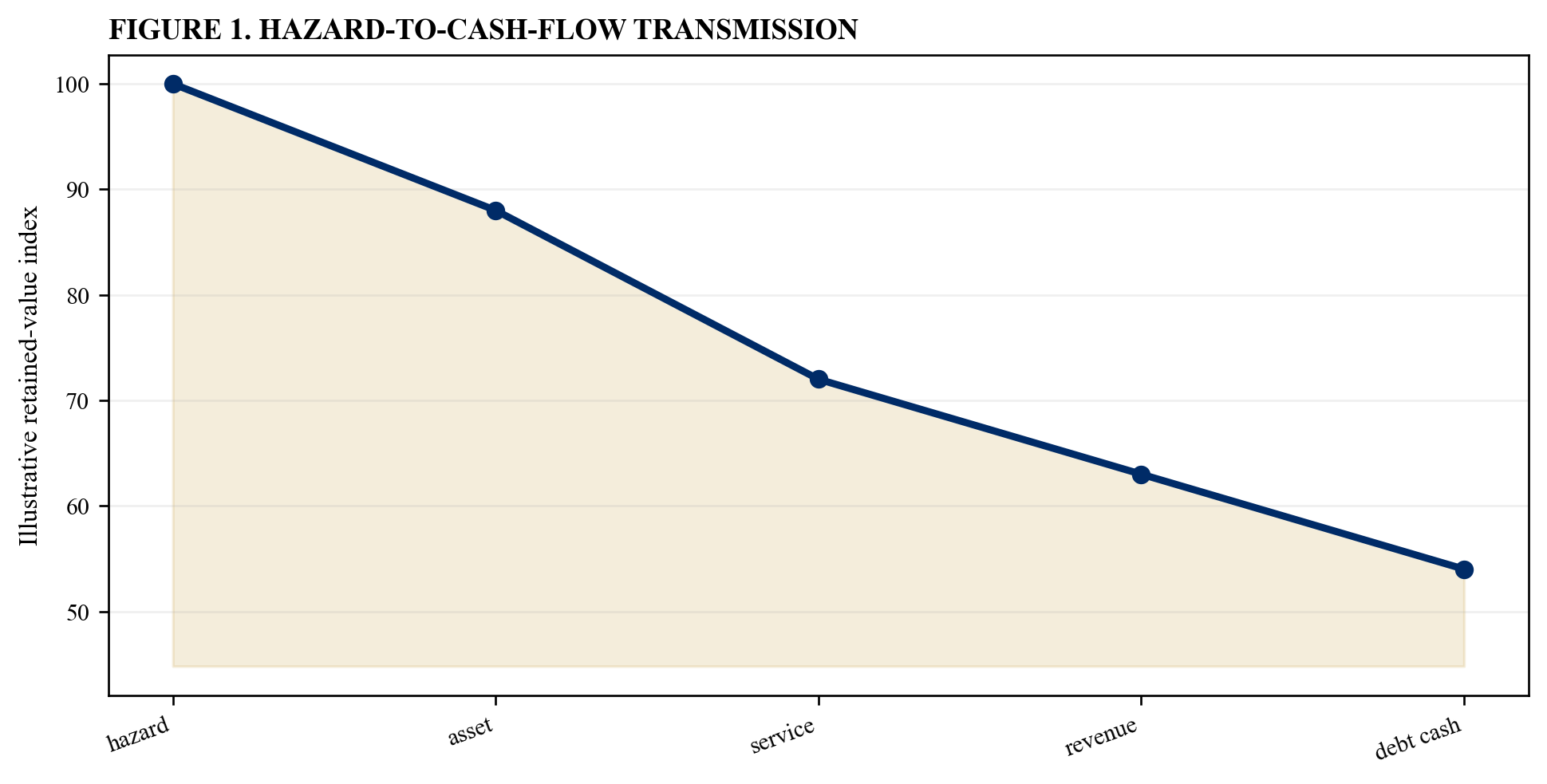
Illustrative analytical scenario; verified project evidence should replace values.
9. Apply the control and absorption tests
The project team should score authority, operator, contractor, insurer and user influence, information, mitigation tools and financial capacity. The required output is a climate-risk control matrix. Record the accountable party, evidence, assumption, contractual right, cash-flow consequence, approval and review date [1][17].
Test the proposed treatment against current hazard evidence, engineering tolerances, service criticality, asset condition, interdependencies, insurance terms, affordability, lender requirements, fiscal capacity and applicable law. Preserve the source, scenario, date, uncertainty range and reason for every material judgement.
The principal risk is that risk can be allocated to a party that neither controls the driver nor survives the downside. Quantify effects on service availability, recovery time, lifecycle cost, demand, revenue, insurance proceeds, debt-service coverage, equity returns, contingent public liabilities and user welfare. Compare the chosen response with credible prevention, transfer, sharing, reserve and public-support alternatives.
Translate the conclusion into design requirements, performance standards, payment terms, insurance obligations, adaptation triggers, financing assumptions, monitoring, relief, dispute and termination provisions. Refresh it when hazard evidence, asset performance, standards, insurance markets, technology or public-service needs change.
10. Embed resilience in procurement
The project team should require comparable hazard assumptions, resilience solutions, lifecycle costs, competence evidence and performance commitments. The required output is a climate-smart bid protocol. Record the accountable party, evidence, assumption, contractual right, cash-flow consequence, approval and review date [18][19].
Test the proposed treatment against current hazard evidence, engineering tolerances, service criticality, asset condition, interdependencies, insurance terms, affordability, lender requirements, fiscal capacity and applicable law. Preserve the source, scenario, date, uncertainty range and reason for every material judgement.
The principal risk is that the lowest nominal bid can externalise future adaptation and recovery costs. Quantify effects on service availability, recovery time, lifecycle cost, demand, revenue, insurance proceeds, debt-service coverage, equity returns, contingent public liabilities and user welfare. Compare the chosen response with credible prevention, transfer, sharing, reserve and public-support alternatives.
Translate the conclusion into design requirements, performance standards, payment terms, insurance obligations, adaptation triggers, financing assumptions, monitoring, relief, dispute and termination provisions. Refresh it when hazard evidence, asset performance, standards, insurance markets, technology or public-service needs change.
11. Evaluate whole-life adaptation value
The project team should compare capital cost, avoided loss, service continuity, maintenance, insurance and residual value across scenarios. The required output is an adaptation value model. Record the accountable party, evidence, assumption, contractual right, cash-flow consequence, approval and review date [20][21].
Test the proposed treatment against current hazard evidence, engineering tolerances, service criticality, asset condition, interdependencies, insurance terms, affordability, lender requirements, fiscal capacity and applicable law. Preserve the source, scenario, date, uncertainty range and reason for every material judgement.
The principal risk is that protective investment can be rejected when procurement sees only upfront cost. Quantify effects on service availability, recovery time, lifecycle cost, demand, revenue, insurance proceeds, debt-service coverage, equity returns, contingent public liabilities and user welfare. Compare the chosen response with credible prevention, transfer, sharing, reserve and public-support alternatives.
Translate the conclusion into design requirements, performance standards, payment terms, insurance obligations, adaptation triggers, financing assumptions, monitoring, relief, dispute and termination provisions. Refresh it when hazard evidence, asset performance, standards, insurance markets, technology or public-service needs change.
12. Use robust decision-making under uncertainty
The project team should test options across plausible climate pathways and favour measures that perform acceptably across futures. The required output is a robustness assessment. Record the accountable party, evidence, assumption, contractual right, cash-flow consequence, approval and review date [22][23].
Test the proposed treatment against current hazard evidence, engineering tolerances, service criticality, asset condition, interdependencies, insurance terms, affordability, lender requirements, fiscal capacity and applicable law. Preserve the source, scenario, date, uncertainty range and reason for every material judgement.
The principal risk is that optimisation around one forecast can create fragile irreversible assets. Quantify effects on service availability, recovery time, lifecycle cost, demand, revenue, insurance proceeds, debt-service coverage, equity returns, contingent public liabilities and user welfare. Compare the chosen response with credible prevention, transfer, sharing, reserve and public-support alternatives.
Translate the conclusion into design requirements, performance standards, payment terms, insurance obligations, adaptation triggers, financing assumptions, monitoring, relief, dispute and termination provisions. Refresh it when hazard evidence, asset performance, standards, insurance markets, technology or public-service needs change.
13. Stage adaptive pathways
The project team should sequence no-regret measures, monitoring triggers, reserved corridors, modular upgrades and future decisions. The required output is an adaptation pathway. Record the accountable party, evidence, assumption, contractual right, cash-flow consequence, approval and review date [24][25].
Test the proposed treatment against current hazard evidence, engineering tolerances, service criticality, asset condition, interdependencies, insurance terms, affordability, lender requirements, fiscal capacity and applicable law. Preserve the source, scenario, date, uncertainty range and reason for every material judgement.
The principal risk is that premature overbuild and delayed intervention can both destroy value. Quantify effects on service availability, recovery time, lifecycle cost, demand, revenue, insurance proceeds, debt-service coverage, equity returns, contingent public liabilities and user welfare. Compare the chosen response with credible prevention, transfer, sharing, reserve and public-support alternatives.
Translate the conclusion into design requirements, performance standards, payment terms, insurance obligations, adaptation triggers, financing assumptions, monitoring, relief, dispute and termination provisions. Refresh it when hazard evidence, asset performance, standards, insurance markets, technology or public-service needs change.
14. Define adaptation change triggers
The project team should link verified thresholds in hazard, asset performance, law, standard or insurance availability to a controlled review. The required output is an adaptation trigger schedule. Record the accountable party, evidence, assumption, contractual right, cash-flow consequence, approval and review date [14][26].
Test the proposed treatment against current hazard evidence, engineering tolerances, service criticality, asset condition, interdependencies, insurance terms, affordability, lender requirements, fiscal capacity and applicable law. Preserve the source, scenario, date, uncertainty range and reason for every material judgement.
The principal risk is that parties can disagree over when changing evidence justifies capital expenditure. Quantify effects on service availability, recovery time, lifecycle cost, demand, revenue, insurance proceeds, debt-service coverage, equity returns, contingent public liabilities and user welfare. Compare the chosen response with credible prevention, transfer, sharing, reserve and public-support alternatives.
Translate the conclusion into design requirements, performance standards, payment terms, insurance obligations, adaptation triggers, financing assumptions, monitoring, relief, dispute and termination provisions. Refresh it when hazard evidence, asset performance, standards, insurance markets, technology or public-service needs change.
15. Govern adaptation proposals
The project team should set initiation rights, evidence requirements, independent review, option appraisal, approval timing and dispute steps. The required output is an adaptation change procedure. Record the accountable party, evidence, assumption, contractual right, cash-flow consequence, approval and review date [15][27].
Test the proposed treatment against current hazard evidence, engineering tolerances, service criticality, asset condition, interdependencies, insurance terms, affordability, lender requirements, fiscal capacity and applicable law. Preserve the source, scenario, date, uncertainty range and reason for every material judgement.
The principal risk is that necessary works can stall between scientific uncertainty and contractual consent. Quantify effects on service availability, recovery time, lifecycle cost, demand, revenue, insurance proceeds, debt-service coverage, equity returns, contingent public liabilities and user welfare. Compare the chosen response with credible prevention, transfer, sharing, reserve and public-support alternatives.
Translate the conclusion into design requirements, performance standards, payment terms, insurance obligations, adaptation triggers, financing assumptions, monitoring, relief, dispute and termination provisions. Refresh it when hazard evidence, asset performance, standards, insurance markets, technology or public-service needs change.
16. Allocate adaptation cost
The project team should distinguish baseline compliance, operator efficiency, authority change, shared systemic change and emergency works. The required output is an adaptation cost waterfall. Record the accountable party, evidence, assumption, contractual right, cash-flow consequence, approval and review date [1][28].
Test the proposed treatment against current hazard evidence, engineering tolerances, service criticality, asset condition, interdependencies, insurance terms, affordability, lender requirements, fiscal capacity and applicable law. Preserve the source, scenario, date, uncertainty range and reason for every material judgement.
The principal risk is that all future resilience expenditure can default to the public balance sheet. Quantify effects on service availability, recovery time, lifecycle cost, demand, revenue, insurance proceeds, debt-service coverage, equity returns, contingent public liabilities and user welfare. Compare the chosen response with credible prevention, transfer, sharing, reserve and public-support alternatives.
Translate the conclusion into design requirements, performance standards, payment terms, insurance obligations, adaptation triggers, financing assumptions, monitoring, relief, dispute and termination provisions. Refresh it when hazard evidence, asset performance, standards, insurance markets, technology or public-service needs change.
Table 2. Adaptation cost allocation
| Cause | Indicative bearer | Control |
|---|---|---|
| baseline compliance | private | output specification |
| operator efficiency | private | business case |
| authority change | public | change procedure |
| systemic evidence shift | shared | trigger and review |
Illustrative analytical structure; verified project and jurisdiction evidence governs.
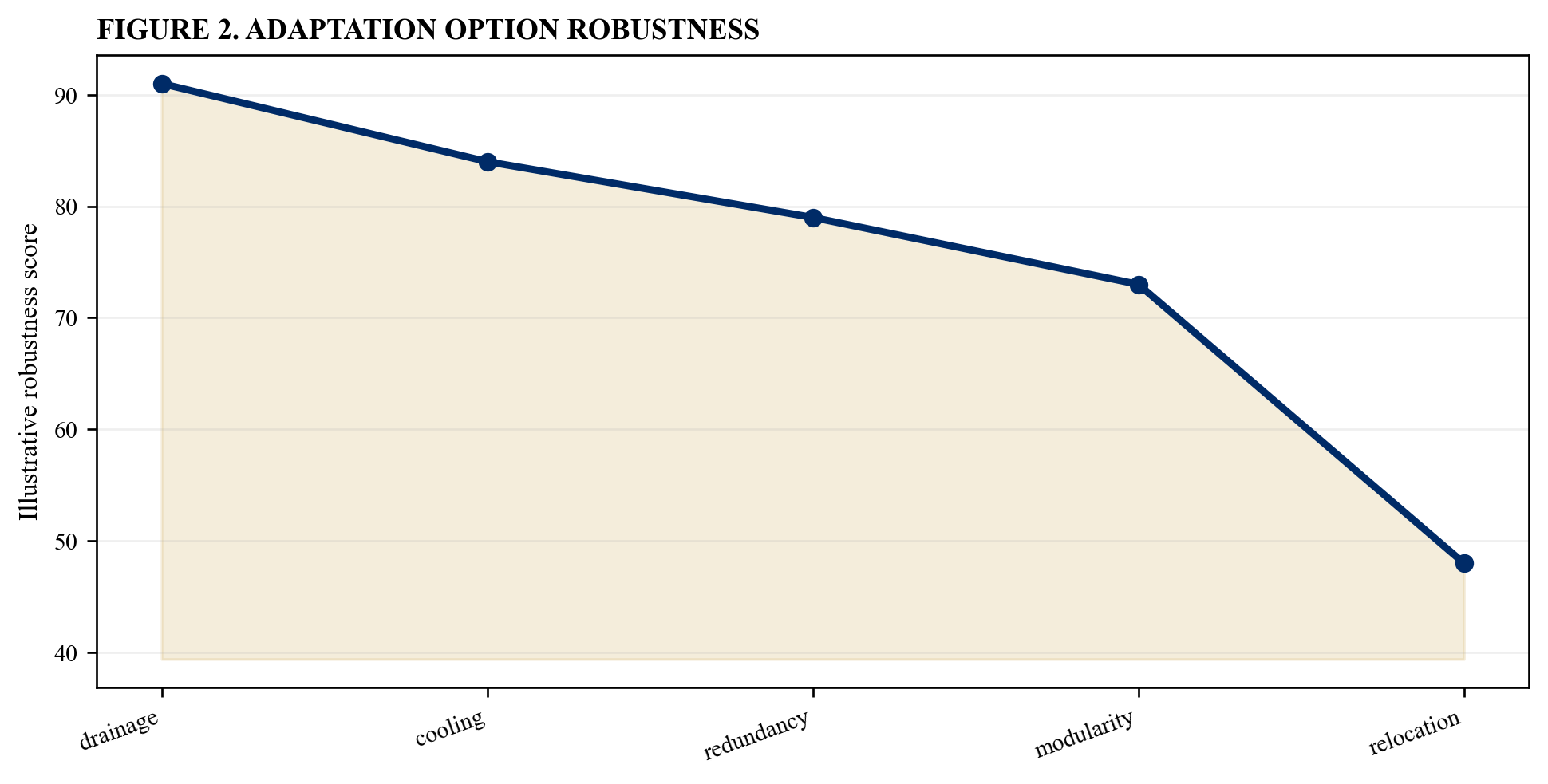
Illustrative analytical scenario; verified project evidence should replace values.
17. Share adaptation benefits
The project team should measure avoided deductions, insurance savings, operating efficiency, extended life and residual value. The required output is a resilience benefit-sharing schedule. Record the accountable party, evidence, assumption, contractual right, cash-flow consequence, approval and review date [20][29].
Test the proposed treatment against current hazard evidence, engineering tolerances, service criticality, asset condition, interdependencies, insurance terms, affordability, lender requirements, fiscal capacity and applicable law. Preserve the source, scenario, date, uncertainty range and reason for every material judgement.
The principal risk is that one party can fund improvements while another captures the economic gain. Quantify effects on service availability, recovery time, lifecycle cost, demand, revenue, insurance proceeds, debt-service coverage, equity returns, contingent public liabilities and user welfare. Compare the chosen response with credible prevention, transfer, sharing, reserve and public-support alternatives.
Translate the conclusion into design requirements, performance standards, payment terms, insurance obligations, adaptation triggers, financing assumptions, monitoring, relief, dispute and termination provisions. Refresh it when hazard evidence, asset performance, standards, insurance markets, technology or public-service needs change.
18. Integrate the payment mechanism
The project team should connect availability, output quality, recovery time and resilience obligations to deductions, relief and incentives. The required output is a climate-linked payment schedule. Record the accountable party, evidence, assumption, contractual right, cash-flow consequence, approval and review date [13][30].
Test the proposed treatment against current hazard evidence, engineering tolerances, service criticality, asset condition, interdependencies, insurance terms, affordability, lender requirements, fiscal capacity and applicable law. Preserve the source, scenario, date, uncertainty range and reason for every material judgement.
The principal risk is that performance deductions can punish uncontrollable catastrophe or excuse preventable failure. Quantify effects on service availability, recovery time, lifecycle cost, demand, revenue, insurance proceeds, debt-service coverage, equity returns, contingent public liabilities and user welfare. Compare the chosen response with credible prevention, transfer, sharing, reserve and public-support alternatives.
Translate the conclusion into design requirements, performance standards, payment terms, insurance obligations, adaptation triggers, financing assumptions, monitoring, relief, dispute and termination provisions. Refresh it when hazard evidence, asset performance, standards, insurance markets, technology or public-service needs change.
19. Structure climate performance metrics
The project team should define uptime, recovery, redundancy, leakage, thermal tolerance, emergency capacity and reporting quality. The required output is a measurable resilience scorecard. Record the accountable party, evidence, assumption, contractual right, cash-flow consequence, approval and review date [2][18].
Test the proposed treatment against current hazard evidence, engineering tolerances, service criticality, asset condition, interdependencies, insurance terms, affordability, lender requirements, fiscal capacity and applicable law. Preserve the source, scenario, date, uncertainty range and reason for every material judgement.
The principal risk is that aspirational resilience language can remain commercially unenforceable. Quantify effects on service availability, recovery time, lifecycle cost, demand, revenue, insurance proceeds, debt-service coverage, equity returns, contingent public liabilities and user welfare. Compare the chosen response with credible prevention, transfer, sharing, reserve and public-support alternatives.
Translate the conclusion into design requirements, performance standards, payment terms, insurance obligations, adaptation triggers, financing assumptions, monitoring, relief, dispute and termination provisions. Refresh it when hazard evidence, asset performance, standards, insurance markets, technology or public-service needs change.
20. Build the insurance risk register
The project team should map property damage, business interruption, delay, liability, environmental and parametric coverage to exposures. The required output is an insurance coverage matrix. Record the accountable party, evidence, assumption, contractual right, cash-flow consequence, approval and review date [31][32].
Test the proposed treatment against current hazard evidence, engineering tolerances, service criticality, asset condition, interdependencies, insurance terms, affordability, lender requirements, fiscal capacity and applicable law. Preserve the source, scenario, date, uncertainty range and reason for every material judgement.
The principal risk is that policy names can conceal material gaps between insured events and project losses. Quantify effects on service availability, recovery time, lifecycle cost, demand, revenue, insurance proceeds, debt-service coverage, equity returns, contingent public liabilities and user welfare. Compare the chosen response with credible prevention, transfer, sharing, reserve and public-support alternatives.
Translate the conclusion into design requirements, performance standards, payment terms, insurance obligations, adaptation triggers, financing assumptions, monitoring, relief, dispute and termination provisions. Refresh it when hazard evidence, asset performance, standards, insurance markets, technology or public-service needs change.
21. Audit exclusions and deductibles
The project team should identify flood, named storm, wildfire, corrosion, gradual deterioration, pollution and change exclusions. The required output is an exclusion-and-retention map. Record the accountable party, evidence, assumption, contractual right, cash-flow consequence, approval and review date [31][33].
Test the proposed treatment against current hazard evidence, engineering tolerances, service criticality, asset condition, interdependencies, insurance terms, affordability, lender requirements, fiscal capacity and applicable law. Preserve the source, scenario, date, uncertainty range and reason for every material judgement.
The principal risk is that headline limits can overstate recoverable cash after exclusions, waiting periods and deductibles. Quantify effects on service availability, recovery time, lifecycle cost, demand, revenue, insurance proceeds, debt-service coverage, equity returns, contingent public liabilities and user welfare. Compare the chosen response with credible prevention, transfer, sharing, reserve and public-support alternatives.
Translate the conclusion into design requirements, performance standards, payment terms, insurance obligations, adaptation triggers, financing assumptions, monitoring, relief, dispute and termination provisions. Refresh it when hazard evidence, asset performance, standards, insurance markets, technology or public-service needs change.
22. Test insurance availability over time
The project team should forecast premium, capacity, exclusions, limits, sublimits, reinstatement and renewal under worsening hazard. The required output is an insurance-availability scenario. Record the accountable party, evidence, assumption, contractual right, cash-flow consequence, approval and review date [5][34].
Test the proposed treatment against current hazard evidence, engineering tolerances, service criticality, asset condition, interdependencies, insurance terms, affordability, lender requirements, fiscal capacity and applicable law. Preserve the source, scenario, date, uncertainty range and reason for every material judgement.
The principal risk is that a policy available at financial close can become unaffordable or unobtainable later. Quantify effects on service availability, recovery time, lifecycle cost, demand, revenue, insurance proceeds, debt-service coverage, equity returns, contingent public liabilities and user welfare. Compare the chosen response with credible prevention, transfer, sharing, reserve and public-support alternatives.
Translate the conclusion into design requirements, performance standards, payment terms, insurance obligations, adaptation triggers, financing assumptions, monitoring, relief, dispute and termination provisions. Refresh it when hazard evidence, asset performance, standards, insurance markets, technology or public-service needs change.
23. Allocate uninsurability risk
The project team should define tests for market-wide withdrawal, unreasonable price, project-specific failure and mitigation obligations. The required output is an uninsurability protocol. Record the accountable party, evidence, assumption, contractual right, cash-flow consequence, approval and review date [15][31].
Test the proposed treatment against current hazard evidence, engineering tolerances, service criticality, asset condition, interdependencies, insurance terms, affordability, lender requirements, fiscal capacity and applicable law. Preserve the source, scenario, date, uncertainty range and reason for every material judgement.
The principal risk is that the contract can transfer a risk that commercial markets cease to cover. Quantify effects on service availability, recovery time, lifecycle cost, demand, revenue, insurance proceeds, debt-service coverage, equity returns, contingent public liabilities and user welfare. Compare the chosen response with credible prevention, transfer, sharing, reserve and public-support alternatives.
Translate the conclusion into design requirements, performance standards, payment terms, insurance obligations, adaptation triggers, financing assumptions, monitoring, relief, dispute and termination provisions. Refresh it when hazard evidence, asset performance, standards, insurance markets, technology or public-service needs change.
24. Use parametric cover selectively
The project team should test objective triggers, basis risk, payout speed, data reliability and interaction with indemnity insurance. The required output is a parametric-insurance assessment. Record the accountable party, evidence, assumption, contractual right, cash-flow consequence, approval and review date [35][36].
Test the proposed treatment against current hazard evidence, engineering tolerances, service criticality, asset condition, interdependencies, insurance terms, affordability, lender requirements, fiscal capacity and applicable law. Preserve the source, scenario, date, uncertainty range and reason for every material judgement.
The principal risk is that rapid payout can still miss the project loss when the trigger and damage diverge. Quantify effects on service availability, recovery time, lifecycle cost, demand, revenue, insurance proceeds, debt-service coverage, equity returns, contingent public liabilities and user welfare. Compare the chosen response with credible prevention, transfer, sharing, reserve and public-support alternatives.
Translate the conclusion into design requirements, performance standards, payment terms, insurance obligations, adaptation triggers, financing assumptions, monitoring, relief, dispute and termination provisions. Refresh it when hazard evidence, asset performance, standards, insurance markets, technology or public-service needs change.
Table 3. Insurance tower
| Layer | Function | Residual exposure |
|---|---|---|
| deductible reserve | first loss | liquidity |
| indemnity policy | physical loss | exclusions |
| parametric cover | rapid payout | basis risk |
| public backstop | catastrophic tail | fiscal risk |
Illustrative analytical structure; verified project and jurisdiction evidence governs.
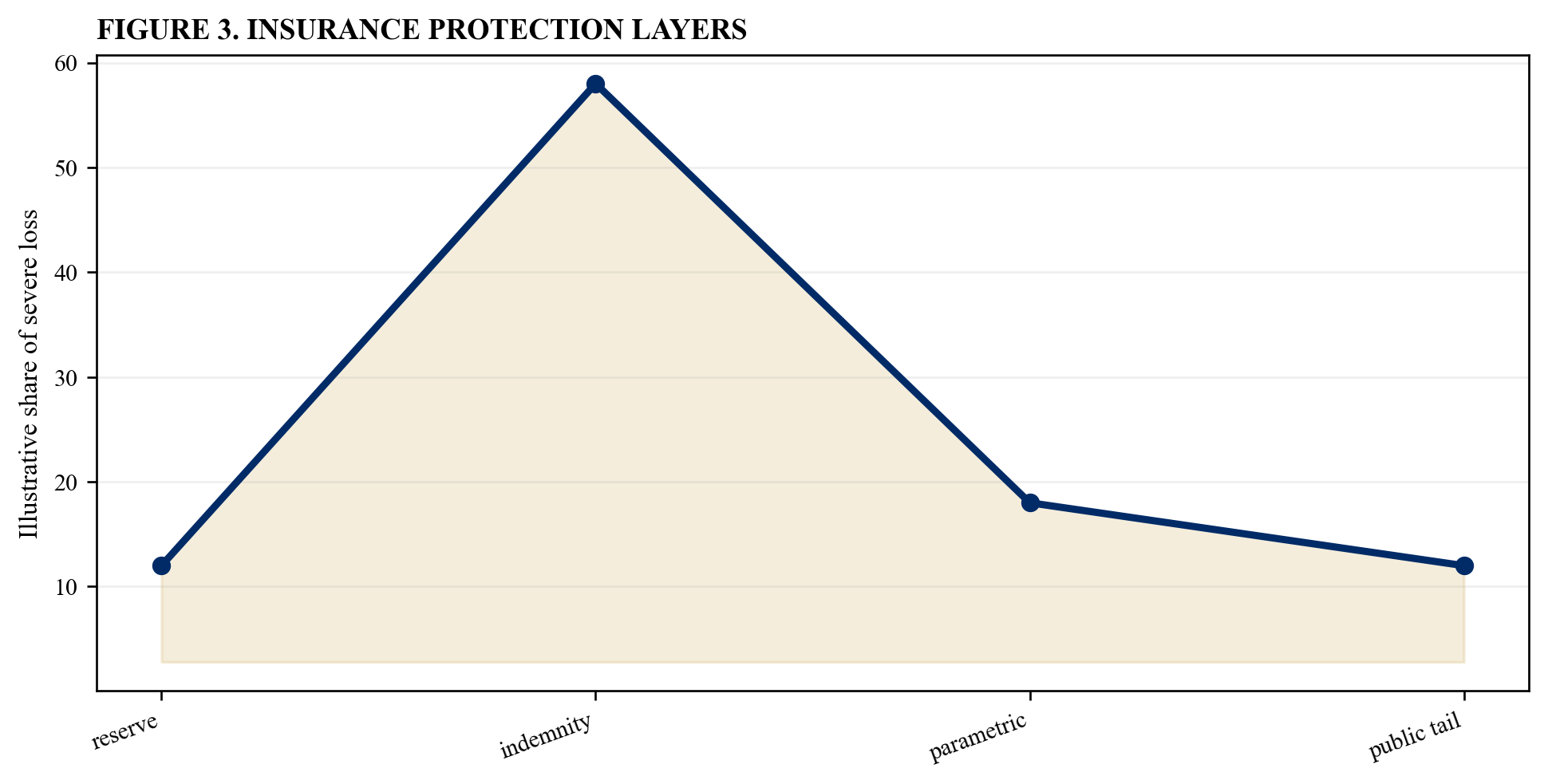
Illustrative analytical scenario; verified project evidence should replace values.
25. Design reserves and liquidity
The project team should size deductibles, waiting periods, emergency response, uninsured loss and delayed public payment. The required output is a climate-liquidity reserve. Record the accountable party, evidence, assumption, contractual right, cash-flow consequence, approval and review date [28][37].
Test the proposed treatment against current hazard evidence, engineering tolerances, service criticality, asset condition, interdependencies, insurance terms, affordability, lender requirements, fiscal capacity and applicable law. Preserve the source, scenario, date, uncertainty range and reason for every material judgement.
The principal risk is that a solvent project can fail during the timing gap between disruption, claim and recovery. Quantify effects on service availability, recovery time, lifecycle cost, demand, revenue, insurance proceeds, debt-service coverage, equity returns, contingent public liabilities and user welfare. Compare the chosen response with credible prevention, transfer, sharing, reserve and public-support alternatives.
Translate the conclusion into design requirements, performance standards, payment terms, insurance obligations, adaptation triggers, financing assumptions, monitoring, relief, dispute and termination provisions. Refresh it when hazard evidence, asset performance, standards, insurance markets, technology or public-service needs change.
26. Define force majeure precisely
The project team should state qualifying events, causation, prevention, notice, mitigation, relief, insurance proceeds and duration. The required output is a force-majeure clause map. Record the accountable party, evidence, assumption, contractual right, cash-flow consequence, approval and review date [15][16].
Test the proposed treatment against current hazard evidence, engineering tolerances, service criticality, asset condition, interdependencies, insurance terms, affordability, lender requirements, fiscal capacity and applicable law. Preserve the source, scenario, date, uncertainty range and reason for every material judgement.
The principal risk is that broad boilerplate can obscure which climate events remain preventable and insurable. Quantify effects on service availability, recovery time, lifecycle cost, demand, revenue, insurance proceeds, debt-service coverage, equity returns, contingent public liabilities and user welfare. Compare the chosen response with credible prevention, transfer, sharing, reserve and public-support alternatives.
Translate the conclusion into design requirements, performance standards, payment terms, insurance obligations, adaptation triggers, financing assumptions, monitoring, relief, dispute and termination provisions. Refresh it when hazard evidence, asset performance, standards, insurance markets, technology or public-service needs change.
27. Separate relief from compensation
The project team should distinguish time relief, performance relief, tariff or payment adjustment, cost sharing and revenue support. The required output is a relief-and-compensation ladder. Record the accountable party, evidence, assumption, contractual right, cash-flow consequence, approval and review date [15][30].
Test the proposed treatment against current hazard evidence, engineering tolerances, service criticality, asset condition, interdependencies, insurance terms, affordability, lender requirements, fiscal capacity and applicable law. Preserve the source, scenario, date, uncertainty range and reason for every material judgement.
The principal risk is that excusing performance can leave the project without cash to restore essential service. Quantify effects on service availability, recovery time, lifecycle cost, demand, revenue, insurance proceeds, debt-service coverage, equity returns, contingent public liabilities and user welfare. Compare the chosen response with credible prevention, transfer, sharing, reserve and public-support alternatives.
Translate the conclusion into design requirements, performance standards, payment terms, insurance obligations, adaptation triggers, financing assumptions, monitoring, relief, dispute and termination provisions. Refresh it when hazard evidence, asset performance, standards, insurance markets, technology or public-service needs change.
28. Require continuous mitigation
The project team should define reasonable prevention, preparedness, emergency response, recovery and evidence duties before and after an event. The required output is a mitigation duty schedule. Record the accountable party, evidence, assumption, contractual right, cash-flow consequence, approval and review date [6][16].
Test the proposed treatment against current hazard evidence, engineering tolerances, service criticality, asset condition, interdependencies, insurance terms, affordability, lender requirements, fiscal capacity and applicable law. Preserve the source, scenario, date, uncertainty range and reason for every material judgement.
The principal risk is that automatic relief can weaken incentives to reduce foreseeable loss. Quantify effects on service availability, recovery time, lifecycle cost, demand, revenue, insurance proceeds, debt-service coverage, equity returns, contingent public liabilities and user welfare. Compare the chosen response with credible prevention, transfer, sharing, reserve and public-support alternatives.
Translate the conclusion into design requirements, performance standards, payment terms, insurance obligations, adaptation triggers, financing assumptions, monitoring, relief, dispute and termination provisions. Refresh it when hazard evidence, asset performance, standards, insurance markets, technology or public-service needs change.
29. Connect change in law and standards
The project team should allocate mandatory resilience upgrades, permit changes, technical codes and environmental requirements. The required output is a standards-change protocol. Record the accountable party, evidence, assumption, contractual right, cash-flow consequence, approval and review date [14][27].
Test the proposed treatment against current hazard evidence, engineering tolerances, service criticality, asset condition, interdependencies, insurance terms, affordability, lender requirements, fiscal capacity and applicable law. Preserve the source, scenario, date, uncertainty range and reason for every material judgement.
The principal risk is that force majeure can be misused for costs created by regulatory evolution. Quantify effects on service availability, recovery time, lifecycle cost, demand, revenue, insurance proceeds, debt-service coverage, equity returns, contingent public liabilities and user welfare. Compare the chosen response with credible prevention, transfer, sharing, reserve and public-support alternatives.
Translate the conclusion into design requirements, performance standards, payment terms, insurance obligations, adaptation triggers, financing assumptions, monitoring, relief, dispute and termination provisions. Refresh it when hazard evidence, asset performance, standards, insurance markets, technology or public-service needs change.
30. Model the integrated cash-flow impact
The project team should translate damage, downtime, demand loss, operating cost, capex, insurance and public support into project cash flow. The required output is a climate-adjusted financial model. Record the accountable party, evidence, assumption, contractual right, cash-flow consequence, approval and review date [37][38].
Test the proposed treatment against current hazard evidence, engineering tolerances, service criticality, asset condition, interdependencies, insurance terms, affordability, lender requirements, fiscal capacity and applicable law. Preserve the source, scenario, date, uncertainty range and reason for every material judgement.
The principal risk is that engineering analysis and financing models can use inconsistent event and recovery assumptions. Quantify effects on service availability, recovery time, lifecycle cost, demand, revenue, insurance proceeds, debt-service coverage, equity returns, contingent public liabilities and user welfare. Compare the chosen response with credible prevention, transfer, sharing, reserve and public-support alternatives.
Translate the conclusion into design requirements, performance standards, payment terms, insurance obligations, adaptation triggers, financing assumptions, monitoring, relief, dispute and termination provisions. Refresh it when hazard evidence, asset performance, standards, insurance markets, technology or public-service needs change.
31. Stress correlated and compound events
The project team should combine physical damage, input shortage, network outage, demand shock, inflation and insurance delay. The required output is a compound-event stress matrix. Record the accountable party, evidence, assumption, contractual right, cash-flow consequence, approval and review date [4][39].
Test the proposed treatment against current hazard evidence, engineering tolerances, service criticality, asset condition, interdependencies, insurance terms, affordability, lender requirements, fiscal capacity and applicable law. Preserve the source, scenario, date, uncertainty range and reason for every material judgement.
The principal risk is that single-hazard sensitivities can materially understate liquidity and debt-service pressure. Quantify effects on service availability, recovery time, lifecycle cost, demand, revenue, insurance proceeds, debt-service coverage, equity returns, contingent public liabilities and user welfare. Compare the chosen response with credible prevention, transfer, sharing, reserve and public-support alternatives.
Translate the conclusion into design requirements, performance standards, payment terms, insurance obligations, adaptation triggers, financing assumptions, monitoring, relief, dispute and termination provisions. Refresh it when hazard evidence, asset performance, standards, insurance markets, technology or public-service needs change.
32. Size debt to resilient cash flow
The project team should distinguish contracted base cash, climate-sensitive revenue, insured recovery, reserves and contingent support. The required output is a resilience-adjusted debt bridge. Record the accountable party, evidence, assumption, contractual right, cash-flow consequence, approval and review date [37][40].
Test the proposed treatment against current hazard evidence, engineering tolerances, service criticality, asset condition, interdependencies, insurance terms, affordability, lender requirements, fiscal capacity and applicable law. Preserve the source, scenario, date, uncertainty range and reason for every material judgement.
The principal risk is that leverage can depend on service and insurance assumptions that fail together. Quantify effects on service availability, recovery time, lifecycle cost, demand, revenue, insurance proceeds, debt-service coverage, equity returns, contingent public liabilities and user welfare. Compare the chosen response with credible prevention, transfer, sharing, reserve and public-support alternatives.
Translate the conclusion into design requirements, performance standards, payment terms, insurance obligations, adaptation triggers, financing assumptions, monitoring, relief, dispute and termination provisions. Refresh it when hazard evidence, asset performance, standards, insurance markets, technology or public-service needs change.
Table 4. Illustrative climate cash-flow bridge
| Item | Base index | Compound-event index |
|---|---|---|
| service revenue | 100 | 74 |
| operating cost | 100 | 128 |
| insurance recovery | 0 | 18 |
| cash for debt service | 100 | 57 |
Illustrative analytical structure; verified project and jurisdiction evidence governs.
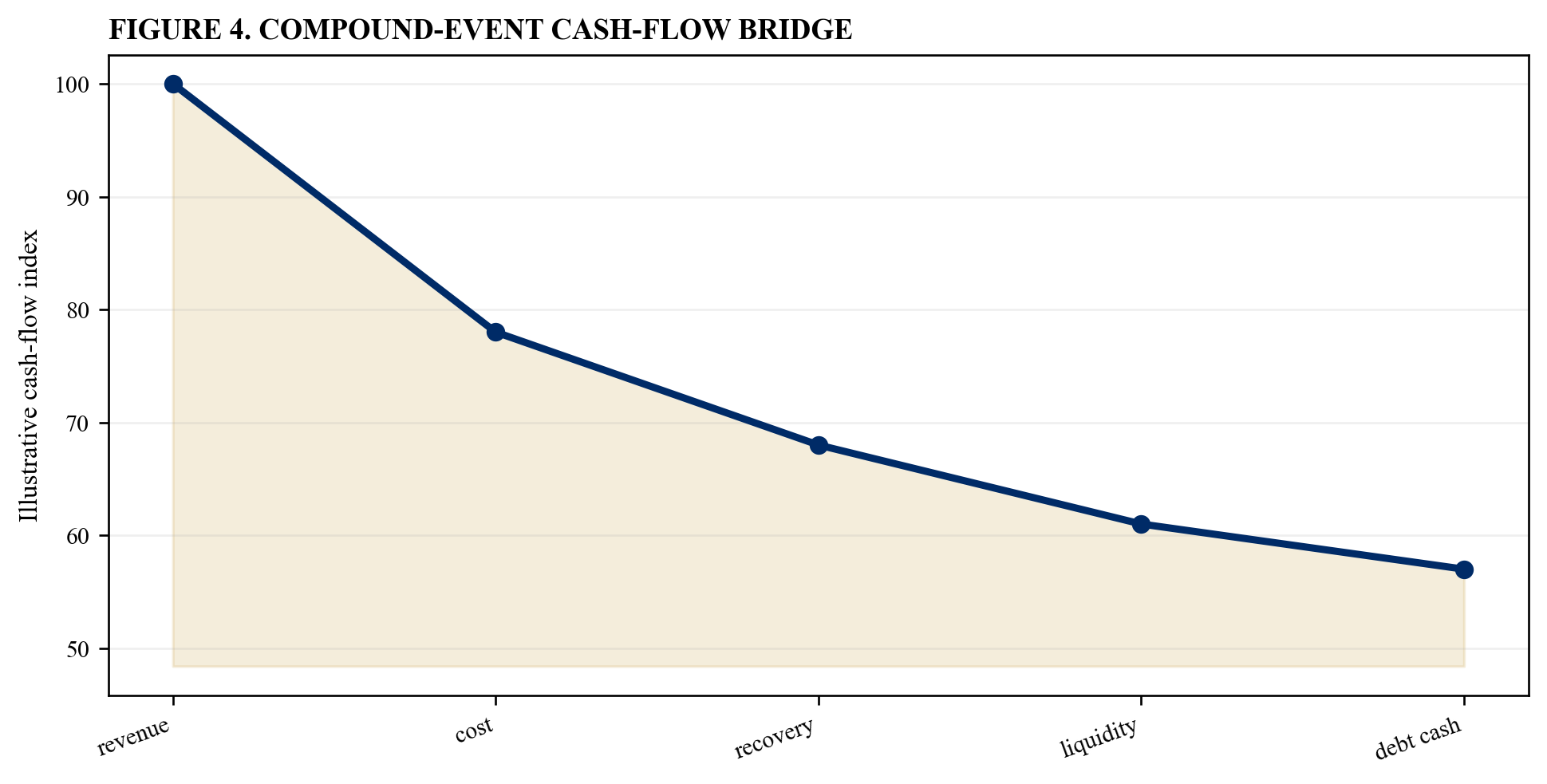
Illustrative analytical scenario; verified project evidence should replace values.
33. Record public fiscal exposure
The project team should measure adaptation contributions, availability payments, guarantees, emergency support and termination liabilities. The required output is a climate fiscal-risk statement. Record the accountable party, evidence, assumption, contractual right, cash-flow consequence, approval and review date [28][38].
Test the proposed treatment against current hazard evidence, engineering tolerances, service criticality, asset condition, interdependencies, insurance terms, affordability, lender requirements, fiscal capacity and applicable law. Preserve the source, scenario, date, uncertainty range and reason for every material judgement.
The principal risk is that public obligations can emerge only after a shock when budget flexibility is weakest. Quantify effects on service availability, recovery time, lifecycle cost, demand, revenue, insurance proceeds, debt-service coverage, equity returns, contingent public liabilities and user welfare. Compare the chosen response with credible prevention, transfer, sharing, reserve and public-support alternatives.
Translate the conclusion into design requirements, performance standards, payment terms, insurance obligations, adaptation triggers, financing assumptions, monitoring, relief, dispute and termination provisions. Refresh it when hazard evidence, asset performance, standards, insurance markets, technology or public-service needs change.
34. Align lender protections
The project team should integrate information rights, cure, reserve control, insurance approval, step-in, restructuring and termination compensation. The required output is a lender resilience term sheet. Record the accountable party, evidence, assumption, contractual right, cash-flow consequence, approval and review date [30][37].
Test the proposed treatment against current hazard evidence, engineering tolerances, service criticality, asset condition, interdependencies, insurance terms, affordability, lender requirements, fiscal capacity and applicable law. Preserve the source, scenario, date, uncertainty range and reason for every material judgement.
The principal risk is that credit protections can activate too late to preserve service and asset value. Quantify effects on service availability, recovery time, lifecycle cost, demand, revenue, insurance proceeds, debt-service coverage, equity returns, contingent public liabilities and user welfare. Compare the chosen response with credible prevention, transfer, sharing, reserve and public-support alternatives.
Translate the conclusion into design requirements, performance standards, payment terms, insurance obligations, adaptation triggers, financing assumptions, monitoring, relief, dispute and termination provisions. Refresh it when hazard evidence, asset performance, standards, insurance markets, technology or public-service needs change.
35. Design emergency governance
The project team should set command authority, information channels, temporary works, procurement flexibilities and stakeholder communication. The required output is an emergency decision protocol. Record the accountable party, evidence, assumption, contractual right, cash-flow consequence, approval and review date [2][9].
Test the proposed treatment against current hazard evidence, engineering tolerances, service criticality, asset condition, interdependencies, insurance terms, affordability, lender requirements, fiscal capacity and applicable law. Preserve the source, scenario, date, uncertainty range and reason for every material judgement.
The principal risk is that ordinary approval chains can be too slow during a service-critical disruption. Quantify effects on service availability, recovery time, lifecycle cost, demand, revenue, insurance proceeds, debt-service coverage, equity returns, contingent public liabilities and user welfare. Compare the chosen response with credible prevention, transfer, sharing, reserve and public-support alternatives.
Translate the conclusion into design requirements, performance standards, payment terms, insurance obligations, adaptation triggers, financing assumptions, monitoring, relief, dispute and termination provisions. Refresh it when hazard evidence, asset performance, standards, insurance markets, technology or public-service needs change.
36. Monitor leading indicators
The project team should track hazard thresholds, asset condition, near misses, downtime, claims, premium changes and adaptation triggers. The required output is a climate early-warning dashboard. Record the accountable party, evidence, assumption, contractual right, cash-flow consequence, approval and review date [3][19].
Test the proposed treatment against current hazard evidence, engineering tolerances, service criticality, asset condition, interdependencies, insurance terms, affordability, lender requirements, fiscal capacity and applicable law. Preserve the source, scenario, date, uncertainty range and reason for every material judgement.
The principal risk is that management can detect resilience failure only after an insured event occurs. Quantify effects on service availability, recovery time, lifecycle cost, demand, revenue, insurance proceeds, debt-service coverage, equity returns, contingent public liabilities and user welfare. Compare the chosen response with credible prevention, transfer, sharing, reserve and public-support alternatives.
Translate the conclusion into design requirements, performance standards, payment terms, insurance obligations, adaptation triggers, financing assumptions, monitoring, relief, dispute and termination provisions. Refresh it when hazard evidence, asset performance, standards, insurance markets, technology or public-service needs change.
37. Audit data and model governance
The project team should assign source ownership, update frequency, validation, version control, access and independent challenge. The required output is a climate-data governance plan. Record the accountable party, evidence, assumption, contractual right, cash-flow consequence, approval and review date [4][22].
Test the proposed treatment against current hazard evidence, engineering tolerances, service criticality, asset condition, interdependencies, insurance terms, affordability, lender requirements, fiscal capacity and applicable law. Preserve the source, scenario, date, uncertainty range and reason for every material judgement.
The principal risk is that changing models can alter obligations without a traceable evidence chain. Quantify effects on service availability, recovery time, lifecycle cost, demand, revenue, insurance proceeds, debt-service coverage, equity returns, contingent public liabilities and user welfare. Compare the chosen response with credible prevention, transfer, sharing, reserve and public-support alternatives.
Translate the conclusion into design requirements, performance standards, payment terms, insurance obligations, adaptation triggers, financing assumptions, monitoring, relief, dispute and termination provisions. Refresh it when hazard evidence, asset performance, standards, insurance markets, technology or public-service needs change.
38. Rehearse recovery and continuity
The project team should test emergency response, backup systems, mutual aid, customer communication and restoration priorities. The required output is a resilience exercise programme. Record the accountable party, evidence, assumption, contractual right, cash-flow consequence, approval and review date [9][10].
Test the proposed treatment against current hazard evidence, engineering tolerances, service criticality, asset condition, interdependencies, insurance terms, affordability, lender requirements, fiscal capacity and applicable law. Preserve the source, scenario, date, uncertainty range and reason for every material judgement.
The principal risk is that contractual rights cannot substitute for operational preparedness. Quantify effects on service availability, recovery time, lifecycle cost, demand, revenue, insurance proceeds, debt-service coverage, equity returns, contingent public liabilities and user welfare. Compare the chosen response with credible prevention, transfer, sharing, reserve and public-support alternatives.
Translate the conclusion into design requirements, performance standards, payment terms, insurance obligations, adaptation triggers, financing assumptions, monitoring, relief, dispute and termination provisions. Refresh it when hazard evidence, asset performance, standards, insurance markets, technology or public-service needs change.
39. Align handback and residual life
The project team should include climate-adjusted condition, remaining life, adaptation status, data transfer and latent defects. The required output is a resilient handback standard. Record the accountable party, evidence, assumption, contractual right, cash-flow consequence, approval and review date [12][25].
Test the proposed treatment against current hazard evidence, engineering tolerances, service criticality, asset condition, interdependencies, insurance terms, affordability, lender requirements, fiscal capacity and applicable law. Preserve the source, scenario, date, uncertainty range and reason for every material judgement.
The principal risk is that the public authority can inherit an asset designed for an outdated climate baseline. Quantify effects on service availability, recovery time, lifecycle cost, demand, revenue, insurance proceeds, debt-service coverage, equity returns, contingent public liabilities and user welfare. Compare the chosen response with credible prevention, transfer, sharing, reserve and public-support alternatives.
Translate the conclusion into design requirements, performance standards, payment terms, insurance obligations, adaptation triggers, financing assumptions, monitoring, relief, dispute and termination provisions. Refresh it when hazard evidence, asset performance, standards, insurance markets, technology or public-service needs change.
40. Issue the climate-resilience certificate
The project team should reconcile evidence, design basis, allocation, adaptation, payment, insurance, finance, fiscal exposure and monitoring. The required output is an auditable climate-resilience certificate. Record the accountable party, evidence, assumption, contractual right, cash-flow consequence, approval and review date [1][2].
Test the proposed treatment against current hazard evidence, engineering tolerances, service criticality, asset condition, interdependencies, insurance terms, affordability, lender requirements, fiscal capacity and applicable law. Preserve the source, scenario, date, uncertainty range and reason for every material judgement.
The principal risk is that approval can rest on isolated studies that never become binding lifecycle controls. Quantify effects on service availability, recovery time, lifecycle cost, demand, revenue, insurance proceeds, debt-service coverage, equity returns, contingent public liabilities and user welfare. Compare the chosen response with credible prevention, transfer, sharing, reserve and public-support alternatives.
Translate the conclusion into design requirements, performance standards, payment terms, insurance obligations, adaptation triggers, financing assumptions, monitoring, relief, dispute and termination provisions. Refresh it when hazard evidence, asset performance, standards, insurance markets, technology or public-service needs change.
Table 5. Climate-resilience certificate
| Decision | Evidence | Owner |
|---|---|---|
| design basis | hazard and vulnerability | technical |
| allocation | control matrix | legal |
| insurance | coverage and renewal | risk |
| finance | stress and liquidity | finance |
Illustrative analytical structure; verified project and jurisdiction evidence governs.
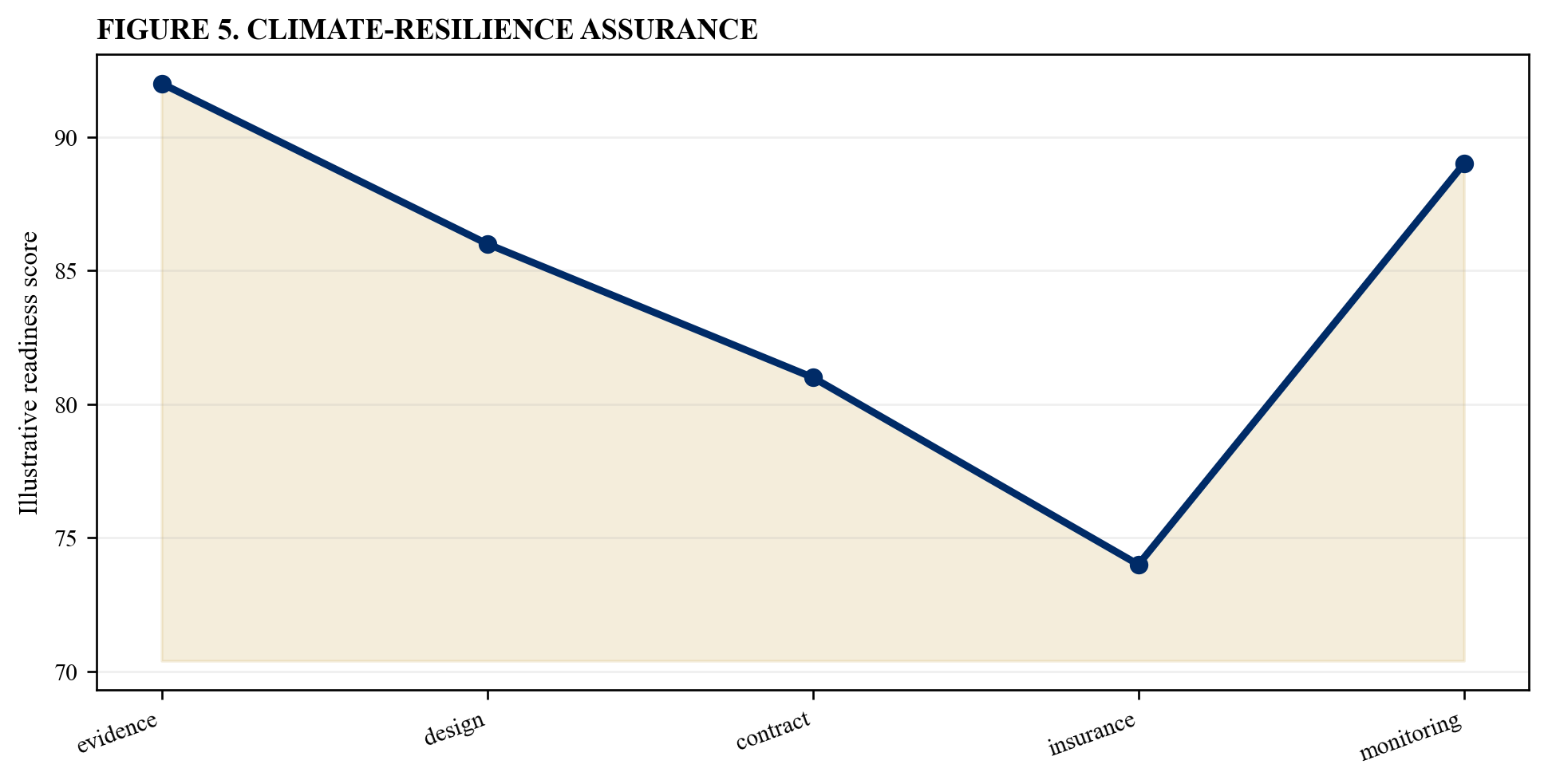
Illustrative analytical scenario; verified project evidence should replace values.
References
- World Bank Group, PPP Reference Guide Version 3, https://ppp.worldbank.org/sites/default/files/2024-08/PPP%20Reference%20Guide%20Version%203.pdf
- Global Center on Adaptation and partners, Climate-Resilient Infrastructure Officer Handbook, https://ppp.worldbank.org/library/climate-resilient-infrastructure-officer-handbook
- IPCC, Sixth Assessment Report Working Group II, https://www.ipcc.ch/report/ar6/wg2/
- World Bank, Climate and Disaster Risk Screening Tools, https://climatescreeningtools.worldbank.org/
- World Bank PPP Resource Center, Climate Change and Natural Disasters, https://ppp.worldbank.org/public-private-partnership/climate-change-and-natural-disasters
- UNDRR, Principles for Resilient Infrastructure, https://www.undrr.org/publication/principles-resilient-infrastructure
- ISO, ISO 14091 Adaptation to Climate Change, https://www.iso.org/standard/68508.html
- OECD, Infrastructure for a Climate-Resilient Future, https://www.oecd.org/en/publications/infrastructure-for-a-climate-resilient-future_a74a45b0-en.html
- OECD, Good Governance for Critical Infrastructure Resilience, https://www.oecd.org/en/publications/good-governance-for-critical-infrastructure-resilience_02f0e5a0-en.html
- UNDRR, Global Assessment Report on Disaster Risk Reduction, https://www.undrr.org/gar
- World Bank, Lifelines: The Resilient Infrastructure Opportunity, https://openknowledge.worldbank.org/handle/10986/31805
- ISO, ISO 55001 Asset Management, https://www.iso.org/standard/83054.html
- World Bank PPP Resource Center, Preparing, Procuring and Implementing Climate-Smart PPPs, https://ppp.worldbank.org/climate-smart/climate-smart-clean-technology-ppps/preparing-procuring-and-implementing-climate-smart-ppps
- World Bank, Climate Toolkits for Infrastructure PPPs, https://ppp.worldbank.org/climate-smart/climate-toolkits-infrastructure-ppps
- World Bank PPP Resource Center, Adjustments in Exceptional Situations, https://ppp.worldbank.org/adjustments-exceptional-situations
- World Bank Group, Guidance on PPP Contractual Provisions, https://ppp.worldbank.org/sites/default/files/2024-07/Guidance_%20PPP_Contractual_Provisions_EN_2017.pdf
- World Bank PPP Resource Center, Risk Allocation, https://ppp.worldbank.org/risk-allocation
- World Bank PPP Resource Center, Climate-Smart PPPs, https://ppp.worldbank.org/energy-and-power/climate-smart-ppps
- European Commission, Technical Guidance on Climate Proofing of Infrastructure 2021-2027, https://eur-lex.europa.eu/legal-content/EN/TXT/?uri=CELEX:52021XC0916(03)
- OECD, Climate-Resilient Infrastructure Policy Perspectives, https://www.oecd.org/environment/cc/policy-perspectives-climate-resilient-infrastructure.pdf
- World Bank, Economics for Disaster Prevention and Preparedness, https://www.worldbank.org/en/topic/disasterriskmanagement
- World Bank, Decision Making under Deep Uncertainty, https://openknowledge.worldbank.org/handle/10986/12028
- World Bank, Robust Decision Making in Water Resources Planning, https://openknowledge.worldbank.org/handle/10986/22544
- Dynamic Adaptive Policy Pathways, Deltares, https://www.deltares.nl/en/expertise/areas-of-expertise/flood-risk-management/adaptive-delta-management
- European Environment Agency, Climate Adaptation Platform, https://climate-adapt.eea.europa.eu/
- ISO, ISO 14090 Adaptation to Climate Change, https://www.iso.org/standard/68507.html
- World Bank PPP Resource Center, Guidance on PPP Contractual Provisions, https://ppp.worldbank.org/climate-smart/contractual-provisions/guidance-ppp-contractual-provisions
- International Monetary Fund, P-FRAM, https://www.imf.org/external/np/fad/publicinvestment/
- Climate Bonds Initiative, Climate Resilience Principles, https://ppp.worldbank.org/library/climate-resilience-principles-framework-assessing-climate-resilience-investments
- World Bank PPP Resource Center, Payment Mechanism, https://ppp.worldbank.org/payment-mechanism
- World Bank PPP Resource Center, Climate Change Risk and Insurance, https://ppp.worldbank.org/climate-smart/climate-smart-clean-technology-ppps/preparing-procuring-and-implementing-climate-smart-ppps
- International Association of Insurance Supervisors, Climate Risk, https://www.iaisweb.org/activities-topics/climate-risk/
- OECD, Financial Management of Flood Risk, https://www.oecd.org/finance/insurance/financial-management-of-flood-risk.htm
- European Insurance and Occupational Pensions Authority, NatCat Protection Gap, https://www.eiopa.europa.eu/tools-and-data/dashboard-insurance-protection-gap-natural-catastrophes_en
- World Bank, Disaster Risk Financing and Insurance Program, https://www.worldbank.org/en/programs/disaster-risk-financing-and-insurance-program
- Global Facility for Disaster Reduction and Recovery, Disaster Risk Finance, https://www.gfdrr.org/en/disaster-risk-finance
- World Bank PPP Resource Center, Government Support, https://ppp.worldbank.org/government-support
- International Monetary Fund, Fiscal Transparency Code, https://www.imf.org/external/np/fad/trans/
- IPCC, Climate Change 2022 Impacts Adaptation and Vulnerability Summary, https://www.ipcc.ch/report/ar6/wg2/
- World Bank PPP Resource Center, Technical Brief on Resilient Infrastructure PPPs, https://ppp.worldbank.org/library/technical-brief-resilient-infrastructure-public-private-partnerships-policy-contracting-and-finance
