

1. Start with the decision the client is making
Climate transition investing can mean several different things. One client may want to reduce exposure to transition risk. Another may want to allocate capital to companies financing measurable decarbonisation. A third may seek competitive returns from electrification, grids, storage, efficiency or industrial transformation. A fourth may require exclusions based on personal values. These objectives can overlap, yet they lead to different product and portfolio choices.
The first task is therefore to define the client decision in plain language. The record should identify the financial objective, sustainability preference, intended mechanism, time horizon, acceptable uncertainty and evidence required. It should also record the client's return target, capacity for loss, liquidity needs, concentration limits, currency exposure and existing holdings. A sustainability preference should sit within the complete suitability record.
Vague terms create avoidable risk. A request for a green portfolio can refer to low current emissions, climate solutions, Paris alignment, corporate transition, exclusions, stewardship or reported impact. The relationship manager should test the intended meaning and explain the trade-offs. A low-emissions portfolio can exclude sectors where substantial transition capital is needed. A transition portfolio can own current high emitters when a credible pathway and financing purpose support the thesis. A climate-solutions portfolio can carry technology, valuation and concentration risk.
The client mandate should define how a product will be judged. Useful questions include whether the client prioritises current portfolio characteristics or forward-looking change, whether engagement is acceptable, whether unlisted assets are appropriate, how much tracking error can be tolerated and whether the client requires a particular label or disclosure. These decisions become measurable portfolio instructions.
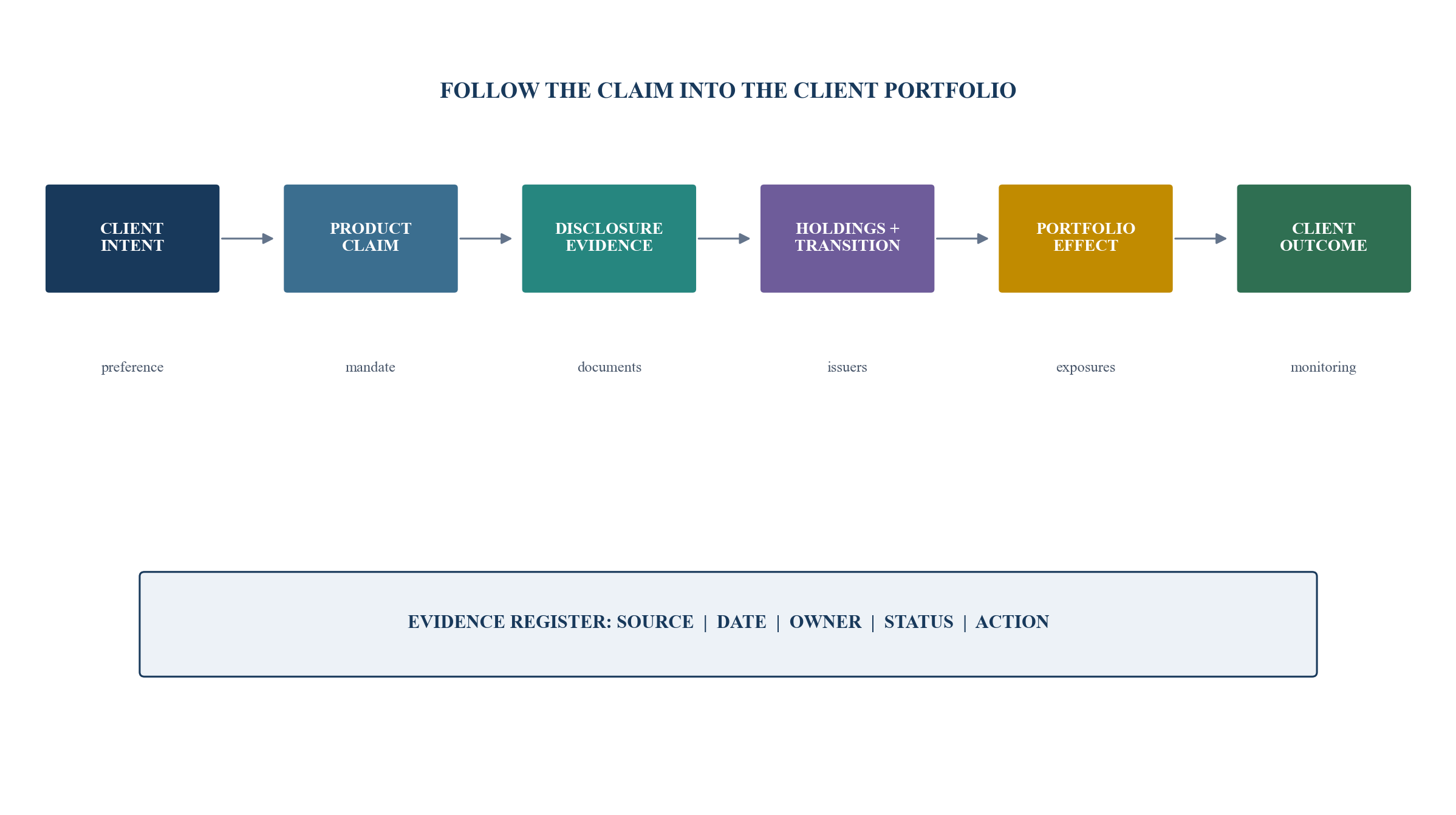
Author framework. Each link has a source, owner, review date and decision consequence.
2. Separate six layers of climate product evidence
A disciplined review separates the client's intent from the product's claim. It then tests the disclosure framework, economic exposures, issuer evidence and whole-portfolio outcome. This prevents a label or classification from becoming a substitute for analysis.
The client-intent layer states the outcome sought and constraints accepted. The product-claim layer identifies the formal objective and investment mechanism. The disclosure layer records the applicable label, naming rule, prospectus, periodic report and marketing statements. The exposure layer examines holdings, sector and factor weights, benchmark, derivatives, cash and look-through exposures. The issuer layer tests transition plans, capital expenditure, targets, governance and progress. The portfolio layer measures how the proposed position changes risk, return, liquidity, concentration and stated sustainability characteristics.
Each layer can fail independently. A well-disclosed product may not fit a client. A suitable strategy can use an overstated name. A portfolio of climate-solution companies can be highly concentrated. A transition strategy can depend on weak issuer plans. A labelled fund can drift after purchase. The evidence register should preserve these distinctions.
The minimum record includes document identity, effective date, source, owner, review frequency and status. It should distinguish verified current evidence from missing data and management assumptions. A material gap should lead to clarification, escalation, a portfolio limit or rejection. The product committee should state which gaps are tolerable for each strategy and client type.
Table 1. Climate product evidence register
| Evidence layer | Minimum evidence | Review question | Possible decision |
|---|---|---|---|
| client intent | documented preference, objective, horizon, risk, liquidity, exclusions and evidence expectation | what outcome does the client actually want? | clarify, translate or stop |
| product claim | objective, strategy, binding rules, benchmark and permitted instruments | what mechanism is the product required to use? | approve, condition or reject |
| disclosure context | label, name, prospectus, consumer disclosure, periodic report and marketing | which formal claims apply, in which jurisdiction and period? | accept, restrict wording or escalate |
| economic exposure | holdings, sector, factor, geography, currency, duration, derivatives and cash | what does the client economically own? | size, diversify or decline |
| issuer transition | targets, interim milestones, capital plan, governance, dependencies, assurance and progress | is the claimed transition pathway credible enough for the mandate? | include, watch, engage or exclude |
| portfolio outcome | contribution to risk, return, liquidity, concentration, cost and stated climate metrics | how does the total portfolio change? | implement, resize or redesign |
The fields are a design framework and should be adapted to the applicable regulatory and product-governance requirements.
3. Understand what labels and names establish
The FCA's Sustainability Disclosure Requirements include an anti-greenwashing rule, naming and marketing requirements, disclosures and four voluntary investment labels. FCA label criteria include a sustainability objective and, for labelled products, a requirement that at least 70 percent of assets are invested in accordance with that objective, subject to the detailed criteria and scope. The label provides structured evidence about the product design. It is not a conclusion about investment merit or client suitability.
ESMA's guidelines on fund names using ESG or sustainability-related terms establish an 80 percent threshold linked to environmental or social characteristics or sustainable investment objectives, together with exclusions that vary by the terminology used. The guidelines regulate names within their scope. They do not make all strategies bearing similar words economically identical.
The SEC's amended Names Rule generally requires a fund whose name suggests a focus on particular investments or characteristics to adopt an 80 percent investment policy. The SEC extended compliance dates to 11 June 2026 for larger fund groups and 11 December 2026 for smaller fund groups. The rule addresses consistency between a fund's name and investments within its scope. It does not create a climate quality rating.
Across regimes, a name or label can improve discipline by making a claim more testable. The product review should record the exact term, binding criteria, calculation method, exclusions, temporary departures, disclosure frequency and consequences of change. The committee should also examine the strategy beneath the classification.
4. Use international rules as a design map
International materials share several design themes: clear objectives, consistency between claims and holdings, disclosure of strategy and risks, governance, monitoring and information that helps investors understand the product. Their scopes and legal effects differ.
The Hong Kong SFC's 2021 circular for ESG funds sets disclosure and ongoing monitoring expectations and uses a 70 percent threshold for investments reflecting the key ESG focus under one or more stated ESG strategies. The SFC's public list explains that inclusion is not a recommendation, endorsement or guarantee and that investors should understand the strategy and risks.
MAS Circular CFC 02/2022 applies disclosure and reporting guidelines to retail ESG funds within its scope. It seeks to mitigate greenwashing risk and improve comparability. ASIC Information Sheet 271 frames practical questions for avoiding greenwashing when offering or promoting sustainability-related products. Japan's Financial Services Agency amended supervisory guidelines concerning ESG investment trusts following a survey and greenwashing concerns.
IOSCO's 2021 recommendations address asset-manager practices, policies, procedures and disclosure, together with product-level disclosure and supervision. A global wealth firm can use the recurring elements to create a common product file. Local counsel and compliance should determine which duties apply to each entity, product, client and communication.
Table 2. International official design evidence
| Market | Official material | Design implication | Scope boundary |
|---|---|---|---|
| United Kingdom | FCA Sustainability Disclosure Requirements and investment labels | connect objective, label criteria, naming, consumer disclosure, distribution and anti-greenwashing controls | confirm product, firm and distribution scope |
| European Union | ESMA fund-name guidelines and existing sustainable-finance disclosures | test name threshold, exclusions, objective, holdings and periodic disclosure | confirm current legal framework and do not treat proposals as enacted law |
| United States | SEC Investment Company Names Rule | maintain the required investment policy, testing, records and disclosure for covered names | rule addresses registered investment companies and BDCs within scope |
| Hong Kong | SFC 2021 ESG-fund circular | document key ESG focus, strategy, allocation, reference benchmark, risks and ongoing monitoring | applies to SFC-authorised ESG funds within stated scope |
| Singapore | MAS CFC 02/2022 | connect ESG focus, strategy, criteria, risks, benchmark and periodic reporting | applies to authorised or recognised retail ESG funds meeting the circular's definition |
| Australia | ASIC Information Sheet 271 | use specific, substantiated, current and consistent sustainability claims | legal analysis depends on product, disclosure and conduct obligations |
| Japan | FSA supervisory guidance on ESG investment trusts | establish product-definition, strategy, resources, disclosure and monitoring discipline | confirm current Japanese text and product scope |
| International | IOSCO asset-management recommendations | align firm practices, product disclosure, supervision, terminology and investor education | implementation occurs through member jurisdictions |
Each source has its own scope, legal status and effective date. The table identifies design implications rather than legal conclusions.
5. Map the product shelf by investment mechanism
Climate products should be classified by what they do with capital and ownership rights. An exclusion strategy removes defined activities or issuers. A best-in-class strategy selects issuers with preferred characteristics relative to peers. A climate-solutions strategy owns businesses deriving revenues from relevant technologies or services. A transition strategy finances or owns entities expected to change materially. A stewardship strategy uses voting and engagement. A green-bond strategy finances eligible projects subject to its framework. A sustainability-linked instrument ties financial terms to stated performance targets. Private-market strategies can provide direct capital to infrastructure, companies or projects.
These mechanisms generate different evidence needs. Exclusions require definitions, data coverage and breach controls. Climate solutions require revenue taxonomy and valuation discipline. Transition strategies require credible issuer plans and progress monitoring. Stewardship requires objectives, escalation and reporting. Use-of-proceeds instruments require allocation and impact reporting. Sustainability-linked instruments require material targets, baselines, verification and meaningful economic consequences. Private assets require due diligence, valuation, governance, capital-call planning and exit evidence.
A shelf map should therefore show investment mechanism, eligible universe, benchmark, liquidity, evidence standard, target client, principal risks, costs and monitoring burden. It should also identify overlap between products. Several funds can own the same large technology or industrial companies while presenting different narratives.
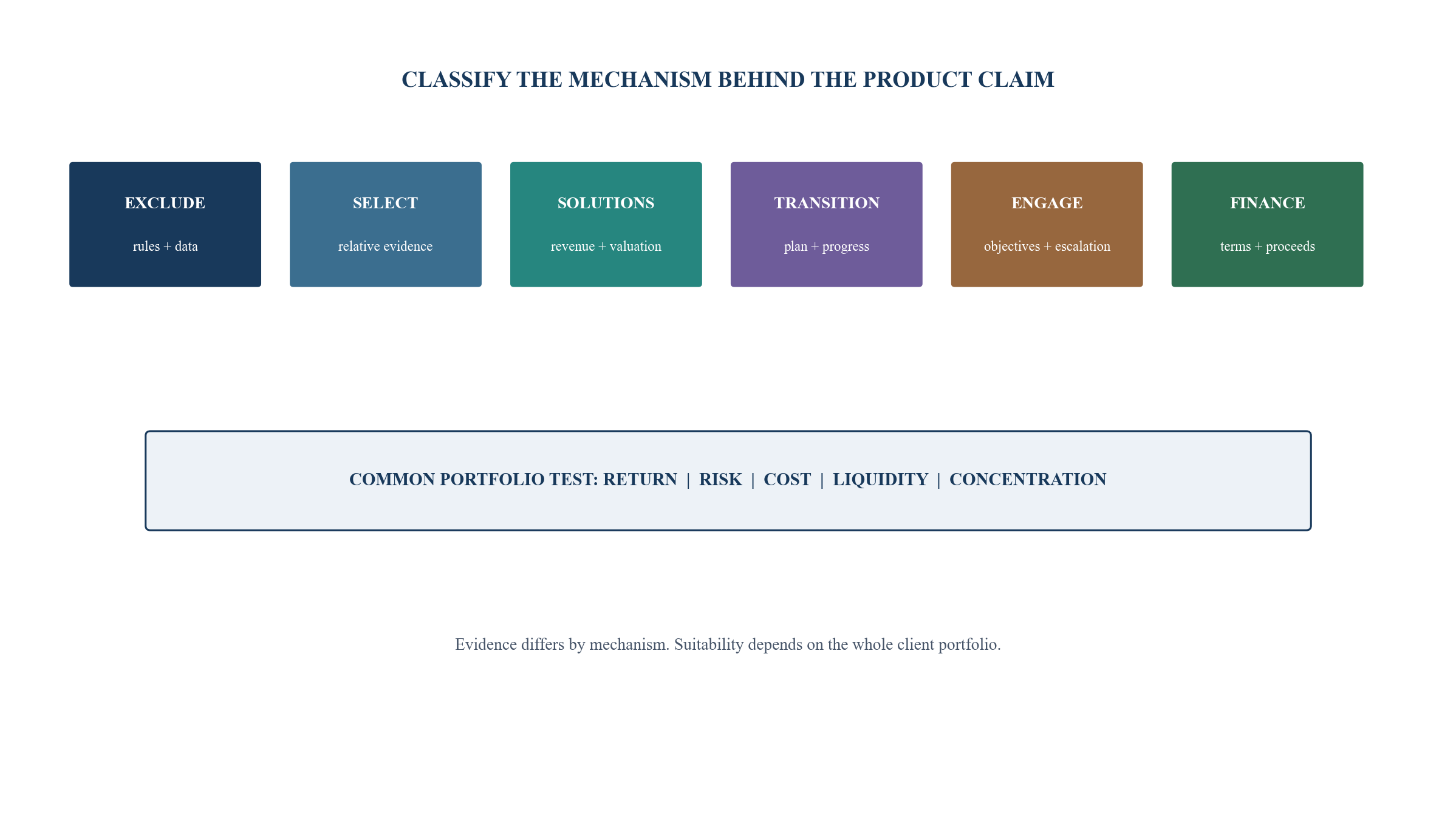
Author framework. Strategies can combine mechanisms; the product file should identify the primary mechanism and evidence test.
6. Test the credibility of transition claims
Transition investing requires forward-looking judgement. Current emissions can be high because the investee operates in a difficult-to-abate sector. The investment case may depend on technology, policy, capital expenditure, customer adoption and management execution. A long-term target alone provides little decision value.
The OECD Guidance on Transition Finance identifies elements of credible corporate transition plans, including net-zero and interim targets, metrics, implementation actions, internal coherence with the business plan, governance, transparency and verification. It also addresses carbon lock-in, offsets, responsible business conduct, just transition considerations and conditions facing emerging markets and developing economies. This provides a useful issuer-underwriting structure.
The product team should test whether the issuer's target covers material operations and value-chain emissions, whether interim milestones are time-bound, whether capital expenditure and operating plans support the pathway, whether governance and incentives align, and whether progress is disclosed and verified. Sector pathways and local enabling conditions matter. A uniform numerical threshold can misclassify businesses across sectors and geographies.
IFRS S2 requires disclosures about governance, strategy, risk management, metrics and targets concerning climate-related risks and opportunities for entities applying the standard. Such disclosure can improve the information set. Disclosure quality does not establish that a transition plan will succeed. Product underwriting should preserve the distinction between reported facts, external estimates and management judgement.
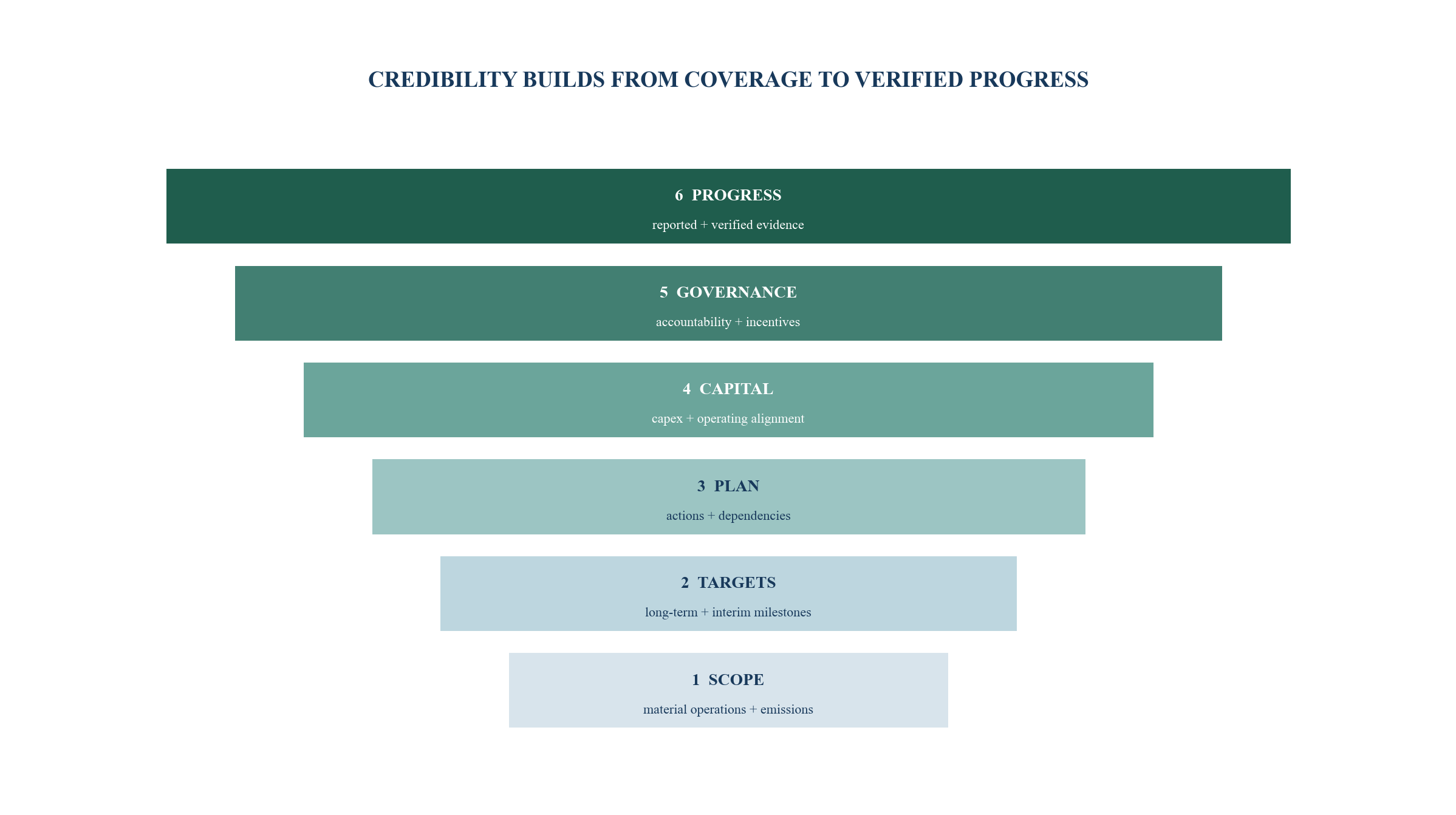
Author framework informed by OECD transition-finance guidance. Advancement requires evidence at every preceding level.
7. Translate preferences into portfolio instructions
A client conversation should produce more than a narrative preference. The RM can translate intent into a set of portfolio instructions that an investment team can implement and monitor. Each instruction should include a definition, measurement method, acceptable range, evidence source, review frequency and escalation rule.
A client focused on climate solutions may specify a target allocation to businesses with defined eligible revenues, together with a limit on thematic concentration. A client focused on transition may allow current high emitters only when issuer plans meet stated credibility tests. A client focused on risk may prioritise scenario resilience and diversification. A values-led client may specify exclusions. A stewardship-led client may require engagement objectives and voting transparency.
The translation should identify trade-offs. Tighter exclusions can increase tracking error and reduce diversification. A solutions allocation can carry growth-factor and valuation exposure. Private infrastructure can provide direct economic exposure with limited liquidity and delayed valuation. Green bonds can introduce duration and credit risk. Transition holdings can generate higher current financed emissions even when the thesis expects future reductions.
Table 3. Translating client preferences into portfolio instructions
| Client statement | Decision interpretation | Possible measurable instruction | Required explanation |
|---|---|---|---|
| I want to invest in climate solutions | allocate to businesses or assets providing defined enabling products and services | target range by eligible-revenue method plus issuer and theme concentration limits | definition, data coverage, valuation risk and overlap |
| I want companies that are changing | support credible transition in material sectors | transition-plan eligibility test, milestone monitoring and exit or engagement rules | current emissions, pathway uncertainty and lock-in risk |
| I want lower climate risk | manage physical and transition risks within the portfolio | scenario, sector, geography and issuer limits integrated with financial risk | model uncertainty and limits of scenario analysis |
| I do not want selected activities | apply values-based restrictions | documented exclusions, revenue thresholds, look-through coverage and breach process | data limitations and indirect exposure |
| I want measurable impact | seek contribution and evidence of outcomes | intentionality, contribution, additionality and outcome-reporting criteria | attribution limits, time horizon and verification |
| I want to use ownership influence | select products with credible stewardship | engagement objectives, escalation milestones, voting record and outcome reporting | uncertain results and time required for change |
Examples are illustrative. Actual instructions require client-specific suitability and legal analysis.
8. Build a product due-diligence file
Product due diligence should connect legal documents, portfolio data and operating evidence. The file should state the product objective, binding strategy, benchmark, portfolio-construction process, research method, governance, resources, risk controls, valuation, liquidity, costs, conflicts, stewardship and reporting. It should preserve the evidence used for approval and subsequent reviews.
Holdings analysis needs enough history to identify actual implementation. Point-in-time holdings can miss turnover, derivatives, cash, temporary deviations and window dressing. For funds of funds and private assets, look-through coverage may be incomplete. The file should state data coverage and limitations.
The review should compare claims across the prospectus, website, presentations, factsheets, questionnaires and reports. Terms should remain consistent. A marketing claim about impact or alignment requires a defined method and supporting evidence. When a product uses a benchmark, the committee should understand how the benchmark is constructed and how active decisions differ from it.
Operating capability matters. The manager needs relevant staff, data, methods, systems, stewardship processes and controls. Outsourced data or ratings create dependency and methodology risk. The committee should understand provider changes, overrides, quality checks and contingency plans.
Table 4. Product due-diligence decision matrix
| Dimension | Evidence to inspect | Approval question | Monitoring trigger |
|---|---|---|---|
| mandate | objective, binding criteria, universe, exclusions and benchmark | is the claim clear and enforceable enough for the shelf? | mandate, label, name or benchmark change |
| portfolio | holdings, turnover, derivatives, cash, factor and sector exposures | does implementation match the stated mechanism? | drift, concentration or unexplained exposure |
| transition | issuer plans, milestones, capital allocation and progress | is forward-looking credibility tested consistently? | missed milestone, capex change or controversy |
| stewardship | objectives, escalation, voting, resources and outcomes | does ownership activity support the proposition? | repeated failed engagement or reporting gap |
| operating model | team, governance, data, models, providers and controls | can the manager execute and evidence the process? | key-person, provider, method or control change |
| economics | management fee, transaction costs, performance fee, platform and advice costs | is the complete cost reasonable for the client outcome? | fee change, high turnover or performance drag |
| liquidity | dealing, notice, gates, side pockets, valuation and funding | does liquidity match the assets and client need? | mismatch, suspension, stale valuation or capital call |
| reporting | disclosures, holdings, engagement, outcomes and exceptions | can the firm monitor the approved thesis after sale? | delayed, inconsistent or materially revised report |
Scores are not prescribed. The committee should document evidence, material gaps and decision consequences.
9. Compare benchmarks and baselines carefully
Climate indices can support implementation and measurement, yet their design choices matter. The European Union created EU Climate Transition Benchmarks and EU Paris-aligned Benchmarks with minimum standards and disclosure requirements. A benchmark label establishes specified construction criteria within that regime. Investors should still examine universe, decarbonisation trajectory, exclusions, sector exposure, turnover and tracking error.
Portfolio decarbonisation can occur through security selection, issuer emissions reductions, changes in enterprise value, data revisions or rebalancing. A falling weighted-average carbon intensity does not by itself show that real-economy emissions fell because of the investor's action. The monitoring report should state the metric, denominator, scope, coverage and drivers of change.
The baseline should fit the client decision. A global equity strategy may need a broad financial benchmark plus a climate-characteristics reference. A private infrastructure portfolio may require asset-level operating measures and cash-flow comparisons. A transition credit strategy may need issuer milestones and credit-risk measures. One metric rarely answers investment performance, portfolio climate characteristics and real-economy contribution simultaneously.
10. Construct the portfolio from total exposures
Portfolio construction begins with expected return, risk and liquidity, then integrates the client's climate instructions. The investment team should measure the proposed product alongside existing holdings. Climate strategies can produce common hidden bets, including growth, quality, technology, industrials, utilities, long duration, policy sensitivity and private-market illiquidity.
The team should calculate issuer overlap, sector and geography differences, currency, factor exposures, duration, credit quality, concentration, liquidity and cost. Where data allow, it can also report financed emissions, carbon intensity, climate-solution revenues, transition eligibility and stewardship coverage. Missing coverage should remain visible.
Allocation size should reflect conviction, uncertainty and diversification. A product with a compelling narrative and limited evidence may warrant a smaller position or watchlist. A private-market allocation should be paced through commitments and modelled with capital calls, distributions and liquidity reserves. A thematic public-equity fund should be tested against existing technology and industrial exposures.
The investment case should include disconfirming evidence. Examples include policy reversal, slower technology adoption, supply constraints, higher rates, weak issuer execution, valuation compression, benchmark drift and unreliable data. Predefined review triggers make these risks actionable.
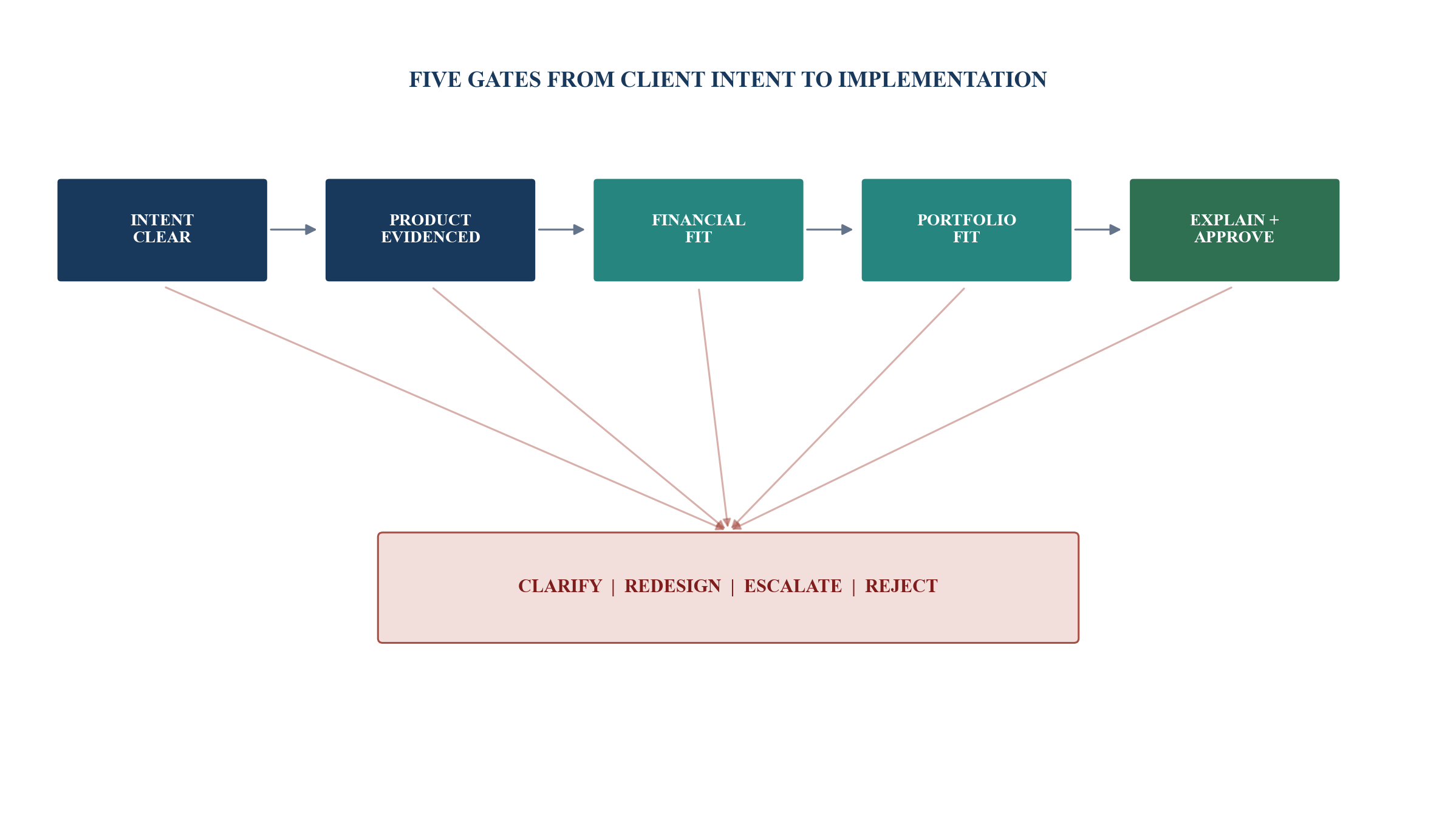
Author framework. A failed material gate routes the proposal to clarification, redesign, escalation or rejection.
11. Use hypothetical cases to reveal trade-offs
Worked cases can help committees and RMs understand how the framework behaves. The following cases use hypothetical management assumptions. They do not describe actual products, clients, expected returns or recommended allocations.
Case A is a liquid global portfolio seeking modest climate integration with limited tracking error. It uses a diversified public-market core, a smaller climate-solutions sleeve and an investment-grade green and transition bond allocation. The key risks are benchmark overlap, duration and whether the labelled fixed-income instruments support the intended use.
Case B places greater weight on corporate transition. It includes a diversified equity core, an actively researched transition strategy and an engagement-led credit sleeve. The main issues are current emissions, issuer-plan credibility, active-manager risk and clear monitoring of milestones.
Case C adds private infrastructure and private credit. It can create more direct exposure to grids, storage, efficiency and industrial projects. It introduces manager selection, valuation, concentration, construction, policy and liquidity risk. Commitment pacing and liquidity reserves become central.
Table 5. Hypothetical climate-transition portfolio cases
| Sleeve | Case A: liquid integration | Case B: transition emphasis | Case C: private-market build |
|---|---|---|---|
| diversified public-market core | 70% | 55% | 45% |
| climate-solutions public equity | 10% | 10% | 5% |
| transition equity or credit | 5% | 20% | 10% |
| labelled investment-grade bonds | 15% | 15% | 10% |
| private infrastructure | 0% | 0% | 20% |
| private transition credit | 0% | 0% | 10% |
| primary control | tracking error and overlap | issuer milestones and active risk | pacing, liquidity reserve and valuation |
| review question | does the sleeve improve the stated characteristic without duplicating existing exposure? | are high-emitting holdings supported by credible plans and monitored progress? | can the client fund commitments and tolerate illiquidity through adverse conditions? |
All allocations are hypothetical management assumptions for method demonstration. They are not recommendations, forecasts or actual client portfolios.
12. Show risk and sustainability characteristics together
An investment dashboard should present financial and sustainability characteristics in the same decision view. Separate reports encourage sustainability information to be treated as an appendix. A combined view shows whether a proposed improvement in one measure creates another risk.
The risk panel can cover expected volatility, drawdown sensitivity, tracking error, duration, credit quality, currency, liquidity and concentration. The sustainability panel can cover strategy mechanism, data coverage, current emissions metrics, solution revenues, transition-plan eligibility, engagement coverage and reported progress. Each metric should include a definition and source date.
Metrics should not be aggregated into one opaque score unless the methodology and trade-offs are understood. A red-amber-green display can support attention when the underlying values remain accessible. Thresholds should trigger review rather than create a false claim of precision.
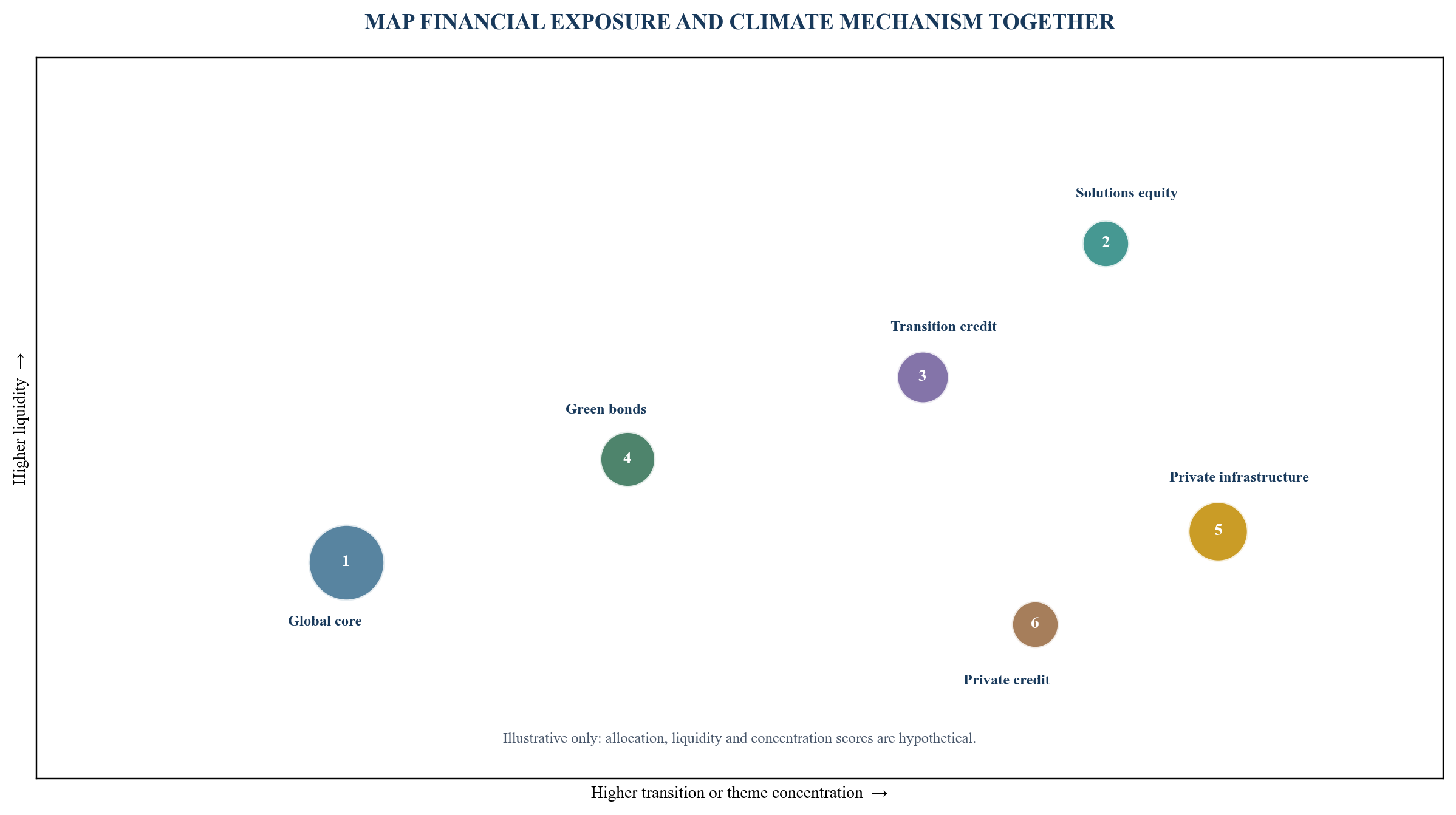
Hypothetical management assumptions for illustration. Bubble size represents assumed allocation; positions do not describe real products.
13. Make complete economics visible
The client should see the complete cost of the proposition. Costs can include fund management fees, performance fees, transaction costs, platform fees, custody, advice, structuring, foreign exchange, hedging and underlying vehicle expenses. Private funds can add carried interest, organisational expenses and costs at portfolio-company or project level.
A fee waterfall should begin with gross portfolio return as a hypothetical analytical input and show each cost layer before arriving at the client's net result. The purpose is to compare products consistently and identify double charging. The model should also show costs during weak or flat performance, because some fixed charges continue when returns do not.
Cost analysis should connect to the service delivered. An active transition strategy can require costly research and stewardship. The committee should test whether the evidence, portfolio differentiation and implementation justify the fee. A low-cost index product can still create transaction, tax, spread and tracking considerations.
All fee illustrations should state assumptions, dates and exclusions. Product-specific disclosures remain authoritative. Tax effects require client-specific professional advice.
14. Equip relationship managers with an evidence card
The RM needs a concise view that supports an informed conversation. The card should state the client's documented objective, product mechanism, binding criteria, principal exposures, role in the portfolio, key risks, complete costs, liquidity, evidence limitations and monitoring triggers. It should link to approved source documents.
The card should distinguish facts from analysis. A label and prospectus term can be documented facts. An assessment that an issuer plan is credible is a professional judgement supported by evidence. A scenario result is conditional on assumptions. This distinction strengthens explanations and review.
Approved language should avoid broad claims that the product is green, aligned or impactful without definition. The RM can explain what the product seeks to do, how it implements the strategy, what evidence supports the claim and which uncertainties remain. The client should understand that climate characteristics and financial performance can change.
Training should use realistic cases. RMs should practise clarifying ambiguous preferences, comparing products, explaining current high emitters in a transition strategy, discussing data gaps and responding when a client requests a claim that the evidence does not support.
15. Govern distribution and communication
Distributors should receive current product information, target-market definitions, risks, costs, changes and monitoring alerts. The manufacturer and distributor should agree how material events are communicated and which documents are authoritative. Local rules determine the exact product-governance and distribution obligations.
Websites, presentations, factsheets, proposals and RM scripts should use consistent defined terms. Claims should be specific, substantiated, current and proportionate. A product review should capture material differences between a formal objective and marketing shorthand. Translations should preserve meaning.
Digital journeys need controls as well. Filters and questionnaires can lead clients toward products. The design should explain criteria, limitations and the relationship between preferences and financial suitability. A product badge should link to meaningful evidence rather than operate as a decorative signal.
Complaint and feedback data can reveal misunderstanding. Recurring questions about impact, emissions or guarantees should lead to improved wording, training and product evidence. Distribution governance therefore extends beyond approval into observed client understanding.
16. Monitor drift, milestones and data changes
The approval thesis should become the monitoring plan. A transition product can drift because holdings change, an issuer misses milestones, a benchmark changes, a data provider revises methodology, a label is removed, an engagement fails or a manager changes its process. Financial characteristics and liquidity can also change.
The dashboard should show evidence freshness, mandate compliance, holding overlap, transition-plan status, engagement progress, data coverage, performance, risk, liquidity and cost. It should identify exceptions, owners and due dates. A material breach should have a defined consequence.
Monitoring frequency should match risk. Daily or monthly controls may apply to mandate and portfolio data. Quarterly review may suit holdings, exposures and engagement. Annual review may cover the complete product thesis and operating model. Event-driven review should follow material changes.
The committee should examine outcomes across the shelf. If multiple products repeatedly miss transition milestones or deliver similar exposures at different fees, the shelf may need consolidation or redesign. Client portfolios should be reviewed when the original preference, financial circumstances or product evidence changes.
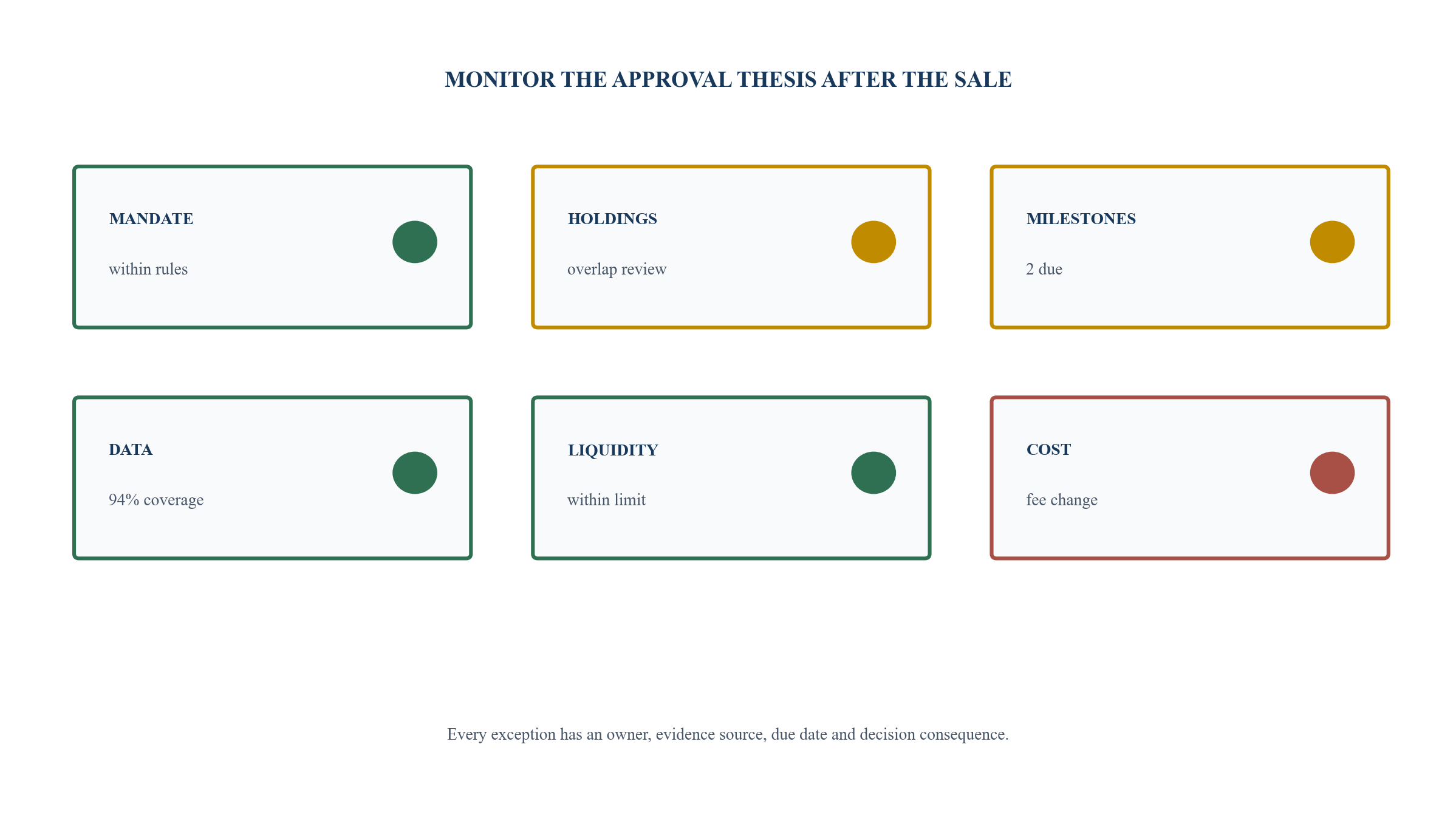
Hypothetical management thresholds for illustration. Firms should set evidence-based thresholds and named owners.
17. Define escalation and exit rules
The product file should state what leads to watchlist, restriction, suspension or removal. Triggers can include a material mandate breach, misleading communication, loss of label, persistent data gaps, missed transition milestones, weak engagement, strategy drift, key-person departure, valuation concern, liquidity event or unacceptable operational failure.
An exit decision should consider client impact, market liquidity, tax, contractual terms and available alternatives. Immediate sale can harm a client in stressed markets or closed structures. The committee should have authority to stop new purchases while developing an orderly client-specific response.
The RM communication should explain the event, its effect on the original investment thesis, actions taken and choices available. Claims about environmental outcomes should be corrected when evidence changes. Records should preserve the original evidence and the reason for the decision.
For private assets, exit can be constrained. Governance may rely on consent rights, advisory committees, covenants, stewardship, manager engagement, secondary sales or holding to maturity. This makes initial underwriting and commitment sizing especially important.
18. Implement the operating model in 180 days
Implementation should produce usable controls and evidence. The first month establishes accountable ownership, product inventory, client-preference taxonomy and a gap assessment. Days 31 to 60 define the evidence register, product taxonomy, due-diligence standard and communication rules. Days 61 to 90 pilot reviews and build portfolio analytics.
Days 91 to 120 integrate suitability, fees, RM evidence cards and approval workflows. Days 121 to 150 implement monitoring, change alerts, escalation and training. Days 151 to 180 test the process, remediate gaps and provide senior management with an evidence-based launch decision.
The programme should prioritise products with the highest claim complexity, client exposure, illiquidity or evidence gaps. It should name owners for investments, product, compliance, risk, operations, data, technology, legal and distribution. Deliverables should be stored in one controlled product file.
Table 6. 180-day climate-product implementation roadmap
| Period | Core work | Evidence delivered | Decision gate |
|---|---|---|---|
| days 1-30 | appoint owners; inventory products, claims, jurisdictions and client exposure | scope, governance, product register and gap assessment | approve programme scope and priorities |
| days 31-60 | define taxonomy, evidence register, claim standard and client-preference translation | data dictionary, product template, communication rules and controls | approve minimum evidence standard |
| days 61-90 | pilot product underwriting and portfolio look-through | completed files, exposure analytics, exceptions and remediation | decide pilot shelf status |
| days 91-120 | embed suitability, fee waterfall, RM card and approvals | workflow, scripts, records, source links and authority matrix | approve controlled distribution |
| days 121-150 | activate monitoring, alerts, training, complaints and escalation | dashboard, watchlist, event process and competency evidence | confirm operating readiness |
| days 151-180 | test cases, challenge evidence, remediate and report | test results, open risks, management attestations and board pack | launch, limit, extend pilot or pause |
Sequence and ownership are illustrative and should be adapted to the firm, licence, products and jurisdictions.
19. Give senior management decision-useful reporting
Senior management needs information that connects client exposure to product evidence and control performance. A useful pack includes assets and clients by strategy mechanism, jurisdiction and label; evidence completeness; data coverage; concentration; liquidity; fees; transition milestones; engagement; exceptions; complaints; watchlist products and overdue remediation.
The pack should explain changes and decisions. Counts alone can hide materiality. A single misleading claim in a widely distributed product can matter more than many low-risk documentation gaps. Exposure, severity and client consequence should shape escalation.
Management should see the assumptions and limitations behind portfolio metrics. Data coverage, estimation methods and provider changes can affect trends. The report should explain whether a change reflects holdings, issuer performance, market values or methodology.
Board or committee minutes should record challenge and action. Questions can include whether approved products deliver distinct exposures, whether costs remain justified, whether RMs can explain the propositions, whether evidence is current and whether any claim exceeds support.
20. Build the commercial proposition around evidence
Private clients can access climate narratives through many providers. A differentiated advice proposition connects the client's objective to a governed product shelf, a complete portfolio and continuing evidence. The value comes from clarification, underwriting, construction, implementation and monitoring.
This work also creates operating leverage. One evidence register can support product committee review, RM conversations, portfolio reporting, compliance testing and management oversight. Standard definitions reduce repeated debate. Clear escalation rules shorten decisions when evidence changes.
The proposition should describe the service accurately. It can offer a documented preference assessment, product due diligence, portfolio diagnostics, implementation roadmap and periodic monitoring. Outcomes depend on markets, products, issuers and client decisions. The service should not promise investment performance or environmental results.
Conclusion
Climate transition products should move through an evidence chain from client intent to product claim, disclosure context, holdings, issuer transition evidence and whole-portfolio outcome. Each layer answers a different question and requires a named source, owner and review cycle.
International rules and standards provide useful disciplines for product names, labels, disclosures, governance and investor understanding. Their scopes differ. A firm can apply a common evidence architecture while completing jurisdiction-specific legal and compliance analysis.
Portfolio construction remains central. The investment team should measure return, risk, liquidity, concentration, currency, factors, costs and overlap alongside climate characteristics. Hypothetical cases show that liquid integration, transition emphasis and private-market exposure require different controls.
The governing question is practical: can the firm show what the client asked for, what the product is required to do, what the client economically owns, why the transition claim is credible enough for the mandate, how the total portfolio changes, what it costs and what evidence will trigger action? A complete answer converts climate language into an accountable investment process.
References
- UK Financial Conduct Authority, Sustainability Disclosure Requirements regime, updated 8 June 2026, https://www.fca.org.uk/firms/climate-change-and-sustainable-finance/sustainability-disclosure-requirements-sdr-regime
- UK Financial Conduct Authority, Sustainability labels, updated 5 June 2026, https://www.fca.org.uk/firms/climate-change-and-sustainable-finance/labels
- UK Financial Conduct Authority, Sustainable investment labels: good and poor practice, updated 5 June 2026, https://www.fca.org.uk/publications/good-and-poor-practice/sustainable-investment-labels
- European Securities and Markets Authority, Guidelines on funds' names using ESG or sustainability-related terms, 21 August 2024, https://www.esma.europa.eu/sites/default/files/2024-08/ESMA34-1592494965-657_Guidelines_on_funds_names_using_ESG_or_sustainability_related_terms.pdf
- European Commission, Sustainability-related disclosure in the financial services sector, https://finance.ec.europa.eu/sustainable-finance/disclosures/sustainability-related-disclosure-financial-services-sector_en
- European Commission, Commission simplifies transparency rules for sustainable financial products, legislative proposal, 20 November 2025, https://finance.ec.europa.eu/publications/commission-simplifies-transparency-rules-sustainable-financial-products_en
- European Commission, EU labels for climate benchmarks and benchmark ESG disclosures, https://finance.ec.europa.eu/sustainable-finance/disclosures/eu-labels-benchmarks-climate-esg-and-benchmarks-esg-disclosures_en
- European Commission, Implementing and delegated acts under the EU Climate Transition Benchmarks Regulation, https://finance.ec.europa.eu/regulation-and-supervision/financial-services-legislation/implementing-and-delegated-acts/eu-climate-transition-benchmarks-regulation_en
- United States Securities and Exchange Commission, SEC adopts amendments to enhance the Names Rule, 20 September 2023, https://www.sec.gov/newsroom/press-releases/2023-188
- United States Securities and Exchange Commission, SEC extends compliance dates for amendments to Investment Company Names Rule, 14 March 2025, https://www.sec.gov/newsroom/press-releases/2025-54
- United States Securities and Exchange Commission, Investment Company Names Rule FAQs, https://www.sec.gov/rules-regulations/staff-guidance/division-investment-management-frequently-asked-questions/2025-26-names-rule-faqs
- Securities and Futures Commission of Hong Kong, Circular to management companies of SFC-authorised unit trusts and mutual funds: ESG funds, 29 June 2021, https://apps.sfc.hk/edistributionWeb/api/circular/openFile?lang=EN&refNo=21EC27
- Securities and Futures Commission of Hong Kong, List of ESG funds, https://www.sfc.hk/en/regulatory-functions/products/list-of-esg-funds
- Monetary Authority of Singapore, Circular CFC 02/2022: Disclosure and Reporting Guidelines for Retail ESG Funds, 28 July 2022, https://www.mas.gov.sg/-/media/mas/regulations-and-financial-stability/regulations-guidance-and-licensing/securities-futures-and-fund-management/regulations-guidance-and-licensing/circulars/cfc-02-2022-disclosure-and-reporting-guidelines-for-retail-esg-funds.pdf
- Australian Securities and Investments Commission, Information Sheet 271: How to avoid greenwashing when offering or promoting sustainability-related products, https://asic.gov.au/regulatory-resources/financial-services/how-to-avoid-greenwashing-when-offering-or-promoting-sustainability-related-products/
- Financial Services Agency of Japan, Publication of supervisory guideline amendments concerning ESG investment trusts, 31 March 2023, https://www.fsa.go.jp/en/news/2023/20230331/20230331.html
- IFRS Foundation, IFRS S2 Climate-related Disclosures, issued 26 June 2023, https://www.ifrs.org/issued-standards/ifrs-sustainability-standards-navigator/ifrs-s2-climate-related-disclosures/
- Organisation for Economic Co-operation and Development, OECD Guidance on Transition Finance: Ensuring Credibility of Corporate Climate Transition Plans, 3 October 2022, https://doi.org/10.1787/7c68a1ee-en
- International Organization of Securities Commissions, Recommendations on Sustainability-Related Practices, Policies, Procedures and Disclosure in Asset Management, November 2021, https://www.iosco.org/library/pubdocs/pdf/IOSCOPD688.pdf
About the Author
Chennakeshav Adya is an independent researcher and Managing Partner of Matchpoint Partners. His work examines strategy, capital formation, valuation, transactions and operating execution across private and public markets.
