

Introduction
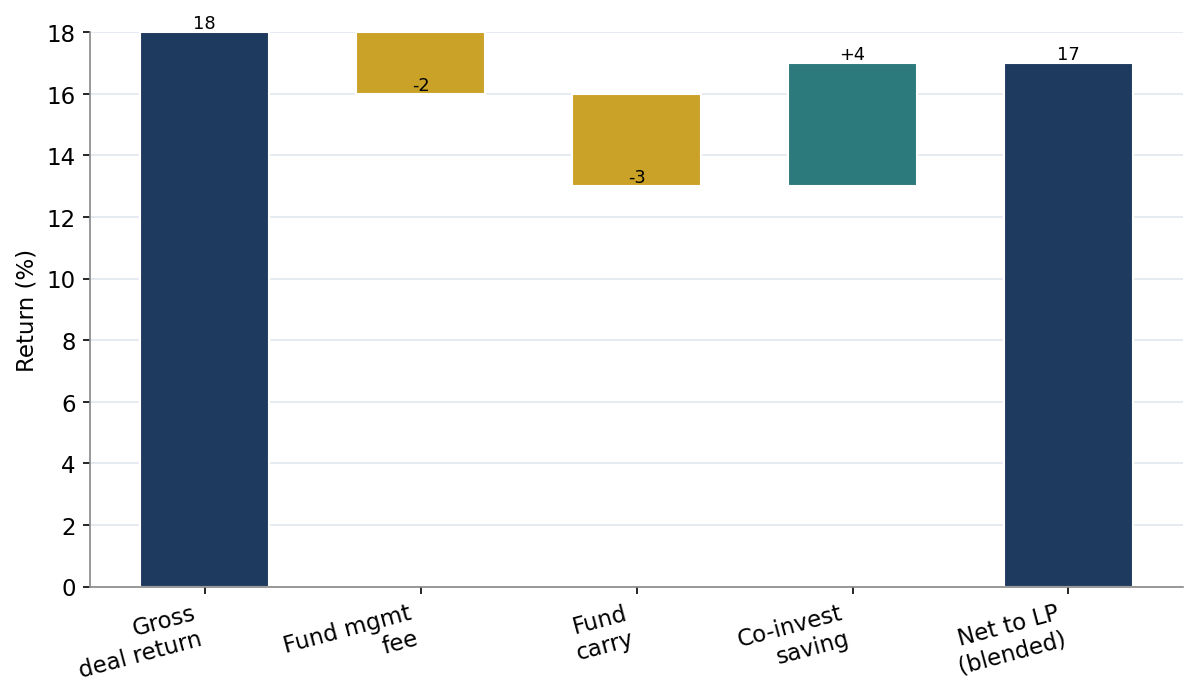
When a family office measures the return it earns from private markets, the number that matters is not the gross return the underlying investments produce but the net return it actually keeps after fees. Between the two lies the fee drag, the management fees, the performance fees or carry, and the fund expenses that the manager takes, and that drag is substantial: it can consume a quarter or more of the gross return over the life of an investment. Reducing the fee drag is therefore one of the most effective ways a family office can improve its net return, and co-investment is the most powerful tool for doing so.
Co-investment is the right to invest directly alongside a fund manager in a specific deal, usually on terms that reduce or eliminate the fees and carry on the co-invested capital. An investor that commits to a fund and also co-invests captures the manager sourcing and underwriting on the co-invested portion while paying little or no fee on it, blending the diversification and access of fund investing with the low cost of direct investing. The effect on the net return can be material, which is why co-investment has become one of the most sought-after rights in private markets and a central tool for sophisticated LPs.
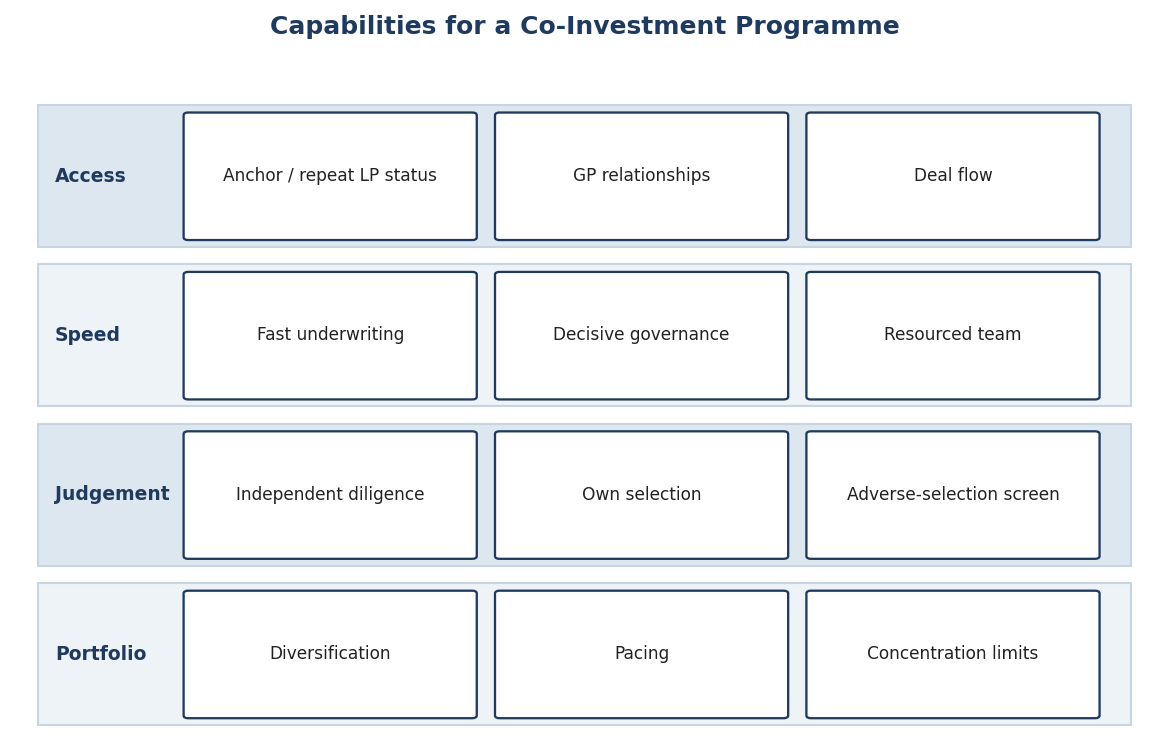
This paper examines co-investment rights as a tool for GCC family offices and private wealth to improve their net LP returns. The central argument is that co-investment can lift the blended net return materially, that the uplift rises with the share of the allocation co-invested, but that capturing it depends on three things: access to co-investment opportunities, which the best managers offer to their most valued investors; the independent judgement to select among the opportunities offered; and the disciplined management of the adverse-selection risk that a manager may share its less attractive deals. Co-investment is not free money; it is a capability that must be built and a risk that must be managed.
The Net-Return Uplift
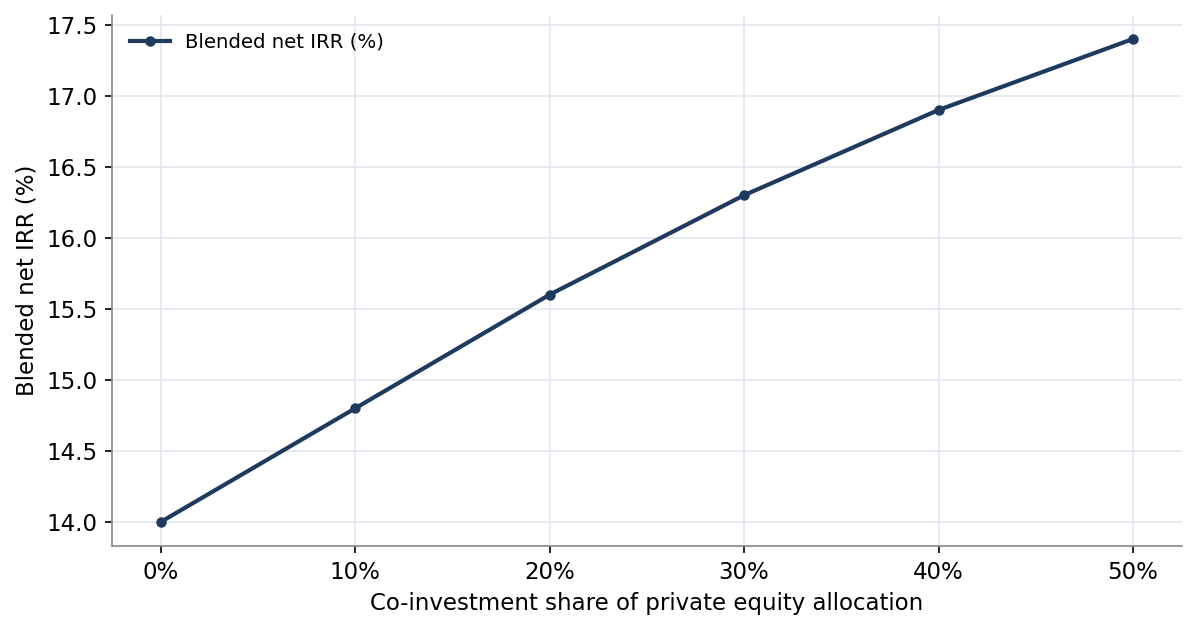
The net-return uplift from co-investment is the central benefit, and Figure 3 quantifies how it rises with the share of the allocation co-invested. As the co-invested share rises from zero, the blended net internal rate of return rises, because more of the allocation captures the low co-investment fees rather than the full fund fees. The uplift is material: a substantial co-investment share can lift the blended net return by a meaningful margin, which over a large allocation and across years is a significant enhancement to the family office wealth.
Figure 3. Blended Net IRR Against Co-Investment Share
The uplift rises with the co-invested share because the fee saving applies to more of the allocation, but it is bounded by the access an LP can secure and by prudence. An LP cannot co-invest its whole allocation, both because it cannot secure that much co-investment access and because doing so would concentrate its capital in the specific co-invested deals, sacrificing the diversification of the fund. The optimal co-investment share therefore balances the fee-saving uplift against the access available and the diversification and concentration considerations, and it is typically a substantial but not total share of the private markets allocation.
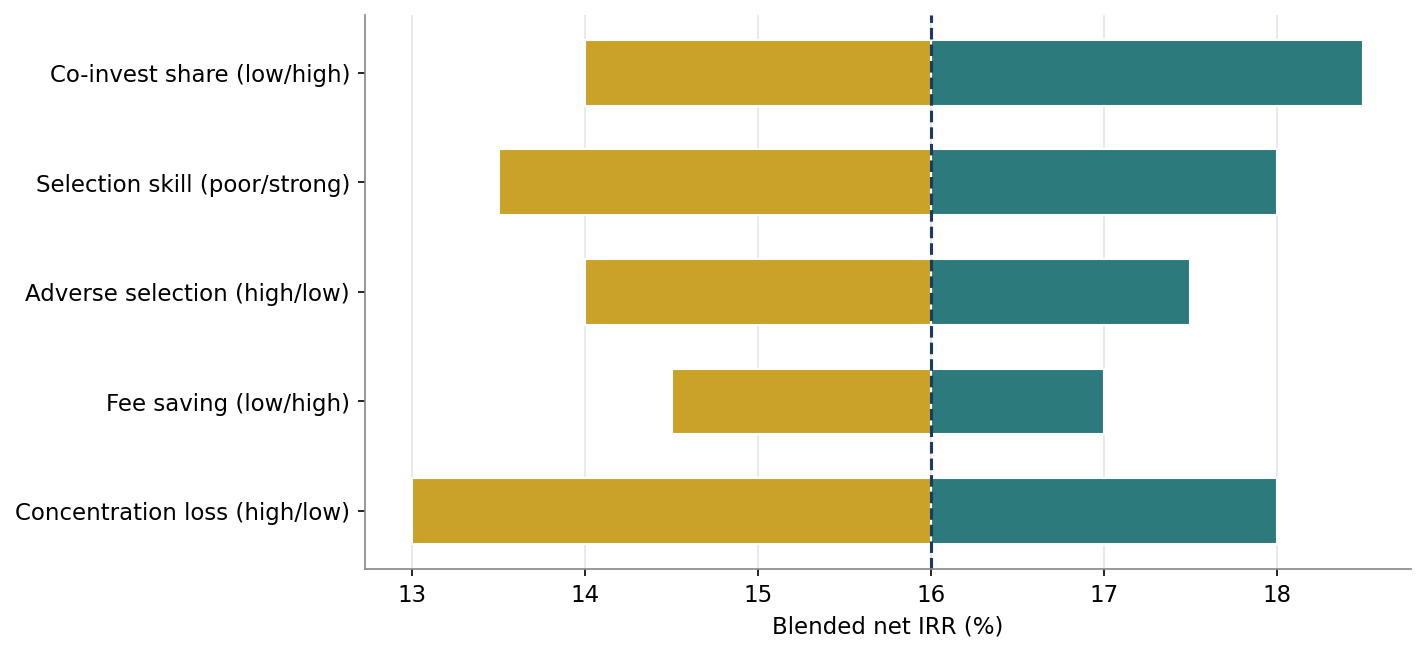
The uplift is also conditional on the co-investments being well-selected, because a poorly-selected co-investment captures the fee saving on a poor deal, which may produce a poor net return despite the low fee. The uplift in Figure 3 assumes co-investments of comparable quality to the fund deals, which holds only if the LP selects well and avoids adverse selection. An LP that selects poorly, or that suffers adverse selection, may find its co-investments underperform, eroding rather than enhancing its net return, which is why the selection and adverse-selection management examined later are essential to capturing the uplift.
The net-return uplift, well captured, is one of the most valuable enhancements available to a private markets LP, because it works directly on the controllable fee drag and compounds over the life of the allocation. A family office that builds a co-investment programme that captures the uplift on well-selected deals lifts its blended net return materially, enhancing its wealth across the private markets allocation. The uplift is the prize that justifies building the co-investment capability and managing the risks, and capturing it well is the objective the framework pursues.
Fee Structures on Co-Investment
The fee structures on co-investment vary, and understanding them is part of capturing the uplift. The most favourable structure, offered to valued LPs, is no fee and no carry on the co-invested capital, so the LP keeps the full gross return on its co-investment. This is the structure that delivers the maximum uplift, and a valued LP should seek it. Less favourable structures charge a reduced fee or carry, still below the full fund fees but capturing less of the saving, and an LP should understand which structure it is being offered and negotiate toward the most favourable it can secure.
The fee structure reflects the LP standing and the manager motivation. A manager offers no-fee, no-carry co-investment to its most valued LPs, to reward and retain them, while it may charge a reduced fee to less valued LPs or on deals where it has more leverage. An LP that has established itself as valued, through reliable commitment and constructive engagement, can secure the most favourable fee structures, capturing more of the co-investment benefit, which is part of why establishing oneself as a valued LP is central to the co-investment programme. The fee structure is a function of the relationship as much as the deal.
The fee structure also affects the comparison between co-investment and the fund. A no-fee, no-carry co-investment captures the full gross return, materially above the fund net return, while a reduced-fee co-investment captures less of the saving. The LP should assess the net return it would earn on the co-investment, after whatever fees apply, against the fund net return, to gauge the uplift, and should weight its co-investment toward the most favourable fee structures. The fee structure determines the size of the uplift, and an LP focused on its net return will seek and weight toward the structures that deliver the most.
The Adverse-Selection Risk
The central risk in co-investment is adverse selection, illustrated in Figure 5: the risk that the co-investments an LP is offered are skewed toward the manager less attractive deals, because the manager retains its best deals for the fund where it earns full fees and carry. If a manager behaves this way, the LP that takes the offered co-investments without independent selection ends up with a portfolio of the manager weaker deals, capturing the fee saving but on inferior deals, which may underperform the fund despite the lower fees.
Figure 5. Adverse-Selection Risk by Manager Behaviour
Not all managers behave this way; some share co-investment pro-rata across their deals, or even share their best deals to reward valued LPs, and the adverse-selection risk depends on the manager behaviour. An LP must assess, for each manager and each co-investment, why the manager is sharing the deal: is it sharing pro-rata, sharing a deal too large for the fund, or offloading a difficult deal it would rather not hold in full? The answer determines the adverse-selection risk, and an LP should probe the manager motivation, favouring managers that share fairly and being wary of those that appear to offload their weaker deals.
Managing adverse selection requires independent underwriting: the LP must assess each co-investment on its own merits, with its own judgement, rather than assuming the manager offering it is acting in the LP interest. An LP that underwrites each co-investment independently can distinguish the genuinely attractive opportunities from the manager rejects, taking the former and declining the latter, capturing the uplift on good deals while avoiding the adverse-selection trap. The independent underwriting is the LP defence against adverse selection, and it is why the selection capability examined next is central to co-investment.
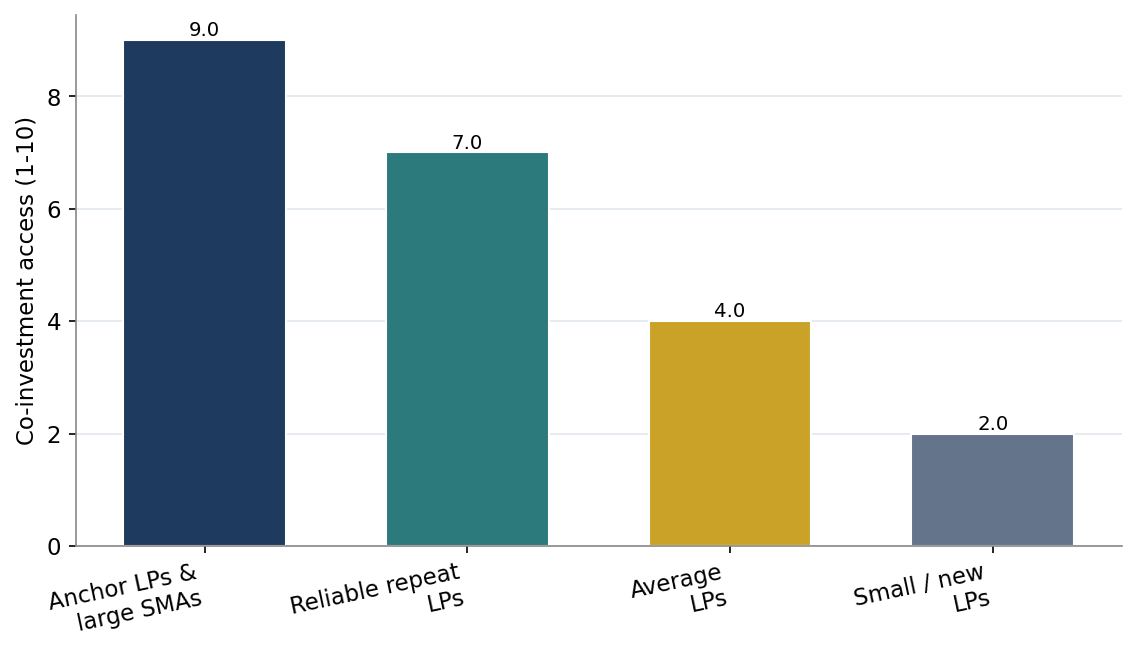
The adverse-selection risk means that access alone is not enough; the LP must also select well among the co-investments it is offered. An LP with strong access but weak selection may take the manager weaker deals and underperform, while an LP with strong access and strong selection takes the genuinely attractive deals and captures the uplift. The combination of access and selection is therefore what captures the uplift, and the adverse-selection risk is the reason selection matters as much as access. The LP must build both the access to be offered co-investments and the selection to choose well among them.
Selecting Co-Investments
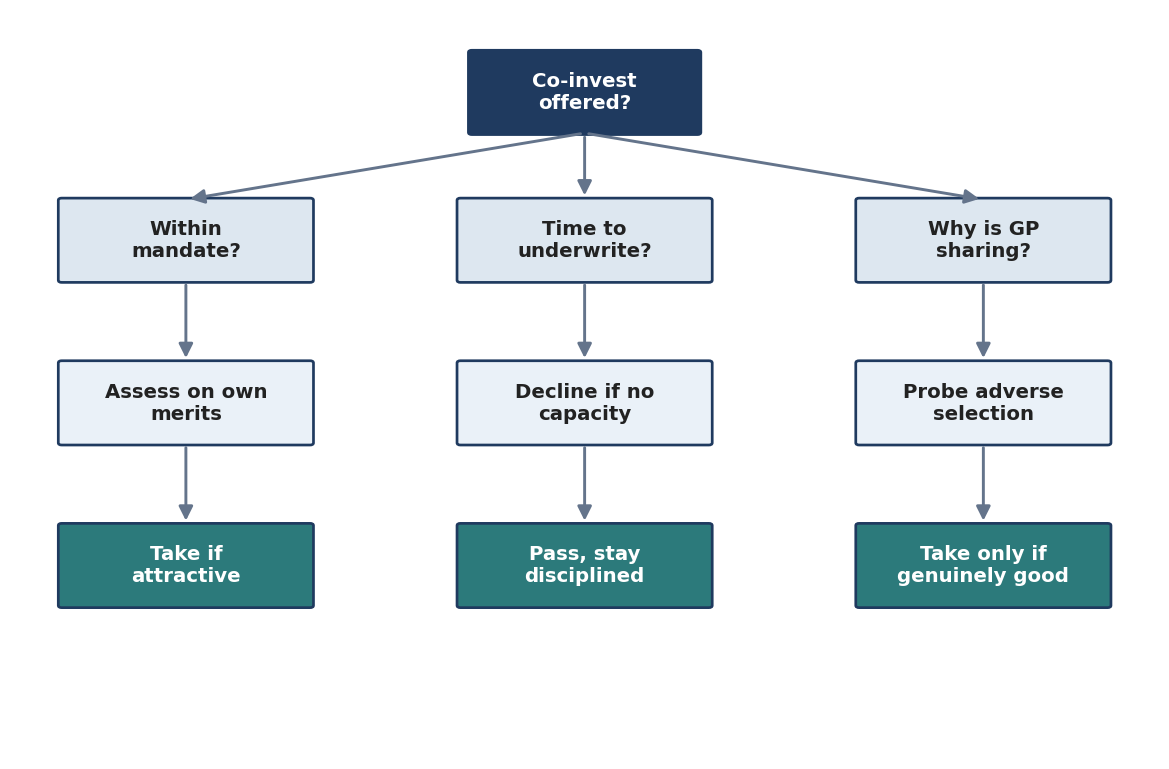
Selecting co-investments well is the LP defence against adverse selection and the key to capturing the uplift on genuinely attractive deals. Figure 6 sets out a decision framework for a co-investment opportunity. The LP should assess whether the deal is within its mandate and capability to underwrite, whether it has the time and capacity to underwrite it on the manager timetable, and why the manager is sharing it, probing for adverse selection. Only if the deal is attractive on its own merits, within the LP capability, and free of adverse-selection concerns should the LP take it.
Figure 6. Co-Investment Selection Decision Framework
The selection requires the LP to underwrite the deal independently, assessing the asset or company, the price, the structure, the risks, and the return, with its own judgement on the manager underwriting rather than merely accepting it. The LP need not replicate the manager full diligence, but it must form its own view of the opportunity, sufficient to decide whether it is genuinely attractive. This independent underwriting is the core of co-investment selection, and it is what distinguishes a disciplined co-investor that captures the uplift on good deals from an undisciplined one that takes whatever is offered.
The selection should also consider the fit of the co-investment within the LP portfolio: its diversification, its concentration, and its contribution to the portfolio risk and return. A co-investment that is attractive on its own merits but that concentrates the LP portfolio in a sector or risk it is already heavily exposed to may not be a good addition, while one that diversifies the portfolio adds more. The selection therefore considers both the deal merits and the portfolio fit, ensuring that the co-investments build a diversified, balanced portfolio rather than a concentrated one, which the portfolio construction examined later addresses.
Risk Management
Co-investment carries risks the LP must manage beyond adverse selection. The principal additional risk is concentration: co-investments concentrate the LP capital in specific deals, and a co-investment programme must be diversified, as the portfolio construction discussed, to manage the concentration. An LP that co-invests heavily in a few deals bears the idiosyncratic risk of each, and a poor outcome on a concentrated co-investment can materially harm the LP return, which is why diversification across co-investments is essential to managing the concentration risk.
The second risk is the selection risk, that the LP selects poorly among the co-investments it is offered, taking deals that underperform. This risk is managed by the independent underwriting and disciplined selection examined earlier, which capture the genuinely attractive deals and decline the others. An LP with weak selection bears the selection risk, taking deals that underperform, while one with strong selection manages it, and the selection capability is therefore both the key to capturing the uplift and the management of the selection risk, which are two sides of the same capability.
The third risk is the speed risk, that the compressed co-investment timetable forces the LP to decide quickly with insufficient diligence, leading to poor decisions. This risk is managed by building the capability to underwrite and decide quickly but well, with processes that allow a sound decision on the manager timetable, and by declining co-investments the LP cannot underwrite adequately in the time available. An LP that decides quickly but poorly bears the speed risk, while one that can decide quickly and well, or that declines what it cannot assess in time, manages it. The speed capability is therefore part of the risk management as well as the access.
The risk management, across adverse selection, concentration, selection and speed, is what allows the LP to capture the co-investment uplift without taking on the risks that co-investment carries. An LP that manages these risks, through independent underwriting, diversification, disciplined selection, and the capability to decide quickly but well, captures the uplift on a well-managed portfolio, while one that does not may capture the fee saving but on a concentrated, poorly-selected portfolio that underperforms. The risk management is therefore integral to capturing the uplift well, and it is part of the co-investment capability the LP must build.
Structuring and Terms
Co-investments are structured through vehicles and terms that the LP should understand and negotiate. The co-investment is typically held through a special-purpose vehicle that holds the LP interest in the deal alongside the fund, isolating the co-investment and defining the LP rights. The LP should understand the vehicle, its governance, its costs, and the rights it confers, and should ensure the structure gives it the protections appropriate to a direct investment in the deal, not merely a passive interest.
The terms cover the fees, examined earlier, and the LP rights in the deal: its information rights, its rights on major decisions, its rights on exit, and its rights relative to the fund. A valued LP can negotiate favourable terms, including good information and governance rights, while a less valued LP may take standard terms. The LP should negotiate the terms to secure the rights it needs to monitor and protect its co-investment, recognising that the co-investment is a direct interest in the deal that warrants appropriate rights, not merely a fee-reduced fund interest.
The structuring should also address the alignment between the co-investors and the fund, and the treatment of the co-investment relative to the fund on key decisions and exit. The co-investment and the fund invest in the same deal but through different vehicles, and the structuring should ensure they are aligned on the key decisions and the exit, so that the co-investors are not disadvantaged relative to the fund. An LP should understand how its co-investment ranks and aligns with the fund, and should ensure the structuring treats it fairly, particularly on exit timing and proceeds.
The compliant dimension applies to co-investment structuring as to other private markets, and a GCC LP requiring Shariah compliance must ensure its co-investments and their vehicles are compliant. Because the LP structures its co-investment directly, it has more control over the compliance than in a fund, where it relies on the fund compliance, which can be an advantage for an LP requiring compliance. The LP should ensure its co-investment vehicles and the underlying deals are compliant where it requires, structuring them appropriately, which is more within its control in co-investment than in fund investing.
Case Studies
Three investor cases illustrate the framework applied at different scales of co-investment. The figures are modelled for analytical clarity and are not drawn from any specific investor.
Case A: the anchor-LP programme
Case A is a large family office that commits to funds as an anchor investor and secures strong co-investment access, building a substantial co-investment programme that co-invests a large share of its private equity allocation. It captures a material net-return uplift from the fee saving on the large co-invested share, while managing the adverse-selection and concentration risks through independent underwriting and diversification across many co-investments. The case illustrates the anchor-LP programme, securing strong access through scale and capturing a large uplift on a well-managed co-investment portfolio.
Case B: the selective co-investor
Case B is a family office of moderate scale that commits to funds and co-invests selectively alongside a few valued managers, co-investing a moderate share of its allocation on carefully selected deals. It captures a moderate uplift from the fee saving, focusing its co-investment on the genuinely attractive deals it can underwrite well, and managing the risks through disciplined selection and diversification. The case illustrates the selective co-investor, capturing a moderate uplift through disciplined selection of co-investments from a few valued managers.
Case C: the opportunistic co-investor
Case C is a smaller family office, building its co-investment capability, that co-invests opportunistically on the occasional deals it is offered, co-investing a small share of its allocation. It captures a smaller uplift, limited by its access and capability, but builds its co-investment capability and relationships through the opportunities it takes, laying the foundation for a larger programme as its access and capability grow. The case illustrates the opportunistic co-investor, capturing a smaller uplift while building toward a larger programme.
Figure 8. Co-Investment Share and Net IRR Uplift by Programme
Common Errors and How to Avoid Them
A recognisable set of errors recurs in co-investment programmes.
Uncritical co-investment. Taking every co-investment offered, without independent selection, exposes the LP to adverse selection and concentration. The remedy is disciplined, independent selection of each co-investment.
Ignoring adverse selection. Assuming the GP is acting in the LP interest on each deal ignores the adverse-selection risk. The remedy is to probe why the GP is sharing each deal and underwrite independently.
Concentrated co-investment. Co-investing heavily without diversification concentrates the LP capital in specific deals. The remedy is to diversify the co-investment portfolio across deals, sectors and managers.
Neglecting access. Failing to build the access and standing that secure co-investment offers limits the uplift. The remedy is to establish oneself as a valued, reliable, decisive LP.
Mismanaging the speed. Deciding on co-investments too quickly with insufficient diligence, or too slowly to meet the GP timetable, leads to poor decisions or missed opportunities. The remedy is the capability to decide quickly but well.
Each of these errors is avoidable through the disciplined approach the framework encourages: select independently, manage adverse selection, diversify, build access, and decide quickly but well. The LP that does so captures the co-investment uplift on a well-managed, diversified portfolio of genuinely attractive deals, while the one that does not takes the adverse-selection rejects, concentrates its capital, fails to secure access, or mismanages the speed. The discipline is what turns co-investment from a risk into the powerful net-return lever it can be.
Implementation Roadmap
Establish the LP standing that secures co-investment access, through reliable, scaled, constructive fund commitments and relationships with valued managers.
Build the capability to underwrite and decide on co-investments quickly but well, with the team, processes and governance to act on the GP timetable.
Select co-investments independently, assessing each on its own merits, probing the GP motivation, and managing the adverse-selection risk.
Negotiate favourable terms, seeking no-fee, no-carry structures and appropriate rights, from the LP standing as a valued investor.
Pace and construct the co-investment portfolio, diversifying across deals, sectors, geographies and managers, and complementing the fund allocation.
Manage the concentration, selection, adverse-selection and speed risks through diversification, independent underwriting, and disciplined decision-making.
Integrate the co-investment programme into the broader private markets allocation, sizing the co-investment share to capture the uplift while maintaining diversification, and using it to build toward direct investing.
Conclusion
Co-investment is the most effective controllable lever a family office has on the net return it keeps from private markets, working directly on the fee drag that is the largest and most controllable cost. This paper has shown that co-investment can lift the blended net return materially, that the uplift rises with the co-invested share, and that capturing it depends on three things: the access that the best managers offer their most valued investors, the independent judgement to select among the opportunities offered, and the disciplined management of the adverse-selection and concentration risks that co-investment carries.
The central conclusions are that co-investment is not free money but a capability to be built and a set of risks to be managed; that access depends on the LP standing, selection on its judgement, and the uplift on both; that the adverse-selection risk requires independent underwriting and a screen for why the manager is sharing each deal; and that the co-investment programme, integrated into the broader allocation, enhances the net return and builds toward direct investing. The family office that builds the access and the selection capability, manages the risks, and integrates co-investment into its broader programme will capture a material, durable net-return uplift, and the frameworks in this paper are intended to help it do so.
Limitations and Directions for Further Research
This paper is framework-oriented and relies on modelled figures, and its conclusions are directional rather than precise. The fee savings, return uplifts and risk figures are calibrated to observable conditions but are not empirical estimates, and they vary across managers, deals and programmes. The adverse-selection risk, central to the framework, is difficult to observe directly and varies across managers.
Several extensions would strengthen the analysis. An empirical study of the net-return uplift achieved by co-investment programmes, by LP scale and selection capability, would test the framework central claims. An analysis of adverse selection in co-investment, comparing the performance of co-invested deals with the fund deals, would quantify the risk the framework emphasises. And a study of how co-investment programmes have performed through a downturn, when concentration and adverse selection bite, would illuminate the risks. Each is a natural subject for a later paper in this series.
| Scenario | Co-invest share | Selection | Blended net IRR |
|---|---|---|---|
| Strong programme | High | Strong | ~18% |
| Selective | Moderate | Strong | ~16% |
| Limited | Low | Moderate | ~15% |
| Adverse | High | Weak | ~13% or below fund |
