

1. Define the mandate
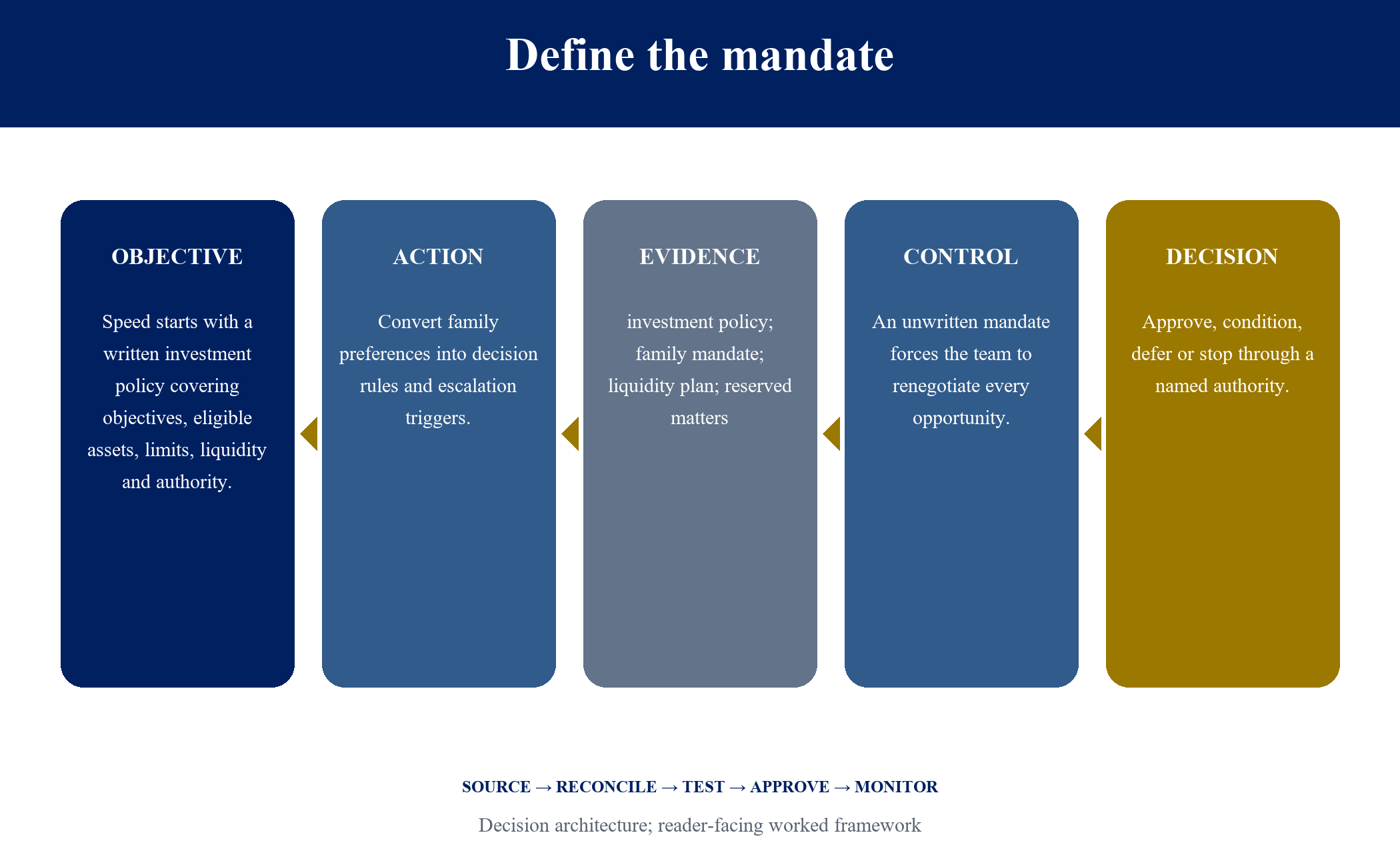
Speed starts with a written investment policy covering objectives, eligible assets, limits, liquidity and authority. This matters in the two-person deal team because the economics, legal rights, operating evidence and timing can move on different clocks. A useful analysis therefore begins with the decision being made, the party authorised to make it and the date on which the evidence is expected to be current. The work should distinguish source facts, management representations, analytical assumptions and professional judgement so that a reviewer can see where each conclusion originates.
The recommended workstream is to convert family preferences into decision rules and escalation triggers. The team should translate that instruction into named owners, dated gates and a common set of definitions. A base case should describe the expected path; a downside case should test weaker operating performance or slower execution; and a delay case should test what happens when a required approval, document, counterparty or financing event arrives later than planned. Any decision threshold used in the model should be recorded as a management choice unless it comes directly from a cited rule or contract.
The decision framework has four layers. First, define the commercial objective and non-negotiable constraints. Second, assemble the minimum source record and reconcile it to the numbers used in the analysis. Third, compare executable alternatives under consistent assumptions, including cost, control, liquidity, timing and downside. Fourth, approve the route, its conditions and the fallback. This sequence keeps a transaction from moving ahead on an attractive headline while unresolved implementation questions remain outside the decision paper.
1.2 Evidence and controls
The minimum evidence for this module is investment policy; family mandate; liquidity plan; reserved matters Each item should have an owner, effective date, source location and review status. Where information is produced through a model or transformation, the file should preserve the original input, calculation logic and output version. The reviewer should be able to reproduce the material conclusion without relying on a presentation slide, an uncited summary or the memory of the person who prepared it.
Control quality can be tested through three questions. Does the source support the stated fact? Does the calculation use the approved definition? Does the proposed action remain within the authority and risk limits already granted? An exception to any of these tests should enter a dated register with a named resolver and a stop, proceed or conditional-proceed decision. Completion means that the evidence and decision have been accepted by the accountable owner; document production alone is an intermediate output.
The principal failure mode is that an unwritten mandate forces the team to renegotiate every opportunity. The response is to make the vulnerable assumption visible, test a plausible adverse state and identify the earliest observable warning indicator. The analysis should also state what remains outside its scope and which legal, tax, regulatory, accounting, valuation, technical or investment conclusions require qualified advice. This creates a practical boundary between a research framework and a conclusion for a particular company, investor, lender, family or transaction.
| Control question | Required record | Decision response |
|---|---|---|
| What is being decided? | Convert family preferences into decision rules and escalation triggers. | Approve objective and authority. |
| What proves the case? | investment policy; family mandate; liquidity plan; reserved matters | Reconcile and sign off. |
| What can fail? | An unwritten mandate forces the team to renegotiate every opportunity. | Test downside and escalation. |
2. Split the two roles
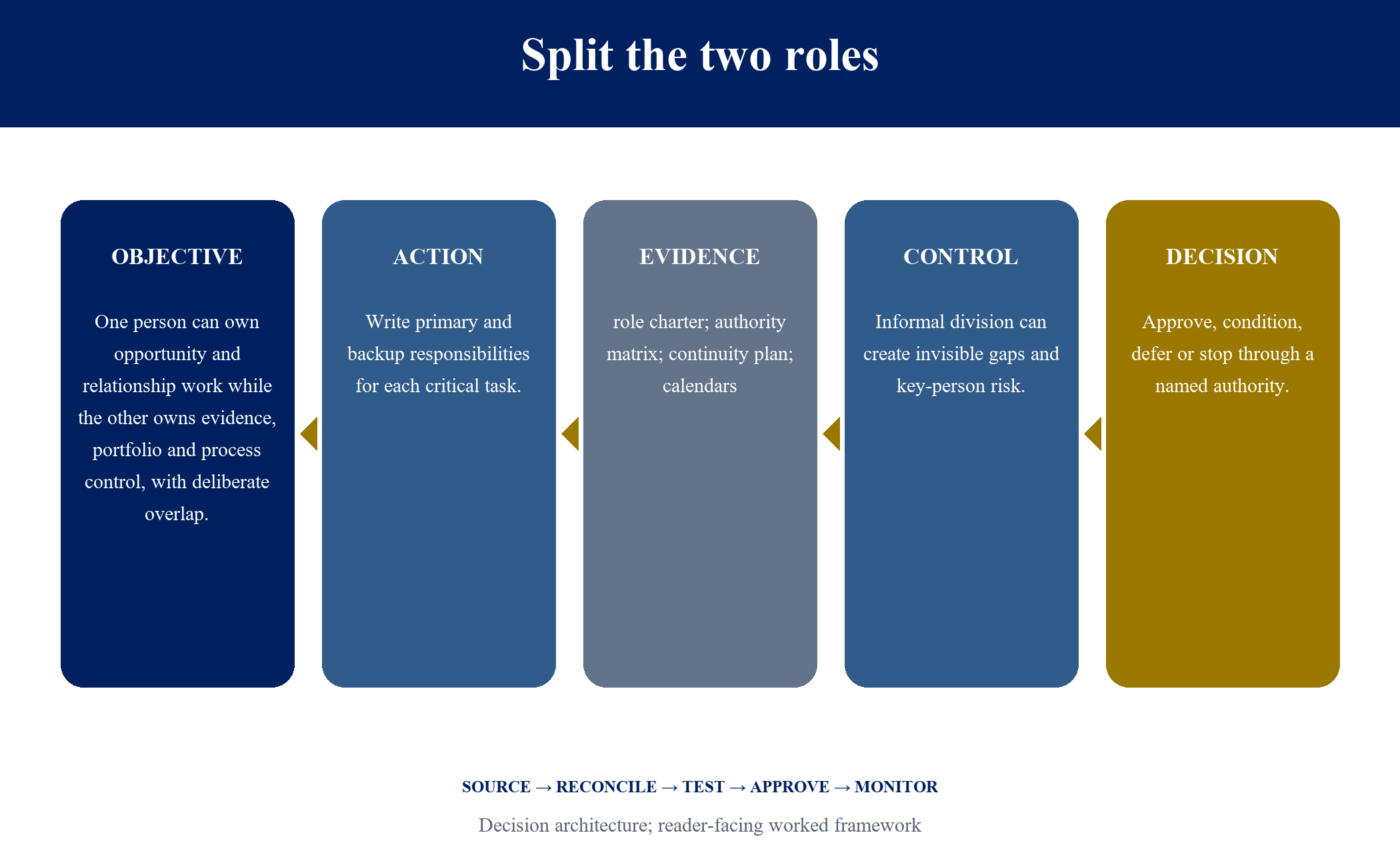
One person can own opportunity and relationship work while the other owns evidence, portfolio and process control, with deliberate overlap. This matters in the two-person deal team because the economics, legal rights, operating evidence and timing can move on different clocks. A useful analysis therefore begins with the decision being made, the party authorised to make it and the date on which the evidence is expected to be current. The work should distinguish source facts, management representations, analytical assumptions and professional judgement so that a reviewer can see where each conclusion originates.
The recommended workstream is to write primary and backup responsibilities for each critical task. The team should translate that instruction into named owners, dated gates and a common set of definitions. A base case should describe the expected path; a downside case should test weaker operating performance or slower execution; and a delay case should test what happens when a required approval, document, counterparty or financing event arrives later than planned. Any decision threshold used in the model should be recorded as a management choice unless it comes directly from a cited rule or contract.
The decision framework has four layers. First, define the commercial objective and non-negotiable constraints. Second, assemble the minimum source record and reconcile it to the numbers used in the analysis. Third, compare executable alternatives under consistent assumptions, including cost, control, liquidity, timing and downside. Fourth, approve the route, its conditions and the fallback. This sequence keeps a transaction from moving ahead on an attractive headline while unresolved implementation questions remain outside the decision paper.
2.2 Evidence and controls
The minimum evidence for this module is role charter; authority matrix; continuity plan; calendars Each item should have an owner, effective date, source location and review status. Where information is produced through a model or transformation, the file should preserve the original input, calculation logic and output version. The reviewer should be able to reproduce the material conclusion without relying on a presentation slide, an uncited summary or the memory of the person who prepared it.
Control quality can be tested through three questions. Does the source support the stated fact? Does the calculation use the approved definition? Does the proposed action remain within the authority and risk limits already granted? An exception to any of these tests should enter a dated register with a named resolver and a stop, proceed or conditional-proceed decision. Completion means that the evidence and decision have been accepted by the accountable owner; document production alone is an intermediate output.
The principal failure mode is that informal division can create invisible gaps and key-person risk. The response is to make the vulnerable assumption visible, test a plausible adverse state and identify the earliest observable warning indicator. The analysis should also state what remains outside its scope and which legal, tax, regulatory, accounting, valuation, technical or investment conclusions require qualified advice. This creates a practical boundary between a research framework and a conclusion for a particular company, investor, lender, family or transaction.
| Control question | Required record | Decision response |
|---|---|---|
| What is being decided? | Write primary and backup responsibilities for each critical task. | Approve objective and authority. |
| What proves the case? | role charter; authority matrix; continuity plan; calendars | Reconcile and sign off. |
| What can fail? | Informal division can create invisible gaps and key-person risk. | Test downside and escalation. |
3. Build the intake funnel
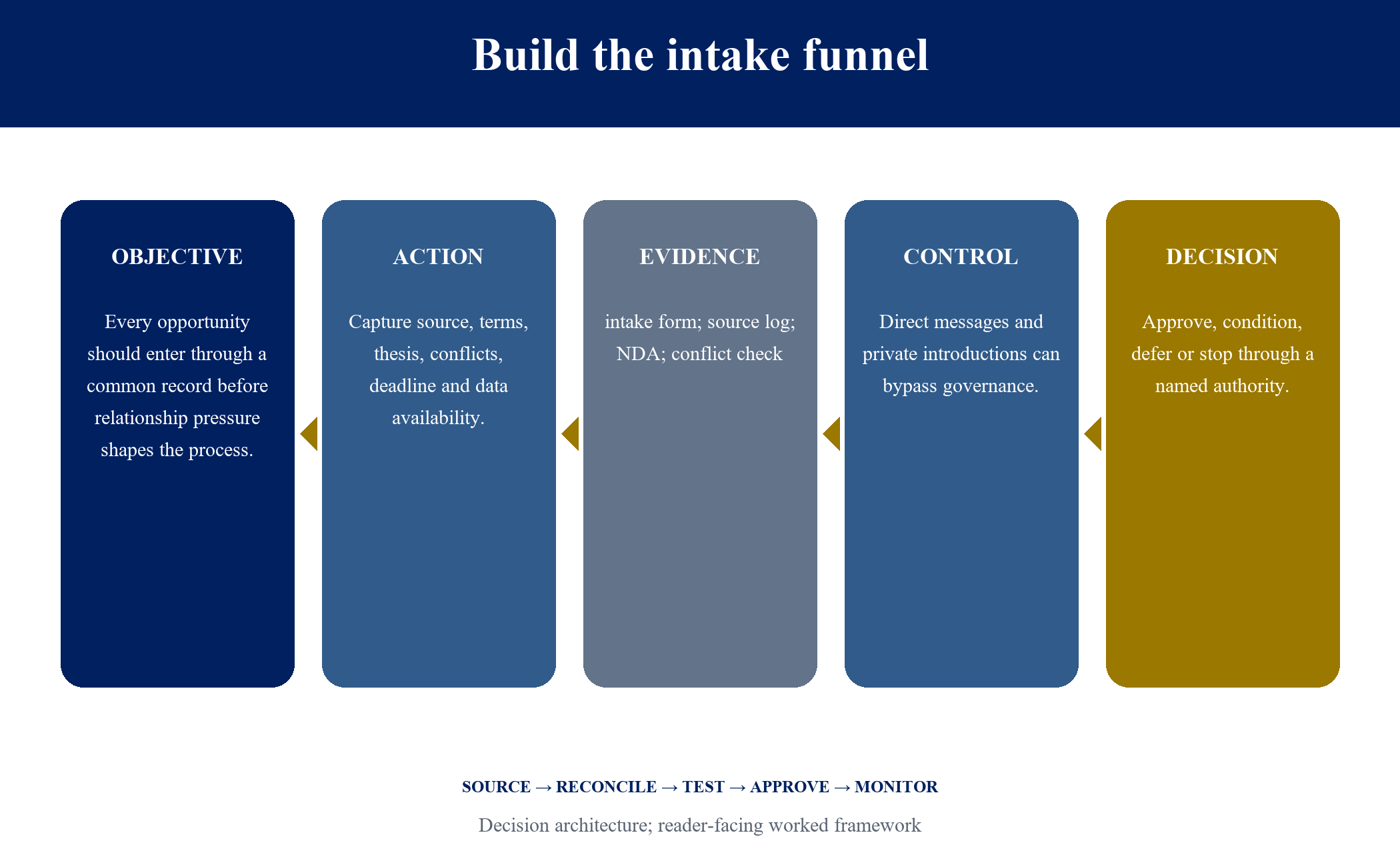
Every opportunity should enter through a common record before relationship pressure shapes the process. This matters in the two-person deal team because the economics, legal rights, operating evidence and timing can move on different clocks. A useful analysis therefore begins with the decision being made, the party authorised to make it and the date on which the evidence is expected to be current. The work should distinguish source facts, management representations, analytical assumptions and professional judgement so that a reviewer can see where each conclusion originates.
The recommended workstream is to capture source, terms, thesis, conflicts, deadline and data availability. The team should translate that instruction into named owners, dated gates and a common set of definitions. A base case should describe the expected path; a downside case should test weaker operating performance or slower execution; and a delay case should test what happens when a required approval, document, counterparty or financing event arrives later than planned. Any decision threshold used in the model should be recorded as a management choice unless it comes directly from a cited rule or contract.
The decision framework has four layers. First, define the commercial objective and non-negotiable constraints. Second, assemble the minimum source record and reconcile it to the numbers used in the analysis. Third, compare executable alternatives under consistent assumptions, including cost, control, liquidity, timing and downside. Fourth, approve the route, its conditions and the fallback. This sequence keeps a transaction from moving ahead on an attractive headline while unresolved implementation questions remain outside the decision paper.
3.2 Evidence and controls
The minimum evidence for this module is intake form; source log; NDA; conflict check Each item should have an owner, effective date, source location and review status. Where information is produced through a model or transformation, the file should preserve the original input, calculation logic and output version. The reviewer should be able to reproduce the material conclusion without relying on a presentation slide, an uncited summary or the memory of the person who prepared it.
Control quality can be tested through three questions. Does the source support the stated fact? Does the calculation use the approved definition? Does the proposed action remain within the authority and risk limits already granted? An exception to any of these tests should enter a dated register with a named resolver and a stop, proceed or conditional-proceed decision. Completion means that the evidence and decision have been accepted by the accountable owner; document production alone is an intermediate output.
The principal failure mode is that direct messages and private introductions can bypass governance. The response is to make the vulnerable assumption visible, test a plausible adverse state and identify the earliest observable warning indicator. The analysis should also state what remains outside its scope and which legal, tax, regulatory, accounting, valuation, technical or investment conclusions require qualified advice. This creates a practical boundary between a research framework and a conclusion for a particular company, investor, lender, family or transaction.
| Control question | Required record | Decision response |
|---|---|---|
| What is being decided? | Capture source, terms, thesis, conflicts, deadline and data availability. | Approve objective and authority. |
| What proves the case? | intake form; source log; NDA; conflict check | Reconcile and sign off. |
| What can fail? | Direct messages and private introductions can bypass governance. | Test downside and escalation. |
4. Screen against policy
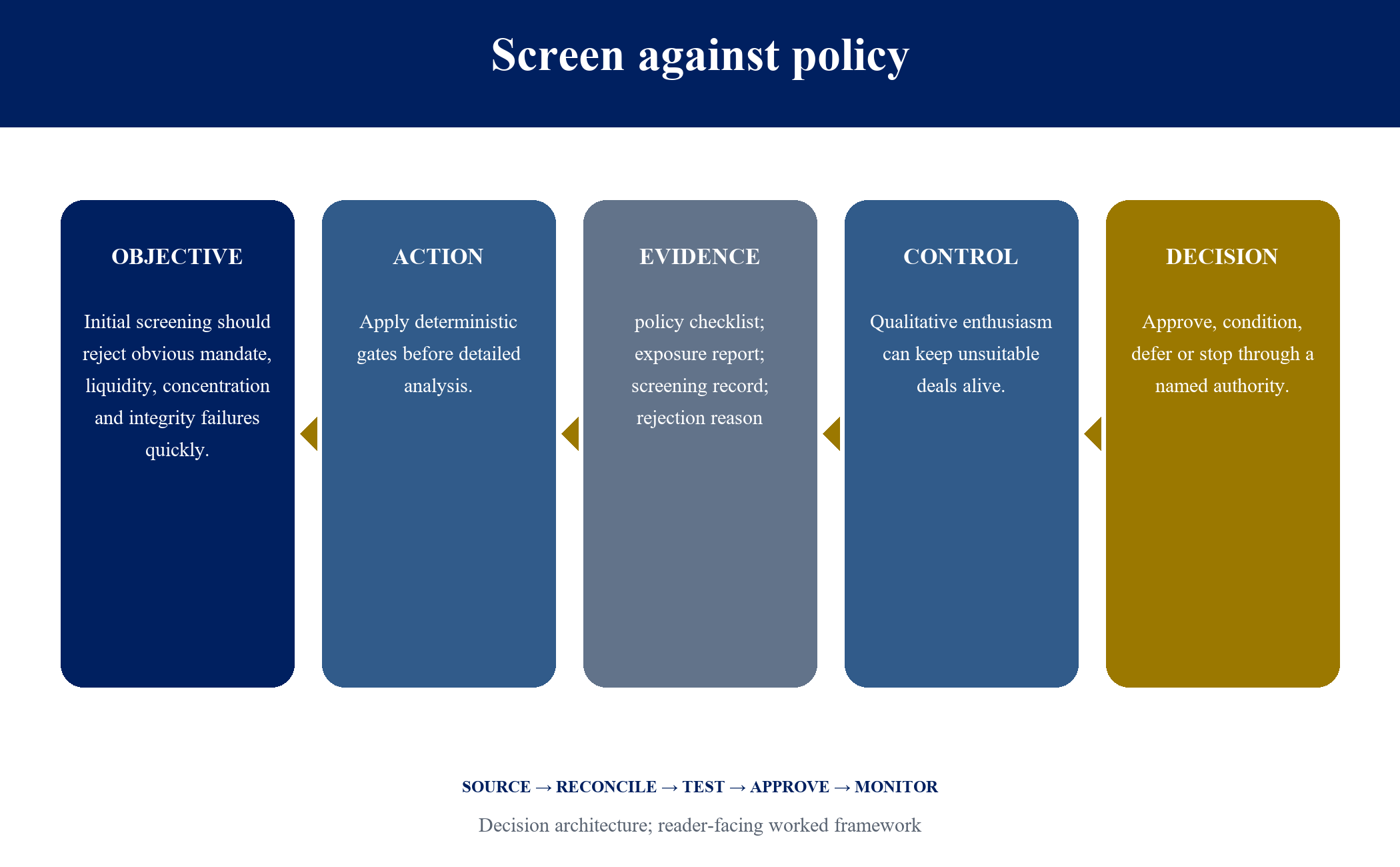
Initial screening should reject obvious mandate, liquidity, concentration and integrity failures quickly. This matters in the two-person deal team because the economics, legal rights, operating evidence and timing can move on different clocks. A useful analysis therefore begins with the decision being made, the party authorised to make it and the date on which the evidence is expected to be current. The work should distinguish source facts, management representations, analytical assumptions and professional judgement so that a reviewer can see where each conclusion originates.
The recommended workstream is to apply deterministic gates before detailed analysis. The team should translate that instruction into named owners, dated gates and a common set of definitions. A base case should describe the expected path; a downside case should test weaker operating performance or slower execution; and a delay case should test what happens when a required approval, document, counterparty or financing event arrives later than planned. Any decision threshold used in the model should be recorded as a management choice unless it comes directly from a cited rule or contract.
The decision framework has four layers. First, define the commercial objective and non-negotiable constraints. Second, assemble the minimum source record and reconcile it to the numbers used in the analysis. Third, compare executable alternatives under consistent assumptions, including cost, control, liquidity, timing and downside. Fourth, approve the route, its conditions and the fallback. This sequence keeps a transaction from moving ahead on an attractive headline while unresolved implementation questions remain outside the decision paper.
4.2 Evidence and controls
The minimum evidence for this module is policy checklist; exposure report; screening record; rejection reason Each item should have an owner, effective date, source location and review status. Where information is produced through a model or transformation, the file should preserve the original input, calculation logic and output version. The reviewer should be able to reproduce the material conclusion without relying on a presentation slide, an uncited summary or the memory of the person who prepared it.
Control quality can be tested through three questions. Does the source support the stated fact? Does the calculation use the approved definition? Does the proposed action remain within the authority and risk limits already granted? An exception to any of these tests should enter a dated register with a named resolver and a stop, proceed or conditional-proceed decision. Completion means that the evidence and decision have been accepted by the accountable owner; document production alone is an intermediate output.
The principal failure mode is that qualitative enthusiasm can keep unsuitable deals alive. The response is to make the vulnerable assumption visible, test a plausible adverse state and identify the earliest observable warning indicator. The analysis should also state what remains outside its scope and which legal, tax, regulatory, accounting, valuation, technical or investment conclusions require qualified advice. This creates a practical boundary between a research framework and a conclusion for a particular company, investor, lender, family or transaction.
| Control question | Required record | Decision response |
|---|---|---|
| What is being decided? | Apply deterministic gates before detailed analysis. | Approve objective and authority. |
| What proves the case? | policy checklist; exposure report; screening record; rejection reason | Reconcile and sign off. |
| What can fail? | Qualitative enthusiasm can keep unsuitable deals alive. | Test downside and escalation. |
5. Design the diligence plan
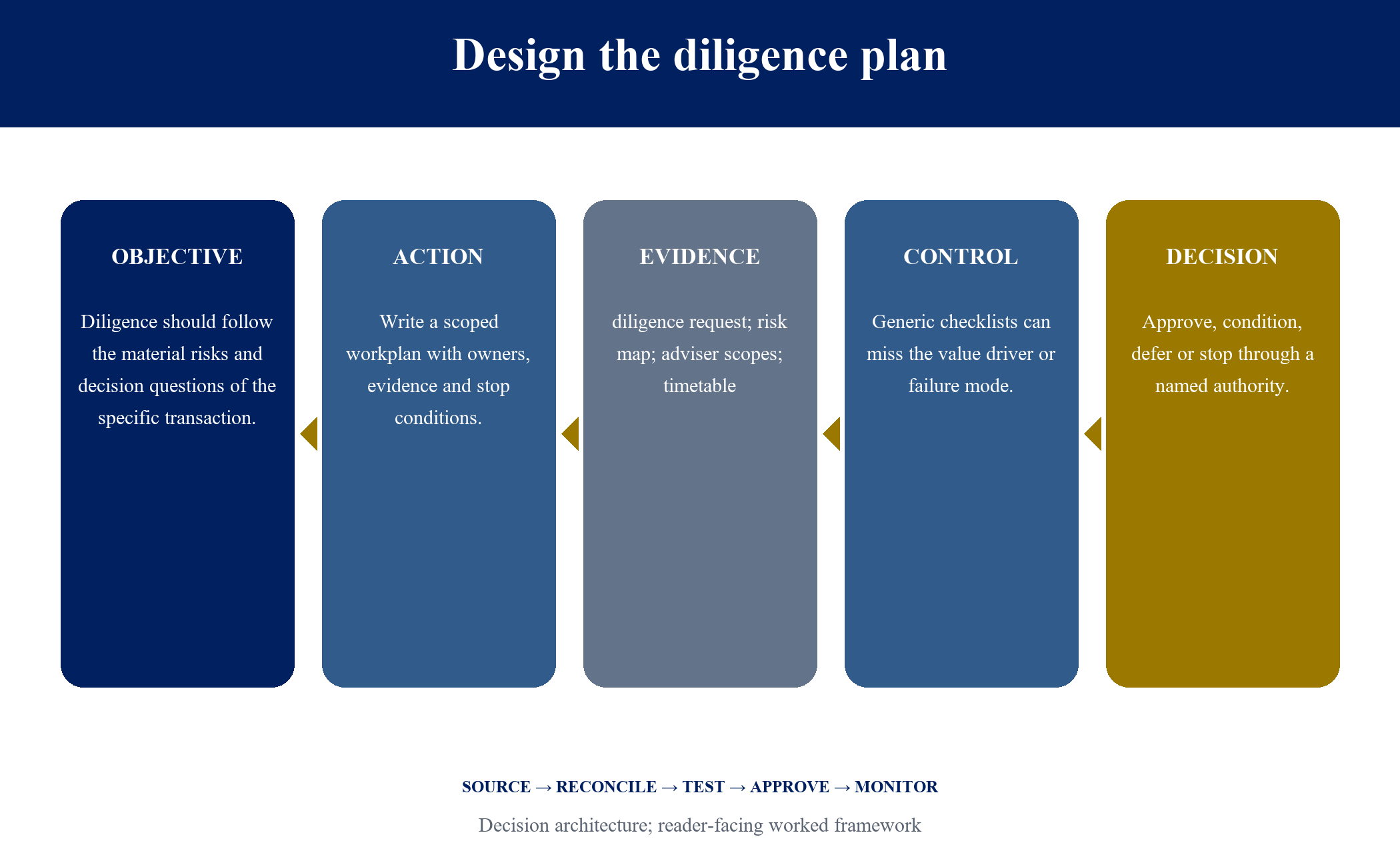
Diligence should follow the material risks and decision questions of the specific transaction. This matters in the two-person deal team because the economics, legal rights, operating evidence and timing can move on different clocks. A useful analysis therefore begins with the decision being made, the party authorised to make it and the date on which the evidence is expected to be current. The work should distinguish source facts, management representations, analytical assumptions and professional judgement so that a reviewer can see where each conclusion originates.
The recommended workstream is to write a scoped workplan with owners, evidence and stop conditions. The team should translate that instruction into named owners, dated gates and a common set of definitions. A base case should describe the expected path; a downside case should test weaker operating performance or slower execution; and a delay case should test what happens when a required approval, document, counterparty or financing event arrives later than planned. Any decision threshold used in the model should be recorded as a management choice unless it comes directly from a cited rule or contract.
The decision framework has four layers. First, define the commercial objective and non-negotiable constraints. Second, assemble the minimum source record and reconcile it to the numbers used in the analysis. Third, compare executable alternatives under consistent assumptions, including cost, control, liquidity, timing and downside. Fourth, approve the route, its conditions and the fallback. This sequence keeps a transaction from moving ahead on an attractive headline while unresolved implementation questions remain outside the decision paper.
5.2 Evidence and controls
The minimum evidence for this module is diligence request; risk map; adviser scopes; timetable Each item should have an owner, effective date, source location and review status. Where information is produced through a model or transformation, the file should preserve the original input, calculation logic and output version. The reviewer should be able to reproduce the material conclusion without relying on a presentation slide, an uncited summary or the memory of the person who prepared it.
Control quality can be tested through three questions. Does the source support the stated fact? Does the calculation use the approved definition? Does the proposed action remain within the authority and risk limits already granted? An exception to any of these tests should enter a dated register with a named resolver and a stop, proceed or conditional-proceed decision. Completion means that the evidence and decision have been accepted by the accountable owner; document production alone is an intermediate output.
The principal failure mode is that generic checklists can miss the value driver or failure mode. The response is to make the vulnerable assumption visible, test a plausible adverse state and identify the earliest observable warning indicator. The analysis should also state what remains outside its scope and which legal, tax, regulatory, accounting, valuation, technical or investment conclusions require qualified advice. This creates a practical boundary between a research framework and a conclusion for a particular company, investor, lender, family or transaction.
| Control question | Required record | Decision response |
|---|---|---|
| What is being decided? | Write a scoped workplan with owners, evidence and stop conditions. | Approve objective and authority. |
| What proves the case? | diligence request; risk map; adviser scopes; timetable | Reconcile and sign off. |
| What can fail? | Generic checklists can miss the value driver or failure mode. | Test downside and escalation. |
6. Own the financial analysis
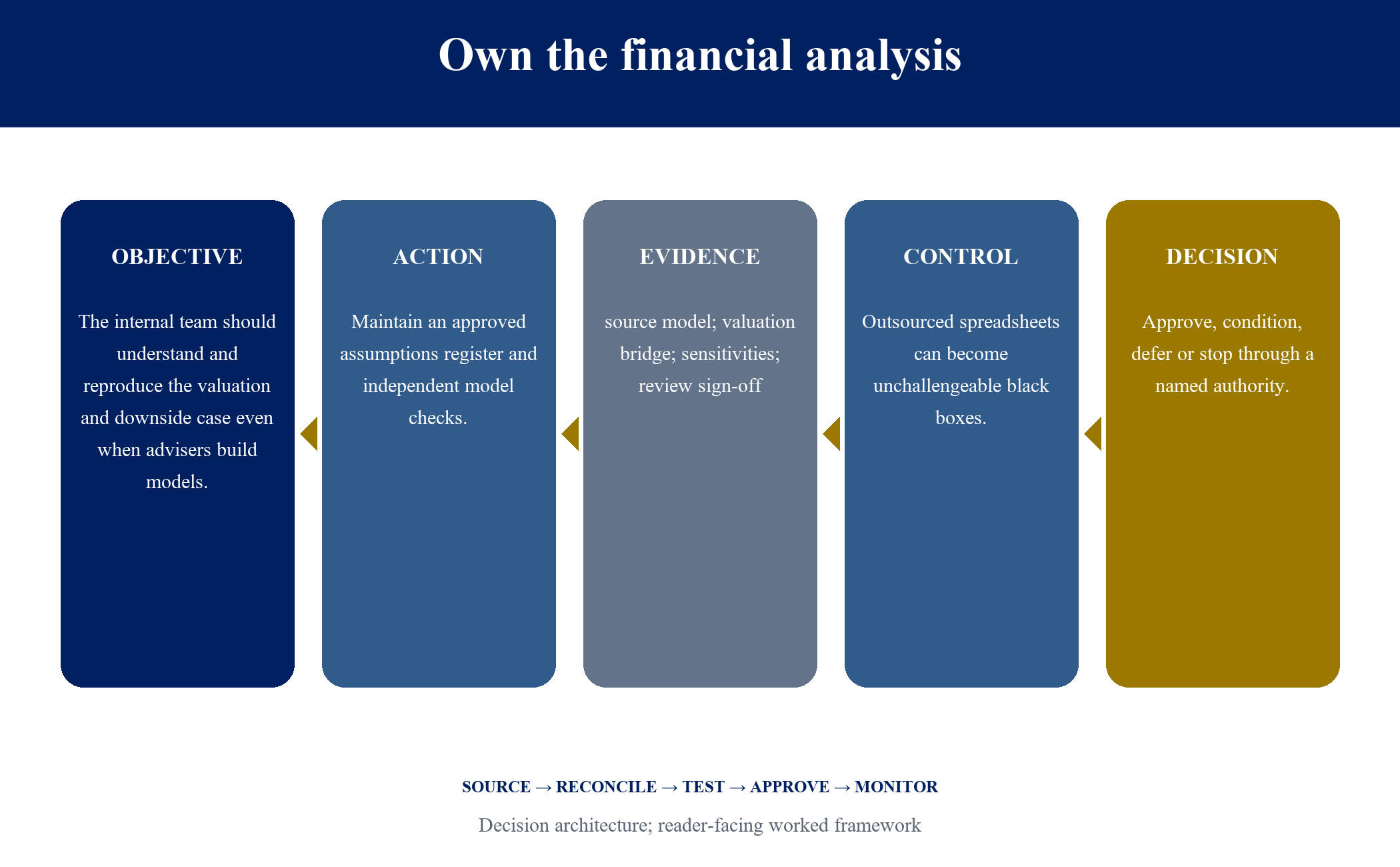
The internal team should understand and reproduce the valuation and downside case even when advisers build models. This matters in the two-person deal team because the economics, legal rights, operating evidence and timing can move on different clocks. A useful analysis therefore begins with the decision being made, the party authorised to make it and the date on which the evidence is expected to be current. The work should distinguish source facts, management representations, analytical assumptions and professional judgement so that a reviewer can see where each conclusion originates.
The recommended workstream is to maintain an approved assumptions register and independent model checks. The team should translate that instruction into named owners, dated gates and a common set of definitions. A base case should describe the expected path; a downside case should test weaker operating performance or slower execution; and a delay case should test what happens when a required approval, document, counterparty or financing event arrives later than planned. Any decision threshold used in the model should be recorded as a management choice unless it comes directly from a cited rule or contract.
The decision framework has four layers. First, define the commercial objective and non-negotiable constraints. Second, assemble the minimum source record and reconcile it to the numbers used in the analysis. Third, compare executable alternatives under consistent assumptions, including cost, control, liquidity, timing and downside. Fourth, approve the route, its conditions and the fallback. This sequence keeps a transaction from moving ahead on an attractive headline while unresolved implementation questions remain outside the decision paper.
6.2 Evidence and controls
The minimum evidence for this module is source model; valuation bridge; sensitivities; review sign-off Each item should have an owner, effective date, source location and review status. Where information is produced through a model or transformation, the file should preserve the original input, calculation logic and output version. The reviewer should be able to reproduce the material conclusion without relying on a presentation slide, an uncited summary or the memory of the person who prepared it.
Control quality can be tested through three questions. Does the source support the stated fact? Does the calculation use the approved definition? Does the proposed action remain within the authority and risk limits already granted? An exception to any of these tests should enter a dated register with a named resolver and a stop, proceed or conditional-proceed decision. Completion means that the evidence and decision have been accepted by the accountable owner; document production alone is an intermediate output.
The principal failure mode is that outsourced spreadsheets can become unchallengeable black boxes. The response is to make the vulnerable assumption visible, test a plausible adverse state and identify the earliest observable warning indicator. The analysis should also state what remains outside its scope and which legal, tax, regulatory, accounting, valuation, technical or investment conclusions require qualified advice. This creates a practical boundary between a research framework and a conclusion for a particular company, investor, lender, family or transaction.
| Control question | Required record | Decision response |
|---|---|---|
| What is being decided? | Maintain an approved assumptions register and independent model checks. | Approve objective and authority. |
| What proves the case? | source model; valuation bridge; sensitivities; review sign-off | Reconcile and sign off. |
| What can fail? | Outsourced spreadsheets can become unchallengeable black boxes. | Test downside and escalation. |
7. Rent specialist depth
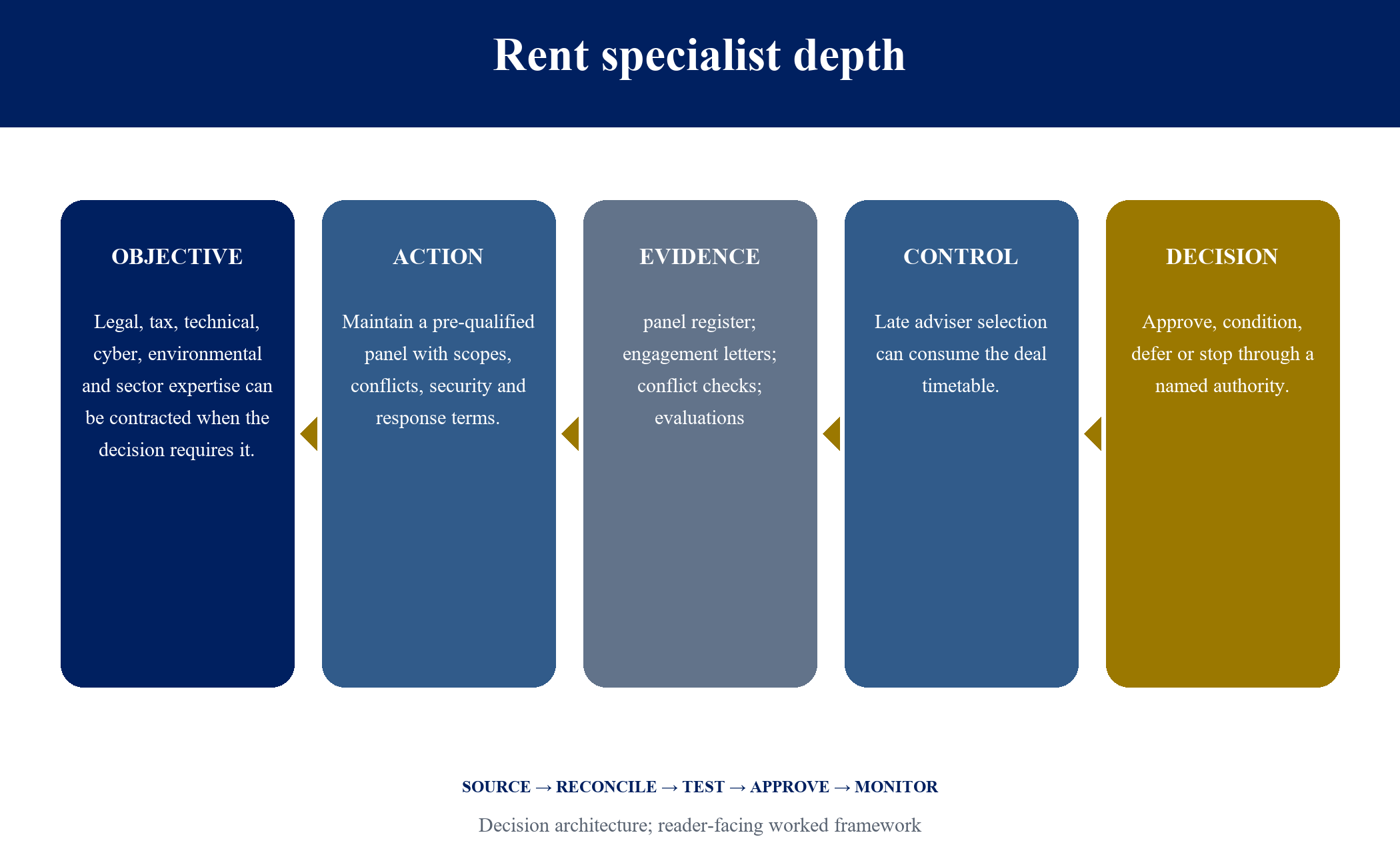
Legal, tax, technical, cyber, environmental and sector expertise can be contracted when the decision requires it. This matters in the two-person deal team because the economics, legal rights, operating evidence and timing can move on different clocks. A useful analysis therefore begins with the decision being made, the party authorised to make it and the date on which the evidence is expected to be current. The work should distinguish source facts, management representations, analytical assumptions and professional judgement so that a reviewer can see where each conclusion originates.
The recommended workstream is to maintain a pre-qualified panel with scopes, conflicts, security and response terms. The team should translate that instruction into named owners, dated gates and a common set of definitions. A base case should describe the expected path; a downside case should test weaker operating performance or slower execution; and a delay case should test what happens when a required approval, document, counterparty or financing event arrives later than planned. Any decision threshold used in the model should be recorded as a management choice unless it comes directly from a cited rule or contract.
The decision framework has four layers. First, define the commercial objective and non-negotiable constraints. Second, assemble the minimum source record and reconcile it to the numbers used in the analysis. Third, compare executable alternatives under consistent assumptions, including cost, control, liquidity, timing and downside. Fourth, approve the route, its conditions and the fallback. This sequence keeps a transaction from moving ahead on an attractive headline while unresolved implementation questions remain outside the decision paper.
7.2 Evidence and controls
The minimum evidence for this module is panel register; engagement letters; conflict checks; evaluations Each item should have an owner, effective date, source location and review status. Where information is produced through a model or transformation, the file should preserve the original input, calculation logic and output version. The reviewer should be able to reproduce the material conclusion without relying on a presentation slide, an uncited summary or the memory of the person who prepared it.
Control quality can be tested through three questions. Does the source support the stated fact? Does the calculation use the approved definition? Does the proposed action remain within the authority and risk limits already granted? An exception to any of these tests should enter a dated register with a named resolver and a stop, proceed or conditional-proceed decision. Completion means that the evidence and decision have been accepted by the accountable owner; document production alone is an intermediate output.
The principal failure mode is that late adviser selection can consume the deal timetable. The response is to make the vulnerable assumption visible, test a plausible adverse state and identify the earliest observable warning indicator. The analysis should also state what remains outside its scope and which legal, tax, regulatory, accounting, valuation, technical or investment conclusions require qualified advice. This creates a practical boundary between a research framework and a conclusion for a particular company, investor, lender, family or transaction.
| Control question | Required record | Decision response |
|---|---|---|
| What is being decided? | Maintain a pre-qualified panel with scopes, conflicts, security and response terms. | Approve objective and authority. |
| What proves the case? | panel register; engagement letters; conflict checks; evaluations | Reconcile and sign off. |
| What can fail? | Late adviser selection can consume the deal timetable. | Test downside and escalation. |
8. Control the data room
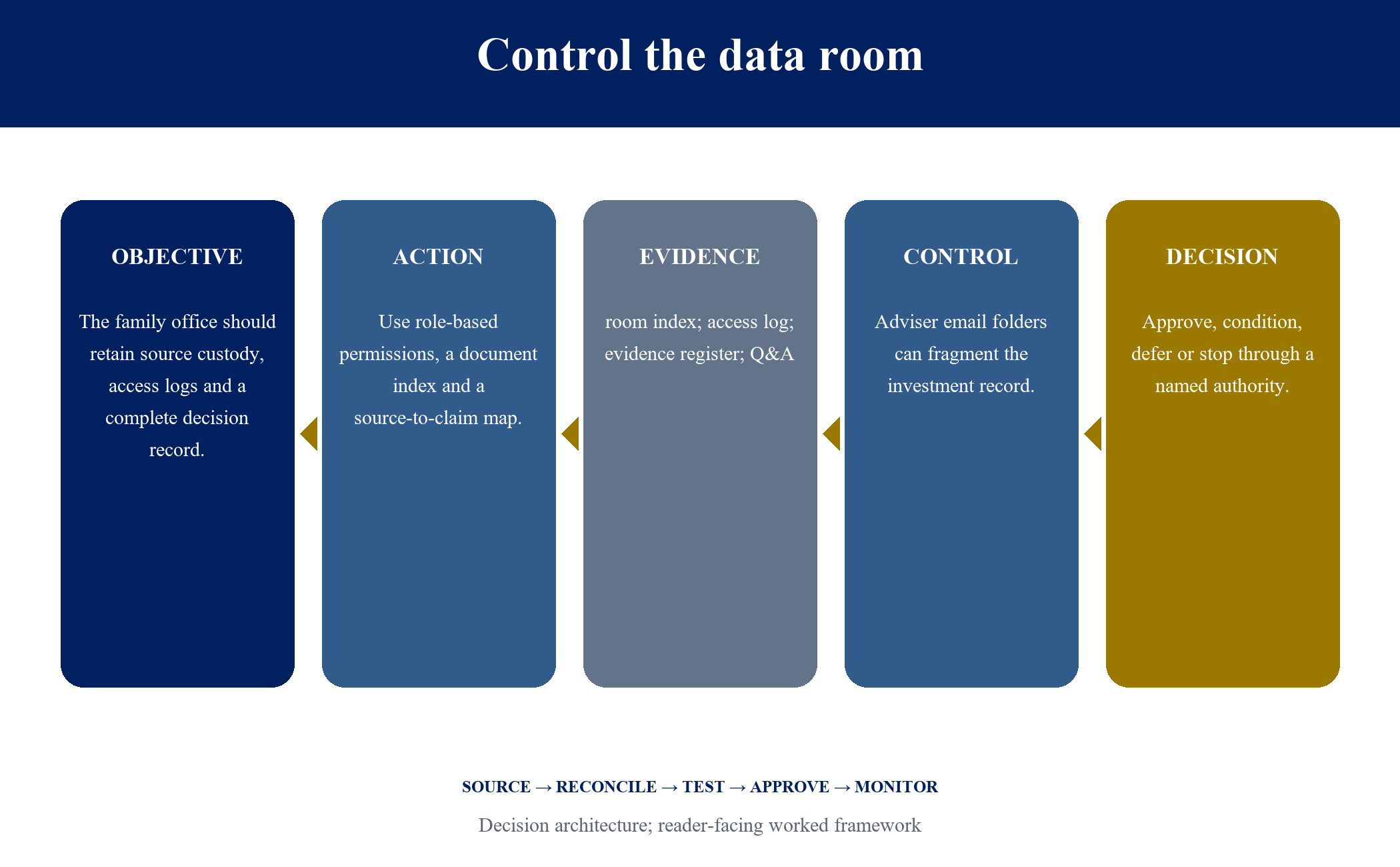
The family office should retain source custody, access logs and a complete decision record. This matters in the two-person deal team because the economics, legal rights, operating evidence and timing can move on different clocks. A useful analysis therefore begins with the decision being made, the party authorised to make it and the date on which the evidence is expected to be current. The work should distinguish source facts, management representations, analytical assumptions and professional judgement so that a reviewer can see where each conclusion originates.
The recommended workstream is to use role-based permissions, a document index and a source-to-claim map. The team should translate that instruction into named owners, dated gates and a common set of definitions. A base case should describe the expected path; a downside case should test weaker operating performance or slower execution; and a delay case should test what happens when a required approval, document, counterparty or financing event arrives later than planned. Any decision threshold used in the model should be recorded as a management choice unless it comes directly from a cited rule or contract.
The decision framework has four layers. First, define the commercial objective and non-negotiable constraints. Second, assemble the minimum source record and reconcile it to the numbers used in the analysis. Third, compare executable alternatives under consistent assumptions, including cost, control, liquidity, timing and downside. Fourth, approve the route, its conditions and the fallback. This sequence keeps a transaction from moving ahead on an attractive headline while unresolved implementation questions remain outside the decision paper.
8.2 Evidence and controls
The minimum evidence for this module is room index; access log; evidence register; Q&A Each item should have an owner, effective date, source location and review status. Where information is produced through a model or transformation, the file should preserve the original input, calculation logic and output version. The reviewer should be able to reproduce the material conclusion without relying on a presentation slide, an uncited summary or the memory of the person who prepared it.
Control quality can be tested through three questions. Does the source support the stated fact? Does the calculation use the approved definition? Does the proposed action remain within the authority and risk limits already granted? An exception to any of these tests should enter a dated register with a named resolver and a stop, proceed or conditional-proceed decision. Completion means that the evidence and decision have been accepted by the accountable owner; document production alone is an intermediate output.
The principal failure mode is that adviser email folders can fragment the investment record. The response is to make the vulnerable assumption visible, test a plausible adverse state and identify the earliest observable warning indicator. The analysis should also state what remains outside its scope and which legal, tax, regulatory, accounting, valuation, technical or investment conclusions require qualified advice. This creates a practical boundary between a research framework and a conclusion for a particular company, investor, lender, family or transaction.
| Control question | Required record | Decision response |
|---|---|---|
| What is being decided? | Use role-based permissions, a document index and a source-to-claim map. | Approve objective and authority. |
| What proves the case? | room index; access log; evidence register; Q&A | Reconcile and sign off. |
| What can fail? | Adviser email folders can fragment the investment record. | Test downside and escalation. |
9. Write the investment memo
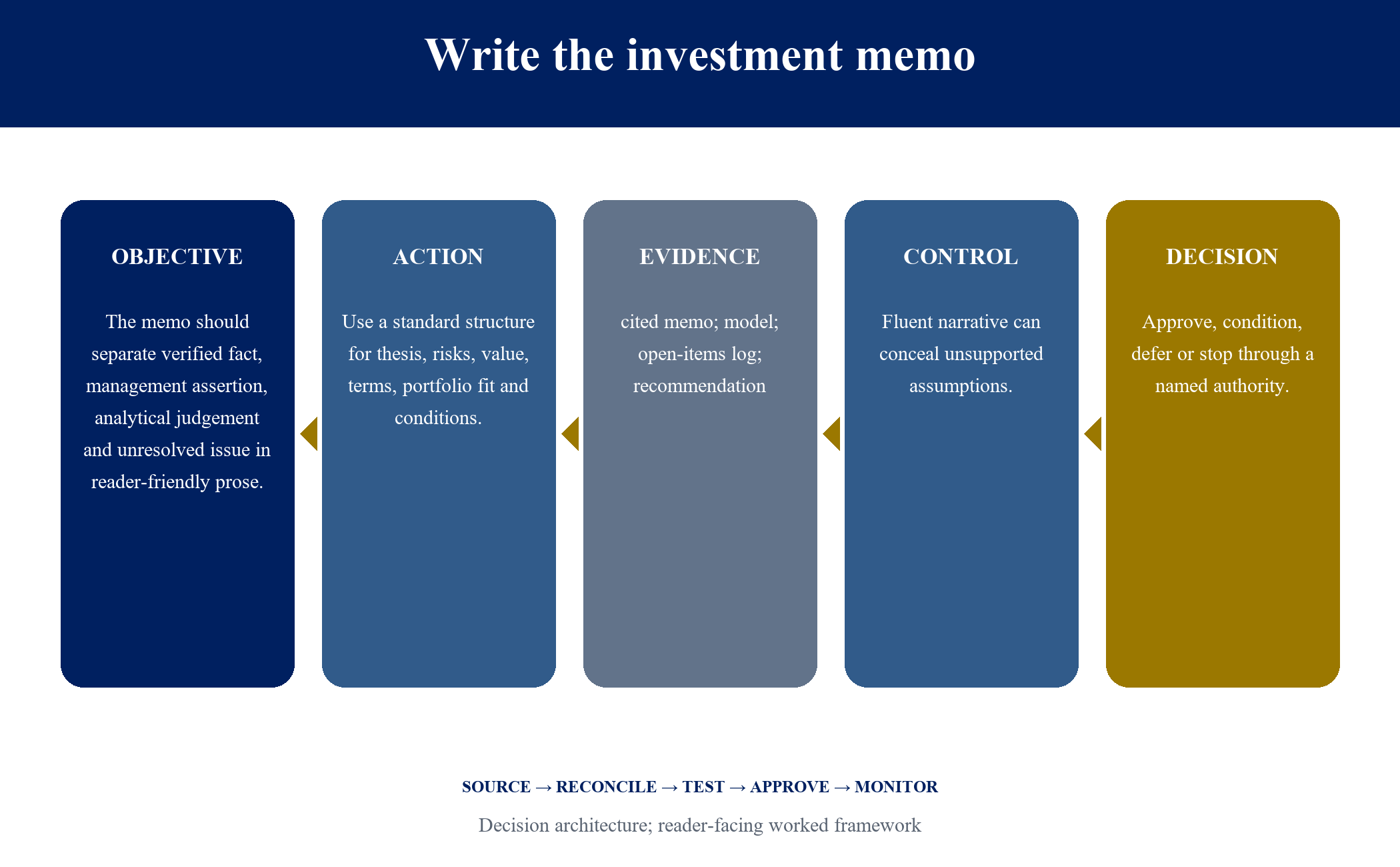
The memo should separate verified fact, management assertion, analytical judgement and unresolved issue in reader-friendly prose. This matters in the two-person deal team because the economics, legal rights, operating evidence and timing can move on different clocks. A useful analysis therefore begins with the decision being made, the party authorised to make it and the date on which the evidence is expected to be current. The work should distinguish source facts, management representations, analytical assumptions and professional judgement so that a reviewer can see where each conclusion originates.
The recommended workstream is to use a standard structure for thesis, risks, value, terms, portfolio fit and conditions. The team should translate that instruction into named owners, dated gates and a common set of definitions. A base case should describe the expected path; a downside case should test weaker operating performance or slower execution; and a delay case should test what happens when a required approval, document, counterparty or financing event arrives later than planned. Any decision threshold used in the model should be recorded as a management choice unless it comes directly from a cited rule or contract.
The decision framework has four layers. First, define the commercial objective and non-negotiable constraints. Second, assemble the minimum source record and reconcile it to the numbers used in the analysis. Third, compare executable alternatives under consistent assumptions, including cost, control, liquidity, timing and downside. Fourth, approve the route, its conditions and the fallback. This sequence keeps a transaction from moving ahead on an attractive headline while unresolved implementation questions remain outside the decision paper.
9.2 Evidence and controls
The minimum evidence for this module is cited memo; model; open-items log; recommendation Each item should have an owner, effective date, source location and review status. Where information is produced through a model or transformation, the file should preserve the original input, calculation logic and output version. The reviewer should be able to reproduce the material conclusion without relying on a presentation slide, an uncited summary or the memory of the person who prepared it.
Control quality can be tested through three questions. Does the source support the stated fact? Does the calculation use the approved definition? Does the proposed action remain within the authority and risk limits already granted? An exception to any of these tests should enter a dated register with a named resolver and a stop, proceed or conditional-proceed decision. Completion means that the evidence and decision have been accepted by the accountable owner; document production alone is an intermediate output.
The principal failure mode is that fluent narrative can conceal unsupported assumptions. The response is to make the vulnerable assumption visible, test a plausible adverse state and identify the earliest observable warning indicator. The analysis should also state what remains outside its scope and which legal, tax, regulatory, accounting, valuation, technical or investment conclusions require qualified advice. This creates a practical boundary between a research framework and a conclusion for a particular company, investor, lender, family or transaction.
| Control question | Required record | Decision response |
|---|---|---|
| What is being decided? | Use a standard structure for thesis, risks, value, terms, portfolio fit and conditions. | Approve objective and authority. |
| What proves the case? | cited memo; model; open-items log; recommendation | Reconcile and sign off. |
| What can fail? | Fluent narrative can conceal unsupported assumptions. | Test downside and escalation. |
10. Govern the committee
Decision authority, quorum, conflicts, pre-reads and conditional approvals should be explicit. This matters in the two-person deal team because the economics, legal rights, operating evidence and timing can move on different clocks. A useful analysis therefore begins with the decision being made, the party authorised to make it and the date on which the evidence is expected to be current. The work should distinguish source facts, management representations, analytical assumptions and professional judgement so that a reviewer can see where each conclusion originates.
The recommended workstream is to run a timed committee with recorded questions, conditions and dissent. The team should translate that instruction into named owners, dated gates and a common set of definitions. A base case should describe the expected path; a downside case should test weaker operating performance or slower execution; and a delay case should test what happens when a required approval, document, counterparty or financing event arrives later than planned. Any decision threshold used in the model should be recorded as a management choice unless it comes directly from a cited rule or contract.
The decision framework has four layers. First, define the commercial objective and non-negotiable constraints. Second, assemble the minimum source record and reconcile it to the numbers used in the analysis. Third, compare executable alternatives under consistent assumptions, including cost, control, liquidity, timing and downside. Fourth, approve the route, its conditions and the fallback. This sequence keeps a transaction from moving ahead on an attractive headline while unresolved implementation questions remain outside the decision paper.
10.2 Evidence and controls
The minimum evidence for this module is agenda; pre-read; minutes; conflicts; conditions Each item should have an owner, effective date, source location and review status. Where information is produced through a model or transformation, the file should preserve the original input, calculation logic and output version. The reviewer should be able to reproduce the material conclusion without relying on a presentation slide, an uncited summary or the memory of the person who prepared it.
Control quality can be tested through three questions. Does the source support the stated fact? Does the calculation use the approved definition? Does the proposed action remain within the authority and risk limits already granted? An exception to any of these tests should enter a dated register with a named resolver and a stop, proceed or conditional-proceed decision. Completion means that the evidence and decision have been accepted by the accountable owner; document production alone is an intermediate output.
The principal failure mode is that informal family consensus can leave authority and accountability unclear. The response is to make the vulnerable assumption visible, test a plausible adverse state and identify the earliest observable warning indicator. The analysis should also state what remains outside its scope and which legal, tax, regulatory, accounting, valuation, technical or investment conclusions require qualified advice. This creates a practical boundary between a research framework and a conclusion for a particular company, investor, lender, family or transaction.
| Control question | Required record | Decision response |
|---|---|---|
| What is being decided? | Run a timed committee with recorded questions, conditions and dissent. | Approve objective and authority. |
| What proves the case? | agenda; pre-read; minutes; conflicts; conditions | Reconcile and sign off. |
| What can fail? | Informal family consensus can leave authority and accountability unclear. | Test downside and escalation. |
11. Negotiate and close
Commercial terms, diligence findings and documentation should remain tied to the approved case. This matters in the two-person deal team because the economics, legal rights, operating evidence and timing can move on different clocks. A useful analysis therefore begins with the decision being made, the party authorised to make it and the date on which the evidence is expected to be current. The work should distinguish source facts, management representations, analytical assumptions and professional judgement so that a reviewer can see where each conclusion originates.
The recommended workstream is to maintain one issues list and require reapproval for material change. The team should translate that instruction into named owners, dated gates and a common set of definitions. A base case should describe the expected path; a downside case should test weaker operating performance or slower execution; and a delay case should test what happens when a required approval, document, counterparty or financing event arrives later than planned. Any decision threshold used in the model should be recorded as a management choice unless it comes directly from a cited rule or contract.
The decision framework has four layers. First, define the commercial objective and non-negotiable constraints. Second, assemble the minimum source record and reconcile it to the numbers used in the analysis. Third, compare executable alternatives under consistent assumptions, including cost, control, liquidity, timing and downside. Fourth, approve the route, its conditions and the fallback. This sequence keeps a transaction from moving ahead on an attractive headline while unresolved implementation questions remain outside the decision paper.
11.2 Evidence and controls
The minimum evidence for this module is term sheet; issues list; closing set; change memo Each item should have an owner, effective date, source location and review status. Where information is produced through a model or transformation, the file should preserve the original input, calculation logic and output version. The reviewer should be able to reproduce the material conclusion without relying on a presentation slide, an uncited summary or the memory of the person who prepared it.
Control quality can be tested through three questions. Does the source support the stated fact? Does the calculation use the approved definition? Does the proposed action remain within the authority and risk limits already granted? An exception to any of these tests should enter a dated register with a named resolver and a stop, proceed or conditional-proceed decision. Completion means that the evidence and decision have been accepted by the accountable owner; document production alone is an intermediate output.
The principal failure mode is that deal momentum can erode protections approved by the committee. The response is to make the vulnerable assumption visible, test a plausible adverse state and identify the earliest observable warning indicator. The analysis should also state what remains outside its scope and which legal, tax, regulatory, accounting, valuation, technical or investment conclusions require qualified advice. This creates a practical boundary between a research framework and a conclusion for a particular company, investor, lender, family or transaction.
| Control question | Required record | Decision response |
|---|---|---|
| What is being decided? | Maintain one issues list and require reapproval for material change. | Approve objective and authority. |
| What proves the case? | term sheet; issues list; closing set; change memo | Reconcile and sign off. |
| What can fail? | Deal momentum can erode protections approved by the committee. | Test downside and escalation. |
12. Monitor the investment
Monitoring should track thesis, covenant, liquidity, governance and exit indicators. This matters in the two-person deal team because the economics, legal rights, operating evidence and timing can move on different clocks. A useful analysis therefore begins with the decision being made, the party authorised to make it and the date on which the evidence is expected to be current. The work should distinguish source facts, management representations, analytical assumptions and professional judgement so that a reviewer can see where each conclusion originates.
The recommended workstream is to define a reporting calendar and event-driven escalation for each asset. The team should translate that instruction into named owners, dated gates and a common set of definitions. A base case should describe the expected path; a downside case should test weaker operating performance or slower execution; and a delay case should test what happens when a required approval, document, counterparty or financing event arrives later than planned. Any decision threshold used in the model should be recorded as a management choice unless it comes directly from a cited rule or contract.
The decision framework has four layers. First, define the commercial objective and non-negotiable constraints. Second, assemble the minimum source record and reconcile it to the numbers used in the analysis. Third, compare executable alternatives under consistent assumptions, including cost, control, liquidity, timing and downside. Fourth, approve the route, its conditions and the fallback. This sequence keeps a transaction from moving ahead on an attractive headline while unresolved implementation questions remain outside the decision paper.
12.2 Evidence and controls
The minimum evidence for this module is board packs; financials; covenant reports; valuation record Each item should have an owner, effective date, source location and review status. Where information is produced through a model or transformation, the file should preserve the original input, calculation logic and output version. The reviewer should be able to reproduce the material conclusion without relying on a presentation slide, an uncited summary or the memory of the person who prepared it.
Control quality can be tested through three questions. Does the source support the stated fact? Does the calculation use the approved definition? Does the proposed action remain within the authority and risk limits already granted? An exception to any of these tests should enter a dated register with a named resolver and a stop, proceed or conditional-proceed decision. Completion means that the evidence and decision have been accepted by the accountable owner; document production alone is an intermediate output.
The principal failure mode is that portfolio attention can fall after the transaction closes. The response is to make the vulnerable assumption visible, test a plausible adverse state and identify the earliest observable warning indicator. The analysis should also state what remains outside its scope and which legal, tax, regulatory, accounting, valuation, technical or investment conclusions require qualified advice. This creates a practical boundary between a research framework and a conclusion for a particular company, investor, lender, family or transaction.
| Control question | Required record | Decision response |
|---|---|---|
| What is being decided? | Define a reporting calendar and event-driven escalation for each asset. | Approve objective and authority. |
| What proves the case? | board packs; financials; covenant reports; valuation record | Reconcile and sign off. |
| What can fail? | Portfolio attention can fall after the transaction closes. | Test downside and escalation. |
13. Use technology with control
Automation can support intake, extraction, retrieval, comparison and drafting within approved data and authority boundaries. This matters in the two-person deal team because the economics, legal rights, operating evidence and timing can move on different clocks. A useful analysis therefore begins with the decision being made, the party authorised to make it and the date on which the evidence is expected to be current. The work should distinguish source facts, management representations, analytical assumptions and professional judgement so that a reviewer can see where each conclusion originates.
The recommended workstream is to keep rules, calculations, access and approvals deterministic and test model-assisted tasks. The team should translate that instruction into named owners, dated gates and a common set of definitions. A base case should describe the expected path; a downside case should test weaker operating performance or slower execution; and a delay case should test what happens when a required approval, document, counterparty or financing event arrives later than planned. Any decision threshold used in the model should be recorded as a management choice unless it comes directly from a cited rule or contract.
The decision framework has four layers. First, define the commercial objective and non-negotiable constraints. Second, assemble the minimum source record and reconcile it to the numbers used in the analysis. Third, compare executable alternatives under consistent assumptions, including cost, control, liquidity, timing and downside. Fourth, approve the route, its conditions and the fallback. This sequence keeps a transaction from moving ahead on an attractive headline while unresolved implementation questions remain outside the decision paper.
13.2 Evidence and controls
The minimum evidence for this module is system inventory; evaluation set; access review; audit log Each item should have an owner, effective date, source location and review status. Where information is produced through a model or transformation, the file should preserve the original input, calculation logic and output version. The reviewer should be able to reproduce the material conclusion without relying on a presentation slide, an uncited summary or the memory of the person who prepared it.
Control quality can be tested through three questions. Does the source support the stated fact? Does the calculation use the approved definition? Does the proposed action remain within the authority and risk limits already granted? An exception to any of these tests should enter a dated register with a named resolver and a stop, proceed or conditional-proceed decision. Completion means that the evidence and decision have been accepted by the accountable owner; document production alone is an intermediate output.
The principal failure mode is that technology can accelerate an error or disclosure breach. The response is to make the vulnerable assumption visible, test a plausible adverse state and identify the earliest observable warning indicator. The analysis should also state what remains outside its scope and which legal, tax, regulatory, accounting, valuation, technical or investment conclusions require qualified advice. This creates a practical boundary between a research framework and a conclusion for a particular company, investor, lender, family or transaction.
| Control question | Required record | Decision response |
|---|---|---|
| What is being decided? | Keep rules, calculations, access and approvals deterministic and test model-assisted tasks. | Approve objective and authority. |
| What proves the case? | system inventory; evaluation set; access review; audit log | Reconcile and sign off. |
| What can fail? | Technology can accelerate an error or disclosure breach. | Test downside and escalation. |
14. Measure operating economics
The relevant cost includes internal time, advisers, technology, abandoned diligence and monitoring. This matters in the two-person deal team because the economics, legal rights, operating evidence and timing can move on different clocks. A useful analysis therefore begins with the decision being made, the party authorised to make it and the date on which the evidence is expected to be current. The work should distinguish source facts, management representations, analytical assumptions and professional judgement so that a reviewer can see where each conclusion originates.
The recommended workstream is to calculate cost and elapsed time per screened, diligenced, approved and closed opportunity. The team should translate that instruction into named owners, dated gates and a common set of definitions. A base case should describe the expected path; a downside case should test weaker operating performance or slower execution; and a delay case should test what happens when a required approval, document, counterparty or financing event arrives later than planned. Any decision threshold used in the model should be recorded as a management choice unless it comes directly from a cited rule or contract.
The decision framework has four layers. First, define the commercial objective and non-negotiable constraints. Second, assemble the minimum source record and reconcile it to the numbers used in the analysis. Third, compare executable alternatives under consistent assumptions, including cost, control, liquidity, timing and downside. Fourth, approve the route, its conditions and the fallback. This sequence keeps a transaction from moving ahead on an attractive headline while unresolved implementation questions remain outside the decision paper.
14.2 Evidence and controls
The minimum evidence for this module is time records; invoices; pipeline data; outcome ledger Each item should have an owner, effective date, source location and review status. Where information is produced through a model or transformation, the file should preserve the original input, calculation logic and output version. The reviewer should be able to reproduce the material conclusion without relying on a presentation slide, an uncited summary or the memory of the person who prepared it.
Control quality can be tested through three questions. Does the source support the stated fact? Does the calculation use the approved definition? Does the proposed action remain within the authority and risk limits already granted? An exception to any of these tests should enter a dated register with a named resolver and a stop, proceed or conditional-proceed decision. Completion means that the evidence and decision have been accepted by the accountable owner; document production alone is an intermediate output.
The principal failure mode is that low visible headcount can hide high outsourced or opportunity cost. The response is to make the vulnerable assumption visible, test a plausible adverse state and identify the earliest observable warning indicator. The analysis should also state what remains outside its scope and which legal, tax, regulatory, accounting, valuation, technical or investment conclusions require qualified advice. This creates a practical boundary between a research framework and a conclusion for a particular company, investor, lender, family or transaction.
| Control question | Required record | Decision response |
|---|---|---|
| What is being decided? | Calculate cost and elapsed time per screened, diligenced, approved and closed opportunity. | Approve objective and authority. |
| What proves the case? | time records; invoices; pipeline data; outcome ledger | Reconcile and sign off. |
| What can fail? | Low visible headcount can hide high outsourced or opportunity cost. | Test downside and escalation. |
15. Build resilience and scale
A small team should add volume only after the operating system performs under absence, conflict and simultaneous deals. This matters in the two-person deal team because the economics, legal rights, operating evidence and timing can move on different clocks. A useful analysis therefore begins with the decision being made, the party authorised to make it and the date on which the evidence is expected to be current. The work should distinguish source facts, management representations, analytical assumptions and professional judgement so that a reviewer can see where each conclusion originates.
The recommended workstream is to test continuity, surge capacity and stop rules through simulations. The team should translate that instruction into named owners, dated gates and a common set of definitions. A base case should describe the expected path; a downside case should test weaker operating performance or slower execution; and a delay case should test what happens when a required approval, document, counterparty or financing event arrives later than planned. Any decision threshold used in the model should be recorded as a management choice unless it comes directly from a cited rule or contract.
The decision framework has four layers. First, define the commercial objective and non-negotiable constraints. Second, assemble the minimum source record and reconcile it to the numbers used in the analysis. Third, compare executable alternatives under consistent assumptions, including cost, control, liquidity, timing and downside. Fourth, approve the route, its conditions and the fallback. This sequence keeps a transaction from moving ahead on an attractive headline while unresolved implementation questions remain outside the decision paper.
15.2 Evidence and controls
The minimum evidence for this module is continuity exercise; capacity dashboard; exception log; hiring gate Each item should have an owner, effective date, source location and review status. Where information is produced through a model or transformation, the file should preserve the original input, calculation logic and output version. The reviewer should be able to reproduce the material conclusion without relying on a presentation slide, an uncited summary or the memory of the person who prepared it.
Control quality can be tested through three questions. Does the source support the stated fact? Does the calculation use the approved definition? Does the proposed action remain within the authority and risk limits already granted? An exception to any of these tests should enter a dated register with a named resolver and a stop, proceed or conditional-proceed decision. Completion means that the evidence and decision have been accepted by the accountable owner; document production alone is an intermediate output.
The principal failure mode is that deal flow can outrun review capacity before the family sees the control failure. The response is to make the vulnerable assumption visible, test a plausible adverse state and identify the earliest observable warning indicator. The analysis should also state what remains outside its scope and which legal, tax, regulatory, accounting, valuation, technical or investment conclusions require qualified advice. This creates a practical boundary between a research framework and a conclusion for a particular company, investor, lender, family or transaction.
| Control question | Required record | Decision response |
|---|---|---|
| What is being decided? | Test continuity, surge capacity and stop rules through simulations. | Approve objective and authority. |
| What proves the case? | continuity exercise; capacity dashboard; exception log; hiring gate | Reconcile and sign off. |
| What can fail? | Deal flow can outrun review capacity before the family sees the control failure. | Test downside and escalation. |
Primary and authoritative sources
- ADGM, Establish Your Family Office. https://www.adgm.com/business-areas/family-offices
- DIFC Family Wealth Centre. https://www.difc.com/ecosystem/difc-family-wealth-centre
- International Finance Corporation, Family Business Governance Handbook. https://www.ifc.org/en/insights-reports/2008/family-business-governance-handbook
- Institutional Limited Partners Association, Due Diligence Questionnaire. https://ilpa.org/due-diligence-questionnaire/
- CFA Institute, Standards of Practice Handbook. https://www.cfainstitute.org/ethics-standards/codes/standards-of-practice-guidance/standards-of-practice-handbook
- NIST Cybersecurity Framework. https://www.nist.gov/cyberframework
