The competitive-deal governance problem
Audience and Decision Perimeter
principal and family-owner requirement
An principal needs to know which decisions remain personal, which can be delegated and how the office acts when a seller imposes a short clock. The reserved-matters schedule should protect decisions that affect family purpose, control, reputation, related parties, total exposure, leverage, guarantees, succession or a stated concentration limit. Routine screening, diligence expenditure, non-binding bids and investments within an approved mandate can be assigned to accountable professionals within explicit limits.
The principal's control does not depend on attending every call. Control can be expressed through a written purpose, risk appetite, portfolio limits, delegated authority, reporting, exception rights and the ability to replace delegates. A process that waits for all family members to consider every intermediate question can blur ownership with execution. A process that gives professionals unrestricted discretion can create mandate drift. The architecture in this paper uses bounded delegation and visible exceptions.
CIO and head-of-alternatives requirement
An investment professional needs a mandate that can be executed under transaction pressure. The mandate should specify asset classes, geography, strategy, stage, cheque range, ownership objective, return framework, concentration, leverage, liquidity, responsible-investment constraints, prohibited activities and co-investment requirements. It should also identify which conditions must be satisfied before a non-binding or binding commitment.
The CIO needs authority to decline out-of-mandate opportunities promptly. A queue of unqualified opportunities consumes management time and creates apparent delay. A short intake screen should identify mandate fit, counterparty, process stage, requested decision, deadline, information available, expected capital, funding source, conflicts and required family involvement. Opportunities failing a hard constraint should be rejected or escalated with the reason recorded.
Shared decision object
The family and investment team should work from one deal record. It links the opportunity, mandate, decision lane, diligence, funding, conflicts, committee materials and final outcome. Each field needs a source, owner, date and status. The record should distinguish verified facts, adviser conclusions, management estimates and assumptions.
What Current Family-Office Data Says
Formal structures are present in part of the surveyed market
UBS reported that 60 percent of its 2026 respondents had an investment committee, 50 percent had a documented investment process including an investment policy statement, and 49 percent had a governance framework with board oversight [2]. The same report stated that 68 percent had formal financial-performance measurement. These figures describe the UBS sample. They do not show whether a committee meets quickly, whether the policy delegates authority, or whether the governance framework improves deal outcomes.
UBS also reported that 86 percent of respondents kept strategic asset allocation in-house and 80 percent kept financial reporting in-house, while specialist legal, tax and cyber-security functions were more often outsourced [2]. Goldman Sachs reported that its 2025 respondents managed an average of 70 percent of investment needs in-house [6]. These results support an operating model that combines internal accountability with specialist external capacity. They do not identify an optimal staffing ratio.
Alternatives create a relevant governance context
BlackRock reported that alternatives represented 42 percent of participating family-office portfolios in its 2025 survey [4]. UBS reported an 11 percent actual allocation to direct private equity in its 2025 sample table, with 8 percent planned among respondents changing allocations for 2026 [2]. Portfolio percentages vary by methodology and sample. The relevant governance implication is that private assets can require transaction review, legal structuring, capital calls, monitoring and exits outside public-market dealing routines.
Block and co-authors surveyed 749 private-equity investors and found that revenue growth was the most important investment criterion in their stated choice experiment, followed by value added by the product or service, management track record and profitability; family-office respondents placed relatively greater weight on profitability than angels and venture capital investors [23]. The study spans investor categories and does not measure decision time. It illustrates that decision rules can be made explicit and tested rather than left implicit.
Governance remains heterogeneous
Deloitte's 2024 study reported on 354 single family offices and interviews with 40 executives [5]. PwC's 2023 family-business survey covered 2,043 leaders in 82 countries and addressed trust, governance and purpose [7]. The IFC Family Business Governance Handbook describes governance arrangements that evolve as ownership and family complexity increase [11]. Suess's literature review found multiple family-governance mechanisms, including family meetings, councils and constitutions, while noting heterogeneity and limits in causal evidence [24].
The evidence supports a diagnostic approach. The office should document its actual bodies, authority and information flow. Labels such as board, council or investment committee are insufficient because identical labels can carry different powers.
Gulf and global regulatory structures shape the perimeter
UAE Federal Decree-Law No. 37 of 2022 provides a statutory framework for family businesses, including a family charter and governance-related arrangements [8]. The Ministry of Economy publishes family-business materials and a model family charter [9,10]. DIFC's Family Arrangements Regulations 2023 replaced its earlier Single Family Office Regulations and provide a framework for family entities and registered family offices [12]. The DIFC Family Wealth Centre provides an ecosystem entry point [13]. These sources guide legal structure and status. They do not determine the investment authority of a specific family without its constitutional and contractual documents.
The United States SEC family-office rule defines conditions for exclusion from the Investment Advisers Act definition, including advice solely to family clients, family ownership and control, and no holding out to the public [14]. Hong Kong's 2023 policy statement and tax-concession framework define conditions for eligible family-owned investment holding vehicles and single family offices [15,16]. Jurisdictional definitions serve regulatory and tax purposes. They should not be used as a substitute for a governance design.
Why Deal Clocks Expose Governance Latency
External time and internal time
A competitive process can include a seller deadline, an exclusivity period, financing conditions, regulatory review and a proposed completion date. The UK Takeover Code provides a formal timetable for public offers within its scope [17]. Private transactions have negotiated processes and may change. The actual private-deal timetable must be obtained from the process letter, adviser or counterparty.
Internal elapsed time should be split into working states:
opportunity received but not triaged;
triaged and waiting for mandate or conflict clearance;
active diligence;
waiting for information from the seller or adviser;
decision memorandum in preparation;
waiting for committee or family meeting;
decision made with conditions open; and
communicated to the counterparty.
This state model avoids attributing all calendar time to governance. An office can calculate active internal hours, external waiting hours and scheduled-meeting delay. The reason codes should be agreed before measurement.
Strategic-decision research
Eisenhardt's 1989 study examined eight microcomputer firms in high-velocity environments [18]. Faster strategic decision processes in that sample used more real-time information, considered more alternatives, drew on experienced counsellors, sought consensus with qualification, and integrated strategic and operating decisions. Bourgeois and Eisenhardt's four-case study described effective strategic decision-making as careful and quick, with a decisive chief executive and a powerful management team [19]. These small, sector-specific studies provide mechanisms for design. They are not family-office benchmarks.
Clark and Collins tested parts of the Eisenhardt framework in 66 high-technology firms and found partial replication [20]. Amason's research distinguishes cognitive conflict around tasks from affective conflict and links decision-team dynamics to quality and acceptance [21]. Simons, Pelled and Smith examined debate, diversity and top-management-team performance [22]. Together, these studies support an information-rich process with explicit alternatives and controlled dissent. They do not support haste or removal of risk review.
The transaction clock
The core speed measure is:
Internal decision latency = decision timestamp minus complete-decision-pack timestamp, adjusted for recorded external waiting states.
The complete-decision-pack timestamp should be governed. It requires a stated minimum dataset for the relevant lane. A team should not stop the clock by declaring a pack complete while material questions remain unrecorded. A committee can decide to proceed, decline, defer, or proceed subject to conditions. Deferral should carry an owner, required evidence and next decision date.
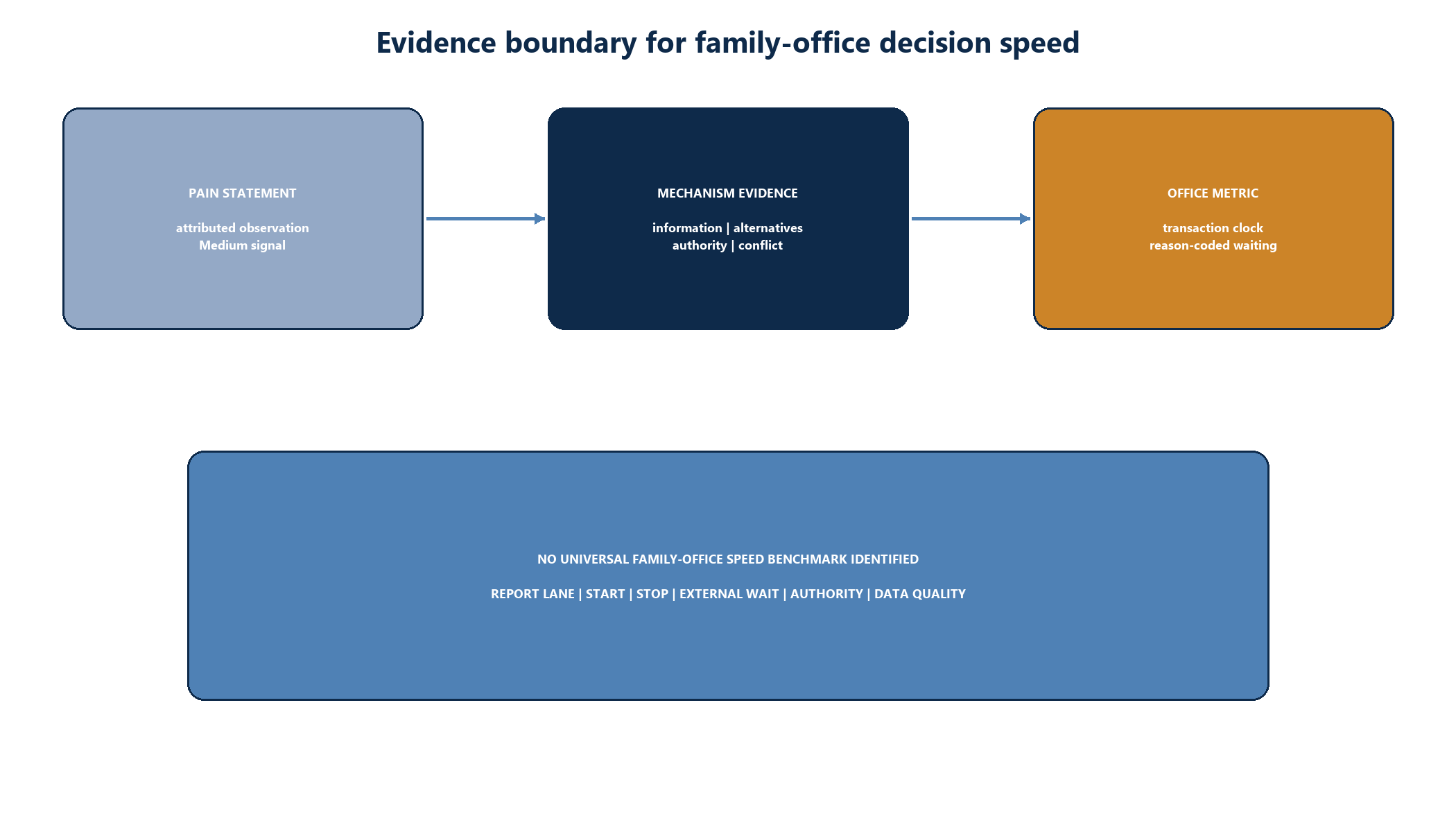
Figure 2. Deal-clock critical path and reason-coded waiting states
Source: Matchpoint transaction-clock framework; no universal family-office speed benchmark identified.
Family, Board, Committee And Management Architecture
Four distinct bodies
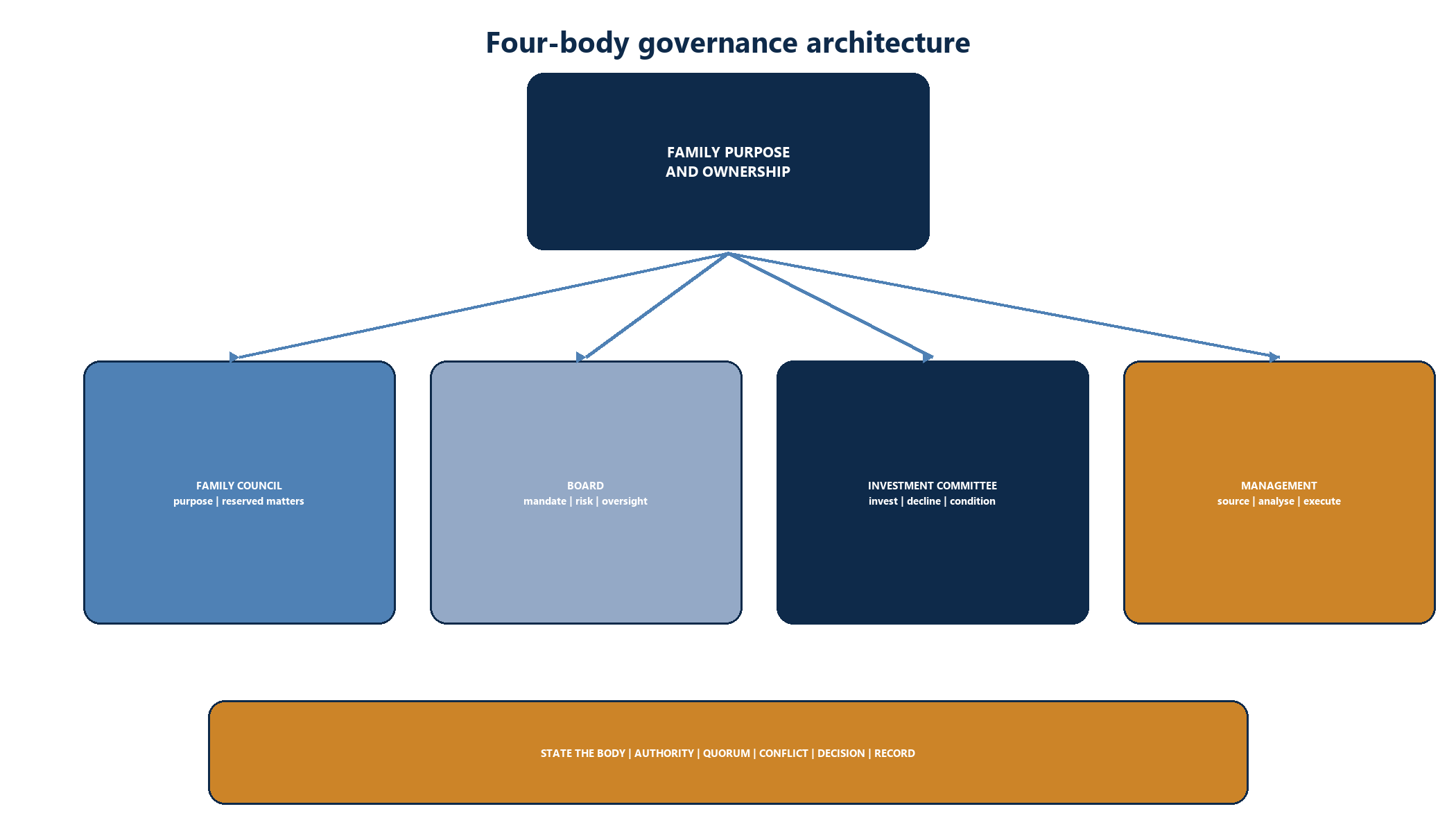
The framework distinguishes four bodies even when the same people occupy more than one:
family assembly or family council, which expresses purpose, values, family policy and reserved family matters;
board or governing body, which oversees the family-office entity, risk, leadership and control environment;
investment committee, which decides investments within its delegated charter; and
management and deal team, which sources, analyses, executes and monitors transactions.
The IFC handbook separates family governance from company governance and describes the family council as a representative body for family matters [11]. The OECD G20 Principles of Corporate Governance call for clear responsibilities, board oversight, management of conflicts and timely access to relevant information [25]. The principles address corporate governance broadly.
The purpose of separation
Separation clarifies which question each body answers. The family council can decide whether a sector conflicts with family values. The board can approve the office's risk framework and appoint the CIO. The investment committee can decide a transaction within the mandate. The deal team can spend an approved diligence budget and submit a non-binding indication within delegated parameters.
Overlap should be recorded. A principal who sits on the investment committee may also be a director and beneficiary. The meeting minutes should state which body is acting and under which authority. Related interests should be disclosed for the specific decision.
Reserved matters
Reserved matters can include a transaction above a specified exposure, a new asset class, a guarantee, recourse borrowing, a related-party transaction, a family-controlled operating company, a reputational exception, a change to the investment policy, a disposal of a legacy asset, or a transaction affecting succession or family employment. The exact list requires approval under the family's legal documents.
The reserved-matter test should occur at intake. A deal team should know early that a family decision is required. The office can then secure a meeting, identify conflicts and prepare the relevant family-level question while diligence proceeds.
Figure 3. Four-body governance architecture and authority boundaries
Source: Matchpoint framework; IFC and OECD governance sources [11,25].
| Research question | Evidence position | |
|---|---|---|
| family offices lose competitive deals because they decide slowly | one attributed practitioner observation with Medium signal [1] | define a testable hypothesis; measure opportunity-specific outcomes |
| decision-speed benchmarks | no verified universal family-office benchmark identified | create transaction-specific elapsed-time and queue benchmarks |
| delegation compresses decision time | supported as a governance design mechanism; outcome depends on implementation [11-22] | document authority, limits, conditions and escalation |
| faster decisions are always better | unsupported | measure speed together with information quality, discipline and outcome |
| one governance model fits every family | unsupported | adapt the model to purpose, ownership, structure, jurisdiction and capability |
Policy, decision lanes and delegated authority
The Investment Policy As A Delegation Instrument
From aspiration to executable rules
An investment policy statement can translate family purpose into rules that a professional team can apply. It should identify the asset pool, beneficiaries or relevant stakeholders, objectives, horizon, liquidity needs, risk tolerance, strategic allocation, permitted instruments, concentration, leverage, currency, responsible-investment constraints, benchmarks, rebalancing, custody, valuation, reporting and authority. The policy should also state which information may be provided by an external adviser and who remains accountable for the decision.
The policy should distinguish a hard limit from a target and an escalation threshold. A hard limit blocks delegated approval. A target guides portfolio construction. An escalation threshold allows a defined body to approve an exception after considering the effect and mitigation. Ambiguous terms such as "opportunistic" or "appropriate diversification" should be linked to measurable criteria or a documented judgement process.
Transaction mandate annex
A private-markets annex can specify:
strategy and stage;
geography and jurisdiction exclusions;
equity cheque and total exposure range;
ownership and governance-rights objective;
leverage and guarantee boundaries;
minimum required information by decision gate;
valuation method and sensitivity requirements;
concentration and liquidity tests;
environmental, social, governance and reputational review;
related-party and conflict procedures;
post-investment monitoring; and
exit and impairment governance.
The annex can pre-authorise low-cost screening and defined diligence expenditure. It can also authorise a non-binding indication subject to stated conditions. A binding commitment should require the authority defined in the matrix.
Policy exception record
An exception should not be hidden inside a transaction memorandum. The record should state the policy clause, reason, quantified effect where supportable, duration, decision-maker, conditions, monitoring and expiry. Repeated exceptions can reveal that the policy is outdated or that sourcing has drifted from the mandate.
Three Decision Lanes
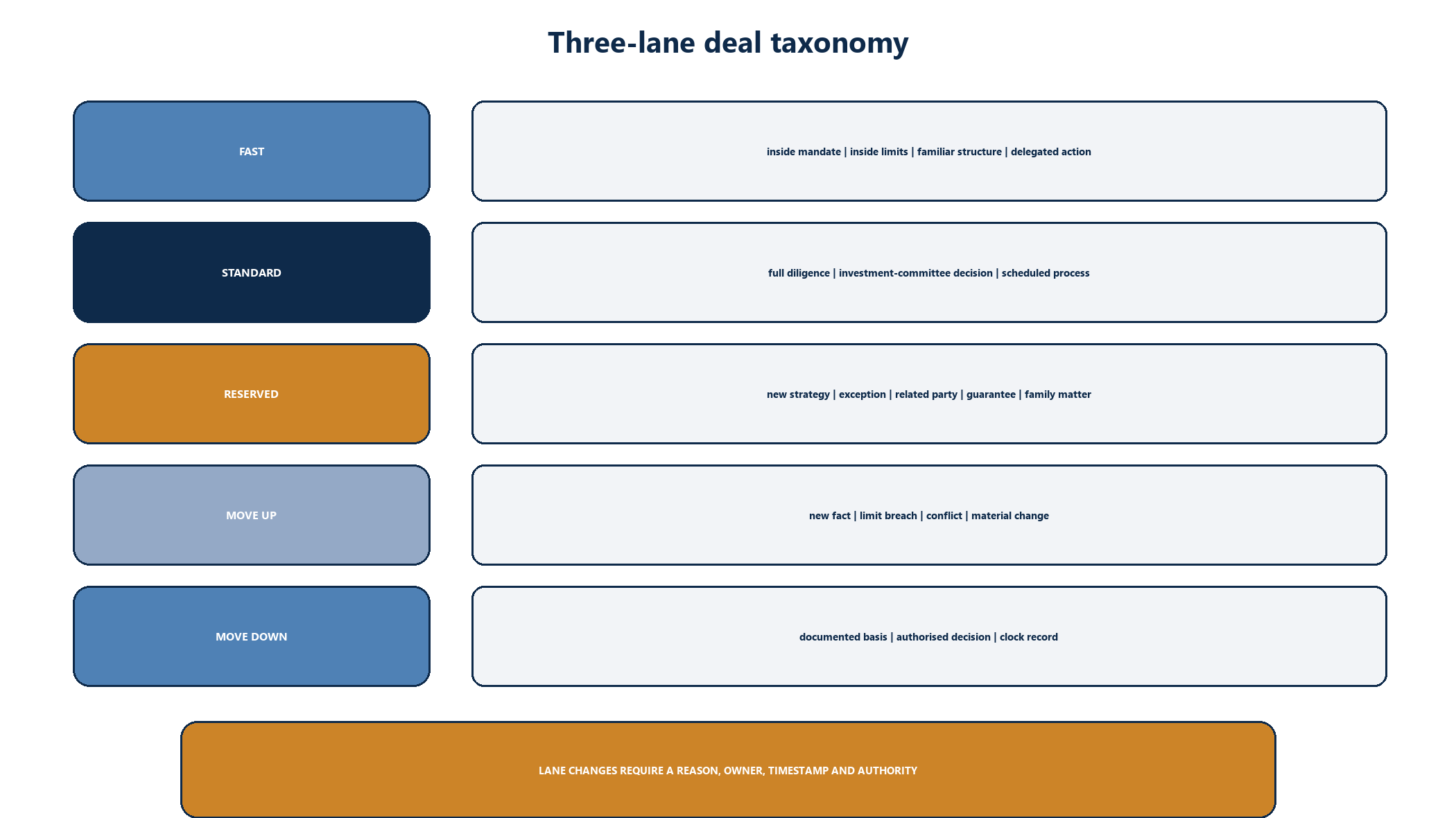
Fast lane
The fast lane is suitable for an opportunity that fits an approved mandate, remains within exposure and liquidity limits, uses familiar documents or a standard fund subscription, has no identified related-party conflict, and falls within delegated financial authority. Fast-lane status does not waive legal, sanctions, tax, investment or operational checks. It specifies a shorter minimum decision pack and an on-call approval process.
The lane can be used for a non-binding indication, diligence budget, follow-on within an approved reserve, or transaction within a pre-approved programme. The delegation matrix should state exactly which action is permitted.
Standard lane
The standard lane covers a new private transaction within strategy that requires full diligence, valuation, legal negotiation, funding confirmation and a scheduled investment-committee decision. It uses the full memorandum and standard workstreams. The timetable is built backwards from the external deadline with owners for each information item and adviser opinion.
Reserved lane
The reserved lane covers matters requiring family or board approval. Examples include a new strategy, an exposure above a limit, recourse leverage, a related-party transaction, a guarantee, a reputational exception, an investment in a family-controlled business, or a change to the investment policy. The reserved decision should be framed as a discrete question. The investment committee can still make a recommendation and complete technical review.
Lane assignment and movement
Lane criteria should be objective enough to audit. The chief investment officer or designated chair assigns the initial lane at intake. A later fact can move the deal to a higher-control lane. A move to a lower-control lane requires a documented basis and appropriate authority. The transaction clock records lane changes.
Figure 4. Three-lane deal taxonomy and escalation rules
Source: Matchpoint implementation framework; transaction-specific criteria required.
Delegation-Of-Authority Matrix
Matrix design
The delegation matrix should list decisions down the rows and bodies or roles across the columns. Each cell should state decide, recommend, review, consult, execute or inform. Financial thresholds should state currency, aggregation period, related transactions, total exposure and whether commitments, guarantees and follow-ons are included.
The matrix must align with constitutional documents, trust deeds, shareholder agreements, board authorities, banking mandates and applicable regulation. A management matrix cannot create legal authority that the governing documents withhold. Qualified legal and tax advisers should review the adopted structure.
Gates across a private transaction
The matrix should address at least:
opportunity decline;
conflict clearance;
adviser appointment;
diligence expenditure;
confidentiality and data-room access;
non-binding indication;
exclusivity;
financing and hedging;
binding offer or subscription;
final documents and conditions;
completion payment;
board nomination and voting instructions;
follow-on capital;
impairment, restructuring or waiver; and
exit.
Conditions and expiry
Delegation should have conditions and an expiry. A delegate may approve a non-binding indication within a price range provided that it is subject to investment-committee approval, satisfactory diligence, funding and legal documentation. A standing programme can expire annually or when a portfolio limit is reached. Emergency authority should state the circumstances, maximum duration and retrospective reporting requirement.
Sample architecture
The table is a model requiring legal and family approval.
Figure 5. Delegation-of-authority matrix from intake to exit Source: Matchpoint implementation framework; legal-document alignment required.
| Criterion | Fast lane | Standard lane | Reserved lane |
|---|---|---|---|
| mandate | clearly inside | inside with judgement | new or exception |
| exposure | within delegated limit | within committee limit | above limit or special concentration |
| conflict | none identified | manageable under standard process | related party or material personal interest |
| structure | familiar and bounded | transaction-specific | guarantee, recourse or novel control issue |
| evidence pack | short prescribed pack | full memorandum | full memorandum plus family or board question |
| decision body | delegated officer or subcommittee | investment committee | family council or board after committee recommendation |
Investment committee and decision-speed controls
Investment-Committee Design
Charter
The investment-committee charter should state purpose, authority, membership, chair, secretary, term, quorum, voting, conflicts, recusal, information rights, meeting cadence, emergency meetings, written resolutions, minutes, escalation and review. The Ford Foundation's published Investment Committee Charter provides one institutional example of delegated oversight and authority [26]. It is not a family-office template. A family office should align its charter with its own legal documents and mandate.
Composition
The committee needs sufficient investment, portfolio, legal, tax, operating and risk judgement for the strategies it approves. Not every specialist needs a vote. An external expert can advise without becoming a standing decision-maker. The role of family members should be explicit. A family member can contribute purpose, risk tolerance, history and relationship context. Professional members can contribute repeatable analysis and execution discipline.
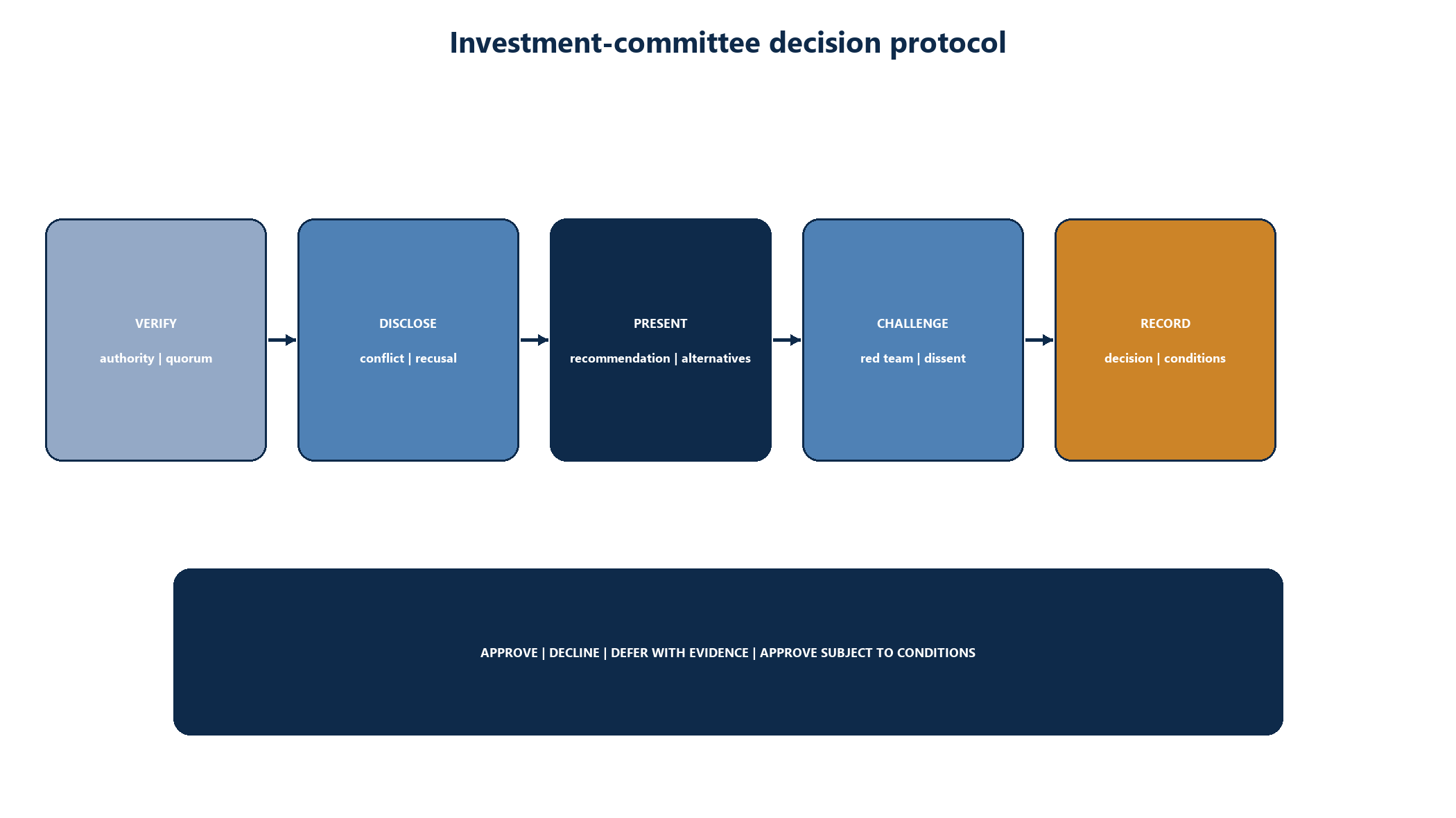
The chair protects the decision process. The chair confirms the question, verifies quorum and conflicts, allocates time, invites dissent, distinguishes open evidence from preference, calls the decision and confirms conditions. The secretary maintains the pack, attendance, minutes, decision log and condition register.
Quorum and voting
Quorum rules should address recusal and absence. A large committee requiring every member can create scheduled-meeting latency. A very small quorum can concentrate power. The charter can set a normal quorum, a higher quorum for reserved categories, and a route for an alternate or emergency meeting.
Voting rules should specify simple majority, supermajority or unanimity by decision category. A casting vote, veto or family-principal consent should be explicit. A veto should carry a defined scope. Silence should not count as approval unless the governing documents lawfully provide that outcome.
Dissent and decision quality
Amason links cognitive conflict to decision quality and affective conflict to lower acceptance [21]. Schweiger, Sandberg and Ragan compared dialectical inquiry, devil's advocacy and consensus approaches in strategic decision-making [27]. Janis's work on groupthink highlights pressures that can impair critical evaluation [28]. These sources support a designed challenge process. The committee can assign a red-team member to identify the strongest disconfirming evidence, failure conditions and alternative use of capital.
The dissent note should record the issue and evidence without characterising motive. A committee can approve despite dissent, decline, or require a condition. The record supports learning and protects institutional memory.
Figure 6. Investment-committee decision protocol and controlled dissent
Source: Matchpoint framework; decision-process evidence [18-22,27,28].
Decision-Speed Measurement
A benchmark built from the office's own data
The office should establish a baseline from completed and declined opportunities over a defined period. The data set should identify lane, strategy, cheque band, transaction type, external deadline, information completeness, conflict, adviser involvement, each clock timestamp, decision, conditions and outcome. A small or incomplete sample should be labelled. Medians and ranges are preferable to an unsupported point target.
Comparable groups matter. A fund re-up should not be compared directly with a control acquisition. A follow-on under an existing reserve differs from a new jurisdiction or related-party transaction. The benchmark should state the inclusion rules and cut-off date.
Core measures
Recommended measures include:
median intake latency by lane;
median complete-pack-to-decision time;
percentage of decisions before the counterparty deadline;
percentage of meetings rescheduled for lack of quorum;
percentage of deferrals with a stated evidence gap and next date;
internal waiting time by gate;
external-information waiting time;
policy-exception rate;
condition completion time; and
decision reversals or material post-decision corrections.
The measures describe process. They do not by themselves establish investment quality. A dashboard should also show whether approved deals remained inside mandate, whether key assumptions were realised, and whether risk or control exceptions occurred.
Service levels
A service level can be set after the baseline. It should be specific to a lane and decision. For example, an office can require initial triage within a stated number of working hours, a conflict check within a stated period, or an emergency meeting within a chartered notice period. The actual numbers require management approval and capacity testing.
Data integrity
Timestamps should come from a controlled workflow where practical. Manual edits need a reason and audit trail. The office should avoid stopping the clock during internal debate unless the state is explicitly defined. Opportunities that disappear because the counterparty chooses another bidder should retain an outcome code and available evidence. The team should avoid inferring that speed caused the loss without counterparty evidence.
Data Room, Memorandum And Red-Team Operating System
Minimum decision pack
The minimum decision pack should be proportional to the gate. An intake decision needs mandate, counterparty, requested action, deadline, preliminary exposure and known conflicts. A non-binding indication needs valuation range, key assumptions, funding path, information limitations and conditions. A binding decision requires the evidence defined by the policy and committee charter.
The pack should contain a decision question on the first page. It should state the authority, lane, external deadline, recommendation, alternatives, capital, total exposure, funding, concentration, key risks, conflicts, diligence status, open assumptions and requested conditions. The body can include business, market, financial, legal, tax, operations, technology, people, responsible-investment, valuation, structure and exit analysis as relevant.
Source and assumption control
Each material claim should point to a source. Management projections, adviser analysis, public information, audited accounts and internal calculations have different evidential status. The assumption register should state owner, basis, sensitivity, validation method and decision effect.
Kahneman and Lovallo describe biases that can produce timid choices and bold forecasts [29]. Lovallo and Kahneman discuss the outside view and reference-class thinking for large initiatives [30]. Flyvbjerg explains reference-class forecasting as a response to optimism and strategic misrepresentation in project forecasts [31]. These sources support an explicit base-rate or comparison section where reliable comparable data exists. The family office should disclose where no defensible reference class is available.
Alternatives
The decision memorandum should include at least three alternatives where practical: proceed under the proposed terms, proceed under modified terms, and decline or allocate capital elsewhere. Eisenhardt's mechanism research links faster decisions in its sample with consideration of more alternatives [18]. Alternatives can clarify which feature drives the recommendation and prevent a binary process from absorbing unnecessary debate.
Red team
The red team should identify disconfirming evidence, failure modes, omitted stakeholders, concentration effects, governance weaknesses and exit constraints. It should not repeat the entire diligence process. A standard red-team page can ask:
what evidence would change the recommendation;
which assumption creates the largest downside sensitivity;
which contractual protection may fail in practice;
what the seller or sponsor has strongest incentives to emphasise or omit;
which risk is correlated with the existing portfolio;
which condition must be satisfied before commitment; and
what a credible alternative use of the capital offers.
Meeting-ready standard
The secretary can reject a pack that lacks the decision question, authority, sources, conflicts, funding, exposure, recommendation or required approvals. The reason should be recorded. A late pack can be admitted by the chair under an exception with the risk acknowledged. The purpose is to protect decision quality and reduce meeting time spent discovering missing basics.
Alignment, conflicts, liquidity and advisers
Family Alignment Before The Live Deal
Purpose and risk conversation
Live deal processes are a poor setting for first-time debate over family purpose, leverage, values or liquidity. The family council should review those matters through a regular governance calendar. The output can be incorporated into the investment policy and reserved-matters schedule.
Socioemotional wealth research describes non-financial family objectives and control considerations that can shape family-firm choices [32,33]. Long-term-orientation research examines the distinctive time horizon of family firms [34]. Agency and stewardship theories offer different accounts of owner, manager and family behaviour [35-37]. These theories support explicit discussion of purpose and incentives. They do not prescribe one answer for a family.
Education and decision readiness
UBS reported that 27 percent of its 2026 respondents had organised education for the next generation and 35 percent had a family-office succession plan [2]. These sample figures indicate that formal readiness arrangements are not universal. A family can create an annual programme covering portfolio structure, investment risk, private-market mechanics, conflicts, fiduciary roles, legal entities, tax boundaries, cyber risk and decision simulation.
Education should be separated from live approval. A family member who lacks context can receive a briefing and ask questions before serving as a voting member. Alternates and succession arrangements should be documented.
Pre-agreed principles
The family can approve principles for recurring situations:
co-investments introduced by a family member;
investments involving a family operating company;
requests for personal guarantees;
transactions in sensitive sectors or jurisdictions;
board seats and public association;
use of debt against family assets;
information shared across family branches;
family employment in portfolio companies; and
media, philanthropy or reputation implications.
The principles reduce ambiguity. Each live case still requires facts, conflict review and the authority specified by the charter.
Disagreement protocol
The governance documents should state how disagreement is handled. Options include a defined voting threshold, chair-led synthesis, adjournment for specified evidence, independent advice, mediation, escalation to the family council or a decision not to proceed. The protocol should separate a values objection from a valuation or diligence question because the appropriate decision body may differ.
Conflicts, Independence And Related Parties
Conflict register
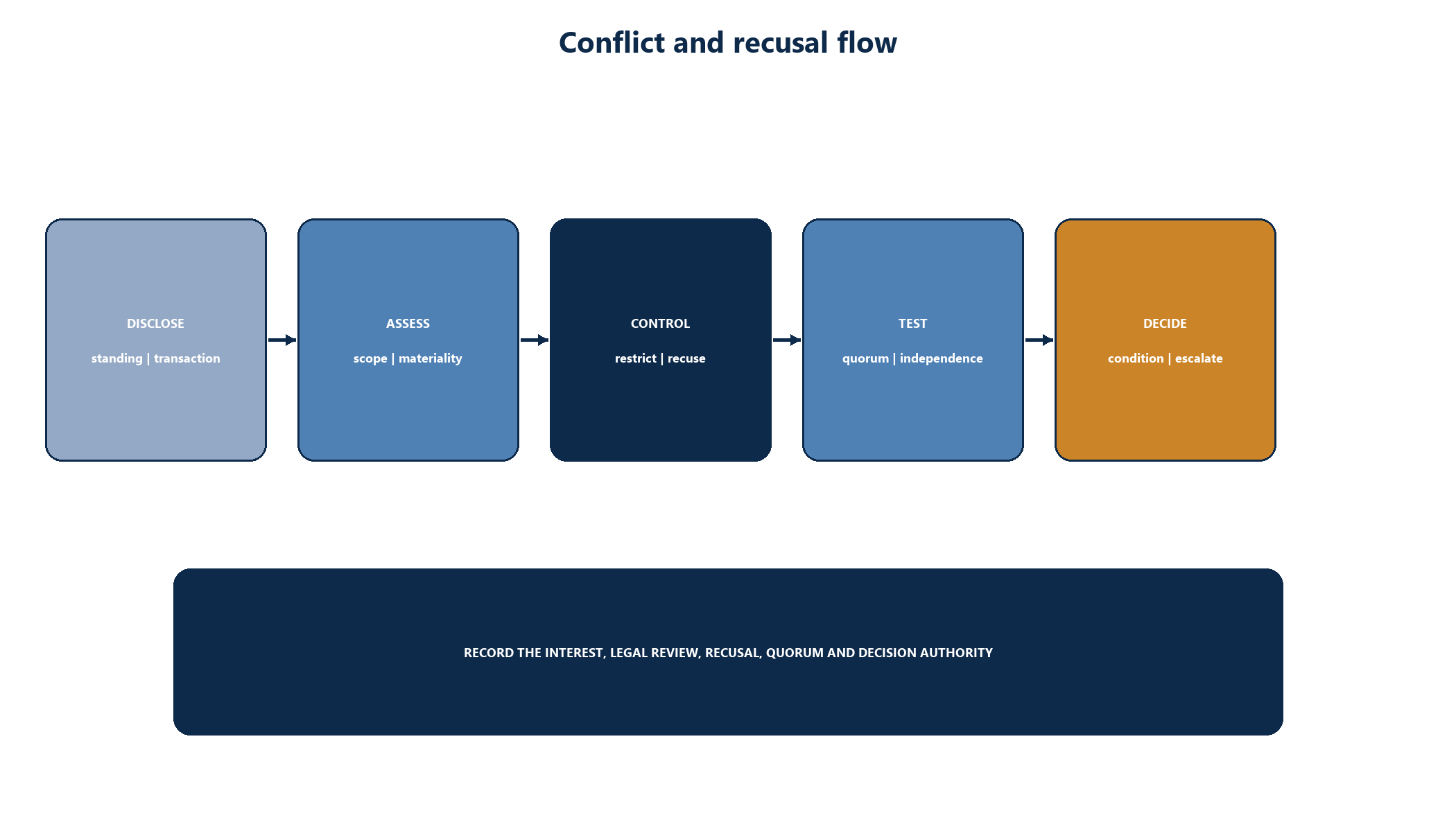
Family-office networks can create proprietary access and conflicts. A family member, adviser, director or employee may have an interest in the seller, sponsor, fund manager, lender, broker, service provider or portfolio company. The office should maintain a standing interest register and require transaction-specific confirmation.
The OECD principles identify conflicts of interest, related-party transactions and board oversight as core governance concerns [25]. The SEC family-office rule defines family clients and ownership/control for its regulatory purpose [14]. The applicable duties and rules depend on entity, role and jurisdiction. Qualified counsel should determine the legal requirements.
Recusal architecture
Recusal should specify whether the conflicted person receives papers, attends factual discussion, participates in debate, counts in quorum or votes. The treatment may differ by conflict type. The unconflicted members should decide whether independent valuation, legal advice or a fairness process is required.
The committee should plan for quorum after recusal. An alternate independent member or escalation route can avoid invalid approval under a short deadline. Any waiver or management of the conflict requires the authority defined in the governing documents.
Introducer and adviser economics
Fees, carried interests, referral payments, board compensation and other economic interests should be disclosed. The decision memorandum should state who pays the adviser, the scope, the fee basis and any success component. The office should avoid relying on an adviser for an independent check where the adviser's economics depend materially on completion without appropriate safeguards.
Related-party transactions
A related-party transaction should be assigned to the reserved lane. The process can require independent data, comparison with alternatives, an unconflicted recommendation, documented recusals, a higher voting threshold and approval by the body specified in the legal documents. The record should state the relationship and why the transaction serves the relevant investment and family objectives.
Figure 7. Conflict disclosure, recusal and independent-review flow
Source: Matchpoint framework; OECD and jurisdiction-specific governance review required [25].
Liquidity, Concentration And Funding Certainty
The portfolio decision
A direct investment cannot be assessed only on company merit. The committee needs current and pro forma exposure by issuer, sector, geography, currency, liquidity, strategy and common risk factor. It should aggregate commitments, guarantees, follow-ons and related entities under the policy's rules.
UBS reported that 60 percent of respondents planned strategic-asset-allocation changes in 2026 and 82 percent of Middle East respondents intended to adjust strategic allocations [2,3]. These sample results show active portfolio change. They do not determine an appropriate allocation for another family.
Liquidity schedule
The liquidity schedule should reconcile cash, marketable assets, credit facilities, committed but undrawn capital, expected capital calls, taxes, distributions, family spending, philanthropy, operating-company needs and debt service. Forecast amounts should state source and confidence. A stress case can test delayed distributions, accelerated calls, currency movement and a follow-on requirement.
Funding certificate
Before a binding commitment, an accountable finance officer should certify the planned funding source, ownership entity, currency, payment timetable, approvals, bank mandate, hedging decision, financing conditions and fallback. A legal or tax adviser should confirm structure-specific matters within their scope. The certificate should identify any dependence on asset sales or third-party financing.
Concentration exception
A concentration exception should quantify the current and pro forma exposure under the policy method. It should state the rationale, downside sensitivity, correlation with existing assets, governance rights, liquidity, mitigation, monitoring and exit path. The decision body should be clear.
Regulatory And Jurisdiction Boundary
Legal-status check
The phrase family office can describe different structures. Regulatory treatment depends on ownership, clients, activities, jurisdiction and holding out. The SEC rule, DIFC regulations, UAE family-business law and Hong Kong tax-concession rules use different definitions and purposes [8,12,14-16]. A family office should maintain a legal-entity and regulatory-perimeter map reviewed by qualified advisers.
Cross-border transactions
A cross-border deal can require merger control, foreign-investment, sanctions, anti-money-laundering, beneficial-ownership, sector, exchange-control, tax, data and licensing analysis. The committee should receive a jurisdiction matrix with the question, adviser, source, status, decision impact and expected timing. A legal conclusion should be attributed to the qualified adviser providing it.
Confidentiality and data
Family offices may hold sensitive family, beneficial-owner and portfolio information. Data-room access should follow least-privilege principles, confidentiality terms, logging, controlled downloads and retention rules. The committee pack should avoid unnecessary personal data. A related-party or personal relationship should be disclosed through a controlled conflict process.
Governance documents and legal effect
The delegation matrix, committee charter and investment policy must be reconciled to binding documents. Board and family resolutions should be executed under applicable procedures. Bank mandates, powers of attorney and signatory records should match the approved authority. The office should retain evidence of adoption, effective date and superseded versions.
External Advisers And Surge Capacity
Accountable client, scoped adviser
External advisers can add jurisdiction, sector, tax, legal, technology, operating or diligence capacity during a short process. UBS's 2026 sample shows that many offices retain strategic asset allocation and reporting in-house while using external specialists for functions such as legal, tax and cyber security [2]. The office should retain an accountable internal owner for each workstream.
An engagement letter should define scope, questions, deliverables, reliance, assumptions, access, confidentiality, conflicts, fees, deadline and escalation. The decision memorandum should distinguish an adviser conclusion from management judgement. A reliance restriction should be visible to the committee.
Standing panels
A standing panel can reduce onboarding time. The office can pre-agree confidentiality, conflicts checks, rate cards, information-security requirements, standard scopes and contact routes. Panel inclusion does not determine suitability for a transaction. The workstream owner should select the relevant capability and document any conflict.
Parallel workstreams
The deal leader can run commercial, financial, legal, tax, operational, technology, people and responsible-investment workstreams in parallel after the intake gate. Dependencies should be mapped. A key finding enters one issue log with decision impact and owner. Repeated requests to the seller should be consolidated where practical.
Adviser latency
The transaction clock should record adviser instruction, data availability, draft and final delivery. Late input can reflect late instruction, access limits, scope change or external dependency. The office should preserve the reason code and avoid attributing all delay to the adviser.
| Conflict state | Minimum response | Decision effect |
|---|---|---|
| no identified conflict | signed confirmation | normal lane continues |
| disclosed manageable interest | chair and legal review | conditions, information restriction or recusal |
| voting-member conflict | recusal and quorum test | alternate or escalation may be required |
| related-party transaction | independent evidence and reserved lane | unconflicted recommendation and authorised approval |
| adviser success fee | disclosure and scope review | independent challenge may be commissioned |
| unresolved conflict | recorded legal and governance escalation | decision deferred or declined |
Transaction gates and implementation
From Opportunity To Binding Decision
Gate 0: receipt and triage
The designated intake channel records the opportunity and external deadline. The team checks mandate, conflict, counterparty, requested action, approximate exposure and reserved-matter flags. The CIO assigns a lane and owner. A clear out-of-mandate opportunity can be declined within delegated authority.
Gate 1: permission to spend and indicate
The deal leader prepares the short pack. The authorised body approves a diligence budget, adviser appointments and a conditional non-binding indication where permitted. The record states the valuation range, conditions, funding assumption and information limitations.
Gate 2: diligence and structure
Workstreams open against a controlled question list. The issue log ranks items by decision effect. The exposure and liquidity schedules are updated. Conflicts, legal perimeter and required family or board approvals are confirmed. The committee receives early notice of a potential exception.
Gate 3: binding decision
The complete pack is circulated under the charter. The secretary confirms authority, quorum, conflicts and pack completeness. The chair states the question. The deal team presents the recommendation, alternatives and conditions. The red team presents disconfirming evidence. Members decide, decline, defer or approve subject to conditions.
Gate 4: execution and condition control
Approved conditions enter a register. Signing authority and funding are confirmed. Changes from the approved terms are classified. A material change returns to the decision body. Completion evidence, final exposure and monitoring owners are recorded.
Gate 5: learning
The office reviews the transaction clock, process exceptions, decision assumptions and counterparty outcome. A declined or lost opportunity remains valuable process evidence. The review should state what is observed and avoid invented explanations.
Illustrative Example Competitive Direct Deal
This section is an Illustrative example. The family, opportunity, amounts, timings, committee actions and outcomes are fictional. They demonstrate the framework and are not a forecast, client result or benchmark.
Scenario facts
A GCC family office receives an adviser-led opportunity to acquire a minority position in a profitable business. The requested equity cheque is USD 25 million. The process letter requests a non-binding indication in five working days and a binding offer after a subsequent diligence period. The office's approved direct-investment mandate permits the sector and a cheque up to USD 30 million, subject to concentration, liquidity, legal, tax and investment-committee approval.
The family has three branches. Its prior practice asked eight adult family members to vote on each direct investment. The office has no observed decision-time baseline. A recently approved charter reserves related-party transactions, guarantees and exposures above USD 30 million to the family council. It delegates investments inside the mandate to a five-member investment committee with a three-member quorum, provided that one family member and the CIO are present.
Intake and lane
The intake screen identifies mandate fit, no known related-party connection, exposure within the committee limit and no recourse guarantee. The CIO assigns the standard lane. The secretary schedules a conditional non-binding-indication meeting and begins the transaction clock. A conflict confirmation is requested from committee members and the family council chair.
Conditional indication
The deal team prepares a short memorandum with a valuation range, funding source, concentration estimate, known information gaps and conditions. The committee approves a non-binding indication subject to full diligence, confirmatory valuation, legal and tax review, funding certification and final committee approval. The indication is submitted before the fictional deadline.
Diligence and challenge
Parallel workstreams review the business, financial information, legal documents, tax structure, technology and management. The red team identifies customer concentration and dependence on a founder. The deal team models a downside case and seeks governance rights, information rights and a founder-transition covenant. A family member discloses a social relationship with one seller director and is recused from the relevant discussion under counsel's direction. Quorum remains available.
Binding decision
The committee pack states the decision question, authority, price, exposure, liquidity, conditions, conflicts and open matters. The committee approves within its fictional delegated authority, subject to completion of named conditions and no material adverse change in agreed facts. A price or term change outside the approval range must return to the committee.
Scenario economics boundary
The fictional USD 25 million amount is an input. No return, avoided loss, cash saving, revenue or alpha is attributed to Matchpoint or a client. The scenario demonstrates a governance route; it does not claim that delegation causes a winning bid or superior investment performance.
Governance Maturity Model And Implementation
Five levels
The maturity model is a Matchpoint implementation framework. It is not a validated industry scale.
Level 1: person-dependent. Opportunities arrive through personal channels. Authority is implicit. Meetings are convened ad hoc. Decision evidence is fragmented.
Level 2: documented. The office has an investment policy, committee and templates. Some authorities and conflicts are recorded. Timelines depend on individuals and meeting calendars.
Level 3: controlled. The office uses a delegation matrix, three lanes, minimum packs, quorum and recusal rules, a decision log and a transaction clock. Exceptions are visible.
Level 4: measured. The office maintains comparable process cohorts, service levels, reason-coded latency and periodic assumption reviews. The board receives governance metrics.
Level 5: adaptive. The office updates mandates, authorities, adviser panels and decision routines from evidence while preserving legal and family control. Scenario exercises test continuity and succession.
Ninety-day implementation
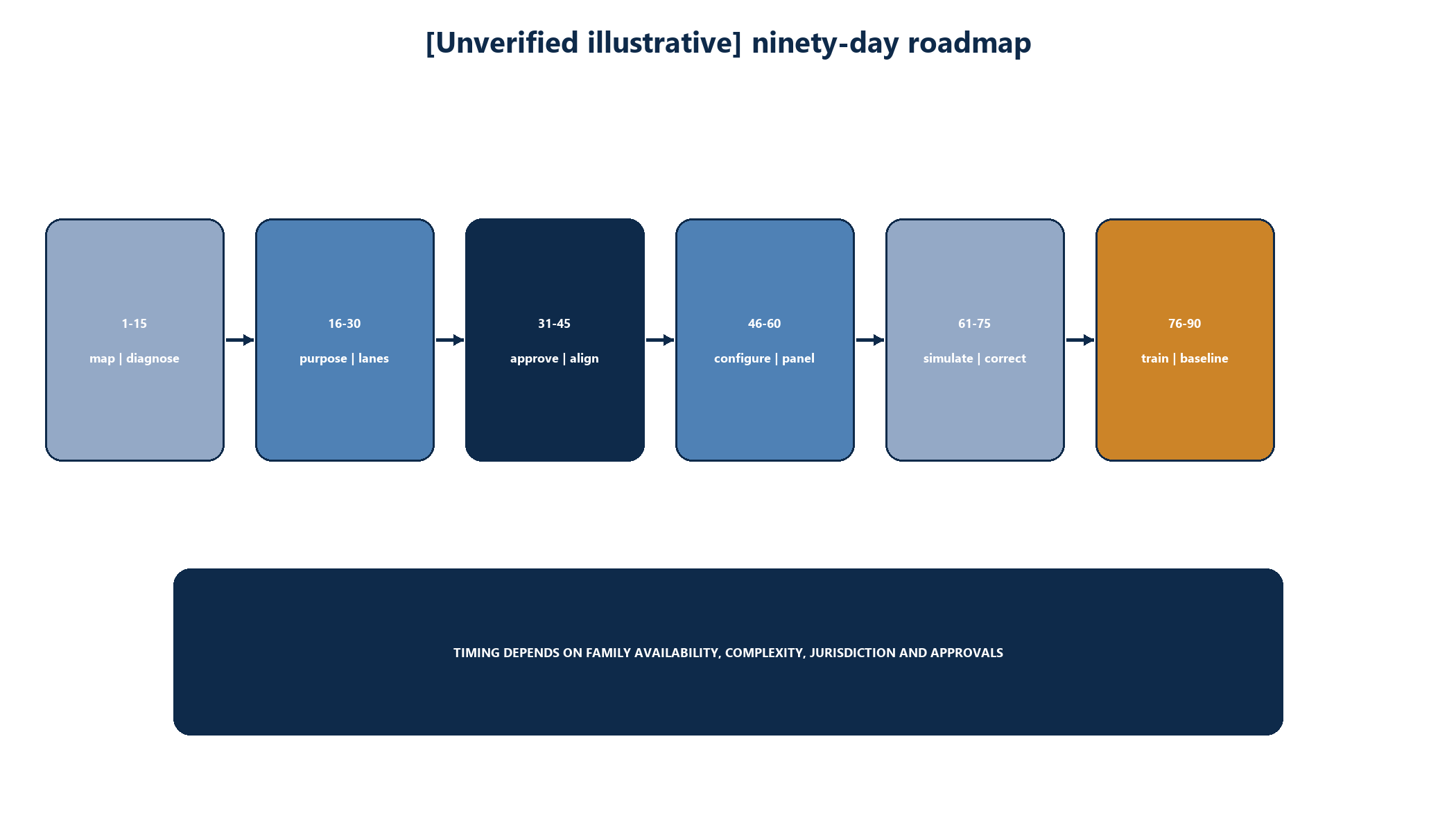
The implementation should begin with legal-document and current-state review. The exact timing depends on family availability, complexity, jurisdiction and approvals. The following sequence is an Hypothetical modelling assumptions.
Days 1-15: inventory entities, governing documents, committees, mandates, bank authorities, recent deals and decision records. Map the actual process and unresolved conflicts.
Days 16-30: agree purpose, decision perimeter, reserved matters, three lanes and minimum data. Draft the investment policy annex, delegation matrix and committee charter.
Days 31-45: secure legal and governance review. Approve the documents through the required bodies. Align bank mandates, powers and signatories.
Days 46-60: configure intake, data room, decision memorandum, conflict register, clock, condition register and dashboard. Establish the adviser panel.
Days 61-75: run a tabletop simulation using a fictional competitive deal. Test quorum, recusal, emergency meeting, written resolution, funding certificate and material-change escalation.
Days 76-90: correct gaps, train users, establish the baseline dataset and board reporting cadence. Record unresolved items with owners and dates.
Governance dashboard
The dashboard should report the process without encouraging indiscriminate speed. It can show pipeline by lane, upcoming deadlines, complete-pack-to-decision time, rescheduled meetings, deferrals, policy exceptions, conflict recusals, condition status and post-decision corrections. Investment outcome data should use the valuation and performance policy.
Figure 8. Five-level family-office governance maturity model
Source: Matchpoint implementation framework; not a validated industry scale.
Figure 9. Ninety-day governance implementation roadmap
Limitations And Conclusion
Limitations
First, The attributed practitioner statement is an attributed practitioner observation with Medium signal and no population denominator [1]. Second, current sector surveys use different samples, definitions and methodologies [2-7]. Third, the strategic-decision-speed literature draws substantially from corporate and high-technology settings rather than family offices [18-22]. Fourth, family-office structures, legal duties and regulatory classifications vary by entity and jurisdiction [8-16]. Fifth, faster decisions can still be poor decisions; process speed is not investment quality.
The framework should therefore be tested inside each office. Baseline measures should state sample, period, lane and data quality. Governance documents require legal and tax review. Investment recommendations require transaction-specific diligence. Family purpose and reserved matters require authorised family decisions.
Conclusion
Family-office decision speed is an operating-system question. The office needs clarity over purpose, reserved matters, delegated authority, committee design, information, conflicts, funding and escalation before a seller starts the clock. Current surveys show that formal structures such as investment committees and documented investment processes exist in part of the market [2]. They do not reveal whether those structures compress latency or improve outcomes.
The practical response is measurable. Build a transaction clock. Separate external waiting from internal decision latency. Route opportunities into fast, standard and reserved lanes. Give professionals bounded authority. Design quorum, voting, recusal and emergency procedures. Use a concise sourced memorandum, controlled dissent and a signed decision log. Review exceptions and outcomes through comparable cohorts.
This architecture preserves the family's reserved decisions while allowing the office to act within an approved mandate. Any claim that it improves win rate, returns or capital efficiency requires observed evidence. No Matchpoint or client financial outcome is claimed.
| Maturity level | Authority | Information | Measurement | Continuity |
|---|---|---|---|---|
| 1 person-dependent | implicit | personal files | none | key-person dependent |
| 2 documented | partial | templates | selected counts | informal alternates |
| 3 controlled | matrix and lanes | controlled pack | transaction clock | chartered quorum and escalation |
| 4 measured | evidence-led review | source and assumption register | comparable cohorts and reason codes | tested alternates |
| 5 adaptive | governed updates | integrated knowledge | decision and outcome learning | succession simulation |