

1. Map every role before sharing the opportunity
A syndication should begin with an entity-and-role map. It identifies the seller, legal owner, beneficial owner, source intermediary, arranger, adviser, placement agent, principal, warehouse vehicle, SPV manager, administrator, investor, custodian, escrow agent and issuer. Each role needs a legal entity, capacity, authority, duty, compensation and information entitlement.
One organisation can occupy several roles. The conflict record should show when the firm or an affiliate owns inventory, earns an arrangement fee, advises a buyer, selects allocations or controls the vehicle. The record also identifies employees and connected persons with an economic interest.
The map should follow money and risk. It records acquisition funding, warehouse interest, hedging or carry cost, deposits, investor subscriptions, seller proceeds, fees, reserves, rebates and residual value. A party receiving an indirect benefit appears even when it is absent from the principal agreement.
Decision rights should be assigned before marketing. The mandate owner confirms seller authority. The transaction owner confirms inventory and transfer route. The conflicts owner reviews connected interests. The allocation owner applies the approved method. Finance reconciles every payment. Specialist advisers decide reserved legal, regulatory, tax, accounting and valuation matters.
The file should distinguish client from counterparty. A seller may be the firm's client while participating investors are counterparties, clients of another entity or clients for a different service. The applicable relationship and duties require precise confirmation.
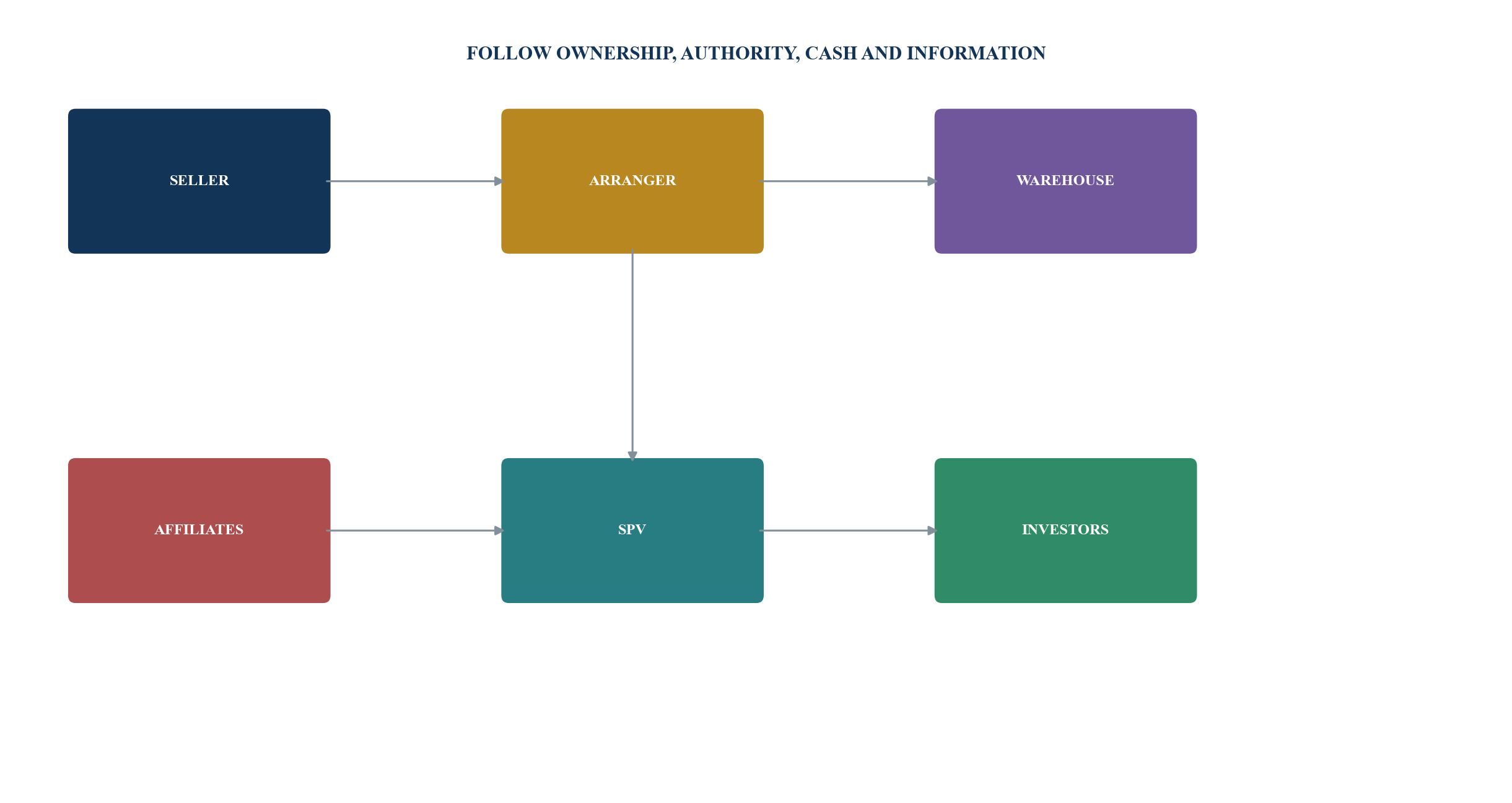
Legal relationships and duties require transaction-specific review.
Table 1. Role-conflict register
| Role | Decision right | Economic interest | Required evidence |
|---|---|---|---|
| seller or holder | accept terms and transfer | proceeds and timing | title, authority and mandate |
| arranger | process and coordination | fee and relationship value | engagement and capacity |
| warehouse | acquire, fund and sell inventory | spread, carry and residual | investment approval and funding |
| SPV manager | operate vehicle and allocations | management or administration fee | governing documents |
| investor | submit and fund order | investment return | eligibility, order and funds |
| affiliate or employee | participate under approved route | direct or indirect gain | relationship and conflict approval |
Capacity and duty should be confirmed under current applicable law.
2. Establish what inventory exists and who controls it
Syndication should use verified inventory. The file identifies the exact security, class, quantity, registered and beneficial owner, restrictions, encumbrances, rights processes, seller authority, expiry and evidence date. Expected access remains separate from owned or controlled inventory.
Duplicate supply can enter through multiple brokers. The team should preserve source lineage and avoid summing the same holder several times. A potential duplicate remains quarantined until independent origin or ownership is established.
The seller mandate should define exclusivity, permitted investors, jurisdictions, price instructions, minimum and maximum size, disclosure permissions, fees, term, withdrawal rights and settlement route. An intermediary's representation should be evidenced rather than assumed.
Warehouse inventory needs its own title record. The file shows when risk transfers, what conditions remain, who funds the acquisition, whether the warehouse can sell before registration, and which losses or expenses it bears. A back-to-back expectation should not be reported as settled ownership.
Inventory status should use defined states: expected, evidenced, mandated, approved for sharing, matched, funded, acquired, deliverable, allocated, settled and residual. Each state has an owner and evidence threshold.
Material changes reopen approval. Quantity, holder, class, rights, price, warehouse entity, investor route or issuer consent can alter conflicts and economics. The system should preserve the original record and the reason for change.
3. Define warehouse purpose, limit and exit before acquisition
Warehousing can bridge timing between seller certainty and investor formation. It can also move market, credit, liquidity, funding, operational and regulatory risk onto the warehouse. The decision should state the commercial purpose and why the chosen entity is appropriate.
The approval pack includes security, quantity, source price, complete acquisition cost, expected investor price, funding, holding period, transfer route, concentration, downside scenarios, exit alternatives, conflicts, related parties and decision owner. Revenue and exit assumptions remain management estimates until executed and collected.
Limits should cover issuer, security, counterparty, currency, jurisdiction, duration and aggregate exposure. A warehouse that exceeds its planned holding period should trigger re-underwriting rather than automatic extension.
The warehouse should not set investor allocation solely to reduce its own unwanted exposure. Residual risk belongs in the disclosed economics and decision framework. Pressure created by funding maturity, price movement or an expiring seller agreement should be visible to the approving function.
Exit scenarios include complete syndication, partial syndication, price concession, extended hold, transfer failure, issuer refusal and unwind. Each scenario identifies cash needs, loss allocation, investor communication and authority.
Employees or affiliates funding the warehouse create additional interests. Their priority, economics, governance and access to information should be recorded. The conflicts owner determines the permitted route and required controls.
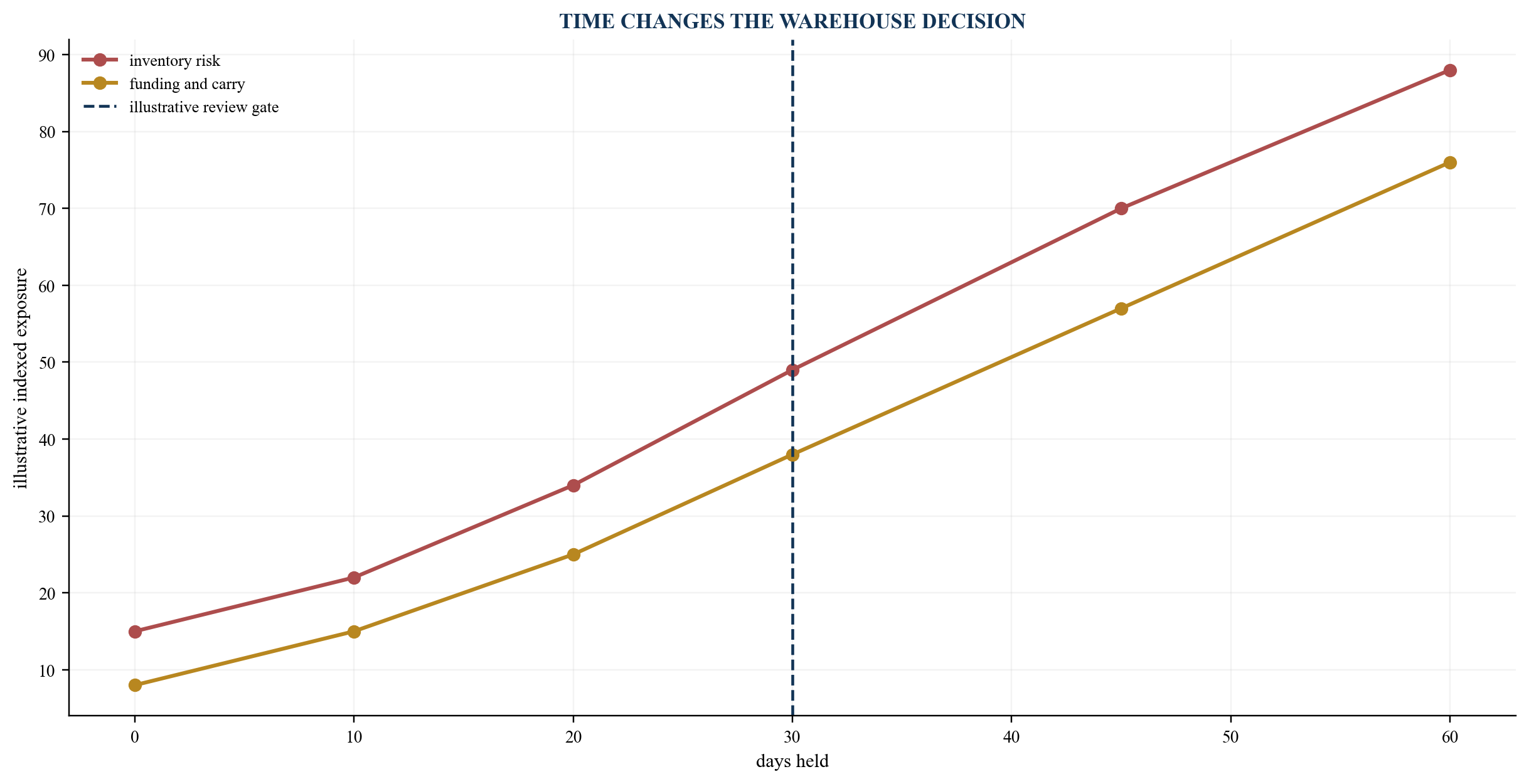
Days, limits and loss estimates are illustrative management assumptions.
Table 2. Warehouse approval record
| Dimension | Decision evidence | Stop trigger | Reapproval event |
|---|---|---|---|
| title and route | ownership and transfer evidence | unverifiable inventory | holder or route change |
| funding | committed facility and cash model | unavailable or expired funding | cost or maturity change |
| economics | acquisition-to-exit bridge | unexplained spread | price or fee change |
| duration | target and maximum hold | limit exceeded | extension request |
| concentration | issuer and aggregate exposure | approved limit breached | additional acquisition |
| exit | base, downside and unwind | no authorised pathway | material market event |
Limits and approval levels are management choices requiring formal adoption.
4. Separate source price, investor price and complete economics
A syndication can contain several prices. The seller receives a source price. The warehouse records acquisition cost. Investors pay a security or SPV subscription price. Fees, carry, financing, tax, FX, reserves and vehicle expenses affect complete economics.
The price-and-fee bridge should identify every difference. It states the payer, recipient, capacity, calculation basis, timing, contingency, approval and conflict. Principal spread, agency commission, arrangement fee and vehicle expense use accurate labels.
The warehouse's return should be measured across price movement and explicit charges. A disclosed fee does not reveal an embedded principal gain unless capacity and acquisition economics are also described where required. Current counsel and compliance should determine disclosure and consent.
Expenses should follow governing documents and the agreed allocation method. Broken-deal costs, diligence, SPV formation, administration, legal work, bank charges and hedging can benefit different parties. The file should explain why each party bears its amount.
Foreign exchange and financing can create indirect value transfer. The bridge records rates, spreads, interest, commitment fees, dates and recipients. Rebates, credits and waived charges also appear.
The final reconciliation connects contracts, invoices, bank receipts, SPV ledger and accounting entries. Forecast, contracted, invoiced and collected amounts remain distinct.
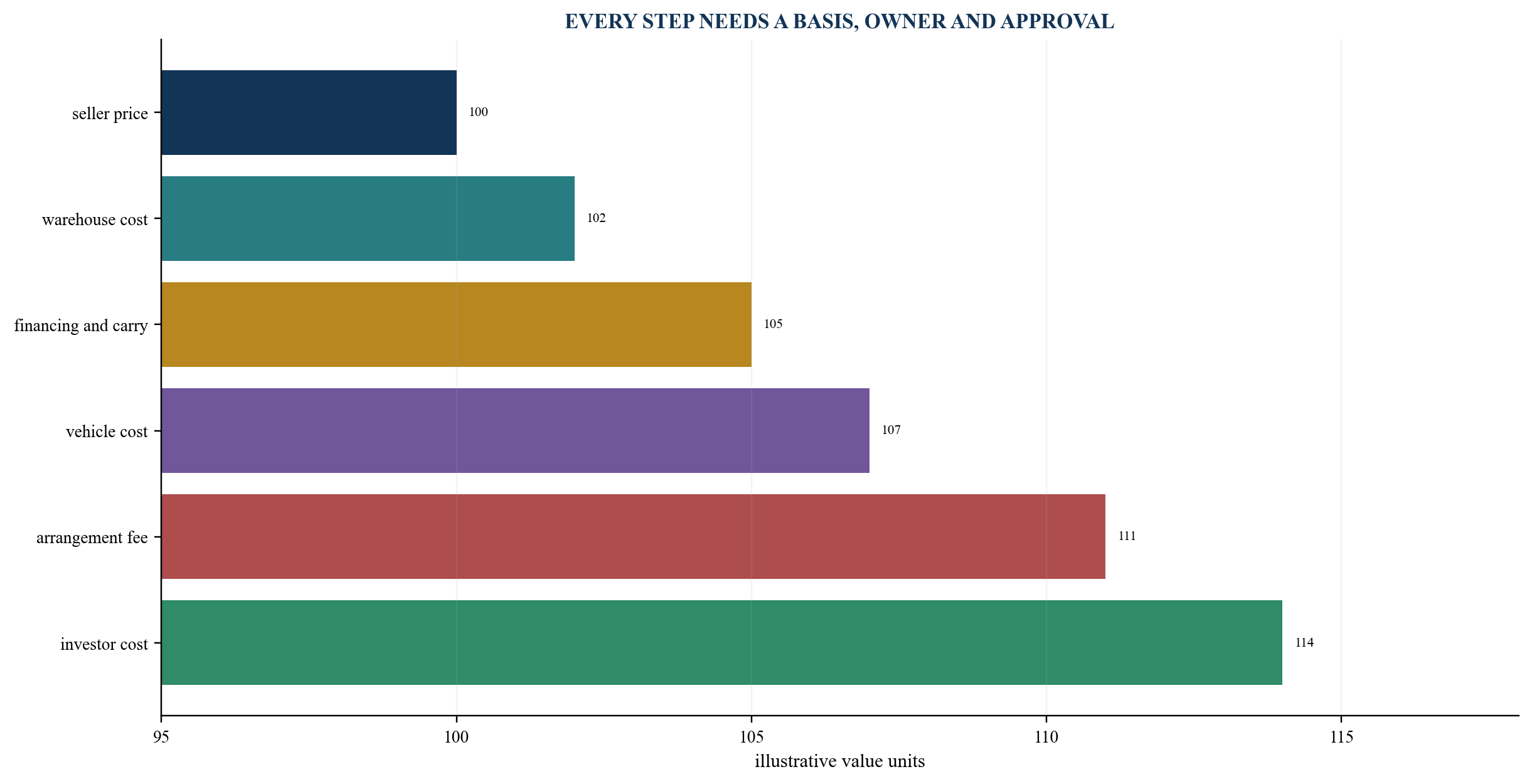
Values are illustrative management assumptions and exclude transaction-specific tax advice.
5. Approve allocation objectives before seeing final demand
Allocation becomes harder to defend when rules are chosen after the book reveals investor names and economics. The governing body should approve objectives, eligible populations, priorities, constraints, discretion and conflicts before final demand is known.
Possible objectives include fair treatment under client duties, issuer preferences, diversification, minimum viable tickets, funding certainty, strategic fit, relationship commitments, concentration limits and settlement readiness. The applicable objective should be stated and ranked.
The rulebook should address scarcity. It defines whether scaling is pro rata, tiered, minimum-first, strategic, lottery-based or discretionary. Any priority rights from contracts or side letters appear in the hierarchy. Oral promises and relationship expectations should be captured and reviewed.
Allocation should use order facts available at the cut-off: investor entity, time, quantity, price, conditions, funding status, eligibility, concentration, permissions and settlement readiness. Later changes should use defined reallocation rules.
Discretion requires boundaries. The allocation owner records reasons for departures, comparison with similarly situated investors and conflict approval. A high-fee or affiliated investor should not receive unexplained preference.
The final method should be reproducible. A reviewer with the same order book, rules and constraints should be able to understand the outcome, including any approved judgement.
6. Build an immutable demand and order ledger
Investor interest progresses through enquiry, indication, conditional order, firm order, funded subscription and settled allocation. The ledger preserves each state and timestamp. A sales summary should not replace the underlying record.
Each order identifies investor legal entity, decision maker, represented account, eligibility, jurisdiction, source, relationship, requested quantity, price, conditions, expiry, funding, KYC, approvals and evidence. Changes create new events.
The ledger should identify connected relationships. Existing client, prospective client, lender, service provider, employee, affiliate, portfolio company, referral source and personal connection can influence allocation or create perceived influence.
Order quality matters. A large indication without authority or funds may be weaker than a smaller verified order. The allocation method can use defined readiness criteria while retaining the requested amount and status.
Information access should be logged. Investors receiving different data, management access or timing may have unequal ability to price. Any differentiated access should follow an approved basis and confidentiality controls.
At cut-off, the system freezes an immutable snapshot. Late orders, withdrawals and corrections are processed under the rulebook and preserved for audit.
Table 3. Order-ledger fields
| Field group | Core evidence | Control purpose | Exception |
|---|---|---|---|
| identity | legal entity and authority | valid represented principal | unknown beneficiary |
| economics | quantity, price and conditions | comparable demand | incomplete terms |
| readiness | KYC, funds and approvals | settlement probability | unmet condition |
| relationship | client, affiliate or connected status | conflict assessment | undisclosed link |
| access | materials and meetings received | information fairness | unauthorised disclosure |
| history | timestamp and version | immutable audit trail | overwritten order |
Data collection and use should comply with applicable privacy and confidentiality duties.
7. Control related-party and employee participation
Related-party participation begins with a broad relationship test. The team identifies affiliates, owners, directors, employees, family members, controlled vehicles, managed accounts, portfolio companies, service providers and entities with material commercial relationships.
The gate asks whether participation is permitted, disclosed where required, economically fair and consistent with the allocation rulebook. It examines information advantage, price, fees, priority, financing, governance rights, liquidity, exit and downside allocation.
Employees may have access to inventory, demand and price information. Personal participation should follow pre-clearance, dealing, confidentiality and conflicts policies. The reviewer should be independent from the employee and commercial pressure.
Affiliated vehicles can provide useful anchor capital or warehouse capacity. Their participation should not create hidden preferential economics or force external investors to absorb unwanted risk. The file states who benefits from the structure.
Related-party pricing should seek appropriate independent evidence. Market testing, third-party valuation, separate committees or external opinions may be relevant depending on the facts. Current advisers should define the necessary safeguards.
Approval should be transaction-specific. A standing disclosure can describe the type of conflict while the actual amount, parties, economics and allocation require a current record.
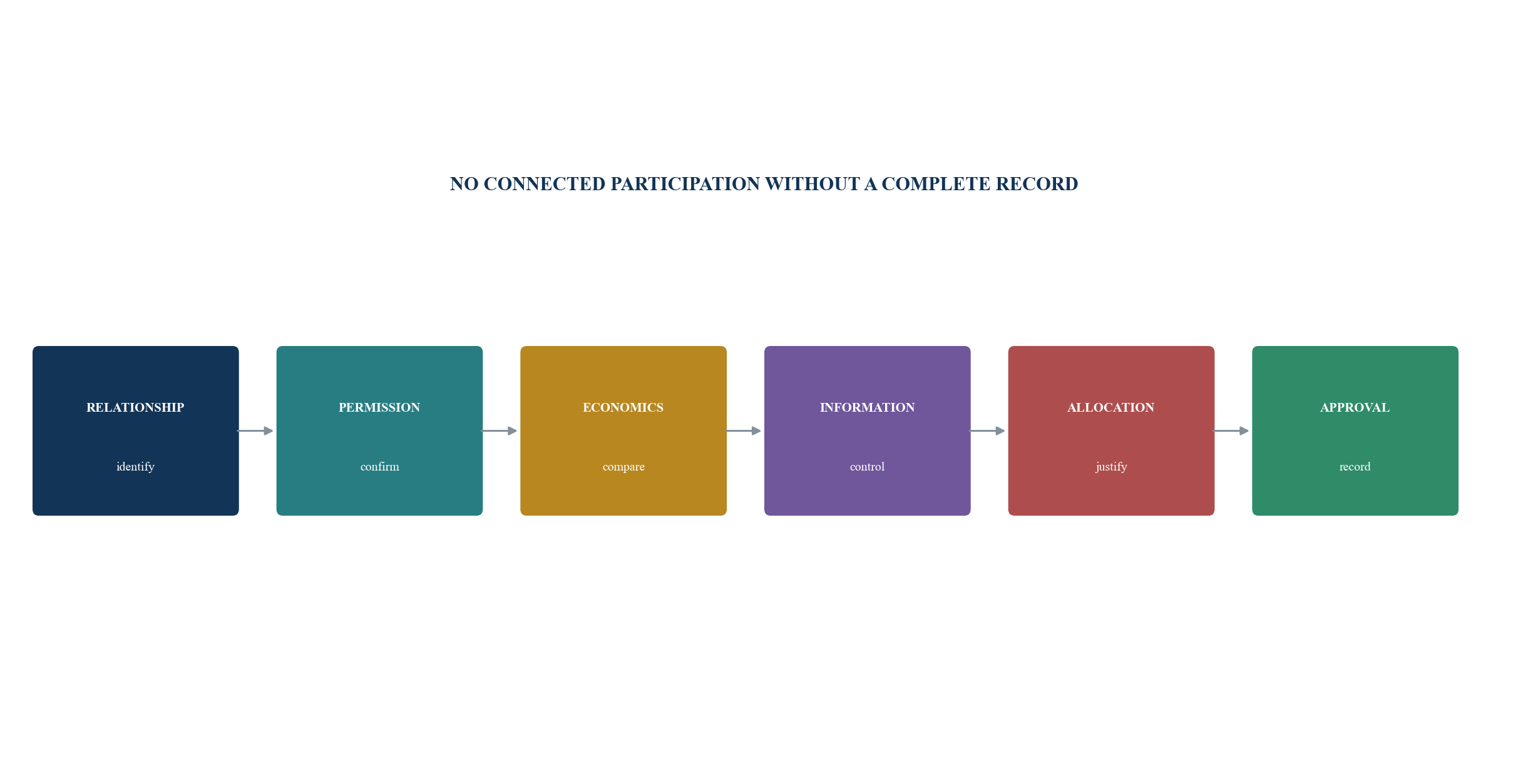
The gate is an author framework; current legal and compliance advice determines the applicable outcome.
8. Separate information pools and communication permissions
Syndication information can include seller identity, ownership, issuer data, price limits, investor orders and allocation decisions. The access model should follow mandate, confidentiality, regulatory permission and need.
Seller-side information should not flow automatically to warehouse investors or affiliates. Investor demand should not be shared with other investors to influence bids unless authorised. Allocation deliberations require restricted access.
The data room should use role-based groups, watermarking, version control, download rules and access logs. The team records which materials and management interactions each investor received.
Market colour should be accurate. Aggregated demand, oversubscription and price statements should be supported and authorised. A warehouse position should be described with correct ownership and capacity.
Cross-border communications require an approved route for sender, recipient, territory, content, service, compensation and next act. A valid allocation policy does not replace marketing or transaction permissions.
Breaches should trigger containment, recipient identification, corrective communication, allocation impact review and specialist escalation. The incident record should preserve decisions and remediation.
9. Run the allocation engine with constraint and conflict controls
The engine begins with eligible orders. It applies legal, contractual, issuer, concentration, minimum-ticket, funding and settlement constraints. Orders failing a critical condition remain visible and excluded or conditional.
The approved priority method is then applied. Pro rata scaling can be based on requested quantity, capped demand or another defined measure. Minimum allocations may be handled before scaling. Strategic or discretionary elements require recorded criteria.
The engine should produce both allocation and rationale. For each investor it shows requested, eligible, preliminary, adjusted and final quantity; constraint; relationship; exception; approver; and change history.
Warehouse and firm interests should not control the result invisibly. If risk reduction is an approved objective, it should be disclosed and balanced with duties and fairness. A residual position remains with the designated risk owner.
Reallocation rules address withdrawals, failed KYC, funding shortfalls, issuer rejection and late changes. The original allocation remains preserved. Reallocation should follow the same hierarchy or a pre-approved fallback.
The final file should reconcile total deliverable inventory with allocated, settled, cancelled and residual quantities. No unexplained difference should remain.
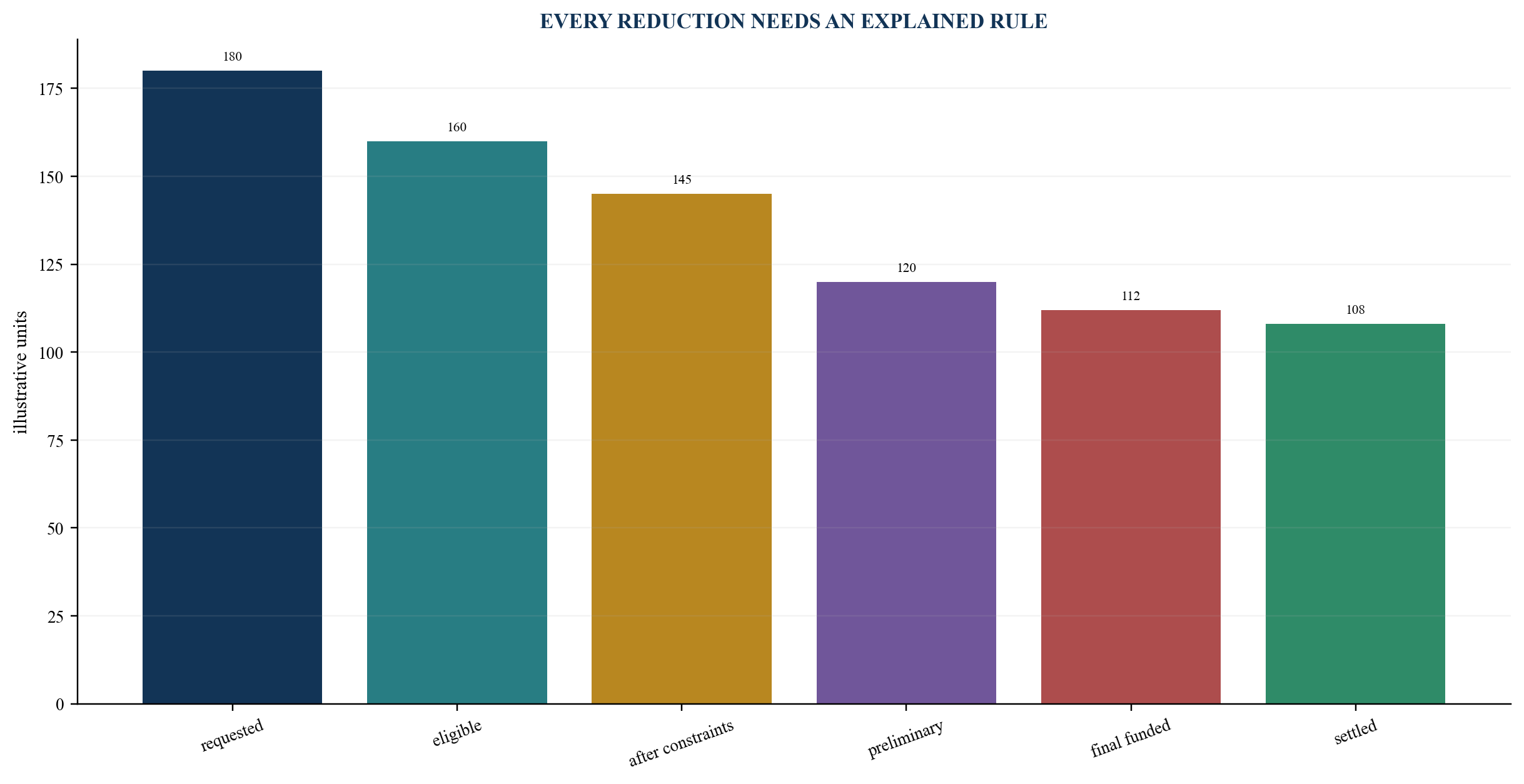
Quantities and scaling rules are illustrative management assumptions.
Table 4. Allocation audit trail
| Stage | Record | Conflict test | Approval evidence |
|---|---|---|---|
| eligibility | passed and failed conditions | connected treatment | reviewer sign-off |
| priority | applicable tier or right | fee and relationship influence | rulebook reference |
| scaling | formula and inputs | comparable investors | calculation archive |
| discretion | adjustment and reason | benefit to firm or affiliate | independent approval |
| reallocation | trigger and successor order | favouritism and timing | change record |
| finality | funded and settled quantity | residual warehouse benefit | reconciliation |
The method should reflect contractual promises and applicable duties.
10. Allocate transaction fees and expenses to the beneficiaries
Fees and expenses should be mapped to the service and beneficiary. Seller advice, acquisition diligence, warehouse financing, SPV formation, investor administration and settlement serve different parties.
The governing documents and contracts provide the starting basis. The file identifies shared costs, allocation method, caps, offsets, rebates and broken-deal treatment. A non-pro-rata allocation needs a documented rationale and any required notice or consent.
The SEC's private-fund examination observations have addressed conflicts involving investment allocation and fees and expenses. The cited 2020 Risk Alert described preferential allocations to new, higher-fee or proprietary clients and allocations at different prices or apparently inequitable amounts without adequate disclosure or consistency with disclosed process.
The expense ledger should reconcile estimate, contract, invoice, approval, payment and accounting. Related-party service providers and mark-ups receive specific review. Tax and regulatory treatment require current specialists.
Residual expenses after a failed or partial syndication should follow the approved method. The warehouse should not pass its own acquisition or carry loss to investors without contractual and legal basis.
Investor reporting should show complete economics under the applicable relationship. Forecast and accrued amounts remain separate from paid and collected amounts.
11. Govern transfers among clients, funds and vehicles
Cross-transactions and asset transfers can place the firm on both sides of value. One client may sell while another client, fund, SPV or warehouse buys. The file should identify each represented interest and the decision process for both sides.
The FCA's 2025 review of private-market valuation practices highlighted conflicts where valuations determine transfer prices affecting buyers, sellers and remaining investors. It described controls including third-party valuation, separate teams or committees and market testing.
Transfer price should use a defined evidence process. The record includes market checks, comparable observations, valuation method, adjustments, conflicts, alternatives and approval. Any fairness or valuation opinion is assessed for scope, independence and relationships.
Consent and advisory-committee processes should follow governing documents and law. The disclosure should contain enough transaction-specific information for the required decision. Generic conflict language should not replace actual economics.
Different capital-stack positions require additional governance. A credit vehicle and equity vehicle can have adverse interests in amendment, financing, enforcement or exit. Allocation of information, opportunities and expenses should reflect those interests.
Post-transfer reporting should reconcile the asset, cash, valuation, fees and performance impact across every affected vehicle.
12. Use an exception register and independent challenge
Exceptions include late orders, priority claims, related-party participation, price changes, quantity changes, failed eligibility, funding extensions, expense deviations and residual reallocations. Each exception has an owner, reason, evidence, affected parties, conflict assessment, approval and expiry.
Independent challenge should focus on economic substance. The reviewer asks who gains, who bears risk, what alternative existed, what comparable party received and whether the decision matches the approved policy and mandate.
Critical stops include unverifiable inventory, unauthorised seller or buyer, missing permission, undisclosed principal capacity, unexplained price difference, prohibited connected participation, altered order records and allocation beyond deliverable quantity.
Committee minutes should record evidence, challenge, dissent and outcome. A checkbox approval without reasons provides limited assurance for a judgement-heavy allocation.
Overrides should be time-bound. A relationship-based exception for one transaction should not become an informal standing priority. Repeated exceptions signal that policy or commercial commitments need review.
The conflicts function should monitor patterns across transactions, sources, employees and affiliates. Concentrated benefits can be visible only at portfolio level.
Table 5. Exception and escalation matrix
| Trigger | Immediate action | Evidence required | Approval |
|---|---|---|---|
| related-party order | hold final allocation | relationship and economics | conflicts owner |
| late or changed order | preserve prior event | reason and timing | allocation owner |
| price or fee difference | reconcile complete bridge | contracts and calculations | finance and conflicts |
| warehouse limit breach | stop additional exposure | re-underwriting and exit | risk authority |
| information disparity | contain and assess impact | access logs and communication | compliance owner |
| unexplained allocation | withhold confirmation | rule, comparison and rationale | independent reviewer |
Materiality and approval levels are illustrative management assumptions.
13. Test outcomes after allocation and settlement
Post-allocation review compares requested, allocated, funded and settled quantities. It analyses withdrawals, failed conditions, reallocation, residual inventory and timing. The result improves future readiness rules.
Fairness testing compares similarly situated investors. The team examines allocation rate by priority, fee level, relationship, affiliate status, timing, order quality and investor type. Differences require a documented policy basis.
Economics testing reconciles seller proceeds, warehouse return, investor cost, fees, expenses, rebates and residual value. Related-party outcomes remain separately visible.
Information testing compares access to materials, meetings and updates. Complaints and corrections are reviewed. Any material disparity is assessed for decision impact.
Commercial measures include paid conflict diagnostics, signed syndication-control retainers, active blocks, completed transactions, invoiced fees, cleared receipts, repeat mandates and contribution after delivery cost. Pipeline and expected fees remain management estimates.
Control measures include duplicate inventory, unexplained discretion, missing order versions, related-party exceptions, unauthorised communications, fee differences and unreconciled quantities. Findings receive owners and deadlines.
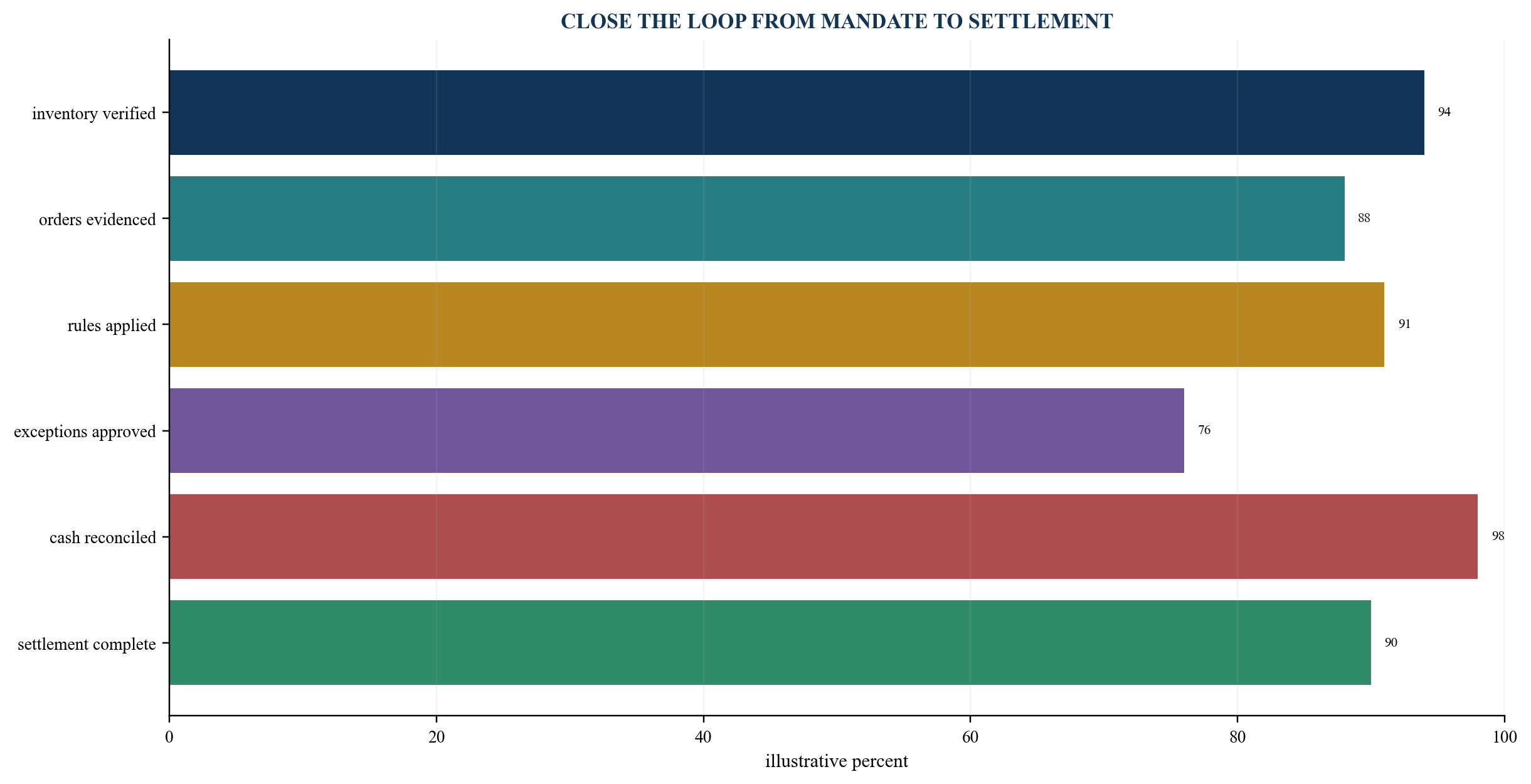
Values are illustrative management assumptions.
14. Run a ten-day syndication-conflicts diagnostic
Days one and two define the transaction population, entities, services, capacities, jurisdictions, mandates, vehicles, warehouse exposures and allocation policies. Active blocks receive priority.
Days three and four sample inventory and orders. The review tests ownership, authority, source lineage, status, price, quantity, conditions, relationships, information access and evidence.
Days five and six reconstruct economics. Seller proceeds, warehouse cost, funding, investor price, fees, expenses, FX, rebates and residual value are reconciled.
Days seven and eight reconstruct allocations. The team compares rules, orders, eligibility, scaling, discretion, connected participation, changes, settlement and outcomes.
Day nine scores maturity across role clarity, inventory, warehouse governance, economics, allocation, related parties, information, exceptions and reconciliation. Critical stops receive immediate owners.
Day ten presents a board-ready remediation plan with target operating model, policy changes, data needs, system controls, responsibility, timetable, delivery assumptions and measures.
15. Implement a thirty-day syndication control office
Days one to five establish governance, role maps, conflict taxonomy, decision rights, stop rules and the active transaction population.
Days six to ten implement inventory, mandate and warehouse records. Ownership, authority, limits, funding and exit evidence are reconciled.
Days eleven to fifteen implement the order ledger, eligibility gates, relationship flags, access controls and immutable cut-off snapshot.
Days sixteen to twenty configure allocation methods, related-party gates, price-and-fee bridges, exception records and committee packs. Historical cases test the design.
Days twenty-one to twenty-five reconcile current allocations, cash, fees, SPV interests, settlement and residual inventory. Exceptions receive owners and deadlines.
Days twenty-six to thirty train users, test incidents, finalise reporting and obtain management acceptance. Periodic outcome testing and policy review enter the calendar.
Table 6. Thirty-day control-office deliverables
| Workstream | Deliverable | Acceptance evidence | Owner |
|---|---|---|---|
| roles | entity, capacity and conflict map | approved current register | governing owner |
| inventory | title, mandate and state ledger | sampled evidence complete | transaction owner |
| warehouse | limits, economics and exit record | approved exposures | risk owner |
| orders | immutable demand ledger | identity and versions tested | allocation owner |
| allocation | rule engine and exceptions | reproduced historical cases | independent reviewer |
| reporting | economics, settlement and outcomes | reconciled dashboard | management owner |
Scope should reflect mandate volume, entity structure and applicable regulation.
16. Package the work around paid transaction outcomes
The framework can support a syndication-conflicts diagnostic, warehouse governance build, allocation rulebook, order-ledger implementation, related-party review, transaction control office, historical allocation audit or portfolio surveillance.
Commercial qualification should identify the active consequence: a live block, limited inventory, warehouse exposure, competing client interests, connected investors, disputed fees, allocation complaints, audit findings or a board deadline. The economic buyer should own the decision and budget.
The engagement should define entities, roles, jurisdictions, securities, data, decisions, deliverables, advisers and reliance limitations. Reserved legal, regulatory, brokerage, valuation, accounting, audit and tax functions remain with qualified and authorised providers.
Fees can reflect transaction count, entity and vehicle complexity, order volume, warehouse exposure, related parties, jurisdictions, historical reconstruction and system integration. Any transaction-linked component requires current legal and regulatory review and an executed agreement.
Evidence of commercial success requires executed mandates, valid invoices, cleared bank receipts and contribution after delivery cost. Expressions of interest and projected collections remain management estimates.
The strongest offer connects a painful decision to a defined output: verified inventory, controlled exposure, defensible allocations, transparent economics, reconciled settlement and a repeatable operating model.
17. Prepare an incident playbook for live syndications
A conflict incident can develop while a book is open. An employee may submit an order, an affiliate may reveal a hidden interest, warehouse funding may tighten, an investor may receive information outside the approved data room, or the deliverable quantity may fall after allocations have been communicated. The team needs a response sequence that protects evidence and prevents commercial pressure from deciding the outcome informally.
The first step is containment. The controller freezes the affected allocation, communication, payment or release while preserving unaffected work where appropriate. Access changes, order versions, messages, calls, approvals and payment instructions are secured. The incident owner records the known facts and avoids premature conclusions.
The second step is consequence mapping. The file identifies affected investors, seller, warehouse, SPV, affiliates, employees and service providers. It tests price, quantity, information, eligibility, funding, allocation, fee, settlement and disclosure effects. Legal and compliance advisers determine required notification, consent, correction or regulatory action.
The third step is remediation design. Options may include correcting information, reopening the book, recalculating allocations, removing a connected order, obtaining independent review, refunding an amount, extending a deadline or stopping the transaction. Each option should show beneficiaries, burdens and residual conflicts.
Communication should use a single authorised factual record. The team states the evidenced transaction state and approved corrective action. It avoids unsupported completion or fairness claims. Investor-specific confidential information remains protected.
Closure requires more than resolving the immediate event. The controller reconciles orders, allocations, cash, ownership and fees; records root cause; assigns policy, system or training actions; and sets a verification date. A significant incident should enter the governing body's periodic conflicts review.
18. Build the data architecture around immutable events
Syndication control depends on reliable data across mandates, inventory, warehouses, orders, allocations, SPVs, payments and settlement. A spreadsheet can support a limited process if it uses controlled fields, permissions, version history and reconciliations. Larger or recurring activity benefits from a structured event model.
The master identifiers should cover transaction, issuer, security, inventory lot, holder, mandate, warehouse position, vehicle, investor, order, allocation, payment and settlement. Every event carries timestamp, actor, source evidence, status, prior state and approval where applicable. This structure reduces ambiguity when several transactions involve the same issuer or investor.
The system should avoid overwriting economic history. A changed quantity creates a new order event. A price amendment creates a new term event. A withdrawn investor retains its prior submitted and eligible states. A reallocation links the released quantity to its successor. This lineage supports both reconstruction and outcome analysis.
Permission metadata should travel with the record. It identifies who may see the seller, investor, price, issuer information, allocation deliberation and connected relationship. Exports and dashboards should inherit the restriction rather than creating uncontrolled copies.
Automated rules can flag duplicate inventory, expired mandates, connected entities, allocation deviations, fee differences and quantity mismatches. Material decisions remain under named human authority. System outputs should expose inputs, rule version, exceptions and overrides.
Reconciliations connect subsystems. The deliverable inventory equals allocations plus residual. Funded subscriptions equal cleared receipts plus explained differences. Allocated interests equal the SPV or ownership ledger. Fees equal contracts, invoices, receipts and accounting entries. Unresolved differences remain open exceptions.
Retention should follow applicable law, contracts, privacy and litigation requirements. The firm should preserve enough evidence to reproduce material decisions while restricting unnecessary personal and confidential information. Destruction holds and incident preservation require documented authority.
19. Give the governing body a decision-focused syndication pack
Board and committee reporting should highlight decisions and economic exposure. A long list of transactions can obscure the few matters requiring attention. The pack should distinguish active decisions, exceptions, incidents, ageing exposures and completed outcome tests.
For each material block, the pack identifies role and capacity, verified inventory, seller mandate, warehouse exposure, investor demand, proposed allocation method, related parties, complete economics, unresolved conditions, settlement route and approvals required. Management assumptions appear separately from executed or bank-verified facts.
Portfolio reporting should show concentration by issuer, warehouse, affiliate, investor, employee and source intermediary. It should identify residual positions, limit breaches, ageing, funding maturity, allocations to connected parties and economic benefits received by the firm or related persons.
The governing body should ask whether the allocation rule preceded the final order book, whether similarly situated investors received comparable treatment, whether the warehouse influenced allocations, whether source and investor prices reconcile, whether fees follow contracts, and whether information access differed.
Outcome reporting should compare initial expectations with completed evidence. Relevant measures include quantity delivered, settlement time, withdrawals, reallocation, residual losses, investor complaints, fee collection and contribution after delivery cost. Forecast revenue remains outside collected-fee reporting.
Decisions should produce clear instructions, owners and deadlines. Approval of an exception should state its scope and expiry. A request for further evidence should keep the affected action paused. Minutes should preserve the rationale and material challenge.
20. Conclusion
Syndication becomes governable when roles, inventory, economics and allocation remain visible from mandate through settlement. The role map shows duties and benefits. The warehouse record controls exposure. The order ledger preserves demand. The rulebook defines priorities before names and economics influence outcomes. The related-party gate applies independent challenge. The economics bridge and final reconciliation show who paid and received every amount.
Conflicts cannot be understood through disclosure language alone. The transaction record should show actual parties, interests, alternatives, decisions and outcomes. Rules should support consistent action while permitting documented judgement under defined authority.
The final operating standard is practical: no inventory without verified control, no warehouse without an approved exit, no allocation without a pre-defined method, no connected participation without a transaction-specific gate and no close without reconciling quantity, cash, fees and residual risk.
References
- US Securities and Exchange Commission. Examinations Observations of Investment Adviser Obligations Related to Economic Conflicts of Interest. 9 June 2026. https://www.sec.gov/compliance/risk-alerts/exams-observations-ia-obligations-related-economic-conflicts-interest-060926
- US Securities and Exchange Commission. Observations from Examinations of Investment Advisers Managing Private Funds. 23 June 2020. https://www.sec.gov/files/Private%20Fund%20Risk%20Alert.pdf
- US Securities and Exchange Commission. Commission Interpretation Regarding Standard of Conduct for Investment Advisers. https://www.sec.gov/rules-regulations/2019/06/ia-5248
- Financial Industry Regulatory Authority. Private Placements: Regulatory Obligations and Related Considerations. https://www.finra.org/rules-guidance/guidance/reports/2024-finra-annual-regulatory-oversight-report/private-placements
- Financial Conduct Authority. Private Market Valuation Practices. 5 March 2025. https://www.fca.org.uk/publications/multi-firm-reviews/private-market-valuation-practices
- Financial Conduct Authority. Quid Pro Quo? What Factors Influence IPO Allocations to Investors? Updated 3 June 2026. https://www.fca.org.uk/publications/occasional-papers/occasional-paper-no-15-quid-pro-quo-what-factors-influence-ipo
- Dubai Financial Services Authority. COB 6.8.6: Allocation of Transactions. https://dfsaen.thomsonreuters.com/rulebook/cob-686
- Dubai Financial Services Authority. COB 11.3.14 Guidance: Transaction-Specific Conflict Disclosure. https://dfsaen.thomsonreuters.com/rulebook/cob-11314-guidance
- Abu Dhabi Global Market Financial Services Regulatory Authority. Guidance: Regulatory Framework for Private Financing Platforms. https://www.adgm.com/documents/legal-framework/guidance-and-policy/fsra/guidance-regulatory-framework-for-private-financing-platforms-ver-20231218.pdf
About the Author
Chennakeshav Adya, Independent Researcher
