

1. Every block needs a transaction identity before it needs a buyer
A private secondary should receive a unique transaction identity at the first substantive contact. That identity connects the seller, beneficial owner, buyer, issuer, security, quantity, price indication, currency, intermediary roles, compensation, intended resale route, transfer path and status. It prevents an opportunity from being represented differently to different parties.
The file should state who is doing what. Introducing, soliciting, recommending, negotiating, arranging, executing, holding funds, holding securities, advising, valuing and communicating can have different legal and regulatory consequences. The SEC explains that activities such as finding investors, finding buyers and sellers, participating in important transaction steps or operating a securities-trading platform can raise broker-dealer registration questions in the United States. Other jurisdictions apply their own regulatory perimeters.
The operating model should route regulated activity to appropriately authorised persons and firms. A consultant, issuer, shareholder, employee, finder, platform or adviser should not be assigned a role based on a commercial label. Current counsel should assess the actual conduct, compensation and jurisdiction.
The transaction identity also fixes the version of facts under review. Quantity, seller, class, price and structure can change during a process. Each material change should update the record and trigger the affected diligence modules.
The block cannot move to external circulation until an authorised owner confirms the perimeter, minimum evidence and approved communication. Urgency does not replace the gate.
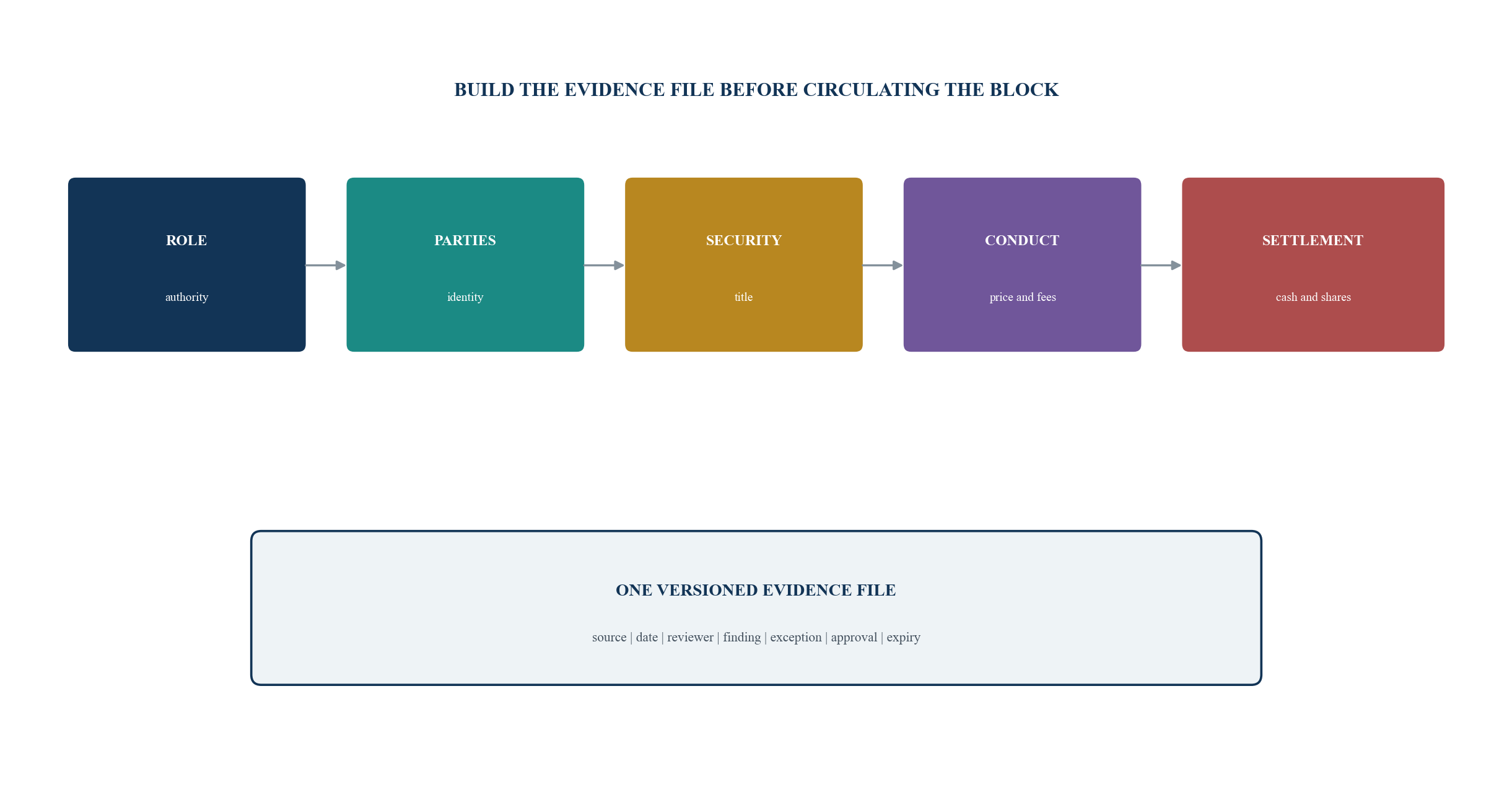
A transaction can progress only when role, asset, party, conduct and settlement evidence converge.
2. Define the legal and regulatory perimeter by conduct
The perimeter memo should identify every person and entity performing a transaction function. It should cover the intermediary, representatives, affiliates, referral sources, issuer, seller, buyer, SPV, nominee, custodian, transfer agent, escrow provider and any lender or hedging counterparty.
The analysis should ask where each person is located, where the communication is received, where the issuer is organised, where the security is held and where the transaction will be executed and settled. Cross-border digital communication can create several relevant jurisdictions.
Compensation is a material fact. Transaction-based compensation, success fees, spreads, mark-ups, placement fees, referral payments, equity, rebates and indirect benefits should be recorded before roles are accepted. Compensation can affect regulatory perimeter, conflicts and disclosure.
The SEC's April 2026 broker-dealer material explains that persons engaged in buying or selling securities for others generally may need registration and highlights solicitation, negotiation, execution and transaction participation. This is a routing signal. Current counsel should determine the outcome for the facts.
The United Kingdom's financial-promotion restriction can apply to invitations or inducements communicated in the course of business. The FCA states that a relevant communication generally must be made by an authorised person, approved by an authorised person with the appropriate permission, or fall within an applicable exemption. A recipient's wealth or sophistication should be evidenced under the current route; it should not be assumed from job title or reputation.
Table 1. Regulatory-perimeter and role map
| Function | Evidence | Perimeter question | Control outcome |
|---|---|---|---|
| introduction | source, message, parties and compensation | does the conduct remain a limited introduction? | approved wording and routing |
| solicitation | recipient, targeting and communication | is a regulated promotion or solicitation occurring? | authorised or exempt route evidenced |
| recommendation | analysis, audience and rationale | do suitability, best-interest or other conduct duties apply? | product and customer assessment |
| negotiation | authority, terms and communications | is the intermediary arranging or effecting a securities transaction? | licensed owner and supervision |
| execution | order, counterparty and venue | who accepts and executes the securities order? | authorised execution route |
| custody or funds | account, control and payment mechanics | may the party hold or control client assets? | approved custodian or escrow chain |
| fee receipt | payer, amount, timing and basis | does compensation affect registration or conflicts? | legal conclusion and full disclosure |
Current counsel and compliance should classify the actual activities and permissions in each relevant jurisdiction.
3. Convert each assertion into a source, test and finding
The evidence file should not consist of documents alone. It should connect each material assertion to its source, test, reviewer, date, conclusion and limitation. “Shares available” becomes a set of tested facts: the seller exists, owns or controls the position, can instruct it, has the stated quantity, holds the stated class and can pursue a defined transfer route.
Evidence quality varies. Primary evidence can include issuer registers, executed agreements, certificates, custodian statements, bank confirmations, audited financial statements, regulatory records and direct confirmations from the responsible institution. Secondary evidence can support context. Marketing decks, screenshots, forwarded messages and unsigned schedules require corroboration for critical facts.
The file should preserve provenance. It should record who supplied the item, whether it is complete, whether it was independently obtained, the period it covers and whether a later event may have changed it. A document without provenance can be difficult to rely upon or defend.
FINRA's private-placement investigation guidance emphasises reasonable investigation, the issuer and management, business prospects, assets, claims and use of proceeds within its scope. It also states that red flags require further inquiry. A private secondary involves different transaction facts, yet the evidence discipline is useful: material representations should be tested and adverse information should be resolved or escalated.
The broker should preserve conflicting evidence. Deleting an adverse item from the working file removes the audit trail. The record should show the conflict, resolution work, conclusion and approver.
4. Prove the seller, beneficial owner and authority
The seller module begins with legal identity, formation or personal identity, address, tax status, beneficial ownership and authorised signatories. It should identify nominees, trustees, general partners, managers, protectors, investment committees, directors and persons with veto or instruction rights.
The beneficial-owner chain should be traced to natural persons or other required terminal owners under the applicable rules. The file should explain trusts, foundations, funds, SPVs, partnerships and layered holding entities. Ownership and control are separate questions.
Authority should be transaction-specific. Constitutional documents, board or investment-committee approvals, powers of attorney, fund documents, shareholder agreements and custody mandates should support the proposed sale. A person who sourced the opportunity may lack authority to bind the seller.
The seller's source of wealth and source of the securities should be understood on a risk basis. The acquisition documents, payment evidence, employment or founder records, fund subscription, distribution or prior transfer should connect the seller to the position.
Sanctions, politically exposed person, adverse media, regulatory and litigation checks should be performed under the firm's current policy and applicable law. A match should be resolved through evidence and escalation. A name-screening result alone is not a final conclusion.
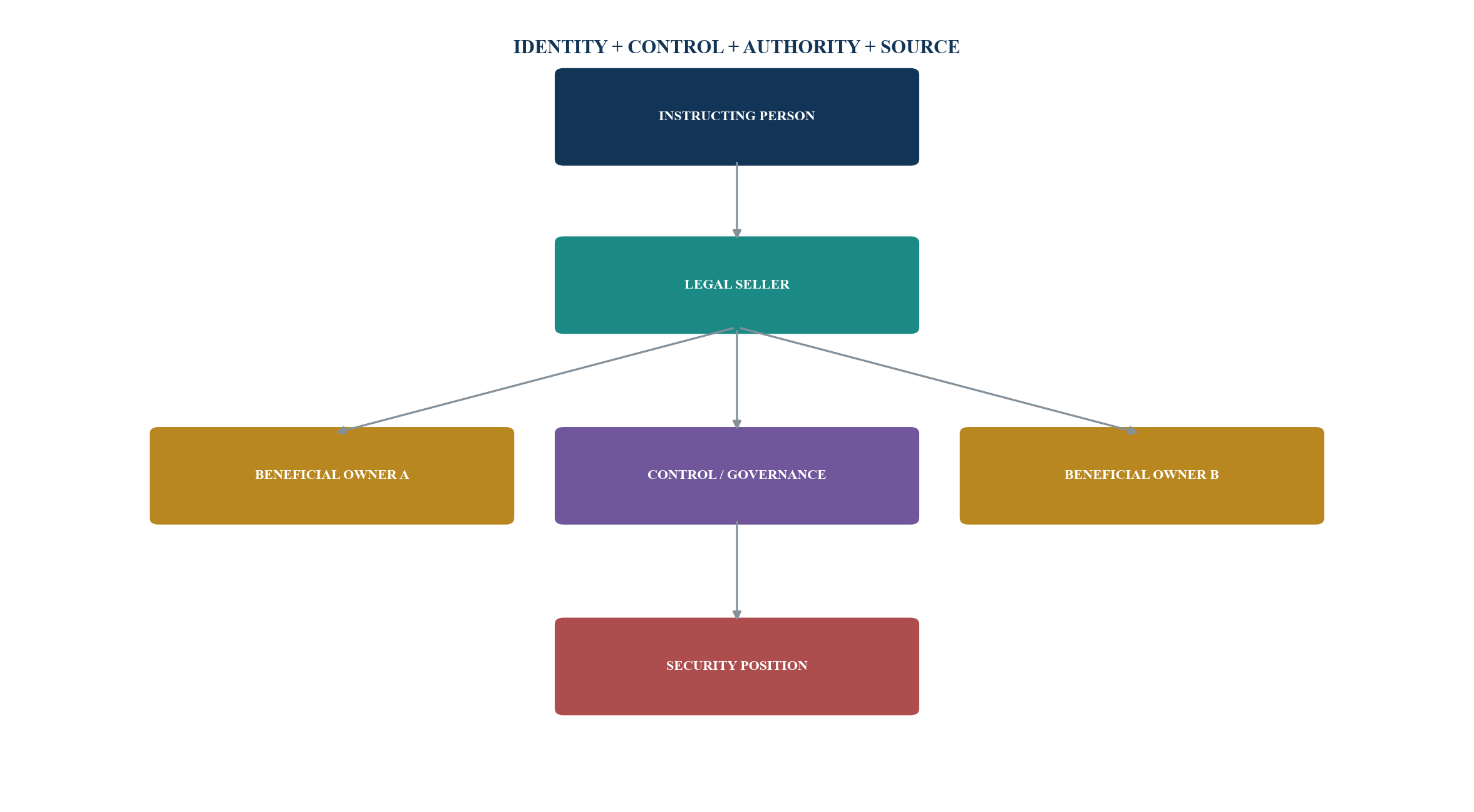
The file should connect the instructing person to the legal seller and the beneficial owners before terms are circulated.
5. Prove the security, title chain and transfer path
The security module identifies the exact issuer legal entity, jurisdiction, class, quantity, issue date, certificate or electronic identifier, registered holder, beneficial holder, paid status, rights and encumbrances. It should distinguish shares from an interest in an SPV that owns shares.
The title chain should bridge original issuance through every transfer, conversion, split, consolidation, recapitalisation, distribution and nominee movement. The issuer register, executed agreements, certificates, cap table, custodian records and payment history should reconcile.
Transfer restrictions should be extracted from shareholder agreements, constitutions, subscription or purchase agreements, legends, side letters, rights of first refusal, co-sale provisions, issuer policies, applicable law and any lock-up. The file should state the proposed compliance steps, responsible parties and timing.
The SEC's April 2026 private-secondary guidance describes several US federal resale pathways with specific conditions. Section 4(a)(4), for example, concerns a broker's part in executing an unsolicited customer order and is unavailable when the broker knows or has reasonable grounds to believe the selling customer's part is not exempt. Rule 144, Section 4(a)(7) and other routes have their own requirements. Current counsel should select and support the actual route.
A legal conclusion should identify the facts relied upon. Seller affiliate status, issuer reporting status, acquisition history, holding period, purchaser status, manner of offering and information availability can affect the result. A template conclusion without matched facts is weak evidence.
Table 2. Security and chain-of-title evidence module
| Evidence question | Primary record | Test | Output |
|---|---|---|---|
| what is the issuer? | registry and issuer confirmation | legal name, domicile and status match | verified issuer identity |
| what is the security? | certificate, register and governing rights | class, quantity and rights reconcile | verified security record |
| who owns it? | issuer, nominee and custodian evidence | registered and beneficial chains agree | verified title chain |
| how was it acquired? | issue or transfer agreement and payment | dates, consideration and parties connect | acquisition history |
| what restricts transfer? | contract, legend, policy and legal memo | every restriction mapped to steps | restriction register |
| is it encumbered? | lien, pledge, custody and financing records | release mechanics confirmed | available or conditional quantity |
| how will it settle? | agent and custodian checklist | instructions, approvals and accounts feasible | documented transfer path |
The controlling issuer records and executed documents should be reconciled for the actual position.
6. Understand the issuer and test the claims being circulated
The issuer module should establish current legal existence, management, business model, capital structure, financial condition, recent financing, material litigation, regulatory matters, major customers or dependencies and known transaction events. The scope should match the claims and investor decision.
The broker should distinguish issuer-provided information, seller-provided information, public information and independently verified information. The date and permission to use each item should be recorded.
Claims about revenue, customers, valuation, IPO timing, profitability, contracts, market leadership, investor participation and strategic interest should be tested. A named customer can represent a signed contract, pilot, reseller relationship, non-binding memorandum or historical engagement. The evidence should preserve that distinction.
The latest funding price requires a security and rights bridge. Preferred and common shares, seniority, participation, conversion and dilution can make headline prices incomparable. A broker should not present one round price as a current common-share value without a supported bridge and suitable context.
Adverse information and inconsistencies should enter the red-flag register. FINRA's guidance states within its scope that a broker-dealer cannot simply rely on management representations, offering disclosure or a counsel report when red flags are present. The file should show additional inquiry and a reasoned outcome.
7. Verify the buyer and investor eligibility
The buyer module identifies the legal investor, beneficial owners, controller, authorised signatories, adviser, nominee, custodian and funding account. It should confirm the investment mandate and authority to acquire the specific security.
Investor eligibility should be determined under the actual transaction route and jurisdiction. Accredited, qualified, professional, sophisticated or institutional categories have defined tests and evidence. A self-description should be handled under the applicable rule and firm policy.
The buyer's ability to receive the security is separate from financial eligibility. The issuer can impose competitor, concentration, jurisdiction, sanctions, transfer, KYC, confidentiality or minimum-holding conditions. The custodian or vehicle can have its own acceptance limits.
The buyer should receive an accurate evidence pack and material risk disclosure. If the intermediary makes a recommendation, product and customer obligations can apply under the relevant regime. The file should document the analysis, approvals and communications.
Source of funds, payment account and expected transaction purpose should be consistent with the buyer profile. Third-party funds, rapid changes in purchaser, unexplained nominees and circular flows require escalation under the firm's AML programme.
8. Create a dated price bridge and market-evidence record
Private-share price discovery should show how the indicated or agreed price was formed. The record can include recent primary rounds, observed secondary indications, executed trades where lawfully available, issuer performance, public comparables, security rights, transfer friction, concentration, information quality, liquidity and transaction-specific terms.
The price bridge should separate enterprise value, equity value, fully diluted capital, security allocation and per-share value. It should identify currency, date, quantity, class, fees and whether the price includes financing, forward settlement, indemnity, escrow or other economic terms.
FCA findings on private-market valuation practices emphasise governance, conflicts, independence and the particular risks when assets transfer between investors. Those observations have their own UK regulated-firm scope. They support a useful control principle: the person whose fee depends on closing should not have sole authority over the evidence used to state price fairness.
The broker should describe the price as an indication, offer, bid, last transaction, model value or agreed price according to the evidence. These categories should not be merged.
The dashboard should retain stale or withdrawn observations with status. Removing them can create selection bias and obscure market change.
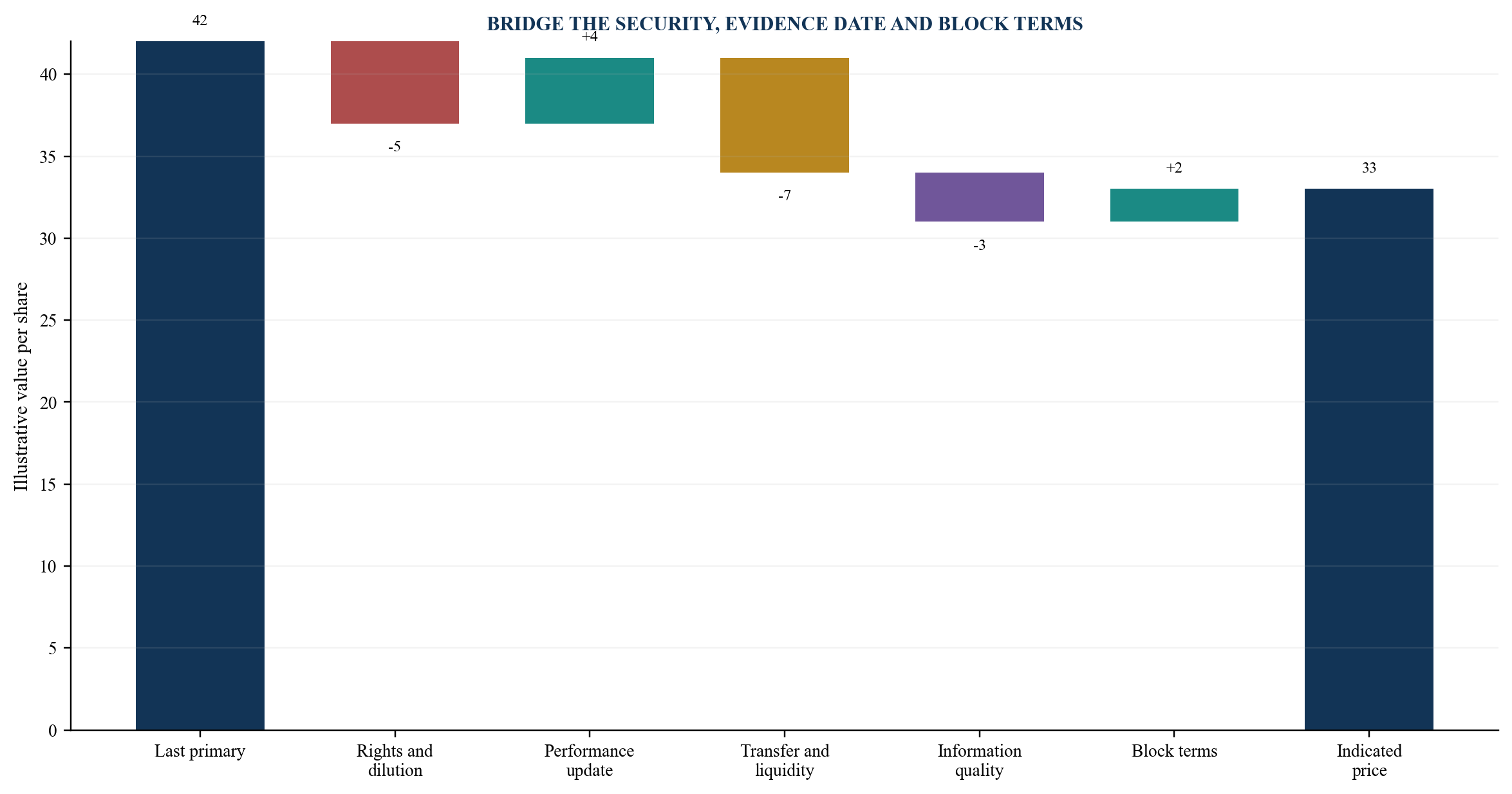
All values are management assumptions for method demonstration and do not represent an observed issuer or transaction.
9. Disclose every fee, spread, rebate and conflict
The fee module should identify every economic benefit connected to the block. It should cover advisory or placement fees, buyer and seller commissions, spreads, mark-ups, referral payments, platform charges, SPV formation and administration, legal and custody costs, financing, hedging, rebates, securities or warrants, carried interest and related-party benefits.
The record should show payer, recipient, calculation basis, timing, contingency, currency and tax treatment. It should state whether the same firm or affiliate represents several parties, finances the trade, owns a position, provides a valuation or receives an issuer fee.
Conflicts should be identified before external circulation. The control response can include disclosure, information barriers, separate teams, independent pricing evidence, recusal, committee approval or declining the role. The selected response should match applicable law and the firm's policy.
The FCA's sponsor-conflict material explains within its scope that conflicts should be identified and managed and that some conflicts can require a firm not to act. Its private-market valuation review describes additional independence and documentation practices for transfers. These are valuable design signals for private-share intermediation.
Net economics should be shown to each relevant party using the amounts they bear. A low headline commission can coexist with a larger undisclosed spread or vehicle fee. Complete disclosure supports informed consent and internal supervision.
Table 3. Fee and conflict disclosure waterfall
| Economic item | Illustrative basis | Recipient | Disclosure and control |
|---|---|---|---|
| seller advisory fee | 2.0% of gross proceeds | seller-side adviser | engagement and net-proceeds statement |
| buyer commission | 1.0% of purchase value | authorised intermediary | buyer agreement and cost disclosure |
| price spread | USD 1.25 per share | executing or principal party | explicit bid, offer and capacity disclosure |
| referral fee | 20% of collected advisory fee | approved introducer | perimeter, conflict and payment approval |
| SPV costs | USD 150,000 plus annual costs | vehicle providers | governing documents and investor allocation |
| custody and transfer | actual provider charges | agent and custodian | pre-close estimate and final reconciliation |
| financing benefit | interest, fees or equity | lender or affiliate | separate financing terms and conflict review |
Values are management assumptions and do not describe a market fee or a recommended charge.
10. Control all communications and document permissions
The communication register should preserve every teaser, message, deck, data-room item, price indication, risk statement, Q&A and update sent to an external party. It should record author, approver, recipients, date, version, purpose and applicable audience restriction.
Claims should be consistent with the evidence file. If the issuer has not verified a statement, the communication should identify the source and limitation in reader-friendly language. Material changes should be circulated to affected recipients promptly through the approved process.
Confidentiality and data rights should be checked before sharing. The seller's possession of an issuer document does not establish permission to distribute it. The file should include the NDA, clean-team or restricted-access rules, watermarks and withdrawal process where applicable.
The FCA explains that UK financial promotions must be fair, clear and not misleading within the applicable regime. Its PISCES material describes core and additional disclosures and intermediary responsibilities for that market. The actual communication route should be confirmed before use.
The broker should avoid implying issuer endorsement, guaranteed allocation, assured IPO, fixed return, risk-free transfer or regulatory approval. Current evidence should support every material statement.
11. Run customer, beneficial-owner, funds and sanctions controls
The AML file should connect customer identity, beneficial ownership, purpose, source of wealth, source of securities, source of funds, payment account, destination account and transaction rationale. It should be proportionate to risk and updated when facts change.
FINRA's 2026 AML report identifies control failures including inadequate identity and beneficial-owner verification, undisclosed principals using nominee accounts and insufficient follow-up on red flags. FATF securities-sector guidance describes risk-based customer diligence, enhanced information, source-of-wealth and source-of-funds work, transaction purpose and ongoing monitoring.
The settlement structure should minimise unexplained third-party flows. Funds should come from and proceed to verified accounts consistent with the approved parties and transaction. Any exception requires current compliance review.
Red flags can include unexplained urgency, inconsistent beneficial ownership, reluctance to provide evidence, cash from an unrelated party, rapid changes in buyer or seller, a price far from supported evidence, circular payments, forged or altered documents, a recently created nominee, sanctions exposure or instructions to conceal a party or fee.
The response can include further information, independent verification, enhanced diligence, rejection, account restriction, escalation or reporting under applicable law and policy. The file should not disclose protected reporting decisions to unauthorised persons.
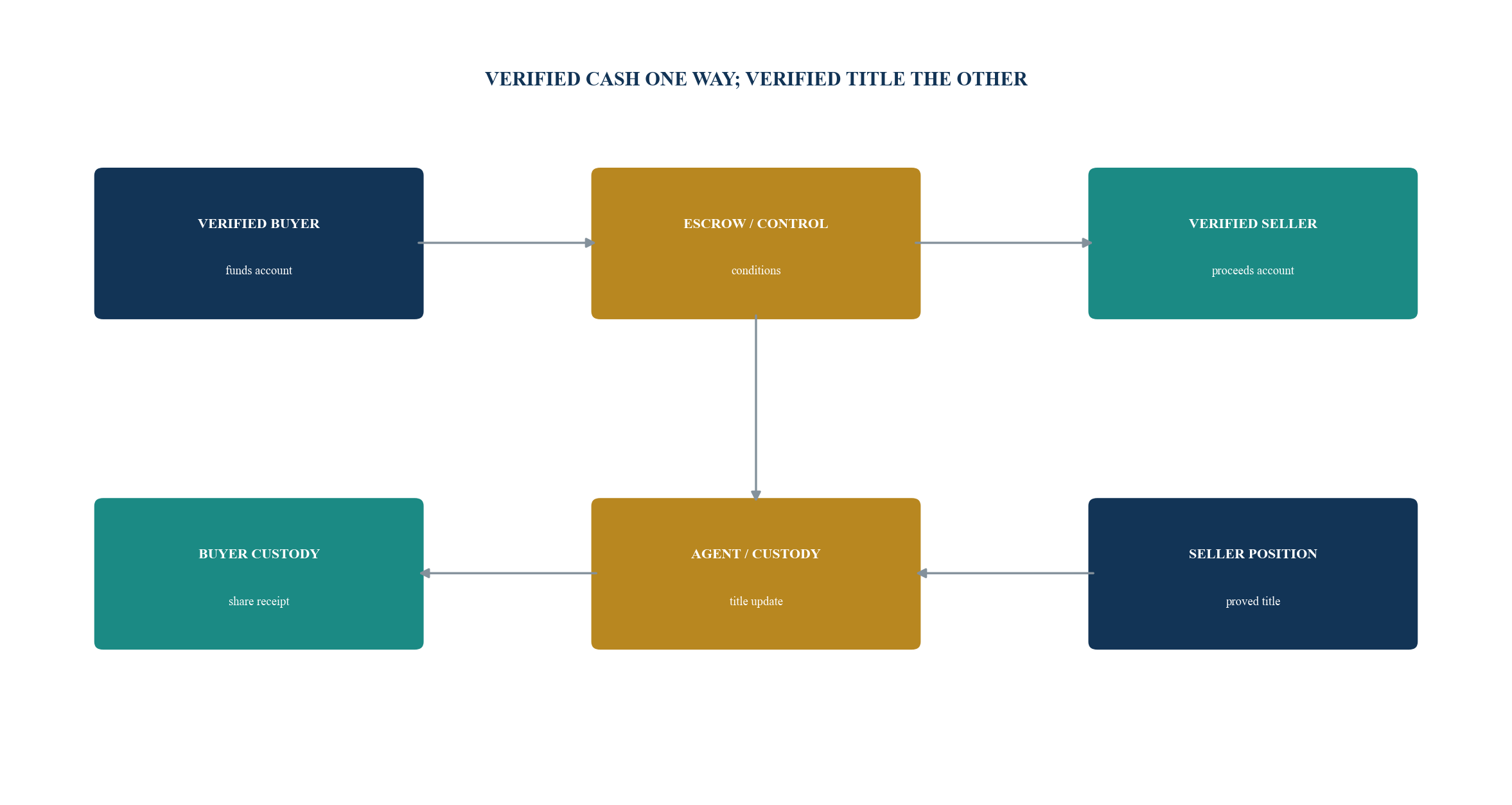
Payment and delivery should remain within verified accounts and instructions.
12. Separate price agreement from transfer completion
The transaction workflow should distinguish indication, matched interest, term sheet, binding agreement, conditions precedent, issuer process, funding, title transfer, settlement and post-close reconciliation. Each stage has a defined status.
A matched buyer and seller do not create completed title. Rights of first refusal, issuer consent, buyer approval, legal opinions, KYC, lien release and register update can remain outstanding. The record should prevent the block from being described as closed until the agreed completion evidence exists.
The agreement should define security, quantity, price, currency, deposit, timing, conditions, representations, indemnities, fees, confidentiality, termination, governing law, dispute process and settlement mechanics. Current transaction counsel should prepare or review the documents.
The settlement agent or custodian should confirm feasible instructions. A broker should not collect or control funds or securities outside its permissions and approved operating model.
Failed or delayed settlement should trigger an exception process. The parties need a controlled decision on extension, cure, termination, refund, price adjustment or enforcement under the agreement.
The conditions checklist should distinguish documentary completion from substantive completion. A delivered certificate can remain inconsistent with the issuer register. A legal opinion can remain conditional on facts that have changed. KYC can be complete for the contracting entity while the funding account belongs to a different party. Each condition should therefore identify the underlying fact, acceptable evidence, reviewer, validity period and release authority.
Cash and securities instructions should be independently authenticated using controlled contact details. A last-minute email changing a bank account, custodian or beneficiary should trigger enhanced verification and a hold under the applicable policy. Dual approval, callback, verified account ownership and instruction versioning reduce payment-diversion and settlement risk.
The closing statement should reconcile gross consideration, deposits, commissions, spreads, taxes or withholding, agent charges, legal costs, financing repayment and net proceeds. It should also reconcile contracted quantity, transferred quantity, rejected or pending quantity and the buyer's credited position. The transaction status should remain partially settled when either side is incomplete.
Post-close evidence should include the issuer or agent's updated record, custodian statements, bank confirmation, invoices, fee receipts and the final exception log. This evidence supports accounting, tax, regulatory, investor and dispute records. It also supplies observed data for future cycle-time and failure analysis.
Table 4. Settlement conditions and completion evidence
| Condition | Evidence before release | Control owner | Completion record |
|---|---|---|---|
| party authority | current resolutions, signatories and powers | legal and operations | authenticated signed agreement |
| transfer permission | issuer, contractual and legal approvals | transaction counsel | written consent or completed process |
| unrestricted quantity | reconciled register, custody and lien status | title-control owner | agent-confirmed transferable balance |
| buyer acceptance | eligibility, KYC, mandate and account approval | compliance and broker | approved purchaser and delivery account |
| funds readiness | verified source, account and escrow instruction | AML and treasury | cleared funds in authorised control account |
| securities delivery | matched agent and custodian instructions | settlement operations | buyer position credited and reconciled |
| fees and deductions | approved fee map, invoices and tax instructions | finance and conflicts owner | final closing statement and receipts |
| residual exceptions | cure, extension, refund or termination decision | transaction committee | closed or continuing exception record |
The executed agreement and approved providers determine the actual conditions, evidence and remedies.
13. Use a red-flag register with evidence-based closure
The red-flag register should record the issue, source, discovery date, affected assertion, risk, required investigation, owner, deadline, status, conclusion and approver. Closure should require evidence.
Red flags can arise from discrepancies, omissions, adverse information, unusual behaviour, document metadata, price, fee arrangements, funds, securities, counterparties or market conditions. A small inconsistency can reveal a larger identity or title problem.
The register should distinguish open, mitigated, accepted and fatal issues. Mitigation reduces a risk through a defined control. Acceptance requires authorised judgment. A fatal issue stops the transaction under the applicable policy or law.
The reviewer should consider aggregation. Several individually explainable issues can form a pattern that requires enhanced diligence or rejection.
The file should preserve why a transaction proceeded. A generic “business approved” note does not show how evidence and risk were evaluated.
Table 5. Red-flag escalation standard
| Red flag | Evidence response | Escalation | Approval outcome |
|---|---|---|---|
| seller name differs across records | obtain legal bridge and direct institutional confirmations | legal and AML | clear, restructure or decline |
| quantity exceeds issuer or custody evidence | reconcile every lot and pending transaction | operations and legal | resize or stop |
| price materially departs from dated evidence | rebuild price bridge and conflict review | valuation committee | disclose, reprice or decline |
| third-party funds proposed | identify payer, purpose and beneficial owner; verify route | AML officer | approve only under valid policy route |
| issuer or management adverse event | independent inquiry and updated disclosure | compliance and senior management | continue with controls or stop |
| intermediary fee is undisclosed | complete fee map and perimeter review | legal and conflicts owner | disclose, restructure or decline |
| deadline prevents reasonable review | reset timetable or reject incomplete file | transaction committee | defer or stop |
Thresholds and actions are management process assumptions and should align with the regulated firm's policies.
14. Score evidence readiness without turning judgment into a black box
The readiness model can score completeness, independence, recency, consistency and decision relevance for each evidence module. A score helps prioritise work. It does not replace legal, compliance or transaction judgment.
Critical gates should remain binary. Identity, authority, title, transaction route, buyer eligibility, funds and settlement cannot be averaged away by strong evidence elsewhere. A high issuer score does not cure an unproved seller.
Evidence age should be measured from the relevant date. A certificate can remain historically valid while a sanctions check, cap table, price indication, financial statement or custody balance becomes stale. Each type needs a defined refresh rule.
The score should preserve unknowns. Missing evidence should not receive a neutral value. The report should show the impact and owner.
The committee should see module scores, critical gate status, open red flags and changes since the last approval.
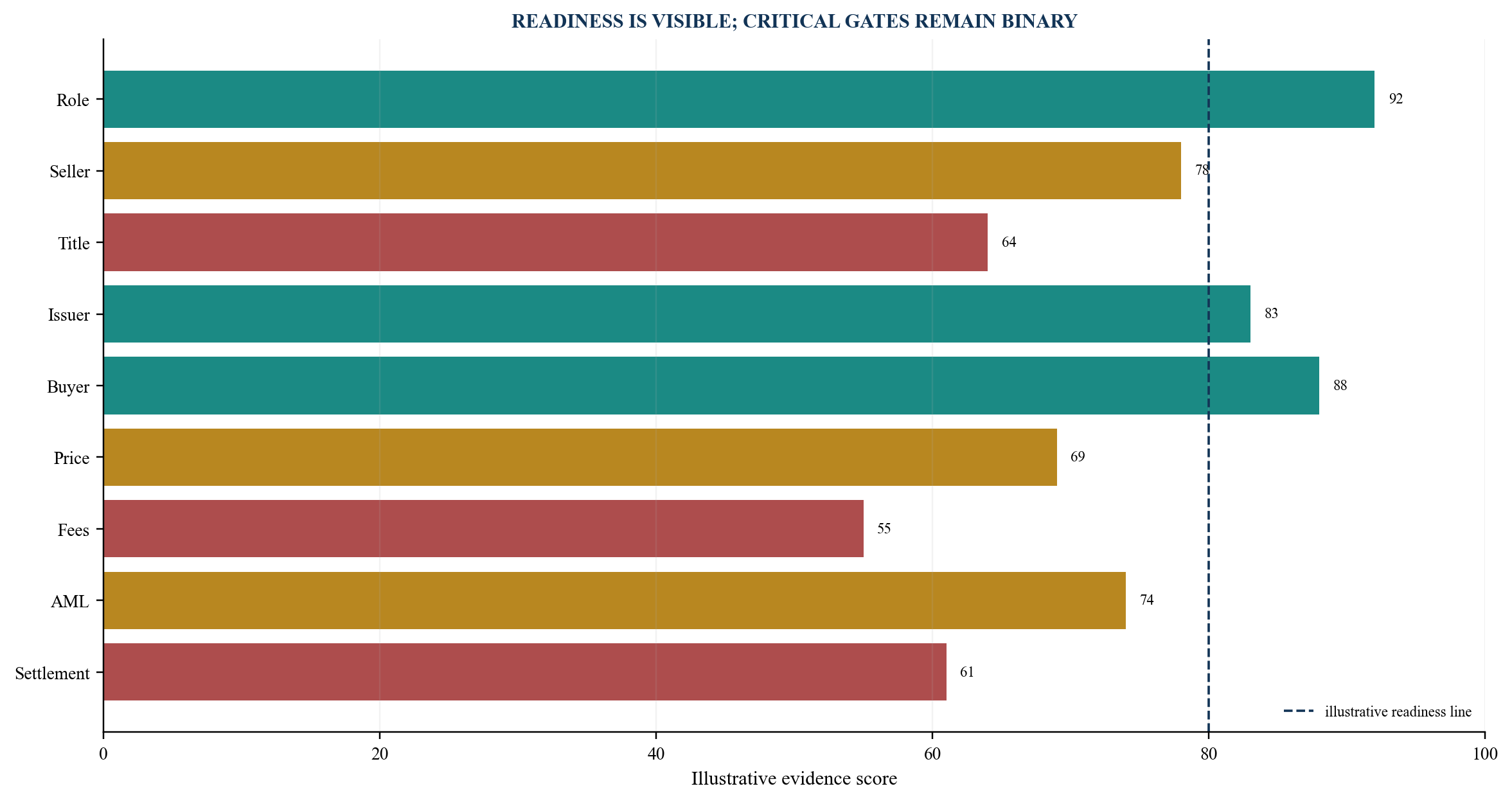
Scores are management assumptions for method demonstration and do not represent a transaction.
15. Run a ten-day block diagnostic
The diagnostic locates missing evidence and conflicts before a full market process. It should use direct source requests and current official records.
Days one and two establish role, permissions, transaction identity, parties, beneficial owners and authority. Days three and four reconcile security, title, restrictions and the proposed resale route. Days five and six test issuer claims, buyer eligibility, price and communications. Days seven and eight complete fees, conflicts, AML, funds and settlement. Days nine and ten resolve red flags, define conditions and obtain approval.
The output should state whether the block is ready for controlled circulation, ready with conditions, paused for evidence or declined. It should identify the audience and information permitted at each status.
Table 6. Ten-day pre-IPO block diagnostic
| Day | Module | Required output | Decision enabled |
|---|---|---|---|
| 1 | role and perimeter | activity, jurisdiction, permission and compensation map | accept or reroute mandate |
| 2 | parties | identity, beneficial ownership and authority file | verify instructing parties |
| 3 | security | issuer, class, quantity, rights and acquisition record | define exact asset |
| 4 | title and route | title chain, restrictions and current legal path | establish potential transferability |
| 5 | issuer | facts, claims, adverse information and evidence dates | approve factual summary |
| 6 | buyer and price | eligibility, mandate, price bridge and capacity | define qualified audience and terms |
| 7 | communications | approved teaser, NDA, data rights and version log | authorise controlled circulation |
| 8 | fees and AML | full economics, conflicts, funds and screening | clear conduct and financial-crime gates |
| 9 | settlement | agreement, agent, accounts, conditions and cash path | confirm executable workflow |
| 10 | committee | red flags, exceptions, conditions and expiry | approve, pause or decline |
Duration is a management planning assumption and depends on complexity and evidence availability.
16. Operate a thirty-day evidence office
The implementation office creates ownership, templates, systems and supervision around the standard. Week one defines the policy, regulated perimeter, block identifier and critical gates. Week two builds the evidence modules, source hierarchy and approval matrix. Week three connects communication, data-room, CRM, custody and settlement records. Week four tests live or historical cases and corrects weaknesses.
The system should be access-controlled and versioned. Sensitive personal, issuer and transaction data should be limited to authorised users. Retention, privacy, legal privilege and regulatory access should follow applicable law and firm policy.
Standard templates should accelerate work while preserving transaction-specific judgment. The file should support clear “not applicable” conclusions with reasons. Empty fields should remain visibly incomplete.
Supervision should sample files, review ageing, test red-flag closure, reconcile fees and compare communications with approved evidence. Findings should produce corrective actions and named owners.
The office can be delivered as a retainer-supported control function where the engagement, permissions and regulated responsibilities are clearly defined. Commercial demand and fee levels remain unverified until supported by signed engagements and collected payments.
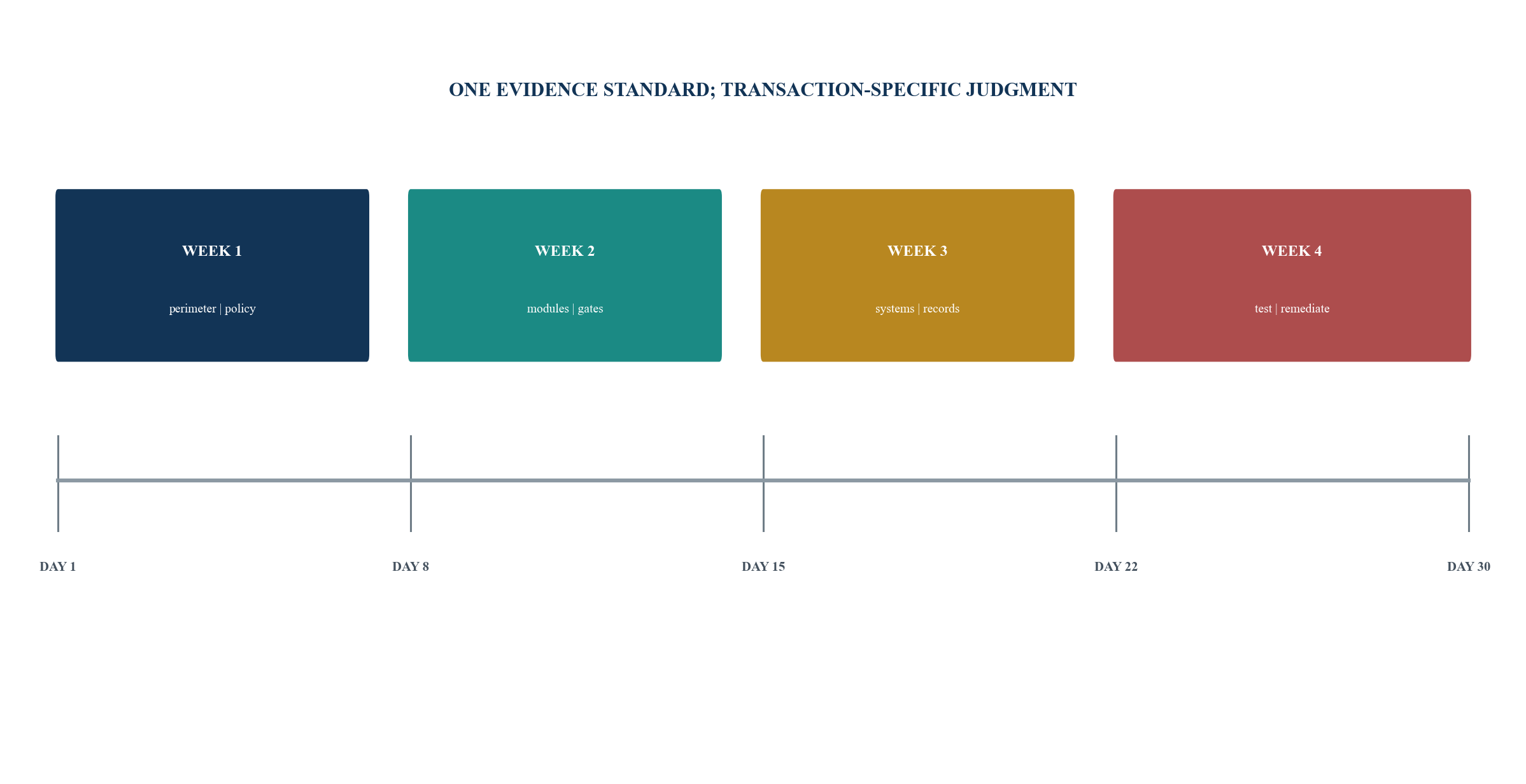
Timing is a management implementation assumption and should be adapted to the firm's permissions and systems.
17. Measure quality, cycle time and commercial outcomes separately
Quality measures include critical gates passed, primary-source coverage, open red flags, evidence age, conflicts disclosed, communication deviations, settlement failures, fee reconciliation and post-close breaks.
Cycle measures include days from intake to perimeter decision, title verification, qualified circulation, binding agreement, issuer consent and settlement. Speed should be analysed alongside quality. A shorter cycle created by skipped evidence is a control failure.
Commercial measures can include qualified blocks, signed mandates, retained control assignments, transactions closed, collected retainers, collected success fees and repeat counterparties. These outcomes should be supported by executed agreements, invoices and bank evidence. Pipeline values and management forecasts should remain labelled as such.
The evidence office can support revenue by making the service tangible: a block-readiness diagnostic, title and restriction remediation, buyer and seller file, price and fee governance, controlled data room, settlement office and post-close reconciliation. The engagement should identify tasks that require a licensed intermediary or external legal, compliance, tax, custody or brokerage provider.
The dashboard should prevent activity metrics from substituting for outcomes. Documents reviewed and introductions made are useful operating measures. Collected fees and completed, compliant transactions are the commercial results.
18. Conclusion
A pre-IPO block is a chain of evidenced propositions. The intermediary must know the role it is performing, the parties it is dealing with, the security being transferred, the route supporting the transaction, the facts being communicated, the price and fees being presented, the funds being accepted and the settlement being completed.
The evidence-file standard makes that chain explicit. It converts documents into tested findings, preserves provenance and conflicts, forces red flags into a controlled process and creates a defensible approval record.
The strongest files begin before market circulation. They use current primary evidence, appropriately authorised roles and transparent economics. They close only after funds and securities reconcile through the approved chain.
References
- US Securities and Exchange Commission. Private Secondary Markets. Updated 24 April 2026. https://www.sec.gov/resources-small-businesses/capital-raising-building-blocks/private-secondary-markets
- US Securities and Exchange Commission. Broker-Dealers. Updated 24 April 2026. https://www.sec.gov/resources-small-businesses/capital-raising-building-blocks/broker-dealers
- Financial Industry Regulatory Authority. 2026 Annual Regulatory Oversight Report: Private Placements. https://www.finra.org/rules-guidance/guidance/reports/2026-finra-annual-regulatory-oversight-report/private-placements
- Financial Industry Regulatory Authority. Regulatory Notice 23-08: Obligations When Selling Private Placements. 9 May 2023. https://www.finra.org/rules-guidance/notices/23-08
- Financial Industry Regulatory Authority. Regulatory Notice 10-22: Obligation of Broker-Dealers to Conduct Reasonable Investigations in Regulation D Offerings. 20 April 2010. https://www.finra.org/rules-guidance/notices/10-22
- Financial Industry Regulatory Authority. Regulatory Notice 21-03: Fraud and Distribution of Unregistered Securities. https://www.finra.org/rules-guidance/notices/21-03
- Financial Industry Regulatory Authority. 2026 Annual Regulatory Oversight Report: Anti-Money Laundering, Fraud and Sanctions. https://www.finra.org/rules-guidance/guidance/reports/2026-finra-annual-regulatory-oversight-report/aml
- Financial Conduct Authority. PISCES: Platforms for Trading Private Company Shares. https://www.fca.org.uk/markets/pisces-private-intermittent-securities-capital-exchange-system
- Financial Conduct Authority. Approving Financial Promotions. Updated 28 May 2024. https://www.fca.org.uk/firms/financial-promotions-and-adverts/approving-financial-promotions
- Financial Conduct Authority. Private Market Valuation Practices. 5 March 2025. https://www.fca.org.uk/publications/multi-firm-reviews/private-market-valuation-practices
- Financial Conduct Authority. Sponsor Conflicts of Interest. https://www.fca.org.uk/markets/sponsor-regime/sponsor-conflicts-interest
- Financial Action Task Force. Guidance for a Risk-Based Approach for the Securities Sector. https://www.fatf-gafi.org/content/dam/fatf-gafi/guidance/RBA-Securities-Sector.pdf
About the Author
Chennakeshav Adya, Independent Researcher
