

1. Treat transfer permission as controlled inventory
A seller’s cap table can show one million shares while the transaction team has no confirmed block available for settlement. Ownership answers who holds the economic interest. Transferability requires a separate chain of evidence and decisions. The team must identify the security, governing documents, applicable restrictions, intended buyer, transaction structure, resale route, required notices, approval authorities and registration mechanics.
The issuer-permission inventory expresses that difference. It starts with the recorded position and deducts quantities affected by title gaps, pledges, holding-period or resale issues, contractual prohibitions, rights of first refusal, consent requirements, buyer restrictions, notice failures, incomplete documents and operational registration constraints. The remainder is the quantity that can enter a controlled sale process under stated assumptions.
Each inventory line needs a source date and status. “Board consent required” is incomplete. The record should state the clause, document version, holder, security class, approving body, information package, decision standard, notice route, response window, expiry and evidence of approval. Where discretion is broad, the team should describe the uncertainty and avoid representing consent as committed.
The same discipline should cover partial quantities, staged closings, substitute buyers and amended economics. These changes can alter the permission analysis and the available inventory.
The SEC explains that private-company securities are often illiquid and may be restricted under federal securities law. Contractual or corporate permission remains a separate question. Meeting a federal resale pathway does not by itself complete a contractual transfer or cause the issuer to register the new holder. The transaction file should therefore run a resale workstream and an issuer-permission workstream in parallel.
The commercial purpose is accurate inventory. A broker, adviser, family office or shareholder should circulate only the block whose restrictions and approval path have been identified. This supports credible pricing, reduces failed allocations and gives the buyer a timetable grounded in evidence.
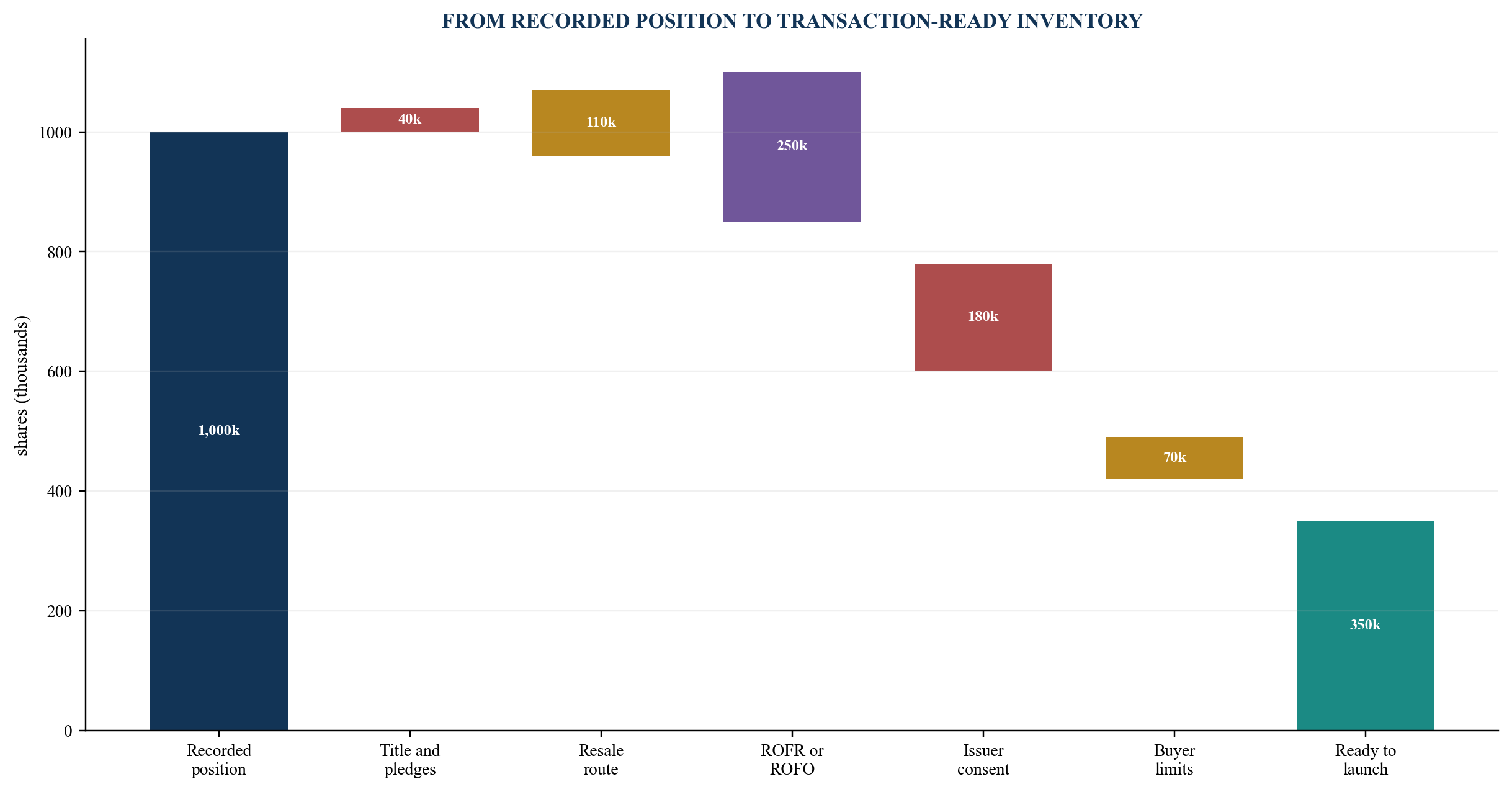
Illustrative quantities are management assumptions used solely to demonstrate the inventory method.
2. Build the source hierarchy before interpreting clauses
Transfer restrictions can sit across several documents. The certificate or articles, bylaws, shareholders’ agreement, investor-rights agreement, voting agreement, stock-purchase agreement, option plan, award agreement, side letter, financing agreement, pledge, trust or nominee arrangement may each affect the same position. Local corporate law, securities law and regulatory requirements can add further conditions.
The source register should capture every potentially controlling instrument and record its execution date, parties, amendment history, accession mechanics, affected class, termination events and relationship with other documents. An extracted clause without its definitions, schedules, amendments and precedence language can create a false conclusion.
Delaware General Corporation Law section 202 recognises several types of written transfer restriction, including prior-offer requirements, consent requirements and restrictions involving designated persons or classes. It also addresses how a restriction is imposed and disclosed. That statutory framework does not supply the terms of a particular company’s restriction. The actual certificate, bylaws and agreements remain essential evidence.
The hierarchy memo should identify which document prevails when terms conflict. A later side letter may modify rights for one holder. A financing round may amend a shareholders’ agreement. A class conversion may change which provision applies. A corporate reorganisation can leave legacy instruments outstanding. Counsel should resolve conflicts and document the conclusion.
The team also needs the complete defined-term chain. “Transfer,” “Affiliate,” “Permitted Transferee,” “Competitor,” “Prohibited Person,” “Change of Control” and “Beneficial Ownership” can determine whether a transaction triggers a process. Transfers can include gifts, pledges, changes in control of a holding vehicle, trust distributions, economic hedges or other arrangements depending on the wording.
Table 1. Transfer-restriction source register
| Source | Extraction focus | Evidence test | Common failure |
|---|---|---|---|
| constitutional document | issuer powers, board discretion and class terms | current certified version and amendments | superseded version reviewed |
| shareholders’ agreement | ROFR, ROFO, consent, tag, drag and permitted transfers | executed copy, parties and accessions | seller never validly acceded |
| purchase or award agreement | holder-specific restrictions and vesting | executed schedule and security identifier | grant terms separated from position data |
| side letter | waiver, priority or bespoke consent | authority, scope, expiry and continuing effect | undocumented commercial assurance |
| financing or pledge | liens, negative covenants and enforcement rights | lender confirmation and release process | encumbered shares marketed as free |
| statute and regulation | enforceability, registration and resale conditions | current official text and applicable jurisdiction | corporate and securities rules blended |
| issuer register | legal holder, class and quantity | direct issuer or authorised registrar evidence | platform display treated as legal register |
The operative hierarchy and legal effect require transaction-specific legal advice.
3. Separate restriction categories and decision owners
The restriction inventory should classify each condition by purpose and decision owner. Securities-law restrictions address lawful offers and resales. Corporate restrictions can govern who may hold the shares, how ownership changes are approved and when a transfer is registered. Contractual restrictions allocate rights among the company and shareholders. Regulatory ownership controls may require approval when a buyer gains influence or crosses a threshold. Liens and court orders can prevent disposal. Operational conditions determine whether records, signatures and settlement instructions are complete.
Classification affects the remedy. A missing issuer notice cannot be solved by a legal opinion on federal resale. A holding-period issue cannot be cured by board consent alone. A right-of-first-refusal process cannot be skipped because a buyer is professionally qualified. A buyer’s acquisition may require a regulated change-of-control approval even when the company welcomes the investor.
The team should assign one accountable owner to each restriction. Counsel can advise on legal effect, while the issuer’s authorised body makes its decision. The company secretary or registrar may control registration evidence. A lender controls lien release. A regulator controls approval within its remit. The transaction office coordinates these dependencies and preserves evidence; it does not replace the relevant authority.
The status vocabulary should be precise: identified, under review, notice-ready, submitted, acknowledged, conditionally approved, approved, waived, expired, refused or disputed. “In progress” obscures the legal and operational state. Each status needs a dated source.
4. Convert clause extraction into an executable restriction matrix
Clause extraction should produce operating data. For each restriction, the matrix records the triggering event, exempt transfers, required notice, information package, recipients, response period, matching standard, consent standard, conditions, expiry, appeal or resubmission route and proof of completion.
A right may depend on precise economics. A ROFR holder may need the same price and material terms offered by a third party. Consideration that includes earn-outs, swaps, services, financing or contingent value can be difficult to match. The transaction team should identify how non-cash or conditional consideration is treated and whether a proposed change requires a fresh process.
The matrix should distinguish contractual deadlines from management targets. The notice may be deemed received only through a specified address or portal. Business days may exclude local holidays. The response window may start after a complete notice. A missing exhibit can prevent the clock from starting. Counsel should confirm the calculation.
Waiver analysis must be equally specific. A historic waiver for one transaction, buyer, quantity or period may not apply to a later block. An authorised decision maker must issue the waiver in the required form. Informal support from management may have no binding effect.
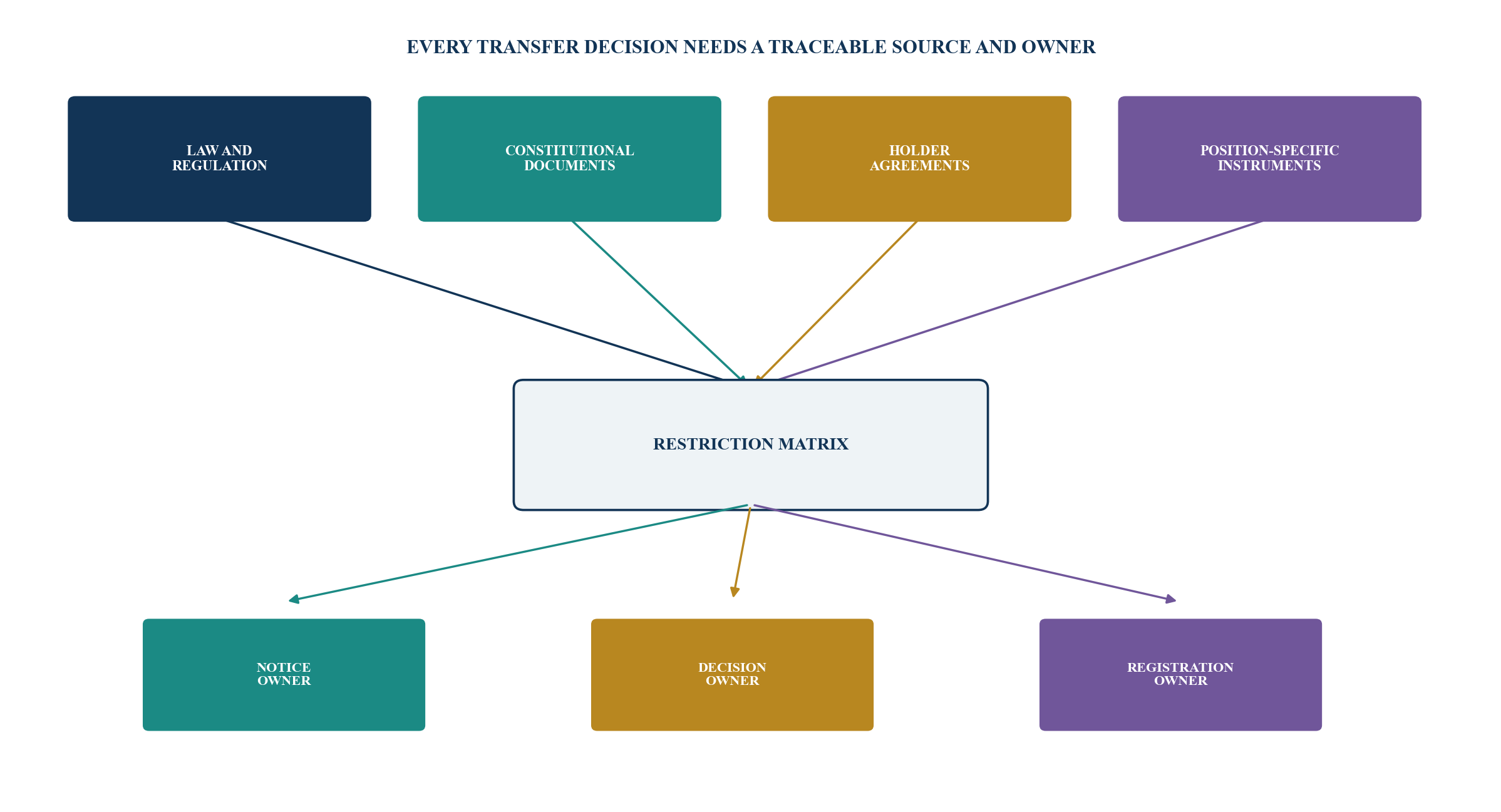
The diagram shows an author framework; actual precedence and decision authority follow the governing law and documents.
5. Design the right-of-first-refusal process around exact matching
A ROFR generally gives a defined person the opportunity to acquire the shares after the seller receives or negotiates a third-party offer, subject to the governing terms. The process may require delivery of buyer identity, quantity, price, payment form, closing conditions and other material terms. The right holder then decides whether to match within the prescribed period.
The transaction office should establish the exact trigger. Preliminary indications, letters of intent, term sheets and binding agreements may receive different treatment. Signing a third-party agreement before completing the ROFR process can breach the restriction where the documents require an earlier offer or notice.
The notice package should be complete, internally consistent and delivered through the contractually valid route. Sensitive buyer information should be shared under lawful confidentiality arrangements. The team should preserve proof of delivery and acknowledgement.
Matching analysis becomes complex where terms have different value to different buyers. Deferred consideration, financing contingencies, indemnities, escrow, rollover equity and relationship arrangements may affect equivalence. The file should show how counsel and the decision owner treated each term. A lower nominal price with faster certainty may have different economics from a higher contingent price.
If the right is declined or expires, the seller may receive a limited window to close with the third party on terms no more favourable than those offered to the right holder. Price changes, buyer changes, quantity changes or an expired closing window can require a new notice. The process register should test those refresh events before execution.
Table 2. ROFR control sequence
| Stage | Required evidence | Decision | Stop condition |
|---|---|---|---|
| trigger assessment | offer status, terms and clause | has the contractual trigger occurred? | transaction state remains ambiguous |
| notice preparation | buyer, quantity, price and all material terms | is the package complete? | omitted or inconsistent economics |
| valid delivery | specified recipients, channel and time | has the contractual clock begun? | address, authority or attachment failure |
| matching period | acknowledgement and deadline calculation | has the right been exercised validly? | conditional or partial response unresolved |
| third-party window | decline or expiry evidence | may the seller close with this buyer now? | terms changed or window expired |
| registration | approvals, transfer instrument and ledger update | has legal ownership changed? | issuer or registrar has not registered transfer |
The legal trigger, matching requirement and clock follow the operative agreement.
6. Distinguish ROFO, pre-emption, tag and drag mechanics
A right of first offer usually requires the seller to approach the right holder before a third-party sale process, under the exact agreement. A ROFR generally responds to third-party terms. The commercial labels cannot substitute for clause analysis. The operative language defines the sequence, price process and freedom to transact after the right holder declines.
Pre-emption on new issuance addresses dilution and primary capital. Transfer pre-emption addresses secondary sales. A company can have both. The transaction team should avoid applying an issuance waiver to a shareholder transfer.
Tag-along rights can allow other holders to participate in a sale, increasing the transaction quantity and adding notice, allocation and documentation requirements. Drag-along rights can require holders to sell in a qualifying transaction, subject to thresholds and protections. A block sale below a control threshold may not activate either right, yet associated change-of-control definitions should be checked.
Co-sale rights can change settlement because the buyer may need to acquire additional shares on equivalent terms. The seller should avoid promising an exact block before the participation window closes. The buyer should understand whether the desired quantity can be diluted by other sellers.
The inventory model should therefore show base quantity, potential tag quantity, maximum buyer commitment, allocation rule and final registrable amount. These are separate fields.
7. Treat issuer consent as a decision process with evidence
Issuer or board consent can be discretionary, qualified, objective or linked to specific grounds. The request should map the decision authority and the information needed for a valid determination. It should avoid assuming that supportive executives can bind the board or company.
The consent pack can include seller and buyer identity, beneficial ownership, security class and quantity, transaction price, proposed transfer date, regulatory status, investor eligibility, sanctions and AML evidence, competitor analysis, confidentiality commitments, deed of adherence, tax forms and requested waivers. The governing documents determine the minimum; the issuer may request additional lawful information.
The company’s process should manage conflicts. A director, shareholder or affiliate with a competing economic interest may require disclosure, abstention or another treatment under the governing rules. The record should identify who received the materials, who decided, what authority supported the decision and what conditions attach.
Conditional consent needs an expiry and completion checklist. Conditions can include payment, document execution, legal opinion, regulatory approval, cancellation of certificates, lien release or completion by a long-stop date. A “consent received” status is premature until the conditions are understood.
The FCA’s PISCES framework provides a current example of structured issuer control in a private-company trading environment. Its policy statement describes companies deciding when shares can trade, who can buy, price parameters and information access during intermittent events. The platform framework is jurisdiction- and regime-specific, while the operating lesson is broader: issuer permission should be expressed as observable rules and event data.
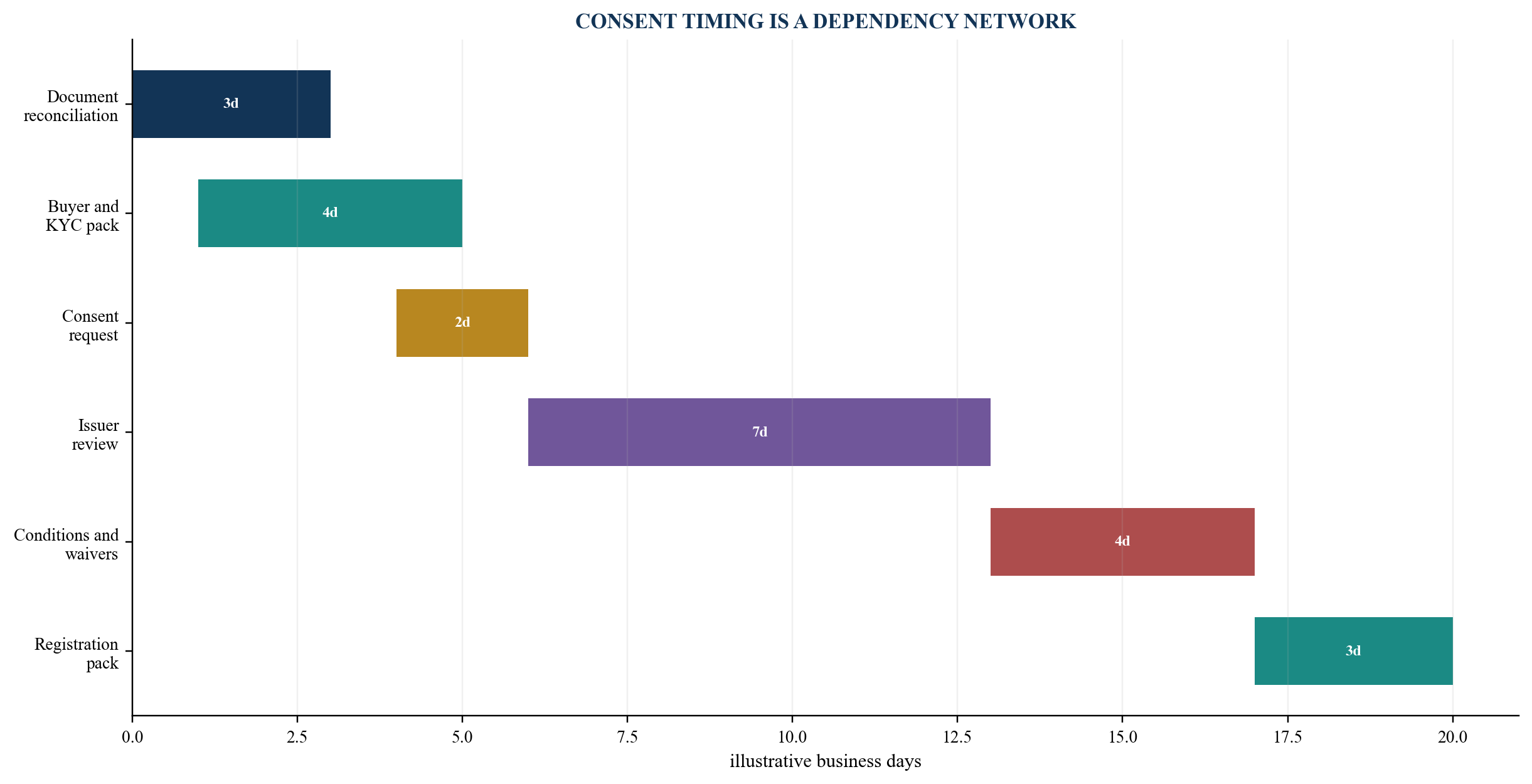
Illustrative business-day ranges are management assumptions and do not represent contractual or statutory deadlines.
8. Screen the buyer before requesting permission
An incomplete buyer profile wastes the consent clock. The seller should know the prospective buyer’s legal identity, beneficial owners, jurisdiction, investment authority, regulatory status, acquisition vehicle, funding evidence, competitor status, sanctions position and ability to execute required accession documents.
The restriction matrix may prohibit or condition ownership by competitors, strategic buyers, sanctioned persons, excessive holder counts, persons in specified jurisdictions or buyers who fail eligibility tests. Regulated businesses may have ownership or change-of-control thresholds. A small block can still confer influence through agreements or concert-party arrangements.
The UK legislative framework requires companies to process lodged transfers under applicable procedures, and current reforms allow refusal where required member-register information has not been supplied. The actual articles and agreements can add decision rights. The file should therefore include the information required to register the transferee, alongside contractual buyer evidence.
In ADGM, official event-driven filing guidance lists an instrument of transfer, register of shareholders and board resolution approving a share transfer among relevant documents. The precise submission depends on the entity and transaction. That guidance reinforces the need to align the commercial closing set with the issuer’s corporate record and filing workflow.
Buyer clearance should have a validity period. Ownership, funding, sanctions and regulatory facts can change. A substitute acquisition vehicle should trigger refreshed analysis and possibly a new issuer request.
Table 3. Buyer-perimeter and permission screen
| Buyer dimension | Evidence | Restriction question | Readiness outcome |
|---|---|---|---|
| identity and ownership | formation, register and natural-person chain | is the proposed holder permitted? | verified legal buyer and beneficial owners |
| authority | board, committee or delegated approval | can the buyer execute and fund? | current authority evidenced |
| competitor status | business, affiliates and strategic relationships | does a competitor restriction apply? | issuer classification or counsel view |
| jurisdiction | domicile, management and account location | is the geography restricted or regulated? | lawful acquisition and settlement route |
| regulatory influence | voting, agreements and aggregate holdings | does approval or notification apply? | regulatory condition identified |
| funding | source, account and availability | can the buyer meet the closing terms? | verified funds plan |
| adherence | deed, confidentiality and policy documents | will the buyer assume required obligations? | execution-ready accession pack |
The screen routes issues for current legal, regulatory and compliance analysis.
9. Link permission status to price and exclusivity
Permission risk affects economic value. A buyer asked to commit capital before a ROFR window, board consent or regulatory approval may demand conditionality, exclusivity, a lower price or expense protection. The seller may prefer a buyer with higher execution certainty even where another indication is nominally higher.
The price bridge should separate company value from transaction friction. It can show the last primary-round reference, security-class rights, company performance, dilution, information quality, block size, transfer restrictions, approval timing, buyer concentration, fees and settlement conditions. Every adjustment should be described as an observed fact, third-party indication or management assumption.
Exclusivity should match the critical path. A buyer needs time to diligence and seek consent, while the seller needs protection against an open-ended lock. The agreement can include evidence milestones, cooperation obligations, long-stop dates, termination rights, cost allocation and treatment of a ROFR exercise. Counsel should design the actual terms.
A deposit or escrow arrangement requires careful structuring. The parties should know who holds funds, when they become refundable or releasable, what happens if issuer permission is refused and whether any party is authorised to receive or control client money.
The transaction dashboard should publish the approval-adjusted case alongside the headline price. This gives decision makers a clearer comparison of bids with different timing and condition risk.
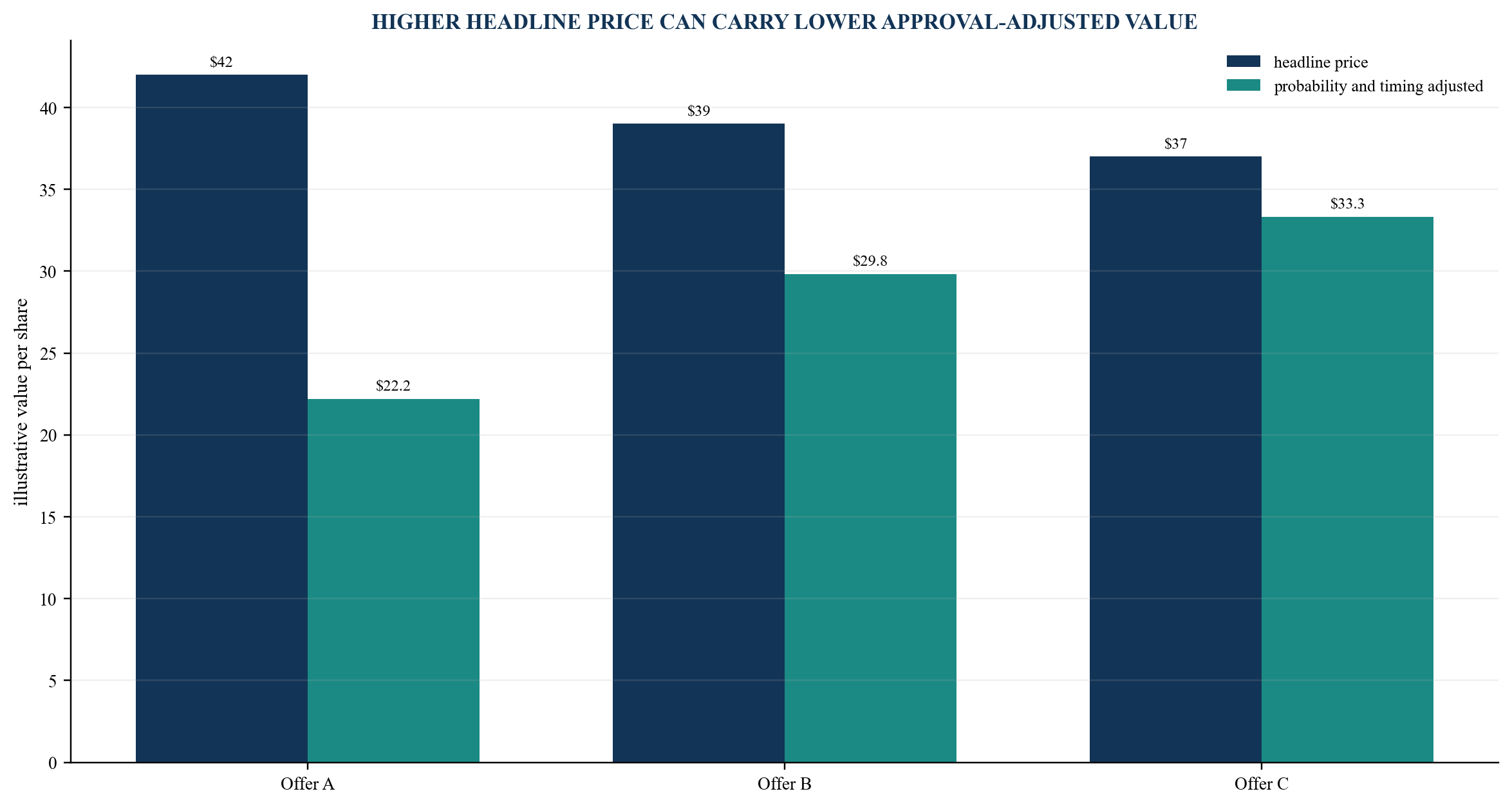
Prices, probabilities and timing are illustrative management assumptions; they are not valuations or forecasts.
10. Manage notices as controlled transaction instruments
Notices should be generated from the restriction matrix and reviewed against the current transaction terms. Each notice needs the correct sender, authority, recipient, address, delivery method, timing, referenced clause and supporting attachments.
The notice register should show preparation, legal review, signature, dispatch, receipt, completeness response, clock start, deadline, decision and expiry. It should retain delivery evidence. A messaging-app acknowledgement can support context, yet it may not satisfy the contractual method.
Information rights and confidentiality require attention. The seller may need to disclose a bona fide offer to activate a right, while the buyer may restrict disclosure of its identity or terms. The transaction agreement and confidentiality arrangements should anticipate the required issuer and shareholder disclosures.
Material changes after notice should enter change control. The team compares the executed terms with the notified terms and determines whether refreshed notice or approval is required. Side arrangements should be captured because they can affect matching rights or the truthfulness of the notice.
The final evidence pack should include the exact notice version, all attachments, delivery proof, responses, waiver or expiry evidence and the executed transaction documents. This creates one defensible record.
11. Model permission as a probability-weighted timetable
A single expected closing date hides dependency risk. The model should identify each approval, contractual window, information dependency and possible restart. It can then show base, accelerated and delayed cases with explicit management assumptions.
The critical path may include document reconciliation, buyer verification, indicative agreement, ROFR notice, response period, issuer consent, regulatory clearance, lien release, execution, payment, certificate cancellation, register update and confirmation. Some steps can run in parallel. Others depend on a valid prior event.
Probability should not substitute for evidence. A 75 percent consent assumption is a planning input; it is not issuer approval. The model should record who supplied the assumption, the supporting history, the date and the decision that uses it.
Scenario design should consider refusal, incomplete notice, exercise by a right holder, altered terms, expired windows, buyer substitution, regulatory questions and delayed registration. Each scenario needs an owner and response.
Table 4. Permission and closing scenario model
| Scenario | Assumed probability | Permission path | Closing time | Control response |
|---|---|---|---|---|
| accelerated | 20% | valid waiver and complete buyer pack | 10 business days | confirm authority and waiver scope |
| base | 50% | full ROFR period followed by consent | 25 business days | preserve clock and conditions evidence |
| delayed | 20% | supplemental information and renewed review | 45 business days | extend long-stop and refresh evidence |
| right exercised | 7% | ROFR holder matches under governing terms | 30 business days | switch counterparty and reconcile terms |
| refused or abandoned | 3% | permission denied or conditions fail | no close | close file, refund funds and preserve reasons |
All probabilities and timing values are illustrative management assumptions.
12. Keep agreement, approval and registration as separate states
Signing a sale agreement establishes contractual rights and conditions. It does not necessarily transfer legal title. The contract should state the conditions precedent, responsibility for notices and consent, cooperation duties, termination rights and settlement mechanics.
Approval is a second state. The team should confirm its source, authority, scope, conditions, expiry and relationship to the signed terms. A conditional approval can remain incomplete until each condition is satisfied or waived validly.
Registration is the third state. The company or authorised registrar updates the relevant register after accepting the transfer documents and requirements. Certificates, electronic records, cap tables, shareholder ledgers and platform displays should reconcile to the controlling legal record.
The SEC’s Rule 144 investor guidance illustrates a related operational dependency in the public-market context: a transfer agent generally requires issuer consent, commonly supported by issuer counsel, before removing a restrictive legend. The private-secondary process has its own documents, yet the control lesson is similar. A legal pathway and an operationally registrable position must converge.
Settlement status should reflect both consideration and securities. Cash sent with no registered transfer is not a completed bilateral outcome. The closing file should include bank confirmation, escrow statement where applicable, executed instruments, issuer registration evidence, updated holder record, fee reconciliation and exception closure.
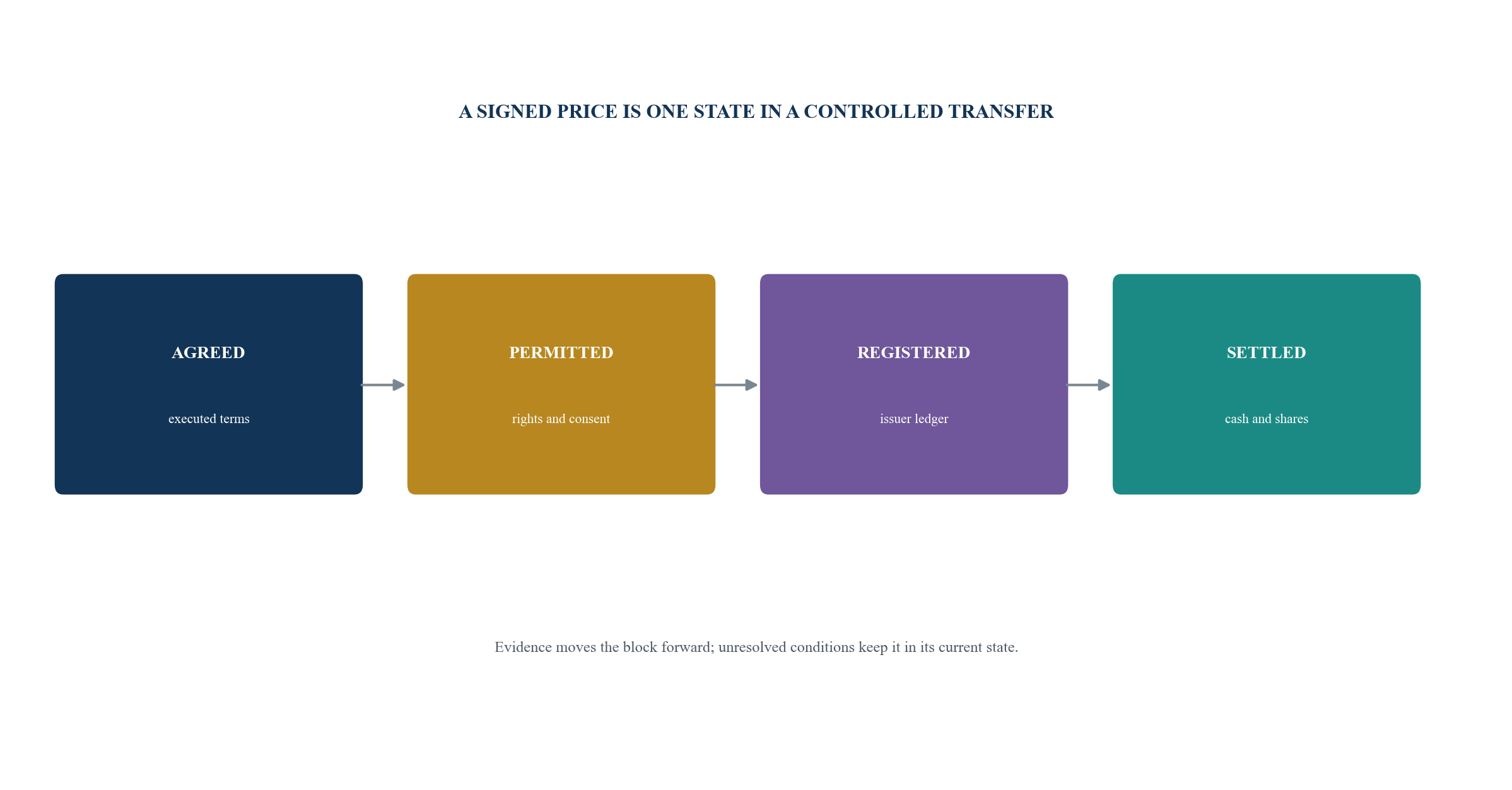
Each state requires independent evidence and an accountable decision owner.
13. Govern waivers, exceptions and expired permissions
An exception register should capture every requested waiver, missing item, alternative evidence and conditional decision. It records the clause, affected quantity, reason, risk, temporary control, decision authority, date and expiry.
Waivers should be read narrowly. A waiver of a ROFR may leave issuer consent, buyer eligibility, registration and securities-law requirements intact. A board approval may not waive rights held by individual shareholders. A lender release may be conditional on payment.
Expired permissions return the block to review. The team should avoid carrying an approval from one abandoned process into another buyer, price or period. The inventory line moves from approved to expired, with the historical evidence preserved.
Repeated exceptions can reveal a structural problem. Fragmented documents, outdated registers, inconsistent side letters or slow decision authority can depress liquidity across the shareholder base. The issuer may benefit from a controlled remediation programme with counsel and shareholders.
14. Score readiness without converting discretion into certainty
The readiness score should measure evidence completeness, not predict the legal decision. Categories can include source hierarchy, holder title, restriction extraction, buyer clearance, notice readiness, ROFR status, issuer decision, regulatory conditions, registration pack and settlement controls.
Critical gates override the average. A high score cannot compensate for a missing transfer right, prohibited buyer or unresolved title conflict. The dashboard should show pass, conditional, fail and not applicable, plus a dated narrative.
Evidence ageing matters. A register extract, beneficial-owner record, funding confirmation or sanctions screen can become stale. The team should define refresh triggers and expiry periods based on risk and applicable requirements.
Table 5. Transfer-readiness scorecard
| Module | Weight | Illustrative score | Evidence gap | Required action |
|---|---|---|---|---|
| source hierarchy | 12% | 90 | one side letter unconfirmed | obtain issuer confirmation |
| title and quantity | 14% | 82 | pledge release pending | agree lender release mechanics |
| restriction extraction | 14% | 95 | none material | preserve counsel review |
| buyer clearance | 10% | 75 | ownership refresh required | update buyer evidence |
| ROFR process | 12% | 60 | notice not yet delivered | finalise valid notice package |
| issuer consent | 14% | 40 | decision outstanding | submit and track conditions |
| regulatory conditions | 8% | 85 | threshold aggregation open | confirm affiliated holdings |
| registration pack | 8% | 65 | accession deed unsigned | execute current form |
| settlement controls | 8% | 80 | account callback pending | independently verify instructions |
Illustrative scores and thresholds are management assumptions; critical legal and approval gates remain binary.
15. Run a ten-day permission diagnostic
Days one and two establish the transaction identity, holder, security, quantity, buyer, structure, price and desired timing. The office collects the current issuer register and full governing-document population.
Days three and four build the source hierarchy, defined-term map and clause extraction. Counsel identifies the applicable resale, corporate, contractual and regulatory workstreams.
Days five and six create the restriction matrix, buyer screen, notice requirements, decision owners and critical path. The team reconciles competing document provisions and records open questions.
Days seven and eight prepare the ROFR or consent package, transaction terms, confidentiality treatment, buyer evidence, accession documents and settlement plan. No notice is issued until the package has passed the required review.
Days nine and ten produce the issuer-permission inventory, readiness score, scenario timetable, decision paper and engagement plan. The decision identifies what can launch, what requires remediation and what should remain outside circulation.
16. Operate a sixty-day transfer-readiness office
The first fifteen days complete the position inventory, documents, restriction hierarchy, buyer perimeter and initial legal analysis. The office establishes one version-controlled data room and evidence register.
Days sixteen to thirty remediate title, pledges, missing accessions, inconsistent records and incomplete buyer information. The team prepares notices and obtains pre-submission feedback where permitted.
Days thirty-one to forty-five run the valid notice, ROFR, consent and regulatory processes. The dashboard tracks contractual clocks, information requests, decisions and conditions without describing pending approval as committed.
Days forty-six to sixty complete transaction documents, conditions, payment controls, registration pack, final reconciliations and post-close evidence. Any failed process receives a documented close-out and inventory status.
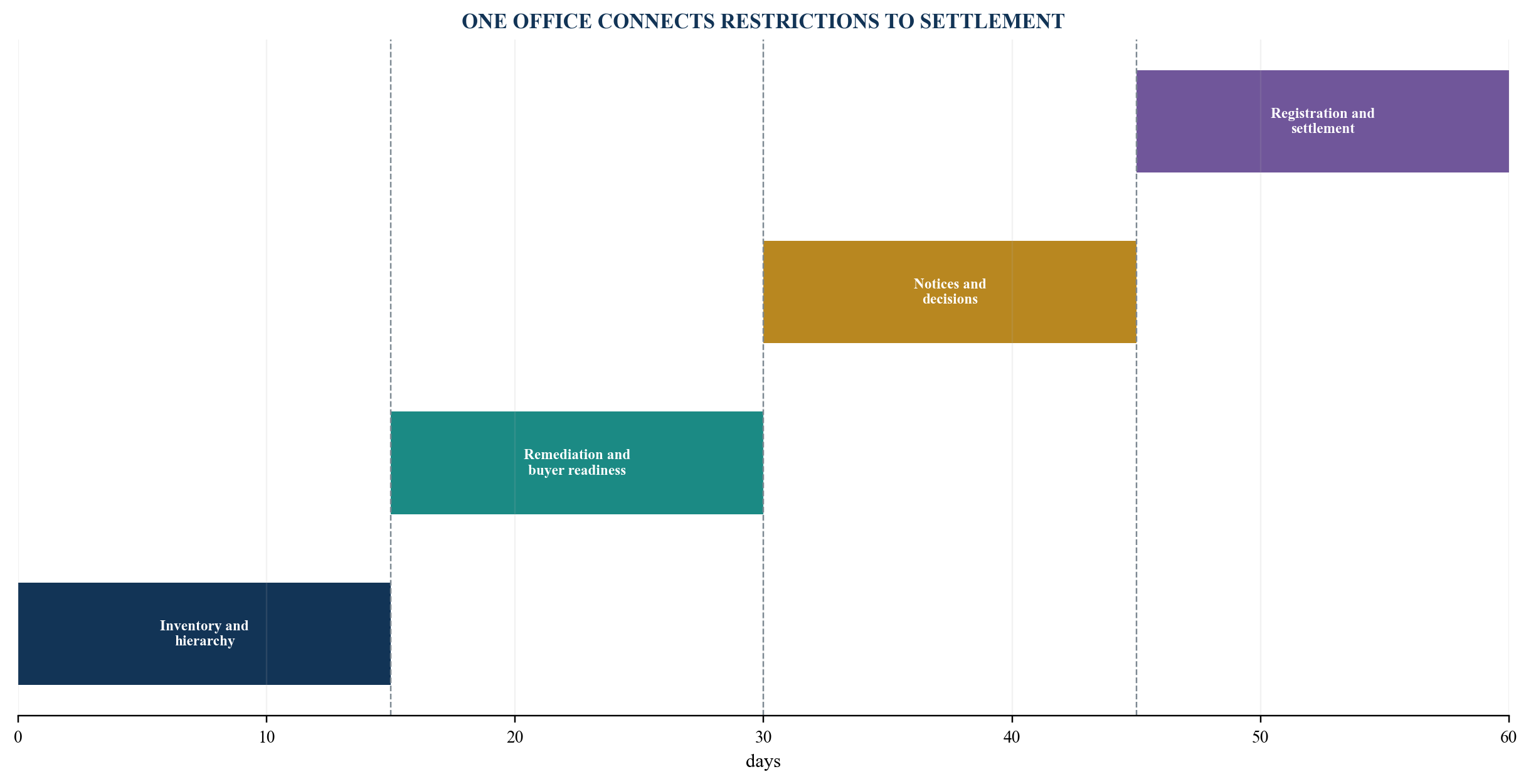
Timing is an author framework and should be adapted to the operative agreements and approval authorities.
Table 6. Sixty-day workplan and approval gates
| Days | Workstream | Controlled deliverable | Gate |
|---|---|---|---|
| 1 to 5 | inventory | position, holder, class, buyer and transaction identity | scope reconciled to issuer evidence |
| 6 to 10 | documents | source hierarchy, definitions and restriction matrix | counsel confirms applicable workstreams |
| 11 to 15 | planning | notice path, decision owners and scenario timetable | launch scope approved |
| 16 to 25 | remediation | title, pledge, accession and buyer gaps | critical evidence complete |
| 26 to 30 | package | final terms, notices, confidentiality and settlement plan | authorised submission approval |
| 31 to 40 | rights process | valid ROFR or ROFO record | exercise, decline or expiry evidenced |
| 41 to 45 | consent | issuer and regulatory decisions | conditions and validity confirmed |
| 46 to 52 | execution | signed documents and closing evidence | all conditions satisfied or validly waived |
| 53 to 57 | registration | updated issuer register and holder evidence | legal position reconciled |
| 58 to 60 | close | funds, securities, fees and exceptions reconciled | post-close owner accepts file |
Deliverables and timing require adaptation to the actual transaction and decision rights.
17. Measure liquidity quality and commercial outcomes separately
Quality measures include current-document coverage, critical clauses extracted, title breaks, valid notices, clock accuracy, consent conditions, expired approvals, buyer exceptions, registration failures and settlement breaks.
Cycle measures include days to complete the source hierarchy, obtain a complete buyer pack, launch a valid notice, receive a decision, satisfy conditions, register the transfer and settle. The team should identify delay by owner and cause.
Commercial measures can include transaction-ready inventory, qualified buyers, paid diagnostics, signed readiness retainers, completed blocks, collected success fees and repeat issuer relationships. Executed agreements, invoices and bank evidence should support reported outcomes. Pipeline and forecast values should remain labelled as management estimates.
The service can be packaged as a restriction diagnostic, shareholder-liquidity inventory, ROFR and consent office, buyer-perimeter file, controlled data room, price and timetable model, registration coordination and post-close reconciliation. Regulated or reserved tasks must remain with appropriately authorised legal, regulatory, brokerage, custody, company-secretarial and compliance providers.
Activity volume can indicate workload. Collected fees and completed, compliant transactions show commercial results.
18. Conclusion
Issuer permission is a measurable component of private-share inventory. A recorded position becomes transaction-ready when title, resale route, governing restrictions, buyer eligibility, notices, rights processes, approvals, registration and settlement controls converge.
The framework converts scattered clauses into an operating system. It assigns a source, owner, clock, decision and expiry to each restriction. It keeps agreement, approval, registration and settlement as separate states. It also connects permission risk to buyer confidence, exclusivity, price and closing scenarios.
A credible private-secondary process begins with the exact quantity that can be supported by current evidence. Every subsequent change returns to that inventory.
References
- US Securities and Exchange Commission. Private Secondary Markets. Updated 24 April 2026. https://www.sec.gov/resources-small-businesses/capital-raising-building-blocks/private-secondary-markets
- US Securities and Exchange Commission. Rule 144: Selling Restricted and Control Securities. https://www.sec.gov/reports/rule-144-selling-restricted-control-securities
- Delaware General Assembly. Delaware General Corporation Law, Title 8, section 202, Restrictions on Transfer and Ownership of Securities. https://www.delcode.delaware.gov/title8/c001/sc06/
- Financial Conduct Authority. Policy Statement PS25/6: Private Intermittent Securities and Capital Exchange System. May 2025. https://www.fca.org.uk/publication/policy/ps25-6.pdf
- Financial Conduct Authority. PISCES: Platforms for Trading Private Company Shares. https://www.fca.org.uk/markets/pisces-private-intermittent-securities-capital-exchange-system
- UK Parliament. Companies Act 2006, section 771, Procedure on Transfer Being Lodged. https://www.legislation.gov.uk/ukpga/2006/46/section/771
- UK Parliament. Economic Crime and Corporate Transparency Act 2023, Explanatory Notes, section 46. https://www.legislation.gov.uk/ukpga/2023/56/notes/division/7/index.htm
- Abu Dhabi Global Market Registration Authority. Event-driven Filing: Shares and Shareholders. https://www.adgm.com/operating-in-adgm/obligations-of-adgm-registered-entities/event-driven-filings
- Abu Dhabi Global Market. Companies Regulations 2020. https://assets.adgm.com/download/assets/ADGM1547_20963_VER072020.pdf/fb4a15ce5d4111efaccc3653e4bba5a5
About the Author
Chennakeshav Adya, Independent Researcher
