

1. Treat the continuation transaction as a transfer of value and governance
A continuation vehicle moves one or more portfolio assets from an existing fund into a new vehicle that remains under the same sponsor or an affiliated manager. Existing investors usually receive an election to realise cash, continue exposure through the new vehicle, or divide their interest between those routes. Incoming secondary investors supply the liquidity and may also provide additional capital. The transaction can solve a genuine duration problem, support an asset's next investment phase and give investors different liquidity choices. It can also crystallise value and economics while the sponsor sits on both sides of the transfer.
The governing question is therefore broader than whether the price falls within a valuation range. A defensible transaction should show why the vehicle is preferable to holding the asset, extending the existing fund, distributing the asset, refinancing, selling to a strategic or financial buyer, pursuing an initial public offering, or staging a later exit. It should show how price was discovered, how conflicts were identified and managed, what information each party received, how the election worked, how the new economics compare with the old, and how portfolio risks will be governed after closing.
ILPA's 2023 guidance asks sponsors to articulate the rationale, explore alternatives, present the process and bids to the limited partner advisory committee, run a competitive process, validate price through a third party and allow investors sufficient time and information to decide [1]. ILPA released a standardised disclosure template in January 2026 and a draft update in June 2026 covering process integrity, election options, conflict management, pricing validation and transparency [2, 3, 4]. The draft's comment period closed on 5 August 2026; ILPA states that final guidance is planned later in 2026 [2, 4]. The draft remains a consultation document at the date of this paper.
The board, investment committee and fund-governance bodies need one controlled transaction record. It should link every material decision to the governing document, evidence, adviser, owner, date and approval. The record converts a bespoke transaction into an auditable process without pretending that a checklist resolves commercial judgement.
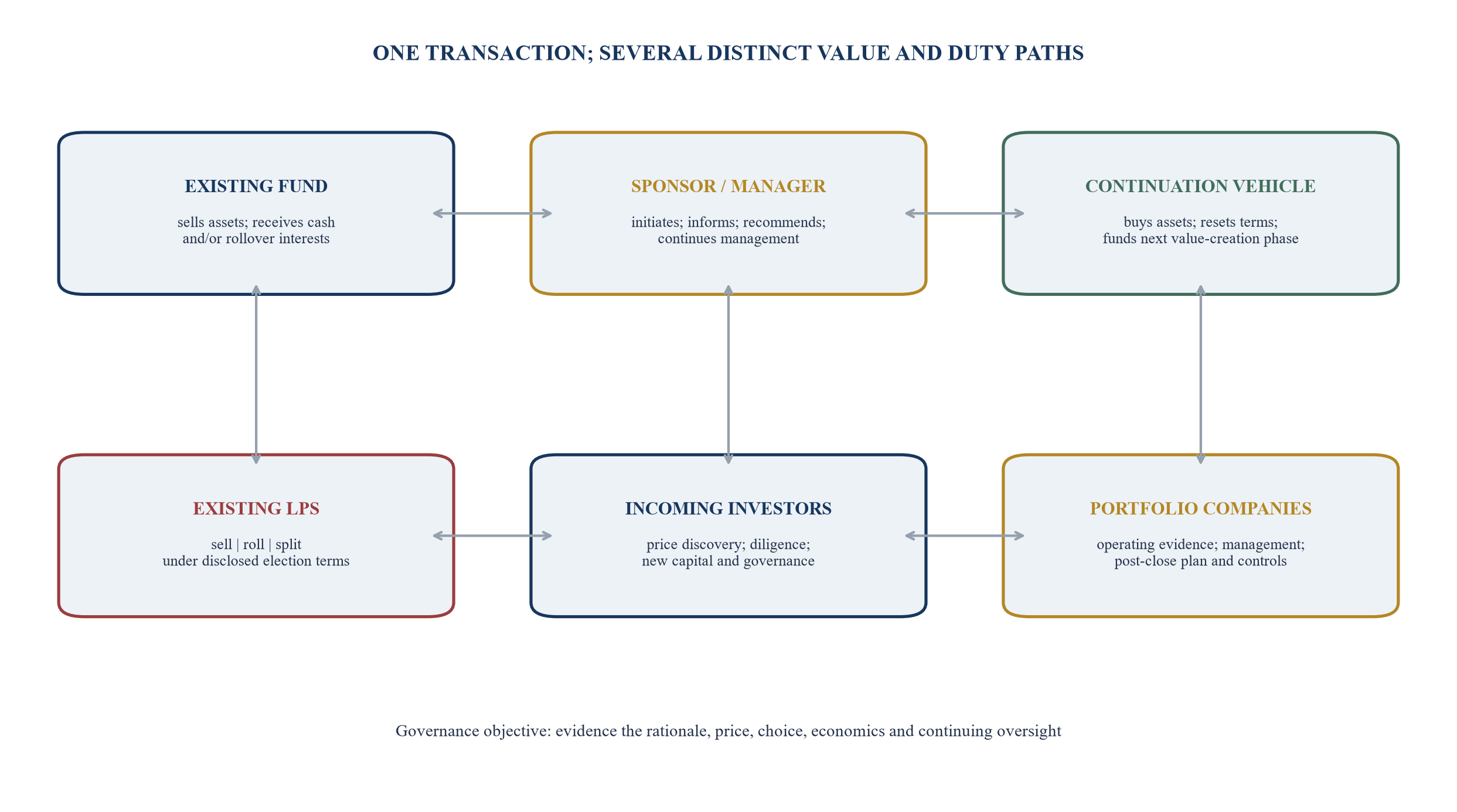
The diagram is an illustrative process architecture. Rights and obligations depend on the fund documents, governing law and transaction terms.
2. Define the transaction perimeter and decision rights
The first work product should describe the complete transaction perimeter. It should identify the selling funds, assets, acquisition vehicle, incoming investors, co-investors, sponsor entities, carried-interest vehicles, financing providers, advisers, portfolio companies and any parallel fundraise. It should also identify partial interests, deferred consideration, earn-outs, reinvestment, additional capital and arrangements that affect economics after closing. A clean structure chart should accompany a written perimeter statement.
Decision rights arise from several sources. The limited partnership agreement may address related-party transactions, conflicts, valuation, term extensions, asset transfers, advisory-committee approvals, amendments and investor consents. The continuation vehicle has its own constitutional and subscription documents. The sponsor has fiduciary, contractual and regulatory duties that vary by entity and jurisdiction. Portfolio-company boards retain their own duties. Financing agreements, shareholder arrangements and regulatory approvals can add further gates.
The perimeter record should distinguish four types of authority: a legal requirement, a contractual consent, an internal approval and a commercial consultation. Those categories should not be merged into one status label. An advisory-committee waiver may address a conflict under the existing fund document while leaving other legal duties, disclosure obligations, valuation controls and investor elections unaffected. An independent opinion can inform a decision while leaving the approving body responsible for its judgement.
The sponsor should appoint a transaction steering committee with named representatives from investment, legal, finance, compliance, valuation, investor relations and operations. A separate challenge route should be available to the advisory committee and existing investors. The process should identify who can approve scope, launch, bidder access, price, terms, disclosure, amendments, election extensions, financing and closing. Delegated authority should be recorded before decisions become urgent.
Table 1. Continuation-vehicle authority and evidence register
| Decision | Governing source | Evidence required | Preparer | Challenger | Approval gate |
|---|---|---|---|---|---|
| transaction rationale and scope | existing fund documents and sponsor governance | alternatives paper, asset plan and investor-liquidity analysis | deal team | investment committee and advisory committee | launch authority |
| related-party transfer and conflicts | LPA, policy and applicable law | conflict ledger, mitigants and disclosure | legal and compliance | independent counsel or committee adviser | waiver or consent where required |
| price and value | valuation policy, accounting framework and process terms | bids, valuation work, sensitivities and opinion | valuation lead and adviser | independent committee or valuer | price approval |
| LP election | fund terms and transaction documents | disclosure pack, options, deadlines and confirmations | investor relations and counsel | advisory committee and administrator | release of election materials |
| new vehicle economics | continuation-vehicle documents | fee, carry, expenses, governance and waterfall bridge | sponsor finance and counsel | rolling and incoming investors | final terms approval |
| closing and post-close controls | transaction and financing documents | conditions certificate and obligation register | programme lead | counsel, compliance and finance | closing authorisation |
The register is a management template. Qualified advisers should confirm the applicable authority and required approvals.
3. Build a conflict ledger before selecting the process
Conflicts should be identified as economic pathways rather than generic labels. The sponsor may benefit from a longer management-fee period, a new fee base, reset carried interest, transaction fees, monitoring fees, future fundraising relationships and retention of a high-performing asset. Selling investors prefer a higher transfer price and immediate certainty. Rolling investors care about both the entry price and the future economics. Incoming investors prefer an attractive acquisition price and may negotiate governance or a commitment to another sponsor fund. The existing fund and continuation vehicle are counterparties even where the same organisation manages both.
The FCA's review of private-market valuation practices found that asset transfers create valuation conflicts because the manager's valuation can affect buyers, sellers and remaining investors. Firms with continuation funds in the review sought advisory-committee agreement and obtained independent fairness opinions; the FCA also emphasised that impartial valuation and sufficient information remain important [9]. The EU AIFMD delegated regulation requires written conflict policies, identification of incentives to favour one investor or fund over another, procedures that support appropriate independence and documented valuation controls [11]. The U.S. SEC's 2019 fiduciary interpretation states that advisers should eliminate a conflict or adequately mitigate it where full and fair disclosure cannot support informed consent [6].
The SEC's 2023 private-fund rules included a specific adviser-led secondaries rule, although the Fifth Circuit vacated the rule package in June 2024. The SEC's October 2024 announcement confirms that the adviser-led secondaries rule is no longer in effect [5]. A governance paper should state this current status accurately. Operative antifraud, fiduciary, disclosure and contract requirements still require transaction-specific analysis [5, 6, 7, 8].
Each conflict should be linked to the party that benefits, the party that may bear cost, the decision affected, the evidence needed and the mitigation. Possible mitigants include separate teams, independent committee advisers, competitive bidding, external valuation work, recusal, information controls, matched economics for rolling investors, sufficient election time and specific disclosure. Disclosure should describe the mechanism and potential effect rather than recite that a conflict may exist.
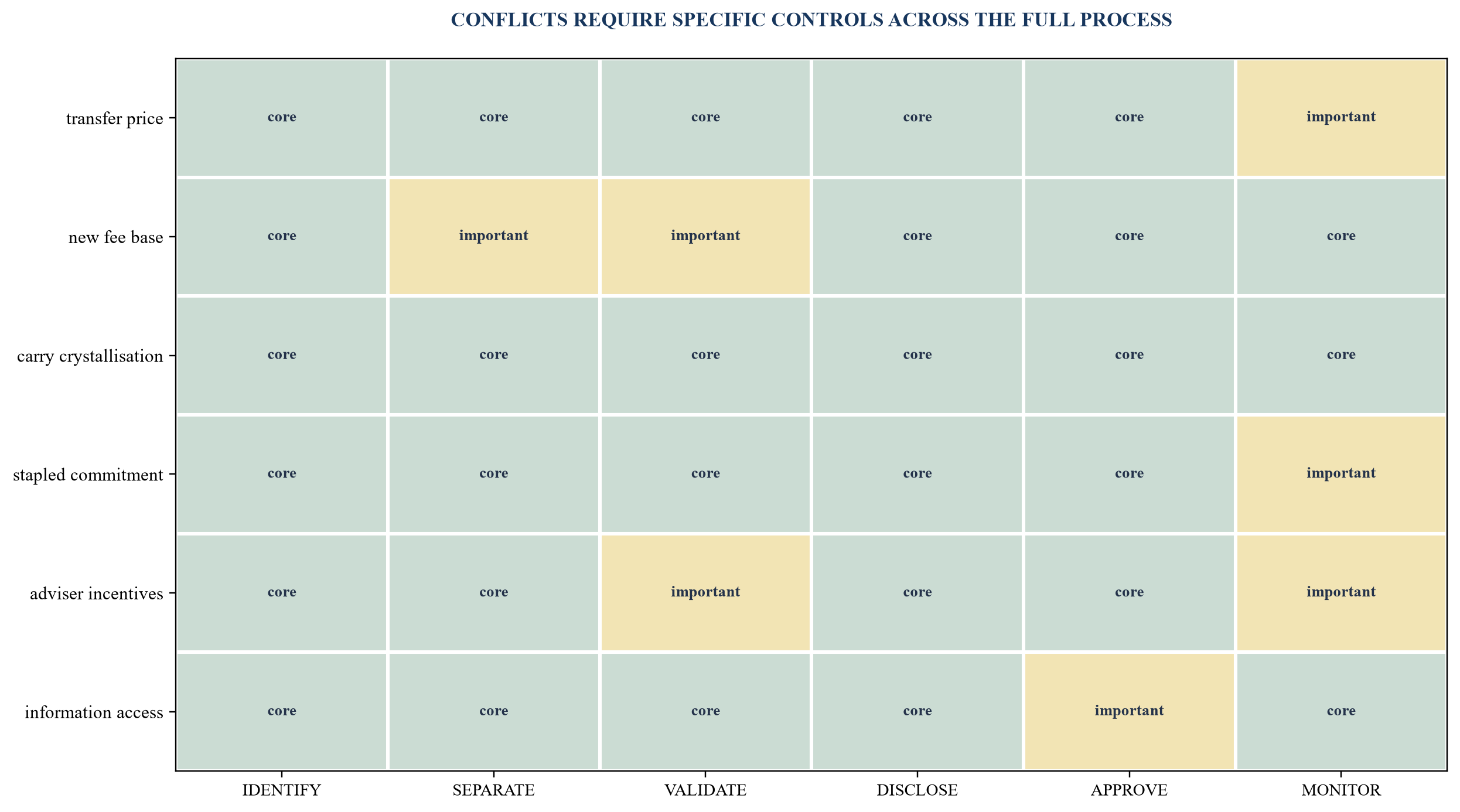
The control assignments are illustrative. The fund documents and applicable legal advice determine the required response.
4. Establish a commercial rationale that survives comparison
The rationale should explain the asset problem, investor problem and proposed solution in separate terms. An asset may need additional time to complete a transformation, execute an acquisition, absorb capital expenditure, navigate a cycle or reach a credible exit window. Existing investors may have different liquidity preferences or allocation constraints. The sponsor may believe that continued ownership offers attractive risk-adjusted value. Each proposition needs evidence and should be tested independently.
The alternatives paper should compare at least the status quo, an existing-fund extension, a third-party sale, a strategic sale, an initial public offering where relevant, a refinancing or dividend recapitalisation, a distribution in kind and the proposed continuation vehicle. The comparison should include expected proceeds, residual exposure, execution certainty, timing, required consents, financing, tax, portfolio-company disruption, regulatory risk and sponsor economics. ILPA's 2023 guidance asks the sponsor to have explored alternatives and to present the rationale to the advisory committee [1]. The current ILPA material also emphasises a strong evidenced commercial rationale [2, 4].
The process should explain why a continuation vehicle is chosen at that moment. Fund maturity by itself may describe a constraint without proving that the selected structure best serves investors. A high-quality asset may still be transferable at an unfair price. A fair price may still sit inside a process with weak choice or unfavourable reset economics. The decision memorandum should therefore evaluate rationale, price, choice and future terms as distinct gates.
The sponsor should document the counterfactual. What happens to value, liquidity and risk if the transaction does not proceed? The counterfactual should incorporate available fund extensions, covenant headroom, capital needs, expected holding period and portfolio-company operating scenarios. Every estimate should identify its source and status. Management cases should be labelled as hypothetical assumptions inside the modelling work rather than presented as observed outcomes.
Table 2. Alternatives analysis for sponsor-led liquidity
| Alternative | Liquidity outcome | Asset runway | Price evidence | Execution dependencies | Governance question |
|---|---|---|---|---|---|
| hold in existing fund | no immediate liquidity | limited by term and reserves | periodic valuation only | extension, reserves and investor support | can the existing vehicle fund the plan fairly? |
| extend existing fund | deferred liquidity | additional time within current structure | no transfer price | LPA authority and investor consent | are economics and rights preserved? |
| sell to third party | cash realisation | buyer controls future plan | external bid | buyer diligence, financing and approvals | does the process capture competitive value? |
| refinance or recapitalise | partial liquidity | operating company retains ownership plan | debt capacity and lender terms | leverage, covenants and cash flow | does debt shift excessive risk to the asset? |
| distribute in kind | asset exposure continues at LP level | no pooled follow-on vehicle | distribution valuation | transferability, custody, tax and LP capability | can investors hold and govern the asset? |
| continuation vehicle | sell, roll or split | new duration and capital | bids plus valuation and opinion | conflicts, elections, financing and new terms | are price, choice and future economics defensible? |
The scoring and decision criteria are hypothetical management assumptions. Transaction-specific evidence should determine the result.
5. Separate fair value, transaction price and process quality
Fair value, a negotiated transaction price and a fairness conclusion answer related but different questions. A valuation framework estimates value under defined assumptions and accounting or professional standards. A bid records what a specific buyer is prepared to pay under stated terms. A fairness opinion addresses the scope described in its engagement and methodology. Process quality concerns bidder access, information, competition, conflicts, time and governance. A board should receive all four views and understand their limits.
The 2025 IPEV Valuation Guidelines describe current best practice for fair-value measurement in private capital and apply for quarterly reporting periods beginning on or after 1 April 2026 [13]. They align with fair-value concepts under IFRS and U.S. GAAP while stating that applicable law and accounting standards prevail [13]. The EU AIFMD delegated regulation requires sound, transparent and documented valuation policies; appropriate methods; independent sources where possible; controls over inputs; escalation of differences; and review where related parties or financially interested parties may influence value [11]. The Cayman Islands Private Funds Act permits internal valuation where the valuation function is independent from portfolio management or conflicts are properly identified, managed, monitored and disclosed; the regulator may require independent verification [16].
The price architecture should begin with an unaffected reference value and reconcile every change to the offered consideration. The bridge can include performance since the valuation date, debt and cash, leakage, transaction costs, deferred consideration, rollover mechanics, foreign exchange, working capital, tax attributes, portfolio-company liabilities and any financing placed at closing. It should show gross asset price, equity price, cash proceeds to each selling fund and the value assigned to rollover interests.
Sensitivity analysis should focus on variables that can change investor outcomes: revenue, margin, exit multiple, holding period, leverage, refinancing cost, capital calls, dilution and new fee or carry terms. The model should not convert a range into a single scientific answer. It should expose how much of the conclusion depends on sponsor forecasts and how much is supported by external market evidence.
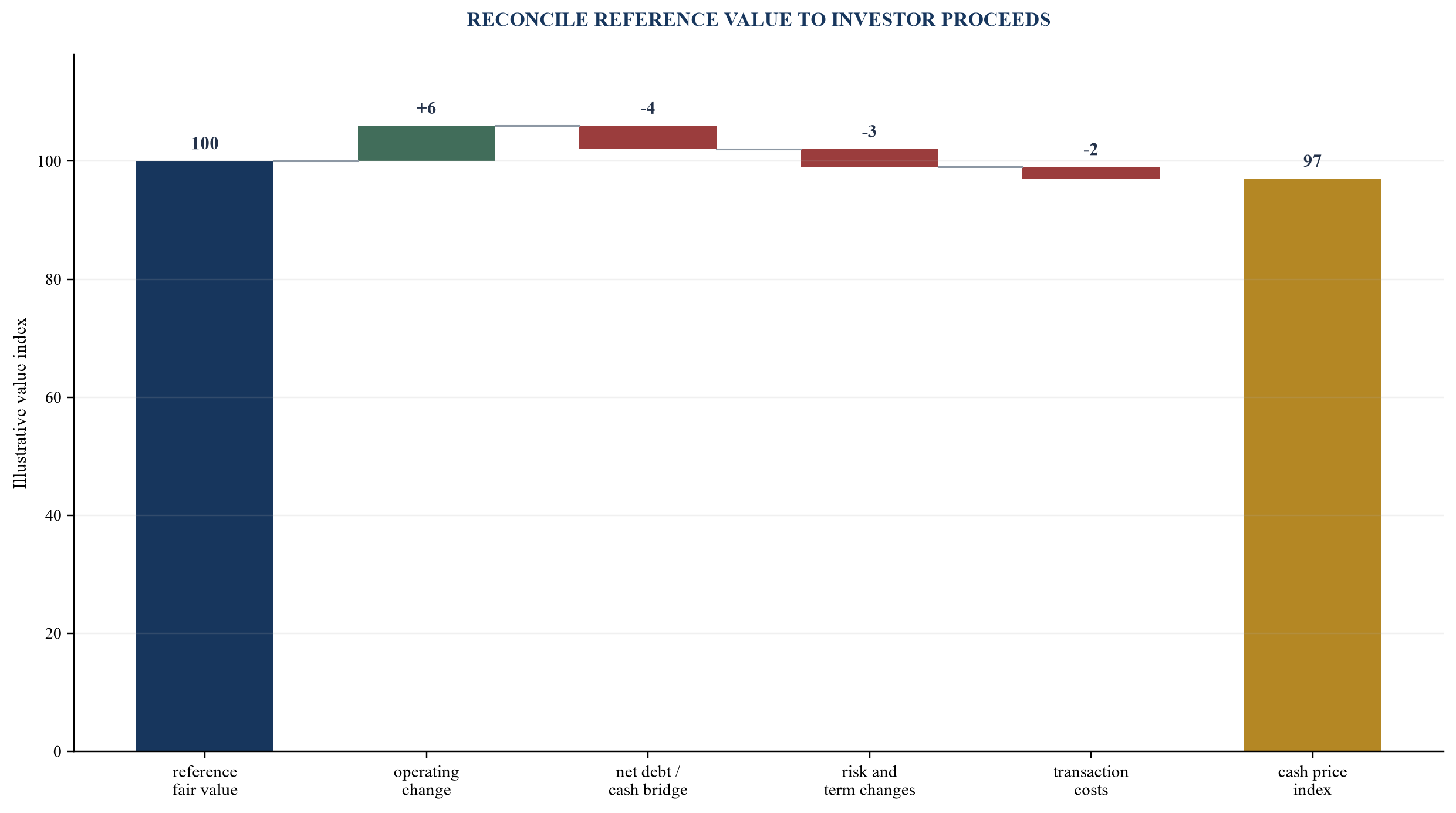
Values are hypothetical and expressed as an index for method illustration. They are not a transaction valuation or market benchmark.
6. Design price discovery before choosing the preferred bidder
A competitive process should produce evidence about both value and terms. The bidder universe should reflect asset type, size, concentration, geography, financing needs, regulatory constraints and appetite for single-asset or multi-asset exposure. The adviser should document why parties were included or excluded, what information they received, when they received it and what conditions attached to each bid. The record should distinguish indicative interest, underwritten price, binding consideration and financed deliverability.
Bid comparison should normalise terms. A higher headline price can have lower certainty, more deferred consideration, a larger staple, broader diligence conditions, weaker financing or greater execution risk. A lower price may give existing investors more flexible rollover rights or preserve value through better governance. The transaction committee should compare cash price, rollover value, conditionality, financing, required warranties, timing, regulatory risk, certainty and alignment.
Market testing can be weakened by a narrow outreach, sponsor-imposed bidder constraints, uneven information, a pre-selected lead buyer or a requirement to commit to another sponsor vehicle. These features do not automatically invalidate a process. They should be disclosed and analysed for their effect on price and competition. The SEC's vacated 2023 release described how a stapled commitment could reduce the amount buyers are willing to pay; the specific rule is vacated, while the economic conflict remains relevant to governance analysis [5].
The process letter should state milestones, access rules, bid requirements, financing evidence, conflict disclosures and rights to change or stop the process. Any material change after launch should be recorded with its effect on bidders and existing investors. The committee should retain authority to widen the process, request revised bids, seek separate price validation or decline the transaction.
7. Use independent opinions as scoped evidence
An independent valuation or fairness opinion can improve the evidence base. It cannot make the transaction fair through its existence alone. The engagement letter defines the subject, valuation date, standard, information relied upon, procedures, assumptions, limitations, addressees and use. The approving body should understand whether the provider opines on fair value, financial fairness, a range, transaction price or another specified question.
The provider's independence should be assessed in substance. The conflict review should cover current and prior work for the sponsor, funds, portfolio companies, buyer and financing parties; contingent or success-based fees; future mandates; information supplied by management; and any limitation on bidder or market access. The provider should disclose material relationships and compensation arrangements. Separate teams, fixed fees and independent committee appointment may help, depending on the facts.
The opinion should be tested against the market process. A valuation range based heavily on sponsor forecasts may provide less external evidence than competitive bids. A single bid may require stronger independent challenge. A fairness conclusion reached before the final economics or rollover terms are settled may need an update. The committee should ask what would change the conclusion and whether the provider reviewed the complete consideration bridge.
The FCA review observed the use of independent fairness opinions in continuation-fund transfers and also stated that incoming investors' ability to form their own price view depends heavily on sufficient information [9]. Governance should therefore connect opinion work, bidder diligence and investor disclosure. The opinion belongs inside the evidence architecture rather than serving as a substitute for it.
8. Build information symmetry through a controlled data room
Information asymmetry exists at several levels. The sponsor and portfolio-company management know the assets. The lead buyer may receive extensive diligence access. Existing investors may receive a shorter disclosure pack. Rolling investors continue taking asset risk, although they may have limited time and resources to re-underwrite. Selling investors need enough information to evaluate whether the cash price reflects the asset's prospects. The process should state which information each group receives and why any difference is necessary.
The data architecture should connect five layers: portfolio-company operating evidence, the sponsor's investment case, valuation and price materials, transaction terms, and investor election documents. Each number should have a source and date. Forecasts should be distinguished from actual performance. Adjusted earnings should reconcile to reported results. Debt, liquidity and capital-expenditure needs should reconcile across the model, lender materials and disclosure pack.
ILPA's 2026 disclosure template is designed to standardise the high-level information investors receive and directs them to supporting materials; ILPA states that the template does not replace definitive transaction documents or sponsor and adviser materials [3]. A sponsor can use the template as an index while providing a deeper evidence pack appropriate to transaction complexity. The package should cover rationale, alternatives, process, bids, valuation, conflicts, asset performance, new terms, financing, fees, expenses, elections and risks.
Access should be controlled for confidentiality, privilege, data protection and competitively sensitive material. Clean-team arrangements may be required where an incoming investor or affiliated business competes with a portfolio company. Redactions should be recorded. If material information becomes available after elections begin, the sponsor should assess whether the pack, deadline or election needs to be updated. Counsel should direct that decision.
Table 3. Minimum continuation-vehicle evidence pack
| Evidence module | Core content | Source owner | Independent challenge | Investor decision supported |
|---|---|---|---|---|
| rationale and alternatives | asset plan, fund constraint, options considered and counterfactual | sponsor investment team | investment committee and advisory committee | why transact now? |
| process and bids | outreach list, access, bid rounds, conditions and normalisation | transaction adviser | committee adviser or independent director | was price tested? |
| valuation and bridge | methods, inputs, sensitivities, debt, costs and proceeds | valuation lead and finance | external valuer or opinion provider | what value transfers? |
| conflicts and economics | sponsor benefits, fees, carry, expenses, staple and adviser incentives | legal, compliance and finance | independent counsel and advisory committee | who benefits and how? |
| asset underwriting | actuals, forecast, strategy, management, leverage, ESG and exit cases | portfolio company and sponsor | buyer diligence and technical specialists | what risk continues? |
| election and new terms | sell, roll and split mechanics; deadline; defaults; governance; side letters | counsel, administrator and investor relations | advisory committee and LP counsel | what does each choice mean? |
Exact disclosure depends on the transaction, fund documents, law and investor requirements.
9. Make the LP election a genuine choice
An election is meaningful when each option is clear, actionable and supported by sufficient time and information. The pack should explain cash proceeds, rollover mechanics, partial elections, allocation if the vehicle is over- or undersubscribed, tax treatment to be confirmed by advisers, side-letter treatment, default consequences, withdrawal rights, settlement and any requirement to fund additional capital. Investors should know whether rollover is on a status-quo basis, requires a new subscription, changes their liability, or exposes them to a different fee and governance regime.
ILPA's 2023 guidance recommends at least thirty calendar days or twenty business days for roll or sell decisions [1]. A calendar period should be measured from receipt of a complete and usable package, subject to the transaction documents and applicable law. A nominal deadline can provide little effective review time where documents arrive in stages, investment committees meet infrequently, legal opinions are required or cross-border investors face translation and tax work.
The sponsor should map the investor journey from disclosure to settlement. Questions need a documented response channel. Answers of general relevance should be shared consistently, subject to confidentiality and law. Any corrections should be versioned. An extension policy should identify who can approve additional time and how other investors are treated. The administrator should confirm receipt and completeness of every election.
The default route deserves particular scrutiny. Silence should not produce an economically significant outcome that investors could not reasonably understand. The documents should state the default prominently, and reminders should follow an approved protocol. Where investors choose a split, the method for dividing costs, proceeds and future exposure should be explicit. A true status-quo option may be impossible where the old vehicle is selling the asset; the pack should state this plainly and explain the closest available rollover route.
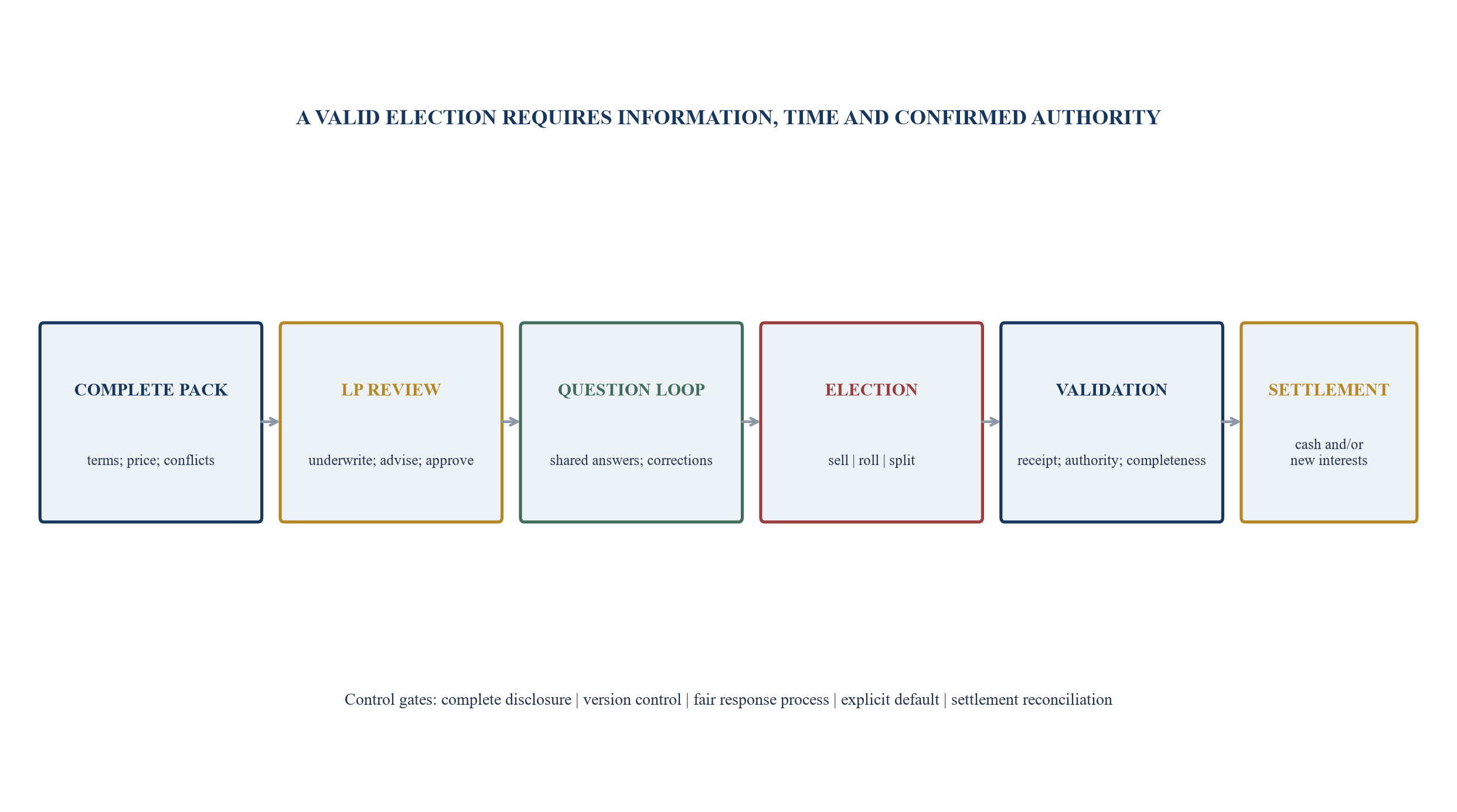
Timing and approval roles are hypothetical management assumptions. The transaction documents and applicable law govern actual elections.
Table 4. Sell, roll and split decision comparison
| Decision dimension | Sell | Roll | Split |
|---|---|---|---|
| immediate liquidity | cash proceeds subject to closing | limited or no immediate cash | partial cash proceeds |
| continued asset exposure | none after settlement | continues through new vehicle | continues on elected portion |
| sensitivity to transfer price | direct effect on realised proceeds | entry value affects future return base | affects both realised and retained value |
| future fees and carry | usually ends for transferred interest | governed by new vehicle terms | applies to rolled portion |
| concentration | reduces asset concentration | may maintain or increase concentration | can calibrate concentration |
| unfunded commitment | generally none for sold interest | may continue or reset | depends on rolled proportion and terms |
| governance and reporting | ends after settlement, subject to claims | new rights, reporting and side-letter treatment | mixed relationship |
| principal evidence need | price, certainty and tax | asset case, governance and new economics | both sets plus allocation mechanics |
The criteria are a decision framework. They do not recommend an investment choice or predict outcomes.
10. Reconcile the old and new economics line by line
Rolling investors should receive a bridge from the existing fund economics to the continuation vehicle economics. The bridge should cover management fee rate and base, fee step-downs, carried-interest rate, preferred return, catch-up, crystallisation, sponsor commitment, transaction fees, monitoring fees, broken-deal expenses, organisational expenses, financing costs, offsets, recycling, reserves and distribution waterfall. It should state which expenses are borne by selling investors, rolling investors, incoming investors, the existing fund, the new vehicle, the sponsor or portfolio companies.
ILPA's 2023 guidance states that rolling investors should be no worse off than if the transaction had not occurred. It also recommends no increase in the management-fee basis or percentage, no increase in carry or reduction in the preferred-return hurdle, no crystallisation of carry for rolling investors, and rollover of the sponsor's carry attributable to selling interests [1]. These are industry best-practice recommendations rather than a substitute for governing documents or law. The committee should record how the transaction follows, modifies or departs from them.
Economics can transfer value through timing as well as headline rates. Resetting the preferred-return clock, changing the fee base from invested cost to net asset value, extending the investment period, financing deferred consideration or allocating transaction costs can materially affect outcomes. A model should show gross asset performance, fund expenses and net investor returns separately. Scenario analysis should test holding period, operating performance, exit multiple, leverage and fee terms.
Sponsor commitment should be analysed for amount, funding source, seniority, hedging, financing and alignment. A commitment funded from transaction proceeds or financed on limited-recourse terms may carry different incentives from fresh capital at risk. The disclosure should state the source and terms. The approving body should also understand how existing carried interest is crystallised, rolled or waived.
11. Surface stapled commitments, adviser incentives and financing conflicts
A stapled commitment links participation in the continuation transaction to capital for another sponsor fund or strategy. It may strengthen the sponsor's fundraising relationship and attract buyers with a broader partnership objective. It may also narrow the bidder universe or affect the price allocated to the existing fund. The transaction record should show whether the staple was required, preferred or optional; how bids were compared; and whether price changed when the staple changed.
Adviser compensation can influence process design. A transaction adviser may receive a fee contingent on closing, a percentage of value, financing fees, placement fees or future mandates. The adviser may represent the sponsor, the selling fund, the continuation vehicle or more than one party. Each relationship and fee should be disclosed to the relevant approving bodies and assessed for its effect on advice, bidder selection, price and timetable. Independent committee counsel or a separate adviser may be appropriate where interests diverge.
Financing creates its own value pathways. Subscription facilities, NAV facilities, acquisition debt, preferred equity, deferred consideration and portfolio-company leverage can support closing while changing risk and proceeds. The model should show debt at the existing fund, new vehicle and portfolio-company levels. It should identify recourse, covenants, maturity, interest, hedging, cash sweeps, distributions and enforcement. A cash price funded by leverage is not economically complete without the resulting liability and control rights.
The conflict ledger should also include placement of co-investment, allocation of follow-on opportunities, transfer of management or monitoring agreements, insurance, foreign exchange, hedging and service-provider appointments. The objective is traceability. Each commercial benefit should be visible to the decision-maker and connected to a control.
12. Re-underwrite the assets for the new holding period
A continuation vehicle creates a new underwriting decision even where the sponsor knows the asset well. The investment case should state the value-creation plan, required capital, leadership, competitive position, customer economics, regulatory exposure, technology, operational resilience, ESG matters, leverage, exit routes and expected holding period. Historical performance should be reconciled to the original acquisition plan and current carrying value.
The most important challenge is often the gap between the sponsor's information advantage and the investor's ability to test it. Incoming investors may conduct detailed diligence and negotiate protections. Rolling investors may have limited access or capability. The sponsor should provide operating evidence sufficient to understand the key drivers and should disclose the scope of buyer diligence and material findings, subject to law and confidentiality.
The model should separate base, downside and severe but plausible cases. It should show capital required before exit and identify who funds shortfalls. Asset-level debt maturity, covenant headroom and refinancing assumptions require direct evidence. Management incentives should be reconciled before and after the transfer. A change in equity pool, hurdle or rollover can affect both value and retention.
Exit analysis should identify credible buyers, market capacity, regulatory constraints, separation requirements and preparation work. A continuation vehicle can postpone an exit while increasing concentration in the asset. The post-close plan should therefore include exit-readiness milestones rather than rely on a future market window.
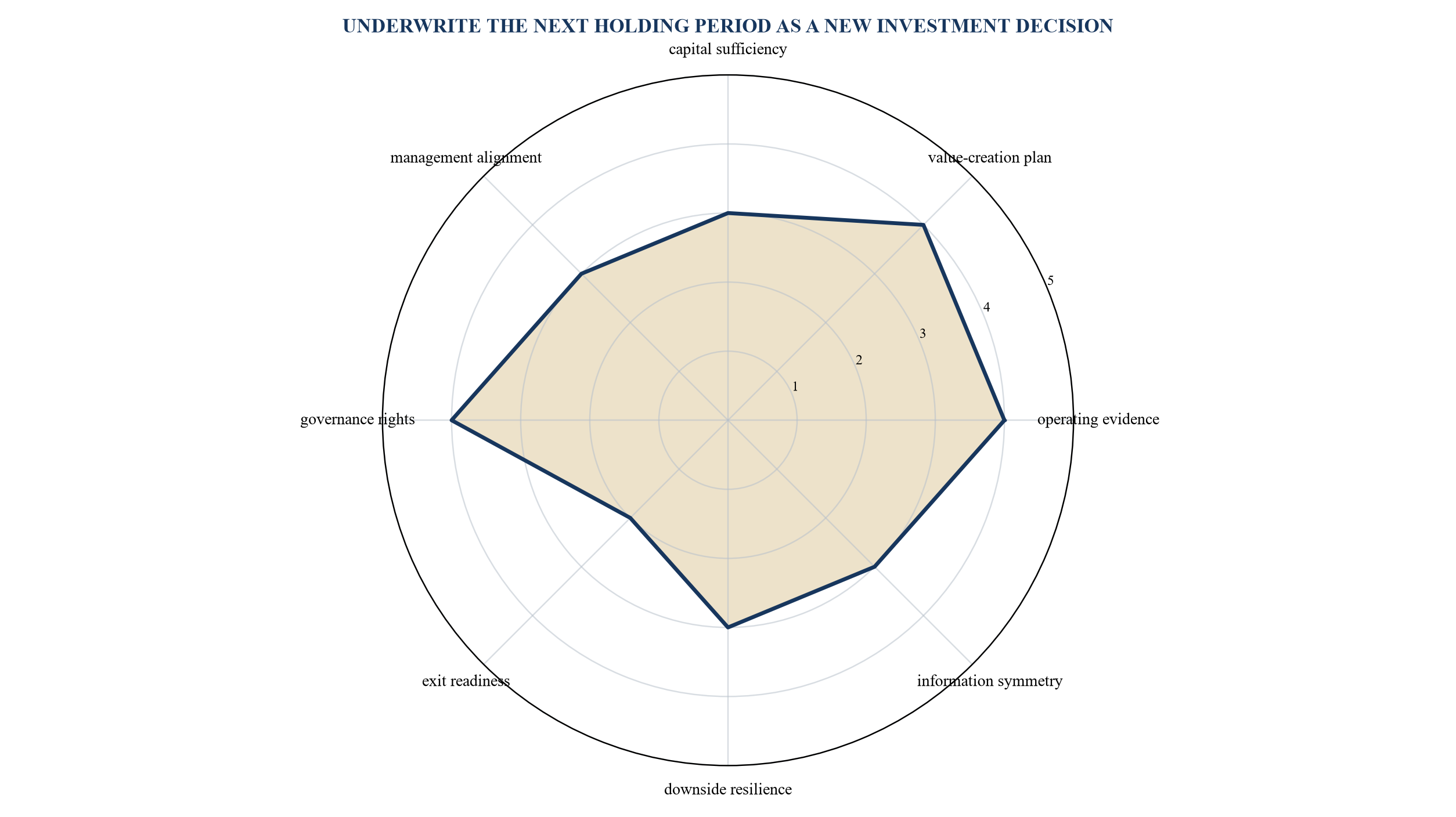
Scores are hypothetical process states. They are not investment ratings, valuations or outcome probabilities.
13. Apply jurisdictional requirements to each entity and investor path
Continuation transactions can span several regulatory and legal regimes. The existing fund may be a Delaware limited partnership, Cayman exempted limited partnership, Luxembourg vehicle, English limited partnership, DIFC fund or ADGM fund. The manager may be authorised elsewhere. Portfolio companies and investors introduce additional jurisdictions. The analysis should map each entity, governing document, regulator, fiduciary or conduct standard, valuation framework, tax residence, securities-law perimeter and transfer restriction.
In the United States, the specific adviser-led secondaries rule adopted in 2023 was vacated [5]. Registered and exempt advisers still require advice on the Advisers Act, fiduciary duty, antifraud rules, Form ADV disclosure, policies, custody, books and records, and applicable state or contractual duties [6, 7, 8, 30]. The SEC's fiduciary interpretation requires full and fair disclosure of material facts relating to the advisory relationship and conflicts, with elimination or adequate mitigation where informed consent cannot be obtained [6].
In the United Kingdom, the FCA requires firms to identify, avoid, manage and where relevant disclose conflicts. Its private-market valuation review focuses on governance, functional independence, documentation, back-testing and asset-transfer conflicts [9, 10]. EU AIFMs should assess AIFMD duties, conflict policies, fair treatment, valuation, delegation and disclosure under the applicable national implementation and EU rules [11, 12, 25].
The Cayman Private Funds Act contains valuation requirements for registered private funds [16]. DIFC and ADGM structures require transaction-specific analysis under the DFSA and FSRA rulebooks and fund documents [22, 23]. These regimes should not be reduced to a common checklist. Local counsel should confirm how the asset transfer, investor election, marketing, financing and new vehicle operate in each jurisdiction.
Table 5. Cross-border continuation-vehicle control map
| Regime | Principal governance focus | Valuation focus | Process evidence | Transaction gate |
|---|---|---|---|---|
| United States | adviser fiduciary duty, antifraud, disclosure and fund documents | fair-value policy and conflict controls | specific conflict disclosure, approvals and Form ADV consistency | counsel-confirmed adviser and fund compliance |
| United Kingdom | SYSC conflicts, client interests and valuation governance | functional independence, challenge and back-testing | committee records, opinion scope and information sufficiency | authorised-firm compliance approval |
| European Union | AIFMD conflicts, fair treatment, valuation and delegation | documented methods, independent inputs and escalation | written policy, investor disclosure and national-law review | AIFM and local counsel sign-off |
| Cayman Islands | Private Funds Act, constitutional documents and CIMA rules | independent valuation or managed and disclosed conflicts | valuation policy, verification and operator approvals | fund operator and Cayman counsel sign-off |
| DIFC | DFSA collective-investment and conduct rules | fund valuation policy and conflict management | fund-manager records and investor communications | DFSA perimeter and DIFC counsel review |
| ADGM | FSRA fund, conduct and governance requirements | policy, independence and fund-document compliance | governing-body record and regulatory analysis | FSRA perimeter and ADGM counsel review |
The table identifies review questions only. Local counsel should confirm the current law and transaction-specific obligations.
14. Coordinate legal, tax, accounting and regulatory workstreams
The transaction structure can affect tax at the fund, investor, sponsor and portfolio-company levels. The workstream should identify transfer taxes, withholding, capital gains, carried-interest consequences, permanent-establishment risk, substance, VAT or indirect tax, interest deductibility, tax attributes, investor exemptions and reporting. Investor outcomes can differ by jurisdiction and election. Qualified tax advisers should provide the transaction-specific analysis and identify which conclusions can be shared with investors.
Accounting analysis should address deconsolidation or continuing control, related-party treatment, fair-value measurement, gain recognition, carried interest, transaction costs, financing and subsequent reporting. The existing fund, new vehicle, sponsor and portfolio companies may reach different accounting conclusions. Auditors should receive the structure and valuation evidence early enough to resolve issues before closing and reporting.
Regulatory work may include change of control, foreign investment, merger control, sector approvals, sanctions, anti-money laundering, beneficial ownership, data protection and marketing rules. A single-asset vehicle holding a regulated business may require approvals that affect bidder selection, closing conditions and exit. The regulatory map should show authority, filing party, information need, timing, confidentiality and consequence.
Legal documentation should align the separate workstreams. Asset-transfer agreements, fund amendments, new partnership documents, subscription agreements, election forms, side-letter arrangements, financing, warranties, indemnities and management agreements should use consistent definitions and economics. A final funds-flow schedule should reconcile every payment, expense, carry amount, rollover interest and financing draw.
15. Convert signing conditions into a controlled closing path
Signing should occur after the approving bodies understand the rationale, process, price evidence, conflict response, investor options, new economics, financing and unresolved conditions. The signing paper should distinguish matters fixed at signing from those still subject to investor elections, allocation, financing, regulatory approval or third-party consent. Any authority delegated to finalise terms should include a boundary and reporting obligation.
Conditions to closing may include advisory-committee approval or waiver, investor elections, minimum rollover or cash participation, buyer commitments, financing, regulatory approvals, portfolio-company consents, fund amendments, tax opinions, legal opinions and absence of specified adverse events. Each condition should have an owner, evidence, deadline, waiver authority and consequence. The transaction should not be described as complete while material conditions remain.
The election result can change financing and allocation. A larger sell election increases cash needed at closing. A larger roll election changes the continuation vehicle's investor base and may alter incoming investor allocations. The funding model should therefore include ranges and committed sources. The administrator should reconcile elections to investor records, authority documents, side letters and anti-money-laundering status.
Material amendments after investors elect require careful analysis. A change in price, fees, carry, financing, allocation, assets, closing date or disclosure may affect the validity or fairness of earlier elections. Counsel should determine whether investors need updated information, additional time or a new election. The process register should preserve the previous and revised terms.
Closing should proceed through a certificate that confirms conditions, approvals, funds flow, final economics, allocation, investor records, regulatory status and authority. The certificate is a governance record and does not replace legal opinions or transaction documents. It gives the closing body a single view of readiness.
16. Operate a twelve-week transaction cadence
A continuation process requires a cadence that links commercial, governance and documentation work. The first phase establishes rationale, perimeter, decision rights, conflicts, alternatives and adviser appointments. The second phase prepares asset evidence, valuation, bidder materials and transaction structure. The third phase runs market testing, normalises bids, challenges price and finalises the investor package. The fourth phase supports elections, financing, conditions and closing.
The cadence should be adjusted to the facts. A single-asset transaction with current diligence may move faster than a multi-asset vehicle spanning regulated businesses and several funds. Timelines in a project plan are management assumptions. They should not be presented as market standards or certainty. The process should expand where investors lack complete information, material terms change, governance approvals are delayed or financing remains conditional.
Each weekly meeting should review decisions due, evidence gaps, conflicts, bidder process, valuation, disclosure, elections, financing, approvals, documentation and portfolio-company burden. The output should be an updated register with owners and dates. Executive time should be reserved for decisions and material exceptions. Workstreams should maintain daily coordination when the process is in bidding, disclosure, election or closing stages.
The board and advisory committee should receive milestone-based reports. Relevant events include approval of rationale, launch of bidder outreach, receipt of bids, selection of a preferred investor, price or opinion conclusion, approval of disclosure, election results, material amendments and closing. Reports should state the decision requested and the evidence supporting it.
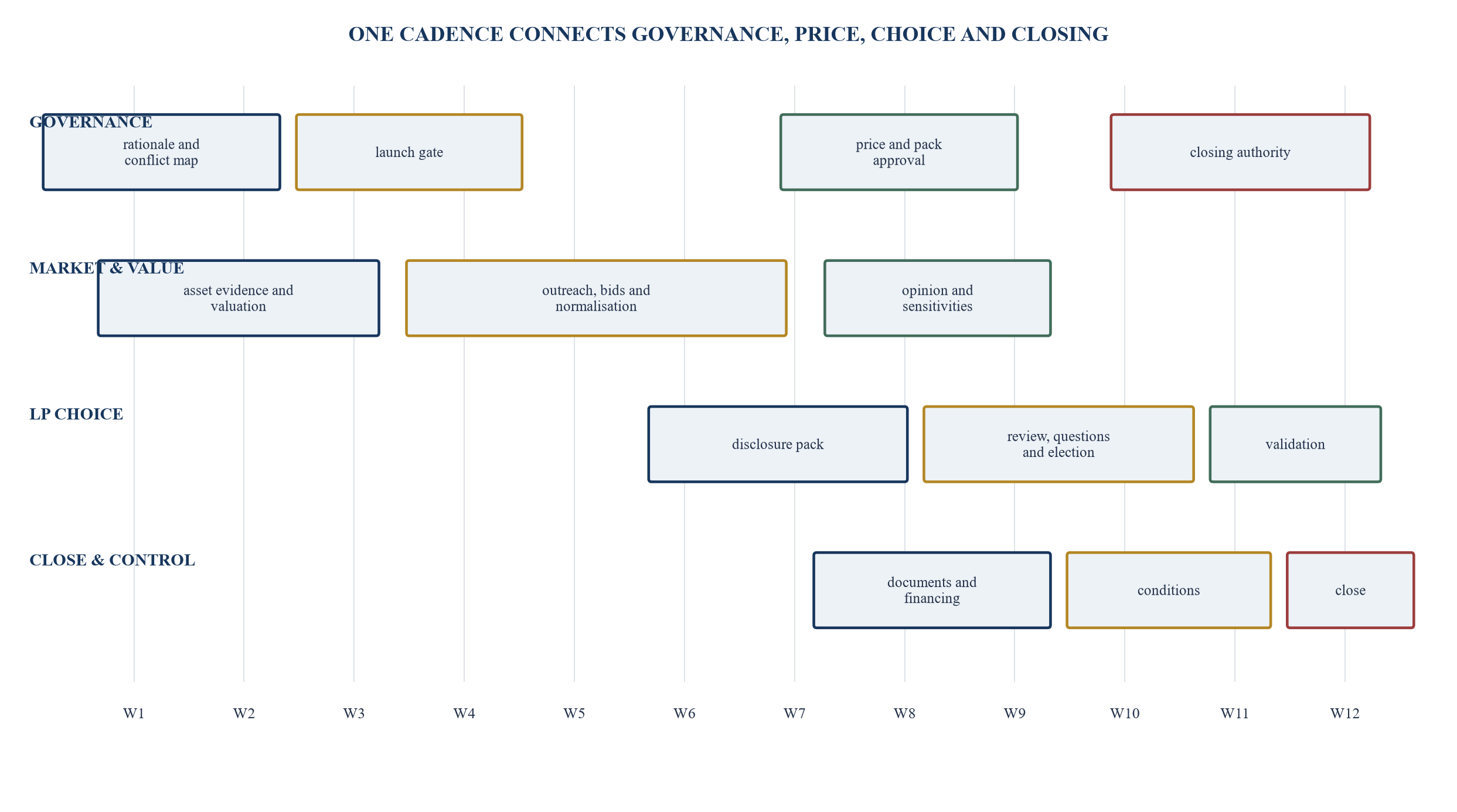
Durations and sequencing are hypothetical management assumptions. Actual timing depends on transaction complexity, investor needs, documents and applicable law.
Table 6. Decision-gated continuation-vehicle workplan
| Period | Primary objective | Required output | Principal owners | Decision gate |
|---|---|---|---|---|
| weeks 1 to 2 | define rationale, perimeter and conflicts | structure map, alternatives paper and authority register | investment, legal, compliance and finance | approve process design |
| weeks 2 to 5 | prepare evidence and valuation | asset data room, model, valuation bridge and bidder materials | portfolio team, management, adviser and valuer | approve market launch |
| weeks 4 to 8 | discover price and terms | bid log, normalised comparison, financing evidence and conflict updates | transaction adviser and steering committee | select preferred route |
| weeks 7 to 9 | complete disclosure and new terms | investor pack, opinion, fund terms and election mechanics | counsel, valuer, administrator and investor relations | release elections |
| weeks 9 to 11 | support investor decisions | question log, corrections, valid elections and allocation model | administrator, counsel and investor relations | confirm funding and allocation |
| weeks 10 to 12 | satisfy conditions and close | approvals, funds flow, closing certificate and obligation register | programme lead, finance, counsel and compliance | authorise closing |
The periods and outputs are hypothetical management assumptions requiring transaction-specific approval.
17. Carry governance into the continuation vehicle
Closing changes the governance problem. The sponsor continues managing the assets under a new capital structure, time horizon and investor group. The new vehicle should therefore have a clearly documented investment mandate, term, extension process, reserve policy, borrowing authority, follow-on capital rules, valuation policy, reporting, key-person provisions, conflicts process, advisory committee, transfer rights and exit governance.
The post-close value-creation plan should translate the underwriting case into measurable milestones. It should identify operating initiatives, capital requirements, leadership actions, acquisitions or disposals, debt milestones, regulatory approvals and exit-readiness work. Each initiative needs evidence, an accountable owner, a delivery date and a decision route. The programme should preserve the distinction between a target and an observed result.
Valuation governance should reflect the new concentration. A single-asset or concentrated vehicle may have fewer portfolio offsets and greater sensitivity to one model. The valuation committee should review methods, inputs, market evidence, changes, back-testing, financing and conflicts. Material departures from the transaction underwriting should be explained to investors under the reporting framework.
Conflict governance continues after closing. Follow-on opportunities, allocation of management time, portfolio-company fees, co-investment, financing, cross-fund transactions, add-on acquisitions and exit timing may involve the sponsor's other funds. The continuation vehicle's conflict register should be live rather than archived with the transaction file.
The governing body should set an exit-readiness review. The review can assess strategic options, buyer universe, audited evidence, management depth, separation, tax, regulation, data room and debt. The next exit should be prepared through operating evidence rather than dependence on a forecast market window.
18. Make the dashboard decision-oriented
The board dashboard should answer a small set of questions. Is the commercial rationale still supported? Is the process operating within approved conflict controls? Does the current price have sufficient external and independent evidence? Do investors have complete information and usable choices? Are financing and closing conditions covered? After closing, is the asset plan delivering and is exit readiness improving?
Each line should state the source, owner, date, status and action. Legal conclusions should be attributed to counsel. Valuation conclusions should identify the responsible body and valuation date. Investor-election statistics should come from the administrator. Bid information should reconcile to adviser records. Portfolio-company metrics should reconcile to management reporting and audited information where available.
Red and amber states should have defined escalation. A price outside an approved range, material change in forecast, loss of a bidder, financing gap, disclosure correction, election dispute, unresolved consent or conflict-control breach should trigger a documented decision. Thresholds are management choices and should be approved for the transaction.
The dashboard should also show value transmission. A change in price affects selling investors; a change in new fees affects rolling and incoming investors; a delay can change financing cost and asset risk; an election shift changes funding needs; a leverage change affects downside resilience. This view helps the committee consider the whole transaction rather than optimise one workstream.
19. Recognise failure modes before they become closing crises
The first failure mode is a rationale built around sponsor convenience. The remedy is an evidence-based alternatives paper and a recorded counterfactual. The second is price validation that relies on a narrow process or sponsor forecasts. The remedy is wider outreach where feasible, normalised bids, independent valuation work and explicit sensitivity analysis. The third is generic conflict disclosure. The remedy is a transaction-specific ledger that shows the economic pathway and control.
The fourth failure mode is compressed investor choice. The remedy is a complete pack, sufficient effective review time, a managed question process, prominent defaults and extension authority. The fifth is incomplete economics. The remedy is a line-by-line bridge between old and new terms, including expenses, financing and carry. The sixth is financing that masks risk. The remedy is a full liability map and proceeds reconciliation.
The seventh failure mode is treating an opinion as a conclusion on the entire transaction. The remedy is an engagement-scope review and separate consideration of price, process, choice and future governance. The eighth is material change after elections start. The remedy is version control and counsel-led assessment of re-disclosure and re-election.
The ninth is post-close governance drift. The remedy is an obligation register, value-creation cadence, valuation controls and conflict monitoring. The tenth is weak records. The remedy is an auditable file containing decisions, evidence, adviser advice, approvals, bids, disclosure, elections, funds flow and post-close handover.
20. Build a reusable sponsor capability
Repeat sponsors can maintain a continuation-vehicle playbook without converting prior transactions into precedent. The playbook can include a rationale template, alternatives matrix, authority map, conflict taxonomy, adviser conflict questionnaire, data-room index, bidder protocol, valuation bridge, opinion-scope checklist, disclosure index, election control, economic bridge, funds-flow reconciliation, closing certificate and post-close dashboard.
The capability should have distributed ownership. Investment teams own the asset case and alternatives. Finance owns reconciliations, economics and funds flow. Legal and compliance own the governing-document map, regulatory analysis, conflicts and disclosure. Investor relations and the administrator own communication and election operations. Valuation committees own policy and challenge. Portfolio companies own operating evidence. The approving bodies retain decision responsibility.
Training should use realistic scenarios. A process can rehearse a late price change, bidder withdrawal, forecast downgrade, financing shortfall, disclosure correction, disputed election, changed tax advice or portfolio-company consent delay. The purpose is to test authority, evidence and response time. Scenario results are internal management observations rather than market forecasts.
Annual assurance should verify that the playbook reflects current law, regulation and guidance; adviser panels and conflicts are current; templates link to source evidence; valuation policies reflect the 2025 IPEV framework where adopted; election and administrator controls are tested; and closed transactions have completed post-close reviews. ILPA's active 2026 guidance process illustrates why the playbook needs a dated source register [2, 4].
21. Approve the transaction through five independent gates
The final decision memorandum should answer five questions independently. First, does the transaction have a supported commercial rationale after credible alternatives are considered? Second, are the conflicts identified, managed, disclosed and approved through the applicable process? Third, is the price supported by competitive and independent evidence with a complete proceeds bridge? Fourth, can investors make an informed sell, roll or split decision on usable terms? Fifth, does the new vehicle have economics and governance that support the next holding period?
The memorandum should state unresolved issues and the authority delegated to close them. It should attach the structure chart, alternatives analysis, conflict ledger, bid comparison, valuation and opinion summaries, disclosure index, election report, economics bridge, financing map, regulatory matrix, closing checklist and post-close plan. Advice from legal, tax, accounting, valuation and regulatory specialists should be attributed and dated.
A continuation vehicle can create a legitimate liquidity and value-creation solution when the transaction process is designed around evidence and investor choice. The governance system should protect selling investors at the transfer, rolling investors at entry to the new vehicle, incoming investors in underwriting, portfolio companies during diligence, and all participants through post-close execution.
No framework can establish that a transaction is fair or suitable without its actual facts and governing documents. A disciplined process can make value transfer visible, create challenge before decisions are irreversible and provide an auditable basis for approval. That is the operating standard boards and investment committees should demand.
Sources and further reading
- Institutional Limited Partners Association, Continuation Funds: Considerations for Limited Partners and General Partners, May 2023 Official source
- Institutional Limited Partners Association, Continuation Vehicles guidance hub Official source
- Institutional Limited Partners Association, Continuation Fund Disclosure Template, January 2026 Official source
- Institutional Limited Partners Association, Draft New Continuation Vehicle Guidance, June 2026 Official source
- U.S. Securities and Exchange Commission, Announcement Regarding the Private Fund Advisers Rules, October 2024 Official source
- U.S. Securities and Exchange Commission, Commission Interpretation Regarding Standard of Conduct for Investment Advisers, IA-5248 Official source
- U.S. Securities and Exchange Commission, Frequently Asked Questions Regarding Disclosure of Certain Financial Conflicts Related to Investment Adviser Compensation Official source
- Electronic Code of Federal Regulations, Investment Advisers Act Rule 206(4)-8 Official source
- Financial Conduct Authority, Private Market Valuation Practices, March 2025 Official source
- Financial Conduct Authority Handbook, SYSC 10 Conflicts of Interest Official source
- EUR-Lex, Commission Delegated Regulation (EU) No 231/2013, conflicts and valuation provisions Official source
- EUR-Lex, Directive 2011/61/EU on Alternative Investment Fund Managers, consolidated text Official source
- International Private Equity and Venture Capital Valuation Board, IPEV Valuation Guidelines 2025 Official source
- IFRS Foundation, IFRS 13 Fair Value Measurement Official source
- Financial Accounting Standards Board, Accounting Standards Codification Topic 820 Fair Value Measurement Official source
- Cayman Islands Monetary Authority, Private Funds Act 2025 Revision Official source
- Cayman Islands Monetary Authority, Investment Funds Regulatory Measures Official source
- OECD, G20/OECD Principles of Corporate Governance 2023 Official source
- International Organization of Securities Commissions, Principles for the Valuation of Collective Investment Schemes Official source
- Singapore Statutes Online, Securities and Futures Act 2001 Official source
- Monetary Authority of Singapore, Guidelines on Licensing, Registration and Conduct of Business for Fund Management Companies Official source
- Dubai Financial Services Authority, Collective Investment Rules module Official source
- Abu Dhabi Global Market, FSRA Fund Rules and legal framework Official source
- Luxembourg Commission de Surveillance du Secteur Financier, Circular CSSF 18/698 Official source
- EUR-Lex, Directive (EU) 2024/927 amending AIFMD and UCITS rules Official source
- Institutional Limited Partners Association, GP-Led Secondary Fund Restructurings: Considerations for General and Limited Partners Official source
- Institutional Limited Partners Association, ILPA Principles 3.0 Official source
- Institutional Limited Partners Association, NAV-Based Facilities Guidance and Roadmap Official source
- OECD, Responsible Business Conduct for Institutional Investors Official source
- U.S. Securities and Exchange Commission, Form ADV and Instructions Official source
