

1. Define the cost-synergy value question
Translate each headline saving into a controlled bridge from gross opportunity to sustainable net cash benefit.
The synergy economics team should reconcile investment case, diligence, operating models, forecasts and approvals. Each conclusion records the accountable owner, source, assessment date, model version, evidence, cash consequence, value effect, dependency, control and unresolved exception. The immediate output is a cost-synergy economics mandate.
Cost synergy must be proved through operating evidence and realised cash after inflation, full implementation cost, stranded cost, dis-synergy, reinvestment and disruption. Reviewers test scope, quantities, rates, timing, dependencies, accounting, liquidity and benefit delivery against native records and observed performance. The investment case, target operating model, transaction documents and governing law control every conclusion.
Material gaps require an owner, corrective action, estimate update, funding response, advice and decision date. Consequences flow through customers, delivery, cash, financing, value, controls and transaction timing. Residual risk remains visible until the cost perimeter is complete, contingencies are funded, benefits are measurable and authorised governing bodies approve the next gate.
2. Set the gross-to-net synergy perimeter
Include baseline drift, volume and rate effects, inflation, foreign exchange, implementation, restructuring, stranded cost, dis-synergy, reinvestment, tax, contingency and cash timing.
The synergy economics team should reconcile purchase agreement, plans, ledgers, contracts, estimates and accounting policy. Each conclusion records the accountable owner, source, assessment date, model version, evidence, cash consequence, value effect, dependency, control and unresolved exception. The immediate output is a gross-to-net synergy taxonomy.
Cost synergy must be proved through operating evidence and realised cash after inflation, full implementation cost, stranded cost, dis-synergy, reinvestment and disruption. Reviewers test scope, quantities, rates, timing, dependencies, accounting, liquidity and benefit delivery against native records and observed performance. The investment case, target operating model, transaction documents and governing law control every conclusion.
Material gaps require an owner, corrective action, estimate update, funding response, advice and decision date. Consequences flow through customers, delivery, cash, financing, value, controls and transaction timing. Residual risk remains visible until the cost perimeter is complete, contingencies are funded, benefits are measurable and authorised governing bodies approve the next gate.
3. Establish evidence integrity
Preserve source, date, scope, version, owner and limitation for every cost and benefit.
The synergy economics team should reconcile native records, contracts, workpapers, models, interviews and approvals. Each conclusion records the accountable owner, source, assessment date, model version, evidence, cash consequence, value effect, dependency, control and unresolved exception. The immediate output is an synergy-evidence register.
Cost synergy must be proved through operating evidence and realised cash after inflation, full implementation cost, stranded cost, dis-synergy, reinvestment and disruption. Reviewers test scope, quantities, rates, timing, dependencies, accounting, liquidity and benefit delivery against native records and observed performance. The investment case, target operating model, transaction documents and governing law control every conclusion.
Material gaps require an owner, corrective action, estimate update, funding response, advice and decision date. Consequences flow through customers, delivery, cash, financing, value, controls and transaction timing. Residual risk remains visible until the cost perimeter is complete, contingencies are funded, benefits are measurable and authorised governing bodies approve the next gate.
4. Map the post-synergy operating model
Define processes, systems, people, locations, controls and service levels required after integration.
The synergy economics team should reconcile strategy, operating models, architecture, organisation and customer commitments. Each conclusion records the accountable owner, source, assessment date, model version, evidence, cash consequence, value effect, dependency, control and unresolved exception. The immediate output is a target operating blueprint.
Cost synergy must be proved through operating evidence and realised cash after inflation, full implementation cost, stranded cost, dis-synergy, reinvestment and disruption. Reviewers test scope, quantities, rates, timing, dependencies, accounting, liquidity and benefit delivery against native records and observed performance. The investment case, target operating model, transaction documents and governing law control every conclusion.
Material gaps require an owner, corrective action, estimate update, funding response, advice and decision date. Consequences flow through customers, delivery, cash, financing, value, controls and transaction timing. Residual risk remains visible until the cost perimeter is complete, contingencies are funded, benefits are measurable and authorised governing bodies approve the next gate.
5. Map the savings-delivery architecture
Sequence Day One, stabilisation, migration, consolidation and optimisation across dependencies.
The synergy economics team should reconcile workstream plans, milestones, critical paths, cutovers and governance. Each conclusion records the accountable owner, source, assessment date, model version, evidence, cash consequence, value effect, dependency, control and unresolved exception. The immediate output is an integration transition map.
Cost synergy must be proved through operating evidence and realised cash after inflation, full implementation cost, stranded cost, dis-synergy, reinvestment and disruption. Reviewers test scope, quantities, rates, timing, dependencies, accounting, liquidity and benefit delivery against native records and observed performance. The investment case, target operating model, transaction documents and governing law control every conclusion.
Material gaps require an owner, corrective action, estimate update, funding response, advice and decision date. Consequences flow through customers, delivery, cash, financing, value, controls and transaction timing. Residual risk remains visible until the cost perimeter is complete, contingencies are funded, benefits are measurable and authorised governing bodies approve the next gate.
6. Cost synergy governance
Estimate integration leadership, workstream, PMO, assurance, communications and reporting resources.
The synergy economics team should reconcile resourcing plan, rates, duration, governance and delivery model. Each conclusion records the accountable owner, source, assessment date, model version, evidence, cash consequence, value effect, dependency, control and unresolved exception. The immediate output is a programme-governance budget.
Cost synergy must be proved through operating evidence and realised cash after inflation, full implementation cost, stranded cost, dis-synergy, reinvestment and disruption. Reviewers test scope, quantities, rates, timing, dependencies, accounting, liquidity and benefit delivery against native records and observed performance. The investment case, target operating model, transaction documents and governing law control every conclusion.
Material gaps require an owner, corrective action, estimate update, funding response, advice and decision date. Consequences flow through customers, delivery, cash, financing, value, controls and transaction timing. Residual risk remains visible until the cost perimeter is complete, contingencies are funded, benefits are measurable and authorised governing bodies approve the next gate.
7. Cost systems integration
Price applications, infrastructure, licences, interfaces, testing, migration, decommissioning and support.
The synergy economics team should reconcile inventories, contracts, architecture, vendor quotes and technical plans. Each conclusion records the accountable owner, source, assessment date, model version, evidence, cash consequence, value effect, dependency, control and unresolved exception. The immediate output is a systems integration budget.
Cost synergy must be proved through operating evidence and realised cash after inflation, full implementation cost, stranded cost, dis-synergy, reinvestment and disruption. Reviewers test scope, quantities, rates, timing, dependencies, accounting, liquidity and benefit delivery against native records and observed performance. The investment case, target operating model, transaction documents and governing law control every conclusion.
Material gaps require an owner, corrective action, estimate update, funding response, advice and decision date. Consequences flow through customers, delivery, cash, financing, value, controls and transaction timing. Residual risk remains visible until the cost perimeter is complete, contingencies are funded, benefits are measurable and authorised governing bodies approve the next gate.
8. Cost data migration
Estimate extraction, cleansing, mapping, consent, retention, reconciliation, testing and archive needs.
The synergy economics team should reconcile data inventories, quality profiles, privacy records, volumes and designs. Each conclusion records the accountable owner, source, assessment date, model version, evidence, cash consequence, value effect, dependency, control and unresolved exception. The immediate output is a data migration budget.
Cost synergy must be proved through operating evidence and realised cash after inflation, full implementation cost, stranded cost, dis-synergy, reinvestment and disruption. Reviewers test scope, quantities, rates, timing, dependencies, accounting, liquidity and benefit delivery against native records and observed performance. The investment case, target operating model, transaction documents and governing law control every conclusion.
Material gaps require an owner, corrective action, estimate update, funding response, advice and decision date. Consequences flow through customers, delivery, cash, financing, value, controls and transaction timing. Residual risk remains visible until the cost perimeter is complete, contingencies are funded, benefits are measurable and authorised governing bodies approve the next gate.
Table 1. Integration cost taxonomy
| Cost layer | Primary evidence | Decision use |
|---|---|---|
| systems | architecture and quotes | migration budget |
| people | workforce and terms | transition budget |
| compliance | obligations and gaps | remediation budget |
| customers | cohorts and service data | protection budget |
Illustrative programme design; company-specific facts and authorised advice govern.
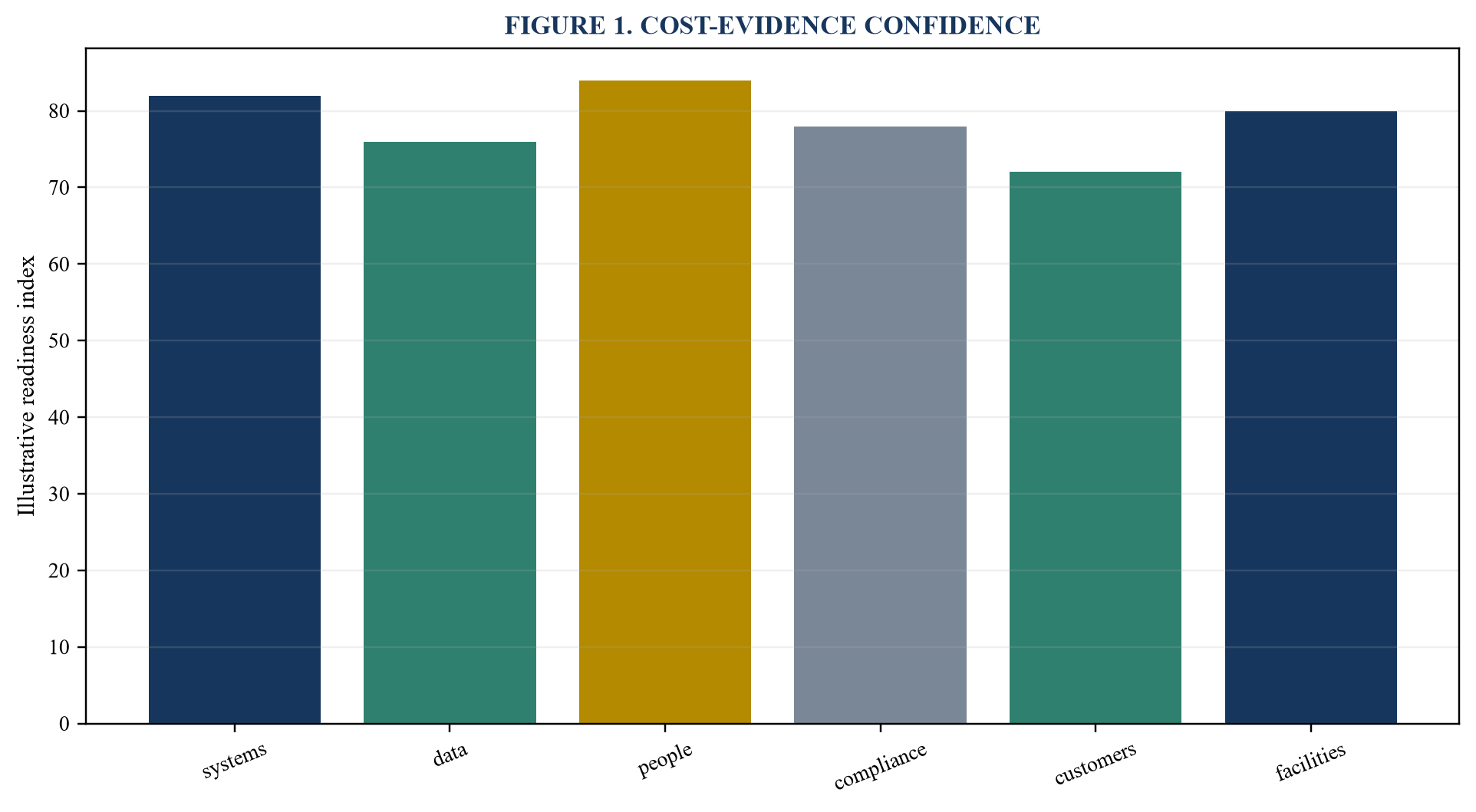
Values are illustrative readiness indices and require company-specific evidence.
9. Cost cybersecurity integration
Price identity, network, monitoring, remediation, resilience, incident readiness and secure cutover.
The synergy economics team should reconcile security assessments, architecture, tool contracts, tests and risk register. Each conclusion records the accountable owner, source, assessment date, model version, evidence, cash consequence, value effect, dependency, control and unresolved exception. The immediate output is a cyber integration budget.
Cost synergy must be proved through operating evidence and realised cash after inflation, full implementation cost, stranded cost, dis-synergy, reinvestment and disruption. Reviewers test scope, quantities, rates, timing, dependencies, accounting, liquidity and benefit delivery against native records and observed performance. The investment case, target operating model, transaction documents and governing law control every conclusion.
Material gaps require an owner, corrective action, estimate update, funding response, advice and decision date. Consequences flow through customers, delivery, cash, financing, value, controls and transaction timing. Residual risk remains visible until the cost perimeter is complete, contingencies are funded, benefits are measurable and authorised governing bodies approve the next gate.
10. Cost finance integration
Estimate close, reporting, chart of accounts, consolidation, controls, treasury, tax and audit changes.
The synergy economics team should reconcile finance processes, systems, controls, calendars and adviser estimates. Each conclusion records the accountable owner, source, assessment date, model version, evidence, cash consequence, value effect, dependency, control and unresolved exception. The immediate output is a finance integration budget.
Cost synergy must be proved through operating evidence and realised cash after inflation, full implementation cost, stranded cost, dis-synergy, reinvestment and disruption. Reviewers test scope, quantities, rates, timing, dependencies, accounting, liquidity and benefit delivery against native records and observed performance. The investment case, target operating model, transaction documents and governing law control every conclusion.
Material gaps require an owner, corrective action, estimate update, funding response, advice and decision date. Consequences flow through customers, delivery, cash, financing, value, controls and transaction timing. Residual risk remains visible until the cost perimeter is complete, contingencies are funded, benefits are measurable and authorised governing bodies approve the next gate.
11. Cost people transition
Price retention, severance, consultation, recruitment, mobility, benefits and payroll change.
The synergy economics team should reconcile workforce data, plans, contracts, law, benchmarks and advice. Each conclusion records the accountable owner, source, assessment date, model version, evidence, cash consequence, value effect, dependency, control and unresolved exception. The immediate output is a people transition budget.
Cost synergy must be proved through operating evidence and realised cash after inflation, full implementation cost, stranded cost, dis-synergy, reinvestment and disruption. Reviewers test scope, quantities, rates, timing, dependencies, accounting, liquidity and benefit delivery against native records and observed performance. The investment case, target operating model, transaction documents and governing law control every conclusion.
Material gaps require an owner, corrective action, estimate update, funding response, advice and decision date. Consequences flow through customers, delivery, cash, financing, value, controls and transaction timing. Residual risk remains visible until the cost perimeter is complete, contingencies are funded, benefits are measurable and authorised governing bodies approve the next gate.
12. Cost organisation redesign
Estimate role design, selection, spans, layers, onboarding, training and productivity ramp.
The synergy economics team should reconcile organisation data, target model, talent evidence and transition plan. Each conclusion records the accountable owner, source, assessment date, model version, evidence, cash consequence, value effect, dependency, control and unresolved exception. The immediate output is an organisation change budget.
Cost synergy must be proved through operating evidence and realised cash after inflation, full implementation cost, stranded cost, dis-synergy, reinvestment and disruption. Reviewers test scope, quantities, rates, timing, dependencies, accounting, liquidity and benefit delivery against native records and observed performance. The investment case, target operating model, transaction documents and governing law control every conclusion.
Material gaps require an owner, corrective action, estimate update, funding response, advice and decision date. Consequences flow through customers, delivery, cash, financing, value, controls and transaction timing. Residual risk remains visible until the cost perimeter is complete, contingencies are funded, benefits are measurable and authorised governing bodies approve the next gate.
13. Cost culture and communication
Fund leadership alignment, listening, communications, change networks and behaviour reinforcement.
The synergy economics team should reconcile culture evidence, stakeholder map, plan, channels and measurement. Each conclusion records the accountable owner, source, assessment date, model version, evidence, cash consequence, value effect, dependency, control and unresolved exception. The immediate output is a culture transition budget.
Cost synergy must be proved through operating evidence and realised cash after inflation, full implementation cost, stranded cost, dis-synergy, reinvestment and disruption. Reviewers test scope, quantities, rates, timing, dependencies, accounting, liquidity and benefit delivery against native records and observed performance. The investment case, target operating model, transaction documents and governing law control every conclusion.
Material gaps require an owner, corrective action, estimate update, funding response, advice and decision date. Consequences flow through customers, delivery, cash, financing, value, controls and transaction timing. Residual risk remains visible until the cost perimeter is complete, contingencies are funded, benefits are measurable and authorised governing bodies approve the next gate.
14. Cost compliance integration
Price licences, filings, policies, remediation, testing, surveillance and regulatory engagement.
The synergy economics team should reconcile obligations, licences, gaps, regulator correspondence and plans. Each conclusion records the accountable owner, source, assessment date, model version, evidence, cash consequence, value effect, dependency, control and unresolved exception. The immediate output is a compliance integration budget.
Cost synergy must be proved through operating evidence and realised cash after inflation, full implementation cost, stranded cost, dis-synergy, reinvestment and disruption. Reviewers test scope, quantities, rates, timing, dependencies, accounting, liquidity and benefit delivery against native records and observed performance. The investment case, target operating model, transaction documents and governing law control every conclusion.
Material gaps require an owner, corrective action, estimate update, funding response, advice and decision date. Consequences flow through customers, delivery, cash, financing, value, controls and transaction timing. Residual risk remains visible until the cost perimeter is complete, contingencies are funded, benefits are measurable and authorised governing bodies approve the next gate.
15. Cost customer continuity
Estimate account coverage, communications, contract changes, service protection and remediation.
The synergy economics team should reconcile CRM, contracts, service metrics, complaints, research and account plans. Each conclusion records the accountable owner, source, assessment date, model version, evidence, cash consequence, value effect, dependency, control and unresolved exception. The immediate output is a customer protection budget.
Cost synergy must be proved through operating evidence and realised cash after inflation, full implementation cost, stranded cost, dis-synergy, reinvestment and disruption. Reviewers test scope, quantities, rates, timing, dependencies, accounting, liquidity and benefit delivery against native records and observed performance. The investment case, target operating model, transaction documents and governing law control every conclusion.
Material gaps require an owner, corrective action, estimate update, funding response, advice and decision date. Consequences flow through customers, delivery, cash, financing, value, controls and transaction timing. Residual risk remains visible until the cost perimeter is complete, contingencies are funded, benefits are measurable and authorised governing bodies approve the next gate.
16. Cost supplier transition
Price consent, novation, repricing, dual running, exit, onboarding and continuity protection.
The synergy economics team should reconcile supplier contracts, dependencies, spend, risks and procurement plan. Each conclusion records the accountable owner, source, assessment date, model version, evidence, cash consequence, value effect, dependency, control and unresolved exception. The immediate output is a supplier transition budget.
Cost synergy must be proved through operating evidence and realised cash after inflation, full implementation cost, stranded cost, dis-synergy, reinvestment and disruption. Reviewers test scope, quantities, rates, timing, dependencies, accounting, liquidity and benefit delivery against native records and observed performance. The investment case, target operating model, transaction documents and governing law control every conclusion.
Material gaps require an owner, corrective action, estimate update, funding response, advice and decision date. Consequences flow through customers, delivery, cash, financing, value, controls and transaction timing. Residual risk remains visible until the cost perimeter is complete, contingencies are funded, benefits are measurable and authorised governing bodies approve the next gate.
Table 2. Hidden-cost register
| Hidden item | Failure signal | Economic effect |
|---|---|---|
| stranded cost | cost does not exit | lower synergy |
| dual running | cutover delay | cash overrun |
| dis-synergy | lost scale or revenue | value leakage |
| remediation | service or control failure | unplanned spend |
Illustrative programme design; company-specific facts and authorised advice govern.
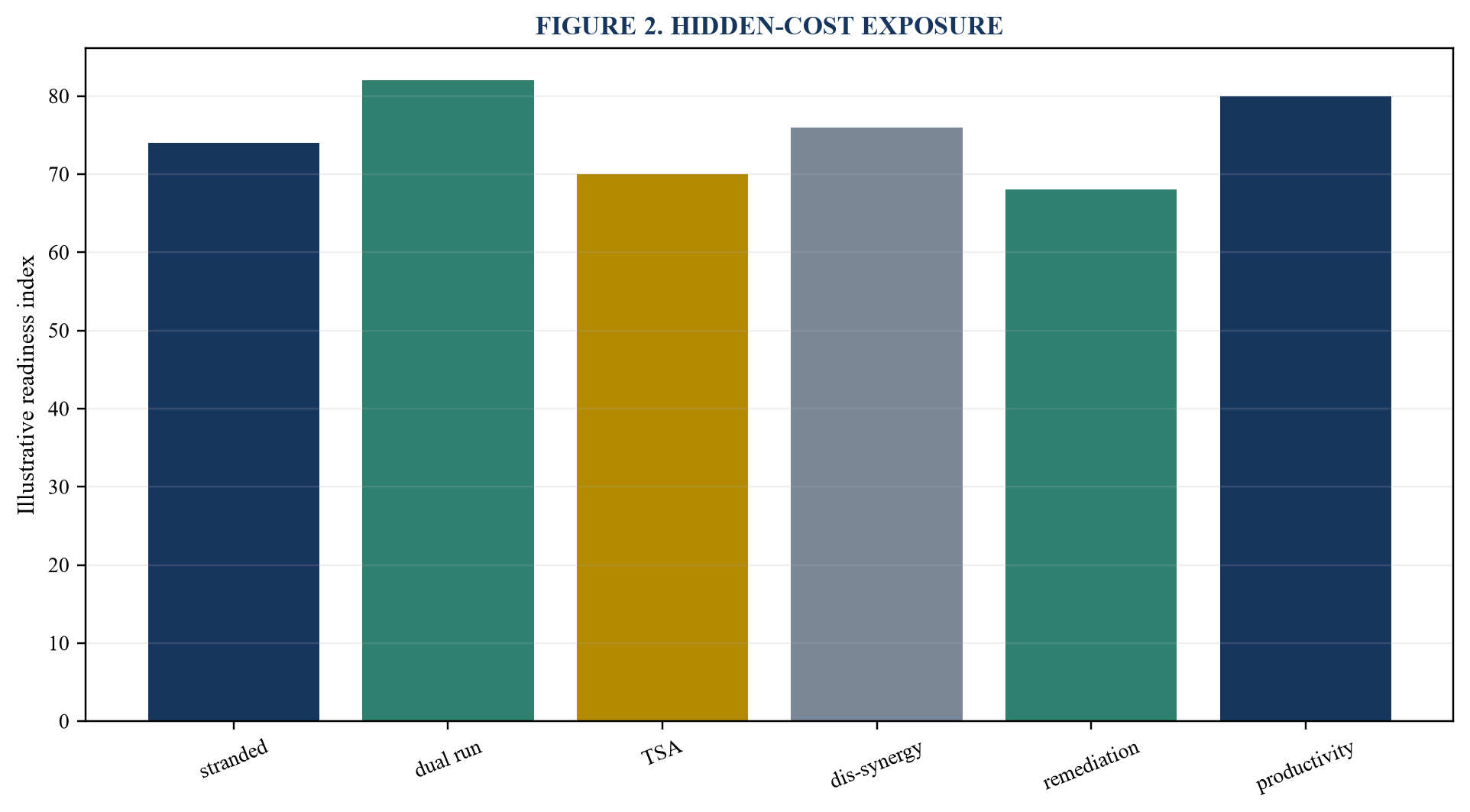
Values are illustrative readiness indices and require company-specific evidence.
17. Cost facilities and operations
Estimate consolidation, fit-out, relocation, closure, impairment, logistics and productivity effects.
The synergy economics team should reconcile leases, assets, capacity, location plans, quotes and operating data. Each conclusion records the accountable owner, source, assessment date, model version, evidence, cash consequence, value effect, dependency, control and unresolved exception. The immediate output is a facilities integration budget.
Cost synergy must be proved through operating evidence and realised cash after inflation, full implementation cost, stranded cost, dis-synergy, reinvestment and disruption. Reviewers test scope, quantities, rates, timing, dependencies, accounting, liquidity and benefit delivery against native records and observed performance. The investment case, target operating model, transaction documents and governing law control every conclusion.
Material gaps require an owner, corrective action, estimate update, funding response, advice and decision date. Consequences flow through customers, delivery, cash, financing, value, controls and transaction timing. Residual risk remains visible until the cost perimeter is complete, contingencies are funded, benefits are measurable and authorised governing bodies approve the next gate.
18. Cost product and brand migration
Price portfolio decisions, packaging, approvals, rebranding, channels and customer adoption.
The synergy economics team should reconcile product economics, IP, inventory, regulation, research and launch plans. Each conclusion records the accountable owner, source, assessment date, model version, evidence, cash consequence, value effect, dependency, control and unresolved exception. The immediate output is a product transition budget.
Cost synergy must be proved through operating evidence and realised cash after inflation, full implementation cost, stranded cost, dis-synergy, reinvestment and disruption. Reviewers test scope, quantities, rates, timing, dependencies, accounting, liquidity and benefit delivery against native records and observed performance. The investment case, target operating model, transaction documents and governing law control every conclusion.
Material gaps require an owner, corrective action, estimate update, funding response, advice and decision date. Consequences flow through customers, delivery, cash, financing, value, controls and transaction timing. Residual risk remains visible until the cost perimeter is complete, contingencies are funded, benefits are measurable and authorised governing bodies approve the next gate.
19. Cost transaction-service arrangements
Model service scope, pricing, volumes, duration, exits, extensions and stranded dependencies.
The synergy economics team should reconcile TSA schedules, service baselines, contracts and separation plans. Each conclusion records the accountable owner, source, assessment date, model version, evidence, cash consequence, value effect, dependency, control and unresolved exception. The immediate output is a TSA cost-and-exit model.
Cost synergy must be proved through operating evidence and realised cash after inflation, full implementation cost, stranded cost, dis-synergy, reinvestment and disruption. Reviewers test scope, quantities, rates, timing, dependencies, accounting, liquidity and benefit delivery against native records and observed performance. The investment case, target operating model, transaction documents and governing law control every conclusion.
Material gaps require an owner, corrective action, estimate update, funding response, advice and decision date. Consequences flow through customers, delivery, cash, financing, value, controls and transaction timing. Residual risk remains visible until the cost perimeter is complete, contingencies are funded, benefits are measurable and authorised governing bodies approve the next gate.
20. Keep stranded costs in the bridge
Locate residual people, systems, leases, vendors and shared services after planned synergies.
The synergy economics team should reconcile cost centres, allocations, contracts, capacity and separation evidence. Each conclusion records the accountable owner, source, assessment date, model version, evidence, cash consequence, value effect, dependency, control and unresolved exception. The immediate output is a stranded-cost register.
Cost synergy must be proved through operating evidence and realised cash after inflation, full implementation cost, stranded cost, dis-synergy, reinvestment and disruption. Reviewers test scope, quantities, rates, timing, dependencies, accounting, liquidity and benefit delivery against native records and observed performance. The investment case, target operating model, transaction documents and governing law control every conclusion.
Material gaps require an owner, corrective action, estimate update, funding response, advice and decision date. Consequences flow through customers, delivery, cash, financing, value, controls and transaction timing. Residual risk remains visible until the cost perimeter is complete, contingencies are funded, benefits are measurable and authorised governing bodies approve the next gate.
21. Quantify dis-synergies
Estimate lost buying power, revenue conflict, tax leakage, duplicated controls and transition inefficiency.
The synergy economics team should reconcile commercial data, contracts, tax, operations and scenarios. Each conclusion records the accountable owner, source, assessment date, model version, evidence, cash consequence, value effect, dependency, control and unresolved exception. The immediate output is a dis-synergy schedule.
Cost synergy must be proved through operating evidence and realised cash after inflation, full implementation cost, stranded cost, dis-synergy, reinvestment and disruption. Reviewers test scope, quantities, rates, timing, dependencies, accounting, liquidity and benefit delivery against native records and observed performance. The investment case, target operating model, transaction documents and governing law control every conclusion.
Material gaps require an owner, corrective action, estimate update, funding response, advice and decision date. Consequences flow through customers, delivery, cash, financing, value, controls and transaction timing. Residual risk remains visible until the cost perimeter is complete, contingencies are funded, benefits are measurable and authorised governing bodies approve the next gate.
22. Allocate benefit and cost ownership
Distinguish seller, buyer, target, shared, reimbursable and disputed obligations.
The synergy economics team should reconcile purchase agreement, TSA, employment terms, contracts and legal advice. Each conclusion records the accountable owner, source, assessment date, model version, evidence, cash consequence, value effect, dependency, control and unresolved exception. The immediate output is an integration cost responsibility matrix.
Cost synergy must be proved through operating evidence and realised cash after inflation, full implementation cost, stranded cost, dis-synergy, reinvestment and disruption. Reviewers test scope, quantities, rates, timing, dependencies, accounting, liquidity and benefit delivery against native records and observed performance. The investment case, target operating model, transaction documents and governing law control every conclusion.
Material gaps require an owner, corrective action, estimate update, funding response, advice and decision date. Consequences flow through customers, delivery, cash, financing, value, controls and transaction timing. Residual risk remains visible until the cost perimeter is complete, contingencies are funded, benefits are measurable and authorised governing bodies approve the next gate.
23. Separate run-rate, accounting and cash timing
Map commitment, cash payment, accounting recognition, tax effect and benefit start by period.
The synergy economics team should reconcile contracts, project plan, accounting policy, tax advice and cash forecast. Each conclusion records the accountable owner, source, assessment date, model version, evidence, cash consequence, value effect, dependency, control and unresolved exception. The immediate output is an integration cash curve.
Cost synergy must be proved through operating evidence and realised cash after inflation, full implementation cost, stranded cost, dis-synergy, reinvestment and disruption. Reviewers test scope, quantities, rates, timing, dependencies, accounting, liquidity and benefit delivery against native records and observed performance. The investment case, target operating model, transaction documents and governing law control every conclusion.
Material gaps require an owner, corrective action, estimate update, funding response, advice and decision date. Consequences flow through customers, delivery, cash, financing, value, controls and transaction timing. Residual risk remains visible until the cost perimeter is complete, contingencies are funded, benefits are measurable and authorised governing bodies approve the next gate.
24. Build the quantity-rate gross saving
Use quantities, rates, duration, dependencies and named assumptions for every work package.
The synergy economics team should reconcile work breakdown, vendor quotes, benchmarks, capacity and owner estimates. Each conclusion records the accountable owner, source, assessment date, model version, evidence, cash consequence, value effect, dependency, control and unresolved exception. The immediate output is a bottom-up integration estimate.
Cost synergy must be proved through operating evidence and realised cash after inflation, full implementation cost, stranded cost, dis-synergy, reinvestment and disruption. Reviewers test scope, quantities, rates, timing, dependencies, accounting, liquidity and benefit delivery against native records and observed performance. The investment case, target operating model, transaction documents and governing law control every conclusion.
Material gaps require an owner, corrective action, estimate update, funding response, advice and decision date. Consequences flow through customers, delivery, cash, financing, value, controls and transaction timing. Residual risk remains visible until the cost perimeter is complete, contingencies are funded, benefits are measurable and authorised governing bodies approve the next gate.
Table 3. Estimate-control architecture
| Control | Required evidence | Output |
|---|---|---|
| scope | work breakdown | complete perimeter |
| quantity | volume and duration | cost driver |
| rate | quote or benchmark | unit cost |
| contingency | risk and maturity | approved reserve |
Illustrative programme design; company-specific facts and authorised advice govern.
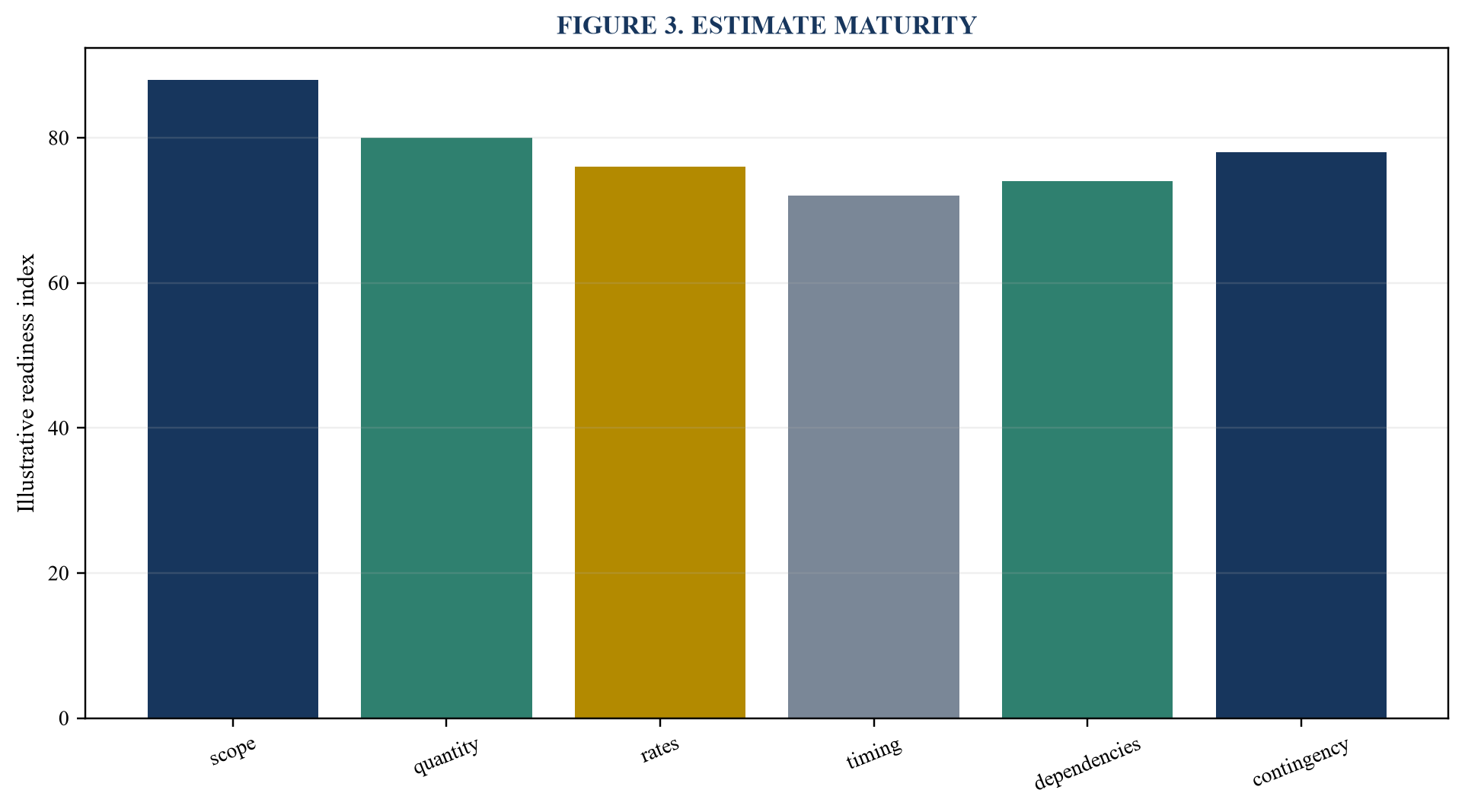
Values are illustrative readiness indices and require company-specific evidence.
25. Set contingency and confidence gates
Apply evidence-based uncertainty, correlation, maturity and decision-gate allowances without hiding scope.
The synergy economics team should reconcile risk register, estimate class, scenario data and governance. Each conclusion records the accountable owner, source, assessment date, model version, evidence, cash consequence, value effect, dependency, control and unresolved exception. The immediate output is an integration contingency model.
Cost synergy must be proved through operating evidence and realised cash after inflation, full implementation cost, stranded cost, dis-synergy, reinvestment and disruption. Reviewers test scope, quantities, rates, timing, dependencies, accounting, liquidity and benefit delivery against native records and observed performance. The investment case, target operating model, transaction documents and governing law control every conclusion.
Material gaps require an owner, corrective action, estimate update, funding response, advice and decision date. Consequences flow through customers, delivery, cash, financing, value, controls and transaction timing. Residual risk remains visible until the cost perimeter is complete, contingencies are funded, benefits are measurable and authorised governing bodies approve the next gate.
26. Test accounting treatment
Separate acquisition consideration, transaction expense, restructuring, capitalisable spend and impairment.
The synergy economics team should reconcile IFRS or GAAP policy, contracts, plans, advice and audit evidence. Each conclusion records the accountable owner, source, assessment date, model version, evidence, cash consequence, value effect, dependency, control and unresolved exception. The immediate output is an integration accounting bridge.
Cost synergy must be proved through operating evidence and realised cash after inflation, full implementation cost, stranded cost, dis-synergy, reinvestment and disruption. Reviewers test scope, quantities, rates, timing, dependencies, accounting, liquidity and benefit delivery against native records and observed performance. The investment case, target operating model, transaction documents and governing law control every conclusion.
Material gaps require an owner, corrective action, estimate update, funding response, advice and decision date. Consequences flow through customers, delivery, cash, financing, value, controls and transaction timing. Residual risk remains visible until the cost perimeter is complete, contingencies are funded, benefits are measurable and authorised governing bodies approve the next gate.
27. Test tax treatment
Assess deductibility, VAT or sales tax, payroll, withholding, transfer pricing and deferred tax.
The synergy economics team should reconcile cost taxonomy, jurisdictions, invoices, structures and tax advice. Each conclusion records the accountable owner, source, assessment date, model version, evidence, cash consequence, value effect, dependency, control and unresolved exception. The immediate output is an integration tax bridge.
Cost synergy must be proved through operating evidence and realised cash after inflation, full implementation cost, stranded cost, dis-synergy, reinvestment and disruption. Reviewers test scope, quantities, rates, timing, dependencies, accounting, liquidity and benefit delivery against native records and observed performance. The investment case, target operating model, transaction documents and governing law control every conclusion.
Material gaps require an owner, corrective action, estimate update, funding response, advice and decision date. Consequences flow through customers, delivery, cash, financing, value, controls and transaction timing. Residual risk remains visible until the cost perimeter is complete, contingencies are funded, benefits are measurable and authorised governing bodies approve the next gate.
28. Test cumulative cash and liquidity
Connect payment timing, working capital, minimum cash, facilities and covenant definitions.
The synergy economics team should reconcile cash curve, financing model, facilities, covenants and treasury policy. Each conclusion records the accountable owner, source, assessment date, model version, evidence, cash consequence, value effect, dependency, control and unresolved exception. The immediate output is an integration liquidity bridge.
Cost synergy must be proved through operating evidence and realised cash after inflation, full implementation cost, stranded cost, dis-synergy, reinvestment and disruption. Reviewers test scope, quantities, rates, timing, dependencies, accounting, liquidity and benefit delivery against native records and observed performance. The investment case, target operating model, transaction documents and governing law control every conclusion.
Material gaps require an owner, corrective action, estimate update, funding response, advice and decision date. Consequences flow through customers, delivery, cash, financing, value, controls and transaction timing. Residual risk remains visible until the cost perimeter is complete, contingencies are funded, benefits are measurable and authorised governing bodies approve the next gate.
29. Validate the gross saving
Require baseline, action, owner, timing, cost, dependency and measurement for every benefit.
The synergy economics team should reconcile value thesis, ledgers, operating data, plans and benchmarks. Each conclusion records the accountable owner, source, assessment date, model version, evidence, cash consequence, value effect, dependency, control and unresolved exception. The immediate output is a synergy evidence schedule.
Cost synergy must be proved through operating evidence and realised cash after inflation, full implementation cost, stranded cost, dis-synergy, reinvestment and disruption. Reviewers test scope, quantities, rates, timing, dependencies, accounting, liquidity and benefit delivery against native records and observed performance. The investment case, target operating model, transaction documents and governing law control every conclusion.
Material gaps require an owner, corrective action, estimate update, funding response, advice and decision date. Consequences flow through customers, delivery, cash, financing, value, controls and transaction timing. Residual risk remains visible until the cost perimeter is complete, contingencies are funded, benefits are measurable and authorised governing bodies approve the next gate.
30. Calculate sustainable net synergy value
Bridge gross synergy to implementation cost, stranded cost, dis-synergy, disruption, tax and timing.
The synergy economics team should reconcile cost model, benefit schedule, valuation and discount rate. Each conclusion records the accountable owner, source, assessment date, model version, evidence, cash consequence, value effect, dependency, control and unresolved exception. The immediate output is a sustainable net synergy value bridge.
Cost synergy must be proved through operating evidence and realised cash after inflation, full implementation cost, stranded cost, dis-synergy, reinvestment and disruption. Reviewers test scope, quantities, rates, timing, dependencies, accounting, liquidity and benefit delivery against native records and observed performance. The investment case, target operating model, transaction documents and governing law control every conclusion.
Material gaps require an owner, corrective action, estimate update, funding response, advice and decision date. Consequences flow through customers, delivery, cash, financing, value, controls and transaction timing. Residual risk remains visible until the cost perimeter is complete, contingencies are funded, benefits are measurable and authorised governing bodies approve the next gate.
31. Stress inflation, delay and reinvestment
Vary scope, delay, inflation, adoption, customer loss, productivity and financing conditions.
The synergy economics team should reconcile risk register, history, market evidence and integrated model. Each conclusion records the accountable owner, source, assessment date, model version, evidence, cash consequence, value effect, dependency, control and unresolved exception. The immediate output is an integration scenario library.
Cost synergy must be proved through operating evidence and realised cash after inflation, full implementation cost, stranded cost, dis-synergy, reinvestment and disruption. Reviewers test scope, quantities, rates, timing, dependencies, accounting, liquidity and benefit delivery against native records and observed performance. The investment case, target operating model, transaction documents and governing law control every conclusion.
Material gaps require an owner, corrective action, estimate update, funding response, advice and decision date. Consequences flow through customers, delivery, cash, financing, value, controls and transaction timing. Residual risk remains visible until the cost perimeter is complete, contingencies are funded, benefits are measurable and authorised governing bodies approve the next gate.
32. Quantify customer disruption
Model churn, price leakage, service failures, delayed sales and remediation by cohort.
The synergy economics team should reconcile CRM, service data, contracts, complaints, pipeline and scenarios. Each conclusion records the accountable owner, source, assessment date, model version, evidence, cash consequence, value effect, dependency, control and unresolved exception. The immediate output is a customer revenue-at-risk model.
Cost synergy must be proved through operating evidence and realised cash after inflation, full implementation cost, stranded cost, dis-synergy, reinvestment and disruption. Reviewers test scope, quantities, rates, timing, dependencies, accounting, liquidity and benefit delivery against native records and observed performance. The investment case, target operating model, transaction documents and governing law control every conclusion.
Material gaps require an owner, corrective action, estimate update, funding response, advice and decision date. Consequences flow through customers, delivery, cash, financing, value, controls and transaction timing. Residual risk remains visible until the cost perimeter is complete, contingencies are funded, benefits are measurable and authorised governing bodies approve the next gate.
Table 4. Net-value bridge
| Layer | Treatment | Control |
|---|---|---|
| gross synergy | benefit cash flow | baseline and owner |
| implementation | cash cost | work package |
| disruption | lost contribution | cohort model |
| timing | discount and delay | milestone gate |
Illustrative programme design; company-specific facts and authorised advice govern.
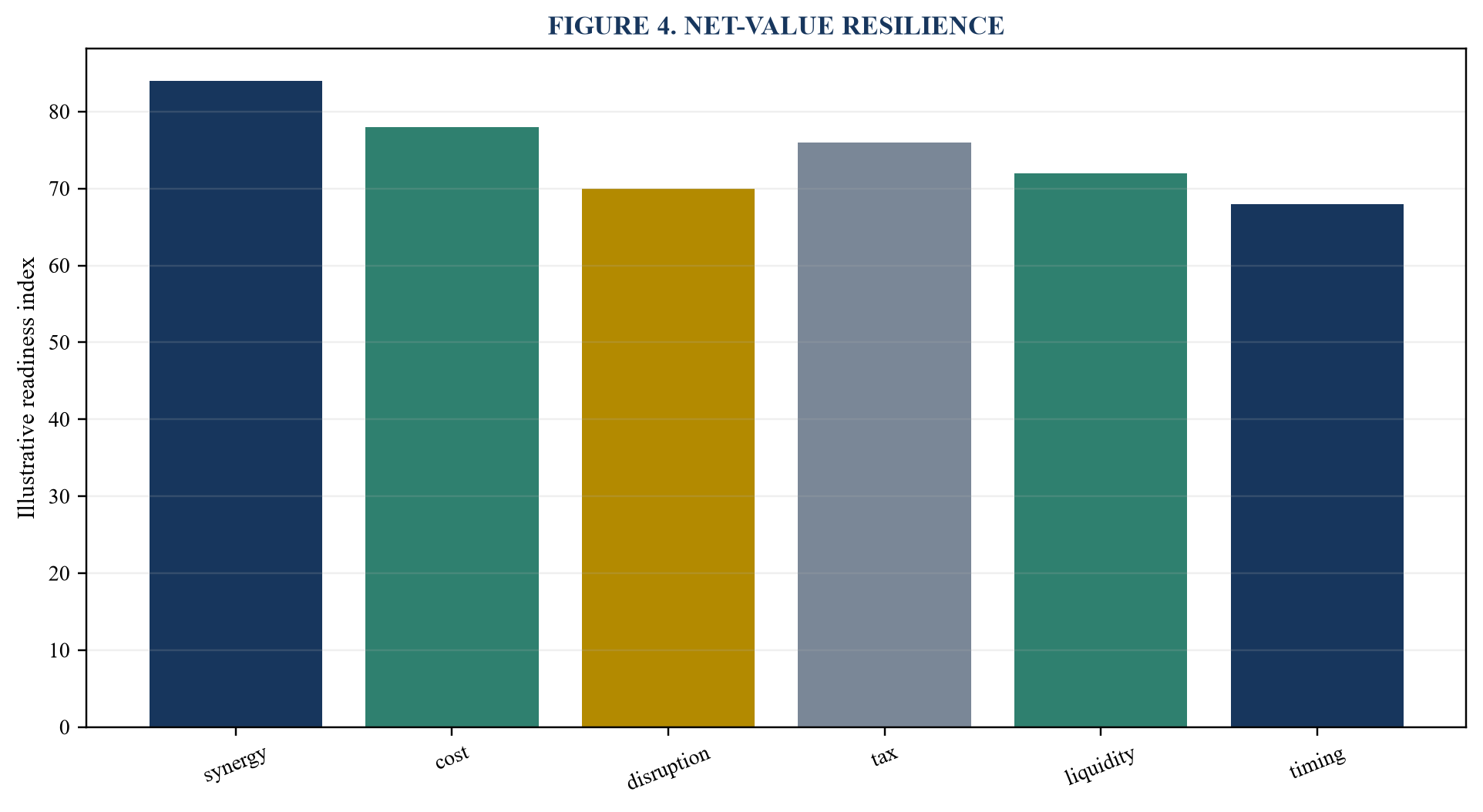
Values are illustrative readiness indices and require company-specific evidence.
33. Quantify productivity disruption
Estimate management distraction, vacancy, training, dual running, cutover and learning curves.
The synergy economics team should reconcile capacity, time records, transition plan, workforce data and benchmarks. Each conclusion records the accountable owner, source, assessment date, model version, evidence, cash consequence, value effect, dependency, control and unresolved exception. The immediate output is a productivity loss model.
Cost synergy must be proved through operating evidence and realised cash after inflation, full implementation cost, stranded cost, dis-synergy, reinvestment and disruption. Reviewers test scope, quantities, rates, timing, dependencies, accounting, liquidity and benefit delivery against native records and observed performance. The investment case, target operating model, transaction documents and governing law control every conclusion.
Material gaps require an owner, corrective action, estimate update, funding response, advice and decision date. Consequences flow through customers, delivery, cash, financing, value, controls and transaction timing. Residual risk remains visible until the cost perimeter is complete, contingencies are funded, benefits are measurable and authorised governing bodies approve the next gate.
34. Quantify working-capital effects
Model billing, collections, inventory, supplier terms, cutover errors and cash controls.
The synergy economics team should reconcile ageing, inventory, terms, systems, forecasts and scenarios. Each conclusion records the accountable owner, source, assessment date, model version, evidence, cash consequence, value effect, dependency, control and unresolved exception. The immediate output is an integration working-capital bridge.
Cost synergy must be proved through operating evidence and realised cash after inflation, full implementation cost, stranded cost, dis-synergy, reinvestment and disruption. Reviewers test scope, quantities, rates, timing, dependencies, accounting, liquidity and benefit delivery against native records and observed performance. The investment case, target operating model, transaction documents and governing law control every conclusion.
Material gaps require an owner, corrective action, estimate update, funding response, advice and decision date. Consequences flow through customers, delivery, cash, financing, value, controls and transaction timing. Residual risk remains visible until the cost perimeter is complete, contingencies are funded, benefits are measurable and authorised governing bodies approve the next gate.
35. Translate leakage into the financing case
Test liquidity, leverage, coverage, covenant headroom and refinancing after integration cash.
The synergy economics team should reconcile financing model, cost curve, downside cases and debt documents. Each conclusion records the accountable owner, source, assessment date, model version, evidence, cash consequence, value effect, dependency, control and unresolved exception. The immediate output is an integration debt-capacity stress.
Cost synergy must be proved through operating evidence and realised cash after inflation, full implementation cost, stranded cost, dis-synergy, reinvestment and disruption. Reviewers test scope, quantities, rates, timing, dependencies, accounting, liquidity and benefit delivery against native records and observed performance. The investment case, target operating model, transaction documents and governing law control every conclusion.
Material gaps require an owner, corrective action, estimate update, funding response, advice and decision date. Consequences flow through customers, delivery, cash, financing, value, controls and transaction timing. Residual risk remains visible until the cost perimeter is complete, contingencies are funded, benefits are measurable and authorised governing bodies approve the next gate.
36. Design Day-One controls
Protect authority, cash, customers, people, systems, data, compliance and incident response.
The synergy economics team should reconcile Day-One plan, delegations, access, testing and escalation. Each conclusion records the accountable owner, source, assessment date, model version, evidence, cash consequence, value effect, dependency, control and unresolved exception. The immediate output is a Day-One value-protection plan.
Cost synergy must be proved through operating evidence and realised cash after inflation, full implementation cost, stranded cost, dis-synergy, reinvestment and disruption. Reviewers test scope, quantities, rates, timing, dependencies, accounting, liquidity and benefit delivery against native records and observed performance. The investment case, target operating model, transaction documents and governing law control every conclusion.
Material gaps require an owner, corrective action, estimate update, funding response, advice and decision date. Consequences flow through customers, delivery, cash, financing, value, controls and transaction timing. Residual risk remains visible until the cost perimeter is complete, contingencies are funded, benefits are measurable and authorised governing bodies approve the next gate.
37. Build the one-hundred-day synergy plan
Sequence critical integration actions, decisions, spending and benefit gates with owners.
The synergy economics team should reconcile transition map, budgets, milestones, dependencies and reporting. Each conclusion records the accountable owner, source, assessment date, model version, evidence, cash consequence, value effect, dependency, control and unresolved exception. The immediate output is an integration execution roadmap.
Cost synergy must be proved through operating evidence and realised cash after inflation, full implementation cost, stranded cost, dis-synergy, reinvestment and disruption. Reviewers test scope, quantities, rates, timing, dependencies, accounting, liquidity and benefit delivery against native records and observed performance. The investment case, target operating model, transaction documents and governing law control every conclusion.
Material gaps require an owner, corrective action, estimate update, funding response, advice and decision date. Consequences flow through customers, delivery, cash, financing, value, controls and transaction timing. Residual risk remains visible until the cost perimeter is complete, contingencies are funded, benefits are measurable and authorised governing bodies approve the next gate.
38. Govern change and scope
Control baselines, change requests, approvals, forecasts, contingencies and benefit trade-offs.
The synergy economics team should reconcile PMO records, model, risk register, authority and audit trail. Each conclusion records the accountable owner, source, assessment date, model version, evidence, cash consequence, value effect, dependency, control and unresolved exception. The immediate output is an integration change-control system.
Cost synergy must be proved through operating evidence and realised cash after inflation, full implementation cost, stranded cost, dis-synergy, reinvestment and disruption. Reviewers test scope, quantities, rates, timing, dependencies, accounting, liquidity and benefit delivery against native records and observed performance. The investment case, target operating model, transaction documents and governing law control every conclusion.
Material gaps require an owner, corrective action, estimate update, funding response, advice and decision date. Consequences flow through customers, delivery, cash, financing, value, controls and transaction timing. Residual risk remains visible until the cost perimeter is complete, contingencies are funded, benefits are measurable and authorised governing bodies approve the next gate.
39. Monitor gross-to-net value
Track commitments, cash, forecast at completion, synergies, disruption and net present value.
The synergy economics team should reconcile ledgers, contracts, PMO, operating data and dashboards. Each conclusion records the accountable owner, source, assessment date, model version, evidence, cash consequence, value effect, dependency, control and unresolved exception. The immediate output is an integration value-control dashboard.
Cost synergy must be proved through operating evidence and realised cash after inflation, full implementation cost, stranded cost, dis-synergy, reinvestment and disruption. Reviewers test scope, quantities, rates, timing, dependencies, accounting, liquidity and benefit delivery against native records and observed performance. The investment case, target operating model, transaction documents and governing law control every conclusion.
Material gaps require an owner, corrective action, estimate update, funding response, advice and decision date. Consequences flow through customers, delivery, cash, financing, value, controls and transaction timing. Residual risk remains visible until the cost perimeter is complete, contingencies are funded, benefits are measurable and authorised governing bodies approve the next gate.
40. Issue the cost-synergy conclusion
State full cost, cash timing, net value, downside, funding, conditions and operating controls.
The synergy economics team should reconcile reconciled evidence, models, plans, advice and approvals. Each conclusion records the accountable owner, source, assessment date, model version, evidence, cash consequence, value effect, dependency, control and unresolved exception. The immediate output is an integration-economics certificate.
Cost synergy must be proved through operating evidence and realised cash after inflation, full implementation cost, stranded cost, dis-synergy, reinvestment and disruption. Reviewers test scope, quantities, rates, timing, dependencies, accounting, liquidity and benefit delivery against native records and observed performance. The investment case, target operating model, transaction documents and governing law control every conclusion.
Material gaps require an owner, corrective action, estimate update, funding response, advice and decision date. Consequences flow through customers, delivery, cash, financing, value, controls and transaction timing. Residual risk remains visible until the cost perimeter is complete, contingencies are funded, benefits are measurable and authorised governing bodies approve the next gate.
Table 5. Integration-economics certificate
| Dimension | Required conclusion | Evidence |
|---|---|---|
| scope | full cost perimeter | taxonomy |
| cash | funded timing | cash curve |
| value | net downside value | value bridge |
| control | owners and gates | execution roadmap |
Illustrative programme design; company-specific facts and authorised advice govern.
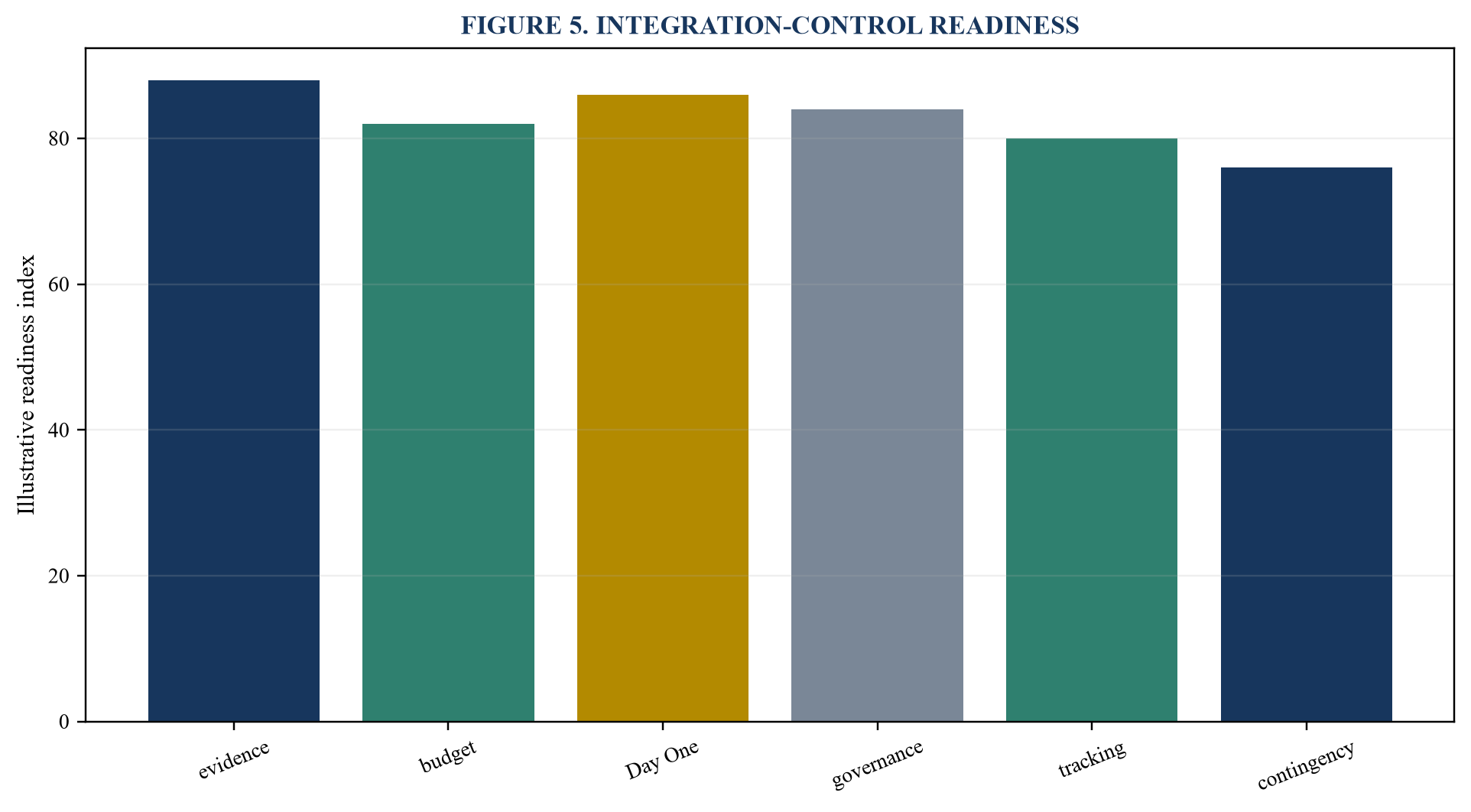
Values are illustrative readiness indices and require company-specific evidence.
References
- IFRS Foundation, IFRS 3 Business Combinations, https://www.ifrs.org/issued-standards/list-of-standards/ifrs-3-business-combinations/
- IFRS Foundation, IAS 37 Provisions Contingent Liabilities and Contingent Assets, https://www.ifrs.org/issued-standards/list-of-standards/ias-37-provisions-contingent-liabilities-and-contingent-assets/
- IFRS Foundation, IAS 36 Impairment of Assets, https://www.ifrs.org/issued-standards/list-of-standards/ias-36-impairment-of-assets/
- IFRS Foundation, IAS 38 Intangible Assets, https://www.ifrs.org/issued-standards/list-of-standards/ias-38-intangible-assets/
- IFRS Foundation, IAS 19 Employee Benefits, https://www.ifrs.org/issued-standards/list-of-standards/ias-19-employee-benefits/
- IFRS Foundation, IFRS 16 Leases, https://www.ifrs.org/issued-standards/list-of-standards/ifrs-16-leases/
- IFRS Foundation, IAS 12 Income Taxes, https://www.ifrs.org/issued-standards/list-of-standards/ias-12-income-taxes/
- IFRS Foundation, IAS 7 Statement of Cash Flows, https://www.ifrs.org/issued-standards/list-of-standards/ias-7-statement-of-cash-flows/
- Financial Accounting Standards Board, Business Combinations Topic 805, https://asc.fasb.org/topic&trid=2127482
- Financial Accounting Standards Board, Exit or Disposal Cost Obligations Topic 420, https://asc.fasb.org/topic&trid=2127437
- Financial Accounting Standards Board, Impairment or Disposal of Long-Lived Assets Topic 360, https://asc.fasb.org/topic&trid=2127400
- US Securities and Exchange Commission, Staff Accounting Bulletin No. 100 Restructuring and Impairment Charges, https://www.sec.gov/interps/account/sab100.htm
- US Securities and Exchange Commission, Non-GAAP Financial Measures Compliance and Disclosure Interpretations, https://www.sec.gov/corpfin/non-gaap-financial-measures.htm
- US Securities and Exchange Commission, Financial Reporting Manual, https://www.sec.gov/corpfin/cf-manual
- US Department of Justice Antitrust Division, Merger Remedies Manual, https://www.justice.gov/atr/page/file/1312416/dl
- US Department of Justice and Federal Trade Commission, Merger Guidelines, https://www.justice.gov/atr/2023-merger-guidelines
- Competition and Markets Authority, Merger remedies guidance CMA87, https://www.gov.uk/government/publications/merger-remedies-cma87
- European Commission, Remedies acceptable under the Merger Regulation, https://competition-policy.ec.europa.eu/mergers/procedures/remedies_en
- International Organization for Standardization, ISO 31000 Risk management, https://www.iso.org/iso-31000-risk-management.html
- International Organization for Standardization, ISO 22301 Business continuity management systems, https://www.iso.org/standard/75106.html
- International Organization for Standardization, ISO/IEC 27001 Information security management systems, https://www.iso.org/standard/27001
- International Organization for Standardization, ISO 10006 Quality management in projects, https://www.iso.org/standard/70376.html
- National Institute of Standards and Technology, Cybersecurity Framework 2.0, https://doi.org/10.6028/NIST.CSWP.29
- International Valuation Standards Council, IVS 200 Businesses and Business Interests, https://www.ivsc.org/standards/
- OECD, Guidelines for Multinational Enterprises on Responsible Business Conduct, https://mneguidelines.oecd.org/
- Frank Lichtenberg and Moshe Kim, The Effects of Mergers on Prices Costs and Capacity Utilization, NBER Working Paper 3197, https://doi.org/10.3386/w3197
