

1. Make cash evidence the first sale process deliverable
A distressed seller needs time to preserve value, run a competitive process and complete a transaction. Lenders and buyers will grant that time only when the cash case is credible. A weekly forecast that cannot reconcile to the bank, explain variances or identify funding triggers weakens every negotiation. It also encourages stakeholders to build independent downside cases using incomplete information.
The cash case should show how the business trades through the process, when liquidity reaches its lowest point, which payments protect enterprise value and what action follows if performance misses plan. The model must connect sales, customer collections, supplier terms, payroll, taxes, capital expenditure, debt service and transaction costs. Each material assumption needs an owner and evidence.
This paper proposes a thirteen-week weekly cash system for a distressed sale. It combines an evidence map, cash-control rules, scenario analysis, a risk-control matrix and an implementation roadmap. The framework supports management decisions and structured engagement with lenders and buyers. Legal duties, financing terms, insolvency priorities and transaction mechanics require advice based on the company, jurisdiction and process.
2. Define the decision the forecast must support
A forecast can serve several decisions. Directors may need to assess liquidity and going concern. Lenders may need to decide whether to maintain facilities, waive a breach or fund a sale process. Buyers may need to judge whether the business can reach completion and how much rescue funding is required. The seller should identify these decisions before choosing model detail and reporting frequency.
The weekly model should answer five practical questions. It should establish available cash, the lowest point of headroom, the week of any breach, the operational cause of the movement and the action needed to remain viable through the process. It should also show the difference between recurring cash generation and one-off measures such as asset sales, tax deferrals, accelerated collections or temporary supplier support.
The model's horizon should match the process. Thirteen weeks provides enough detail for immediate control while keeping each receipt and payment traceable. A longer monthly plan can show the path beyond completion. The two views should share assumptions and reconcile at their boundary. The weekly model should not become a compressed annual budget.
The forecast should identify its intended users and permitted decisions. Directors need enough detail to discharge their responsibilities. Lenders may require covenant, security and facility information. Buyers need a controlled view of the cash required to preserve the business. Preparing separate models for each audience creates reconciliation risk. A governed core model with controlled output schedules keeps the numbers consistent while respecting confidentiality.
3. Prove the opening cash position
The opening cash balance must be supported by current bank statements, online balances, reconciliations, blocked-account terms, cash-in-transit records and payment-provider balances. The company should separate unrestricted cash from funds subject to security, set-off, customer trust arrangements or legal restriction. A ledger balance without this evidence can overstate liquidity.
Entity and currency matter. Cash in one subsidiary may be unavailable to another because of law, covenant, minority ownership, tax, exchange control or practical banking constraints. The forecast should model the legal entity that makes each payment and record the mechanism required to move funds. Treasury and advisers should verify proposed transfers.
The opening position also needs a cut-off. Receipts, payments and financing movements around the reporting date should reconcile to bank value dates and the prior forecast. Unexplained differences should remain visible. The first weekly report should show how the opening number was established and identify any unresolved balances rather than burying them in a plug.
Bank access should be tested as well as observed. The company should confirm who can initiate, approve and release payments, which daily limits apply, how new beneficiaries are controlled and what happens if an approver is unavailable. Available cash has limited practical value when authority or technical access prevents use. The opening certificate should identify any account that cannot be operated through the approved process.
Table 1. Weekly cash evidence map
| Forecast line | Minimum evidence | Accountable input |
|---|---|---|
| Opening cash | Bank statement, reconciliation, restrictions and authority | Treasury |
| Customer receipts | Invoice, acceptance, dispute, payment confirmation and action | Commercial and finance |
| Supplier payments | Invoice, contract, criticality, terms and consequence | Procurement and operations |
| Payroll | Employee population, calculation, deductions, funding and bank file | People and finance |
| Financing | Commitment, conditions, security, draw mechanics and timing | CFO and advisers |
| Process costs | Approved scope, fee basis, invoice timing and decision purpose | Transaction lead |
Proposed management record. Actual evidence, duties and approvals depend on the company, process and jurisdiction.
4. Build the evidence map before the model
The evidence map links each forecast line to a source, owner, update frequency and quality assessment. Customer receipts can be supported by invoices, acceptance certificates, dispute status, collection correspondence and historical payment behaviour. Supplier payments can be supported by contracts, invoices, goods-received records, criticality and agreed terms. Payroll should reconcile to the employee population and payment file.
Evidence quality should be expressed in ordinary language. A customer-confirmed payment date differs from a sales estimate. A signed supplier standstill differs from an expected extension. A lender term sheet differs from committed and drawable funding. The model should allow decision makers to see these distinctions without interpreting hidden cell colours.
Open questions need owners and deadlines. If a material receipt depends on customer acceptance, the commercial owner should identify the evidence and action needed to secure it. If a supplier threatens suspension, procurement should quantify the cash required and the customer delivery at risk. The map turns diligence into a cash-control process.
The evidence map should preserve lineage through revisions. When an assumption changes, the record should show the previous value, new evidence, approver and date. This is particularly important when a lender or bidder has already received an earlier case. A controlled change log allows the company to explain the effect without reconstructing history from email and workbook copies.
Table 2. Direct cash forecast fields
| Field | Required content | Control purpose |
|---|---|---|
| Cash event | Receipt or payment by legal entity and currency | Reconcile to bank movement |
| Timing | Contractual date, proposed date and reporting week | Expose timing risk |
| Evidence | Source document, confirmation and evidence date | Support the assumption |
| Owner | Person responsible for validation and action | Create accountability |
| Scenario | Management, downside or funded process treatment | Explain case differences |
| Trigger | Threshold, decision body, response and deadline | Escalate before breach |
Proposed model design. The company should tailor materiality, categories and controls to its circumstances.
5. Structure the weekly direct cash flow
The model should use direct cash categories that reconcile to bank movements. Inflows include customer collections, tax refunds, asset proceeds and verified financing. Outflows include payroll, suppliers, rent, utilities, tax, insurance, restructuring costs, capital expenditure, interest, principal and transaction costs. Non-cash accounting entries should stay outside the direct forecast unless they drive a cash event.
Each line should identify amount, timing, legal entity, currency, source and owner. Material items should be listed individually; recurring immaterial items can be grouped with a documented basis. Contractual due date and proposed payment date should appear separately when management plans to negotiate or defer a liability. The model should avoid assuming that a delayed payment has no operational or legal consequence.
The first three weeks may need daily schedules beneath the weekly model when payroll, tax or financing events create timing pressure. These schedules should roll into the weekly totals. The model owner should keep the calculation simple enough to update, reconcile and review under time pressure.
The model should separate cash that follows normal trading from cash created by management intervention. A receipt accelerated through a discount, a supplier payment deferred through agreement and an asset sold outside ordinary operations should each be identifiable. This distinction helps reviewers judge whether liquidity improvement can recur. It also prevents a one-off action from being treated as evidence that the underlying operating cycle has recovered.
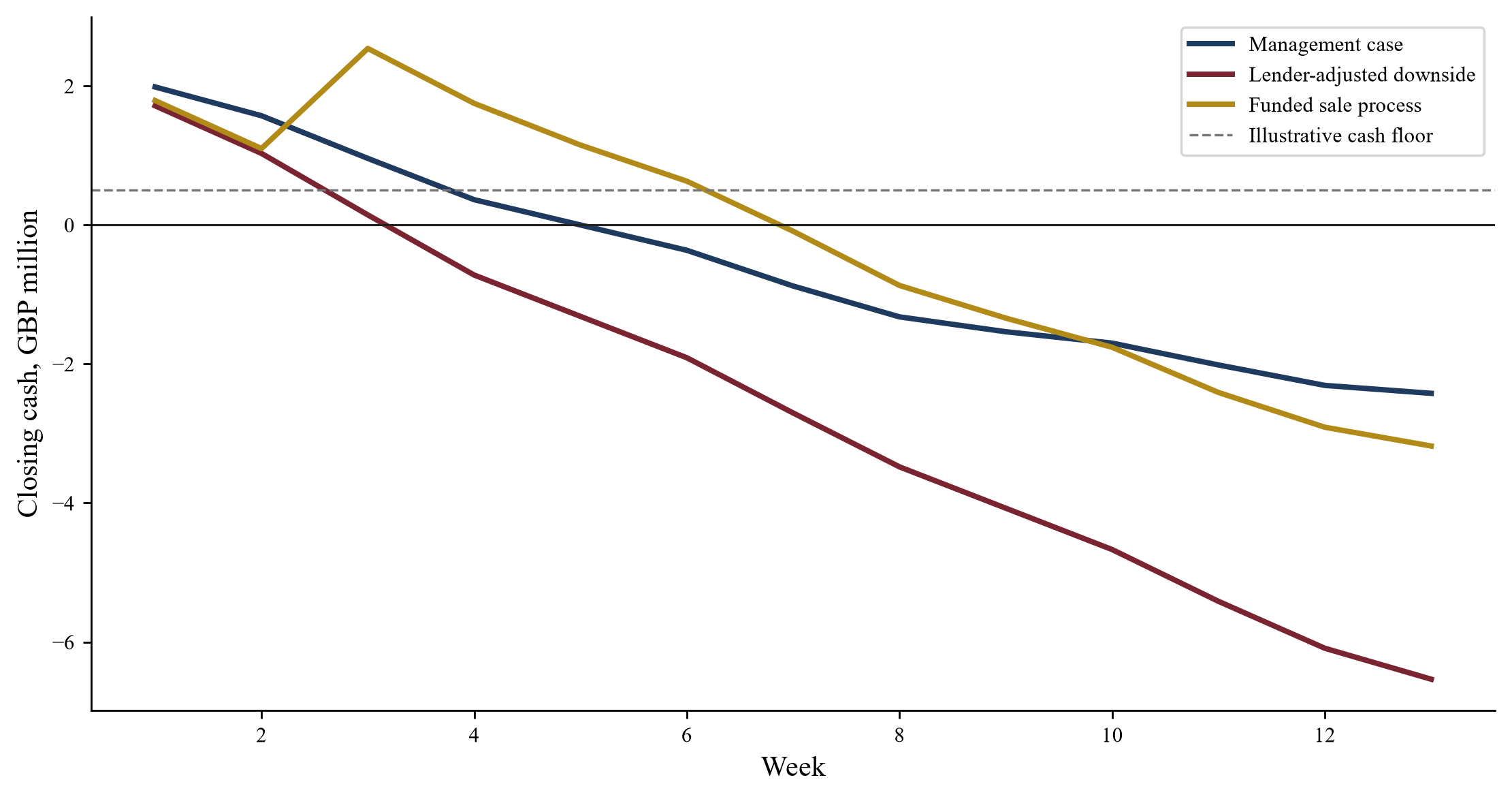
Author assumptions only. The cases are not forecasts and have no assigned probability.
6. Reconcile forecast to actual cash every week
Credibility develops through reconciliation. At each reporting date, the model should compare forecast and actual receipts, payments and closing cash. Every material variance needs a reason, an owner and an effect on the remaining horizon. Timing differences should move to the correct week. Permanent differences should change the base assumption.
The reconciliation should bridge bank-confirmed cash. If the prior forecast expected GBP 1.8 million and the bank shows GBP 1.4 million, the report should explain the GBP 0.4 million difference through identifiable movements. A balancing item weakens the forecast because it prevents users from distinguishing collection failure, unplanned payment and data error.
Variance history improves the downside case. Repeated optimism in collection timing should influence future receipt assumptions. Persistent unplanned payments may reveal weak purchase control or incomplete liabilities. The model should preserve the original forecast, actual result and revised forecast so lenders and buyers can see how management responds to evidence.
The team should set materiality for reporting without hiding smaller recurring errors. A single immaterial variance may not need board discussion, while repeated variances of the same type can reveal a structural weakness. The weekly review should group these patterns, assign a corrective action and update the forecasting method. Accuracy improves when process errors receive the same attention as headline cash misses.
7. Model customer receipts by evidence and action
Receipts should be scheduled from named invoices or other contractual events. The forecast records invoice value, due date, acceptance status, dispute, expected payment date, collection owner and supporting contact. Historical days-sales-outstanding can provide context, but a distressed process requires account-specific judgement because customers may change behaviour.
The commercial team should own collection actions. These can include completing acceptance evidence, resolving a dispute, issuing a credit note under authority, obtaining a payment promise or escalating to the customer's finance leadership. The forecast should state which action supports the date. A receipt without an action or evidence trail is a weak assumption.
Concentration needs explicit treatment. A single delayed payment can determine the week of minimum cash. The downside case should stress material customers individually and show the funding or operating response. Management should avoid applying a broad percentage haircut that hides which relationship creates the risk.
Customer receipts should also reconcile to delivery capacity. A forecast may assume collection from work that still requires materials, labour, certification or customer acceptance. The model should connect the receipt to the remaining cash cost and milestone. Collecting early through a deposit can improve liquidity while creating an obligation to perform; the cash case should retain the related delivery requirement.
8. Link supplier payments to enterprise value
Supplier payments should reflect the service, inventory or licence protected by each outflow. A payment freeze can preserve cash while interrupting customer delivery and reducing collections. The forecast should therefore show the consequence of non-payment and the availability of alternatives. Procurement and operations should validate criticality.
Government guidance identifies loss of trade credit and trade credit insurance as factors that can intensify financial distress [1]. Suppliers may shorten terms, demand deposits or stop supply when they perceive a higher risk. The model should update these changes quickly and distinguish agreed support from management expectation.
Proposals such as partial payment, direct settlement for new supply, consignment, shorter order cycles or escrow require transaction-specific review. The cash case should show duration, operational benefit and exit. A temporary arrangement that creates a large catch-up payment immediately before completion can transfer the liquidity problem to the buyer.
Supplier concentration can extend beyond the immediate counterparty. A component provider may depend on a specialist sub-tier manufacturer, freight route, utility or software licence. The seller should ask critical suppliers about the dependencies that could interrupt the next thirteen weeks. The forecast should include any necessary deposit, expedited freight or alternative-sourcing cost supported by evidence.
9. Protect payroll and essential staff
Payroll is often the largest fixed weekly or monthly event and a direct test of management control. The forecast should reconcile headcount, gross pay, deductions, benefits, timing and bank-file authority. It should identify any arrears, disputed amounts or employees outside the standard process. Funding should be reserved early enough to avoid relying on an uncertain receipt on the payment day.
The sale process may require retention of employees who sustain customers, collections, safety, systems or transaction execution. Retention costs should appear in the cash model when approved. The business case should describe the role protected, payment timing, conditions and alternatives. Employment and tax specialists should validate the arrangement.
Communication influences retention. Employees need verified information about payroll, leadership, process governance and how questions will be handled. Unsupported promises can create liability and damage confidence. Management should align employee communication with the transaction timetable and applicable consultation obligations.
10. Capture tax, rent, insurance and other fixed events
Fixed obligations can create the lowest point of cash even when trading is stable. The weekly schedule should identify tax, rent, insurance, utilities, leases and regulatory payments by due date and legal entity. It should record any agreed payment plan, security consequence or right of termination. Management expectation of deferral should not be modelled as fact.
The company should maintain evidence of communications and approvals. A request for time to pay does not itself change the contractual or statutory date. Advisers should determine the available options and consequences. The cash model should show both the due amount and the proposed treatment until an agreement is executed.
Insurance deserves particular attention during a sale. Coverage, premium payment and disclosure obligations may affect continued trading and buyer diligence. The company should confirm the insured entity, policy period, outstanding premium and any change-of-control provisions with qualified advisers.
11. Separate maintenance capital from optional investment
Distress encourages broad reductions in capital expenditure. Some spending may be necessary for safety, regulatory compliance, equipment reliability or a customer milestone. The forecast should classify each item by operational consequence, timing, contractual commitment and ability to defer. The authority matrix should identify who approves exceptions.
Optional growth investment should have a cash case. Management should state the expected benefit, lead time and downside if the spend is delayed. During a short sale process, some projects may not generate cash before completion. A buyer may still value them, but the seller should distinguish preservation spending from strategic investment.
The model should avoid double counting. Maintenance included in supplier outflows should not reappear as capital expenditure. Committed purchase orders, deposits and completion payments need a single owner and schedule. The evidence map should link them to contracts and assets.
Disposal proceeds require similar discipline. An asset may appear saleable while being subject to finance, title, operational dependence or consent. The forecast should include proceeds only when the route, timing, costs and authority are supported. Until then, the asset sale can remain an identified management action outside the committed cash case and enter a separate upside schedule.
12. Include process and restructuring costs
A distressed sale consumes cash through advisers, diligence support, data-room preparation, retention, redundancy, site separation, cyber remediation and buyer requests. These costs often increase as the process develops. The weekly forecast should include a controlled budget, invoice timing, tax treatment and approval route.
Transaction costs should be separated from ordinary operations. This allows lenders and buyers to see the cost of preserving the process and the underlying business. It also helps management decide which requests create value. A new diligence workstream should show its cost, decision purpose and deadline.
Restructuring actions may require cash before they improve performance. Redundancy, contract exit, inventory clearance and site closure can have immediate uses and delayed benefits. The model should show both the action cost and the weekly run-rate effect. Legal, employment, tax and accounting advice is necessary.
13. Model financing as evidence rather than hope
The forecast should include financing only when its amount, timing, conditions and draw mechanics are understood. Undrawn committed facilities differ from uncommitted overdrafts, lender discussions, shareholder intentions and buyer rescue proposals. Each source should carry an evidence status and responsible owner.
Financing conditions need a timetable. A bridge may require security, intercreditor consent, diligence, board approval, documentation and account control. The forecast should identify the latest date each condition can be satisfied before cash falls below the approved floor. This converts a funding discussion into an executable critical path.
The model should show repayment, fees, interest and any cash sweep where applicable. A facility that fills the first liquidity gap but matures before sale completion may create a second crisis. Lenders and advisers should validate the terms. The illustrative model in this paper does not represent a financing offer or recommendation.
Funding certainty can be graded through observable stages. An initial expression of interest, credit committee approval, agreed commercial terms, executed documents and a tested draw process do not carry the same execution risk. The weekly report should state the current stage, remaining conditions and responsible party. It should also show the cash position if the draw moves by one or two weeks.
14. Build a management case from owned assumptions
The management case should represent the operating plan that accountable leaders expect to deliver. Each material receipt, cost and action needs a named owner. The case should reflect current trading and known post-reporting events. It should avoid automatic growth or collection improvements unsupported by a specific action.
Management should document the key assumptions outside formulas. Examples include customer payment dates, supplier support, order intake, gross margin, payroll changes, tax timing and planned asset proceeds. The assumptions register should identify evidence and the next validation date. This allows reviewers to challenge the decision inputs without rebuilding the workbook.
The case should also state its cash floor and trigger. A positive closing balance may still be inadequate when the company needs a reserve for payroll, a supplier release or forecast error. The board should approve the minimum cash level and the action required when headroom approaches it.
15. Construct a lender-adjusted downside
Lenders may adjust optimistic receipts, restore deferred supplier payments, remove uncommitted funding and add costs omitted from management's case. The company should perform this work before presenting the forecast. A transparent downside demonstrates that management understands where the case can fail and what action would follow.
The downside should use specific stresses. It can delay a named customer, reduce collection conversion, restore cash-on-delivery terms, add restructuring costs or postpone a transaction milestone. Each stress should have a reason and a response. Applying an arbitrary haircut to every line can obscure the operational mechanism.
Management should reconcile the downside with known historical error. If customer receipts have consistently arrived later than forecast, the downside should reflect that evidence. If supplier support has held through previous pressure, the case should still test the consequence of withdrawal without asserting that it will occur. The purpose is to identify a response before the adverse event removes the option.
The FRC's 2025 going-concern guidance encourages company-specific assessment of solvency and liquidity risks and the factors supporting the conclusion [2]. Its scope and purpose differ from a lender standstill decision, but its emphasis on supportable assumptions, sensitivities and transparent conclusions is relevant to forecast governance.
16. Create a funded sale process case
The funded sale process case begins with the downside operating assumptions and adds the liquidity and costs required to reach a realistic completion window. It should show the bridge amount, draw date, conditions, interest, fees and repayment source. It should also include sale-process costs and any spending required to preserve the asset perimeter.
Completion timing must be evidence-based. The model should reflect diligence, bidder approval, regulatory or third-party consent, documentation and funds flow. A headline bid does not establish completion cash. The process timetable should identify the decisions that can shorten or extend runway.
The case helps lenders assess whether additional exposure protects recovery and whether controls can contain it. Buyers can see the funding needed to preserve the business. Directors can compare a funded process with alternative outcomes. The actual decision requires current evidence and specialist advice.
17. Set a minimum cash floor and escalation triggers
The minimum cash floor protects the company from timing error and critical events. Its size should reflect payroll, concentrated receipts, essential suppliers, bank processing time and access to further funding. The floor should be approved by the board and aligned with any lender controls.
Triggers should act before the floor is breached. Examples include a receipt delay above a stated amount, withdrawal of supplier support, loss of a key customer, failed financing condition or forecast variance beyond tolerance. Each trigger needs an owner, response, decision body and deadline.
The report should show the distance to each trigger. Decision makers can then distinguish a manageable variance from a change requiring immediate lender engagement or process redesign. Triggers should update as evidence changes and should not remain static simply because they appeared in an earlier presentation.
18. Use the forecast to support lender engagement
Lenders need a reconciled account of cash, collateral, performance, funding need and process milestones. The weekly pack should begin with decisions requested, then show cash headroom, variance, receipts at risk, critical payments, financing conditions and sale progress. Supporting schedules should allow review without overwhelming the main decision.
The company should disclose material weaknesses in the model and explain the corrective action. A known data gap that has an owner and deadline is more manageable than a hidden assumption discovered by the lender. Forecast credibility depends on how management handles misses, not on producing an implausibly smooth line.
Government distress guidance notes that lenders can be central to ongoing trading and may control the timing of enforcement or withdrawal of support [1]. The company's engagement should therefore begin before the liquidity event. Counsel and restructuring advisers should manage confidentiality, duties and negotiations.
19. Use the cash case to improve buyer diligence
Buyers need to understand the cash required to reach completion and stabilise ownership. The seller should provide a reconciled forecast, evidence map, critical payment schedule and explanation of scenario differences under controlled data-room access. This can reduce duplicate questions and expose issues while there is time to solve them.
The cash case should reconcile to other diligence. Revenue assumptions should align with customer contracts and pipeline evidence. Supplier outflows should align with purchase commitments and inventory. Payroll should align with employee data. Financing should align with facility documents. Contradictions damage confidence and can affect price, structure or conditionality.
The seller should preserve a decision log for buyer requests that change cash. Accelerated remediation, new retention arrangements or additional separation work should enter the forecast. Management can then assess whether the request preserves value and who funds it.
Buyer diligence should distinguish cash through completion from cash after completion. The seller's forecast can establish the former, while the buyer may apply different ownership, financing and stabilisation assumptions to the latter. A clear boundary prevents the seller's model from being treated as a buyer integration plan. It also allows purchase agreement and rescue-funding discussions to focus on the transition point.
20. Govern confidentiality and information access
Distressed sale information is highly sensitive. Premature disclosure can destabilise customers, employees, suppliers and financing. The Bank of England's 2026 operational guide to transfer resolution highlights confidentiality during distressed marketing because disclosure may destabilise the firm or undermine the sale [5]. Its statutory context is specific to financial firms, while the operational principle is useful more broadly.
The seller should control data-room access, downloads, buyer teams, adviser permissions and escalation. Cash information may reveal customer concentration, pricing, supplier dependence and financing pressure. Access should follow process stage and legitimate need. Data-protection, competition and confidentiality obligations require specialist review.
The forecast itself needs version control. Every shared copy should identify its date, case, author, approval and permitted use. The company should record questions and responses so all selected bidders receive consistent information where the process requires it.
21. Establish the weekly governance rhythm
The company should run a fixed weekly cycle. Operations and commercial teams update source schedules. Finance consolidates the forecast, reconciles actuals and prepares variances. Management challenges assumptions and actions. The board or delegated committee approves decisions. Lenders receive the agreed pack and supporting evidence on schedule.
The cycle should include an intraweek alert process for material changes. A lost receipt or supplier stop cannot wait for the next formal report. The authority matrix should state who can update the forecast, approve an emergency payment and contact lenders or bidders. Each urgent decision should enter the weekly record.
The meeting should focus on decisions and owners. Re-reading the model line by line consumes time without improving control. The pack should highlight changed assumptions, trigger proximity, funding conditions, stakeholder risks and process milestones.
Model governance requires separation of preparation, review and approval where the team has enough capacity. Finance can own consolidation, operating leaders can certify inputs and an executive can approve the issued version. The workbook should protect formulas and identify manual overrides. Independent review should test arithmetic, links, opening cash, scenario switches and the consistency of totals across schedules.
Table 3. Hypothetical weekly model assumptions
| Input | Assumption | Timing |
|---|---|---|
| Opening unrestricted cash | GBP 2.40m | Week 1 |
| Baseline customer receipts | GBP 1.25m before case factor | Weekly |
| Payroll | GBP 0.70m | Weekly |
| Baseline supplier demand | GBP 0.62m before coverage factor | Weekly |
| Other operating outflow | GBP 0.25m | Weekly |
| Maintenance capital expenditure | GBP 0.20m | Weeks 3, 7 and 11 |
| Debt service | GBP 0.18m | Weeks 4, 8 and 12 |
All values are author assumptions. The model excludes purchase price, sale proceeds, foreign exchange and insolvency distributions.
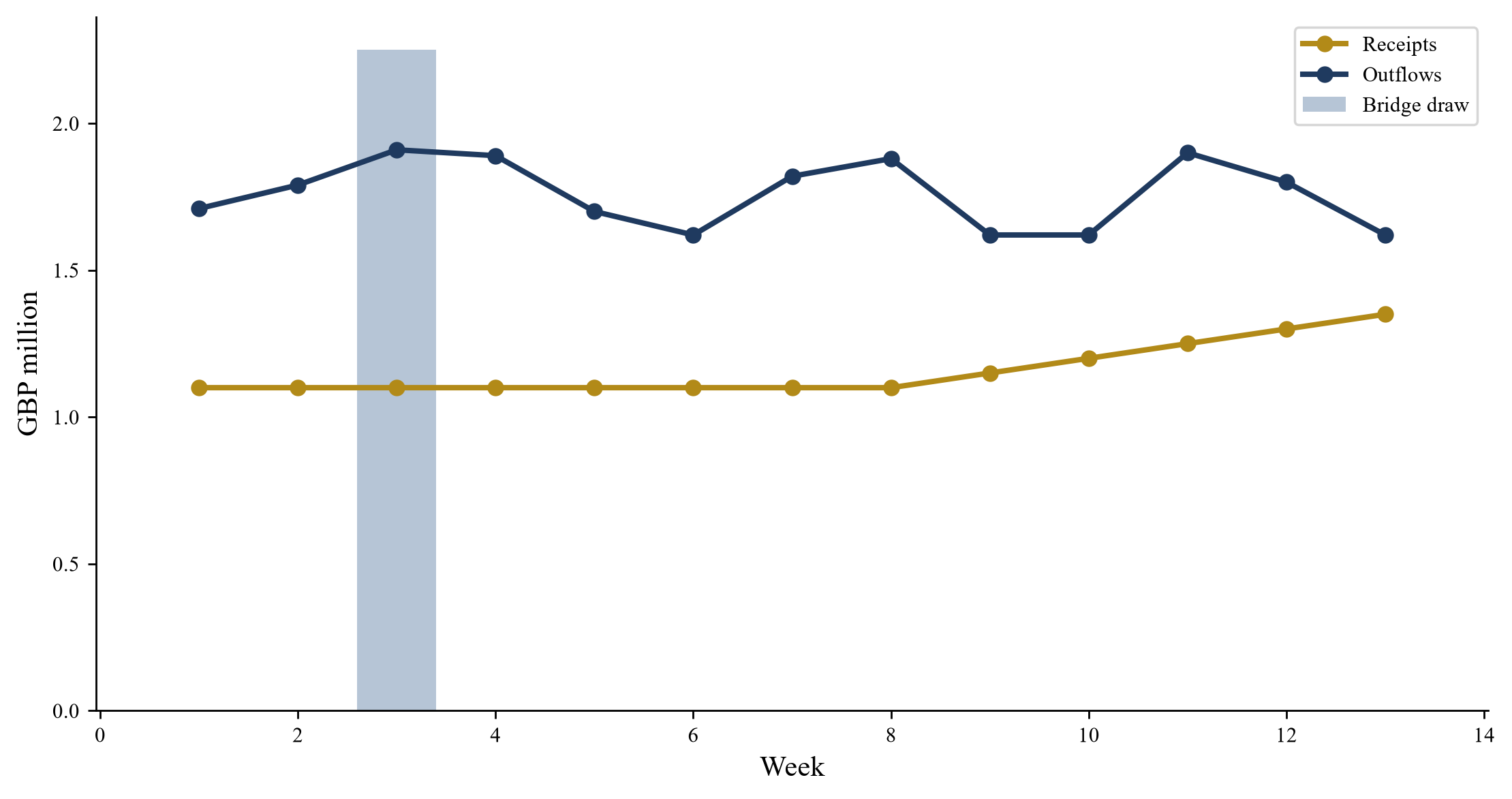
Author assumptions. The bridge draw is hypothetical and does not represent committed financing.
22. Establish the hypothetical model
The original model covers thirteen weeks for a hypothetical distressed industrial-services seller. It begins with GBP 2.40 million of unrestricted cash. Baseline customer receipts are GBP 1.25 million per week before case factors. Payroll is GBP 0.70 million per week, baseline supplier demand is GBP 0.62 million, other operating outflow is GBP 0.25 million, and restructuring cost varies by case during the first four weeks.
The model adds maintenance capital expenditure of GBP 0.20 million in weeks three, seven and eleven and debt service of GBP 0.18 million in weeks four, eight and twelve. The funded sale case includes GBP 0.08 million of process cost in weeks two, five, eight and eleven and a hypothetical GBP 2.25 million bridge draw in week three.
All numerical inputs are author assumptions. They are not benchmarks, forecasts or evidence about a company. The model assigns no probability and provides no financing commitment, legal conclusion, tax advice or valuation. It excludes purchase price, transaction proceeds, foreign exchange, working-capital facilities and insolvency distributions.
Table 4. Hypothetical thirteen-week case results
| Case | Minimum cash | Ending cash | First negative week | Funding to GBP 0.50m floor |
|---|---|---|---|---|
| Management case | -2.42 | -2.42 | 6 | 2.92 |
| Lender-adjusted downside | -6.54 | -6.54 | 4 | 7.04 |
| Funded sale process | -3.18 | -3.18 | 7 | 3.68 |
GBP million. Results follow directly from author assumptions; no likelihood or financing recommendation is assigned.
23. Read the management case
The management case assumes ninety-eight percent receipt conversion, payment of ninety-five percent of baseline supplier demand, GBP 0.10 million of weekly restructuring cost during the first four weeks and receipt recovery from week seven. These assumptions represent an owned operating case for analysis rather than a prediction.
The case can remain above zero while falling below a prudent cash floor. That distinction matters. A forecast that shows a small positive balance may still require funding because a single delayed receipt, banking cut-off or supplier demand can stop trading. The model therefore calculates the additional liquidity required to preserve a GBP 0.50 million floor.
Management should compare the case with actual performance each week. If receipt conversion or supplier terms miss plan, the case should change. Preserving the original forecast allows stakeholders to assess whether management responds early and accurately.
24. Read the lender-adjusted downside
The downside assumes eighty-two percent receipt conversion, full payment of baseline supplier demand, higher restructuring cost and recovery from week eleven. It removes the benefit of optimistic collections and delayed supplier payments. The case illustrates how a modest change in weekly receipts compounds across the horizon.
The week of minimum cash defines the latest practical action point. The company needs enough time to negotiate funding, execute operational measures or change the sale timetable. Waiting until the forecast shows a negative balance can leave these actions impossible to complete.
The downside should lead to specific questions. Which customers explain the receipt difference? Which supplier payments protect revenue? Which restructuring costs are committed? What actions reduce the funding requirement? The answers should update the evidence map and decision log.
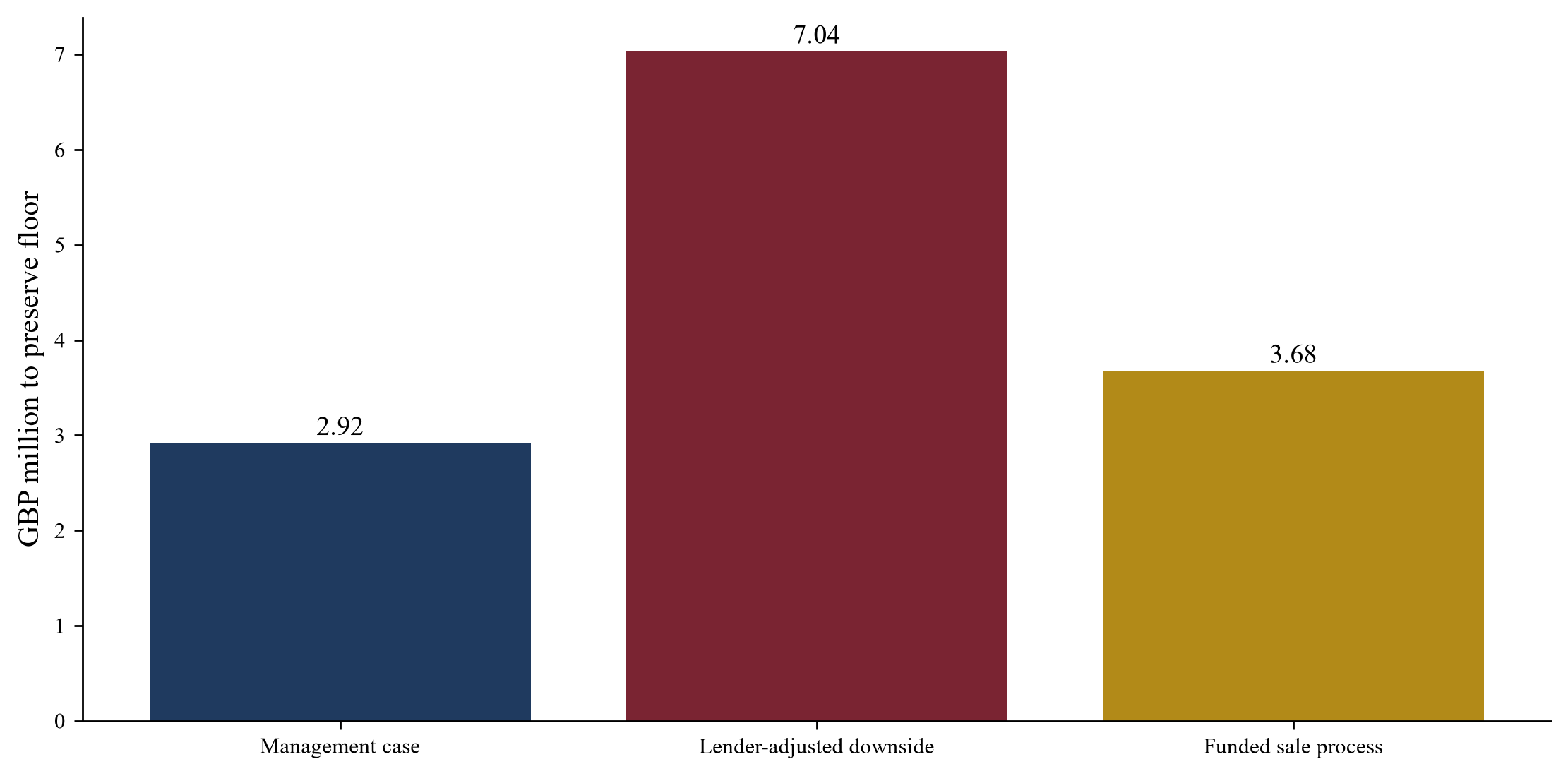
Author assumptions. Required funding equals the amount needed to keep modeled cash at or above GBP 0.50 million.
25. Read the funded sale process case
The funded case uses a conservative operating view, includes transaction costs and draws a hypothetical bridge in week three. It shows how liquidity can fund the time needed to continue trading and complete diligence. The result depends entirely on the assumed draw and operating recovery.
The bridge does not repair a weak forecast. Its conditions, timing and controls need the same evidence as operating cash. If documentation or security takes longer than planned, the model should show the resulting gap. A fallback may require earlier action, a different amount or a shorter process.
The company should connect funding releases to process and operating gates. Examples include an approved information memorandum, a minimum number of credible bidders, completed customer work, maintained supplier coverage and reconciled reporting. The actual conditions belong in negotiated documents.
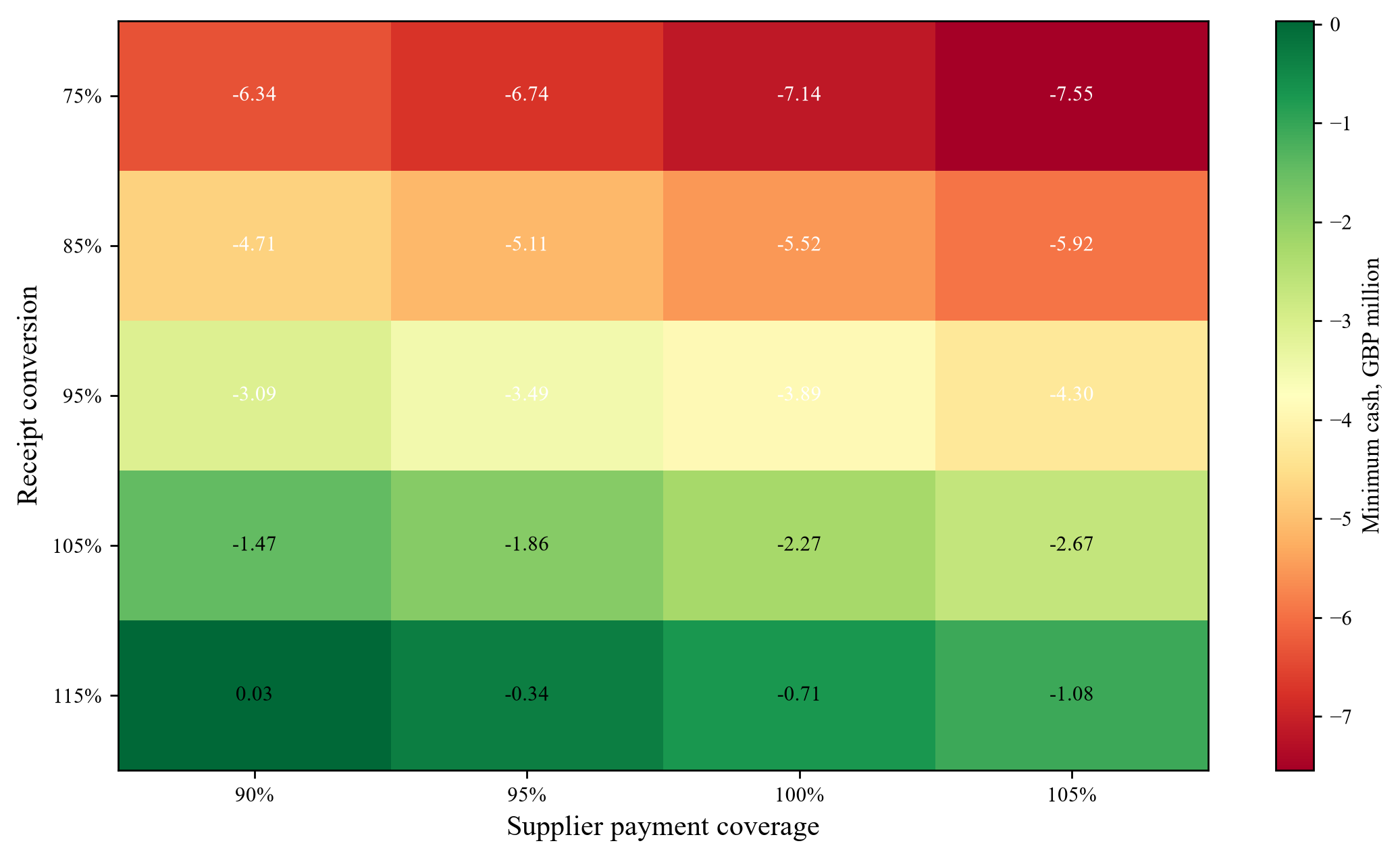
Author assumptions. Each cell varies receipt conversion and supplier coverage; no probability is assigned.
26. Use sensitivity to identify the critical evidence
The sensitivity grid varies receipt conversion from seventy-five to one hundred and fifteen percent of baseline and supplier payment coverage from ninety to one hundred and five percent. It reports minimum cash and the funding required to preserve the GBP 0.50 million floor. No likelihood is assigned to any cell.
The grid identifies which assumptions drive liquidity. If receipt conversion dominates, customer evidence and collection actions deserve the greatest scrutiny. If supplier coverage materially changes the minimum, procurement negotiations and service consequences need attention. Sensitivity should allocate management effort as well as quantify cash.
Management can add transaction-specific stresses such as a delayed buyer deposit, consent cost, foreign-exchange movement or customer termination. Each added stress should have a source and response. The model should remain understandable enough for independent review.
Table 5. Proposed cash-case risk-control matrix
| Failure mode | Indicator | Control | Evidence |
|---|---|---|---|
| Opening cash overstated | Ledger differs from usable bank balance | Bank proof and restriction review | Reconciliation and authority test |
| Receipt unsupported | Missing acceptance or payment confirmation | Named invoice schedule and collection action | Customer evidence and variance |
| Supplier interruption | Terms withdrawn or delivery held | Criticality map and funded agreement | Supplier confirmation |
| Funding delayed | Condition or approval misses timetable | Conditions tracker and downside trigger | Executed document and draw test |
| Model error | Unexplained change or broken link | Protected logic and independent review | Version log and control check |
| Information leak | Unauthorised access or inconsistent release | Controlled data room and issue register | Access log and approved response |
Proposed controls. Accountable directors and qualified advisers determine the actual risk treatment.
27. Maintain the risk-control matrix
The matrix links failure modes to indicators, controls, owners and evidence. Priority risks include overstated opening cash, unsupported receipts, supplier interruption, missed payroll, uncommitted funding, model error, information leakage and process delay. Each risk should state the cash or transaction consequence.
Controls need observable evidence. Daily bank reconciliation, customer confirmation, signed supplier terms, payroll testing, financing conditions tracking and version approval are stronger than broad instructions to monitor. Each control also needs an exception route and fallback.
The board should review residual risk in decision terms. A red funding risk should state the amount, required date, missing conditions and available alternatives. This gives directors and lenders a basis for action without treating a colour as analysis.
28. Convert the cash case into an executable roadmap
The roadmap begins with opening-cash proof, authority, model ownership and the evidence map. Week one establishes the direct cash flow and first reconciliation. Week two completes customer and supplier validation. Week three aligns financing conditions and sale milestones. Each later week repeats the control cycle while closing data gaps and protecting value.
The roadmap should use gates. A lender pack is ready when opening cash reconciles, material receipts and payments have evidence, scenarios are approved and funding triggers are clear. A buyer cash pack is ready when it also reconciles to operational and diligence records. A financing draw is ready when its conditions and funds flow are executable.
The weekly cash case earns time through reliability. It tells stakeholders what the business needs, why it needs it, when decisions must occur and how management will respond to a miss. That evidence supports a controlled sale process and gives the board a defensible basis for protecting liquidity and enterprise value.
The process should end with a handover record. At completion, the seller provides the final issued forecast, bank reconciliation, committed payment schedule, customer collection evidence, supplier arrangements, financing position and open actions permitted by the transaction documents. This record helps the buyer establish its opening control environment and reduces disagreement over cash events around completion.
References
- UK Government. Corporate Financial Distress Guidance Note. Updated 15 June 2026; accessed 6 September 2026. https://www.gov.uk/government/publications/the-sourcing-and-consultancy-playbooks/corporate-financial-distress-guidance-note-html
- Financial Reporting Council. Guidance on the Going Concern Basis of Accounting and Related Reporting, including Solvency and Liquidity Risks. Published 25 February 2025; accessed 6 September 2026. https://www.frc.org.uk/library/standards-codes-policy/accounting-and-reporting/annual-corporate-reporting/guidance-on-going-concern-basis/
- Financial Reporting Council. ISA UK 570 Going Concern. Updated September 2025; accessed 6 September 2026. https://www.frc.org.uk/library/standards-codes-policy/audit-assurance-and-ethics/auditing-standards/isa-uk-570/
- ICAEW. Liquidity management for businesses at times of stress. Accessed 6 September 2026. https://www.icaew.com/technical/corporate-finance/business-restructuring/liquidity-management-for-businesses-at-times-of-stress
- Bank of England. Operational guide to transfer resolution. Published 13 April 2026; accessed 6 September 2026. https://www.bankofengland.co.uk/paper/2026/operational-guide-to-transfer-resolution
- Bank of England. Financial Stability Report, July 2026. Accessed 6 September 2026. https://www.bankofengland.co.uk/financial-stability-report/2026/july-2026
- ICAEW. Financial Modelling Code. Accessed 6 September 2026. https://www.icaew.com/-/media/corporate/files/technical/technology/excel/2019-webinars/305---1911358-financial-modelling-code.ashx
- UK Government. Navigating the risks of PFI project distress: summary of the guidance. Published August 2026; accessed 6 September 2026. https://www.gov.uk/government/publications/navigating-the-risks-of-pfi-project-distress/summary-of-the-guidance
