

1. Define the decision before contacting buyers
The board's decision is whether a sale process can produce an executable outcome before liquidity, enforcement or stakeholder confidence expires. That decision requires more than an enterprise-value range. It requires a route-specific view of cash at closing, creditor recoveries, authority to approve the transaction, release mechanics, residual liabilities and the consequences of failure.
A distressed company normally has several overlapping maps. The legal-entity map shows borrowers, guarantors, asset owners, employers and contracting entities. The capital-structure map shows facilities, notes, hedges, guarantees, leases and shareholder instruments. The security map shows collateral, ranking, perfection and enforcement rights. The stakeholder map shows who can vote, direct, object, accelerate, terminate or withhold a required document. These maps must reconcile before an auction timetable is credible.
The board should approve the proposed sale perimeter, intended route, minimum operating cash, latest safe launch date, target closing window and alternative if consent is not obtained. It should also define which conclusions remain legal advice, which are financial analysis and which depend on creditor confirmation. A waterfall is a decision tool, not a substitute for the governing documents or applicable law.
UNCITRAL recommends clear priority and distribution rules, recognition of secured claims against encumbered assets and proportionate treatment within the same rank. [1] The World Bank similarly treats predictable creditor rights and effective insolvency systems as important to orderly debt resolution and productive-resource reallocation. [2] Those principles frame the problem; the actual route depends on the relevant law, security and contract.
2. Build one creditor-alignment architecture
Creditor alignment should connect five layers. The first is fact: entities, claims, collateral, cash, contracts and current defaults. The second is economics: estimated proceeds, costs, cure funding, recoveries and downside alternatives. The third is authority: contractual instructions, statutory votes, court approvals, board duties and regulatory consents. The fourth is documentation: payoff letters, releases, deeds, court orders, filings, notices and funds-flow instructions. The fifth is execution: people, dates, dependencies, signatures and evidence that money and documents can move together.
Each layer needs an accountable owner. Finance owns the reconciled claim and cash numbers. Legal advisers interpret the documents and law. The restructuring or transaction lead owns the process and issue register. Security, facility and note trustees should confirm their operational requirements. Workstream owners should not treat a term-sheet indication as a binding instruction or an expected release as a delivered document.
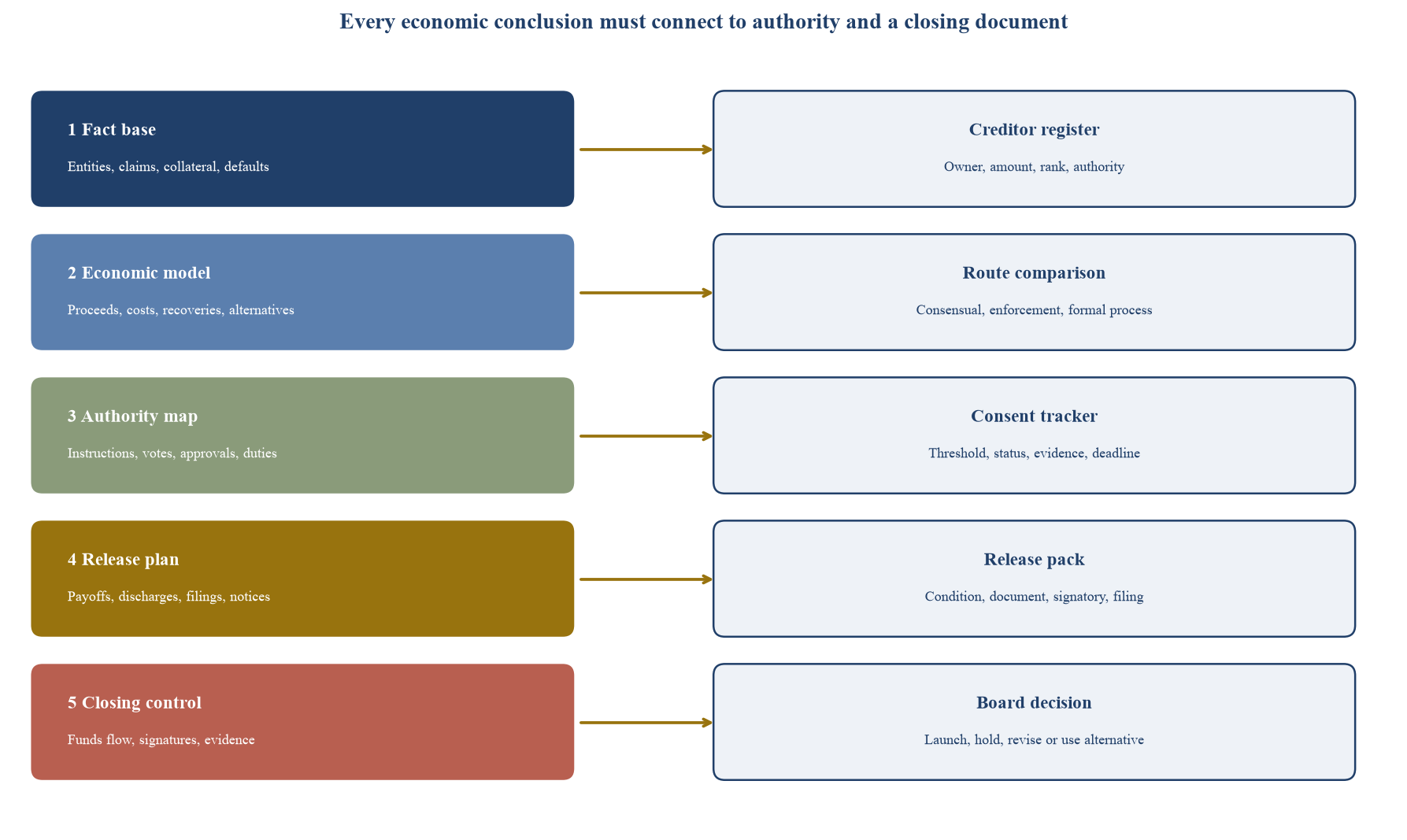
Original framework. Rights, thresholds and documents require instrument-specific and jurisdiction-specific verification.
3. Define the sale perimeter and legal-entity perimeter
The sale perimeter should state whether the buyer acquires shares, selected assets, a business as a going concern or a combination. It should identify every entity, asset, contract, employee, licence, receivable, liability and cash balance included or excluded. The legal-entity perimeter should show which company owns each item and which company granted security or a guarantee over it.
This distinction matters because value and release authority may sit in different places. A parent may own the shares while an operating subsidiary owns the customer contracts. A treasury company may be the borrower while several subsidiaries are guarantors. Intellectual property may sit in another jurisdiction. A lender may hold security over shares, bank accounts and substantially all assets. The bidder needs a coherent business; the seller must identify the rights that attach to each part.
Intercompany balances should be classified by settlement, waiver, assumption or retention. Shared cash and cash-pooling arrangements require particular care. A balance in the group accounts may be unavailable to the selling entity or subject to account control. A guarantee can survive an asset sale unless it is released. The perimeter model should therefore include every borrower, guarantor and obligor whose liability or property affects closing.
The perimeter should remain version controlled. Buyer requests, lender positions, customer consents and regulatory conditions can change it. Every change should flow through the valuation, waterfall, consent map, transaction documents and buyer instructions.
4. Reconcile every claim to evidence
The creditor register should begin with executed documents and current statements. It should include principal, accrued interest, default interest, fees, break costs, hedge close-out, letters of credit, guarantees, lease liabilities, contingent claims and undrawn commitments. Management accounts are an index; they do not determine contractual payoff.
Each claim should carry an owner, legal entity, instrument, rank, security package, governing law, maturity, default status, instruction mechanics, voting rights, transfer status, disputed amount and evidence date. The register should distinguish admitted, estimated, contingent and disputed claims. It should also record whether a creditor acts directly or through a facility agent, trustee or security agent.
The debt schedule must reconcile to cash and the general ledger. Interest and fees should be calculated to alternative closing dates. A delayed close can change the payoff and the allocation between classes. Revolving and asset-based facilities require available commitments, reserves, cash dominion and termination mechanics. Hedging claims can move with the market and may rank with secured debt under the finance documents.
| Class | Claim or payoff | Principal control | Security or priority | Required evidence |
|---|---|---|---|---|
| Asset-based facility | USD 9.4m | Facility agent under lender instructions | Receivables, inventory and controlled accounts | Payoff, termination, cash release and filing steps |
| First-lien term loan | USD 38.8m | Majority lenders direct agent and security agent | Shares, accounts and substantially all assets | Instruction threshold, enforcement authority and release deed |
| Second-lien notes | USD 14.0m | Trustee or noteholder direction under documents | Second-ranking collateral | Consent, turnover and release provisions |
| Employee and critical cure | USD 4.3m | Company, subject to law and route | Statutory, contractual or operational priority varies | Payroll, supplier and continuity schedule |
| Transaction costs | USD 3.2m | Board and process budget | Treatment depends on route | Engagements, invoices, approval and funds flow |
| Release and contingency reserve | USD 1.5m | Board, agents and closing parties | Earmarked closing amount | Agreed reserve purpose, holder and release condition |
| Ordinary unsecured claims | USD 16.0m | Individual creditors or class process | Unsecured | Reconciled claims, set-off, disputes and route treatment |
All amounts and terms are hypothetical. Contractual and statutory treatment requires current advice.
5. Map security, priority and enforcement rights
A security map should identify the collateral, grantor, secured obligations, ranking, perfection evidence, governing law and release mechanism. It should distinguish fixed or specific security from floating or enterprise security where those concepts apply. It should show whether assets are subject to retention of title, leases, factoring, receivables assignments, account control, statutory liens or third-party interests.
Priority can arise from law and contract. Statutory expenses, employee claims, tax claims, insolvency financing or other categories may affect the distributable proceeds. Contractual subordination can change payments among creditors while leaving the debtor's legal liabilities intact. The analysis should explain both layers and avoid presenting one universal waterfall across jurisdictions.
UK official guidance illustrates a statutory sequence involving fixed-charge creditors, process expenses, preferential and secondary preferential creditors, a prescribed part for unsecured creditors, floating-charge creditors and ordinary unsecured creditors. [7] The detail depends on the assets, charge type, dates and procedure. UAE law separately addresses secured-asset enforcement and objections where enforcement could harm a viable restructuring or produce greater creditor damage. [3]
The enforcement map should state who can accelerate, appoint an office-holder, instruct a sale, credit bid, use cash collateral, grant priority financing or release collateral. It should also state standstill periods, consultation duties and good-faith or fair-value standards in the governing instruments.
6. Separate the three meanings of consent
Commercial support means a creditor prefers the proposed outcome. Legal authority means the required person can bind the relevant creditor group or release the relevant right. Operational readiness means the authorised document, signature, funds-flow instruction and filing can be delivered by closing. These states should be tracked separately.
A relationship lender may express support without a formal credit approval. A majority group may direct an agent for enforcement while a separate affected-lender consent is required to amend payment priority. A security agent may have authority to release collateral in an instructed distressed disposal but require certificates, valuations or proceeds application. A trustee may need an officer's certificate, legal opinion and indemnity before acting.
The consent tracker should identify the exact clause or legal provision, calculation base, excluded votes, required threshold, decision body, notice period, quorum, form of instruction, conditions, signatory and evidence received. It should avoid broad labels such as lender consent when several decisions exist.
The UK restructuring-plan regime provides a formal example: a class can approve with at least 75 per cent in value of those present and voting, subject to court sanction, and the statutory conditions can permit cross-class cram down. [5] [6] United States Chapter 11 uses different voting tests for a class and separate confirmation requirements. [9] [11] A transaction team should never transfer a threshold from one route to another.
7. Build route-specific waterfalls
A waterfall should start with the exact proceeds and route. It should state whether the buyer pays cash, assumes liabilities, leaves cash in the business, funds cure items, pays deferred consideration or provides replacement support. It should separate enterprise value from cash available for distribution.
The first bridge should reconcile headline value to funds available at closing. Deductions may include leakage, working-capital adjustment, debt assumed, cure funding, transaction expenses, taxes, employee amounts, financing termination costs and reserves. The second bridge applies the relevant security and priority rules. The third applies contractual sharing or subordination among creditor groups. The fourth shows residual liabilities and distributions after closing.
Every line should have a source and a decision owner. The model should show disputed amounts and scenarios. It should avoid treating a negotiated allocation as legally effective until the required consents and documents are available.
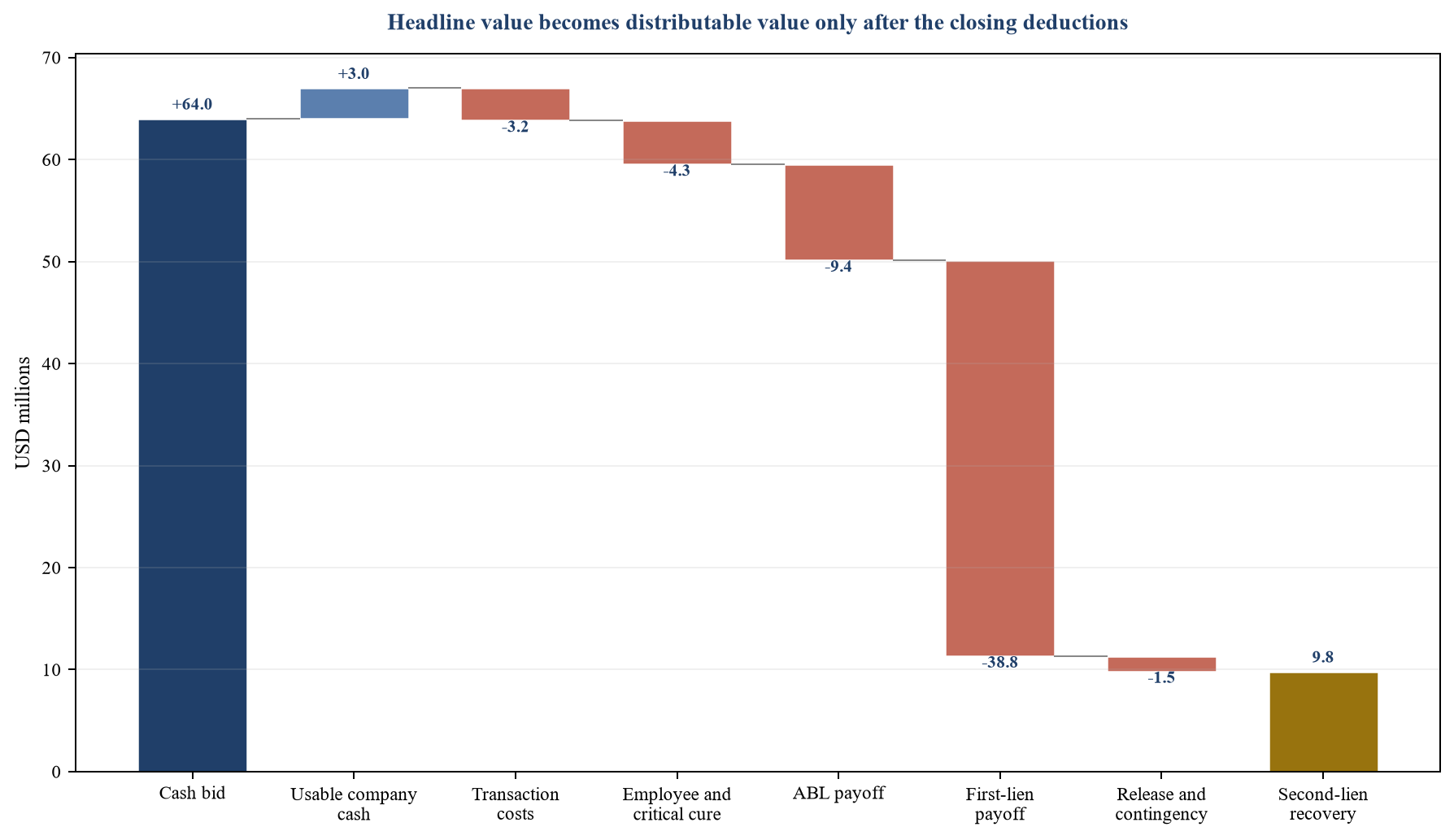
Original analysis using hypothetical amounts. The sequence is a simplified transaction case, not a statement of legal priority.
8. Value the counterfactual before asking for support
Creditors evaluate a proposal against alternatives. The comparison should include at least the proposed sale, a delayed sale, an enforcement or formal process, a refinancing or rescue, and an orderly wind-down where relevant. Each case should use consistent perimeter, timing, costs and recoveries.
The counterfactual should identify who controls the route and whether value deteriorates with time. A creditor can rationally reject a higher nominal recovery if the bid lacks funding, depends on unavailable consents or consumes cash beyond the runway. Another creditor may prefer delay because its collateral is stable while the enterprise value is not. The model should expose those differences.
Valuation should be presented as a range with evidence and sensitivities. It should state whether value is going-concern, orderly-sale, forced-sale or liquidation value. It should show professional costs, trading losses, cure costs, tax and time. The board should avoid using a single low counterfactual merely to pressure dissenting stakeholders.
The European restructuring directive requires class formation on verifiable commonality of interest, separate treatment of secured and unsecured claims at minimum, and conditions for binding dissenting classes. [12] The policy logic reinforces the need for a credible counterfactual and transparent class treatment even where that directive does not govern the transaction.
9. Design creditor classes around rights
Creditor classes should reflect legal rights, security, priority, recourse and proposed treatment. Economic similarity alone may be insufficient. Two creditors with the same recovery percentage can have different rights against collateral, guarantors or third parties. Two facilities with shared security can have different instruction or payment rights under an intercreditor agreement.
The class map should state which claims are affected, how amounts are calculated, who votes, which interests are excluded and which disputes must be resolved. It should reconcile claims to the waterfall and identify creditors whose rights are untouched. A vote should not be solicited before the company understands the information and procedural requirements.
Formal processes can bind dissent in defined circumstances. They also require notice, evidence, class analysis and judicial or administrative approval. A consensual transaction may be faster, but unanimity or instrument-specific consent may be required for matters outside majority authority. The route comparison should address this trade-off explicitly.
Creditor communications should explain the proposal, counterfactual, treatment, timing, risks and implementation. Selective disclosure can damage confidence and create process risk. Sensitive information may require clean teams, confidentiality restrictions or staged access.
10. Read the intercreditor agreement as an operating manual
The intercreditor agreement should be converted into a decision map. Relevant provisions often include ranking, payment blockage, turnover, enforcement instructions, consultation, standstill, distressed-disposal powers, security-agent authority, release of guarantees, application of proceeds, valuation standards and indemnities.
The team should identify the instructing group and calculation denominator. It should test whether defaulted, affiliate-held, non-responsive or transferred debt is included. It should distinguish the vote to direct enforcement from the vote to amend priority or release obligations. Transfers during the process can change the constituency and require updated registers and notices.
Filed intercreditor agreements illustrate how a security agent may be authorised to release security and liabilities in a qualifying distressed disposal if stated conditions and proceeds rules are satisfied. [14] Such an exhibit is evidence of one negotiated contract, not a market-wide rule. The live documents must be read in full.
The operating map should also cover information rights and liability standards. Agents may require formal instructions, certificates, legal opinions, funding and indemnity. A transaction timetable that ignores those requirements can reach signing without an executable release.
The extraction process should begin with the original executed agreement and every amendment, accession, transfer certificate and side letter. A summary prepared for an earlier refinancing can omit a later voting change or an accession by a new creditor. The debt register should be reconciled to the documents before any threshold is calculated. The team should record the relevant clause, the operative wording, the affected instrument, the calculation base, exclusions, notice method, notice period, evidence requirement and person authorised to act. Counsel should validate the completed map for the live transaction.
Threshold analysis should be tested numerically. If an instruction requires a percentage of commitments, the denominator may differ from outstanding principal. Undrawn commitments, hedging exposure, ancillary facilities, defaulted lenders, affiliates and non-cash claims can affect the result depending on the documents. A creditor group that appears to hold an economic majority may therefore lack the required instruction threshold. The analysis should show the amount needed, the amount confirmed, the buffer above or below the threshold and the effect of any disputed or transferred position.
The team should also identify veto rights that sit outside the main majority mechanics. Amendments to ranking, pro rata sharing, release of all or substantially all collateral, borrower substitution, currency, maturity or individual payment rights may require a higher threshold or affected-lender consent. Reserved rights can remain relevant even where a majority controls enforcement. Each reserved matter should be connected to the proposed transaction step so that the board understands whether it is changing rights, using an existing enforcement power or relying on a formal process.
Creditor transfers create a live governance risk during the auction. A supportive lender can sell its position, a distressed investor can accumulate a blocking stake, and an undisclosed affiliate relationship can affect eligibility. The process should monitor transfers where the documents and law permit, refresh contact and authority records, require confidentiality accessions before sensitive disclosure and retest thresholds before every material instruction. The company should avoid assuming that an early support statement remains effective at signing or closing.
The intercreditor map should include proceeds application in operational detail. It should identify which costs rank ahead of secured claims, how enforcement expenses are approved, whether hedge termination amounts share in a secured class, how revolving facilities and letters of credit are treated, whether recoveries must be turned over and where disputed amounts are reserved. It should reconcile contractual application provisions with the statutory route selected for the sale. UNCITRAL and World Bank materials emphasise clarity and predictability in priority and creditor rights; the transaction model should preserve that discipline in the actual closing sequence. [1] [2]
Finally, the security agent's protection package needs its own workstream. The team should determine whether the agent requires lender instructions, transaction documents, a valuation certificate, legal opinions, indemnity funding, advance payment of expenses or confirmation that stated disposal conditions are satisfied. Draft certificates and instructions should be prepared alongside the purchase agreement. The agent should have enough time to review them and raise questions. Completion should never depend on an instruction format first circulated on the closing date.
11. Determine release mechanics asset by asset
The release plan should identify every security interest, guarantee, account control, share pledge, assignment, mortgage, filing and possession arrangement that affects the sale perimeter. Each item should have a governing law, secured party or agent, release condition, document, signatory, filing authority, effective time and evidence of completion.
Payoff and release are connected but distinct. Payment may discharge an obligation while a registered charge remains until a filing is completed. A release document may become effective only when irrevocable funds are received. A guarantee may continue for retained obligations. Foreign-law security may require local notarisation, registration or physical delivery.
The buyer should receive a closing release schedule early enough to review. The seller should obtain draft payoff letters and release deeds before final bid selection. The security agent should confirm the form of instructions and conditions to acting. Legal opinions should address authority and effectiveness where required.
Under section 363 of the United States Bankruptcy Code, a sale free and clear can proceed in specified circumstances, including consent or defined statutory alternatives. [10] The route still requires court process and precise treatment of interests. Outside a formal process, contractual releases and applicable property law remain central.
| Right or document | Decision owner | Trigger or threshold | Closing evidence | Failure consequence |
|---|---|---|---|---|
| Enforcement instruction | Defined instructing creditors | Instrument-specific majority | Executed direction and agent acknowledgement | Sale route lacks authority |
| ABL termination | Facility agent and required lenders | Full payoff and agreed obligations | Payoff letter, account release and commitment termination | Cash and receivables remain controlled |
| First-lien release | Security agent under valid instruction | Distressed-disposal or repayment conditions | Release deed, filings and original documents | Buyer cannot receive clean title |
| Second-lien treatment | Trustee or required holders | Consent, turnover or formal-process treatment | Instruction, release or binding order | Junior challenge or closing hold |
| Guarantee discharge | Relevant beneficiary or authorised agent | Defined liabilities paid, released or assumed | Deed and liability schedule | Seller group retains exposure |
| Statutory approval | Court or competent authority | Route-specific evidence and test | Sealed order or formal approval | Transaction cannot complete on planned basis |
| Filing completion | Registry or local counsel | Executed release and required filing | Receipt, updated search or counsel confirmation | Public record remains encumbered |
The schedule is a transaction-control framework. Exact requirements depend on the governing documents and law.
12. Align the funds flow with the legal waterfall
The funds-flow memorandum should be the bridge between the economic model and the release pack. It should identify every payer, account, beneficiary, amount, currency, bank, payment reference, condition, sequence and authorised signatory. It should distinguish amounts paid at closing from escrowed, retained, deferred or assumed amounts.
The sequence should match the release conditions. Some documents may be held in escrow and released against confirmed funds. Some payoffs require same-day value before an agent releases security. Cross-border transfers can create cut-off, time-zone, sanctions-screening and correspondent-bank risk. The closing plan should include fallback accounts and evidence protocols where lawful and agreed.
The cash model should extend beyond completion. Residual entities may need payroll, tax, insurance, adviser costs, claims reserves and wind-down funding. A transaction that distributes every available dollar can leave the board unable to complete post-closing duties.
The funds flow should be reconciled to the buyer's sources and uses, the seller's proceeds bridge, creditor statements, transaction documents and accounting entries. A dry run should test names, accounts, approvals and file transmission without moving funds.
13. Manage taxes, employees and critical trade creditors
Statutory priority and operational criticality are different. Tax or employee claims may have legal priority in a formal procedure. A supplier may have no statutory priority but can stop delivery, retain title or terminate a licence. The alignment plan should record both legal rank and operational consequence.
Employee amounts can include wages, leave, pension, benefits, retention, severance and transfer obligations. The company should identify the employing entity and timing. Critical suppliers should be ranked by continuity consequence, substitutability, arrears, contractual rights and cure requirement. Customer deposits and prepayments may fund unfinished obligations and should not be treated as free proceeds.
Payments before a formal process can raise preference, transaction-at-undervalue, fiduciary or equality concerns depending on the jurisdiction. The board should obtain advice before making selective payments. The cash forecast should label proposed critical payments and their decision rationale.
Creditor alignment improves when stakeholders understand which payments preserve the transaction estate and which redistribute value. The model should separate continuity funding from creditor recovery and should avoid counting the same amount twice.
14. Control information and negotiations
The company should use one controlled fact base for creditors and bidders. Claims, payoff assumptions, sale perimeter, liquidity and process milestones should reconcile. Material differences should be logged, explained and approved. A data room designed only for buyers can omit the evidence required for creditor decisions.
Creditor materials should include the proposed route, credible alternatives, valuation range, waterfall, timing, assumptions, release plan and requested action. They should state unresolved matters. The company should avoid unsupported commitments about recoveries, timing or approvals.
Negotiations should be tracked by issue rather than by meeting. Each item should record the stakeholder, requested change, economic effect, legal effect, other classes affected, decision owner and deadline. A concession to one group may change another group's treatment or vote.
Confidentiality and market-abuse obligations may apply. Public companies and regulated entities need controlled disclosure and adviser input. The transaction team should know which information can be shared with which creditor under existing undertakings and applicable law.
15. Compare bids on distributable value and release readiness
Headline enterprise value is one component of the decision. The board should compare cash at closing, assumed liabilities, cure funding, conditions, financing evidence, diligence completion, creditor support, release readiness, regulatory path and closing date. A high bid that cannot secure releases before the liquidity deadline may preserve less value.
The comparison should use observable evidence rather than invented probabilities. A readiness score can structure discussion if each component has a defined test and evidence date. The score is not a statistical likelihood of closing.
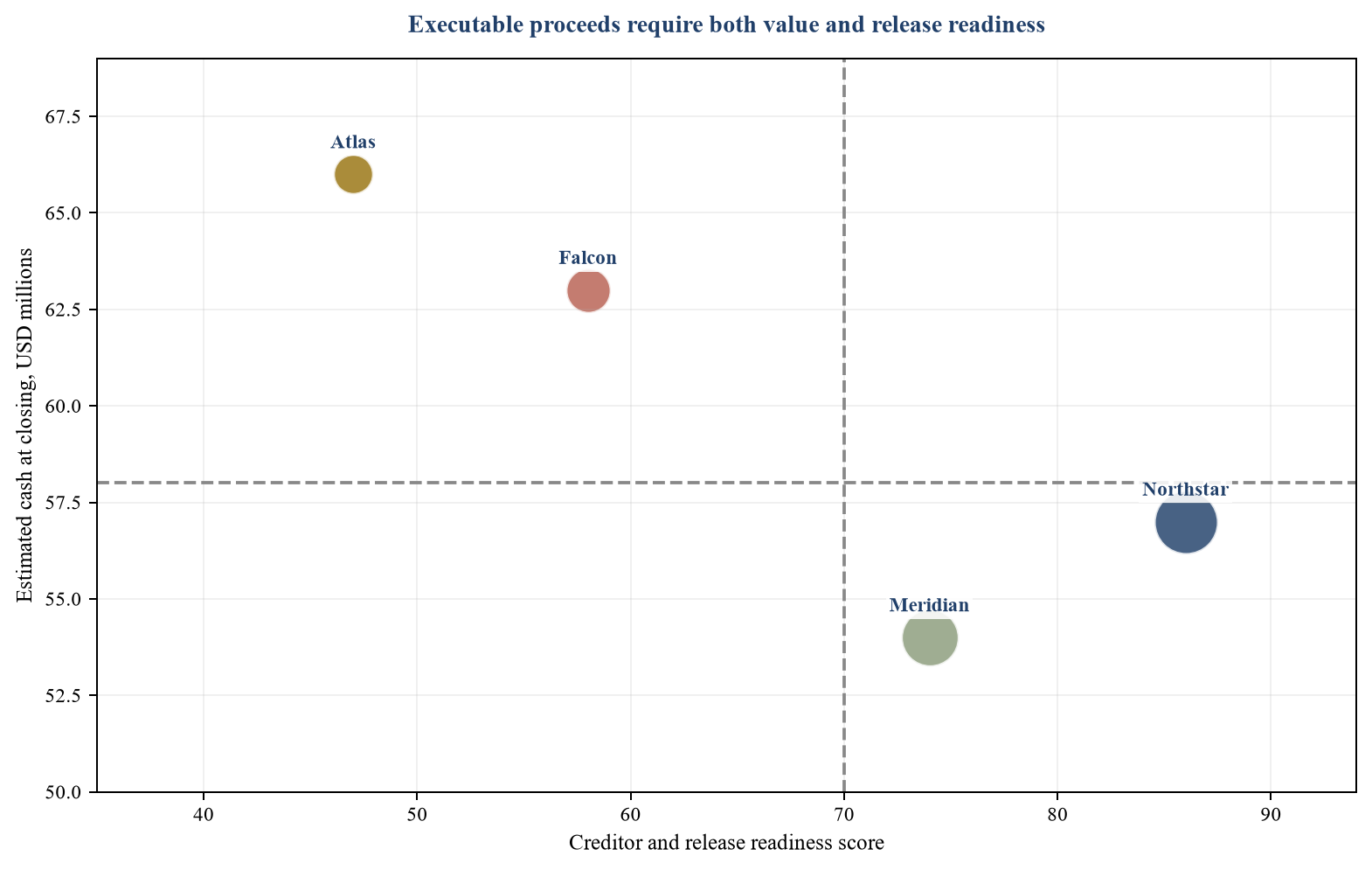
Original analysis using hypothetical bids. Bubble size represents confirmed acquisition funding; the chart does not estimate closing probability.
16. Apply the hypothetical engineering-services case
The hypothetical group operates engineering, inspection and maintenance businesses across three jurisdictions. It has four principal legal entities, shared cash management, secured debt at two ranking levels, an asset-based facility, customer guarantees and a concentrated supplier base. A weekly forecast shows enough liquidity for a controlled process if the company launches promptly and preserves collections.
The reconciled closing claims are USD 9.4 million for the asset-based facility, USD 38.8 million for the first-lien term loan and USD 14.0 million for the second-lien class. The company expects USD 3.2 million of transaction costs, USD 4.3 million of employee and critical-supplier cure requirements and USD 1.5 million of release and contingency reserves. Ordinary unsecured claims total USD 16.0 million.
Northstar offers USD 64.0 million in cash and permits USD 3.0 million of usable company cash to enter the funds flow. After senior closing deductions, USD 9.8 million remains for the second-lien class. Its headline claim therefore is not paid in full, and ordinary unsecured creditors receive no distribution in this simplified consensual-sale case. The result is not a legal-priority opinion and changes under another route.
Falcon offers higher cash at closing but requires fourteen weeks, customer consents and a financing syndicate that has not delivered final commitments. Meridian offers lower value with strong funding and a narrower perimeter. Atlas offers the highest stated value with extensive diligence, deferred funding and uncertain releases. The board compares executable cash and timing, not headline price alone.
| Measure | Northstar | Falcon | Meridian | Atlas |
|---|---|---|---|---|
| Headline cash bid | USD 64.0m | USD 69.0m | USD 61.0m | USD 72.0m |
| Estimated cash at closing | USD 57.0m | USD 63.0m | USD 54.0m | USD 66.0m |
| Creditor and release readiness | 86 / 100 | 58 / 100 | 74 / 100 | 47 / 100 |
| Funding evidence | Signed equity commitment and cash confirmation | Conditional club facility | Signed commitment with limited conditions | Indicative financing only |
| Principal release issue | Final second-lien instruction | Customer and lender conditions | Excluded assets and guarantees | Senior and junior releases unresolved |
| Earliest credible close | Week 8 | Week 14 | Week 10 | Week 16 |
| Board issue | Lower value with strongest execution evidence | Higher proceeds beyond base runway | Executable route with perimeter leakage | Highest headline value without a controlled closing path |
All values, scores and outcomes are hypothetical. Scores structure evidence review and are not statistical probabilities.
17. Use a consent heat map that connects rights to time
The risk map should plot consequence against evidence weakness or unresolved dependency. It should distinguish a missing formal instruction from a commercial objection, an unquantified claim from a disputed priority and an unsigned release from a completed filing.
High-consequence matters should have a route treatment. Missing senior instructions may require engagement, an amended transaction or a formal process. A disputed junior claim may require reserve, escrow, adjudication or route change. A foreign-law release may need local counsel and additional lead time. The issue register should state the latest safe date for each response.
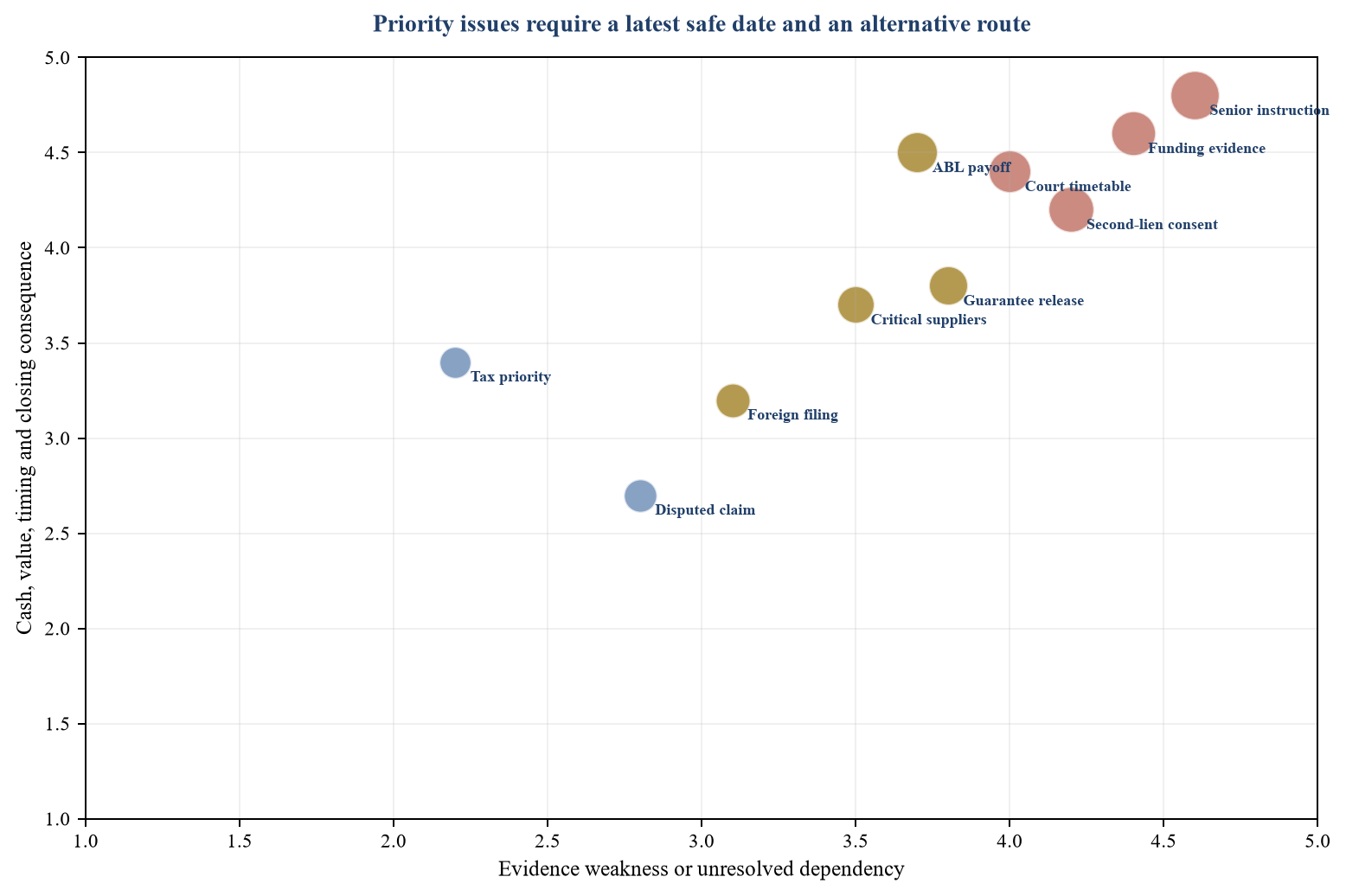
Original framework using hypothetical positions. Ratings require documented evidence and accountable review.
18. Govern the process through a decision committee
The board should retain authority over the transaction perimeter, route, bidder selection, material creditor concessions, minimum cash, formal-procedure decisions and final approval. A transaction committee may manage detailed work within clear reserved matters.
Finance should certify claims, payoff assumptions and funds flow. Legal advisers should certify the authority and release schedule within their scope. The chief restructuring or transaction officer should own the integrated timetable. Security and facility agents should be engaged through the contractually required process.
Conflicts should be disclosed. Directors may represent sponsors, lenders or management. Advisers may have creditor relationships. A creditor may hold debt in several classes or have a proposed financing role. Recusal, independent advice and documented decisions may be required.
The committee pack should show liquidity, route, bid comparison, waterfall, consent status, release readiness, open risks and alternatives. Minutes should record the evidence considered and reasons for decisions. The pack should distinguish confirmed facts from management assumptions.
19. Set trigger-based alternatives before launch
A sale process needs a credible alternative. Triggers may include failure to obtain senior instructions, insufficient funding evidence, a buyer timetable beyond the runway, inability to release material assets, an adverse court timetable or deterioration in operating continuity.
Each trigger should have a date and owner. The alternative may be a narrower perimeter, refinancing, enforcement-led sale, administration, restructuring plan, Chapter 11 sale, UAE process or orderly wind-down depending on the facts and jurisdiction. The board should obtain current advice before selecting any route.
Formal processes can provide stays, class voting, court authority or free-and-clear mechanisms in defined circumstances. They also add notice, evidence, cost and implementation requirements. United States Courts guidance explains that sales outside the ordinary course require permission and that use of cash collateral requires consent or court authorisation with adequate protection. [9] UAE law and executive regulations provide their own procedures, thresholds and court roles. [3] [4]
The alternative should remain prepared while the consensual process advances. A contingency described only after the principal route fails is unlikely to be executable within a short runway.
20. Implement the framework in five phases
Phase one establishes control. The company freezes the perimeter, reconciles cash and debt, obtains current advice, maps entities and collateral, identifies defaults and approves decision authority.
Phase two builds the economics. Finance prepares route-specific waterfalls, counterfactuals, closing payoffs and a weekly liquidity model. Legal advisers convert the finance documents and law into an authority, threshold and release map.
Phase three aligns stakeholders. The company validates claims, engages agents and principal creditors, tests the proposed treatment, requests draft payoffs and releases, and records support, authority and readiness separately. It resolves information and conflict protocols.
Phase four launches and selects. Buyer materials use the controlled perimeter. Bid instructions require funding, conditions, timing and release dependencies. The board compares distributable value and execution evidence, while the alternative route remains ready.
Phase five closes and validates. The parties finalise instructions, court or regulatory approvals, release documents, funds flow, filings and post-closing reserves. Finance reconciles actual payments and remaining liabilities. Legal advisers confirm completion evidence within their scope.
| Phase | Indicative timing | Core outputs | Board gate | Escalation if incomplete |
|---|---|---|---|---|
| Control | Days 1 to 7 | Perimeter, liquidity, claims, entity and security maps | Is the company governed and funded for preparation? | Use emergency liquidity and route advice |
| Economics | Days 5 to 20 | Waterfalls, counterfactual, payoff forecast and recovery ranges | Does the proposal improve the evidenced alternative? | Revise perimeter, value or route |
| Authority and releases | Days 10 to 30 | Threshold map, agent process, payoff drafts and release schedule | Can the required stakeholders bind and deliver? | Prepare formal or enforcement alternative |
| Auction and selection | Days 25 to 60 | Controlled process, bid comparison and creditor engagement | Which bid maximises executable distributable value? | Narrow process or activate alternative |
| Documentation and close | Day 50 to closing | Instructions, approvals, funds flow, releases and filings | Will funds and documents move together? | Hold closing until dependencies are controlled |
| Validate | Closing onward | Payment reconciliation, residual-liability register and completion evidence | Did the transaction match the approved case? | Remediate filings, claims or control failures |
Timing is indicative and should follow verified liquidity, governing documents, law and transaction complexity.
The roadmap should operate as a controlled evidence cycle rather than a static project plan. Every material change in bid value, closing date, perimeter, claim amount, cure requirement, tax position or release condition should flow through the liquidity model, waterfall, consent register and board paper. A change that appears favourable in the purchase agreement can reduce distributable value once additional cure payments, delayed collections or reserve requirements are recognised. The transaction team should therefore identify which schedules are authoritative, who may change them and when each schedule becomes frozen for signing and closing.
The board should require a short exception report at each gate. The report should identify missing evidence, quantify the affected value or liquidity where possible, name the decision owner and state the latest safe resolution date. A red issue should have a defined consequence: delay launch, limit the sale perimeter, change the bid instruction, reserve proceeds, obtain additional authority or activate the alternative route. Amber items should have dated actions and an escalation threshold. Green status should require documented evidence rather than verbal comfort.
Closing preparation should include at least one full funds-flow and release rehearsal. Finance, treasury, legal advisers, the security agent, paying agent and buyer should test account details, payment sequence, document delivery, conditional releases, filing responsibilities and confirmation protocols. The rehearsal should identify circular dependencies, including a release that becomes effective only after payment while the buyer requires evidence of release before funding. The parties can then use escrow, agreed undertakings, simultaneous electronic delivery or another advised mechanism suited to the governing law and transaction documents.
Post-closing validation remains part of the creditor-alignment process. The company should reconcile bank movements to the approved funds flow, confirm the discharge or amendment of each relevant security interest, record residual claims and reserves, complete required filings and preserve the evidence pack. This work protects the integrity of the transaction record and gives directors, lenders, insolvency officeholders and auditors a clear account of how value and authority moved through closing.
21. Conclusion
Creditor alignment is a precondition to an executable distressed auction. The company should know the sale perimeter, claims, collateral, priority, counterfactual, recoveries, authority and release mechanics before it asks buyers to invest time and capital.
The economic waterfall, contractual instruction map and statutory route should remain connected. A commercially supportive creditor may lack binding authority. A majority instruction may not cover every amendment or release. A formal process may bind dissent but still depends on class analysis, evidence, notice, approval and implementation documents.
The hypothetical case shows the decision gap. A USD 64.0 million bid plus USD 3.0 million of usable cash leaves USD 9.8 million for the second-lien class after the stated senior deductions. The result changes if the close is delayed, payoffs move, cure amounts increase, the perimeter changes or a different legal route applies. The board therefore needs live waterfalls and consent evidence rather than a fixed recovery headline.
The reusable principle is direct: every claim should connect to evidence, every recovery to a route-specific waterfall, every consent to defined authority, every release to a document and every closing payment to an approved funds flow. That chain allows the board to launch an auction with a credible path to completion and a prepared alternative if alignment fails.
Sources
- UNCITRAL, Legislative Guide on Insolvency Law, Read the primary source
- World Bank, Principles for Effective Insolvency and Creditor/Debtor Regimes, revised 2021, Read the primary source
- United Arab Emirates, Federal Decree-Law No. 51 of 2023 Promulgating the Financial Restructuring and Bankruptcy Law, Read the primary source
- United Arab Emirates, Cabinet Resolution No. 94 of 2024 concerning the Executive Regulations, Read the primary source
- United Kingdom, Corporate Insolvency and Governance Act 2020 explanatory notes: restructuring plans, Read the primary source
- United Kingdom, Corporate Insolvency and Governance Act 2020 explanatory notes: voting and cross-class cram down, Read the primary source
- UK Insolvency Service, Technical guidance for Official Receivers: distributions, Read the primary source
- UK Insolvency Service, Requirements for independent scrutiny of disposals in administration, Read the primary source
- United States Courts, Chapter 11 Bankruptcy Basics, Read the primary source
- United States Code, Title 11 Section 363, use, sale or lease of property, Read the primary source
- United States Code, Title 11 Section 1126, acceptance of plan, Read the primary source
- European Union, Directive 2019/1023 on restructuring and insolvency, Read the primary source
- Abu Dhabi Global Market, Insolvency Practitioners: relevant legislation, Read the primary source
- United States Securities and Exchange Commission, filed intercreditor agreement exhibit containing distressed-disposal and release provisions, Read the primary source
