

1. Start with the client promise
A booking-centre decision should begin with the service promised to the client. The proposition may include local relationship coverage, strategic wealth advice, discretionary management, access to global products, credit, consolidated reporting, custody, execution, family-governance support and continuity across a change of residence. Each promise creates a different combination of regulated activities, people, systems, contracts and evidence.
The institution should state the client outcome in operational terms. A globally mobile entrepreneur may need one investment policy across several residences, reliable multicurrency liquidity, controlled product access and an orderly migration path when residence changes. A domestic private client may need local advice and tax documentation with access to a regional product platform. A family office may require entity-by-entity custody, delegated authorities and reporting across several jurisdictions. These are different service models even when assets are recorded in the same custody centre.
Commercial aspirations should be tested against permitted delivery. A relationship manager cannot make a client-specific recommendation merely because the group has an attractive product elsewhere. A local representative office may provide general information while lacking permission to advise or arrange. A product approved in one booking centre may be unavailable or unsuitable in another. A custody route may support listed securities while lacking operational capability for private funds, credit facilities or certain digital assets.
The initial design brief should identify the target client corridors, service components, expected volumes, required currencies, product families, credit needs, digital journeys, languages and continuity standards. Management should also define the evidence required to open, advise, transact, hold, report and exit. The result is a service blueprint that can be tested against legal, economic and operating constraints.
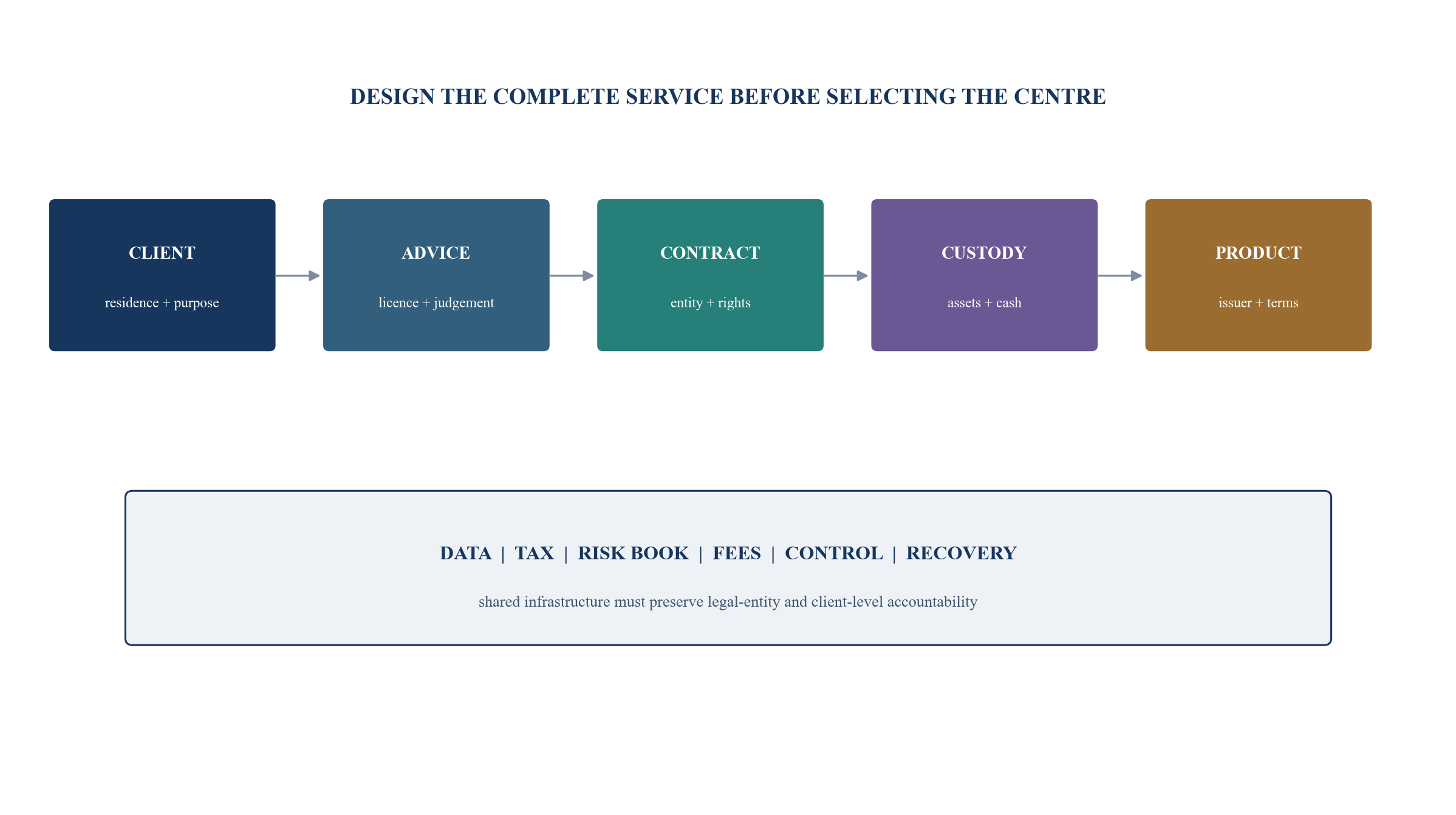
Author framework. Every link requires a named entity, accountable owner, evidence source and contingency route.
2. Separate eight location questions
The phrase booking centre can hide several decisions. The client residence determines important conduct, promotion, tax-reporting and data questions. The relationship manager's location can affect whether an activity is treated as local or cross-border. The advice entity determines the licence, duty and complaint route. The contracting entity defines the client's legal counterparty. The custodian controls assets and cash within its mandate. The product issuer or manufacturer determines the instrument and primary disclosure. The risk-book entity absorbs market, credit or liquidity exposure. The data locations determine processing, access, transfer and resilience obligations.
These locations can coincide. A domestic private bank may contract, advise, custody, book risk and process data through one entity. An international group may distribute them across branches, subsidiaries, affiliates and providers. Distribution can create efficiency and specialist depth; it also creates hand-offs, dependencies and possible gaps between the client experience and legal responsibility.
The institution should create an authoritative entity-and-activity register. Each row should state the activity, client segment, countries served, legal entity, branch, permission, responsible executive, contract, systems, data, outsourcing, revenue, cost, risk, evidence and contingency. The register should distinguish current permission from a proposed licence or exemption. It should also distinguish general marketing, introduction, advice, arranging, management, execution, custody, lending and product manufacture.
Official rules illustrate the distinctions. The DFSA's representative-office guidance limits information to general information about related parties and distinguishes that activity from regulated advice and arranging. The MAS Financial Institutions Directory records institution-level statuses and permitted activities. ESMA's MiFID II materials explain branch requirements for third-country firms in relevant circumstances. The FCA directs international firms carrying on UK regulated activities to the authorisation perimeter. The legal analysis remains corridor-specific.
Table 1. Eight-location control map
| Location question | Evidence required | Principal decision |
|---|---|---|
| client and beneficial owners | residence, tax status, legal capacity, ownership and classification | which conduct, reporting and product rules apply |
| relationship and advice staff | employment entity, physical location, travel, communications and authority | where solicitation, advice and service occur |
| contract and account | signed agreement, branch or subsidiary, governing law and redress | who owes the client duties and performs each service |
| custody and cash | custodian, sub-custodian, account, segregation, lien and recovery terms | where assets and money are controlled and recovered |
| product and execution | issuer, manufacturer, distributor, venue, counterparty and documents | which entity may offer, recommend, arrange and execute |
| market, credit and liquidity risk | ledger, balance sheet, hedge, funding, limits and capital | where exposure is recorded, managed and supervised |
| data and records | controller, processor, system, access, transfer, retention and audit trail | where client information may be used and produced |
| economics and tax | functions, assets, risks, revenue, expense, transfer price and tax filings | how value, cost and profit are supported by substance |
The correct answer depends on the actual corridor, entity, permissions, contracts and facts.
3. Segment corridors before segmenting wealth
Assets under management are an incomplete basis for cross-border service design. The same wealth level can create very different complexity depending on residence, mobility, family structure, product needs and the number of entities involved. A stable domestic resident receiving local advice through a global custodian can be operationally simpler than a smaller client who travels, holds several citizenships, controls operating companies and changes residence.
A useful segmentation uses two axes: corridor complexity and service integration. Corridor complexity rises with the number of residences, tax statuses, beneficial owners, countries of solicitation, restrictions, data transfers and reporting regimes. Service integration rises as the proposition combines advice, discretionary management, financing, custody, private-market products, entity services and consolidated reporting.
Four segments support early decisions. Local-global clients receive local advice and use a global custody or product hub. Mobile-wealth clients require controlled service continuity when location or residence changes. Cross-border family clients combine several family members, entities, advisers and booking centres. Institutional-family clients require negotiated custody, credit, alternatives, governance and reporting across the family balance sheet.
The segment should drive the service perimeter. A local-global model can standardise advice locally while centralising execution and custody. Mobile wealth needs event triggers, travel rules and a residence-change process. Cross-border families need authority and ownership maps. Institutional families may need separate mandates for individuals, trusts, foundations, holding companies and operating businesses. Management should avoid promising a unified service until the operating model can preserve each legal boundary.
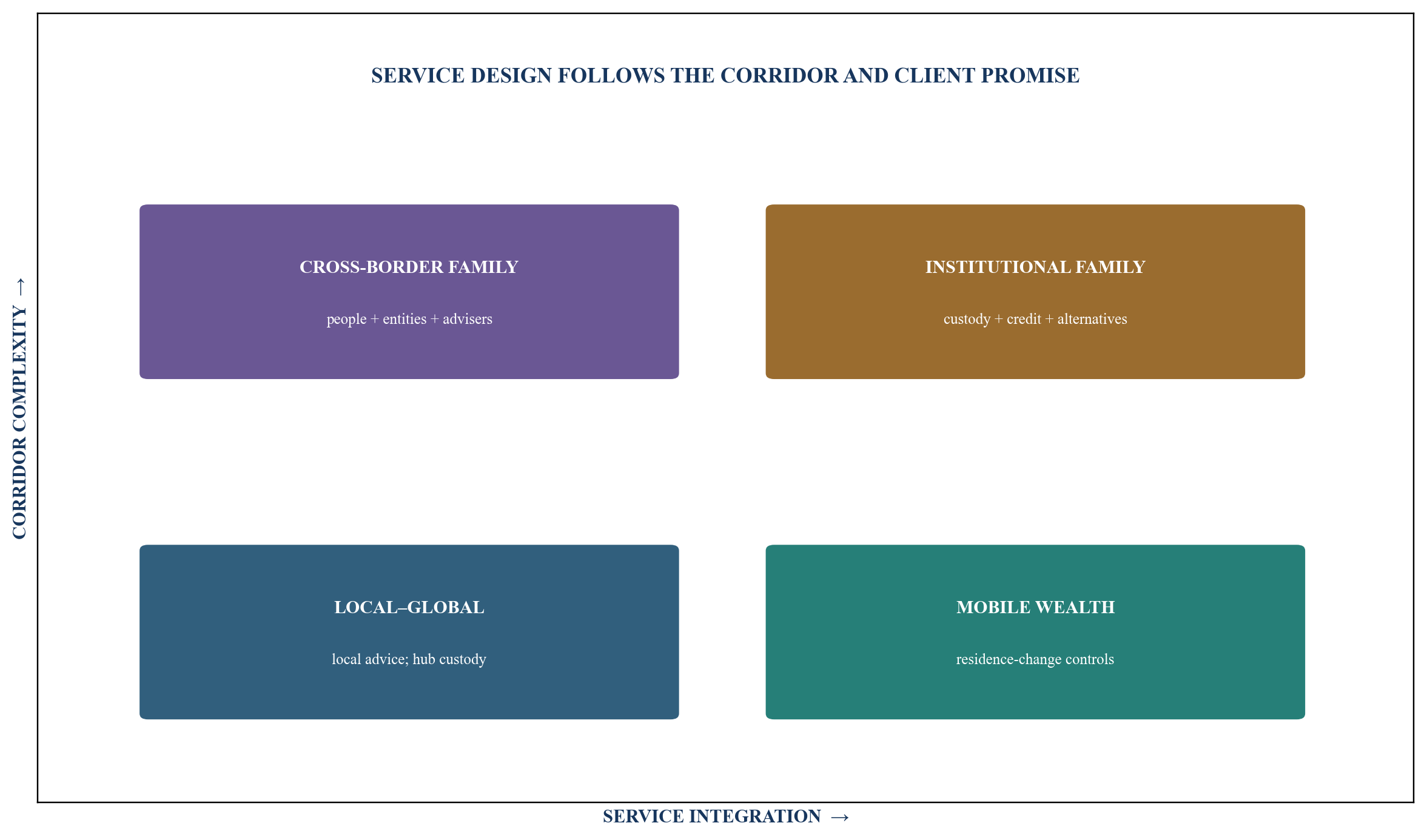
Author framework. Segment positions are qualitative and require client-specific assessment.
4. Establish the market-access perimeter
Market access is an activity-by-activity determination. The analysis should identify the client location and classification, how the relationship began, which people communicate, what is said, which product or service is involved, where each person is located, which entity performs the activity and whether a licence, branch, registration, passport, exemption or client-initiative route applies.
Group policy should translate legal opinions into usable country rules. A relationship manager needs clear permissions for travel, telephone, video, messaging, marketing, product discussion, recommendation, order receipt, document signature and ongoing service. The rule set should cover residents who are temporarily abroad and clients who change residence. Unsupported country codes in a customer system provide limited control when the underlying advice and evidence are inaccessible.
FINMA's cross-border position expects firms to comply with applicable foreign supervisory law and define an appropriate service model for each target market. The European Union's MiFID II Article 39 permits a Member State to require an authorised branch where a third-country firm intends to serve retail clients or certain professional clients. FCA guidance states that international firms carrying on UK regulated activities need authorisation, subject to the applicable perimeter. Singapore's Financial Advisers Act framework and institution directory distinguish entity status and permitted activities. The Hong Kong Cross-boundary Wealth Management Connect shows how an approved corridor can set partner-bank, product, promotion, account and flow rules.
The perimeter file should name its source, effective date, owner and review trigger. New laws, equivalence decisions, licences, enforcement cases, product changes or service innovations should trigger review. Staff should be able to stop activity when the rule is unclear, record the client need and route the question to accountable legal and compliance owners.
5. Choose the legal-entity architecture
The group can deliver through a locally incorporated subsidiary, a branch, a cross-border entity where permitted, a representative office with limited scope, or a combination. The choice affects supervision, capital, liquidity, governance, resolution, tax, data, outsourcing and the client's contract. Management should assess each route against the target service rather than treating legal form as a corporate-administration decision.
A subsidiary creates a separate legal person with local governance, capital and potentially greater supervisory visibility. A branch is part of the same legal entity as its head office and can support integrated delivery, subject to home-host supervision and local requirements. Direct cross-border service can reduce physical infrastructure where permitted, while increasing dependence on precise country rules and controls. A representative office can support presence and introductions within its permitted scope; it cannot be treated as a substitute for regulated advice, arranging or custody.
The UK PRA states that it remains open to highly integrated international firms operating through branches or subsidiaries where expectations are met. Its framework examines effective supervision, prudent conduct, systems, controls, local capability, booking and resilience. The selection should also examine client-assets treatment, deposit protection, complaints, insolvency, access to liquidity, outsourcing and the ability to obtain records.
A group architecture may use several routes. The control objective is to make responsibility clear. The client agreement, disclosures, statements, product documents, trade confirmations, custody records and complaint process should tell a consistent story. Intercompany agreements should support that story by defining services, authority, data, standards, fees, incidents, audit access and exit.
Table 2. Legal-entity architecture decision matrix
| Route | Potential operating strength | Evidence and control questions |
|---|---|---|
| local subsidiary | local governance, balance sheet and supervisory visibility | capital, liquidity, board capability, local systems, recovery and group dependencies |
| branch | integrated legal entity and possible group-scale efficiencies | home-host supervision, local substance, booking controls, depositor and resolution treatment |
| permitted cross-border service | lower physical duplication and access to hub expertise | exact activity perimeter, solicitation, client class, country rules and evidence of permission |
| representative office | local presence, general information and group introductions | strict activity limits, staff scripts, referral controls and no unauthorised advice or arranging |
| partner or third-party model | local capability and broader infrastructure reach | due diligence, client ownership, hand-offs, liability, data, service levels and exit rights |
This matrix supports structured analysis and does not replace corridor-specific legal advice.
6. Map advice to accountable judgement
Advice should sit where the institution can evidence permission, competence, client knowledge, product knowledge, conflicts management, supervision and redress. The physical location of the adviser, employment entity, advisory contract and investment committee can differ. The model should identify who forms the recommendation and who approves or communicates it.
A central investment office can provide research, model portfolios and specialist input. The accountable adviser still needs to test that material against the client, local perimeter and approved shelf. The institution should distinguish general research, investment strategy, personal recommendation, discretionary decision and execution. A group investment view does not automatically become suitable advice for every client or corridor.
The advice record should contain the client objective, risk capacity, horizon, liquidity, knowledge, constraints, existing portfolio, tax and legal considerations within the agreed scope, alternatives considered, product evidence, conflicts, fees, recommendation, explanation and client decision. Where another entity contributes, the record should state its role and the evidence transferred.
Remote advice needs the same clarity. Video, messaging and digital tools can move communications across borders without changing the client's legal needs. Systems should capture staff and client location where relevant, route the activity to the permitted entity and prevent a recommendation when the service perimeter is unsupported.
7. Design the product shelf by corridor
A global master shelf is a research universe rather than a promise that every product is available everywhere. Each corridor view should combine product approval, distributor permission, client eligibility, documentation, language, tax, reporting, custody, execution, liquidity, currency, leverage, financial-crime controls and monitoring. The shelf needs a reason for inclusion and a reason for any restriction.
Product manufacture and distribution should remain distinct. The issuer or fund manager defines the instrument and primary terms. The distributor selects a target market, performs due diligence, approves communications and controls client access. The custodian determines whether the asset can be held, valued, reconciled, transferred and recovered. Credit or structured products can also create balance-sheet and risk-book decisions.
Cross-border private-market access deserves particular care. A feeder, nominee, fund platform or special-purpose vehicle can simplify administration while adding fees, legal entities, tax considerations, liquidity terms and dependencies. Management should compare direct and intermediated routes using the same economic exposure and complete cost.
The shelf should have an exception process. An exception should identify the client need, product, corridor, permission, custody, due diligence, conflicts, fee effect, owner, expiry and monitoring. Repeated exceptions can indicate that the target operating model or product strategy needs revision.
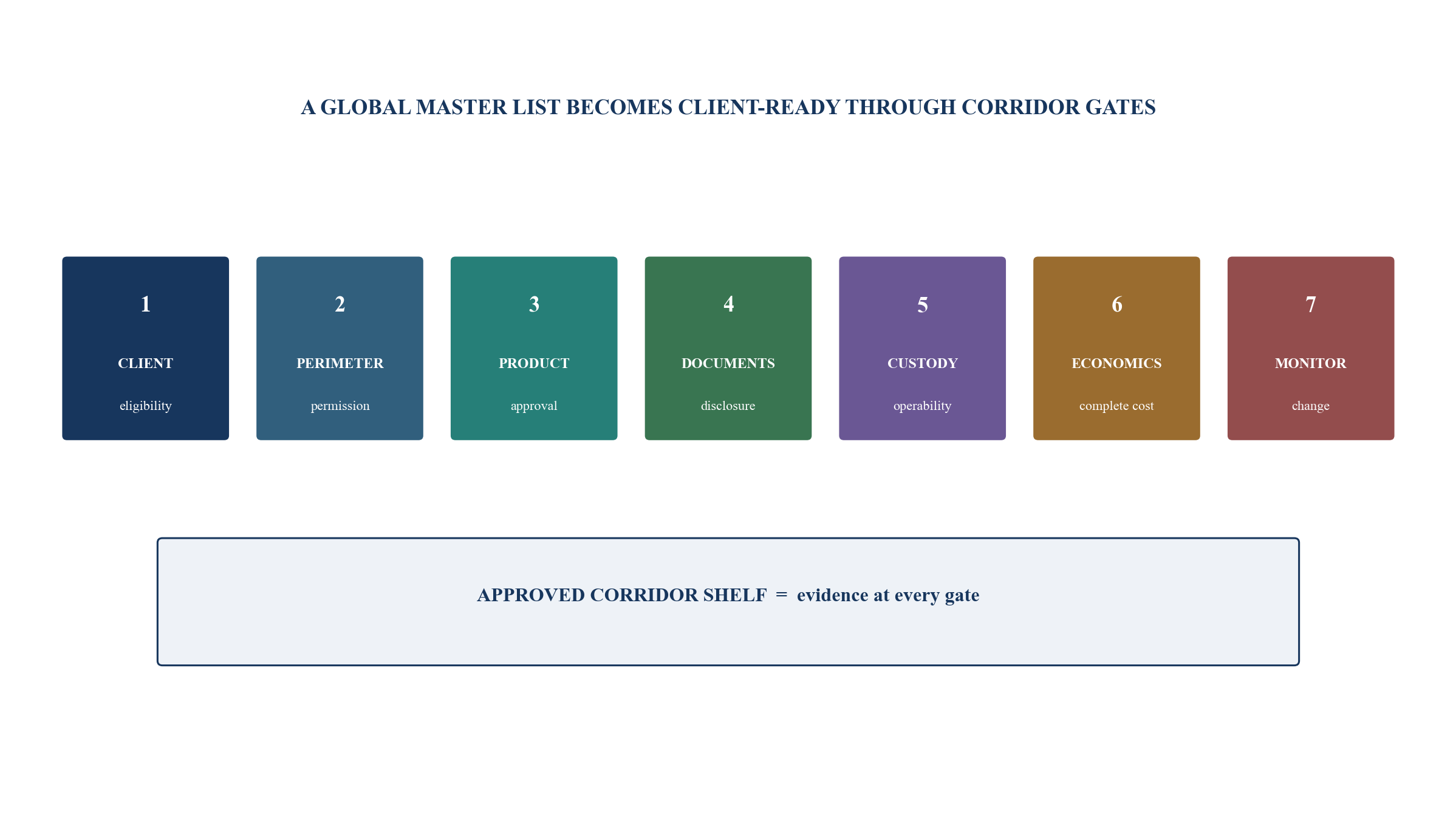
Author framework. All gates require current evidence for the relevant client, entity and product.
8. Make custody a legal and operational decision
Custody determines who safeguards and administers assets, how cash moves, which sub-custodians are used, how records reconcile and what happens during failure. The client may experience custody as a line on a statement; the institution must understand the full chain.
The diligence file should cover legal title, account structure, segregation, use of nominees, client money, liens, set-off, collateral, securities lending, sub-custody, settlement, corporate actions, income, tax processing, valuation, reconciliation, cyber security, outsourcing, insurance, incident response and recovery. The analysis should distinguish arranging custody from providing custody where the applicable regime does so.
Location can affect product access and financing. A custody centre may support a strong listed-asset proposition yet lack the preferred route for locally registered funds, private assets or secured lending. Moving assets between centres can create consent, tax, operational and market risks. The institution should model ordinary transactions, large transfers, death, incapacity, sanctions changes, custodian failure and group-service interruption.
Client disclosures should identify the contractual custodian, material third parties and principal protections and limitations. Internal records should reconcile the client-facing view with legal accounts and ledgers. Management should receive exceptions for failed settlement, unmatched positions, stale valuations, unallocated cash, restricted assets and unresolved corporate actions by entity and corridor.
9. Control data and record location
Cross-border wealth services use identity, ownership, source-of-wealth, transactions, portfolios, communications, preferences and family information. Data can be stored centrally while accessed from several countries. The control map should identify controller and processor roles, systems, physical and logical locations, users, purposes, retention, transfers, encryption, monitoring and production to regulators or clients.
The United Kingdom Information Commissioner's Office explains when international-transfer rules apply and provides checklists for restricted transfers. The applicable analysis should be performed for every relevant data flow and jurisdiction. Contractual mechanisms do not replace the need to test access, security, purpose and retention.
Records should support the regulated activity. The institution needs to reproduce what the client saw, which entity acted, who advised, what evidence was used, which product version applied, how fees were calculated, where an order went and how the outcome was monitored. Central systems should preserve legal-entity and branch dimensions rather than blending them into one client profile.
Operational resilience requires tested alternatives. The Basel Committee's principles call for banks to withstand events that could disrupt critical operations. A cross-border service should identify tolerances, dependencies, fallback communications, alternate access, manual procedures, data restoration and responsibility when a hub, provider, network or country route becomes unavailable.
Table 3. Cross-border advice and suitability workflow
| Stage | Required evidence | Stop condition |
|---|---|---|
| establish client and corridor | residence, presence, classification, ownership, contact route and change triggers | location or authority cannot be established |
| select service entity | permission, contract, staff authority, data route and redress | proposed activity is outside the approved perimeter |
| define client need | objectives, capacity, liquidity, horizon, knowledge and constraints | material client evidence remains incomplete |
| select corridor shelf | product approval, eligibility, documents, tax, custody and execution | product or document is unavailable for the client route |
| form recommendation | alternatives, portfolio effect, conflicts, fees, risks and accountable judgement | advice cannot be supported or explained |
| execute and settle | order authority, venue, counterparty, risk book, cash and custody | instruction or asset route fails control checks |
| monitor and refresh | client changes, product changes, restrictions, valuations, incidents and outcomes | residence, licence, product or service change invalidates approval |
The workflow should be configured to the institution's approved activities and relevant corridor.
10. Locate market, credit and liquidity risk deliberately
For investment banking activities, the UK PRA defines booking broadly as the complete sequence directing a trade to the correct entity or branch, including trade capture, risk transfer, settlement and controls. Its terminology includes centralised, split or multi-hub and remote-booking models. Wealth businesses should use the same discipline for structured products, foreign exchange, lending, derivatives and any service that puts a group balance sheet at risk.
The risk book should follow a coherent business and risk-management rationale. A central hub can aggregate exposures, provide specialist traders, support netting and use common infrastructure. A multi-hub model can provide local capability and resilience while creating duplicated inventory, internal transfers and governance complexity. Remote booking can connect local origination with a hub balance sheet; it requires clear authority, supervision, trade capture, limits, reconciliation and local understanding of resulting risks.
Credit adds further questions. The lending entity, collateral custodian, relationship owner and client adviser may differ. The institution should map underwriting, approval, documentation, collateral perfection, valuation, margin, funding, interest, covenant monitoring, workout and complaint responsibilities. A cross-booking-centre Lombard or mortgage proposition should demonstrate that the promised response remains available during market stress.
Management information should disaggregate risk by legal entity, branch, product, client corridor, originator and booking route. Exceptions should include incorrect entity, unsupported remote booker, late risk transfer, failed hedge, limit breach, settlement failure and data mismatch. Senior responsibility and internal audit should cover the complete framework.
11. Build economics from functions, assets and risks
Booking-centre economics should connect client revenue to the work and risk that produce it. Relevant components include relationship acquisition and service, client advice, discretionary management, investment research, product manufacture, distribution, execution, custody, lending balance sheet, treasury, technology, operations, compliance, financial crime, tax reporting and group management.
The OECD's work on profit attribution to bank permanent establishments and transfer pricing for financial transactions emphasizes functions, assets and risks. The economic model should identify significant people functions, capital and balance-sheet usage, assets employed, control of risk and intercompany services. A revenue split selected solely to reach a target tax result creates poor evidence and can misalign management incentives.
The finance file should reconcile client charges, external product income, trading revenue, credit margin and other revenue to each entity. It should also record direct and allocated costs, provisions, capital and liquidity charges, transfer prices and tax. Each rule needs a policy, rationale, source data, approval and periodic review. Legal agreements and operational reality should match the accounting entries.
The client fee view should remain complete. A client may pay advisory or management fees, custody and administration, transaction costs, product fees, platform fees, financing margin, foreign-exchange spread and taxes. Distribution or retrocession income should be treated according to applicable law and policy. Moving a product or custody route can change both group economics and client outcomes.
Table 4. Hypothetical fee and profit-attribution waterfall
| Component | Hypothetical annual amount | Economic owner or evidence question |
|---|---|---|
| client advisory and management fee | USD 480,000 | which entity contracts, advises and carries conduct responsibility |
| custody and administration fee | USD 90,000 | which entity or provider safeguards, reconciles and services assets |
| product and distribution income | USD 140,000 | who manufactures, approves, distributes and monitors the products |
| execution, foreign-exchange and credit revenue | USD 210,000 | which entities execute, fund and control market or credit risk |
| direct relationship and advice cost | (USD 260,000) | people, travel, suitability, client service and local supervision |
| platform, custody and operating cost | (USD 180,000) | systems, providers, settlement, data, reporting and resilience |
| control, capital and liquidity charge | (USD 150,000) | financial-crime, compliance, risk, capital, funding and recovery |
| illustrative pre-tax contribution | USD 330,000 | reconciled outcome before entity-specific tax and approved allocations |
Every amount is a hypothetical management assumption for method demonstration; no market rate or client result is implied.
12. Measure the client and institutional economics together
A centre can appear profitable while weakening the client proposition. Revenue may rise through a higher-fee product route, wider spreads or internal distribution income while the client's complete cost rises and liquidity falls. Another centre can support superior custody and product access while creating unnecessary duplication for a simple client segment.
The decision model should measure client outcomes, complete costs and institutional economics together. Client measures include availability, suitability, after-fee portfolio effect, service speed, reporting quality, continuity and complaint resolution. Institutional measures include revenue, cost to serve, capital, liquidity, risk, control effort, tax, technology, provider concentration and strategic capacity.
Contribution should be measured after the full service cost. Relationship teams need visibility into exception handling, manual documentation, repeated reviews, complex tax reporting, hard-to-value assets and travel controls. A nominally high-revenue corridor can consume substantial legal, compliance, operations and senior-management capacity.
The institution should also measure scale thresholds. Some corridors justify a local team and entity. Others can be served through a permitted hub or partner. A narrow product need may be solved through an approved platform. The threshold decision should retain non-financial considerations such as client trust, strategic option value, risk concentration and exit cost.
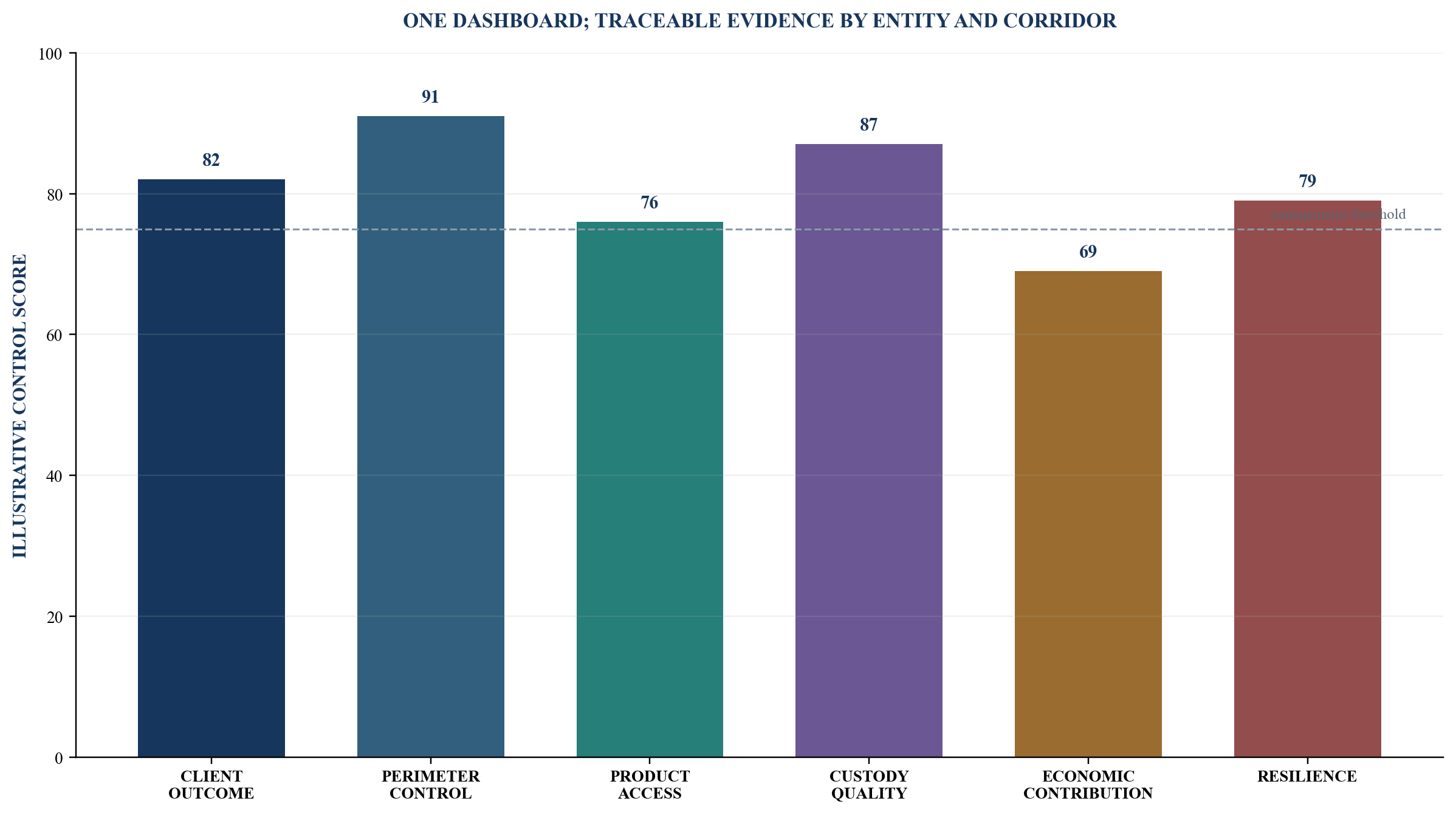
Author framework. Thresholds require institution-specific approval and should connect to underlying evidence.
13. Give the relationship manager one evidence card
The relationship manager is often the human bridge across entities. The operating model should give that person a concise, current record of what can be done and which entity is responsible. The card should identify the client and owners, residence and location, contractual entity, adviser, permitted channels, approved services, custody, product restrictions, credit route, reporting, required disclosures, open exceptions and change triggers.
The card should connect to controlled sources rather than become a manually maintained summary. A change in residence, citizenship, beneficial ownership, legal capacity, client classification, product, sanctions exposure, source of wealth, contact location or service request should trigger the required review. The system should show the effective date and owner of each conclusion.
Training should use corridor scenarios. Staff need to understand the boundary between general information, product discussion, recommendation, arranging, order handling and discretionary management. They also need a route for questions and a documented stop process. Incentives should not reward revenue from activities that cannot be evidenced within the approved perimeter.
Supervision should review communications, travel, system activity, orders, exceptions and complaints by corridor. The objective is to identify mismatches early: advice from the wrong entity, documents from the wrong shelf, unapproved products, unsupported remote activity or custody and risk-book routes that differ from the client record.
14. Govern tax residence and financial-account reporting
Client tax residence and the location where an account is maintained have reporting consequences. The OECD Common Reporting Standard requires self-certification capable of determining the account holder's residence or residences for tax purposes. Its peer-review materials describe annual exchange of information on financial accounts held outside a taxpayer's jurisdiction of residence, covering deposits, custody assets, certain insurance and financial investments.
The institution should treat tax residence as client evidence rather than a booking preference. Onboarding and periodic review should capture all relevant residences, tax identification information, changes in circumstances, controlling persons and entity classification. The record should connect the client, account, custodian and reporting financial institution.
Entity economics also require tax analysis. The OECD framework for bank permanent establishments and financial transactions uses functions, assets and risks. Intercompany advice, distribution, platform, custody, treasury and guarantee arrangements need supportable documentation. Staff presence and authority can also affect permanent-establishment and profit-attribution analysis.
Tax outcomes should be modelled after the operating design. A low headline tax rate does not compensate for an unsupported service perimeter, weak substance or an uneconomic client journey. Management should obtain current advice for the actual structure and retain the assumptions, agreements, calculations and filings that support the chosen route.
15. Integrate financial-crime and sanctions controls
Cross-border private banking carries elevated financial-crime exposure because clients, entities, assets, transactions and counterparties can span jurisdictions. FINMA's risk materials emphasise the risk in cross-border wealth management and the need for defined risk tolerance and effective controls. FATF provides the international framework for customer due diligence, beneficial ownership, politically exposed persons, sanctions-related controls where applicable, ongoing monitoring and record keeping.
The group should define which entity owns onboarding and continuing due diligence, which sources it uses, how reliance works and which data can be shared. A central file can reduce duplication while each regulated entity retains its own obligations. Material differences in risk appetite, customer classification, enhanced diligence, transaction monitoring and reporting should be explicit.
Booking and custody changes should trigger financial-crime review. A new entity, product, country, payment route, private asset, operating company or power of attorney can alter risk. The relationship manager should not assume that prior group approval automatically covers a new service or booking centre.
Management information should show high-risk clients, overdue reviews, source-of-wealth gaps, unusual transactions, sanctions alerts, restricted products and declined or exited relationships by entity and corridor. The board should understand both accepted risk and the capacity of teams and systems to monitor it.
16. Stress the operating model
The institution should test scenarios that cut across legal entities. Examples include loss of a booking-centre licence, sanctions change, data-transfer interruption, cyber incident, sub-custodian failure, liquidity stress, product suspension, market closure, staff unavailability, residence change, client incapacity and provider exit. Each scenario should identify the client impact, authority, data, cash, assets, open orders, collateral, communications and recovery steps.
Operational resilience should focus on important client services. A service such as access to liquidity may depend on advice, credit approval, collateral valuation, custody, payments, data and communications across several locations. Testing one component cannot prove the end-to-end service.
Contingency design can include alternate staff, locally accessible records, second providers, manual orders, alternate payment routes, pre-agreed client communications and transfer plans. The institution should define impact tolerances and conditions for stopping new business. Lessons should update the entity register, contracts, systems and training.
Exit planning matters even in normal conditions. Closing a booking centre or changing custodian requires client consent, product transferability, tax analysis, records, communications, open-order handling and ongoing advice. Exit cost should enter the original economic case.
Table 5. Hypothetical client-corridor cases
| Case | Service need | Principal design issue | Illustrative controlled route |
|---|---|---|---|
| internationally mobile executive with USD 12 million | advice continuity, listed investments and multicurrency liquidity | residence changes and communication across three markets | local permitted advice; global custody; residence-change gate before further advice |
| business-owning family with USD 65 million | entities, private markets, credit and consolidated reporting | several owners, contracts, custodians and product routes | entity-level mandates; hub investment office; approved corridor shelves; consolidated control view |
| entrepreneur after a USD 180 million sale | liquidity, treasury, alternatives and secured credit | concentrated onboarding, product access, data and balance-sheet use | staged service; enhanced diligence; separate custody and risk-book approvals; complete fee review |
All facts, amounts and proposed actions are hypothetical management assumptions used solely to demonstrate the framework.
17. Use seven approval gates
Gate one approves the target client segment, corridor and client promise. Gate two confirms legal entities, permissions, staff activities, contracts and market access. Gate three approves advice governance, product shelf, custody, execution and credit routes. Gate four validates data, tax reporting, financial crime and record production. Gate five completes economics, transfer pricing, capital, liquidity and tax. Gate six tests technology, providers, operations, resilience, complaints and exit. Gate seven authorises a limited launch with named thresholds and monitoring.
Each gate should have an accountable owner, evidence pack, decision, conditions and expiry. A red issue in one gate should remain visible across the programme. Commercial urgency should be recorded; it does not substitute for permission or operational readiness.
The limited launch can restrict clients, products, countries, staff, communications and transaction types. Management should compare the observed client journey, control performance and economics with the approved case. Expansion should require evidence of sustained service quality and closed material issues.
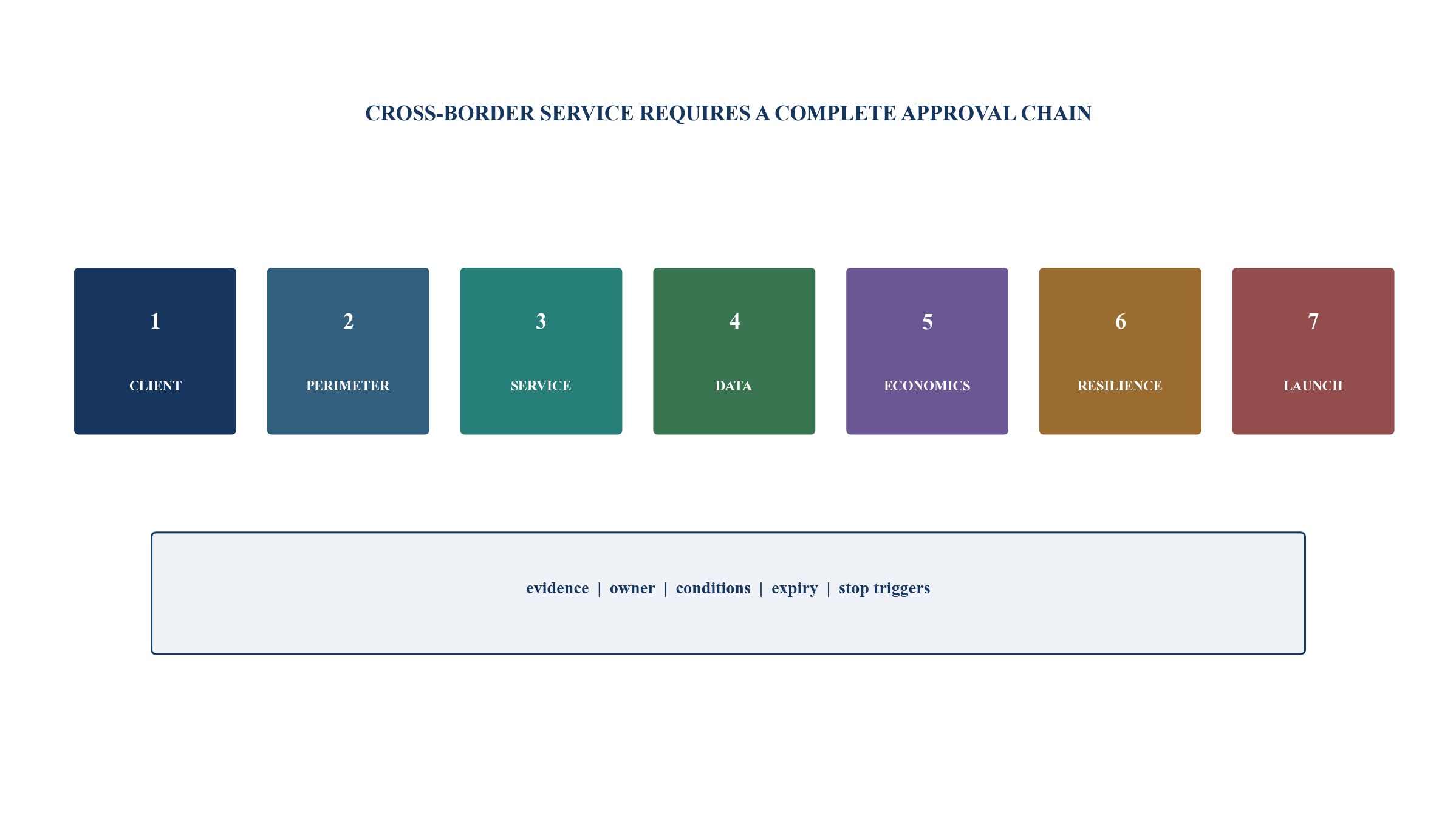
Author framework. A gate records decision evidence and does not cure a failure in another control domain.
18. Implement through a 180-day sequence
Days 0 to 30 should define the client corridors, service promise, current legal entities, revenue, assets, products, staff and known incidents. The team should establish governance, evidence standards and a single issue register. Management should identify any current activity that lacks a clear owner or perimeter conclusion.
Days 31 to 60 should complete the activity-and-entity register, country rules, client segmentation, contract map, product shelf and custody routes. Legal, compliance, tax, finance, data and operations owners should document the current state and target decisions. Unsupported activities should be stopped, restricted or routed through an approved alternative.
Days 61 to 90 should design advice governance, client journeys, the relationship-manager evidence card, data controls, tax reporting, financial-crime reliance, economics and transfer pricing. Systems should preserve entity, branch, staff, client, product, custody and risk-book dimensions. Intercompany agreements and client documents should be reconciled with the target model.
Days 91 to 120 should configure controls, reports, training, product gates, custody operations, fee calculations, communications and exception workflows. Testing should cover ordinary service and failure scenarios. The programme should verify that records can be produced to clients, auditors and relevant authorities.
Days 121 to 150 should run a limited pilot with approved clients, staff and products. Every advice, order, fee, transfer, exception and complaint should receive enhanced review. Management should compare actual service time, product access, control effort and contribution with the approved case.
Days 151 to 180 should close material issues, approve the continuing operating model and establish periodic reviews. Expansion should follow evidence. New corridors, products, entities, custody routes or technology should return through the relevant gates.
19. Build a board and management scorecard
The board needs an integrated view of client outcomes, market access, conduct, financial crime, assets, risk, economics and resilience. Aggregate assets and revenue cannot reveal where a service depends on an unsupported activity or fragile provider. The scorecard should support drill-down by legal entity, branch, client corridor, product, custodian and relationship team.
Leading indicators include clients with unclear residence, activity outside approved country rules, expired legal opinions, shelf exceptions, custody breaks, stale documents, overdue reviews, incorrect booking, unallocated revenue, transfer-pricing exceptions, data incidents and failed resilience tests. Outcome measures include client understanding, suitable implementation, complete cost, service availability, complaint resolution and successful transfer or recovery.
Management thresholds should define action and authority. A threshold breach may pause onboarding, restrict a product, require remediation, change a provider, reprice a service or exit a corridor. Every action should have an owner and due date.
The scorecard should link to evidence. A green status should mean that required records are current, tested and within approved tolerance. Self-reported confidence without accessible evidence should remain an open issue.
Table 6. Board scorecard for cross-border booking-centre governance
| Domain | Board question | Decision evidence |
|---|---|---|
| client outcome | does the model deliver suitable, understandable and continuous service? | client files, portfolio outcomes, fees, service measures and complaints |
| perimeter | can every activity be traced to a permitted entity and corridor? | entity register, country rules, licences, communications and exceptions |
| assets and products | are custody, product, execution and credit routes controlled? | shelf approvals, reconciliations, incidents, liquidity and recovery tests |
| financial crime and tax | are ownership, residence, source of wealth and reporting current? | due diligence, monitoring, self-certifications, filings and assurance |
| economics | do revenue, cost, capital, liquidity and profit attribution follow substance? | ledgers, functional analysis, agreements, transfer prices and tax records |
| resilience | can important client services continue through disruption or exit? | dependency maps, tolerances, exercises, recovery actions and lessons |
| governance | are owners acting on breaches and changing facts? | committee decisions, conditions, actions, due dates and internal audit |
Thresholds and risk appetite require institution-specific approval; no numerical target is assumed here.
20. Make location a continuously governed decision
A booking-centre structure should change when the client base, rules, people, products, technology or economics change. The institution needs periodic corridor reviews and event-driven reassessment. Material triggers include a new country, residence change, acquisition, licence change, new product, custody provider, technology platform, data-transfer route, tax rule, sanctions event, service failure or sustained economic underperformance.
The durable operating principle is traceability. Management should be able to show who the client is, where the client and adviser were, which entity acted, what activity occurred, which contract and permission applied, where assets and risk sat, which data moved, how the client and group paid, and who owned the outcome. This chain supports client trust, supervision, tax, resilience and disciplined growth.
The institution should retain a single accountable service owner for the client, supported by an explicit entity network. Local teams contribute client knowledge and permitted coverage. Hubs contribute scale, product expertise, investment capability, custody or balance sheet. Providers contribute defined services under controlled agreements. The operating model becomes viable when every contribution is evidenced and the hand-offs work in practice.
The board question is concise: can the group reproduce the complete client service from first contact through advice, product, execution, custody, risk, fees, reporting and recovery, by entity and corridor? A complete answer supports expansion. Missing links require remediation before the model scales.
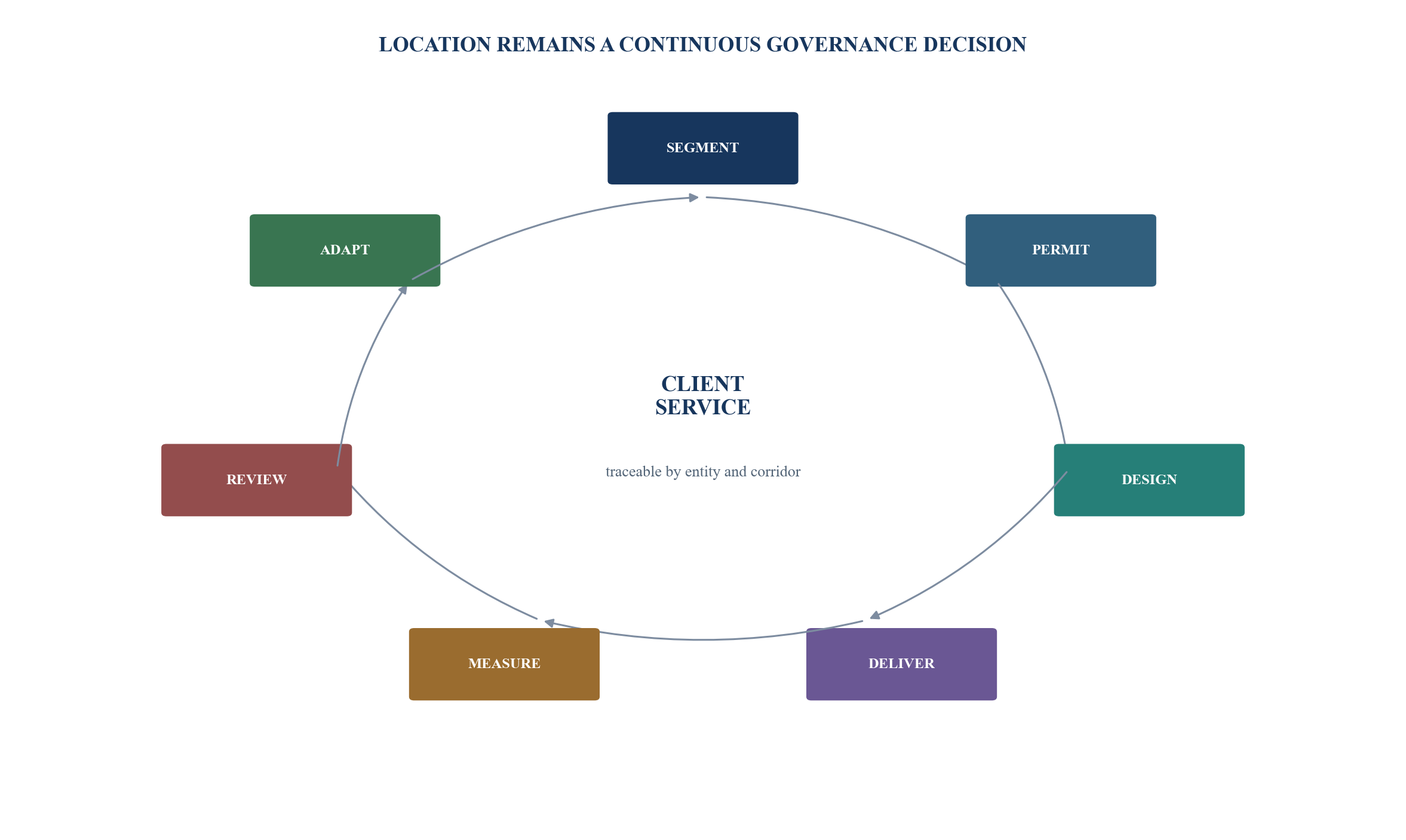
Author framework. A change in client, corridor, entity, product or provider returns the service through controlled review.
References
- Swiss Financial Market Supervisory Authority, Position paper on the legal and reputational risks in cross-border financial services, 22 October 2010, https://www.finma.ch/en/news/2010/10/mm-finma-positionspapier-rechtsrisiken-20101022/
- Swiss Financial Market Supervisory Authority, Financial Services Act and Ordinance, https://www.finma.ch/en/documentation/legal-basis/laws-and-ordinances/finanzdienstleistungen/
- Swiss Financial Market Supervisory Authority, Money laundering and sanctions, https://www.finma.ch/en/documentation/dossier/dossier-geldwaeschereibekaempfung/geldwaescherei-und-sanktionen/
- Swiss Financial Market Supervisory Authority, Guidelines on the Berne Financial Services Agreement, 31 October 2025, https://www.finma.ch/en/~/media/finma/dokumente/dokumentencenter/wegleitungen-archiv/w_bfsa_20251031.pdf
- Prudential Regulation Authority, International banks: the PRA's approach to branch and subsidiary supervision, Supervisory Statement 5/21, effective 24 April 2026, https://www.bankofengland.co.uk/prudential-regulation/publication/2021/july/pra-approach-to-branch-and-subsidiary-supervision-ss.
- Prudential Regulation Authority, International firms: Updates to SS5/21 and branch reporting, Policy Statement 6/25, 20 May 2025, https://www.bankofengland.co.uk/prudential-regulation/publication/2025/may/international-firms-upates-to-ss521-policy-statement
- Financial Conduct Authority, International firms looking to do business in the UK, https://www.fca.org.uk/firms/wholesale-markets-firm-applicants/international-firms
- Financial Conduct Authority, Perimeter Guidance Manual, PERG 2, https://handbook.fca.org.uk/handbook/perg2
- Financial Conduct Authority, Berne Financial Services Agreement for UK and Swiss firms, https://www.fca.org.uk/firms/berne-financial-services-agreement
- European Securities and Markets Authority, MiFID II Article 39: Establishment of a branch, https://www.esma.europa.eu/publications-and-data/interactive-single-rulebook/mifid-ii/article-39-establishment-branch
- European Banking Authority, Market access, https://www.eba.europa.eu/regulation-and-policy/market-access
- European Commission, Equivalence of non-EU financial services frameworks, updated 23 December 2025, https://finance.ec.europa.eu/eu-and-world/equivalence-non-eu-financial-services-frameworks_en
- Monetary Authority of Singapore, Financial advisers, https://www.mas.gov.sg/regulation/capital-markets/understand-the-types-of-capital-market-entities/financial-advisers
- Monetary Authority of Singapore, Financial Institutions Directory, https://eservices.mas.gov.sg/fid/institution/print?sector=Financial+Advisory
- Hong Kong Monetary Authority, Amendments to Implementation Arrangements for the Cross-boundary Wealth Management Connect Pilot Scheme, 24 January 2024, https://brdr.hkma.gov.hk/eng/doc-ldg/docId/20240124-9-EN
- Hong Kong Monetary Authority, Promotion and Sale Arrangements under the Southbound Scheme, 12 June 2025, https://brdr.hkma.gov.hk/eng/doc-ldg/docId/20250612-3-EN
- Dubai Financial Services Authority, Representative Offices: Frequently Asked Questions, https://www.dfsa.ae/application/files/1815/8401/9895/20190805_Rep-Offices-FAQ.pdf
- Dubai Financial Services Authority, What does Regulated by the DFSA mean?, 24 March 2022, https://www.dfsa.ae/news/regulated-dfsa
- Abu Dhabi Global Market Financial Services Regulatory Authority, Client classification, client assets and conduct enhancements, https://www.adgm.com/media/announcements/adgm-fsra-enhances-financial-regulatory-framework-for-client-classification
- Organisation for Economic Co-operation and Development, Report on the Attribution of Profits to Permanent Establishments, https://www.oecd.org/content/dam/oecd/en/publications/reports/2008/07/report-on-the-attribution-of-profits-to-permanent-establishments_4b2cfc48/c628bb9f-en.pdf
- Organisation for Economic Co-operation and Development, Transfer Pricing Guidance on Financial Transactions, 11 February 2020, https://www.oecd.org/en/publications/transfer-pricing-guidance-on-financial-transactions-inclusive-framework-on-beps-actions-4-8-10_794bcddd-en.html
- Organisation for Economic Co-operation and Development, International Standards for Automatic Exchange of Information in Tax Matters, https://www.oecd.org/en/publications/international-standards-for-automatic-exchange-of-information-in-tax-matters_896d79d1-en/full-report/component-13.html
- Financial Action Task Force, The FATF Recommendations, updated 2026, https://www.fatf-gafi.org/en/publications/Fatfrecommendations/Fatf-recommendations.html
- Information Commissioner's Office, A brief guide to international transfers, updated 15 January 2026, https://ico.org.uk/for-organisations/uk-gdpr-guidance-and-resources/international-transfers/a-brief-guide-to-international-transfers/
- Basel Committee on Banking Supervision, Principles for operational resilience, 31 March 2021, https://www.bis.org/bcbs/publ/d516.htm
- Bank for International Settlements, International finance through the lens of BIS statistics: the geography of banking, December 2024, https://www.bis.org/publ/qtrpdf/r_qt2412e.htm
About the Author
Chennakeshav Adya is an independent researcher and Managing Partner of Matchpoint Partners. His work examines strategy, capital formation, valuation, transactions and operating execution across private and public markets.
