

1 Put the execution problem before the pitch
A seller does not buy a logo; it appoints people to prepare, market, negotiate and help close a particular transaction. A persuasive pitch may show prior deals and access to buyers. The owner still needs to know who will do the valuation work, build the information memorandum, maintain the data room, contact potential acquirers, manage diligence and reconcile offers. Cross-border transactions add legal, competition, investment, sector and financing questions whose treatment depends on the actual parties and assets. These questions should be visible when an adviser is selected, not discovered after an exclusivity period begins.
This paper uses “execution” in a narrow, observable sense. It means producing agreed work products, administering a controlled process, escalating decisions and documenting a path from initial preparation to signed and completed terms. It does not mean that the adviser can make a buyer bid, secure a regulatory clearance or guarantee closing. A mandate can be well executed and still end without a sale because the owner's reservation value exceeds available offers or because a material risk cannot be resolved. Equally, a quick sale may reflect an unusually attractive asset rather than superior advice.
The seller's question is consequently specific: which adviser and named team have the relevant permission, experience, capacity, access, judgement and contractual accountability for this sale perimeter? The word “local” must be unpacked. It may refer to a regulated establishment, language capability, relationships, sector knowledge, on-the-ground diligence capacity or familiarity with public authorities. None substitutes automatically for the others. A firm operating from one GCC financial centre may need a different permission or a qualified partner for another jurisdiction or activity. Counsel should confirm the applicable perimeter.
Historical research offers useful questions, with limited transferability. Studies of large, mostly public transactions associate adviser characteristics with some announcement and completion measures in their samples [1–3]. They cannot prove that a particular adviser will shorten a private GCC seller's timetable. The defensible near-term response is evidence collection and contracting. A future empirical study could test whether those practices predict outcomes once the relevant records, including unsuccessful processes, are available.
2 Define the proposed sale before asking for credentials
Adviser comparison begins with the asset being sold. An owner may offer shares in one company, a group holding multiple licences, an operating division, a portfolio of contracts or a minority interest with continuing governance rights. These are different assignments. An adviser whose references concern whole-company sales may have little relevant experience in a complex carve-out. A team that knows a sector may still need legal support to explain which contracts, employees, intellectual property and liabilities move with the business.
The request for proposal should state the ownership structure, broad scale, countries of operation, known regulated activities, available financial information, preferred transaction perimeter and owner objectives. It should disclose enough for advisers to assess fit while protecting competitively sensitive information. The owner should identify who can approve outreach, decide on price guidance, approve a bidder's access to information and accept final terms. If family shareholders, a fund investment committee or a government stakeholder must participate, their decision rights belong in the timetable from the outset.
The seller should also distinguish reasons for a sale. Liquidity for one shareholder, full exit, a strategic partner, growth capital and a debt-led recapitalisation can lead to different buyer universes and fee incentives. A mandate framed only as “find a buyer” leaves room for incompatible assumptions. An adviser may propose an auction when the seller needs speed and discretion, or a negotiated bilateral route when a broader market test would better establish value. The pitch should state why its proposed route fits the owner’s objectives and the asset's disclosure risk.
The initial perimeter is a working specification, not a promise that every asset can transfer. Legal, tax, accounting, regulatory and employment consequences require transaction-specific advisers. If uncertainty is material, the investment-banking adviser should state what it needs from specialists and when. A credential review is more meaningful against that map than against a generic list of completed deals.
3 Read the adviser evidence cautiously
Golubov, Petmezas and Travlos examined acquisitions in their historical sample and found that top-tier bidder advisers were associated with higher bidder announcement returns in public acquisitions; the pattern did not carry uniformly to private and subsidiary targets [1]. Their paper also considers completion and timing, but its setting is bidder-side advice, largely outside the private GCC sell-side problem. A seller cannot import a return premium, a probability of completion or a number of days saved from that study into this mandate.
Hunter and Jagtiani studied announced mergers involving publicly traded companies in a 1995–2000 sample, analysing adviser choice, fees and effort [2]. Their associations between adviser tier and transaction outcomes help motivate questions about resources and incentives. They do not establish that paying a higher fee causes a faster sale. Adviser choice is endogenous: larger or more difficult transactions may hire prominent advisers, and better prepared clients may seek particular firms. A completed-deal sample also omits mandates that never reached announcement.
Lawrence, Raithatha and Rodriguez examined cultural and institutional factors in cross-border acquisitions [3]. Their analysis connects completion and duration primarily with deal-level characteristics, while identifying adviser-related associations in its own sample. For a GCC seller, the methodological lesson is to control for deal complexity before attributing a delay to an adviser. A multi-country asset sale with competition reviews should not be compared naively with a domestic transfer of a small unregulated business.
These sources justify an evidence framework rather than a prestige ranking. An owner can examine whether a proposed team has worked on comparable assets, handled the relevant stages, managed a similar approval sequence and stayed engaged through difficult diligence. It should ask for the denominator: how many mandates of the stated type were attempted, how many were paused or withdrawn, and which roles were actually performed. Client confidentiality may limit disclosure. The adviser should then offer permissible, independently checkable substitutes instead of an unverifiable success percentage.
4 Verify permission in its jurisdiction and activity
Before a seller treats an entity's regulated status as a credential, it should identify the entity that will sign and perform the mandate. Brand names, group memberships and informal representative offices do not establish that a particular legal entity may conduct a particular regulated activity. The seller and counsel should map the activities proposed in the engagement letter, the location of the parties and the applicable rules. The adviser should explain which entity will provide which service and when another licensed firm or counsel is required.
The ADGM Financial Services Regulatory Authority maintains a public register of firms and individuals [4]. The Dubai Financial Services Authority has a public firms register for DIFC-authorised entities [5]. Saudi Arabia's Capital Market Authority publishes information on authorised financial-market institutions and their activities [6]. These are useful sources for checking an entity's name, status and stated permissions within their respective regimes. They do not create a single pan-GCC licence, and the presence of a name does not prove capability for a specific sale. Record the date of the check, register URL, exact legal name, permission and any restriction shown.
A negative result needs investigation before judgment. An adviser could be operating through another entity, relying on an exemption, conducting a service outside the scope of the searched regime or not be authorised for the proposed work. Each explanation has different implications. A seller should ask the firm for the legal basis and have qualified counsel assess it. The seller should avoid using a public-register check as a substitute for a legal opinion about activities across borders.
Figure 1 places permission at the entry point of a broader ladder. Regulatory eligibility is essential where applicable; it cannot answer whether the named people can deliver. The seller should next verify their roles in comparable completed transactions, ask who is available now, inspect the proposed process and record how evidence will be refreshed. The ladder makes a claim harder to inflate: a list of group-level deals remains group-level evidence until the actual team's contribution is documented.
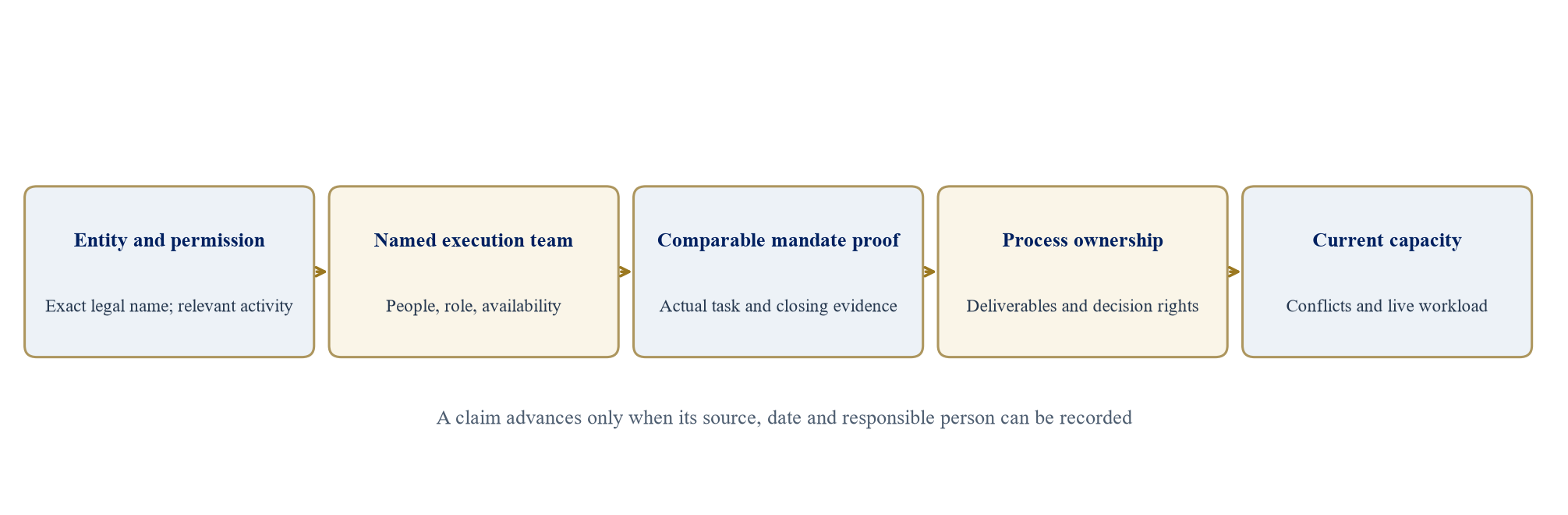
Author-developed decision sequence. Permission checks depend on the applicable legal perimeter; the diagram does not certify any firm.
5 Attribute completed transactions to the people who worked on them
Transaction tombstones are often compressed descriptions. A firm may say it “advised on” a sale without stating whether it originated the buyer, prepared the materials, led negotiations, raised financing, conducted valuation, provided legal advice or occupied a limited supporting role. The seller should seek a role statement for each example used as evidence. It should name the client side, transaction type, stage entered, stages completed, jurisdictions and the members of the proposed team who performed the work. Where identity is confidential, the adviser can describe the role and offer a reference under suitable conditions.
Comparable does not mean identical. The most useful reference may come from a different industry with the same hard execution feature: a multi-licence perimeter, founder succession, related-party contract, earn-out, regulated buyer or complex carve-out. Conversely, a deal in the target's sector may be a poor comparator if it involved a listed buyer, clean balance sheet and straightforward domestic transfer while the present assignment requires debt restructuring and multiple shareholder approvals. Ask the adviser to explain both similarity and difference.
The seller should distinguish announcement from closing and initial pitch from assigned responsibility. A press release about a completed deal can verify that a transaction occurred; it may not identify the individual banker or every function performed. Confidential references may verify the team's conduct but could be selected by the adviser. The evaluation file should preserve source type and limitations. When a reference is unverifiable, record that status instead of converting a broad claim into a fact.
Team continuity is another issue. A senior rainmaker may have built the firm's deal list, while the people on the present mandate have different backgrounds. The engagement letter should identify the accountable lead, principal workstream owners and replacement rules. The owner should meet the actual analysts or vice presidents who will prepare the data and run day-to-day process management. A client can ask how much of the relevant completed work rests with each person and how the firm handles departures during a live sale.
6 Test current capacity and conflicts before exclusivity
Historical capability can be neutralised by present workload. A proposed team may be running multiple live sell-side processes, advising an obvious buyer, financing a competitor or supporting another project with a coincident deadline. A seller should ask for a capacity plan that names the accountable lead, the people assigned, their expected work products and the escalation path if another mandate demands attention. The adviser need not disclose confidential client names to explain its capacity and conflict-control process.
Conflicts should be examined against buyers, lenders, shareholders and related services, not merely against the target's direct competitors. An adviser might hope to win financing or buy-side work from a prospective acquirer. It might hold an economic interest in a service provider whose work the seller will purchase. The relevant question is how those interests could affect buyer selection, information flow, valuation advice and fee incentives. The DFSA's 2026 thematic review addresses the treatment of conflicts among DIFC firms [7]; its scope is the DIFC firms covered by that regulator. Counsel should consider the applicable rules and contractual disclosures for the actual adviser.
An abstract assurance of independence is weak evidence. A conflict declaration should identify categories of relationships, an update duty, who evaluates a newly arising conflict, information barriers where appropriate and the client's right to approve or terminate an affected activity. A public-register status alone says nothing about the firm's present commercial relationships. Sellers should record the review before confidential material reaches the adviser and refresh it when the buyer list changes.
Capacity also includes technical support. A cross-border sale may require accounting-quality earnings analysis, sector licences, competition assessment, tax structure, employment transfer advice and cyber or environmental diligence. The investment-banking adviser need not perform every specialist task; it should coordinate dependencies and identify who will be engaged, budgeted and instructed by the owner. A pitch that promises full execution without an accountable work map invites delay when an issue crosses professional boundaries.
7 Use a claim-to-evidence matrix
Table 1 converts common pitch statements into checkable questions. It is a diligence tool, not a weighted score. The owner can add columns for the source document, observation date, who verified it, outstanding evidence and the final decision. A strong firm may have some blanks because private transactions are confidential. The adviser should explain how those blanks can be narrowed lawfully. Missing evidence should remain visible; it must not silently become an adverse finding or a favourable assumption.
Different claims need different evidence. Regulatory permission is checked against the relevant public register and legal analysis. A completed transaction may be supported by a public announcement or a confidential client reference. Buyer relationships can be tested through a buyer-specific route and authorised contact, not by a count of names in a database. “Global reach” should be translated into who performs work in each jurisdiction and how the home team supervises it.
The matrix also helps keep interview questions comparable. Each finalist should receive the same sale perimeter and answer the same core questions. Follow-up questions can explore unique strengths. A seller may value discretion above a broad auction, or may require international investor access. That preference belongs in the decision record. It need not be disguised as a numerical prediction of closing probability.
Table 1. Adviser claim-to-evidence matrix
| Adviser claim | Evidence to request or check | Decision use | Open question |
|---|---|---|---|
| Relevant authorisation | Exact entity, register entry, permission and restriction | Determine whether proposed regulated work has a viable route | Does the permission cover this activity and jurisdiction? |
| Completed comparable deals | Dated transaction, seller-side role, closing and team contribution | Test task-specific experience | Which work did these people actually perform? |
| Cross-border coverage | Named personnel or partner in each relevant country | Map coordination and accountability | Who supervises the local work? |
| Buyer access | Buyer-specific thesis and permitted route to decision maker | Assess outreach quality | Is the relationship current and authorised? |
| Execution capacity | Named team, workload disclosure and replacement plan | Assess delivery risk | Who produces the work under time pressure? |
| Independent advice | Conflict declaration, update process and information controls | Protect buyer selection and information | What relationships may change the advice? |
| Fee alignment | Retainer, milestone, success fee, tail and expenses | Evaluate incentives and cash exposure | Which event creates each payment obligation? |
Author-developed diligence fields; the legal perimeter and relevance of each source require transaction-specific review.
8 Map the mandate as parallel workstreams
Cross-border delays are rarely explained by one line of a timetable. Financial preparation can run while counsel maps ownership and licences. Buyer outreach can begin after a controlled information pack is approved, while management continues to resolve diligence gaps. Financing questions can be raised during bid qualification, not deferred until a final price has been agreed. The adviser should show dependencies and decision gates so the owner knows what must finish before another step can proceed.
Figure 2 depicts a generic sequence without assigning invented durations. A transaction-specific plan should identify the responsible party, document and decision date for each workstream. The plan should distinguish controllable adviser tasks from conditions owned by buyers, authorities, lenders or the seller. It should also record work that can proceed in parallel. A firm that promises an aggressive closing date without mapping approval dependencies has given the seller a claim that cannot yet be assessed.
The seller should ask each finalist to identify the three most likely sources of rework in this assignment. In a carve-out, they may concern standalone financials, shared contracts and transitional services. In a regulated-services exit, the principal questions may concern licence continuity, change-of-control consent and fit-and-proper review. These are possible examples, not claims about a particular transaction. The adviser should state what evidence it needs to test them and how it would brief buyers without prematurely exposing sensitive information.
An integrated workplan has a governance dimension. The owner needs a weekly decision log, an escalation contact and a rule for changing the transaction perimeter or price guidance. The adviser should specify what it will prepare for board or shareholder decisions and what it expects management to do. A sophisticated process is not simply more tasks; it is a sequence in which each work product answers a decision that would otherwise be postponed.
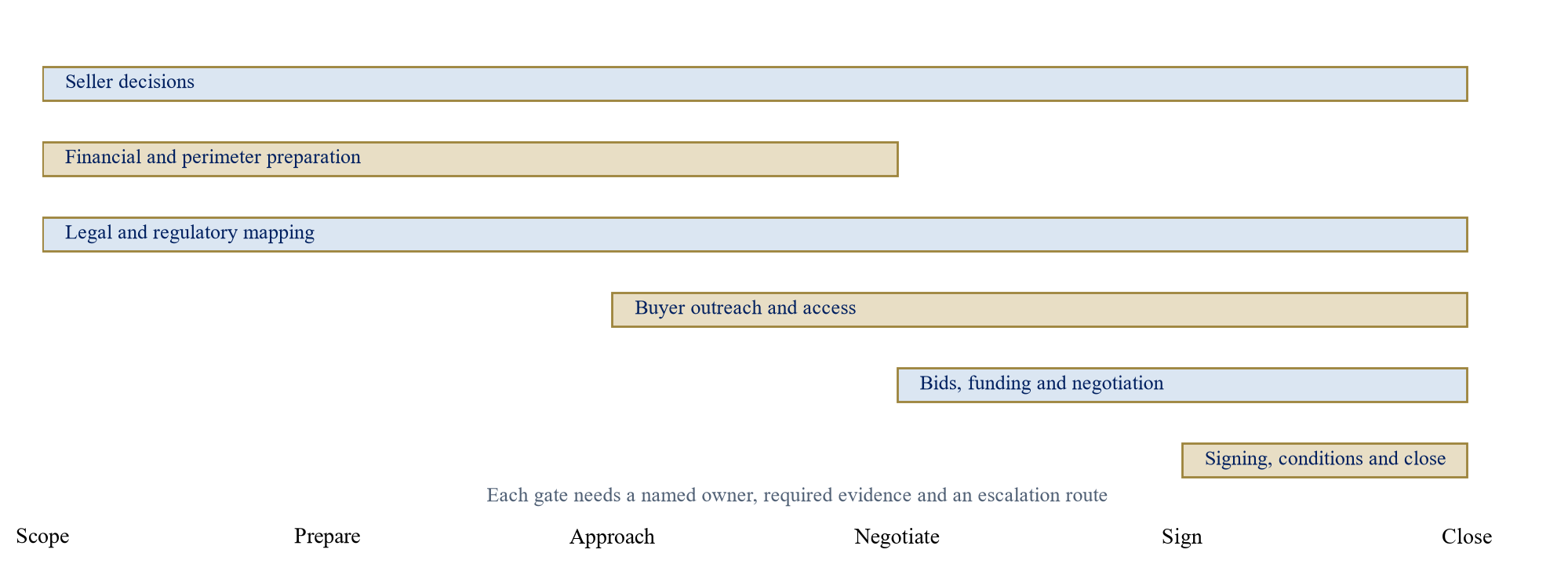
Author-developed sequence. Bar lengths are schematic and express neither forecast days nor regulatory periods.
9 Establish who owns the buyer process
The seller should have a documented right to approve the buyer universe, outreach order and material information releases. The adviser should propose candidates with a buyer-specific rationale and a realistic contact route. A claimed relationship should identify the role or decision path that matters for this asset. A database entry or previous meeting is a starting point; it is not proof of current acquisition authority. The owner should also be able to exclude a competitor where disclosure risk exceeds the likely benefit.
Process ownership includes version control. The adviser should maintain an approved teaser, confidentiality form, information memorandum, data-room index, question log, management-presentation material and bid instructions. Each release should have a date, recipient and permission. If the owner later changes the transaction perimeter, the adviser needs a method to update parties consistently. Inconsistent information can create diligence rework, misunderstandings about price and potentially unequal access among bidders.
The buyer process should be staged. Early questions can test strategic interest and who would sponsor the acquisition. Deeper financial and customer information should follow appropriate confidentiality and competition-sensitive information controls. Written indications of interest should be requested under common assumptions, including transaction perimeter, price basis, consideration form, financing, approvals and timing. The owner can then compare proposals on economic and execution terms rather than on headline price alone.
An adviser may recommend a bilateral approach because a small number of buyers have distinctive synergies. It may recommend a controlled auction to test price and terms across qualified parties. Each choice has information, timing and confidentiality costs. A strong pitch will show an alternative process and the circumstances that would cause a switch. It will not equate the number of outreach names with the quality of demand.
10 Translate cross-border coverage into a responsibility map
“We have offices in both countries” leaves too many questions. The relevant map identifies the seller entity, target assets, potential buyer location, financing location and the jurisdictions whose authorities, contracts or employees may be affected. For each, the adviser should name its own responsible person, local partner if any, specialist counsel and client decision maker. It should explain how advice is consolidated and what happens when views conflict.
Saudi merger and acquisition regulations apply to their specified public-offer and market contexts [8]. Saudi economic-concentration rules provide a separate regulatory pathway where the transaction is within scope [9]. A GCC seller considering a UK target or buyer may need to consider UK national-security notification rules if the asset and control circumstances meet the statutory criteria [10]. These examples demonstrate how different regimes can arise; none is a conclusion that a filing is required for a particular private exit. The transaction team should obtain current advice under the actual facts.
Cross-border coverage also involves document and language capability. If underlying customer contracts and accounts are in different languages, the adviser should specify what will be translated, by whom and at whose cost. If buyer financing is in a currency different from the seller's accounting currency, the offer-comparison model should identify exchange-rate assumptions. If operations are spread across countries, management presentations and diligence may need local subject experts. These are operational matters that can cause delay even when a law firm's regulatory map is sound.
The responsibility map should be tested through a scenario interview. Ask the proposed lead what it would do if a buyer requests an asset carve-out, a lender requires a quality-of-earnings adjustment or a regulator asks for information after signing. The answer should assign owners and documents, then identify which decisions require seller approval. It need not predict the outcome. This exercise reveals whether “cross-border execution” means coordinated work or an unexamined claim about geographic reach.
11 Make the financial work product testable
The adviser should describe what it will deliver before the first buyer conversation. A financial story for a private company commonly requires management accounts, a bridge from reported earnings to proposed normalisations, cash and debt definitions, working-capital seasonality, customer concentration and a credible forecast. The seller should ask which source records will support each assertion and which matters require accountants or other specialists. The adviser can coordinate a quality-of-earnings process; it should not imply that an unaudited spreadsheet has the status of an independent report.
The choice of valuation method should reflect the business and transaction perimeter. Comparable listed companies, precedent transactions, discounted cash flow and asset values can illuminate different aspects of value. None automatically establishes the price a buyer will pay. A cross-border business may have tax, currency, minority-interest or holding-company complications that require explicit assumptions. The adviser should show sensitivity to the assumptions a buyer is likely to test and explain which value drivers require evidence before marketing.
Ask a finalist for a redacted sample of its decision material and for an outline tailored to the present company. The seller should inspect whether the numbers reconcile, whether a claim links to a data-room document and whether uncertainties are presented without false precision. A glossy deck can coexist with a weak accounting bridge. The owner should be able to challenge a proposed add-back or forecast and see how that change affects buyer communications and price expectations.
Financial preparation is a timing question as well as a valuation question. If revenue recognition, related-party transactions or contract margins will be challenged, those issues can be investigated before exclusivity. The adviser should identify what management can prepare internally, what requires external assurance and what can be deferred without misrepresenting the company. A mandate contract should name the financial work products and acceptance criteria; otherwise “transaction preparation” can mean very different things to the client and the firm.
12 Contract for deliverables and decisions
An engagement letter should translate a pitch into obligations. At a minimum it should identify the client and adviser entities, scope, transaction perimeter, named senior lead, expected deliverables, client dependencies, conflict treatment, expense approval, fee structure, term, termination and tail. Counsel should review the document under the governing law and the actual regulated activity. The commercial question is whether the owner can observe progress and change course before a large success fee becomes the only measure of service.
Deliverables should be specific enough to inspect. An adviser might commit to a sale-readiness issues list, valuation analysis with stated assumptions, approved buyer universe with evidence, information memorandum, controlled data room, outreach log, management-presentation plan, comparable bid table and negotiation support. The letter can set milestone review points without promising a closing date. It can state that the seller approves each contact and each release of sensitive information. It should identify the consequences of a missed deliverable caused by the adviser's work and a delay caused by unavailable seller data.
The contract should address how the adviser interacts with legal, tax and accounting advisers. If those services are outside its role, the statement should be clear and the coordination obligation should still be defined. The same is true for financing: identifying potential lenders, arranging credit and advising on investment transactions may have different legal and fee implications. The precise scope should be checked against permissions and qualified advice. A broad phrase such as “all capital solutions” gives little guidance about who is responsible when a buyer changes the consideration structure.
Table 3 below brings deliverables beside fee events. It is a negotiation checklist, not a recommended legal form. The seller may choose a higher retainer for intensive preparation, a success component for outcomes, or another structure. Whatever it chooses, the agreement should state when an amount is earned, payable, refundable or credited, and which transactions or counterparties are covered. Undefined triggers can create conflict precisely when the parties are negotiating a difficult final deal.
13 Inspect the incentives in the fee
A retainer may fund real analytical work and reserve a named team. A success fee can reward completion. Either can create misalignment if its basis is vague. A percentage of transaction value may encourage a large headline valuation even where earn-outs, seller financing, debt assumptions or contingent proceeds make the owner's realised economics different. A fee due on signing can become payable before conditions close; a fee due on closing may leave work on a failed but well-executed process uncompensated. The seller and adviser should discuss those consequences explicitly.
Definitions matter. “Transaction value” can include or exclude debt, cash, escrow, deferred consideration, rollover equity and contingent payments. A minimum fee, monthly retainer credit, expense cap, VAT and currency provision can materially change the cost. The agreement should address a minority sale, phased sale, recapitalisation, affiliate transaction or sale of assets if those are plausible alternatives. It should state whether a buyer introduced before the mandate is included and what evidence establishes an introduction.
Tail clauses deserve close attention. A firm may seek a fee if an introduced party closes after termination. A seller can reasonably want protection against paying for no meaningful causal contribution. The parties should define a documented list of contacted or meaningfully advanced parties at termination, a finite tail period and the transaction forms covered. Counsel should draft the legal language. The negotiation principle is to make the fee basis reviewable from dated process records.
The owner should also compare a fee against the proposed staffing and deliverables. A low retainer with a broad success fee can leave preparation underfunded. A high retainer with no milestone review can create the opposite risk. Neither structure is inherently superior in every mandate. The key is that the adviser can explain why its incentives support the owner's objective, what resource it commits and how the owner can inspect performance before exclusivity or termination becomes costly.
14 Compare fictional candidates without a false score
Consider an owner selling a regional services company with operations in two GCC jurisdictions and a potential UK buyer group. Three fictional advisers pitch. Adviser A has a prominent global brand and public examples of large listed transactions, but the proposed local team has not yet shown that it led a comparable private sale. Adviser B has a smaller platform and two documented private-company mandates with similar contract and licensing issues, but its proposed buyer coverage outside the GCC is unproven. Adviser C has a strong buyer network and a low upfront retainer, yet its legal entity, fee tail and possible buy-side relationships remain unclear.
Table 2 treats these as questions to resolve. It deliberately assigns no points, odds or forecast duration. A may become compelling if the actual team and cross-border partner can show relevant work and capacity. B may be the best lead if it can demonstrate an authorised route to international buyers. C may be unsuitable until permission and conflict questions are resolved, regardless of its stated access. These are alternative evidence paths, not a ranking. The owner must apply its own objectives after the same information requests are made to each firm.
The exercise also demonstrates why brand and local coverage should be decomposed. A globally recognised platform can bring sector reach, senior approval channels and financing connections. It can also staff a small assignment thinly. A specialist regional adviser can bring on-the-ground execution and clear senior attention. It can also lack a needed cross-border route. The seller should inspect the named team and delivery plan rather than assume either pattern.
In a live selection, every statement in the comparison would need a source or a clear note that it is the adviser's claim. The fictional case is an author-created teaching example. It is not a disguised client transaction, a performance comparison among real firms or evidence that a smaller or larger adviser closes faster. Its purpose is to make the remaining questions explicit before a mandate is signed.
Table 2. Worked comparison of three fictional adviser proposals
| Candidate | Evidence presented | Unresolved execution issue | Next verification step |
|---|---|---|---|
| Adviser A | Public large-deal record and international platform | Named private-sale team role and present capacity | Obtain role-specific references and staffing plan |
| Adviser B | Documented regional private-sale experience | Buyer access beyond the home market | Test a buyer-specific international route and partner responsibilities |
| Adviser C | Stated buyer network and low initial retainer | Exact entity, conflicts and fee tail | Check applicable register and negotiate disclosure and fee definitions |
The candidates are author-created and have no observed mandates or estimated completion probabilities.
15 Trace delay to its source
An elapsed-day count is a poor adviser performance metric on its own. A process can pause because the seller changes its valuation target, because source accounts do not reconcile, because a bidder's lender changes terms, because a regulator seeks information or because the adviser failed to finish an agreed work product. These are different events. A delay register should record the date, decision gate, missing item, party responsible, evidence requested, date resolved and counterfactual next step. The objective is learning and accountability, not assigning blame after a disappointing outcome.
Figure 3 proposes a feedback loop. It separates adviser-controlled preparation and communication from seller decisions, buyer financing and external conditions. The same issue can cross categories: an adviser may identify a customer-consent risk promptly, while the buyer then waits for a customer response. A process report should describe both events. The distinction matters if owners compare advisers or decide whether to extend exclusivity. Delay attribution should not be transformed into a causal estimate without a suitable dataset.
The register can expose avoidable rework. If a draft earnings bridge changes repeatedly because management supplied different source accounts, the adviser should show versions and explain the effect on the buyer pack. If buyer questions sit unanswered because the firm has not assigned an owner, that is a different failure. If a government approval takes longer than expected, record the filing date, questions and applicable official response timeline. A seller then sees what can be improved and what cannot be controlled by the adviser.
The owner should review the register alongside qualitative indicators: whether buyers understand the transaction perimeter, whether information releases are consistent, whether written proposals state financing and conditions, and whether counsel receives issues early. A fast process that omits a material diligence risk may create a longer delay after signing. The performance question is whether the adviser improves the quality and timeliness of decisions given the constraints of the actual sale.
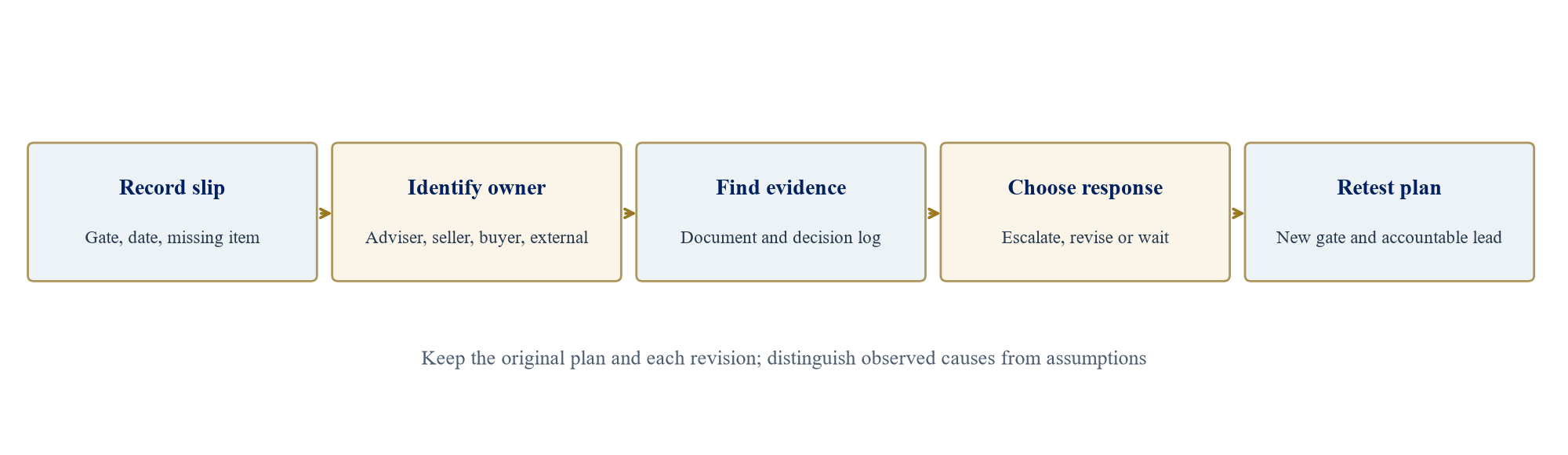
Author-developed attribution loop. The categories are descriptive; no causal effect or forecast duration is asserted.
16 Set a mandate review that can change direction
The engagement should have review gates. At appointment, the owner should approve the proposed workplan and information boundary. After preparation, it should inspect the evidence pack and buyer universe. After initial outreach, it should review buyer responses and decide whether to widen, narrow or pause the process. Before exclusivity, it should see comparable written terms and unresolved diligence. These gates give the owner structured opportunities to change direction while preserving a record of why.
At each gate, the adviser should present the original assumption, new evidence and requested decision. If an expected buyer group is absent, the adviser should distinguish no interest, no authorised contact, a delayed response and an explicit refusal. If the valuation range changes, it should show which financial, market or structural assumption changed. If an adviser proposes a different transaction form, it should identify effects on owners, governance, financing and fees. This is execution reporting, not a guarantee of a favourable market.
An agreed escalation path helps when the seller's objectives conflict. One shareholder may prefer speed, another price, and management may value continued independence. The adviser cannot resolve ownership governance by itself. It can frame alternatives and show how each affects process design. The mandate should name the client representative who can give instructions and the decisions requiring wider board or shareholder approval. Without this clarity, delays may be misattributed to the adviser when no one was authorised to choose.
A review gate should also examine whether the team remains appropriate. If the sale becomes a complex carve-out, the owner may need additional specialists. If an expected cross-border bidder group disappears, a regional team may be sufficient. If conflicts arise, the owner may need new protections or an adviser change. The contract should contain practical ways to address those circumstances without making a failed original forecast look like breach or making the seller hostage to sunk fees.
17 Negotiate a measurable fee-and-deliverables checklist
The checklist in Table 3 is designed for a commercial conversation and legal drafting. It puts each payment event beside the work or outcome that triggers it. The seller should ask for a sample fee calculation under a cash sale, a sale with rollover equity, an earn-out and a deal that signs but fails to close. The examples should reveal whether minimum fees, expenses, tax and retainers produce different total costs than a headline percentage suggests.
Deliverable acceptance should have a practical standard. The owner can require that an information memorandum reconcile to approved financials and that a buyer universe include a source and rationale for each contact. It can require a data-room index, version history and formal weekly status report. Acceptance does not mean that the adviser warrants every business assertion; management remains responsible for the company's information, while accountants and lawyers have their own professional duties. The contract should set the handoffs.
Expenses deserve controls. Travel, translation, data-room services, third-party research and external valuation work can be legitimate. The agreement should say which are included in the retainer, which require prior approval, whether mark-ups apply and how invoices will be documented. In a cross-border mandate, small recurring charges can accumulate. The owner should not have to discover them at a signing when attention is focused elsewhere.
The fee schedule must also be consistent with conflicts treatment. If the adviser receives compensation from a buyer, lender, insurer or other participant, the seller needs disclosure and a decision on whether the arrangement is acceptable. If the adviser has a referral arrangement with a diligence provider, the owner needs to understand it. The applicable legal and regulatory standards may require more; qualified counsel should review them. The paper supplies a decision checklist, not a legal opinion.
Table 3. Fee and deliverables checklist for mandate negotiation
| Topic | Proposed document or rule | Review question |
|---|---|---|
| Scope and team | Entity, accountable lead, named workstream owners and replacements | Who performs and supervises the work? |
| Preparation | Issues list, financial bridge, valuation assumptions and approved materials | What is complete before outreach? |
| Buyer process | Approved universe, staged release log, response and bid records | Which contacts and information need client approval? |
| Retainer and expenses | Amount, credit, invoice dates, cap and approval threshold | What is owed if the process pauses? |
| Success fee | Basis, minimum, debt and contingent consideration treatment | What is owed on signing, closing or later payments? |
| Termination and tail | Notice, returned materials, dated party list and tail duration | Which later transactions remain fee-bearing? |
| Conflicts | Initial declaration, update duty and response procedure | What new relationship requires a client decision? |
Author-developed negotiation guide; actual engagement terms require legal and regulatory review.
18 Treat proposed cohort analysis as research, not a sales promise
The empirical question is whether verified local coverage and completed comparable experience are associated with lower execution delay after accounting for deal characteristics. This paper has not assembled the private mandate records required to answer it. A lawful study would need seller consent, defined confidentiality controls and a sampling frame that includes mandates that did not close. Studying only announced completions would conceal failed processes and could make an adviser with an easier client base look more effective.
The unit of observation could be a seller mandate, with linked adviser-team, bidder and process-event records. “Local coverage” would need a pre-specified definition: a relevant permission, named local professional, local counsel coordination or demonstrated execution work are separate measures. “Comparable transaction” would require a documented role and closeness of execution challenge. Delay could be measured at distinct gates, such as appointment to approved materials, outreach to written bids, signing to closing and total elapsed time. Mixing those intervals would obscure where an adviser could have an effect.
Controls would include transaction size, sector, sale perimeter, ownership concentration, target financial quality, country combination, buyer type, process design, financing structure, regulatory exposure and market conditions. Endogeneity remains a central problem. Sellers may choose a prestigious or specialist adviser because a deal is difficult, and stronger targets may attract better proposals and more resources. A prospective design, pre-registered definitions and blind coding of source documents could improve discipline. They would not alone prove causality. An identification strategy and careful sensitivity analysis would still be needed.
The study should report missingness and selection. Confidential mandates may be least willing to share failed outcomes. Small deals may lack public records. A completion metric can reward an adviser that encourages a low price, while a price metric can reward an adviser that takes longer. Owner proceeds, conditions, risk and satisfaction should be reported separately if consent allows. No coefficient, number of days saved, accuracy statistic or causal effect is presented here.
19 Protect transaction data and separate public from private facts
An adviser-selection file contains sensitive material: seller finances, buyer identities, fee terms, bid prices, potential conflicts and personal information about employees or shareholders. A research dataset would add further confidentiality risk. The owner should decide who can access each class of material, how it is stored, how long it is retained and which disclosures can be made to references or researchers. Contractual confidentiality, data-protection duties and professional obligations need transaction-specific review.
A public transaction announcement can verify a closing date, stated parties and some price information, subject to the document's wording. It may not reveal the actual sell-side mandate, a private fee, a failed bidder or the reasons for delay. A public register can verify a firm's entry and stated activity at the time checked; it cannot establish an actual conflict position or staff allocation. An adviser reference may provide detail but is selected by the adviser. A disciplined file labels each source type and does not merge them into a uniform “verified” score.
Any future publication of cohort results should aggregate outcomes and suppress combinations that could identify a deal or bidder. Consent should specify what the research can use and what remains confidential. If data cannot be shared, the researcher should report the scope limitation rather than invent a benchmark from visible deals. The current paper has no access to a private sell-side mandate cohort. Its examples and diagrams are author-developed methods to organise decisions, not observations of named clients.
This distinction also protects the seller when briefing a board. A board can act under uncertainty while clearly seeing what is known, claimed, estimated and unresolved. A dated register check, a team reference, a draft offer and a closing certificate have different evidentiary weight. The adviser should keep those distinctions visible as the process advances. An assurance that “we can handle the transaction” becomes useful only when translated into a permission route, responsible people, deliverables and a testable timetable.
20 Leave the owner with an auditable mandate decision
The seller's decision file should begin with the transaction specification and owner objectives. It should include the shortlist, identical core questions sent to each finalist, the source and date of each material claim, relevant entity and permission checks, named team, comparable role evidence, capacity and conflicts, proposed workplan, fee calculation and legal review. It should state which unanswered questions the owner accepted and why. A board can then choose an adviser on defensible grounds without pretending that a predictive performance model exists.
After appointment, the same file becomes an execution record. The adviser should deliver the agreed preparation material, maintain an approved outreach and information log, present buyer responses under consistent stage definitions and surface financing and regulatory dependencies early. The owner should review the evidence at agreed gates, document any changed instructions and inspect written bids on a common basis. If the process stalls, the delay register should show what is missing, who owns it and the next decision.
The literature provides reasons to ask about adviser quality, effort and cross-border deal characteristics [1–3]. The official registers provide sources for certain permission checks [4–6]. Regulatory publications identify rules and conflicts issues within their jurisdictions [7–10]. None of these sources resolves the seller's entire selection problem or promises a faster closing. The value of this framework is in making capabilities, dependencies, incentives and evidence inspectable before fees and exclusivity make correction expensive.
The final decision may favour a large platform, a specialist adviser or a coordinated team of firms. The paper does not rank those structures. It asks the owner to state the work to be done and to select people who can show how they will do it. If a future consented study can link pre-mandate credentials to process outcomes, the field may gain a better empirical benchmark. Until then, a sourced mandate file and disciplined review gates are the reliable basis for a specific seller decision.
References
- Golubov, A., Petmezas, D. and Travlos, N. G. “When It Pays to Pay Your Investment Banker: New Evidence on the Role of Financial Advisors in M&As.” Journal of Finance 67(1), 2012. Accessed 6 October 2026. https://onlinelibrary.wiley.com/doi/10.1111/j.1540-6261.2011.01712.x
- Hunter, W. C. and Jagtiani, J. “An Analysis of Advisor Choice, Fees, and Effort in Mergers and Acquisitions.” Review of Financial Economics 12(1), 2003. Accessed 6 October 2026. https://www.sciencedirect.com/science/article/abs/pii/S1058330003000077
- Lawrence, E. R., Raithatha, M. and Rodriguez, I. “The Effect of Cultural and Institutional Factors on Initiation, Completion, and Duration of Cross-Border Acquisitions.” Journal of Corporate Finance 68, 2021. Accessed 6 October 2026. https://www.sciencedirect.com/science/article/pii/S0929119921000717
- Abu Dhabi Global Market Financial Services Regulatory Authority. Public Registers. Accessed 6 October 2026. https://www.adgm.com/public-registers/fsra
- Dubai Financial Services Authority. Public Register of Firms. Accessed 6 October 2026. https://www.dfsa.ae/public-register/firms
- Capital Market Authority, Saudi Arabia. Financial Market Institutions directory. Accessed 6 October 2026. https://cma.gov.sa/en/Market/AuthorisedPersons/Pages/default.aspx
- Dubai Financial Services Authority. “New DFSA Thematic Review: Conflicts of Interest across DIFC Firms.” 9 January 2026. Accessed 6 October 2026. https://www.dfsa.ae/news/new-dfsa-thematic-review-conflict-interest-across-difc-firms
- Capital Market Authority, Saudi Arabia. Merger and Acquisition Regulations, as published. Accessed 6 October 2026. https://cma.gov.sa/en/RulesRegulations/Regulations/Documents/Merger%20and%20Acquisition%20Regulations.pdf
- General Authority for Competition, Saudi Arabia. Economic Concentration Review Guidelines. Accessed 6 October 2026. https://gacbep.gac.gov.sa/cms/b9376edc-79a1-4573-a36d-4f3effaba838.pdf
- UK Government. “National Security and Investment Act: Guidance on Notifiable Acquisitions.” Accessed 6 October 2026. https://www.gov.uk/government/publications/national-security-and-investment-act-guidance-on-notifiable-acquisitions/national-security-and-investment-act-guidance-on-notifiable-acquisitions
About the Author
Chennakeshav (CK) is a corporate finance and investment banking executive with 25+ years of global experience in deal origination, structuring and execution across M&A, growth capital and corporate strategy. He has led value-creation mandates for founders, corporates and funds — bridging the boardroom view to hands-on execution and close.
His career spans Morgan Stanley, HSBC, Lloyds Banking Group, EWEC, ADQ portfolio companies and Emirates Growth Fund, across TMT, real estate, fintech, deeptech, cleantech, infrastructure and energy. He has partnered with C-suite leaders, private equity and venture funds, sovereign wealth funds and family offices to finance complex fund raises and scale-up ventures, and has led M&A due diligence, post-merger integration and business-transformation initiatives to create value.
At Matchpoint Partners he is Managing Partner, leading the firm's corporate finance, M&A and capital-raising practice. He holds an MBA from London Business School, an engineering degree from VTU and a Master of Laws (LLM, in progress) from UCL London.
An active start-up mentor, CK mentors at Techstars, DIFC FinTech Hive, Startup Grind, Founder Institute and IN5, serves as Entrepreneur Mentor in Residence (EMiR) at London Business School, and judges the Entrepreneurship World Cup.
