Introduction
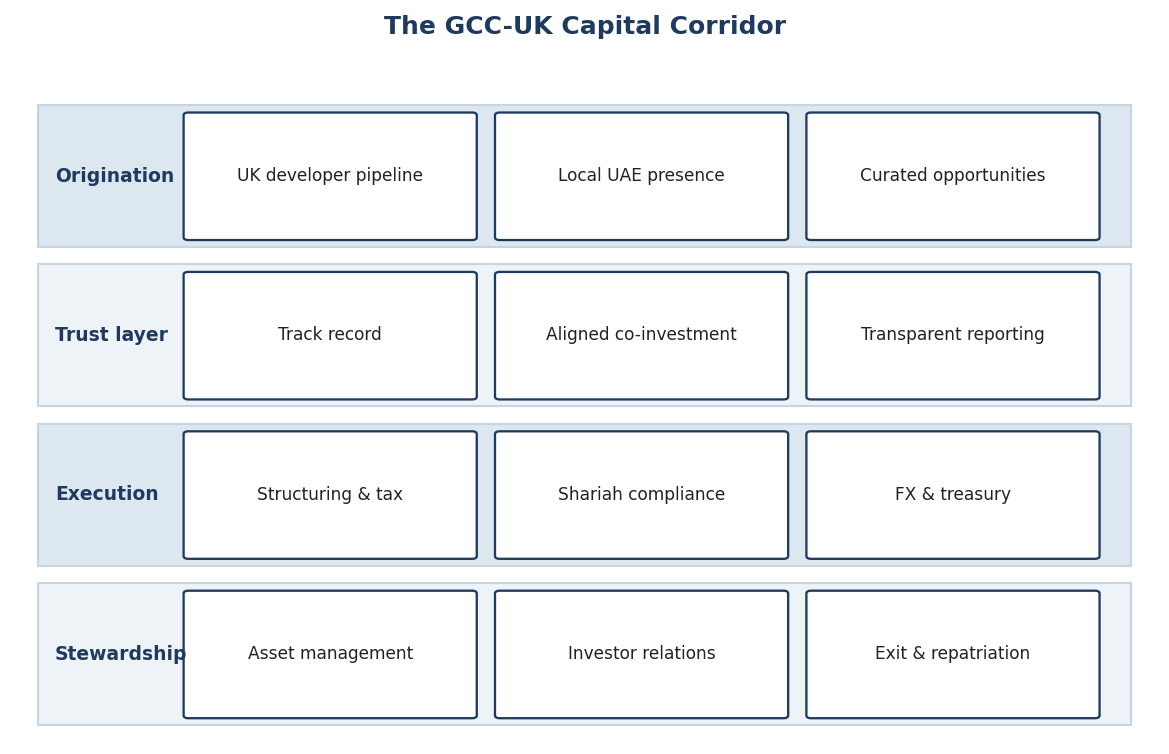
Two facts about the international real estate market in 2026 sit naturally together. The first is that UK real estate developers face a constrained domestic financing environment, in which elevated sterling interest rates have raised the cost of debt, banks have grown cautious about development risk, and domestic equity is competed for and expensive. The second is that the GCC holds a large and growing pool of capital, in family offices, sovereign vehicles and private wealth, that is actively seeking international real-asset exposure and that regards the UK as a favoured destination. The natural consequence is a corridor of capital from the Gulf to the UK, and this paper is about how that corridor works and how developers and investors can use it.
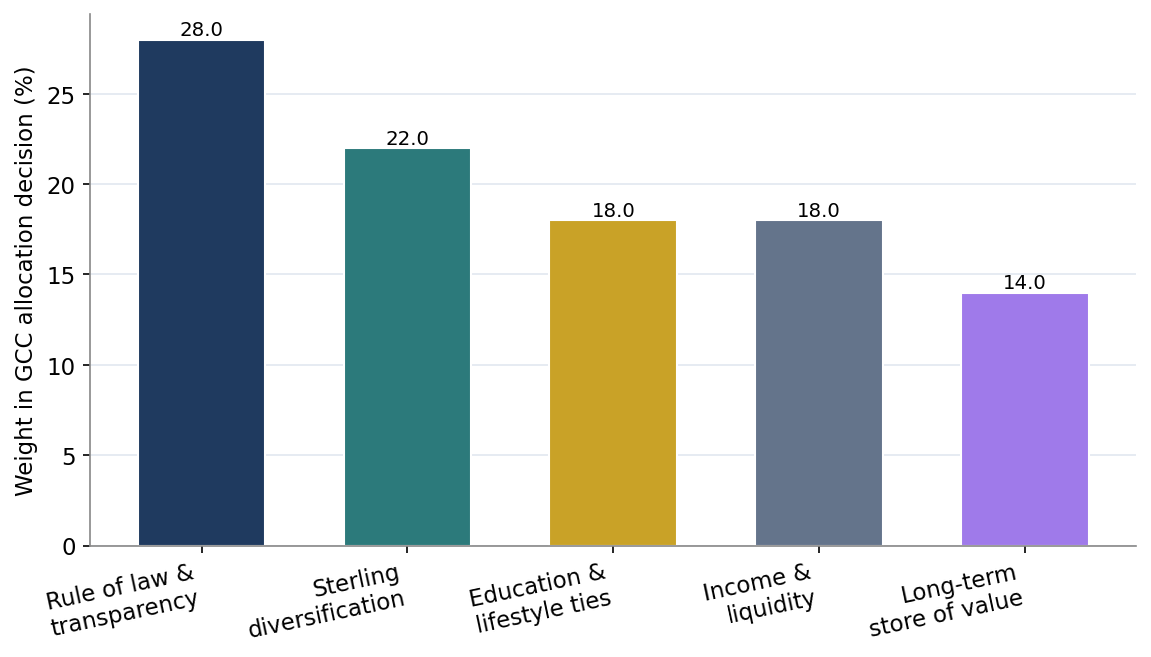
For the UK developer, GCC capital offers an alternative and complementary source of equity and debt that is less constrained than the domestic market and that brings patient, long-term capital with a genuine appetite for UK real estate. For the GCC investor, UK real estate offers a combination of attributes, the rule of law, transparency, currency diversification, income, and deep cultural and educational ties, that few other markets match. The corridor is therefore underpinned by real economic complementarity: each side has what the other wants, and the flow of capital is a response to that complementarity rather than a passing fashion.
The central argument of this paper is that accessing the corridor successfully is less a matter of economics, which are favourable, than of structure and trust. The economic case for GCC capital in UK real estate is strong and well understood; what determines whether a particular UK developer can access it is whether the developer can present the right opportunity in the right structure to the right Gulf investor, and whether it can build the trust that allows capital to flow across the distance and difference between the two markets. The framework in this paper addresses both the structuring and the relationship dimensions, because both are necessary and neither alone is sufficient.
The GCC Capital Landscape
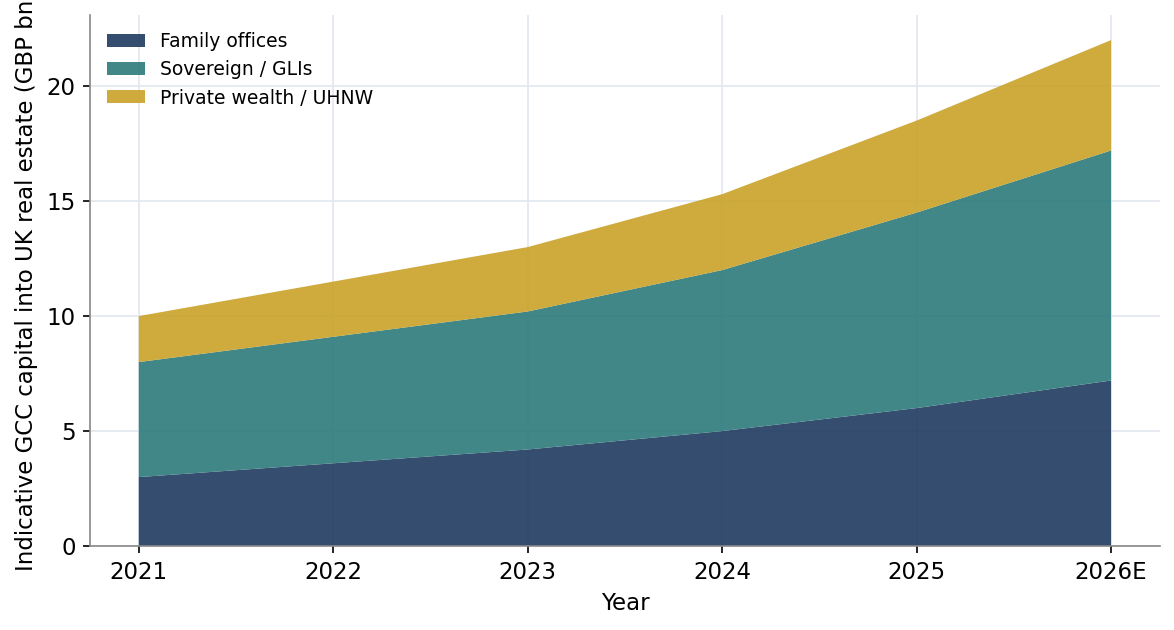
The GCC capital that flows into UK real estate is not homogeneous, and a UK developer seeking to access it must understand the distinct types of allocator and what each wants. Figure 2 sets out the indicative appetite of GCC allocators across UK real estate sectors.
Figure 2. Indicative GCC Allocator Appetite by UK Real Estate Sector
Sovereign and government-linked investors are the largest allocators, and they typically seek large, core, income-producing assets, prime offices, logistics, build-to-rent portfolios, that can absorb substantial capital and provide stable long-term income. They are patient, return-moderate and scale-seeking, and they are the natural counterparty for large core transactions rather than for development risk. Their appetite is for size and stability, and a UK developer seeking sovereign capital should bring large, stabilised or near-stabilised assets rather than early-stage development.
Family offices are a faster-growing and more flexible source, with a broader appetite that extends from core income assets to development upside. A Gulf family office may seek a prime residential holding for preservation, a build-to-rent forward funding for income, or a joint venture with a UK developer for development return, depending on its objectives and its sophistication. Family offices are typically more willing than sovereigns to take development risk in exchange for higher returns, and they are the natural counterparty for the UK developer seeking equity for a development scheme. Private wealth and ultra-high-net-worth individuals, the third category, often seek prime residential and trophy assets for preservation, lifestyle and the familiarity of a known, prestigious market.
The practical implication is that a UK developer must match its opportunity to the right type of Gulf allocator. A development scheme seeking equity is poorly matched to a sovereign seeking core income, but well matched to a family office seeking development upside; a stabilised income asset is poorly matched to a family office seeking return, but well matched to a sovereign seeking scale and stability. The developer that understands these distinctions can target the right allocator for its opportunity and avoid the wasted effort of pursuing capital whose objectives its opportunity does not meet. Section 7 develops this matching into a framework.
Anatomy of Cross-Border Structures
Capital flows from the Gulf to UK real estate through a range of structures, illustrated in Figure 4, and the choice among them depends on the investor objective, the asset, and the degree of involvement and risk each side seeks. Table 1 compares the principal structures.
Figure 4. Cross-Border Capital Structure: GCC to UK Real Estate
Indicative schematic of the routes from GCC capital to UK assets. Not transaction-specific.
Direct equity investment, in which the Gulf investor acquires an asset outright, suits the sovereign or private investor seeking a core holding with full control and is common for prime standing assets. A joint venture, in which the Gulf investor provides equity alongside a UK developer, suits the investor seeking development upside with the benefit of the developer expertise, and it is the natural structure for the UK developer seeking development equity. A club deal, in which several investors co-invest in a single large asset, suits investors seeking scale and diversification beyond what one can fund alone, and it allows a UK sponsor to assemble a group of Gulf investors for a large transaction.
A fund, in which the Gulf investor commits to a vehicle managed by a UK or international manager, suits the investor seeking diversified, professionally managed exposure without the burden of direct asset selection, and it is the route for investors who prefer to delegate. Forward funding, in which the investor funds the construction of an asset, typically build-to-rent or similar, in exchange for owning it on completion, suits the income-seeking investor and the developer seeking construction capital, and it has grown rapidly with the build-to-rent sector. Debt, in which the Gulf investor or a Gulf private credit vehicle lends against a UK asset, suits the investor seeking fixed income and the developer seeking an alternative to constrained domestic debt.
Table 1. Comparison of Cross-Border Structures
Indicative comparison. The right structure depends on the investor objective and the asset. Not transaction-specific.
| Structure | GCC investor type | Risk/return | UK developer benefit |
|---|---|---|---|
| Direct equity | Sovereign, private wealth | Low-moderate | Asset sale / exit |
| Joint venture | Family office | Higher | Development equity |
| Club deal | Multiple FOs / SWFs | Moderate | Scale for large assets |
| Fund | Any, delegated | Diversified | Programmatic capital |
| Forward funding | Income-seeking SWF/FO | Moderate | Construction capital |
| Debt | Private credit, FO | Lower | Alternative to bank debt |
Matching GCC Capital to UK Opportunities
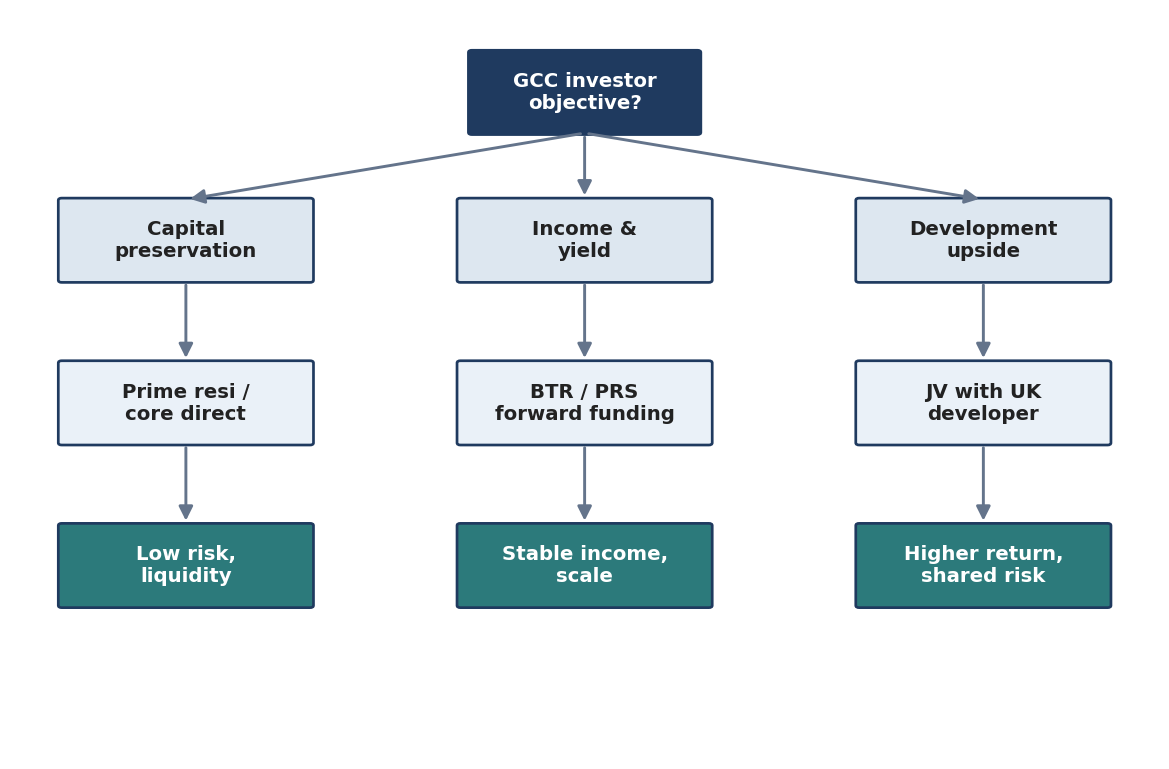
The framework for accessing the corridor is to match the UK opportunity and structure to the GCC investor objective, because a match converts quickly and a mismatch wastes effort. Figure 5 presents the framework as a decision tree organised by the investor objective.
Figure 5. Matching GCC Investor Objective to UK Structure
Indicative framework. Investor sophistication and asset quality modify the indicated route.
An investor whose objective is capital preservation, typically private wealth or a conservative family office, is best matched to prime residential or core direct holdings, where the emphasis is on the security and quality of the asset rather than on the return. The structure is direct ownership or a simple holding, and the UK developer or agent role is to source and transact a prime, secure asset. An investor whose objective is income and yield, typically a sovereign or an income-seeking family office, is best matched to build-to-rent, student housing or logistics, often through forward funding or a stabilised acquisition, where the emphasis is on the stability and scale of the income.
An investor whose objective is development upside, typically a sophisticated family office willing to take risk for return, is best matched to a joint venture with a UK developer, where the investor provides equity and shares the development return in exchange for taking development risk alongside the developer expertise. This is the match most relevant to the UK developer seeking development equity, and it is the heart of the corridor for development purposes. The developer seeking Gulf development equity should therefore target sophisticated, risk-tolerant family offices and present a genuine joint venture in which the alignment between developer and investor is clear, rather than approaching conservative or income-seeking capital that its development risk does not suit.
The matching framework also implies a sequencing for the developer that needs capital across the life of a project. Development equity from a family-office joint venture funds the risk-bearing development phase; forward funding from an income-seeking investor can fund the construction of an income asset; and a direct sale to a sovereign or private investor seeking a stabilised core holding can provide the exit. By matching each stage of the project to the Gulf investor type whose objective it suits, the developer can fund the whole life-cycle from the corridor, drawing development equity, construction capital and an exit from different Gulf counterparties each matched to the relevant stage.
Shariah-Compliant Cross-Border Structures
A significant portion of Gulf capital is invested on a Shariah-compliant basis, and a UK developer or adviser able to offer compliant structures widens the pool of capital it can access. Compliant structures for UK real estate, commonly based on Ijara or Murabaha arrangements or on compliant equity participation, can replicate the economics of conventional equity and debt while satisfying the requirements of a compliant investor, and a substantial market exists for compliant UK real estate finance and investment.
For the UK developer, the ability to offer a compliant structure is not merely a courtesy but a genuine expansion of its addressable capital, because a portion of Gulf capital can be deployed only on a compliant basis and is closed to a developer that cannot accommodate it. A developer that defaults to conventional structures, without considering the compliant alternative, narrows its pool of Gulf capital unnecessarily, while a developer that can offer both conventional and compliant structures accesses the full breadth of the Gulf market. The structuring cost of a compliant arrangement is higher, but for a transaction of reasonable size the access to a wider pool of capital justifies it.
The UK has a relatively developed market for Shariah-compliant real estate finance, with experienced advisers and a track record of compliant transactions, which makes offering a compliant structure to a Gulf investor more straightforward than it would be in a less developed market. A UK developer or adviser seeking Gulf capital should be familiar with the compliant structures and able to discuss them, because the ability to do so signals an understanding of the Gulf investor needs and opens the door to the substantial pool of capital that requires compliance. The compliant route should be part of the developer toolkit for accessing the corridor, not an afterthought.
Risk Considerations
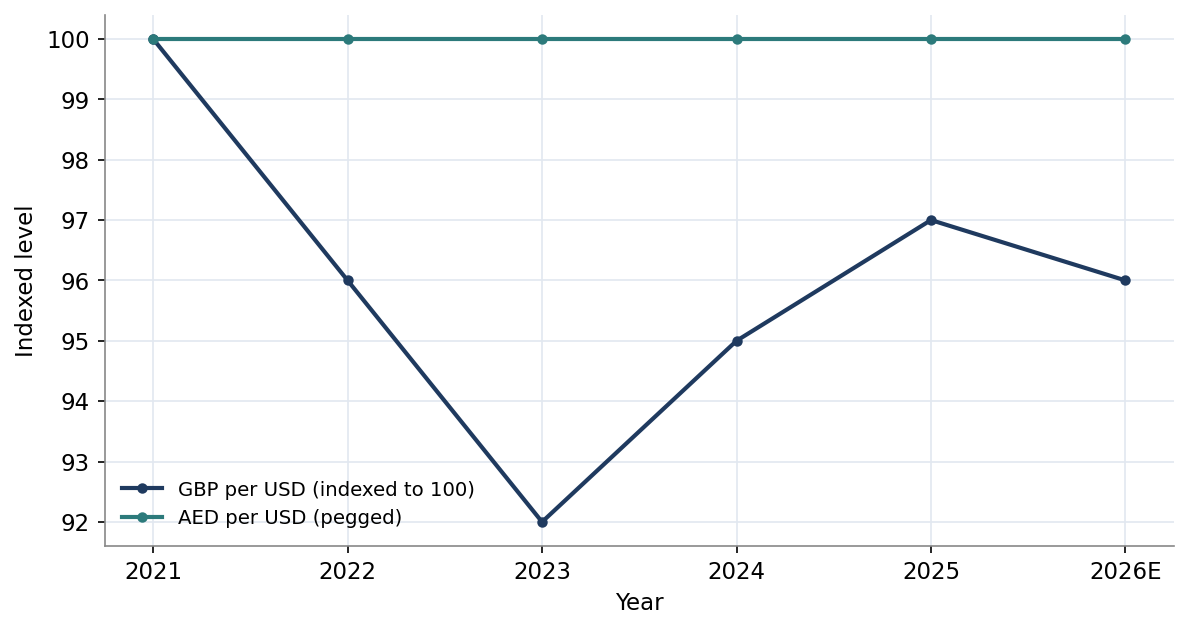
Cross-border investment carries risks beyond those of a domestic transaction, and both the UK developer and the Gulf investor must understand them. The currency risk discussed in Section 8 is the most quantifiable, and it can be a material component of the investor return. Regulatory and political risk, the possibility that changes in UK tax, planning or foreign-investment rules alter the economics or the attractiveness of an investment, is a genuine consideration for a long-term Gulf investor, and it argues for structures and assets that are robust to a range of policy outcomes.
Distance and information risk, the difficulty for a Gulf investor of monitoring and managing an asset in a market it does not inhabit, is a real friction that the corridor must overcome. The Gulf investor depends on its UK developer, manager or adviser for information, execution and stewardship, and the quality and trustworthiness of that counterparty is therefore central to the investor risk. This is why, as Section 15 argues, the trust and relationships that underpin the corridor are as important as the economics: an investor deploying capital at a distance is, above all, trusting the counterparty that will steward it. Alignment risk, the possibility that the interests of the developer and the investor diverge, is a related concern, and it is managed through aligned co-investment, transparent reporting and well-structured governance.
For the UK developer, the principal risk in accessing Gulf capital is the risk of misunderstanding the investor needs and objectives, and thereby either failing to access the capital or accessing it on a basis that proves unsustainable. A developer that misreads what the investor wants, that presents the wrong opportunity in the wrong structure, or that fails to deliver the transparency and stewardship the investor expects, may secure capital once but will not build the durable relationship that makes the corridor valuable. The risk, in other words, is as much relational as financial, and managing it requires the developer to understand and serve the investor genuinely rather than treating it as a one-off source of funds.
Indicative Case Studies
Three indicative cases show the corridor in action across different structures and investor types. The figures are synthetic and constructed for analytical clarity, not drawn from any specific transaction.
Case A: London residential joint venture
Case A is a UK developer with a prime central London residential scheme that needs development equity. It forms a joint venture with a sophisticated Gulf family office seeking development upside, with the family office providing the equity and the developer providing the expertise and a co-investment, sharing the development return. The structure matches the family office objective of development upside to the developer need for equity, the co-investment aligns the parties, and the prime London asset provides the security and quality the family office values. The target return reflects the development risk the family office accepts.
Table 5. Case A Structure, London Residential JV
Matches family-office upside objective to developer equity need. Not transaction-specific.
Case B: build-to-rent forward funding
Case B is a UK developer building a build-to-rent scheme that needs construction capital, matched with a Gulf sovereign or income-seeking family office through a forward-funding arrangement. The investor funds the construction in exchange for owning the income-producing asset on completion, matching its objective of stable income and scale to the developer need for construction capital. The structure suits the investor preference for income over development risk, since the developer bears the construction risk and the investor receives a completed, income-producing asset, and the target return is lower than the development joint venture, reflecting the lower risk.
Table 6. Case B Structure, BTR Forward Funding
Matches income objective to developer construction capital need. Not transaction-specific.
Case C: regional development debt
Case C is a UK regional developer that cannot secure acceptable senior debt from the constrained domestic bank market, and that raises development debt from a Gulf private credit vehicle or family office seeking fixed income. The Gulf lender provides the debt at a return that reflects the development risk and the regional location, offering the developer an alternative to the unavailable domestic debt and the investor a fixed-income return secured against a UK asset. The structure matches the investor income objective to the developer debt need, and it illustrates the corridor providing debt as well as equity.
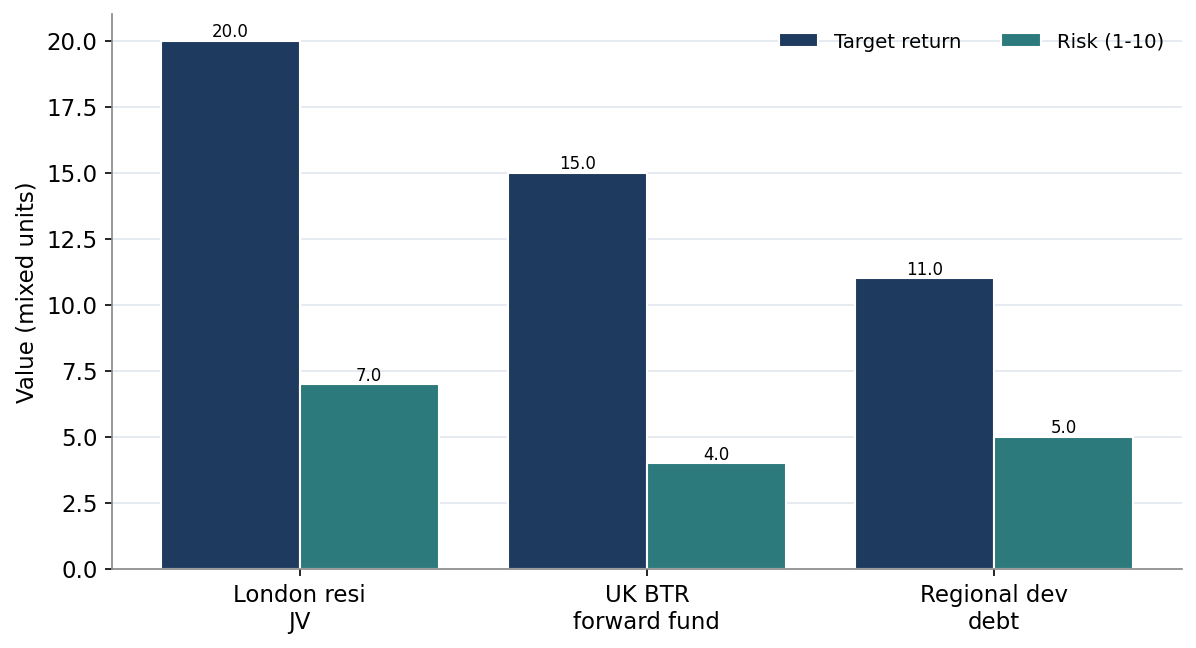
Figure 8. Target Return and Risk by Case
Synthetic figures for analytical comparison. Risk on a 1-10 scale. Not a forecast.
| Term | Detail | Note |
|---|---|---|
| Investor type | Gulf family office | Seeks development upside |
| Structure | 50/50 joint venture | Developer co-invests |
| Developer role | Expertise + co-investment | Alignment |
| Asset | Prime central London resi | Security and quality |
| Target return | ~20% | Reflects development risk |
Sensitivity and Scenario Analysis
A tornado analysis identifies the variables that most influence the Gulf investor return in a UK development investment. Figure 9 presents the result for the development joint venture.
Figure 9. Sensitivity of GCC Investor Return to Key Variables
Each bar shows the investor return when the labelled variable moves to its low or high case. Dashed line is the base case. Indicative.
The analysis shows that the sterling exchange rate move and the UK exit yield dominate the investor return, with the development margin and leverage also significant. The prominence of the currency variable is the distinctive feature of cross-border investment: for a Gulf investor, the sterling move can be as large a component of the return as the property performance itself, which is why the currency dimension discussed in Section 8 is so central. The exit yield, the yield at which the asset is sold, reflects the UK market conditions at exit and is the principal property variable, as it is in any real estate investment. The implication for the UK developer is that it should help the investor understand and, where appropriate, manage the currency exposure, because the currency can make or unmake the return regardless of how well the developer executes the project.
Table 2. Scenario Matrix for GCC Investor Return
Indicative scenarios for a development joint venture. Not a forecast.
The scenario matrix underlines that a Gulf investor in UK real estate is exposed to two largely independent sources of variation, the property performance and the currency, and that an adverse move in either can materially reduce the return even if the other is favourable. This is the price of the diversification and the attributes that draw the investor to the UK, and a well-advised investor accepts it knowingly, managing the currency exposure according to its view and objective. The UK developer that understands this two-dimensional risk can set realistic return expectations with the investor and avoid the disappointment that arises when an investor expecting a property return is surprised by a currency loss, which damages the relationship that the corridor depends on.
| Term | Detail | Note |
|---|---|---|
| Investor type | Sovereign / income family office | Seeks stable income |
| Structure | Forward funding | Funds construction |
| Developer role | Builds and delivers | Bears construction risk |
| Asset | Build-to-rent / PRS | Completed income asset |
| Target return | ~13% | Lower risk than JV |
Implementation Roadmap
Understand the GCC capital landscape and identify the investor types, sovereign, family office, private wealth, whose objectives match the opportunity to be funded.
Position the UK opportunity in the terms the Gulf investor values, security, transparency, quality, and the relevant objective of preservation, income or upside, rather than on return alone.
Select the structure, direct, joint venture, club, fund, forward funding or debt, that matches the investor objective and the asset.
Analyse and optimise the UK tax and structuring with specialist advice, and present the honest net, after-tax, after-currency return.
Offer a Shariah-compliant structure where the investor requires one, to access the full breadth of Gulf capital.
Address the currency dimension explicitly, helping the investor understand and, where appropriate, manage its sterling exposure.
Invest in the relationship and the trust, through presence, track record, alignment, transparency and stewardship, recognising that the corridor rewards durable relationships over one-off transactions.
Conclusion
The corridor between GCC capital and UK real estate is underpinned by genuine and durable economic complementarity: UK developers need capital that the constrained domestic market does not readily provide, and Gulf investors seek the security, transparency, diversification and income that UK real estate offers. This paper has argued that accessing the corridor successfully is less a matter of economics, which are favourable, than of matching the right opportunity in the right structure to the right Gulf investor, and of building the trust that allows capital to flow across the distance between the two markets.
The developer that internalises these lessons, understanding the distinct objectives of sovereign, family-office and private-wealth capital, positioning its opportunities in the terms the Gulf investor values, matching structure to objective, presenting the honest net return, offering compliant structures, addressing the currency dimension, and above all investing in the trust and relationships that the corridor requires, can access a deep and patient pool of capital that the domestic market cannot match. The developer or adviser that goes further and builds an institutional bridge across the corridor positions itself in a durable flow that will persist as long as the underlying complementarity does. In a financing environment where UK capital is constrained and Gulf capital is plentiful, the corridor is among the most valuable sources available to UK developers, and the frameworks in this paper are intended to help them access it.
| Scenario | Sterling move | UK exit yield | Investor return |
|---|---|---|---|
| Favourable | Appreciation | Compression | 24% |
| Base | Stable | Stable | 17% |
| Adverse property | Stable | Expansion | 11% |
| Adverse currency | Depreciation | Stable | 9% |
Limitations and Directions for Further Research
This paper is framework-oriented and relies on indicative data, and its conclusions are directional rather than precise. The capital flows, allocator appetites and return figures are calibrated to observable conditions but are not empirical estimates, and they vary with market conditions, the currency cycle and the evolving UK tax framework. The tax and structuring discussion is general and requires specialist, current advice for any specific transaction.
Several extensions would strengthen the analysis. An empirical study of realised GCC flows into UK real estate by investor type and sector would replace the indicative figures with data. A detailed analysis of the current UK tax treatment of non-resident investors and the efficient structures available would sharpen the structuring dimension. And a study of how the corridor behaves through a sterling cycle, when the currency moves materially against or in favour of Gulf investors, would illuminate the currency dimension that the sensitivity analysis identifies as central. Each is a natural subject for a later paper in this series.