
Introduction
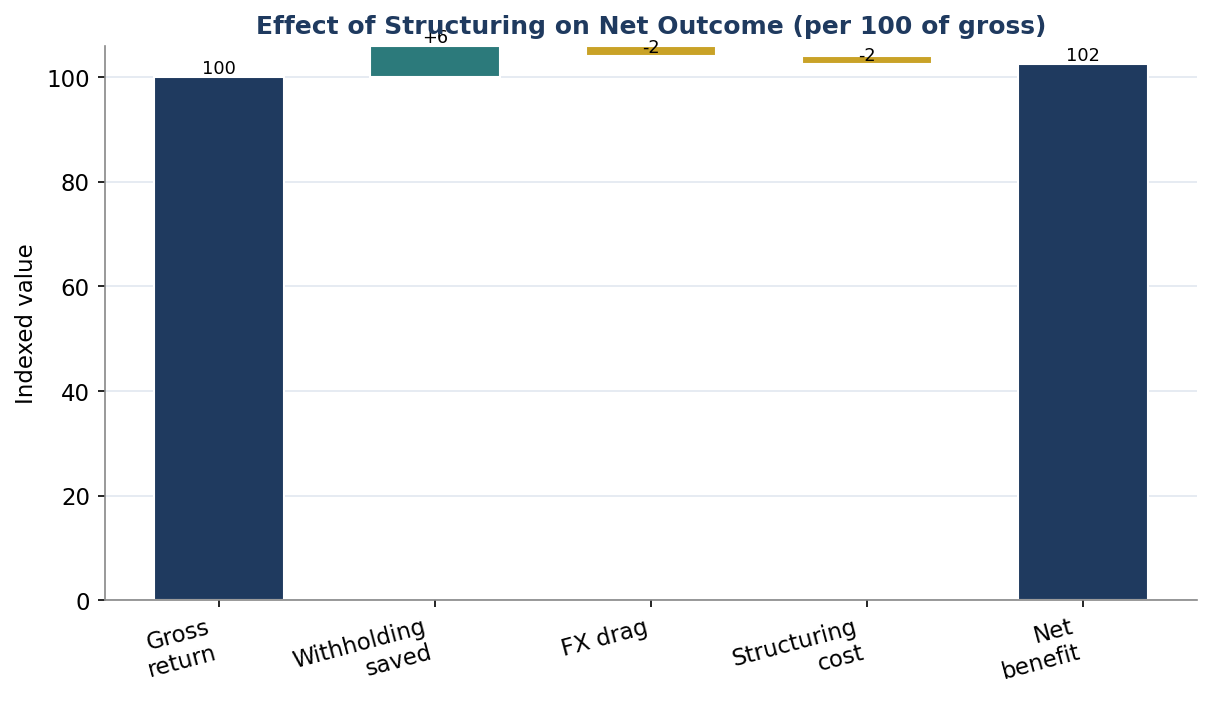
A family that has built wealth across two or more countries faces a problem that a single-jurisdiction investor never sees. The portfolio may perform well in gross terms, yet a surprising share of that performance never reaches the family, lost instead to withholding taxes the family could have reclaimed, to currency movements it could have hedged, to succession events it failed to plan for and to a tangle of fees and compliance costs that multiply with every additional jurisdiction. For families in the Gulf, who increasingly invest in the United Kingdom, Europe, the United States and Asia while keeping their base in the UAE or Saudi Arabia, this leakage is one of the largest and least examined drags on long-term wealth.
The scale of the issue has grown with the scale of Gulf wealth itself. Over the past two decades, families that made their fortunes in regional trade, real estate, energy services and industry have diversified aggressively into international markets, drawn by deeper capital markets, currency diversification and the desire to plant roots in the countries where their children study and live. The result is a generation of families whose balance sheets span four or five jurisdictions, often assembled opportunistically over time rather than designed, and whose structures reflect the advice available at the moment each asset was acquired rather than any coherent plan. The cost of that incoherence is rarely visible in any single year, which is precisely why it persists.
This paper treats cross-jurisdictional structuring not as an exercise in aggressive tax avoidance but as the disciplined management of leakage. The objective is to ensure that legitimate returns reach the family efficiently, that the structure is robust enough to survive scrutiny and a change of generation, and that the cost of the structure itself is proportionate to the wealth it protects. The analysis is framed for the Gulf family office and its advisors, with particular attention to the UAE as a base, the United Kingdom as a major investment destination, and Switzerland and Singapore as the principal alternatives for holding and custody. Throughout, the emphasis is on arrangements that are transparent and defensible, because in the current environment a structure that cannot withstand scrutiny is not an asset but a liability.
Choosing the Holding Jurisdiction
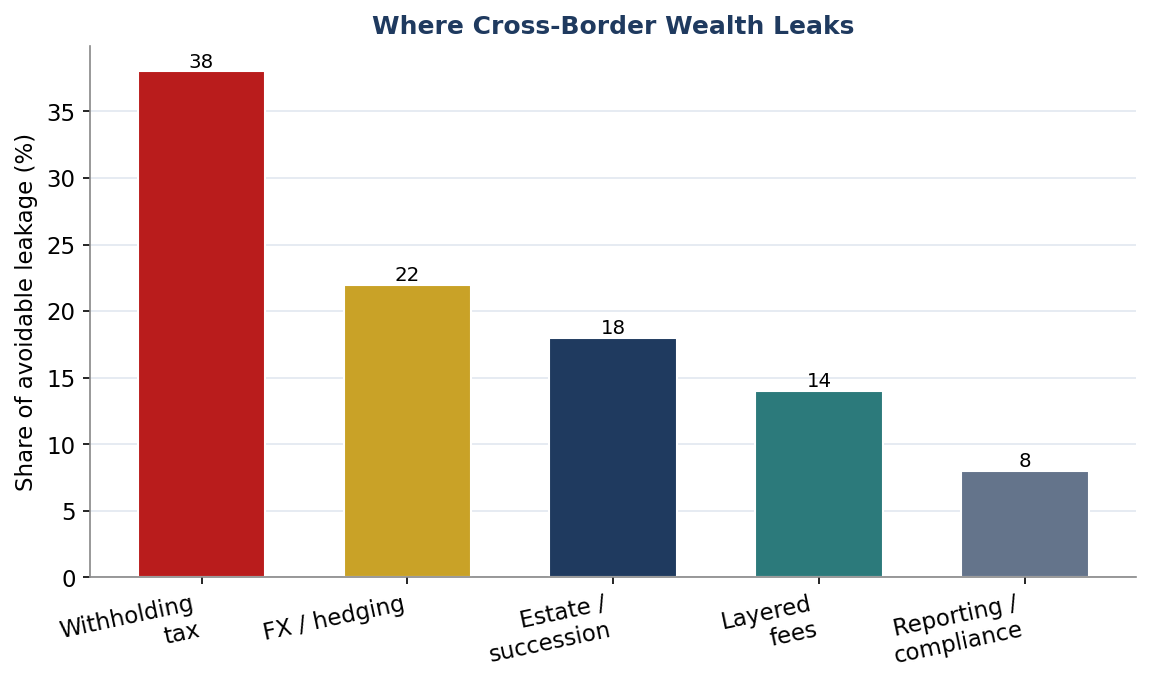
The choice of where to hold assets is the foundation on which everything else rests. No jurisdiction is best on every measure, so the decision is a weighted trade-off across the criteria that matter most to the family. The scorecard below compares the five jurisdictions most relevant to Gulf families on five dimensions, scored from one for strongest to five for weakest. The weightings a family applies should reflect its own priorities: a family focused on US investments will weight treaty access heavily, while one focused on succession certainty will weight that dimension instead.
Figure 2. Holding Jurisdiction Scorecard
Lower scores are stronger. Weightings should be set by the family’s own priorities.
The UAE scores strongly on tax neutrality, substance and stability, which is why it is the natural base for most Gulf families, but its treaty network, while expanding, is narrower than that of the United Kingdom or Switzerland for certain investment flows. The United Kingdom offers an unrivalled treaty network and deep capital markets but carries a heavier tax and succession profile for assets held directly. Switzerland and Singapore offer strong succession certainty and reputation, with Singapore providing a particularly efficient bridge into Asian markets and a well-developed variable-capital-company regime for pooled holdings.
The practical answer for most families is not a single jurisdiction but a deliberate combination, with the base in the UAE and specific functions placed where they are strongest. A family might hold its consolidating entity and succession vehicle in the UAE, route US-facing investments through a treaty-favoured holding location, and keep liquid assets with a custodian in Switzerland or Singapore. The skill lies in matching each function to the jurisdiction that serves it best, while keeping the overall structure simple enough to govern and defend. The table below summarises how the five jurisdictions tend to be used in practice.
Table 1. Typical Roles by Jurisdiction
Roles are indicative; the right combination depends on the family’s asset mix and objectives.
Succession and the Cost of Inaction
The benefit that structuring delivers at succession dwarfs its annual contribution, yet it is the part families most often neglect. Assets held in personal names, scattered across jurisdictions, can lose a large fraction of their value to forced sales, multi-court probate and, in some cases, inheritance tax. A proper succession vehicle compresses that loss dramatically, turning a chaotic and value-destroying event into an orderly transfer of control.
Figure 6. Succession Structure and Value at Risk on Transfer
Estimated value at risk on transfer of a multi-jurisdiction portfolio under different succession arrangements.
A family with no plan can see a very large share of value at risk on the transfer of a multi-jurisdiction portfolio, between forced liquidation, legal cost and tax. A will alone reduces this but does not eliminate the cross-border probate problem, because a will must still be proved in each jurisdiction where assets sit, and conflicts between the succession laws of different countries can produce delay and dispute. A trust or foundation that already holds the assets removes most of the friction, because the legal owner does not change on the death of a principal.
Full governance, with a family constitution and clear succession of control, reduces the residual risk to a small fraction and adds a benefit that no legal structure alone provides: clarity about who decides what, and how disputes are resolved. This is the clearest case in all of wealth structuring where the cost of inaction exceeds the cost of action by an order of magnitude. A family that would never leave a major asset uninsured routinely leaves its entire balance sheet exposed to a succession event it knows is certain to come, simply because the planning is uncomfortable. The remedy is to treat succession structuring as the most important, not the most deferrable, element of the plan.
| Jurisdiction | Common role | Principal strength | Principal limitation |
|---|---|---|---|
| UAE | Base, holding and succession | Neutrality, substance, home presence | Narrower treaty network |
| United Kingdom | Investment destination | Treaty depth, capital markets | Inheritance tax on situs assets |
| Switzerland | Custody and succession | Stability, banking, reputation | Cost, substance expectations |
| Singapore | Asian gateway, pooled holding | Treaties, VCC regime, governance | Substance and reporting burden |
| Luxembourg | Fund and pooled holding | Fund toolkit, EU access | Complexity, ongoing cost |
Substance and Defensibility
A structure is only as good as its ability to withstand scrutiny. Tax administrations across the family’s footprint increasingly apply substance tests, economic-substance rules and general anti-avoidance provisions that disregard arrangements lacking genuine activity. A defensible structure has real directors who make real decisions in the jurisdiction of the entity, maintains proper books and board minutes, and can demonstrate a commercial rationale beyond tax. Families should treat substance as a running obligation rather than a one-time formation step, because the cost of a structure being unwound retroactively far exceeds the cost of maintaining it properly.
In practice, substance has several concrete components that a family can audit. There should be directors resident in the entity’s jurisdiction who genuinely exercise judgement, not merely sign documents prepared elsewhere. Board meetings should take place where the entity is resident, with real agendas and minutes. The entity should have the resources appropriate to its function, whether that is staff and premises for an operating company or simply proper administration for a holding vehicle. And there should be a coherent, documented reason for the structure that a tax authority would accept as commercial. Families that build a simple substance file at formation and maintain it over time find that the cost is small and the protection considerable.
The contrast with the past could not be sharper. A generation ago, a brass-plate company in a low-tax jurisdiction, controlled in reality from elsewhere, could deliver its intended benefit with little risk of challenge. Today the same arrangement is an invitation to look-through, retroactive assessment and penalty. The families that prosper in the current environment are those that have internalised this change and build for substance from the outset, accepting a modest ongoing cost in exchange for durability. Defensibility, in short, has become the central design criterion rather than an afterthought.
Three Worked Cases
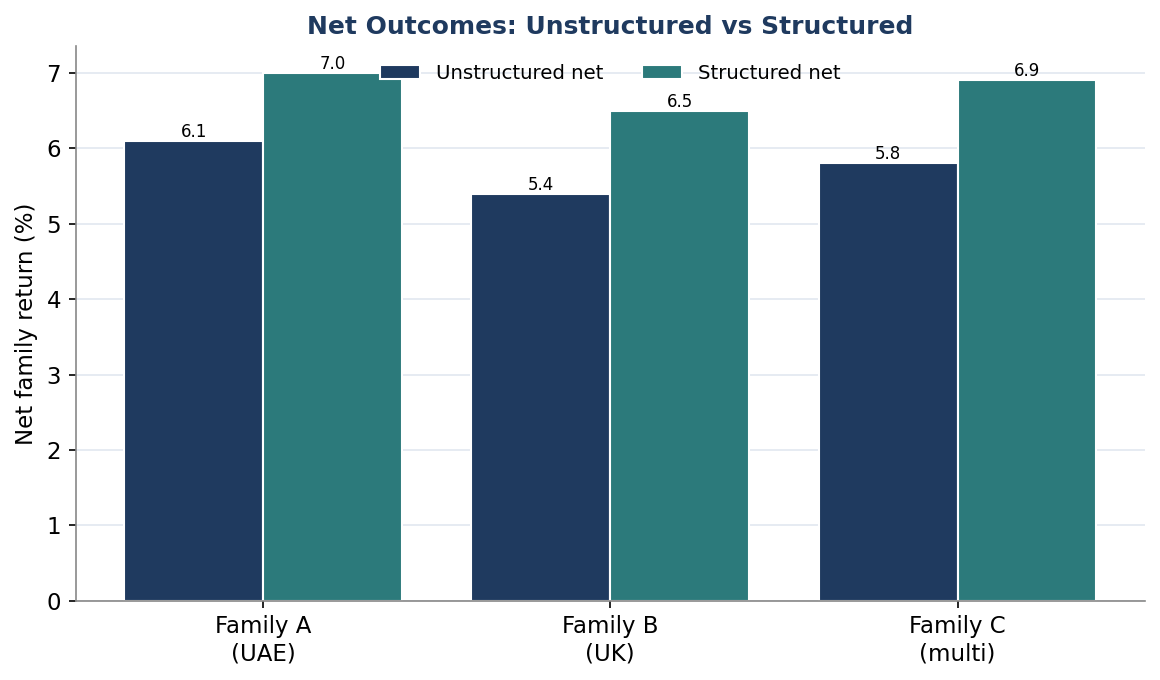
To make the framework concrete, consider three families with different footprints, each holding a portfolio of comparable size and gross performance. The cases compare the net family return under an unstructured baseline and under a disciplined structure, isolating the effect of structuring from any difference in investment performance.
Figure 7. Net Family Return: Unstructured versus Structured
Modelled net family return for three representative families under each approach.
Table 2. Case Summary
Modelled figures. Gains arise from withholding relief, currency policy and reduced fee and compliance drag, before any succession benefit.
Family A. A UAE-based family with US dividend-paying equities and a UK investment property. Its main leakage was withholding on US income through a non-optimal vehicle and inheritance-tax exposure on the UK property. Routing the US holdings through a treaty-favoured vehicle and holding the UK property through an appropriate structure lifted the net return by roughly ninety basis points and removed a large succession exposure.
Family B. A UK-resident family with global assets faced the heaviest tax profile of the three, since residence brings worldwide income within scope. Its gains came from disciplined use of available reliefs, a coherent holding structure and a currency policy aligned to sterling liabilities, lifting the net return by about a percentage point while substantially simplifying its compliance.
Family C. A family with assets across four countries suffered most from fragmentation: six custodians, overlapping advisers and no consolidating layer. Consolidation into a layered structure with a single holding entity and succession foundation cut fee and compliance drag, improved oversight and lifted the net return by over a percentage point, with the largest benefit reserved for succession.
In each case the structured outcome is roughly one percentage point a year ahead of the baseline, achieved without taking additional investment risk. Compounded over a generation, and combined with the succession benefit that does not appear in an annual figure, the difference between the two paths is very large. The cases also show that the source of the gain differs by family: withholding for one, reliefs and currency for another, consolidation for the third. This is why a generic structure is inferior to one designed around the family’s specific footprint.
An Implementation Roadmap
A family can move from an ad hoc collection of holdings to a coherent structure over a single planning cycle by following a disciplined sequence. The aim is to address the largest sources of leakage first and to build for substance and permanence from the outset.
Map the family’s full footprint: where members are resident, where assets sit, and where income and gains arise, to locate every point of leakage and quantify it in rough proportion.
Define the family’s objectives and weightings for the jurisdiction scorecard, distinguishing what is essential from what is merely desirable, and agree them across the generations involved.
Establish the holding and succession layers, favouring the UAE base with an ADGM or DIFC foundation where it meets the family’s needs, and build a substance file from the start.
Place operating vehicles by asset class in treaty-favoured locations, and consolidate custodians and advisers to control fee and compliance drag and improve oversight.
Set a written currency policy linked to the family’s liabilities, and a substance protocol covering directors, decisions and records in each entity’s jurisdiction.
Document a succession plan and, where appropriate, a family constitution, so that control passes smoothly and disputes have a clear resolution mechanism.
Review the structure annually and on any major life or regulatory event, ensuring it remains proportionate, defensible and aligned to the family’s objectives.
Comparing the Core Vehicles
Beneath the architecture lies a practical choice among the building blocks: the company, the trust and the foundation. Each has a distinct legal character and serves the family’s needs differently, and the right structure usually combines them rather than relying on one. Understanding their respective strengths prevents the common error of forcing a single vehicle to perform a role for which it is poorly suited.
The company is the natural vehicle for holding and operating assets. It has clear ownership through shares, a familiar governance model through directors, and is well understood by banks, tax authorities and counterparties everywhere. Its weakness is succession: shares must be transferred on death, which reintroduces exactly the probate friction the family is trying to avoid, so a company works best as an operating or holding layer beneath a succession vehicle rather than as the apex of the structure.
The trust, a creature of common law, separates legal ownership held by trustees from beneficial enjoyment by the family, and is a powerful and flexible succession tool. Its strengths are continuity, because the trust does not die with a principal, and discretion, because trustees can adapt distributions to circumstances. Its limitations are that it is less familiar in civil-law and some Islamic-law contexts, and that the family must be comfortable ceding legal ownership to trustees. The foundation, increasingly available in the DIFC and ADGM, blends features of both: it is a separate legal person like a company but exists to hold and govern wealth across generations like a trust, without the need to vest assets in external trustees. For many Gulf families the foundation has become the preferred apex vehicle precisely because it offers trust-like succession within a familiar, locally respected legal person.
Table 3. Core Vehicles Compared
The strongest structures combine a foundation or trust apex with company operating layers beneath.
| Family | Footprint | Unstructured net | Structured net | Annual gain |
|---|---|---|---|---|
| A | UAE base, US and UK assets | 6.1% | 7.0% | ~0.9% |
| B | UK-resident, global assets | 5.4% | 6.5% | ~1.1% |
| C | Multi-jurisdiction, four countries | 5.8% | 6.9% | ~1.1% |
Conclusion
Cross-jurisdictional structuring is not about secrecy or aggressive avoidance. It is about ensuring that legitimate returns reach the family efficiently and survive the change of a generation. The leakage that structuring addresses, from withholding tax and currency drag to succession friction and layered fees, is real, measurable and, for the most part, avoidable. A family that maps its footprint, chooses its jurisdictions deliberately, separates the functions of ownership, succession and operation, and maintains genuine substance can lift its net return by roughly a percentage point a year and dramatically reduce the value at risk when wealth passes to the next generation.
That combination, modest annual gain and large succession protection, is among the most reliable ways for a multi-jurisdiction family to compound wealth over the long term. It requires no market view and takes no additional investment risk; it is return earned through structure and discipline rather than through exposure. For Gulf families navigating an increasingly transparent and demanding global environment, the path forward is clear: build at home where the regime now allows it, build for substance and permanence, and treat the structure as the enduring institutional foundation of the family’s wealth rather than a one-time transaction.
Limitations
This paper uses modelled figures to illustrate relationships rather than to forecast outcomes for any specific family, and tax and regulatory rules change frequently and differ by precise facts. Nothing here constitutes tax, legal or investment advice. Cross-border structuring must be designed with qualified advisers in each relevant jurisdiction, taking account of the family’s specific circumstances, residence and objectives, and reviewed regularly as laws and the family’s situation evolve. The jurisdiction scores and leakage proportions are indicative and intended to frame analysis, not to substitute for jurisdiction-specific advice.
| Feature | Company | Trust | Foundation |
|---|---|---|---|
| Legal nature | Separate person | Relationship | Separate person |
| Best role | Holding / operating | Succession | Apex / succession |
| Succession on death | Shares transfer | Seamless | Seamless |
| Familiarity to banks | High | Moderate | Growing |
| Suits GCC base | Yes | Sometimes | Strongly |
