

1. Define culture operationally
The integration leadership should describe culture through repeated choices, behaviours and stakeholder consequences. The required output is an operational culture definition. Record the purpose, affected decisions, expected behaviour, stakeholder consequence, accountable owner, evidence, boundary, incentive, control, escalation and review date [1][2].
Translate the cultural intent into observable operating practice. Define what leaders and teams must do when commercial, customer, risk, people and control objectives conflict. Identify the decision trigger, permitted discretion, required challenge, approval route, record and consequence.
The principal risk is that culture can remain a slogan without observable decision content. Test whether formal policy, actual decisions, resource allocation, incentives, promotion, recognition, case handling and leadership actions send a consistent signal across businesses, geographies and seniority levels.
Retain decision records, workforce evidence, customer outcomes, control tests, cases, exceptions, remediation and board challenge. Protect privacy, confidentiality, employee voice and lawful process. Refresh the rule when evidence shows unintended consequences, weak adoption or changed operating conditions.
2. Connect culture to the deal thesis
The integration leadership should identify behaviours and capabilities required to deliver the strategic and economic case. The required output is a culture-to-value map. Record the purpose, affected decisions, expected behaviour, stakeholder consequence, accountable owner, evidence, boundary, incentive, control, escalation and review date [3][4].
Translate the cultural intent into observable operating practice. Define what leaders and teams must do when commercial, customer, risk, people and control objectives conflict. Identify the decision trigger, permitted discretion, required challenge, approval route, record and consequence.
The principal risk is that integration can target uniformity that weakens the acquisition logic. Test whether formal policy, actual decisions, resource allocation, incentives, promotion, recognition, case handling and leadership actions send a consistent signal across businesses, geographies and seniority levels.
Retain decision records, workforce evidence, customer outcomes, control tests, cases, exceptions, remediation and board challenge. Protect privacy, confidentiality, employee voice and lawful process. Refresh the rule when evidence shows unintended consequences, weak adoption or changed operating conditions.
3. Map consequential decisions
The integration leadership should inventory recurring choices on customers, risk, investment, people, information, quality and escalation. The required output is a decision inventory. Record the purpose, affected decisions, expected behaviour, stakeholder consequence, accountable owner, evidence, boundary, incentive, control, escalation and review date [1][5].
Translate the cultural intent into observable operating practice. Define what leaders and teams must do when commercial, customer, risk, people and control objectives conflict. Identify the decision trigger, permitted discretion, required challenge, approval route, record and consequence.
The principal risk is that important cultural signals can remain hidden inside routine approvals. Test whether formal policy, actual decisions, resource allocation, incentives, promotion, recognition, case handling and leadership actions send a consistent signal across businesses, geographies and seniority levels.
Retain decision records, workforce evidence, customer outcomes, control tests, cases, exceptions, remediation and board challenge. Protect privacy, confidentiality, employee voice and lawful process. Refresh the rule when evidence shows unintended consequences, weak adoption or changed operating conditions.
4. Diagnose behavioural differences
The integration leadership should compare evidence from decisions, outcomes, cases, controls, voice and stakeholder experience. The required output is a behavioural difference map. Record the purpose, affected decisions, expected behaviour, stakeholder consequence, accountable owner, evidence, boundary, incentive, control, escalation and review date [2][6].
Translate the cultural intent into observable operating practice. Define what leaders and teams must do when commercial, customer, risk, people and control objectives conflict. Identify the decision trigger, permitted discretion, required challenge, approval route, record and consequence.
The principal risk is that stereotypes can replace evidence about how each organisation operates. Test whether formal policy, actual decisions, resource allocation, incentives, promotion, recognition, case handling and leadership actions send a consistent signal across businesses, geographies and seniority levels.
Retain decision records, workforce evidence, customer outcomes, control tests, cases, exceptions, remediation and board challenge. Protect privacy, confidentiality, employee voice and lawful process. Refresh the rule when evidence shows unintended consequences, weak adoption or changed operating conditions.
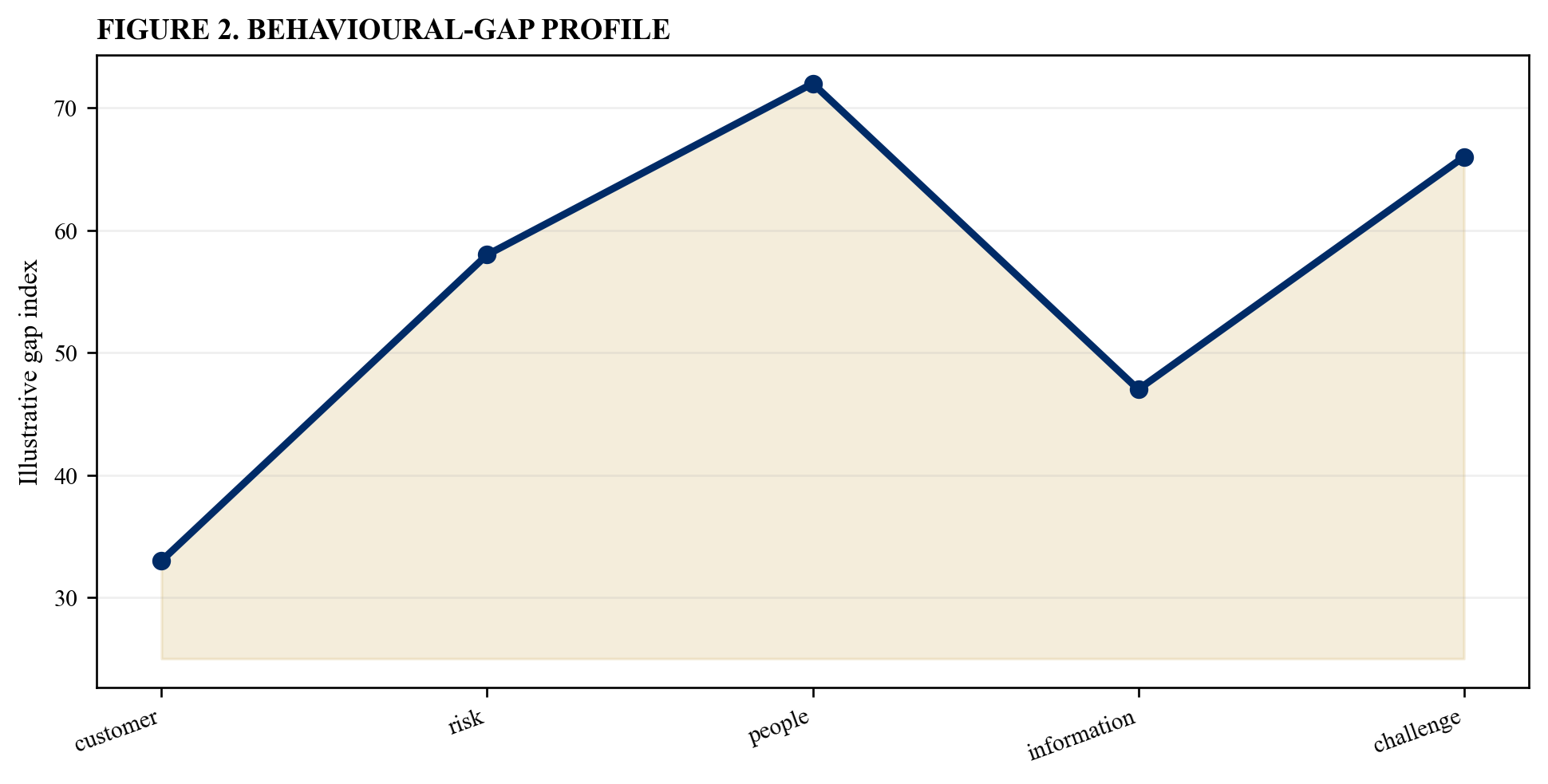
Illustrative analytical scenario; verified transaction evidence should replace index values.
5. Separate advantage from harm
The integration leadership should classify practices as value creating, context dependent, ineffective or harmful. The required output is a preserve-adapt-stop register. Record the purpose, affected decisions, expected behaviour, stakeholder consequence, accountable owner, evidence, boundary, incentive, control, escalation and review date [3][7].
Translate the cultural intent into observable operating practice. Define what leaders and teams must do when commercial, customer, risk, people and control objectives conflict. Identify the decision trigger, permitted discretion, required challenge, approval route, record and consequence.
The principal risk is that integration can preserve misconduct or remove entrepreneurial advantage. Test whether formal policy, actual decisions, resource allocation, incentives, promotion, recognition, case handling and leadership actions send a consistent signal across businesses, geographies and seniority levels.
Retain decision records, workforce evidence, customer outcomes, control tests, cases, exceptions, remediation and board challenge. Protect privacy, confidentiality, employee voice and lawful process. Refresh the rule when evidence shows unintended consequences, weak adoption or changed operating conditions.
6. Set non-negotiable conduct boundaries
The integration leadership should define legal, regulatory, safety, dignity, customer and integrity requirements. The required output is a conduct baseline. Record the purpose, affected decisions, expected behaviour, stakeholder consequence, accountable owner, evidence, boundary, incentive, control, escalation and review date [8][9].
Translate the cultural intent into observable operating practice. Define what leaders and teams must do when commercial, customer, risk, people and control objectives conflict. Identify the decision trigger, permitted discretion, required challenge, approval route, record and consequence.
The principal risk is that local custom can be invoked to excuse unacceptable behaviour. Test whether formal policy, actual decisions, resource allocation, incentives, promotion, recognition, case handling and leadership actions send a consistent signal across businesses, geographies and seniority levels.
Retain decision records, workforce evidence, customer outcomes, control tests, cases, exceptions, remediation and board challenge. Protect privacy, confidentiality, employee voice and lawful process. Refresh the rule when evidence shows unintended consequences, weak adoption or changed operating conditions.
7. Translate values into operating rules
The integration leadership should express each value as permitted, required and prohibited actions in named decisions. The required output is a values-to-rules dictionary. Record the purpose, affected decisions, expected behaviour, stakeholder consequence, accountable owner, evidence, boundary, incentive, control, escalation and review date [1][10].
Translate the cultural intent into observable operating practice. Define what leaders and teams must do when commercial, customer, risk, people and control objectives conflict. Identify the decision trigger, permitted discretion, required challenge, approval route, record and consequence.
The principal risk is that abstract values can support contradictory interpretations. Test whether formal policy, actual decisions, resource allocation, incentives, promotion, recognition, case handling and leadership actions send a consistent signal across businesses, geographies and seniority levels.
Retain decision records, workforce evidence, customer outcomes, control tests, cases, exceptions, remediation and board challenge. Protect privacy, confidentiality, employee voice and lawful process. Refresh the rule when evidence shows unintended consequences, weak adoption or changed operating conditions.
Table 1. Values-to-operating-rules dictionary
| Value | Required decision | Evidence |
|---|---|---|
| customer stewardship | test outcome and fairness | customer record |
| integrity | refuse improper value | decision log |
| accountability | name owner and consequence | approval record |
| challenge | surface contrary evidence | meeting record |
Illustrative structure; verified transaction evidence and specialist review govern.
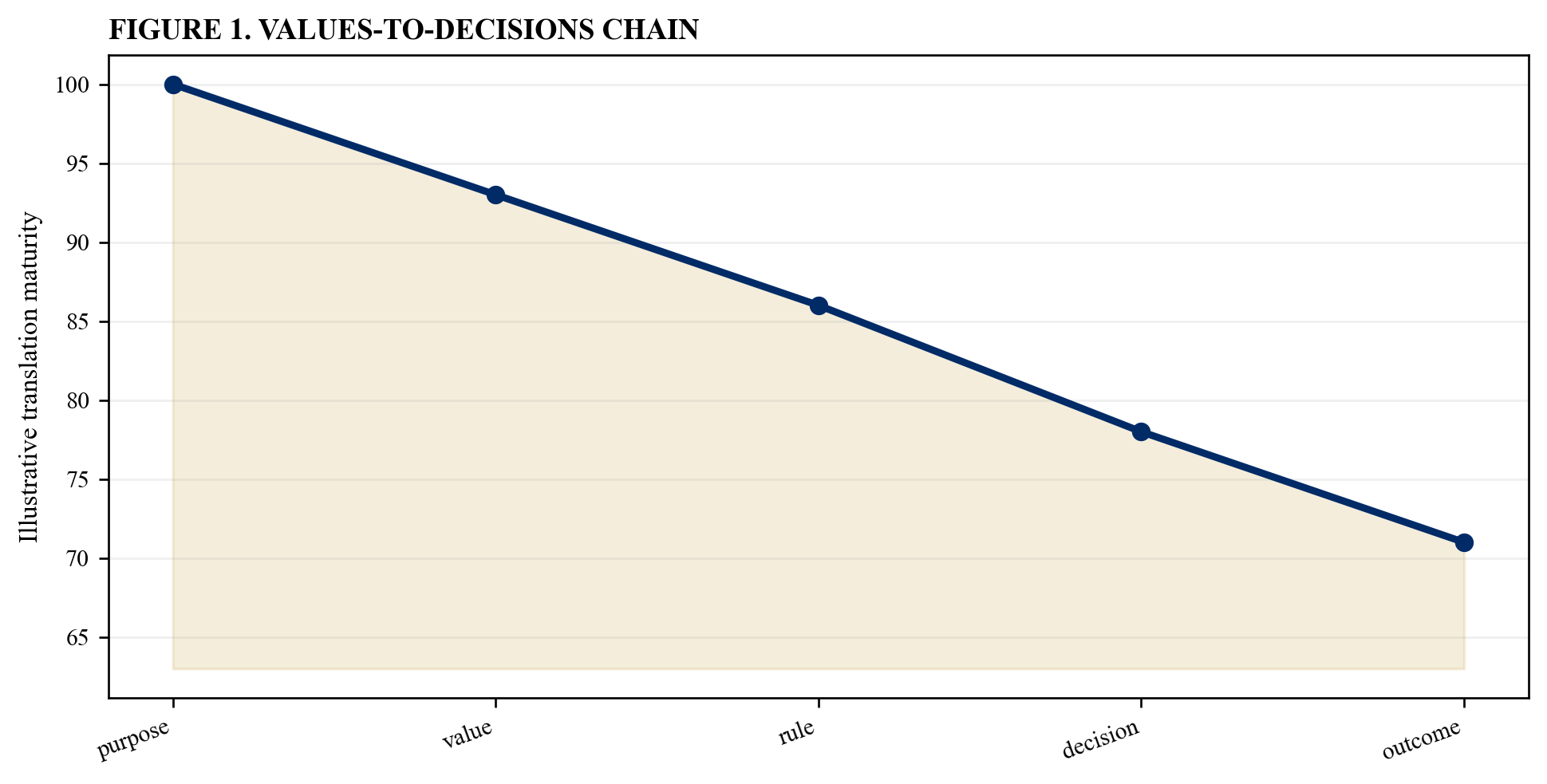
Illustrative analytical scenario; verified transaction evidence should replace index values.
8. Clarify decision rights
The integration leadership should assign propose, challenge, approve, execute, assure and escalate rights. The required output is a cultural decision-rights map. Record the purpose, affected decisions, expected behaviour, stakeholder consequence, accountable owner, evidence, boundary, incentive, control, escalation and review date [11][12].
Translate the cultural intent into observable operating practice. Define what leaders and teams must do when commercial, customer, risk, people and control objectives conflict. Identify the decision trigger, permitted discretion, required challenge, approval route, record and consequence.
The principal risk is that authority ambiguity can reward silence and informal power. Test whether formal policy, actual decisions, resource allocation, incentives, promotion, recognition, case handling and leadership actions send a consistent signal across businesses, geographies and seniority levels.
Retain decision records, workforce evidence, customer outcomes, control tests, cases, exceptions, remediation and board challenge. Protect privacy, confidentiality, employee voice and lawful process. Refresh the rule when evidence shows unintended consequences, weak adoption or changed operating conditions.
9. Model leadership behaviour
The integration leadership should specify actions, resource choices and consequences expected from senior leaders. The required output is a leadership commitment ledger. Record the purpose, affected decisions, expected behaviour, stakeholder consequence, accountable owner, evidence, boundary, incentive, control, escalation and review date [1][13].
Translate the cultural intent into observable operating practice. Define what leaders and teams must do when commercial, customer, risk, people and control objectives conflict. Identify the decision trigger, permitted discretion, required challenge, approval route, record and consequence.
The principal risk is that messages can lose credibility when executive decisions contradict them. Test whether formal policy, actual decisions, resource allocation, incentives, promotion, recognition, case handling and leadership actions send a consistent signal across businesses, geographies and seniority levels.
Retain decision records, workforce evidence, customer outcomes, control tests, cases, exceptions, remediation and board challenge. Protect privacy, confidentiality, employee voice and lawful process. Refresh the rule when evidence shows unintended consequences, weak adoption or changed operating conditions.
10. Activate middle management
The integration leadership should equip managers to resolve trade-offs, coach behaviour and escalate pressure. The required output is a manager operating guide. Record the purpose, affected decisions, expected behaviour, stakeholder consequence, accountable owner, evidence, boundary, incentive, control, escalation and review date [14][15].
Translate the cultural intent into observable operating practice. Define what leaders and teams must do when commercial, customer, risk, people and control objectives conflict. Identify the decision trigger, permitted discretion, required challenge, approval route, record and consequence.
The principal risk is that employees often experience culture through local managers rather than corporate messages. Test whether formal policy, actual decisions, resource allocation, incentives, promotion, recognition, case handling and leadership actions send a consistent signal across businesses, geographies and seniority levels.
Retain decision records, workforce evidence, customer outcomes, control tests, cases, exceptions, remediation and board challenge. Protect privacy, confidentiality, employee voice and lawful process. Refresh the rule when evidence shows unintended consequences, weak adoption or changed operating conditions.
11. Align performance objectives
The integration leadership should connect results with customer, control, conduct, collaboration and capability outcomes. The required output is a balanced performance model. Record the purpose, affected decisions, expected behaviour, stakeholder consequence, accountable owner, evidence, boundary, incentive, control, escalation and review date [8][16].
Translate the cultural intent into observable operating practice. Define what leaders and teams must do when commercial, customer, risk, people and control objectives conflict. Identify the decision trigger, permitted discretion, required challenge, approval route, record and consequence.
The principal risk is that financial targets can crowd out stated behavioural expectations. Test whether formal policy, actual decisions, resource allocation, incentives, promotion, recognition, case handling and leadership actions send a consistent signal across businesses, geographies and seniority levels.
Retain decision records, workforce evidence, customer outcomes, control tests, cases, exceptions, remediation and board challenge. Protect privacy, confidentiality, employee voice and lawful process. Refresh the rule when evidence shows unintended consequences, weak adoption or changed operating conditions.
12. Redesign incentives
The integration leadership should test salary, bonus, promotion, recognition and non-financial rewards against desired decisions. The required output is an incentive alignment map. Record the purpose, affected decisions, expected behaviour, stakeholder consequence, accountable owner, evidence, boundary, incentive, control, escalation and review date [8][17].
Translate the cultural intent into observable operating practice. Define what leaders and teams must do when commercial, customer, risk, people and control objectives conflict. Identify the decision trigger, permitted discretion, required challenge, approval route, record and consequence.
The principal risk is that reward systems can pay for outcomes achieved through unacceptable conduct. Test whether formal policy, actual decisions, resource allocation, incentives, promotion, recognition, case handling and leadership actions send a consistent signal across businesses, geographies and seniority levels.
Retain decision records, workforce evidence, customer outcomes, control tests, cases, exceptions, remediation and board challenge. Protect privacy, confidentiality, employee voice and lawful process. Refresh the rule when evidence shows unintended consequences, weak adoption or changed operating conditions.
Table 2. Incentive alignment
| Lever | Desired signal | Control |
|---|---|---|
| objective | balanced outcome | feasibility test |
| bonus | sustained value and conduct | malus review |
| promotion | capability and behaviour | calibrated evidence |
| recognition | constructive contribution | transparent criteria |
Illustrative structure; verified transaction evidence and specialist review govern.
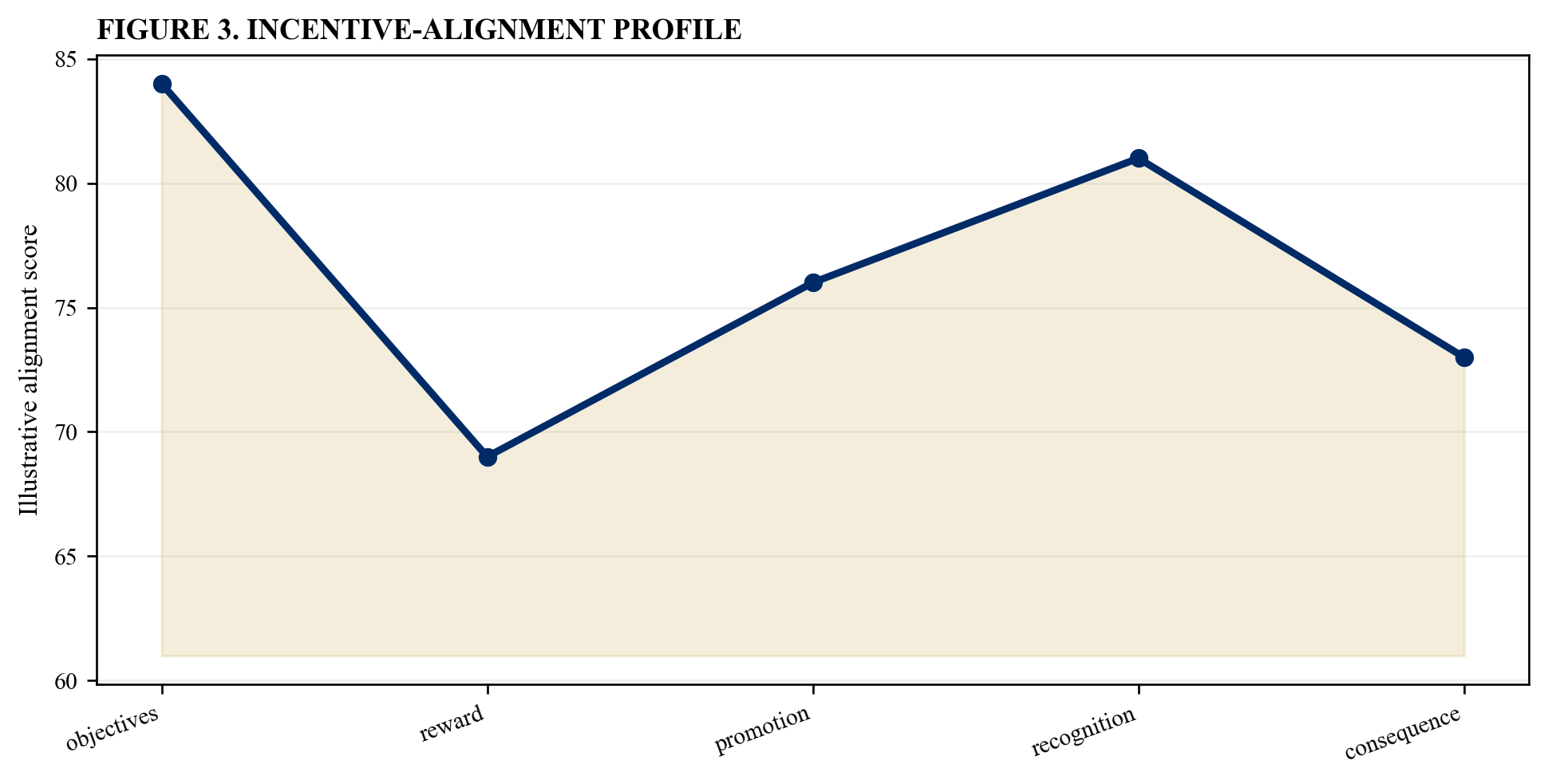
Illustrative analytical scenario; verified transaction evidence should replace index values.
13. Define fair consequences
The integration leadership should set consistent investigation, discipline, remediation and accountability principles. The required output is a consequence framework. Record the purpose, affected decisions, expected behaviour, stakeholder consequence, accountable owner, evidence, boundary, incentive, control, escalation and review date [8][18].
Translate the cultural intent into observable operating practice. Define what leaders and teams must do when commercial, customer, risk, people and control objectives conflict. Identify the decision trigger, permitted discretion, required challenge, approval route, record and consequence.
The principal risk is that selective enforcement can destroy trust and deterrence. Test whether formal policy, actual decisions, resource allocation, incentives, promotion, recognition, case handling and leadership actions send a consistent signal across businesses, geographies and seniority levels.
Retain decision records, workforce evidence, customer outcomes, control tests, cases, exceptions, remediation and board challenge. Protect privacy, confidentiality, employee voice and lawful process. Refresh the rule when evidence shows unintended consequences, weak adoption or changed operating conditions.
14. Protect employee voice
The integration leadership should provide accessible, confidential and non-retaliatory channels with visible follow-through. The required output is a speak-up architecture. Record the purpose, affected decisions, expected behaviour, stakeholder consequence, accountable owner, evidence, boundary, incentive, control, escalation and review date [19][20].
Translate the cultural intent into observable operating practice. Define what leaders and teams must do when commercial, customer, risk, people and control objectives conflict. Identify the decision trigger, permitted discretion, required challenge, approval route, record and consequence.
The principal risk is that staff can remain silent when challenge appears unsafe or futile. Test whether formal policy, actual decisions, resource allocation, incentives, promotion, recognition, case handling and leadership actions send a consistent signal across businesses, geographies and seniority levels.
Retain decision records, workforce evidence, customer outcomes, control tests, cases, exceptions, remediation and board challenge. Protect privacy, confidentiality, employee voice and lawful process. Refresh the rule when evidence shows unintended consequences, weak adoption or changed operating conditions.
15. Govern investigations
The integration leadership should define triage, independence, privilege, privacy, evidence, timeliness and remediation. The required output is a case-governance protocol. Record the purpose, affected decisions, expected behaviour, stakeholder consequence, accountable owner, evidence, boundary, incentive, control, escalation and review date [8][21].
Translate the cultural intent into observable operating practice. Define what leaders and teams must do when commercial, customer, risk, people and control objectives conflict. Identify the decision trigger, permitted discretion, required challenge, approval route, record and consequence.
The principal risk is that poor case handling can harm people and obscure systemic causes. Test whether formal policy, actual decisions, resource allocation, incentives, promotion, recognition, case handling and leadership actions send a consistent signal across businesses, geographies and seniority levels.
Retain decision records, workforce evidence, customer outcomes, control tests, cases, exceptions, remediation and board challenge. Protect privacy, confidentiality, employee voice and lawful process. Refresh the rule when evidence shows unintended consequences, weak adoption or changed operating conditions.
16. Control workforce data
The integration leadership should set lawful purposes, access, retention, minimisation and cross-border safeguards. The required output is a people-data control model. Record the purpose, affected decisions, expected behaviour, stakeholder consequence, accountable owner, evidence, boundary, incentive, control, escalation and review date [22][23].
Translate the cultural intent into observable operating practice. Define what leaders and teams must do when commercial, customer, risk, people and control objectives conflict. Identify the decision trigger, permitted discretion, required challenge, approval route, record and consequence.
The principal risk is that culture analytics can become intrusive or discriminatory. Test whether formal policy, actual decisions, resource allocation, incentives, promotion, recognition, case handling and leadership actions send a consistent signal across businesses, geographies and seniority levels.
Retain decision records, workforce evidence, customer outcomes, control tests, cases, exceptions, remediation and board challenge. Protect privacy, confidentiality, employee voice and lawful process. Refresh the rule when evidence shows unintended consequences, weak adoption or changed operating conditions.
17. Protect dignity and inclusion
The integration leadership should translate respect into staffing, meetings, allocation, feedback, promotion and complaint rules. The required output is an inclusive-decision standard. Record the purpose, affected decisions, expected behaviour, stakeholder consequence, accountable owner, evidence, boundary, incentive, control, escalation and review date [24][25].
Translate the cultural intent into observable operating practice. Define what leaders and teams must do when commercial, customer, risk, people and control objectives conflict. Identify the decision trigger, permitted discretion, required challenge, approval route, record and consequence.
The principal risk is that formal inclusion commitments can coexist with exclusionary routines. Test whether formal policy, actual decisions, resource allocation, incentives, promotion, recognition, case handling and leadership actions send a consistent signal across businesses, geographies and seniority levels.
Retain decision records, workforce evidence, customer outcomes, control tests, cases, exceptions, remediation and board challenge. Protect privacy, confidentiality, employee voice and lawful process. Refresh the rule when evidence shows unintended consequences, weak adoption or changed operating conditions.
18. Preserve psychological safety
The integration leadership should distinguish constructive challenge from obstruction and protect evidence-led dissent. The required output is a challenge protocol. Record the purpose, affected decisions, expected behaviour, stakeholder consequence, accountable owner, evidence, boundary, incentive, control, escalation and review date [19][26].
Translate the cultural intent into observable operating practice. Define what leaders and teams must do when commercial, customer, risk, people and control objectives conflict. Identify the decision trigger, permitted discretion, required challenge, approval route, record and consequence.
The principal risk is that teams can suppress bad news to maintain superficial harmony. Test whether formal policy, actual decisions, resource allocation, incentives, promotion, recognition, case handling and leadership actions send a consistent signal across businesses, geographies and seniority levels.
Retain decision records, workforce evidence, customer outcomes, control tests, cases, exceptions, remediation and board challenge. Protect privacy, confidentiality, employee voice and lawful process. Refresh the rule when evidence shows unintended consequences, weak adoption or changed operating conditions.
19. Integrate customer conduct
The integration leadership should define evidence-based rules for suitability, pricing, service, complaints and vulnerable customers. The required output is a customer-decision code. Record the purpose, affected decisions, expected behaviour, stakeholder consequence, accountable owner, evidence, boundary, incentive, control, escalation and review date [9][27].
Translate the cultural intent into observable operating practice. Define what leaders and teams must do when commercial, customer, risk, people and control objectives conflict. Identify the decision trigger, permitted discretion, required challenge, approval route, record and consequence.
The principal risk is that commercial pressure can convert cultural conflict into customer harm. Test whether formal policy, actual decisions, resource allocation, incentives, promotion, recognition, case handling and leadership actions send a consistent signal across businesses, geographies and seniority levels.
Retain decision records, workforce evidence, customer outcomes, control tests, cases, exceptions, remediation and board challenge. Protect privacy, confidentiality, employee voice and lawful process. Refresh the rule when evidence shows unintended consequences, weak adoption or changed operating conditions.
20. Integrate risk appetite
The integration leadership should translate board tolerances into front-line thresholds, escalation and stop decisions. The required output is a risk-decision playbook. Record the purpose, affected decisions, expected behaviour, stakeholder consequence, accountable owner, evidence, boundary, incentive, control, escalation and review date [11][28].
Translate the cultural intent into observable operating practice. Define what leaders and teams must do when commercial, customer, risk, people and control objectives conflict. Identify the decision trigger, permitted discretion, required challenge, approval route, record and consequence.
The principal risk is that teams can claim shared values while accepting incompatible risks. Test whether formal policy, actual decisions, resource allocation, incentives, promotion, recognition, case handling and leadership actions send a consistent signal across businesses, geographies and seniority levels.
Retain decision records, workforce evidence, customer outcomes, control tests, cases, exceptions, remediation and board challenge. Protect privacy, confidentiality, employee voice and lawful process. Refresh the rule when evidence shows unintended consequences, weak adoption or changed operating conditions.
21. Integrate control ownership
The integration leadership should assign first-line decisions, second-line challenge and independent assurance. The required output is a control-accountability map. Record the purpose, affected decisions, expected behaviour, stakeholder consequence, accountable owner, evidence, boundary, incentive, control, escalation and review date [11][29].
Translate the cultural intent into observable operating practice. Define what leaders and teams must do when commercial, customer, risk, people and control objectives conflict. Identify the decision trigger, permitted discretion, required challenge, approval route, record and consequence.
The principal risk is that culture can be delegated to human resources while operating controls remain unchanged. Test whether formal policy, actual decisions, resource allocation, incentives, promotion, recognition, case handling and leadership actions send a consistent signal across businesses, geographies and seniority levels.
Retain decision records, workforce evidence, customer outcomes, control tests, cases, exceptions, remediation and board challenge. Protect privacy, confidentiality, employee voice and lawful process. Refresh the rule when evidence shows unintended consequences, weak adoption or changed operating conditions.
22. Integrate information norms
The integration leadership should define transparency, confidentiality, need-to-know, recordkeeping and escalation expectations. The required output is an information-behaviour standard. Record the purpose, affected decisions, expected behaviour, stakeholder consequence, accountable owner, evidence, boundary, incentive, control, escalation and review date [22][30].
Translate the cultural intent into observable operating practice. Define what leaders and teams must do when commercial, customer, risk, people and control objectives conflict. Identify the decision trigger, permitted discretion, required challenge, approval route, record and consequence.
The principal risk is that openness can be confused with unlawful or unnecessary information sharing. Test whether formal policy, actual decisions, resource allocation, incentives, promotion, recognition, case handling and leadership actions send a consistent signal across businesses, geographies and seniority levels.
Retain decision records, workforce evidence, customer outcomes, control tests, cases, exceptions, remediation and board challenge. Protect privacy, confidentiality, employee voice and lawful process. Refresh the rule when evidence shows unintended consequences, weak adoption or changed operating conditions.
23. Respect merger-control limits
The integration leadership should protect independent competition and sensitive information until lawful integration is permitted. The required output is a clean-team behaviour protocol. Record the purpose, affected decisions, expected behaviour, stakeholder consequence, accountable owner, evidence, boundary, incentive, control, escalation and review date [30][31].
Translate the cultural intent into observable operating practice. Define what leaders and teams must do when commercial, customer, risk, people and control objectives conflict. Identify the decision trigger, permitted discretion, required challenge, approval route, record and consequence.
The principal risk is that cultural engagement can create premature coordination or influence. Test whether formal policy, actual decisions, resource allocation, incentives, promotion, recognition, case handling and leadership actions send a consistent signal across businesses, geographies and seniority levels.
Retain decision records, workforce evidence, customer outcomes, control tests, cases, exceptions, remediation and board challenge. Protect privacy, confidentiality, employee voice and lawful process. Refresh the rule when evidence shows unintended consequences, weak adoption or changed operating conditions.
24. Integrate decision cadence
The integration leadership should embed operating rules in meetings, approvals, reviews, retrospectives and board reporting. The required output is a governed decision rhythm. Record the purpose, affected decisions, expected behaviour, stakeholder consequence, accountable owner, evidence, boundary, incentive, control, escalation and review date [1][12].
Translate the cultural intent into observable operating practice. Define what leaders and teams must do when commercial, customer, risk, people and control objectives conflict. Identify the decision trigger, permitted discretion, required challenge, approval route, record and consequence.
The principal risk is that one-off workshops can remain detached from real work. Test whether formal policy, actual decisions, resource allocation, incentives, promotion, recognition, case handling and leadership actions send a consistent signal across businesses, geographies and seniority levels.
Retain decision records, workforce evidence, customer outcomes, control tests, cases, exceptions, remediation and board challenge. Protect privacy, confidentiality, employee voice and lawful process. Refresh the rule when evidence shows unintended consequences, weak adoption or changed operating conditions.
25. Design symbolic decisions carefully
The integration leadership should select early actions whose rationale and stakeholder effect are consistent with the target culture. The required output is a symbolic-action test. Record the purpose, affected decisions, expected behaviour, stakeholder consequence, accountable owner, evidence, boundary, incentive, control, escalation and review date [1][32].
Translate the cultural intent into observable operating practice. Define what leaders and teams must do when commercial, customer, risk, people and control objectives conflict. Identify the decision trigger, permitted discretion, required challenge, approval route, record and consequence.
The principal risk is that high-visibility gestures can appear arbitrary or performative. Test whether formal policy, actual decisions, resource allocation, incentives, promotion, recognition, case handling and leadership actions send a consistent signal across businesses, geographies and seniority levels.
Retain decision records, workforce evidence, customer outcomes, control tests, cases, exceptions, remediation and board challenge. Protect privacy, confidentiality, employee voice and lawful process. Refresh the rule when evidence shows unintended consequences, weak adoption or changed operating conditions.
26. Manage legacy identities
The integration leadership should recognise histories, professional identities and sources of pride while defining combined obligations. The required output is an identity transition plan. Record the purpose, affected decisions, expected behaviour, stakeholder consequence, accountable owner, evidence, boundary, incentive, control, escalation and review date [2][33].
Translate the cultural intent into observable operating practice. Define what leaders and teams must do when commercial, customer, risk, people and control objectives conflict. Identify the decision trigger, permitted discretion, required challenge, approval route, record and consequence.
The principal risk is that forced assimilation can trigger loss of trust and scarce talent. Test whether formal policy, actual decisions, resource allocation, incentives, promotion, recognition, case handling and leadership actions send a consistent signal across businesses, geographies and seniority levels.
Retain decision records, workforce evidence, customer outcomes, control tests, cases, exceptions, remediation and board challenge. Protect privacy, confidentiality, employee voice and lawful process. Refresh the rule when evidence shows unintended consequences, weak adoption or changed operating conditions.
27. Retain critical culture carriers
The integration leadership should identify credible leaders, experts and informal networks that sustain valuable practices. The required output is a culture-carrier map. Record the purpose, affected decisions, expected behaviour, stakeholder consequence, accountable owner, evidence, boundary, incentive, control, escalation and review date [3][34].
Translate the cultural intent into observable operating practice. Define what leaders and teams must do when commercial, customer, risk, people and control objectives conflict. Identify the decision trigger, permitted discretion, required challenge, approval route, record and consequence.
The principal risk is that retention focused only on hierarchy can miss influential capability. Test whether formal policy, actual decisions, resource allocation, incentives, promotion, recognition, case handling and leadership actions send a consistent signal across businesses, geographies and seniority levels.
Retain decision records, workforce evidence, customer outcomes, control tests, cases, exceptions, remediation and board challenge. Protect privacy, confidentiality, employee voice and lawful process. Refresh the rule when evidence shows unintended consequences, weak adoption or changed operating conditions.
28. Sequence cultural change
The integration leadership should prioritise high-risk and high-value decisions while pacing broader routines. The required output is a culture integration roadmap. Record the purpose, affected decisions, expected behaviour, stakeholder consequence, accountable owner, evidence, boundary, incentive, control, escalation and review date [4][35].
Translate the cultural intent into observable operating practice. Define what leaders and teams must do when commercial, customer, risk, people and control objectives conflict. Identify the decision trigger, permitted discretion, required challenge, approval route, record and consequence.
The principal risk is that simultaneous change can overload leaders and employees. Test whether formal policy, actual decisions, resource allocation, incentives, promotion, recognition, case handling and leadership actions send a consistent signal across businesses, geographies and seniority levels.
Retain decision records, workforce evidence, customer outcomes, control tests, cases, exceptions, remediation and board challenge. Protect privacy, confidentiality, employee voice and lawful process. Refresh the rule when evidence shows unintended consequences, weak adoption or changed operating conditions.
29. Measure observable decisions
The integration leadership should track approvals, exceptions, resource choices, challenge, complaints, cases and remediation. The required output is a decision-evidence dashboard. Record the purpose, affected decisions, expected behaviour, stakeholder consequence, accountable owner, evidence, boundary, incentive, control, escalation and review date [5][8].
Translate the cultural intent into observable operating practice. Define what leaders and teams must do when commercial, customer, risk, people and control objectives conflict. Identify the decision trigger, permitted discretion, required challenge, approval route, record and consequence.
The principal risk is that survey sentiment can conceal contradictory operational evidence. Test whether formal policy, actual decisions, resource allocation, incentives, promotion, recognition, case handling and leadership actions send a consistent signal across businesses, geographies and seniority levels.
Retain decision records, workforce evidence, customer outcomes, control tests, cases, exceptions, remediation and board challenge. Protect privacy, confidentiality, employee voice and lawful process. Refresh the rule when evidence shows unintended consequences, weak adoption or changed operating conditions.
Table 3. Behavioural evidence
| Evidence | Leading use | Limitation |
|---|---|---|
| decisions | observe trade-offs | context required |
| employee voice | detect pressure | participation bias |
| cases | find control failure | lagging signal |
| customer outcomes | test external effect | attribution |
Illustrative structure; verified transaction evidence and specialist review govern.
30. Combine leading and lagging evidence
The integration leadership should pair perceptions and behaviours with customer, workforce, control and financial outcomes. The required output is an evidence architecture. Record the purpose, affected decisions, expected behaviour, stakeholder consequence, accountable owner, evidence, boundary, incentive, control, escalation and review date [2][36].
Translate the cultural intent into observable operating practice. Define what leaders and teams must do when commercial, customer, risk, people and control objectives conflict. Identify the decision trigger, permitted discretion, required challenge, approval route, record and consequence.
The principal risk is that outcomes can arrive too late while perceptions alone remain ambiguous. Test whether formal policy, actual decisions, resource allocation, incentives, promotion, recognition, case handling and leadership actions send a consistent signal across businesses, geographies and seniority levels.
Retain decision records, workforce evidence, customer outcomes, control tests, cases, exceptions, remediation and board challenge. Protect privacy, confidentiality, employee voice and lawful process. Refresh the rule when evidence shows unintended consequences, weak adoption or changed operating conditions.
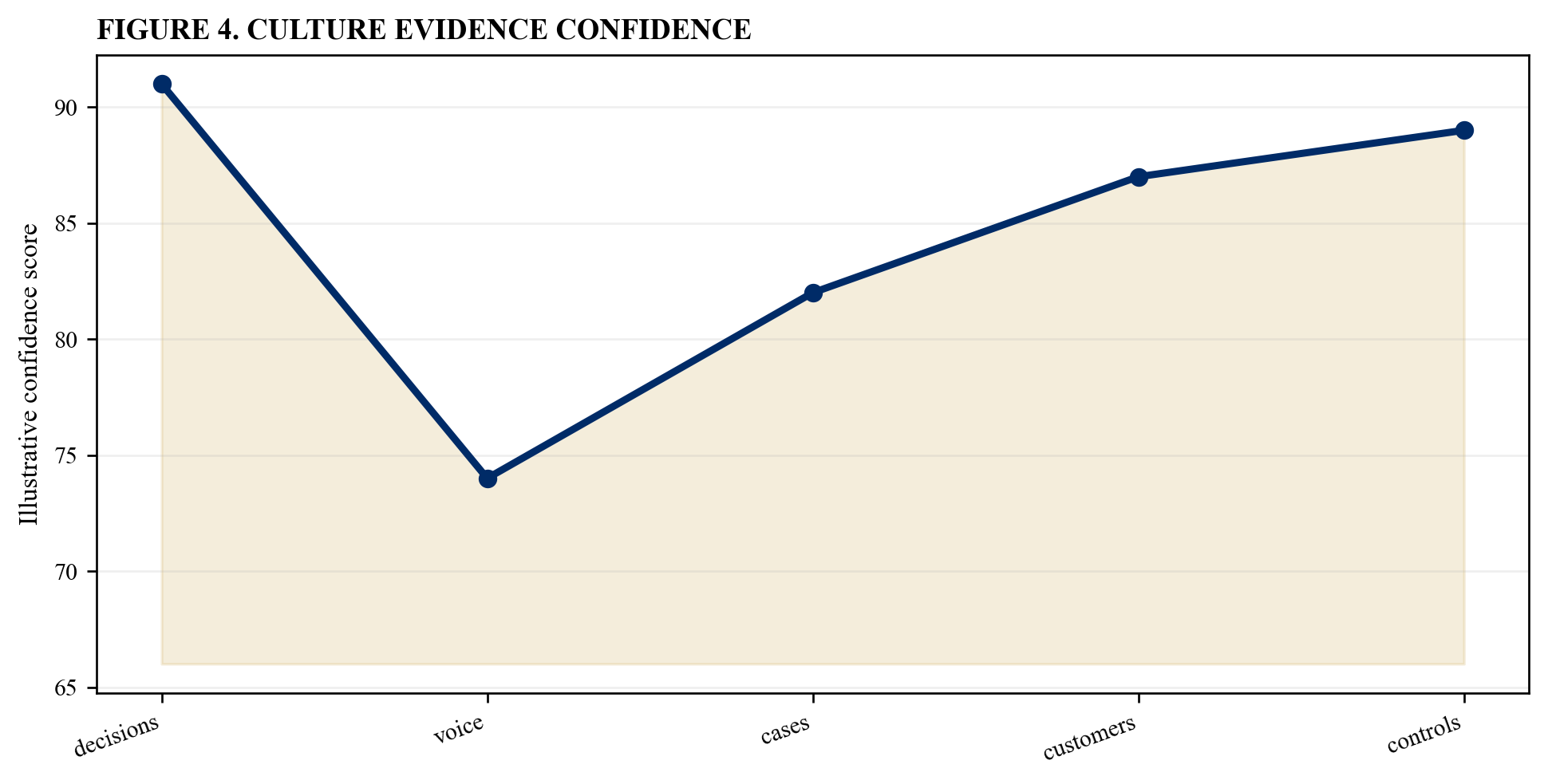
Illustrative analytical scenario; verified transaction evidence should replace index values.
31. Test measurement bias
The integration leadership should review participation, anonymity, selection, language, hierarchy and adverse-inference risks. The required output is a measurement assurance plan. Record the purpose, affected decisions, expected behaviour, stakeholder consequence, accountable owner, evidence, boundary, incentive, control, escalation and review date [22][23].
Translate the cultural intent into observable operating practice. Define what leaders and teams must do when commercial, customer, risk, people and control objectives conflict. Identify the decision trigger, permitted discretion, required challenge, approval route, record and consequence.
The principal risk is that culture data can misrepresent groups or chill participation. Test whether formal policy, actual decisions, resource allocation, incentives, promotion, recognition, case handling and leadership actions send a consistent signal across businesses, geographies and seniority levels.
Retain decision records, workforce evidence, customer outcomes, control tests, cases, exceptions, remediation and board challenge. Protect privacy, confidentiality, employee voice and lawful process. Refresh the rule when evidence shows unintended consequences, weak adoption or changed operating conditions.
32. Detect pressure and trade-offs
The integration leadership should monitor unattainable targets, workload, bottlenecks, overrides and incentives that distort decisions. The required output is a pressure-risk register. Record the purpose, affected decisions, expected behaviour, stakeholder consequence, accountable owner, evidence, boundary, incentive, control, escalation and review date [8][16].
Translate the cultural intent into observable operating practice. Define what leaders and teams must do when commercial, customer, risk, people and control objectives conflict. Identify the decision trigger, permitted discretion, required challenge, approval route, record and consequence.
The principal risk is that misconduct can emerge from systems that reward impossible results. Test whether formal policy, actual decisions, resource allocation, incentives, promotion, recognition, case handling and leadership actions send a consistent signal across businesses, geographies and seniority levels.
Retain decision records, workforce evidence, customer outcomes, control tests, cases, exceptions, remediation and board challenge. Protect privacy, confidentiality, employee voice and lawful process. Refresh the rule when evidence shows unintended consequences, weak adoption or changed operating conditions.
33. Learn from cases and near misses
The integration leadership should identify root causes, system conditions, supervisory gaps and transferable remediation. The required output is a culture learning loop. Record the purpose, affected decisions, expected behaviour, stakeholder consequence, accountable owner, evidence, boundary, incentive, control, escalation and review date [8][21].
Translate the cultural intent into observable operating practice. Define what leaders and teams must do when commercial, customer, risk, people and control objectives conflict. Identify the decision trigger, permitted discretion, required challenge, approval route, record and consequence.
The principal risk is that cases can be closed as individual failures without changing the system. Test whether formal policy, actual decisions, resource allocation, incentives, promotion, recognition, case handling and leadership actions send a consistent signal across businesses, geographies and seniority levels.
Retain decision records, workforce evidence, customer outcomes, control tests, cases, exceptions, remediation and board challenge. Protect privacy, confidentiality, employee voice and lawful process. Refresh the rule when evidence shows unintended consequences, weak adoption or changed operating conditions.
Table 4. Culture learning loop
| Stage | Question | Output |
|---|---|---|
| detect | what happened | verified event |
| diagnose | why it happened | root cause |
| remediate | what must change | owned action |
| verify | did practice change | test evidence |
Illustrative structure; verified transaction evidence and specialist review govern.
34. Govern exceptions
The integration leadership should require rationale, owner, duration, control, stakeholder impact and review for deviations. The required output is an exception register. Record the purpose, affected decisions, expected behaviour, stakeholder consequence, accountable owner, evidence, boundary, incentive, control, escalation and review date [11][29].
Translate the cultural intent into observable operating practice. Define what leaders and teams must do when commercial, customer, risk, people and control objectives conflict. Identify the decision trigger, permitted discretion, required challenge, approval route, record and consequence.
The principal risk is that informal exceptions can recreate legacy practices. Test whether formal policy, actual decisions, resource allocation, incentives, promotion, recognition, case handling and leadership actions send a consistent signal across businesses, geographies and seniority levels.
Retain decision records, workforce evidence, customer outcomes, control tests, cases, exceptions, remediation and board challenge. Protect privacy, confidentiality, employee voice and lawful process. Refresh the rule when evidence shows unintended consequences, weak adoption or changed operating conditions.
35. Assure consistency across units
The integration leadership should compare decisions and consequences across geographies, businesses and seniority levels. The required output is a consistency review. Record the purpose, affected decisions, expected behaviour, stakeholder consequence, accountable owner, evidence, boundary, incentive, control, escalation and review date [8][18].
Translate the cultural intent into observable operating practice. Define what leaders and teams must do when commercial, customer, risk, people and control objectives conflict. Identify the decision trigger, permitted discretion, required challenge, approval route, record and consequence.
The principal risk is that standards can be applied differently to powerful or commercially successful groups. Test whether formal policy, actual decisions, resource allocation, incentives, promotion, recognition, case handling and leadership actions send a consistent signal across businesses, geographies and seniority levels.
Retain decision records, workforce evidence, customer outcomes, control tests, cases, exceptions, remediation and board challenge. Protect privacy, confidentiality, employee voice and lawful process. Refresh the rule when evidence shows unintended consequences, weak adoption or changed operating conditions.
36. Report to the board
The integration leadership should present decisions, incentives, voice, cases, outcomes, exceptions, learning and residual risk. The required output is a board culture report. Record the purpose, affected decisions, expected behaviour, stakeholder consequence, accountable owner, evidence, boundary, incentive, control, escalation and review date [1][11].
Translate the cultural intent into observable operating practice. Define what leaders and teams must do when commercial, customer, risk, people and control objectives conflict. Identify the decision trigger, permitted discretion, required challenge, approval route, record and consequence.
The principal risk is that averages can hide severe pockets of risk or deteriorating trust. Test whether formal policy, actual decisions, resource allocation, incentives, promotion, recognition, case handling and leadership actions send a consistent signal across businesses, geographies and seniority levels.
Retain decision records, workforce evidence, customer outcomes, control tests, cases, exceptions, remediation and board challenge. Protect privacy, confidentiality, employee voice and lawful process. Refresh the rule when evidence shows unintended consequences, weak adoption or changed operating conditions.
37. Reconcile culture with value
The integration leadership should connect behavioural evidence to retention, customers, execution, controls and synergy delivery. The required output is a culture-value bridge. Record the purpose, affected decisions, expected behaviour, stakeholder consequence, accountable owner, evidence, boundary, incentive, control, escalation and review date [3][4].
Translate the cultural intent into observable operating practice. Define what leaders and teams must do when commercial, customer, risk, people and control objectives conflict. Identify the decision trigger, permitted discretion, required challenge, approval route, record and consequence.
The principal risk is that culture can be treated as activity without economic or stakeholder accountability. Test whether formal policy, actual decisions, resource allocation, incentives, promotion, recognition, case handling and leadership actions send a consistent signal across businesses, geographies and seniority levels.
Retain decision records, workforce evidence, customer outcomes, control tests, cases, exceptions, remediation and board challenge. Protect privacy, confidentiality, employee voice and lawful process. Refresh the rule when evidence shows unintended consequences, weak adoption or changed operating conditions.
38. Prepare the culture certificate
The integration leadership should retain rules, leadership actions, incentives, cases, metrics, exceptions and assurance. The required output is an auditable certificate. Record the purpose, affected decisions, expected behaviour, stakeholder consequence, accountable owner, evidence, boundary, incentive, control, escalation and review date [1][8].
Translate the cultural intent into observable operating practice. Define what leaders and teams must do when commercial, customer, risk, people and control objectives conflict. Identify the decision trigger, permitted discretion, required challenge, approval route, record and consequence.
The principal risk is that leaders can declare alignment without evidence that behaviour changed. Test whether formal policy, actual decisions, resource allocation, incentives, promotion, recognition, case handling and leadership actions send a consistent signal across businesses, geographies and seniority levels.
Retain decision records, workforce evidence, customer outcomes, control tests, cases, exceptions, remediation and board challenge. Protect privacy, confidentiality, employee voice and lawful process. Refresh the rule when evidence shows unintended consequences, weak adoption or changed operating conditions.
Table 5. Culture-integration certificate
| Conclusion | Retained evidence | Acceptance |
|---|---|---|
| rules | decision dictionary | approved |
| alignment | incentives and consequences | tested |
| practice | behavioural evidence | verified |
| risk | exceptions and owners | accepted |
Illustrative structure; verified transaction evidence and specialist review govern.
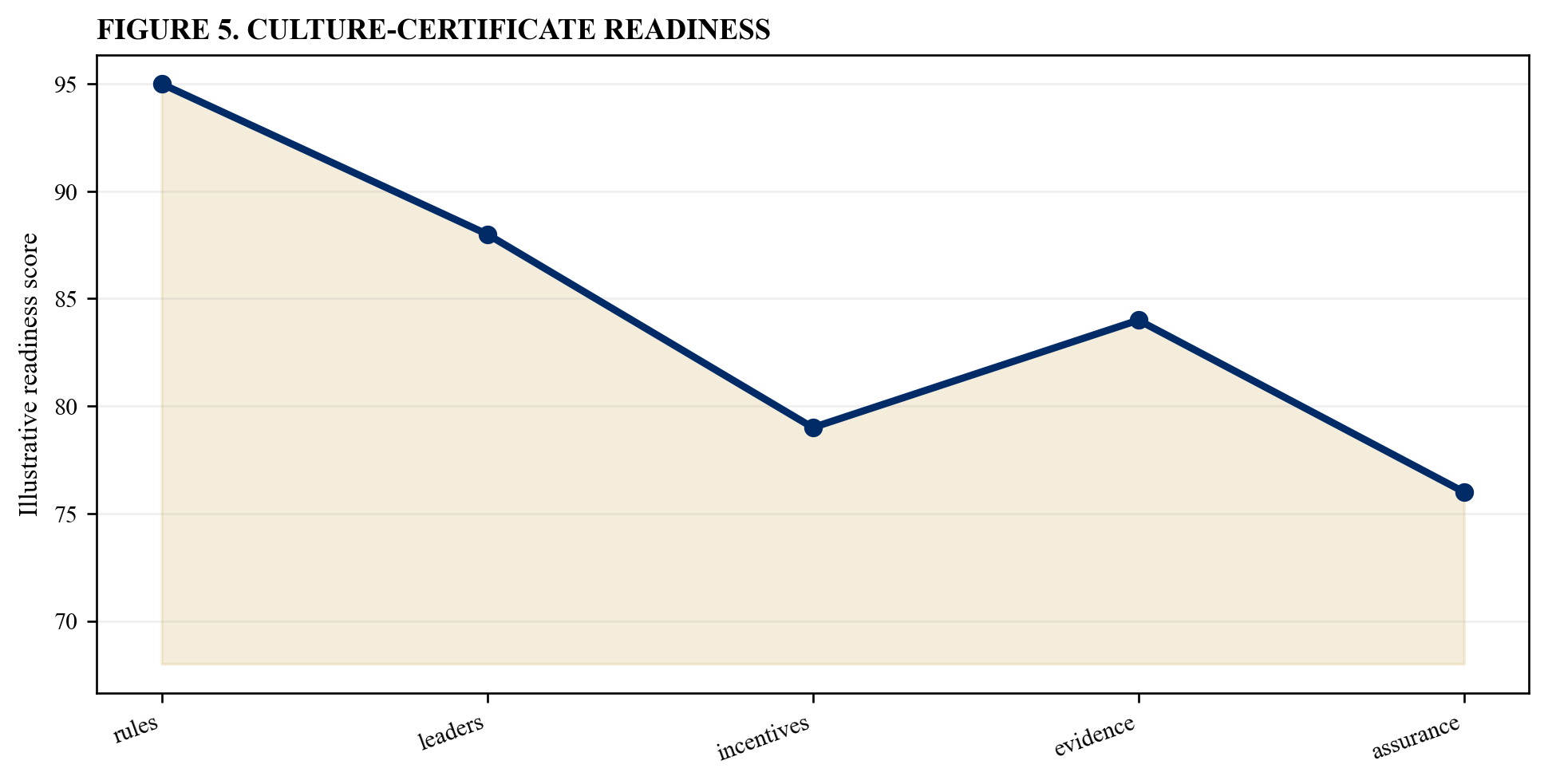
Illustrative analytical scenario; verified transaction evidence should replace index values.
39. Set post-integration ownership
The integration leadership should assign enduring responsibility for culture, conduct, people systems, controls and assurance. The required output is a steady-state ownership model. Record the purpose, affected decisions, expected behaviour, stakeholder consequence, accountable owner, evidence, boundary, incentive, control, escalation and review date [11][29].
Translate the cultural intent into observable operating practice. Define what leaders and teams must do when commercial, customer, risk, people and control objectives conflict. Identify the decision trigger, permitted discretion, required challenge, approval route, record and consequence.
The principal risk is that accountability can disappear when the integration programme closes. Test whether formal policy, actual decisions, resource allocation, incentives, promotion, recognition, case handling and leadership actions send a consistent signal across businesses, geographies and seniority levels.
Retain decision records, workforce evidence, customer outcomes, control tests, cases, exceptions, remediation and board challenge. Protect privacy, confidentiality, employee voice and lawful process. Refresh the rule when evidence shows unintended consequences, weak adoption or changed operating conditions.
40. Continue evidence-led adaptation
The integration leadership should review operating rules when strategy, regulation, workforce or performance changes. The required output is a continuous review cycle. Record the purpose, affected decisions, expected behaviour, stakeholder consequence, accountable owner, evidence, boundary, incentive, control, escalation and review date [1][37].
Translate the cultural intent into observable operating practice. Define what leaders and teams must do when commercial, customer, risk, people and control objectives conflict. Identify the decision trigger, permitted discretion, required challenge, approval route, record and consequence.
The principal risk is that a fixed cultural blueprint can become detached from operating reality. Test whether formal policy, actual decisions, resource allocation, incentives, promotion, recognition, case handling and leadership actions send a consistent signal across businesses, geographies and seniority levels.
Retain decision records, workforce evidence, customer outcomes, control tests, cases, exceptions, remediation and board challenge. Protect privacy, confidentiality, employee voice and lawful process. Refresh the rule when evidence shows unintended consequences, weak adoption or changed operating conditions.
References
- UK Financial Reporting Council, Corporate Culture, https://www.frc.org.uk/library/standards-codes-policy/corporate-governance/corporate-culture/
- UK Financial Reporting Council, Corporate Culture and the Role of Boards, https://media.frc.org.uk/documents/Corporate_Culture_and_the_Role_of_Boards_Report_of_Observations_interactive_PDF.pdf
- IFRS Foundation, IFRS 3 Business Combinations, https://www.ifrs.org/issued-standards/list-of-standards/ifrs-3-business-combinations/
- IFRS Foundation, Business Combinations Disclosures Goodwill and Impairment Project, https://www.ifrs.org/projects/work-plan/goodwill-and-impairment/
- US Department of Justice, Evaluation of Corporate Compliance Programs, https://www.justice.gov/criminal/criminal-fraud/page/file/937501/dl
- UK Financial Reporting Council, Creating Positive Culture, https://www.frc.org.uk/library/standards-codes-policy/corporate-governance/corporate-culture/
- OECD, Guidelines for Multinational Enterprises on Responsible Business Conduct, https://mneguidelines.oecd.org/mneguidelines/
- US Department of Justice, Principles of Federal Prosecution of Business Organizations, https://www.justice.gov/jm/jm-9-28000-principles-federal-prosecution-business-organizations
- UK Financial Conduct Authority, Culture and Governance, https://www.fca.org.uk/firms/culture-governance
- UK Financial Reporting Council, UK Corporate Governance Code 2024, https://www.frc.org.uk/library/standards-codes-policy/corporate-governance/uk-corporate-governance-code/
- UK Financial Reporting Council, Corporate Governance Code Guidance, https://www.frc.org.uk/library/standards-codes-policy/corporate-governance/corporate-governance-code-guidance/
- Committee of Sponsoring Organizations of the Treadway Commission, Internal Control Integrated Framework, https://www.coso.org/internal-control
- OECD, G20 OECD Principles of Corporate Governance 2023, https://www.oecd.org/corporate/principles-corporate-governance/
- UK Financial Conduct Authority, Conduct Rules, https://www.fca.org.uk/firms/senior-managers-certification-regime/conduct-rules
- UK Advisory Conciliation and Arbitration Service, Managing People, https://www.acas.org.uk/managing-staff
- US Department of Justice, Corporate Enforcement and Compensation Incentives, https://www.justice.gov/criminal/corporate-enforcement-note-compensation-incentives-and-clawback-pilot
- UK Financial Conduct Authority, Recognition and Incentives, https://www.fca.org.uk/firms/culture-and-governance/recognition-and-incentives
- US Securities and Exchange Commission, Clawback Rules, https://www.sec.gov/files/rules/final/2022/33-11126.pdf
- UK Government, Whistleblowing for Employees, https://www.gov.uk/whistleblowing
- European Union, Directive 2019/1937 on Protection of Whistleblowers, https://eur-lex.europa.eu/eli/dir/2019/1937/oj
- US Department of Justice, Evaluation of Corporate Compliance Programs in Criminal Antitrust Investigations, https://www.justice.gov/atr/media/1376686/dl
- European Union, General Data Protection Regulation, https://eur-lex.europa.eu/eli/reg/2016/679/oj
- UK Information Commissioner's Office, Employment Practices and Data Protection, https://ico.org.uk/for-organisations/uk-gdpr-guidance-and-resources/employment/
- UK Equality and Human Rights Commission, Employment Statutory Code of Practice, https://www.equalityhumanrights.com/equality/equality-act-2010/codes-practice/employment-statutory-code-practice
- UK Financial Conduct Authority, Non-Financial Misconduct, https://www.fca.org.uk/firms/culture-governance/non-financial-misconduct
- US Government Accountability Office, Organizational Transformation, https://www.gao.gov/products/gao-03-669
- UK Financial Conduct Authority, Consumer Duty, https://www.fca.org.uk/firms/consumer-duty
- International Organization for Standardization, ISO 31000 Risk Management, https://www.iso.org/iso-31000-risk-management.html
- Institute of Internal Auditors, Three Lines Model, https://www.theiia.org/en/content/position-papers/2020/the-iias-three-lines-model-an-update-of-the-three-lines-of-defense/
- UK Competition and Markets Authority, Interim Measures in Merger Investigations, https://www.gov.uk/government/publications/interim-measures-and-derogations-guidance-and-templates
- European Commission, EU Merger Control Procedures, https://competition-policy.ec.europa.eu/mergers/procedures_en
- UK Financial Reporting Council, Guidance on Board Effectiveness, https://www.frc.org.uk/library/standards-codes-policy/corporate-governance/guidance-on-board-effectiveness/
- European Union, Directive 2002/14/EC on Informing and Consulting Employees, https://eur-lex.europa.eu/eli/dir/2002/14/oj
- UK Government, Business Transfers Takeovers and TUPE, https://www.gov.uk/transfers-takeovers
- US Government Accountability Office, Cost Estimating and Assessment Guide, https://www.gao.gov/products/gao-20-195g
- IFRS Foundation, IFRS 18 Presentation and Disclosure in Financial Statements, https://www.ifrs.org/issued-standards/list-of-standards/ifrs-18-presentation-and-disclosure-in-financial-statements/
- International Organization for Standardization, ISO 37301 Compliance Management Systems, https://www.iso.org/standard/75080.html
- National Institute of Standards and Technology, Cybersecurity Framework 2.0, https://www.nist.gov/publications/nist-cybersecurity-framework-csf-20
