

1. The acquisition question
A buyer considering a distressed business needs to establish how much customer cash flow remains available after public concern about the seller's survival. Historical sales describe completed transactions. A purchase price depends on future decisions by customers, the buyer's ability to serve them, and the cash required during the transition. We propose a customer-level diligence method that carries those decisions through to a revenue forecast, operating contribution, funding requirement and negotiated purchase-price boundary.
The central recommendation is to separate four questions for each material customer. Does the seller have an enforceable right to supply or be paid? Does the customer intend to continue purchasing? Can the business fulfil the commitment through completion? When will the resulting cash become available? Different evidence answers each question. A signed contract provides limited evidence of operational readiness. A supportive conversation provides limited evidence of a procurement approval. An invoice provides limited evidence of its collection date. Recording these differences makes the valuation contestable and updateable.
The unit of analysis should be a customer-contract-product-period record. A single customer can retain one service, reduce a second and terminate a third. Combining these movements into a single retained-customer flag conceals their economics. The proposed method therefore reconciles customer records to finance data while retaining the underlying decisions and dates. It is intended for acquisition diligence and transaction planning. Legal enforceability, accounting treatment and insolvency outcomes require qualified advice for the relevant contract, structure and jurisdiction.
This paper combines selected published evidence with an author-designed analytical framework and a hypothetical numerical example. The example is a teaching model, has no empirical calibration, and represents no client or actual transaction. Its assumptions are deliberately visible so that a transaction team can challenge them. No result establishes an expected return, an acquisition price or a causal estimate of distress-related customer loss.
2. What published evidence supports
The UK Government's corporate financial distress guidance identifies loss of customer confidence and movement towards alternative suppliers among the potential consequences of distress. It also describes the interaction with trade-credit withdrawal and other pressures on liquidity. This supports examining commercial and financing dependencies together. The guidance addresses government contracting; its observations do not provide a universal customer-attrition coefficient for private transactions. [1]
Hortaçsu, Matvos, Syverson and Venkataraman study how automobile manufacturers' financial distress affects owners of durable goods. Their research connects distress to concerns over continuing services associated with those goods. The relevance here is the economic importance of future support to a purchase made today. The study's industry, period and identification strategy limit direct extrapolation to software, engineering projects or professional services. Its findings should inform the questions asked during diligence, with transaction-specific evidence determining numerical inputs. [2]
Spirit Airlines' 2024 Form 10-K describes risks to customer and other counterparty relationships associated with its Chapter 11 proceedings. It also explains that credit-card processors can retain collateral under specified contractual circumstances, reducing unrestricted cash. These are company disclosures of risks and arrangements, rather than a measured estimate of customer losses caused by bankruptcy. They illustrate why a diligence team should inspect both customer behaviour and the payment mechanisms through which customer receipts reach the business. [3]
Quanta Services' 2025 Form 10-K describes valuing acquired customer relationships using a multi-period excess earnings method, with customer renewals and attrition among the inputs. Its disclosed 2025 acquisition assumptions include attrition rates ranging from 5% to 30%, with an 11% weighted average. These are transaction-specific management assumptions disclosed in that filing. They are neither distressed-business benchmarks nor suggested inputs for the model in this paper. [4]
The research proposition is therefore specific: a buyer should investigate the mechanisms by which customer decisions affect cash flow and should avoid importing an attrition rate merely because another transaction disclosed it. Published material supplies context and methodological boundaries. The acquisition's own contracts, operating records and customer evidence must supply its forecast.
3. Dating the event and defining the perimeter
We recommend an event chronology with several distinct dates: the first documented customer concern, the first public report, any formal financing announcement, the opening of a sale process and any insolvency filing. The chronology should preserve the source and time of each entry. Where the first rumour cannot be dated reliably, use a range and test alternative start dates. Choosing an exact date without evidence gives a misleading impression of precision.
The analyst should freeze the original data extracts before adding account-team explanations. This permits later reviewers to distinguish a contemporaneous observation from an explanation supplied after a customer left. Record whether a reduction followed a price increase, a delivery failure, a competitor's offer or a customer's own budget change. Several causes may coexist. The chronology should allow multiple contributing factors without asserting that the rumour caused every subsequent movement.
Define the legal and operating perimeter at the same time. A carve-out can include a customer name in group reports even when only some contracts, systems or service teams transfer. Match the proposed acquired entities to invoices, contract counterparties, service obligations and receipts. Eliminate intercompany amounts from external customer demand. Identify agreements that span retained and acquired operations, since their revenue allocation and service responsibilities may need negotiation.
A useful control is a reconciliation from the seller's reported revenue to the customer model, followed by a separate bridge to the proposed acquisition perimeter. Unallocated differences should remain visible. The bid committee needs to know whether uncertainty concerns missing data, disputed ownership or forecast customer behaviour. Each category requires a different response and cannot be resolved by the same percentage reduction.
4. Building a customer evidence file
The proposed evidence file links each material claim to an identifiable document or record. For booked sales, collect the executed agreement, relevant order, delivery or acceptance record, invoice and subsequent receipt. For renewals, include the notice window, renewal decision maker, latest written communication and any open service issue. For pipeline, record the customer's approval process and the next verifiable milestone. An internal probability attached to a CRM stage should remain identified as management's estimate.
Use explicit evidence states such as confirmed, awaiting confirmation and disputed within the diligence working file. These are internal workflow descriptions, not judgments about a person's honesty. A confirmation should state its scope. A customer may confirm that an invoice is valid while declining to confirm renewal. Store that distinction alongside the confirmation date and person authorised to give it. Legal advisers should determine whether the proposed contact process is permitted and appropriate before outreach begins.
Coverage can be measured in several ways: percentage of revenue tested, percentage of contribution tested and percentage of near-term receipts tested. A high revenue coverage rate can coexist with weak coverage of the cash needed to reach completion. We recommend selecting the initial sample by economic consequence, adding customers with imminent decision dates and unresolved disputes, and then testing a broader sample for systematic errors.
The evidence file should also record missingness. If operational teams cannot produce service logs for a material account, the model should not silently interpret that absence as satisfactory delivery. Show the unsupported exposure, explain the forecast assumption and request an alternative source. A visible uncertainty register allows the buyer to price, fund or exclude the exposure without pretending that the evidence is complete.
Table 1. Evidence required for customer decisions
| Question | Primary record | Decision use |
|---|---|---|
| Contract transfers? | Executed terms and legal advice | Consent or completion condition |
| Customer continues? | Renewal decision and dated response | Volume scenario |
| Delivery feasible? | Resource and service plan | Fulfilment assumption |
| Cash available? | Receipt evidence and restrictions | Weekly liquidity forecast |
Author-proposed diligence framework. Legal conclusions require transaction-specific advice.
5. Cohorts and retention measures
Define cohorts around behaviour relevant to the decision. An annual software subscription, an engineering milestone and a discretionary repeat order have different decision points. Customer size alone does not capture these differences. We propose combining contract form, renewal window and operational dependency as the primary segmentation, then examining geography, tenure and concentration where the data supports additional distinctions.
Logo retention counts relationships that continue under a defined rule. Revenue retention measures the monetary amount preserved from an opening cohort. Contribution retention also accounts for variable delivery costs and price concessions. Cash retention concerns receipts over a stated period. Specify the denominator, treatment of foreign exchange, inclusion of expansion sales and observation window for every reported percentage. Keep newly acquired customers outside an opening-cohort retention calculation.
A customer that remains in the database with no orders may satisfy a loose logo definition while contributing no revenue. Conversely, a project customer can finish its contracted work successfully and then produce no further sales without breaching any expectation of renewal. Define inactivity separately for each commercial model. Inspect whether a proposed churn classification reflects a contractual event, a behavioural threshold or an account manager's expectation.
For concentration, calculate the contribution and cash exposure of individual accounts as well as revenue share. Add the time needed to replace the account's volume and the fixed capacity left behind. Two accounts with equal revenue can have materially different consequences under the model if one uses specialised staff or assets that cannot be redeployed. This consequence is a scenario to test against operating evidence, rather than an assumed feature of every concentrated business.
6. Causal attribution and competing explanations
A pre-event and post-event comparison is a useful description, but it does not by itself establish causation. A revenue decline may reflect seasonality, a product retirement, a market contraction or service deterioration that also contributed to financial distress. The analyst should present the observed change first, then state the evidence supporting any proposed explanation. Where attribution remains unresolved, valuation can still use the observed condition without claiming to know its cause.
We propose comparing affected cohorts with commercially similar cohorts that had different exposure to the public event. Before relying on such a comparison, inspect their earlier trends, product mix, renewal calendars and geography. A customer that learned of distress earlier than the public announcement cannot serve as an untreated comparison simply because its contract sits in another division. Contamination of comparison groups should be documented.
A difference-in-differences calculation can be an exploratory diagnostic when the data and assumptions warrant it. For example, compare the change in renewal rates in the exposed group with the contemporaneous change in the comparison group. Any causal interpretation depends on assumptions about the trends that would otherwise have occurred, selection and other events. Small samples or changing cohort composition may make descriptive reporting more defensible than an estimated causal effect.
For time-to-event analysis, preserve customers that have not yet reached a renewal decision as censored observations. Classifying them immediately as retained overstates what has been observed. For small acquisition datasets, a simple renewal calendar with explicit unresolved outcomes may be more decision-useful than a complex fitted survival model. The method should match the evidence available at the bid date.
7. Contract rights and commercial willingness
For each significant agreement, ask counsel to identify the counterparty, governing law, term, notice periods, assignment provisions and relevant termination rights. Record whether a proposed share purchase or asset purchase changes the required steps. A contractual remedy may depend on facts, notices or court orders that the financial team cannot infer from a clause heading. Put those dependencies into the completion timetable.
US Bankruptcy Code section 365 addresses assumption, rejection and assignment of executory contracts and unexpired leases. Its provisions include court approval, cure and adequate-assurance requirements in relevant circumstances, together with important exceptions. The section should not be summarised as a blanket right to transfer every customer agreement. A US transaction needs advice on the particular contract and applicable law. Other jurisdictions require their own analysis. [5]
The commercial model should retain a separate field for customer willingness even where the legal route is supported. A customer can comply with the existing term and then reduce discretionary orders or decline renewal. A long contractual duration may provide little protection when minimum purchases are negligible. Conversely, customers dependent on a specialised service may prefer a funded continuity proposal, although that preference requires confirmation.
Translate each material legal dependency into a financial scenario. If a consent is required, show the revenue and cash affected by a delayed or refused consent. Include any proposed cure payment once, with a clear classification in purchase price, assumed liabilities or operating cash. The legal team should approve the interpretation; finance should reconcile the resulting amounts and dates.
8. Revenue recognition and the economic forecast
IFRS 15 establishes a framework for reporting the nature, amount, timing and uncertainty of revenue and related cash flows from customer contracts. Its five-step approach includes identifying performance obligations and determining and allocating the transaction price. Variable consideration therefore requires attention when concessions, refunds or other adjustments affect the amount expected under a contract. The standard's overview provides the accounting context; transaction-specific conclusions require the applicable detailed requirements and professional review. [6]
In acquisition diligence, keep recognised revenue, invoices, cash receipts and forward demand in separate schedules. A balance can reconcile correctly to the ledger while providing limited evidence of next year's orders. Trace changes in accounting estimates to the underlying commercial event. If management has updated a forecast for concessions but billing has not issued the corresponding credits, explain the timing difference and check for double counting.
The proposed forecast begins with deliverable demand expressed at existing prices, then applies separately documented changes in customer volume, fulfilment and price. This ordering makes the assumptions visible. It also permits a reviewer to ask whether the same service failure has been included both in a cancellation estimate and in a full revenue refund. Where outcomes overlap, use mutually exclusive states or customer-level calculations.
Prepayments need a further schedule showing remaining delivery obligations and the resources available to meet them. Receiving cash before completion does not establish that the buyer receives that cash or can use it freely. The transaction documents and operating budget should identify who retains the balance, who performs the service and how the required expenditure is funded. The economic forecast must follow those agreed responsibilities.
9. Designing the hypothetical model
The following author-designed example uses USD millions and a one-year horizon. It starts with 100 of annual demand at unchanged list prices: 40 from contracted services, 35 from project customers and 25 from transactional buyers. Their assumed contribution margins before concessions are 60%, 35% and 25%. These figures are illustrative inputs, have no empirical calibration and should never be treated as industry benchmarks.
Three cases change retained volume, discounts and deliverability together. The continuity case assumes retention of 95%, 90% and 85% respectively, discounts of 2%, 3% and 1%, and 98% fulfilment. The disruption case uses retention of 80%, 70% and 60%, discounts of 8%, 10% and 5%, and 90% fulfilment. Severe disruption uses retention of 60%, 45% and 40%, discounts of 12%, 15% and 10%, and 80% fulfilment. These cases illustrate different degrees of deterioration; no probabilities are assigned to them.
For each cohort, multiply baseline demand by the retained-volume fraction and the fulfilment fraction to calculate delivered demand at the original price. Multiply that amount by one minus the concession rate to obtain revenue. Variable cost equals delivered demand at the original price multiplied by one minus the original contribution margin. The calculation therefore assumes concessions reduce price without reducing unit delivery cost. This is an intentional modelling choice that should be changed when actual cost evidence supports another relationship.
The example holds annual fixed cash operating cost at 20 and adds retention expenditure of 1, 2 or 3 by case. It assumes depreciation and capital expenditure of 2 each, a hypothetical 25% tax on positive operating profit after depreciation, and no tax benefit for losses. It excludes financing costs, transaction fees, restructuring liabilities and changes in inventory or payables. These exclusions limit its use as a purchase-price or financing model.
Table 2. Hypothetical model assumptions
| Input | Continuity | Disruption | Severe |
|---|---|---|---|
| Service retention | 95% | 80% | 60% |
| Project retention | 90% | 70% | 45% |
| Transactional retention | 85% | 60% | 40% |
| Service concession | 2% | 8% | 12% |
| Project concession | 3% | 10% | 15% |
| Transactional concession | 1% | 5% | 10% |
| Fulfilment | 98% | 90% | 80% |
| Collection days | 45 | 65 | 90 |
| Retention spend | 1 | 2 | 3 |
Author assumptions with no empirical calibration. Monetary amounts are hypothetical USD million. Baseline demand 100; fixed cash cost 20.
10. Retention and concessions in the model
The continuity case produces revenue of 87.056 and contribution of 36.476. After fixed cost and retention expenditure, EBITDA is 15.476. In the disruption case revenue falls to 59.166, contribution to 23.189 and EBITDA to 1.189. Severe disruption produces revenue of 34.806, contribution of 12.936 and an EBITDA loss of 10.064. All values are outputs of the stated hypothetical assumptions, rounded to three decimals.
The calculation demonstrates operating leverage within this example. Fixed costs remain at 20 while demand and delivered volume contract. A proposal to reduce fixed cost should therefore identify the actual resources removed, associated cash payments, timetable and consequences for customer service. Counting savings from an immediate staff reduction while retaining an unchanged fulfilment assumption requires a supporting operating plan.
Price concessions also need a separate decision. Under the disruption assumptions, contracted services generate delivered demand at the original price of 28.8. An 8% concession reduces revenue by 2.304. Variable cost remains 11.52 under the model, leaving contribution of 14.976. A retention manager can use this structure to examine whether a discount is justified by an evidenced increase in retained volume. The discount's cost is visible even when the customer logo remains.
We recommend comparing proposed interventions against an explicit no-intervention scenario. Estimate incremental retained contribution, subtract intervention costs and consider the timing of receipts. Document who supplied each assumption and what evidence could change it. A signed renewal or a verified service improvement may justify revising the case. A general belief that the new owner will restore confidence should remain an unsupported proposition until tested.
Table 3. Hypothetical operating results
| USD million | Continuity | Disruption | Severe disruption |
|---|---|---|---|
| Revenue | 87.056 | 59.166 | 34.806 |
| Contribution | 36.476 | 23.189 | 12.936 |
| EBITDA | 15.476 | 1.189 | -10.064 |
| Cash tax | 3.369 | 0.000 | 0.000 |
Calculated from Table 2 and section 9. Rounded outputs; no financing, transaction costs or restructuring liabilities included.
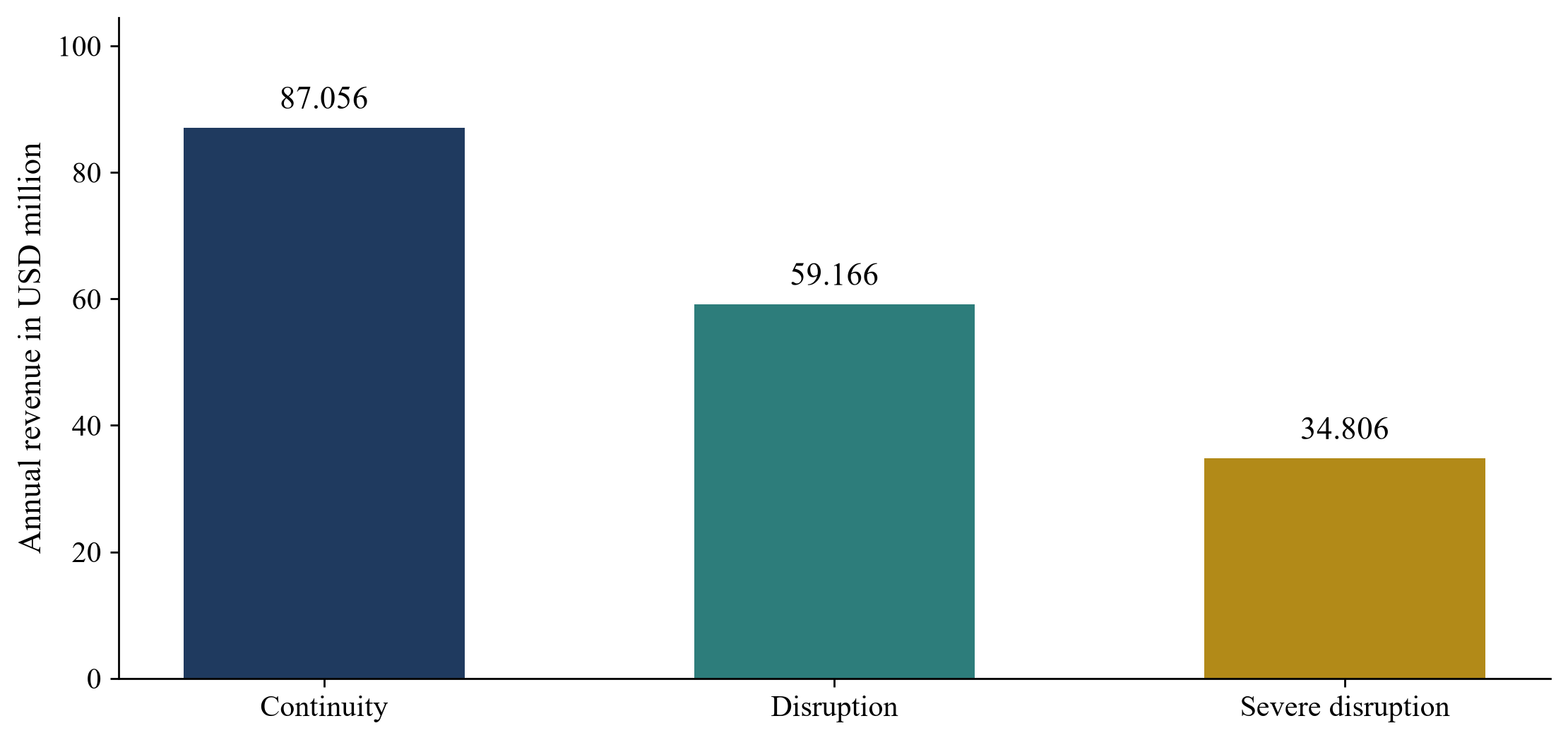
Author calculations using section 9 assumptions. These are scenarios, not observed market outcomes.
11. Receivables and the cash bridge
The example begins with receivables of 12.329, calculated as baseline revenue of 100 multiplied by 45 days and divided by 365. Closing receivables use each case's revenue and assumed collection period: 45 days for continuity, 65 for disruption and 90 for severe disruption. For simplicity, all opening receivables are assumed collectible. No provision is made for disputes, defaults or payment-processor reserves. These assumptions require explicit replacement in an actual transaction.
Closing receivables are 10.733, 10.536 and 8.582 respectively. Despite the longer assumed collection periods, the lower sales volumes produce smaller closing balances in all three cases. Consequently, the model shows a receivables release rather than additional annual funding from this item. This result is important because a statement that slower collections must always increase the year-end receivables balance would be incorrect under these particular inputs.
After the assumed cash tax, capital expenditure and change in receivables, first-year operating cash flow is 11.703 in continuity, 0.981 in disruption and negative 8.318 in severe disruption. These amounts exclude debt service and the other items listed earlier. A positive result is therefore insufficient evidence of acquisition-financing capacity. It also gives no assurance that every month remains funded.
Annual working-capital calculations can hide a short-term shortfall. A buyer should replace the closing-balance approximation with a weekly receipts schedule during distress, using actual invoice dates, promised payments and disputed amounts. Model refunds, deposits, processor holdbacks and customer credits separately when applicable. The opening balance should follow the acquisition perimeter and purchase agreement. Any receivables retained by the seller cannot be counted as the buyer's opening source of cash.
Table 4. Hypothetical annual cash bridge
| USD million | Continuity | Disruption | Severe disruption |
|---|---|---|---|
| Opening receivables | 12.329 | 12.329 | 12.329 |
| Closing receivables | 10.733 | 10.536 | 8.582 |
| Change in receivables | -1.596 | -1.792 | -3.746 |
| Operating cash flow | 11.703 | 0.981 | -8.318 |
Cash flow equals EBITDA less cash tax, capital expenditure of 2, and change in receivables. Negative change in receivables releases cash. All opening receivables assumed collected.
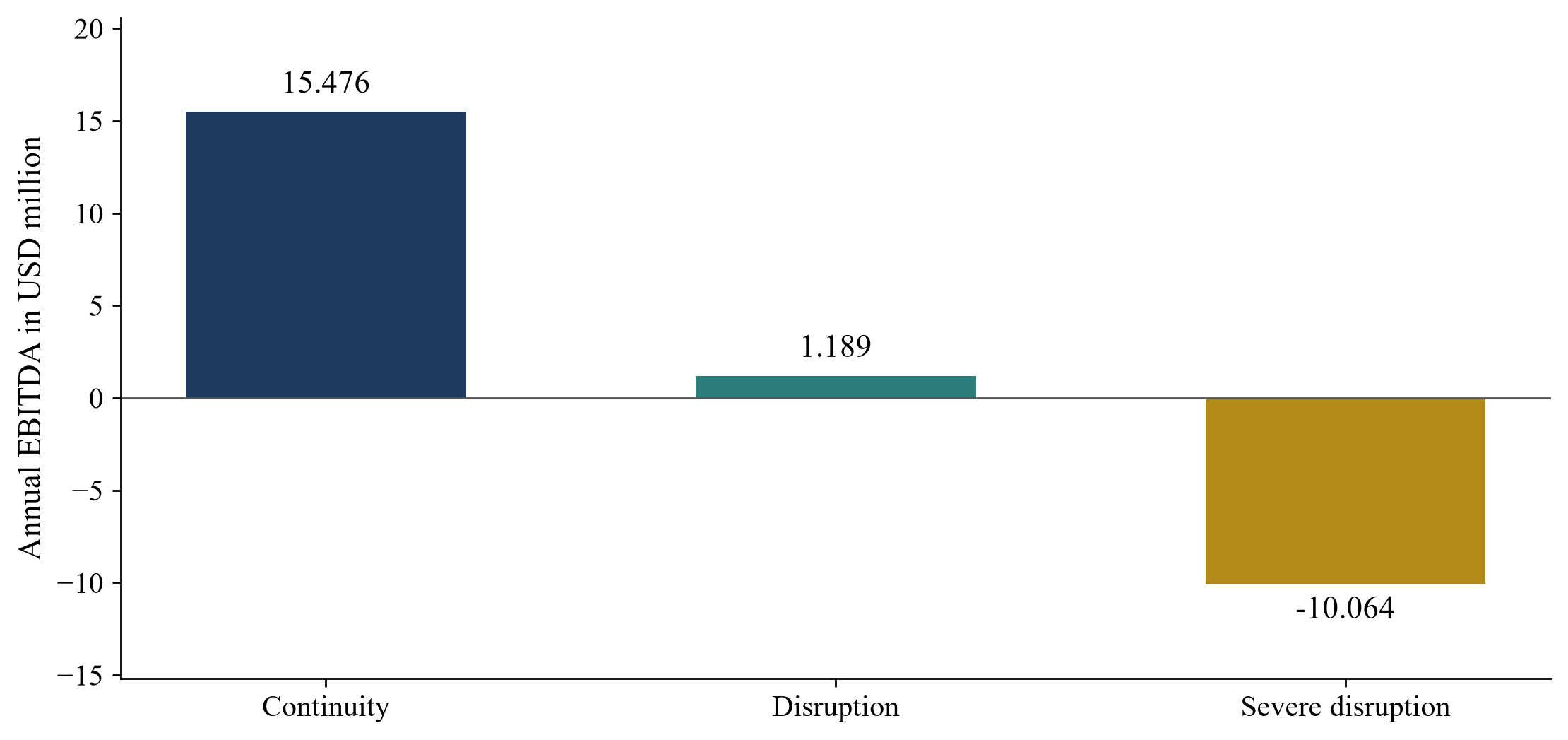
Hypothetical model. Fixed cash cost remains 20 in every case; retention expenditure is 1, 2 and 3.
12. Timing and the liquidity trough
We propose a weekly cash schedule spanning signing, expected completion and the first stable operating cycle. Start with unrestricted cash that the buyer can legally access. Add receipts linked to identified invoices or supportable forecast sales. Deduct payroll, supplier payments, retention measures, capital expenditure and other contractual commitments on their expected dates. Keep opening liquidity separate from financing that remains conditional.
An annual cash-flow model can remain positive while a critical payment falls due before receipts arrive. Test the lowest weekly cash balance and the conditions attached to any facility proposed to cover it. A delayed customer payment may have a different consequence if a supplier requires advance payment to release an essential component. Record the operational dependency and test whether the resulting delivery delay changes the customer forecast again.
To avoid an uncontrolled circular spreadsheet, define discrete cases for such dependencies. One case might assume that the bridge facility is available and the component arrives on schedule. Another might assume a funding delay and a specified loss of deliveries. The analyst should identify the trigger and the evidence supporting each case, rather than solving a circular forecast through an arbitrary balancing amount.
Customer cash safeguards can be legally and commercially complex. A segregated receipt, a refundable deposit and a processor reserve should not be treated as interchangeable unrestricted cash. Obtain the relevant contract and legal assessment. The practical funding decision should identify the amount, availability date, permitted use and repayment or release conditions for each proposed source. This information supports a financing decision that the annual EBITDA figure alone cannot answer.
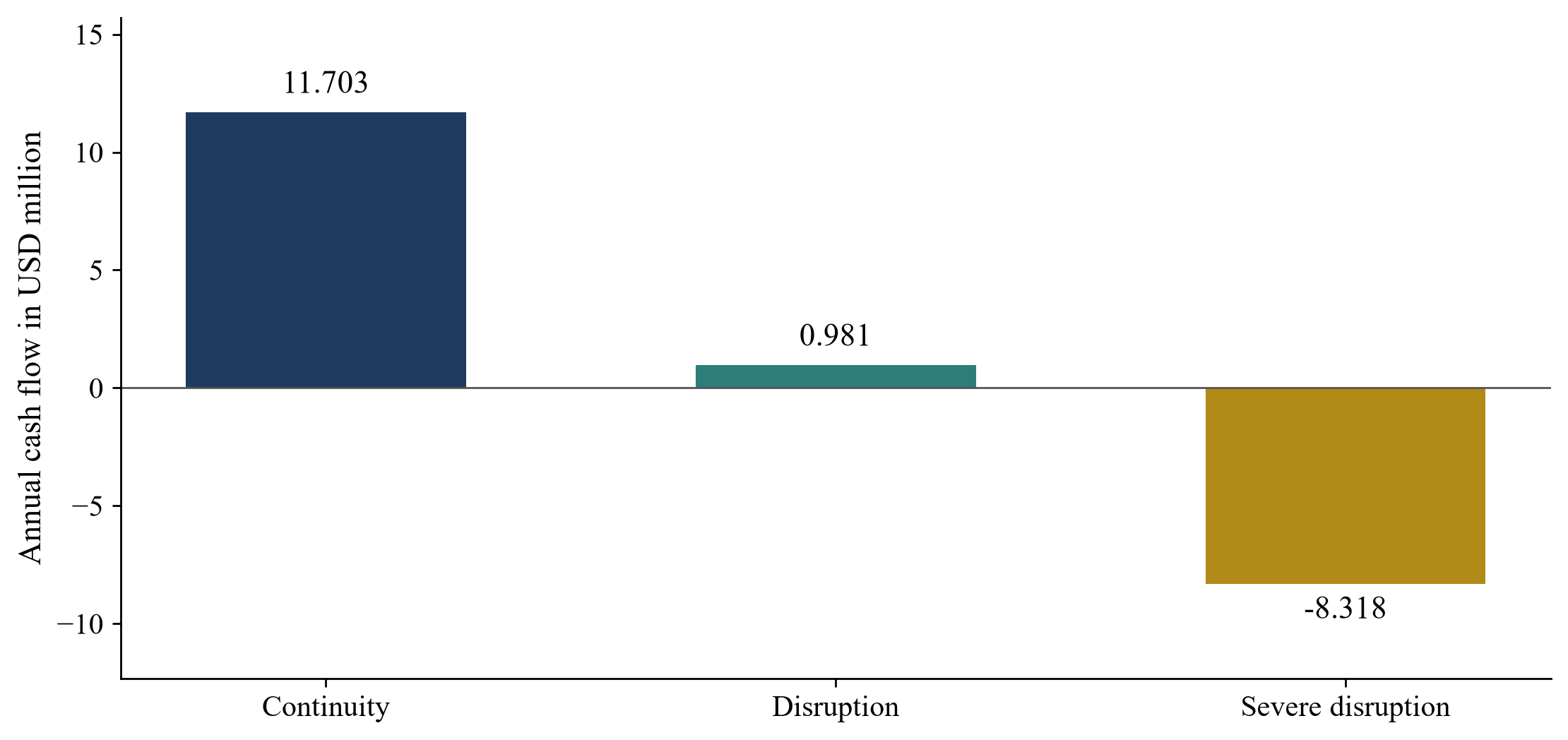
Hypothetical model with all opening receivables collected. Excludes financing, transaction costs, restructuring liabilities and changes in inventory or payables.
13. Valuation boundaries
IFRS 13 defines fair value by reference to an orderly transaction between market participants at the measurement date and requires assumptions reflecting market participants' consideration of risk. A pressured sale price and a buyer's internal investment case should therefore be identified according to their purpose. This paper does not provide an accounting fair-value opinion or determine whether any particular sale is orderly. [7]
For acquisition decisions, we recommend an enterprise cash-flow model that includes the costs required to operate the customer base, maintain assets and fund working capital. The numerical example above stops before a complete enterprise valuation. Extending it requires a justified forecast horizon, taxes, investment, financing perimeter, residual value and discount-rate basis. A revenue multiple can be used as a cross-check only after examining what economics and risks the comparable multiple represents.
A separate existing-customer runoff analysis can show how persistence affects the present value of contribution. In the accompanying calculations, the first-year contribution is reduced by an assumed 10% annually for four additional years and discounted at illustrative rates of 12%, 18% and 24%. There is no terminal value. This is a contribution-only sensitivity, excluding fixed cost, tax, investment, working capital and contributory asset charges. It is neither enterprise value nor the fair value of an identifiable customer relationship.
The distinction matters when presenting results to an investment committee. A contribution-only number can appear attractive because it omits expenditure that the buyer must incur. Label every valuation output with its perimeter and exclusions. If risk has already reduced expected cash flows, examine whether an additional discount-rate adjustment reflects another risk or duplicates the same assumption. The valuation specialist should document the treatment consistently across cases.
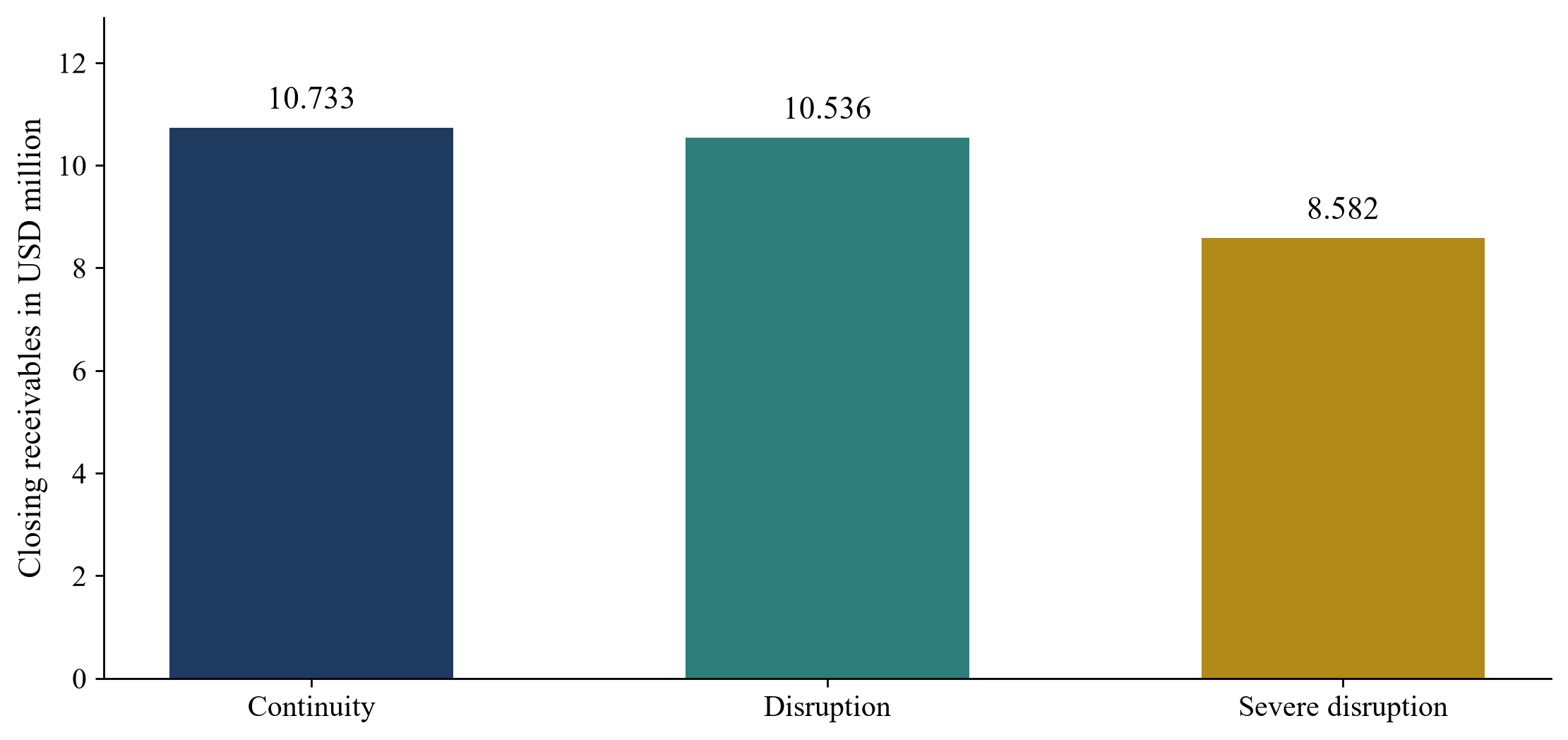
Hypothetical closing-balance approximation. Collection periods are 45, 65 and 90 days; this chart does not establish weekly liquidity.
14. Debt capacity and the acquisition price
The buyer's maximum affordable consideration depends on funding the business after completion as well as paying the seller. We propose a sources-and-uses schedule separating purchase consideration, assumed liabilities, transaction expenditure, operating liquidity and contingency. Each source should carry its commitment status and conditions. An indicative facility should not appear as unconditional available cash.
Debt capacity should be tested against the lender's actual cash-flow definition, covenant terms and repayment dates. In the disruption example, EBITDA is 1.189 before financing costs and operating cash flow is only 0.981 under favourable simplifying assumptions about opening receivables. These model outputs would require further funding analysis before supporting debt. The severe case is cash-consuming even before debt service. No leverage ratio derived from this example is a market lending recommendation.
Where the sale timetable is short, identify which uncertainty can be resolved before bidding and which must remain with the buyer. A large customer renewal scheduled after completion may be impossible to verify beforehand. The buyer can still quantify the exposure, fund a downside and negotiate consideration accordingly. A contractual allocation of risk should be evaluated alongside the counterparty's capacity to pay any resulting claim.
The proposed bid memorandum should contain a clear reconciliation from the customer forecast to enterprise cash flows, then from enterprise value to equity consideration. Show acquired cash, debt, debt-like items, working-capital adjustments and exceptional obligations with consistent definitions. This paper supplies the customer-analysis component; it does not substitute for financial, tax, legal or valuation diligence across the wider transaction.
15. Earnouts and customer-related protections
Contingent consideration can allocate some uncertainty about future customer outcomes, subject to negotiation and legal advice. Its economic usefulness depends on a measurable outcome and workable operating obligations. A test based solely on retained customer names can reward relationships that generate little contribution. A revenue test can be affected by discounting, credits, timing or sales transferred between entities. The metric should fit the actual uncertainty.
We propose defining the opening customer population, eligible products, recognition policy, treatment of concessions and measurement period before selecting a payout formula. Specify how acquired and newly won customers are distinguished. Consider whether receipts or contribution provide a better measure than revenue for the particular issue. Each choice introduces additional data requirements and possible disputes that the parties should assess explicitly.
Operational control after completion also matters. If the buyer changes pricing, closes a service line or reallocates accounts, the agreement should describe the resulting measurement treatment. Counsel should address reporting access, review rights, dispute resolution and any relevant conduct obligations. The financial model should test the maximum payout and its payment date alongside the funding needs of the acquired business.
Escrow, holdbacks, consents and price adjustments address different exposures. Map each proposed protection to the identified risk and avoid treating several overlapping protections as separate recoveries in the downside case. The transaction team should ask whether the protection is enforceable, collectible and timely enough to help when cash is needed. A disputed payment years later may provide limited support for an immediate operating shortfall.
16. Customer intervention and communications
An intervention plan should identify the customer's specific reason for concern. For a support-dependent product, this may involve access to maintenance, replacement parts or technical staff. For a project, the issue may be delivery funding and acceptance. For a discretionary buyer, it may be price or alternative supply. The response should address the evidenced concern and identify the resources and authority needed to deliver it.
We propose preparing a short account plan for each economically critical relationship. Record the upcoming customer decision, responsible executive, open service commitments, permitted commercial offers and next evidence milestone. Finance should quantify the intervention's cost and model its assumed benefit. Operations should confirm deliverability. Legal and communications advisers should review sensitive statements and the timing of contact.
Messages should be accurate about the status of a transaction and any committed funding. Avoid promising uninterrupted service where the supporting arrangements remain unresolved. A customer may require a formal novation, evidence of insurance or confirmation of a regulatory approval. An informal assurance should not be recorded as completion of that requirement. Keep the customer's actual response and any outstanding condition in the account plan.
Prioritisation should reflect incremental contribution and continuity consequences, rather than revenue size alone. A small account may be important to a regulated approval or shared operating system; that dependency needs evidence. A large account may demand a concession that makes the relationship uneconomic. The proposed process permits either conclusion, with the assumptions and decision authority visible to the investment committee.
17. Data governance and analytical tools
Customer-level diligence can involve personal and commercially sensitive information. The ICO's acquisition guidance calls for considering the purposes for which data was collected, the lawful basis for sharing, transparency and security where control of data changes. The page states that it is under review following the Data (Use and Access) Act. Its current status and the transaction's obligations should be checked with advisers before sharing. [8]
We recommend a staged analytical dataset using pseudonymous customer identifiers where names are unnecessary. Restrict access to sensitive contract terms and contact information according to the agreed diligence process. Preserve the mapping needed for authorised verification separately. Record the provenance, refresh date and permitted use of each extract. Analytical convenience does not establish permission to disclose customer records.
Machine-assisted text review can be proposed for locating renewal clauses, grouping complaints or identifying inconsistent CRM fields. Any deployment needs testing against a manually reviewed sample and human validation of material outputs. This paper makes no claim about the accuracy of a particular AI system. A tool-generated clause summary should link to the executed document and relevant passage so that counsel can inspect the wording and context.
For predictive churn models, separate training information available at the decision date from information learned later. Evaluate false alerts and missed departures by economically meaningful cohort. A model that ranks accounts usefully may still produce poorly calibrated probabilities. Until performance is demonstrated on relevant data, use its output as an investigative lead rather than a valuation input. Keep the rationale for material forecast changes reviewable without relying on an opaque score.
18. Sector and geography adaptations
The common analytical record can support different commercial models, but its fields must follow the relevant business. For subscription software, investigate renewal timing, contractual minimums, usage and the availability of support. For engineering projects, investigate milestone acceptance, remaining delivery cost and customer approval of variations. For distribution, distinguish shipments to a channel from evidence of end demand and returns. These are proposed diligence questions, not claims about observed outcomes in a particular market.
For infrastructure or public-service contracts, identify the authority required for transfer and any continuity obligation that constrains the buyer's operating choices. For cross-border transactions, map the contract's governing law, performing entity and payment location. A customer relationship reported globally may depend on local licences, data arrangements or qualified personnel. The appropriate specialists must establish whether these dependencies apply.
Currency treatment should be consistent across historical retention and the forecast. A change in translated revenue can arise without a change in customer volume. Report constant-currency comparisons where suitable and explain the exchange-rate basis. Then apply the financing model's currency assumptions to actual receipts and expenditure. Do not remove a genuine currency cash exposure merely because retention is reported at constant currency.
Country labels alone provide insufficient grounds for changing attrition assumptions. A proposed higher loss rate in one geography should identify the customer evidence or relevant commercial mechanism. Where the information is unavailable, report the uncertainty and a sensitivity. The framework can travel across jurisdictions, while contractual conclusions, taxes and financing terms remain transaction-specific.
19. Implementation and decision controls
The first workstream should reconcile the acquired revenue perimeter and preserve event-dated extracts. The second should review the customers whose decisions can change near-term funding or bid value. The third should construct the scenario model and link unresolved evidence to assumptions. These workstreams can progress concurrently, with a named person controlling changes to the common customer record and forecast.
Before signing, the investment committee should receive the reconciliation, material customer exceptions, the lowest forecast cash balance and the conditions needed for completion. Identify which assumptions are supported by executed documents, which are management estimates and which are hypothetical sensitivities. A forecast should not move from downside to base solely because a deadline approaches. Record the new evidence that supports any change.
At completion, test the customer-facing activities needed immediately: taking orders, delivering, supporting customers, invoicing and receiving funds. Assign ownership of unresolved incidents and preserve the first set of post-completion results. During the following weeks, compare actual outcomes with the original cohort forecast. Analyse whether deviations reflect retention, delivery, price, cost or collection. This permits targeted revisions without rewriting the original investment case.
The proposed control matrix should connect each issue to an owner, a due date, an evidence requirement and a decision consequence. Examples include obtaining a required consent, funding a delivery commitment or resolving a material receivable dispute. Completion of a task should mean that the required evidence exists. A status colour or verbal assurance provides limited support without the underlying record.
Table 5. Proposed implementation controls
| Exposure | Owner role | Required evidence | Decision |
|---|---|---|---|
| Consent outstanding | Legal | Valid approval | Completion condition |
| Delivery unfunded | Operations and finance | Available resources and funds | Fund or reduce forecast |
| Renewal unresolved | Commercial | Customer decision | Scenario and price |
| Receivable disputed | Finance and legal | Claim and receipt assessment | Cash and adjustment |
| Intervention untested | Commercial and operations | Cost and response evidence | Approve or revise |
Author-proposed control matrix; responsibilities and remedies must be agreed for the actual transaction.
20. A worked retention decision
Consider a further hypothetical decision within the contracted-services cohort of the disruption case. Suppose an intervention could increase its retained-volume fraction from 80% to 85%, with fulfilment remaining at 90% and the concession rate remaining at 8%. Baseline demand remains 40 and the original variable-cost fraction remains 40%. The additional delivered demand at the original price would be 1.8. After the concession, incremental revenue would be 1.656 and incremental variable cost 0.720, leaving incremental contribution of 0.936.
If the intervention requires an additional cash operating expenditure of 0.500 during the same year, the model's incremental EBITDA would be 0.436. This is a conditional calculation, not evidence that the intervention can achieve the assumed improvement. Before spending, the buyer should seek a customer commitment, operational test or other support for the expected change. The calculation also assumes the intervention does not alter other customers' prices, delivery or service cost. Any precedent effect or capacity constraint needs a separate estimate.
Under these assumptions, each additional percentage point of retained volume generates contribution of 0.1872. Dividing intervention expenditure of 0.500 by that contribution yields an EBITDA break-even improvement of approximately 2.671 percentage points. The assumed five-percentage-point improvement exceeds this threshold within the example. A smaller achievable increase, a lower fulfilment rate or a larger concession could reverse the result. This threshold provides a specific question for the commercial team to test with customer evidence.
Timing could still make the intervention difficult to fund. An immediate payment of 0.500 may precede collections from the additional work. The buyer should insert the expenditure and receipts into the weekly cash schedule and test the lowest balance. If the resulting requirement exceeds committed liquidity, management needs an available funding source or a differently structured intervention before implementation. The annual contribution calculation gives no answer about the availability of that funding.
There is also an allocation question when several accounts compete for limited support capacity. Compare their incremental contribution after intervention expenditure and their use of the scarce resource. Avoid assuming that every account can receive the same specialist team at the same time. A scheduling constraint may reduce the achievable portfolio benefit even where each isolated account calculation appears positive. Record any dependency between projects so that separate account plans do not collectively promise more capacity than operations can provide.
Finally, measure the intervention against its original assumptions after the customer decision. Record the retained volume, actual concession, service expenditure and receipts. If the predicted improvement did not occur, distinguish a forecasting error from incomplete execution and update subsequent decisions accordingly. Preserve the original forecast for comparison. This creates an auditable learning record without claiming that one successful or unsuccessful intervention establishes a general causal relationship.
21. Limitations and conclusion
The framework is an acquisition-analysis proposal. It has not been validated on a proprietary transaction dataset, and its numerical cases are hypothetical. The selected publications establish context and examples of relevant methods and risks; they do not estimate a universal relationship between rumours, customer attrition and acquisition value. The analysis also excludes many liabilities and strategic effects that a complete investment decision must address.
Several extensions would improve empirical testing. A study could assemble event-dated customer cohorts across distressed transactions, define renewal opportunities consistently and distinguish public news from operational failures. It could then examine how forecast error varies with evidence coverage and contract type. Access, confidentiality, missing observations and selection into completed acquisitions would require careful treatment. Until such evidence exists, the proposed framework should be assessed for transparency and usefulness in a specific transaction, without claiming predictive validation.
For a buyer, the actionable output is a traceable forecast of customer economics with explicit consequences for price and funding. Begin with the acquired perimeter, investigate the relevant customer decisions, model delivery and concessions separately, and reconcile contribution to cash. Preserve uncertainty where the evidence remains incomplete. The hypothetical example shows how the calculations work and how fixed costs and timing assumptions affect the result.
A transaction recommendation should identify the price under consideration, the customer outcomes it requires and the funding available if those outcomes disappoint. It should also state which unresolved dependencies could change the decision before completion. This makes the investment case available for challenge by commercial, operating, finance and legal teams and provides a consistent basis for reviewing actual performance after control transfers.
References
- UK Government Commercial Function. Corporate Financial Distress Guidance note. Updated 15 June 2026. https://www.gov.uk/government/publications/the-sourcing-and-consultancy-playbooks/corporate-financial-distress-guidance-note-html
- Ali Hortacsu, Gregor Matvos, Chad Syverson and Sriram Venkataraman. Are Consumers Affected by Durable Goods Makers' Financial Distress? The Case of Auto Manufacturers. NBER Working Paper 16197, 2010. https://www.nber.org/papers/w16197
- Spirit Airlines Inc. Annual Report on Form 10-K for the year ended 31 December 2024. Risk factors and credit-card processing arrangements. https://www.sec.gov/Archives/edgar/data/1498710/000149871025000008/save-20241231.htm
- Quanta Services Inc. Annual Report on Form 10-K for the year ended 31 December 2025. Acquisitions and identifiable intangible assets. https://www.sec.gov/Archives/edgar/data/1050915/000105091526000006/pwr-20251231.htm
- United States Code, Title 11, section 365. Executory contracts and unexpired leases. https://www.law.cornell.edu/uscode/text/11/365
- IFRS Foundation. IFRS 15 Revenue from Contracts with Customers, standard overview. https://www.ifrs.org/issued-standards/list-of-standards/ifrs-15-revenue-from-contracts-with-customers/
- IFRS Foundation. IFRS 13 Fair Value Measurement, standard overview. https://www.ifrs.org/issued-standards/list-of-standards/ifrs-13-fair-value-measurement/
- Information Commissioner's Office. Due diligence when sharing data following mergers and acquisitions. Guidance marked under review when accessed 5 September 2026. https://ico.org.uk/for-organisations/uk-gdpr-guidance-and-resources/data-sharing/data-sharing-a-code-of-practice/due-diligence/
