

1. The communication decision under distress
A distressed sale places management between competing duties and commercial pressures. Customers want confidence that products, services, warranties and data will remain supported. Suppliers want evidence that current deliveries will be paid and that future orders are authorised. Lenders, employees, regulators and buyers need information on different timetables. An uncontrolled statement can accelerate attrition or breach confidentiality. Silence can leave important counterparties to interpret late payment, operational disruption or market rumours without reliable facts.
The board therefore needs a communication control system rather than a single announcement. The system should connect each message to an operating decision, a legal basis, verified evidence, an authorised speaker and an escalation path. It should identify what a recipient needs to decide, what the company can support today, which information remains restricted, and when the message must change. The objective is to protect continuity while preserving a fair and executable transaction process.
This paper develops that system for a company preparing or conducting a distressed sale. It treats communication as transaction infrastructure. Current UK guidance, insolvency legislation, employment-transfer rules, data-protection guidance, market-disclosure requirements, payment-practice reporting and international insolvency principles establish the external context. They apply within their stated jurisdictions and purposes. Qualified advisers must determine the requirements for each company.
2. Why counterparties react before a sale is public
Financial distress is often visible through operational signals. Suppliers may observe late invoices, smaller orders, disputed balances, requests for longer terms or changes in authorised purchasers. Customers may see service delays, weaker quality, employee departures or requests for accelerated payment. Credit insurers, lenders and data providers may change limits or classifications. The UK Government's corporate financial distress guidance explains that publicity can cause loss of trade credit, custom, banking facilities and key staff, reinforcing the underlying distress [1].
These reactions are rational from each counterparty's perspective. A supplier may need cash in advance because it cannot absorb an unsecured exposure. A customer may activate a replacement plan because interruption would damage its own operations. A lender may restrict availability because forecast assumptions have deteriorated. Each action can reduce the seller's liquidity and going-concern value even when the stakeholder intends only to protect itself.
Management should map observable signals before designing messages. It should assume that facts such as missed payments or service failures will circulate through commercial networks. The communication plan needs credible answers for those facts. Reassurance without operational support can lose trust more quickly than a limited, accurate statement. The board should compare the harm from disclosure with the harm from a recipient learning indirectly and acting without a managed response.
3. Communication is an operating control
A message creates value only when it enables a required action. A critical supplier may need a purchase-order authority, payment date, deposit, guarantee or short-form continuity agreement. A customer may need a named service lead, inventory allocation, support plan, transition protocol or assurance about data handling. A message that says the business is trading normally cannot substitute for these controls when performance, liquidity or authority has changed.
The proposed operating model separates five stages: prepare, qualify, engage, confirm and transfer. Preparation establishes facts, decision rights, draft messages and recipient priorities. Qualification identifies which counterparties are essential and what they can affect. Engagement opens controlled dialogue with authorised content. Confirmation records commitments, exceptions and new information. Transfer moves the relationship, contract, data and communication owner to the transaction outcome.
Every message should have a control record. The record states the audience, purpose, approved facts, restricted facts, commitments, delivery channel, speaker, time, acknowledgement and next review. It also links the communication to the cash forecast, contract register, service-continuity plan and transaction timetable. This allows the deal team to identify whether communication changed behaviour and whether the resulting assumption belongs in the valuation or bid comparison.
Table 1. Proposed communication objectives and operating decisions
| Stakeholder | Decision to influence | Evidence required | Operating control |
|---|---|---|---|
| Critical customer | Continue buying and avoid emergency switch | Delivery capacity, support and transition plan | Named owner and continuity milestone |
| Critical supplier | Continue supplying on executable terms | Authorised order, payment source and forecast | Terms sheet and payment control |
| Employee representative | Support lawful transfer or restructuring process | Defined proposal, affected population and measures | Consultation plan and issue log |
| Lender | Fund the controlled process | Cash forecast, milestones and downside | Reporting cadence and stop condition |
| Buyer | Maintain confidence in transferable relationships | Contracts, consent status and behaviour evidence | Diligence pack and contact protocol |
Management framework. Legal, regulatory, employment and contractual requirements may prescribe different timing or content.
4. Governance before contact
The board should approve the communication mandate before sensitive contact begins. The mandate defines the proposed transaction perimeter, confidentiality rules, insider controls where relevant, data-sharing constraints, decision authorities and legal review process. It should state who may contact customers and suppliers, who approves exceptions, and what events require immediate escalation. Contact lists copied from normal sales or procurement systems are rarely sufficient because they do not show contractual authority or distress sensitivity.
A small communication control group should include the transaction lead, chief financial officer, operations lead, legal adviser, communications lead and an information-security or data-protection representative where personal or sensitive data may be shared. Specialist employment, regulatory and insolvency advice may be required. Business relationship owners contribute facts and make calls within approved scripts. They should not improvise transaction terms or give assurances outside their authority.
The group should meet against the same cadence as the liquidity and sale process. Daily review may be appropriate when cash is short or rumours are active. Each meeting reconciles new stakeholder reactions, service failures, payment exceptions, buyer requests and public-disclosure obligations. The decision log records what was said, why, by whom, and what changed. This evidence protects consistency and gives the board a current view of relationship value at risk.
5. Duties, insolvency process and local law
Communication cannot override the legal position. Directors' duties, insolvency practitioner authority, court orders, creditor rights, procurement rules and contract terms may determine whether the company can promise payment, continue performance or transfer an agreement. UNCITRAL's Legislative Guide recognises the need to balance rapid treatment of financial difficulty with the interests of creditors and other stakeholders [3]. Its materials also identify employees, suppliers and customers among the groups management may need to consider as insolvency approaches.
The legal mechanism changes the message. A solvent accelerated sale, a restructuring negotiation, administration, liquidation and a US Chapter 11 sale produce different authority, payment and transfer consequences. The UK Government guidance notes that an administrator may choose not to honour onerous contracts and that liquidation normally terminates contracts and supplies unless permitted assignment or novation arrangements are made [1]. Broad statements about continuity can therefore be misleading unless linked to the actual process.
Management should use a jurisdiction matrix for each legal entity and material contract. The matrix covers authority, confidentiality, disclosure, consultation, data, payment, termination, consent and transfer. Communications should use plain commercial language while reflecting specialist advice. The record should distinguish verified facts, approved intentions and conditions still outside the company's control.
6. The evidence map
The evidence map converts each proposed statement into a supportable claim. If management wants to say that orders will be fulfilled, the supporting evidence includes inventory, production capacity, staffing, logistics, supplier commitments and cash required. If it wants to say that a buyer will continue a service, the buyer's binding obligation and completion conditions matter. An expression of interest or management expectation does not support that assurance.
The map should identify the source, cut-off date, owner, reviewer and contradiction status. Cash statements reconcile to bank balances and approved facilities. Payment statements reconcile to the accounts-payable ledger, dispute log and funding source. Contract statements reconcile to signed agreements, amendments, consent rights and termination clauses. Service claims reconcile to operational data. Data-transfer statements reconcile to controller roles, lawful bases and security controls.
Evidence also includes counterparty behaviour. A supplier's signed continuity agreement has greater decision value than a positive call note. A customer's purchase order, renewal or written transition position can inform the forecast and buyer diligence. These behaviours should be recorded without converting them into certainty. Every material commitment remains subject to its terms, counterparties' rights and changing circumstances.
Table 2. Evidence map for customer and supplier messages
| Message claim | Primary evidence | Reconciliation | Escalation trigger |
|---|---|---|---|
| Trading continuity | Weekly cash, staffing, inventory and operating plan | Cash and service milestones | Forecast breach or service failure |
| Supplier payment | Approved invoice, funding source and payment run | Accounts payable and bank control | Missed or disputed payment |
| Customer delivery | Order, capacity, critical inputs and logistics | Order book and fulfilment data | Delay, allocation or quality failure |
| Contract transfer | Signed contract, consent and transaction perimeter | Legal register and buyer terms | Consent refusal or perimeter change |
| Data continuity | Controller map, lawful basis, access and security | Data inventory and transfer plan | Breach, objection or incompatible purpose |
Proposed minimum evidence. The applicable legal and regulatory framework remains controlling.
7. Segment by dependency and fragility
Counterparties should be prioritised through dependency and consequence, not revenue or spend alone. A low-spend component supplier may stop a production line. A customer with moderate revenue may control a licence, reference account or route to market. A large customer with multiple substitutes may be less fragile than a smaller customer whose systems are deeply integrated. The map needs economic, operational, legal and reputational dimensions.
The proposed score uses consequence, dependency and fragility. Consequence measures the effect of loss on cash, service, value and transaction feasibility. Dependency measures how difficult the relationship is to replace within the sale timetable. Fragility assesses the likelihood that incomplete information, distress signals or a change in terms causes adverse action. Scores focus attention; they are not statistical predictions.
The owner should overlay contractual rights, outstanding balances, decision-makers, contact restrictions and buyer relevance. A high-priority counterparty receives earlier preparation, senior ownership, a tailored evidence pack and rapid escalation. A lower-priority group can receive a later standard message when the transaction reaches a defined disclosure stage. This sequencing reduces unnecessary exposure while protecting relationships that determine going-concern value.
Table 3. Proposed stakeholder segmentation fields
| Field | Question | Scale or record | Use |
|---|---|---|---|
| Consequence | What value or continuity is lost? | 1 to 5 | Seniority and speed |
| Dependency | Can the relationship be replaced in time? | 1 to 5 | Contingency investment |
| Fragility | How readily might the party act adversely? | 1 to 5 | Message timing and proof |
| Exposure | What cash, claim or liability is outstanding? | Amount and ageing | Terms and approval |
| Rights | What can the party terminate, suspend or withhold? | Contract and legal review | Escalation and structure |
| Buyer relevance | Does the relationship affect price or completion? | High, medium or low | Diligence and consent plan |
Scores are management inputs. They require review against current relationship evidence.
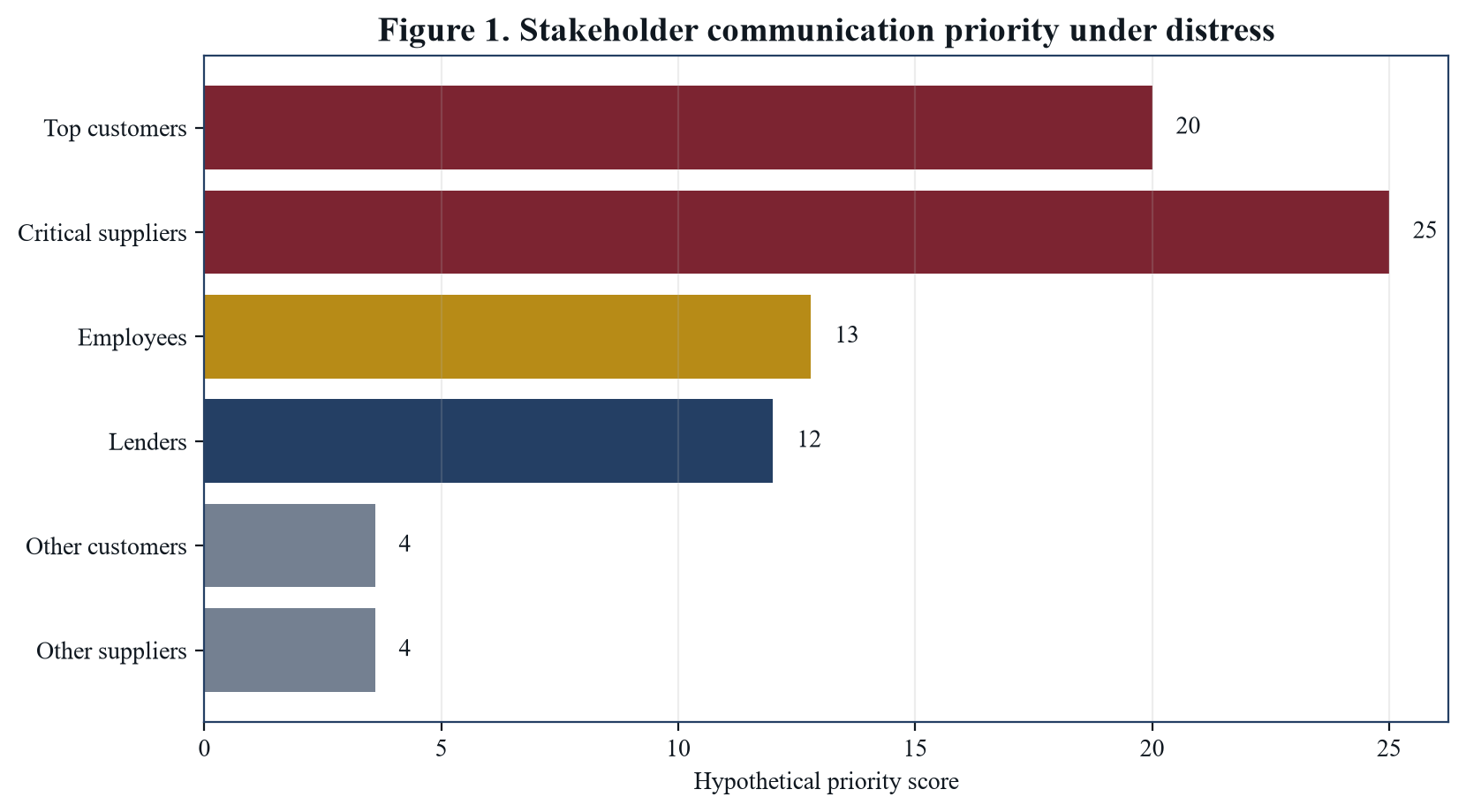
Author assumptions. Scores illustrate a prioritisation method and do not estimate behaviour in a real transaction.
8. Customer continuity case
Customers evaluate continuity through their own risk exposure. They may need uninterrupted service, replacement parts, regulated support, data access, warranty performance or advance-payment protection. A distressed seller should understand the customer's switching time, internal approval requirements, inventory position and contractual remedies. The message must answer the customer's decision rather than repeat the seller's transaction narrative.
A customer continuity pack can include the current order position, delivery schedule, named operating contacts, inventory allocation, service-level exceptions, support arrangements and a controlled transition path. It should identify conditions and dates. When the sale perimeter is uncertain, management should state what the current company can perform and avoid attributing commitments to an unidentified or non-binding buyer.
Relationship owners should capture questions and evidence requests. Repeated questions may reveal a market concern that belongs in the broader message. A customer requesting accelerated delivery or withholding payment affects cash and working capital. A customer seeking termination or step-in rights affects value and transaction structure. These reactions should flow into the forecast and buyer data room on an appropriate, lawful basis.
9. Supplier continuity case
Suppliers focus on payment, authority and future demand. The company should separate pre-distress arrears, disputed invoices, current authorised supply and future commitments. A promise to clear all balances may be impossible or inappropriate under the applicable insolvency process. The supplier needs a clear statement of who can place orders, which deliveries are essential, how current supply will be paid, and who can approve changed terms.
The UK framework contains protections for supplies of goods and services in specified insolvency procedures, including section 233B arrangements and exclusions [4]. Earlier essential-services guidance addresses continuity and protections for specified supplies [11]. These rules are fact-specific. The communication plan should record whether the contract and process fall within a relevant provision and what security, hardship, termination or post-commencement payment questions require legal advice.
Management should negotiate with a complete economic view. Cash in advance may protect supply but consume runway. Shorter order horizons, consignment stock, direct buyer payment, escrow, guarantees or alternative sources may produce different risk allocation. The communication owner should have approved boundaries and an escalation route. Unauthorised side agreements can create inconsistency, preference risk or a hidden liability for the buyer.
10. Payment truth and credibility
Credibility can fail when the company uses different payment facts across communications. Procurement may cite contractual terms, accounts payable may cite invoice approval, treasury may cite the payment run, and suppliers may experience the actual cash date. The communication pack should reconcile all four. Ageing, disputes, retention, offsets, credit notes and unapplied cash need explicit treatment.
UK reporting guidance requires in-scope large businesses to publish specified payment-practice and performance information [9]. Public reports can be reviewed by suppliers and buyers. A distressed company should not make claims that conflict with its published record or ledger. Where payment performance has changed since the reporting period, the company should use current verified facts and qualified advice on any reporting obligation.
A supplier message should state the specific invoice or order, approved amount, payment condition, source of authority and next update. If payment depends on new funding or completion, that condition must be visible. Management should avoid rolling unfulfilled promises forward. A missed commitment triggers senior escalation, forecast revision and consideration of whether the relationship can remain within the operating plan.
11. Confidentiality and selective disclosure
Distressed-sale information can be commercially sensitive, personal, price-sensitive or subject to contractual confidentiality. The board should classify information before contact. Public facts, relationship-specific operating information, transaction-sensitive information, personal data and inside information require different controls. A confidentiality agreement does not automatically make every disclosure lawful or prudent.
For listed issuers, the FCA's DTR 2 addresses identification, control and disclosure of inside information, including holding announcements where confidence may be lost [6]. It also notes that unpublished information shared with third parties may engage Market Abuse Regulation requirements. The issuer and its advisers must determine the actual obligation. A private company still faces contractual, data, competition and transaction risks from selective disclosure.
The communication record should state why the recipient needs each fact and whether a less sensitive alternative can support the same decision. Access should be staged, logged and time-limited. Clean teams, aggregation or counsel-led channels may be required. If a leak occurs or becomes likely, the escalation plan should connect legal assessment, public disclosure, customer and supplier response, employee communication and buyer-process control.
12. Data protection and customer information
A sale may require the sharing or transfer of customer contacts, usage records, account histories, support tickets or supplier personal data. The ICO states that mergers, acquisitions and insolvency asset sales require data-sharing due diligence, including identifying the data, original purposes, lawful basis, transparency, security and governance [5]. It also requires organisations to consider when and how individuals will be informed.
The company should map controllers, processors, systems, purposes, categories, locations, retention and access before including data in a diligence room or transfer plan. Commercial urgency does not remove these questions. Data should be minimised to what the recipient needs at that stage. Aggregated or redacted evidence can often support early diligence. Identifiable records may require a later controlled stage.
Customer communications about the transaction should align with the data plan. A message that promises unchanged processing may be inaccurate when the controller, purpose, system or location will change. The buyer and seller should allocate notification, rights handling, security and incident responsibilities. Technical migration evidence should be reconciled with the legal description before communication.
13. Employees as relationship infrastructure
Employees often hold the customer and supplier relationships the sale seeks to preserve. They also face personal uncertainty and may be subject to formal information and consultation rights. Rumour can cause key people to leave or to give inconsistent messages. Management needs an employee communication path that is coordinated with customer, supplier and transaction communications.
UK TUPE guidance explains that both old and new employers must inform recognised trade unions or employee representatives before a relevant transfer and may need to consult on measures [7]. Government guidance also addresses information about employees during transfers [8]. Insolvency changes how protections and liabilities may operate. Acas advises that the insolvency type and timing affect rights and that specialist facts determine the outcome [7].
The paper does not determine whether TUPE or another employment regime applies. The control principle is to identify affected populations, proposed measures, representatives, required information, consultation milestones and buyer inputs early. Relationship owners should receive approved customer and supplier talking points only after the employee process permits them. Questions that expose new facts must return to the control group rather than be answered informally.
14. Customers with public-service or regulated dependencies
Some customers cannot tolerate an ordinary commercial interruption. Government, utility, health, financial, transport and infrastructure relationships may have contingency, resolution, procurement or regulatory requirements. The UK corporate distress guidance describes business-continuity and disaster-recovery planning, emergency exit information and the need for contracting authorities to maintain their own contingency plans for critical services [1].
The company should identify contracts with public-interest consequences, regulated service levels, step-in rights, data sovereignty, safety requirements or formal notification triggers. The communication plan should involve the responsible regulatory and public-sector specialists. General reassurance can be especially harmful when it delays the customer's contingency response or conflicts with mandatory disclosure.
The operating solution may include ring-fenced resources, direct funding, inventory reservation, technical handover, transition services or a controlled novation. Each mechanism changes valuation, cash and buyer obligations. The transaction model should reflect the cost of maintaining critical services and the consequence of a failed transfer. Communication confirms the agreed control; it does not create the control by itself.
15. Buyer access to counterparties
Buyers may want direct access to key customers and suppliers before making a binding offer. Access can improve diligence and support valuation. It can also expose the company to leaks, solicitation, renegotiation and relationship damage. The seller should define when access becomes justified by buyer qualification and what protections apply.
Qualification should consider strategic rationale, funding evidence, regulatory feasibility, conflicts, confidentiality history, transaction timetable and indicative terms. The seller can begin with anonymised concentration and performance data, then progress to management-led calls, restricted confirmatory access and consent discussions. The buyer should receive an approved purpose, script and participant list. Contact outside the protocol becomes a process breach.
Call notes should record questions, answers, commitments and follow-up evidence. The seller should distinguish a counterparty's willingness to continue from a binding consent or amendment. Buyers should not promise future commercial terms without authority. If the buyer introduces a new requirement, management should assess its cash, value and execution consequences before accepting the narrative into wider communications.
16. Message architecture
An effective message contains six elements. It identifies the verified event, explains what remains operational, states what the recipient needs to do, describes the control supporting continuity, names the next update and provides an escalation contact. The message should be short enough to use and specific enough to guide action. Legal qualifiers should be accurate and readable.
The architecture should separate current facts from future conditions. Current facts include today's authority, inventory, payment position and service schedule. Conditional facts include funding approval, buyer selection, regulatory clearance, contract consent and completion. Management intentions should be labelled as intentions. This avoids turning a process objective into a promise.
Different channels serve different purposes. A senior call can address a critical relationship and test concerns. Written follow-up preserves accuracy. A portal can distribute standard updates. Formal notices meet contractual or legal requirements. Public statements address the wider market. The control record should reconcile them so that a supplier does not receive a payment assurance inconsistent with a lender report or public announcement.
17. Rumour, leak and hostile narrative
The team should prepare for rumours before they arise. A holding statement should contain verified facts, operational contacts and the next update. It should avoid confirming restricted transaction details or giving unsupported reassurance. The company should identify social, press, customer and supplier monitoring channels, with clear boundaries on personal data and employee surveillance.
When a rumour appears, management should assess its source, reach, accuracy and operating effect. A limited inaccurate post may require targeted correction. A credible report reaching critical counterparties may require direct calls and possibly public disclosure. Listed issuers must consider market-disclosure requirements with qualified advisers [6]. The response decision should be recorded alongside the facts available at the time.
The hostile narrative may focus on unpaid suppliers, product support, layoffs, data security or asset stripping. The strongest response is operational evidence. Payment proof, service metrics, named support, inventory control and an authorised transaction process can stabilise decisions. Attacking the source without addressing the underlying issue may deepen concern.
18. Scenario model and limitations
The hypothetical model compares three communication routes for a company with a USD 120 million starting transaction-value benchmark and USD 16 million of unrestricted cash. Reactive silence allows signals to spread without structured engagement. Broad early disclosure informs counterparties before their information needs and operating controls are ready. Staged evidence-led communication prioritises critical relationships and releases information as proof and authority become available.
The model deducts four categories of value leakage: customer attrition, supplier-term effects, operating disruption and communication-control cost. It also shows thirteen-week cash paths after assumed customer and supplier reactions. Every figure is an author assumption. The routes are simplified and do not represent observed market averages, statistical probabilities or advice for a particular company.
The model's purpose is to show how communication can enter the valuation and liquidity analysis. Management should replace every input with company evidence, received counterparty positions, current cash and qualified advice. The result should be presented by scenario, with the assumptions and downside visible. A higher modeled outcome does not authorise disclosure or a sale process.
Table 4. Hypothetical communication-route assumptions
| Route | Customer leakage | Supplier terms | Disruption | Control cost | Modeled net value |
|---|---|---|---|---|---|
| Reactive silence | 18.0 | 9.0 | 6.0 | 1.0 | 86.0 |
| Broad early disclosure | 14.0 | 12.0 | 5.0 | 2.0 | 87.0 |
| Staged evidence-led | 6.0 | 4.0 | 2.0 | 2.5 | 105.5 |
All figures are author assumptions in USD millions. They have no empirical calibration.
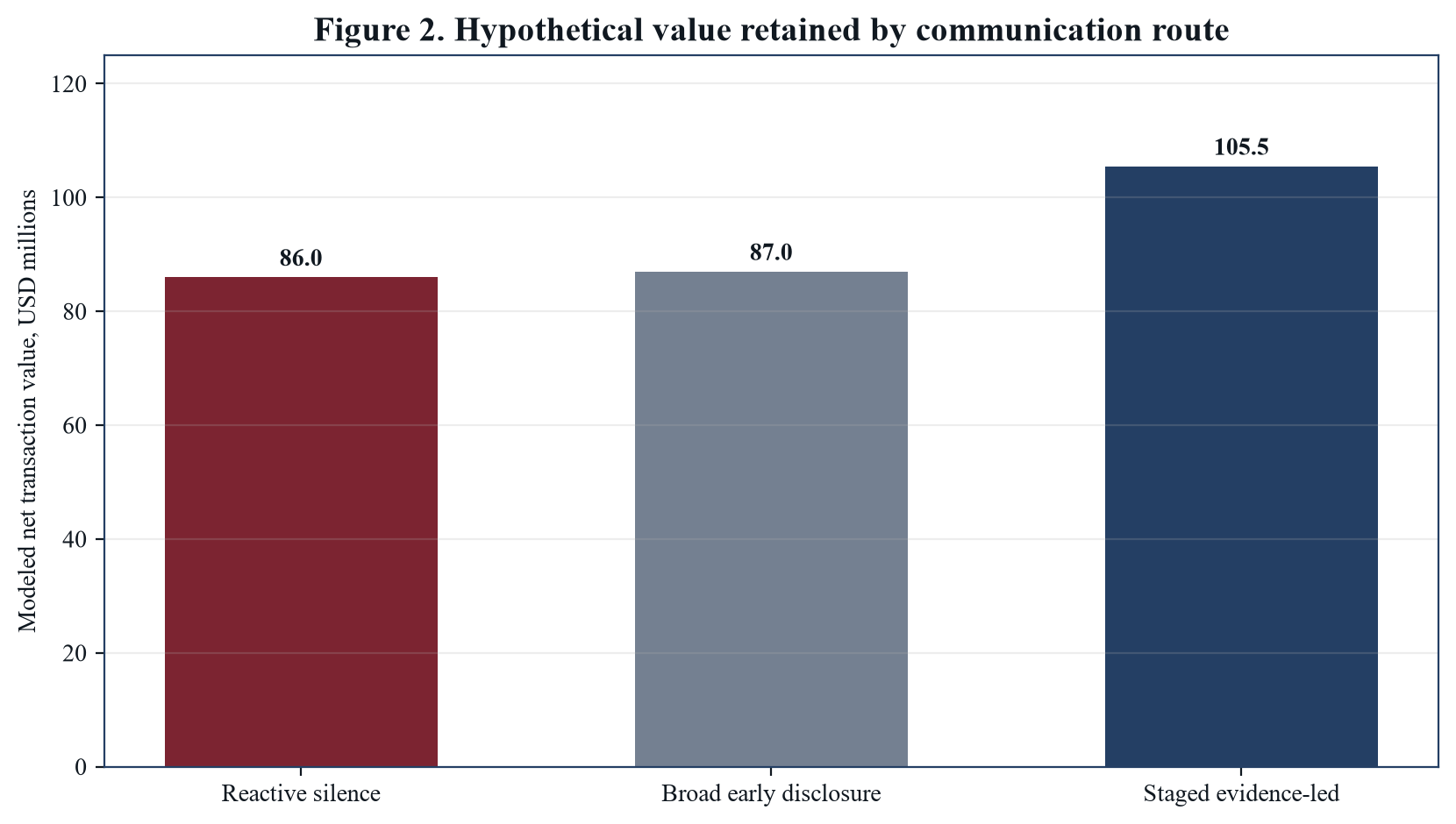
Author assumptions. Modeled values are decision illustrations rather than valuation conclusions.
19. Why reactive silence loses value in the model
The reactive-silence route has the lowest operating-control cost because the company prepares little structured engagement. That apparent saving is overwhelmed by assumed customer attrition of USD 18 million, supplier-term leakage of USD 9 million and disruption of USD 6 million. The modeled net transaction value is USD 86 million.
The mechanism is cumulative. Customers detect weak service or rumours and activate alternatives. Suppliers reduce credit or delay dispatch while seeking payment clarity. Relationship owners provide inconsistent answers because they lack approved facts. Buyer diligence identifies churn and working-capital deterioration after it has occurred. The company then communicates from a weaker position.
Silence can be required for a period by confidentiality, law or transaction strategy. The model does not treat all limited disclosure as a failure. The failure is the absence of preparation and targeted operating control. A company can preserve confidentiality while preparing evidence, identifying critical stakeholders, controlling signals and responding accurately to relationship-specific questions.
20. Why broad disclosure also destroys value
The broad early-disclosure route avoids some uncertainty but releases information before recipient segmentation and continuity controls are ready. The model assumes USD 14 million of customer leakage, USD 12 million of supplier-term impact, USD 5 million of disruption and USD 2 million of communication cost. Net value is USD 87 million, only modestly above reactive silence.
The supplier effect is larger because many counterparties act at once. Even suppliers that would have continued normal terms may seek deposits, reduce limits or shorten orders. Customers with no immediate risk may trigger procurement reviews. Employees spend time responding to questions. Buyers may lose the benefit of a controlled contact sequence. Confidentiality and disclosure risks expand.
The lesson is sequencing. Transparency must be accurate, lawful and responsive to legitimate information needs. It also needs operating readiness. The recipient should receive information when it can make a supported decision and when the company can manage the resulting action. Formal legal obligations remain controlling and may require earlier or broader communication than a commercial model would otherwise select.
21. The staged evidence-led route
The staged route invests USD 2.5 million in assumed control, continuity and communication activities. It prioritises critical suppliers and customers, uses verified claims, creates escalation capacity and aligns contact with buyer and funding milestones. The model assumes USD 6 million of customer leakage, USD 4 million of supplier-term impact and USD 2 million of disruption, producing net value of USD 105.5 million.
The USD 18.5 million difference from broad disclosure and USD 19.5 million difference from reactive silence are model outputs under stated assumptions. They do not estimate the return from communications in a real case. They show the size of value that management should test when counterparty continuity is a major component of going-concern value.
The staged route also retains cash in the simplified thirteen-week path. This reflects assumed collections, payment terms and operating stability. In a live case, management should model the cash effect of each signed agreement or observed behaviour. A customer extension, supplier deposit, credit-insurance withdrawal or service failure should update the cash path immediately.
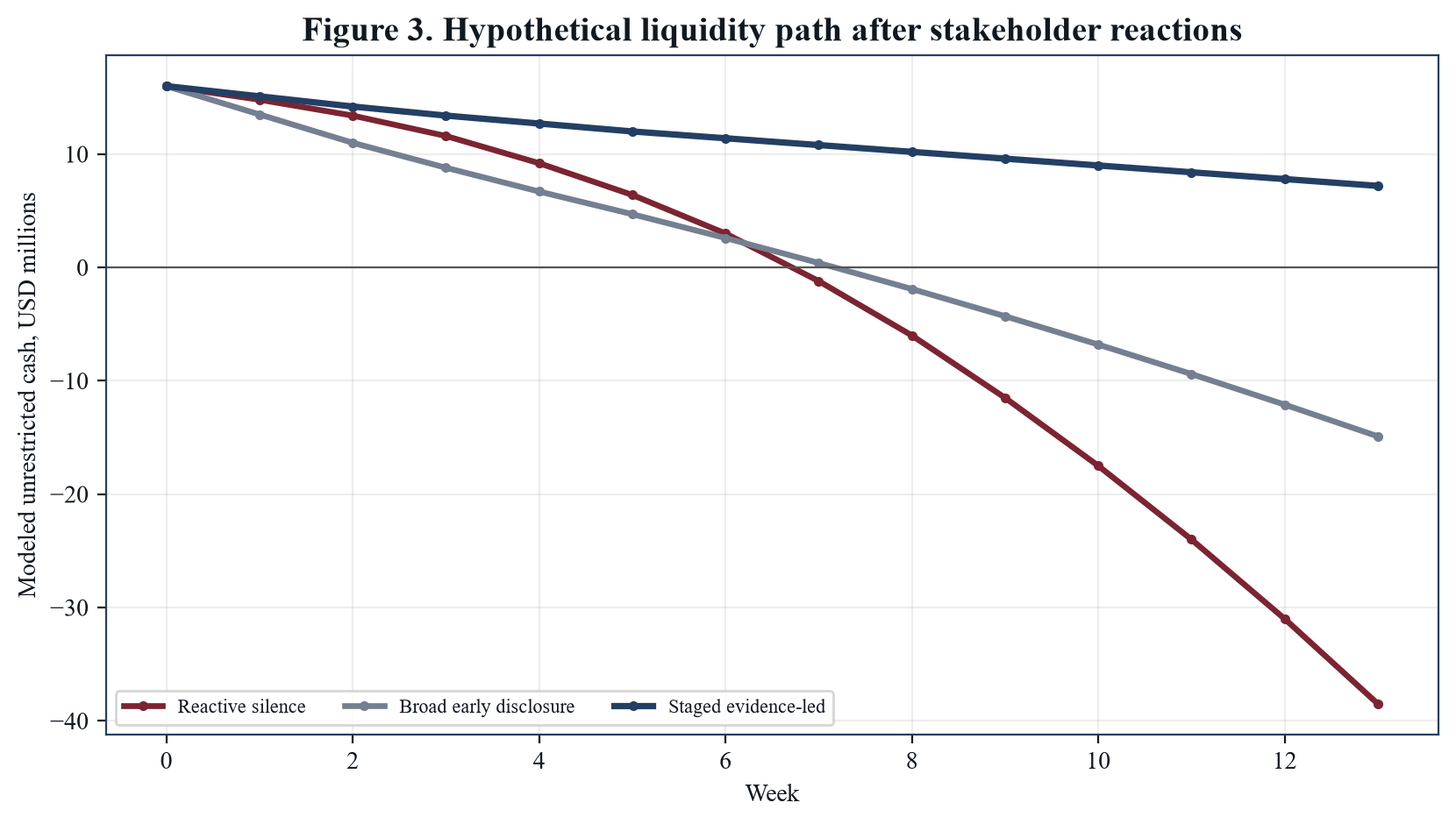
Author assumptions. Negative balances indicate that additional funding or an earlier transaction decision would be required.
22. Link communications to the weekly cash model
The communication register should connect directly to the weekly cash forecast. For customers, the links include collections, advance payments, credit notes, refunds, service credits, churn and delivery conditions. For suppliers, they include payment dates, deposits, minimum orders, credit limits, holds, alternative sources and logistics. Each change should identify the message or agreement that caused it.
Forecast timing matters as much as amount. A supplier may continue only after receiving cash, while a customer may pay only after delivery. The model should show these dependencies in sequence. A statement that both parties remain supportive can conceal an impossible funding gap between the two events. Treasury and operations should approve the same schedule.
The board should receive a counterparty bridge with the cash forecast. It should show the prior assumption, new evidence, change, owner and next decision. Where the company lacks written confirmation, the forecast should use an appropriate scenario rather than treating a verbal indication as committed cash. The legal effect of any arrangement requires qualified review.
23. Contract rights, consents and transfer
Communication should begin with the contract register. Change-of-control, assignment, novation, termination, insolvency, set-off, audit, confidentiality, data, service-level and step-in provisions can determine what the counterparty may do. The legal team should identify which rights are triggered by distress, process entry, signing, completion or performance failure.
The UK rules on protection of supplies may restrict reliance on certain termination provisions in relevant insolvency procedures, subject to exclusions and protections [4][11]. Other jurisdictions use different approaches. The existence of a legal restriction does not ensure practical supply, quality or commercial cooperation. Management still needs an operating arrangement and a lawful payment path.
Consent discussions should be staged around transaction certainty. Asking too early can expose the process. Asking too late can make completion impossible. The buyer's proposed changes may affect consent. The control record should state whether the counterparty acknowledged the transaction, agreed to continue, waived a right, gave a conditional consent or executed the required document. These states should not be conflated.
24. Competition and clean-team boundaries
A strategic buyer may compete with the seller or its counterparties. Customer pricing, pipeline, supplier rebates, capacity and forecasts can be competitively sensitive. Direct contacts may reveal information that changes market conduct before completion. Competition counsel should define clean-team, aggregation, access and communication rules for the relevant jurisdictions.
The seller can often test continuity without disclosing sensitive commercial detail. A neutral adviser may conduct anonymised surveys. Counsel can manage consent discussions. Clean-team members can review restricted data and provide aggregated conclusions. Relationship owners should use approved questions and avoid discussing future coordination, prices, customers or supply allocation outside the permitted process.
Any restriction should be operationally workable. If clean-team conclusions arrive too late to support a bid, the process may lose value. The sale timetable should include the preparation, review and response cycle. Breaches require immediate escalation, access suspension where appropriate, preservation of evidence and qualified legal assessment.
25. Communication with trade credit insurers and finance providers
Trade credit insurance, receivables finance, supply-chain finance, surety bonds and customer advance-payment protections can amplify stakeholder reactions. A credit insurer's limit reduction may cause several suppliers to tighten terms simultaneously. A factor may exclude receivables or increase reserves. A bonding provider may require collateral. Customers may seek security for deposits.
The company should map each provider, notification obligation, information covenant, insured exposure and decision timetable. Communications must reconcile with lender reporting and the cash model. A statement to suppliers about available credit may be misleading if the insurer or financier retains discretion. Where a provider gives a conditional position, those conditions should be visible.
Management can test mitigants such as direct payment, escrow, receivables control, inventory security, reduced order horizons or new guarantees. Each changes economics and may require consent. The board should compare the cash and value effect with the cost of losing the relationship. Specialist finance and legal advice is required before implementing these structures.
26. Public statements and private messages
Public and private communications should share a common fact base. A public statement may need to remain concise, while a critical counterparty receives operational detail under appropriate controls. The difference should reflect legitimate purpose and confidentiality, not contradictory facts. The control group should maintain a claims register across channels.
Listed issuers need continuous assessment of inside-information obligations and leak risk [6]. Regulated companies may have sector-specific notifications. Private companies may face lender, contract or employee requirements. The communication calendar should identify the earliest applicable trigger for each audience and the approvals required.
Once a public statement is issued, relationship owners need updated talking points and escalation contacts. Customers and suppliers may ask questions the statement cannot answer. The company should respond with verified relationship-specific information, record new risks and avoid speculation. A delayed or inconsistent follow-up can turn a controlled disclosure into operational damage.
27. Risk control matrix
The communication process can fail through unsupported assurance, late contact, over-disclosure, contradictory channels, unauthorised commitments, mishandled personal data, employee-process breaches or poor documentation. Each failure mode needs an indicator, preventive control, accountable owner and retained evidence. The board should see exceptions rather than a simple count of messages sent.
An exception dashboard should highlight missed payment promises, service failures, unapproved contacts, consent refusals, leaks, data incidents, employee complaints and changes in counterparty behaviour. It should connect each item to cash, value, transaction milestones and legal assessment. A red status requires an action or an explicit acceptance decision.
Independent review should test a sample of communications against source evidence and authority. It should also trace counterparty outcomes into the forecast and data room. The objective is to identify whether the system produces decision-useful evidence, not merely consistent wording.
Table 5. Proposed communication risk-control matrix
| Failure mode | Early indicator | Control | Evidence retained |
|---|---|---|---|
| Unsupported assurance | Message exceeds current funding or capacity | Claim-to-evidence review | Approved pack and source link |
| Late critical contact | Supplier hold or customer exit begins | Priority map and trigger dates | Contact plan and acknowledgement |
| Over-disclosure | Sensitive data reaches an unnecessary recipient | Staged access and purpose test | Access log and approval |
| Contradictory messages | Different dates or terms across channels | Central claims register | Version history |
| Unauthorised commitment | Relationship owner changes payment or service terms | Delegated limits and escalation | Call note and signed agreement |
| Missing outcome data | Forecast ignores stakeholder reaction | Cash-model integration | Assumption bridge |
Proposed controls require adaptation to the company, process and jurisdiction.
28. Staged release sequence
The prepare stage begins before external contact. The company builds the fact base, priority map, scripts, holding statements, access controls and contingency plans. Board, advisers and key lenders usually require early involvement within applicable confidentiality and disclosure rules. Critical customers and suppliers are prepared for engagement when operating evidence and authority are available.
The qualify and engage stages add counterparties according to consequence and fragility. The company should avoid a fixed calendar that ignores events. A missed payment, service failure, leak, formal filing, buyer milestone or contract trigger may accelerate communication. Each release decision should state what changed and why the recipient now needs the information.
The confirm and transfer stages convert dialogue into documented arrangements. These can include payment terms, order plans, service commitments, consent documents, data notices and transition responsibilities. Wider counterparties receive communication when the transaction or legal process requires it. The final register should transfer open obligations and relationship intelligence to the accountable post-close or wind-down owner.
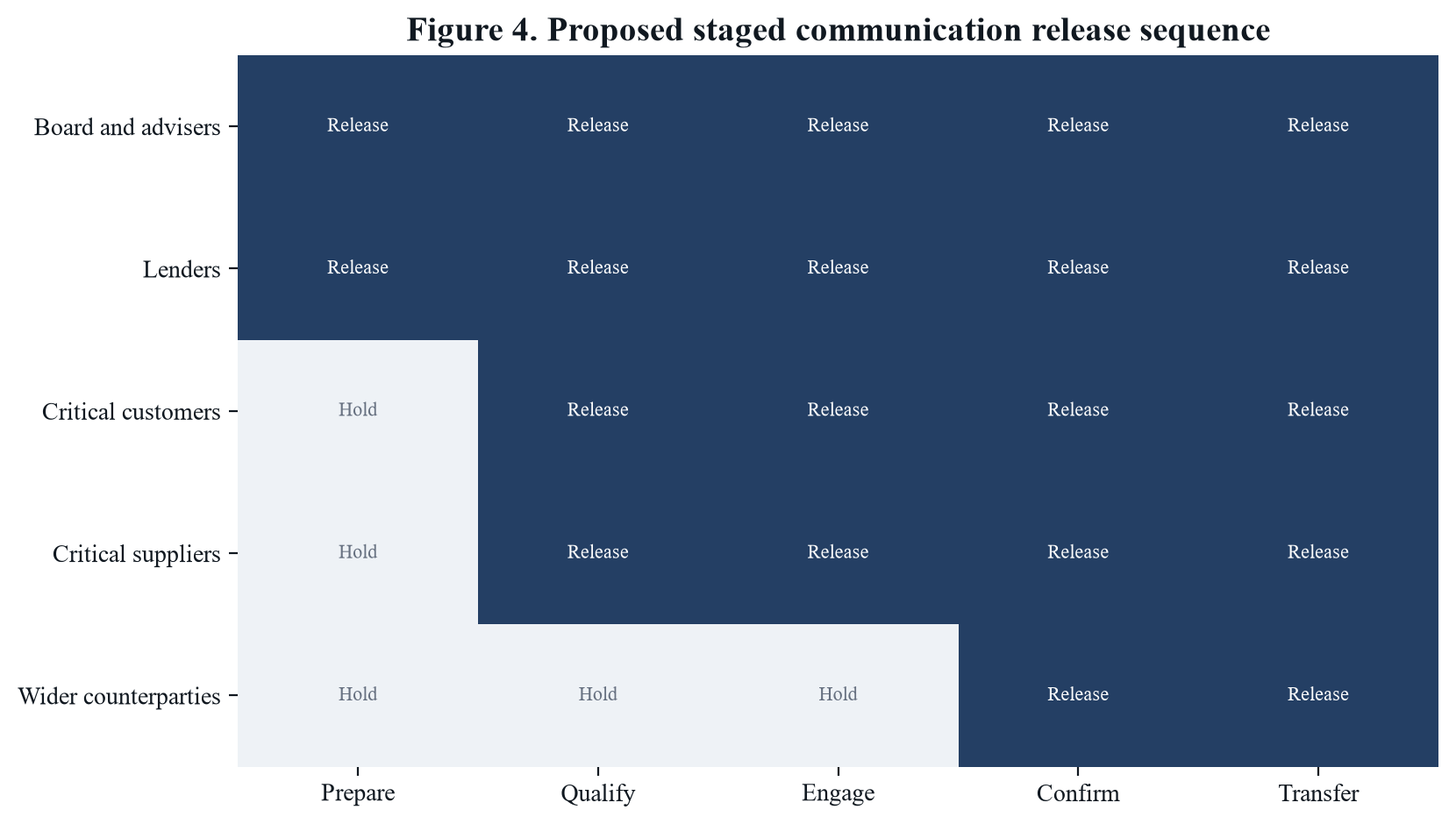
Proposed sequence. Mandatory disclosures, consultation and contractual notices may require a different order.
29. Ten-business-day implementation roadmap
Days one and two establish governance. The board confirms the process, authority and adviser roles. Treasury issues the current cash and payment truth. Operations identifies critical dependencies. Legal maps disclosure, contract, employment and data constraints. The team creates the first holding statements and leak protocol.
Days three to five build the stakeholder map and evidence packs. Management scores counterparties, reviews contracts, reconciles balances and identifies relationship owners. It drafts customer and supplier message variants, escalation rules and written follow-ups. The cash model incorporates the downside if each critical relationship changes terms or exits.
Days six to ten begin approved engagement. The company contacts the highest-priority parties, records reactions and closes evidence gaps. It agrees continuity arrangements where supportable, updates buyer diligence and presents the board with exceptions, liquidity consequences and the next release decisions. The timetable is a management framework only. Mandatory procedures and the company's facts determine actual timing.
Table 6. Proposed ten-business-day implementation roadmap
| Period | Core action | Required output | Board gate |
|---|---|---|---|
| Days 1 to 2 | Confirm authority, cash and constraints | Mandate, fact base and leak protocol | Approve control system |
| Days 3 to 5 | Segment stakeholders and prepare evidence | Priority map, scripts and cash sensitivities | Approve contact tiers |
| Days 6 to 8 | Engage critical relationships | Call notes, exceptions and draft arrangements | Fund or revise continuity actions |
| Days 9 to 10 | Confirm positions and update transaction pack | Signed terms, consent status and revised forecast | Continue, accelerate or change route |
Management framework. Mandatory legal, regulatory and contractual timetables remain controlling.
30. Board reporting and stop conditions
The board pack should show the number and value of relationships in each stage, critical uncontacted parties, written commitments, adverse actions, cash impact, buyer relevance and legal exceptions. It should also show message versions and any public-disclosure decision. Aggregate counts should not hide a single relationship capable of stopping operations.
Stop conditions can include an unfunded cash gap, loss of a required supplier, customer termination above the approved downside, a consent barrier, a data or confidentiality breach, failed employee-process milestone, or loss of buyer competition. A stop condition does not always end the sale. It may require a faster process, different perimeter, bridge funding, formal restructuring or contingency transfer.
The board should minute the options considered, evidence, advice, stakeholder effects and reasons for the decision. Communications should update after a route changes. Continuing to use an old reassurance after the operating plan or transaction perimeter has failed creates additional risk.
31. Role of technology and AI
Authorised technology can reconcile contact lists, contracts, balances, order data, communications and access logs. It can identify inconsistent dates, unapproved claims, missing acknowledgements and stakeholders whose behaviour has changed. Natural-language tools can help classify questions and prepare draft responses grounded in approved evidence. Workflow systems can route exceptions to accountable owners.
The company should protect confidential, personal and competitively sensitive information. Models and vendors require approved access, retention, security and data-use terms. Generated content can omit conditions or turn uncertain information into confident language. Human reviewers must validate facts, authority, legal requirements and commitments before release.
AI outputs should remain traceable to the approved claims register. The system should record source documents, version, reviewer and released text. It should not autonomously contact stakeholders, change commercial terms or decide disclosure. The transaction team remains accountable for communication and the underlying operating decisions.
32. Limitations
This paper provides a general decision framework. It is not legal, employment, data-protection, insolvency, regulatory, accounting, tax, investment, communications or transaction advice. The cited materials apply in their stated contexts and may change. Each company requires current jurisdiction-specific advice and review of its contracts, facts and process.
All numerical inputs, scores, leakage amounts and liquidity paths are author assumptions without empirical calibration. They do not estimate market averages, customer or supplier behaviour, transaction value, completion probability or creditor recovery. The simplified model excludes many factors, including currency, tax, multiple legal entities, insurance limits, security, set-off, regulated licences, product liability, public-law duties and buyer financing conditions.
Management should rebuild the framework with verified company data and preserve alternative scenarios. A communication plan can reduce avoidable uncertainty and improve execution evidence. It cannot guarantee stakeholder support, funding, a sale or continuity.
33. Conclusion
Customer and supplier communications during a distressed sale should operate as a controlled transaction workstream. The board begins with authority, liquidity, legal constraints and a map of relationships that determine continuity and value. Management then connects each message to verified evidence, an operating control, a responsible owner and a decision date.
The central discipline is staged engagement. Critical counterparties receive tailored, supportable information when the company can manage the resulting decision. Wider disclosure follows legal, contractual and process requirements. Every reaction updates the cash forecast, valuation, buyer diligence and risk register.
A board that governs communication this way can see whether the business remains transferable, what continuity costs, and which relationships require intervention. The result is a more credible sale process and a clearer record of how value and stakeholder interests were protected under pressure.
References
- UK Government. Corporate Financial Distress Guidance Note. Updated 15 June 2026; accessed 6 September 2026. https://www.gov.uk/government/publications/the-sourcing-and-consultancy-playbooks/corporate-financial-distress-guidance-note-html
- Financial Reporting Council. Guidance on the Going Concern Basis of Accounting and Related Reporting including Solvency and Liquidity Risks. Published 25 February 2025; accessed 6 September 2026. https://www.frc.org.uk/library/standards-codes-policy/accounting-and-reporting/annual-corporate-reporting/guidance-on-going-concern-basis/
- United Nations Commission on International Trade Law. Legislative Guide on Insolvency Law. Accessed 6 September 2026. https://uncitral.un.org/en/texts/insolvency/legislativeguides/insolvency_law
- UK Parliament. Corporate Insolvency and Governance Act 2020, protection of supplies provisions and explanatory material. Accessed 6 September 2026. https://www.legislation.gov.uk/ukpga/2020/12/notes/division/6/index.htm
- Information Commissioner's Office. Due diligence when sharing data following mergers and acquisitions. Accessed 6 September 2026. https://ico.org.uk/for-organisations/uk-gdpr-guidance-and-resources/data-sharing/data-sharing-a-code-of-practice/due-diligence/
- Financial Conduct Authority. DTR 2: Disclosure and control of inside information by issuers. Accessed 6 September 2026. https://handbook.fca.org.uk/handbook/dtr2
- Advisory, Conciliation and Arbitration Service. TUPE transfers if an employer is insolvent and informing and consulting requirements. Updated 23 February 2026; accessed 6 September 2026. https://www.acas.org.uk/tupe/advice-for-employers-and-employees/tupe-transfers-if-your-employer-is-insolvent
- UK Government. Business transfers, takeovers and TUPE: information about employees during transfers. Accessed 6 September 2026. https://www.gov.uk/transfers-takeovers/information-about-employees-during-transfers
- Department for Business and Trade. Duty to report on payment practices and performance. Updated 2 September 2025; accessed 6 September 2026. https://www.gov.uk/government/publications/business-payment-practices-and-performance-reporting-requirements/duty-to-report-guidance-to-reporting-on-payment-practices-and-performance
- United States Trustee Program. Chapter 11 Case Administration. Updated February 2026; accessed 6 September 2026. https://www.justice.gov/ust/file/volume_3_chapter_11_case_administration.pdf/dl?inline=
- The Insolvency Service. Essential services: guidance for insolvency practitioners and suppliers. Published 6 October 2015; accessed 6 September 2026. https://www.gov.uk/government/publications/essential-services-guidance-for-insolvency-practitioners-and-suppliers
- UK Government. Setting up a case for redundancy payments: guidance for insolvency practitioners. Updated 2 April 2026; accessed 6 September 2026. https://www.gov.uk/guidance/case-set-up-guidance-for-insolvency-practitioners
