

1. Set the transaction assurance objective
Define the deal perimeter, buyer reliance standard and risk appetite before evidence collection begins.
The review should reconcile board mandate, deal route, critical systems and decision thresholds. The workpaper records population, period, source system, owner, completeness, sample basis, exception logic, reviewer, authorised-advice dependency and transaction relevance. Its immediate output is an approved cyber and AI diligence charter.
Testing asks whether the evidence supports the stated control across the relevant period, including failures, overrides and changes. The conclusion should separate design, implementation and operating effectiveness; distinguish confirmed facts from management assertions; and connect exceptions to confidentiality, integrity, availability, privacy, safety, customer commitments, regulatory exposure, operational continuity and buyer reliance.
The transaction team should quantify realistic consequences, assign remediation ownership and preserve closure evidence. Material matters flow into the data room, management fact book, forecast, separation or integration plan, disclosure process, purchase agreement, financing case and board decisions. Residual uncertainty remains explicit until the required proof is obtained or the risk is contractually allocated.
2. Map entities, systems and data flows
Reconcile legal entities, business units, hosting regions, networks, applications, models, datasets and processors.
The review should reconcile architecture diagrams, asset registers, data maps and entity records. The workpaper records population, period, source system, owner, completeness, sample basis, exception logic, reviewer, authorised-advice dependency and transaction relevance. Its immediate output is a transaction technology perimeter.
Testing asks whether the evidence supports the stated control across the relevant period, including failures, overrides and changes. The conclusion should separate design, implementation and operating effectiveness; distinguish confirmed facts from management assertions; and connect exceptions to confidentiality, integrity, availability, privacy, safety, customer commitments, regulatory exposure, operational continuity and buyer reliance.
The transaction team should quantify realistic consequences, assign remediation ownership and preserve closure evidence. Material matters flow into the data room, management fact book, forecast, separation or integration plan, disclosure process, purchase agreement, financing case and board decisions. Residual uncertainty remains explicit until the required proof is obtained or the risk is contractually allocated.
3. Build the vendor and dependency universe
Identify cloud, software, managed services, model, data, security and critical subcontractor dependencies.
The review should reconcile procurement, accounts payable, SSO, network, API and contract populations. The workpaper records population, period, source system, owner, completeness, sample basis, exception logic, reviewer, authorised-advice dependency and transaction relevance. Its immediate output is a reconciled third-party dependency register.
Testing asks whether the evidence supports the stated control across the relevant period, including failures, overrides and changes. The conclusion should separate design, implementation and operating effectiveness; distinguish confirmed facts from management assertions; and connect exceptions to confidentiality, integrity, availability, privacy, safety, customer commitments, regulatory exposure, operational continuity and buyer reliance.
The transaction team should quantify realistic consequences, assign remediation ownership and preserve closure evidence. Material matters flow into the data room, management fact book, forecast, separation or integration plan, disclosure process, purchase agreement, financing case and board decisions. Residual uncertainty remains explicit until the required proof is obtained or the risk is contractually allocated.
4. Separate policy from operating evidence
Test whether written requirements are implemented, monitored and enforced in practice.
The review should reconcile policies, configurations, tickets, alerts, logs, samples and interviews. The workpaper records population, period, source system, owner, completeness, sample basis, exception logic, reviewer, authorised-advice dependency and transaction relevance. Its immediate output is a policy-to-control evidence bridge.
Testing asks whether the evidence supports the stated control across the relevant period, including failures, overrides and changes. The conclusion should separate design, implementation and operating effectiveness; distinguish confirmed facts from management assertions; and connect exceptions to confidentiality, integrity, availability, privacy, safety, customer commitments, regulatory exposure, operational continuity and buyer reliance.
The transaction team should quantify realistic consequences, assign remediation ownership and preserve closure evidence. Material matters flow into the data room, management fact book, forecast, separation or integration plan, disclosure process, purchase agreement, financing case and board decisions. Residual uncertainty remains explicit until the required proof is obtained or the risk is contractually allocated.
5. Establish evidence provenance
Record source, owner, extraction date, system of record, completeness and alteration controls.
The review should reconcile native exports, hashes, access histories, screenshots and reviewer workpapers. The workpaper records population, period, source system, owner, completeness, sample basis, exception logic, reviewer, authorised-advice dependency and transaction relevance. Its immediate output is an evidence chain-of-custody register.
Testing asks whether the evidence supports the stated control across the relevant period, including failures, overrides and changes. The conclusion should separate design, implementation and operating effectiveness; distinguish confirmed facts from management assertions; and connect exceptions to confidentiality, integrity, availability, privacy, safety, customer commitments, regulatory exposure, operational continuity and buyer reliance.
The transaction team should quantify realistic consequences, assign remediation ownership and preserve closure evidence. Material matters flow into the data room, management fact book, forecast, separation or integration plan, disclosure process, purchase agreement, financing case and board decisions. Residual uncertainty remains explicit until the required proof is obtained or the risk is contractually allocated.
6. Design materiality tiers
Rank systems and vendors by revenue, safety, confidentiality, availability, substitutability and closing dependency.
The review should reconcile financial, operational, customer, regulatory and transaction exposure. The workpaper records population, period, source system, owner, completeness, sample basis, exception logic, reviewer, authorised-advice dependency and transaction relevance. Its immediate output is a risk-based review plan.
Testing asks whether the evidence supports the stated control across the relevant period, including failures, overrides and changes. The conclusion should separate design, implementation and operating effectiveness; distinguish confirmed facts from management assertions; and connect exceptions to confidentiality, integrity, availability, privacy, safety, customer commitments, regulatory exposure, operational continuity and buyer reliance.
The transaction team should quantify realistic consequences, assign remediation ownership and preserve closure evidence. Material matters flow into the data room, management fact book, forecast, separation or integration plan, disclosure process, purchase agreement, financing case and board decisions. Residual uncertainty remains explicit until the required proof is obtained or the risk is contractually allocated.
7. Assess cyber governance
Evaluate accountability, board oversight, management forums, risk acceptance and reporting cadence.
The review should reconcile charters, minutes, dashboards, exceptions and remediation decisions. The workpaper records population, period, source system, owner, completeness, sample basis, exception logic, reviewer, authorised-advice dependency and transaction relevance. Its immediate output is a cyber governance fact book.
Testing asks whether the evidence supports the stated control across the relevant period, including failures, overrides and changes. The conclusion should separate design, implementation and operating effectiveness; distinguish confirmed facts from management assertions; and connect exceptions to confidentiality, integrity, availability, privacy, safety, customer commitments, regulatory exposure, operational continuity and buyer reliance.
The transaction team should quantify realistic consequences, assign remediation ownership and preserve closure evidence. Material matters flow into the data room, management fact book, forecast, separation or integration plan, disclosure process, purchase agreement, financing case and board decisions. Residual uncertainty remains explicit until the required proof is obtained or the risk is contractually allocated.
8. Assess AI governance
Evaluate model ownership, intended use, prohibited use, human oversight and lifecycle accountability.
The review should reconcile AI inventories, approvals, model cards, monitoring and incident records. The workpaper records population, period, source system, owner, completeness, sample basis, exception logic, reviewer, authorised-advice dependency and transaction relevance. Its immediate output is an AI governance fact book.
Testing asks whether the evidence supports the stated control across the relevant period, including failures, overrides and changes. The conclusion should separate design, implementation and operating effectiveness; distinguish confirmed facts from management assertions; and connect exceptions to confidentiality, integrity, availability, privacy, safety, customer commitments, regulatory exposure, operational continuity and buyer reliance.
The transaction team should quantify realistic consequences, assign remediation ownership and preserve closure evidence. Material matters flow into the data room, management fact book, forecast, separation or integration plan, disclosure process, purchase agreement, financing case and board decisions. Residual uncertainty remains explicit until the required proof is obtained or the risk is contractually allocated.
Table 1. Policy-to-evidence test
| Claim | Operating evidence | Decision |
|---|---|---|
| governance | minutes and exceptions | accountability |
| access | native logs and samples | effectiveness |
| resilience | restore and failover tests | continuity |
| AI oversight | evaluations and approvals | trust |
Illustrative analytical design; company-specific scope, evidence and authorised advice govern.
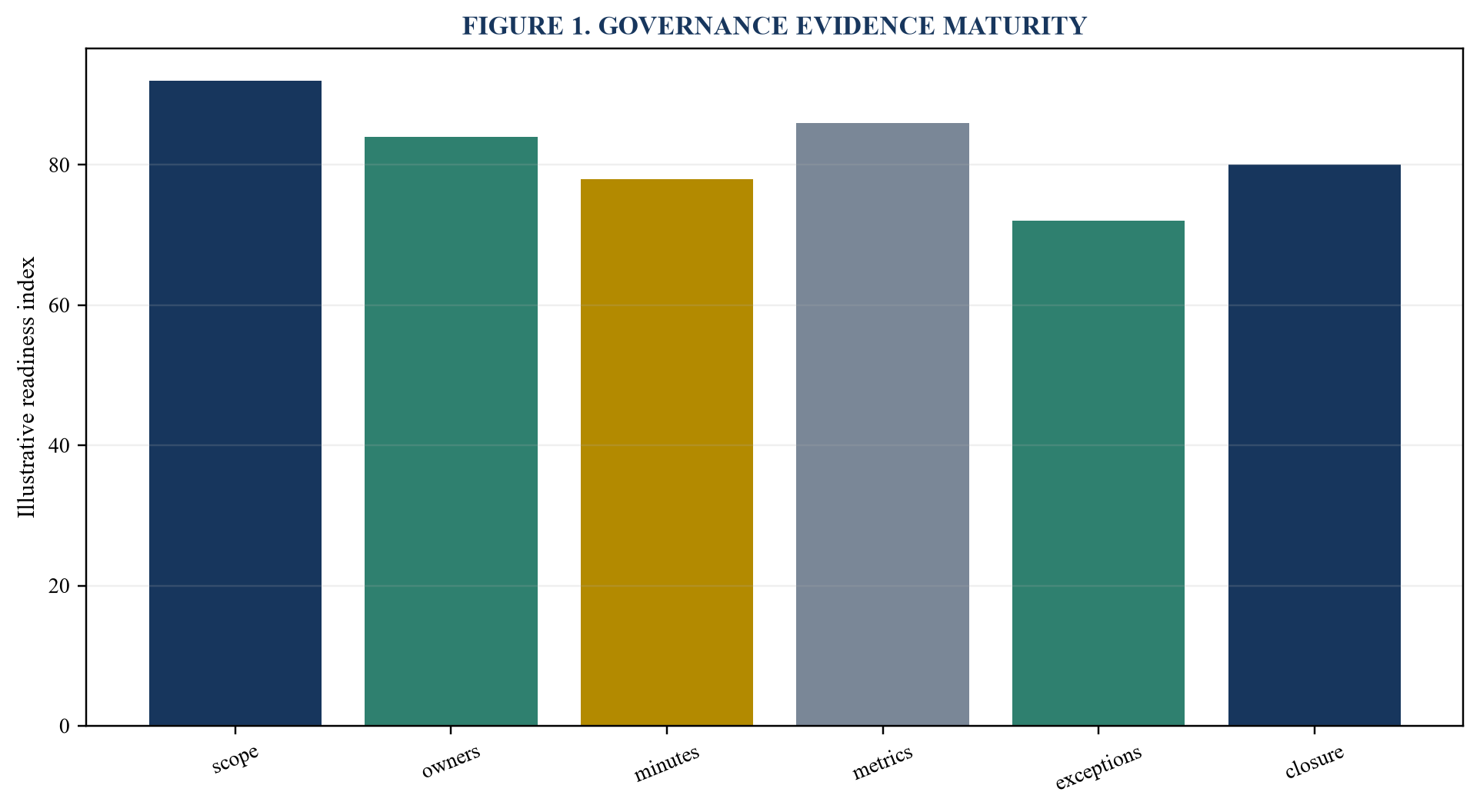
Values are illustrative readiness indices and require company-specific testing.
9. Inventory identities and privileged access
Reconcile employees, contractors, service accounts, administrators, keys and emergency access.
The review should reconcile identity provider, HR, PAM, cloud and application records. The workpaper records population, period, source system, owner, completeness, sample basis, exception logic, reviewer, authorised-advice dependency and transaction relevance. Its immediate output is a privileged-access assurance map.
Testing asks whether the evidence supports the stated control across the relevant period, including failures, overrides and changes. The conclusion should separate design, implementation and operating effectiveness; distinguish confirmed facts from management assertions; and connect exceptions to confidentiality, integrity, availability, privacy, safety, customer commitments, regulatory exposure, operational continuity and buyer reliance.
The transaction team should quantify realistic consequences, assign remediation ownership and preserve closure evidence. Material matters flow into the data room, management fact book, forecast, separation or integration plan, disclosure process, purchase agreement, financing case and board decisions. Residual uncertainty remains explicit until the required proof is obtained or the risk is contractually allocated.
10. Test joiner, mover and leaver controls
Sample provisioning, role changes, termination, recertification and dormant-account handling.
The review should reconcile HR events, workflow tickets, approval records and access logs. The workpaper records population, period, source system, owner, completeness, sample basis, exception logic, reviewer, authorised-advice dependency and transaction relevance. Its immediate output is an identity lifecycle test pack.
Testing asks whether the evidence supports the stated control across the relevant period, including failures, overrides and changes. The conclusion should separate design, implementation and operating effectiveness; distinguish confirmed facts from management assertions; and connect exceptions to confidentiality, integrity, availability, privacy, safety, customer commitments, regulatory exposure, operational continuity and buyer reliance.
The transaction team should quantify realistic consequences, assign remediation ownership and preserve closure evidence. Material matters flow into the data room, management fact book, forecast, separation or integration plan, disclosure process, purchase agreement, financing case and board decisions. Residual uncertainty remains explicit until the required proof is obtained or the risk is contractually allocated.
11. Test security configuration
Compare production settings with approved baselines across cloud, endpoints, networks, applications and databases.
The review should reconcile configuration exports, policies, drift reports and exception registers. The workpaper records population, period, source system, owner, completeness, sample basis, exception logic, reviewer, authorised-advice dependency and transaction relevance. Its immediate output is a configuration assurance matrix.
Testing asks whether the evidence supports the stated control across the relevant period, including failures, overrides and changes. The conclusion should separate design, implementation and operating effectiveness; distinguish confirmed facts from management assertions; and connect exceptions to confidentiality, integrity, availability, privacy, safety, customer commitments, regulatory exposure, operational continuity and buyer reliance.
The transaction team should quantify realistic consequences, assign remediation ownership and preserve closure evidence. Material matters flow into the data room, management fact book, forecast, separation or integration plan, disclosure process, purchase agreement, financing case and board decisions. Residual uncertainty remains explicit until the required proof is obtained or the risk is contractually allocated.
12. Test vulnerability and patch management
Measure discovery, prioritisation, remediation, exception and verification across assets and dependencies.
The review should reconcile scanner results, patch records, KEV exposure, penetration tests and retests. The workpaper records population, period, source system, owner, completeness, sample basis, exception logic, reviewer, authorised-advice dependency and transaction relevance. Its immediate output is a vulnerability closure analysis.
Testing asks whether the evidence supports the stated control across the relevant period, including failures, overrides and changes. The conclusion should separate design, implementation and operating effectiveness; distinguish confirmed facts from management assertions; and connect exceptions to confidentiality, integrity, availability, privacy, safety, customer commitments, regulatory exposure, operational continuity and buyer reliance.
The transaction team should quantify realistic consequences, assign remediation ownership and preserve closure evidence. Material matters flow into the data room, management fact book, forecast, separation or integration plan, disclosure process, purchase agreement, financing case and board decisions. Residual uncertainty remains explicit until the required proof is obtained or the risk is contractually allocated.
13. Test secure software development
Trace security requirements, code review, dependency control, secrets handling, testing and release approval.
The review should reconcile repositories, pipelines, artefact stores, SBOMs, findings and deployment records. The workpaper records population, period, source system, owner, completeness, sample basis, exception logic, reviewer, authorised-advice dependency and transaction relevance. Its immediate output is a software assurance evidence pack.
Testing asks whether the evidence supports the stated control across the relevant period, including failures, overrides and changes. The conclusion should separate design, implementation and operating effectiveness; distinguish confirmed facts from management assertions; and connect exceptions to confidentiality, integrity, availability, privacy, safety, customer commitments, regulatory exposure, operational continuity and buyer reliance.
The transaction team should quantify realistic consequences, assign remediation ownership and preserve closure evidence. Material matters flow into the data room, management fact book, forecast, separation or integration plan, disclosure process, purchase agreement, financing case and board decisions. Residual uncertainty remains explicit until the required proof is obtained or the risk is contractually allocated.
14. Assess open-source and software supply-chain risk
Map component provenance, licences, vulnerabilities, maintainers, build integrity and update exposure.
The review should reconcile SBOMs, lockfiles, attestations, advisories and supplier controls. The workpaper records population, period, source system, owner, completeness, sample basis, exception logic, reviewer, authorised-advice dependency and transaction relevance. Its immediate output is a software supply-chain risk map.
Testing asks whether the evidence supports the stated control across the relevant period, including failures, overrides and changes. The conclusion should separate design, implementation and operating effectiveness; distinguish confirmed facts from management assertions; and connect exceptions to confidentiality, integrity, availability, privacy, safety, customer commitments, regulatory exposure, operational continuity and buyer reliance.
The transaction team should quantify realistic consequences, assign remediation ownership and preserve closure evidence. Material matters flow into the data room, management fact book, forecast, separation or integration plan, disclosure process, purchase agreement, financing case and board decisions. Residual uncertainty remains explicit until the required proof is obtained or the risk is contractually allocated.
15. Assess data governance and privacy
Trace lawful purpose, minimisation, quality, retention, access, localisation, transfer and deletion.
The review should reconcile records of processing, inventories, contracts, consent, DPIAs and deletion evidence. The workpaper records population, period, source system, owner, completeness, sample basis, exception logic, reviewer, authorised-advice dependency and transaction relevance. Its immediate output is a data lifecycle assurance map.
Testing asks whether the evidence supports the stated control across the relevant period, including failures, overrides and changes. The conclusion should separate design, implementation and operating effectiveness; distinguish confirmed facts from management assertions; and connect exceptions to confidentiality, integrity, availability, privacy, safety, customer commitments, regulatory exposure, operational continuity and buyer reliance.
The transaction team should quantify realistic consequences, assign remediation ownership and preserve closure evidence. Material matters flow into the data room, management fact book, forecast, separation or integration plan, disclosure process, purchase agreement, financing case and board decisions. Residual uncertainty remains explicit until the required proof is obtained or the risk is contractually allocated.
16. Map AI systems and model lineage
Identify internally built, fine-tuned, embedded and externally supplied models and their dependencies.
The review should reconcile registries, APIs, model cards, training records, evaluation reports and licences. The workpaper records population, period, source system, owner, completeness, sample basis, exception logic, reviewer, authorised-advice dependency and transaction relevance. Its immediate output is an AI system and lineage register.
Testing asks whether the evidence supports the stated control across the relevant period, including failures, overrides and changes. The conclusion should separate design, implementation and operating effectiveness; distinguish confirmed facts from management assertions; and connect exceptions to confidentiality, integrity, availability, privacy, safety, customer commitments, regulatory exposure, operational continuity and buyer reliance.
The transaction team should quantify realistic consequences, assign remediation ownership and preserve closure evidence. Material matters flow into the data room, management fact book, forecast, separation or integration plan, disclosure process, purchase agreement, financing case and board decisions. Residual uncertainty remains explicit until the required proof is obtained or the risk is contractually allocated.
Table 2. AI system diligence map
| Layer | Key evidence | Primary risk |
|---|---|---|
| data | provenance and rights | leakage or misuse |
| model | evaluation and monitoring | performance drift |
| application | permissions and logs | unsafe action |
| vendor | contract and assurance | dependency |
Illustrative analytical design; company-specific scope, evidence and authorised advice govern.
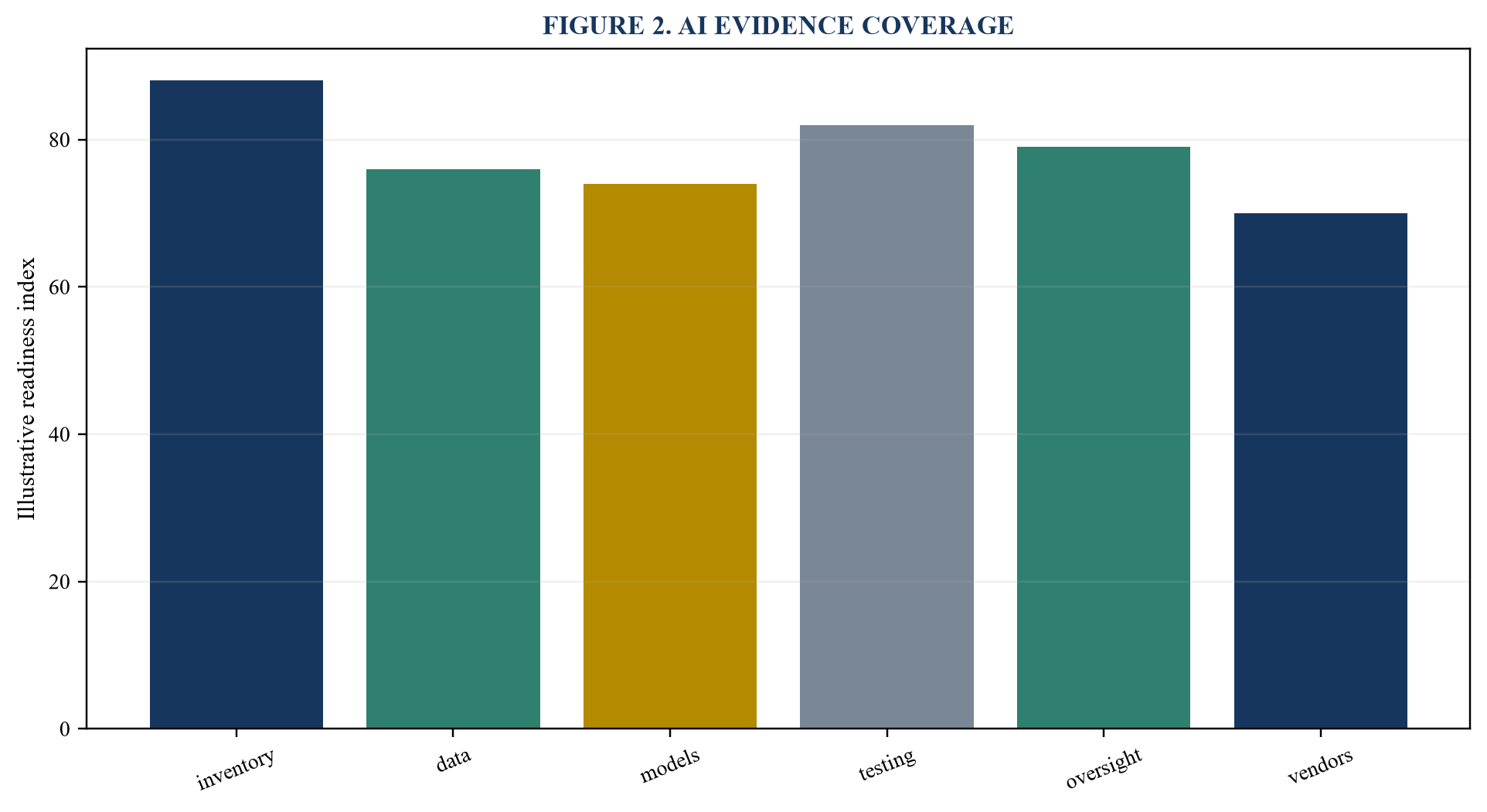
Values are illustrative readiness indices and require company-specific testing.
17. Test training and evaluation data
Assess provenance, rights, representativeness, leakage, poisoning, privacy and quality controls.
The review should reconcile dataset cards, licences, sampling, deduplication and test results. The workpaper records population, period, source system, owner, completeness, sample basis, exception logic, reviewer, authorised-advice dependency and transaction relevance. Its immediate output is a data suitability assessment.
Testing asks whether the evidence supports the stated control across the relevant period, including failures, overrides and changes. The conclusion should separate design, implementation and operating effectiveness; distinguish confirmed facts from management assertions; and connect exceptions to confidentiality, integrity, availability, privacy, safety, customer commitments, regulatory exposure, operational continuity and buyer reliance.
The transaction team should quantify realistic consequences, assign remediation ownership and preserve closure evidence. Material matters flow into the data room, management fact book, forecast, separation or integration plan, disclosure process, purchase agreement, financing case and board decisions. Residual uncertainty remains explicit until the required proof is obtained or the risk is contractually allocated.
18. Test model performance and limitations
Verify accuracy, robustness, calibration, drift, subgroup behaviour and conditions of use.
The review should reconcile benchmark design, test sets, evaluation logs, acceptance thresholds and monitoring. The workpaper records population, period, source system, owner, completeness, sample basis, exception logic, reviewer, authorised-advice dependency and transaction relevance. Its immediate output is a model performance assurance pack.
Testing asks whether the evidence supports the stated control across the relevant period, including failures, overrides and changes. The conclusion should separate design, implementation and operating effectiveness; distinguish confirmed facts from management assertions; and connect exceptions to confidentiality, integrity, availability, privacy, safety, customer commitments, regulatory exposure, operational continuity and buyer reliance.
The transaction team should quantify realistic consequences, assign remediation ownership and preserve closure evidence. Material matters flow into the data room, management fact book, forecast, separation or integration plan, disclosure process, purchase agreement, financing case and board decisions. Residual uncertainty remains explicit until the required proof is obtained or the risk is contractually allocated.
19. Test generative AI security
Evaluate prompt injection, sensitive-information disclosure, tool misuse, excessive agency and unsafe output paths.
The review should reconcile red-team cases, guardrails, permissions, retrieval controls and execution logs. The workpaper records population, period, source system, owner, completeness, sample basis, exception logic, reviewer, authorised-advice dependency and transaction relevance. Its immediate output is a generative AI attack-path map.
Testing asks whether the evidence supports the stated control across the relevant period, including failures, overrides and changes. The conclusion should separate design, implementation and operating effectiveness; distinguish confirmed facts from management assertions; and connect exceptions to confidentiality, integrity, availability, privacy, safety, customer commitments, regulatory exposure, operational continuity and buyer reliance.
The transaction team should quantify realistic consequences, assign remediation ownership and preserve closure evidence. Material matters flow into the data room, management fact book, forecast, separation or integration plan, disclosure process, purchase agreement, financing case and board decisions. Residual uncertainty remains explicit until the required proof is obtained or the risk is contractually allocated.
20. Test human oversight and contestability
Determine where people review, override, escalate and communicate AI-assisted decisions.
The review should reconcile workflow design, approval logs, user guidance, complaints and remediation. The workpaper records population, period, source system, owner, completeness, sample basis, exception logic, reviewer, authorised-advice dependency and transaction relevance. Its immediate output is a human-control effectiveness assessment.
Testing asks whether the evidence supports the stated control across the relevant period, including failures, overrides and changes. The conclusion should separate design, implementation and operating effectiveness; distinguish confirmed facts from management assertions; and connect exceptions to confidentiality, integrity, availability, privacy, safety, customer commitments, regulatory exposure, operational continuity and buyer reliance.
The transaction team should quantify realistic consequences, assign remediation ownership and preserve closure evidence. Material matters flow into the data room, management fact book, forecast, separation or integration plan, disclosure process, purchase agreement, financing case and board decisions. Residual uncertainty remains explicit until the required proof is obtained or the risk is contractually allocated.
21. Assess incident preparedness
Test classification, escalation, containment, evidence preservation, notification and recovery for cyber and AI events.
The review should reconcile plans, exercises, incidents, communications, lessons and corrective actions. The workpaper records population, period, source system, owner, completeness, sample basis, exception logic, reviewer, authorised-advice dependency and transaction relevance. Its immediate output is an incident readiness report.
Testing asks whether the evidence supports the stated control across the relevant period, including failures, overrides and changes. The conclusion should separate design, implementation and operating effectiveness; distinguish confirmed facts from management assertions; and connect exceptions to confidentiality, integrity, availability, privacy, safety, customer commitments, regulatory exposure, operational continuity and buyer reliance.
The transaction team should quantify realistic consequences, assign remediation ownership and preserve closure evidence. Material matters flow into the data room, management fact book, forecast, separation or integration plan, disclosure process, purchase agreement, financing case and board decisions. Residual uncertainty remains explicit until the required proof is obtained or the risk is contractually allocated.
22. Assess backup, recovery and resilience
Verify backup scope, immutability, restoration, failover, capacity and recovery objectives.
The review should reconcile backup consoles, restore tests, DR exercises, dependencies and exceptions. The workpaper records population, period, source system, owner, completeness, sample basis, exception logic, reviewer, authorised-advice dependency and transaction relevance. Its immediate output is a resilience evidence pack.
Testing asks whether the evidence supports the stated control across the relevant period, including failures, overrides and changes. The conclusion should separate design, implementation and operating effectiveness; distinguish confirmed facts from management assertions; and connect exceptions to confidentiality, integrity, availability, privacy, safety, customer commitments, regulatory exposure, operational continuity and buyer reliance.
The transaction team should quantify realistic consequences, assign remediation ownership and preserve closure evidence. Material matters flow into the data room, management fact book, forecast, separation or integration plan, disclosure process, purchase agreement, financing case and board decisions. Residual uncertainty remains explicit until the required proof is obtained or the risk is contractually allocated.
23. Assess security monitoring and detection
Evaluate telemetry coverage, alert logic, investigation, retention, tuning and management oversight.
The review should reconcile SIEM, EDR, cloud, identity, model and application monitoring records. The workpaper records population, period, source system, owner, completeness, sample basis, exception logic, reviewer, authorised-advice dependency and transaction relevance. Its immediate output is a detection coverage and efficacy map.
Testing asks whether the evidence supports the stated control across the relevant period, including failures, overrides and changes. The conclusion should separate design, implementation and operating effectiveness; distinguish confirmed facts from management assertions; and connect exceptions to confidentiality, integrity, availability, privacy, safety, customer commitments, regulatory exposure, operational continuity and buyer reliance.
The transaction team should quantify realistic consequences, assign remediation ownership and preserve closure evidence. Material matters flow into the data room, management fact book, forecast, separation or integration plan, disclosure process, purchase agreement, financing case and board decisions. Residual uncertainty remains explicit until the required proof is obtained or the risk is contractually allocated.
24. Assess customer-facing security commitments
Reconcile contractual obligations, questionnaires, certifications, SLAs and actual control performance.
The review should reconcile customer contracts, trust portals, audit reports, exceptions and claims. The workpaper records population, period, source system, owner, completeness, sample basis, exception logic, reviewer, authorised-advice dependency and transaction relevance. Its immediate output is a commitments-to-controls matrix.
Testing asks whether the evidence supports the stated control across the relevant period, including failures, overrides and changes. The conclusion should separate design, implementation and operating effectiveness; distinguish confirmed facts from management assertions; and connect exceptions to confidentiality, integrity, availability, privacy, safety, customer commitments, regulatory exposure, operational continuity and buyer reliance.
The transaction team should quantify realistic consequences, assign remediation ownership and preserve closure evidence. Material matters flow into the data room, management fact book, forecast, separation or integration plan, disclosure process, purchase agreement, financing case and board decisions. Residual uncertainty remains explicit until the required proof is obtained or the risk is contractually allocated.
Table 3. Control evidence hierarchy
| Evidence | Strength | Use |
|---|---|---|
| native export | high | configuration or event |
| reperformed test | high | control operation |
| assurance report | conditional | scoped reliance |
| policy or interview | supporting | design and context |
Illustrative analytical design; company-specific scope, evidence and authorised advice govern.
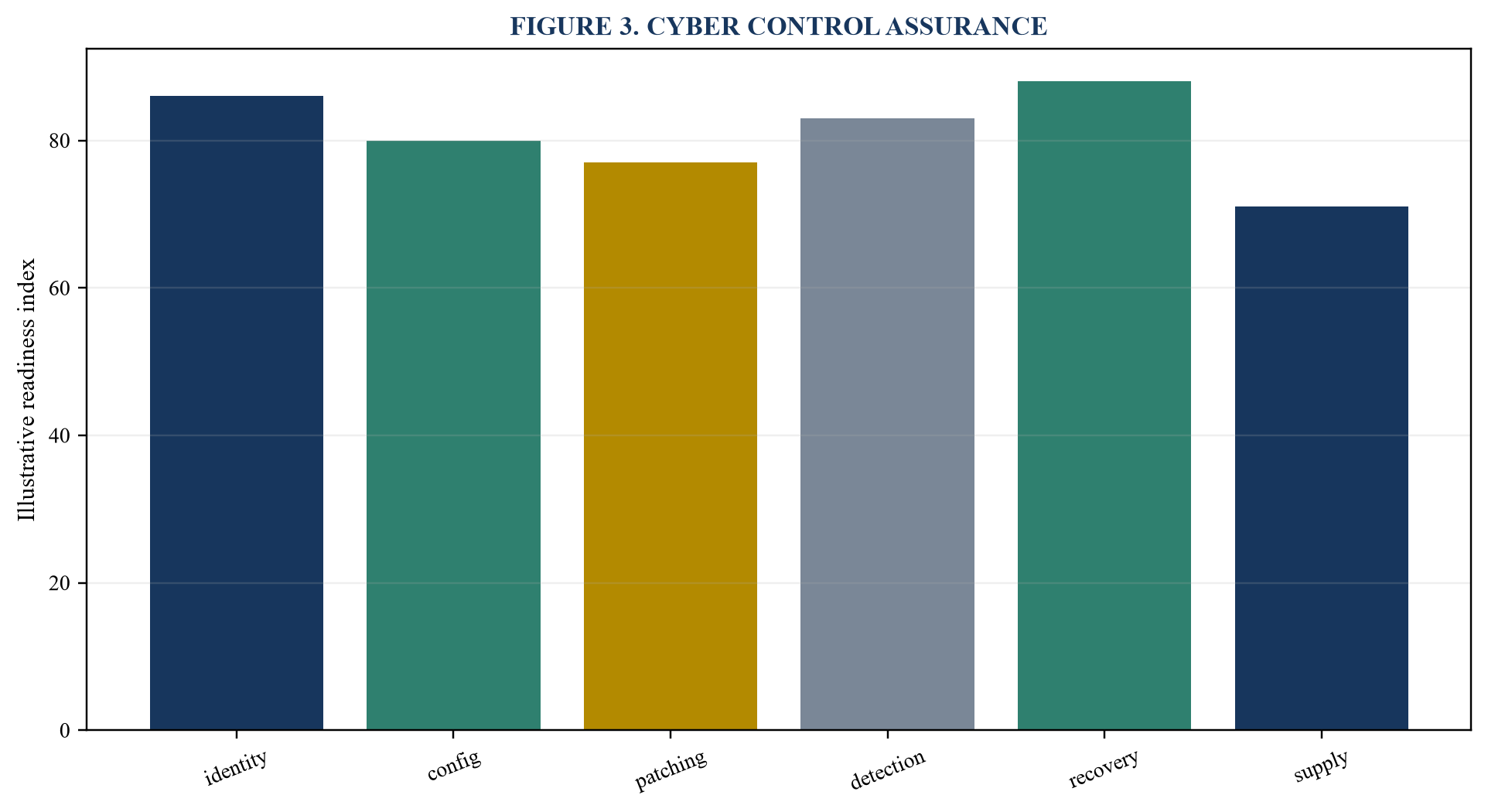
Values are illustrative readiness indices and require company-specific testing.
25. Assess regulatory exposure
Map applicable cyber, privacy, AI, sector, securities and resilience requirements by entity and geography.
The review should reconcile legal analyses, registrations, filings, regulator correspondence and control mappings. The workpaper records population, period, source system, owner, completeness, sample basis, exception logic, reviewer, authorised-advice dependency and transaction relevance. Its immediate output is a regulatory applicability register.
Testing asks whether the evidence supports the stated control across the relevant period, including failures, overrides and changes. The conclusion should separate design, implementation and operating effectiveness; distinguish confirmed facts from management assertions; and connect exceptions to confidentiality, integrity, availability, privacy, safety, customer commitments, regulatory exposure, operational continuity and buyer reliance.
The transaction team should quantify realistic consequences, assign remediation ownership and preserve closure evidence. Material matters flow into the data room, management fact book, forecast, separation or integration plan, disclosure process, purchase agreement, financing case and board decisions. Residual uncertainty remains explicit until the required proof is obtained or the risk is contractually allocated.
26. Assess certifications and assurance reports
Determine scope, period, exclusions, reliance limits, exceptions and bridge coverage.
The review should reconcile ISO certificates, SOC reports, penetration tests and management responses. The workpaper records population, period, source system, owner, completeness, sample basis, exception logic, reviewer, authorised-advice dependency and transaction relevance. Its immediate output is an assurance reliance schedule.
Testing asks whether the evidence supports the stated control across the relevant period, including failures, overrides and changes. The conclusion should separate design, implementation and operating effectiveness; distinguish confirmed facts from management assertions; and connect exceptions to confidentiality, integrity, availability, privacy, safety, customer commitments, regulatory exposure, operational continuity and buyer reliance.
The transaction team should quantify realistic consequences, assign remediation ownership and preserve closure evidence. Material matters flow into the data room, management fact book, forecast, separation or integration plan, disclosure process, purchase agreement, financing case and board decisions. Residual uncertainty remains explicit until the required proof is obtained or the risk is contractually allocated.
27. Review cyber insurance
Test insured entities, limits, exclusions, notifications, control warranties and change-of-control effects.
The review should reconcile policies, applications, claims, broker correspondence and incident facts. The workpaper records population, period, source system, owner, completeness, sample basis, exception logic, reviewer, authorised-advice dependency and transaction relevance. Its immediate output is a cyber insurance continuity analysis.
Testing asks whether the evidence supports the stated control across the relevant period, including failures, overrides and changes. The conclusion should separate design, implementation and operating effectiveness; distinguish confirmed facts from management assertions; and connect exceptions to confidentiality, integrity, availability, privacy, safety, customer commitments, regulatory exposure, operational continuity and buyer reliance.
The transaction team should quantify realistic consequences, assign remediation ownership and preserve closure evidence. Material matters flow into the data room, management fact book, forecast, separation or integration plan, disclosure process, purchase agreement, financing case and board decisions. Residual uncertainty remains explicit until the required proof is obtained or the risk is contractually allocated.
28. Review critical technology contracts
Test audit, security, privacy, AI use, service levels, subcontracting, portability, exit and termination rights.
The review should reconcile master terms, orders, DPAs, AI addenda, amendments and performance records. The workpaper records population, period, source system, owner, completeness, sample basis, exception logic, reviewer, authorised-advice dependency and transaction relevance. Its immediate output is a technology contract risk register.
Testing asks whether the evidence supports the stated control across the relevant period, including failures, overrides and changes. The conclusion should separate design, implementation and operating effectiveness; distinguish confirmed facts from management assertions; and connect exceptions to confidentiality, integrity, availability, privacy, safety, customer commitments, regulatory exposure, operational continuity and buyer reliance.
The transaction team should quantify realistic consequences, assign remediation ownership and preserve closure evidence. Material matters flow into the data room, management fact book, forecast, separation or integration plan, disclosure process, purchase agreement, financing case and board decisions. Residual uncertainty remains explicit until the required proof is obtained or the risk is contractually allocated.
29. Assess concentration and substitutability
Quantify reliance on cloud regions, models, data sources, specialists and single points of failure.
The review should reconcile architecture, spend, workloads, capacity, alternatives and migration tests. The workpaper records population, period, source system, owner, completeness, sample basis, exception logic, reviewer, authorised-advice dependency and transaction relevance. Its immediate output is a concentration downside model.
Testing asks whether the evidence supports the stated control across the relevant period, including failures, overrides and changes. The conclusion should separate design, implementation and operating effectiveness; distinguish confirmed facts from management assertions; and connect exceptions to confidentiality, integrity, availability, privacy, safety, customer commitments, regulatory exposure, operational continuity and buyer reliance.
The transaction team should quantify realistic consequences, assign remediation ownership and preserve closure evidence. Material matters flow into the data room, management fact book, forecast, separation or integration plan, disclosure process, purchase agreement, financing case and board decisions. Residual uncertainty remains explicit until the required proof is obtained or the risk is contractually allocated.
30. Test separation and integration feasibility
Identify shared infrastructure, identities, data, licences, teams and transition dependencies.
The review should reconcile carve-out maps, TSA assumptions, migration plans, costs and critical paths. The workpaper records population, period, source system, owner, completeness, sample basis, exception logic, reviewer, authorised-advice dependency and transaction relevance. Its immediate output is a technology separation and integration plan.
Testing asks whether the evidence supports the stated control across the relevant period, including failures, overrides and changes. The conclusion should separate design, implementation and operating effectiveness; distinguish confirmed facts from management assertions; and connect exceptions to confidentiality, integrity, availability, privacy, safety, customer commitments, regulatory exposure, operational continuity and buyer reliance.
The transaction team should quantify realistic consequences, assign remediation ownership and preserve closure evidence. Material matters flow into the data room, management fact book, forecast, separation or integration plan, disclosure process, purchase agreement, financing case and board decisions. Residual uncertainty remains explicit until the required proof is obtained or the risk is contractually allocated.
31. Connect control gaps to financial exposure
Translate incidents, downtime, remediation, churn, claims, fines and investment needs into cash and forecast effects.
The review should reconcile loss scenarios, historic costs, customer exposure and remediation estimates. The workpaper records population, period, source system, owner, completeness, sample basis, exception logic, reviewer, authorised-advice dependency and transaction relevance. Its immediate output is a cyber and AI value bridge.
Testing asks whether the evidence supports the stated control across the relevant period, including failures, overrides and changes. The conclusion should separate design, implementation and operating effectiveness; distinguish confirmed facts from management assertions; and connect exceptions to confidentiality, integrity, availability, privacy, safety, customer commitments, regulatory exposure, operational continuity and buyer reliance.
The transaction team should quantify realistic consequences, assign remediation ownership and preserve closure evidence. Material matters flow into the data room, management fact book, forecast, separation or integration plan, disclosure process, purchase agreement, financing case and board decisions. Residual uncertainty remains explicit until the required proof is obtained or the risk is contractually allocated.
32. Connect findings to valuation
Adjust forecast confidence, maintenance investment, growth enablement, discount rates and scenario weightings.
The review should reconcile management plan, buyer case, capex, opex and sensitivity analysis. The workpaper records population, period, source system, owner, completeness, sample basis, exception logic, reviewer, authorised-advice dependency and transaction relevance. Its immediate output is a valuation impact schedule.
Testing asks whether the evidence supports the stated control across the relevant period, including failures, overrides and changes. The conclusion should separate design, implementation and operating effectiveness; distinguish confirmed facts from management assertions; and connect exceptions to confidentiality, integrity, availability, privacy, safety, customer commitments, regulatory exposure, operational continuity and buyer reliance.
The transaction team should quantify realistic consequences, assign remediation ownership and preserve closure evidence. Material matters flow into the data room, management fact book, forecast, separation or integration plan, disclosure process, purchase agreement, financing case and board decisions. Residual uncertainty remains explicit until the required proof is obtained or the risk is contractually allocated.
Table 4. Transaction consequence map
| Finding | Potential effect | Response |
|---|---|---|
| critical vulnerability | incident and delay | verified remediation |
| model limitation | forecast and conduct | guardrail or restriction |
| vendor concentration | continuity and leverage | fallback or protection |
| evidence gap | buyer uncertainty | test and disclosure |
Illustrative analytical design; company-specific scope, evidence and authorised advice govern.
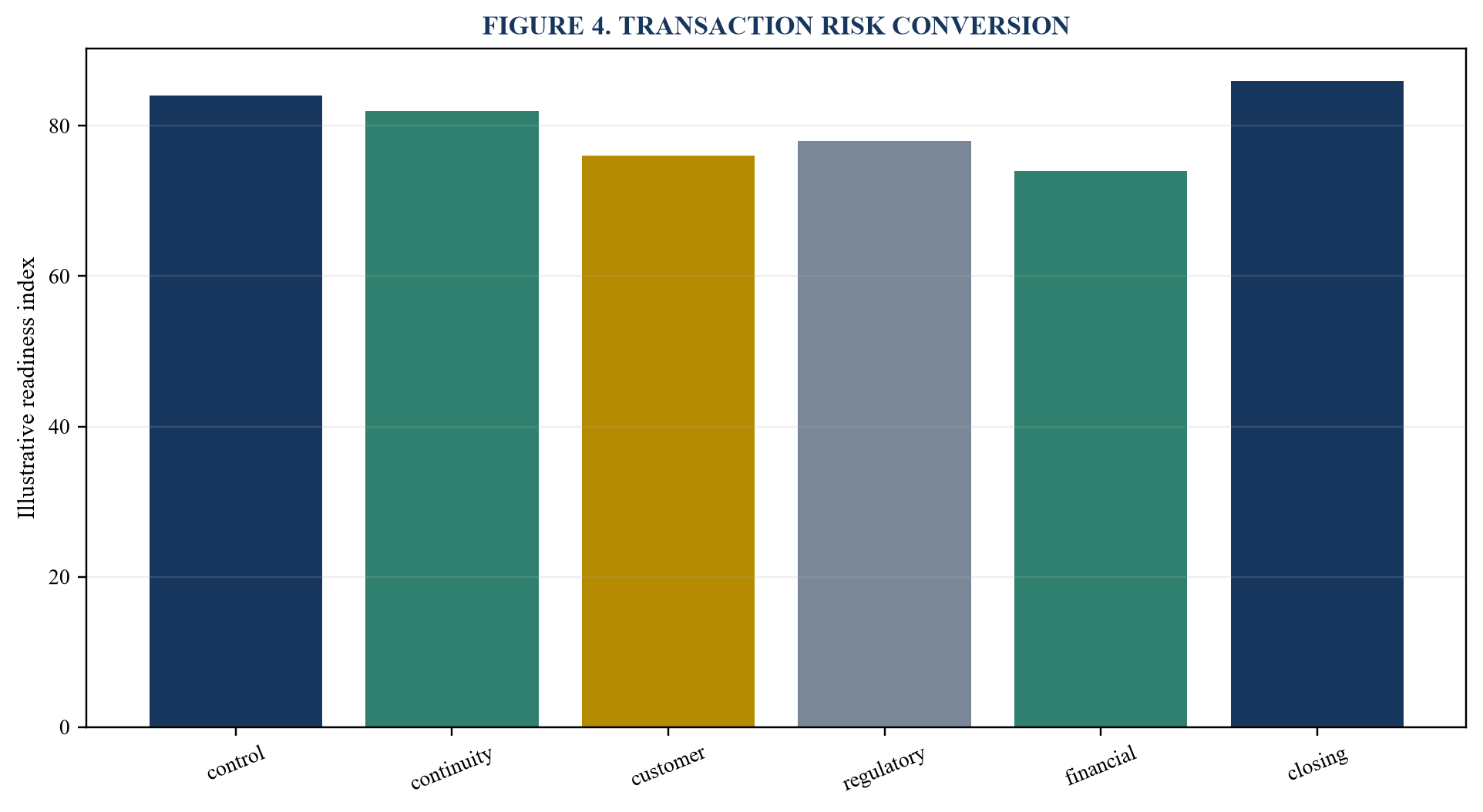
Values are illustrative readiness indices and require company-specific testing.
33. Design remediation before launch
Prioritise evidence gaps and control failures by closing, customer, regulator, continuity and value consequence.
The review should reconcile owners, milestones, proof requirements, dependencies and budgets. The workpaper records population, period, source system, owner, completeness, sample basis, exception logic, reviewer, authorised-advice dependency and transaction relevance. Its immediate output is a transaction remediation roadmap.
Testing asks whether the evidence supports the stated control across the relevant period, including failures, overrides and changes. The conclusion should separate design, implementation and operating effectiveness; distinguish confirmed facts from management assertions; and connect exceptions to confidentiality, integrity, availability, privacy, safety, customer commitments, regulatory exposure, operational continuity and buyer reliance.
The transaction team should quantify realistic consequences, assign remediation ownership and preserve closure evidence. Material matters flow into the data room, management fact book, forecast, separation or integration plan, disclosure process, purchase agreement, financing case and board decisions. Residual uncertainty remains explicit until the required proof is obtained or the risk is contractually allocated.
34. Prepare the buyer evidence room
Organise governed evidence, summaries, samples, exceptions, remediation and authorised legal analysis.
The review should reconcile indexed documents, provenance records, redactions, access and Q&A controls. The workpaper records population, period, source system, owner, completeness, sample basis, exception logic, reviewer, authorised-advice dependency and transaction relevance. Its immediate output is a buyer-ready cyber and AI data room.
Testing asks whether the evidence supports the stated control across the relevant period, including failures, overrides and changes. The conclusion should separate design, implementation and operating effectiveness; distinguish confirmed facts from management assertions; and connect exceptions to confidentiality, integrity, availability, privacy, safety, customer commitments, regulatory exposure, operational continuity and buyer reliance.
The transaction team should quantify realistic consequences, assign remediation ownership and preserve closure evidence. Material matters flow into the data room, management fact book, forecast, separation or integration plan, disclosure process, purchase agreement, financing case and board decisions. Residual uncertainty remains explicit until the required proof is obtained or the risk is contractually allocated.
35. Govern management representations
Separate verified facts, management assertions, legal conclusions, forecasts and unresolved matters.
The review should reconcile representation matrices, source links, approvals and uncertainty labels. The workpaper records population, period, source system, owner, completeness, sample basis, exception logic, reviewer, authorised-advice dependency and transaction relevance. Its immediate output is a controlled management fact book.
Testing asks whether the evidence supports the stated control across the relevant period, including failures, overrides and changes. The conclusion should separate design, implementation and operating effectiveness; distinguish confirmed facts from management assertions; and connect exceptions to confidentiality, integrity, availability, privacy, safety, customer commitments, regulatory exposure, operational continuity and buyer reliance.
The transaction team should quantify realistic consequences, assign remediation ownership and preserve closure evidence. Material matters flow into the data room, management fact book, forecast, separation or integration plan, disclosure process, purchase agreement, financing case and board decisions. Residual uncertainty remains explicit until the required proof is obtained or the risk is contractually allocated.
36. Design transaction protections
Map findings to conditions, covenants, warranties, indemnities, escrows, retention, insurance and disclosure.
The review should reconcile risk ownership, quantification, duration, caps, exclusions and evidence. The workpaper records population, period, source system, owner, completeness, sample basis, exception logic, reviewer, authorised-advice dependency and transaction relevance. Its immediate output is a transaction protection options paper.
Testing asks whether the evidence supports the stated control across the relevant period, including failures, overrides and changes. The conclusion should separate design, implementation and operating effectiveness; distinguish confirmed facts from management assertions; and connect exceptions to confidentiality, integrity, availability, privacy, safety, customer commitments, regulatory exposure, operational continuity and buyer reliance.
The transaction team should quantify realistic consequences, assign remediation ownership and preserve closure evidence. Material matters flow into the data room, management fact book, forecast, separation or integration plan, disclosure process, purchase agreement, financing case and board decisions. Residual uncertainty remains explicit until the required proof is obtained or the risk is contractually allocated.
37. Plan Day One cyber continuity
Protect identities, monitoring, incident response, access, connectivity and customer commitments at control transfer.
The review should reconcile cutover plans, command structures, contact trees and rollback options. The workpaper records population, period, source system, owner, completeness, sample basis, exception logic, reviewer, authorised-advice dependency and transaction relevance. Its immediate output is a Day One cyber control plan.
Testing asks whether the evidence supports the stated control across the relevant period, including failures, overrides and changes. The conclusion should separate design, implementation and operating effectiveness; distinguish confirmed facts from management assertions; and connect exceptions to confidentiality, integrity, availability, privacy, safety, customer commitments, regulatory exposure, operational continuity and buyer reliance.
The transaction team should quantify realistic consequences, assign remediation ownership and preserve closure evidence. Material matters flow into the data room, management fact book, forecast, separation or integration plan, disclosure process, purchase agreement, financing case and board decisions. Residual uncertainty remains explicit until the required proof is obtained or the risk is contractually allocated.
38. Plan AI continuity and change control
Preserve model performance, data access, approvals, monitoring and vendor support through ownership change.
The review should reconcile model baselines, licences, interfaces, thresholds and release controls. The workpaper records population, period, source system, owner, completeness, sample basis, exception logic, reviewer, authorised-advice dependency and transaction relevance. Its immediate output is a Day One AI continuity plan.
Testing asks whether the evidence supports the stated control across the relevant period, including failures, overrides and changes. The conclusion should separate design, implementation and operating effectiveness; distinguish confirmed facts from management assertions; and connect exceptions to confidentiality, integrity, availability, privacy, safety, customer commitments, regulatory exposure, operational continuity and buyer reliance.
The transaction team should quantify realistic consequences, assign remediation ownership and preserve closure evidence. Material matters flow into the data room, management fact book, forecast, separation or integration plan, disclosure process, purchase agreement, financing case and board decisions. Residual uncertainty remains explicit until the required proof is obtained or the risk is contractually allocated.
39. Govern buyer questions and new facts
Control responses, source verification, authorised review, concessions and downstream document changes.
The review should reconcile Q&A logs, evidence links, versioning, approvals and issue escalation. The workpaper records population, period, source system, owner, completeness, sample basis, exception logic, reviewer, authorised-advice dependency and transaction relevance. Its immediate output is a buyer challenge register.
Testing asks whether the evidence supports the stated control across the relevant period, including failures, overrides and changes. The conclusion should separate design, implementation and operating effectiveness; distinguish confirmed facts from management assertions; and connect exceptions to confidentiality, integrity, availability, privacy, safety, customer commitments, regulatory exposure, operational continuity and buyer reliance.
The transaction team should quantify realistic consequences, assign remediation ownership and preserve closure evidence. Material matters flow into the data room, management fact book, forecast, separation or integration plan, disclosure process, purchase agreement, financing case and board decisions. Residual uncertainty remains explicit until the required proof is obtained or the risk is contractually allocated.
40. Issue the transaction assurance conclusion
Summarise scope, testing, exceptions, remediation, residual risk, reliance limits and next decisions.
The review should reconcile signed workpapers, exception schedules, open items and board approval. The workpaper records population, period, source system, owner, completeness, sample basis, exception logic, reviewer, authorised-advice dependency and transaction relevance. Its immediate output is a cyber and AI transaction assurance certificate.
Testing asks whether the evidence supports the stated control across the relevant period, including failures, overrides and changes. The conclusion should separate design, implementation and operating effectiveness; distinguish confirmed facts from management assertions; and connect exceptions to confidentiality, integrity, availability, privacy, safety, customer commitments, regulatory exposure, operational continuity and buyer reliance.
The transaction team should quantify realistic consequences, assign remediation ownership and preserve closure evidence. Material matters flow into the data room, management fact book, forecast, separation or integration plan, disclosure process, purchase agreement, financing case and board decisions. Residual uncertainty remains explicit until the required proof is obtained or the risk is contractually allocated.
Table 5. Buyer-ready assurance certificate
| Gate | Required proof | Decision use |
|---|---|---|
| complete | reconciled scope | coverage |
| tested | operating evidence | effectiveness |
| remediated | closure evidence | residual risk |
| protected | continuity and documents | closing |
Illustrative analytical design; company-specific scope, evidence and authorised advice govern.
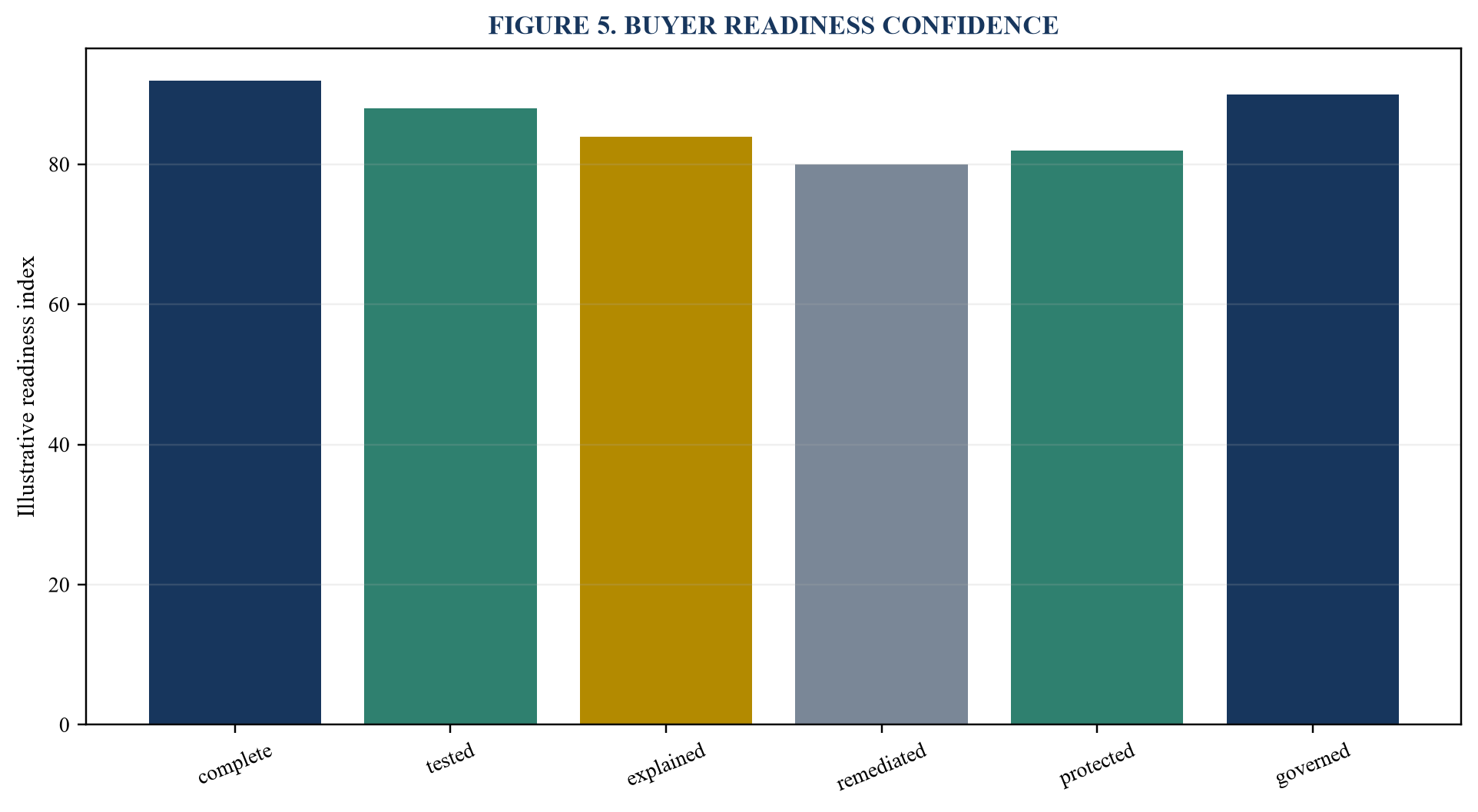
Values are illustrative readiness indices and require company-specific testing.
References
- NIST, Cybersecurity Framework 2.0, https://www.nist.gov/cyberframework
- NIST, Artificial Intelligence Risk Management Framework 1.0, https://www.nist.gov/itl/ai-risk-management-framework
- NIST, Generative Artificial Intelligence Profile NIST AI 600-1, https://nvlpubs.nist.gov/nistpubs/ai/NIST.AI.600-1.pdf
- NIST, Cybersecurity Framework Profile for Artificial Intelligence, https://csrc.nist.gov/pubs/ir/8596/iprd
- NIST, Security and Privacy Controls for Information Systems and Organizations SP 800-53 Rev. 5, https://csrc.nist.gov/pubs/sp/800/53/r5/upd1/final
- NIST, Secure Software Development Framework SP 800-218, https://csrc.nist.gov/pubs/sp/800/218/final
- NIST, Computer Security Incident Handling Guide SP 800-61 Rev. 2, https://csrc.nist.gov/pubs/sp/800/61/r2/final
- NIST, Cybersecurity Supply Chain Risk Management Practices SP 800-161 Rev. 1, https://csrc.nist.gov/pubs/sp/800/161/r1/final
- CISA, Secure by Design, https://www.cisa.gov/securebydesign
- CISA, Known Exploited Vulnerabilities Catalog, https://www.cisa.gov/known-exploited-vulnerabilities-catalog
- CISA, Software Bill of Materials, https://www.cisa.gov/sbom
- International Organization for Standardization, ISO/IEC 27001 Information Security Management Systems, https://www.iso.org/standard/27001
- International Organization for Standardization, ISO/IEC 27017 Cloud Security Controls, https://www.iso.org/standard/43757.html
- International Organization for Standardization, ISO/IEC 27018 Protection of PII in Public Clouds, https://www.iso.org/standard/76559.html
- International Organization for Standardization, ISO/IEC 27701 Privacy Information Management, https://www.iso.org/standard/71670.html
- International Organization for Standardization, ISO/IEC 42001 Artificial Intelligence Management Systems, https://www.iso.org/standard/81230.html
- International Organization for Standardization, ISO/IEC 23894 Artificial Intelligence Risk Management, https://www.iso.org/standard/77304.html
- European Union, Artificial Intelligence Act, https://eur-lex.europa.eu/eli/reg/2024/1689/oj
- European Union, General Data Protection Regulation, https://eur-lex.europa.eu/eli/reg/2016/679/oj
- European Union, Digital Operational Resilience Act, https://eur-lex.europa.eu/eli/reg/2022/2554/oj
- European Union, NIS 2 Directive, https://eur-lex.europa.eu/eli/dir/2022/2555/oj
- European Data Protection Board, Guidelines and Recommendations, https://www.edpb.europa.eu/our-work-tools/general-guidance/guidelines-recommendations-best-practices_en
- UK Information Commissioner's Office, Guidance on AI and Data Protection, https://ico.org.uk/for-organisations/uk-gdpr-guidance-and-resources/artificial-intelligence/
- US Securities and Exchange Commission, Cybersecurity Risk Management Strategy Governance and Incident Disclosure, https://www.sec.gov/rule-release/33-11216
- US Federal Trade Commission, Safeguards Rule, https://www.ftc.gov/business-guidance/privacy-security/gramm-leach-bliley-act
- OWASP Foundation, Top 10 for Large Language Model Applications, https://owasp.org/www-project-top-10-for-large-language-model-applications/
