

1. Convert cyber findings into transaction decisions
A cyber diligence report should support decisions about value, allocation and control. A list of vulnerabilities cannot do that on its own. The deal team needs to know which business service is exposed, how a failure could affect customers or cash, whether an incident has already occurred, which duties or contracts may be triggered, how quickly the condition can be corrected and who bears the cost and residual risk.
The analytical chain begins with evidence. A finding should identify its source, date, scope, owner and reliability. The team then maps it to an attack or failure path, an affected critical service and a financial or legal consequence. The final step assigns a transaction response: remediation before signing, a closing condition, a price adjustment, an escrow, a specific indemnity, a covenant, insurance treatment, Day One containment or an accepted ownership risk.
This chain prevents two common errors. First, it prevents technical severity from becoming an automatic valuation adjustment. A critical vulnerability on an isolated test system can be less economically important than a moderate weakness in the identity service supporting every customer environment. Second, it prevents commercial optimism from suppressing structural exposure. A fast-growing platform can carry a latent compromise, irrecoverable data, uninsurable representations or a supplier dependency that threatens the investment thesis.
The board needs visibility of uncertainty. Limited access, incomplete logs, restricted testing, unavailable personnel and unresolved forensic questions should be recorded as evidence limitations. The response to uncertainty may be additional work, a conservative model, stronger protection, delayed integration or a decision to stop. Describing a limitation without assigning a consequence leaves the transaction exposed.
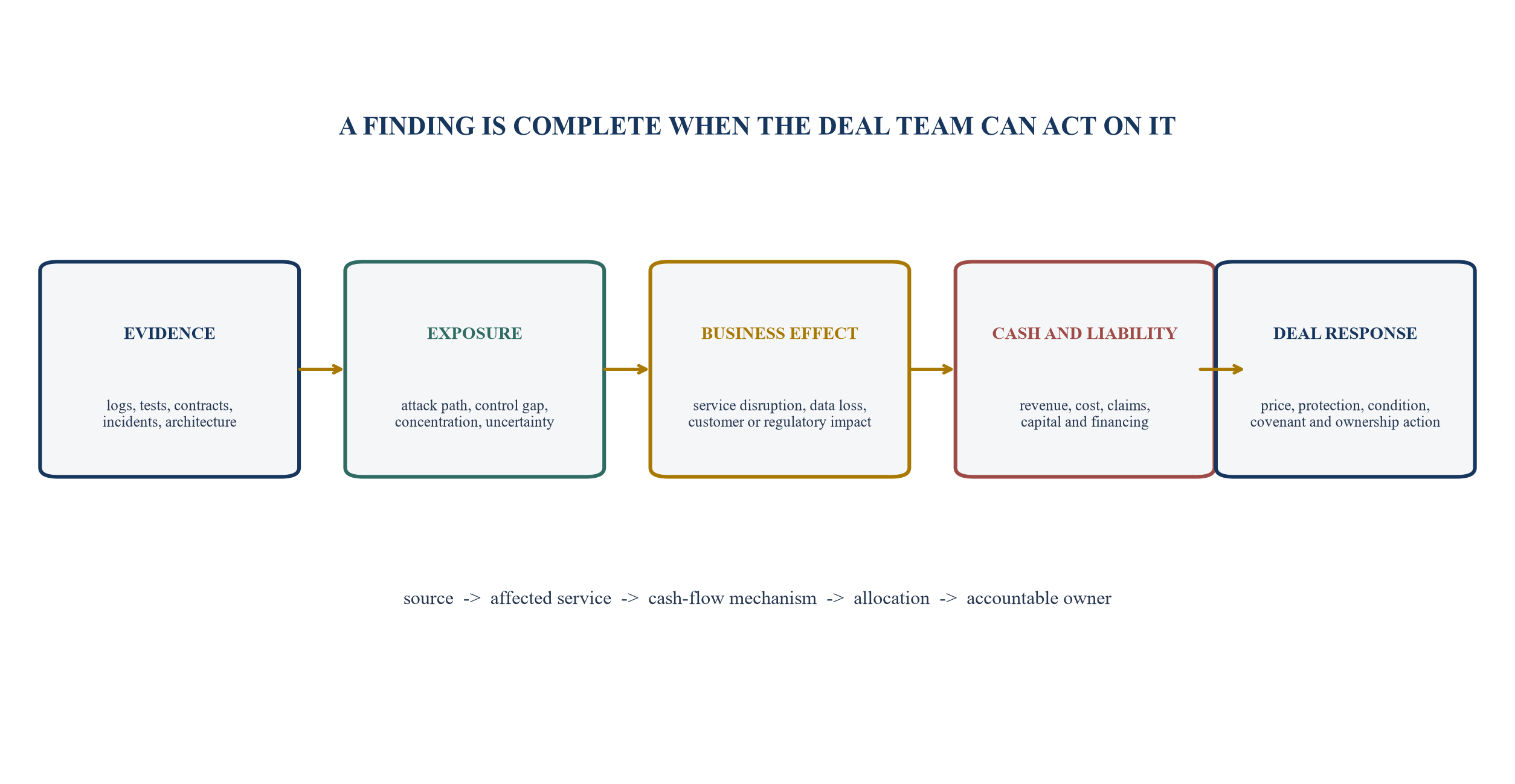
Every material finding should reach a documented economic, legal or operating response.
2. Define the transaction and technology perimeter
The diligence perimeter should follow the ability to deliver the acquired proposition. It should include legal entities, products, customer environments, critical services, applications, infrastructure, cloud accounts, operational technology, identities, data stores, code repositories, suppliers, licences, insurance and people. The share purchase perimeter may differ from the operating perimeter when technology is held by an affiliate, founder, joint venture, university, outsourced provider or shared group function.
The team should identify what changes at signing and closing. A change-of-control clause can affect cloud, software, managed-security, incident-response or insurance arrangements. A carve-out may require new domains, certificates, networks, licences and monitoring before the business can operate independently. A merger may connect two estates with incompatible identity, logging and recovery systems. The cyber review should therefore examine both the target's present state and the planned transition state.
Product claims should be connected to technical components and customer commitments. A target can describe its platform as resilient while relying on one cloud region, one identity provider or a small engineering team with privileged access. Customer contracts may promise notification, audit, recovery or security standards that exceed the target's current controls. The perimeter should map each obligation to the actual service and supporting assets.
The team should distinguish acquired liabilities from future integration choices. Historical incidents, inadequate disclosures and existing control gaps enter the transaction risk. A buyer's plan to consolidate systems, migrate data or change suppliers creates a separate execution risk. Combining the two can lead to duplicated cost or misplaced protection. The valuation bridge should show the stand-alone condition, mandatory remediation, chosen integration and expected synergy separately.
Perimeter changes during diligence should be controlled. New products, acquisitions, incidents, customer commitments, cloud migrations or regulatory designations can alter the exposure. A dated perimeter register and change log allow the deal team to identify when prior testing must be refreshed.
3. Build a deal team with explicit decision rights
Cyber liability crosses functions. The chief information security officer or technical adviser can assess controls and threat paths. Legal advisers interpret duties, privilege, representations and liability. Privacy specialists assess personal-data obligations. Finance converts exposures into cash flows. Insurance advisers examine policy response. Commercial diligence tests customer consequences. Integration leaders determine feasibility and timing. The transaction lead and board decide allocation and residual risk.
The team should agree decision rights before high-pressure findings emerge. One owner should maintain the exception ledger. Each finding should have a technical assessment, legal or regulatory route where relevant, economic treatment, proposed deal response and integration owner. The transaction committee should resolve conflicts, such as whether a remediation belongs in price, seller protection or the ownership plan.
Legal privilege and clean-team arrangements require deliberate design. Sensitive forensic material, personal data, customer information, export-controlled technology and competitively sensitive systems may need restricted review. The team should define who may receive which evidence, how conclusions are summarised and how access is logged. The arrangement should preserve useful evidence while respecting applicable law and transaction constraints.
The team also needs escalation thresholds. Examples include evidence of active compromise, unreliable management statements, unreported incidents, unavailable backups, material customer notification duties, a regulatory deadline, a critical uninsured exposure or an essential system that cannot transfer. An escalation should trigger a specified decision forum and timetable.
Table 1. Cyber liability deal-team operating model
| role | primary evidence responsibility | decision contribution | escalation trigger | output |
|---|---|---|---|---|
| transaction lead | perimeter, timetable and data-room completeness | coordinates price, protection and approvals | finding threatens signing, financing or thesis | integrated exception ledger |
| cyber specialist | architecture, controls, incidents and testing | assesses attack path, severity and remediation | active compromise or unreliable technical evidence | technical risk and remediation plan |
| legal and privacy | laws, contracts, privilege and notification | defines liability, disclosure and drafting route | notification duty, claim, order or missing consent | legal issue map and proposed clauses |
| finance and valuation | budgets, forecasts, losses and commitments | converts exposure into cash-flow and value effects | unbounded cost or double-counted adjustment | quantified value bridge |
| insurance adviser | policies, applications, notices and exclusions | assesses existing and transactional coverage | coverage gap, change-of-control issue or late notice | coverage and claims memorandum |
| integration leader | Day One access, continuity and remediation | tests deliverability, owners and sequence | critical action cannot be completed safely | 100-day control plan |
| board or investment committee | complete evidence and residual-risk view | approves value, protection, conditions and acceptance | unresolved thesis-critical exposure | recorded decision and conditions |
Actual roles and privilege arrangements depend on the transaction and applicable professional advice.
4. Use an evidence architecture that survives restricted access
Cyber diligence rarely provides unrestricted production access. Sellers must protect systems, personal data, customer confidentiality and transaction secrecy. The buyer still needs decision-grade evidence. A tiered architecture can begin with governance records and management interviews, progress to redacted artefacts and sampled evidence, and reserve targeted technical validation for the highest-risk questions.
The initial request should seek critical-service maps, security governance, risk registers, material incidents, regulatory correspondence, customer security obligations, insurance, asset and identity records, vulnerability management, logging, recovery tests, supplier access and security expenditure. The team should test internal consistency. An incident register should reconcile with insurance notices, customer communications, legal matters, service tickets, regulator contacts and board minutes.
Technical validation should be risk-led. External attack-surface review, configuration evidence, vulnerability samples, access reviews, backup restoration evidence and log-coverage maps can reveal operating quality without intrusive testing. Penetration testing requires explicit authority, scope and coordination. A buyer should never treat unauthorised probing as diligence.
Evidence should be graded. Direct system output and independently reproduced tests provide stronger support than a policy document or verbal statement. Certification can inform the review while scope, date, exceptions and reliance need examination. A security report covering one product does not establish control across the estate. The ledger should state what the evidence proves and what remains unknown.
Where access remains limited, the deal response should reflect the untested condition. Options include a seller-led independent assessment, confirmatory work before close, a specific condition, restricted Day One connectivity, escrow, a covenant, enhanced warranty or a conservative valuation case. The limitation should never disappear from the committee paper simply because the transaction has progressed.
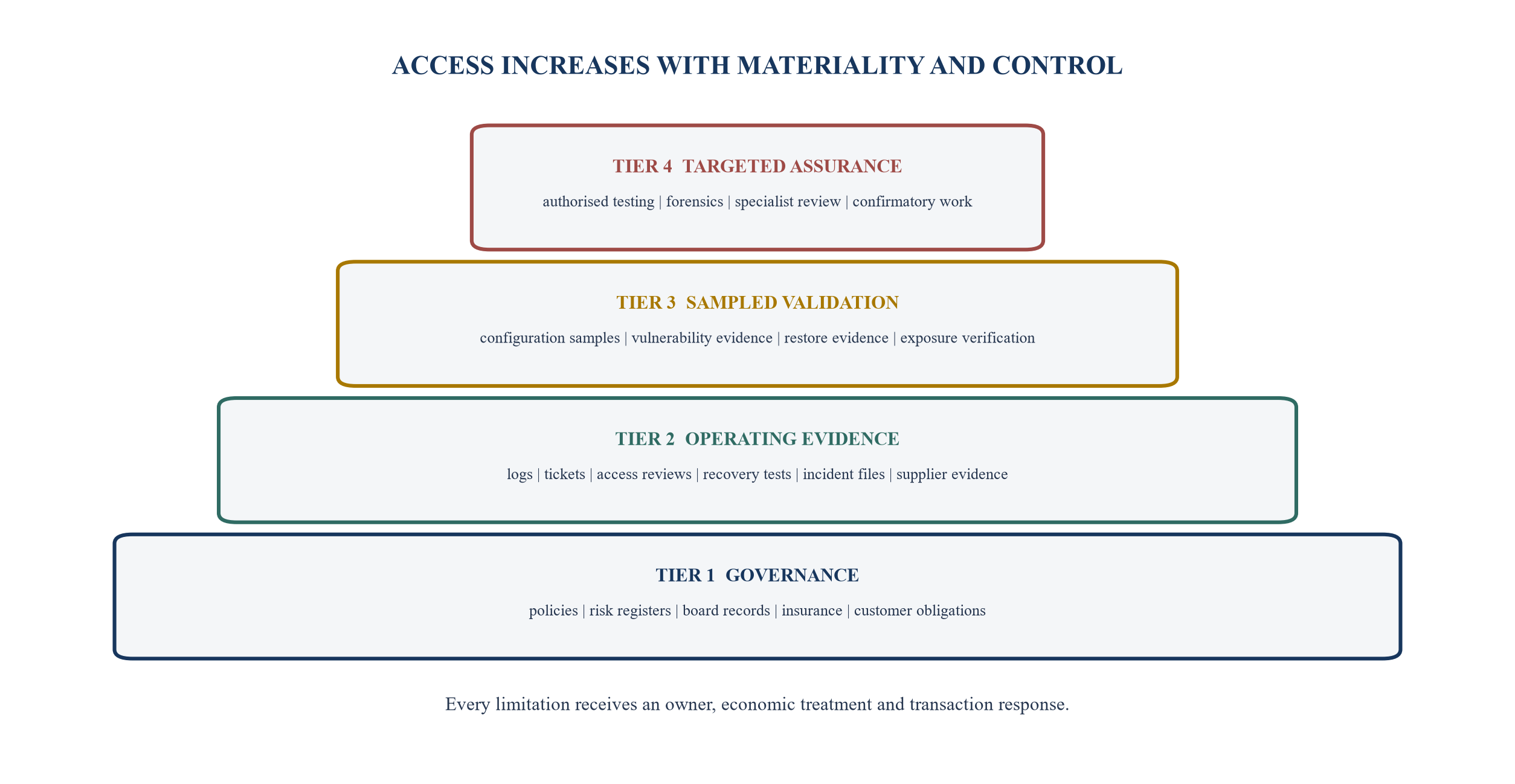
Higher access should follow materiality, authority and controlled handling.
5. Reconstruct incident history and disclosure quality
Incident history is more than a count. The team should reconstruct detection, scope, containment, root cause, affected systems, data, customer impact, regulatory analysis, notifications, insurance, remediation and lessons. Near misses and control failures matter because they can reveal exposure that did not yet produce a reported loss. The absence of recorded incidents can indicate strong control, limited visibility or incomplete reporting.
The review should reconcile several sources. Security operations records, service-desk tickets, legal matters, privacy logs, customer notices, insurance claims, forensic reports, regulator correspondence and board materials may describe the same event differently. Differences should be investigated. A management statement that an incident was immaterial should be supported by the contemporaneous assessment and available evidence.
Notification clocks vary by jurisdiction and sector. United States public-company rules require disclosure after a materiality determination. European regimes can require early warnings and later reports. Data-protection regimes may use risk or harm thresholds. India's CERT-In directions use a short reporting period for specified incidents. Singapore's critical-information-infrastructure regime includes rapid notification and supply-chain coverage. The deal team should identify the applicable clock, awareness point, threshold, recipient and evidence of compliance.
Historical compromise can persist. Credentials, tokens, remote-access tools, scheduled tasks, backdoors or copied data may survive apparent containment. The team should test whether the target validated eradication and whether later monitoring supports that conclusion. A closed incident with incomplete forensic evidence may require a clean-environment plan, additional monitoring or specific transaction protection.
Disclosure quality is itself an indicator. Delayed escalation, missing root-cause analysis, inconsistent customer accounts or unsupported closure can reveal governance weakness. Strong incident records show authority, facts, decisions, communications, recovery and corrective action. The buyer should value that operating discipline independently from whether the target has experienced an attack.
Table 2. Minimum cyber-incident reconstruction ledger
| field | evidence | diligence question | unresolved-risk treatment | ownership destination |
|---|---|---|---|---|
| detection and awareness | alerts, tickets, emails and chronology | when did the organisation first know enough to act? | test reporting clocks and governance | disclosure and notification workstream |
| scope and affected service | forensics, architecture and customer records | which systems, data and services were affected? | model wider plausible scope | valuation and continuity plan |
| containment and eradication | response records, credential resets and scans | was attacker access removed and validated? | require confirmatory work or clean build | closing or Day One condition |
| legal and regulatory analysis | advice, notices and correspondence | were all applicable duties assessed and completed? | quantify claims, penalties and remediation | legal protection and covenant |
| customer and contractual impact | notices, credits, disputes and renewals | did the event affect revenue or future obligations? | adjust cohorts and contingent value | commercial and valuation bridge |
| insurance response | policy, notice, reservation and payments | is the claim preserved and transferable? | exclude uncertain recovery from base case | insurance and purchase-price treatment |
| lessons and remediation | root-cause review, plan and closure evidence | did controls improve in operation? | fund and verify unfinished work | 100-day programme |
Legal privilege, confidentiality and reporting rules determine access and handling.
6. Map critical services and plausible attack paths
Business impact should be assessed through critical services. A target can remain technically online while producing corrupted transactions, exposing confidential data or operating an unsafe process. The service map should therefore cover availability, integrity, confidentiality and control. It should identify customers, operational tolerances, revenue, contractual commitments, regulated outcomes and dependencies.
The team should select severe but plausible attack paths that reflect the target's architecture and threat environment. Examples include privileged-identity compromise, ransomware, destructive cloud control-plane access, software supply-chain compromise, business-email fraud, data exfiltration, denial of service and operational-technology manipulation. Each path should trace initial access, privilege, movement, affected service, detection, response and recovery.
This mapping changes prioritisation. An unpatched external system supporting a critical service can create an immediate exposure. A shared identity platform can connect otherwise separate products. A managed service provider can create correlated risk across environments. A backup platform using the same credentials and network can fail with production. The economic model should reflect these dependencies rather than average control scores.
Service tolerances provide a decision standard. The board can ask how long the service can be unavailable, how much data can be lost or corrupted, what manual capacity exists and which harm becomes unacceptable. Recovery objectives and service levels support those tolerances. A stated target without exercised recovery remains an assumption.
The attack-path review should also identify control breakpoints. Multi-factor authentication, privileged-access separation, endpoint visibility, network segmentation, immutable backup, supplier notification and practiced incident authority can interrupt different stages. The deal team should evaluate whether these controls operate across the relevant service, including inherited and third-party components.
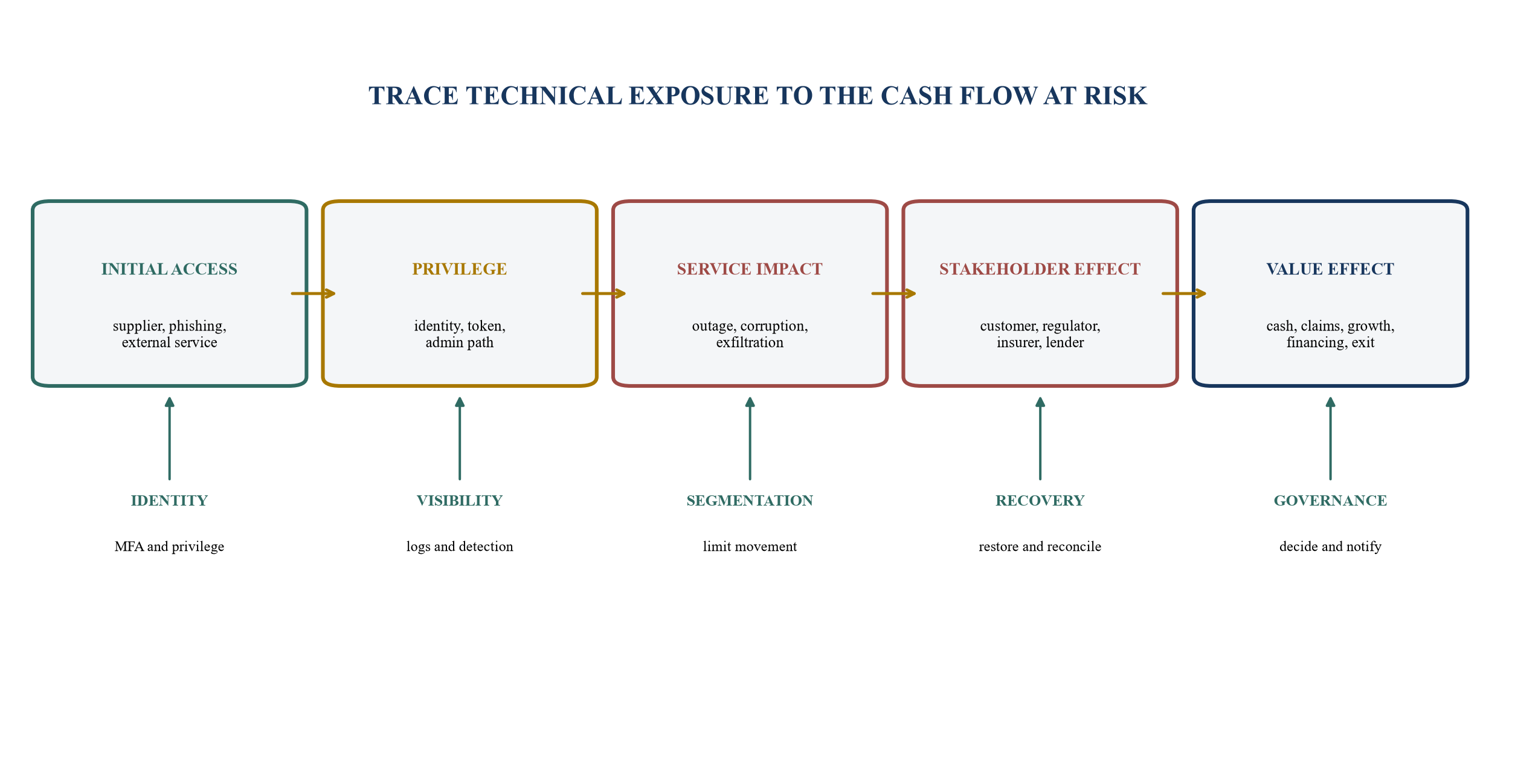
The path is illustrative; target-specific evidence determines the actual sequence and impact.
7. Test identity, privilege and ownership transition
Identity is often the shortest route from a single compromised account to enterprise-wide control. The review should map workforce identities, privileged accounts, service accounts, machine identities, application keys, cloud roles, emergency access and external administrators. It should identify authoritative directories, authentication methods, access-review processes and the ability to revoke access promptly.
The team should sample joiner, mover and leaver events; privileged grants; dormant accounts; shared credentials; emergency access; multi-factor enrolment; conditional access; password and key rotation; and logging. Evidence should cover subsidiaries, acquired systems, cloud platforms and operational technology. A policy applied to the corporate directory may omit product infrastructure or engineering environments.
Change of control creates specific risks. Founders or contractors may own domains, repositories, certificates, cloud subscriptions or password vaults. Service accounts may depend on personal email or unmanaged devices. The buyer should confirm ownership and transferability before closing. Critical secrets should have a controlled rotation plan, with rollback and service-continuity testing.
Privileged access should be assessed through reach and consequence. One account that can alter production, disable logging and delete backups has a different exposure from a local administrator on an isolated device. The team should identify toxic combinations and whether approval, session recording, time limits or separate recovery credentials constrain them.
Day One access should follow minimum necessary authority. The buyer may need visibility before broad federation or network connection. Staged trust, separate monitoring and verified revocation can reduce the risk of importing an undetected compromise. The integration plan should state the sequence and evidence required for each connection.
8. Assess external exposure, vulnerabilities and technical debt
Vulnerability counts require context. The team should identify internet-facing services, unsupported technology, known exploited vulnerabilities, exposed credentials, weak remote access, insecure configurations, missing endpoint visibility and patch-management failures. It should then map each condition to reachability, privilege, compensating controls, affected services and credible attacker use.
The target should provide asset and vulnerability evidence with dates, scope, exclusions and remediation performance. The buyer should test whether inventories reconcile across discovery, cloud, endpoint, network and service-management sources. Unknown assets and stale records can be more important than the average age of known vulnerabilities. External exposure review can help validate the perimeter, subject to explicit authority and passive or otherwise approved methods.
Technical debt becomes a transaction issue when it changes cash, timing or executability. Unsupported operating systems may require replacement. A monolithic application may make segmentation difficult. An unmaintained library can create repeated exposure. A product with no secure-development evidence may require a sustained engineering programme. The team should separate immediate containment, mandatory remediation and elective modernisation.
Severity should therefore combine exploitability, exposure, privilege, service criticality, detection, recovery and persistence. A scoring model can support consistency while the committee should retain judgement. The output should describe the loss pathway and treatment, not merely a colour.
Remediation estimates should include testing, downtime, supplier effort, customer coordination, licence cost, engineering opportunity cost and the risk of change. A fast patch may be inexpensive. Replacing an unsupported core platform can affect the investment case and integration sequence. The budget should show confidence and dependencies.
9. Build a jurisdiction and notification matrix
Cyber liability follows people, data, services, listings, sectors and infrastructure. The target's place of incorporation is only one factor. The team should identify where affected individuals are located, where systems and providers operate, which customers impose notification duties, whether the target is regulated, whether a listed parent or issuer is involved and which incident-reporting regimes apply.
The European Union's NIS2 framework requires risk-management measures that include supply-chain security and multi-stage reporting for significant incidents. The United States Securities and Exchange Commission requires public-company disclosure of material cybersecurity incidents after the materiality determination. UAE federal data-protection law requires security measures and breach processes, while ADGM and sector regimes can impose their own notification requirements. India's CERT-In directions require rapid reporting for specified incidents. Singapore's Cybersecurity Act extends attention to critical infrastructure, foundational digital infrastructure and supply chains. Australia's APRA and privacy regimes add board, third-party and notification duties.
The matrix should record the legal trigger, awareness point, timetable, information required, responsible decision maker, regulator or recipient, contractual overlay and evidence. A single event can activate several clocks. The team should prepare an integrated chronology and avoid assuming that one filing satisfies every duty.
Cross-border investigations also raise access and transfer questions. Forensic images, logs, personal data and employee information may be moved to advisers or response providers in other jurisdictions. The incident plan should identify lawful routes and minimum necessary access. Qualified advisers should decide the legal position from the facts.
Regulatory uncertainty should be explicit. A rule may be implemented differently across member states or sectors. A target may be approaching a designation threshold. The deal team should state current advice, assumptions and sensitivity rather than creating a false global standard.
Table 3. Illustrative cross-border cyber notification matrix
| jurisdiction or regime | transaction diligence focus | incident trigger or clock | evidence to request | deal implication |
|---|---|---|---|---|
| United States public issuer | materiality process, governance and prior filings | Form 8-K within four business days after materiality determination | incident chronology, materiality record and disclosures | disclosure readiness, warranty and issuer integration |
| European Union NIS2 | entity scope, supply chain and management oversight | staged reporting can include 24-hour warning and 72-hour notification | sector analysis, incident route and supplier obligations | covenant, governance remediation and reporting plan |
| European or UK personal data | controller role, risk and M&A data sharing | risk-based authority and individual notification duties | breach register, assessment, notices and data map | privacy indemnity, remediation and integration controls |
| UAE federal or financial centre | security measures, controller duties and local overlays | applicable federal, ADGM, DIFC or sector process | jurisdiction map, incident records and regulator contacts | condition, local advice and Day One authority |
| India CERT-In and data protection | specified cyber events and personal-data safeguards | specified incidents can require reporting within six hours | logs, reporting process, processor contracts and notices | rapid escalation design and compliance remediation |
| Singapore Cybersecurity Act and PDPA | CII, FDI, supply chains and personal-data impact | regulated cyber and notifiable data-breach processes | designation, supplier map, incident forms and assessments | supplier covenant, reporting plan and continuity test |
| Australia APRA and privacy | critical information assets, third parties and serious harm | APRA and NDB duties depend on scope and impact | CPS 234 evidence, incident assessment and notices | board assurance, control budget and customer response |
This is a research summary. Qualified advisers should confirm current rules, scope, triggers and deadlines.
10. Trace personal data, confidentiality and customer obligations
Data diligence should map material information from collection through use, storage, sharing, backup, archive and deletion. The team should identify the controller or equivalent decision maker, processors, purposes, legal bases, sensitive categories, locations, transfers, retention and security controls. A high-level privacy policy cannot replace operational lineage.
M&A creates specific data-sharing questions. The UK Information Commissioner's Office states that organisations should consider data sharing as part of due diligence when a merger or acquisition changes the controller or adds one. The team should establish the original purpose, lawful basis, changes after the transaction, transparency, governance and security. Similar fact-specific analysis may be required elsewhere.
Customer contracts can create duties beyond data-protection law. Notification periods, audit rights, security standards, data-location commitments, subcontractor approvals, deletion obligations and liability caps should be extracted and mapped to the services involved. The target should demonstrate operating compliance and disclose exceptions. A single strategic customer can change the financial importance of a control gap.
The team should test whether the target can determine what data was affected during an incident. Asset inventories, classification, logging, encryption, key management and lineage support that decision. Weak evidence can expand the plausible breach population and response cost. It can also delay notifications and customer communication.
Data deletion and separation matter at closing and integration. A carve-out may contain seller data that must be removed. The buyer may lack rights to combine datasets across businesses. Backups and logs can retain information after production deletion. The separation plan should define verified deletion, retained legal records, transition access and responsibilities.
11. Test software supply chains, suppliers and shared responsibility
Software products and digital services depend on code, packages, build systems, cloud platforms, managed service providers, identity services, data processors and specialist support. A target's control environment can therefore fail through a supplier. The diligence team should map direct providers, critical fourth parties, administrative access, data flows, incident duties, audit rights, continuity and exit.
NIST Cybersecurity Framework 2.0 includes governance outcomes for due diligence, contractual requirements, supplier monitoring, incident coordination and end-of-relationship actions. European NIS2 materials and Singapore's updated framework also emphasise supply-chain security and reporting. Australian guidance calls for supplier risk assessment, shared responsibility and transparency. These principles support a transaction-level supplier register.
Contracts should be compared with technical reality. A cloud shared-responsibility model can leave the target responsible for identity, configuration, data and applications. A managed provider may have broad privilege while the contract lacks rapid notification or evidence rights. A software vendor may disclaim consequential loss while supporting a critical service. The buyer should identify which responsibilities are controlled, transferred, insured or retained.
For software targets, the review should examine development environments, repositories, build pipelines, signing, dependencies, secrets, vulnerability handling and release approval. A software bill of materials can improve transparency when it is current and connected to deployed versions. Build provenance and reproducibility can support assurance that released code came from the controlled process.
Concentration should be modelled. Several suppliers may rely on one cloud, identity platform, network or open-source component. The team should identify realistic alternatives, transition time, data portability, contractual exit and tested continuity. A nominal right to terminate provides little protection when replacement takes a year.
12. Verify recovery, forensics and continuity evidence
Recovery is a financial control. The ability to restore critical services determines business interruption, customer harm, liquidity and the duration of crisis management. The diligence team should review backup scope, isolation, immutability, credentials, retention, monitoring, restoration testing and reconciliation. It should confirm that backups cover configuration, code, keys, dependencies and data required to deliver the service.
A backup success report does not prove recoverability. The target should demonstrate restoration of representative services, including clean infrastructure, identity, applications, data and validation. The test should measure elapsed time, data loss, manual work, dependencies and unresolved errors. Recovery into a compromised environment can reintroduce the attacker or corrupted configuration.
Forensic readiness supports both response and liability management. The team should assess logging scope, time synchronisation, retention, tamper resistance, endpoint and cloud visibility, evidence handling and access to specialist support. Missing evidence can prevent management from defining the affected population, validating eradication or supporting insurance and regulatory positions. The cash-flow model should recognise the wider plausible scope created by weak evidence.
Continuity plans should address customer delivery, manual alternatives, communications, legal decisions, liquidity, payroll, suppliers and critical personnel. A technical recovery plan can restore systems while leaving a commercial crisis unmanaged. The board and executive team should have explicit authority for containment, shutdown, disclosure, notification, ransom decisions, customer remedies and external communications.
The buyer should review exercises and actual outcomes. A tabletop can test decisions and coordination. A technical exercise can test detection and recovery. A supplier exercise can test external dependencies. Findings should have owners, budgets and closure evidence. Repeated unresolved actions indicate that the plan is not operating as intended.
13. Quantify cyber loss through cash-flow pathways
Cyber value adjustments should be based on cash-flow mechanisms rather than headline breach statistics. The model can separate immediate response, business interruption, customer remediation, contractual claims, regulatory and legal cost, capital expenditure, working-capital effects, insurance recovery, financing impact and delayed growth. Each line needs a scenario, probability or range, timing, tax treatment where advised, dependency and evidence source.
Immediate response can include forensics, legal advisers, notification, public relations, customer support and emergency technology. Business interruption should use the critical-service map, downtime, manual capacity, backlog, service credits, lost transactions and recovery curve. Customer effects can include churn, lower renewal, delayed sales, price concessions and audit requirements. Capital cost can include identity redesign, segmentation, platform replacement, logging, recovery and secure development.
Regulatory penalties should not be treated as the only liability. Investigation, remediation, monitoring, customer communication and management distraction can be more significant. Fines and claims depend on facts, law, discretion, causation and mitigation. The model should state uncertainty and avoid presenting statutory maxima as expected loss.
Insurance recovery should remain separate. Coverage depends on policy terms, application accuracy, notice, exclusions, retentions, sublimits, consent, aggregation and change of control. A gross-loss case and a separately probability-weighted recovery case allow the committee to see the underlying exposure. Expected insurance proceeds should not erase the need for liquidity during response.
The model should also identify non-linear effects. A short outage during a low-volume period differs from the same outage at a regulatory deadline or peak sales event. A data incident involving sensitive records can have a different claims path from loss of ordinary contact information. A compromise of code signing can affect customers beyond the target. Scenarios should therefore reflect business context.
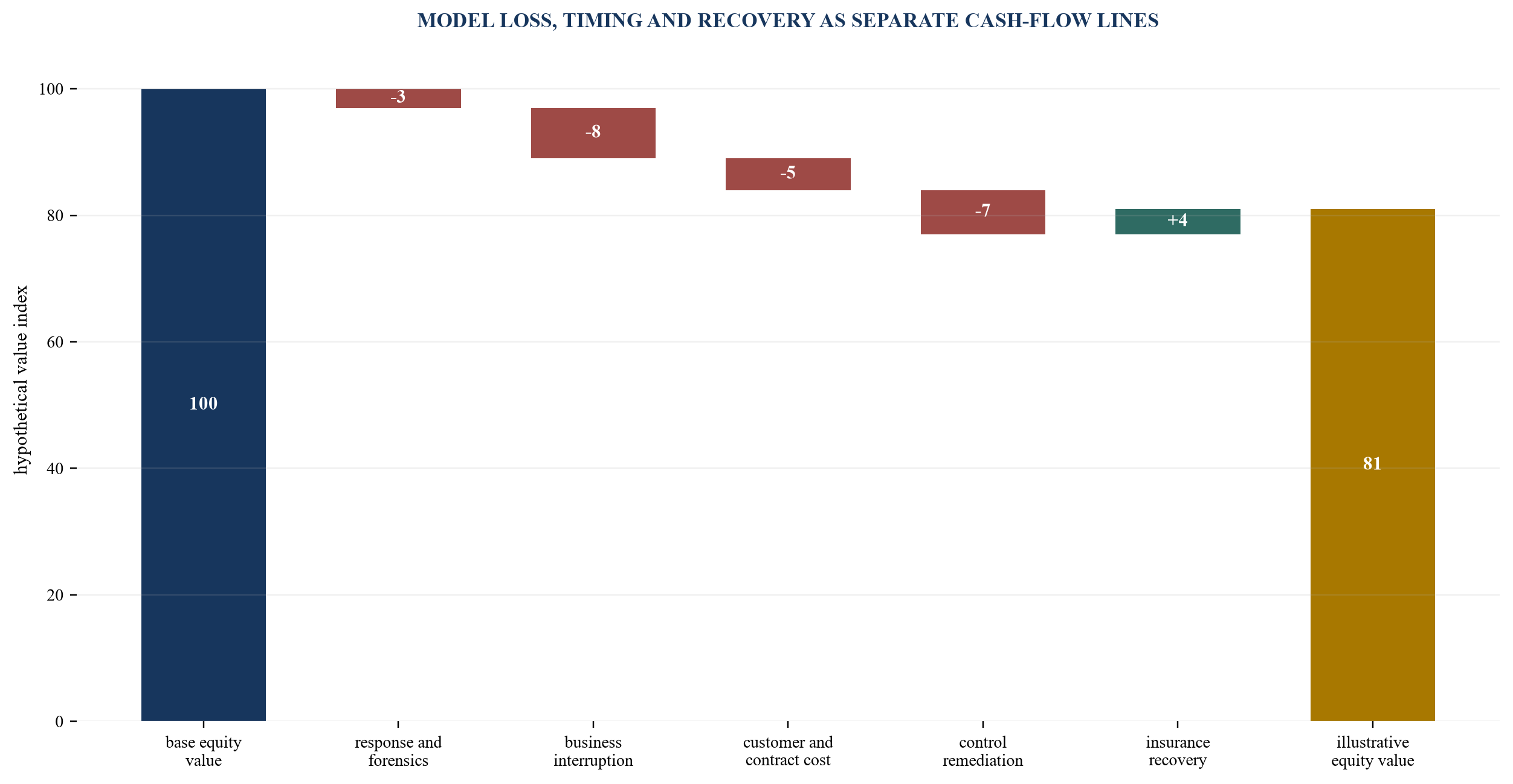
Values are hypothetical management assumptions and do not represent an actual company, claim or transaction.
Table 4. Cyber loss and value bridge
| cash-flow pathway | evidence | modelling question | common error | transaction use |
|---|---|---|---|---|
| incident response | panel rates, retainers, prior events and scope | what specialist work begins immediately? | using a generic cost per record | liquidity reserve and escrow sizing |
| business interruption | service tolerance, revenue pattern and recovery test | how does disruption affect transactions, backlog and cash? | assuming full revenue loss for all downtime | downside case and covenant headroom |
| customers and contracts | credits, notification duties, concentration and cohorts | which customers can claim, leave or delay purchase? | treating reputation as an unquantified label | revenue bridge and earnout design |
| legal and regulatory | incident facts, jurisdictions, claims and advice | what investigation, defence, remediation and redress may occur? | using maximum fines as expected value | specific protection and disclosure |
| control remediation | architecture, estimate, sequence and downtime | which spend is mandatory to preserve the thesis? | blending mandatory work with integration choice | price, condition and 100-day budget |
| insurance recovery | policy, notice, exclusions, retention and consent | when and how much recovery is supportable? | netting assumed limits against gross exposure | separate recovery case and claims covenant |
| financing and exit | lender terms, disclosure and assurance gaps | can the exposure affect liquidity, covenants or later diligence? | omitting capital-market consequences | financing condition and exit evidence plan |
The table provides a modelling structure. Actual amounts require target evidence and qualified advice.
14. Examine insurance as evidence, liquidity and allocation
Cyber insurance can provide response services and financial protection, while policy existence does not establish coverage for the transaction's exposure. The team should review policy periods, named insureds, limits, retentions, sublimits, waiting periods, exclusions, territorial scope, retroactive dates, prior knowledge, control warranties, applications, notices, claims, consent requirements and change-of-control provisions.
The application and renewal evidence matter because inaccurate statements about controls can affect coverage. The buyer should compare representations about multi-factor authentication, backups, endpoint detection, privileged access and incident history with diligence findings. A gap should be reviewed by qualified insurance and legal advisers. The deal team should also identify whether circumstances or claims require notice before closing.
Coverage should be mapped to loss pathways. Incident response, business interruption, dependent business interruption, data restoration, cyber extortion, privacy liability, regulatory defence, media liability and fraud may have different conditions and sublimits. Business-email compromise or infrastructure failure may be excluded or addressed elsewhere. The policy can also provide access to approved forensic, legal and communication providers.
Change of control can end or restrict cover for post-close events while preserving claims for pre-close acts under specific conditions. Run-off or tail arrangements may be relevant. The buyer's programme may begin at closing, subject to underwriting and disclosure. The team should coordinate placement, notices and continuity so that no assumption of coverage is left untested.
Insurance does not substitute for control or transaction protection. It can provide liquidity and expertise while claims can be delayed, disputed or capped. The valuation should show gross exposure and supportable recovery separately. The purchase agreement should address control of claims, cooperation, proceeds and the interaction between insurance and indemnity.
15. Translate findings into valuation without double counting
The valuation bridge should distinguish four mechanisms: sustainable cash-flow change, one-time remediation, contingent liability and transaction execution cost. A weak security programme can require recurring operating expense. Unsupported systems can require capital expenditure. A known incident can create contingent claims. A carve-out can require transition cost. Each item should appear once in the model.
Revenue adjustments should follow customer evidence. A cyber incident can affect retention, pricing, sales cycles or contractual credits. The team should avoid reducing revenue for a risk and then separately deducting the full enterprise-value effect of the same risk. A transparent bridge should state the affected forecast line, period, probability and any corresponding protection.
Gross margin can change when the target must add monitoring, secure infrastructure, support, insurance or supplier redundancy. Recurring control cost belongs in the operating case. One-time remediation should be separately budgeted. Integration choices that create broader buyer capability should not be charged entirely to the seller condition without a defined allocation.
Valuation may also reflect option loss. A target that cannot meet regulated-customer requirements may have a smaller addressable market. A weak software supply chain may delay product release. An inability to demonstrate security can impair financing or exit. These effects need scenario evidence rather than a generic discount.
The board should see base, remediation and severe-event cases. The severe case should test liquidity, covenant headroom, customer concentration, recovery capacity and financing. The purpose is to understand resilience of the investment thesis. Scenario weights are management assumptions and should be shown explicitly.
16. Select a proportionate transaction-protection ladder
Transaction protection should match the nature of the exposure. A correctable control gap may be addressed through a closing action or funded remediation. A known historical incident may require a specific indemnity, escrow and claims cooperation. An uncertain latent exposure may affect price, representations, insurance and confirmatory diligence. A thesis-breaking condition may require stopping the transaction.
The team should begin with the desired operating state. What evidence must exist before control transfers? Which condition can be completed after closing without exposing customers or violating obligations? Which risk can be quantified and accepted? Which loss should remain with the seller because it arose before closing? These questions guide the legal mechanism.
Generic cybersecurity representations can cover policies, incidents, compliance, data, controls and notices. Specific drafting may be needed for known facts, material systems, customer obligations, software provenance, access, backups or regulatory correspondence. Disclosure schedules should identify exceptions clearly. A broad data-room reference can leave the commercial issue unresolved.
Escrow and holdback design should reflect plausible loss, duration, evidence and claim mechanics. A large escrow with a short period can fail to protect a slowly developing exposure. A long claim period with no accessible funds can provide limited practical recovery. Qualified advisers should align survival, caps, baskets, exclusions, insurance and control of defence.
Protection should remain linked to ownership action. Legal recovery does not restore a critical service or retain customers. Each protected exposure should have a remediation owner, budget, timetable and verification standard. The deal team should monitor both legal rights and operating closure.
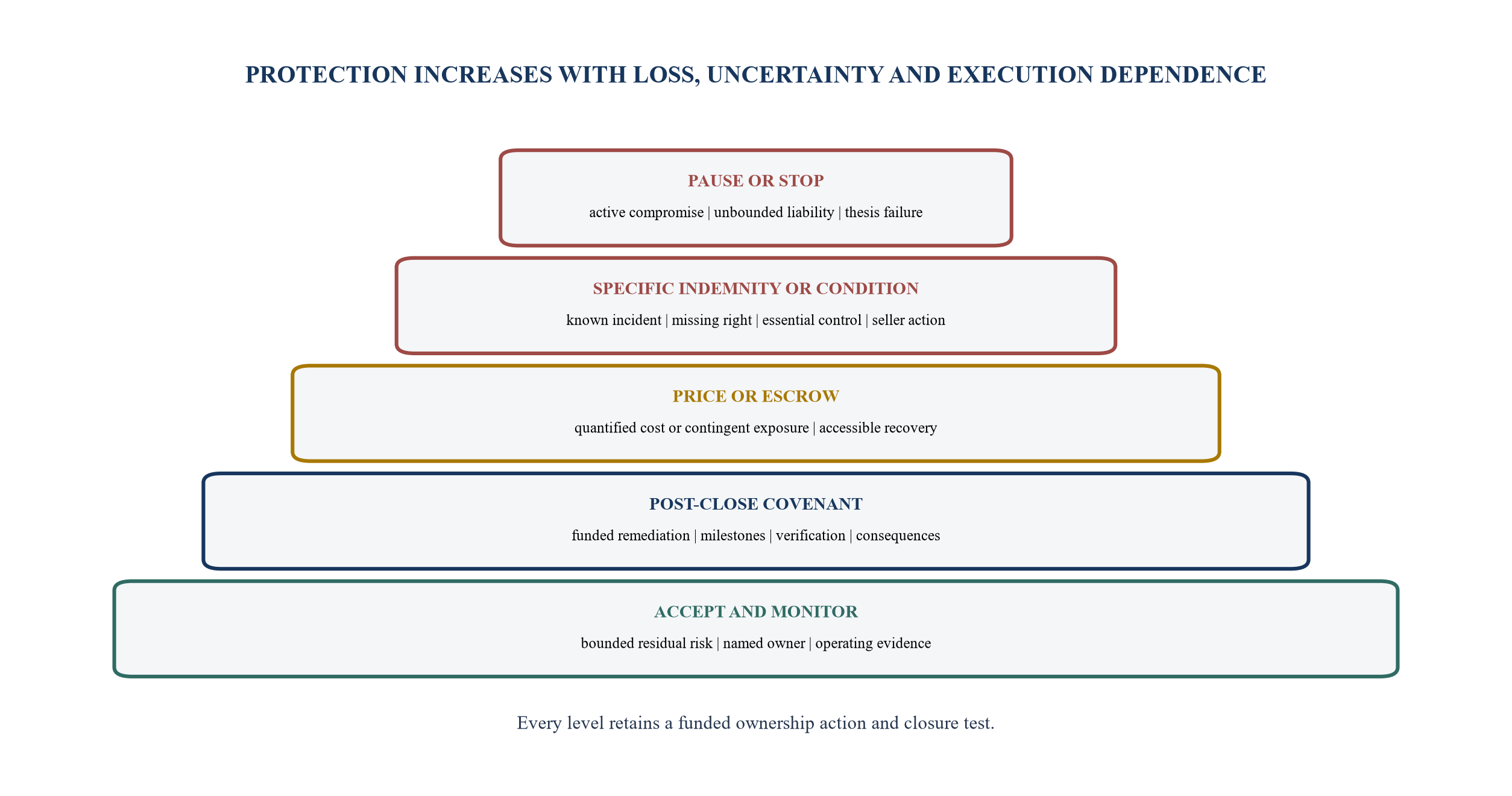
Qualified advisers should design the final transaction terms from the facts and governing law.
Table 5. Cyber finding to transaction response
| finding type | economic treatment | protection route | closing or ownership action | verification |
|---|---|---|---|---|
| active or suspected compromise | severe downside and interruption liquidity | condition, specific protection and claims cooperation | independent containment and clean-environment decision | forensic evidence and monitored period |
| known historical incident | contingent claims and remediation | specific indemnity, escrow, notice and defence terms | complete notices, preserve evidence and close actions | regulator, customer, insurer and technical records |
| unsupported critical platform | recurring risk plus replacement capital | price adjustment, covenant or condition | containment, funded replacement and continuity plan | migration, recovery and service test |
| weak identity or privileged access | remediation cost and elevated incident scenario | covenant, retention and representation | rotate secrets, control privilege and stage connectivity | sampled access and logging evidence |
| missing supplier rights or notification | interruption and claims sensitivity | consent condition, warranty or specific covenant | amend contract, create alternative and test exit | executed agreement and continuity evidence |
| incomplete diligence evidence | conservative case or unpriced uncertainty | confirmatory work, escrow or enhanced representation | restrict Day One trust until evidence is complete | independent report and committee sign-off |
| bounded control gap | one-time budget with contingency | ordinary covenant or accepted risk | assigned remediation with due date | closure evidence and board reporting |
The response should be tailored to the evidence, loss mechanism and legal advice.
17. Align representations, indemnities and transactional insurance
Representations should be built from the diligence perimeter. Relevant subjects can include material systems, security policies, compliance, incidents, notices, claims, personal data, customer commitments, business continuity, suppliers, software components, access and insurance. Definitions and materiality qualifiers determine coverage. Qualified counsel should connect drafting to the actual evidence and disclosure schedule.
Known issues generally require explicit treatment. A representation can establish a factual baseline while a specific indemnity may allocate a defined pre-close exposure. The agreement should address loss definition, third-party claims, mitigation, defence control, cooperation, insurance proceeds and interaction with caps or baskets. The transaction team should understand practical recovery, not only drafting breadth.
Warranty and indemnity insurance can affect negotiation and recovery, subject to underwriting, exclusions and the diligence record. A cyber issue excluded from the policy remains with the negotiated parties. An incomplete diligence process can narrow coverage. The deal team should coordinate the technical report, legal analysis, disclosure and underwriting answers so they describe the same facts.
Cyber insurance and transactional insurance serve different purposes. Cyber insurance can respond to incidents and operational losses under its terms. Transactional insurance can respond to breach of covered representations. Neither should be assumed to cover a known matter without specific confirmation. The model should show each recovery path and avoid duplicate proceeds.
The disclosure process is an operational test. The seller should identify incidents, exceptions, notices and claims in a form the buyer can evaluate. Late or inconsistent disclosure may require fresh diligence and revised terms. The buyer should preserve the evidence supporting the final allocation because later claims depend on what was known, represented and disclosed.
18. Control the period from signing to closing
Cyber exposure can change between signing and closing. Attackers do not wait for regulatory clearance, financing or completion. The agreement and operating plan should address ordinary-course security, material architecture changes, supplier changes, incident notification, access, remediation, insurance and cooperation. The seller should retain operational control until permitted transfer.
The parties need a transaction-specific incident protocol. It should define what event triggers notice, to whom, how quickly, what information is provided, how privilege and confidentiality are managed and who controls response. The protocol should respect law, customer contracts, insurance and securities duties. It should also address whether a material event changes closing conditions, valuation or termination rights.
Pre-close integration planning should avoid unauthorised control and unsafe connectivity. Teams can map dependencies, design Day One access, prepare monitoring, identify critical secrets and agree recovery priorities. Network connection, credential sharing or operational direction should wait until legally permitted and technically controlled.
Confirmatory diligence should refresh time-sensitive evidence. External exposure, critical vulnerabilities, incidents, insurance notices, privileged access, key suppliers and recovery status can change quickly. The committee should receive a dated update before close, with changes to the risk and protection map.
Day One should preserve service and evidence. Critical logs, forensic records, insurance documents, regulator correspondence, customer commitments and security architecture should be transferred to accountable owners. The buyer should avoid immediate changes that destroy evidence or weaken the target's existing controls.
19. Run a control-led first hundred days
The first hundred days should begin with authority, visibility and continuity. The buyer should confirm incident command, privileged access, monitoring, backup protection, critical suppliers, insurance contacts, notification routes and service owners. High-risk credentials and secrets should be rotated through a tested sequence. Connectivity should be staged according to evidence.
The next phase should close thesis-relevant gaps. Examples include removing exposed services, completing incident remediation, strengthening identity, expanding logs, isolating recovery, replacing unsupported platforms, improving supplier terms and testing critical-service restoration. Each action needs a service owner, technical owner, budget, due date, dependency and verification evidence.
Integration decisions should preserve resilience. Consolidating identity, cloud, networks or monitoring can create temporary concentration and migration risk. The team should compare current and target states, define rollback, test customer obligations and maintain detection during transition. Cost synergy should not depend on removing a control that supports the investment case.
Board reporting should focus on decisions and residual exposure. A dashboard can show critical services, material exceptions, incident readiness, recovery evidence, supplier concentration, insurance, regulatory actions and remediation. A completion percentage is insufficient when the remaining item is thesis-critical.
The hundred-day review should update valuation assumptions. Actual remediation cost, customer response, recovery tests and supplier negotiations provide evidence. Material deviations should enter the value-creation plan, covenant forecast and exit-readiness record. This closes the loop between diligence and ownership.
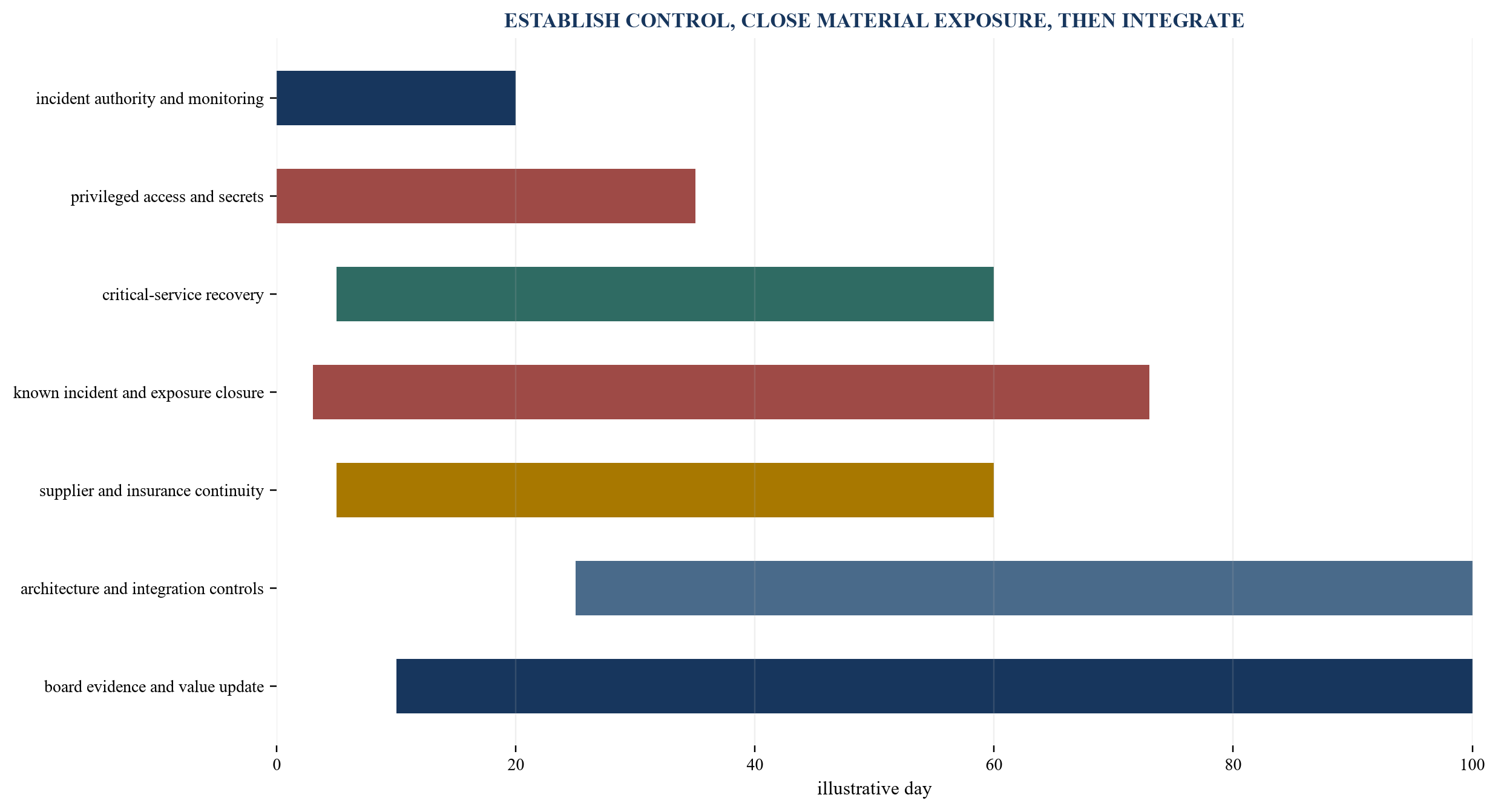
Timing is a hypothetical management assumption; actual sequencing depends on the target and transaction.
20. Apply the framework to a hypothetical acquisition
Consider a hypothetical acquisition of a business-to-business software company. Management reports USD 60 million of recurring revenue and states that no material cyber incident has affected customers. The company operates in several jurisdictions, uses two cloud providers and relies on a managed security provider. All figures and outcomes in this example are hypothetical management assumptions.
The service map identifies one identity platform and one deployment pipeline supporting every product. Evidence shows broad administrator access, incomplete service-account ownership and inconsistent log retention. An external review identifies an unsupported internet-facing component connected to a legacy customer portal. Management remediates the exposure during diligence and commissions targeted forensic work.
Incident reconstruction finds that a credential compromise eighteen months earlier was recorded as a minor service event. The target reset one account and found no evidence of customer-data access. Available logs cover only part of the relevant period, so complete scope cannot be established. Customer contracts include short notification periods for security events, while the contemporaneous legal assessment did not test every contract.
The recovery review demonstrates successful database restoration but no full-service recovery from clean infrastructure. Cloud backups use a separate account, while identity recovery depends on two individuals. The supplier review finds that the managed provider's contract lacks a rapid notification requirement and gives the target limited access to investigation evidence. Cyber insurance remains in force, subject to notice and change-of-control analysis.
The deal team builds three cases. The base case includes recurring identity, monitoring and supplier-assurance cost. The remediation case funds service-account ownership, log retention, clean recovery and portal replacement. The severe-event case models interruption, customer response, forensic cost and limited insurance recovery. It avoids using statutory maximum fines as expected loss.
The transaction requires completion of targeted forensic work and insurance notice before closing. A specific escrow supports the historical incident and defined customer claims. Representations and disclosure identify the affected environment, incident and available evidence. Signing-to-closing covenants require rapid incident notice and preservation of security controls. Day One connectivity remains staged until privileged access and monitoring meet the agreed evidence gate.
The example demonstrates connected decision-making. The historical incident does not automatically determine the transaction outcome. Evidence limitations, customer duties, recovery and control concentration create specific cash-flow and execution consequences. The board can approve the transaction with an explicit value bridge, protection package and ownership plan.
21. Use a board gate that records value, protection and residual risk
The board paper should state the acquisition thesis, technology perimeter, critical services, material incidents, plausible attack paths, jurisdiction matrix, customer obligations, identity and vulnerability findings, supplier concentration, recovery evidence, insurance, cash-flow bridge, transaction terms and first-hundred-day plan. It should separate verified evidence, management assumptions and advice still required.
Every material finding should have one economic treatment and one accountable owner. If the same exposure reduces forecast revenue, creates a separate valuation deduction and is fully covered by escrow, the committee should understand whether the treatments overlap. If a finding receives legal protection without funded remediation, the service remains exposed after closing.
The board should challenge uncertainty. Which logs, systems, incidents or jurisdictions remain untested? What adverse condition is plausible? How does the proposed protection respond? What evidence will release escrow, permit network connection or close the remediation? A limitation should become a condition or accepted residual risk with clear reasoning.
Stop conditions should be approved before timetable pressure dominates. Examples include evidence of active compromise without credible containment, an essential service that cannot recover, unbounded customer or regulatory exposure, unavailable rights to operate the platform, insurance or seller protection that cannot be secured, or remediation cost that breaks the investment thesis.
The final decision should establish a continuous evidence system. Diligence records should transfer into risk, incident, supplier, insurance and board processes. Post-close reviews should compare assumptions with actual cost, recovery, customer response and control performance. This makes cyber diligence an ownership capability and improves the quality of future transactions.
Table 6. Board gate for cyber liability in a transaction
| domain | minimum evidence | board challenge | pause or stop signal | post-close owner |
|---|---|---|---|---|
| perimeter and critical services | mapped entities, services, assets, suppliers and obligations | what must remain available and controlled at close? | essential operating asset or right is outside the perimeter | integration executive |
| incidents and exposure | reconciled history, current monitoring and targeted validation | can management define scope and validate eradication? | active compromise or irreducible evidence gap | incident executive and counsel |
| identity and technology | privileged-access map, vulnerability context and transition plan | which account or component can create enterprise control? | critical privilege cannot be transferred or constrained | chief information security officer |
| data and regulation | data map, jurisdictions, notices and customer duties | which clocks and claims can the transaction activate? | material unreported duty or missing lawful route | legal and privacy leads |
| recovery and suppliers | restoration evidence, shared responsibility and alternatives | can critical services recover within the approved tolerance? | no credible recovery or concentrated supplier exit | operations and technology leads |
| value and insurance | cash-flow pathways, remediation budget and policy analysis | is gross exposure separated from supportable recovery? | unbounded liquidity or financing requirement | chief financial officer |
| transaction protection | price, conditions, warranties, indemnities, escrow and covenants | does each term correspond to a defined exposure? | thesis-critical loss remains unallocated | transaction lead and counsel |
| ownership programme | Day One control, 100-day plan, budget and closure evidence | who will complete each action and how will closure be proved? | critical action lacks owner, funding or safe sequence | portfolio or integration committee |
The board should approve explicit evidence requirements, conditions and residual-risk ownership.
Sources and further reading
- National Institute of Standards and Technology, The NIST Cybersecurity Framework 2.0 Official source
- National Institute of Standards and Technology, Cybersecurity Framework 2.0 Quick-Start Guide for Cybersecurity Supply Chain Risk Management Official source
- United States Securities and Exchange Commission, Cybersecurity Risk Management, Strategy, Governance, and Incident Disclosure Official source
- United States Securities and Exchange Commission, Small Entity Compliance Guide for Cybersecurity Disclosures Official source
- United States Department of Justice, Evaluation of Corporate Compliance Programs Official source
- United States Federal Trade Commission, Safeguards Rule Notification Requirement Official source
- United States Federal Trade Commission, New and Improved Data Security Orders Official source
- UK Information Commissioner's Office, Due Diligence when Sharing Data Following Mergers and Acquisitions Official source
- UK Information Commissioner's Office, Marriott International Penalty Notice Official source
- UK National Cyber Security Centre, Cyber Insurance Guidance Official source
- UK National Cyber Security Centre, Supplier Assurance Questions Official source
- UK National Cyber Security Centre, Cyber Assessment Framework Response and Recovery Planning Official source
- European Union, Directive (EU) 2022/2555 on Measures for a High Common Level of Cybersecurity Official source
- European Data Protection Board, Guidelines 9/2022 on Personal Data Breach Notification under GDPR Official source
- European Union, Implementing Regulation on NIS2 Cybersecurity Risk-Management Measures Official source
- United Arab Emirates, Federal Decree by Law No. 45 of 2021 Concerning the Protection of Personal Data Official source
- Abu Dhabi Global Market, Data Protection Regulations 2021 Official source
- Abu Dhabi Global Market, Personal Data Breach Notifications Official source
- Abu Dhabi Global Market Financial Services Regulatory Authority, IT Risk Management Official source
- Dubai Financial Services Authority, Cyber Risk Supervision Summary Official source
- Indian Computer Emergency Response Team, Directions under Section 70B of the Information Technology Act Official source
- Indian Computer Emergency Response Team, Frequently Asked Questions on Cyber Security Directions Official source
- Government of India, Digital Personal Data Protection Act 2023 Official source
- Government of India, Digital Personal Data Protection Rules 2025 Official source
- Cyber Security Agency of Singapore, Cybersecurity Act Official source
- Personal Data Protection Commission Singapore, Guide on Managing and Notifying Data Breaches under the PDPA Official source
- Australian Prudential Regulation Authority, CPS 234 Information Security Official source
- Office of the Australian Information Commissioner, Notifiable Data Breaches Scheme Official source
- Australian Securities and Investments Commission, Key Questions for an Organisation's Board of Directors Official source
- Australian Signals Directorate, Guidelines for Procurement and Outsourcing Official source
