

1. Define the valuation question
Separate business value, data-asset value, transaction price and accounting measurement.
The controlled record should identify the relevant customer, revenue stream, contract, cohort, relationship owner, commercial dependency, evidence source, baseline, trend, scenario, control, exception, accountable executive, deadline and approval. The immediate deliverable is a valuation scope memorandum.
The principal failure occurs when data is assigned a premium before the basis of value is defined. Reviewers should connect the evidence to revenue durability, gross margin, cash conversion, renewal probability, switching behaviour, counterparty credit and transaction value; distinguish contractual protection from observed customer behaviour; and test whether the conclusion survives a downside scenario.
The decision pack for define the valuation question should state the commercial question, measurement perimeter, historical evidence, customer-specific facts, forecast logic, sensitivity, management action, buyer implication, residual uncertainty and next gate. Material exceptions should flow into the valuation model, quality-of-earnings work, diligence room, sale-process narrative, transaction protections and board reporting.
2. Inventory the data estate
Identify datasets, fields, volumes, formats, locations, lineage, owners and custodians.
The controlled record should identify the relevant customer, revenue stream, contract, cohort, relationship owner, commercial dependency, evidence source, baseline, trend, scenario, control, exception, accountable executive, deadline and approval. The immediate deliverable is a data asset register.
The principal failure occurs when the claimed asset cannot be located or bounded. Reviewers should connect the evidence to revenue durability, gross margin, cash conversion, renewal probability, switching behaviour, counterparty credit and transaction value; distinguish contractual protection from observed customer behaviour; and test whether the conclusion survives a downside scenario.
The decision pack for inventory the data estate should state the commercial question, measurement perimeter, historical evidence, customer-specific facts, forecast logic, sensitivity, management action, buyer implication, residual uncertainty and next gate. Material exceptions should flow into the valuation model, quality-of-earnings work, diligence room, sale-process narrative, transaction protections and board reporting.
3. Map data provenance
Trace collection, creation, purchase, inference, transformation and enrichment.
The controlled record should identify the relevant customer, revenue stream, contract, cohort, relationship owner, commercial dependency, evidence source, baseline, trend, scenario, control, exception, accountable executive, deadline and approval. The immediate deliverable is a provenance graph.
The principal failure occurs when lineage gaps conceal unlawful or low-quality inputs. Reviewers should connect the evidence to revenue durability, gross margin, cash conversion, renewal probability, switching behaviour, counterparty credit and transaction value; distinguish contractual protection from observed customer behaviour; and test whether the conclusion survives a downside scenario.
The decision pack for map data provenance should state the commercial question, measurement perimeter, historical evidence, customer-specific facts, forecast logic, sensitivity, management action, buyer implication, residual uncertainty and next gate. Material exceptions should flow into the valuation model, quality-of-earnings work, diligence room, sale-process narrative, transaction protections and board reporting.
4. Establish legal rights
Verify ownership, licence, consent, contractual use, database rights, confidentiality and trade-secret protection.
The controlled record should identify the relevant customer, revenue stream, contract, cohort, relationship owner, commercial dependency, evidence source, baseline, trend, scenario, control, exception, accountable executive, deadline and approval. The immediate deliverable is a rights and restrictions matrix.
The principal failure occurs when possession is mistaken for an unrestricted commercial right. Reviewers should connect the evidence to revenue durability, gross margin, cash conversion, renewal probability, switching behaviour, counterparty credit and transaction value; distinguish contractual protection from observed customer behaviour; and test whether the conclusion survives a downside scenario.
The decision pack for establish legal rights should state the commercial question, measurement perimeter, historical evidence, customer-specific facts, forecast logic, sensitivity, management action, buyer implication, residual uncertainty and next gate. Material exceptions should flow into the valuation model, quality-of-earnings work, diligence room, sale-process narrative, transaction protections and board reporting.
5. Classify personal and regulated data
Identify personal, sensitive, sector-regulated, export-controlled and confidential information.
The controlled record should identify the relevant customer, revenue stream, contract, cohort, relationship owner, commercial dependency, evidence source, baseline, trend, scenario, control, exception, accountable executive, deadline and approval. The immediate deliverable is a regulatory classification schedule.
The principal failure occurs when valuation ignores legal limits on use and transfer. Reviewers should connect the evidence to revenue durability, gross margin, cash conversion, renewal probability, switching behaviour, counterparty credit and transaction value; distinguish contractual protection from observed customer behaviour; and test whether the conclusion survives a downside scenario.
The decision pack for classify personal and regulated data should state the commercial question, measurement perimeter, historical evidence, customer-specific facts, forecast logic, sensitivity, management action, buyer implication, residual uncertainty and next gate. Material exceptions should flow into the valuation model, quality-of-earnings work, diligence room, sale-process narrative, transaction protections and board reporting.
6. Test purpose compatibility
Compare original collection purpose, notices, consent and contractual purpose with intended monetisation.
The controlled record should identify the relevant customer, revenue stream, contract, cohort, relationship owner, commercial dependency, evidence source, baseline, trend, scenario, control, exception, accountable executive, deadline and approval. The immediate deliverable is a purpose-compatibility assessment.
The principal failure occurs when future use cases exceed authorised purpose. Reviewers should connect the evidence to revenue durability, gross margin, cash conversion, renewal probability, switching behaviour, counterparty credit and transaction value; distinguish contractual protection from observed customer behaviour; and test whether the conclusion survives a downside scenario.
The decision pack for test purpose compatibility should state the commercial question, measurement perimeter, historical evidence, customer-specific facts, forecast logic, sensitivity, management action, buyer implication, residual uncertainty and next gate. Material exceptions should flow into the valuation model, quality-of-earnings work, diligence room, sale-process narrative, transaction protections and board reporting.
7. Map geographic constraints
Assess localisation, cross-border transfer, adequacy, contractual safeguards and government access.
The controlled record should identify the relevant customer, revenue stream, contract, cohort, relationship owner, commercial dependency, evidence source, baseline, trend, scenario, control, exception, accountable executive, deadline and approval. The immediate deliverable is a geographic transfer map.
The principal failure occurs when global forecasts assume frictionless data movement. Reviewers should connect the evidence to revenue durability, gross margin, cash conversion, renewal probability, switching behaviour, counterparty credit and transaction value; distinguish contractual protection from observed customer behaviour; and test whether the conclusion survives a downside scenario.
The decision pack for map geographic constraints should state the commercial question, measurement perimeter, historical evidence, customer-specific facts, forecast logic, sensitivity, management action, buyer implication, residual uncertainty and next gate. Material exceptions should flow into the valuation model, quality-of-earnings work, diligence room, sale-process narrative, transaction protections and board reporting.
8. Assess exclusivity
Determine whether competitors, customers, suppliers or public sources can access equivalent data.
The controlled record should identify the relevant customer, revenue stream, contract, cohort, relationship owner, commercial dependency, evidence source, baseline, trend, scenario, control, exception, accountable executive, deadline and approval. The immediate deliverable is an exclusivity evidence file.
The principal failure occurs when scarcity is claimed despite broad market availability. Reviewers should connect the evidence to revenue durability, gross margin, cash conversion, renewal probability, switching behaviour, counterparty credit and transaction value; distinguish contractual protection from observed customer behaviour; and test whether the conclusion survives a downside scenario.
The decision pack for assess exclusivity should state the commercial question, measurement perimeter, historical evidence, customer-specific facts, forecast logic, sensitivity, management action, buyer implication, residual uncertainty and next gate. Material exceptions should flow into the valuation model, quality-of-earnings work, diligence room, sale-process narrative, transaction protections and board reporting.
Table 1. Rights and scarcity
| Test | Evidence | Failure |
|---|---|---|
| ownership | contracts and law | possession only |
| purpose | notices and consent | restricted use |
| exclusivity | market comparison | common data |
| transfer | assignment and approvals | stranded asset |
Illustrative analytical design; company-specific evidence and professional advice govern.
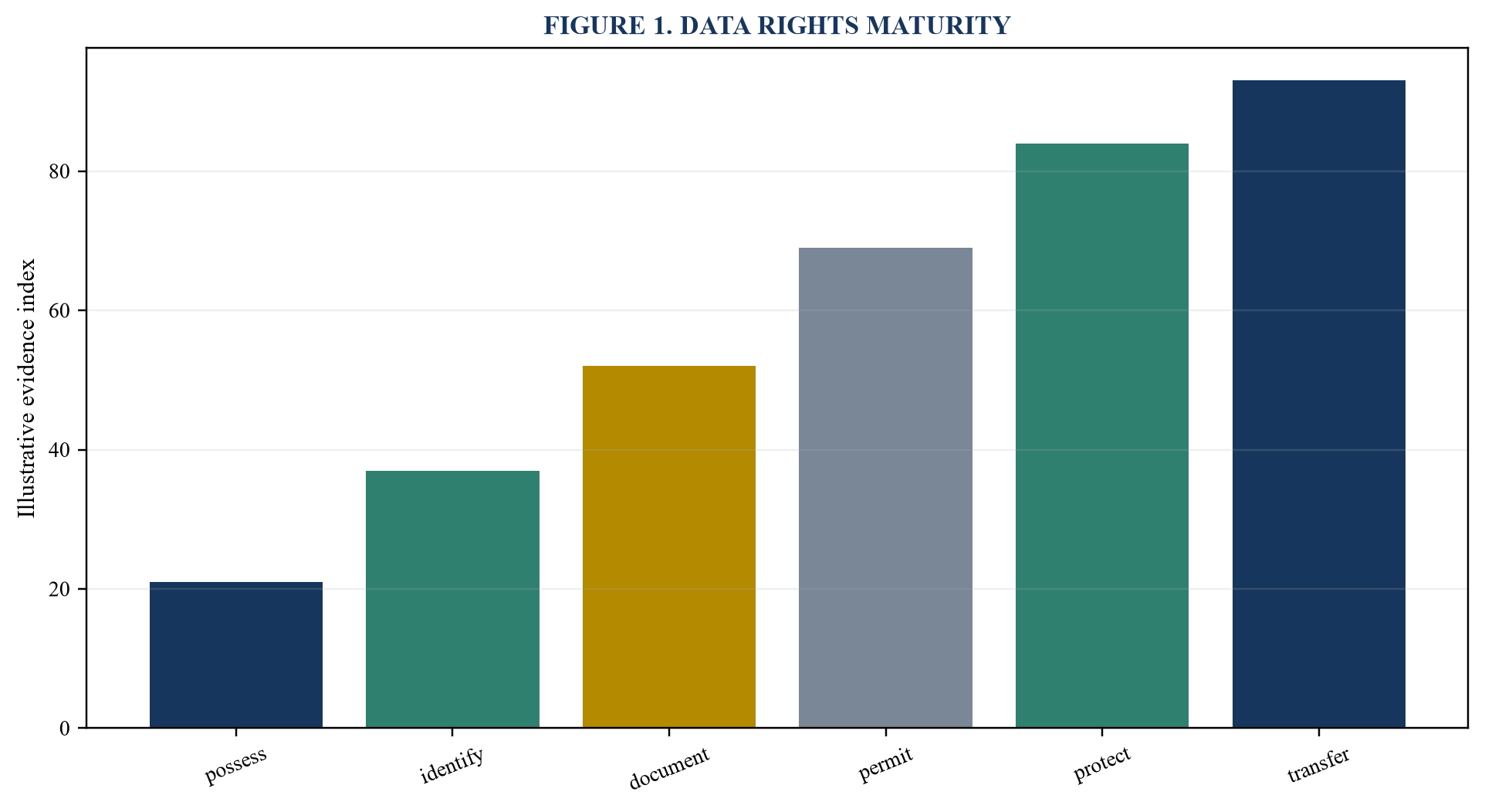
Values are illustrative evidence indices and require company-specific support.
9. Measure replicability
Estimate time, cost, permissions, coverage and failure risk for recreating the dataset.
The controlled record should identify the relevant customer, revenue stream, contract, cohort, relationship owner, commercial dependency, evidence source, baseline, trend, scenario, control, exception, accountable executive, deadline and approval. The immediate deliverable is a replication feasibility model.
The principal failure occurs when historical spend is treated as replacement cost. Reviewers should connect the evidence to revenue durability, gross margin, cash conversion, renewal probability, switching behaviour, counterparty credit and transaction value; distinguish contractual protection from observed customer behaviour; and test whether the conclusion survives a downside scenario.
The decision pack for measure replicability should state the commercial question, measurement perimeter, historical evidence, customer-specific facts, forecast logic, sensitivity, management action, buyer implication, residual uncertainty and next gate. Material exceptions should flow into the valuation model, quality-of-earnings work, diligence room, sale-process narrative, transaction protections and board reporting.
10. Test substitutability
Identify alternative datasets, synthetic data, proxies and model techniques.
The controlled record should identify the relevant customer, revenue stream, contract, cohort, relationship owner, commercial dependency, evidence source, baseline, trend, scenario, control, exception, accountable executive, deadline and approval. The immediate deliverable is a substitution analysis.
The principal failure occurs when the dataset is valuable only within one obsolete workflow. Reviewers should connect the evidence to revenue durability, gross margin, cash conversion, renewal probability, switching behaviour, counterparty credit and transaction value; distinguish contractual protection from observed customer behaviour; and test whether the conclusion survives a downside scenario.
The decision pack for test substitutability should state the commercial question, measurement perimeter, historical evidence, customer-specific facts, forecast logic, sensitivity, management action, buyer implication, residual uncertainty and next gate. Material exceptions should flow into the valuation model, quality-of-earnings work, diligence room, sale-process narrative, transaction protections and board reporting.
11. Measure data quality
Assess completeness, accuracy, timeliness, consistency, uniqueness and fitness for purpose.
The controlled record should identify the relevant customer, revenue stream, contract, cohort, relationship owner, commercial dependency, evidence source, baseline, trend, scenario, control, exception, accountable executive, deadline and approval. The immediate deliverable is a quality scorecard.
The principal failure occurs when volume substitutes for utility. Reviewers should connect the evidence to revenue durability, gross margin, cash conversion, renewal probability, switching behaviour, counterparty credit and transaction value; distinguish contractual protection from observed customer behaviour; and test whether the conclusion survives a downside scenario.
The decision pack for measure data quality should state the commercial question, measurement perimeter, historical evidence, customer-specific facts, forecast logic, sensitivity, management action, buyer implication, residual uncertainty and next gate. Material exceptions should flow into the valuation model, quality-of-earnings work, diligence room, sale-process narrative, transaction protections and board reporting.
12. Quantify coverage
Map population, geography, time, edge cases, labels and selection bias.
The controlled record should identify the relevant customer, revenue stream, contract, cohort, relationship owner, commercial dependency, evidence source, baseline, trend, scenario, control, exception, accountable executive, deadline and approval. The immediate deliverable is a coverage matrix.
The principal failure occurs when data breadth is overstated by duplicate or narrow records. Reviewers should connect the evidence to revenue durability, gross margin, cash conversion, renewal probability, switching behaviour, counterparty credit and transaction value; distinguish contractual protection from observed customer behaviour; and test whether the conclusion survives a downside scenario.
The decision pack for quantify coverage should state the commercial question, measurement perimeter, historical evidence, customer-specific facts, forecast logic, sensitivity, management action, buyer implication, residual uncertainty and next gate. Material exceptions should flow into the valuation model, quality-of-earnings work, diligence room, sale-process narrative, transaction protections and board reporting.
13. Analyse freshness and decay
Measure update frequency, latency, drift and useful life by use case.
The controlled record should identify the relevant customer, revenue stream, contract, cohort, relationship owner, commercial dependency, evidence source, baseline, trend, scenario, control, exception, accountable executive, deadline and approval. The immediate deliverable is a data-decay curve.
The principal failure occurs when stale observations receive perpetual value. Reviewers should connect the evidence to revenue durability, gross margin, cash conversion, renewal probability, switching behaviour, counterparty credit and transaction value; distinguish contractual protection from observed customer behaviour; and test whether the conclusion survives a downside scenario.
The decision pack for analyse freshness and decay should state the commercial question, measurement perimeter, historical evidence, customer-specific facts, forecast logic, sensitivity, management action, buyer implication, residual uncertainty and next gate. Material exceptions should flow into the valuation model, quality-of-earnings work, diligence room, sale-process narrative, transaction protections and board reporting.
14. Test identity resolution
Review entity matching, duplicates, confidence, false links and master-data controls.
The controlled record should identify the relevant customer, revenue stream, contract, cohort, relationship owner, commercial dependency, evidence source, baseline, trend, scenario, control, exception, accountable executive, deadline and approval. The immediate deliverable is an identity-resolution dossier.
The principal failure occurs when apparent scale reflects unresolved duplication. Reviewers should connect the evidence to revenue durability, gross margin, cash conversion, renewal probability, switching behaviour, counterparty credit and transaction value; distinguish contractual protection from observed customer behaviour; and test whether the conclusion survives a downside scenario.
The decision pack for test identity resolution should state the commercial question, measurement perimeter, historical evidence, customer-specific facts, forecast logic, sensitivity, management action, buyer implication, residual uncertainty and next gate. Material exceptions should flow into the valuation model, quality-of-earnings work, diligence room, sale-process narrative, transaction protections and board reporting.
15. Assess interoperability
Evaluate schema, metadata, standards, APIs, exportability and integration effort.
The controlled record should identify the relevant customer, revenue stream, contract, cohort, relationship owner, commercial dependency, evidence source, baseline, trend, scenario, control, exception, accountable executive, deadline and approval. The immediate deliverable is an interoperability assessment.
The principal failure occurs when data value depends on a proprietary system that limits transfer. Reviewers should connect the evidence to revenue durability, gross margin, cash conversion, renewal probability, switching behaviour, counterparty credit and transaction value; distinguish contractual protection from observed customer behaviour; and test whether the conclusion survives a downside scenario.
The decision pack for assess interoperability should state the commercial question, measurement perimeter, historical evidence, customer-specific facts, forecast logic, sensitivity, management action, buyer implication, residual uncertainty and next gate. Material exceptions should flow into the valuation model, quality-of-earnings work, diligence room, sale-process narrative, transaction protections and board reporting.
16. Measure annotation economics
Quantify labelling method, expertise, quality assurance, disagreement and refresh cost.
The controlled record should identify the relevant customer, revenue stream, contract, cohort, relationship owner, commercial dependency, evidence source, baseline, trend, scenario, control, exception, accountable executive, deadline and approval. The immediate deliverable is an annotation cost model.
The principal failure occurs when labels are assumed accurate and reusable without evidence. Reviewers should connect the evidence to revenue durability, gross margin, cash conversion, renewal probability, switching behaviour, counterparty credit and transaction value; distinguish contractual protection from observed customer behaviour; and test whether the conclusion survives a downside scenario.
The decision pack for measure annotation economics should state the commercial question, measurement perimeter, historical evidence, customer-specific facts, forecast logic, sensitivity, management action, buyer implication, residual uncertainty and next gate. Material exceptions should flow into the valuation model, quality-of-earnings work, diligence room, sale-process narrative, transaction protections and board reporting.
Table 2. Quality and usability
| Dimension | Measure | Decision |
|---|---|---|
| accuracy | verified error | fitness |
| coverage | population and time | bias |
| freshness | update latency | decay |
| interoperability | schema and export | integration |
Illustrative analytical design; company-specific evidence and professional advice govern.
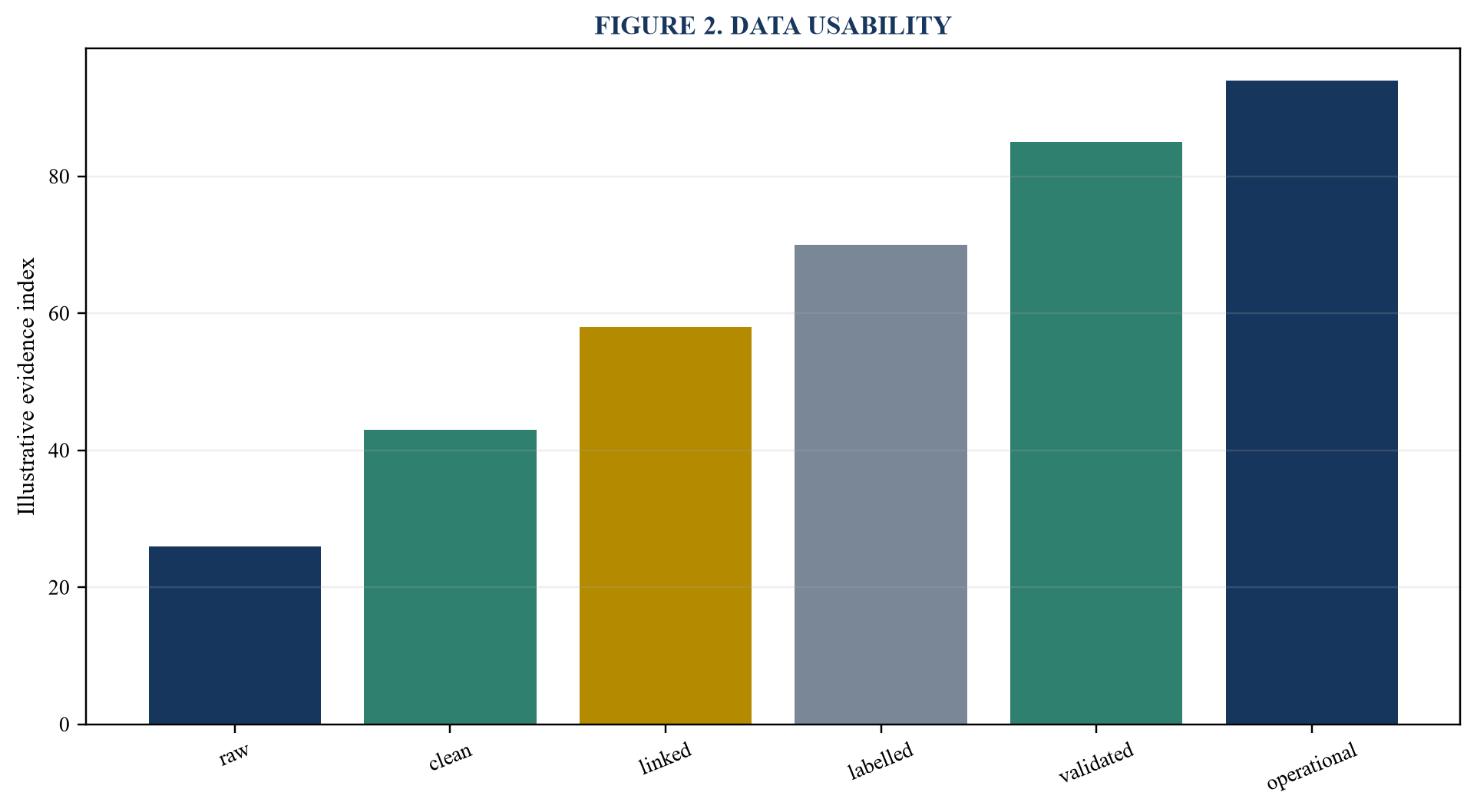
Values are illustrative evidence indices and require company-specific support.
17. Map transformation value
Separate raw collection from cleaning, linking, features, insights and decisions.
The controlled record should identify the relevant customer, revenue stream, contract, cohort, relationship owner, commercial dependency, evidence source, baseline, trend, scenario, control, exception, accountable executive, deadline and approval. The immediate deliverable is a data value-chain map.
The principal failure occurs when all value is attributed to raw data. Reviewers should connect the evidence to revenue durability, gross margin, cash conversion, renewal probability, switching behaviour, counterparty credit and transaction value; distinguish contractual protection from observed customer behaviour; and test whether the conclusion survives a downside scenario.
The decision pack for map transformation value should state the commercial question, measurement perimeter, historical evidence, customer-specific facts, forecast logic, sensitivity, management action, buyer implication, residual uncertainty and next gate. Material exceptions should flow into the valuation model, quality-of-earnings work, diligence room, sale-process narrative, transaction protections and board reporting.
18. Identify use cases
Tie each dataset to a specific decision, product, customer and economic outcome.
The controlled record should identify the relevant customer, revenue stream, contract, cohort, relationship owner, commercial dependency, evidence source, baseline, trend, scenario, control, exception, accountable executive, deadline and approval. The immediate deliverable is a use-case register.
The principal failure occurs when generic optionality is capitalised without a route to cash. Reviewers should connect the evidence to revenue durability, gross margin, cash conversion, renewal probability, switching behaviour, counterparty credit and transaction value; distinguish contractual protection from observed customer behaviour; and test whether the conclusion survives a downside scenario.
The decision pack for identify use cases should state the commercial question, measurement perimeter, historical evidence, customer-specific facts, forecast logic, sensitivity, management action, buyer implication, residual uncertainty and next gate. Material exceptions should flow into the valuation model, quality-of-earnings work, diligence room, sale-process narrative, transaction protections and board reporting.
19. Prove incremental utility
Compare outcomes with and without the dataset through controlled evaluation.
The controlled record should identify the relevant customer, revenue stream, contract, cohort, relationship owner, commercial dependency, evidence source, baseline, trend, scenario, control, exception, accountable executive, deadline and approval. The immediate deliverable is an incremental utility test.
The principal failure occurs when correlation is treated as causal value. Reviewers should connect the evidence to revenue durability, gross margin, cash conversion, renewal probability, switching behaviour, counterparty credit and transaction value; distinguish contractual protection from observed customer behaviour; and test whether the conclusion survives a downside scenario.
The decision pack for prove incremental utility should state the commercial question, measurement perimeter, historical evidence, customer-specific facts, forecast logic, sensitivity, management action, buyer implication, residual uncertainty and next gate. Material exceptions should flow into the valuation model, quality-of-earnings work, diligence room, sale-process narrative, transaction protections and board reporting.
20. Measure model lift
Quantify accuracy, calibration, latency, robustness and segment effects attributable to data.
The controlled record should identify the relevant customer, revenue stream, contract, cohort, relationship owner, commercial dependency, evidence source, baseline, trend, scenario, control, exception, accountable executive, deadline and approval. The immediate deliverable is a model-lift dossier.
The principal failure occurs when technical improvement lacks a commercial threshold. Reviewers should connect the evidence to revenue durability, gross margin, cash conversion, renewal probability, switching behaviour, counterparty credit and transaction value; distinguish contractual protection from observed customer behaviour; and test whether the conclusion survives a downside scenario.
The decision pack for measure model lift should state the commercial question, measurement perimeter, historical evidence, customer-specific facts, forecast logic, sensitivity, management action, buyer implication, residual uncertainty and next gate. Material exceptions should flow into the valuation model, quality-of-earnings work, diligence room, sale-process narrative, transaction protections and board reporting.
21. Translate utility into cash flow
Connect improved pricing, conversion, loss reduction, productivity or risk control to attributable cash.
The controlled record should identify the relevant customer, revenue stream, contract, cohort, relationship owner, commercial dependency, evidence source, baseline, trend, scenario, control, exception, accountable executive, deadline and approval. The immediate deliverable is a utility-to-cash bridge.
The principal failure occurs when technical metrics remain disconnected from enterprise value. Reviewers should connect the evidence to revenue durability, gross margin, cash conversion, renewal probability, switching behaviour, counterparty credit and transaction value; distinguish contractual protection from observed customer behaviour; and test whether the conclusion survives a downside scenario.
The decision pack for translate utility into cash flow should state the commercial question, measurement perimeter, historical evidence, customer-specific facts, forecast logic, sensitivity, management action, buyer implication, residual uncertainty and next gate. Material exceptions should flow into the valuation model, quality-of-earnings work, diligence room, sale-process narrative, transaction protections and board reporting.
22. Test customer willingness to pay
Review contracts, price differences, renewals and controlled experiments.
The controlled record should identify the relevant customer, revenue stream, contract, cohort, relationship owner, commercial dependency, evidence source, baseline, trend, scenario, control, exception, accountable executive, deadline and approval. The immediate deliverable is a monetisation evidence pack.
The principal failure occurs when internal enthusiasm substitutes for external demand. Reviewers should connect the evidence to revenue durability, gross margin, cash conversion, renewal probability, switching behaviour, counterparty credit and transaction value; distinguish contractual protection from observed customer behaviour; and test whether the conclusion survives a downside scenario.
The decision pack for test customer willingness to pay should state the commercial question, measurement perimeter, historical evidence, customer-specific facts, forecast logic, sensitivity, management action, buyer implication, residual uncertainty and next gate. Material exceptions should flow into the valuation model, quality-of-earnings work, diligence room, sale-process narrative, transaction protections and board reporting.
23. Assess revenue attribution
Separate value created by data from product, brand, distribution, talent and capital.
The controlled record should identify the relevant customer, revenue stream, contract, cohort, relationship owner, commercial dependency, evidence source, baseline, trend, scenario, control, exception, accountable executive, deadline and approval. The immediate deliverable is an attributable-revenue model.
The principal failure occurs when total product revenue is assigned to the dataset. Reviewers should connect the evidence to revenue durability, gross margin, cash conversion, renewal probability, switching behaviour, counterparty credit and transaction value; distinguish contractual protection from observed customer behaviour; and test whether the conclusion survives a downside scenario.
The decision pack for assess revenue attribution should state the commercial question, measurement perimeter, historical evidence, customer-specific facts, forecast logic, sensitivity, management action, buyer implication, residual uncertainty and next gate. Material exceptions should flow into the valuation model, quality-of-earnings work, diligence room, sale-process narrative, transaction protections and board reporting.
24. Map cost to maintain
Include ingestion, storage, security, governance, licences, quality, annotation and compliance.
The controlled record should identify the relevant customer, revenue stream, contract, cohort, relationship owner, commercial dependency, evidence source, baseline, trend, scenario, control, exception, accountable executive, deadline and approval. The immediate deliverable is a lifecycle cost model.
The principal failure occurs when maintenance obligations are omitted from value. Reviewers should connect the evidence to revenue durability, gross margin, cash conversion, renewal probability, switching behaviour, counterparty credit and transaction value; distinguish contractual protection from observed customer behaviour; and test whether the conclusion survives a downside scenario.
The decision pack for map cost to maintain should state the commercial question, measurement perimeter, historical evidence, customer-specific facts, forecast logic, sensitivity, management action, buyer implication, residual uncertainty and next gate. Material exceptions should flow into the valuation model, quality-of-earnings work, diligence room, sale-process narrative, transaction protections and board reporting.
Table 3. Utility-to-cash
| Use | Evidence | Value driver |
|---|---|---|
| pricing | controlled uplift | margin |
| conversion | cohort experiment | revenue |
| risk | loss comparison | avoided cost |
| productivity | time and quality | cash saving |
Illustrative analytical design; company-specific evidence and professional advice govern.
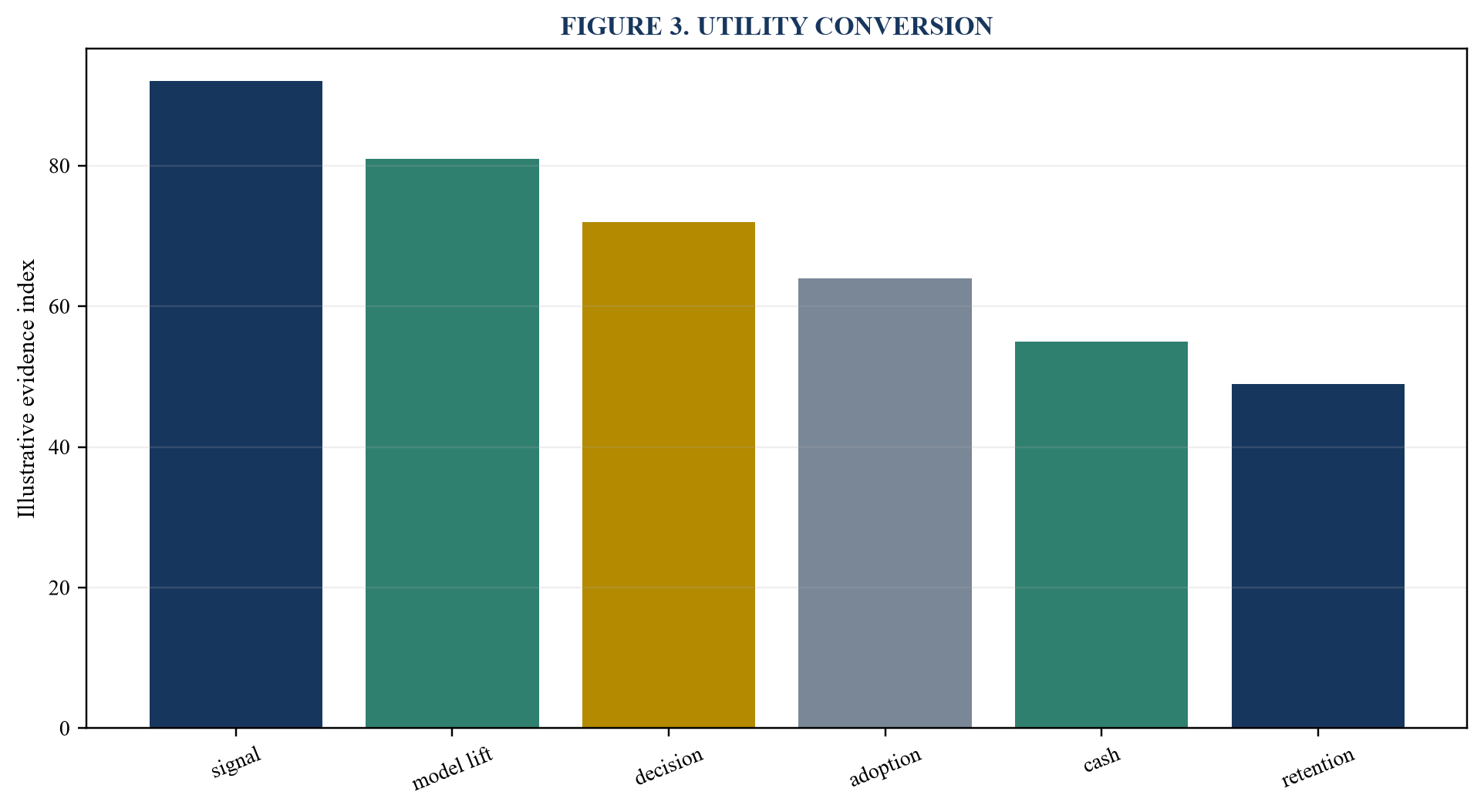
Values are illustrative evidence indices and require company-specific support.
25. Estimate replacement cost
Build current cost for lawful collection, cleaning, linkage, validation and readiness, with obsolescence.
The controlled record should identify the relevant customer, revenue stream, contract, cohort, relationship owner, commercial dependency, evidence source, baseline, trend, scenario, control, exception, accountable executive, deadline and approval. The immediate deliverable is a replacement-cost schedule.
The principal failure occurs when book cost and historical spend are used without adjustment. Reviewers should connect the evidence to revenue durability, gross margin, cash conversion, renewal probability, switching behaviour, counterparty credit and transaction value; distinguish contractual protection from observed customer behaviour; and test whether the conclusion survives a downside scenario.
The decision pack for estimate replacement cost should state the commercial question, measurement perimeter, historical evidence, customer-specific facts, forecast logic, sensitivity, management action, buyer implication, residual uncertainty and next gate. Material exceptions should flow into the valuation model, quality-of-earnings work, diligence room, sale-process narrative, transaction protections and board reporting.
26. Apply obsolescence
Adjust for physical, functional, technological, economic and legal impairment.
The controlled record should identify the relevant customer, revenue stream, contract, cohort, relationship owner, commercial dependency, evidence source, baseline, trend, scenario, control, exception, accountable executive, deadline and approval. The immediate deliverable is an obsolescence model.
The principal failure occurs when replacement cost ignores cheaper current methods and lost rights. Reviewers should connect the evidence to revenue durability, gross margin, cash conversion, renewal probability, switching behaviour, counterparty credit and transaction value; distinguish contractual protection from observed customer behaviour; and test whether the conclusion survives a downside scenario.
The decision pack for apply obsolescence should state the commercial question, measurement perimeter, historical evidence, customer-specific facts, forecast logic, sensitivity, management action, buyer implication, residual uncertainty and next gate. Material exceptions should flow into the valuation model, quality-of-earnings work, diligence room, sale-process narrative, transaction protections and board reporting.
27. Select income methods
Evaluate relief-from-royalty, excess earnings, with-and-without and incremental cash flow.
The controlled record should identify the relevant customer, revenue stream, contract, cohort, relationship owner, commercial dependency, evidence source, baseline, trend, scenario, control, exception, accountable executive, deadline and approval. The immediate deliverable is an income-method selection paper.
The principal failure occurs when method choice follows the highest output. Reviewers should connect the evidence to revenue durability, gross margin, cash conversion, renewal probability, switching behaviour, counterparty credit and transaction value; distinguish contractual protection from observed customer behaviour; and test whether the conclusion survives a downside scenario.
The decision pack for select income methods should state the commercial question, measurement perimeter, historical evidence, customer-specific facts, forecast logic, sensitivity, management action, buyer implication, residual uncertainty and next gate. Material exceptions should flow into the valuation model, quality-of-earnings work, diligence room, sale-process narrative, transaction protections and board reporting.
28. Select market evidence
Review licences, transactions and comparable assets with rights and utility adjustments.
The controlled record should identify the relevant customer, revenue stream, contract, cohort, relationship owner, commercial dependency, evidence source, baseline, trend, scenario, control, exception, accountable executive, deadline and approval. The immediate deliverable is a market evidence matrix.
The principal failure occurs when non-comparable headline data prices set the conclusion. Reviewers should connect the evidence to revenue durability, gross margin, cash conversion, renewal probability, switching behaviour, counterparty credit and transaction value; distinguish contractual protection from observed customer behaviour; and test whether the conclusion survives a downside scenario.
The decision pack for select market evidence should state the commercial question, measurement perimeter, historical evidence, customer-specific facts, forecast logic, sensitivity, management action, buyer implication, residual uncertainty and next gate. Material exceptions should flow into the valuation model, quality-of-earnings work, diligence room, sale-process narrative, transaction protections and board reporting.
29. Reconcile valuation approaches
Weight income, market and cost evidence by reliability and purpose.
The controlled record should identify the relevant customer, revenue stream, contract, cohort, relationship owner, commercial dependency, evidence source, baseline, trend, scenario, control, exception, accountable executive, deadline and approval. The immediate deliverable is a valuation reconciliation.
The principal failure occurs when divergent methods are averaged without diagnosis. Reviewers should connect the evidence to revenue durability, gross margin, cash conversion, renewal probability, switching behaviour, counterparty credit and transaction value; distinguish contractual protection from observed customer behaviour; and test whether the conclusion survives a downside scenario.
The decision pack for reconcile valuation approaches should state the commercial question, measurement perimeter, historical evidence, customer-specific facts, forecast logic, sensitivity, management action, buyer implication, residual uncertainty and next gate. Material exceptions should flow into the valuation model, quality-of-earnings work, diligence room, sale-process narrative, transaction protections and board reporting.
30. Assess data concentration
Measure dependence on one supplier, customer, geography, source or collection channel.
The controlled record should identify the relevant customer, revenue stream, contract, cohort, relationship owner, commercial dependency, evidence source, baseline, trend, scenario, control, exception, accountable executive, deadline and approval. The immediate deliverable is a concentration heat map.
The principal failure occurs when a fragile source supports the full forecast. Reviewers should connect the evidence to revenue durability, gross margin, cash conversion, renewal probability, switching behaviour, counterparty credit and transaction value; distinguish contractual protection from observed customer behaviour; and test whether the conclusion survives a downside scenario.
The decision pack for assess data concentration should state the commercial question, measurement perimeter, historical evidence, customer-specific facts, forecast logic, sensitivity, management action, buyer implication, residual uncertainty and next gate. Material exceptions should flow into the valuation model, quality-of-earnings work, diligence room, sale-process narrative, transaction protections and board reporting.
31. Test licence termination
Model renewal, audit, price reset, change of control, assignment and revocation.
The controlled record should identify the relevant customer, revenue stream, contract, cohort, relationship owner, commercial dependency, evidence source, baseline, trend, scenario, control, exception, accountable executive, deadline and approval. The immediate deliverable is a licence continuity scenario.
The principal failure occurs when a cancellable licence is valued as owned property. Reviewers should connect the evidence to revenue durability, gross margin, cash conversion, renewal probability, switching behaviour, counterparty credit and transaction value; distinguish contractual protection from observed customer behaviour; and test whether the conclusion survives a downside scenario.
The decision pack for test licence termination should state the commercial question, measurement perimeter, historical evidence, customer-specific facts, forecast logic, sensitivity, management action, buyer implication, residual uncertainty and next gate. Material exceptions should flow into the valuation model, quality-of-earnings work, diligence room, sale-process narrative, transaction protections and board reporting.
32. Assess cyber and leakage risk
Scenario-weight breach, theft, corruption, ransomware, disclosure and competitive diffusion.
The controlled record should identify the relevant customer, revenue stream, contract, cohort, relationship owner, commercial dependency, evidence source, baseline, trend, scenario, control, exception, accountable executive, deadline and approval. The immediate deliverable is a cyber value-at-risk model.
The principal failure occurs when secrecy value ignores loss probability. Reviewers should connect the evidence to revenue durability, gross margin, cash conversion, renewal probability, switching behaviour, counterparty credit and transaction value; distinguish contractual protection from observed customer behaviour; and test whether the conclusion survives a downside scenario.
The decision pack for assess cyber and leakage risk should state the commercial question, measurement perimeter, historical evidence, customer-specific facts, forecast logic, sensitivity, management action, buyer implication, residual uncertainty and next gate. Material exceptions should flow into the valuation model, quality-of-earnings work, diligence room, sale-process narrative, transaction protections and board reporting.
Table 4. Valuation approaches
| Approach | Primary evidence | Constraint |
|---|---|---|
| income | incremental cash | attribution |
| market | licences and deals | comparability |
| cost | lawful replacement | utility ceiling |
| reconciliation | evidence weighting | purpose |
Illustrative analytical design; company-specific evidence and professional advice govern.
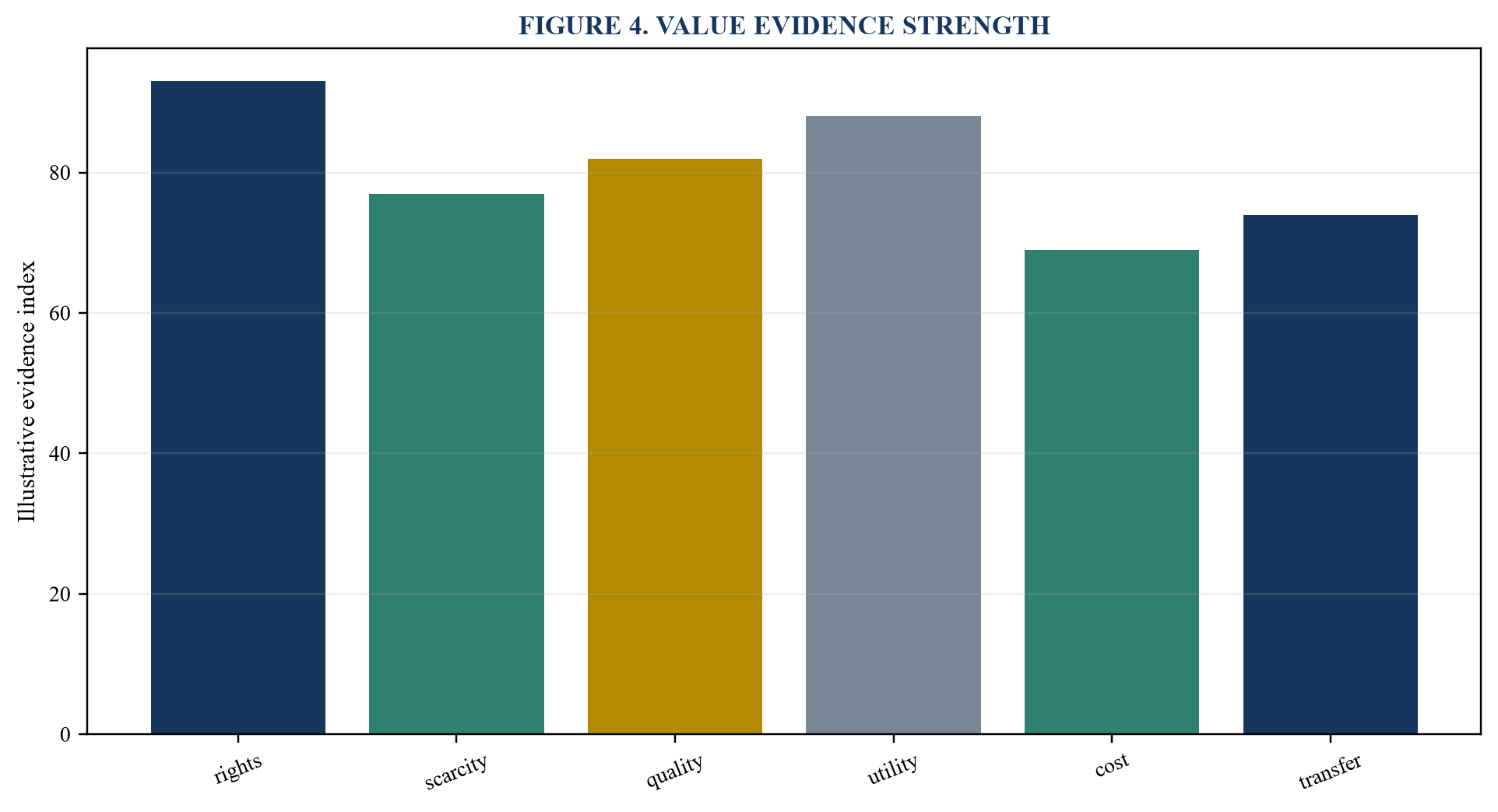
Values are illustrative evidence indices and require company-specific support.
33. Test trade-secret controls
Review secrecy, access, contracts, monitoring, employee practices and incident response.
The controlled record should identify the relevant customer, revenue stream, contract, cohort, relationship owner, commercial dependency, evidence source, baseline, trend, scenario, control, exception, accountable executive, deadline and approval. The immediate deliverable is a trade-secret control file.
The principal failure occurs when claimed secrecy lacks reasonable protective measures. Reviewers should connect the evidence to revenue durability, gross margin, cash conversion, renewal probability, switching behaviour, counterparty credit and transaction value; distinguish contractual protection from observed customer behaviour; and test whether the conclusion survives a downside scenario.
The decision pack for test trade-secret controls should state the commercial question, measurement perimeter, historical evidence, customer-specific facts, forecast logic, sensitivity, management action, buyer implication, residual uncertainty and next gate. Material exceptions should flow into the valuation model, quality-of-earnings work, diligence room, sale-process narrative, transaction protections and board reporting.
34. Assess regulatory change
Model consent withdrawal, access rights, deletion, portability, AI restrictions and sector rules.
The controlled record should identify the relevant customer, revenue stream, contract, cohort, relationship owner, commercial dependency, evidence source, baseline, trend, scenario, control, exception, accountable executive, deadline and approval. The immediate deliverable is a regulatory scenario matrix.
The principal failure occurs when future cash assumes today’s permissions persist. Reviewers should connect the evidence to revenue durability, gross margin, cash conversion, renewal probability, switching behaviour, counterparty credit and transaction value; distinguish contractual protection from observed customer behaviour; and test whether the conclusion survives a downside scenario.
The decision pack for assess regulatory change should state the commercial question, measurement perimeter, historical evidence, customer-specific facts, forecast logic, sensitivity, management action, buyer implication, residual uncertainty and next gate. Material exceptions should flow into the valuation model, quality-of-earnings work, diligence room, sale-process narrative, transaction protections and board reporting.
35. Analyse transaction transferability
Verify assignability, consents, separation, migration, transitional services and buyer purpose.
The controlled record should identify the relevant customer, revenue stream, contract, cohort, relationship owner, commercial dependency, evidence source, baseline, trend, scenario, control, exception, accountable executive, deadline and approval. The immediate deliverable is a transferability close plan.
The principal failure occurs when data cannot move with the deal as assumed. Reviewers should connect the evidence to revenue durability, gross margin, cash conversion, renewal probability, switching behaviour, counterparty credit and transaction value; distinguish contractual protection from observed customer behaviour; and test whether the conclusion survives a downside scenario.
The decision pack for analyse transaction transferability should state the commercial question, measurement perimeter, historical evidence, customer-specific facts, forecast logic, sensitivity, management action, buyer implication, residual uncertainty and next gate. Material exceptions should flow into the valuation model, quality-of-earnings work, diligence room, sale-process narrative, transaction protections and board reporting.
36. Separate standalone and buyer-specific value
Identify synergies from buyer distribution, models, rights and complementary datasets.
The controlled record should identify the relevant customer, revenue stream, contract, cohort, relationship owner, commercial dependency, evidence source, baseline, trend, scenario, control, exception, accountable executive, deadline and approval. The immediate deliverable is a standalone-to-synergy bridge.
The principal failure occurs when strategic value is presented as universal fair value. Reviewers should connect the evidence to revenue durability, gross margin, cash conversion, renewal probability, switching behaviour, counterparty credit and transaction value; distinguish contractual protection from observed customer behaviour; and test whether the conclusion survives a downside scenario.
The decision pack for separate standalone and buyer-specific value should state the commercial question, measurement perimeter, historical evidence, customer-specific facts, forecast logic, sensitivity, management action, buyer implication, residual uncertainty and next gate. Material exceptions should flow into the valuation model, quality-of-earnings work, diligence room, sale-process narrative, transaction protections and board reporting.
37. Design contingent consideration
Link deferred price to auditable rights, quality, utility, revenue and transfer milestones.
The controlled record should identify the relevant customer, revenue stream, contract, cohort, relationship owner, commercial dependency, evidence source, baseline, trend, scenario, control, exception, accountable executive, deadline and approval. The immediate deliverable is a data-value earnout architecture.
The principal failure occurs when earnouts reward data volume without usable rights. Reviewers should connect the evidence to revenue durability, gross margin, cash conversion, renewal probability, switching behaviour, counterparty credit and transaction value; distinguish contractual protection from observed customer behaviour; and test whether the conclusion survives a downside scenario.
The decision pack for design contingent consideration should state the commercial question, measurement perimeter, historical evidence, customer-specific facts, forecast logic, sensitivity, management action, buyer implication, residual uncertainty and next gate. Material exceptions should flow into the valuation model, quality-of-earnings work, diligence room, sale-process narrative, transaction protections and board reporting.
38. Run reverse stress tests
Identify rights, scarcity, quality, utility and cost thresholds that eliminate value.
The controlled record should identify the relevant customer, revenue stream, contract, cohort, relationship owner, commercial dependency, evidence source, baseline, trend, scenario, control, exception, accountable executive, deadline and approval. The immediate deliverable is a reverse-stress dashboard.
The principal failure occurs when downside stops before the data moat disappears. Reviewers should connect the evidence to revenue durability, gross margin, cash conversion, renewal probability, switching behaviour, counterparty credit and transaction value; distinguish contractual protection from observed customer behaviour; and test whether the conclusion survives a downside scenario.
The decision pack for run reverse stress tests should state the commercial question, measurement perimeter, historical evidence, customer-specific facts, forecast logic, sensitivity, management action, buyer implication, residual uncertainty and next gate. Material exceptions should flow into the valuation model, quality-of-earnings work, diligence room, sale-process narrative, transaction protections and board reporting.
39. Build the valuation record
Document evidence, methods, assumptions, sensitivities, specialists and approvals.
The controlled record should identify the relevant customer, revenue stream, contract, cohort, relationship owner, commercial dependency, evidence source, baseline, trend, scenario, control, exception, accountable executive, deadline and approval. The immediate deliverable is a valuation committee file.
The principal failure occurs when the conclusion cannot be reproduced. Reviewers should connect the evidence to revenue durability, gross margin, cash conversion, renewal probability, switching behaviour, counterparty credit and transaction value; distinguish contractual protection from observed customer behaviour; and test whether the conclusion survives a downside scenario.
The decision pack for build the valuation record should state the commercial question, measurement perimeter, historical evidence, customer-specific facts, forecast logic, sensitivity, management action, buyer implication, residual uncertainty and next gate. Material exceptions should flow into the valuation model, quality-of-earnings work, diligence room, sale-process narrative, transaction protections and board reporting.
40. Close through evidence gates
Require verified rights, scarcity, utility, replacement economics, transferability and approved value ranges.
The controlled record should identify the relevant customer, revenue stream, contract, cohort, relationship owner, commercial dependency, evidence source, baseline, trend, scenario, control, exception, accountable executive, deadline and approval. The immediate deliverable is a data-asset valuation close certificate.
The principal failure occurs when transaction narrative substitutes for evidence. Reviewers should connect the evidence to revenue durability, gross margin, cash conversion, renewal probability, switching behaviour, counterparty credit and transaction value; distinguish contractual protection from observed customer behaviour; and test whether the conclusion survives a downside scenario.
The decision pack for close through evidence gates should state the commercial question, measurement perimeter, historical evidence, customer-specific facts, forecast logic, sensitivity, management action, buyer implication, residual uncertainty and next gate. Material exceptions should flow into the valuation model, quality-of-earnings work, diligence room, sale-process narrative, transaction protections and board reporting.
Table 5. Valuation close
| Outcome | Measure | Evidence |
|---|---|---|
| rights | permitted use | legal file |
| scarcity | replication barrier | market test |
| utility | incremental outcome | evaluation |
| value | approved range | committee record |
Illustrative analytical design; company-specific evidence and professional advice govern.
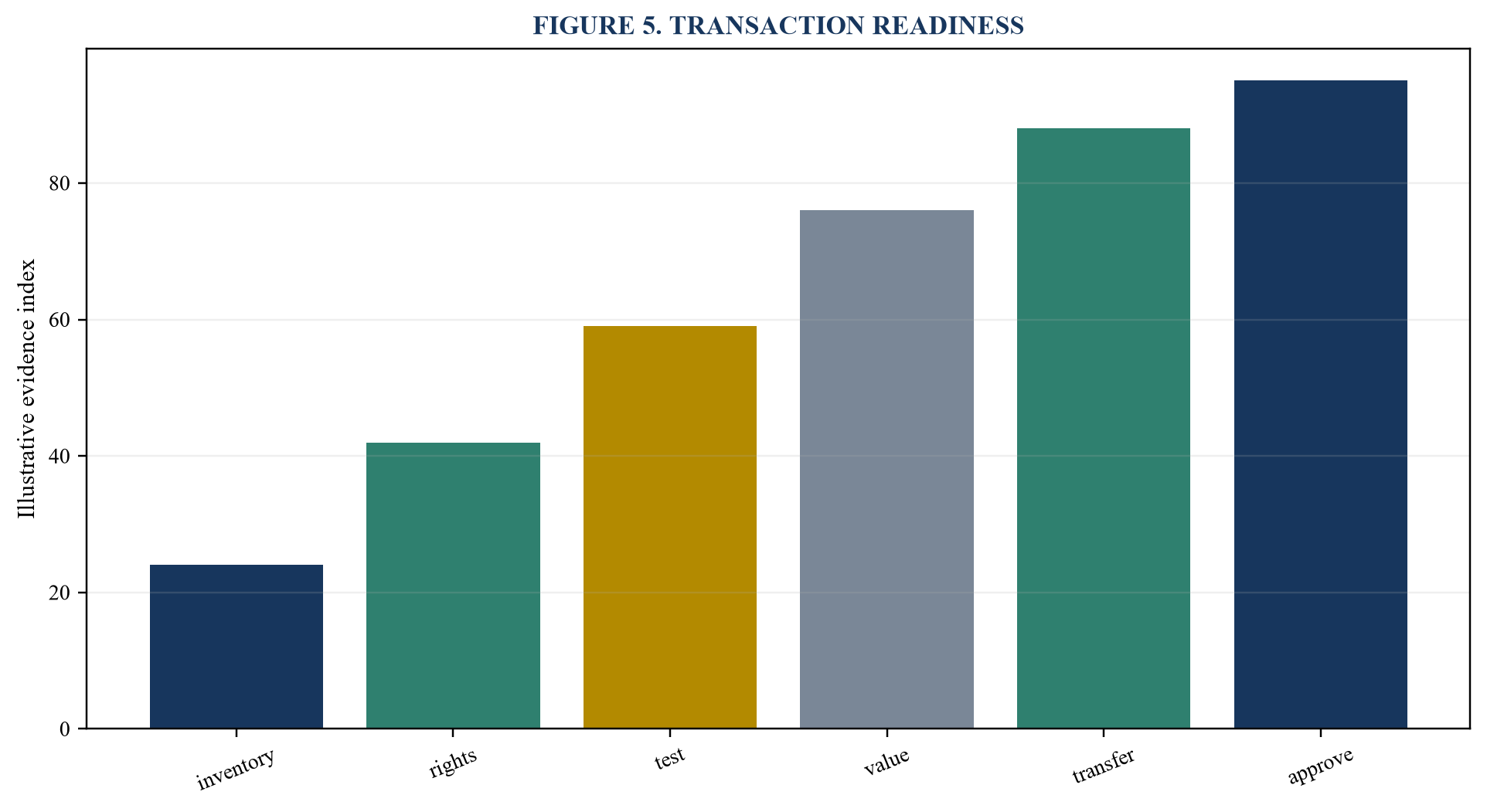
Values are illustrative evidence indices and require company-specific support.
References
- International Valuation Standards Council, International Valuation Standards, https://ivsc.org/standards/
- International Valuation Standards Council, IVS 210 Intangible Assets, https://ivsc.org/new-edition-of-the-international-valuation-standards-ivs-published/
- IFRS Foundation, IAS 38 Intangible Assets, https://www.ifrs.org/issued-standards/list-of-standards/ias-38-intangible-assets/
- IFRS Foundation, Intangible Assets project, https://www.ifrs.org/projects/work-plan/intangible-assets/
- IFRS Foundation, IFRS 3 Business Combinations, https://www.ifrs.org/issued-standards/list-of-standards/ifrs-3-business-combinations/
- OECD, Measuring data as an asset, https://www.oecd.org/en/publications/measuring-data-as-an-asset_b840fb01-en.html
- OECD, Recommendation on Enhancing Access to and Sharing of Data, https://legalinstruments.oecd.org/en/instruments/OECD-LEGAL-0463
- WIPO, Frequently Asked Questions on Trade Secrets, https://www.wipo.int/en/web/trade-secrets/tradesecrets_faqs
- WIPO, Guide to Trade Secrets and Innovation, https://www.wipo.int/publications/en/details.jsp?id=4748
- WIPO, Trade secrets and digital objects, https://www.wipo.int/web-publications/wipo-guide-to-trade-secrets-and-innovation/en/part-vii-trade-secrets-and-digital-objects.html
- WIPO, Protection of Non-Original Databases, https://www.wipo.int/en/web/copyright/activities/databases
- WIPO, WIPO Lex, https://www.wipo.int/en/web/wipolex
- European Union, General Data Protection Regulation, https://eur-lex.europa.eu/eli/reg/2016/679/oj
- European Union, Data Act, https://eur-lex.europa.eu/eli/reg/2023/2854/oj
- European Union, Data Governance Act, https://eur-lex.europa.eu/eli/reg/2022/868/oj
- European Union, Database Directive, https://eur-lex.europa.eu/eli/dir/1996/9/oj
- UK Information Commissioner's Office, Guide to data protection, https://ico.org.uk/for-organisations/uk-gdpr-guidance-and-resources/
- UK Government, Data Protection Act 2018, https://www.legislation.gov.uk/ukpga/2018/12/contents
- NIST, Privacy Framework, https://www.nist.gov/privacy-framework
- NIST, Cybersecurity Framework 2.0, https://www.nist.gov/cyberframework
- NIST, Artificial Intelligence Risk Management Framework, https://www.nist.gov/itl/ai-risk-management-framework
- ISO, ISO/IEC 27001 Information security management systems, https://www.iso.org/standard/27001
- ISO, ISO/IEC 42001 Artificial intelligence management system, https://www.iso.org/standard/81230.html
- European Commission, AI Act regulatory framework, https://digital-strategy.ec.europa.eu/en/policies/regulatory-framework-ai
- US Federal Trade Commission, Data security guidance, https://www.ftc.gov/business-guidance/privacy-security/data-security
- PCAOB, Auditing Accounting Estimates, Including Fair Value Measurements, https://pcaobus.org/oversight/standards/auditing-standards/details/AS2501
