
Introduction
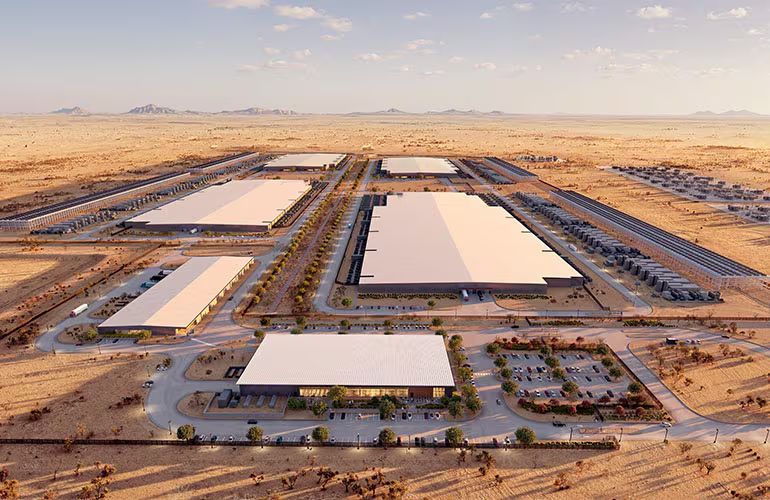
The artificial intelligence boom has created, for the allocator, a new real-asset class. Data centers, the facilities that house the computation on which AI runs, have moved from a niche technical asset to a substantial investment opportunity, as the AI boom drives demand for capacity and as the contracted, income-producing nature of well-let facilities makes them attractive to investors seeking real-asset exposure. For GCC family offices and institutional investors seeking to deploy capital into real assets, data centers represent a new and growing opportunity, and this paper makes the investment case for them as an asset class.
A companion paper examined the financing of data centers from the developer and lender perspective; this paper addresses the allocator perspective, asking whether and how a GCC investor should allocate to data centers as an asset class. The two perspectives are complementary: the financing paper concerns how data centers are funded, while this paper concerns how an investor accesses them as an investment, and together they cover the asset from both the financing and the investment angles.
The central argument is that data centers offer an attractive combination of contracted income, capital growth and low cyclical correlation, but that they carry distinctive risks, technology obsolescence and power dependence, that distinguish them from conventional real assets and that an allocator must understand and price. The investment case is strong for an allocator that can access quality, well-contracted assets and that understands the distinctive risks; it is weaker for an allocator that accesses poor assets or misjudges the risks. The paper develops the framework for an allocator to assess and access the asset class.
The figures used throughout are indicative, calibrated to observable GCC conditions in early 2026 but not drawn from any specific transaction. The paper proceeds from the position of data centers in the real-asset spectrum (Section 2), through the forms of investment (Section 3), the return drivers (Section 4), the distinctive risks (Section 5), the allocator framework (Section 6), portfolio fit (Section 7), the operator and manager perspective (Section 8), GCC-specific considerations (Section 9), three case studies (Section 10), sensitivity analysis (Section 11), an international comparison (Section 12), common errors (Section 13), an implementation roadmap (Section 14), a strategic perspective (Section 15), a conclusion (Section 16) and limitations (Section 17).
The Return Drivers
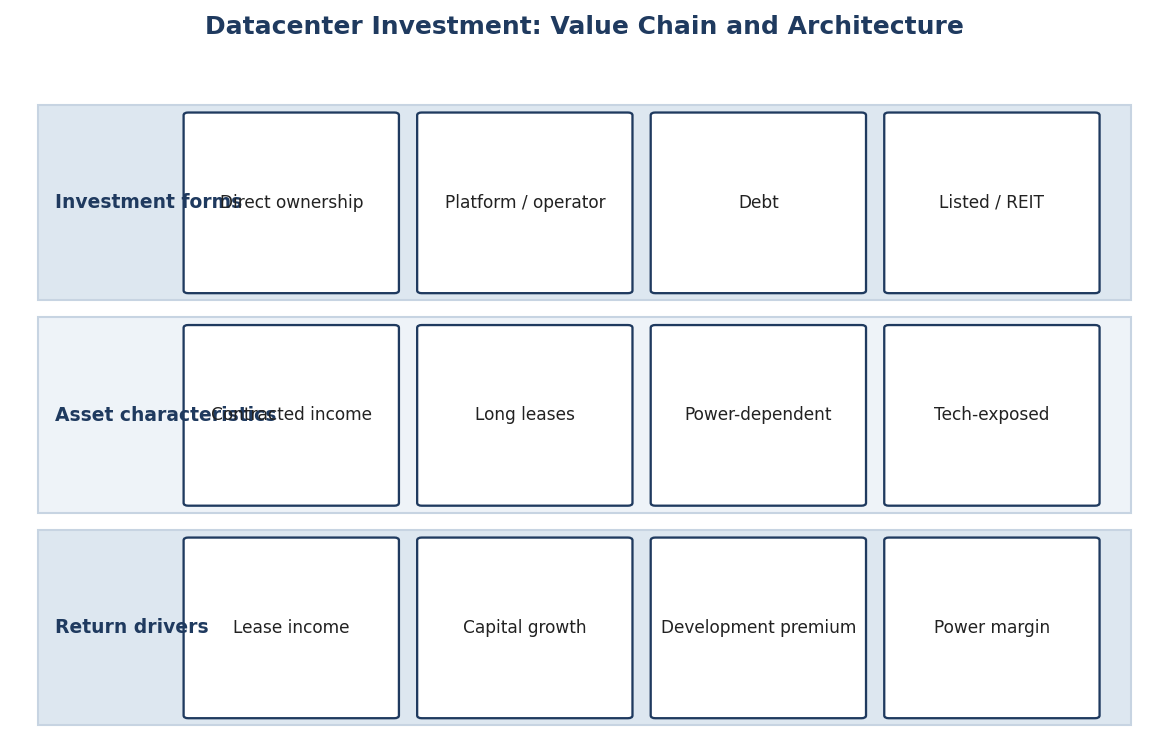
The return from a data center investment is driven by several factors, illustrated in the architecture, principally the lease income, the capital growth, the development premium, and, where relevant, the power margin. The lease income, from the contracted payments of the tenants, provides the stable, recurring return that underpins the investment, much as rental income underpins a real estate investment. The capital growth, driven by the rising value of capacity as AI demand grows, provides the appreciation that adds to the income return.
The development premium, available to an allocator that invests in the development of facilities rather than buying stabilised ones, provides the additional return that compensates for taking the development risk, much as development provides a premium in real estate. The power margin, available where the data center investment includes a power advantage, such as access to cheap power or on-site generation, provides an additional return from the power dimension that is distinctive to the asset. These return drivers combine to give the data center investment its total return, and the mix varies with the form of investment and the asset.
The relative importance of the return drivers depends on the form of investment and the asset stage. A stabilised, well-let facility derives most of its return from the lease income, with modest capital growth; a development platform derives more from the development premium and the capital growth; and an investment with a power advantage derives an additional return from the power margin. An allocator should understand which return drivers its investment relies on, because they carry different risks and require different capabilities, and the mix of return drivers shapes the risk and return profile of the investment. The return drivers, and their mix, are central to assessing a data center investment.
The Distinctive Risks
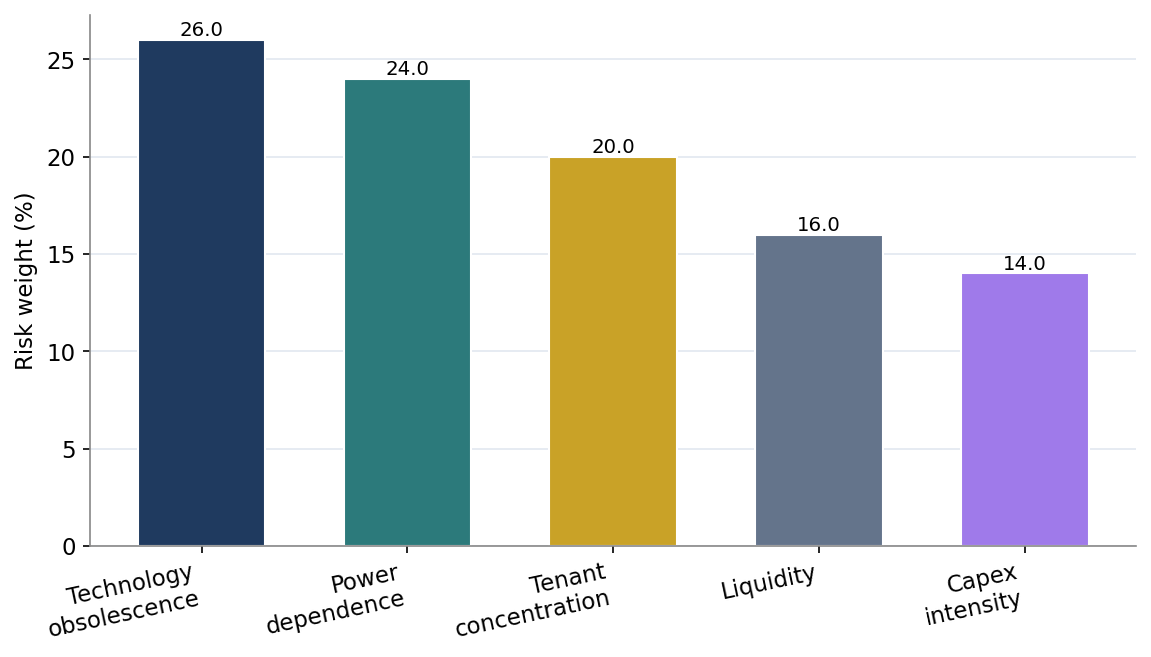
Data centers carry distinctive risks that an allocator must understand, illustrated in Figure 3. The foremost is the technology-obsolescence risk, the risk that the facility becomes outdated as compute technology evolves, which is distinctive to the asset and central, because unlike a conventional building a data center houses rapidly-evolving technology and may have a shorter economic life. The power-dependence risk, the risk that the facility cannot secure the reliable, affordable power it requires, is distinctive and central given the enormous power that AI data centers consume.
Figure 3. Data Center Investment Risks by Weight
The tenant-concentration risk, where a facility depends on a single or few large tenants, is significant for the hyperscaler-let facilities that dominate the sector, because the loss of a single tenant could materially impair the income. The liquidity risk, that data centers are illiquid and hard to sell quickly, applies to direct ownership, and the capex-intensity risk, that data centers require ongoing capital expenditure to remain current, reflects the technology evolution. These risks distinguish data centers from conventional real assets, and an allocator must assess and price them as part of the investment.
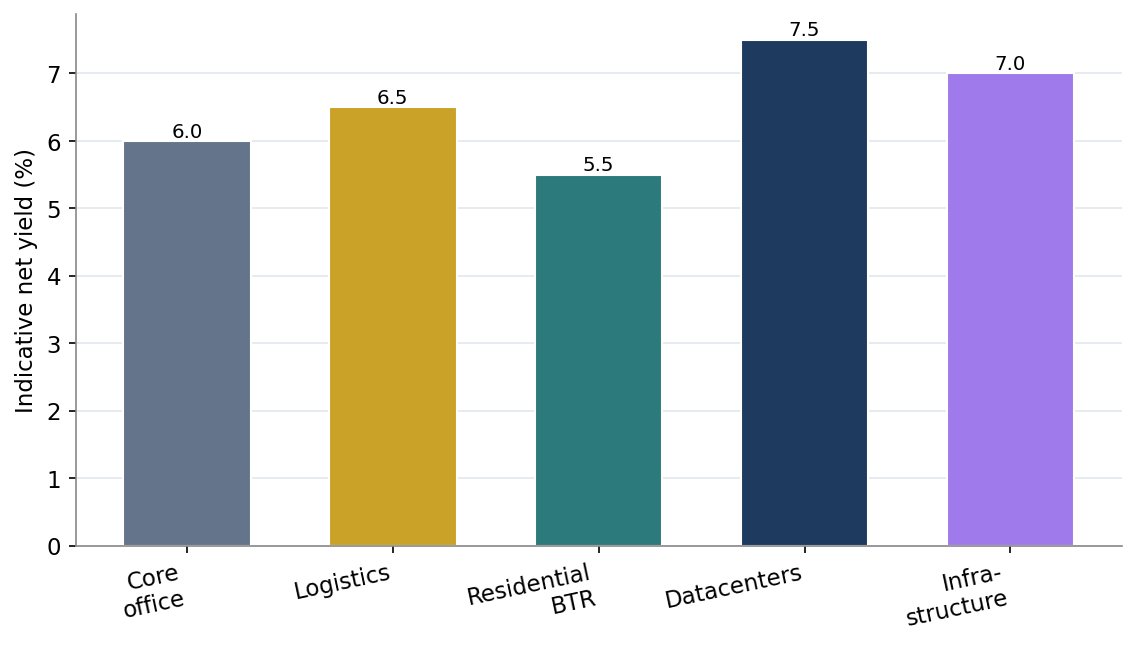
The distinctive risks, particularly the obsolescence and power risks, are what an allocator must understand to assess the asset class correctly. An allocator that treats a data center as a conventional, long-life, low-maintenance real estate asset misjudges these risks, assuming a stability the asset does not have; an allocator that understands the obsolescence and power risks prices them correctly and invests with realistic expectations. The distinctive risks are the reason data centers offer a higher yield than conventional real estate, compensating for the additional risk, and an allocator that understands this prices the asset correctly rather than being surprised by the risks.
The Allocator Framework
The framework for an allocator considering data centers is to match the form of investment to its objectives and capabilities, and to assess the asset distinctive risks. An allocator seeking stable income, able to assess and hold illiquid assets, and comfortable with the concentration and obsolescence risks, may invest directly in stabilised, well-let facilities. An allocator seeking growth, willing to take development and operating risk, and able to assess a platform, may invest in a data center platform or operator. An allocator seeking yield with lower risk may invest in data center debt, and one seeking liquidity in listed exposure.
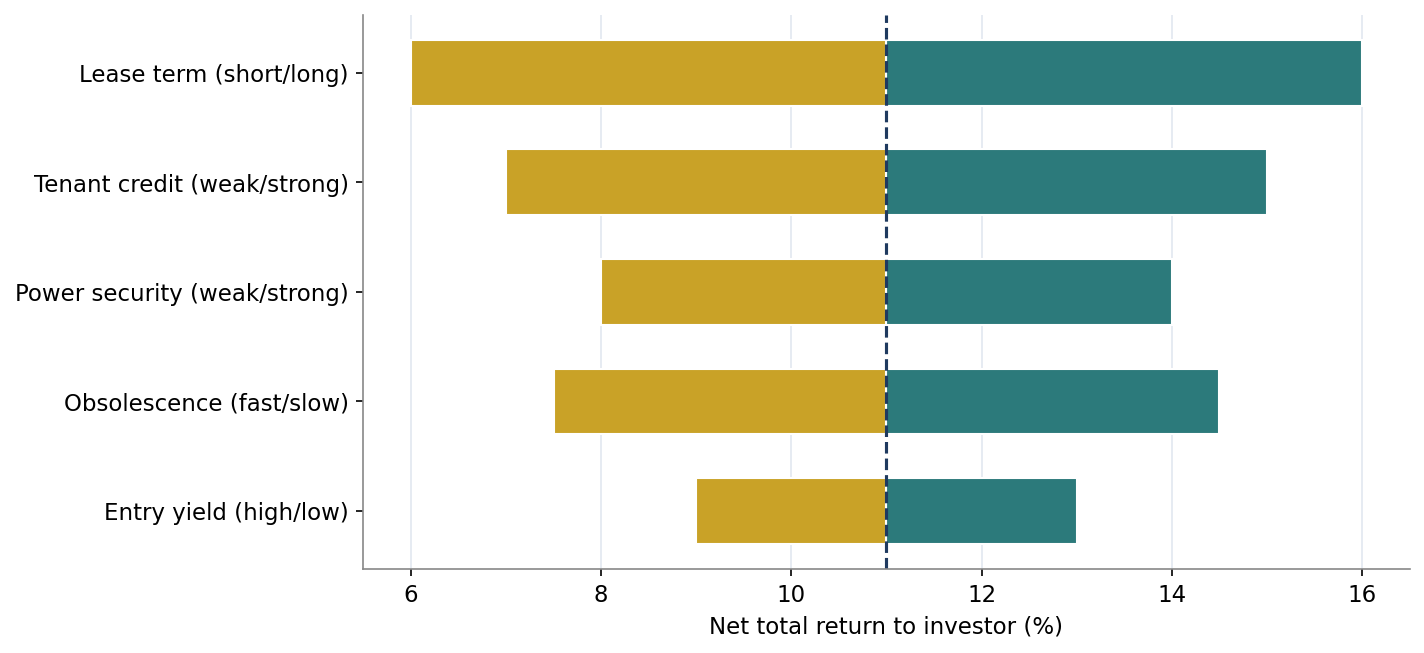
The framework requires the allocator to assess the distinctive risks for each investment. For a direct investment in a stabilised facility, the allocator assesses the tenant credit and lease term, the power security, and the obsolescence risk, since these determine the income stability and the asset durable value. For a platform investment, the allocator assesses the operator capability and the development pipeline. For debt, it assesses the offtake and the security, as the financing paper examined. The risk assessment, focused on the distinctive obsolescence and power risks, is central to the framework, and an allocator that assesses these risks well can invest in the asset class with realistic expectations.
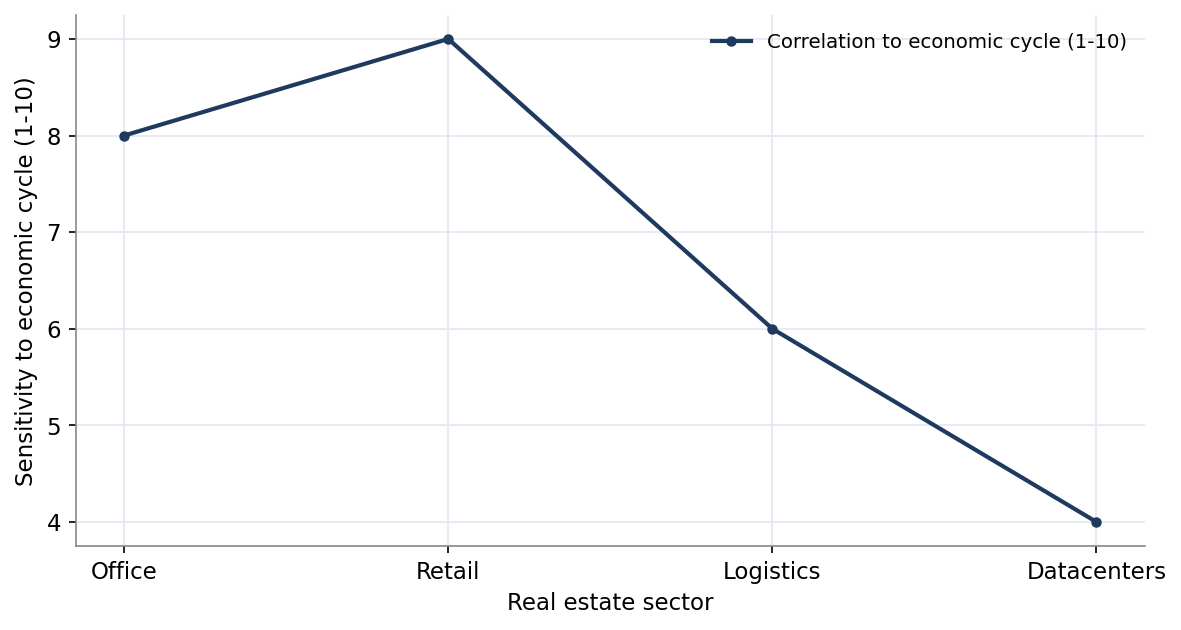
The framework also weighs the data center allocation within the allocator broader portfolio, considering its fit, its diversification benefit, and the appropriate allocation size. Data centers, with their growth, contracted income and low cyclical correlation, can play a valuable role in a real-asset portfolio, providing growth and diversification, but their distinctive risks and their illiquidity argue for a measured allocation rather than an outsized one. The framework, considering the form, the risks and the portfolio fit, guides the allocator to an appropriate, well-assessed allocation to the asset class, which the portfolio-fit section develops.
Considerations Specific to the GCC
The GCC offers distinctive advantages for data center investment, complementing those for data center financing. The region cheap power, the largest operating cost, supports the profitability and the power margin of regional data centers, enhancing the return. The region sovereign backing and technology strategies foster the buildout and provide both demand and capital. And the region capital, both sovereign and private, can be deployed into the asset class, giving regional allocators access to a domestic opportunity in a strategically-favoured sector.
For a GCC allocator, investing in regional data centers offers exposure to a strategically-favoured, growing sector in its home region, with the advantages of cheap power and sovereign backing, and the familiarity of a domestic investment. The regional allocator can access the asset class through direct investment, platforms, debt or listed exposure, and it can participate in the region strategic buildout while earning an attractive return. The alignment of the asset class with the region strategic priorities, and the region structural advantages, make it a particularly attractive opportunity for regional allocators.
The power dimension is, as in the financing, both an advantage and a consideration for the regional allocator. The cheap power enhances the return, but the enormous power demand of AI data centers and the questions of power allocation and grid capacity, examined in the financing paper, affect the asset and its value. A regional allocator should understand the power dimension, the advantage it provides and the constraint it may become, as part of assessing its data center investments. The compliant dimension also applies, with Shariah-compliant data center investment available for the compliant capital, broadening the access to the asset class for regional allocators.
Indicative Case Studies
Three indicative cases show data center investment in action. The figures are synthetic and constructed for analytical clarity, not drawn from any specific transaction.
Case A: direct stabilised investment
Case A is an allocator that invests directly in a stabilised, well-let data center under a long offtake from a creditworthy hyperscaler, seeking stable, contracted income. The investment provides a stable income return from the contracted lease, with modest capital growth, suiting an income-focused allocator able to hold the illiquid asset and comfortable with the concentration and obsolescence risks. The case illustrates the income-focused direct investment, providing stable contracted income at a moderate return and risk.
Case B: development platform
Case B is an allocator that invests in a data center development platform, taking exposure to the development and operation of new facilities, seeking growth. The investment provides a higher return, from the development premium and the capital growth, at a higher risk, taking the development and operating risk through the platform, suiting a growth-focused allocator willing to take the risk and able to assess the platform. The case illustrates the growth-focused platform investment, providing a higher return at a higher risk.
Case C: listed exposure
Case C is an allocator that invests in listed data center companies or trusts, seeking liquid, diversified exposure to the sector without direct ownership. The investment provides liquid exposure to the sector growth and income, diversified across the companies or trusts holdings, suiting an allocator seeking liquidity and diversified exposure without the illiquidity and concentration of direct ownership. The case illustrates the liquid listed exposure, providing diversified sector exposure with liquidity.
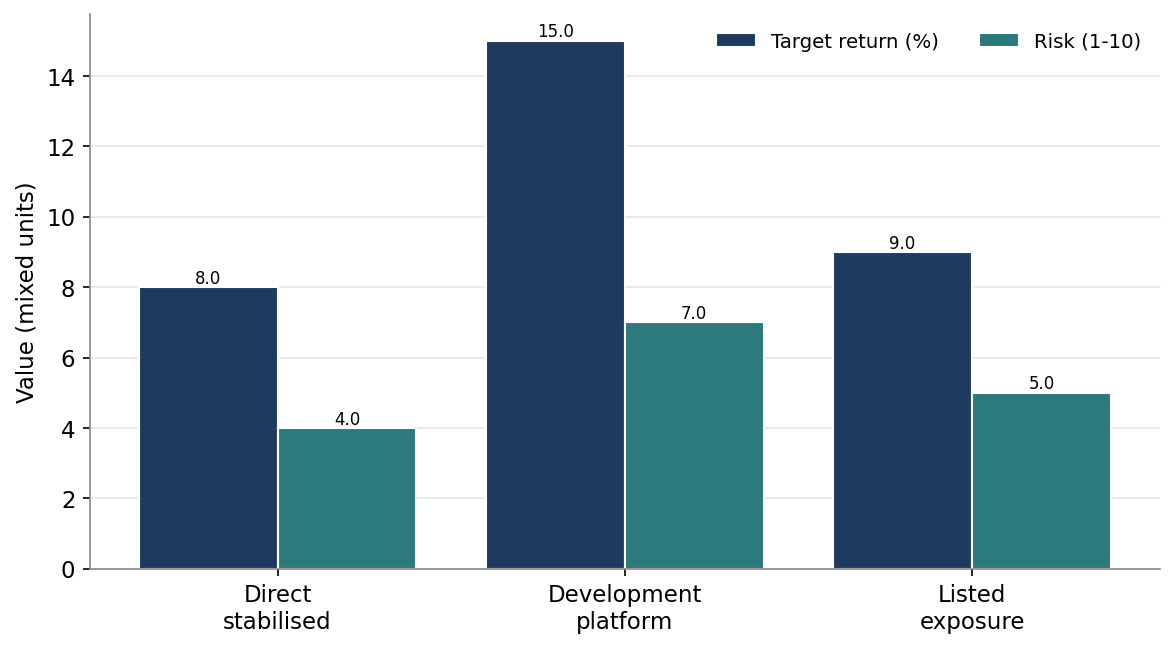
Figure 5. Target Return and Risk by Investment Form
Synthetic figures for analytical comparison. Risk on a 1-10 scale. Not a forecast.
Figure 5 compares the three cases on the target return and risk. The direct stabilised investment offers a moderate return at lower risk; the development platform a higher return at higher risk; and the listed exposure a moderate return with liquidity. The comparison illustrates the range of forms and their risk-return profiles, allowing an allocator to choose the form that suits its objectives, and to combine the forms, holding stabilised assets for income, platforms for growth, and listed exposure for liquidity, in a diversified data center allocation.
International Comparison
Data centers have become an established institutional asset class in the United States and Europe, where large allocators, including pension funds, sovereign funds and specialist managers, have built substantial data center portfolios, and where listed data center trusts provide liquid exposure. The asset class is well understood in these markets, with established forms of investment, return expectations and risk frameworks, and the GCC market can draw on this established international practice as it develops its own data center investment.
The international experience confirms the investment case and highlights the risks. It shows that data centers can provide attractive, diversifying returns for allocators, that the contracted-income, growth and low-cyclical-correlation combination is genuine and valuable, and that the distinctive risks, particularly obsolescence and power, are real and must be managed. It also shows that the asset class has attracted substantial institutional capital, validating it as an institutional asset class, and that the leading allocators access it through capable operators and managers. As the GCC market develops, regional allocators can follow the international example, accessing the asset class through capable operators and managers and managing the distinctive risks, while benefiting from the region structural advantages.
Implementation Roadmap
Assess the role data centers would play in the portfolio, their growth, contracted income and diversification benefit, and determine a measured allocation.
Choose the form of investment, direct, platform, debt or listed, to match the allocator objectives and capabilities, and consider combining forms.
Assess the distinctive risks, technology obsolescence and power dependence, and price them into the investment.
Select capable operators or managers with a track record in securing offtakes, arranging power, and managing technology, and align interests with them.
Favour quality, well-let, contracted assets with strong tenants, secure power and current technology.
Leverage the GCC structural advantages, cheap power and sovereign backing, in regional investments, and consider the compliant route.
Size and integrate the allocation within the broader real-asset and portfolio construction, managing the distinctive risks and illiquidity.
Conclusion
The AI boom has created a new real-asset class in data centers, and this paper has made the investment case for them for GCC allocators. Data centers offer an attractive combination of contracted, long-lease income, capital growth driven by AI demand, and low correlation to the economic cycle, making them a valuable growth and diversification element in a real-asset portfolio. But they carry distinctive risks, technology obsolescence and power dependence, that distinguish them from conventional real assets and that an allocator must understand and price.
The investment case is strong for an allocator that can access quality, well-contracted assets through capable operators, and that understands and prices the distinctive risks; it is weaker for one that accesses poor assets or misjudges the risks. For a GCC allocator, the asset class offers the additional appeal of alignment with the region strategic priorities and structural advantages, providing a way to participate in the region strategic AI infrastructure buildout at an attractive return. The frameworks in this paper are intended to help GCC allocators assess and access the data center asset class well, capturing its attractive, diversifying returns while managing its distinctive risks.
Limitations and Directions for Further Research
This paper is framework-oriented and relies on indicative data, and its conclusions are directional rather than precise. The yields, returns and risk weights are calibrated to observable conditions but are not empirical estimates, and the rapidly evolving AI and data center landscape makes them particularly uncertain. The technology-obsolescence risk, central to the asset, is inherently difficult to assess.
Several extensions would strengthen the analysis. An empirical study of data center investment returns and risks across GCC and international markets would replace the indicative figures with data. An analysis of the correlation of data center returns to the economic cycle and to other real assets would sharpen the portfolio-fit and diversification analysis. And a study of the technology-obsolescence experience and its effect on data center values would illuminate the distinctive risk. Each is a natural subject for a later paper in this series.
| Scenario | Lease / tenant | Power & tech | Net total return |
|---|---|---|---|
| Strong | Long, creditworthy | Secure, current | ~16% |
| Base | Solid | Adequate | ~11% |
| Weak | Short / weaker | Strained | ~7% |
| Adverse | Speculative | Obsolescing | ~4% |
