

Introduction
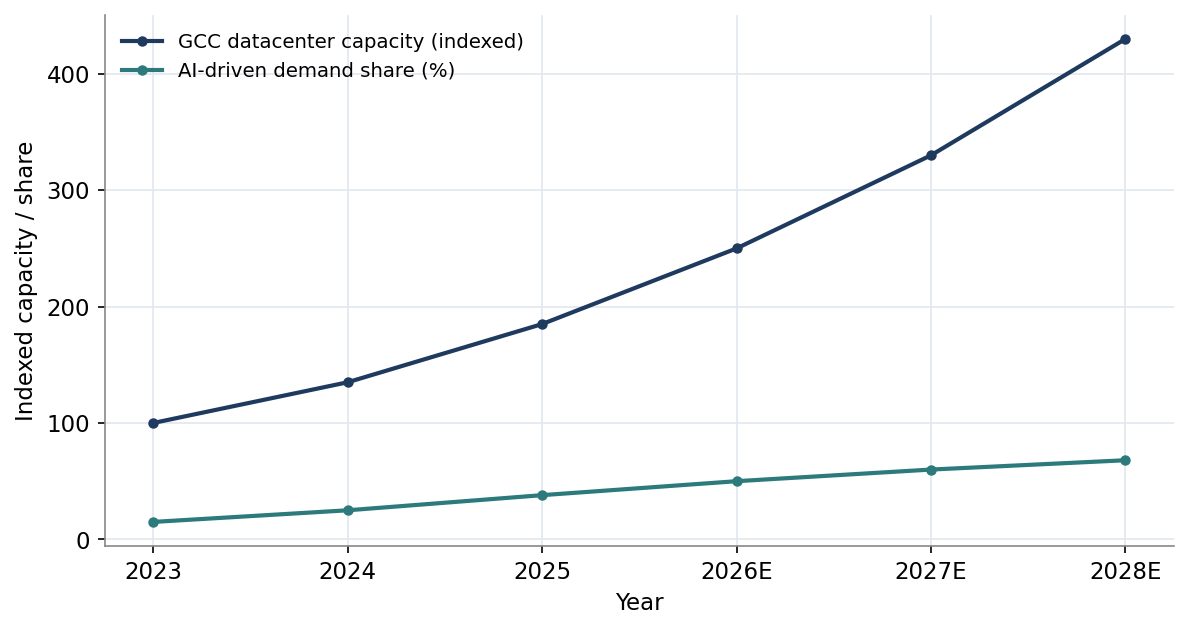
The artificial intelligence boom is, at its foundation, a boom in computation, and computation requires datacenters: vast facilities of servers, power and cooling that house the computing on which AI runs. The demand for AI computation is driving an unprecedented buildout of datacenter capacity worldwide, and the GCC, with its cheap and abundant power, its ambitious national technology strategies, and its capital, is positioning itself as a regional hub for this infrastructure. The buildout requires enormous quantities of capital, and financing it is becoming a significant new segment of regional infrastructure finance.
This paper examines datacenter debt, the project and term financing of these facilities, as a financing opportunity in the GCC. As the region builds datacenter capacity to serve the AI boom, the financing of these facilities, large, long-dated, capital-intensive projects, is emerging as a substantial new market for lenders and investors. Understanding how datacenters are financed, the capital stack, the risks, the role of the offtake contract, is increasingly important for the developers building them, the lenders and investors financing them, and the policymakers fostering the buildout.
The central argument is that datacenter debt is a project-finance discipline in which the strength of the offtake contract, the agreement under which a customer commits to use and pay for the facility, is the principal determinant of the financing, much as in other contracted infrastructure. A facility with a strong, long-term offtake from a creditworthy customer supports substantial, cheap debt; a facility built on speculation, without a committed offtake, supports far less. The GCC structural advantages in power and capital position it well for the buildout, but the asset distinctive risks, power availability and technology obsolescence, must be carefully managed. The paper develops the framework for financing datacenters in the region.
The figures used throughout are indicative, calibrated to observable GCC conditions in early 2026 but not drawn from any specific transaction. The paper proceeds from the demand driving the buildout (Section 2), through the technical and financing architecture (Section 3), the capital stack (Section 4), the risks lenders underwrite (Section 5), the central role of the offtake (Section 6), the financing framework by facility type (Section 7), the lender perspective (Section 8), power and technology risk (Section 9), GCC-specific considerations (Section 10), three case studies (Section 11), sensitivity analysis (Section 12), an international comparison (Section 13), common errors (Section 14), an implementation roadmap (Section 15), a strategic perspective (Section 16), a conclusion (Section 17) and limitations (Section 18).
The Capital Stack
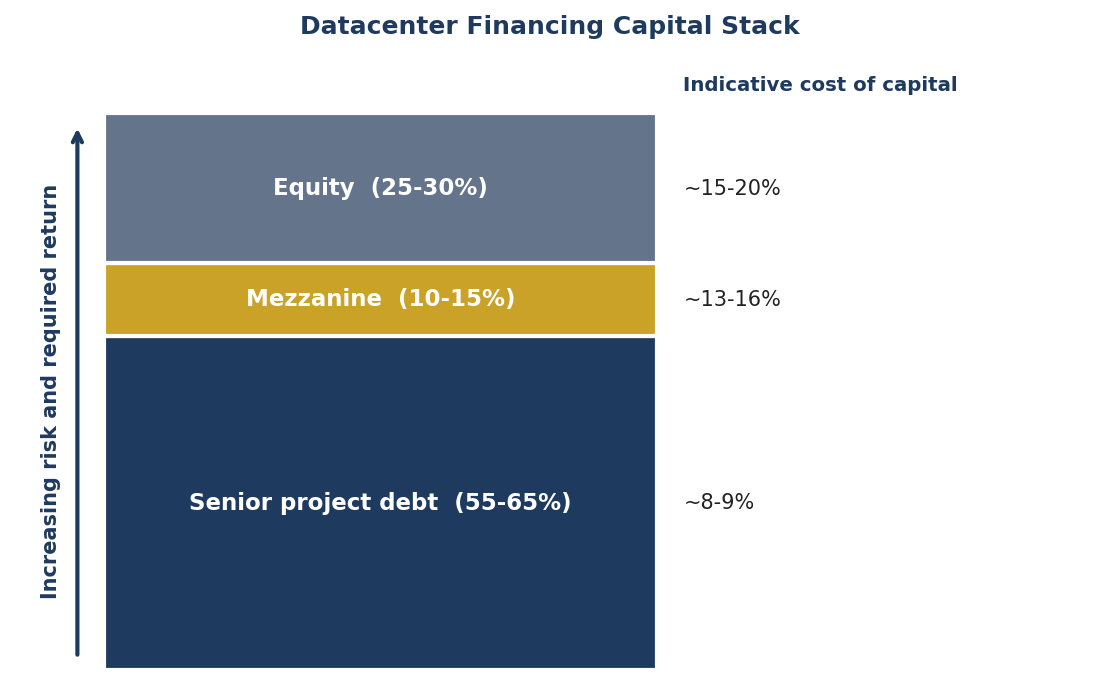
A datacenter is financed through a project-finance capital stack, illustrated in Figure 3, combining senior project debt, mezzanine and equity. The senior project debt funds the bulk of the cost, secured against the facility and supported by the offtake contract, at a cost reflecting the project risk. Mezzanine fills the gap above the senior debt, and equity funds the remainder and bears the first loss. The stack is similar to that of other contracted infrastructure, with the offtake contract supporting the debt much as a power purchase agreement supports a power project.
Figure 3. Datacenter Financing Capital Stack
The loan-to-cost that the senior debt supports depends above all on the strength of the offtake contract, much as the financing of other contracted infrastructure depends on the strength of its offtake. A facility with a strong, long-term offtake from a creditworthy hyperscaler supports a high loan-to-cost, because the contracted revenue reliably services the debt; a facility built on speculation, without a committed offtake, supports a low loan-to-cost or no project debt at all, because the revenue is uncertain. The offtake is therefore the foundation of the capital stack, determining how much debt the facility can support, as the dedicated section explores.
The cost of capital across the stack reflects the project risk and the strength of the offtake. A well-contracted facility, with its risk reduced by the strong offtake, supports cheap senior debt and a moderate equity return; a speculative facility, with its higher risk, supports more expensive debt and demands a higher equity return. The stack is structured to match the capital to the risk, with the senior debt taking the contracted, lower-risk position and the equity taking the residual, higher-risk position. The structuring of the stack, and the loan-to-cost it supports, follows from the offtake and the project risk, as in other project finance.
The Risks Lenders Underwrite
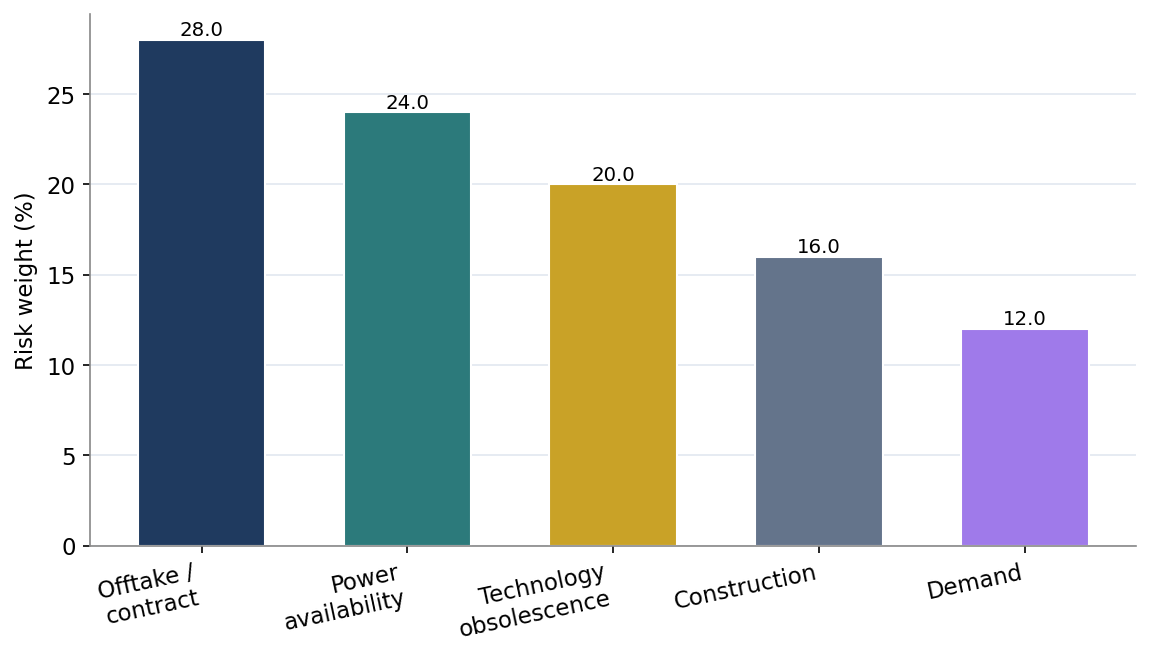
A datacenter lender underwrites a distinctive set of risks, illustrated in Figure 4. The foremost is the offtake or contract risk, the risk that the customer that has contracted for the capacity does not pay or does not renew, which is the principal determinant of the financing. The power risk, the risk that the facility cannot secure the reliable, affordable power it requires, is distinctive to the asset and central, given the enormous power that AI datacenters consume. The technology-obsolescence risk, the risk that the facility becomes outdated as compute technology evolves, is distinctive and growing with the rapid evolution of AI hardware.
Figure 4. Datacenter Project Risks by Weight
The construction risk, the risk that the facility is not built on time and on budget, is common to infrastructure projects, and the demand risk, the risk that the demand the facility was built to serve does not materialise, applies particularly to speculative facilities without a committed offtake. The lender assesses each of these risks, and it structures the financing to mitigate them, through the offtake contract that addresses the contract and demand risks, the power arrangements that address the power risk, and the construction contracts that address the construction risk. The technology-obsolescence risk is the hardest to mitigate and is examined in its own section.
The relative weight of these risks distinguishes datacenter debt from other infrastructure finance. The power risk is far more prominent than in most infrastructure, because of the enormous and rising power consumption of AI datacenters, and the technology-obsolescence risk is distinctive, because unlike a road or a power plant, a datacenter can become technologically outdated. These distinctive risks, power and obsolescence, are what a datacenter lender must particularly understand and manage, and they are what distinguish datacenter debt as a specialist segment of infrastructure finance rather than a routine application of project-finance principles.
The Financing Framework by Facility Type
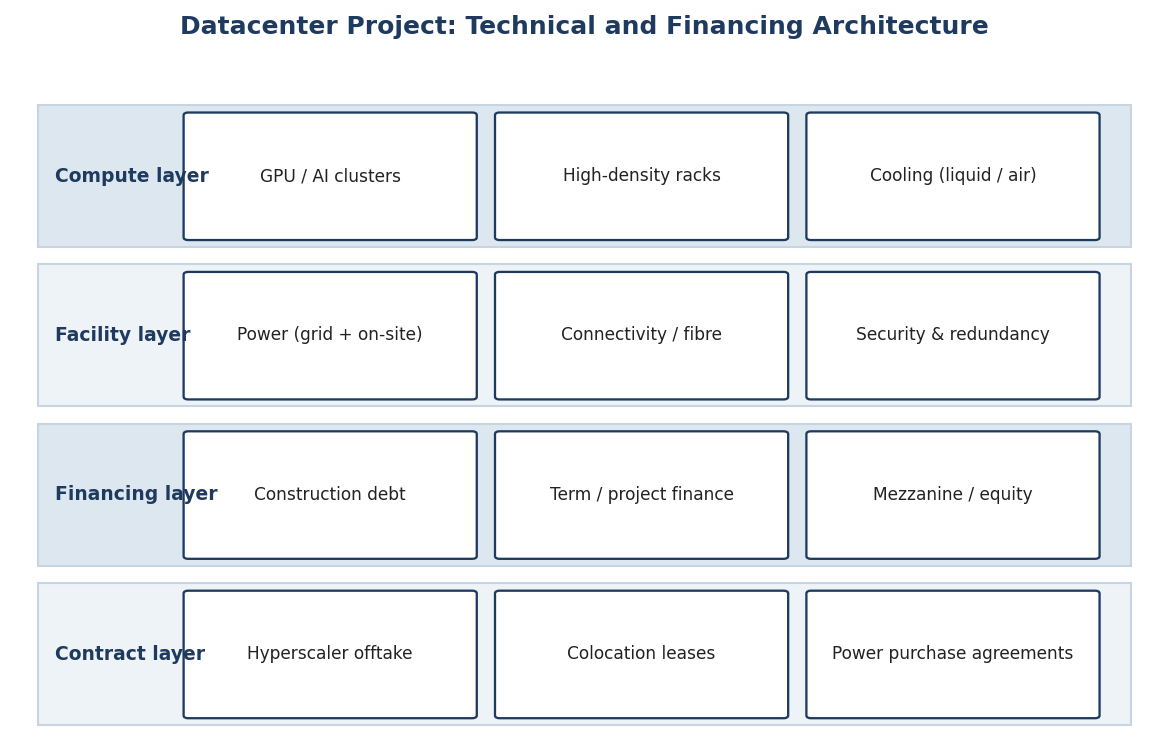
The financing framework distinguishes facility types by their offtake structure. A hyperscaler-contracted facility, built to serve a single large customer under a strong long-term offtake, supports the most and cheapest debt, because its revenue is the most contracted and bankable. A colocation facility, serving multiple customers under shorter leases, supports moderate debt, because its revenue is diversified across customers but less contracted than a single strong offtake. A speculative or edge facility, without a committed offtake, supports the least debt and relies more on equity, because its revenue is uncertain.
The framework matches the financing to the offtake structure of the facility type. The hyperscaler-contracted facility, with its strong single offtake, suits a high-loan-to-cost project financing, much like other contracted infrastructure. The colocation facility, with its diversified but shorter-term revenue, suits a moderate-loan-to-cost financing that reflects the diversification and the shorter contracts. The edge or speculative facility, with its uncertain revenue, suits an equity-heavy financing that takes the demand risk. A developer should understand which type its facility is, and structure its financing accordingly, securing the offtake that supports the debt it seeks.
The framework also reflects the different risk profiles of the facility types. The hyperscaler-contracted facility concentrates its risk in the single customer, so the customer creditworthiness is paramount, while the colocation facility diversifies its risk across customers but takes more demand and renewal risk. The edge or speculative facility takes the full demand risk. A developer and a lender should understand the risk profile of the facility type, the concentration in the contracted facility, the diversification and renewal risk in the colocation, the demand risk in the speculative, and structure the financing to reflect it. The facility type determines both the financing and the risk profile.
Power and Technology Risk
The power risk is distinctive to datacenters and central to their financing, because power is the largest operating cost and the most critical input, and AI datacenters consume enormous and rising quantities of it. A facility that cannot secure reliable, affordable power cannot operate profitably, and the power arrangements, the grid connection, any on-site generation, the power purchase agreements, are therefore central to the financing. The GCC advantage in cheap, abundant power is a significant attraction for datacenter investment, but even in the region the enormous power demand of AI datacenters strains the supply, and securing the power is a central task.
The technology-obsolescence risk is the other distinctive risk, and it is the hardest to manage. Unlike a road or a power plant, which provides the same service for decades, a datacenter houses compute technology that evolves rapidly, and a facility built for one generation of technology may become outdated as new generations require different power, cooling and configuration. This obsolescence risk means a datacenter may have a shorter economic life than other infrastructure, or may require costly refurbishment to remain competitive, and the financing must reflect this through the amortisation, the tenor, and the assessment of the asset durable value.
Managing the technology-obsolescence risk requires the financing to be structured around a realistic view of the asset economic life and the cost of keeping it current. A lender financing a datacenter should not assume the long, stable life of traditional infrastructure, but should reflect the risk that the facility becomes outdated, through a shorter tenor, faster amortisation, and a conservative view of the residual value. The developer, for its part, should design the facility for flexibility, to accommodate evolving technology where possible, and should reflect the refresh cost in its economics. The obsolescence risk is the distinctive challenge of datacenter finance, and managing it well, through realistic economic-life assumptions and flexible design, is central to the discipline.
Indicative Case Studies
Three indicative cases show datacenter financing in action. The figures are synthetic and constructed for analytical clarity, not drawn from any specific transaction.
Case A: hyperscaler-contracted facility
Case A is a datacenter built to serve a single creditworthy hyperscaler under a strong, long-term offtake, which supports a high-loan-to-cost project financing because the contracted revenue reliably services the debt. The financing is structured as contracted infrastructure, with senior project debt supported by the offtake, mezzanine and equity, at a cost reflecting the strong offtake and reduced risk. The case illustrates the strongest financing position, where a strong offtake from a creditworthy customer supports substantial, cheap project debt.
Case B: colocation facility
Case B is a colocation datacenter serving multiple customers under shorter leases, which supports a moderate-loan-to-cost financing reflecting the diversified but less-contracted revenue. The financing reflects the diversification across customers, which reduces the concentration risk, but also the shorter contracts and renewal risk, which increase the revenue uncertainty relative to a single strong offtake. The case illustrates the colocation financing, balancing the diversification benefit against the shorter-contract risk.
Case C: edge facility
Case C is an edge datacenter built closer to users to serve latency-sensitive demand, without a single committed offtake, which supports the least debt and relies more on equity, taking the demand risk. The financing is equity-heavy, reflecting the uncertain revenue and the demand risk, and it suits patient capital willing to take the risk for the higher return. The case illustrates the speculative or edge financing, where the absence of a committed offtake limits the debt and requires equity to take the demand risk.
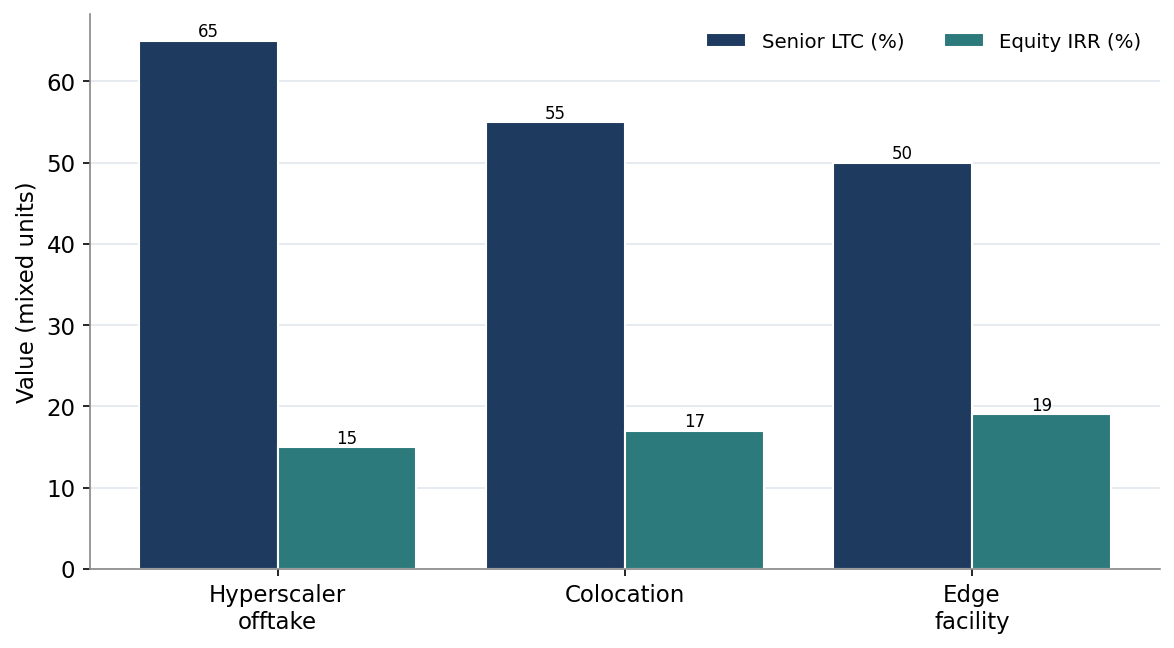
Figure 5. Senior Loan-to-Cost and Equity IRR by Case
Synthetic figures for analytical comparison. Not a forecast.
Figure 5 compares the three cases on the senior loan-to-cost and the equity IRR. The hyperscaler-contracted facility supports the highest loan-to-cost at the lowest equity IRR, reflecting its low risk; the edge facility the lowest loan-to-cost at the highest equity IRR, reflecting its higher risk; and the colocation facility between. The comparison illustrates the central role of the offtake: the stronger and more contracted the revenue, the more debt the facility supports and the lower the equity return, while the more speculative the facility, the less debt and the higher the equity return, reflecting the risk the equity takes.
Sensitivity and Scenario Analysis
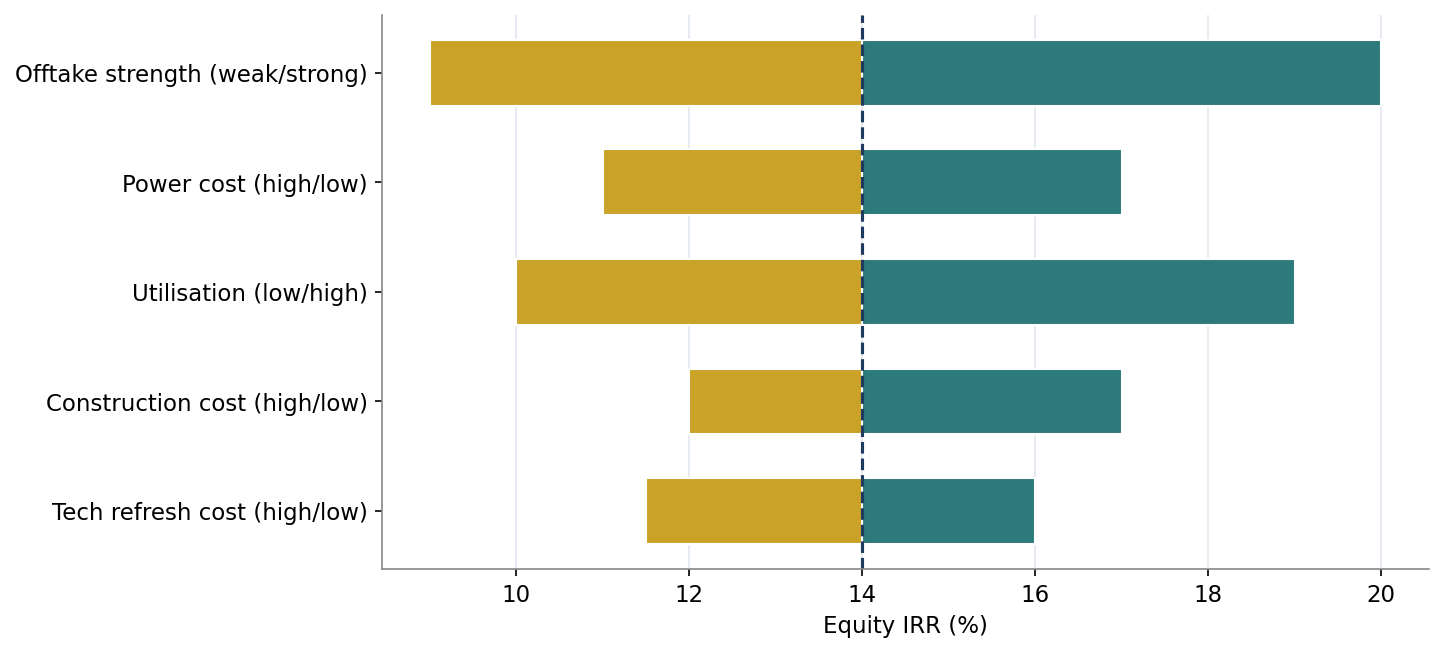
A tornado analysis identifies the variables that most influence the equity IRR of a datacenter project. Figure 6 presents the result.
Figure 6. Sensitivity of Equity IRR to Key Variables
Each bar shows the equity IRR when the labelled variable moves to its low or high case. Dashed line is the base case. Indicative.
The analysis shows that the offtake strength and the utilisation dominate the equity IRR, with the power cost, the construction cost and the technology refresh cost also significant. The prominence of the offtake strength confirms its central role: the offtake determines the revenue, which drives the return, and a strong offtake supports a high return while a weak one depresses it. The utilisation matters because it determines how fully the facility is used and paid for, and the power cost matters because it is the largest operating cost. The sensitivity confirms that the offtake and the operating factors, utilisation and power, drive the return.
Table 2. Scenario Matrix for Equity IRR
Indicative scenarios. Not a forecast.
The scenario matrix shows how the return depends on the offtake and the power cost. The strong scenario, with a long offtake from a creditworthy customer and low power cost, produces an attractive return; the adverse scenario, with a speculative facility and high power cost, produces a poor one. The matrix underlines that the offtake and the power, the two factors most distinctive to and critical for a datacenter, are the principal determinants of the return, and that a developer should focus on securing a strong offtake and affordable, reliable power, which together determine whether the facility earns an attractive return.
Implementation Roadmap
Secure a strong, long-term offtake from a creditworthy customer before seeking project debt, as the offtake is the foundation of the financing.
Arrange reliable, affordable power, through grid connection, power purchase agreements, or on-site generation, as power is the critical input and largest cost.
Structure the financing as contracted infrastructure project finance, with senior debt supported by the offtake, mezzanine and equity.
Reflect the technology-obsolescence risk through realistic economic-life assumptions, appropriate tenor and amortisation, and flexible design.
Match the financing to the facility type, hyperscaler-contracted, colocation, or edge, according to its offtake structure.
Manage the construction risk through appropriate contracts, and the power risk through secure arrangements.
Integrate the project with the region power and renewable strategy where relevant, recognising power as a potential binding constraint.
Strategic Perspective: Infrastructure for the AI Era
Datacenters are the infrastructure of the AI era, as essential to the AI economy as roads and power plants were to the industrial economy, and the GCC positioning itself as a hub for this infrastructure is a strategic bet on its role in the AI economy. The buildout is not merely a financing opportunity but a strategic investment in the region future, providing the computational infrastructure on which the AI economy will run and positioning the region as a provider of this infrastructure to itself and potentially to the wider region. The financing of the buildout is therefore part of a larger strategic endeavour.
For investors and lenders, the datacenter buildout offers a substantial new infrastructure asset class, combining the bankability of contracted infrastructure with the growth of the AI boom, and the GCC structural advantages make it an attractive place to deploy infrastructure capital. The asset class is new and carries the distinctive power and obsolescence risks, but for investors and lenders that understand these risks, it offers an opportunity to participate in the foundational infrastructure of the AI era at attractive returns. The development of datacenter finance in the region is creating a new infrastructure asset class for regional and international capital.
The broader strategic point is that the datacenter buildout connects the region capital, its power, and its technology ambitions in a single strategic endeavour. The region capital funds the buildout, its power runs the facilities, and the facilities serve its technology and AI ambitions, creating a virtuous connection between the region resources and its strategic goals. The financing of the buildout is the mechanism that mobilises the capital, and a region that finances the buildout well, securing the offtakes, the power and the capital, positions itself at the foundation of the AI economy. The strategic prize is significant, and the financing is the means of capturing it.
Conclusion
The AI boom is driving an unprecedented datacenter buildout, and the GCC, with its cheap power, sovereign backing and capital, is positioning itself as a hub. This paper has argued that datacenter debt is a project-finance discipline in which the strength of the offtake contract is the principal determinant of the financing, that the region structural advantages position it well for the buildout, and that the asset distinctive risks, power availability and technology obsolescence, must be carefully managed. A facility with a strong offtake and secure power supports substantial, cheap project debt; one without takes the demand risk and relies on equity.
The buildout is more than a financing opportunity; it is a strategic investment in the infrastructure of the AI era, connecting the region capital, power and technology ambitions. A region that finances the buildout well, securing the offtakes, the power and the capital, and managing the distinctive risks, positions itself at the foundation of the AI economy. For developers, investors and lenders, datacenter debt offers a substantial new infrastructure asset class combining bankability with growth, and the frameworks in this paper are intended to help them finance the buildout well and capture the strategic prize it represents.
Limitations and Directions for Further Research
This paper is framework-oriented and relies on indicative data, and its conclusions are directional rather than precise. The demand, cost and return figures are calibrated to observable conditions but are not empirical estimates, and the rapidly evolving AI and datacenter landscape makes them particularly uncertain. The technology-obsolescence risk, central to the asset, is inherently difficult to assess given the pace of technological change.
Several extensions would strengthen the analysis. An empirical study of GCC datacenter projects, their offtakes, financing and returns, would replace the indicative figures with data. A detailed analysis of the power dimension, the demand, the supply, and the integration with the region energy strategy, would sharpen the treatment of the binding constraint. And a study of the technology-obsolescence experience, how datacenter economic lives are evolving with technology, would illuminate the distinctive risk. Each is a natural subject for a later paper in this series.
| Scenario | Offtake | Power cost | Equity IRR |
|---|---|---|---|
| Strong | Long, creditworthy | Low | ~20% |
| Base | Solid | Moderate | ~14% |
| Weak offtake | Short / weaker | Moderate | ~9% |
| Adverse | Speculative | High | ~5% |
