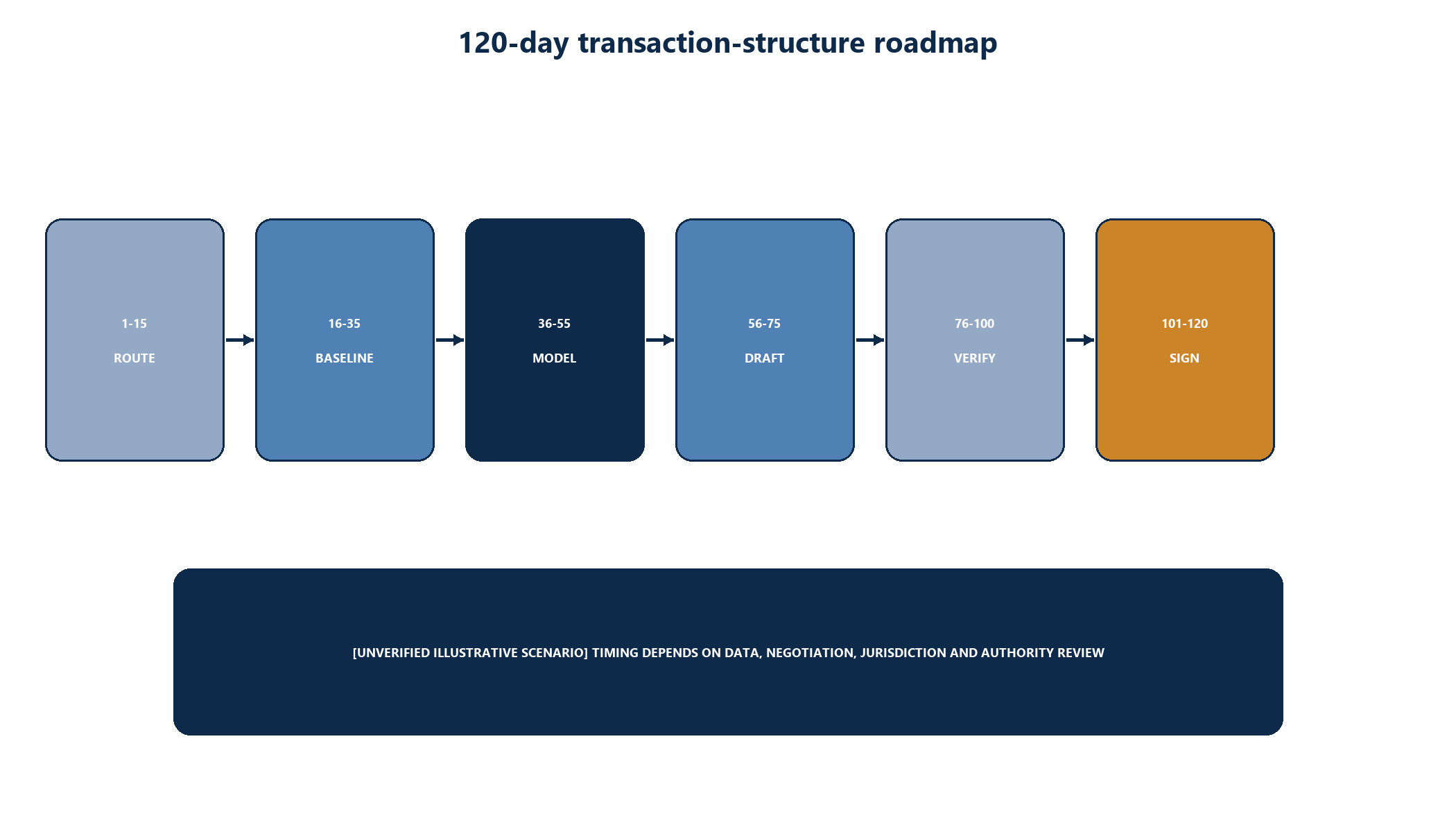
Introduction
Deal value can be agreed before the legal and accounting machinery required to deliver that value is defined. In a Gulf transaction, the parties may sign around a commercial timetable while country-specific competition analysis is incomplete. They may also agree an earnout headline while revenue, EBITDA, accounting policies, operational control and the review mechanism remain open. These two gaps sit on different sides of closing. Merger control can stop or delay completion. An ambiguous earnout can transfer the disagreement into the post-closing period.
No authoritative universal rate of GCC transactions delayed by merger control was identified. No authoritative universal rate of GCC earnout or EBITDA disputes was identified. The paper therefore treats both as transaction-control risks rather than market-wide incidence claims.
The framework uses eight principles:
- route every relevant jurisdiction and sector before fixing the signing-to-closing timetable;
- separate the legal notification test from the commercial assessment of competition risk;
- connect each filing to a condition precedent, cooperation covenant, long-stop date and remedy decision;
- define purchase-price components before using one label for economically different payments;
- treat EBITDA as a contract measure that requires an explicit source and adjustment hierarchy;
- control buyer decisions that can affect post-closing performance during the earnout period;
- give both parties access to a reproducible measurement statement and evidence set; and
- separate accounting-expert questions from legal-interpretation questions in the dispute clause.
The analysis reviews 52 official, primary, academic and scoped professional sources available through 2 August 2026 [1-52]. The source set includes current competition legislation and authority materials, corporate and commercial law, tax guidance, IFRS requirements, DIFC legislation and decisions, peer-reviewed earnout research, and transaction-practice materials. Sources from non-GCC samples inform design questions. They do not establish GCC outcomes.
No approved observed Matchpoint or client evidence was supplied for revenue, cash cost reduction, loss reduction or alpha. Those attributed values remain USD 0. Illustrative examples and Illustrative example figures demonstrate the control architecture. They do not represent completed mandates, client results, forecasts or universal benchmarks.
| GCC merger control is turnover-based since 2023 | Too broad as a GCC-wide proposition | Route six national regimes; state current UAE and Saudi tests from cited official sources |
| Poorly defined EBITDA baselines create post-closing disputes | Supported as a contract and measurement risk; no universal GCC rate identified | Build an accounting hierarchy, bridge, covenant schedule and dispute waterfall |
| Earnouts bridge a valuation gap | Supported as one documented function in empirical literature [35-45] | Test purpose, metric, duration, control and payment sensitivity together |
| Closing follows the commercial timetable | Unsupported without jurisdiction and filing analysis | Use authority timing, information risk, long-stop logic and contingency planning |
| Accounting standards define earnout EBITDA | Unsupported | Use the SPA and schedule as the controlling contract definition, informed by named accounting policies |
| Research proposition | Evidence position | |
|---|---|---|
| GCC merger control is turnover-based since 2023 | Too broad as a GCC-wide proposition | Route six national regimes; state current UAE and Saudi tests from cited official sources |
| Poorly defined EBITDA baselines create post-closing disputes | Supported as a contract and measurement risk; no universal GCC rate identified | Build an accounting hierarchy, bridge, covenant schedule and dispute waterfall |
| Earnouts bridge a valuation gap | Supported as one documented function in empirical literature [35-45] | Test purpose, metric, duration, control and payment sensitivity together |
| Closing follows the commercial timetable | Unsupported without jurisdiction and filing analysis | Use authority timing, information risk, long-stop logic and contingency planning |
| Accounting standards define earnout EBITDA | Unsupported | Use the SPA and schedule as the controlling contract definition, informed by named accounting policies |
Seller And Buyer Decision Perimeter
owner requirement
A owner may seek a full sale, partial liquidity, succession transaction, strategic partnership or growth-capital deal. The owner needs certainty over headline consideration, cash at closing, deferred fixed payments, contingent payments, rollover equity, continuing employment and residual liabilities. Those components have different legal, tax, accounting, financing and control consequences. A single total-consideration number can conceal the proportion that depends on future performance, buyer decisions, continuing employment or regulatory clearance.
The owner should receive a sources-and-uses schedule and a payment-rights schedule before agreeing the final price architecture. Each payment should identify obligor, beneficiary, amount or formula, currency, due date, conditions, security, set-off rights, tax treatment to be confirmed, accounting classification to be confirmed, and enforcement forum. The payment-rights schedule should reconcile to the SPA definitions and funds flow.
buyer requirement
An buyer needs a decision record that can survive investment-committee review, financing review, audit and portfolio governance. The buyer should distinguish the value paid for the business at closing, amounts retained for identified or general risk, and contingent consideration linked to future events. The buyer also needs an operating model that can deliver the investment case while respecting any agreed earnout covenants.
The buyer's regulatory perimeter can extend beyond the target's place of incorporation. The relevant questions include the form of control acquired, group and target sales, sales within each state, relevant markets, market shares, sector regulators and the effect of a foreign transaction on a local market. Competition counsel should confirm the filing analysis.
Shared control object
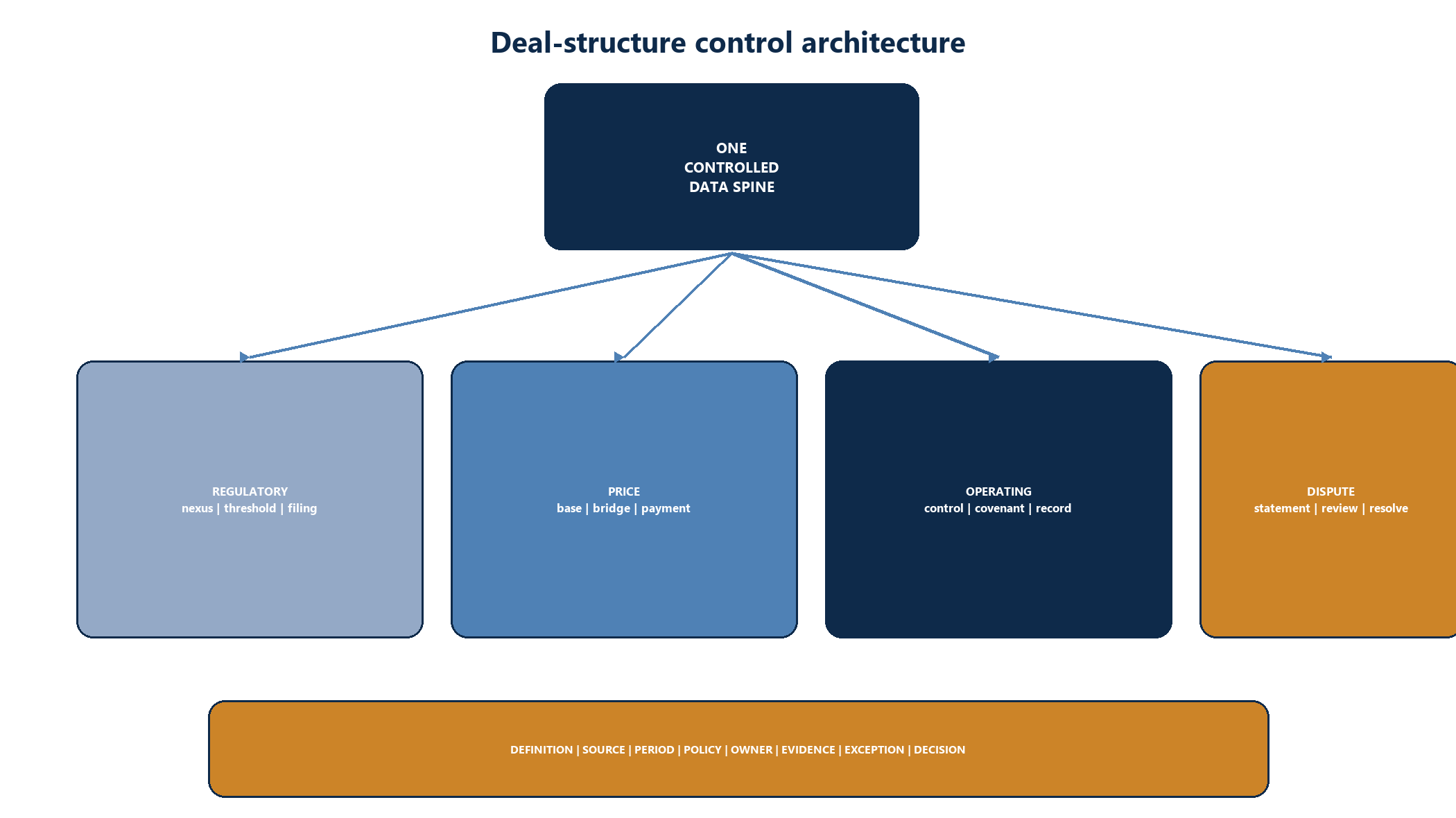
The parties should use one transaction-definition register. It links the legal entities, acquired perimeter, regulatory parties, purchase-price components, baseline financials, accounting policies, forecast periods, operating covenants, information rights and dispute procedures.
| Decision field | Seller question | Buyer question | Required record |
|---|---|---|---|
| regulatory perimeter | When can the sale complete? | Which clearances and remedies are acceptable? | jurisdiction and sector route |
| cash at closing | What is unconditional at completion? | What is funded and protected? | funds flow and conditions |
| earnout metric | What performance creates payment? | What is controllable and auditable? | formula, definitions and examples |
| operational control | Which buyer actions can reduce the metric? | Which integration rights are preserved? | covenant and permitted-action schedule |
| dispute forum | How is a shortfall challenged? | Which questions reach an expert or court? | notice, access, expert scope and governing law |
Why Deal Structures Fail After Signing
Separate workstreams create a hidden interface risk
Regulatory counsel, corporate counsel, financial-diligence teams, tax advisers, lenders and management can each produce a technically coherent work product. The transaction still carries interface risk when the outputs use different entities, periods, currencies, accounting standards or definitions. A merger filing may require group-wide sales while the earnout measures one target entity. A purchase-price adjustment may use closing accounts while the earnout begins the next day. Integration decisions may create allocations that were absent from the baseline.
The transaction-definition register should identify the controlling source for every repeated term. Legal entity names and group boundaries should agree across the merger filing, SPA, funds flow, disclosure letter, completion accounts and earnout schedule. Where a term intentionally differs, the reason and consequence should be stated.
Timeline compression
Commercial timetables often start from a desired signing or closing date. Authority timetables start from a complete filing and can pause, extend or require further information. UAE Federal Decree-Law No. 36 of 2023 requires an application at least 90 days before completion where a notification condition is met, and provides a 90-day decision period that may be extended by 45 days from receipt of a complete application [1]. The Ministry of Economy's 2025 briefing describes 90 working days, a possible 45-day extension, a standstill during review and the consequence stated in that briefing if no decision is issued [5]. Current counsel should reconcile the statute, executive regulations, official process and transaction facts.
The signing date, filing date, completeness date, expected decision date, long-stop date, financing expiry, shareholder-approval date and operational dependency should sit on one critical-path schedule.
Measurement ambiguity
EBITDA is a derived measure. A contract that uses the term without defining revenue recognition, leases, owner compensation, synergies, allocations, provisions, acquisitions, disposals, foreign exchange, exceptional items, accounting-policy changes and dispute evidence leaves multiple permissible calculations. DIFC case materials show that EBITDA and valuation multiples can become central to purchase-price and warranty analysis [13], while a separate DIFC decision shows the interaction between an earnout entitlement and continuing employment [14]. The decisions arise from specific facts and legal questions; they are not GCC-wide rules.
Control after closing
The buyer controls the business during the earnout period in many acquisitions. That control can affect pricing, staffing, sales channels, cost allocation, investment, financing and customer migration. The contract should distinguish ordinary-course discretion, prohibited value transfers, required support, permitted integration and decisions requiring consultation or consent.
| Failure mode | Early signal | Contract control | Operating control |
|---|---|---|---|
| filing starts late | jurisdiction list unresolved at signing | filing condition and cooperation covenant | regulatory data owner |
| baseline moves | draft schedules contain open fields | signed baseline pack and priority rule | locked data room copy |
| EBITDA is non-reproducible | formula lacks ledger mapping | worked example and bridge | chart-of-accounts mapping |
| buyer action changes result | no covenant schedule | specific operating covenants | decision log and allocation policy |
| dispute clause is over-broad | expert mandate includes legal issues | scoped expert determination | complete evidence package |
Gcc Merger-Control Routing
Six national regimes
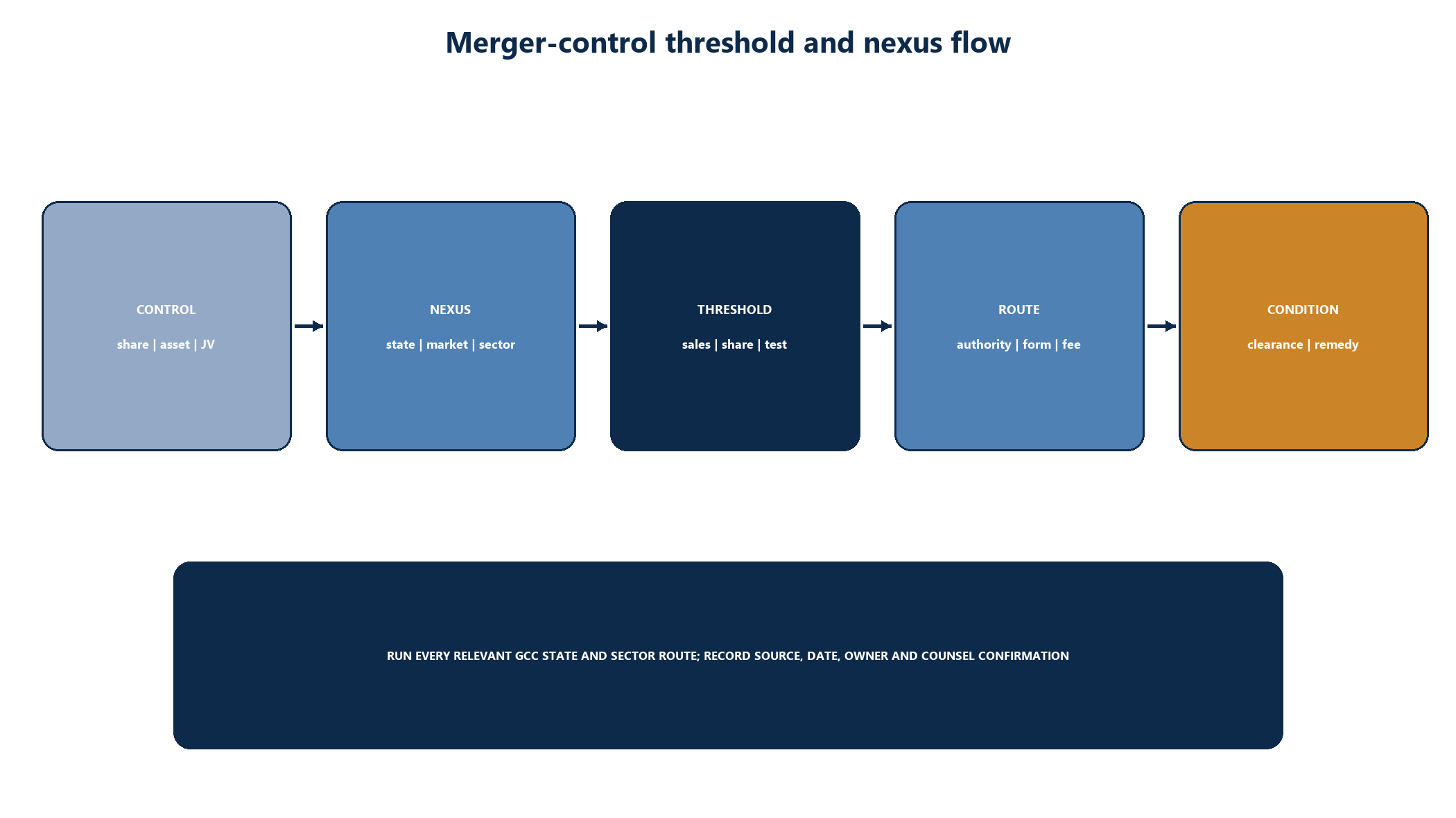
The GCC is a regional organisation, not one merger-control filing jurisdiction for the transactions addressed here. The first screening decision is therefore a country and sector map. A transaction can engage more than one regime. Incorporation, customer location, local sales, market effects, asset location, control rights and regulated activities can each matter under the applicable law.
The route should begin before the parties announce a timetable. Counsel should identify the acquisition form, parties, ultimate groups, control change, joint-venture functions, worldwide sales, state sales, target sales, relevant markets, estimated shares and sectoral approvals. Figures should be sourced from the correct audited period and translated using the required methodology.
Notification and substantive assessment are different
A threshold answers whether a filing may be required. It does not determine whether the transaction harms competition. Conversely, a transaction below a stated financial threshold can still require analysis under another route, sector law or market-effects rule. The file should retain two memoranda: a jurisdiction memorandum and a substantive-overlap memorandum.
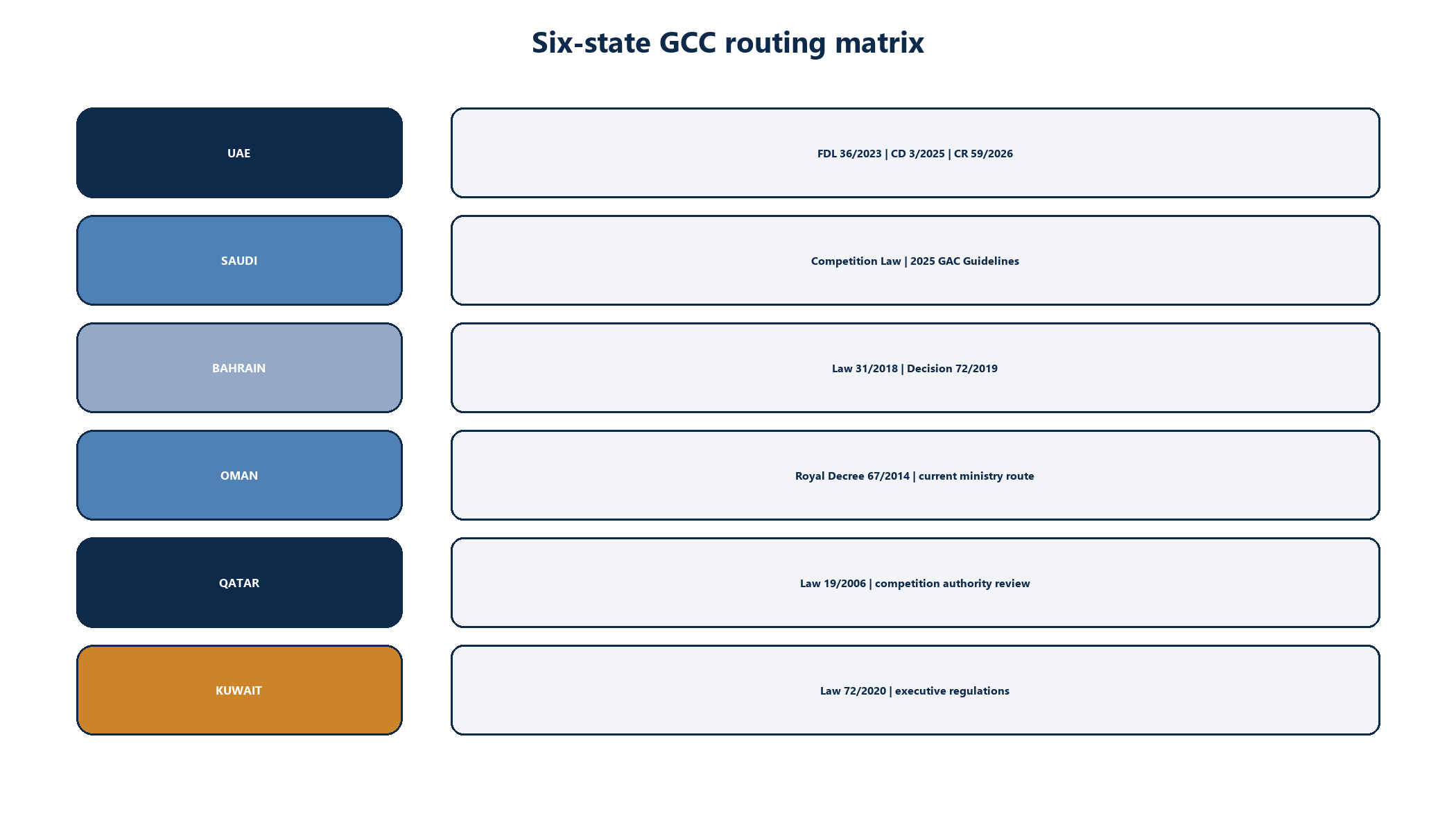
Routing matrix
| State | Primary cited framework | Practical screening focus | Evidence boundary |
|---|---|---|---|
| UAE | FDL 36/2023; CD 3/2025; CR 59/2026 [1-3] | control, UAE relevant-market sales, market share, sector route | threshold and procedure require current counsel confirmation |
| Saudi Arabia | Competition Law and 2025 GAC Guidelines [15,16] | change of control, nexus, worldwide party sales, target sales, Saudi sales | apply GAC definitions and current service requirements |
| Bahrain | Law 31/2018 and Decision 72/2019 [17,18] | control, relevant market and approval categories | retrieve current decisions and authority practice |
| Oman | Royal Decree 67/2014 and current ministry process [19,20] | economic concentration and pre-completion approval route | confirm implementing rules and current form |
| Qatar | Law 19/2006 authority materials and review route [21,22] | economic concentration and committee process | official FAQ is overview, not legal advice |
| Kuwait | Law 72/2020 and executive-regulation materials [23,24] | control, local assets or annual sales, filing process | confirm current thresholds and Board decisions |
The matrix is a routing aid. It is not a legal opinion or complete threshold statement for Bahrain, Oman, Qatar or Kuwait. The official sources confirm active competition-control frameworks and processes. A qualified lawyer in each relevant state should establish the current test, exemptions, calculation rules, timing and filing responsibility.
Sector and foreign-investment overlays
Competition clearance does not replace sector approval, foreign-investment approval, securities approval, central-bank approval, insurance approval, communications approval, health approval or licence change. The regulatory register should use separate lines for every authority. A single condition defined as "all regulatory approvals" can hide ownership, timing and remedy differences.
UAE Economic-Concentration Control
Current federal framework
Federal Decree-Law No. 36 of 2023 defines an economic concentration by reference to a complete or partial transfer that gives direct or indirect control [1]. Article 12 connects pre-completion notification to annual sales in the relevant market in the UAE or market share, at thresholds set by Cabinet. Cabinet Decision No. 3 of 2025 states two alternative thresholds: total annual sales of the undertakings in the relevant market within the UAE exceeding AED 300 million in the last fiscal year, or their total share exceeding 40 percent of transactions in that relevant market during the last fiscal year [2]. The decision became effective on 31 March 2025.
Cabinet Resolution No. 59 of 2026 is the current executive regulation cited in this paper. It was issued on 20 April 2026 and became effective on 30 July 2026 [3]. Its procedures include information, verification and authority interaction. The short interval between its effective date and this paper's cut-off strengthens the need for current counsel and authority confirmation.
Threshold data pack
The parties should prepare a controlled data pack with group charts, acquisition structure, control analysis, audited financial statements, sales by legal entity, customer destination, product, relevant market and UAE geography, plus market-share methodology. The data pack should distinguish accounting revenue from the statutory sales measure. It should retain exclusions, eliminations, currency, period and source.
| UAE screening field | Required source | Reviewer | Open issue |
|---|---|---|---|
| control change | SPA, governance rights, shareholder arrangements | competition counsel | positive and negative control analysis |
| relevant products | product and customer evidence | counsel and economist | substitution and market boundary |
| UAE sales | audited ledger and sales-location rules | finance and counsel | statutory calculation |
| market share | documented market denominator | economist and counsel | reliability and period |
| sector authority | licence and regulator map | regulatory counsel | concurrent or alternative route |
Procedure and timetable
Federal Decree-Law No. 36 of 2023 requires notification at least 90 days before completion when the statutory conditions are met [1]. The law describes a decision period and extension from receipt of a complete application. The Ministry's official economic-concentration page identifies the responsible department and publishes selected outcomes [4]. Its 2025 briefing states a 90-working-day review, a possible 45-day extension, a standstill and an undertaking mechanism [5]. Cabinet Resolution No. 59 of 2026 adds current executive detail [3].
The transaction timetable should include preparation time, pre-filing engagement if available, translation, signature authority, fee, completeness, information requests, third-party consultation, commitments, decision, reconsideration and satisfaction of the SPA condition. The long-stop date should be tested against a downside path rather than a clean filing date.
SPA controls
The SPA should identify the filing party, cooperation standard, information ownership, privilege process, external communications, remedy authority, conduct restrictions, cost allocation, decision standard and termination consequence. A generic "best efforts" clause may not allocate a structural remedy, asset divestment, behavioural commitment or material business restriction. Those decisions require an explicit governance mechanism.
Saudi And Other Gcc Regimes
Saudi Arabia
The General Authority for Competition's 2025 Economic Concentration Review Guidelines describe the Competition Law under Royal Decree No. M/75 and the Implementing Regulations [15]. The guidelines state that an economic concentration is notifiable when the legal and additional criteria are satisfied. For acquisitions, the cited cumulative criteria include total worldwide annual sales of the economic-concentration parties exceeding SAR 200 million, worldwide annual sales of the target exceeding SAR 40 million, and total annual sales in Saudi Arabia of all parties exceeding SAR 40 million [15]. The guidelines also explain nexus, control, group sales, currency translation and transaction types.
The GAC electronic service states a 90-day statutory examination period from completion of required documents, subject to the service terms, and lists required corporate, financial, transaction and economic-effect documents [16]. The service information and guideline should be reconciled with current law and transaction-specific advice at the filing date.
Bahrain
Bahrain Law No. 31 of 2018 establishes the competition framework and defines economic concentration by reference to control [17]. Decision No. 72 of 2019 provides controls concerning economic concentration and relevant market concepts [18]. The filing memorandum should retrieve the current approval categories, thresholds, authority allocation and form.
Oman
Royal Decree No. 67 of 2014 promulgates Oman's Competition Protection and Monopoly Prevention Law [19]. The Ministry of Commerce, Industry and Investment Promotion reported in May 2026 on the process for economic-concentration applications, including pre-completion submission, required documents and evaluation [20]. The report confirms an active process; counsel should confirm current implementing provisions and thresholds.
Qatar
Qatar's Ministry of Commerce and Industry identifies Law No. 19 of 2006 and the Competition Protection and Antimonopoly Committee in its official FAQ [21]. The Ministry also operates a voluntary review program for merger or acquisition projects while stating that the communication does not substitute for the formal economic-concentration application [22]. The project plan should distinguish informal or voluntary engagement from a formal filing.
Kuwait
Kuwait's Competition Protection Agency sets out economic-concentration provisions under Law No. 72 of 2020 and its executive regulations [23]. The authority material describes control events, pre-completion filing, local assets or annual-sales thresholds to be set by Board decision, documents, examination and standstill. The live authority portal publishes filing services and decisions [24]. Current thresholds and calculation rules require confirmation from the authority material in force at signing.
Cross-border control table
| Control | Owner | Minimum evidence | Decision output |
|---|---|---|---|
| jurisdiction list | competition counsel | sales and market nexus by state | filing, no filing or further analysis |
| sector overlay | regulatory counsel | licence and regulator map | approval or notification route |
| threshold model | finance and economist | audited sales and market evidence | version-controlled calculation |
| timetable | transaction counsel | statutory and authority process | condition and long-stop date |
| remedy governance | buyer investment committee | overlap and business criticality | acceptable, escalated or prohibited remedy |
Signing, Conditions And Long-Stop Design
Conditions precedent
A condition precedent should identify the approval, responsible party, satisfaction evidence, waiver right and deadline. The schedule should avoid treating notification, acceptance of a filing, clearance and expiry of a waiting period as the same event. The closing checklist should contain the authority decision or other agreed evidence.
Cooperation covenant
The cooperation covenant should allocate drafting, review, submission, response and meeting responsibilities. It should address information that is competitively sensitive, privileged, personal or restricted. Clean-team protocols may be needed. The parties should agree who controls substantive strategy and who can communicate with the authority.
Remedy covenant
The remedy standard should describe what the buyer must offer or accept. Possible categories include information commitments, behavioural commitments, access obligations, governance restrictions, asset divestments and transaction restructuring. The covenant should state materiality, business perimeter, cost cap, decision rights and whether a remedy affects the earnout baseline or operating covenants.
Long-stop date
The long-stop model should include preparation, translation, internal approval, filing, completeness, review, information requests, extensions, commitments, decision and closing mechanics. Financing expiry, working-capital seasonality and business disruption should be visible.
| Long-stop component | Base path | Downside path | Contract response |
|---|---|---|---|
| data preparation | complete audited data | group-sales or market data incomplete | information covenant and ownership |
| authority completeness | first submission accepted | further information required | extension and update process |
| substantive review | no material overlap | commitments or remedy analysis | remedy governance |
| financing | facility remains available | expiry before clearance | extension, replacement or termination rule |
| business condition | ordinary course maintained | material change during standstill | interim covenant and risk allocation |
Termination economics
Break fees, reverse break fees, expense reimbursement, deposit treatment and exclusivity consequences require legal and tax review. Their purpose, trigger, cap and enforceability should be stated. provides no observed evidence supporting a universal fee level.
Purchase-Price Architecture
Component map
The purchase price can include fixed cash at closing, closing-account adjustment, locked-box leakage adjustment, deferred fixed consideration, seller note, escrow, retention, rollover equity, earnout, contingent value right or post-closing service compensation. Each component transfers a different risk.
The component map should prevent double counting. A recurring cost adjustment may affect maintainable EBITDA, closing working capital and earnout EBITDA. A debt-like item may also appear in the funds flow. The transaction model should assign each item to one price mechanism and state any deliberate interaction.
Completion accounts and locked box
Completion accounts determine defined balance-sheet measures at closing. A locked-box structure relies on an agreed historical balance sheet and leakage protection. An earnout measures future outcomes. Combining them requires clear period boundaries and treatment of post-baseline events.
Deferred fixed consideration and earnout
Deferred fixed consideration delays payment without making entitlement depend on performance, subject to the agreed conditions and enforcement terms. An earnout makes payment contingent on a metric or event. The contract should not use the labels interchangeably. Security, set-off, subordination and acceleration can change the economic value of both.
| Component | Principal risk allocated | Required definition | Control evidence |
|---|---|---|---|
| cash at closing | funding and completion | amount, currency and account | funds flow |
| completion accounts | closing balance-sheet variance | policies, hierarchy and dispute scope | closing statement |
| escrow or retention | specified claim or general recourse | release, claim and interest rules | escrow statement |
| deferred fixed amount | payment timing and credit | due date, security and set-off | payment schedule |
| earnout | future performance and information | metric, period, control and review | earnout statement |
| rollover equity | future enterprise value and liquidity | class, rights and exit | shareholder documents |
Earnout Objective And Contracting Problem
Evidence from research
Earnout research describes contingent payments as a response to valuation uncertainty, adverse selection, moral hazard, retention and financing constraints. Datar, Frankel and Wolfson find earnouts more likely where targets have more private information and in smaller private or service-company acquisitions [35]. Kohers and Ang analyse risk reduction and retention functions [36]. Cain, Denis and Denis document wide variation in earnout size, metric, period, payment form and sensitivity [37]. Cadman, Carrizosa and Faurel examine economic determinants and the information environment after a US accounting change [41].
These studies use defined historical samples, primarily outside the GCC. They support design questions. They do not establish that an earnout creates value in a specific Gulf transaction. The systematic literature review by Dahlen identifies continuing gaps concerning cost, post-merger performance and target effects [45]. Quinn presents evidence and argument that earnouts may distribute uncertain downside rather than solve information asymmetry [38].
Purpose test
Before choosing the formula, the parties should state the earnout's purpose. A valuation-gap earnout should measure the disputed future assumption. A retention arrangement may be compensation rather than purchase consideration for accounting or tax purposes. A milestone payment may fit a regulatory, product or customer event. A financing deferral may be better documented as fixed deferred consideration.
Metric selection
Revenue is closer to customer activity but can ignore margin and cash. EBITDA includes more operating economics but creates more adjustment and allocation choices. Gross profit can connect price and direct cost but requires product-cost definitions. Cash flow introduces working capital and investment timing. Non-financial milestones may be binary while still requiring evidence and control rules.
| Objective | Candidate measure | Main vulnerability | Required control |
|---|---|---|---|
| bridge growth disagreement | revenue or gross profit | timing, channel and related-party terms | contract and cutoff rules |
| bridge earnings disagreement | EBITDA | policies, allocations and buyer decisions | baseline hierarchy and bridge |
| retain seller-manager | service and performance conditions | compensation classification | employment and IFRS analysis |
| fund product milestone | objective milestone | evidence and regulatory dependency | certification and fallback |
| share downside | capped contingent payment | control and measurement | covenant and dispute procedure |
Payment curve
The formula should define threshold, target, cap, interpolation, catch-up, carry-forward, carry-back, overperformance and payment date. A cliff can create a large change in payment from a small measurement difference. A continuous scale can reduce cliff sensitivity while adding formula detail. A worked example should test values below, at and above each breakpoint.
Duration
Duration should match the uncertainty being tested and the buyer's operating plan. A short period can amplify timing. A long period increases exposure to integration, market change and accounting-policy drift. The research documents heterogeneous periods and structures [37,40-45]. supplies no universal optimal GCC duration.
Baseline Definition And Accounting Hierarchy
The contract measure
An earnout schedule should define the measure as a contractual calculation. IFRS can be a reference layer, but a general reference to IFRS does not resolve every transaction choice. The schedule needs an order of priority. One possible hierarchy is: express SPA definitions; express earnout-schedule policies; specific worked examples; the signed baseline; consistently applied accounting policies; then the named accounting framework in force at the agreed date. Counsel and accountants should approve the hierarchy.
Signed baseline pack
The baseline pack should contain the legal-entity trial balances, chart of accounts, audited or management financial statements with status labels, consolidation and elimination entries, revenue schedules, leases, provisions, owner and related-party transactions, exceptional items, capital expenditure, working capital, customer mapping and foreign-exchange rates. Each file should carry a version, period, currency, source and approver.
Policy lock and permitted changes
The schedule should state whether policies are frozen, consistently applied or updated for mandatory standards. It should address changes required by law, accounting standards, auditors, acquisitions, disposals, new products, new entities and system migration. A mandatory change can be recorded through a dual calculation: reported results under the current policy and earnout results on the agreed basis.
Hierarchy table
| Priority | Source | Function | Conflict rule |
|---|---|---|---|
| 1 | express SPA definition | legal and economic deal | prevails within its scope |
| 2 | earnout schedule policy | measurement detail | prevails over general framework reference |
| 3 | worked example | formula interpretation | used only for covered fact pattern |
| 4 | signed baseline pack | historical application | frozen version and bridge |
| 5 | consistent target policy | gaps within existing practice | evidenced from pre-closing records |
| 6 | named accounting framework | residual accounting question | version and adoption date specified |
Change register
Every post-closing change with potential earnout impact should enter a change register. Fields include date, initiator, description, reason, accounting effect, operational effect, metric effect, covenant classification, supporting records, consultation and decision. The register does not replace the SPA; it supplies contemporaneous evidence.
Revenue Baselines
Revenue perimeter
IFRS 15 links revenue recognition to the transfer of promised goods or services and a transaction price to which the entity expects to be entitled [26]. An earnout schedule still needs contract-specific rules. It should identify the legal entity, products, channels, customers, geography, gross-versus-net presentation, related parties, contract modifications, rebates, refunds, warranties, variable consideration and taxes excluded from revenue.
The baseline should reconcile customer-contract data, billing, delivery or service evidence, credit notes, cash and tax records. Where the buyer changes the sales system, the mapping from old to new identifiers should be preserved.
Cutoff and timing
Revenue cutoff can move performance between earnout periods. The schedule should define delivery, acceptance, milestones, service periods, bill-and-hold, subscriptions, renewal, cancellation, returns and collectability. It should state how contracts signed before closing but fulfilled after closing are treated, and how backlog transferred from the seller is measured.
Channel and customer migration
Integration may move sales to a buyer entity, bundle the target product, change the distributor, reprice the offering or use a group framework agreement. The covenant schedule should determine whether those sales remain attributed to the earnout business. Attribution should use an auditable rule rather than discretionary management allocation.
Related-party and non-arm's-length transactions
Related-party revenue can alter both price and volume. The schedule should specify arm's-length requirements, approval, transfer-pricing support and adjustment. UAE transfer-pricing guidance provides current tax context [10]. The tax analysis and earnout calculation can use different legal tests; differences should be reconciled rather than assumed away.
| Revenue issue | Baseline rule | Period evidence | Earnout adjustment |
|---|---|---|---|
| contract cutoff | defined transfer or acceptance point | contract and fulfilment record | reverse premature or delayed recognition |
| gross versus net | principal or agent rule and examples | customer and supplier terms | apply agreed presentation |
| rebates and returns | accrual method and look-back | claims, credit notes and history | true-up under stated window |
| customer migration | attribution rule | CRM and invoice mapping | include qualifying migrated sales |
| related party | arm's-length and approval rule | agreements and pricing support | adjust excluded or non-arm's-length amount |
| acquisition after closing | inclusion or exclusion | acquisition ledger and allocation | apply perimeter rule |
Ebitda Baselines
Start with a named ledger measure
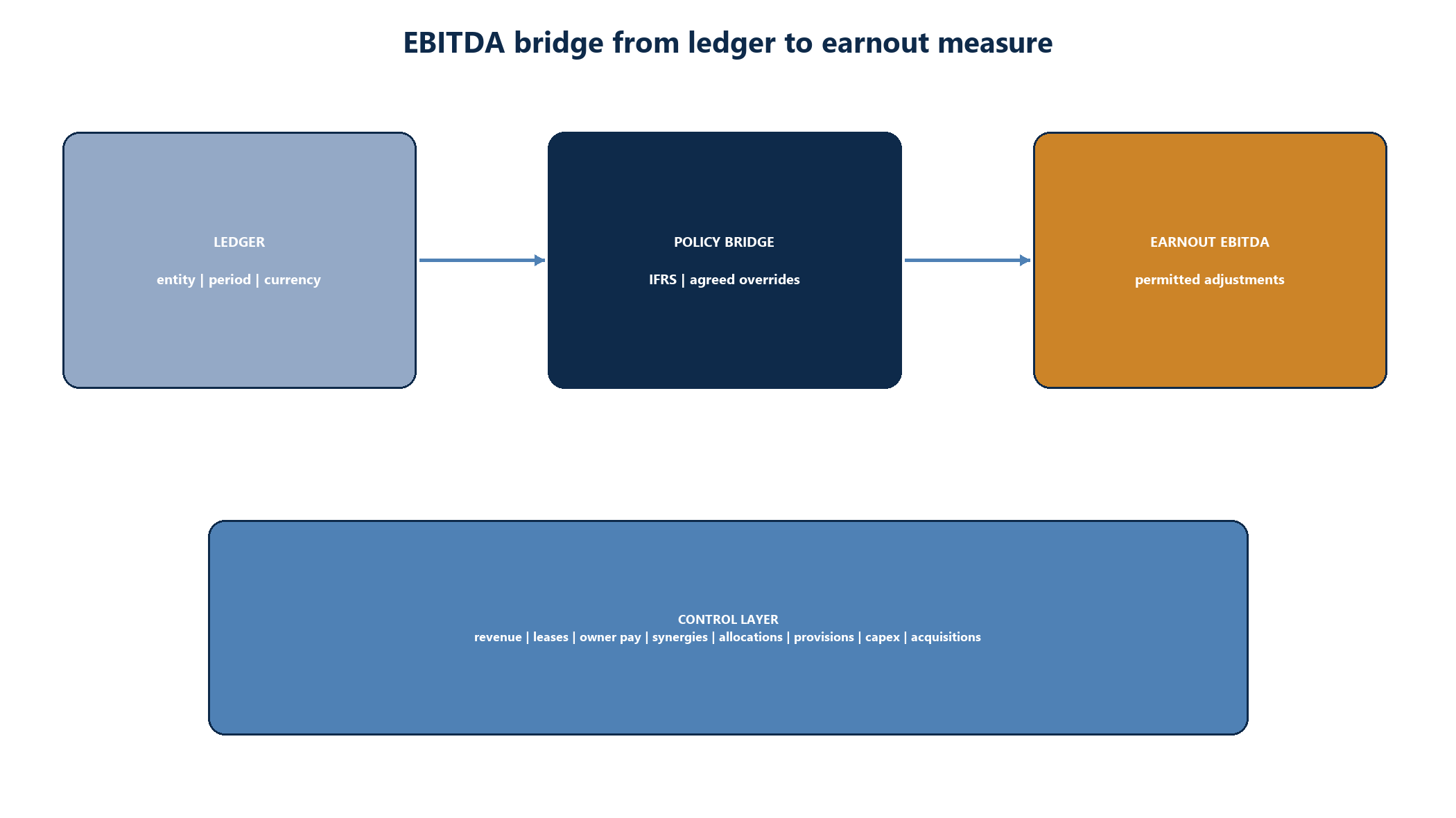
The EBITDA bridge should begin with an identified profit subtotal from the agreed legal-entity or consolidation ledger. It should then list every permitted add-back and deduction. A definition that starts with "earnings before interest, tax, depreciation and amortisation" still requires rules for items that sit above or below that subtotal.
Leases
IFRS 16 changed lessee accounting for many leases [27]. An EBITDA measure can differ materially depending on whether lease expense, depreciation and interest are treated on a pre-IFRS 16, post-IFRS 16 or contract-specific basis. The schedule should specify the basis and a consistent bridge. New leases, modifications, short-term leases and variable rent require treatment.
Owner compensation and related parties
Private-company EBITDA may be normalised for owner compensation, personal expenses, related-party rent or services. The earnout should distinguish a one-time valuation normalisation from the actual cost required to operate after closing. If the seller remains employed, salary, bonus, benefits and earnout treatment should be explicit. IFRS 3 includes indicators for distinguishing contingent consideration from remuneration where continuing employment is involved [25,30].
Synergies and group allocations
Buyer synergies can lower target costs or move functions into the group. Group allocations can also add costs that did not exist in the baseline. The schedule should define which synergies are credited, which stranded costs remain, how shared services are priced, and whether allocations use actual cost, a fixed schedule or an arm's-length method.
Provisions, exceptional items and accounting estimates
IAS 37 addresses provisions and contingent liabilities [28]. The earnout schedule should define treatment of restructuring, litigation, warranties, onerous contracts, bad debts and other estimates. A label such as "exceptional" or "non-recurring" is insufficient. Each permitted adjustment should have a category, objective condition, cap if relevant, evidence and worked example.
Foreign exchange
IAS 21 addresses functional currency and foreign-currency translation [29]. The earnout should state functional and measurement currencies, actual or fixed exchange rates, translation date and treatment of gains or losses. A multi-country target should distinguish transaction FX from consolidation translation.
| EBITDA bridge line | Default evidence | Contract decision |
|---|---|---|
| operating profit subtotal | agreed ledger account and period | legal entity and consolidation perimeter |
| depreciation and amortisation | fixed-asset and intangible registers | included add-back categories |
| lease accounting | lease register and IFRS 16 bridge | pre-standard, current-standard or fixed contract basis |
| owner and related-party items | payroll, expense and agreements | normalisation versus continuing cost |
| group allocations | service catalogue and cost driver | inclusion, cap and allocation method |
| provisions | calculation and approval | permitted categories and reversals |
| exceptional items | source and objective criterion | closed list or approval process |
| FX | transaction and translation records | rate source and treatment |
Working Capital, Capex And Debt-Like Items
Keep mechanisms separate
Working capital, capital expenditure and debt-like items can influence closing price and future EBITDA. The model should show where each item is recognised. A cost should not be deducted from closing debt, included in a working-capital shortfall and excluded again from earnout EBITDA unless the parties deliberately agree that outcome.
Working capital
The working-capital target should define included accounts, excluded accounts, accounting policies, seasonality, ageing, provisions, customer deposits, deferred revenue, tax, related parties and cutoff. If the earnout is revenue- or EBITDA-based, working-capital conduct can change collections, purchasing and provisions. The operating covenants should address deliberate acceleration or delay.
Capital expenditure
Capital expenditure can support earnout performance while reducing cash. An EBITDA-only earnout may encourage capitalisation or investment decisions that shift expense and benefit across periods. The schedule should define maintenance, growth and integration capex, approval rights, minimum or maximum levels, capitalisation policy and treatment of depreciation.
Debt-like items and deferred consideration
Debt-like items should use a closed or principles-based definition approved in the closing-price mechanism. Deferred consideration, seller notes, leases, employee obligations, tax and transaction costs require specific treatment. The financing documents should reconcile to the SPA and funds flow.
| Item | Closing mechanism | Earnout interaction | Control |
|---|---|---|---|
| trade receivables | working capital | revenue quality and bad debt | ageing and collection policy |
| customer deposits | working capital or debt-like definition | revenue timing | contract liability schedule |
| maintenance capex | usually outside EBITDA | supports continuing performance | budget and approval |
| capitalised development | balance sheet | reduces current expense | capitalisation policy |
| leases | debt-like or separate definition | IFRS 16 EBITDA effect | lease bridge |
| transaction bonuses | debt-like, seller cost or expense | possible EBITDA effect | explicit allocation |
| Long-stop component | Base path | Downside path | Contract response |
|---|---|---|---|
| data preparation | complete audited data | group-sales or market data incomplete | information covenant and ownership |
| authority completeness | first submission accepted | further information required | extension and update process |
| substantive review | no material overlap | commitments or remedy analysis | remedy governance |
| financing | facility remains available | expiry before clearance | extension, replacement or termination rule |
| business condition | ordinary course maintained | material change during standstill | interim covenant and risk allocation |
Operating Covenants And Buyer Control
Governance objective
The buyer needs authority to own and integrate the acquired business. The seller needs protection against actions that divert or suppress the agreed earnout measure. The covenant schedule should allocate specific decisions. A broad promise to operate in the ordinary course can leave uncertainty about integration, investment and group policy.
Decision categories
Decisions can be divided into permitted buyer actions, consultation matters, consent matters and prohibited actions. Permitted actions may include legal compliance, safety, fraud prevention and changes required by regulators. Consultation can cover material pricing, budgets and management changes. Consent rights may be narrow to avoid preserving seller control. Prohibited actions can address deliberate diversion, non-arm's-length charges or artificial acceleration and delay.
Support obligations
If the earnout assumes a sales team, budget, facility, product launch or licence, the contract should state the support. An obligation should have a measurable input, period, exception and consequence. A general commitment to provide "adequate resources" can be difficult to test.
Integration and allocations
Integration plans should be attached or referenced at signing where they affect the metric. Customer migration, brand changes, ERP migration, shared services, procurement, financing and legal-entity restructuring should each have an attribution rule. The buyer decision log should record the business purpose and expected earnout effect.
Seller conduct
Seller-managers can also influence performance through customer relationships, hiring, spending, revenue timing and information. Their employment or consultancy agreements should align duties, authority, remuneration, termination and restrictive covenants with the SPA. The DIFC decision in Lal and Hennessy v Benton illustrates that earnout entitlements can interact with employment status and conduct on specific facts [14].
| Decision | Buyer right | Seller protection | Evidence |
|---|---|---|---|
| pricing | manage within stated policy | no targeted value diversion | approved price list and exception log |
| customer transfer | integrate channels | attribution of qualifying sales | CRM and invoice mapping |
| management change | appoint and remove | consultation for named roles | board paper and notice |
| group service | obtain shared support | fixed or arm's-length allocation | service schedule and cost driver |
| capex | approve investment | minimum committed program if agreed | budget and invoices |
| acquisition or disposal | execute strategy | perimeter and pro forma adjustment | transaction ledger and bridge |
Measurement, Review And Dispute Procedure
Measurement statement
The buyer should prepare an earnout statement in the agreed form. It should include the source ledger, baseline bridge, policy changes, permitted adjustments, formula, payment, management certification and indexed workpapers. The statement should reconcile reported financials to earnout results.
Access and objections
The seller should receive a defined review period and access to relevant records, subject to confidentiality, privilege, data protection and third-party restrictions. An objection notice should identify each disputed item, amount, reason and proposed value. Undisputed amounts can be paid separately if the contract so provides.
Representative negotiation
The parties' representatives should meet within a short defined period. The open-item schedule should track the buyer value, seller value, issue type, evidence, contract provision and status. Settlement authority should be clear.
Expert determination
An accounting expert should receive a defined accounting or calculation mandate. Legal interpretation, fraud, covenant breach and disclosure disputes may belong to a court or arbitration under the governing-law clause. Transaction-practice materials repeatedly identify uncertainty where an accounting firm is asked to decide issues beyond accounting [46-52]. The SPA should state whether the expert acts as expert or arbitrator, the standard of review, permitted evidence, timetable, cost allocation, finality and correction of manifest error.
Evidence preservation
ERP migration, customer remapping and integration can destroy comparability. The parties should preserve the signed baseline, chart of accounts, policy manual, source contracts, period ledgers, allocation files, management approvals and change register through the limitation period.
| Stage | Deadline | Required output | Unresolved route |
|---|---|---|---|
| buyer statement | stated days after period end | calculation and indexed workpapers | seller review |
| seller review | stated days after receipt | itemised objection notice | representative meeting |
| representative resolution | stated meeting window | agreed items and open-item schedule | expert or legal forum |
| accounting expert | scoped timetable | determination within mandate | governing-law forum for excluded issues |
| payment | stated days after final amount | funds and tax documents | enforcement under SPA |
Accounting, Tax And Reporting Consequences
IFRS 3 contingent consideration
IFRS 3 requires an acquirer to recognise acquisition-date fair value of contingent consideration as part of consideration transferred and to classify an obligation as liability or equity under the applicable requirements [25]. Subsequent measurement differs by classification. Changes related to events after acquisition are generally accounted for under the relevant subsequent-measurement rules rather than as measurement-period adjustments [25]. Accounting advice should address the specific instrument.
Continuing employment
IFRS 3 includes indicators for deciding whether payments to selling shareholders who continue as employees are consideration or remuneration. Automatic forfeiture on termination is an important indicator in the standard [25,30]. The SPA, employment agreement and incentive plan should be analysed together before signing.
Revenue, leases, provisions and currency
IFRS 15, IFRS 16, IAS 37 and IAS 21 can affect the measure used in an earnout [26-29]. The accounting treatment used for financial reporting and the contract calculation can differ. The transaction should maintain a bridge and disclose the difference appropriately.
Fair value and forecast governance
Contingent consideration valuation can require probability-weighted outcomes, discounting, volatility or other inputs under the relevant framework. Forecasts prepared for the valuation should reconcile to the board plan and purchase-price allocation. Research on earnout fair values and monitoring documents both information value and possible estimation incentives in specific samples [41-44]. An independent valuation and audit process can support governance; it does not replace the contract definition.
UAE tax
UAE Corporate Tax and Federal Tax Authority guidance form part of the transaction tax perimeter [8-10]. Purchase-price allocation, deductibility, seller treatment, employment compensation, withholding in other jurisdictions, transfer pricing, foreign tax and VAT require advice based on the parties, assets, structure and payment. does not state a universal tax treatment for earnouts.
Reporting calendar
| Report | Owner | Timing | Reconciliation |
|---|---|---|---|
| acquisition accounting memo | buyer finance and auditor | acquisition date | SPA consideration components |
| fair-value model | valuation specialist | acquisition and reporting dates | scenario and discount assumptions |
| earnout contract statement | named preparer | contract period | ledger-to-contract bridge |
| tax memorandum | tax advisers | signing and payment events | legal and accounting classification |
| board and investor disclosure | buyer governance | reporting cycle | approved financial statements |
Warranties, Indemnities, Escrow And Retention
Distinct functions
Warranties allocate the risk that stated facts are inaccurate, subject to the governing law and drafted limitations. Indemnities can address specified liabilities. Escrow or retention provides a source of recovery. An earnout allocates future-performance risk. Deducting a warranty claim from an earnout can merge these functions and create set-off disputes.
Set-off
The SPA should state whether the buyer may set off claims against deferred or contingent consideration, which claims qualify, whether they must be admitted or finally determined, whether security substitutes for set-off, and what happens to disputed amounts. The seller should understand the credit and timing effect.
Disclosure and baseline truth
The signed baseline pack should be supported by warranties concerning completeness, accounting records, policies and identified adjustments, subject to negotiated qualifications. The warranty package cannot make an ambiguous earnout formula reproducible. The definitions and examples perform that task.
Escrow release and earnout timing
Escrow release, claim periods and earnout payment dates should be mapped together. If the same amount secures multiple risks, priority and replenishment should be defined. Interest and tax consequences require advice.
| Tool | Risk addressed | Interaction risk | Drafting control |
|---|---|---|---|
| warranty | historical fact | overlap with baseline adjustment | scope, disclosure and loss rule |
| indemnity | identified liability | duplicate recovery | exclusive-remedy and anti-double-counting rule |
| escrow | recovery source | delayed release and competing claims | claim, reserve and release mechanics |
| retention | withheld consideration | credit and set-off | due date, security and permitted deductions |
| earnout | future metric or event | buyer control and measurement | complete schedule and dispute procedure |
Illustrative example Gcc Transaction
Scenario facts
Illustrative example A regional buyer proposes to acquire a UAE operating company from a family owner. The target sells services in the UAE and Saudi Arabia. The seller and buyer disagree about expected growth and agree in principle to an EBITDA earnout. The buyer plans to move finance, procurement and selected customer contracts into a regional platform after closing.
All names, amounts, sales, market shares, time periods, adjustments and outputs in this section are hypothetical illustrative examples inputs. They do not represent a client, completed transaction or forecast. Attributed Matchpoint or client revenue, cash cost reduction, loss reduction and alpha remain USD 0.
Regulatory route
Illustrative example The parties prepare UAE and Saudi screening memoranda. The UAE workstream tests control, relevant-market UAE sales and market share under the current federal sources [1-5]. The Saudi workstream tests control, nexus and the cumulative sales criteria described in the GAC guidelines [15]. Neither memorandum relies on consolidated accounting revenue without a statutory bridge. Other GCC states and sector approvals remain open until counsel completes the nexus map.
Baseline
Illustrative example The parties sign a baseline pack with legal-entity ledgers, customer mapping, owner-compensation normalisation, lease bridge, related-party services and policy schedule. Earnout EBITDA begins with the target's operating profit and permits only listed adjustments. Buyer group allocations use a fixed service catalogue and documented cost drivers. Customer contracts moved to the regional platform remain attributed using invoice-level identifiers.
Worked calculation
Illustrative example The table below demonstrates the calculation structure. Values are intentionally shown as index units rather than currency and do not predict performance.
| Illustrative line | Index units | Evidence |
|---|---|---|
| target operating profit | 100 | period ledger |
| permitted depreciation and amortisation add-back | 25 | fixed-asset register |
| agreed lease-basis adjustment | 8 | lease bridge |
| permitted owner-compensation normalisation | 4 | signed baseline schedule |
| excluded integration allocation | 6 | group service statement |
| earnout EBITDA | 143 | contract bridge |
Illustrative example The payment formula uses a continuous scale between a threshold and cap. The worked example tests results below the threshold, at the threshold, at target and above the cap. The SPA states that the example yields to the express formula for fact patterns outside the example.
Decision result
Illustrative example The investment committee receives one decision memorandum with regulatory routes, authority timetable, long-stop downside, consideration components, baseline policies, covenant exceptions, fair-value accounting, tax open items and dispute forums. Any unresolved filing or accounting issue has an owner and deadline. No transaction outcome or financial benefit is claimed.
120-Day Transaction-Structure Roadmap
Days 1-15: route
Confirm transaction form, entities, control rights, sales data, relevant markets, state nexus, sector regulators, authority contacts and legal advisers. Establish the regulatory critical path and data request.
Days 16-35: baseline
Freeze the historical baseline pack. Reconcile legal entities, audited statements, management ledgers, chart of accounts, revenue, leases, provisions, related parties, capex, working capital and debt-like items. Mark each source as verified, management-provided, third-party-provided or unverified.
Days 36-55: model
Model cash at closing, deferred fixed consideration, escrow, retention, rollover and earnout. Run threshold, target, cap, duration and payment-sensitivity cases. Build the accounting and tax issue list.
Days 56-75: draft
Draft competition conditions, cooperation and remedy covenants, long-stop logic, payment components, earnout definitions, policy hierarchy, examples, operating covenants, statement form, access and dispute waterfall.
Days 76-100: verify
Run the draft formula against historical and forecast periods. Test ERP migration, customer movement, group allocations, acquisitions, disposals, policy changes, seller departure and authority delay. Counsel, finance, tax, accounting and operations sign their sections.
Days 101-120: sign readiness
Resolve open definitions. Produce the final jurisdiction memorandum, regulatory timetable, signed baseline, funds flow, formula workbook, worked examples, covenant matrix, reporting calendar and decision memorandum. Verify that every schedule uses the same entities, dates, currencies and definitions.
| Phase | Gate | Evidence | Failure response |
|---|---|---|---|
| route | jurisdiction and sector map approved | counsel memorandum and sales model | hold timetable |
| baseline | signed data pack reproducible | ledgers, policies and bridge | hold earnout drafting |
| model | payment architecture approved | sensitivity and funding model | redesign component |
| draft | definitions and governance complete | SPA and schedules | escalate open term |
| verify | historical replay passes | calculation and exception log | revise and retest |
| sign | integrated decision pack approved | authority matrix and final schedules | do not release signature pages |
| Item | Closing mechanism | Earnout interaction | Control |
|---|---|---|---|
| trade receivables | working capital | revenue quality and bad debt | ageing and collection policy |
| customer deposits | working capital or debt-like definition | revenue timing | contract liability schedule |
| maintenance capex | usually outside EBITDA | supports continuing performance | budget and approval |
| capitalised development | balance sheet | reduces current expense | capitalisation policy |
| leases | debt-like or separate definition | IFRS 16 EBITDA effect | lease bridge |
| transaction bonuses | debt-like, seller cost or expense | possible EBITDA effect | explicit allocation |
Limitations And Conclusion
Limitations
This paper is a research and control framework. It does not provide legal, regulatory, accounting, audit, tax, valuation, investment or transaction advice. Competition laws, executive rules, thresholds, authority forms and practice can change. Sector rules and free-zone regimes may alter the analysis. English translations of UAE legislation carry the official platform's Arabic-text caveat.
The empirical earnout studies use specific periods, jurisdictions, samples and accounting regimes [35-45]. Their findings cannot be transferred as a predicted outcome for a GCC deal. The DIFC cases concern their own facts, instruments, parties and issues [13,14]. Professional materials are scoped practice evidence [46-52]. No universal GCC dispute rate, optimal earnout size, optimal duration or filing-delay rate was identified.
Worked cases are hypothetical illustrative examples. No approved observed Matchpoint or client evidence supports a revenue, cash cost reduction, loss reduction or alpha claim. Those values remain USD 0.
Conclusion
A deal structure survives closing when the regulatory route, timetable, price mechanism and post-closing measurement system share one controlled data spine. The six GCC states require separate competition analysis. The UAE framework changed materially through the 2023 law, 2025 thresholds and executive regulations effective 30 July 2026 [1-5]. Saudi Arabia uses a separate control, nexus and turnover framework [15,16]. The other GCC states maintain their own active competition processes [17-24].
An earnout can allocate valuation uncertainty and incentives. It also creates a new contract around future accounting and operating decisions. The schedule should define purpose, metric, perimeter, hierarchy, baseline, adjustments, buyer control, seller conduct, evidence, review and forum. EBITDA requires a reproducible bridge. Authority timing requires a downside critical path. Both require named owners and contemporaneous records.
The final investment or sale decision should therefore answer four questions: which authorities can delay or condition closing; which price components are unconditional or contingent; which accounting and operating choices control the contingent payment; and which decision-maker resolves each class of disagreement.
Appendix A. Merger-Control Intake
| Field | Required entry | Source status |
|---|---|---|
| transaction type | share, asset, merger, JV or other | verified from draft documents |
| control rights before and after | ownership, veto, board, budget and strategy | counsel-confirmed |
| ultimate groups | ownership chart and controlled entities | verified or open |
| worldwide sales | latest required period and methodology | audited or labelled |
| state sales | UAE, Saudi and each relevant GCC state | source and allocation rule |
| target sales | worldwide and state-level | source and calculation |
| relevant products and customers | substitution evidence | economist and counsel |
| market shares | numerator, denominator, period and source | verified, estimated or unverified |
| sector regulators | licence and authority | counsel-confirmed |
| expected timetable | preparation through decision | current authority source |
| remedy sensitivity | unacceptable assets, rights or obligations | investment-committee decision |
Appendix B. Earnout Baseline Term Sheet
| Term | Drafting decision |
|---|---|
| purpose | valuation gap, retention, milestone, risk sharing or financing |
| metric | revenue, gross profit, EBITDA, cash, milestone or combination |
| perimeter | entities, branches, products, customers and geography |
| period | start, end, stub, reporting frequency and cutoff |
| hierarchy | SPA, schedule, example, baseline, policy and framework |
| threshold and cap | amount, interpolation and cliff treatment |
| currency | functional, measurement and payment currency; FX rule |
| buyer covenants | permitted, consultation, consent and prohibited actions |
| seller obligations | role, authority, conduct and information |
| statement | preparer, format, certification and workpapers |
| objection | deadline, content and undisputed payment |
| expert | scope, appointment, procedure, finality and cost |
| legal forum | governing law, court or arbitration for excluded questions |
| security and set-off | guarantee, escrow, subordination and claim standard |
Appendix C. Ebitda Bridge
| Bridge category | Baseline value | Earnout-period value | Permitted adjustment | Evidence | Approver |
|---|---|---|---|---|---|
| operating profit subtotal | [input] | [input] | [input] | ledger | finance |
| depreciation | [input] | [input] | [input] | asset register | finance |
| amortisation | [input] | [input] | [input] | intangible register | finance |
| lease adjustment | [input] | [input] | [input] | lease bridge | accountant |
| owner compensation | [input] | [input] | [input] | payroll and schedule | representatives |
| group allocations | [input] | [input] | [input] | service statement | representatives |
| provisions | [input] | [input] | [input] | provision memo | accountant |
| exceptional items | [input] | [input] | [input] | closed-list evidence | representatives |
| FX | [input] | [input] | [input] | rate source | finance |
| earnout EBITDA | [calculated] | [calculated] | [calculated] | controlled workbook | statement preparer |
All blank fields in this appendix require transaction-specific completion. They are not client data or estimates.
Appendix D. Dispute-Driver Register
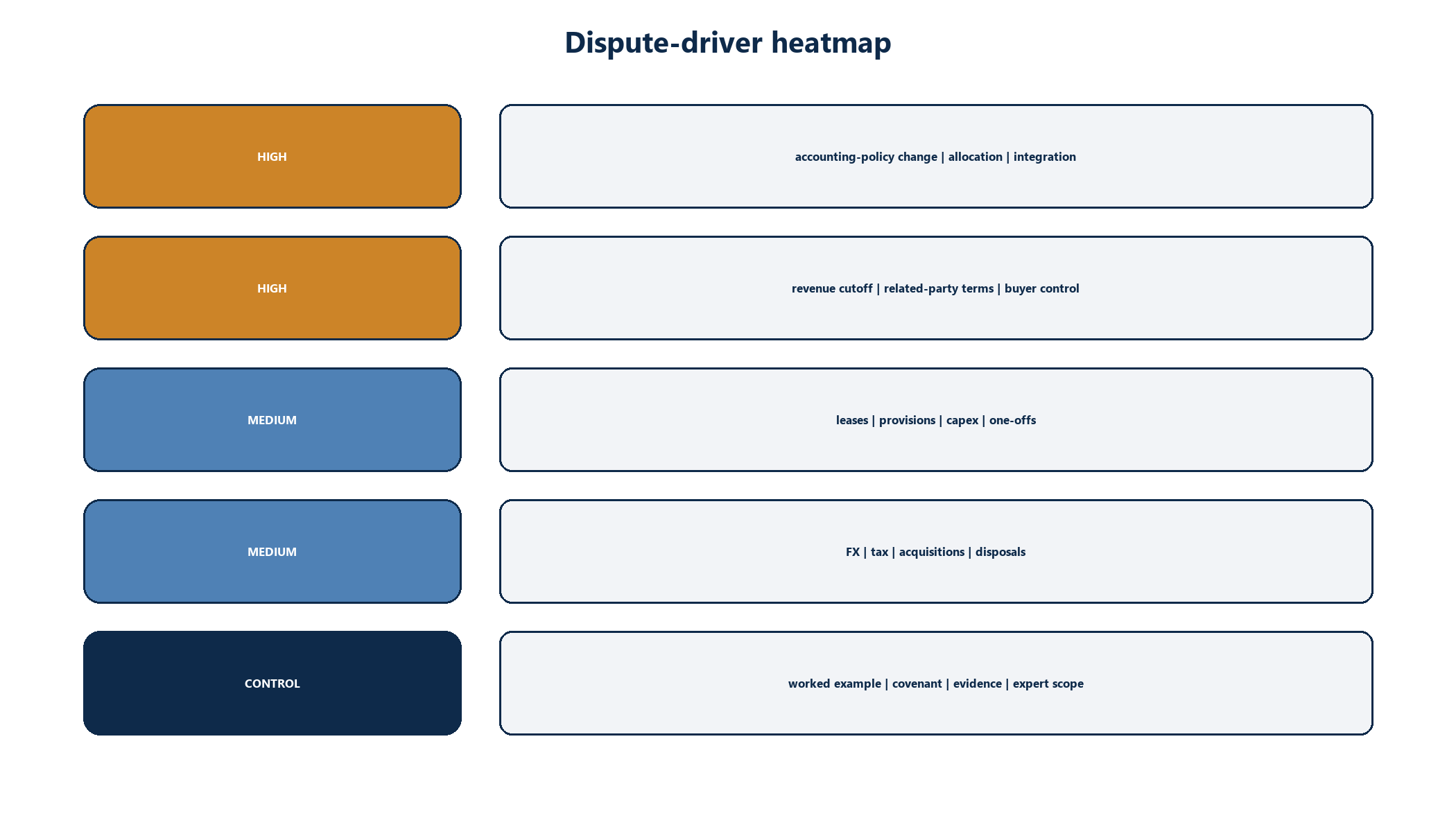
| Driver | Trigger | Preventive definition | Operating evidence | Resolution route |
|---|---|---|---|---|
| revenue cutoff | period-end transaction | transfer and acceptance rule | contract, delivery and invoice | accounting expert |
| group allocation | shared service charge | service catalogue and driver | invoice and allocation file | accounting expert |
| policy change | new accounting treatment | dual calculation or frozen policy | change memo and bridge | expert within scope |
| integration | moved customer or function | attribution and permitted-action rule | CRM and decision log | contract forum if covenant issue |
| seller departure | employment ends | payment and forfeiture rule | employment record | legal forum |
| acquisition or disposal | perimeter changes | inclusion and pro forma rule | transaction ledger | expert or legal forum by issue |
| fraud or bad faith allegation | conduct claim | express reservation | investigation record | legal forum |
Appendix E. Timeline Assumptions
Illustrative example The following schedule is a planning template. It is not an authority commitment or transaction forecast.
| Milestone | Planning input | Dependency | Evidence at completion |
|---|---|---|---|
| jurisdiction map | day 10 | group and sales data | counsel memorandum |
| first filing draft | day 35 | transaction documents and markets | draft form and annexes |
| signing | day 60 | conditions and baseline agreed | executed SPA and schedules |
| complete filing | [authority-dependent] | acceptance and information | completeness evidence |
| authority decision | [authority-dependent] | statutory process and extensions | decision or other agreed evidence |
| closing | [condition-dependent] | all closing conditions | closing certificate and funds flow |
| earnout period | [contract input] | operating covenant effective | period ledger and decision log |
| Phase | Gate | Evidence | Failure response |
|---|---|---|---|
| route | jurisdiction and sector map approved | counsel memorandum and sales model | hold timetable |
| baseline | signed data pack reproducible | ledgers, policies and bridge | hold earnout drafting |
| model | payment architecture approved | sensitivity and funding model | redesign component |
| draft | definitions and governance complete | SPA and schedules | escalate open term |
| verify | historical replay passes | calculation and exception log | revise and retest |
| sign | integrated decision pack approved | authority matrix and final schedules | do not release signature pages |
Appendix F. Transaction Decision Memorandum
- Identify the buyer, seller, target, acquired perimeter and control change.
- Attach the six-state jurisdiction and sector-regulator map.
- State each notification conclusion, source date, adviser and open issue.
- Present the critical path from signing through clearance and closing.
- State unacceptable remedies and the approval authority for deviations.
- Reconcile all purchase-price components to funding and accounting treatment.
- Attach the signed earnout baseline, policy hierarchy and worked examples.
- Attach the operating covenant matrix and integration attribution rules.
- State financial-reporting, fair-value, tax and disclosure open items.
- State the measurement, objection, expert and legal-forum procedures.
- Record every unverified assumption and the date by which it must be resolved.
- State that attributed Matchpoint or client revenue, cash cost reduction, loss reduction and alpha remain USD 0 absent approved observed evidence.
References
[1] United Arab Emirates Government. Federal Decree-Law No. 36 of 2023 Regarding Regulating Competition. UAE Legislation. https://uaelegislation.gov.ae/en/legislations/2117
[2] United Arab Emirates Government. Cabinet Resolution No. 3 of 2025 Regarding the Ratios to the Implementation of Federal Decree-Law No. 36 of 2023 Regarding Regulation Competition. UAE Legislation. https://uaelegislation.gov.ae/en/legislations/2788
[3] United Arab Emirates Government. Cabinet Resolution No. 59 of 2026 Regarding the Executive Regulations of Federal Decree-Law No. 36 of 2023 Regarding the Regulation of Competition. UAE Legislation. https://uaelegislation.gov.ae/en/legislations/4451
[4] United Arab Emirates Ministry of Economy and Tourism. Economic Concentration. https://www.moec.gov.ae/en/economic-concentration
[5] United Arab Emirates Ministry of Economy and Tourism. Ministry reviews Cabinet Resolution on thresholds and controls associated with Competition Law. 20 February 2025. https://www.moec.gov.ae/en/-/ministry-of-economy-reviews-cabinet-resolution-on%C2%A0thresholds-and-controls-associated-with-competition-law-and-its-role-in-enhancing-oversight-of-economic-concentration-transactions-in-the-country
[6] United Arab Emirates Government. Federal Decree-Law No. 32 of 2021 on Commercial Companies. UAE Legislation. https://uaelegislation.gov.ae/en/legislations/1542
[7] United Arab Emirates Government. Federal Decree-Law No. 50 of 2022 Promulgating the Commercial Transactions Law. UAE Legislation. https://uaelegislation.gov.ae/en/legislations/1610
[8] United Arab Emirates Government. Federal Decree-Law No. 47 of 2022 on Corporate and Business Tax. UAE Legislation. https://uaelegislation.gov.ae/en/legislations/1582
[9] Federal Tax Authority. Corporate Tax General Guide. https://tax.gov.ae/en/content/corporate.tax.general.guide.aspx
[10] Federal Tax Authority. Transfer Pricing Guide. 23 October 2023. https://tax.gov.ae/Datafolder/Files/Pdf/2023/Transfer%20Pricing%20Guide%20-%20EN%20-%2023%2010%202023.pdf
[11] Dubai International Financial Centre. Contract Law, DIFC Law No. 6 of 2004, consolidated March 2024. https://www.difc.com/business/laws-and-regulations/legal-database/difc-laws/contract-law-difc-law-no-6-2004
[12] Abu Dhabi Global Market Courts. English Common Law and Application of English Law Regulations 2015. https://www.adgm.com/adgm-courts/english-common-law
[13] DIFC Courts. Ajial National Education Company K.S.C.C. and another v The Securities House Company and others [2021] DIFC CFI 105. https://www.difccourts.ae/rules-decisions/judgments-orders/court-first-instance/1-ajial-national-education-company-kscc-2-talal-khalifa-talal-al-jeri-v-1-securities-house-company-2-stellar-educational-service
[14] DIFC Courts. Anoop Kumar Lal and Paul Patrick Hennessy v Donna Benton [2021] DIFC CFI 005. https://www.difccourts.ae/rules-decisions/judgments-orders/court-first-instance/1-anoop-kumar-lal-2-paul-patrick-hennessy-v-donna-benton-2021-difc-cfi-005
[15] General Authority for Competition, Saudi Arabia. Economic Concentration Review Guidelines, fifth edition. 2025. https://gacbep.gac.gov.sa/cms/b9376edc-79a1-4573-a36d-4f3effaba838.pdf
[16] General Authority for Competition, Saudi Arabia. Economic Concentration Filing Service. https://monafsa.gac.gov.sa/Home/ServiceDetail/11
[17] Kingdom of Bahrain Legislation and Legal Opinion Commission. Law No. 31 of 2018 Promulgating the Law of Promotion and Protection of Competition. https://www.legalaffairs.gov.bh/Legislation/HTM/K3118
[18] Kingdom of Bahrain Legislation and Legal Opinion Commission. Decision No. 72 of 2019 concerning controls regulating economic concentration. https://www.legalaffairs.gov.bh/Legislation/HTM/RICT7219
[19] Sultanate of Oman. Royal Decree No. 67 of 2014 Issuing the Competition Protection and Monopoly Prevention Law. https://oman.om/docs/default-source/default-document-library/%D9%82%D8%%D9%86%D9%88%D9%86-%D8%AD%D9%85%D8%%D9%8A%D8%-%D8%%D9%84%D9%85%D9%86%D8%%D9%81%D8%%D8%-%D9%88%D9%85%D9%86%D8%-%D8%%D9%84%D8%%D8%AD%D8%AA%D9%83%D8%%D8%.pdf
[20] Sultanate of Oman Ministry of Commerce, Industry and Investment Promotion. Workshop discusses mechanisms for submitting economic-concentration applications. 12 May 2026. https://www.tejarah.gov.om/en/media/news/pe6q4oybogl0lxsfii0hp1l1
[21] State of Qatar Ministry of Commerce and Industry. Competition Protection and Antimonopoly Committee Frequently Asked Questions. https://www.moci.gov.qa/en/about-the-ministry/national-committees/protect-competition-and-prevent-monopolistic-practices-committee/frequently-asked-questions/
[22] State of Qatar Ministry of Commerce and Industry. Voluntary Review Program for M&A Projects. https://www.moci.gov.qa/en/review-program/
[23] Kuwait Competition Protection Agency. Economic Concentration under Law No. 72 of 2020 and Executive Regulations. https://cpa.gov.kw/economic/economic1
[24] Kuwait Competition Protection Agency. Authority portal and economic-concentration services. https://cpa.gov.kw/en/pages/about.aspx
[25] IFRS Foundation. IFRS 3 Business Combinations; contingent consideration and post-combination arrangements. https://www.ifrs.org/content/dam/ifrs/publications/pdf-standards/english/2023/issued/part-a/ifrs-3-business-combinations.pdf?bypass=on
[26] IFRS Foundation. IFRS 15 Revenue from Contracts with Customers. https://www.ifrs.org/issued-standards/list-of-standards/ifrs-15-revenue-from-contracts-with-customers/
[27] IFRS Foundation. IFRS 16 Leases project and implementation materials. https://www.ifrs.org/projects/completed-projects/2016/ifrs-16-leases/
[28] IFRS Foundation. IAS 37 Provisions, Contingent Liabilities and Contingent Assets. https://www.ifrs.org/issued-standards/list-of-standards/ias-37-provisions-contingent-liabilities-and-contingent-assets/
[29] IFRS Foundation. IAS 21 The Effects of Changes in Foreign Exchange Rates. https://www.ifrs.org/issued-standards/list-of-standards/ias-21-the-effects-of-changes-in-foreign-exchange-rates/
[30] IFRS Interpretations Committee. IFRS 3 Business Combinations: Continuing Employment, January 2013 agenda decision and related materials. https://www.ifrs.org/content/dam/ifrs/groups/ifric/requests-to-be-considered-at-a-future-committee-meeting/contingent-payments-ifrs-3.pdf
[31] IFRS Foundation. IFRS 13 Fair Value Measurement. https://www.ifrs.org/issued-standards/list-of-standards/ifrs-13-fair-value-measurement/
[32] IFRS Foundation. IAS 12 Income Taxes. https://www.ifrs.org/issued-standards/list-of-standards/ias-12-income-taxes/
[33] Organisation for Economic Co-operation and Development. OECD Transfer Pricing Guidelines for Multinational Enterprises and Tax Administrations 2022. https://www.oecd.org/en/publications/oecd-transfer-pricing-guidelines-for-multinational-enterprises-and-tax-administrations-2022_0e655865-en.html
[34] International Competition Network. Recommended Practices for Merger Notification and Review Procedures. https://www.internationalcompetitionnetwork.org/portfolio/merger-np-recommended-practices/
[35] Datar, S., Frankel, R. and Wolfson, M. Earnouts: The Effects of Adverse Selection and Agency Costs on Acquisition Techniques. Journal of Law, Economics, and Organization, 17(1), 201-238. 2001. https://www.gsb.stanford.edu/faculty-research/publications/earnouts-effects-adverse-selection-agency-costs-acquisition-techniques
[36] Kohers, N. and Ang, J. Earnouts in Mergers: Agreeing to Disagree and Agreeing to Stay. Journal of Business, 73(3), 445-476. 2000. https://doi.org/10.1086/209649
[37] Cain, M. D., Denis, D. J. and Denis, D. K. Earnouts: A Study of Financial Contracting in Acquisition Agreements. Journal of Accounting and Economics, 51(1-2), 151-170. 2011. https://doi.org/10.1016/j.jacceco.2010.05.001
[38] Quinn, B. J. M. Putting Your Money Where Your Mouth Is: The Performance of Earnouts in Corporate Acquisitions. University of Cincinnati Law Review, 81. 2013. https://lira.bc.edu/work/ns/6f448d48-f69b-49ff-9ebc-f5feba1629f0
[39] Bruner, R. F. and Stiegler, S. Structuring and Valuing Incentive Payments in M&A: Earnouts and Other Contingent Payments to the Seller. Darden Case No. UVA-F-1322. 2008. https://papers.ssrn.com/sol3/papers.cfm?abstract_id=1279293
[40] Barbopoulos, L. G. and Adra, S. The Earnout Structure Matters: Takeover Premia and Acquirer Gains in Earnout Financed M&As. International Review of Financial Analysis, 45, 283-294. 2016. https://doi.org/10.1016/j.irfa.2016.04.007
[41] Cadman, B., Carrizosa, R. and Faurel, L. Economic Determinants and Information Environment Effects of Earnouts: New Insights from SFAS 141(R). Journal of Accounting Research, 52(1), 37-74. 2014. https://doi.org/10.1111/1475-679X.12036
[42] Allee, K. D. and Wangerin, D. Auditor Monitoring and Verification in Financial Contracts: Evidence from Earnouts and SFAS 141(R). Review of Accounting Studies. https://papers.ssrn.com/sol3/papers.cfm?abstract_id=1920256
[43] Barbopoulos, L. G., Paudyal, K. and Sudarsanam, S. Earnout Deals: Method of Initial Payment and Acquirers' Gains. European Financial Management, 24(5), 792-828. 2018. https://doi.org/10.1111/eufm.12135
[44] Barbopoulos, L. G. The Real Effects of Earnout Contracts in M&As. Journal of Financial Research, 44(3). 2021. https://doi.org/10.1111/jfir.12256
[45] Dahlen, N. Earnouts in Mergers and Acquisitions: A Systematic Literature Review of a Contingent Payment Mechanism. Management Review Quarterly, 75, 2107-2146. 2025. https://doi.org/10.1007/s11301-024-00429-w
[46] SRS Acquiom. 2024 M&A Deal Terms Study. https://www.srsacquiom.com/our-insights/ma-deal-terms-study/
[47] American Bar Association Business Law Section. Private Target Mergers and Acquisitions Deal Points Study. https://www.americanbar.org/groups/business_law/resources/ma-deal-points-studies/
[48] Charles River Associates. Post-Acquisition Disputes, including earnout disputes over post-closing accounting methodologies. In The Comprehensive Guide to Economic Damages, seventh edition. https://media.crai.com/wp-content/uploads/2023/03/31103555/EconomicDamages7ED_Ch47-PostAcquisitionDisputes.pdf
[49] Jones Day. Earnout Provisions: When Litigation Arises and How to Avoid It. 2024. https://www.jonesday.com/-/media/files/publications/2024/02/earnout-provisions_when-litigation-arises-and-how-to-avoid-it/files/earnout-provisions/fileattachment/earnout-provisions.pdf
[50] Seyfarth Shaw LLP. Anatomy of an Earnout: Best Practices for Designing Earnouts to Avoid Disputes. https://www.seyfarth.com/news-insights/anatomy-of-an-earnout-in-the-era-of-covid-19-best-practices-for-designing-earnouts-to-avoid-disputes.html
[51] Holland & Knight. Mitigating the Risk of Post-Closing M&A Earnout Disputes. 2024. https://www.hklaw.com/-/media/files/insights/publications/2024/02/law360_mitigatingtheriskofpostclosingmaearnoutdisputes.pdf
[52] Bruner, R. F. Applied Mergers and Acquisitions. Wiley. 2004. https://www.wiley.com/en-us/Applied+Mergers+and+Acquisitions-p-9780471395065
Source Register
The full paper records the scope, evidence setting and limitations applied to these sources.
- [1] United Arab Emirates Government. Federal Decree-Law No. 36 of 2023 Regarding Regulating Competition. UAE Legislation. Open source
- [2] United Arab Emirates Government. Cabinet Resolution No. 3 of 2025 Regarding the Ratios to the Implementation of Federal Decree-Law No. 36 of 2023 Regarding Regulation Competition. UAE Legislation. Open source
- [3] United Arab Emirates Government. Cabinet Resolution No. 59 of 2026 Regarding the Executive Regulations of Federal Decree-Law No. 36 of 2023 Regarding the Regulation of Competition. UAE Legislation. Open source
- [4] United Arab Emirates Ministry of Economy and Tourism. Economic Concentration. Open source
- [5] United Arab Emirates Ministry of Economy and Tourism. Ministry reviews Cabinet Resolution on thresholds and controls associated with Competition Law. 20 February 2025. Open source
- [6] United Arab Emirates Government. Federal Decree-Law No. 32 of 2021 on Commercial Companies. UAE Legislation. Open source
- [7] United Arab Emirates Government. Federal Decree-Law No. 50 of 2022 Promulgating the Commercial Transactions Law. UAE Legislation. Open source
- [8] United Arab Emirates Government. Federal Decree-Law No. 47 of 2022 on Corporate and Business Tax. UAE Legislation. Open source
- [9] Federal Tax Authority. Corporate Tax General Guide. Open source
- [10] Federal Tax Authority. Transfer Pricing Guide. 23 October 2023. Open source
- [11] Dubai International Financial Centre. Contract Law, DIFC Law No. 6 of 2004, consolidated March 2024. Open source
- [12] Abu Dhabi Global Market Courts. English Common Law and Application of English Law Regulations 2015. Open source
- [13] DIFC Courts. Ajial National Education Company K.S.C.C. and another v The Securities House Company and others [2021] DIFC CFI 105. Open source
- [14] DIFC Courts. Anoop Kumar Lal and Paul Patrick Hennessy v Donna Benton [2021] DIFC CFI 005. Open source
- [15] General Authority for Competition, Saudi Arabia. Economic Concentration Review Guidelines, fifth edition. 2025. Open source
- [16] General Authority for Competition, Saudi Arabia. Economic Concentration Filing Service. Open source
- [17] Kingdom of Bahrain Legislation and Legal Opinion Commission. Law No. 31 of 2018 Promulgating the Law of Promotion and Protection of Competition. Open source
- [18] Kingdom of Bahrain Legislation and Legal Opinion Commission. Decision No. 72 of 2019 concerning controls regulating economic concentration. Open source
- [19] Sultanate of Oman. Royal Decree No. 67 of 2014 Issuing the Competition Protection and Monopoly Prevention Law. Open source
- [20] Sultanate of Oman Ministry of Commerce, Industry and Investment Promotion. Workshop discusses mechanisms for submitting economic-concentration applications. 12 May 2026. Open source
- [21] State of Qatar Ministry of Commerce and Industry. Competition Protection and Antimonopoly Committee Frequently Asked Questions. Open source
- [22] State of Qatar Ministry of Commerce and Industry. Voluntary Review Program for M&A Projects. Open source
- [23] Kuwait Competition Protection Agency. Economic Concentration under Law No. 72 of 2020 and Executive Regulations. Open source
- [24] Kuwait Competition Protection Agency. Authority portal and economic-concentration services. Open source
- [25] IFRS Foundation. IFRS 3 Business Combinations; contingent consideration and post-combination arrangements. Open source
- [26] IFRS Foundation. IFRS 15 Revenue from Contracts with Customers. Open source
- [27] IFRS Foundation. IFRS 16 Leases project and implementation materials. Open source
- [28] IFRS Foundation. IAS 37 Provisions, Contingent Liabilities and Contingent Assets. Open source
- [29] IFRS Foundation. IAS 21 The Effects of Changes in Foreign Exchange Rates. Open source
- [30] IFRS Interpretations Committee. IFRS 3 Business Combinations: Continuing Employment, January 2013 agenda decision and related materials. Open source
- [31] IFRS Foundation. IFRS 13 Fair Value Measurement. Open source
- [32] IFRS Foundation. IAS 12 Income Taxes. Open source
- [33] Organisation for Economic Co-operation and Development. OECD Transfer Pricing Guidelines for Multinational Enterprises and Tax Administrations 2022. Open source
- [34] International Competition Network. Recommended Practices for Merger Notification and Review Procedures. Open source
- [35] Datar, S., Frankel, R. and Wolfson, M. Earnouts: The Effects of Adverse Selection and Agency Costs on Acquisition Techniques. Journal of Law, Economics, and Organization, 17(1), 201-238. 2001. Open source
- [36] Kohers, N. and Ang, J. Earnouts in Mergers: Agreeing to Disagree and Agreeing to Stay. Journal of Business, 73(3), 445-476. 2000. Open source
- [37] Cain, M. D., Denis, D. J. and Denis, D. K. Earnouts: A Study of Financial Contracting in Acquisition Agreements. Journal of Accounting and Economics, 51(1-2), 151-170. 2011. Open source
- [38] Quinn, B. J. M. Putting Your Money Where Your Mouth Is: The Performance of Earnouts in Corporate Acquisitions. University of Cincinnati Law Review, 81. 2013. Open source
- [39] Bruner, R. F. and Stiegler, S. Structuring and Valuing Incentive Payments in M&A: Earnouts and Other Contingent Payments to the Seller. Darden Case No. UVA-F-1322. 2008. Open source
- [40] Barbopoulos, L. G. and Adra, S. The Earnout Structure Matters: Takeover Premia and Acquirer Gains in Earnout Financed M&As. International Review of Financial Analysis, 45, 283-294. 2016. Open source
- [41] Cadman, B., Carrizosa, R. and Faurel, L. Economic Determinants and Information Environment Effects of Earnouts: New Insights from SFAS 141(R). Journal of Accounting Research, 52(1), 37-74. 2014. Open source
- [42] Allee, K. D. and Wangerin, D. Auditor Monitoring and Verification in Financial Contracts: Evidence from Earnouts and SFAS 141(R). Review of Accounting Studies. Open source
- [43] Barbopoulos, L. G., Paudyal, K. and Sudarsanam, S. Earnout Deals: Method of Initial Payment and Acquirers' Gains. European Financial Management, 24(5), 792-828. 2018. Open source
- [44] Barbopoulos, L. G. The Real Effects of Earnout Contracts in M&As. Journal of Financial Research, 44(3). 2021. Open source
- [45] Dahlen, N. Earnouts in Mergers and Acquisitions: A Systematic Literature Review of a Contingent Payment Mechanism. Management Review Quarterly, 75, 2107-2146. 2025. Open source
- [46] SRS Acquiom. 2024 M&A Deal Terms Study. Open source
- [47] American Bar Association Business Law Section. Private Target Mergers and Acquisitions Deal Points Study. Open source
- [48] Charles River Associates. Post-Acquisition Disputes, including earnout disputes over post-closing accounting methodologies. In The Comprehensive Guide to Economic Damages, seventh edition. Open source
- [49] Jones Day. Earnout Provisions: When Litigation Arises and How to Avoid It. 2024. Open source
- [50] Seyfarth Shaw LLP. Anatomy of an Earnout: Best Practices for Designing Earnouts to Avoid Disputes. Open source
- [51] Holland & Knight. Mitigating the Risk of Post-Closing M&A Earnout Disputes. 2024. Open source
- [52] Bruner, R. F. Applied Mergers and Acquisitions. Wiley. 2004. Open source