

1. Begin with the functions, then select the vehicles
Family-capital structures fail when a legal vehicle is selected before the family has defined what the structure must do. A founder may ask for a foundation when the immediate need is consolidated investment reporting. A chief investment officer may ask for a family office when the unresolved issue is who should own operating-company shares after the founder's death. A tax adviser may describe fiscal transparency while the family is still divided over control, distributions and the role of the next generation. Each request points to a different layer.
The first layer is purpose. The family must decide whether the structure exists to preserve a business, diversify a balance sheet, support members, fund philanthropy, prepare a succession, institutionalise investment or combine several objectives. The second layer is ownership: which legal person owns each asset and accepts each liability. The third is governance: who can appoint, remove, approve, veto, amend and enforce. The fourth is investment: who sets policy, selects managers, executes transactions, values assets and measures risk. The fifth is service execution: who performs accounting, reporting, treasury, administration, tax coordination, document control and family support.
DIFC law gives a foundation separate legal personality from its founder and permits it to hold property for stated objects [1]. The Family Arrangements Regulations provide a framework for Family Entities, Family Offices and Family Businesses in DIFC [3]. These capabilities can work together, yet they should remain conceptually separate. Ownership should not be confused with investment management. A council's legal authority should not be confused with a CIO's delegated mandate. Family-office staff should not be assumed to have authority over assets simply because they prepare reports.
The decision file should therefore start with functions and evidence. It should list assets, owners, liabilities, jurisdictions, decision rights, intended beneficiaries, service providers, regulated activities, tax classifications, reporting obligations, succession events and transition constraints. Only then should advisers compare the legal and operating vehicles that can perform those functions.
Table 1. Foundation or family office entity decision diagnostic
| Decision gate | Foundation-led signal | Family-office-led signal | Both may be required when | Evidence required |
|---|---|---|---|---|
| ownership | assets need a durable legal owner tied to stated objects | assets remain owned by individuals, companies or other vehicles | a foundation owns assets while an office administers and monitors them | title, cap table, custody and liability register |
| succession | continuity of ownership and authority is the core objective | succession concerns staff, process and investment capability | ownership and operating continuity must be solved together | family tree, wills, mandates and incapacity map |
| governance | charter, by-laws, council and guardian rights are central | board, committees, policies and employment authority are central | family constitutional rights must connect to an operating board | rights matrix and reserved-matters schedule |
| investment | the vehicle will hold assets under an approved policy | professionals will source, analyse, execute and report investments | owner and investment operator need distinct mandates | IPS, delegation, custody and valuation policy |
| services | services are ancillary to ownership and objects | accounting, reporting, treasury and administration are primary | the owner needs a dedicated service platform | service catalogue, agreements and cost allocation |
| regulation | activity remains proprietary and within permitted objects | services remain within the applicable family-office perimeter | external managers or advisers perform regulated functions | activity map and written perimeter advice |
| tax and reporting | entity classification, transparency and beneficiary treatment dominate | payroll, service income, transfer pricing and free-zone treatment dominate | multi-entity treatment and consolidated evidence are required | tax registrations, elections, returns and CRS analysis |
The diagnostic identifies the work required before legal implementation. Qualified advisers determine the final structure and regulatory treatment.
2. Understand what a DIFC foundation legally is
The DIFC Foundations Law defines a foundation as a body corporate with legal personality separate from its founder or founders [1]. Property contributed to the foundation becomes foundation property. The foundation's constitution comprises its charter and, subject to the statutory provisions, its by-laws. Its objects may be charitable, non-charitable or designed to benefit persons by name, category or class. This legal form can create ownership continuity beyond an individual's death or incapacity.
Separate personality changes the management question. Once title has been validly transferred, the contributed asset belongs to the foundation. A founder, council member, guardian or qualified recipient does not own that asset merely by holding a governance role or expecting a benefit. The Foundations Law states that a qualified recipient has no right or interest in foundation property other than a payment right arising under the by-laws or a contract [1]. The family should therefore document the difference between governance influence, economic expectation and legal ownership.
The charter sets the public constitutional core required by law. The by-laws can contain the more detailed governance and benefit provisions permitted by the Law. A council administers the property and carries out the objects. A guardian may supervise or enforce specified matters, and a guardian is required in circumstances prescribed by the Law, including where a foundation has charitable or specified non-charitable objects without qualified recipients. The structure can also use a registered agent where required or chosen, subject to the statutory criteria [1].
The foundation can hold many forms of property, including money, investments, company shares, real estate interests and digital assets, subject to the law of the asset location and effective transfer requirements. The March 2024 consolidated Foundations Law expressly includes digital assets in its definition of property [1]. This breadth is useful, yet it does not make every asset transferable or suitable. Shareholder agreements, lender covenants, licences, land rules, fund documents, custody terms and foreign law may restrict or condition transfer.
The legal workstream should produce an asset-by-asset transfer opinion, a foundation-purpose memorandum, draft constitutional documents, a council and guardian suitability assessment, a conflicts policy, an enforcement route and a post-transfer register. Funding the foundation should occur only after advisers confirm the transfer mechanics, tax consequences, consents, valuation and evidence for each asset.
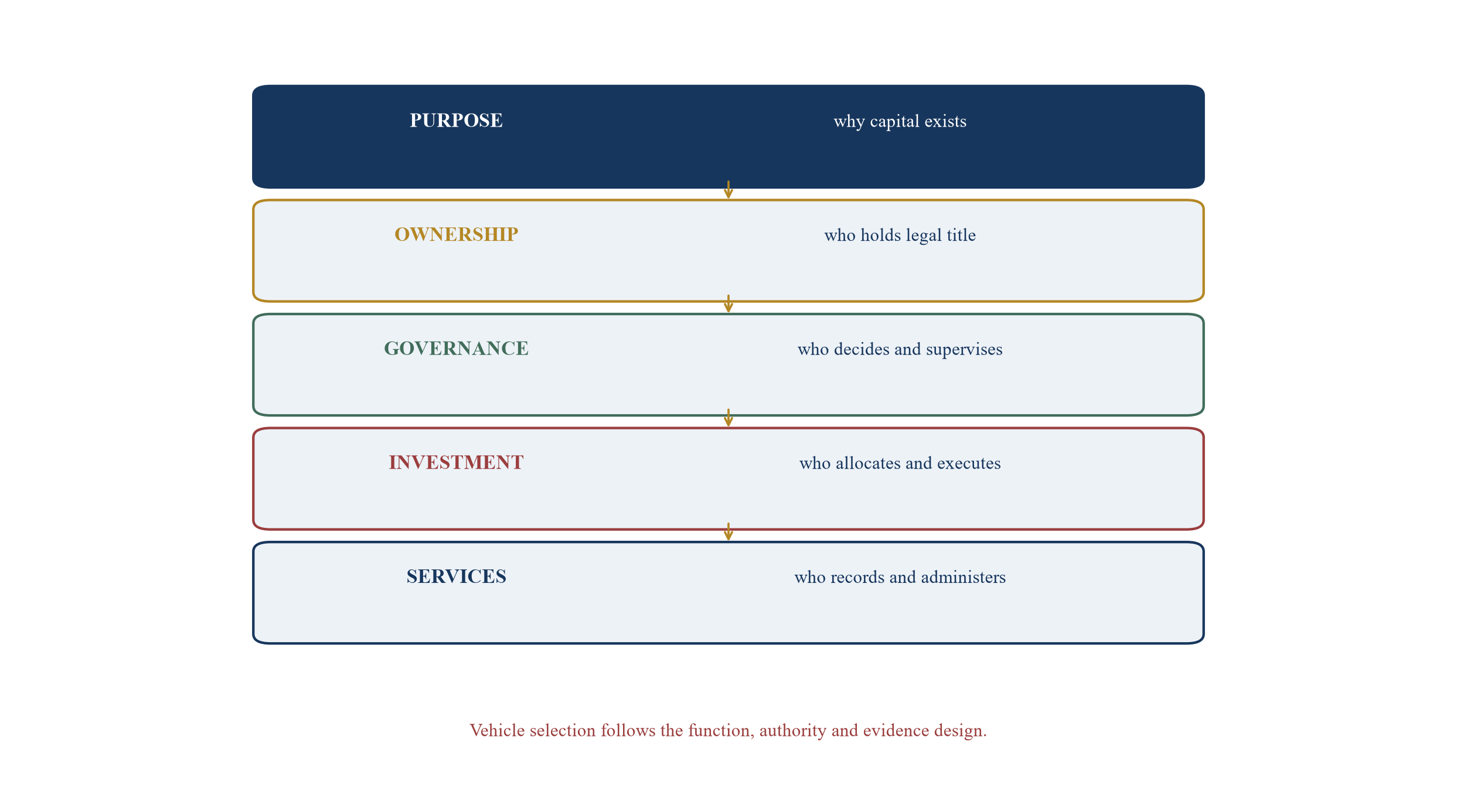
The layers should be designed separately and then connected through legal documents, mandates and evidence.
3. Understand what a DIFC family office entity does
The Family Arrangements Regulations describe arrangements that families can make in DIFC for the operation of their businesses, preservation of wealth, and succession and legacy planning [3]. They replaced the former Single Family Office regime with a Family Office framework. DIFC's official materials describe a family office as a platform that centralises and professionalises services such as investments, strategy, tax coordination, wealth and succession planning, risk management, legal and fiduciary coordination, and administration [4-6].
A family office entity is therefore an operator. It can employ people, contract with data and technology providers, maintain books, coordinate external advisers, prepare consolidated reporting, operate treasury processes and support governance meetings. Its exact permitted activities depend on its licence, constitutional documents, the family relationship and the financial-services perimeter. An entity called a family office does not receive unlimited authority to manage money, give regulated advice or serve unrelated clients.
The office should have a written service catalogue. Each service should identify the recipient, legal basis, owner, process, systems, data, control, fee or allocation, regulator if any, and output. Investment reporting, for example, may involve collecting custodian data and calculating performance. Investment management involves discretion over assets. Advising on financial products, arranging deals, managing assets and operating funds can engage regulatory requirements. The activity description and actual conduct matter more than an internal label.
The operating entity also creates its own risks. Staff can have excessive access to banking and custody. Informal instructions can bypass council or board authority. Costs can be allocated without a defensible method. Sensitive family and investment data can spread across advisers and personal devices. A departure by one trusted employee can expose missing records, passwords and institutional knowledge. These are operating-company problems and require board oversight, employment controls, cybersecurity, segregation of duties, business continuity and auditable procedures.
The family should decide whether to build, outsource or combine capabilities. A lean office may retain independent asset managers, accountants, lawyers and administrators while maintaining one internal controller and one governance lead. A larger office may employ an investment team, finance function, risk officer and family-services personnel. The design should follow complexity and service volume, with control independence preserved where investment originators, valuers and approvers could otherwise become the same person.
4. Define the family boundary before relying on the family-office perimeter
The Family Arrangements Regulations define a Family by reference to a common ancestor and descendants, spouses and specified related persons within the regulatory conditions [3]. A family structure can contain Family Members, Family Entities, Family Businesses and a Family Office. The perimeter is important because DIFC and DFSA treatment can depend on whether services are provided exclusively within the relevant family arrangement.
Management should build a legal family map, rather than relying on surnames or social convention. It should identify the common ancestor used for the structure, every included person, marriages, former spouses where relevant, adopted and stepchildren, trusts, foundations, companies, partnerships and family businesses. Each entity should be connected to its ultimate owners, beneficiaries and service relationship. The map should state which classification has been confirmed under the regulations and which remains subject to advice.
The office should also identify every non-family recipient. A co-investment vehicle may include outside investors. A family business may have independent shareholders. A charitable entity may pursue wider public objects. An investment club may include friends. A service company may invoice third parties. These facts can change the legal, regulatory, tax, data and commercial analysis. They should be escalated before the office provides a service or accepts an instruction.
The DFSA General Module contains an exclusion from the "by way of business" test for specified activities where a person holds a DIFC Registrar licence to operate a Family Office and acts exclusively for the purposes of its duties as a Single Family Office [7]. The same rules include a limited treatment for a Private Trust Company or Family Structure providing trust services to one family without soliciting outside trust business [7]. The precise current rule, licence and fact pattern require DFSA-specialist advice. A family should not treat the exclusion as a general exemption for all financial activity.
The boundary register should be reviewed after marriages, divorces, births, deaths, ownership changes, outside capital raises, co-investments and service expansion. A clean perimeter today can become mixed tomorrow. The compliance process should require pre-clearance before onboarding any new person, entity, account or service recipient.
Table 2. Ownership vehicle and service entity comparison
| Dimension | DIFC foundation | Family office entity | Integration control |
|---|---|---|---|
| primary role | own property and pursue objects | deliver defined services and employ capability | written ownership and service architecture |
| core documents | charter, by-laws and council records | articles, board policies, employment and service agreements | document hierarchy and conflict rule |
| decision body | council, with guardian or other reserved rights where applicable | board, executives and committees | delegation and reserved-matters matrix |
| economic beneficiaries | qualified recipients or object-based beneficiaries under the documents | service recipients and shareholders under its legal form | prohibit undocumented benefit or fee flows |
| investment role | asset owner under an investment policy | analyst, adviser, coordinator or manager within authority | investment management agreement and DFSA review |
| tax focus | Article 17 eligibility, transparency and beneficiary treatment | service income, payroll, transfer pricing and free-zone position | entity-by-entity tax file and elections calendar |
| succession | continuity of ownership and constitutional authority | continuity of people, systems, processes and contracts | combined death and incapacity simulation |
| reporting | foundation accounts, registers and statutory filings | management accounts, service reporting and operating compliance | consolidated dashboard with legal-entity drill-down |
A family can use multiple vehicles. The table separates their principal management functions.
5. Separate legal ownership from beneficial purpose
A foundation can own an asset while serving people or purposes described in its constitutional documents. This separation creates continuity, but it also creates a discipline: the family must stop treating foundation property as the founder's personal account. Payments, benefits, loans, use of property and investment decisions need a legal basis, proper approval, valuation where relevant, accounting and tax analysis.
The asset transfer plan should start with legal title. For a private company, the team should review the share register, articles, shareholders' agreement, pre-emption rights, change-of-control provisions, licence conditions, financing documents and beneficial-ownership filings. For real estate, it should confirm whether the relevant registry recognises the proposed owner, whether consent is required, and whether taxes or fees arise. For funds, it should review transfer restrictions and investor eligibility. For custody assets, it should confirm account-opening and beneficial-owner requirements.
The next step is economic purpose. The by-laws may define categories of recipients, distribution criteria, education or healthcare support, entrepreneurial capital, philanthropy, reserve policies and treatment of family businesses. These provisions should be specific enough to guide the council and flexible enough to survive foreseeable changes. They should also connect to the family's wider wills, marital arrangements, shareholder documents and charitable commitments.
Control rights need their own layer. A founder may reserve certain powers where permitted, appoint council members, designate a guardian, or establish committees. Excessive concentration can create succession, governance, tax and banking concerns. Insufficient clarity can paralyse decisions. The rights matrix should state who initiates, recommends, approves, vetoes, executes, records and reviews each material action. It should include conflicts and emergency decisions.
Ownership evidence must remain current. The foundation should keep an asset register, contribution documents, valuations, consents, account statements, contracts and council resolutions. The office can maintain the records, yet the foundation's council remains responsible for its own legal decisions. A service agreement should define how documents are created, stored, approved and returned if the office or a provider changes.
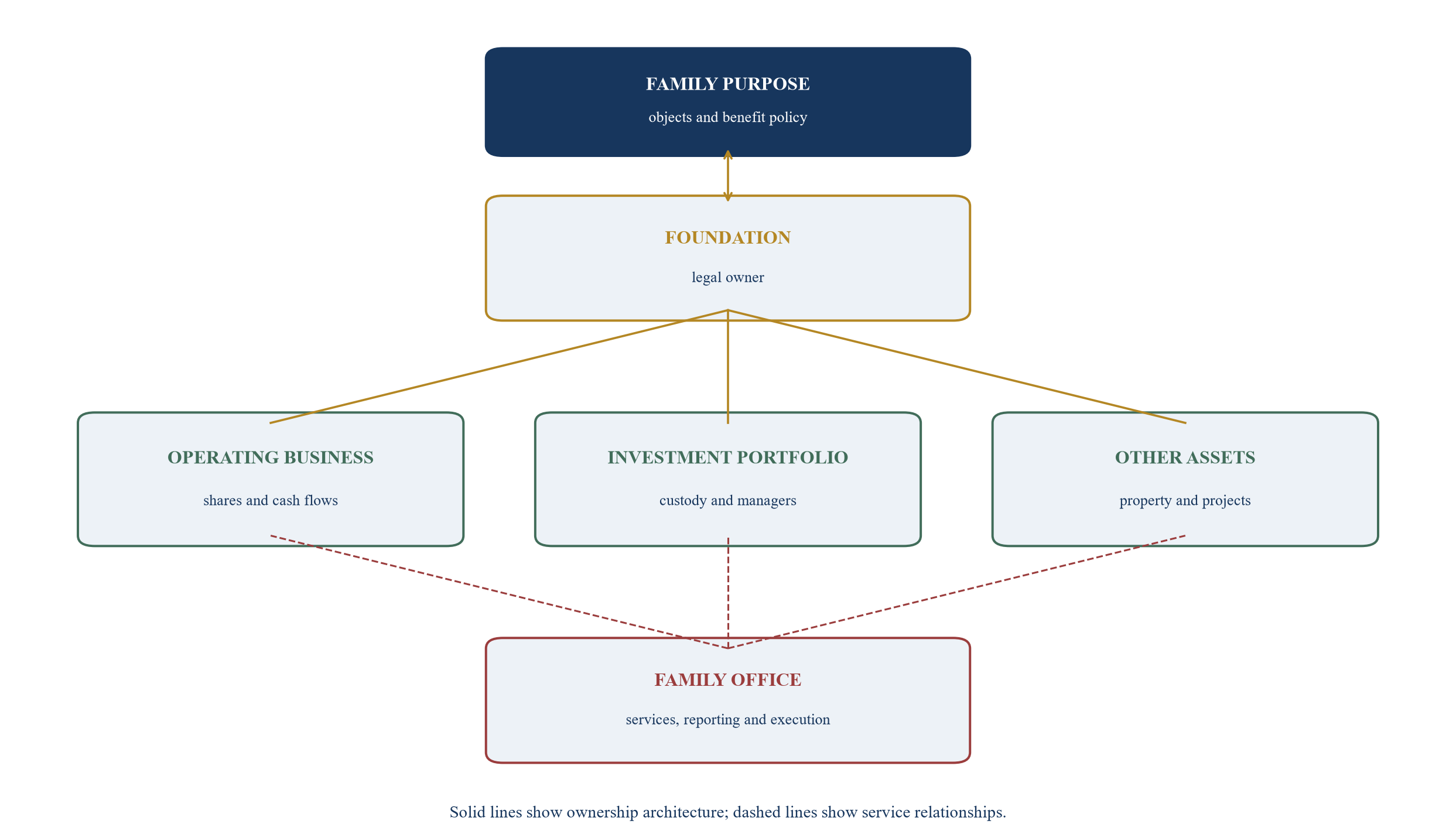
The illustration separates title, authority, investment execution and service support. Actual structures require jurisdiction-specific advice.
6. Build a governance system that can operate without the founder
Governance documents should be tested against real decisions. A family constitution may express values, while the foundation charter and by-laws allocate legally effective rights. Company articles and shareholder agreements govern businesses. Investment policies govern portfolio decisions. Employment contracts and board delegations govern office staff. The documents should be reconciled so that one instrument does not promise an outcome another prevents.
The council needs a competency design. Members collectively require an understanding of the family purpose, assets, businesses, risk, finance, law and succession. Independent members can add judgment and continuity, while family members contribute context and legitimacy. The appointment and removal process should consider terms, succession, conflicts, incapacity, performance and access to information. The council should have a calendar, meeting pack, quorum rules and a documented process for written resolutions.
A guardian can add oversight where the foundation documents and law provide for the role. The guardian's authority should be explicit. A broad veto without response deadlines can stop urgent decisions. A weak information right can make oversight symbolic. The design should state which decisions require consent, what information must be provided, how conflicts are handled, what happens after silence and how a dispute reaches mediation, arbitration or court.
Reserved matters should focus on consequences. Examples include changing objects, amending recipient classes, appointing or removing council members, disposing of a controlling business, borrowing above a threshold, granting security, changing the investment policy, making exceptional distributions, entering related-party transactions, changing domicile or continuing the foundation elsewhere. Thresholds should reflect the asset base and risks rather than a copied list.
The incapacity and death test is decisive. The family should simulate the founder becoming unavailable on a day when a payroll, debt covenant, acquisition signing, capital call and healthcare decision all require action. The team should verify who has authority, who receives notice, which bank accepts the mandate, where documents sit, how digital access transfers and what advice is needed. Exceptions revealed by the simulation should be resolved before the structure is funded materially.
7. Convert informal influence into explicit decision rights
Many family structures appear formal while operating through private conversations. A founder calls the banker, a family member tells the finance director to make a payment, and the office records the result after the fact. This pattern can undermine the foundation's separate personality, expose directors or council members, create inconsistent benefits and weaken the evidence required by banks, auditors and tax authorities.
The solution is a decision-rights matrix. Every recurring decision should have an initiator, preparer, recommender, approver, executor, recorder and independent reviewer. Investment proposals may originate with the office, receive an investment-committee recommendation, require council approval above a threshold, execute through a regulated manager or authorised signatory, and be reconciled by finance. A related-party transaction may require an independent valuation and recusal.
The matrix should also identify information rights. Qualified recipients may have rights under the constitutional documents and law, while other family members may receive information under a family policy. Sensitive data should be tiered. Council members need legal and financial information required for their duties. Investment staff need portfolio data. Beneficiaries may receive statements of policy and relevant benefits. Family-office employees should receive only what their roles require.
Escalation thresholds should cover money, control, risk and reputation. A small transaction with a family member can be more sensitive than a larger third-party trade. A change in custody can create operational risk without changing asset allocation. A media controversy in an operating company can affect the whole family's reputation. The matrix should therefore include qualitative triggers and an emergency route.
Meeting records should show the evidence considered, conflicts disclosed, advice received, alternatives evaluated, decision taken, conditions imposed and follow-up owner. Minutes should remain concise and substantive. A generic statement that a proposal was "discussed and approved" provides limited protection when the decision is later challenged.
Table 3. Governance rights and evidence matrix
| Decision | Initiator | Recommendation | Approval | Independent evidence | Post-decision control |
|---|---|---|---|---|---|
| contribute an asset | founder or owner | legal and tax advisers | owner and council as applicable | title, valuation, consent and tax memo | register update and custody confirmation |
| change investment policy | CIO or council member | investment committee | council and any reserved-right holder | asset-liability and scenario analysis | mandate changes and compliance test |
| dispose of family business | board or shareholder | transaction committee | constitutional and shareholder approvals | valuation, fairness, conflicts and buyer diligence | proceeds policy and closing audit |
| exceptional distribution | eligible requester | office and distribution committee | council under by-laws | purpose, equality, liquidity and tax analysis | payment verification and recipient record |
| related-party transaction | business or family member | conflicted party excluded | independent quorum | market terms and external valuation | annual related-party review |
| appoint manager or custodian | office investment team | investment committee | delegated body | due diligence, licence, fees and controls | performance, risk and concentration monitoring |
| amend governance | council, guardian or authorised person | governance committee and counsel | rights holders under documents | legal opinion and family consultation record | version control and implementation certificate |
Rights must match the charter, by-laws, company documents, service agreements and applicable law.
8. Design the investment operating model separately
The foundation can be the asset owner without becoming an investment manager. Its council can approve an investment policy and delegate implementation to a properly authorised party. The family office can coordinate analysis and monitoring within its permitted activities. External asset managers, banks, fund managers and advisers can execute regulated functions under their licences. The architecture should state the role of every participant.
The investment policy statement should connect family objectives to portfolio constraints. It should define required liquidity, spending and distributions, liabilities, currencies, time horizons, risk capacity, prohibited exposures, concentration limits, private-market pacing, leverage, hedging, responsible-investment preferences and review triggers. It should also state who can approve exceptions and how quickly an emergency decision can be made.
Custody and authority deserve separate attention. The legal owner named on the account should match the structure. Signing rights, dealing authority, view-only access and payment authority should be segregated. The office may aggregate data without holding transaction authority. An external manager may trade without moving cash outside the mandate. Council approval may be required for new accounts or large private investments. Bank documentation should reflect the same model.
Private investments create additional governance. The office should distinguish sourcing, underwriting, conflicts, valuation, execution, portfolio support and exit. A family member who introduces a transaction should disclose economic interests. The investment committee should receive a standard memorandum with downside cases, liquidity, governance rights, follow-on capital and exit routes. Valuation should be independent from deal sponsorship where practical.
Performance reporting should separate market return, currency, cash flows, fees, leverage and private-asset valuation changes. The dashboard should show total-family exposures across vehicles while preserving legal-entity records. Consolidation is a management view; it should not erase which entity owns an asset, owes a liability or approved a decision.
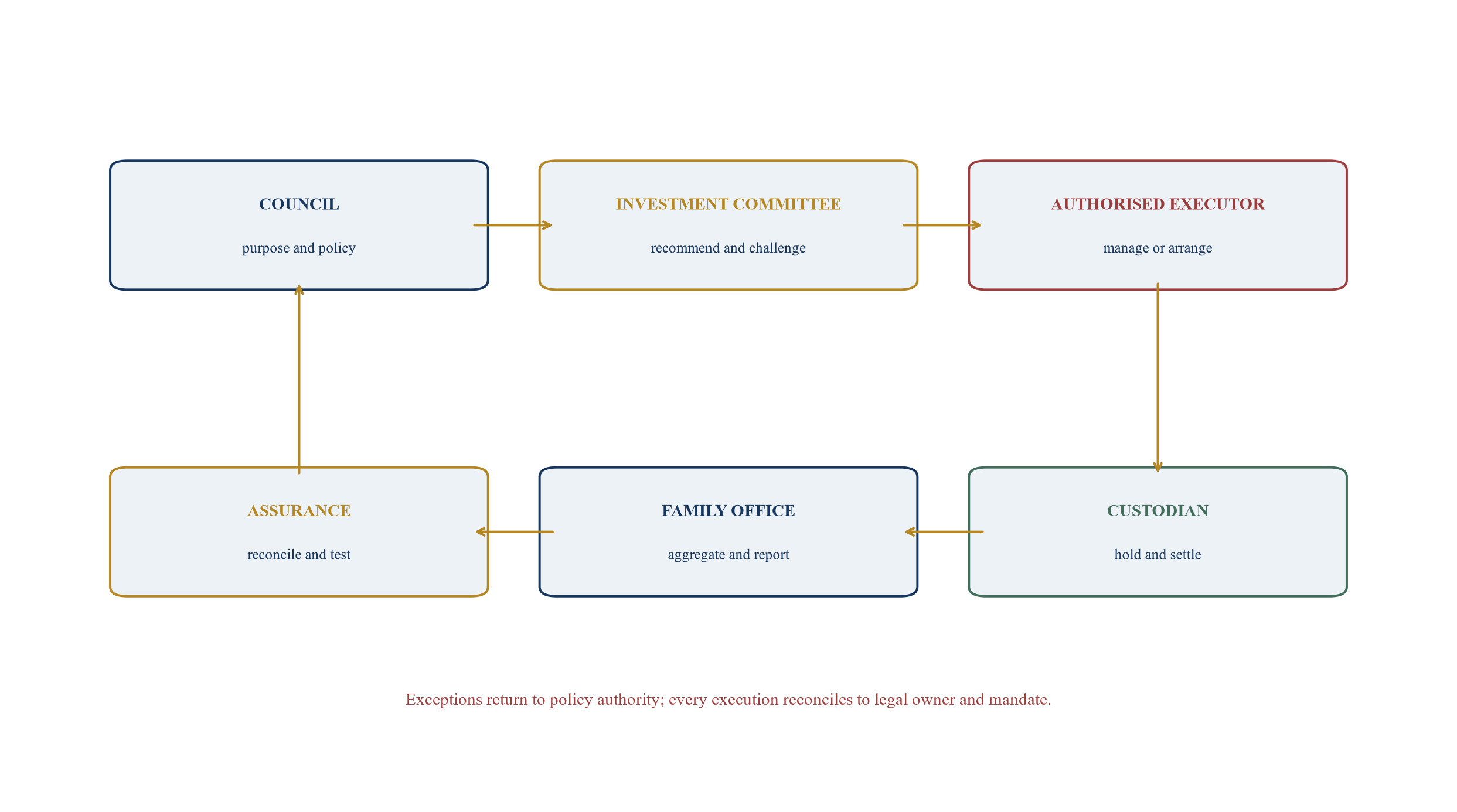
The loop preserves owner oversight while separating policy, recommendation, execution, custody and assurance.
9. Define the DFSA perimeter before staffing or marketing
The DFSA regulates financial services conducted in or from the DIFC. The General Module defines specified activities and contains exclusions and conditions, including the family-office treatment described in GEN 2.3.5 [7]. The family should obtain a written perimeter analysis that maps every proposed activity, recipient, asset, location, remuneration method and service provider to the current rules.
The analysis should use verbs. "Investment support" is too vague. The office may research securities, prepare analytics, recommend an allocation, select a manager, negotiate a fund subscription, transmit an order, exercise discretion, arrange a deal, manage assets, operate a fund, hold client assets or introduce an adviser. Each verb can have a different legal significance. The analysis should state who performs it, for whom, from where, under which agreement and with what authority.
Single-family activity within the relevant licence and conditions may benefit from the specific rule. Activity for multiple unrelated families, outside investors or the public can move beyond that perimeter. A Multi Family Office business model generally requires a different regulatory and commercial analysis. A co-investment with third parties can create a fund, arranging or promotion question. The office should seek advice before expanding recipients or receiving transaction-based remuneration.
Outsourcing does not remove governance responsibility. The family should verify each provider's legal identity, regulator, permissions, jurisdiction and contractual role. The DFSA Public Register can confirm the status and permitted financial services of firms authorised in DIFC [8]. Marketing material and engagement letters should use precise language that matches permissions. The office should maintain an annual licence and permissions review.
The perimeter can change as the operating model evolves. Hiring a CIO, bringing execution in-house, adding a trading desk, pooling family branches, accepting an external investor, launching an investment vehicle, receiving carried interest or advising a family business on securities can alter the facts. A change-control policy should prevent any new service from launching before legal, regulatory, tax, data and insurance reviews are complete.
10. Treat corporate tax classification as a separate decision tree
UAE Corporate Tax uses the term Family Foundation as a tax concept. The FTA explains that the concept can include a foundation, trust or similar entity that satisfies Article 17 conditions, whether formed in the UAE or abroad [9-11]. This tax status is not automatically created by using "foundation" in an entity name. A legal DIFC foundation and a corporate-tax Family Foundation overlap only where the statutory conditions and application requirements are met.
The FTA's Family Foundations Guide states that a juridical person meeting the conditions can apply to be treated as an Unincorporated Partnership and therefore fiscally transparent [9]. Conditions include that the entity was established for the benefit of identified or identifiable natural persons or a public benefit entity, that its principal activity is receiving, holding, investing, disbursing or otherwise managing assets or funds associated with savings or investment, and that it does not conduct a business or activity that would have constituted a business if undertaken directly by the beneficiaries, subject to the detailed law [9].
Registration and application are operational steps. The guide states that a juridical person wishing to apply for transparent treatment must first register for Corporate Tax; multi-tier entities seeking treatment must register and apply separately as applicable [9]. Approval, effective period, annual confirmation and changes require calendar control. The family should retain the legal documents, beneficiary information, activity analysis, ownership chain and income classification supporting the application.
The FTA's 2025 public clarification on family wealth management structures covers a foundation, holding company, special-purpose vehicle, single family office, multi-family office and family members [10]. It explains that a family wealth vehicle with separate legal personality that does not satisfy the relevant Family Foundation conditions is a taxable person in its own right. It also discusses possible free-zone and participation-exemption treatment where the conditions are met [10]. Management should model each entity separately before consolidating the economic result.
The family office's service income, expenses, related-party charges and employees belong in their own tax analysis. A transparent foundation result does not automatically make an operating company transparent. Transfer-pricing principles, arm's-length support, permanent-establishment questions, free-zone conditions and foreign tax can apply. The tax architecture should therefore have an entity-by-entity matrix, a transaction map and a filing calendar.
Table 4. Corporate tax and reporting decision tree
| Entity or flow | First classification question | Evidence file | Decision owner | Recurring control |
|---|---|---|---|---|
| DIFC foundation | does it satisfy Article 17 conditions and approved transparency requirements? | objects, beneficiaries, activities, assets, application and approval | council with tax adviser | annual confirmation and change review |
| wholly owned SPV | can the multi-tier transparent treatment apply, or is it taxable separately? | ownership, control, activity and separate application | SPV board and council | registration, return and ownership monitor |
| family office company | what income, expenses, related-party services and free-zone rules apply? | contracts, functions, staff, invoices and transfer-pricing analysis | office board | quarterly tax provision and annual return |
| natural-person beneficiary | what distributive share, personal investment or business treatment applies? | status, allocation, income type and foreign position | individual with advisers | personal filing and residence update |
| distribution or benefit | what legal and tax character does the payment have? | by-laws, resolution, purpose and recipient details | council and finance | pre-payment review and ledger |
| investment income | where does participation, dividend, property or other treatment apply? | asset, holding period, ownership percentage and source | tax lead | income classification reconciliation |
| cross-border payment | do withholding, treaty, foreign tax credit or reporting rules apply? | payer, recipient, residence, beneficial ownership and treaty claim | payer entity | payment gate and certificate calendar |
Tax outcomes depend on law, facts, applications and approvals. The table is a management evidence map.
11. Build the ownership chain before applying tax labels
Family structures often contain several layers: a foundation, holding company, operating businesses, property companies, investment SPVs, trusts, partnerships and an office company. The FTA guidance permits certain wholly owned and controlled juridical persons in a qualifying multi-tier structure to apply for transparent treatment, subject to the statutory conditions [9]. A partial holding, outside investor or non-qualifying activity can produce a different result.
Management should draw the chain at legal-entity level. Every box should show jurisdiction, legal form, owner percentage, voting control, activity, tax registration, tax status, financial year, bank accounts, assets, liabilities and reporting obligations. Every line should show the legal instrument, consideration, distribution rights and service relationship. The diagram should reconcile to statutory registers and audited or management accounts.
The chain should then be tested under several states. State one reflects the intended structure and approved applications. State two assumes an application is delayed or refused. State three introduces outside capital at one SPV. State four adds active trading or services. State five considers a beneficiary becoming tax resident elsewhere. The purpose is to identify dependencies and documentation, not to produce a universal tax answer.
Transparent treatment can shift the tax analysis to beneficiaries. That shift increases the importance of accurate allocations, income character, beneficiary status and foreign reporting. A natural-person beneficiary may have different UAE Corporate Tax treatment for personal investment income than a corporate beneficiary. A foreign beneficiary may have obligations in another country. The family office should distribute tax packs with enough time for each recipient's advisers.
The structure should avoid circular service and funding flows. A foundation should not pay an office charge without a service agreement, invoice, cost basis and approval. An SPV should not lend to a family member without legal, tax and governance review. A business dividend should reconcile through the chain. Each material cash flow should have a source, authority, classification, banking evidence and ledger treatment.
12. Make transparency and privacy compatible
DIFC foundations can offer a degree of confidentiality through the distinction between registry information and detailed by-laws. Confidentiality does not mean invisibility to competent authorities, banks, tax administrations, auditors or regulated service providers. The structure should be designed for lawful transparency and controlled access.
The Foundations Law requires the Registrar to keep a register and specifies information included for public inspection, while protecting certain personal details from public display [1]. Family Arrangements Regulations also provide for relevant registers and family-structure information [3]. Beneficial-ownership, anti-money-laundering, sanctions and licensing obligations can require additional information. The office should maintain a disclosure matrix identifying which authority or provider receives which data under which legal basis.
Banks and custodians will ask about founders, council members, guardians, qualified recipients, contributors, controlling persons, source of wealth, source of funds, tax residence and expected activity. Inconsistent answers across institutions cause delay and risk. The family should maintain one approved KYC pack with dated evidence, an ownership chart and a narrative connecting wealth creation to current assets. Updates should be issued after relevant changes.
Privacy controls should follow data sensitivity. Identity documents, health information, family disputes, investment positions and distribution records need different access. The office should use role-based permissions, encrypted storage, approved communication channels, retention periods, vendor due diligence and incident response. Personal email and messaging should not become the authoritative record for approvals.
The annual disclosure review should reconcile the foundation register, company registers, bank files, tax registrations, CRS classifications, insurance applications and internal records. Differences should be investigated. A structure can be legally sound and still experience blocked accounts or delayed transactions if the operational evidence is incomplete or inconsistent.
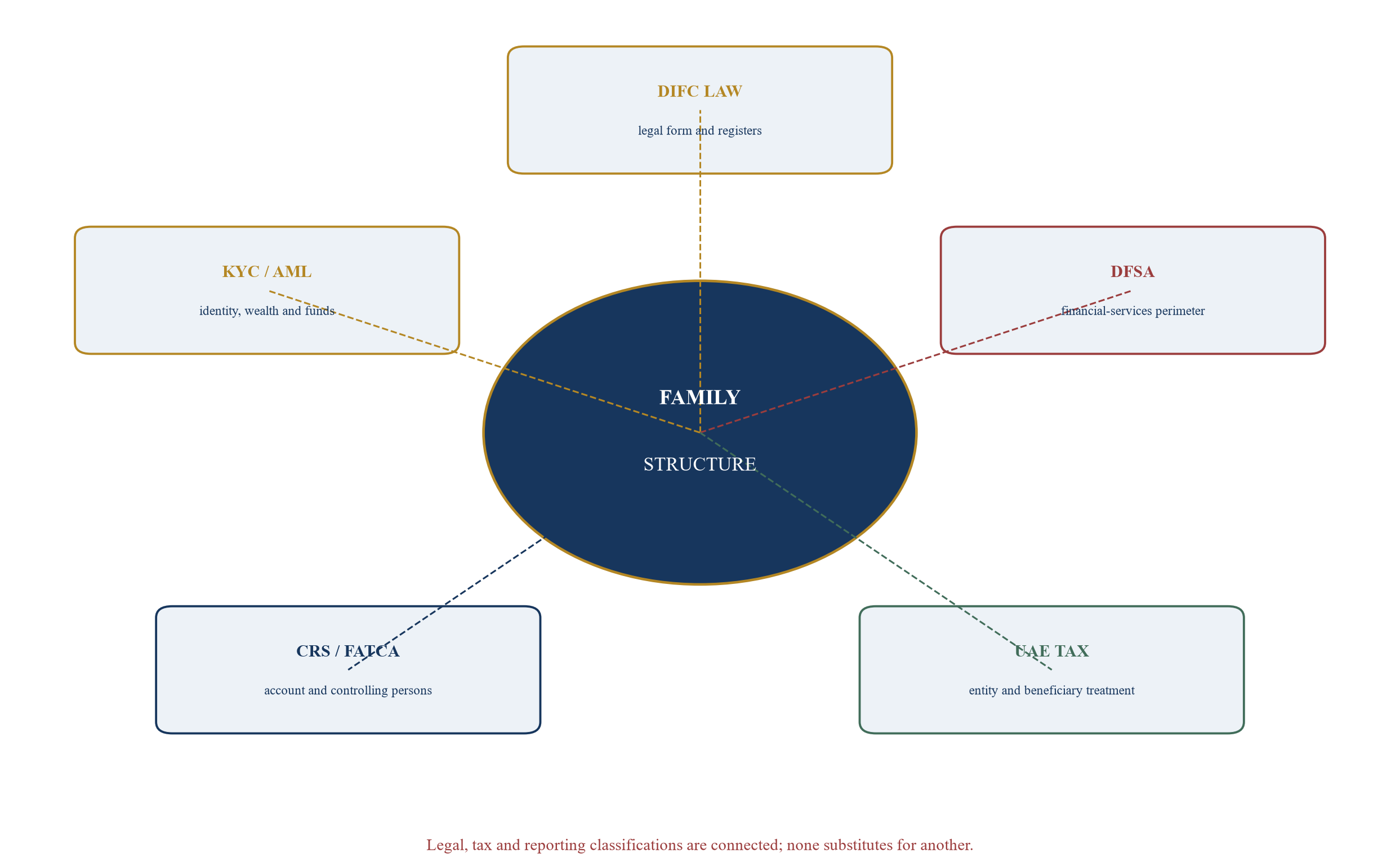
One legal structure can have several classifications. Each perimeter requires a separate evidence file.
13. Classify the structure under CRS and FATCA
The UAE participates in the Common Reporting Standard and FATCA automatic exchange regimes. The Ministry of Finance states that UAE Reporting Financial Institutions collect and report specified account information, which is then exchanged with relevant authorities under the applicable framework [12]. DIFC has its own Common Reporting Standards Law, regulations and guidance administered by the Registrar for DIFC entities [13-15].
A foundation, holding company, office company and investment entity may receive different classifications. The analysis considers activities, assets, income, management and controlling persons under the applicable definitions. A legal foundation is not automatically a Reporting Financial Institution or a passive non-financial entity. The office should obtain a classification memo for every entity and account.
Self-certifications need consistent tax-residence information. Founders, council members, guardians, beneficiaries and other persons can be relevant to controlling-person analysis depending on the entity and classification. The bank's form may use terms that differ from the foundation documents. The KYC pack should explain the mapping and retain adviser support.
Reporting calendars and nil returns should be tracked. The MoF provides registration and reporting systems and publishes guidance, FAQs and deadline materials [12]. DIFC guidance states that certain non-financial entities may also have reporting obligations because the Registrar is the relevant authority [14]. The compliance owner should confirm whether registration, reporting, risk assessment or other submissions are required for each reporting period.
The future-state design should account for CRS 2.0 and the Crypto-Asset Reporting Framework. The UAE Ministry of Finance announced implementation of updated CRS from 1 January 2027, with first exchanges under the updated standard expected in 2028; it also announced the CARF implementation schedule [16,17]. A family structure holding digital assets, e-money or central-bank digital currency exposures should review systems and data before the rules take effect.
14. Connect the foundation to family businesses without weakening either
A foundation can provide continuity for ownership of a family business. The UAE Federal Decree-Law concerning Family Businesses provides a federal framework for family-business governance and transfer, while DIFC's Family Arrangements Regulations support related structures in the centre [3,18]. Company law, free-zone rules, sector licences and shareholder agreements remain relevant to each business.
The ownership decision should preserve commercial agility. A foundation may hold a controlling block, but the operating-company board should remain responsible for strategy, risk and performance. Family employment, dividends and related-party transactions should follow company policies. The foundation council should exercise shareholder rights through a defined owner mandate rather than intervening informally in daily management.
The owner mandate can specify purpose, risk appetite, dividend expectations, leverage limits, capital allocation, acquisition and disposal thresholds, board composition, family employment principles, information rights and succession expectations. It should distinguish decisions reserved to shareholders from those delegated to the board. The company should be able to hire, invest and transact within approved boundaries.
Liquidity planning matters. A foundation that relies on one business dividend may struggle to fund distributions, taxes, philanthropy or office costs during a downturn. The family should model business cash needs, debt covenants, minority rights, dividend capacity and family obligations. A liquidity reserve outside the operating business can reduce pressure for value-destructive dividends or a rushed sale.
Exit planning should be embedded early. A sale can change the family from business owner to financial investor in one transaction. The governance model should define who can approve an exit, how conflicts are managed, how value is assessed, how proceeds are allocated, and how tax, custody, investment policy and family expectations will be handled after closing. Transaction readiness can itself protect value even when no sale is planned.
Table 5. Family business ownership and transition controls
| Workstream | Foundation or owner decision | Operating-company decision | Evidence | Value-protection test |
|---|---|---|---|---|
| strategy | approve owner purpose and major reserved matters | set and execute business strategy | owner mandate and board plan | management retains accountable operating authority |
| capital | define dividend, leverage and new-capital boundaries | propose budgets, borrowing and reinvestment | capital policy and covenant model | family needs do not drain growth capital |
| leadership | appoint shareholder nominees under criteria | appoint and supervise executives | skills matrix and succession plan | role follows competence and documented process |
| family employment | approve principles and conflict safeguards | recruit, assess and reward employees | policy, role profile and performance record | family employees meet comparable standards |
| related parties | set approval and disclosure rules | propose and execute on market terms | valuation, recusal and contract | transaction can withstand independent review |
| M&A | approve thresholds and ownership consequences | source, analyse and integrate transactions | valuation, financing and integration plan | acquisition supports owner purpose and risk capacity |
| exit | approve sale authority and proceeds principles | prepare business and execute approved process | readiness file, bidder process and closing controls | value, certainty, legacy and reinvestment considered |
The owner mandate should complement company law and board duties.
15. Use service agreements and cost allocation to protect substance
The family office should contract with every entity it serves. A service agreement should describe scope, authority, exclusions, personnel, data, systems, records, service levels, fees or allocations, liability, confidentiality, conflicts, outsourcing, termination and handover. It should state that the service provider cannot exceed the owner's or board's legal authority.
Cost allocation should reflect functions and benefit. Investment accounting costs may be allocated by asset complexity or account count. Governance support may follow time spent. Technology may follow users or data volume. A fixed management fee can be appropriate if supported. Arbitrary allocations can distort entity accounts, related-party evidence and performance. The office should maintain a policy, allocation keys, invoices and reconciliations.
Substance is broader than office space. The entity should have decision-makers, competence, meetings, records, contracts, employees or providers, and actual conduct consistent with its role. A foundation council that signs prepared resolutions without understanding the assets is weak governance. An office company that invoices services performed elsewhere may face tax and operational questions. Management should document where decisions are made and work is performed.
Service-level measures should focus on outcomes. Examples include reconciliations completed by deadline, unresolved breaks, investment reports issued, tax packs delivered, KYC requests outstanding, capital calls funded on time, governance actions closed, cyber incidents, provider reviews and succession documents tested. Activity counts alone can hide poor quality.
Termination planning should be built into the first contract. The foundation and family entities should retain ownership or access rights to books, data, models, passwords, contracts and correspondence. The office should maintain a current handover index. A provider change, key-person departure or family dispute should not make the structure inoperable.
16. Build a control environment around cash, data and authority
Family offices combine high-value assets, trusted relationships and confidential information. These conditions make segregation of duties essential. No individual should be able to create a payee, approve a payment, release funds and reconcile the bank account alone. Investment execution, valuation and performance reporting should have independent checks. Emergency access should be logged and reviewed.
The payment policy should specify authority by entity, bank, currency and purpose. Payments should start from an approved obligation, match a contract or resolution, pass sanctions and fraud checks, receive dual approval and reconcile to the ledger. Changes to bank details should use independent callback procedures. Personal instructions should be redirected into the formal workflow.
Data architecture should use a controlled source of truth. The entity register, asset register, document index, contact list, access matrix and obligations calendar should be versioned. Custodian and accounting feeds should reconcile. Manual adjustments should identify preparer, reviewer, reason and evidence. Family members should receive dashboards from the controlled system rather than separate spreadsheets.
Cybersecurity should cover identity, devices, vendors, cloud services, backups and incident response. Multi-factor authentication, privileged-access management, phishing exercises, data-loss controls and recovery tests are practical foundations. The risk review should consider the personal digital security of principals because attackers can bypass office controls through a family member's email or phone.
Insurance should be reviewed for directors, officers, professional liability, cyber, crime, property and key persons as relevant. Policy limits and exclusions should reflect the actual structure. Insurance is a financing tool for residual risk; it does not replace preventive controls or legal authority.
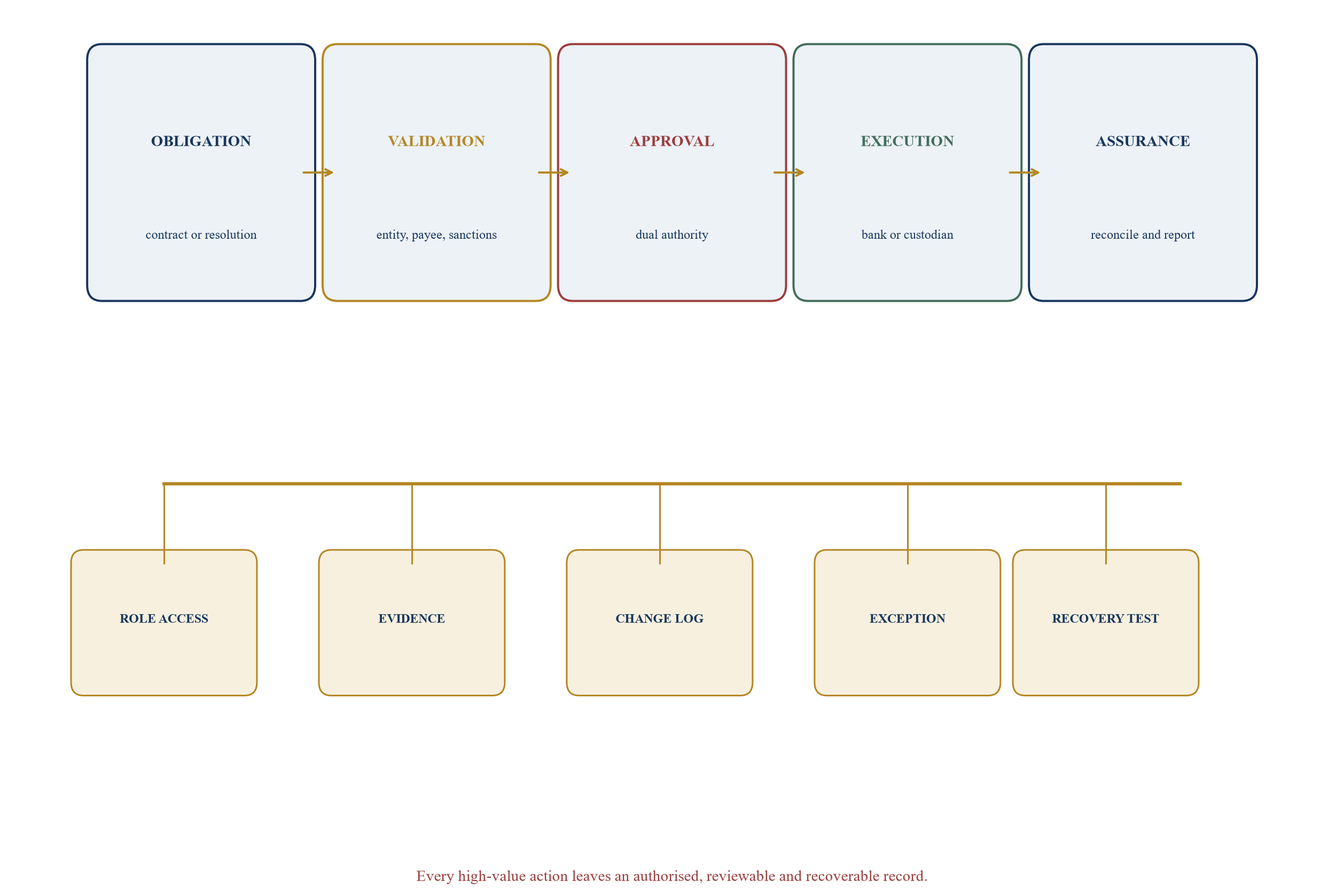
High-value workflows require authorisation, evidence, segregation and independent reconciliation.
17. Model economics without allowing cost to choose the structure
A foundation and family office create establishment and recurring costs. These can include registration, licensed registered-agent or corporate-service support, legal and tax advice, council or director remuneration, office staff, systems, accounting, audit, custody, investment management, insurance, data and compliance. The family should model the full cost by entity and function.
Cost should be compared with complexity and risk. A family with one liquid portfolio and no operating business may obtain better control through a simpler ownership vehicle and outsourced reporting. A family with multiple companies, jurisdictions, trusts, properties, private investments and active succession needs may justify a dedicated office. Scale alone is insufficient; transaction volume, decision complexity, family dispersion and control requirements matter.
The economic model should distinguish fixed platform cost, variable service cost, investment-product fees and transaction costs. It should also identify costs already paid through banks, funds, companies and advisers. Consolidation can reveal duplicated custody, overlapping managers, unused entities and repeated professional work. Savings should be recognised only after contracts or operating changes create them.
Value should be measured through decision quality and risk-adjusted outcomes, not a guaranteed valuation uplift. Useful measures include reduced cash drag, lower fee leakage, better tax and reporting compliance, fewer operational breaks, improved liquidity coverage, timely capital calls, disciplined manager selection, stronger business-owner governance and faster transaction readiness. Each measure needs a baseline and evidence.
Scenario modelling should include failure states. A key person leaves; a bank freezes an account pending KYC; one family branch disputes a distribution; a business needs emergency capital; a foreign country changes tax rules; or a co-investor triggers regulatory questions. The chosen architecture should remain operable under these conditions. A low-cost structure that cannot survive a foreseeable event can be expensive in practice.
18. Test three structural archetypes
The first archetype is a foundation-led owner with outsourced services. The foundation owns selected assets, the council approves policy, and external regulated managers, administrators and advisers deliver execution. A small internal coordinator maintains records and governance. This design can suit a family that wants ownership continuity without building a large operating platform.
The second is a family-office-led operator with distributed ownership. Individuals, trusts, foundations and companies retain their assets. The office provides consolidated reporting, governance support, administration and investment coordination under service agreements. This can suit a family that needs visibility and process while ownership remains constrained by existing structures, taxes, lenders or different family branches.
The third combines a foundation with a family office. The foundation owns core assets or holding companies; the office employs the team and provides services to the foundation and other family entities. The council owns purpose and high-level policy. The office board owns service performance. An investment committee recommends within delegated authority, and regulated providers perform activities requiring permission. This model offers clear separation when documented properly.
No archetype should be implemented solely from a diagram. The family must test asset transfer, tax status, regulatory perimeter, family definitions, succession, banking, foreign-law recognition, control and cost. Some assets may remain outside. Some family branches may use separate vehicles. A phased design can establish governance and reporting first, transfer only validated assets, and add capability when volume supports it.
The decision memorandum should score each archetype against mandatory constraints and weighted objectives. Mandatory constraints include legal transferability, acceptable tax treatment, regulatory compliance, banking access and successor authority. Weighted objectives can include privacy, simplicity, cost, family participation, investment agility, business continuity and philanthropy. A structure that fails a mandatory constraint should not win through a high aggregate score.
Table 6. Structural archetype scorecard
| Criterion | Foundation-led owner | Office-led operator | Integrated foundation and office | Required validation |
|---|---|---|---|---|
| ownership continuity | high | dependent on existing owners | high for contributed assets | transfer and succession opinions |
| operating capability | outsourced | high | high | people, systems and service design |
| governance separation | medium to high | depends on owners and contracts | high when councils and boards are distinct | rights and delegation matrix |
| investment agility | depends on mandates and providers | high within authority | high with clear policy and execution | DFSA perimeter and custody setup |
| implementation complexity | medium | medium | high | workplan, providers and budget |
| entity-level tax complexity | medium | medium to high | high | registrations, applications and flow model |
| consolidated reporting | provider dependent | core capability | core capability | data feeds and accounting architecture |
| resilience | strong legal continuity | strong process continuity | strong when both layers are tested | death, incapacity and key-person simulations |
Scores and weights are hypothetical management assumptions. The family should approve its own criteria after advice.
19. Implement through six controlled workstreams
The first workstream establishes facts. It produces the family map, asset and liability register, entity chain, decision inventory, service catalogue, tax-residence list and document index. Owners attest completeness. Advisers identify missing evidence and urgent constraints. No asset transfer should begin from an incomplete register.
The second defines purpose and governance. The family agrees objectives, recipient principles, reserved matters, council and guardian design, board roles, conflict policy, information rights and dispute route. Draft documents are tested against real decisions. The output is a governance blueprint and issues register, not signed forms alone.
The third validates legal, tax and regulatory treatment. Counsel assesses vehicle formation, asset transfer, foreign recognition, company and property rules. Tax advisers analyse UAE and foreign consequences, Article 17 treatment, applications and reporting. Regulatory counsel maps every service and investment activity. Banking providers review onboarding feasibility. Findings are written and linked to each design choice.
The fourth builds operations. The office or provider model is selected; service agreements, employment, accounting, data, custody, banking, payment, investment reporting, cybersecurity and continuity controls are implemented. The team migrates data and runs parallel reporting before relying on the new platform.
The fifth executes approved transfers and appointments in waves. Each wave has conditions precedent, valuations, consents, resolutions, signatures, registry updates, bank confirmation, tax records and a completion certificate. High-risk or illiquid assets follow successful completion of simpler assets. Exceptions remain visible.
The sixth proves the system. The family performs a governance meeting, investment decision, payment, distribution request, KYC refresh, tax-pack production, cyber recovery and founder-incapacity simulation. Independent reviewers test documents and controls. The council accepts the operating model only after material findings have owners and deadlines.

Timing is illustrative. Legal, tax, regulatory, banking and transaction constraints determine the actual sequence.
20. Operate a quarterly family-capital dashboard
The dashboard should show legal, financial and operational state. The ownership view lists entities, assets, liabilities, valuations, custodians and unresolved title issues. The governance view shows meetings, vacancies, conflicts, reserved-matter decisions and overdue actions. The investment view shows allocation, liquidity, concentration, performance, fees, private-market commitments and mandate breaches.
The compliance view shows licences, tax registrations, applications, returns, CRS and FATCA classifications, KYC refreshes, sanctions screening, insurance and data incidents. The succession view shows wills, powers, foundation appointments, company mandates, key-person dependencies and simulation findings. Each metric should have a legal entity, owner, threshold, source and last review date.
Exceptions matter more than attractive charts. A missing valuation, unsigned contribution, expired passport, overdue tax confirmation, unreviewed manager or unreconciled bank item should remain visible until closed. The dashboard should distinguish overdue, awaiting external action and accepted risk. Accepted risk requires an approver and review date.
The family council should receive a decision page before supporting detail. It should identify decisions due, changes since the prior quarter, emerging exposures, liquidity under base and stress cases, governance vacancies, critical compliance dates and actions requiring family participation. The office board should receive service performance and control detail. These packs overlap but serve different responsibilities.
Annual review should retest structure suitability. Family composition, residences, assets, businesses, regulations, taxes, technology and capabilities change. The review should ask whether each entity still has a purpose, whether ownership matches intention, whether the office's activities remain within permission, whether tax applications remain valid, whether reporting classifications are current and whether the structure can operate without key individuals.
21. Create the board-ready decision file
The final decision file should let an independent reader reconstruct why the family selected its architecture. It begins with approved objectives and mandatory constraints. It includes the family and entity maps, asset and liability register, alternative structures, adviser opinions, tax model, regulatory perimeter, banking feasibility, cost model, governance rights, investment operating model, service design, risk register and implementation plan.
Every recommendation should connect to evidence. If the foundation is chosen for ownership continuity, the file should identify which assets will be contributed, why transfer is legally and commercially suitable, and how successor authority works. If the office is chosen for investment reporting, the file should identify data sources, responsibilities, systems, controls and costs. If both are chosen, service agreements and decision rights should make the boundary explicit.
The approval should contain conditions precedent. These may include satisfactory legal and tax opinions, Corporate Tax registration and application steps, DFSA perimeter confirmation, bank onboarding, provider appointment, constitutional-document execution, consent from lenders or co-owners, valuation, data migration, insurance and successful simulation. Conditions should have owners and completion evidence.
The file should also state what the structure cannot do. It may not remove foreign tax, override asset-country law, guarantee confidentiality, eliminate family disagreement, assure investment returns or permit services outside the regulatory perimeter. Recording limitations protects decision quality and gives future council members a basis for review.
The architecture succeeds when ownership, governance and investment remain distinct and connected. The foundation can preserve legal continuity. The family office can preserve operating capability. Councils, boards, committees, managers and advisers can each exercise defined authority. Evidence connects the parts. This is the basis for a structure that can survive leadership transitions, investment cycles, regulatory scrutiny and changing family needs.
Sources and further reading
- Dubai International Financial Centre, Foundations Law, DIFC Law No. 3 of 2018, Consolidated Version No. 3, March 2024. Official source
- Dubai International Financial Centre, Non-Financial and Retail Checklist, Foundation. Official source
- Dubai International Financial Centre, Family Arrangements Regulations 2023. Official source
- Dubai International Financial Centre, DIFC private and family wealth offering. Official source
- Dubai International Financial Centre, Family Businesses. Official source
- Dubai International Financial Centre, DIFC Family Wealth Centre. Official source
- Dubai Financial Services Authority, General Module, GEN 2.3.5. Official source
- Dubai Financial Services Authority, Public Register of Firms. Official source
- UAE Federal Tax Authority, Corporate Tax Guide: Taxation of Family Foundations, CTGFF1. Official source
- UAE Federal Tax Authority, CTP008: Corporate Tax treatment of family wealth management structures. Official source
- UAE Federal Tax Authority, Corporate Tax guides, references and public clarifications. Official source
- UAE Ministry of Finance, Automatic Exchange of Information, FATCA and CRS. Official source
- Dubai International Financial Centre, Common Reporting Standard Regulations. Official source
- Dubai International Financial Centre, DIFC Common Reporting Standard Guidance Notes. Official source
- Dubai International Financial Centre, Legal Database. Official source
- UAE Ministry of Finance, UAE commitment to implement the updated Common Reporting Standard. Official source
- UAE Ministry of Finance, UAE signs the Multilateral Competent Authority Agreement under the Crypto-Asset Reporting Framework. Official source
- United Arab Emirates, Federal Decree-Law No. 37 of 2022 Concerning Family Businesses. Official source
- United Arab Emirates, Federal Decree-Law No. 47 of 2022 on the Taxation of Corporations and Businesses. Official source
- UAE Ministry of Finance, Cabinet Decision No. 100 of 2023 on Determining Qualifying Income for a Qualifying Free Zone Person. Official source
- Dubai International Financial Centre, DIFC announces enactment of Family Arrangements Regulations. Official source
- Dubai International Financial Centre, DIFC reaffirms commitment to families in the Year of the Family. Official source
- Dubai International Financial Centre, Wealth and Asset Management. Official source
- UAE Federal Tax Authority, Workshop on Corporate Tax for Family Foundations. Official source
