

1. INTRODUCTION
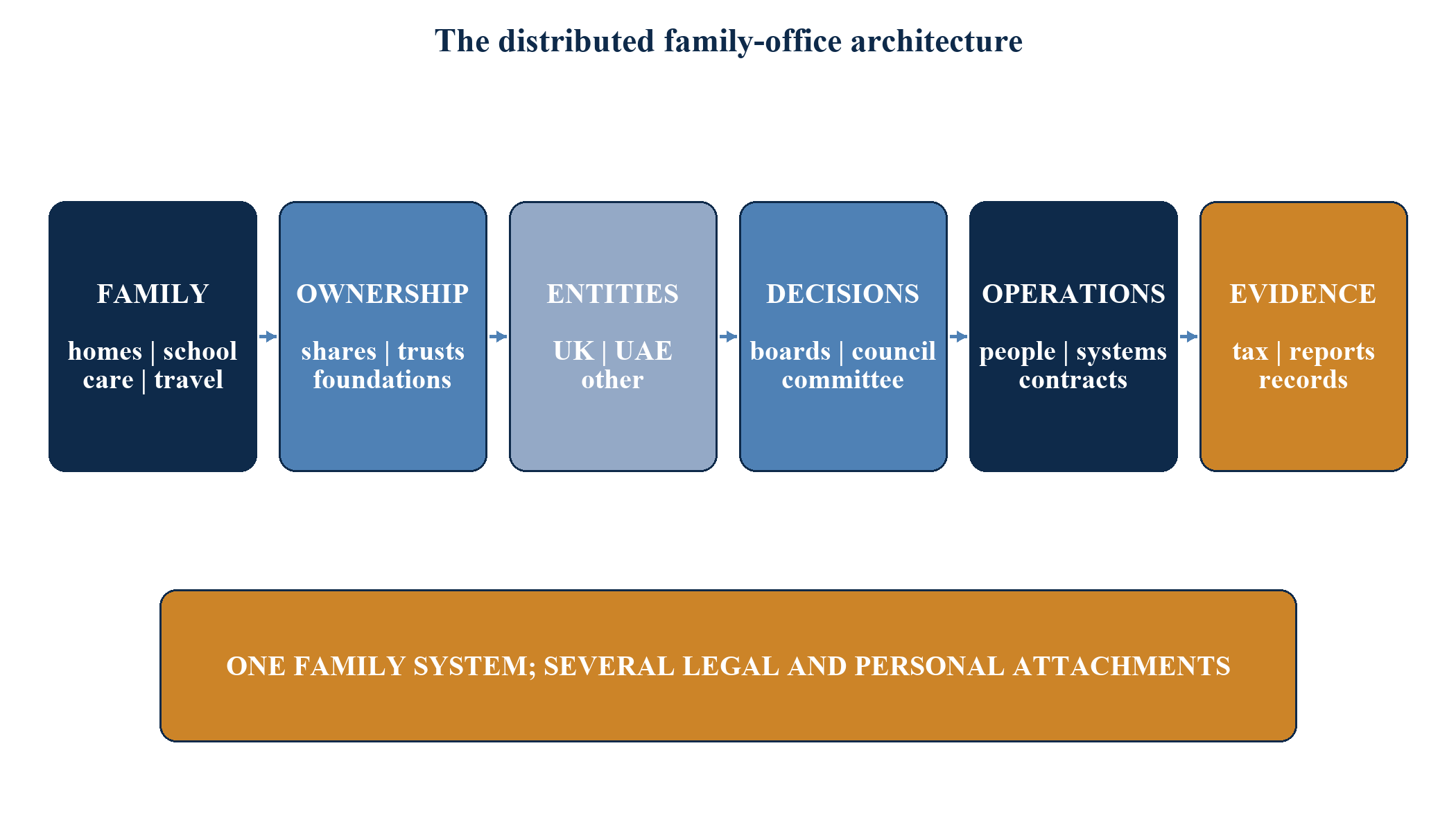
Relocating a family office is rarely a single move. A principal may establish residence in the United Arab Emirates while a spouse and children remain in the United Kingdom. A family investment company may continue to be incorporated in the United Kingdom, the investment team may retain a London office, trustees may sit in a third jurisdiction, and a new foundation or family-office company may be formed in Abu Dhabi or Dubai. The family, ownership chain, decision makers and operating entities can therefore occupy different places for long periods.
That separation creates a coordination problem. Individual tax residence follows facts relating to each person. Company residence and permanent establishment depend on the entity's own management, control, premises and agents. Trusts and foundations have separate governance, reporting and tax questions. A family-office licence or registration answers a regulatory question and does not determine the residence of family members or companies. The location of legal title also does not establish where investment control is exercised.
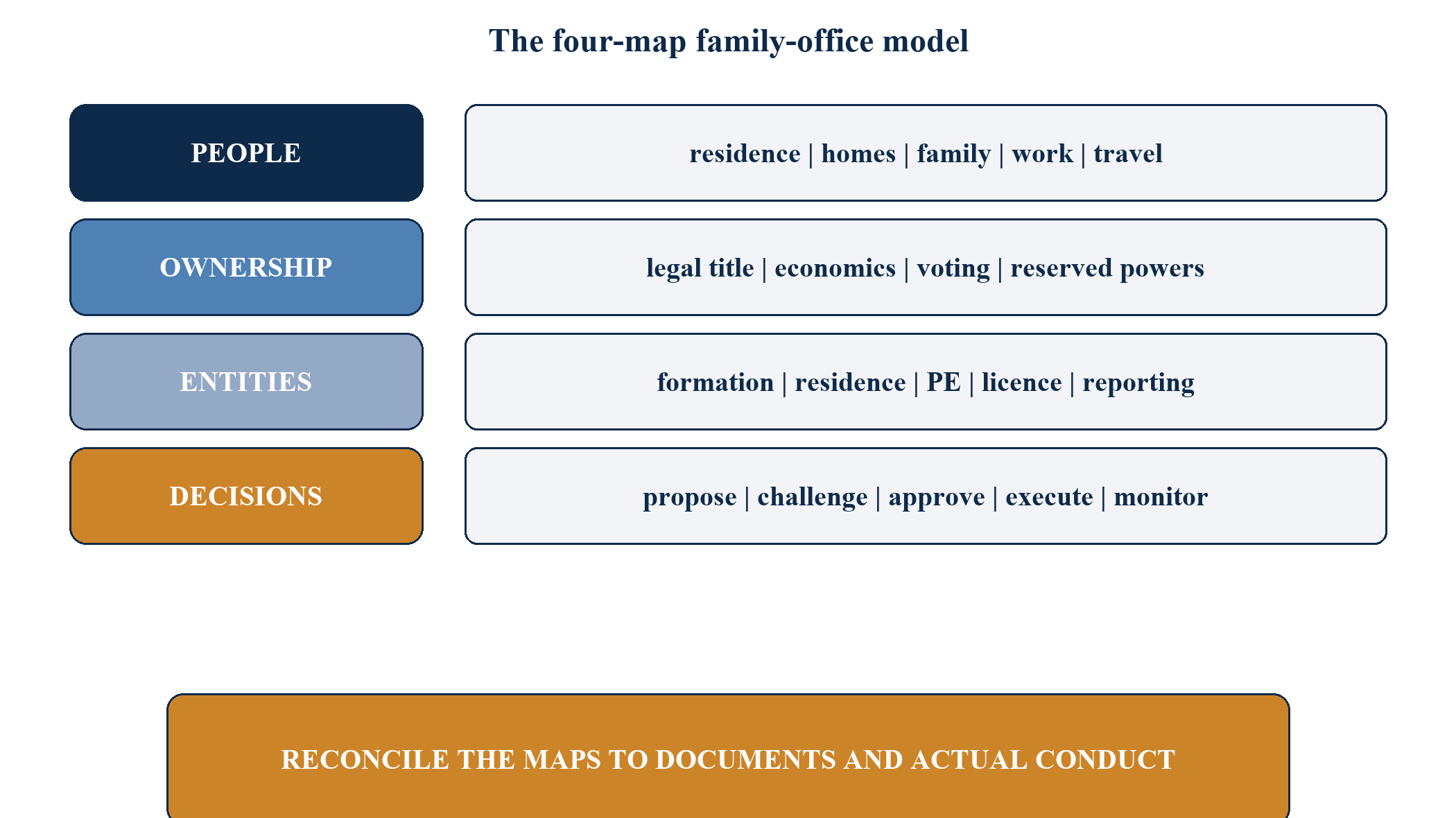
This paper develops a practical framework for a UK-to-UAE family-office transition in which the family and its commercial architecture remain distributed. It integrates current UK residence and inheritance-tax rules, the UK-UAE tax convention, UAE tax-residence and family-foundation guidance, ADGM and DIFC family-office frameworks, beneficial-ownership obligations, and the OECD Common Reporting Standard. It converts those sources into four connected maps: people, ownership, entities and decisions.
The central proposition is that a family office is an operating system rather than an address. A durable transition establishes where every person lives and works, where every entity is managed, who owns and controls each asset, where material decisions are made, and which records can demonstrate the result. The system should be reviewed when travel, family arrangements, governance, investment activity or law changes.
2. THE FAMILY OFFICE AS A SYSTEM
2.1 Family, wealth and administration
A family office connects three domains. The family domain includes residence, education, care, succession, family governance and personal use of assets. The wealth domain includes companies, securities, funds, real estate, operating businesses, trusts, foundations and liabilities. The administration domain includes accounting, tax, investment management, treasury, reporting, legal, compliance, philanthropy and household support.
These domains overlap, yet they should not be treated as one legal person. A family member may own shares without managing the company. A protector may hold consent rights without conducting portfolio management. A foundation council may govern a foundation while an external manager invests its assets. A family office may coordinate advisers without holding client assets or exercising investment discretion.
The first design task is therefore classification. Every person, asset, entity, role and service should have an identified legal attachment. Each attachment should state the jurisdiction, governing document, owner, controller, service provider and evidence owner. The classification should also distinguish personal arrangements from services provided by the family-office business.
2.2 Own-family activity and services to others
Family offices can range from a small administrative company to an institutional investment platform. A single family office normally serves one family and structures its own wealth. A multi-family office or commercial adviser serves several families or third parties. Investment management, arranging, advising, custody, fund management and fiduciary services can fall within regulatory perimeters depending on the activity and jurisdiction.
The perimeter should be tested against actual services. A company described as a single family office can move toward commercial activity if it begins managing unrelated capital, charging third-party fees, marketing investment opportunities or arranging transactions for others. Employment titles, website descriptions, contracts, invoices and operational conduct should use consistent language.
DIFC replaced its earlier single-family-office regime with the Family Arrangements Regulations, which provide a framework for family entities and family offices serving a single family [8]. ADGM provides family-office and foundation routes within its legal and registration framework [6,7]. The exact route should be selected after current legal and regulatory analysis of the proposed services.
2.3 A distributed model can be deliberate
Keeping part of the system in the United Kingdom can serve genuine commercial and family needs. The family may value school continuity, established advisers, a London investment team, UK banking relationships or governance continuity. A UAE entity may provide regional investment access, family governance infrastructure or a new residence base. An offshore trust or foundation may continue to hold assets under its existing law.
The model becomes fragile when the stated structure differs from actual conduct. A UAE board that follows instructions from London, a UK team that negotiates and commits the UAE company, or a foundation council that records decisions already made by the founder can create residence, permanent-establishment, governance and regulatory questions. A disciplined model preserves the commercial benefits of distribution while making authority clear.
3. THE FOUR MAPS
3.1 The people map
The people map covers the founder or principal, spouse or partner, adult children, minor children, dependants, trustees, protectors, council members, directors, investment-committee members, executives and key advisers. For each person, it records citizenship, domestic residence analysis, treaty-residence analysis where relevant, homes, family links, work locations, travel and formal roles.
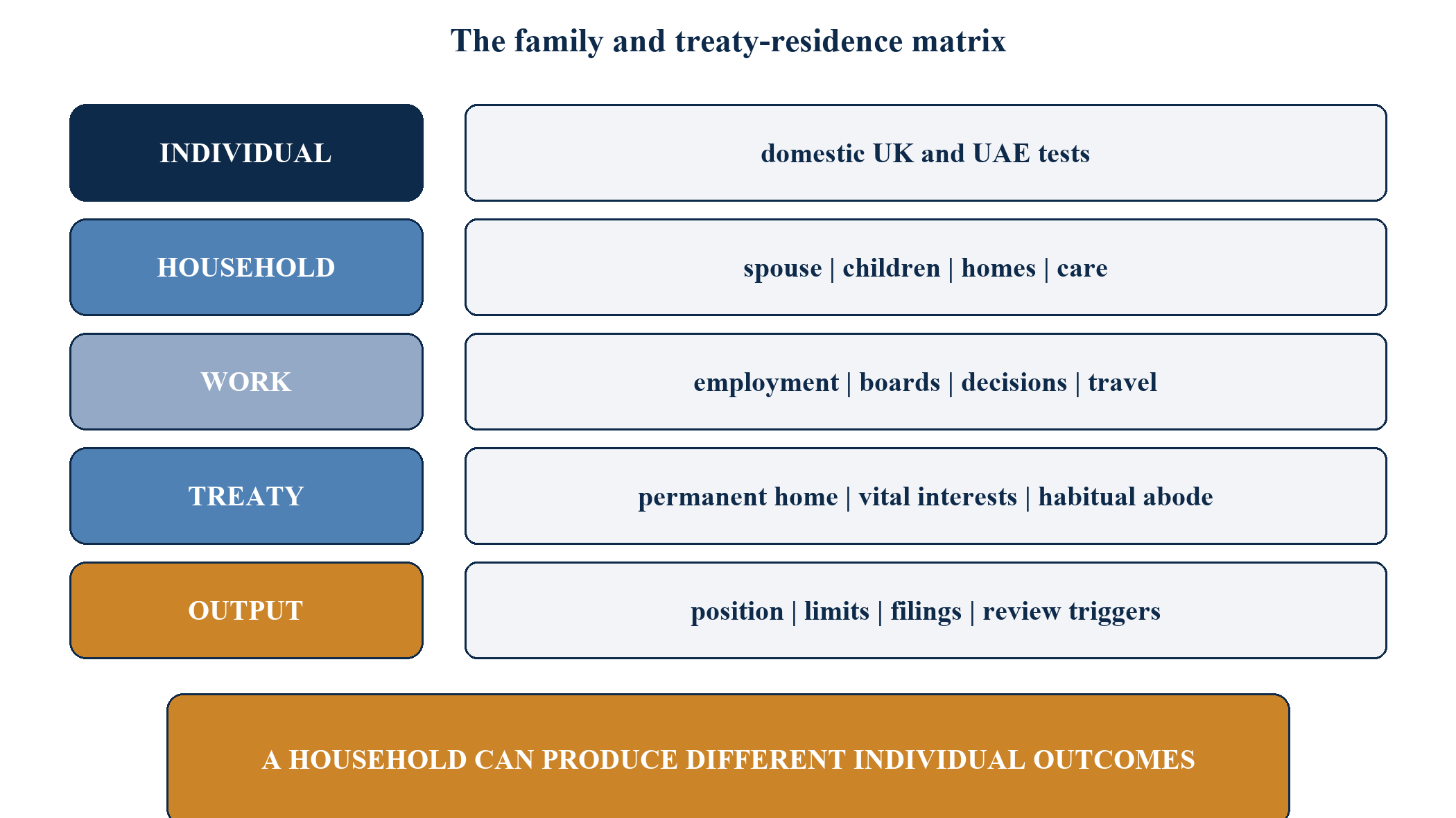
Each row belongs to one person. A household summary can obscure different outcomes. One spouse may become UAE resident while another remains UK resident. An adult child may have a separate home and residence pattern. A child at boarding school can affect family-tie analysis without determining the residence of a parent on its own. The map should retain the facts needed for current advice and protect personal information appropriately.
3.2 The ownership map
The ownership map follows legal and beneficial interests through companies, partnerships, trusts, foundations, nominees and personal holdings. It identifies voting rights, economic rights, reserved matters, appointment and removal powers, protector or guardian rights, beneficiary interests, pledges and security. It should also identify UK land held through overseas entities and other assets with location-specific registration obligations.
Ownership can remain stable while control changes. A founder may contribute assets to a foundation but retain specified reserved powers. A family investment company may remain owned by UK-resident family members while its board moves. Trustees can hold legal title while beneficiaries hold economic interests. These distinctions need explicit documents and fact-based advice.
3.3 The entity map
The entity map lists every company, partnership, trust, foundation, branch, office and investment vehicle. For each, it records place of formation, domestic tax-residence basis, treaty position, permanent establishments, regulatory status, beneficial-ownership filings, tax registrations, bank accounts, service agreements and reporting obligations.
The map should include entities that appear peripheral. A household-employment company, philanthropy vehicle, property company, carried-interest structure or dormant holding company can create separate obligations. Dormancy should be supported by actual inactivity and appropriate filings.
3.4 The decision map
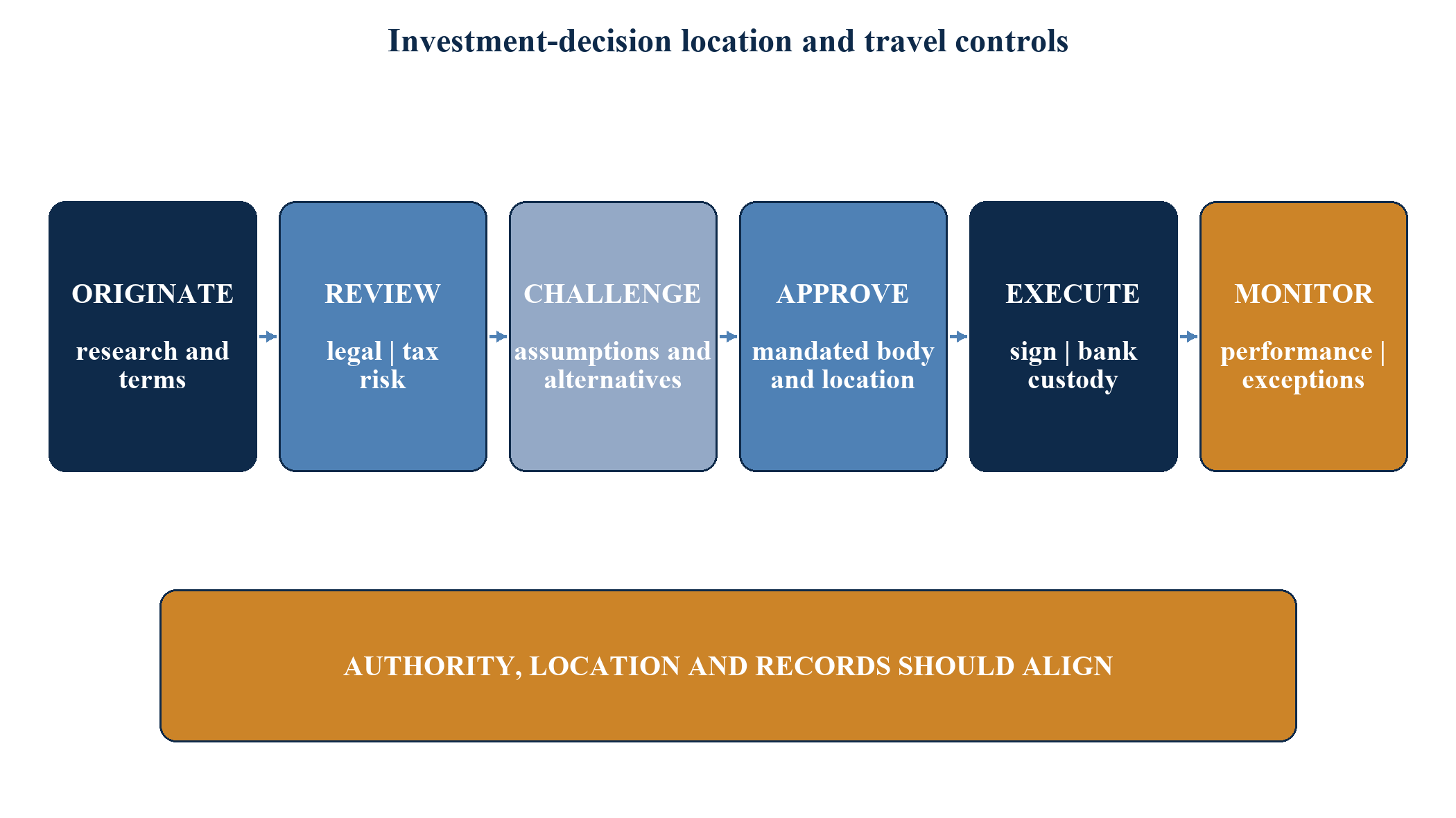
The decision map records who proposes, reviews, challenges, approves, executes and monitors each material action. It covers strategic allocation, investments, disposals, borrowing, distributions, appointments, budgets, service providers, conflicts, succession and amendments to governing documents. It also records the forum and location in which authority is exercised.
A decision map has two purposes. It allocates responsibility before an event and creates a record after the event. The map should align with articles, bylaws, trust deeds, foundation charter and by-laws, board mandates, investment-management agreements and powers of attorney. Differences should be resolved through approved changes to documents and conduct.
| Map | Core question | Minimum evidence | Refresh trigger |
|---|---|---|---|
| people | where does each person live, work and exercise a role? | day records, homes, employment, family facts, role register | travel or family change |
| ownership | who holds legal, economic and control rights? | registers, deeds, charters, reserved powers, security | transfer or amendment |
| entities | where is each vehicle formed, resident, regulated and reporting? | constitutional documents, registrations, tax files | new entity or activity |
| decisions | who actually exercises authority and where? | mandates, papers, minutes, execution records | governance or personnel change |
4. PERSON-BY-PERSON RESIDENCE
4.1 The UK Statutory Residence Test
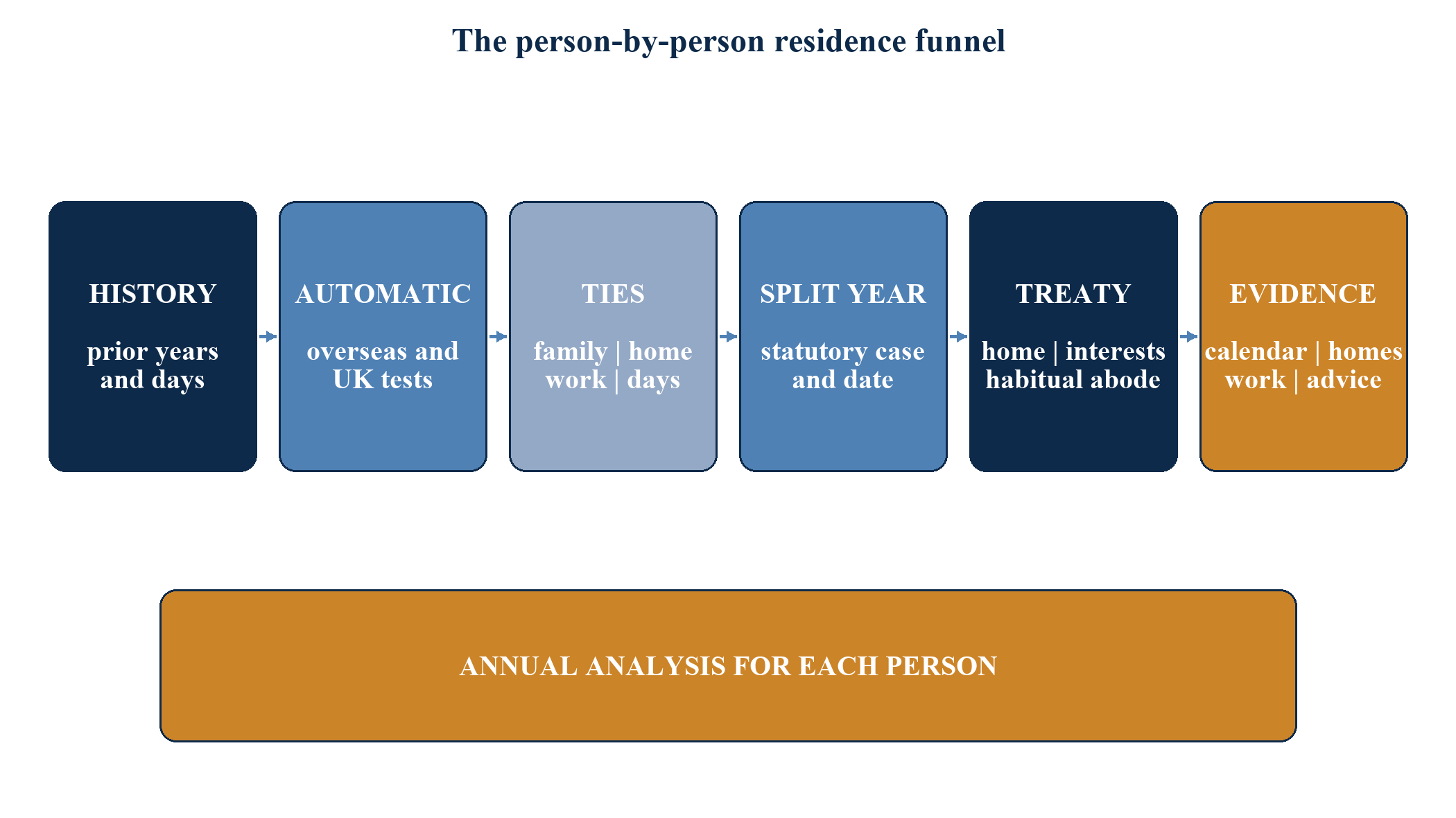
The United Kingdom applies the Statutory Residence Test to determine an individual's residence for a tax year. HMRC's current guidance sets out automatic overseas tests, automatic UK tests and the sufficient-ties test [1]. The analysis is annual and fact specific. It should be completed separately for every family member whose position matters.
Day counting is essential and insufficient on its own. The automatic tests include work and home conditions. When neither automatic set determines the result, the sufficient-ties test examines family, accommodation, work and 90-day ties, with a country tie applying to certain recent UK residents [1,2]. The number of UK days permitted before residence arises varies with the person's ties and recent residence history.
A family-office residence register should capture presence at midnight, qualifying workdays, exceptional circumstances, homes, availability of accommodation, family relationships and prior-year patterns. Source evidence can include travel records, calendars, employment records, property documents and contemporaneous notes. The register should support adviser review rather than replace it.
4.2 Family and accommodation ties
The family tie can apply when a spouse, civil partner, person living as a spouse or minor child is UK resident, subject to detailed rules and exceptions [2]. A principal's move can therefore be affected by the family's continuing UK life. The analysis should consider each relevant relationship and should not treat a household as a single residence unit.
The accommodation tie can apply when a person has a place to live available in the United Kingdom and spends sufficient time there. Ownership is not required. A retained family home, flat, serviced accommodation or another available place can require review. The record should establish availability, use and the person or arrangement providing access.
Family decisions can change during the year. A spouse may move later, a child may begin or finish school, a home may be sold, or a family member may return to provide care. The residence file should use dated facts and should be refreshed when plans change.
4.3 Work and 90-day ties
The work tie turns on days with sufficient UK work under the statutory rules. Senior family-office roles can create workdays through meetings, investment decisions, board activity or management conducted during visits. A job title or employment contract does not establish where work occurs. Calendars, meeting records and communications should support the workday analysis.
The 90-day tie looks back to prior tax years. A move therefore begins with historical data, not only the planned year of departure. The country tie can also matter to a person who was UK resident in one or more of the previous three tax years. A multi-year residence model should capture the look-back and should be checked against current HMRC guidance [1,2].
4.4 Split-year treatment
UK residence is normally determined for the whole tax year. Split-year treatment can apply automatically when a statutory case and its conditions are met [1]. Different cases address circumstances such as starting full-time work overseas, accompanying a partner, ceasing to have a UK home or beginning to have a UK home.
The family office should avoid describing a person as having split the year until the applicable case has been tested. Departure date, work pattern, homes and family position should be documented. The treatment of income and gains depends on the relevant period and statutory rules, so transaction timing requires current advice.
4.5 Temporary non-residence
Temporary non-residence rules can bring specified income and gains into charge when a person returns to the United Kingdom after a period of non-residence. HMRC's residence guidance describes the conditions and categories that can be affected [1]. A planned return, family contingency or short overseas period should therefore form part of the transaction and liquidity analysis.
The risk register should identify distributions, close-company benefits, remittances, disposals and other events that require review during absence. A return-to-UK protocol should be agreed before residence changes, particularly where a family member has received substantial distributions or reorganised ownership.
5. UAE RESIDENCE AND TREATY COORDINATION
5.1 UAE domestic residence
UAE Cabinet Decision No. 85 of 2022 and Ministerial Decision No. 27 of 2023 establish domestic tax-residence criteria for natural and juridical persons. The Ministry of Finance describes natural-person tests involving usual or principal residence and centre of financial and personal interests, a 183-day threshold, and a 90-day route subject to additional conditions [4]. The precise statutory conditions and definitions require current application to the individual.
A residence visa, Emirates ID, tenancy agreement or tax-residency certificate can be important evidence. None should be treated as the complete residence analysis. The record should cover presence, homes, business or employment, financial interests and personal connections relevant to the applicable UAE test.
The UAE Federal Tax Authority administers tax-residency certificate applications. Required evidence can vary with the applicant and purpose. The family office should plan certificate timing around treaty claims, banking, counterparties and filing deadlines, and should retain the evidence supplied.
5.2 The UK-UAE treaty tie-breaker
An individual can satisfy domestic residence rules in both countries. Article 4 of the UK-UAE double taxation convention then applies a sequence involving permanent home, centre of vital interests, habitual abode and nationality, followed by competent-authority agreement where required [3]. Domestic and treaty residence should appear as separate conclusions in the file.
Centre of vital interests is a fact-intensive test. Family, homes, business, investment oversight, social relationships and personal activity can all require consideration. A principal with a UAE home and business role whose spouse, children, long-standing home and regular life remain in the United Kingdom may present a different treaty profile from a principal whose family and routine have moved.
Treaty residence also does not erase domestic filing duties or every source-country charge. UK property, UK employment, directorships, pensions, trust distributions and other income can retain specific treatment. The advice file should identify the provision relied upon for each material position.
5.3 A residence matrix
The family-office residence matrix should show domestic UK residence, domestic UAE residence, treaty residence, day limits, ties, work conditions, certificate status and advice date for each person. It should state the source facts and the person responsible for updating them.
| Person | UK domestic analysis | UAE domestic analysis | Treaty issue | Governance consequence |
|---|---|---|---|---|
| principal | annual SRT and workday review | presence, home and activity evidence | possible dual residence | board and investment locations |
| spouse or partner | separate SRT and family facts | separate UAE test | centre of vital interests | family council and asset use |
| adult child | independent facts and homes | independent UAE test | fact specific | beneficiary and voting rights |
| minor child | schooling and residence facts | household evidence | relevant to parents' facts | guardian and succession planning |
| family-office executive | work and travel pattern | employment and presence | employment articles | authority and permanent establishment |
6. FAMILY LIFE ACROSS BORDERS
6.1 The principal moves first
A common transition begins with the principal establishing a UAE home and business routine while the family remains in the United Kingdom. The arrangement may be temporary or open ended. It should be documented as it exists, with no assumption that later family moves will occur on the original timetable.
The residence model should examine UK visits, use of the retained home, work performed during visits, family contact, and historical day patterns. The governance model should separately examine whether investment and company decisions are being made in the UAE. Personal residence and entity control can point in different directions.
6.2 Education and young adults
Children's education can anchor part of family life in the United Kingdom. Minor-child rules and HMRC guidance require careful application to the facts [1,2]. Adult children should be analysed independently, even when financially dependent or living in a family property.
The family charter can establish how education decisions, maintenance, property use and beneficiary communications are handled. Sensitive personal information should be shared only with advisers and office staff who need it. The governance record can state the decision and authority without reproducing private medical or educational detail.
6.3 Care, health and unexpected events
Care for parents, illness, family separation or bereavement can change presence and home use. UK residence law contains exceptional-circumstances provisions, but they are limited and fact specific [1]. The family office should record events contemporaneously and obtain advice rather than assuming that every unforeseen visit is excluded.
Contingency planning should cover who can exercise investment, banking and governance authority when the principal is unavailable or must travel. Powers of attorney, alternate directors, foundation council succession and emergency investment limits should be reviewed in advance.
6.4 Personal use of entity-owned assets
Homes, aircraft, vessels, art and other assets can be owned through companies, trusts or foundations while used by family members. Personal use can create tax, benefit, governance, disclosure and creditor questions. The ownership map should identify the legal owner, beneficiary or user, funding, charges, approvals and jurisdiction of use.
Governing documents and tax advice should support any occupation or use. A family-office expense policy should distinguish personal expenses, entity expenses, reimbursable items and taxable benefits. Bank and accounting records should follow the policy.
7. ENTITY RESIDENCE AND MANAGEMENT
7.1 Individual residence does not relocate a company
A founder's move does not automatically move the tax residence of every company. A UK-incorporated company is generally UK resident under domestic rules, subject to treaty provisions and statutory exceptions. A non-UK company can be UK resident when its central management and control is exercised in the United Kingdom. HMRC describes the inquiry as a factual assessment of the highest level of control [9,10].
Each company requires its own analysis. A holding company, family investment company, property company, operating business, philanthropy company and family-office service company may have different strategic decisions, directors and activities. A group-level conclusion is insufficient.
7.2 Central management and control
Board meeting location is relevant evidence. The wider inquiry considers who actually directs the business and where that direction occurs [9,10]. A UAE board can be undermined if directors routinely follow instructions from a UK founder or adviser, if papers show that decisions were settled before meetings, or if the board lacks information and competence.
A board protocol should define reserved matters, delegation, information standards, quorum, conflicts, emergency authority and location. Directors should receive papers with enough time, understand alternatives, challenge recommendations and record reasons. Written resolutions require the same discipline as meetings.
7.3 Permanent establishment
Article 5 of the UK-UAE convention addresses a fixed place of business and specified agent activity [3]. A UAE family-office company can therefore require UK permanent-establishment analysis when it uses a London office, staff, a home office or another place to conduct core business. Contract negotiation and conclusion by UK personnel also require review.
The office should maintain a location register and contract-authority register. The location register covers offices, serviced space, affiliate premises and regular home working. The authority register identifies negotiator, approver, signatory and signing location for material contracts. Travel and committee records should reconcile to both.
7.4 Place of effective management and treaty issues
Domestic residence and treaty tests can differ. The UK-UAE convention provides that dual-resident persons other than individuals require competent-authority agreement for treaty treatment [3]. The file should avoid assuming that incorporation, a tax-residency certificate or a stated headquarters resolves every residence issue.
The entity register should record domestic conclusions for each relevant jurisdiction, the treaty provision, any competent-authority process, permanent establishments and advice date. Material treaty benefits should be connected to the precise entity and income stream.
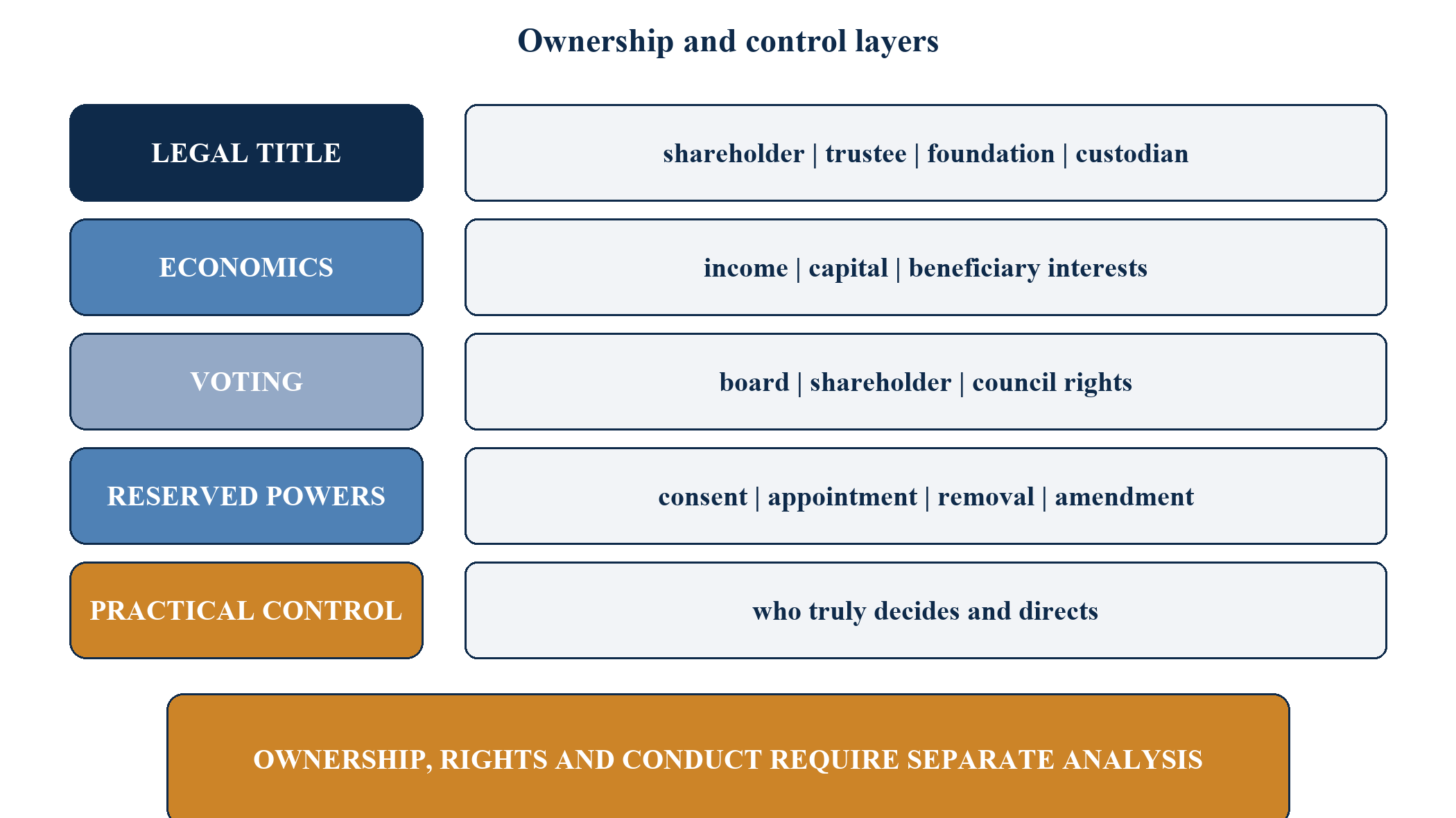
8. OWNERSHIP DOES NOT EQUAL CONTROL
8.1 Legal title and economic interest
Legal ownership determines who holds an asset under the relevant law. Economic interests can be held by shareholders, partners, beneficiaries or other participants. Voting rights, distribution rights and liquidation rights can be allocated differently. Nominees and custodians add further layers.
The ownership register should distinguish legal title, economic entitlement and voting power. It should also identify security interests, options, side agreements and family arrangements that alter practical control. The register should be reconciled to corporate, trust, foundation, banking and tax records.
8.2 Trust roles
A trust can involve settlors, trustees, protectors, beneficiaries and other persons with control. The trust deed and applicable law define their rights. The OECD Common Reporting Standard treats controlling persons of a trust as including the settlor, trustees, protector, beneficiaries or class of beneficiaries, and any other natural person exercising ultimate effective control [13].
The governance analysis should identify investment authority, distribution authority, appointment and removal powers, information rights and reserved consents. A letter of wishes can inform trustees, but it should be used consistently with the trust deed and trustees' legal responsibilities.
8.3 Foundation roles
A foundation is a legal person with its own charter and by-laws. In ADGM, the Foundations Regulations provide for a council, guardian where applicable, beneficiaries and other governance features [7]. Assets transferred to a foundation are held by the foundation, subject to its statutory and constitutional framework.
The founder's reserved powers, council authority, guardian oversight, beneficiary rights and amendment mechanisms should be mapped. The foundation should have records showing that its organs exercise the authority assigned to them. A council that only records the founder's personal decisions can create governance and tax concerns.
8.4 Beneficial ownership
ADGM requires relevant registered entities to identify and maintain information about beneficial ownership and control, subject to the applicable rules and exemptions [14]. UAE and other jurisdictions have their own registers and filing standards. The family office should assign a named owner to every filing and maintain a change-control process.
Beneficial-ownership reporting, tax residence, CRS classification and economic control answer related but distinct questions. A single chart can support all four analyses, while each conclusion should cite its governing rule.
9. FAMILY-OFFICE OPERATING MODELS
9.1 Retained UK family office
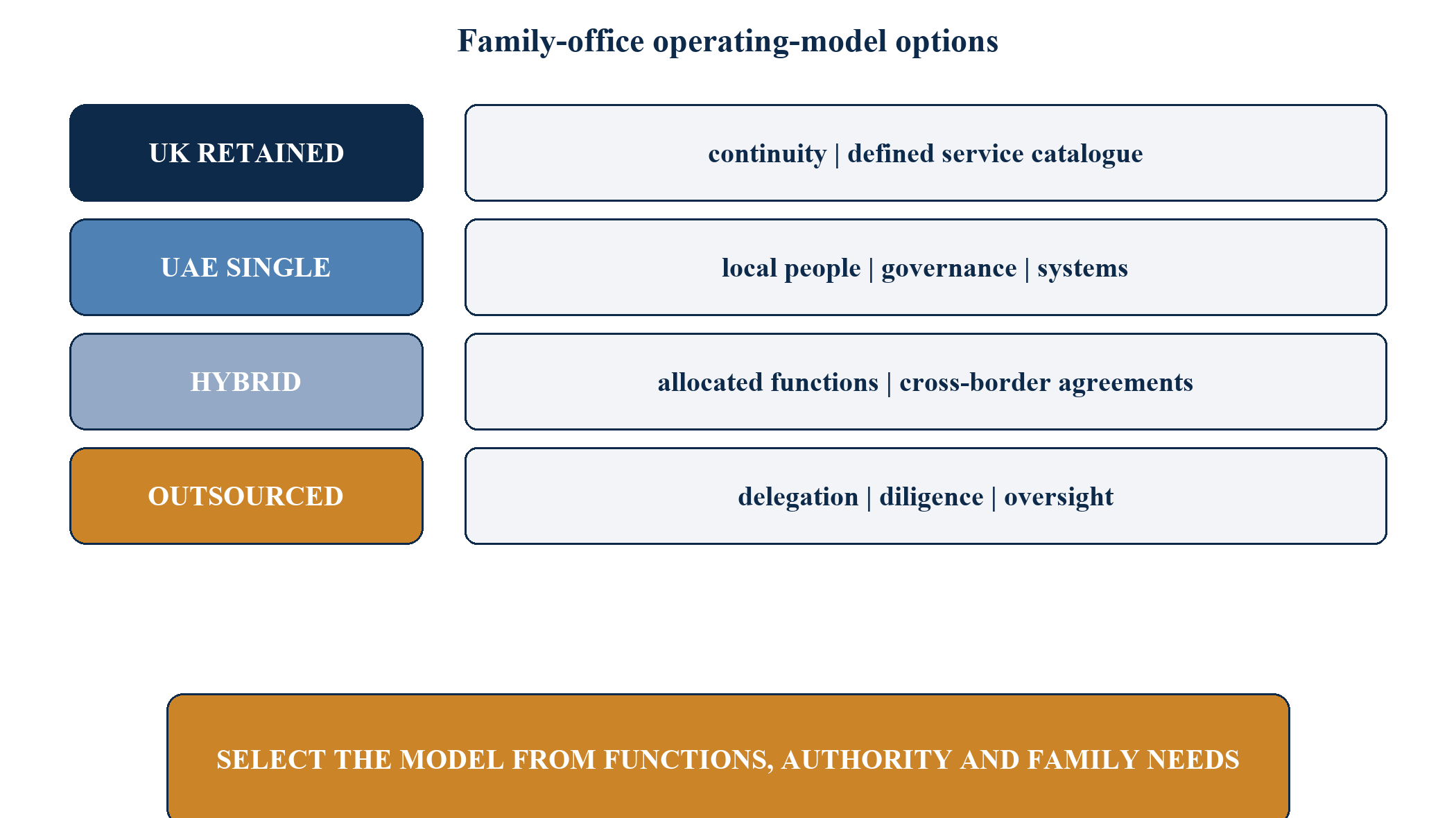
Under a retained UK model, the existing UK entity continues to employ staff, coordinate advisers and administer family affairs. A separate UAE residence and investment structure may be added. This model preserves continuity, but it requires clear analysis of the UK entity's services, fee flows, corporate residence, regulation and relationship with UAE entities.
The UK team should have a defined service catalogue. Investment recommendations, execution, treasury, accounting, household support and governance administration should be distinguished. If a UAE entity is intended to exercise investment management, the decision map and communications should support that allocation.
9.2 UAE single family office
A UAE single family office can consolidate staff, governance, reporting and regional investment activity. DIFC and ADGM each offer family-business and wealth-structuring ecosystems [6,8]. Formation should follow a detailed operating model covering services, clients, ownership, staff, premises, permissions, outsourcing, banking and data.
The transition can be staged. Functions should move only when the receiving entity has people, systems, authority and contracts. Payroll migration or lease commencement alone does not establish that a function has moved.
9.3 Hybrid family office
A hybrid model divides functions between the United Kingdom and the UAE. The UK entity may retain accounting, family administration or research, while the UAE entity holds strategic investment and governance authority. The design should identify every cross-border service and the basis for fees or cost sharing.
Hybrid models require strong escalation rules. A UK employee should know which decisions are outside the role, who approves exceptions, and how urgent matters are handled when UAE decision makers are travelling. Shared systems should preserve access control and decision provenance.
9.4 Outsourced or multi-family support
External managers, administrators, trustees, corporate-service providers and multi-family offices can provide scale and specialist expertise. The family should identify which responsibilities remain with family entities and which are delegated. Contracts should cover scope, authority, service levels, data, conflicts, fees, termination and records.
Serving unrelated families or accepting external capital can alter the regulatory analysis. The perimeter should be rechecked before a single-family platform offers services by way of business to others.
| Model | Core advantage | Principal control question | Evidence priority |
|---|---|---|---|
| retained UK office | continuity of team and systems | what has genuinely moved? | service catalogue and authority map |
| UAE single family office | consolidated regional governance | does local substance match the mandate? | people, premises, committees and contracts |
| hybrid office | access to both ecosystems | where is each function and decision? | cross-border services and decision logs |
| outsourced model | specialist capability and scalability | who retains responsibility and oversight? | delegation, diligence and monitoring |
10. DIFC AND ADGM STRUCTURING ROUTES
10.1 A structure should follow the operating purpose
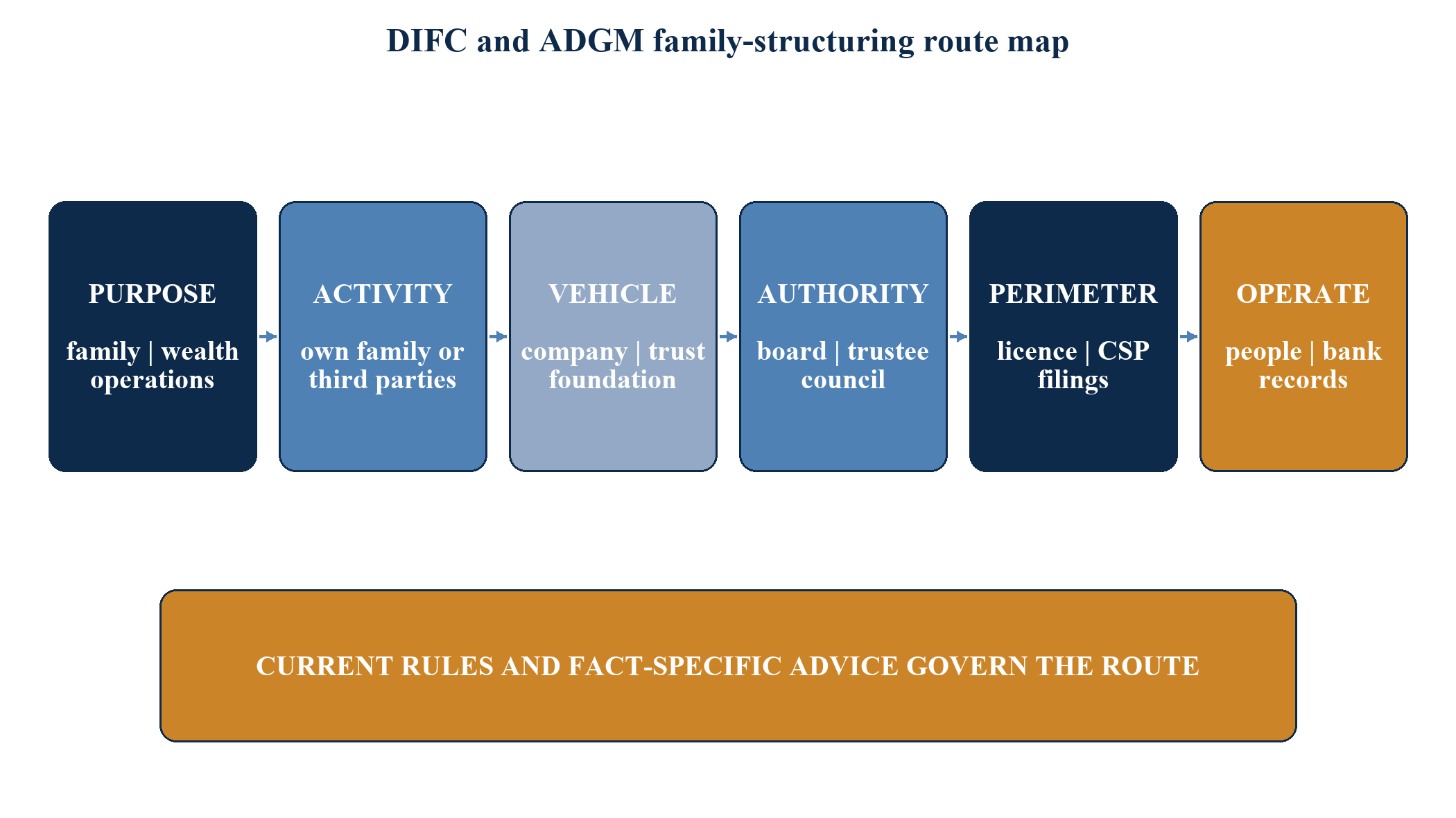
DIFC and ADGM provide common-law-based legal environments, corporate and foundation structures, professional-service ecosystems and financial-regulatory frameworks. The choice should begin with the functions the family needs, the people who will perform them, the assets involved and the governance desired. Jurisdictional familiarity is useful, while the governing documents and operating plan determine whether a route is suitable.
The comparison should cover legal form, registration, permitted activity, family definition, minimum substance, governance, foundation or trust features, corporate-service-provider requirements, beneficial ownership, privacy, employment, banking, accounting, audit, tax and ongoing filings. Current counsel should confirm the rules in force at formation and during operation.
10.2 DIFC family arrangements
DIFC's Family Arrangements Regulations created a framework for family entities and family offices and replaced the earlier single-family-office regulations [8]. The regime is intended to support family businesses, succession and wealth governance. It includes concepts relevant to a family office serving a single family and provides for a private register within the statutory framework.
The family should define who belongs to the family for the arrangement, which entities form part of the structure, what services the office provides and whether any activity is regulated. A family office serving more than one family or conducting financial services by way of business requires separate perimeter analysis.
10.3 ADGM family office and foundation
ADGM describes a family-office ecosystem covering wealth preservation, succession, governance and access to professional services [6]. Its Foundations Regulations establish a foundation as a distinct legal person governed by its charter, by-laws and council, with guardian and beneficiary features as applicable [7].
ADGM amended parts of its commercial legislation in 2026, including aspects relevant to registered entities and beneficial ownership [15]. Formation and migration work should therefore use current consolidated rules and current Registration Authority guidance. A non-exempt foundation or special-purpose vehicle can also require an ADGM-licensed company-service provider under the applicable framework.
10.4 Foundation, trust or company
A company is familiar for ownership and operating activity. A trust separates legal ownership and beneficial interests through a fiduciary relationship. A foundation holds assets as a legal person under its own constitutional framework. Each can support succession and governance, but they distribute authority differently.
Selection should follow a rights matrix. The matrix should cover founder or settlor powers, board or trustee discretion, council authority, protector or guardian oversight, beneficiary enforcement, amendment, migration, revocation, succession, confidentiality, tax, reporting, creditor protection and the treatment of incapacity or death. A structure chosen for one feature can create obligations elsewhere.
11. UAE CORPORATE TAX AND FAMILY FOUNDATIONS
11.1 Entity-by-entity classification
UAE corporate tax applies under Federal Decree-Law No. 47 of 2022 and implementing decisions. Every family-office entity should be classified separately. A family-office company, holding company, foundation, trust, partnership, real-estate company and investment vehicle can have different status, income and filing obligations.
The classification file should state whether the vehicle is a taxable person, exempt person, unincorporated partnership, free-zone person or other category. It should record registration, accounting period, return owner, tax residence, permanent establishments, related parties and transfer-pricing obligations. The analysis should be refreshed when the vehicle acquires new assets or begins new services.
11.2 Family-foundation transparency application
The UAE Federal Tax Authority's Family Foundations Guide explains that a qualifying family foundation can apply to be treated as an unincorporated partnership for corporate-tax purposes when the statutory conditions are satisfied [5]. The application is a formal process. The foundation must first register for corporate tax, and approval has consequences for the foundation and beneficiaries.
The eligibility analysis should examine the foundation's purpose, beneficiaries, activities and asset profile. The family office should retain the application, supporting documents, approval, annual confirmation process and beneficiary information. Changes in beneficiaries, activities or assets should trigger review.
When transparency treatment applies, tax consequences can move to beneficiaries or other relevant persons. The foundation's administrative relief does not remove the need to assess each beneficiary's own obligations. Current advice should address distributions, attributed income and cross-border treatment.
11.3 Free-zone and operating-company questions
A family-office company formed in a free zone should not be described through a headline tax rate. Qualifying Free Zone Person status and Qualifying Income depend on statutory conditions, activities, substance, transfer pricing, financial statements and the nature of the recipient. A family-office service fee and passive investment return can require different analysis.
The operating file should connect income to functions, people, premises, assets and risks. Related-party charges between UK and UAE entities should follow written agreements and an arm's-length analysis. Payments for investment research, administration, treasury, technology or household services should be classified consistently in contracts, invoices and accounts.
11.4 Personal investment activity
The UAE corporate-tax treatment of a natural person's investment activity depends on the legislation, relevant decisions and facts. Personal investment income and a licensed or commercial business should not be combined without analysis. The office should distinguish assets held personally from assets managed through an entity and should record the basis for each treatment.
Banking and investment-account documentation should identify the correct beneficial owner and tax classification. Moving an account relationship or correspondence address does not transfer ownership or change the entity that earns income.
12. THE UNITED KINGDOM AFTER DEPARTURE
12.1 The residence-based tax architecture
From 6 April 2025, the United Kingdom replaced the former domicile-based foreign-income-and-gains framework with residence-based rules. HMRC's published collection describes a four-year foreign income and gains regime for qualifying new UK residents and related changes [16]. Families leaving the United Kingdom should analyse the new system directly rather than relying on earlier non-domicile terminology.
The transition affects income, gains, trusts, inheritance tax and reporting. The applicable result depends on residence history, asset ownership and transaction date. The family office should maintain a change memorandum that identifies which historic advice remains valid and which conclusions require refresh.
12.2 Long-term residence and inheritance tax
From 6 April 2025, long-term UK residence is central to the scope of inheritance tax on non-UK assets. HMRC explains that an individual generally becomes a long-term UK resident after being UK resident for at least 10 of the previous 20 tax years [11]. A person can remain within the long-term-residence framework for a period after leaving, with the length of the tail depending on residence history [11].
A move to the UAE therefore does not necessarily remove non-UK assets from UK inheritance-tax exposure at departure. The analysis should cover the individual, lifetime transfers, personally held assets, trust property, excluded-property history and the statutory tail. Advice should model death, gifts and return scenarios.
12.3 Trusts and foundations
Trust taxation and inheritance tax can depend on the settlor, trustees, beneficiaries, residence history, trust terms, asset location and timing. HMRC's trust and inheritance-tax guidance describes periodic and exit charges and other trust rules [12]. The 2025 reforms changed the relevance of long-term residence to foreign property in settlements.
A foreign foundation may be characterised differently for UK tax purposes from its character under the foundation law. The family office should obtain UK analysis of legal characteristics and tax treatment before funding, amending or distributing from a foundation. Labels used in another jurisdiction do not determine UK treatment.
12.4 UK assets and continuing obligations
UK real estate, UK companies, employment, directorships, pensions, bank accounts and operating businesses can retain UK tax and reporting consequences. An overseas entity that owns UK land may need to register with Companies House and update its beneficial-owner information annually under the Register of Overseas Entities framework [17].
The post-departure calendar should list self-assessment, company, trust, payroll, property, beneficial-ownership and transaction filings. Each obligation should have an owner and supporting evidence. A person should not be removed from the calendar solely because a UAE residence certificate has been obtained.
13. INVESTMENT CONTROL AND DECISION LOCATION
13.1 Investment authority
Investment authority should be expressed through a mandate that identifies asset classes, limits, liquidity, leverage, concentrations, conflicts, delegation and reserved matters. The mandate should state which body approves strategic allocation, individual investments, disposals and exceptions. It should also identify who can execute documents and move cash.
The family investment committee can include members in several jurisdictions. Participant location should be recorded for material meetings. The committee should receive complete papers, challenge the proposal, declare conflicts, record dissent and state the approved action. Circular approvals and instant messages require the same control standards as scheduled meetings.
13.2 Recommendation, approval and execution
Separating recommendation, approval and execution can improve control. It also clarifies where each function is performed. A London research team may develop a non-binding recommendation, a UAE committee may approve the investment, and a custodian may execute. The operating evidence should show that the UAE committee has the information, competence and practical freedom to decide.
A recommendation that leaves no genuine choice, a pre-agreed commitment or routine approval can indicate that authority rests elsewhere. Committee materials should present material assumptions, alternatives, risk, valuation, liquidity and conflicts. Minutes should record the reasoning rather than only the resolution.
13.3 Travel and remote decisions
Remote meetings make location management more complex. The register should capture the physical location of each participant, chair and final approver. A travel protocol should address whether certain decisions are deferred, delegated or escalated when key members are in the United Kingdom.
Urgency should be planned. Alternate members, delegated limits and an emergency committee can prevent informal decisions outside the approved model. Repeated reliance on emergency authority should trigger a governance review.
13.4 Banks, custodians and powers of attorney
Bank mandates, trading authorities, custody instructions and powers of attorney should follow the decision map. A person with broad online access or an unrestricted power can exercise practical control even when formal committee documents say otherwise. Access should be role based and reviewed periodically.
Payment workflows should distinguish initiation, approval and release. Investment execution should preserve the instruction, account owner, approver, broker or custodian and settlement record. Terminated roles and departed employees should be removed promptly.
14. FAMILY GOVERNANCE AND SUCCESSION
14.1 Family constitution
A family constitution or charter can state values, purpose, governance bodies, membership, employment principles, distributions, education, philanthropy, conflict resolution and succession. Its legal effect depends on its form and relationship with binding documents. It should therefore be reconciled with articles, shareholder agreements, trust deeds, foundation documents and wills.
The charter can also explain the distributed model. It can state which decisions belong to the family council, owners, boards, trustees, foundation council and investment committee. A schedule can identify meeting frequency, membership, quorum, information and escalation.
14.2 Family council and owners' council
The family council addresses family matters and communicates with legal governance bodies. An owners' council can coordinate shareholders or branches of the family. Neither should silently override a company board, trustees or a foundation council when the law assigns authority to those bodies.
Minutes should distinguish discussion, recommendation, consent and binding decision. A family member's influence can be legitimate and should be exercised through the correct legal route. The governance map should record appointment and removal rights, vetoes and dispute procedures.
14.3 Incapacity and death
The structure should continue when a founder is unable to act. Relevant documents can include wills, powers of attorney, shareholder provisions, trust or foundation succession, guardian appointments, banking mandates, insurance and key-person arrangements. Each document should be reviewed for jurisdictional recognition and interaction.
The emergency pack should identify immediate cash needs, payroll, debt service, authority, contact details, digital access and the person who confirms death or incapacity under the governing document. Sensitive access credentials should remain in secure systems and should not be reproduced in a general governance manual.
14.4 Successor preparation
Succession involves competence and legitimacy as well as legal title. Family members can participate through observer roles, education, committee service, supervised investment allocations and philanthropy. The programme should state entry criteria, conflicts, evaluation and compensation.
The family office should also plan for professional executives. Reserved matters, delegated authority, retention, incentives and removal should balance family control with institutional capability. A successor should inherit a documented system rather than a set of personal understandings.
15. TRANSPARENCY, REPORTING AND DATA
15.1 Common Reporting Standard
The OECD Common Reporting Standard provides a framework for financial institutions to identify reportable accounts and controlling persons. The 2025 consolidated text retains detailed rules for entity classification, financial accounts, residence, due diligence and controlling persons [13]. Trusts and certain investment entities require particular analysis.
Every entity should have a documented CRS and FATCA classification, with the basis, responsible adviser and review date. Self-certifications should identify the correct account holder and controlling persons. Changes in residence, ownership, entity activity or beneficiaries can trigger refresh.
15.2 Beneficial ownership and registers
Beneficial-ownership registers should reconcile with constitutional documents and control rights. ADGM's published obligations require relevant entities to keep and file beneficial-ownership information under its framework [14]. Companies House requires registered overseas entities holding UK land to update their information annually [17]. Other entities can have separate UK, UAE or offshore filings.
The office should maintain a master filing calendar and evidence of submissions. A change to a protector, council member, voting arrangement or ownership chain should be tested across every relevant register, bank and tax classification.
15.3 Data governance
Family-office data can include passports, travel, health, education, assets, security, tax, communications and investment records. Access should be limited by role and purpose. Systems should provide encryption, backup, retention, incident response and auditable access.
Cross-border transfers require legal and security review. The office should identify where data is hosted, which providers and staff can access it, and how information is returned or destroyed at termination. Governance minutes should avoid unnecessary personal detail.
15.4 The evidence room
The evidence room should be indexed by people, ownership, entities, decisions and filings. Each record should have an owner, date and next review. Privileged legal advice should be separated and access controlled.
Useful categories include residence files, constitutional documents, board and committee records, investment mandates, contracts, transfer pricing, accounts, tax filings, CRS and FATCA, beneficial ownership, licences, insurance, cyber controls, succession and adviser opinions. The evidence room should support current operations, audits and transition to successors.
16. WORKED DISTRIBUTED-FAMILY CASES
The cases in this section are hypothetical and simplified. They illustrate the framework and do not predict a tax, legal, regulatory or investment outcome. Each real family requires advice based on its own facts and current law.
16.1 Case 1: principal in the UAE, spouse and children in the United Kingdom
The principal establishes a Dubai home and spends most of the year in the UAE. The spouse and two children continue living in the London family home during the school year. The principal visits regularly and joins selected family-office meetings during those visits.
The people map identifies separate SRT analyses, the family and accommodation facts, workdays and treaty-residence questions. The entity map remains separate. If the principal makes company or investment decisions while in London, those actions can affect the residence and permanent-establishment files even if the principal remains individually treaty resident in the UAE.
The control response is a residence calendar, visit protocol, meeting-location record and clear allocation of family and company decisions. The family council can meet across borders, while binding entity decisions follow the relevant governing body and mandate.
16.2 Case 2: UAE foundation with a UK family investment company
A family forms an ADGM foundation and considers transferring shares in a UK family investment company to it. The founder retains specified reserved powers, and a professional council includes UAE and non-UAE members.
The ownership map identifies the share transfer, foundation ownership, founder powers, council authority, guardian role and beneficiaries. UK tax advice addresses the transfer, foundation characterisation, inheritance tax, trust-related rules where relevant, company control and future distributions. UAE advice addresses the foundation, corporate-tax application and reporting.
The foundation should not be treated as a label attached to the founder's personal decisions. Council papers, banking mandates and reserved-power use should demonstrate the constitutional allocation. The UK company continues to require its own residence and governance analysis.
16.3 Case 3: London investment team and UAE investment committee
The family retains three analysts in London and appoints an investment committee in Abu Dhabi. The analysts originate and underwrite investments. The UAE committee approves and monitors the portfolio.
The decision map distinguishes research, recommendation, approval and execution. The UAE committee needs adequate information, competence, time and freedom to reject or modify proposals. The UK team's negotiations and external representations should remain within the approved role.
The service agreement, fees, employment reporting lines, systems access, minutes and transaction record should reconcile. UK permanent-establishment, corporate-residence, transfer-pricing and regulatory advice should review the actual conduct.
16.4 Case 4: family council remains centred in London
The family office and foundation operate in the UAE, while most adult family members remain in the United Kingdom. The family council meets in London and recommends annual distribution and philanthropic priorities.
The governance map specifies that the family council makes recommendations. The foundation council exercises the binding authority under the charter and by-laws. Its papers document independent consideration, legal constraints, liquidity and beneficiary fairness.
If the family council has contractual vetoes or reserved rights, those powers should be included in the ownership and control maps. The tax and reporting analysis should reflect practical control as well as formal documents.
16.5 Case 5: a single family office begins serving friends
The UAE office hires an investment team and agrees to review portfolios for two unrelated families. It charges a fee and executes allocations through a shared structure.
The service change triggers a regulatory-perimeter and business-model review before implementation. The family definition, client agreements, permissions, conflicts, custody, marketing, reporting and professional liability require analysis. The office should not rely on its original single-family description.
A decision gate requires legal and regulatory approval before any third-party service, capital or fee is accepted. Website and pitch language should reflect only approved activity.
16.6 Case 6: return to the United Kingdom
After four years in the UAE, the principal returns to the United Kingdom because of a family event. During absence, the principal received distributions, sold investments and funded a foundation.
The return protocol tests UK residence for the return year, split-year conditions, temporary non-residence, the four-year foreign income and gains regime where relevant, inheritance-tax long-term residence and the treatment of every material transaction. The family office gathers the source documents before the move.
Entity authority is also reviewed. If the principal resumes making company and investment decisions from the United Kingdom, the company-residence and permanent-establishment files may change. Governance should follow the new reality.
17. A 120-DAY IMPLEMENTATION ROADMAP
17.1 Days 1 to 30: establish facts
Create the people, ownership, entity and decision maps. Reconcile legal names, registrations, ownership, roles, homes, travel, employment, bank mandates and governing documents. Identify missing evidence and contradictions.
Commission current UK, UAE and relevant third-jurisdiction advice. The advice request should use the same factual pack and should list planned transactions, residence dates, family arrangements, entity activities and governance. Open issues should have owners and decision dates.
17.2 Days 31 to 60: approve the operating model
Select the family-office model and legal structures. Approve service catalogues, entity purposes, governance bodies, decision rights, employment, premises, outsourcing, banking and data architecture. Confirm regulatory perimeter and tax registrations.
Draft or amend constitutional documents, service agreements, employment terms, investment mandate, family charter and policies. The documents should use consistent roles and definitions.
17.3 Days 61 to 90: transfer functions carefully
Move functions when the receiving entity has the required people, authority, systems and contracts. Update bank, custody and investment authorities. Train staff on escalation, travel, conflicts, records and data.
Build the evidence room and filing calendar. Complete opening residence, corporate-tax, beneficial-ownership, CRS and FATCA classifications. Preserve historic records that remain relevant to look-back tests and transition rules.
17.4 Days 91 to 120: test the model
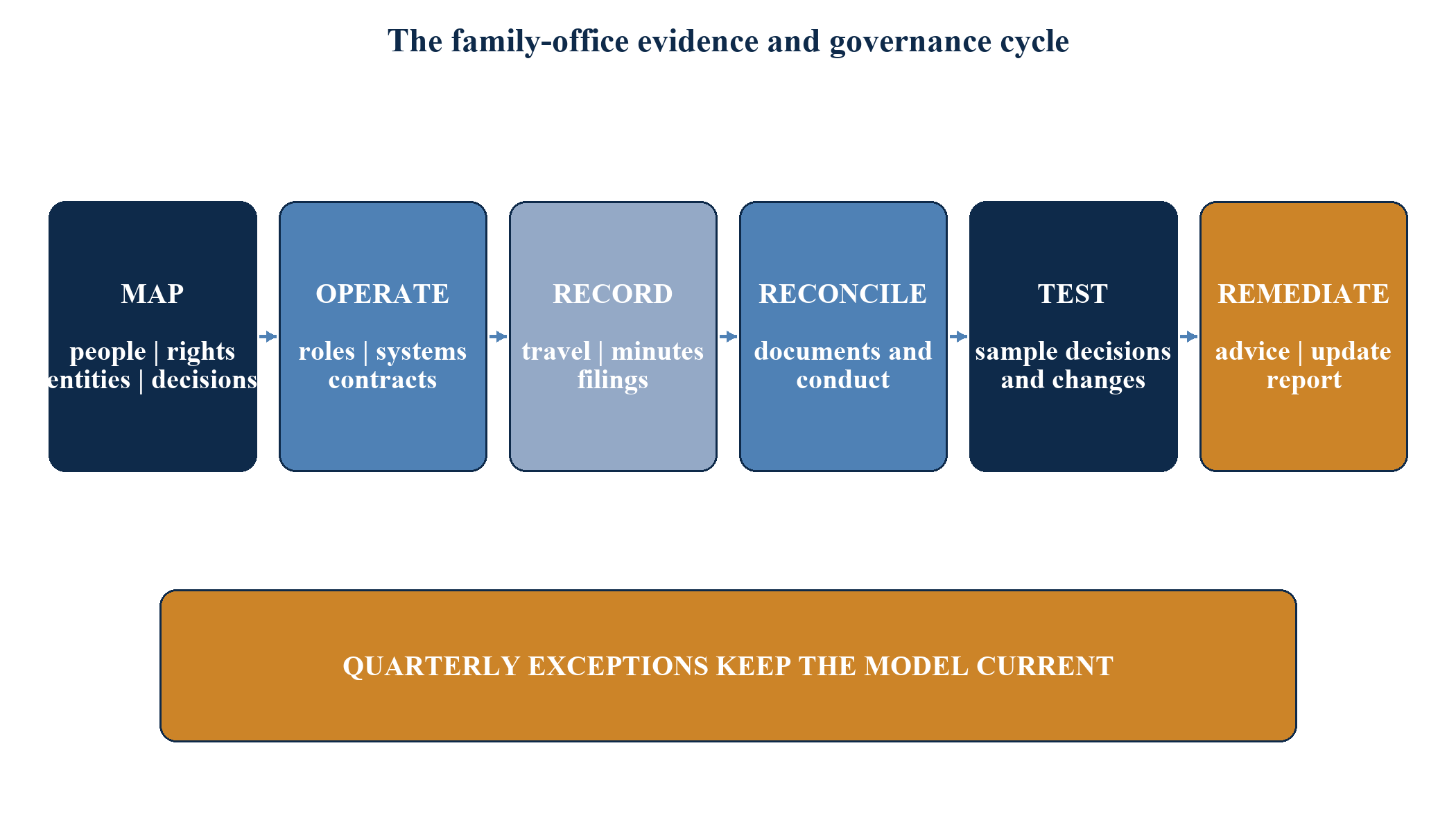
Select recent decisions and trace them from proposal through execution. Compare communications, minutes, travel, signatures and payments with the approved map. Test a family event, urgent investment and temporary return scenario.
Report exceptions to the relevant board, council or committee. Amend authority or conduct, complete filings and set quarterly reviews. The final transition report should state what is complete, what remains conditional and which changes require prior advice.
| Period | Deliverable | Approval body | Completion evidence |
|---|---|---|---|
| days 1-30 | four maps and advice issues | family steering group | reconciled fact pack |
| days 31-60 | approved operating model | boards, council and owners | resolutions and signed documents |
| days 61-90 | function and authority migration | entity owners | payroll, systems, contracts and mandates |
| days 91-120 | operating-model test | audit or governance committee | exception report and remediation log |
18. LIMITATIONS AND CONCLUSION
18.1 Limitations
This paper provides a general governance and operating framework. It does not determine the residence, tax treatment, regulation, succession outcome or legal effect of any actual person, entity, trust, foundation or transaction. Those results depend on complete facts, governing documents, applicable law and current professional advice.
The legal and tax sources can change. Guidance may be updated after publication, and a court, tax authority, regulator or treaty competent authority can interpret facts differently. The family office should verify current rules before implementing a move or transaction.
The worked cases use simplified assumptions. They exclude many issues that can be material, including nationality, immigration, matrimonial property, forced heirship, sanctions, source of wealth, employment, social security, pensions, insurance, licensing, securities law, charity law and rules in third jurisdictions.
18.2 Conclusion
A family can move in stages and preserve legitimate connections to several places. The family office requires a structure that recognises those connections explicitly. Person-by-person residence, entity-by-entity tax and regulation, ownership and control, and decision location should be analysed as connected components.
The four-map model provides that connection. The people map establishes personal facts. The ownership map identifies rights. The entity map establishes legal, tax, regulatory and reporting attachments. The decision map shows where authority is exercised. Together they give directors, trustees, foundation councils, family members and advisers a common operating record.
The most durable family-office transition is maintained through evidence and review. Travel changes, family events, new investments, new services, transfers and legal reforms should trigger updates. A quarterly exception process can keep documents, conduct and reporting aligned with the family's actual life.
APPENDIX A. PERSON AND TIES REGISTER
Maintain one record for every relevant family member and office decision maker. Limit access to authorised personnel and retain supporting evidence under the approved data policy.
| Field | Required detail |
|---|---|
| identity | legal name, citizenship and relevant identifiers |
| residence history | domestic and treaty conclusions by tax year |
| presence | UK, UAE and other jurisdiction days; source records |
| homes | ownership, availability, use and household members |
| family | spouse or partner, minor children and relevant residence facts |
| work | employment, directorships, locations and qualifying workdays |
| ties | family, accommodation, work, 90-day and country-tie analysis |
| UAE evidence | visa, Emirates ID, home, activity and certificate status |
| roles | board, council, trustee, protector, committee and banking authority |
| advice | adviser, opinion date, assumptions and next review |
APPENDIX B. ENTITY, RESIDENCE AND CONTROL REGISTER
For each entity, record:
- legal name, form, place and date of formation;
- registered office, principal office and operational premises;
- shareholders, partners, settlor, trustees, founder, council, guardian, protector, beneficiaries and other controllers as applicable;
- directors, officers and authorised signatories;
- purpose, assets, income and services;
- domestic tax residence in every relevant jurisdiction;
- treaty residence and any competent-authority issue;
- permanent establishments and agent analysis;
- tax registrations, returns and accounting period;
- regulatory status, licences and permitted activity;
- beneficial-ownership, CRS, FATCA and other reporting;
- bank, custody and trading accounts;
- governing documents and reserved matters;
- material service and employment agreements;
- decision forums, locations and evidence owner; and
- next review and change triggers.
APPENDIX C. DECISION-LOCATION LEDGER
| Decision | Proposer | Reviewer | Approver | Executor | Physical locations | Evidence |
|---|---|---|---|---|---|---|
| strategic allocation | investment team | advisers | investment committee | manager or custodian | participant record | paper and minutes |
| private investment | deal lead | legal, tax and risk | investment committee | signatory | negotiation and approval record | diligence and execution file |
| borrowing | finance | legal and risk | board or council | authorised signatories | approval and signing locations | facility and minutes |
| distribution | finance | tax and legal | trustees, council or board | bank approvers | decision record | calculation and instruction |
| service provider | operations | compliance and legal | board or council | authorised officer | selection and signing record | diligence and contract |
| family benefit | family office | tax and governance | proper legal body | finance | meeting and payment locations | purpose and approval |
APPENDIX D. FAMILY GOVERNANCE CHARTER CHECKLIST
The charter should consider:
- family purpose, values and scope;
- membership and representation of family branches;
- family council and owners' council mandates;
- relationship with company boards, trustees and foundation councils;
- reserved matters and consent rights;
- investment principles and risk appetite;
- distributions, liquidity and family benefits;
- family employment and compensation;
- education and successor development;
- philanthropy and impact objectives;
- conflicts, confidentiality and information rights;
- dispute resolution and mediation;
- incapacity, death and emergency authority;
- amendment and periodic review; and
- interaction with binding governing documents.
APPENDIX E. QUESTIONS FOR ADVISERS
E.1 UK tax and legal
- What is the SRT and treaty-residence conclusion for each person under the current facts?
- Which split-year case, if any, applies and from what date?
- Which temporary non-residence rules could affect planned transactions or a return?
- How do the long-term-residence inheritance-tax rules and tail apply?
- How are existing trusts and proposed foundations characterised and taxed?
- Which UK assets, entities, offices and roles retain filing or tax obligations?
- Could any non-UK entity be UK resident or have a UK permanent establishment?
- Which transactions require valuation, clearance, reporting or withholding?
E.2 UAE tax, legal and regulatory
- Which UAE domestic residence test applies to each person and entity?
- What evidence and timing support a tax-residency certificate?
- Which entity and family-office route fits the proposed services?
- Do any services require financial-services permission or another licence?
- Can the foundation apply for unincorporated-partnership treatment, and what ongoing conditions apply?
- What corporate-tax, free-zone, transfer-pricing and filing obligations apply to each entity?
- What beneficial-ownership, company-service-provider, accounting and audit obligations apply?
- How should the structure address incapacity, death, governance disputes and migration?
E.3 Cross-border reporting and operations
- What CRS and FATCA classification applies to each entity and account?
- Who are the controlling persons under the applicable standard?
- Which registers, banks and service providers require updates after a change?
- Where can personal data be hosted and accessed?
- Which contracts, fees and costs require transfer-pricing support?
- How should travel and remote decision making be controlled?
APPENDIX F. QUARTERLY GOVERNANCE AGENDA
- Reconcile the people map to travel, homes, workdays and family changes.
- Reconcile the ownership map to transfers, pledges, reserved powers and beneficiary changes.
- Reconcile the entity map to activities, licences, tax, filings and accounts.
- Reconcile the decision map to sampled investments, contracts and distributions.
- Review board, council, trustee and committee participant locations.
- Review UK work, premises and contract authority for permanent-establishment risk.
- Review UAE substance, staff, premises, services and corporate-tax assumptions.
- Review CRS, FATCA, beneficial ownership and Register of Overseas Entities changes.
- Review data access, cyber incidents, adviser changes and record retention.
- Review return-to-UK, incapacity and urgent-decision scenarios.
- Record exceptions, owners, deadlines and required professional advice.
REFERENCES
[1] HM Revenue & Customs, *Statutory Residence Test: RDR3*, updated June 2026. https://www.gov.uk/government/publications/rdr3-statutory-residence-test-srt/guidance-note-for-statutory-residence-test-srt-rdr3
[2] HM Revenue & Customs, *RFIG20510: Residence, domicile and remittance basis: sufficient ties test*. https://www.gov.uk/hmrc-internal-manuals/residence-domicile-and-remittance-basis/rfig20510
[3] United Kingdom and United Arab Emirates, *2016 UK-UAE Double Taxation Convention*. https://www.gov.uk/government/publications/united-arab-emirates-tax-treaties/2016-uk-uae-double-taxation-convention
[4] UAE Ministry of Finance, *Tax residency criteria: Cabinet Decision No. 85 of 2022 and Ministerial Decision No. 27 of 2023*. https://mof.gov.ae/en/news/following-cabinet-decision-85-of-2022/
[5] UAE Federal Tax Authority, *Family Foundations Guide, CTGFF1*, May 2025. https://tax.gov.ae/Datafolder/Files/Pdf/2025/Family-Foundations-Guide-27-05-2025.pdf
[6] Abu Dhabi Global Market, *Family Offices*. https://www.adgm.com/business-areas/family-offices
[7] Abu Dhabi Global Market, *Foundations Regulations 2017*. https://assets.adgm.com/download/assets/foundations-regulations-2017.pdf/a9b58092643811efb33122e97052245a
[8] Dubai International Financial Centre, *DIFC announces enactment of new DIFC Family Arrangements Regulations*, 2023. https://www.difc.com/whats-on/news/difc-announces-enactment-new-difc-family-arrangements-regulations
[9] HM Revenue & Customs, *INTM120060: Company residence: central management and control*. https://www.gov.uk/hmrc-internal-manuals/international-manual/intm120060
[10] HM Revenue & Customs, *INTM120180: Company residence: location of central management and control*. https://www.gov.uk/hmrc-internal-manuals/international-manual/intm120180
[11] HM Revenue & Customs, *Inheritance Tax if you are a long-term UK resident*, updated 2026. https://www.gov.uk/guidance/inheritance-tax-if-youre-a-long-term-uk-resident
[12] HM Revenue & Customs, *Trusts and Inheritance Tax*. https://www.gov.uk/guidance/trusts-and-inheritance-tax
[13] OECD, *Consolidated Text of the Common Reporting Standard 2025*. https://www.oecd.org/en/publications/consolidated-text-of-the-common-reporting-standard-2025_055664b1-en.html
[14] Abu Dhabi Global Market, *Beneficial Ownership and Control*. https://www.adgm.com/operating-in-adgm/obligations-of-adgm-registered-entities/beneficial-ownership-and-control
[15] Abu Dhabi Global Market, *Registration Authority publishes amendments to the Commercial Legislation*, 2026. https://www.adgm.com/media/announcements/adgm-registration-authority-publishes-amendments-to-the-commercial-legislation
[16] HM Revenue & Customs, *UK tax residence guidance collection*. https://www.gov.uk/government/collections/uk-tax-residence-guidance
[17] Companies House, *Register an overseas entity*. https://www.gov.uk/guidance/register-an-overseas-entity
ABOUT THE AUTHOR
Chennakeshav Adya is an independent researcher. His work examines capital formation, private markets, family capital, cross-border structuring and decision systems connecting the United Kingdom, the Gulf Cooperation Council and international investors.
