

1. Treat relocation as a controlled operating transition
A family relocation can be physically complete while the investment system remains divided between two operating centres. Family members may move first; company directors, foundation officeholders, bank signatories, advisers, data repositories and investment committees may change later. The portfolio can therefore be governed through overlapping authorities and inconsistent information for months. The transition office exists to control that interval.
The programme should define the relocation perimeter before it changes accounts or entities. The perimeter includes people, homes, tax residence evidence, operating businesses, holding vehicles, trusts or foundations, investment accounts, private-market commitments, property, debt, insurance, philanthropy, digital assets, records and service providers. Every item needs a current owner, intended future state, decision route, dependency and evidence date. A move that excludes a material asset or obligation from the perimeter creates an ungoverned exception.
Investment drift is broader than a change in asset-class weights. It includes changes in governance, liquidity, currency, tax exposure, manager coverage, data quality and risk capacity. A portfolio can remain at the same headline allocation while decision rights become slower, liabilities move into a new currency and commitments consume a larger share of available cash. The transition office should measure these dimensions separately and report their combined effect.
The board should appoint one accountable sponsor and one programme lead. Tax, legal, investment, treasury, risk, operations, technology and family-governance specialists retain responsibility for their professional domains. The programme lead integrates their evidence, milestones and exceptions. This separation supports informed decisions and prevents one workstream from silently determining the entire relocation strategy.
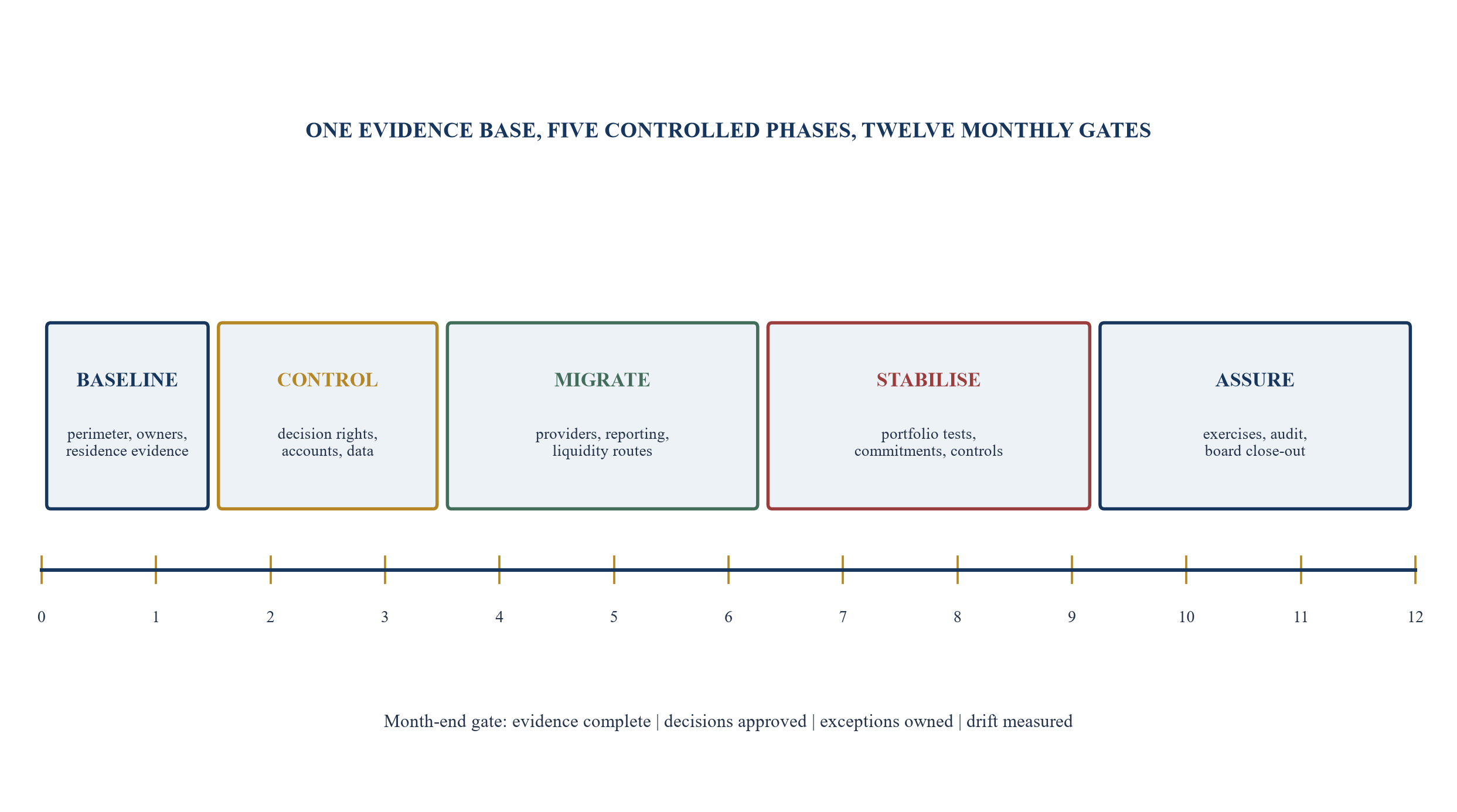
The sequence is an illustrative management design. Legal, tax, safety or institutional requirements may require different timing.
2. Define seven forms of investment drift
Allocation drift is the visible movement of portfolio weights away from approved ranges. It can arise through market performance, cash flows, capital calls, distributions, currency movements or deliberate transactions. During relocation, the family office should calculate allocation against the same taxonomy, valuation date and look-through method in both the old and new reporting environments. A change in classification can otherwise appear to be an investment decision.
Liquidity drift measures the difference between accessible resources and obligations. The analysis should include household expenditure, taxes, property payments, debt service, operating-company support, private-market commitments and transition costs. It should distinguish cash that is legally owned from cash that is institutionally accessible to an authorised person in the required currency and timeframe.
Governance drift occurs when actual decision behaviour departs from approved authority. Examples include an adviser providing de facto discretion without an updated mandate, a principal approving transactions outside the committee calendar, or a new officeholder lacking access to the records required for challenge. Evidence drift arises when valuations, exposures, beneficial-ownership records, tax classifications or contact details are inconsistent across institutions.
Currency, manager and tax-position drift complete the framework. Currency drift compares liabilities and risk capacity with unhedged exposures. Manager drift tests whether the portfolio still receives the required coverage, monitoring and challenge after providers change. Tax-position drift records differences between intended treatment and the evidence available to support residence, ownership, source, control and reporting. The transition office reports all seven dimensions to the board rather than compressing them into one score.
Table 1. Seven-dimensional drift register
| Drift dimension | Baseline evidence | Monthly indicator | Example escalation | Accountable owner |
|---|---|---|---|---|
| allocation | approved strategic ranges and look-through holdings | weight versus approved range | asset class outside range | chief investment officer |
| liquidity | accessible cash, facilities and obligation calendar | funded coverage by currency and time | coverage below approved minimum | treasury lead |
| governance | authority matrix and committee calendar | decisions outside approved route | unauthorised or unrecorded action | governance lead |
| evidence | reconciled records and valuation dates | stale or conflicting records | critical record past evidence limit | data owner |
| currency | liability currency and hedge policy | net exposure by currency | exposure beyond approved band | treasury and risk |
| manager | mandate, service and monitoring map | missed reporting or control obligation | material service failure | investment operations |
| tax position | adviser-confirmed residence and reporting map | open evidence or filing exception | deadline or unsupported position | tax workstream lead |
Thresholds are hypothetical management assumptions and require approval for the family's assets, liabilities and risk capacity.
3. Establish a day-zero investment and operating baseline
The baseline should be a reconciled decision file, not a collection of statements. It records the same economic interest across legal owner, custodian, administrator, manager, tax report and internal portfolio system. Differences are listed as exceptions with owners. The baseline date should be fixed before material transfers begin so later movement can be attributed to markets, cash flows, reclassification or implementation decisions.
Each holding should include legal owner, beneficial owner where applicable, asset class, geography, currency, liquidity terms, valuation basis, custodian, manager, control rights, tax reporting classification, data source and evidence date. Private assets require commitment, funded amount, remaining commitment, distribution expectations, financing, side-letter rights and transfer restrictions. Operating businesses require voting rights, board roles, financing obligations and related-party dependencies.
Liabilities should be reconciled with comparable discipline. The register covers mortgages, investment facilities, guarantees, capital calls, tax reserves, contractual support, property commitments, school fees, insurance premiums and family distributions. A facility that can be cancelled, re-margined or drawn only after documentation is not equivalent to unrestricted cash. The baseline identifies these conditions.
The board should approve the baseline or explicitly accept its open items. A material uncertainty should not disappear inside a total net-worth figure. The transition office can use ranges where valuation evidence is legitimately uncertain, with the source and date disclosed. Any model value, expected cash flow or scenario result remains a management assumption until independent evidence supports it.
The baseline should also preserve provenance. A total reported by a portfolio aggregator may be convenient, yet the institution, administrator, agreement or signed resolution remains the evidential source for the underlying fact. The register should therefore connect each material number to a document, system record, accountable person and retrieval route. Where a value is assembled from several sources, the calculation and reconciliation rule should be retained. This makes the baseline reproducible after an adviser, employee or technology provider changes. It also gives the board a practical way to distinguish a missing document, a stale value, a classification disagreement and a genuine economic exposure.
Completion criteria should be defined before the baseline exercise begins. Cash and listed assets may require position and balance agreement to current institutional records. Private assets may require a commitment roll-forward and the latest valuation package. Entities may require registry evidence, governing instruments, officer records and current authority. The transition office should state any tolerances, evidence ages and approved exceptions. A broad assertion that the file is substantially complete provides weak control because it cannot be tested at the next gate.
4. Separate residence, ownership, control and asset location
Residence is determined person by person and period by period. The United Kingdom's Statutory Residence Test uses statutory rules and includes split-year provisions; HMRC's RDR3 guidance explains how the test applies and was updated in June 2026 [1]. The UAE tax-residence framework uses its own criteria and evidence. The Federal Tax Authority's certificate service describes routes based on physical presence, employment or business, a permanent place of residence, and the centre of financial and personal interests [6].
Residence does not automatically relocate an entity, change an asset's situs or transfer an investment mandate. A company may remain incorporated and managed under its existing rules. A trust or foundation retains its governing instrument and officeholders. Property remains in its jurisdiction. A portfolio account remains subject to the institution's contract, regulatory perimeter and customer records. The transition office keeps these attributes in separate columns.
Control requires additional scrutiny. Board meetings, reserved matters, powers of attorney, investment discretion, protector or guardian rights, bank mandates and digital permissions may point to different decision centres. The programme should record where each decision is prepared, approved, executed and evidenced. Tax and legal advisers then determine the consequences under the relevant facts and law.
The asset-location map should also record reporting and transfer dependencies. A security may be issued in one country, held through a custodian in another, managed by an adviser in a third and ultimately owned through an entity in a fourth. One geographical label cannot describe that chain. The map enables advisers and the board to test each layer without treating relocation as a universal change of jurisdiction.
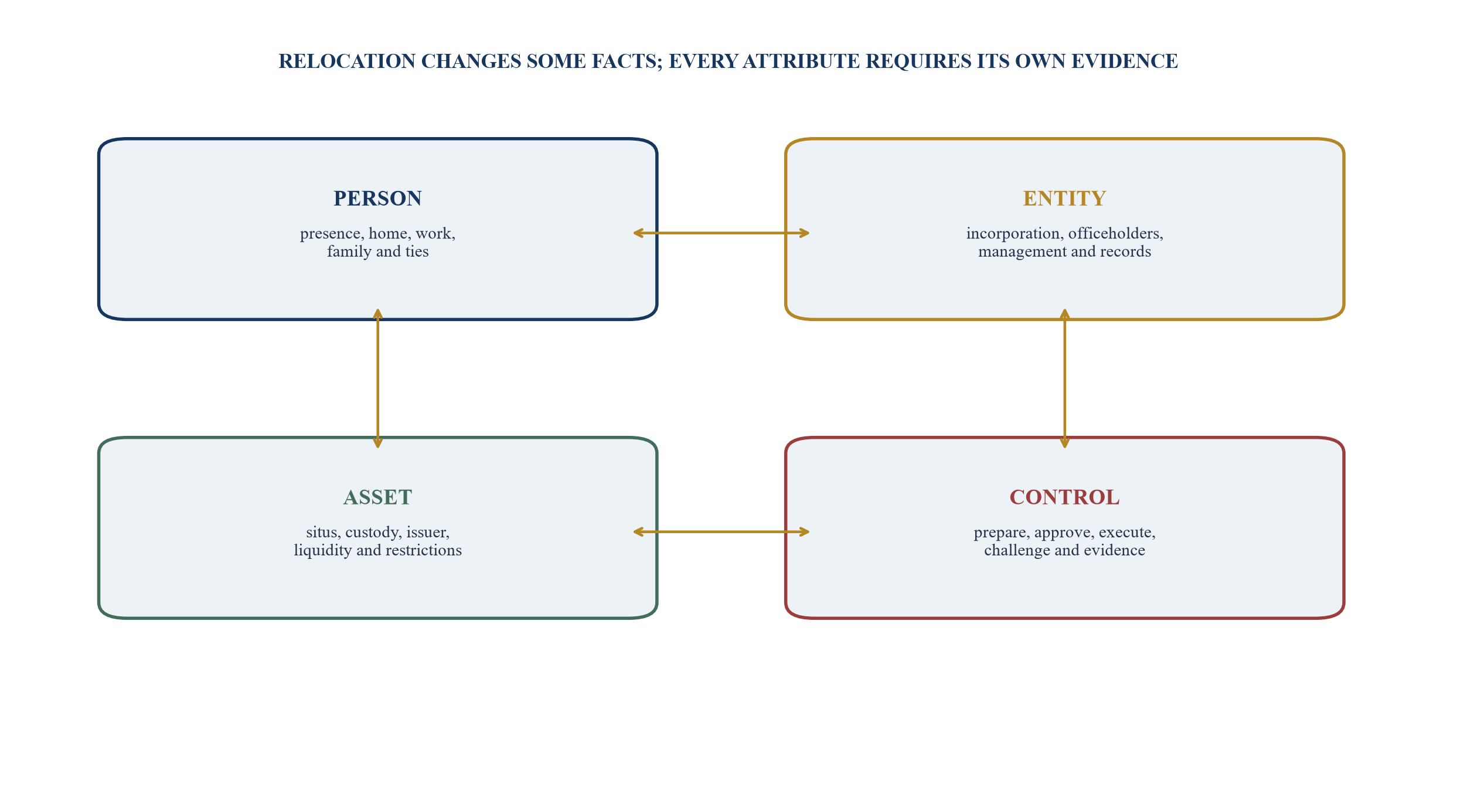
The map separates factual attributes for professional review. It does not determine residence, situs, management or tax treatment.
5. Build the residence and evidence calendar
The transition office should maintain a calendar for presence, homes, work, family facts, entity meetings, travel and documentary milestones. The calendar is an evidence system, not a self-certified tax conclusion. It enables advisers to apply current rules to complete and dated facts and gives the board early warning when planned behaviour diverges from the approved scenario.
For the United Kingdom, the calendar should support the Statutory Residence Test, any split-year analysis and the possibility of future return. The 2026 HMRC temporary non-residence guidance explains that certain gains and income can be treated as arising in the year of return when the statutory conditions are met [4]. UK land can retain reporting and tax consequences for non-residents [5]. The transition office therefore tags transactions that require advice before execution.
Inheritance-tax exposure requires its own clock. HMRC states that from 6 April 2025 long-term UK residence generally applies where a person has been UK resident for at least ten of the previous twenty tax years and that exposure can continue after departure for a period linked to prior residence [2, 3]. The programme records the individual's residence history and obtains advice before presenting any exit date as the end of worldwide exposure.
For the UAE, evidence should be assembled around the applicable domestic or treaty route. The FTA describes supporting materials including entry and exit records, residence documents, proof of employment or business, housing evidence and information about financial and personal interests [6]. The calendar should also record when a person becomes eligible to apply for a certificate and which period it covers. A certificate is evidence issued after review; it does not replace analysis of another jurisdiction or a treaty.
The calendar should connect future decisions to advice lead times. A planned distribution, property sale, carried-interest receipt, refinancing, trust or foundation action, company board meeting or investment transfer may depend on residence, temporary non-residence, entity control, asset situs or reporting analysis. The decision register should identify the latest date on which complete facts must reach the relevant adviser, the expected response date and the authority that can defer the transaction. This turns the calendar into an execution control and reduces the risk that commercial urgency forces the family to act before the analysis is complete.
Evidence quality also requires a consistency review. Travel records, card activity, home availability, employment duties, meeting minutes and institution forms may describe the same period from different perspectives. The transition office should identify discrepancies early and refer them to qualified advisers. It should retain corrections and supporting records with a clear audit trail. Creating a coherent factual file is a governance task; determining the legal result remains the responsibility of the relevant adviser and authority.
Table 2. Residence and evidence calendar
| Evidence stream | Monthly record | Decision supported | Review owner | Escalation trigger |
|---|---|---|---|---|
| physical presence | entry and exit records reconciled to travel | residence analysis and certificate support | personal tax adviser | unplanned days or inconsistent records |
| homes | leases, titles, availability and actual use | permanent-home and accommodation facts | legal and tax advisers | new or retained home arrangement |
| work and business | contracts, duties, location and decision records | workday, business and management analysis | tax and corporate counsel | changed role or decision location |
| family and personal interests | dependant location and settled routine evidence | centre-of-interests analysis | personal tax adviser | family plan changes |
| entity governance | meetings, officeholders and reserved decisions | management and control analysis | company secretary and counsel | decision outside approved process |
| transactions | disposals, distributions, remittances and transfers | pre-transaction tax and legal review | investment and tax leads | transaction enters restricted window |
Requirements vary by person, treaty, period and facts. Qualified advisers should confirm the evidence and conclusions.
6. Freeze definitions before moving the portfolio
The transition office should freeze the investment taxonomy, benchmark, valuation hierarchy and look-through rules at day zero. This does not freeze investment activity. It preserves the measurement language used to decide whether activity is consistent with the mandate. If one provider calls a holding private equity and another calls it strategic ownership, reported allocations can move without any economic transaction.
Every asset class should have a definition, approved range, benchmark, liquidity classification and valuation source. Illiquid holdings should include the treatment of unfunded commitments and any facility used to manage calls. Currency exposures should be measured consistently across securities, cash, derivatives, property, private assets and liabilities. The board should approve any intentional change to methodology and see the effect of the change separately from market performance.
The programme should also define a decision hierarchy. Maintenance decisions keep exposures within approved ranges and service obligations. Strategic decisions change policy, manager architecture, liquidity targets, structures or risk capacity. Exceptional decisions respond to a time-sensitive event. Each class has a different authority, evidence and meeting route.
A transition freeze may be appropriate for selected actions, such as appointing a new illiquid manager, making a large direct investment, changing leverage or transferring an asset whose tax and legal analysis is incomplete. The freeze should have a scope, owner, review date and exception process. It should never become an undocumented barrier that prevents necessary risk management.
7. Reconfirm the investment policy and risk capacity
Relocation can change the family's liabilities, time horizons, currencies and willingness to accept illiquidity. The investment policy should therefore be re-underwritten rather than copied. The review begins with objectives and obligations, then tests strategic allocation, liquidity, leverage, concentration, currency, responsible-investment preferences, direct-investment appetite and delegation.
Risk capacity differs from risk preference. A family may remain comfortable with volatility while its capacity to meet calls declines because taxes, property acquisitions and transition costs use accessible cash. A principal may want more regional investments while the portfolio already has indirect exposure through operating businesses. The transition office quantifies these facts before altering the allocation.
The policy should distinguish permanent strategic changes from implementation timing. A decision to build a UAE and wider Gulf allocation can be approved with pacing, diligence and concentration limits. Immediate deployment is a separate decision. This separation protects the portfolio from replacing one geographical bias with another during a period of operational change.
The board pack should show the current policy, proposed policy, transition path and downside cases on one basis. Each proposed change should identify rationale, evidence, expected liquidity use, governance burden, implementation cost and exit constraints. Forecast returns remain assumptions. The decision should remain valid when expected returns are lower, implementation takes longer or the family returns to the United Kingdom earlier than planned.
The investment-policy review should test concentration at several levels. Legal ownership, headline asset class and geography may conceal common exposure to the same operating company, family business, property cycle, bank group, technology platform or source of family wealth. The review should look through pooled vehicles where information is available and classify unavailable information as an evidence limitation. It should also identify concentrations created by guarantees, co-investment rights, unfunded commitments and correlated liabilities. This view helps the board understand how much capacity remains for new regional or thematic exposure.
Governance capacity belongs inside the policy. Direct investments, co-investments, private funds, complex credit and structured products require different diligence, monitoring and decision resources. A policy can be financially coherent and operationally unworkable when the office lacks people, information rights or review time. The board should specify which exposures may be delegated, which require committee attention and which need an external specialist. The approved allocation should fit both the family's risk capacity and the office's ability to govern it.
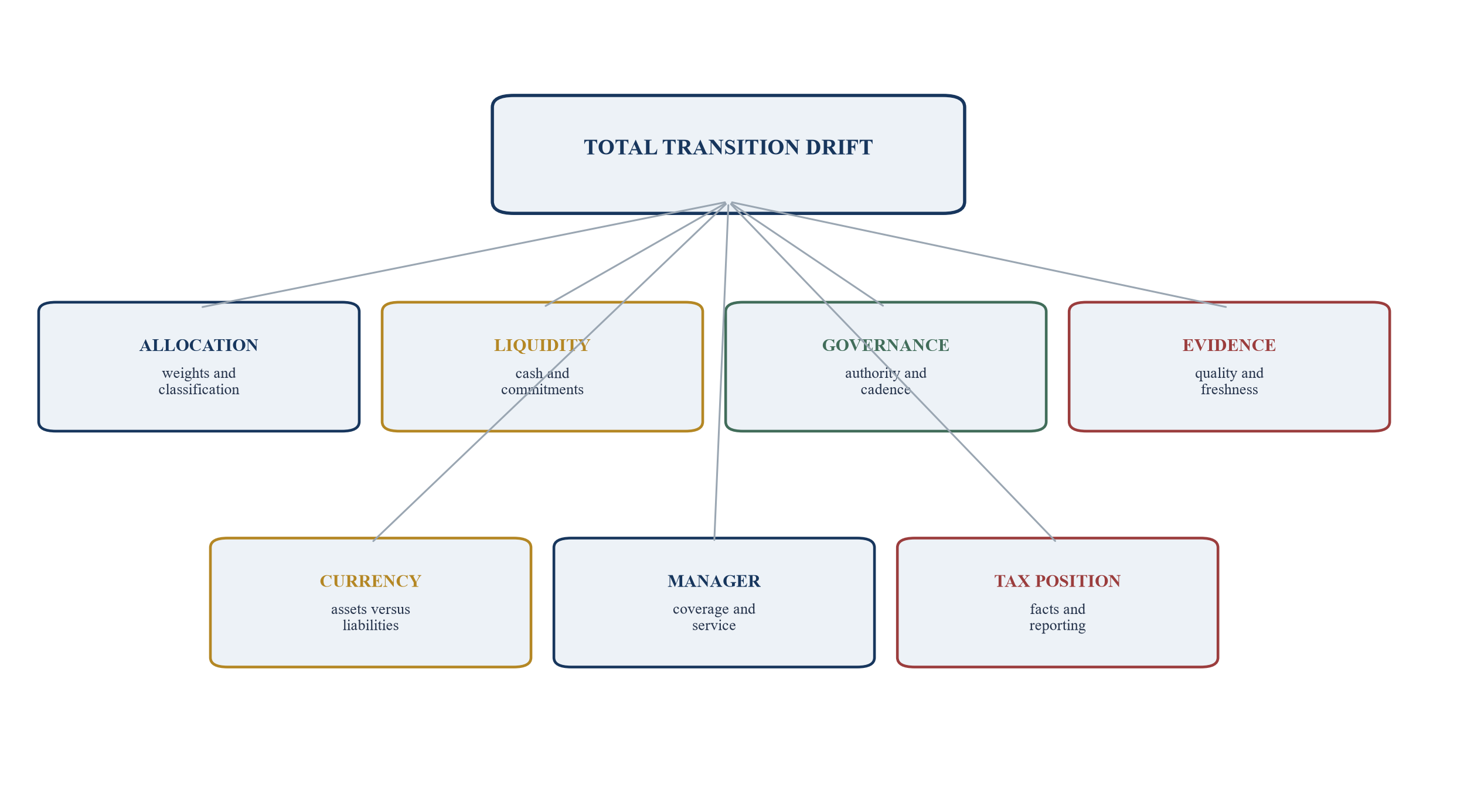
The tree is a diagnostic. It does not assign probability, loss or investment advice to a particular family.
8. Protect liquidity across currencies and time horizons
Liquidity should be modelled as an operating resource. The model starts with dated obligations and classifies resources by access time, currency, legal owner, institution, authority and reliability. Cash available to a holding company may not be available for personal expenditure. A facility may require covenants, notice or collateral. A private-market distribution may be expected but not controllable.
The programme should establish a minimum funded runway for essential personal and office obligations, a separate reserve for known taxes and transition costs, and a commitment reserve for private assets. The amounts and horizons require family-specific approval. A base case, delayed-distribution case, market-stress case and return-to-UK case expose different demands on cash and currency.
Currency planning should begin with liabilities rather than market views. The family maps expected spending, taxes, debt service and commitments in sterling, dirhams, dollars and other material currencies. Hedging, natural offsets and cash locations are then considered within the approved investment policy. A currency position should not be described as hedged unless the instrument, counterparty, maturity and legal owner align with the liability.
The liquidity committee should review actual versus expected flows monthly during transition. Large discretionary investments, distributions, gifts, property purchases and leverage changes should pass a pre-transaction test. The test asks whether the action preserves approved coverage under adverse timing and whether authorised alternates can access the remaining resources.
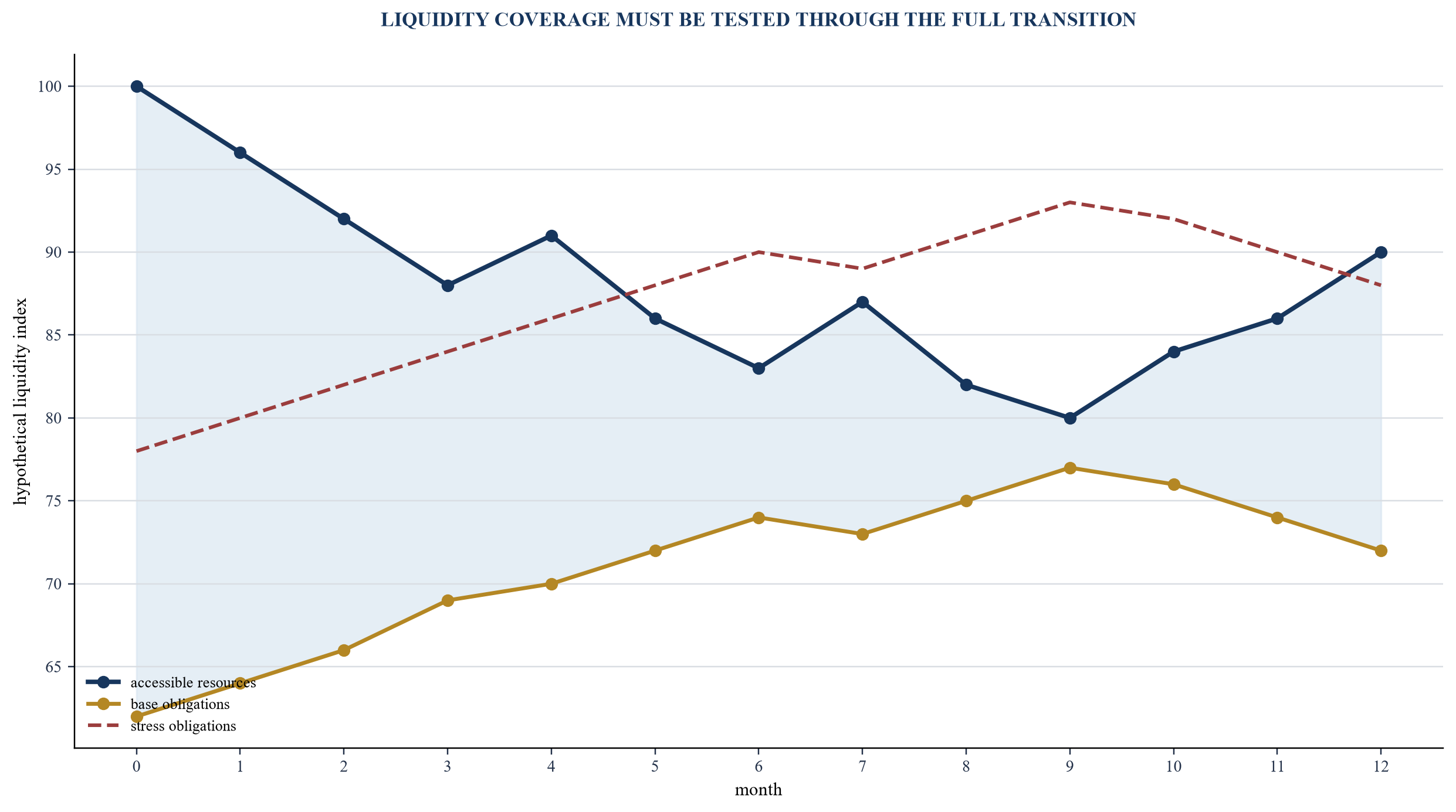
Values are hypothetical management assumptions expressed as an index. They are not a forecast or recommendation.
9. Govern private-market commitments and pacing
Private-market portfolios create delayed and uncertain cash flows. A relocation can add property, tax, office and professional costs at the same time that funds call capital. The transition office should model every commitment by vehicle, currency, remaining commitment, expected call range, distribution range, credit facility, transfer restriction and decision rights.
The model should distinguish contractual obligations from manager forecasts. It should avoid netting expected distributions against calls as though both were certain. A downside case can delay distributions, accelerate calls within contractual limits, reduce available credit and lower public-market liquidity. The board decides the reserve and pacing policy after reviewing these conditions.
New commitments should pass a transition-capacity gate. The gate tests strategic fit, concentration, liquidity coverage, tax and reporting treatment, administrative readiness, currency, manager diligence and the ability of the new operating team to monitor the investment. A compelling manager does not remove these implementation requirements.
Secondary sales, NAV facilities and other liquidity tools can change timing and risk. They require separate economic, legal, tax and governance analysis. The transition office should present price, fees, collateral, covenants, recourse, concentration and downside before treating a financing or sale as available liquidity. Any modelled proceeds or discount are assumptions until documented terms exist.
Pacing should be managed as a range of possible cash paths. For each fund, the office can combine the legal commitment, manager guidance, historical portfolio behaviour where relevant, investment period, recycling provisions, subscription facilities and known transaction activity. The model should retain a conservative case that does not depend on timely exits. Aggregate results should be shown by month, currency, legal owner and facility dependency. This enables the board to identify a shortfall that is hidden by annual totals or by netting one vehicle's expected distribution against another vehicle's contractual call.
The office should also monitor changes in exposure after commitments are made. Currency moves, public-market declines, delayed valuations and slower distributions can increase the relative weight of private assets without a new subscription. A denominator effect can therefore narrow liquidity headroom and breach policy ranges during relocation. The transition office should define the indicators that trigger a pacing review, identify the decisions that can be slowed, and retain the authority to reject a new opportunity when the portfolio cannot absorb its downside case.
10. Map operating businesses and control obligations
An internationally mobile family may own operating companies whose governance cannot move with the principal. Board duties, licences, customer contracts, lenders, employees, tax residence, permanent-establishment questions and local substance require separate analysis. The transition office should map each business as both an investment and an operating dependency.
The map records ownership, voting rights, board composition, reserved matters, management location, financing, guarantees, related-party flows, dividend capacity, information rights and succession. It also identifies the decisions that the family office may recommend, those the company board must make and those requiring shareholder or lender consent. Informal influence should not replace formal authority.
Cash-flow assumptions from an operating business require challenge. A planned dividend may be constrained by law, covenants, working capital or board judgment. A sale process may change tax, liquidity and residence analysis. A business may need capital during the same period that the family office expects distributions. The liquidity model should therefore use approved, evidence-backed flows and separate them from aspirations.
The transition office should also assess concentration across the family balance sheet. Public securities, private funds, property and operating companies can share the same regional, currency, interest-rate or technology exposure. A change in residence does not diversify these economic links. The board should review look-through exposure before approving a locally concentrated investment programme.
Table 3. Asset and entity transition map
| Item | Current legal and operating facts | Intended future state | Required decision | Evidence gate | Key dependency |
|---|---|---|---|---|---|
| personal portfolio | owner, custodian, mandate and tax classification | approved custody and reporting architecture | retain, transfer or appoint | adviser sign-off and institution acceptance | KYC and transfer timing |
| holding company | incorporation, board, records and bank | confirmed governance and management process | maintain or restructure | legal and tax memorandum | officeholders and substance |
| foundation or trust | governing law, roles and beneficiaries | approved succession and oversight | establish, amend or retain | counsel opinion and registry acceptance | fiduciaries and beneficial ownership |
| operating business | voting, board, debt and cash flow | uninterrupted governance and reporting | board and shareholder actions | company approvals and lender consent | management continuity |
| private funds | commitments, side letters and tax reporting | stable monitoring and call funding | consent or transfer if required | manager and counsel confirmation | transfer restrictions |
| property | title, debt, manager and tax | maintained ownership and operating control | retain, sell or refinance | local advice and service readiness | local manager and lender |
The map is a governance register and requires legal, tax, regulatory and investment confirmation for each item.
11. Redesign decision rights and committee cadence
Decision rights should be documented before the new office starts operating. The matrix identifies who can propose, analyse, recommend, approve, execute, record and challenge each decision. These roles can sit with different people and organisations. A principal's final authority does not remove the need for analysis, conflicts management and a complete record.
The investment committee should retain a stable calendar through relocation. Monthly transition meetings can address liquidity, evidence and implementation. Quarterly investment meetings can address performance, allocation, managers and strategy. Exceptional meetings should have defined triggers, circulation rules and decision records. The programme avoids allowing the transition calendar to crowd out normal portfolio oversight.
Delegation should be bounded by instrument, amount, risk, duration and evidence. An investment manager may have discretion within a mandate. A family-office executive may execute approved transactions. A treasury officer may move cash within approved limits. The board retains strategic, structural and exceptional decisions. The authority register should match bank, custodian and platform records.
Conflicts require explicit treatment. Family members, advisers, operating-company executives and co-investment partners may hold overlapping interests. The process should require disclosure, recusal where appropriate, independent advice and a recorded decision basis. The transition office tracks these controls without making legal conclusions about a specific conflict.
12. Sequence banks, custodians and investment managers
Institution migration should follow a service map. Each relationship is assessed for custody, execution, credit, cash management, reporting, product access, data, service team, jurisdiction, contractual rights and exit process. The family should avoid changing several critical providers at the same time unless risk analysis supports the concentration of implementation work.
The onboarding file should reconcile identity, address, residence, source of wealth, source of funds, ownership, controllers, tax classifications and expected activity. FATF guidance emphasises adequate, accurate and up-to-date beneficial-ownership information for legal persons and arrangements [18, 19]. A transition can stall when institutions receive different versions of the ownership or control narrative.
Manager mandates should be compared on a common basis. The review covers objective, benchmark, discretion, permitted assets, liquidity, leverage, derivatives, currency, concentration, fees, reporting, best execution, conflicts, termination and transition assistance. The family should identify any gap between the approved investment policy and the legal mandate before assets move.
The cutover plan should include data reconciliation and failed-trade control. Opening balances, cost bases, tax lots, cash, corporate actions, performance history, restrictions and beneficiary information require verification. The old relationship remains operational until the new relationship has accepted authority, received assets and produced reconciled reporting. Closure then follows a board-approved evidence gate.
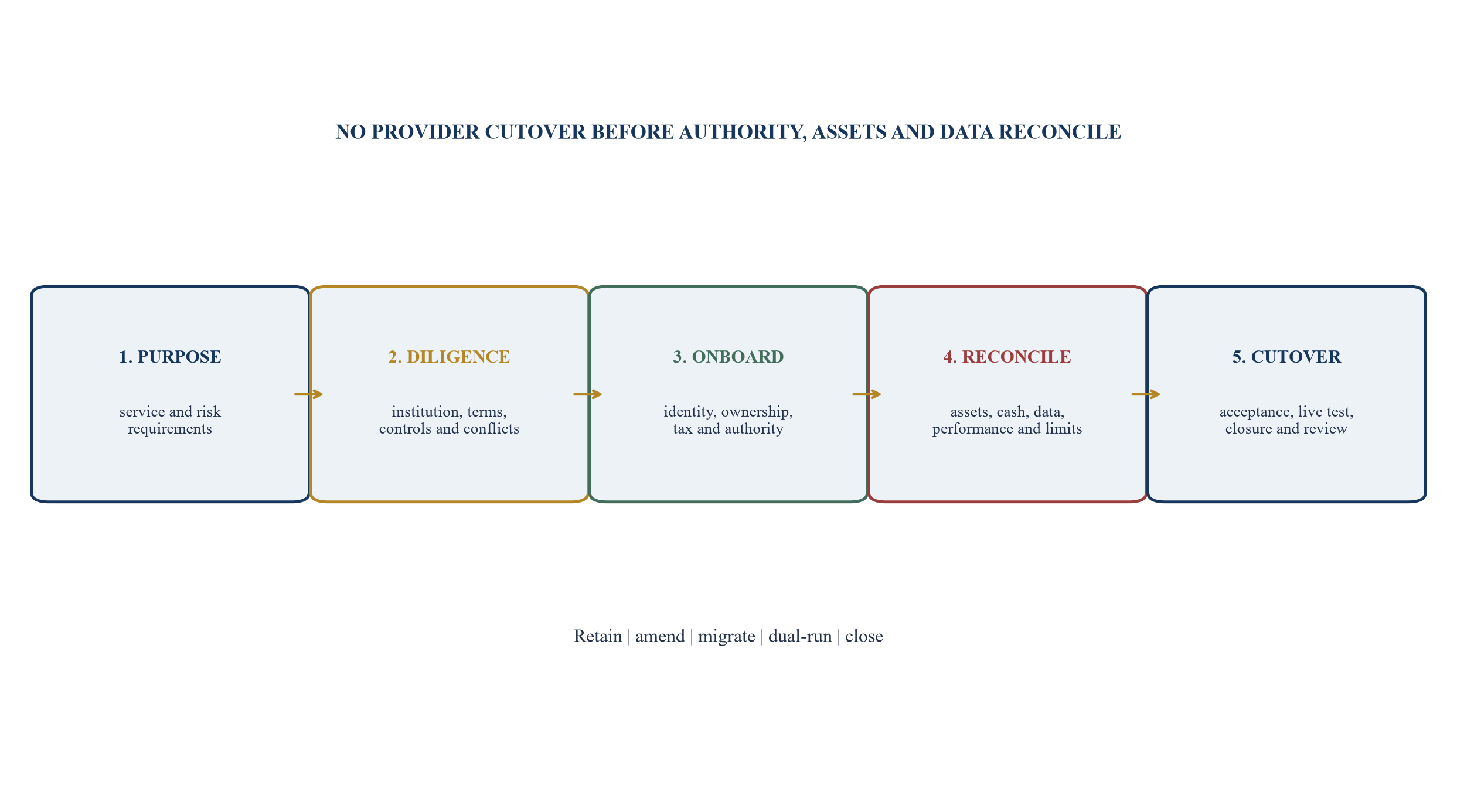
Each gate requires evidence from the relevant institution and advisers. The path does not imply that every relationship should be moved.
13. Create one data and reporting architecture
The family office needs one governed information model even when several providers remain. The model defines holdings, transactions, valuations, commitments, liabilities, currencies, entities, people, documents and decisions. Each field has an authoritative source, owner, refresh frequency and quality rule. Reports should show exceptions rather than silently choosing between conflicting values.
Cross-border access to personal and confidential information requires legal and security review. The United Kingdom Information Commissioner's Office updated its international-transfer guidance in January 2026 and describes a structured test for identifying restricted transfers and selecting a permitted mechanism [20]. The UAE, ADGM and DIFC have their own data-protection regimes and guidance [21, 22, 23]. The programme maps controllers, processors, hosting, remote access and contractual safeguards for each material flow.
Data migration should be minimised and staged. The team classifies records, removes duplicates, confirms retention obligations, encrypts transfer, limits privileges and tests recovery. Live credentials, private keys and unrestricted identity records should remain within approved custody systems. A transition repository should hold evidence and decisions without becoming an uncontrolled copy of every family record.
Reporting should retain comparability across the transition. The board receives the same definitions for performance, allocation, liquidity, commitments, leverage and risk. A change in system or provider is reconciled through parallel reporting for a defined period. The transition office records methodology changes and presents their numerical impact separately.
The architecture should preserve a decision-to-data lineage. A board instruction should connect to the approved paper, authority, execution message, institution confirmation, accounting entry, portfolio record and subsequent monitoring result. This chain helps the office test whether a decision was implemented as approved and whether the intended economic effect appeared. It also supports handover because a new operator can follow the evidence without relying on personal memory. Exceptions in the chain should be visible in reporting and assigned to an owner.
Access design should follow the actual work. Principals, directors, investment staff, accountants, tax advisers, legal advisers, administrators and technology providers need different views and actions. The transition office should map read, propose, approve, execute, export and delete permissions separately. Privileged access should be limited, time-bound where appropriate and reviewable. The recovery process should identify how the office continues if a principal, employee or provider becomes unavailable. Backup evidence has limited value when authorised alternates cannot retrieve it during a time-sensitive obligation.
14. Align reporting, beneficial ownership and tax classifications
International financial accounts and structures can create overlapping information obligations. The OECD's 2025 consolidated Common Reporting Standard includes due-diligence and reporting rules for financial-account information and extends coverage in specified areas, including indirect crypto-asset exposure [16]. The Crypto-Asset Reporting Framework introduces a separate automatic-exchange framework for relevant crypto-asset transactions [17]. The transition office should identify which institutions and advisers own each classification and filing process.
Beneficial-ownership records should be consistent across registries, banks, managers, custodians and internal files. FATF guidance for legal arrangements identifies settlors, trustees, protectors, beneficiaries and persons exercising ultimate control within the relevant concept [18]. Legal-person guidance similarly focuses on the natural persons who ultimately own or control the vehicle [19]. Local law and institutional requirements determine the actual submissions.
Tax classification should not be inferred from an investment label. A family foundation, trust, company, partnership, personal account and fund can have different treatment depending on jurisdiction and facts. The UAE Federal Tax Authority publishes guidance for family foundations and natural persons, including the conditions under which business activity by a natural person can enter the corporate-tax regime [8, 9]. Advisers should confirm the applicable position and evidence.
The programme maintains a reporting calendar with owner, jurisdiction, account or entity, information source, review date, filing date and completion evidence. It includes correction procedures for inconsistent records. The board sees overdue items and material uncertainty without receiving personal data beyond what its governance role requires.
Table 4. Cross-border reporting and data-control matrix
| Record or flow | Authoritative source | Primary use | Cross-border control | Reconciliation evidence | Owner |
|---|---|---|---|---|---|
| identity and residence | official documents and presence records | KYC and residence analysis | minimum access and lawful transfer route | institution and adviser confirmation | compliance lead |
| ownership and control | registers, instruments and resolutions | beneficial ownership and authority | role-based access and version control | registry and institution match | governance lead |
| holdings and transactions | custodian and administrator records | performance, risk and reporting | encrypted interfaces and approved processors | position and cash reconciliation | investment operations |
| private-market commitments | fund notices, agreements and administrator data | liquidity and exposure | controlled repository and adviser access | commitment roll-forward | alternatives lead |
| tax classifications | adviser memoranda and institution forms | reporting and withholding | need-to-know access and retention | annual cross-provider comparison | tax lead |
| board decisions | approved papers, minutes and authority log | governance and audit trail | restricted access and immutable record | decision-to-execution test | company secretary |
The matrix identifies workstreams. It is not a filing determination or data-transfer opinion.
15. Control advisers and third-party dependencies
A transition office can become dependent on one lawyer, tax adviser, bank relationship manager, technology provider or administrator. The programme should map critical services and the providers supporting them. The Financial Stability Board's third-party toolkit recommends identifying critical services, conducting due diligence, managing contracts, monitoring incidents and testing business continuity across provider relationships [25]. The family office can adapt this logic proportionately.
Each adviser mandate should define scope, jurisdiction, assumptions, deliverables, dependencies, decision owner, confidentiality, data handling, conflicts, reliance, fees, completion criteria and handover. Advice from one domain should identify the questions requiring another specialist. The transition office maintains an issues register so that a tax assumption is not converted into a legal instruction or investment decision without the relevant review.
Provider concentration should be assessed across legal entities and family members. Several accounts may use the same custodian group, cloud service, identity provider or administrator. Several advisers may depend on the same source data. The map should identify correlated failure and the practical recovery route.
The programme should also plan provider exit. Records, models, passwords, data schemas, contracts, institutional contacts and open issues need a documented handover. Fees and notice periods should be tracked. A new provider is not ready solely because a contract has been signed; acceptance, access, data and reporting must be tested.
Third-party controls should be proportionate to consequence. A provider that prepares a periodic non-critical report presents a different risk from a provider that holds assets, controls identity, maintains the only ownership register or operates payment authority. The office should classify critical services, define tolerable disruption, identify substitutes and document the minimum information needed to continue. Contractual protections, insurance and service credits may support recovery, yet they do not create an operational alternative. The transition plan should test the practical route for an urgent payment, capital call, board decision and regulatory response when a critical provider is unavailable.
Adviser coordination needs a controlled question-and-answer process. Facts should be shared once through an approved record, with changes logged and routed to every workstream affected by them. Advice should state its scope, factual assumptions, date and unresolved dependencies. When two advisers reach different conclusions, the programme lead should document the issue and obtain a resolved instruction from the accountable decision-maker. The transition office should never reconcile professional disagreements by editing language until it appears consistent.
16. Execute the first thirty days
The first thirty days establish control. The board approves the perimeter, sponsor, workstreams, confidentiality, decision rights and reporting rhythm. The team freezes definitions, captures the day-zero baseline, opens the issue register and identifies time-critical transactions. No structural move should proceed solely to meet an arbitrary programme date.
The residence workstream builds the presence and evidence calendar for each person. Tax advisers identify the facts and transactions requiring immediate review. Legal advisers map entities, officeholders, governing instruments, powers and asset locations. Investment operations reconcile holdings, commitments, cash, liabilities and mandates. Treasury builds the first currency and obligation map.
Critical exceptions receive interim controls. An expiring identity document, unsupported signatory, imminent capital call, uncertain tax classification or inaccessible record may require immediate action. The interim control names an owner, action, deadline and review. It does not present temporary treatment as a final conclusion.
The day-thirty gate should produce an approved baseline, a prioritised critical path and a list of decisions that remain paused. The board should know which facts are complete, which professional opinions are outstanding and which assumptions drive the plan. The transition office should be able to explain every material number and deadline.
17. Build control and readiness during days thirty-one to ninety
Days thirty-one to ninety convert the baseline into an approved target operating model. The family confirms the intended residence and governance scenario with advisers, approves the investment-policy review, sets liquidity and currency parameters, and chooses which institutions and structures require change. The programme avoids implementing providers before these decisions are stable.
Authority and committee records are updated. Institutions receive consistent KYC, beneficial-ownership and tax-classification packs. The data architecture is approved, transfer mechanisms are reviewed and reporting interfaces are designed. Provider due diligence covers service, financial strength, regulatory status where applicable, technology, controls, conflicts and exit.
The portfolio continues to operate. Capital calls, distributions, rebalancing, risk management and company decisions use the existing approved routes until the replacement route passes its gate. Any dual-running period has a clear source of truth and reconciliation owner. The programme measures the cost and risk of overlap.
The day-ninety gate should include a board-approved target model, a sequenced migration schedule, evidence of institution acceptance and a funded liquidity plan. It should list any structural action that remains conditional on advice, consent or operational readiness. The board may approve several possible paths where the final choice depends on unresolved facts.
18. Migrate and stabilise during months four to six
Months four to six execute approved changes in bounded waves. A wave can cover one bank, one reporting process, one entity-governance change or one group of records. Each wave has entry criteria, owner, rollback or contingency route, reconciliation and completion evidence. Simultaneous changes are limited where they share dependencies.
Asset transfers require special control. The team verifies legal owner, receiving account, eligible assets, restrictions, cost basis, tax lots, corporate actions, collateral, cash and settlement. Private-market transfers may require manager or investor consent and can affect reporting or tax. Property and operating businesses require their own local workstreams.
The transition office begins monthly drift reporting. Allocation, liquidity, governance, evidence, currency, manager and tax-position indicators are compared with approved ranges or milestones. Exceptions are explained by cause and action. A market-driven allocation movement is separated from a classification change or cash transfer.
The month-six gate should demonstrate that the new operating model can perform core processes. The office produces reconciled reporting, convenes an authorised committee, funds obligations, processes an approved transaction and retrieves the supporting record. Material failures extend the dual-run or trigger remediation.
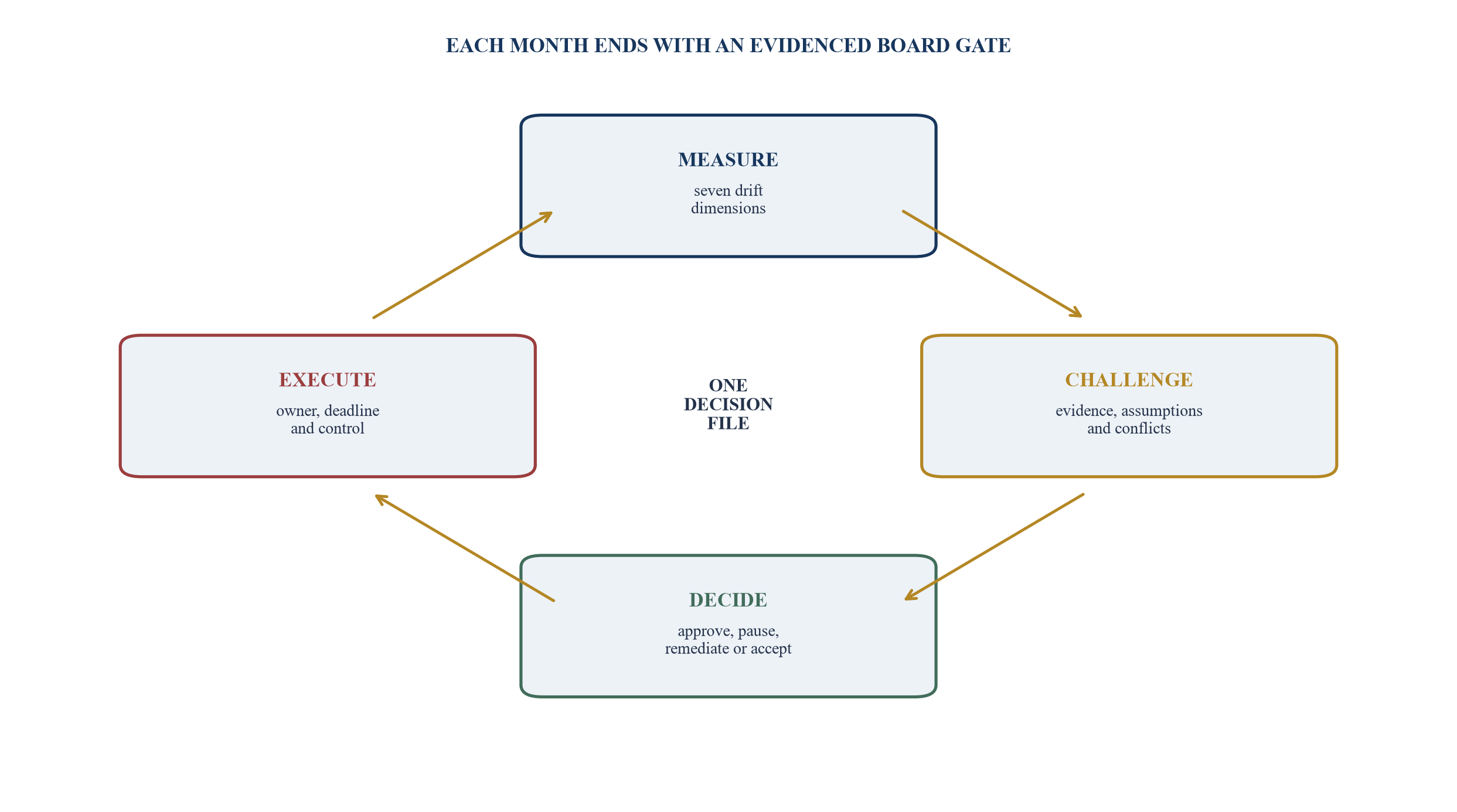
The loop is an illustrative governance process. Assurance scope and independence require family-specific approval.
19. Stabilise and optimise during months seven to nine
Months seven to nine test whether the new office can operate without transition shortcuts. Temporary accounts, duplicate processes, manual reconciliations and adviser workarounds are either retired or approved as permanent controls. The team confirms that each critical service has an owner, alternate, current procedure and evidence source.
The investment committee reviews whether implementation changed the portfolio's intended economics. It analyses fees, taxes, spreads, hedging costs, cash drag, manager changes and realised transition costs. These effects are compared with the approved business case. Any claimed benefit should be supported by actual data and a stated counterfactual.
The office also reviews opportunity pacing. A new regional network may create direct investments, funds, property or operating-company transactions. Each opportunity passes the normal investment process. The transition programme should not become a reason to relax diligence, concentration or liquidity limits.
The month-nine gate should show stable reporting, closed high-risk exceptions and a tested operating cadence. Persistent manual work, stale records, authority gaps or unexplained performance differences indicate that the target model is not yet stable. The board decides whether to extend the transition office, change providers or accept specific residual risk.
20. Assure and close during months ten to twelve
The final quarter should provide independent challenge and operating evidence. Legal and tax advisers confirm the advice and facts within their scope. Investment operations reconcile performance, holdings, commitments and cash. Technology and data specialists test access, security, backup and recovery. Governance reviewers sample decisions from proposal through execution and record.
Exercises should include a realistic disruption. The office can test a principal's unavailability during a capital call, an institution requesting refreshed KYC before a payment, a provider outage during reporting, or an unplanned return to the United Kingdom before a proposed transaction. The scenario is hypothetical; the evidence and response route are real.
The board receives a close-out file containing the baseline, target model, completed decisions, current registers, professional advice, reconciliations, test results, exceptions, costs and annual calendar. Open items have an owner and governing forum. Records required for future residence, tax, ownership and transaction analysis remain accessible under approved retention controls.
The transition office closes only when its functions have permanent owners. Residence evidence enters the annual tax calendar. Portfolio drift enters investment reporting. Institution and KYC maintenance enter compliance operations. Data flows enter information governance. Liquidity, commitments and currency enter treasury. The board retains a consolidated annual review.
The close-out review should compare the approved business case with actual evidence. It should reconcile professional fees, transfer costs, spreads, taxes, custody changes, technology expenditure, staff time and any realised market impact attributable to the transition. Claimed savings or risk reduction should identify the baseline and counterfactual used. Some benefits, such as clearer authority or stronger continuity, are better evidenced through completed tests and fewer control exceptions than through a monetary estimate. The board can accept these benefits with the measurement basis disclosed.
Residual risk should remain explicit after closure. A pending tax position, incomplete historical record, retained overseas property, concentrated operating business, long-dated guarantee or unresolved provider dependency may continue for years. The permanent owner should receive the source documents, monitoring trigger, escalation route and next review date. The annual governance calendar should revisit the assumptions that could change the analysis, including residence history, family circumstances, entity officeholders, account classifications, data flows and intention to return. Closure therefore transfers accountable control; it does not imply that every cross-border issue has ended.
Table 5. Twelve-month workstream and gate plan
| Period | Primary objective | Required evidence | Board decision | Completion test |
|---|---|---|---|---|
| days 1-30 | establish control and baseline | perimeter, reconciliations, residence facts and issue register | approve scope, owners and paused actions | every material item has owner and evidence status |
| days 31-90 | approve target operating model | professional advice, policy review, provider diligence and migration plan | approve target state and sequence | entry criteria documented for each wave |
| months 4-6 | migrate in bounded waves | acceptance, transfers, reconciliations and live process tests | approve cutover or extended dual-run | core processes operate and reconcile |
| months 7-9 | stabilise and measure value | drift reports, cost bridge and closed exceptions | accept, remediate or change providers | reporting and governance run without shortcuts |
| months 10-12 | assure and transfer ownership | independent reviews, exercise evidence and annual calendar | close transition office or extend defined items | permanent owners accept every control |
Timing is an illustrative management assumption. Critical legal, tax, regulatory, safety and liquidity work may require earlier action.
21. Govern the permanent family-office system
The permanent operating model should retain a compact set of linked registers. These include people and residence evidence, entities and officeholders, assets and liabilities, institutions and mandates, commitments and liquidity, decisions and conflicts, data flows, providers, reporting obligations and exceptions. Each register has an owner, refresh rule and board use.
The annual investment-policy review should incorporate residence, tax, spending, business, succession and governance changes. A material event triggers an interim review. Events can include a return to the United Kingdom, a new home, a business sale, a large gift, a foundation or trust change, a new borrowing arrangement, a provider change, a marriage, death or incapacity, or a significant private-market commitment.
The board dashboard should report outcomes and evidence. It shows allocation against approved ranges, accessible liquidity by horizon and currency, commitment coverage, decisions outside cadence, stale critical records, provider failures, open tax and legal questions, and overdue remediation. Engagement, transaction volume or the number of completed tasks does not substitute for control effectiveness.
The family's objective is continuity of purpose through change. A successful transition preserves the ability to decide, fund, execute, record and challenge. It also leaves the portfolio governed by an intentional policy rather than the accidental timing of relocation. The board should approve the permanent model only when it works under normal conditions and under a tested disruption.
Table 6. Board transition and permanent-control dashboard
| Board question | Core indicator | Evidence | Illustrative status rule | Permanent owner |
|---|---|---|---|---|
| Is the portfolio within policy? | seven drift dimensions against approved bands | reconciled holdings, liabilities and decision log | green only when every material breach is explained and owned | chief investment officer |
| Can obligations be funded? | accessible coverage by horizon and currency | bank, facility, commitment and obligation records | amber when stress coverage approaches approved minimum | treasury lead |
| Are decisions authorised? | exceptions to approved authority and cadence | mandates, minutes and execution records | red for unsupported material action | governance lead |
| Is reporting defensible? | stale, conflicting or unreconciled critical fields | source and reconciliation log | amber beyond approved evidence age | data owner |
| Are providers reliable? | service failures, open incidents and concentration | contracts, incidents, tests and exit plans | red when a critical service lacks a tested alternative | operations lead |
| Are residence and reporting facts current? | open adviser questions and filing milestones | presence, ownership, classification and filing evidence | red at missed legal or filing deadline | tax and compliance leads |
All thresholds and status definitions are hypothetical management assumptions requiring board approval.
Sources and further reading
- HM Revenue & Customs, RDR3 Statutory Residence Test Official source
- HM Revenue & Customs, Inheritance Tax if You Are a Long-Term UK Resident Official source
- HM Revenue & Customs, Long-Term UK Residence Test Manual Official source
- HM Revenue & Customs, HS278 Temporary Non-Residents and Capital Gains Tax 2026 Official source
- HM Revenue & Customs, Non-Resident Capital Gains on UK Land and Property 2026 Official source
- UAE Federal Tax Authority, Issuance of Tax Certificates for Tax Residency Official source
- UAE Ministry of Finance, Ministerial Decision No. 27 of 2023 on Tax Residency Official source
- UAE Federal Tax Authority, Corporate Tax Guidance and References Official source
- UAE Federal Tax Authority, Basis of Taxation for a Natural Person Official source
- Dubai International Financial Centre, Family Wealth Centre Official source
- Dubai International Financial Centre, Private and Family Wealth Laws and Resources Official source
- Dubai International Financial Centre, Understanding DIFC Foundations Official source
- Abu Dhabi Global Market, Family Offices Official source
- Abu Dhabi Global Market, Setting Up and Foundations Frequently Asked Questions Official source
- Abu Dhabi Global Market, Company Service Providers for Non-Exempt SPVs and Foundations Official source
- Organisation for Economic Co-operation and Development, Consolidated Text of the Common Reporting Standard 2025 Official source
- Organisation for Economic Co-operation and Development, Crypto-Asset Reporting Framework Introduction Official source
- Financial Action Task Force, Beneficial Ownership and Transparency of Legal Arrangements Official source
- Financial Action Task Force, Beneficial Ownership of Legal Persons Official source
- UK Information Commissioner's Office, Guide to International Transfers Official source
- UAE Government, Data Protection Laws Official source
- Abu Dhabi Global Market, Office of Data Protection Guidance Official source
- Dubai International Financial Centre, Data Export and Sharing Official source
- Basel Committee on Banking Supervision, Principles for Operational Resilience Official source
- Financial Stability Board, Enhancing Third-Party Risk Management and Oversight Official source
- National Institute of Standards and Technology, Cybersecurity Framework 2.0 Official source
- UK Financial Conduct Authority, Operational Resilience Official source
- U.S. Securities and Exchange Commission, Family Offices Official source
- Monetary Authority of Singapore, Guidelines on Individual Accountability and Conduct Official source
- Group of Twenty and Organisation for Economic Co-operation and Development, Principles of Corporate Governance 2023 Official source
