

Introduction
An energy acquisition transfers far more than legal title to plant and contracts. It transfers an operating system: equipment with a particular history, control logic, maintenance practice, spare-parts position, workforce capability, vendor dependence and exposure to physical conditions. The buyer must decide how much future performance can be supported by evidence available before signing and closing. The financial model may assume an availability level, a degradation curve, planned outages, a maintenance budget and a replacement schedule. Each assumption can be plausible in isolation while the combined forecast remains inconsistent with the physical asset.
Digital twins can help by organising operational evidence around the asset and the decision. NIST describes digital twins as models that can observe, diagnose, predict and support decisions, while emphasising that trust requires verification, validation and uncertainty quantification. Those disciplines are particularly important in a transaction. A buyer is using incomplete information under time pressure, and the seller's systems were designed to operate the asset rather than answer acquisition questions. The objective is therefore a transaction-grade evidence model, not a perfect virtual replica.
The central proposition is simple: a digital twin contributes to value only when it changes an accountable transaction decision. It may support a capex adjustment, a downside case, an earn-out, an indemnity, a warranty, an escrow, a condition precedent, a technical covenant or a first-hundred-day action. If an output cannot be traced to one of those decisions, its role in diligence should be challenged.
1 Define the transaction decision before defining the twin
A digital twin should be scoped from the question that the investment committee must answer. Typical questions include whether forecast output is physically achievable, whether recent performance is representative, whether degradation is accelerating, whether major maintenance has been deferred, whether a stated capex plan is sufficient, and whether the buyer can continue to access the data and models after closing. These questions require different data, time horizons and levels of fidelity.
A descriptive twin can reconcile what the asset is and how it has operated. A diagnostic twin can connect events to potential causes. A predictive twin can test future behaviour under stated conditions. A prescriptive system can recommend actions. Diligence should identify which of these capabilities is actually available. Sellers and technology vendors may use the term digital twin broadly. Buyers should request the model purpose, inputs, update frequency, calibration history, validation results, known limitations and decision rights before relying on any output.
The minimum viable transaction twin is often narrower than the seller's operational platform. It covers the assets, variables and time periods that drive the acquisition case. It preserves original evidence, documents transformations and generates reproducible outputs. This narrower design can be more credible because each component exists for a defined diligence purpose.
2 Establish the transaction perimeter
The legal perimeter and the technical perimeter may differ. A share acquisition can include multiple sites, shared systems, central licences and service agreements. An asset acquisition can exclude the enterprise data platform, control-room tools, engineering records or personnel who understand them. A carve-out can leave sensors and controllers physically attached while the historian, analytics licences and remote-support contracts remain with the seller.
The buyer should map legal entities, sites, permits, land rights, grid connections, generation units, storage systems, substations, networks, control systems, data repositories, models, intellectual property, licences, warranties, service agreements and critical personnel. Each item should be marked as transferred, shared, replaced, licensed, supported through a transition service agreement or excluded. Ambiguity in this map creates both valuation and continuity risk.
Table 1. Transaction-perimeter matrix for a digital twin
| Layer | Evidence to identify | Diligence question | Potential transaction response |
|---|---|---|---|
| Physical asset | Asset register, serial numbers, configuration and location | Does the model represent the assets being acquired? | Perimeter schedule, physical verification and completion condition |
| Operating data | Historians, meters, alarms, laboratory results and weather data | Are records complete, time-synchronised and transferable? | Data delivery covenant, quality report and retained copy |
| Models | Code, parameters, calibration files and documentation | Can outputs be reproduced and validated independently? | Licence, source escrow, documentation and acceptance test |
| Technology | Sensors, gateways, cloud services, networks and interfaces | Which components or subscriptions will cease at closing? | Transition service, replacement plan and cost adjustment |
| People | Operators, engineers, data owners and vendor specialists | Who understands exceptions, overrides and model history? | Retention, knowledge transfer and named support obligations |
| Rights and controls | Data rights, cyber controls, privacy, export and vendor terms | Can the buyer lawfully operate and change the system? | Consent, novation, access controls and remediation covenant |
The matrix is an author-developed diligence framework. Required treatment depends on the transaction, asset and governing law.
3 Build an asset hierarchy that reconciles to value
Transaction diligence needs a stable link between the financial model and physical components. The asset hierarchy should connect portfolio, site, system, unit, subsystem, component, sensor and work order. It should also connect those levels to revenue, operating expenditure, capital expenditure and contractual obligations. A turbine identifier in a historian has limited value if it cannot be reconciled to the maintenance ledger, warranty schedule and forecast model.
Reconciliation should start with counts and configuration. Buyers should compare asset registers, fixed-asset records, single-line diagrams, engineering drawings, supervisory-control tags, maintenance-system locations, insurance schedules and site observations. Differences should be classified. Some differences reflect harmless naming conventions; others reveal unrecorded replacements, retired equipment, temporary bypasses or incomplete records.
The hierarchy should preserve changes over time. Components are replaced, control logic is updated, meters are recalibrated and sites are expanded. Historical performance can be misread when records combine different configurations. Effective dates and parent-child relationships allow the buyer to compare like with like and to avoid attributing performance to equipment that was not present throughout the period.
4 Control the diligence data room as an evidence system
A conventional data room organises documents. A transaction twin also needs structured operating data, metadata and reproducible transformations. The buyer should create an evidence register that records source owner, extraction date, system, time zone, unit, sampling interval, calibration status, missing periods, transformations, access restrictions and hash or version information. Original extracts should be preserved separately from working copies.
Data completeness should be tested at several levels. File delivery may be complete while measurements contain gaps. A historian may show values for every timestamp while a failed sensor repeats its last observation. Work orders may exist without closure notes or cost. Alarm logs may be truncated by retention settings. Weather and resource data may come from a different location or resolution than the asset model assumes.
The buyer should maintain a question-to-evidence map. Each major valuation assumption should identify the data and engineering support required, the tests performed, exceptions found, and the effect on the investment case. This discipline prevents a large data room from being mistaken for strong evidence.
5 Build the Model-to-Value Chain
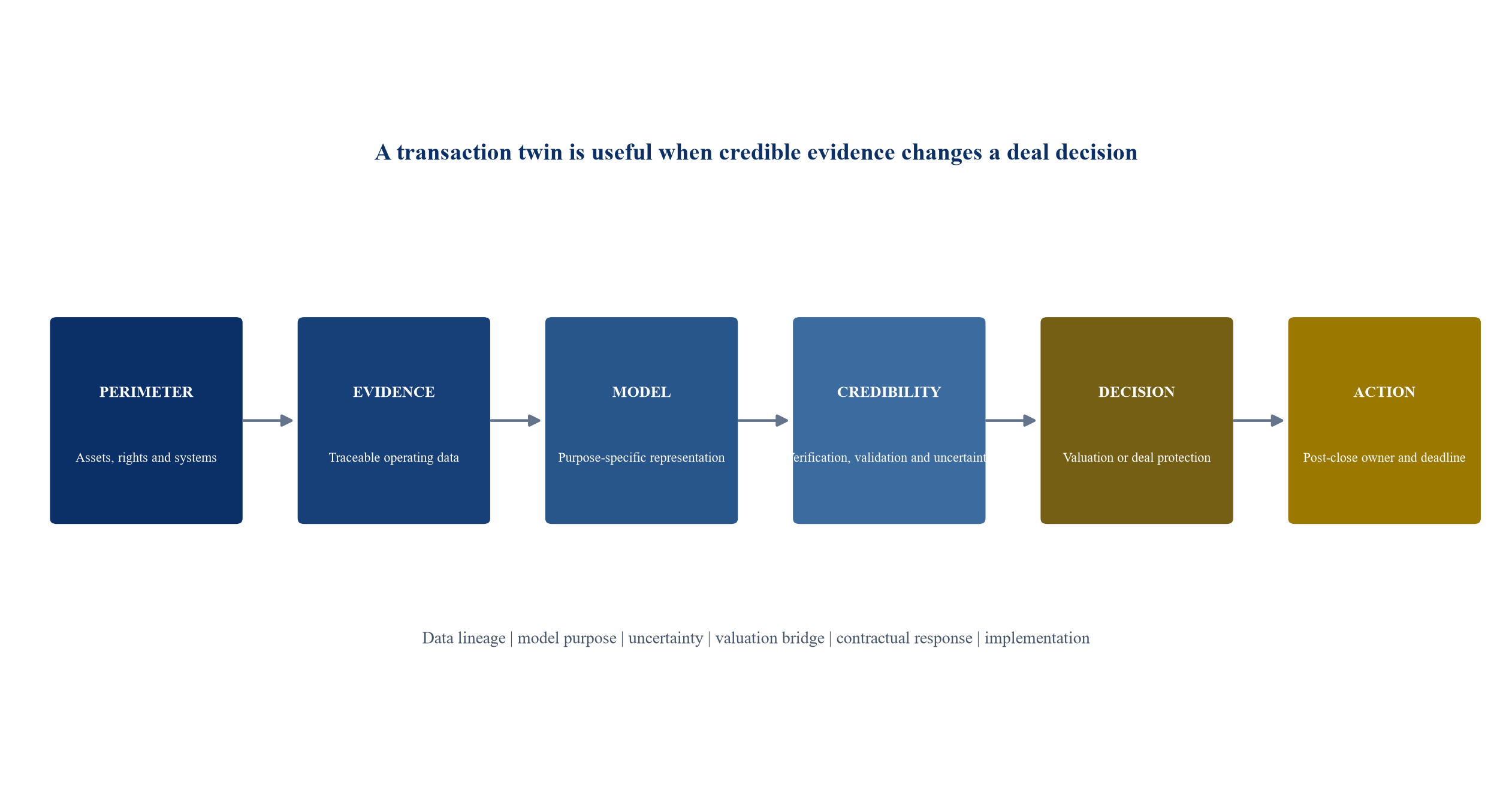
The figure is an author-developed framework. Every transition requires documented ownership, evidence and acceptance criteria.
The chain begins with the perimeter because a technically accurate model can still be irrelevant if it covers assets or systems outside the acquisition. Evidence then supports a purpose-specific representation. Credibility assessment tests whether the representation is implemented correctly, corresponds to observed behaviour and communicates uncertainty. The buyer converts credible outputs into a decision and gives every accepted action an owner and deadline.
Weakness at one stage limits the strength of every later stage. Missing outage records cannot be repaired by a more sophisticated optimisation algorithm. A calibrated model cannot establish transferable data rights. A sound engineering forecast cannot protect value unless the financial model and transaction documents reflect it. Diligence reporting should therefore show the complete chain rather than presenting isolated analytics.
6 Test data lineage before model sophistication
Data lineage explains where a value originated, how it changed and which version entered the model. Energy assets often combine supervisory-control data, revenue meters, weather stations, laboratory systems, maintenance records, operator logs and external forecasts. Clocks can differ, units can change and calculated tags can be confused with measured values. A one-hour shift can distort correlations between production, weather and market prices.
The buyer should test a sample from raw observation to investment-committee output. The sample should include normal operation, an outage, a maintenance event, a sensor failure and an override. Reperformance should produce the same result using documented logic. Manual adjustments should have an owner, reason and approval record.
Lineage tests should also identify silent exclusions. A performance report may omit commissioning months, curtailment periods, force-majeure events or underperforming units. Exclusions can be appropriate, but the investment case must state them and test whether they recur under ownership.
7 Separate verification, validation and uncertainty
NIST's credibility work distinguishes three related disciplines. Verification asks whether the model and software were implemented as intended. Validation asks whether the model represents the real system adequately for its stated purpose. Uncertainty quantification describes the range and sensitivity of results arising from data, parameters and model form. A transaction team should preserve these distinctions because each weakness leads to a different response.
Verification evidence can include code review, unit tests, equation checks, version control, reconciliation to known calculations and reproducible build records. Validation can compare forecasts with held-out operating periods, alternative engineering methods, site tests or independent models. Uncertainty analysis can vary degradation, failure rates, repair time, resource, price, cost and correlation assumptions.
Credibility is purpose-specific. A model that is adequate for daily dispatch may be unsuitable for a twenty-year useful-life forecast. A model calibrated to a new asset may not represent ageing equipment. Diligence should state the intended decision, required accuracy and period of validity rather than awarding the twin a general credibility label.
8 Reconstruct availability consistently
Availability is frequently material to revenue and financing, yet its definition can vary. Calendar availability, technical availability, contractual availability and energy-based availability answer different questions. Planned outages, grid unavailability, curtailment, resource insufficiency, force majeure and derating may be included or excluded differently across contracts and reports.
The buyer should reconstruct availability from event-level evidence and reconcile the result to management reporting, contractual calculations and financial statements. NERC's Generating Availability Data System illustrates the importance of consistent reliability, availability and maintainability definitions for generation analysis. The acquisition model should use a definition that matches the economic mechanism of the asset.
The test should consider duration, frequency and clustering. Two assets can report the same annual availability while one experiences predictable planned outages and the other suffers repeated forced outages during high-price periods. The second profile may carry greater cash-flow and covenant risk even when the headline percentage is identical.
9 Diagnose forced outages and repair duration
Forced-outage analysis should move beyond counts. The buyer should classify events by system, component, cause, operating condition, duration, lost output, repair method, recurrence and warranty status. It should distinguish permanent correction from temporary reset or workaround. Repeated short events can indicate a persistent control or component problem that annual summaries obscure.
Repair duration depends on diagnosis, access, skills, spares, vendor response and logistics. A reliability model that assumes historical repair time may fail after closing if the seller's group support, inventory pool or framework agreements do not transfer. The perimeter analysis should therefore connect outage history to the resources that resolved it.
The diligence conclusion should identify both expected loss and tail exposure. Rare failures of high-value equipment can produce long lead times and concentrated cash-flow effects. Scenario analysis should state whether insurance, warranties, liquidated damages, reserves or redundant capacity absorb any part of the loss.
10 Test degradation by technology and operating regime
Degradation is not one universal rate. Solar modules, wind-turbine components, batteries, thermal equipment, cables and transformers age through different mechanisms. Operating temperature, cycling, loading, environment, maintenance, design and component replacement affect the observed path. Portfolio averages can be informative benchmarks, but acquisition conclusions require asset-specific evidence.
For solar assets, NREL's degradation work demonstrates the need for methods that separate weather and operating effects from long-term performance change. For batteries, usable capacity, round-trip efficiency, power capability and safety limits can evolve differently. For thermal assets, heat rate, starts, ramping and component condition may matter. Wind analysis can consider power curves, availability, component events and wake or resource effects.
The buyer should fit more than one plausible degradation form where evidence permits. It should test stable, accelerating and intervention-dependent paths, then connect each path to output, operating cost, warranty recovery and replacement capex. A single decimal rate in a model can conceal substantial model-form uncertainty.
11 Reconcile maintenance history with physical condition
Maintenance records describe action; they do not prove restored condition. Work orders should be reconciled to failure events, inspection findings, parts usage, contractor invoices, warranty claims and subsequent performance. A high closure rate can coexist with repeated defects when work orders record symptoms rather than root cause.
Preventive-maintenance compliance should be tested by criticality and evidence quality. The buyer should identify overdue tasks, waived work, temporary repairs, cannibalised components, backlog age and jobs awaiting outages. It should also assess whether the seller's maintenance strategy matches the acquired operating plan. A buyer planning higher utilisation may require more frequent inspection and replacement.
Site visits remain important. Operators and technicians can explain alarm conventions, undocumented overrides, difficult access, vendor behaviour and the difference between nominal and practical operating limits. Interview evidence should be corroborated and documented; it can guide sampling without replacing records.
12 Distinguish sustaining, catch-up and growth capex
Capex classification affects both valuation and post-close planning. Sustaining capex preserves the current operating capability. Catch-up capex addresses deferred work or conditions already present. Growth capex expands output or changes the operating envelope. Regulatory, cyber and obsolescence expenditure may overlap these categories and should be assigned consistently.
The transaction twin can connect component condition, failure probability, remaining life, outage windows and replacement cost. The result should be a range and schedule rather than a single unqualified figure. Unit-cost assumptions need currency, location, escalation, logistics, owner costs, contingency and downtime treatment.
Buyers should examine whether recent performance was supported by unsustainably low maintenance or unusually high component replacement. Historical cash flow can overstate steady-state value when expenditure was deferred. It can also understate future performance when a completed overhaul has reset condition. The evidence should determine the adjustment.
13 Build a capex and reliability heatmap
Table 2. Diligence heatmap linking evidence weakness to transaction action
| Issue | Evidence test | Potential cash-flow effect | Indicative response |
|---|---|---|---|
| Incomplete outage history | Reconcile historian, alarms, work orders and operator logs | Availability downside and repair-cost uncertainty | Downside case, data warranty and reserve |
| Accelerating degradation | Compare normalised performance by cohort and condition | Lower output, earlier replacement and reduced terminal value | Price adjustment, earn-out or specific indemnity |
| Deferred major maintenance | Inspect backlog, parts, inspections and outage plan | Near-term catch-up capex and downtime | Completion condition, escrow or capex adjustment |
| Non-transferable model or licence | Review contracts, rights, code and export tests | Loss of optimisation, monitoring or reporting capability | Consent, licence, transition service and replacement budget |
| Unsupported useful life | Compare condition evidence, failure modes and renewal plan | Terminal-value and depreciation risk | Shorter life case and independent engineering review |
| OT control weakness | Test inventory, access, segmentation, logging and recovery | Incident loss, outage and remediation capex | Remediation covenant, holdback and Day 1 control plan |
| Shared specialist dependence | Map people, vendors and support arrangements | Longer repair time and execution risk | Retention, service agreement, spares and knowledge transfer |
Ratings and responses are illustrative. Actual treatment requires asset-specific technical, legal, tax, accounting and financial advice.
The heatmap should combine probability, consequence, evidence strength and response. A high-consequence issue with weak evidence should receive attention even when its estimated probability is low. The response can be analytical, contractual or operational. Some risks require all three.
Colour alone is insufficient. Each rating should link to the underlying evidence, the person responsible for closure and the financial-model line affected. Open issues should remain visible through signing, closing and the first hundred days.
14 Convert engineering evidence into a valuation bridge
The valuation bridge should separate changes in volume, availability, efficiency, price capture, operating cost, sustaining capex, catch-up capex, replacement timing, tax and terminal value. This prevents one physical issue from being counted in several lines. A forced-outage assumption can reduce revenue and increase repair cost; the model should explain both effects and avoid adding a separate generic risk haircut for the same evidence without justification.
IFRS 13 frames fair value using market-participant assumptions under current market conditions. Transaction valuation may use additional buyer-specific cases, yet the team should identify which assumptions represent market participants and which represent the buyer's strategy. IFRS 3 also requires acquisition-date measurement of identifiable assets and liabilities in a business combination, subject to its requirements and exceptions. Technical diligence should provide traceable support to the relevant finance and accounting workstreams.
The bridge should preserve ranges. A model can show the expected case, a credible downside and a tail scenario, with the evidence and probability logic stated. The investment committee can then decide whether the response belongs in price, structure, financing, insurance or post-close control.
15 Demonstrate the mechanics with a hypothetical case
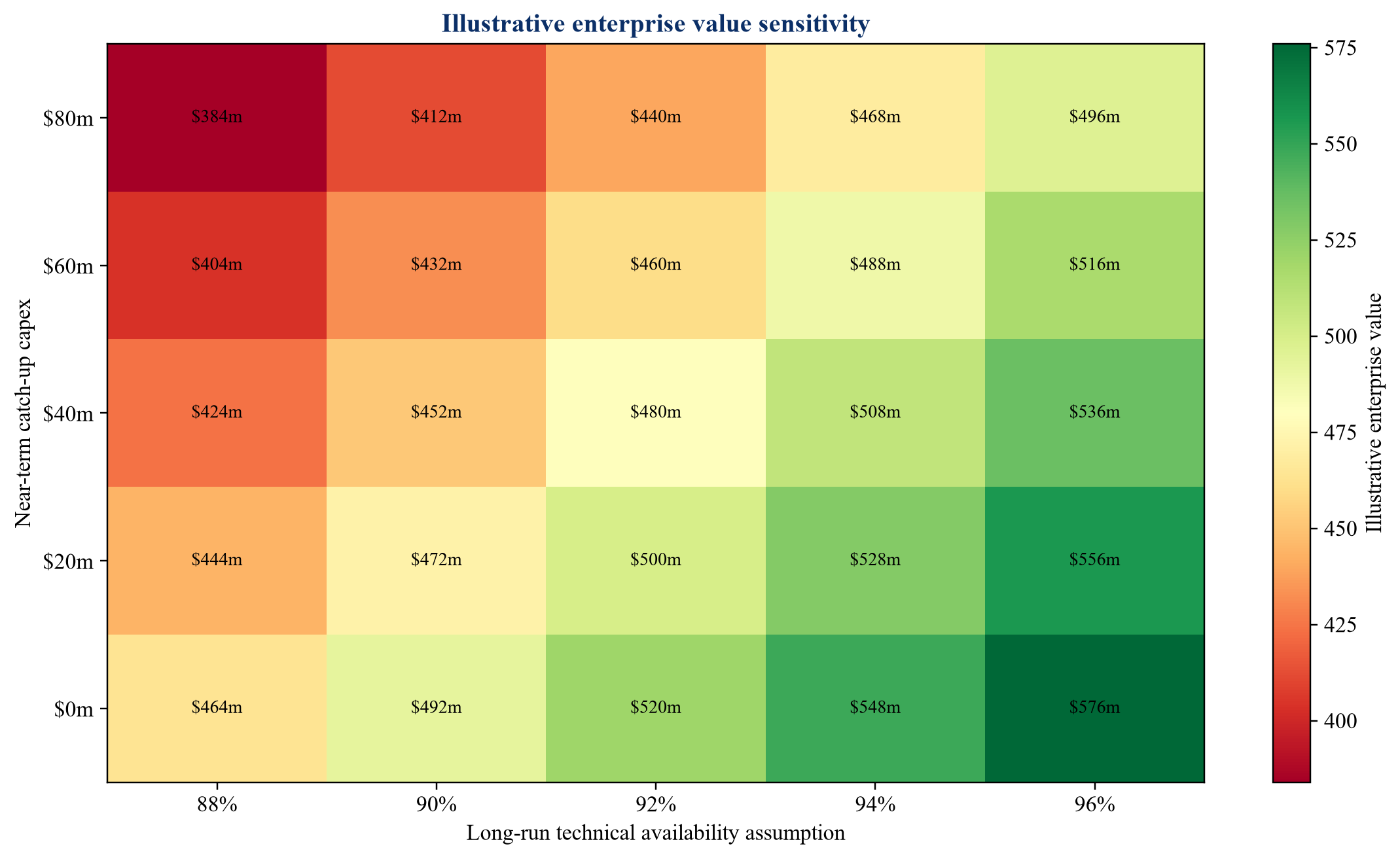
All values are hypothetical author-developed assumptions for analytical illustration. They are not a valuation, forecast or market evidence.
Assume a buyer begins with an illustrative enterprise value of USD 520 million at 92 per cent long-run technical availability and no unmodelled catch-up capex. In the author-developed sensitivity, each percentage point of availability changes value by USD 14 million, and each dollar of near-term catch-up capex reduces value dollar for dollar. These relationships are deliberately simplified. Actual effects depend on prices, contract terms, costs, tax, timing, financing and the physical relationship between maintenance and output.
The figure shows why diligence must connect variables. Lower availability and higher catch-up capex can arise from the same condition; the model should avoid double counting. Some capex restores availability and therefore creates an offsetting benefit. Some expenditure is required merely to preserve the base case. The transaction twin should represent these causal relationships and expose them to review.
16 Use uncertainty without hiding behind ranges
Uncertainty should lead to decisions, not a wider spreadsheet with no governance. The team should identify data uncertainty, parameter uncertainty, model-form uncertainty and scenario uncertainty. It should show which uncertainties can be reduced before signing, which can be allocated contractually, and which must be accepted and managed after closing.
Sensitivity analysis varies one or more assumptions. Scenario analysis combines internally consistent states. Probabilistic analysis can describe distributions when evidence supports them. Each method has limits. A precise distribution built from weak history can imply more knowledge than exists. A broad downside without causal logic can become an arbitrary negotiation position.
The investment committee should see the variables that dominate value, the range supported by evidence, the break-even threshold and the proposed control. The team should also show where variables are correlated. Heat, cycling and price conditions can affect output, degradation and maintenance simultaneously.
17 Test useful life and terminal value
Terminal value can represent a large share of an energy-asset valuation. The buyer should avoid assuming that contractual life, accounting life, technical life and economic life are identical. Grid rights, land rights, permits, market rules, obsolescence, repowering potential and decommissioning obligations can limit value even when equipment remains operable.
The transaction twin can support component-level renewal planning and system-level performance tests. It should identify which components are replaced within the forecast, which survive into the terminal period, and how replacement affects efficiency and capability. Decommissioning estimates should align with the acquired obligations and current cost assumptions.
A credible terminal case requires an operating concept. The paper value of a plant at year twenty has limited meaning if the model does not explain the equipment, contracts, market access and capital required to operate then. Buyers should run shorter-life and repowering cases where evidence warrants them.
18 Connect findings to transaction documents
Technical diligence has limited protective value when findings remain in a report. The transaction team should convert material issues into defined terms, disclosure requirements, representations, warranties, covenants, indemnities, conditions, price mechanisms or contingent consideration. Legal drafting must follow governing law and the negotiated allocation of risk.
Evidence definitions matter. A seller warranty about data completeness should state systems, periods, fields and permitted exclusions. A capex completion condition should identify scope, standard, evidence and acceptance. An earn-out linked to availability should define measurement, exclusions, maintenance obligations, dispatch, force majeure, audit rights and control during the measurement period.
The twin itself may form part of the transferred asset or completion deliverable. The agreement can require current exports, model files, parameters, documentation, licences, access credentials, test results and an agreed acceptance procedure. Sensitive operational credentials should be transferred through controlled channels rather than embedded in general data-room archives.
19 Design representations and warranties around evidence
Broad statements can be difficult to test. Diligence should support specific representations concerning asset registers, material outages, maintenance backlog, known defects, data integrity, model ownership, licence compliance, cyber incidents and changes to control logic. The appropriate scope and knowledge qualification require legal advice.
Disclosure should preserve context. A large data dump may not communicate a material exception. Buyers should request schedules that identify unresolved reliability issues, unsupported assumptions, temporary repairs, missing records and non-transferable technology. The digital evidence register can support these schedules.
Warranty insurance does not replace diligence. Insurers may exclude known conditions, forward-looking performance and cyber or operational matters. The transaction team should understand which risks remain with the buyer and how the evidence affects underwriting.
20 Protect continuity through transition and separation
Carve-outs and platform acquisitions often depend on shared control rooms, networks, cloud tenants, vendor contracts, data lakes and engineering teams. The buyer should define the minimum Day 1 capability and test whether transition services cover it. Service descriptions should include performance, security, data access, incident management, change control, exit assistance and termination rights.
Separation can change model performance. New interfaces, tag mappings, data latency or missing contextual fields can invalidate prior calibration. The buyer should plan parallel runs and reconciliation before relying on the separated system for material decisions. The transition budget should include replacement licences, integration, validation and staff.
The exit from transition services needs measurable readiness. A calendar date alone can force migration before controls are ready. Acceptance criteria can include asset coverage, data completeness, model reproduction, user access, security testing, backup, recovery and a successful operating cycle.
21 Secure operational technology and data rights
Energy twins depend on operational technology, which can affect safety and continuity. CISA's performance goals and OT guidance emphasise asset inventory, controlled access, monitoring, segmentation and recovery. Diligence should identify devices, software, remote connections, privileged accounts, unsupported components, logging, backups and incident history. The buyer should separate read-only analytical access from control authority.
Cyber findings can affect valuation through remediation cost, downtime risk, insurance, regulatory exposure and transition complexity. The transaction response should be proportionate to evidence and consequence. Critical weaknesses may require pre-close remediation or compensating controls. Lower-priority issues can enter a funded post-close plan.
Data rights should cover use, modification, export, retention and model training where relevant. Vendor contracts can restrict transfer, benchmarking or derivative models. Personal data, export controls and critical-infrastructure rules can constrain cross-border access. Legal and cyber teams should review the intended architecture rather than relying on a general technology inventory.
22 Govern artificial intelligence inside the twin
Some twins use machine learning for anomaly detection, remaining-life estimates, forecasting or optimisation. Buyers should identify where statistical models affect material outputs, how training data were selected, how performance is monitored and when humans intervene. A model may perform well on common operating states and poorly on rare events that drive transaction downside.
Validation should be segmented by asset cohort, season, operating regime and consequence. Error metrics should connect to decisions. A small average error can coexist with material misses during high-price hours or abnormal operation. Overrides and rejected recommendations provide valuable evidence about model limitations.
Model change control should continue after closing. Data distributions, equipment and operating policies evolve. The owner should define monitoring, review thresholds, approval, rollback and fallback. Material decisions should not depend on a model whose version, parameters or inputs cannot be reconstructed.
23 Build the post-close roadmap before signing
The first hundred days should convert open diligence findings into controlled work. Priority actions can include preserving evidence, securing accounts, validating asset and data inventories, confirming critical spares, closing urgent maintenance, refreshing the model, reconciling capex, and establishing board reporting. Each action should have an owner, deadline, budget and acceptance evidence.
Integration should distinguish systems that must be standardised from capabilities that should remain local. Immediate platform migration can destroy historical context or interrupt operations. The buyer can preserve source systems while building controlled interfaces and a staged target architecture.
Value-creation initiatives should use verified baselines. Benefits from optimisation, predictive maintenance or reduced outages should be measured after controlling for resource, price, dispatch and asset changes. Early management estimates should remain separate from realised outcomes.
24 Create an investment-committee evidence pack
Table 3. Investment-committee evidence pack for a transaction twin
| Decision area | Minimum evidence | Committee question | Output |
|---|---|---|---|
| Perimeter | Reconciled asset, system, contract and rights map | What exactly transfers and remains usable at closing? | Perimeter exceptions and costed actions |
| Operating history | Reperformed availability, outages, degradation and maintenance | Does history support the forecast base case? | Evidence-backed operating range |
| Model credibility | Purpose, lineage, verification, validation and uncertainty | Which outputs are decision-useful and for how long? | Reliance statement and limitations |
| Capital plan | Condition, backlog, replacement schedule and unit costs | What spend preserves or improves performance? | Sustaining, catch-up and growth capex cases |
| Valuation | Traceable bridge with sensitivities and no double counting | How do physical findings change price and returns? | Base, downside and tail cases |
| Deal protection | Drafted responses linked to evidence | Which risks are priced, allocated or conditioned? | Negotiation schedule |
| Day 1 and 100 days | Owners, controls, resources and acceptance criteria | Can the buyer operate safely and preserve value? | Funded implementation plan |
The table is an author-developed checklist and should be adapted to the asset, transaction and committee mandate.
The pack should explain disagreement. Engineering, operations, finance and legal teams may interpret the same evidence differently. The committee benefits from seeing the issue, evidence, assumptions, range and recommended response rather than a blended conclusion that conceals uncertainty.
The pack should also record negative findings. Confirmed absence of a backlog, supported transfer of a licence or successful reproduction of a model can reduce uncertainty. Evidence of control can justify retaining value rather than applying a blanket discount.
25 Set explicit stop and escalation conditions
A buyer should stop relying on the twin when material data lineage breaks, model versions cannot be reproduced, validation falls outside the intended use, critical sensors are unreliable, cyber integrity is uncertain or the transferred system differs materially from the diligence environment. The fallback can be independent engineering analysis, conservative assumptions, manual monitoring or a narrower operating scope.
Transaction escalation conditions should be defined before final negotiation. Examples include a material undisclosed outage, failure to deliver agreed history, loss of a critical licence, inability to transfer control-system support, or evidence that capex was deferred beyond the agreed baseline. The response can be additional diligence, price adjustment, specific protection, delayed closing or withdrawal, subject to the agreement and advice.
Model uncertainty should never suspend physical safety rules or statutory duties. Operators and qualified engineers retain responsibility for the asset under applicable law, standards and procedures.
26 Measure evidence maturity
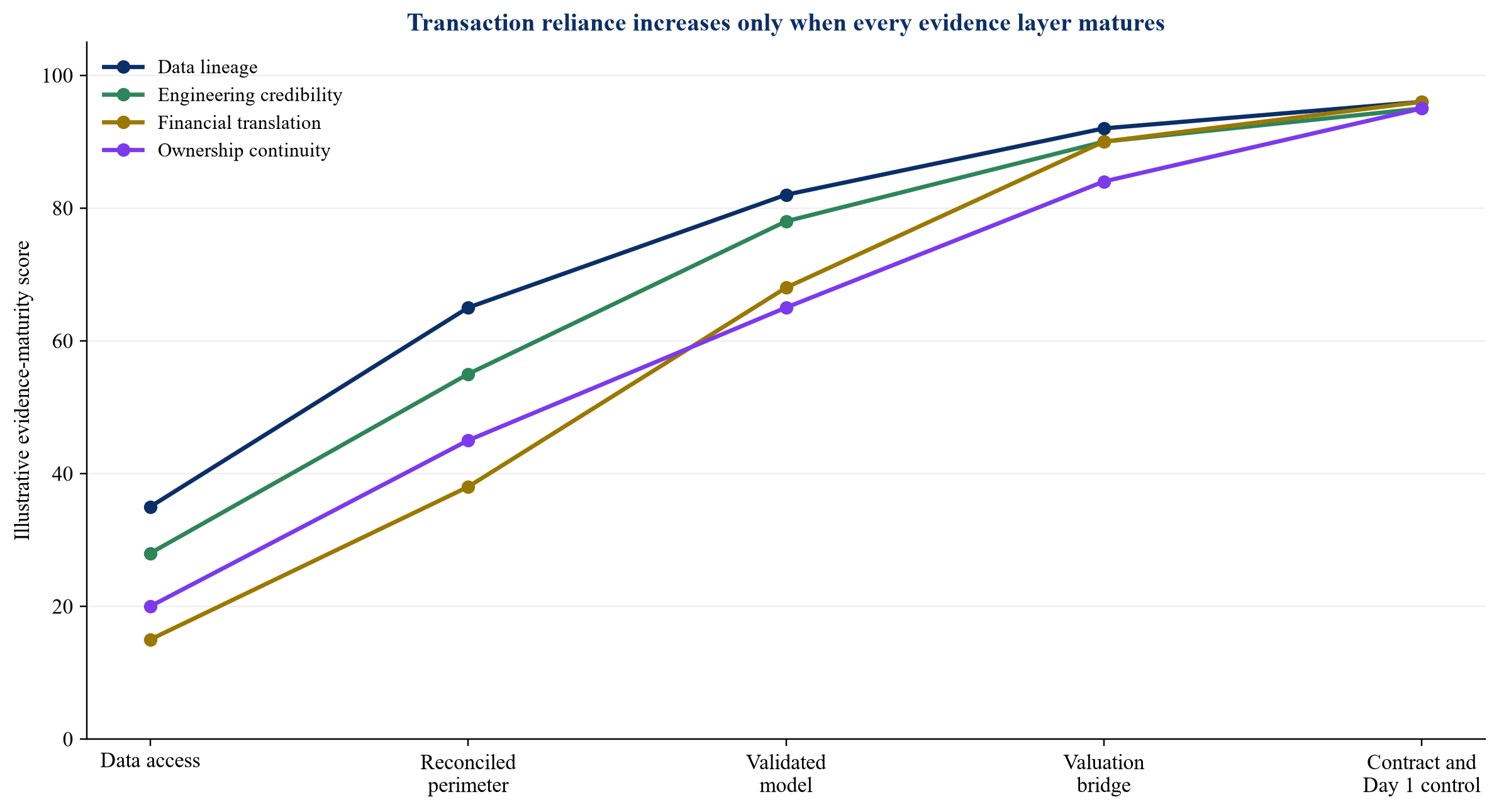
Scores are hypothetical author-developed values on a 0 to 100 scale. They illustrate required evidence maturity and are not performance claims.
Evidence maturity is constrained by the weakest necessary layer. Strong data lineage with no valuation translation produces technical knowledge without a deal response. A sound valuation bridge with no continuity plan can disappear at closing. A complete contractual schedule based on an unvalidated model can allocate a poorly understood risk.
The maturity assessment should be repeated at key gates. Early diligence may accept partial evidence to identify priorities. Signing requires sufficient support for price and protections. Closing requires transfer and continuity evidence. Post-close governance requires current validation and realised-outcome measurement.
27 Recognise limitations
A digital twin cannot reveal information that was never measured or retained. It cannot by itself establish hidden physical condition, future resource, market prices, regulatory decisions or human behaviour. It can reproduce historical bias and measurement error. Model outputs can be sensitive to assumptions that appear minor in documentation.
Transaction access may be limited by competition rules, confidentiality, cybersecurity and operating safety. Clean teams, controlled environments and staged access can help, but they can also restrict the buyer's ability to reproduce analysis before signing. Reports should state these constraints and the consequences for reliance.
This framework does not replace engineering, legal, tax, accounting, environmental, cyber, insurance or investment advice. It provides a structure for connecting those disciplines. Asset-specific conclusions require qualified professionals, current evidence and the governing transaction documents.
Conclusion
Digital twins can improve energy M&A diligence when they organise evidence around a defined transaction decision. The useful object is a traceable chain from perimeter and operating data to a credible model, quantified uncertainty, valuation adjustment, contractual response and post-close action. Sophisticated simulation cannot compensate for missing history, ambiguous rights or weak validation.
Buyers should reconstruct availability, outages, degradation, maintenance and capex using consistent definitions and event-level evidence. They should test useful life and terminal value, distinguish sustaining from catch-up expenditure, and preserve ranges where uncertainty remains. Engineering findings should enter the financial model without double counting and should be converted into negotiated protections or funded implementation actions.
The transaction twin should remain a governed capability after closing. Its value depends on transferable data and licences, secure operational technology, skilled people, model change control and a tested fallback. When these elements are present, the twin can turn fragmented operational records into decision-quality evidence. When they are absent, the buyer should reduce reliance and price, allocate or manage the uncertainty explicitly.
References
- National Institute of Standards and Technology, Digital Twins, 2026. https://www.nist.gov/digital-twins
- National Institute of Standards and Technology, Digital Twins for Advanced Manufacturing, updated 2026. https://www.nist.gov/programs-projects/digital-twins-advanced-manufacturing
- Shao, G., Hightower, J. and Schindel, W., Credibility Consideration for Digital Twins in Manufacturing, NIST, 2022. https://www.nist.gov/publications/credibility-consideration-digital-twins-manufacturing
- National Institute of Standards and Technology, Framework for Cyber-Physical Systems: Volume 1 Overview, 2017. https://nvlpubs.nist.gov/nistpubs/SpecialPublications/NIST.SP.1500-201.pdf
- National Institute of Standards and Technology, Cybersecurity Framework 2.0, 2024. https://www.nist.gov/cyberframework
- National Institute of Standards and Technology, Artificial Intelligence Risk Management Framework 1.0, 2023. https://nvlpubs.nist.gov/nistpubs/ai/NIST.AI.100-1.pdf
- United States Department of Energy, Cognitive Digital Twin for the Development of Secure and Resilient Smart Grid, 2024. https://www.energy.gov/
- United States Department of Energy, Office of Cybersecurity, Energy Security, and Emergency Response, Cybersecurity Baselines for Electric Distribution Systems and Distributed Energy Resources, 2024. https://www.energy.gov/ceser/
- National Renewable Energy Laboratory, Best Practices for Operation and Maintenance of Photovoltaic and Energy Storage Systems, 2019. https://www.nrel.gov/docs/fy19osti/73822.pdf
- National Renewable Energy Laboratory, New Solar PV Tool Accurately Calculates Degradation Rates, 2018. https://www.nrel.gov/manufacturing/news/press/2018/new-solar-pv-tool-accurately-calculates-degradation-rates-saving-money-and-guiding-business-decisions
- National Renewable Energy Laboratory, Operation and Maintenance of PV Systems, 2024. https://www.nrel.gov/docs/fy24osti/85819.pdf
- National Renewable Energy Laboratory, Battery Lifespan, research overview. https://www.nrel.gov/transportation/battery-lifespan.html
- North American Electric Reliability Corporation, Generating Availability Data System Data Reporting Instructions, effective 2026. https://www.nerc.com/programs/reliability-assessment--performance-analysis/generating-availability-data-system/gads-conventional/data-reporting-instructions--templates
- North American Electric Reliability Corporation, Element Availability Percentage and Unavailability Percentage, updated 2025. https://www.nerc.com/programs/reliability-assessment--performance-analysis/reliability-indicators/m-16-element-availability-percentage-apc--unavailability-percentage
- North American Electric Reliability Corporation, Technical Reference Document: Considerations for Performing an Energy Reliability Assessment, 2024. https://www.nerc.com/comm/RSTC_Reliability_Guidelines/Technical%20Reference%20Document%20Considerations%20for%20Performing%20an%20ERA%20V2.pdf
- International Energy Agency, Electricity Grids and Secure Energy Transitions, 2023. https://www.iea.org/reports/electricity-grids-and-secure-energy-transitions
- International Energy Agency, Modernising Grids in the Age of Electricity, 2026. https://www.iea.org/reports/modernising-grids-in-the-age-of-electricity
- International Energy Agency, Renewables 2025, 2025. https://www.iea.org/reports/renewables-2025
- International Renewable Energy Agency, Renewable Power Generation Costs in 2024, 2025. https://www.irena.org/Publications
- International Renewable Energy Agency, Electricity Storage Valuation Framework, 2020. https://www.irena.org/publications/2020/mar/electricity-storage-valuation-framework-2020
- International Finance Corporation, Utility-Scale Solar Photovoltaic Power Plants: A Project Developer's Guide, 2015. https://www.ifc.org/en/insights-reports/2015/utility-scale-solar-photovoltaic-power-plants
- World Bank Group, Environmental, Health, and Safety Guidelines for Electric Power Transmission and Distribution, 2007. https://www.ifc.org/en/insights-reports/2000/general-environmental-health-and-safety-guidelines
- Cybersecurity and Infrastructure Security Agency, Cross-Sector Cybersecurity Performance Goals. https://www.cisa.gov/cybersecurity-performance-goals
- Cybersecurity and Infrastructure Security Agency, Principles of Operational Technology Cybersecurity, 2024. https://www.cisa.gov/news-events/alerts/2024/10/01/asds-acsc-cisa-fbi-nsa-and-international-partners-release-guidance-principles-ot-cybersecurity
- Cybersecurity and Infrastructure Security Agency, Foundations for OT Cybersecurity: Asset Inventory Guidance for Owners and Operators, 2025. https://www.cisa.gov/sites/default/files/2025-08/joint-guide-foundations-for-OT-cybersecurity-asset-inventory-guidance_508c.pdf
- IFRS Foundation, IFRS 3 Business Combinations. https://www.ifrs.org/issued-standards/list-of-standards/ifrs-3-business-combinations/
- IFRS Foundation, IFRS 13 Fair Value Measurement. https://www.ifrs.org/issued-standards/list-of-standards/ifrs-13-fair-value-measurement/
- IFRS Foundation, IAS 36 Impairment of Assets. https://www.ifrs.org/issued-standards/list-of-standards/ias-36-impairment-of-assets/
- International Organization for Standardization, ISO 55000 Asset management. https://www.iso.org/standard/83053.html
- International Organization for Standardization, ISO 31000 Risk management. https://www.iso.org/iso-31000-risk-management.html
- International Organization for Standardization, ISO 23247 Digital twin framework for manufacturing. https://www.iso.org/standard/75066.html
- International Electrotechnical Commission, IEC 62443 Industrial communication networks: Network and system security. https://www.iec.ch/
- Federal Energy Regulatory Commission, Reliability Primer. https://www.ferc.gov/reliability-primer
- European Union Agency for Cybersecurity, Cybersecurity for smart infrastructures. https://www.enisa.europa.eu/topics/critical-information-infrastructures-and-services
- Global Infrastructure Hub, Infrastructure Risk Allocation and Contract Management. https://www.gihub.org/resources/publications/infrastructure-risk-allocation-contract-management-report/
- World Bank, Guidance on PPP Contractual Provisions. https://ppp.worldbank.org/public-private-partnership/library/guidance-ppp-contractual-provisions
- Basel Committee on Banking Supervision, Principles for Operational Resilience, 2021. https://www.bis.org/bcbs/publ/d516.htm
- Organisation for Economic Co-operation and Development, Guidelines for Multinational Enterprises on Responsible Business Conduct, 2023. https://www.oecd.org/corporate/mne/
About the Author
Chennakeshav (CK) is a corporate finance and investment banking executive with 25+ years of global experience in deal origination, structuring and execution across M&A, growth capital and corporate strategy. He has led value-creation mandates for founders, corporates and funds — bridging the boardroom view to hands-on execution and close.
His career spans Morgan Stanley, HSBC, Lloyds Banking Group, EWEC, ADQ portfolio companies and Emirates Growth Fund, across TMT, real estate, fintech, deeptech, cleantech, infrastructure and energy. He has partnered with C-suite leaders, private equity and venture funds, sovereign wealth funds and family offices to finance complex fund raises and scale-up ventures, and has led M&A due diligence, post-merger integration and business-transformation initiatives to create value.
At Matchpoint Partners he is Managing Partner, leading the firm's corporate finance, M&A and capital-raising practice. He holds an MBA from London Business School, an engineering degree from VTU and a Master of Laws (LLM, in progress) from UCL London.
An active start-up mentor, CK mentors at Techstars, DIFC FinTech Hive, Startup Grind, Founder Institute and IN5, serves as Entrepreneur Mentor in Residence (EMiR) at London Business School, and judges the Entrepreneurship World Cup.
