

Introduction
When a family office allocates to private markets, it must decide not only what to invest in but how to access it: directly, by buying assets and companies itself, or indirectly, by committing to funds managed by others. This direct-versus-fund choice runs through every private markets allocation, in real estate, in private equity, in private credit, in infrastructure, and how a family office resolves it shapes the cost it pays, the control it holds, the diversification it achieves, the capabilities it must build, and the returns it earns.
The choice is often framed as a simple trade-off, funds are easy but expensive, direct is cheap but hard, but it is richer than that. Direct investing offers lower fees, greater control and the potential for higher returns, but it demands substantial capability and concentrates risk; fund investing offers diversification, professional management and access, but at the cost of fees and a loss of control. The right balance between them depends on the family office specific capability, its scale, its objectives and the asset class, and it is not a one-time decision but an evolving balance that shifts as the family office develops.
This paper develops a framework for the direct-versus-fund decision across real estate and private markets. The central argument is that the choice should be driven by the family office capability and its typical ticket size, that co-investment is the pivotal middle path that lets a family office build toward direct investing while managing its risks, and that most family offices are best served by a hybrid model combining funds, co-investment and selective direct investing. The framework helps a family office find the balance that suits its capability and objectives, rather than defaulting to either extreme.
The Control Dimension
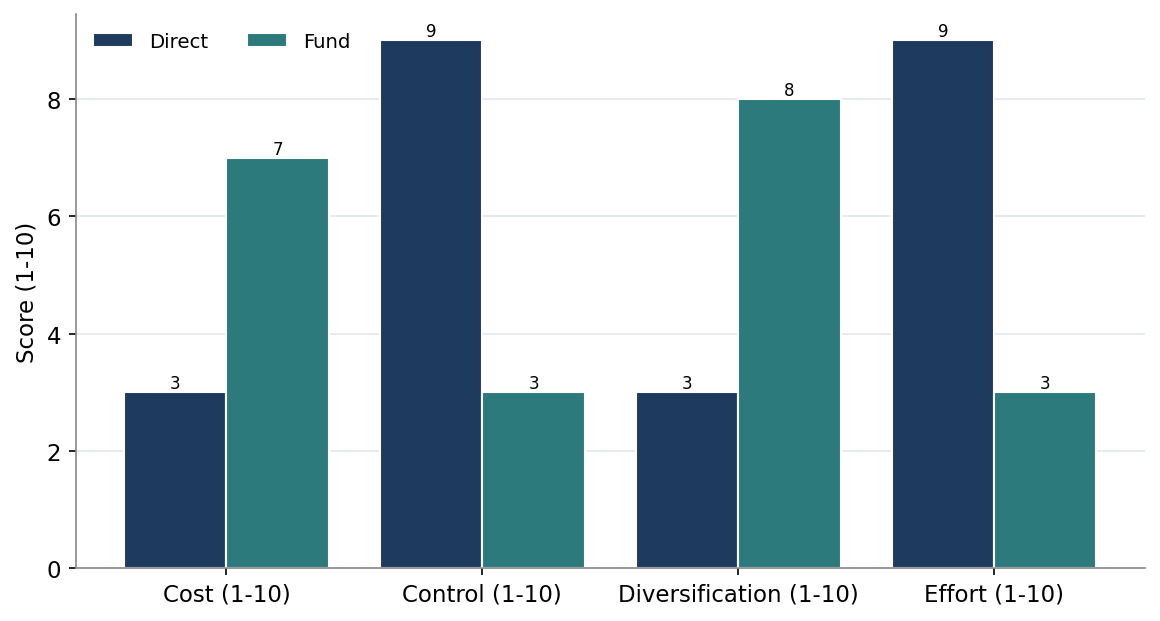
The control dimension is the second advantage of direct investing: it gives the family office full control over the asset and the decisions. A direct investor decides what to buy, how to structure it, how to manage it, when to exit, and on what terms, holding the asset to its own timetable and strategy. A fund investor cedes these decisions to the manager, committing capital to the manager strategy and timetable, and holding only the limited rights its fund agreement provides. For a family office that values control, the difference is significant.
The value of control varies with the family office and the asset. A family office with a clear strategy, a long horizon, and confidence in its own judgement values the control to execute its strategy on its own terms, and may chafe at the constraints of a fund. A family office without a clear strategy or the confidence to exercise control may value the manager judgement and timetable more than its own control. And some assets, particularly those requiring active management or a long, patient hold, reward the control of direct ownership, while others, requiring specialised management the family office lacks, are better left to a manager.
Control also carries responsibility, which is the other side of the dimension. The direct investor that controls the asset also bears the full responsibility for managing it, making the decisions, and living with the consequences, while the fund investor delegates both the control and the responsibility to the manager. A family office that values control must also be willing and able to bear the responsibility it entails, and one that lacks the capability or the appetite to bear the responsibility may be better served by delegating both to a fund, even at the cost of the control.
The control dimension therefore favours direct investing for a family office with a clear strategy, confidence in its judgement, and the willingness to bear the responsibility, particularly for assets that reward active control, and favours funds for a family office that values delegation or lacks the capability to exercise control well. As with the cost dimension, the value of control is conditional on the family office capability and circumstances, and it must be weighed against the diversification that direct investing sacrifices.
The Decision Framework
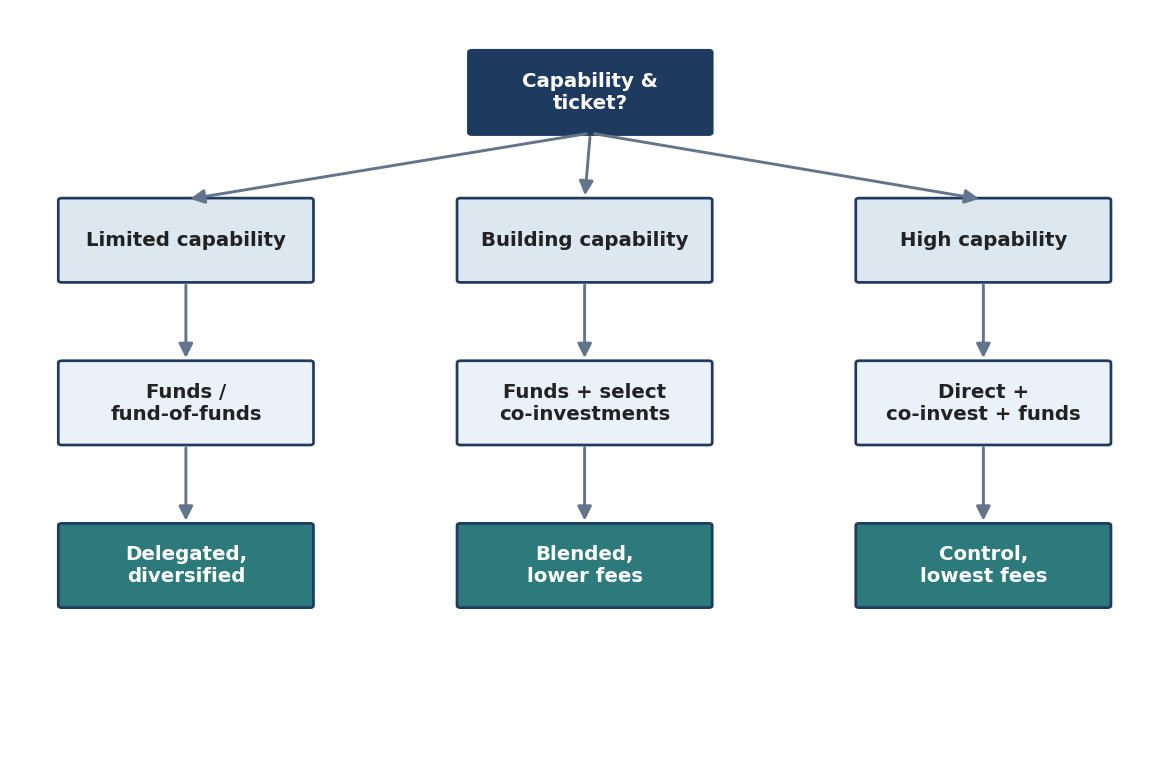
The decision framework matches the access approach to the family office capability and its typical ticket size, illustrated in the decision tree of Figure 5 and the suitability matrix of Figure 6. A family office with limited capability should access private markets through funds and funds-of-funds, relying on managers for the sourcing, underwriting and stewardship it cannot perform itself. A family office building its capability should combine funds with selective co-investment, beginning to invest alongside managers. A family office with high capability can invest directly, alongside co-investment and funds, in areas of genuine capability and advantage.
Figure 5. Access Approach by Capability and Ticket Size
The ticket size interacts with the capability, as Figure 6 shows. A large ticket combined with high capability favours direct investing, because the family office can invest at the scale that justifies the capability cost and diversifies the direct portfolio. A small ticket or limited capability favours funds, because the family office cannot invest directly at the scale or with the skill that direct investing requires. The matrix maps the family office position on these two dimensions to the appropriate access approach, providing a structured answer to the direct-versus-fund question.
Figure 6. Suitability for Direct Investing by Capability and Ticket
The framework produces not a single answer but a balance, a mix of funds, co-investment and direct investing matched to the family office capability and ticket across its allocations. A family office may invest directly in real estate where it has heritage and capability, co-invest in private equity where it is building capability, and use funds in venture where it lacks capability, holding a different balance in each asset class according to its capability there. The framework therefore produces a tailored, asset-class-specific balance rather than a uniform approach, which is the practical answer the framework intends.
The framework is also dynamic, shifting as the family office builds capability. A family office that begins with funds can shift toward co-investment and then direct investing as it builds capability, moving along the spectrum over time, and the framework should be reapplied periodically to reflect the family office growing capability. The balance is therefore not fixed but evolves, and a family office building its capability should expect to shift toward direct investing over time, capturing more of the fee saving and control as its capability matures.
The Access Spectrum
Between the extremes of wholly direct and wholly fund investing lies a spectrum of access structures, each offering a different balance of cost, control, diversification and capability. Understanding the spectrum allows a family office to find the point that suits each allocation, rather than choosing only between the extremes. Table 1 sets out the principal access structures along the spectrum.
Table 1. The Access Spectrum from Fund to Direct
The spectrum from delegated, diversified fund investing to controlled, concentrated direct investing.
At the fund end of the spectrum, funds-of-funds offer the most diversification and the least capability requirement, at the highest cost, suiting a family office wanting fully delegated, diversified access. Commingled funds offer diversification and professional management at a high cost and low capability requirement, the standard fund route. Club deals, in which several investors co-invest in a single asset, offer moderate control and diversification at a moderate cost, suiting investors wanting more control than a fund but less capability requirement than wholly direct.
At the direct end, co-investment offers low cost and moderate-to-high control, relying on the manager sourcing but capturing the fee saving, suiting a family office building toward direct investing. Direct investment offers the lowest cost and highest control at the highest capability requirement and lowest diversification, suiting a family office with full capability and scale. The spectrum allows a family office to position each allocation at the point that suits its capability, its objectives and the asset class, building a tailored access strategy across the spectrum rather than choosing only the extremes.
Building Direct Capability
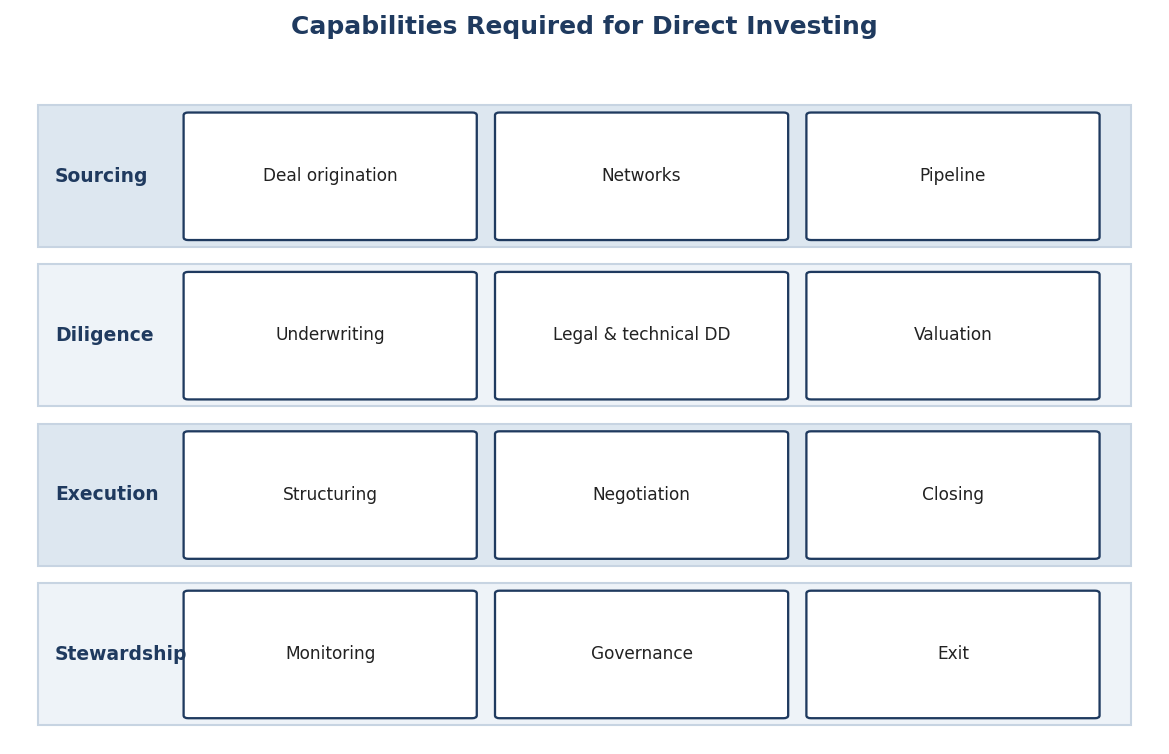
A family office that wishes to shift its balance toward direct investing must build the capability to do it well, and the build is a deliberate, progressive process. It begins with the people: hiring or developing the investment professionals who can source, underwrite, structure and steward direct investments, with experience in the relevant asset classes. The team is the foundation of the capability, and a family office cannot invest directly well without the people to do it, so building the team is the first step in building the capability.
The build continues with the processes and systems: the underwriting framework, the diligence procedures, the decision governance, and the monitoring systems that allow the family office to assess, execute and steward direct investments consistently and well. These processes embody the discipline that good direct investing requires, and they allow the family office to invest directly in a repeatable, controlled way rather than ad hoc. Building the processes alongside the team turns individual judgement into an institutional capability that can be applied consistently across investments.
The build also requires the relationships and the access: the networks that source opportunities, the relationships with managers that provide co-investment, and the standing in the market that brings the family office quality deals. Direct investing depends on access to good opportunities, and building the relationships that provide that access is part of building the capability. A family office that co-invests alongside managers builds these relationships and the access they provide, which is part of why co-investment is the path to building direct capability.
The progressive path, from fund investing through co-investment to direct investing, is the way most family offices build the capability, learning and building at each step. A family office that follows this path builds the team, the processes, and the relationships progressively, graduating to wholly direct investing as the capability matures, rather than attempting wholly direct investing before the capability exists. The progressive build is the prudent path, and it allows the family office to shift its balance toward direct investing over time as its capability grows, capturing more of the fee saving and control as it does.
Risk: Concentration and Selection
Direct investing carries risks that fund investing mitigates, and the family office must manage them. The principal risk is concentration: direct investing concentrates the family office capital in the few assets it holds directly, bearing the full idiosyncratic risk of each, where a fund would have diversified. A family office investing directly must manage this concentration, by building a diversified direct portfolio across enough assets, sectors and geographies to reduce the idiosyncratic risk, which requires the scale and capability to make many direct investments.
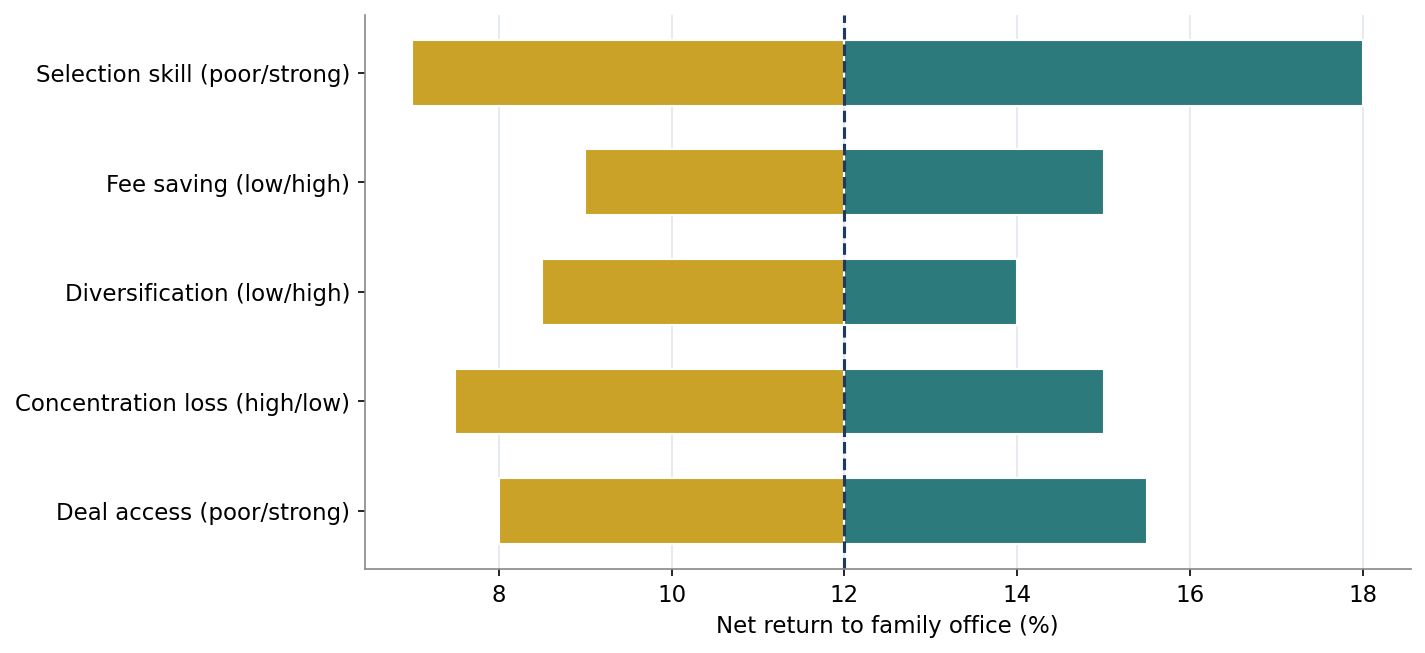
The second risk is selection: because direct investing concentrates capital in the selected assets, a poor selection concentrates capital in poor assets, and the family office bears the consequence directly. The selection risk is the reason selection capability is the threshold for direct investing, and a family office investing directly must have the selection skill to choose well, because its returns will reflect its selection. The selection risk is managed by building genuine selection capability and by diversifying across selections, so that a single poor selection does not dominate the portfolio.
These risks interact: a family office that invests directly with weak selection and insufficient diversification bears the worst of both, concentrating its capital in poorly-selected assets, while one that invests directly with strong selection and adequate diversification manages both, holding a diversified portfolio of well-selected assets. The risks therefore reinforce the framework prescription: invest directly only with genuine selection capability and at sufficient scale to diversify, and use funds where these conditions are not met, because the concentration and selection risks of direct investing are severe for a family office that lacks the capability or scale to manage them.
The risks also argue for the progressive, co-investment-led path to direct investing, because co-investment manages both risks during the build. Co-investment relies partly on the manager selection, mitigating the family office selection risk while it builds its own, and a programme of many co-investments provides diversification, mitigating the concentration risk. The family office building toward direct investing through co-investment therefore manages the concentration and selection risks during the build, graduating to wholly direct investing only when its selection capability and scale can manage the risks itself. The risk management reinforces the co-investment path.
Case Studies
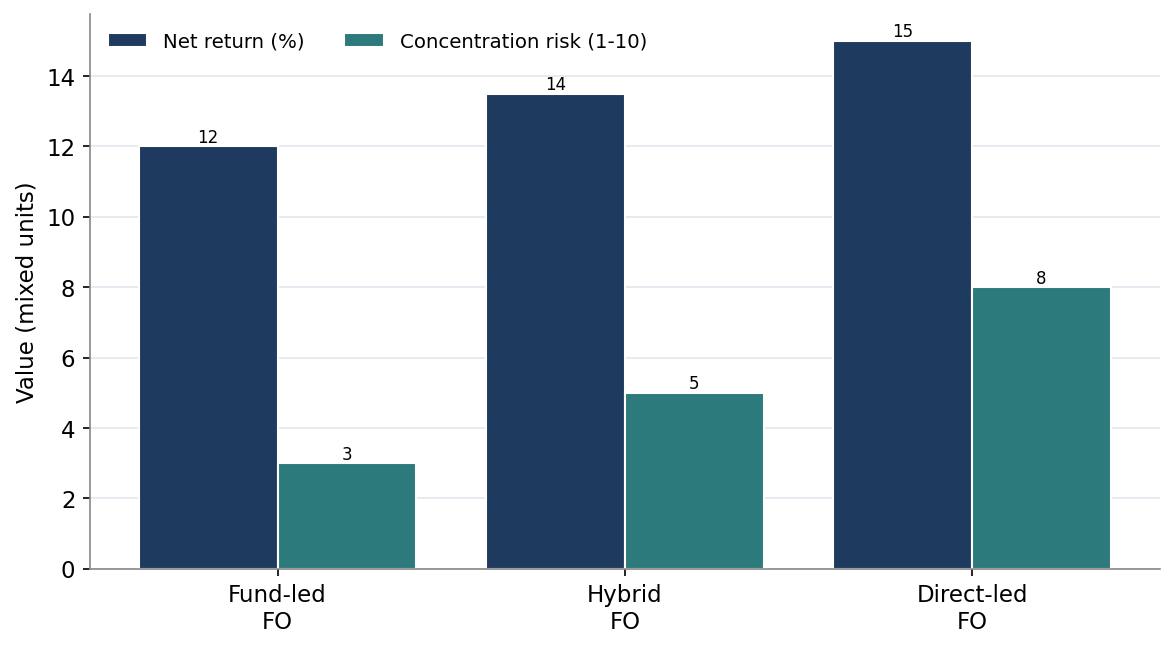
Three family-office cases illustrate the framework applied to different capability levels. The figures are modelled for analytical clarity and are not drawn from any specific family office.
Case A: the fund-led family office
Case A is a family office early in its private markets programme, with limited direct capability, that accesses private markets primarily through funds and funds-of-funds. It relies on managers for sourcing, underwriting and stewardship, achieving diversified exposure with low capability requirement, at the cost of fund fees and limited control. The approach suits its limited capability, providing diversified, professionally-managed exposure while it builds capability, and it lays the foundation for shifting toward co-investment and direct investing as its capability grows. The case illustrates the appropriate approach for limited capability: fund-led, diversified, delegated.
Case B: the hybrid family office
Case B is a family office building its capability, that combines fund investing with a selective co-investment programme. It commits to funds for diversified exposure and the manager capability, and co-invests selectively alongside the managers, capturing fee savings, building its direct capability, and gaining direct exposure. The hybrid approach suits its developing capability, capturing more of the return than funds alone while building toward direct investing, and managing the risks through the managers sourcing and the diversification across co-investments. The case illustrates the hybrid approach for developing capability: funds plus selective co-investment.
Case C: the direct-led family office
Case C is a family office with high capability, particularly in real estate where it has operating heritage, that invests directly in its areas of capability, co-invests in areas of developing capability, and uses funds for diversification and areas of lesser capability. It captures the fee saving and control of direct investing where its capability is genuine, builds toward direct investing in other areas through co-investment, and uses funds where its capability is lacking. The approach suits its high capability, capturing the benefits of direct investing where it has the capability and advantage. The case illustrates the direct-led approach for high capability: direct where capability is genuine, co-investment and funds elsewhere.
Figure 7. Net Return and Concentration Risk by Approach
| Structure | Cost | Control | Diversification | Capability needed |
|---|---|---|---|---|
| Fund-of-funds | Highest | Lowest | Highest | Lowest |
| Commingled fund | High | Low | High | Low |
| Club deal | Moderate | Moderate | Moderate | Moderate |
| Co-investment | Low | Moderate-high | Variable | Moderate-high |
| Direct investment | Lowest | Highest | Lowest | Highest |
Common Errors and How to Avoid Them
A recognisable set of errors recurs in the direct-versus-fund decision.
Direct without capability. Investing directly without adequate selection capability concentrates capital in poorly-selected assets and destroys value. The remedy is to invest directly only where selection capability is genuine.
Concentrated direct investing. Investing directly at insufficient scale to diversify bears concentration risk that funds would have avoided. The remedy is to diversify the direct portfolio or use funds for diversification.
Premature direct leap. Leaping straight to wholly direct investing without building capability progressively skips the co-investment bridge and the capability build. The remedy is the progressive, co-investment-led path.
Defaulting to funds. Defaulting to funds everywhere, even in areas of genuine capability, forgoes the fee saving and control direct investing would provide. The remedy is to invest directly where capability is genuine.
Uncritical co-investment. Assuming co-investment opportunities are always attractive ignores the managers motivation to share less attractive deals. The remedy is to exercise own selection on co-investments.
Each of these errors is avoidable through the disciplined approach the framework encourages: invest directly only with genuine capability and adequate scale, build capability progressively through co-investment, invest directly where capability is genuine and through funds where it is not, and exercise own selection throughout. The family office that does so finds the balance that suits its capability, while the one that does not invests directly without capability, concentrates risk, leaps prematurely, defaults to funds, or co-invests uncritically.
Implementation Roadmap
Assess the family office capability by asset class, identifying where it has genuine selection and management capability and where it does not.
Map each allocation to the appropriate access approach using the capability-and-ticket framework: funds where capability is limited, co-investment where it is building, direct where it is strong.
Use funds for diversified, delegated exposure in areas of lesser capability and for diversification beyond the direct portfolio.
Build a selective co-investment programme alongside fund commitments, to capture fee savings, build capability, and gain direct exposure.
Invest directly in areas of genuine capability and advantage, particularly real estate and sectors of operating heritage, with adequate diversification and governance.
Build direct capability progressively, the team, processes, relationships and governance, shifting the balance toward direct investing as capability matures.
Review the balance periodically as capability grows, and exercise own selection on all direct and co-investment opportunities.
Conclusion
The direct-versus-fund decision shapes the cost, control, diversification, capability and returns of a family office private markets allocation, and it should be driven by the family office capability and its typical ticket size rather than by a blanket preference for either approach. This paper has developed a framework for the decision, analysing the four dimensions on which the approaches differ, mapping the access approach to capability and ticket, examining the full access spectrum, and identifying co-investment as the pivotal middle path that lets a family office build toward direct investing while managing its risks.
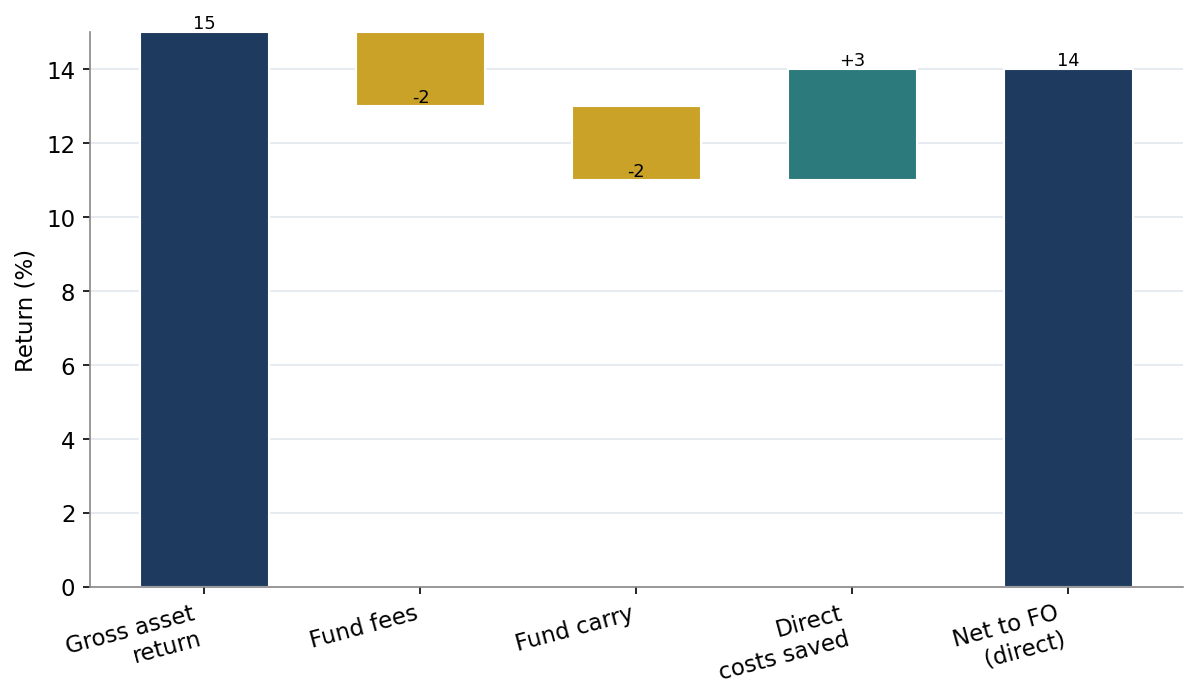
The central conclusions are that direct investing enhances the net return and the control but concentrates risk and demands capability, that selection skill is the binding determinant of whether direct investing pays, that co-investment is the bridge from fund to direct investing, and that most family offices are best served by a hybrid model combining funds, co-investment and selective direct investing in a balance matched to their capability and evolving as it grows. For GCC family offices, with their operating and real estate heritage, the framework suggests direct investing in areas of heritage capability, particularly real estate, with funds and co-investment elsewhere. The family office that builds its capability and finds the balance that suits it will access private markets more effectively than one that defaults to either extreme, and the frameworks in this paper are intended to help it find that balance.
Limitations and Directions for Further Research
This paper is framework-oriented and relies on modelled figures, and its conclusions are directional rather than precise. The cost, return and risk figures are calibrated to observable conditions but are not empirical estimates, and they vary across family offices, asset classes and markets. The capability of family offices, central to the framework, is difficult to assess objectively and varies widely.
Several extensions would strengthen the analysis. An empirical study of the returns achieved by family offices through direct versus fund investing, by capability level, would test the framework central claims. An analysis of the dispersion in direct investing outcomes by family office capability would quantify the selection effect. And a study of how family office direct investing has performed through a downturn, when concentration risk bites, would illuminate the risks the framework identifies. Each is a natural subject for a later paper in this series.
| Scenario | Selection skill | Approach | Net return |
|---|---|---|---|
| Strong direct | Strong | Direct-led | ~15% |
| Hybrid | Developing | Hybrid | ~13.5% |
| Fund-led | Limited | Fund-led | ~12% |
| Poor direct | Weak | Direct-led | ~8% or loss |
