

1. A distressed sale is also a decision-record problem
A board facing financial distress may have only days to compare a refinancing, continued trading, an accelerated sale and a formal insolvency route. The eventual outcome will be visible with hindsight. The information available when the decision was made will be much harder to reconstruct unless the board creates a contemporaneous, source-linked record. That record should show what the directors knew, which alternatives they considered, whose interests were relevant, what advice they received, how conflicts were handled and why the chosen route was rational on the evidence then available.
The central transaction decision is whether to accept a lower but executable offer, continue a process for a higher conditional bid, or activate another route before liquidity removes the choice. Headline price is only one input. Timing, certainty, cash burn, funding, separation costs, employee and customer continuity, creditor outcomes, regulatory conditions and execution risk can change the value actually preserved.
This paper develops a director decision dossier for that problem. It combines an authority map, thirteen-week cash forecast, alternatives register, bid and recovery bridge, stakeholder-impact analysis, conflicts register, adviser-reliance record, evidence ledger, challenge log, decision minutes, stop conditions and implementation roadmap. It uses current UK primary and official materials and UNCITRAL guidance as reference points. Applicable law and duties remain jurisdiction-, entity- and fact-specific.
2. Start with authority and applicable duties
The record should begin with the legal entity taking the decision, its directors, its constitutional authority and the relevant decision forum. A group-level strategy cannot replace an entity-level analysis where subsidiaries have different creditors, security, cash, contracts or solvency positions. The board should identify who may approve a sale, grant exclusivity, incur rescue finance, dispose of assets and commence a formal process.
UK company directors are subject to statutory duties including acting within powers, promoting the success of the company, exercising independent judgment, exercising reasonable care, skill and diligence, avoiding conflicts and declaring interests [1][2]. Section 172 expressly operates subject to rules requiring directors, in certain circumstances, to consider or act in creditors' interests [1]. The Supreme Court in BTI v Sequana confirmed that creditor interests become relevant as insolvency approaches, while the content and weight of those interests change with the company's circumstances [4].
The board should obtain transaction-specific legal and insolvency advice. Its dossier should state the advice date, factual assumptions, scope, recipients and open qualifications. Directors still make their own decision. Current Insolvency Service guidance emphasises independent judgment and reasonable care, skill and diligence [5].
Table 1. Proposed director decision dossier
| Dossier module | Decision question | Core evidence | Accountable owner |
|---|---|---|---|
| Authority and duties | Who decides, under which powers and for whose interests? | Constitution, delegations, advice and solvency analysis | Chair and counsel |
| Liquidity and solvency | How long does the company retain a real choice? | Thirteen-week cash flow, facilities, covenant and creditor data | CFO |
| Alternatives | Which executable routes were assessed? | Route papers, bids, funding terms and timetable | M&A lead |
| Value and recovery | What value reaches each stakeholder after costs and timing? | Valuation, waterfall, leakage and sensitivity analysis | Finance adviser |
| Process integrity | Was information, marketing, conflict and challenge controlled? | Data room, contact log, conflict register and minutes | Company secretary |
Qualified advisers should tailor the record to the company, transaction and jurisdiction.
3. Define the decision before assembling the documents
Many board packs accumulate information without defining the decision. A useful decision statement identifies the proposed action, entity, perimeter, counterparty, consideration, conditions, timing, funding, alternative and latest safe decision date. It also states which matters remain unresolved and what would cause the recommendation to change.
For example, the decision may be whether to accept a USD 103 million offer capable of signing within three days and closing in six weeks, instead of extending exclusivity to a USD 110 million bidder whose financing and regulatory work remain incomplete. The board would need to compare executable value rather than two nominal prices. The pack should identify the minimum evidence required before approval and the authority to adjust terms within approved limits.
A concise decision statement controls the rest of the dossier. Each appendix should answer a live question. Material that does not affect the decision can remain in the data room. This discipline reduces volume, exposes missing evidence and enables each director to understand what they are being asked to approve.
4. Fix the knowledge date and preserve the information set
The board's reasoning must be assessed against the information reasonably available at the time. The dossier therefore needs a defined knowledge date and a frozen index of the materials provided. Later information should be recorded as a new version rather than silently inserted into the old pack.
The evidence ledger should identify every material document by title, owner, source, date, version, verification status, confidentiality and decision relevance. It should distinguish observed data from forecasts, adviser analysis from management assertions, and binding commitments from indications. Cash balances, bid terms, financing letters, customer notices and creditor positions require current evidence.
The ledger also records information the board sought but could not obtain in time. A missing customer forecast or unsigned funding letter is itself decision evidence. The board can then decide whether to wait, apply a haircut, impose a condition or choose another route. Silence should never be converted into an assumption of availability.
5. Build a thirteen-week decision clock
Liquidity determines how long the board can continue to compare routes. The thirteen-week cash flow should be constructed by legal entity and consolidated only after intercompany restrictions are understood. It should reconcile opening cash to bank evidence, separate unrestricted from trapped cash, identify receipts and payments by week, reflect taxes and payroll, include adviser and transaction costs and show facility availability and covenant headroom.
The model should include downside cases for slower collections, supplier tightening, customer churn, retention payments and transaction delay. It should show the week in which the company loses the ability to choose a solvent or value-preserving route. That date may arrive before cash reaches zero because payroll, regulatory capital, critical supplier deposits or directors' duties impose an earlier constraint.
The decision clock links each transaction milestone to cash. Bid confirmation, proof of funds, diligence completion, signing, regulatory filing, consent, completion and contingency activation all need dates. A route that closes after the funded runway is not executable without committed bridge funding.
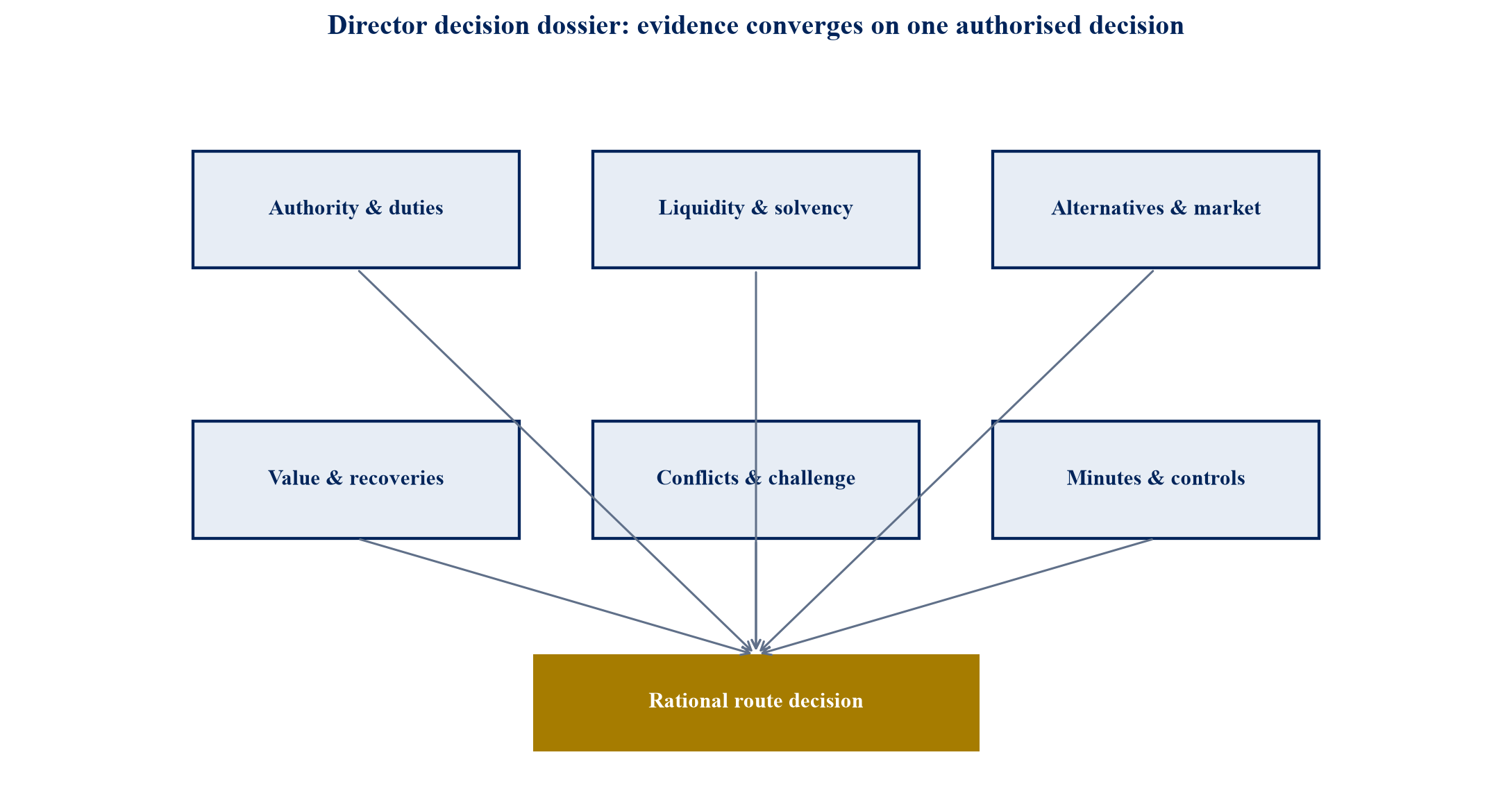
The architecture links authority, evidence, alternatives, value and implementation to one board decision.
6. Maintain a live solvency and creditor-interest assessment
The legal analysis should be refreshed as facts change. Cash-flow insolvency, balance-sheet position, contingent liabilities, facility availability, creditor enforcement and the probability of avoiding insolvency may move rapidly. Directors should receive current advice on how those facts affect their duties and the weight given to creditor interests.
Sequana rejected a simple rule triggered by a merely real risk of insolvency. The judgments explain that the creditor-interest duty arises when directors know or ought to know that the company is insolvent or bordering on insolvency, or that insolvent liquidation or administration is probable, with creditor interests becoming paramount where insolvent liquidation or administration is inevitable [4]. The precise formulation and application require legal advice.
Section 214 of the Insolvency Act addresses wrongful trading and the steps a director took with a view to minimising potential loss to creditors once the statutory conditions are met [3]. The dossier should therefore show the monitoring process, advice, alternatives and loss-minimisation actions. It should not use a single solvency label as a substitute for analysis.
7. Create an alternatives register before choosing a buyer
The board should compare all reasonably available routes: continued trading, new money, covenant waiver, amend-and-extend, rescue financing, equity injection, asset sale, share sale, partial disposal, accelerated sale, company voluntary arrangement, restructuring plan, moratorium, administration and orderly wind-down. Some will be unavailable. The record should explain why.
Each route needs a common set of fields: value, cash requirement, timing, conditions, authority, stakeholder outcome, operational impact, execution probability evidence, downside, stop condition and next action. The register should cite documents rather than use adjectives such as credible or advanced without support.
The aim is a rational comparison under time pressure. A refinancing that depends on an unmandated lender and unresolved security may deserve low readiness despite preserving equity in the upside case. An accelerated sale may produce lower headline value while protecting more enterprise value, jobs and creditor recovery because it completes within the runway.
8. Record how the market was tested
A rational sale record should explain the market-testing strategy. It should identify potential buyer groups, selection criteria, outreach dates, confidentiality arrangements, information access, management meetings, bid instructions, deadlines, responses, reasons for non-participation and any changes in process terms.
The process need not be identical in every distress situation. Public marketing can damage value where customers, employees or suppliers react adversely. A targeted process can preserve confidentiality but may create questions about market coverage. The board should record why the chosen breadth and duration were appropriate given liquidity, value leakage and buyer universe.
Connected parties require heightened attention. UK rules restrict certain substantial disposals by an administrator to a connected person within the first eight weeks of administration unless creditor approval is obtained or an independent evaluator's qualifying report is provided [8][9]. Even outside that mechanism, the board should document conflicts, independent valuation, competitive tension and the treatment of alternative bidders.
9. Make bid comparison reproducible
The bid table should reconcile each offer to one set of definitions. Headline enterprise value, assumed debt, cash retained, working-capital adjustment, excluded liabilities, pension exposure, transaction costs, separation costs, tax, deferred consideration, escrow, earn-out, financing condition and required funding should be shown separately.
Non-cash terms require explicit treatment. A nominally higher offer may shift liabilities back to the seller, require a costly carve-out or defer proceeds behind conditions the company cannot control. The finance team should calculate an estimated net value and identify which adjustments are contractual, modeled or unresolved.
The record should also preserve the original bid and negotiation history. A board needs to know whether a condition was introduced late, whether proof of funds changed and whether the seller traded price for certainty. Version-controlled comparison reduces the risk that management presents only the latest headline.
10. Convert timing into value leakage
Time in distress consumes more than cash. Employees leave, customers delay orders, suppliers shorten terms, insurers tighten cover and management attention moves from operations to the transaction. The value bridge should estimate these effects using stated assumptions and sensitivity ranges.
The model can express executable value as headline consideration less transaction adjustments, separation costs, expected operating leakage and funding costs. It should avoid false precision. Each major assumption needs a range, owner, source and refresh date. The board should see which variable changes the route ranking.
A faster bid can outperform a higher bid when weekly leakage and completion risk are substantial. That conclusion should emerge from transparent arithmetic rather than a narrative preference. The same model can identify the price or funding improvement needed for the slower bidder to become superior.
Table 2. Proposed alternatives and bid comparison register
| Dimension | Continued trade or refinance | Higher conditional sale | Lower executable sale | Formal process contingency |
|---|---|---|---|---|
| Funding through completion | Committed sources and draw conditions | Buyer or seller bridge requirement | Runway to stated close | Office-holder funding and costs |
| Value evidence | Forecast and financing terms | Bid bridge and diligence gaps | Bid bridge and proof of funds | Valuation and recovery estimate |
| Timing evidence | Credit approval and documentation path | Conditions and regulatory path | Signing and closing checklist | Appointment and sale mechanics |
| Principal downside | Funding fails after further leakage | Cash expires before closing | Value left on table | Disruption and reduced control |
| Stop condition | Approval or document deadline missed | Funding or diligence gate missed | Material adverse term change | Better executable rescue becomes available |
Values should be supported by current transaction evidence and qualified advice.
11. Analyse stakeholder impact by legal entity
The board should map secured creditors, preferential creditors, unsecured creditors, employees, pension trustees, customers, suppliers, landlords, regulators, shareholders and public-service users where relevant. For each route, it should show estimated recovery, timing, continuity, consent rights and material non-financial effects.
Stakeholder analysis should follow legal priority and applicable duties. It should not convert every interest into equal voting weight. The purpose is to identify who bears the consequence of delay, perimeter change or failure and whether the transaction transfers risk in a way the board has not considered.
Where the group contains multiple entities, a consolidated result can conceal value transfer. One subsidiary may contribute cash or assets while another receives consideration. Guarantees, security, intercompany balances and tax sharing can alter the outcome. Entity-level waterfalls and board decisions are essential.
12. Separate enterprise preservation from equity preservation
Distress can create tension between protecting the operating business and preserving shareholder value. A transaction may save jobs, contracts and productive assets while leaving little or no return to equity. The decision record should state which value is being preserved and whose economic interests are affected.
Directors should be alert to strategies that consume creditor value for a remote equity upside. The cash model and recovery waterfall can make that transfer visible. The board should obtain advice on the point at which creditor interests govern and document why further trading or transaction expenditure remains justified.
An offer should be compared with the realistic counterfactual, including the costs and recoveries of a formal process. A theoretical going-concern valuation that cannot be funded to completion is not the relevant alternative.
13. Build a source-linked recovery waterfall
The recovery analysis starts with gross proceeds and applies cash, debt, security, priority claims, insolvency costs, transaction expenses, employee claims, pension exposure, tax, leases, guarantees and contingent liabilities. Each amount should have a source or stated range.
The waterfall should show outcomes under each route and downside. It should distinguish estimated recoveries from legal entitlements and avoid presenting uncertain claims as settled. Qualified advisers should confirm priority, security validity and jurisdiction-specific treatment.
The board can then compare whether delay improves total value enough to compensate for cash burn and deterioration. It can also see whether a route benefits one class at the expense of another and whether consents or challenge risk affect distributable value.
14. Record conflicts before they shape the process
Directors, shareholders, lenders, managers and advisers may have different interests. A director may represent a shareholder, hold a guarantee, participate in a bidder, receive transaction-linked compensation or expect employment after completion. A lender may finance a bidder. Management may favour the route that preserves their roles.
The conflicts register should identify the interest, affected decision, disclosure date, legal analysis, mitigation, information restriction, recusal and independent decision maker. Companies Act duties to avoid conflicts and declare interests provide a statutory foundation for this discipline [1]. The board should also consider perceived conflicts that could undermine confidence in the process.
Independent committees, separate advice, restricted information and recorded abstentions can support integrity. The solution depends on the facts and governing documents. A conflict should be managed before the relevant person influences bidder access, valuation, negotiation or recommendation.
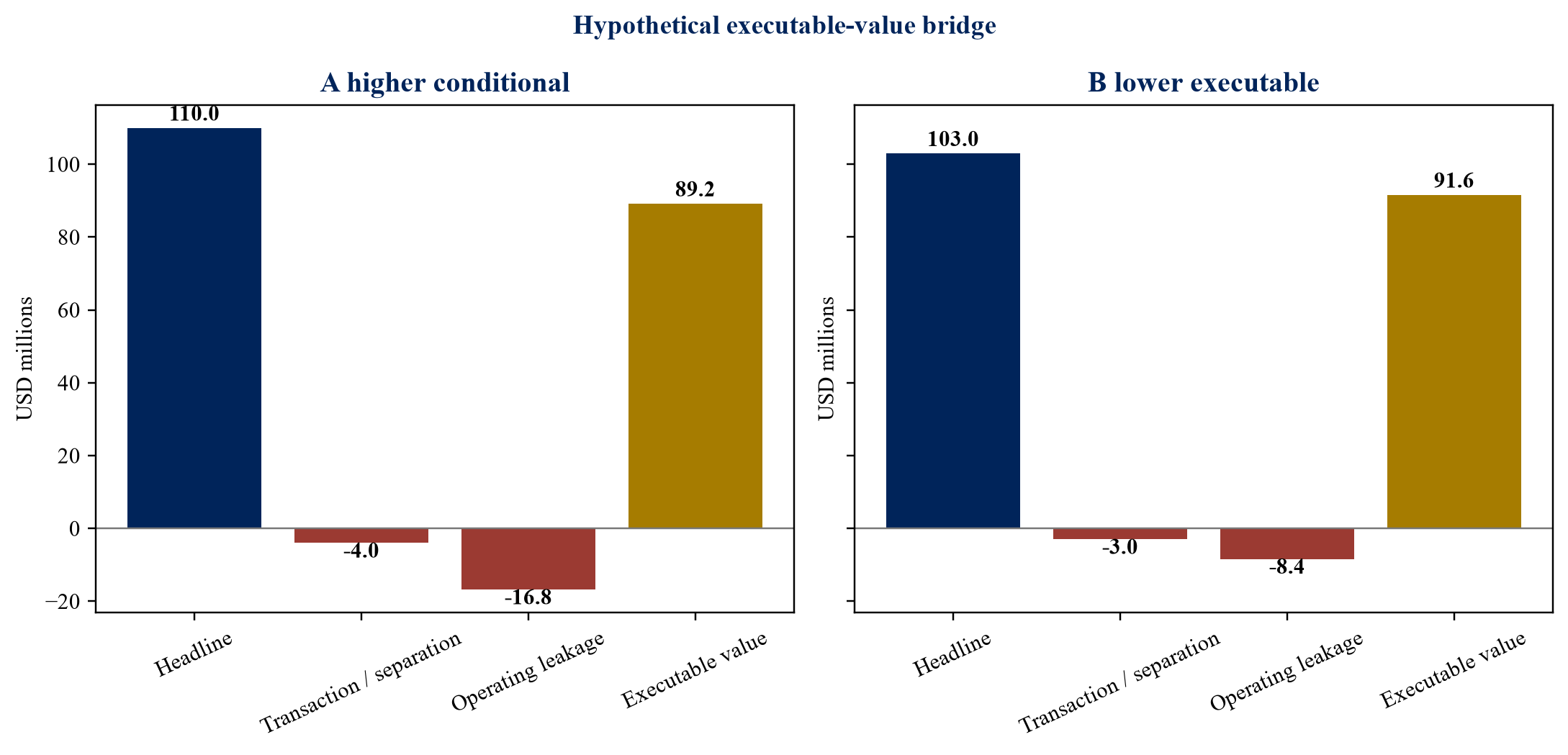
USD millions are author assumptions without empirical calibration and do not predict a transaction outcome.
15. Define the role and limits of advisers
Legal, restructuring, M&A, valuation, tax, pensions, employment, regulatory and operational advisers may contribute to the decision. The dossier should record each engagement scope, reliance limitations, factual assumptions, conflicts check, deliverables and open issues.
Advice should be directed to the correct legal entity and decision maker. A group adviser may not address subsidiary duties. A valuation may assume continued funding that the cash model does not support. A fairness conclusion may exclude legal, solvency or tax matters. The board should understand these boundaries.
UNCITRAL guidance notes that directors may be able to demonstrate reasonable and objective business decisions based on accurate financial information and appropriate professional advice, while duties and defences vary by jurisdiction [6]. Adviser involvement strengthens the evidence base only when the board tests assumptions and exercises its own judgment.
16. Use a challenge log to show independent judgment
Minutes that merely record approval reveal little about deliberation. A challenge log captures the questions asked, answer, supporting source, owner, due date and effect on the recommendation. It should include unresolved questions and dissent.
Core questions include: When does cash become critical? What evidence supports the buyer's funds? Which diligence items can reopen price? What happens if approval is delayed? How was the market tested? What is the creditor outcome under the next-best route? Which director has a conflict? Which assumption drives the valuation difference? When must the contingency start?
The log supports independent judgment and efficient follow-up. It should remain concise and decision-focused. Directors should receive answers with enough time to consider them before approval where circumstances permit.
17. Design minutes as a decision map
Board minutes should state attendance, authority, conflicts, materials reviewed, advisers present, management presentation, questions, alternatives, material assumptions, advice, stakeholder considerations, decision, reasons, conditions, delegations, dissent and next review date. They should identify the exact transaction documents or term sheets approved.
Minutes should avoid both extremes: a formulaic recital that could fit any transaction and a verbatim transcript that obscures the decision. The company secretary can use the dossier index to create a clear map from each reason to its evidence.
Timing matters. Drafts should be circulated promptly while memories are current. Corrections should be controlled and approved. Late reconstruction should be identified as such and supported by contemporaneous documents.
18. Treat dissent as useful governance evidence
A director may disagree with the recommendation, evidence quality or process. The board should record the substance of that dissent and any requested action. UNCITRAL's guide recognises that some legal systems provide procedural mechanisms for directors to record dissent, with details varying by law [6].
Dissent can improve the decision by exposing a hidden assumption or missing alternative. It can also identify where a director believes further advice is required. The chair should ensure the concern receives a response and is not suppressed for the appearance of unanimity.
Directors need jurisdiction-specific advice on the legal effect and required form of dissent. A recorded objection does not automatically discharge every duty.
19. The hypothetical case tests route rationality
Consider a company with USD 18 million of unrestricted cash and a weekly base burn of USD 1.4 million. It has three routes. Route A is a USD 110 million offer expected to close in week 12. Route B is a USD 103 million offer expected to close in week 6. Route C is continued trading while seeking rescue finance, requiring six weeks of work and USD 4 million of transaction or financing cost before any new capital.
The model assumes transaction and separation costs of USD 4 million for Route A and USD 3 million for Route B. Operating leakage to close is USD 16.8 million for Route A and USD 8.4 million for Route B. Modeled executable values are therefore USD 89.2 million and USD 91.6 million respectively. Route C has no assured proceeds and reduces cash through the assumed work period.
Every amount, timing, probability-free score and cash path is an author assumption without empirical calibration. The illustration does not predict value, completion, solvency, creditor recovery, funding or stakeholder behaviour. A live board must replace all inputs with verified evidence and advice.
20. The lower headline bid preserves more modeled value
Route A begins USD 7 million above Route B. Its six additional weeks consume USD 8.4 million more cash before allowing for incremental retention, customer loss or supplier tightening. After stated costs and leakage, Route B produces USD 2.4 million more modeled executable value.
This comparison does not prove that the lower bid should win. Route A could become superior if the bidder funds the extension, shortens the timetable, increases price or removes conditions. Route B could deteriorate if its proof of funds or closing plan fails. The board's record should show the break-even changes.
The model provides a negotiation tool. The slower bidder can see the cash support or price improvement needed to compensate for delay. The board can approve a limited period for that evidence while keeping Route B available.
Table 3. Hypothetical distressed-sale route model
| Route | Headline value | Modeled close | Transaction and separation cost | Operating leakage | Modeled executable value |
|---|---|---|---|---|---|
| A higher conditional bid | 110.0 | Week 12 | 4.0 | 16.8 | 89.2 |
| B lower executable bid | 103.0 | Week 6 | 3.0 | 8.4 | 91.6 |
| C continued trade and rescue finance | No assured proceeds | Decision in week 6 | 4.0 | 8.4 | Not comparable without committed funding |
USD millions and timings are author assumptions without empirical calibration.
21. Cash runway creates the decision deadline
At the stated burn, opening cash supports fewer than thirteen weeks before transaction costs and minimum operating cash. Route A reaches its expected closing date with little or no practical buffer. Route B closes while meaningful liquidity remains. Route C consumes six weeks while leaving financing uncertain.
The relevant deadline is earlier than cash exhaustion. If the company needs USD 4 million of minimum operating cash, the board loses unsupported flexibility during week 10. Route A therefore requires committed bridge funding or a faster closing plan. A buyer's statement that funding will be considered is not a committed source.
The decision record should show the weekly trigger at which Route B or a formal contingency must be activated. That trigger should move with actual receipts, payments and stakeholder behaviour.
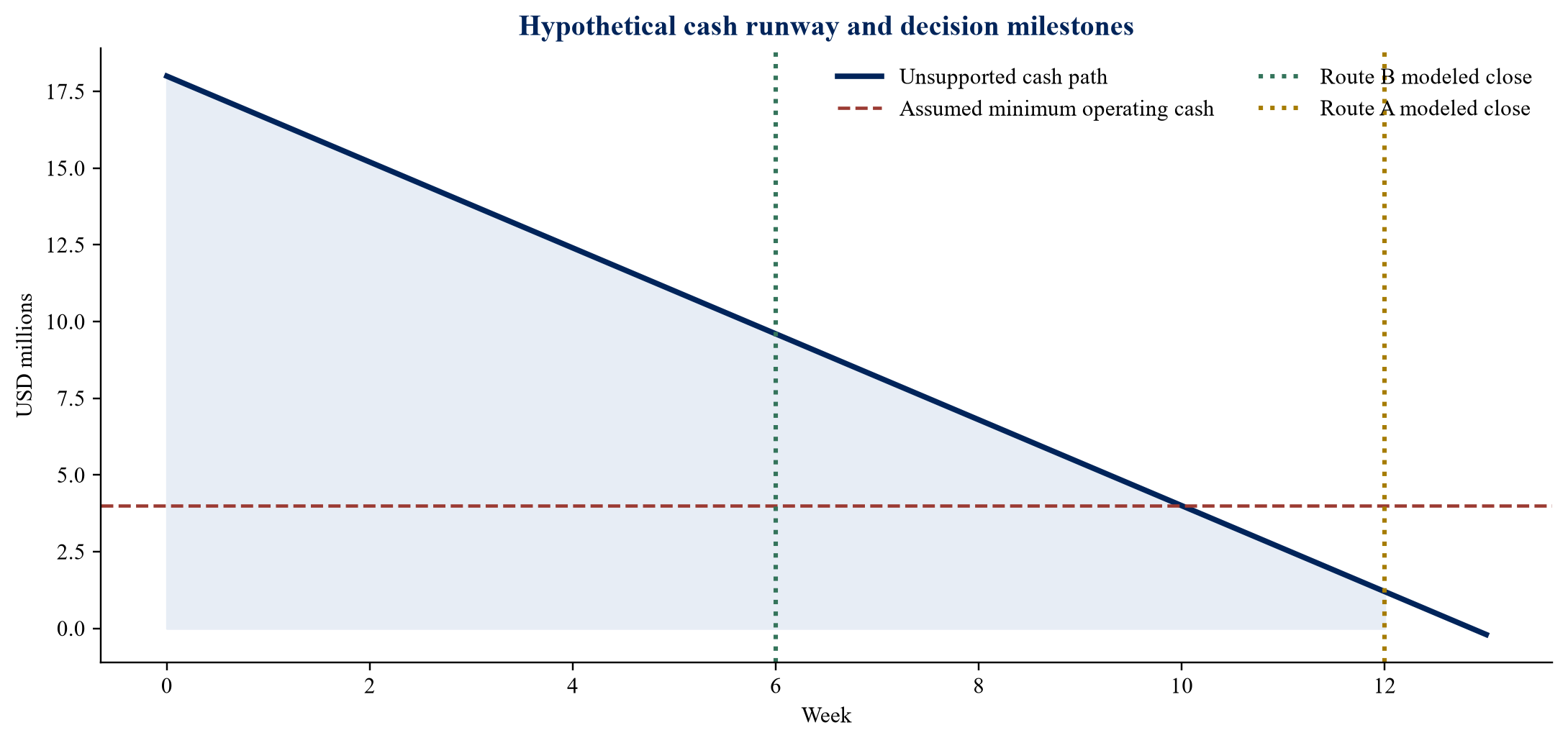
Author assumptions. The chart illustrates timing discipline and does not determine solvency or a legal deadline.
22. Score evidence quality, not confidence
The illustrative decision score uses six dimensions: authority and duties, liquidity evidence, market testing, bid certainty, value and recovery analysis, and conflicts and governance. Each is scored from one to five against defined documentary criteria. Route B scores higher because its timetable, funding and diligence evidence are assumed to be more complete.
A score of five for bid certainty could require executed financing commitments, completed confirmatory diligence, agreed documents, identified consents and a credible closing plan. A score of one could mean an indicative offer with unresolved financing and broad conditions. The score should link to evidence and action.
Weights must reflect the transaction and be approved before final ranking. The scorecard supports deliberation and gap closure. It cannot replace directors' judgment or legal advice.
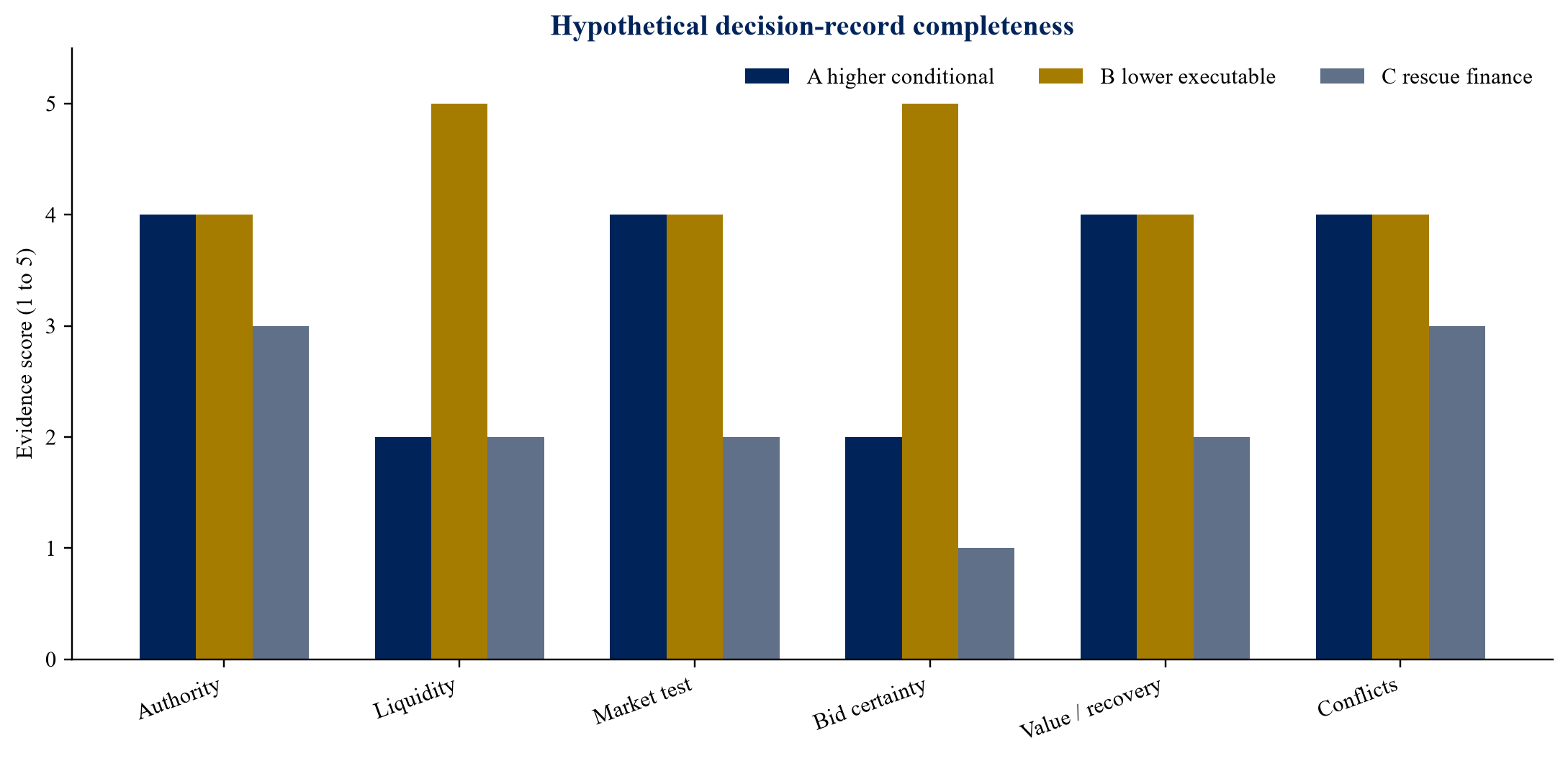
Scores and weights are author assumptions designed to demonstrate transparent comparison.
23. Use a risk-control matrix
The dossier should convert failure modes into observable indicators and controls. A stale cash forecast, unsigned financing letter, unexplained bidder exclusion, unresolved conflict, inconsistent valuation, missing creditor waterfall or unminuted decision should trigger action before approval.
Controls require evidence. A weekly cash review needs bank reconciliation and variance analysis. Proof of funds needs documents checked by authorised advisers. Market coverage needs a contact log. Conflict mitigation needs disclosure and governance records. A valuation bridge needs formulae and source data.
Table 4. Proposed distressed-sale decision risk-control matrix
| Failure mode | Early indicator | Control | Evidence at decision |
|---|---|---|---|
| Board acts on stale liquidity | Forecast misses actual cash or major payments | Weekly reconciliation and downside refresh | Bank evidence, variance log and signed forecast |
| Higher bid cannot close | Financing, diligence or approvals remain conditional | Bid-readiness gates and funded extension | Commitment letters and closing checklist |
| Market test is challenged | Potential buyers lack equal or documented access | Controlled outreach and data-room log | Buyer universe, contact record and bid instructions |
| Conflict distorts recommendation | Interested person controls access or analysis | Disclosure, recusal and independent committee | Conflict register and separate advice |
| Creditor outcome is obscured | Consolidated value hides entity transfers | Entity waterfall and security review | Source-linked recovery model |
| Rationale is reconstructed later | Minutes lack alternatives, challenge or reasons | Decision map and prompt approval | Dated pack, challenge log and approved minutes |
Controls should be tailored to current facts and applicable law.
24. Establish explicit stop and switch conditions
The board should approve the conditions that end or change a route. Examples include failure to provide binding financing by a date, inability to complete diligence, a price reduction beyond an approved threshold, expiry of liquidity support, loss of a critical customer, regulator feedback, a covenant breach or the cash forecast reaching the minimum operating level.
Each trigger needs a predetermined response and authority. The response may be to reopen the process, activate a reserve bidder, obtain bridge funding, narrow the perimeter, appoint an insolvency practitioner or commence a formal process. Management should not wait for another full board cycle when the approved trigger occurs.
Stop conditions counter sunk-cost bias. They also make exclusivity conditional on performance rather than elapsed time.
25. Control exclusivity and bidder optionality
Exclusivity can help a bidder finish diligence and documents. In distress it can also consume the seller's remaining runway. The board should connect exclusivity to milestones such as proof of funds, diligence completion, document turns, regulatory analysis and price confirmation.
The agreement should preserve appropriate rights to respond to superior or more executable alternatives, subject to law and negotiated terms. Break fees, information rights and standstill arrangements require advice. A reserve bidder can be kept warm through controlled updates where permitted.
The minutes should explain why exclusivity length and protections were proportionate to the value and evidence offered. Extension should require new consideration, certainty or funding.
26. Build a defensible information process
All serious bidders should receive controlled, accurate information appropriate to the process. The data room should preserve version history, access logs, questions, responses and corrections. Material new information should reach relevant bidders consistently unless lawful process design justifies a difference.
Management forecasts require reconciled assumptions and clear status. Customer concentration, litigation, tax, pensions, cyber incidents, regulation, cash and liabilities should be disclosed through an approved process. Misleading or selectively optimistic information can damage value and create later claims.
The board should receive a data-quality report identifying missing, stale or disputed items. The decision can then price or condition those uncertainties rather than ignoring them.
27. Account for connected transactions and value transfer
A connected bidder, shareholder-led rescue or management buyout requires a more rigorous record. The board should identify relationships, funding sources, management incentives, information advantages, prior negotiations and any value transferred through leases, services, intellectual property or retained liabilities.
Independent valuation, open market testing, a separate committee and independent advice may be appropriate. The 2021 UK connected-person disposal regime provides a specific statutory control for qualifying administration disposals [8][9]. Other routes and jurisdictions have different rules.
The decision should compare the connected offer with actual alternatives and the relevant counterfactual. A board should avoid relying on familiarity or speed without documenting why those factors preserve value.
28. Prepare the record for a future reviewer
A future reviewer may be an administrator, liquidator, regulator, court, creditor, shareholder, auditor or insurer. The dossier should be understandable without oral explanation. It should contain a chronology, decision index, entity map, adviser map, evidence ledger and clear links between reasons and documents.
The review standard will depend on law and claim. The board should focus on accuracy, completeness and contemporaneity rather than writing advocacy. Unsupported certainty weakens credibility. A transparent record of uncertainty, reasonable inquiry and conditional decisions is more useful.
Retention controls should preserve emails, messages, virtual data-room logs, model versions and meeting materials in accordance with legal holds, privilege, data-protection duties and company policy. Deletion settings should be reviewed promptly when distress becomes material.
29. Use technology and AI within evidence controls
Authorised systems can extract bid terms, compare document versions, reconcile cash data, classify contracts, build chronologies, identify missing approvals and link minutes to source documents. Natural-language tools can help search large data rooms and prepare first drafts.
The governance design should preserve access controls, privilege, confidentiality, source provenance, model version, human review and an audit trail. Automated summaries can omit qualifications or confuse a proposal with a commitment. Legal conclusions, solvency judgments, valuation inputs and board reasons require accountable validation.
The system should never fabricate a missing record or rewrite an earlier pack without showing the change. A generated summary must cite the underlying evidence and carry the correct knowledge date.
30. Implement the dossier in ten business days
Days one and two establish entity authority, duties advice, cash control and the decision statement. Days three and four build the evidence ledger, alternatives register and buyer universe. Days five and six reconcile bids, value, recovery and stakeholder impacts. Days seven and eight close conflicts, adviser gaps and the challenge log. Days nine and ten approve route, stop conditions, delegations and record-retention controls.
Table 5. Proposed ten-business-day decision-record roadmap
| Period | Core action | Required output | Board gate |
|---|---|---|---|
| Days 1 to 2 | Confirm authority, duties, liquidity and decision | Entity map, advice scope and cash baseline | Approve decision standard |
| Days 3 to 4 | Inventory evidence, alternatives and market | Evidence ledger, route register and buyer universe | Confirm process breadth |
| Days 5 to 6 | Reconcile bids, value and recoveries | Bid bridge, leakage model and entity waterfalls | Set executable-value thresholds |
| Days 7 to 8 | Resolve conflicts, advice and challenge | Conflict register, adviser map and challenge log | Confirm independent process |
| Days 9 to 10 | Select route and preserve implementation record | Minutes, stop conditions, delegations and archive | Approve transaction or contingency |
Live transaction timing and legal requirements may require faster or additional work.
31. Limitations and conclusion
This paper is a general transaction and governance framework. It is not legal, insolvency, regulatory, tax, accounting, pensions, employment, financing, valuation, data-protection or investment advice. Directors should obtain advice for each relevant entity and jurisdiction. Law, guidance and facts can change.
The hypothetical model uses author assumptions without empirical calibration. It excludes many possible claims, taxes, funding terms, stakeholder reactions and process outcomes. No number predicts value, timing, solvency, completion or recovery.
A defensible distressed-sale decision begins with authority, duties and current liquidity. The board should define the decision, preserve the information set, compare executable alternatives, reconcile bids to recoveries, control conflicts, challenge assumptions and approve explicit stop conditions. A contemporaneous, source-linked dossier allows the company to act at speed while showing why the chosen route was rational on the evidence available.
References
- UK Parliament. Companies Act 2006, sections 171 to 177 and section 172(3). Current consolidated text; accessed 6 September 2026. https://www.legislation.gov.uk/ukpga/2006/46/contents
- UK Parliament. Companies Act 2006, section 174: duty to exercise reasonable care, skill and diligence. Current consolidated text; accessed 6 September 2026. https://www.legislation.gov.uk/ukpga/2006/46/section/174
- UK Parliament. Insolvency Act 1986, section 214: wrongful trading. Current consolidated text; accessed 6 September 2026. https://www.legislation.gov.uk/ukpga/1986/45/section/214
- UK Supreme Court. BTI 2014 LLC v Sequana SA and others [2022] UKSC 25. Judgment delivered 5 October 2022; accessed 6 September 2026. https://www.supremecourt.uk/cases/uksc-2019-0046
- The Insolvency Service. Director information hub: General duties. Updated 9 June 2026; accessed 6 September 2026. https://www.gov.uk/guidance/director-information-hub-general-duties
- United Nations Commission on International Trade Law. Legislative Guide on Insolvency Law, Part Four: Directors' obligations in the period approaching insolvency. Accessed 6 September 2026. https://uncitral.un.org/en/texts/insolvency/legislativeguides/insolvency_law
- UK Government. Corporate Financial Distress Guidance Note. Updated 15 June 2026; accessed 6 September 2026. https://www.gov.uk/government/publications/the-sourcing-and-consultancy-playbooks/corporate-financial-distress-guidance-note-html
- UK Parliament. The Administration (Restrictions on Disposal etc. to Connected Persons) Regulations 2021. Accessed 6 September 2026. https://www.legislation.gov.uk/uksi/2021/427/contents/made
- The Insolvency Service. Requirements for independent scrutiny of the disposal of assets in administration, including pre-pack sales. Accessed 6 September 2026. https://www.gov.uk/government/publications/requirements-for-independent-scrutiny-of-the-disposal-of-assets-in-administration-including-pre-pack-sales/requirements-for-independent-scrutiny-of-the-disposal-of-assets-in-administration-including-pre-pack-sales
- The Insolvency Service. Company health check: keeping your business on track. Updated 1 April 2022; accessed 6 September 2026. https://www.gov.uk/guidance/company-health-check-keeping-your-business-on-track
- The Insolvency Service. Insolvent Company Investigations: what we do. Accessed 6 September 2026. https://www.gov.uk/government/publications/insolvent-company-investigations/insolvent-company-investigations-what-we-do
- UK Government. Corporate Insolvency and Governance Act 2020. Accessed 6 September 2026. https://www.legislation.gov.uk/ukpga/2020/12/contents
- Organisation for Economic Co-operation and Development. G20/OECD Principles of Corporate Governance 2023. Accessed 6 September 2026. https://doi.org/10.1787/ed750b30-en
- World Bank. Principles for Effective Insolvency and Creditor/Debtor Regimes. 2021 edition; accessed 6 September 2026. https://openknowledge.worldbank.org/handle/10986/35506
- The Insolvency Service. Pre-pack sales in administration report. Published 8 October 2020; accessed 6 September 2026. https://www.gov.uk/government/publications/pre-pack-sales-in-administration/pre-pack-sales-in-administration-report
- UK Parliament. Company Directors Disqualification Act 1986. Current consolidated text; accessed 6 September 2026. https://www.legislation.gov.uk/ukpga/1986/46/contents
